Review

Plasma-Assisted Combustion Technology in Ammonia Combustion: Research and Applications

1
School of Energy and Environment, Anhui University of Technology, Ma’anshan 243002, China
2
School of Mechanical and Electrical Engineering, Chuzhou University, Chuzhou 239000, China
*
Authors to whom correspondence should be addressed.
Processes 2026, 14(3), 458; https://doi.org/10.3390/pr14030458
Submission received: 28 December 2025 / Revised: 21 January 2026 / Accepted: 26 January 2026 / Published: 28 January 2026

Abstract

Achieving a green transition in the energy structure and reducing reliance on traditional fossil fuels has become a global imperative for addressing climate change and promoting sustainable development. The search for clean energy alternatives to traditional fossil fuels has emerged as a critical challenge in the energy and power sector. Ammonia (NH3) shows great potential as a zero-carbon fuel in the energy sector, but issues such as its low flame propagation speed, high ignition energy requirements, and elevated NOx emissions limit its widespread industrial application. To address these issues and enhance ammonia combustion, plasma-assisted combustion technology has gained widespread attention in recent years as an effective solution. The plasma-assisted technology enhances combustion stability and efficiency of ammonia, and effectively suppresses NOx emissions. Additionally, the high-energy electrons and intense chemical reactions in plasma help to decompose and crack ammonia fuel, increase flame propagation speed, and thus improve ammonia combustion performance. This paper provides a comprehensive review of the latest research advancements in plasma-assisted technology in ammonia combustion. It covers the fundamental principles of plasma generation, the mechanisms of combustion enhancement, industrial application status, and development trends. The aim is to assess the potential of plasma-assisted combustion technology in achieving efficient, stable, and low-carbon ammonia combustion, and to explore its future prospects for industrial application.

1. Introduction

Given the urgent issue of rising global carbon emissions, nations are formulating and implementing multiple policies aimed at effectively curbing this trend. To achieve its 2050 ‘carbon neutrality’ goal, the European Union first signed the European Green Deal [1], followed by the release of the ‘Fit for 55’ package [2], and subsequently, the formal approval of regulations related to the EU Emissions Trading System (EU ETS) [3]. Through the series of measures, the EU has demonstrated its commitment and leadership in addressing climate change and advancing global carbon reduction efforts. China has also taken significant measures to address the challenging issue of rising carbon emissions. These include the establishment of a national carbon market, covering industries such as power generation, steel, cement, and aluminum smelting; the implementation of energy-saving and carbon-reduction actions across different industries; and the vigorous development of non-fossil energy sources [4,5]. Through these key initiatives, China aims to achieve its ‘carbon peak and carbon neutrality’ targets and drive the transformation of society toward a green, low-carbon future. At the United Nations Climate Change Summit in September 2025, China announced its goal to achieve a non-fossil energy consumption share of over 30% by 2035 [6,7]. For this, exploring and developing a diverse range of clean energy technologies has become a key pathway.
Ammonia (NH3) shows significant potential as a low-carbon energy source [8,9,10,11], owing to its clean combustion characteristics, where the primary products of complete combustion are nitrogen and water. Nevertheless, ammonia combustion also presents challenges, including high ignition energy, which makes ignition difficult, and poor combustion stability. Additionally, ammonia has an extremely low laminar burning velocity (LBV), less than 7 cm/s at room temperature and pressure [12], significantly lower than that of gasoline and hydrogen. This results in a slower flame propagation rate and lower combustion efficiency. Studies have shown that ammonia has a high auto-ignition temperature of 650 °C [13] and a narrow flammability limit ranging from 15% to 28% [14], making stable combustion challenging in conventional burners. In addition, ammonia combustion can result in the more difficult issue of nitrogen oxide (NOx) emissions [15]. Despite ammonia being carbon-free, the nitrogen atoms in it react with oxygen during combustion at high temperatures, forming NOx, including NO and NO2. As is well known, this directly contributes to the formation of photochemical smog and acid rain [16].
To address the above issues and improve ammonia combustion efficiency, current research mainly focuses on fuel composition optimization [17,18,19], catalytic combustion [20,21,22], and auxiliary combustion technologies [23,24]. Studies have found [25,26,27,28] that blending hydrogen (H2), methane (CH4), and carbon monoxide (CO) with pure ammonia can accelerate its combustion, with hydrogen having a more significant effect. The measured LBV of the NH3/H2 mixture reaches 28.5 cm/s at an equivalence ratio of 1.05 and an H2 blending ratio of 0.4 [22]. This is higher compared to the 16.5 cm/s and 20 cm/s measured under the same conditions for NH3/CH4 and NH3/CO mixtures [27]. Additionally, blending hydrogen effectively widens the flammability limit of ammonia. Experiments also showed that increasing the initial temperature and hydrogen ratio reduced the lower flammability limit of NH3/H2 mixture [28,29]. Specifically, the lower flammability limit of NH3/H2 mixture decreased from 6.35% at 20 °C to 5.75% at 100 °C under 100 kPa and 50% H2 conditions. Meanwhile, it decreased from 11.5% to 5.75% as the H2 content increased from 10% to 90% at 100 kPa and 20 °C conditions.
To lower the ignition temperature of ammonia, Hinokuma et al. [30,31] developed a catalytic combustion system where the catalysts played a key role in enhancing ammonia combustion efficiency. They found that manganese-based oxides exhibited excellent catalytic effects, with MnO2 showing the highest activity [30], followed by Co3O4, CuO, Fe2O3, V2O5, and NiO in descending order of catalytic activity [31]. Building on this, Zhou et al. [21] synthesized a series of novel catalysts, including MnOx, CuOx, FeOx, and CuOx@SiO2, using the flame spray pyrolysis (FSP) method. Comparative analysis revealed that CuOx and CuOx@SiO2 outperform MnOx and FeOx in both catalytic activity and N2 selectivity. Although ammonia co-combustion and ammonia catalytic combustion technologies offer certain advantages, they are still limited by several factors. For co-combustion, safety concerns related to hydrogen storage and transportation cannot be overlooked [32]. Additionally, blending CO or hydrocarbon fuels may result in greenhouse gas emissions [24]. In ammonia catalytic combustion, the main challenges are the selection of catalysts, as well as the cost and long-term stability of catalysts [33,34].
Plasma-assisted combustion (PAC) [24,35,36,37] offers a promising solution for stable ammonia combustion, enabling it to operate effectively under a broader range of conditions. Plasma is a high-energy-density substance composed of numerous free electrons, ions, neutral particles, and photons. These high-energy particles excite and decompose ammonia molecules through particle collisions and ionization, thereby enhancing ammonia combustion and further lowering its ignition temperature. As a result, ammonia combustion can initiate at lower temperatures, significantly increasing the reaction rate and combustion completeness [38,39]. Furthermore, plasma technology holds the potential to modulate chemical reaction pathways and product distributions. By optimizing reaction conditions such as the reduced electric field (E/N), equivalence ratio, pressure, pulse frequency, and energy density, the generation of harmful emissions like NOx can be effectively reduced [39,40,41,42]. For instance, experiments by Choe et al. [39] demonstrated that ammonia/air combustion without plasma produced approximately 2645 ppm NOx at φ = 0.94, while with plasma assistance, NOx emissions were significantly lowered. Specifically, at a discharge power of 59 W, NOx emissions could be reduced to below 2000 ppm. However, it should be noted that precise control of reaction conditions is essential to achieve NOx reduction; otherwise, it may lead to an undesirable increase in NOx emissions. It was found that increasing the pulse energy density considerably raises the NO production rate in pulsed discharge plasma [42]. Similarly, under plasma discharge conditions, NO formation is higher under lean mixtures than under stoichiometric or rich mixtures [40].
For a general understanding of plasma-assisted combustion technology in ammonia combustion, this paper provides a systematic review of the latest research, highlighting the role of plasma in enhancing flame stability, combustion rate, and NOx emission reduction, as well as in promoting fuel cracking. Furthermore, the mechanisms of plasma-enhanced ammonia combustion are discussed to reveal the complex interactions between plasma and ammonia. Finally, the prospects of plasma-assisted combustion technology in industry are discussed, with a focus on its application in internal combustion engines (ICEs) and industrial boilers, highlighting its effectiveness and potential in improving combustion efficiency and reducing pollutant emissions. Through a comprehensive review of plasma technology in ammonia combustion, this paper aims to provide researchers with a multidimensional reference for a better understanding of the fundamental theory, current applications, and future developments of plasma-assisted ammonia combustion.

2. Generation and Characteristics of Plasma

Plasma, composed of highly ionized gases such as ions, electrons, and neutral particles, is considered the fourth state of matter [36,37,43]. It exists in the highest energy state compared to solids, liquids, and gases, due to continuous and substantial energy input. Such external energy input excites the outer electrons of molecules/atoms in the gas, allowing them to overcome the constraints of the atomic nucleus and escape as free electrons, while the remaining part becomes positively charged ions. This process results in the formation of a collection of charged particles, often referred to as ionization. In plasma, charged particles, especially free electrons, possess extremely high kinetic energy, resulting in a high electron temperature. This, in turn, contributes to an elevated thermodynamic temperature of plasma, leading to a higher energy density [36].
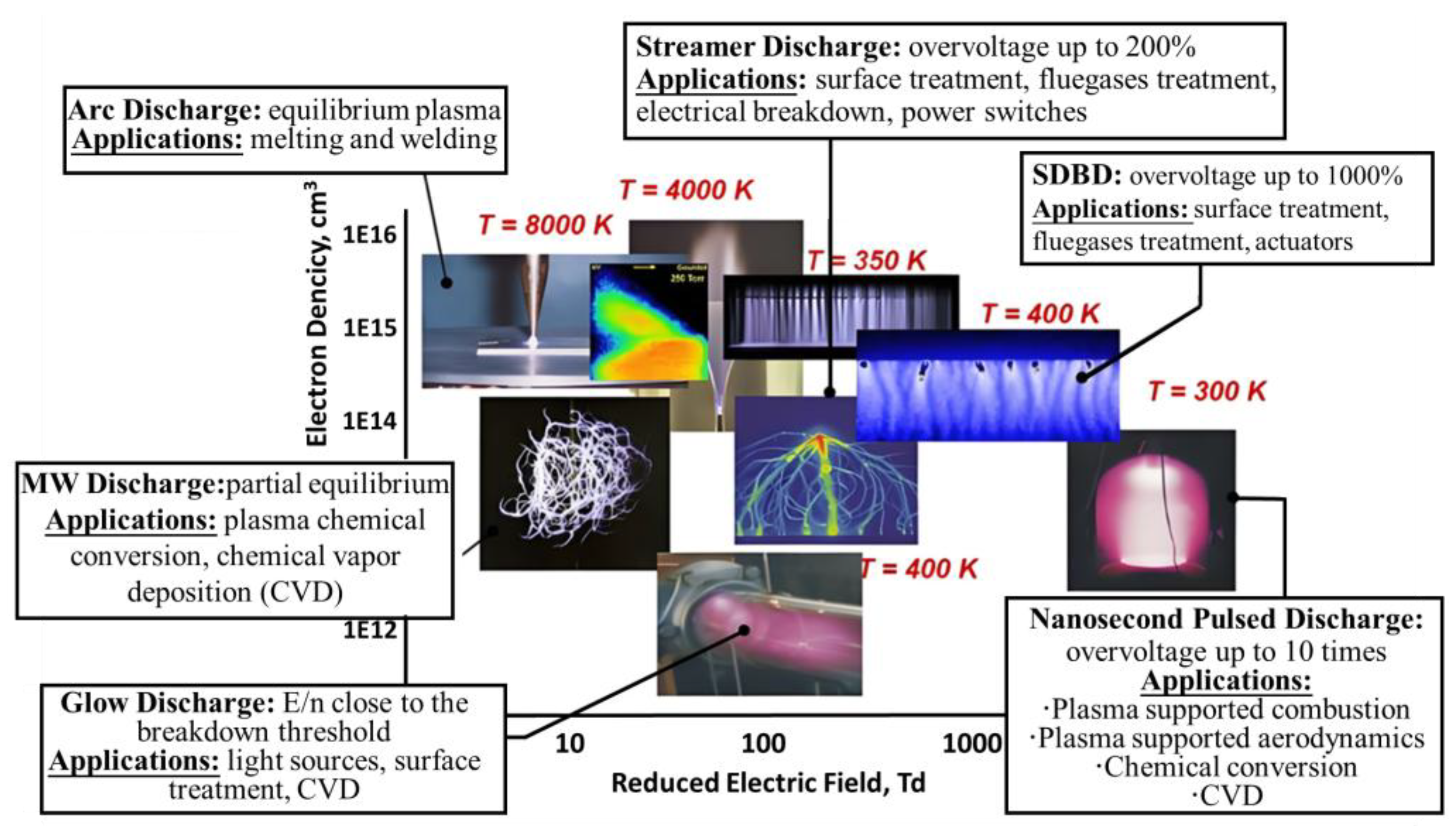
Plasma can be classified into thermal and non-thermal plasma based on its temperature and energy levels. The temperature of thermal plasmas can reach several thousand Kelvin (e.g., arc plasmas) or even several million Kelvin (e.g., the solar corona). They are typically used in arc welding, plasma cutting, and plasma spraying. In non-thermal plasmas, although the electron temperature reaches 104–105 K (1–10 eV), the ion temperature and neutral particle temperature are typically much lower, around 300 K. Therefore, despite the high electron temperature, the overall plasma temperature is maintained at approximately 300–500 K, as the temperature of ions and neutral particles dominates (Figure 1). The low-temperature of non-thermal plasmas enable their widespread applications, such as industrial manufacturing and materials processing, energy and chemical industries, environmental management, and biomedicine [44,45,46,47,48]. It is worth noting that non-thermal plasmas have shown remarkable benefits in combustion assistance and enhancement, mainly reflected in promoting ignition, extending the extinction limit, and improving combustion efficiency and stability [39,49,50,51].
Non-thermal plasma (hereafter referred to as plasma) can be generated in various forms [43,52,53,54,55], with commonly used techniques including gliding arc discharge [38,50,51,56,57,58], nanosecond pulsed discharge [39,40,42,59,60], dielectric barrier discharge [49,61], and microwave discharge [62,63]. Gliding arc discharge (GAD) is a self-sustained discharge in which the arc slides along the electrode driven by airflow. The GAD plasma exhibits characteristics of both thermal and non-thermal plasmas, providing relatively high energy efficiency. Nanosecond pulsed discharge (NPD) generates high power density plasma through nanosecond-duration high-voltage pulses. This plasma is characterized by high electron energy and weak gas heating effects, which aids in the generation of active species at lower temperatures, thereby facilitating chemical reactions. Dielectric barrier discharge (DBD) generates diffuse non-equilibrium plasma by inserting an insulating material between two electrodes. This method is particularly well-suited for large-scale reactors. In microwave discharge (MWD), plasma is generated through electromagnetic wave energy. It provides high power density plasma and avoids electrode contamination issues, although the system is relatively complex. Figure 1 depicts the form and characteristic parameters of different plasmas, while Table 1 compares the discharge characteristics for the four types of plasma.
Figure 1. The form and characteristic parameters of different plasmas [64].
Processes 14 00458 g001
Table 1. Comparisons of common plasma technologies.
Discharge TypeGliding Arc Discharge [52]Nanosecond Pulse Discharge [65]Dielectric Barrier Discharge [49]Microwave Discharge [63]
Key of plasma generationThe airflow blows the arc to extend, elongate, extinguish, and reignite between the electrodes.A nanosecond high-voltage pulse is applied and terminated before the relaxation of high-energy electrons.The dielectric barrier discharge transitions to an arc, forming a large number of filiform micro-discharges.The electric field in microwave accelerates electron collisions, transferring energy to the gas molecules.
Power supplyHigh-frequency alternating current (AC) or pulsed direct current (DC)Nanosecond-duration pulseAC high voltageMicrowave source
Electrode structureTwo or three-dimensional wedge-shaped. Scissor- shaped bare metal electrodes.Multiple forms (needle plate, rod, etc.). Electrodes are usually exposed.At least one electrode is covered with an insulating medium.Typically, without internal electrodes, energy is coupled into the resonant cavity via waveguides or antennas.
Plasma morphologyNon-equilibrium and dynamically changing arc columns move with the airflow.Uniform or filamentousComposed of a large number of micro discharge wires, or uniform glow.Spherical or ellipsoidal flame shape
Electronic temperature0.5–2 eV5–30 eV1–5 eV1–5 eV
Gas temperature3000–10,000 K300–600 K300–500 K300–6000 K
Power densityMedium to highHighLow to mediumHigh
Energy efficiencyMedium to highHighMediumMedium
MechanismThermal and kinetic effectsKinetic effectsKinetic effectsThermal and kinetic effects
Key Limitationsairflow-sensitive arc stability, and electrode erosion/short service life [66,67]strong electromagnetic interference and a complex high-voltage nanosecond pulse power supply [68]Relatively low energy efficiency and low production of active particles [43]Selective for fuels/media, with bulky and complex equipment [37]
ApplicationWaste gas treatment, hydrogen production through reforming, material surface treatment.Flow control (plasma assisted combustion, drag reduction), precision material processing, biomedical, ozone generation.Ozone generator, material surface modification (coating, grafting), polymer treatment, medical disinfection.Chemical vapor deposition, diamond film preparation, waste treatment, spectral analysis.

3. The Key Role of Plasma in Ammonia Combustion

3.1. Flame Stability and Combustion Rate

Ammonia has a relatively low laminar combustion velocity (lower than 7 cm/s at room temperature and pressure [12]), making it more susceptible to stretching or being blown out by the flow field, ultimately leading to local flame extinction. Furthermore, ammonia has a higher ignition temperature (650 °C) and ignition energy (8.0 MJ) [69], along with a narrower flammability limit (15–28% [14]), which further exacerbates the instability of ammonia flames, leading to local or complete flame extinction. These issues may be mitigated by supplying additional energy to the ammonia combustion. As a substance with high energy density, plasma can provide strong energy support to the combustion process due to its high-energy state. It is rich in neutral molecules, ions, free electrons, and other excited species, which facilitate the decomposition and oxidation of fuel, thereby improving combustion efficiency [58,70]. Thus, plasma-assisted combustion technology is regarded as a key method for improving the combustion characteristics of ammonia.
To verify the feasibility of plasma-enhanced ammonia combustion performance, relevant studies have already been conducted. Ju et al. [51] investigated the effect of three-dimensional rotating sliding arc discharge on the stability of ammonia swirl flame. The study found that plasma from the arc discharge improved flame stability and extended the blow-off limit—by 25% at low flow velocities and 4% at high flow velocities. Moreover, the ammonia combustion flame hysteresis phenomenon disappeared at higher gas flow rates, and the flame stabilized at the burner exit bluff body. In contrast, the flame base detached from the bluff body at low flow rates due to fluid dynamic instability and the electric field. Lin et al. [41] utilized GAD plasma to assist ammonia combustion, employing a setup that combined the gliding arc plasma reactor with a swirl burner. The results showed that the GAD plasma in air significantly expanded the combustion limits of ammonia flames and increased the laminar combustion velocity of ammonia. It can be found that the ammonia combustion limits expand from 1.19 to 2.14 (without plasma-assisted combustion) to 0–3.57 at an air flow rate of 30 L/min. Based on spectroscopic diagnostics, it can be inferred that the GAD plasma jet generated in air contained a large number of active species such as OH*, O*, NH*, and Hα, which enhanced ammonia combustion. In contrast, the GAD plasma generated in ammonia induced its decomposition.
Studies have confirmed the effectiveness of GAD plasma in enhancing ammonia combustion. One might naturally wonder whether NPD plasma and DBD plasma also contributes to enhancing ammonia combustion. Hu et al. [71] developed a DBD spark plug for engines and employed a bipolar nanosecond-duration pulsed power supply to address the ignition difficulty of ammonia. As shown in Figure 2, this setup combined the characteristics of both NPD and DBD. Choe et al. [39] employed NPD plasma to assist ammonia combustion. Their study found that the NPD plasma extends the lean blowout (LBO) limit. Under conditions of a plasma discharge voltage of 15 kV, a frequency of 4 kHz, a power of 39 W, and an air flow rate of 30 L/min, the LBO was extended from 0.73 to 0.43. This trend aligns with the findings of Ju et al. [50,51], indicating that NPD plasma shows similar effects to GAD plasma in enhancing ammonia combustion. Subsequently, Choe et al. [72] employed NH2* chemiluminescence and OH Plane Laser Induced Fluorescence (OH PLIF) to analyze the effect of NPD plasma on ammonia combustion in a gas turbine combustion chamber. The results showed that NPD plasma could enhance the stability of NH3/air premixed flames and extend the attachment state of the flame to lower equivalence ratios. As the equivalence ratio decreased to 0.48, the intense flame disappeared, but OH PLIF signals could still be detected near the discharge region. It indicates that OH radicals, which helped stabilize the flame, generated from plasma. In contrast, under conditions without plasma assistance, the flame stability significantly decreased once the equivalence ratio dropped below 0.57.
Chen et al. [49] developed an experimental system for NH3/air premixed swirling combustion assisted by DBD. The findings revealed that application of DBD significantly improved ammonia combustion performance, prevented wall quenching, and expanded the combustion limit of ammonia from 0.75–1.2 to 0.65–1.3. Hu et al. [71] obtained a plasma by surface dielectric barrier discharge (nSDBD) with a nanosecond pulse power supply. The impact of this plasma on the ignition and combustion characteristics of NH3/air mixtures at high ambient pressures (1–20 bar) was then examined. The results demonstrated that nSDBD had no significant effect on flame propagation speed at an equivalence ratio of 0.9 and ambient pressures ranging from 1 to 10 bar. In contrast, the flame propagation speed doubled when the pressure was raised to 15 bar. At 20 bar, it saw a significant increase of 1.5 times. This improvement was mainly due to the ability of nSDBD to generate more active particles, which facilitate the formation of additional flame nuclei, thereby overcoming the ignition challenges of NH3.
Wang et al. [73] applied computational fluid dynamics (CFD) to simulate the combustion characteristics of ammonia with and without plasma assistance. Comparative simulation results indicated that the lean combustion limit of NH3/air premixed mixtures decreased from 0.82 without plasma to 0.78 with plasma. Additionally, plasma was found to enhance the local flame propagation speed, although combustion efficiency decreased as the equivalence ratio decreased.

3.2. NOx Emission

In addition to the combustion challenges that hinder the industrial application of ammonia as a clean fuel, NOx emissions also represent a major limiting factor. The two main challenges regarding NOx emissions from ammonia combustion are as follows: first, ammonia can be converted into fuel-type NOx at high temperatures; second, temperature fluctuations caused by combustion instability can significantly exacerbate this emission [74]. Surprisingly, plasma-assisted combustion technology not only enhances the stability of ammonia combustion but also plays a key role in reducing its NOx emissions [13,39,49]. The key to NOx reduction lies in the alteration of the chemical reaction pathways of nitrogen by the high-energy electrons and active species in the plasma. Choe et al. [39] demonstrated that plasma-assisted ammonia combustion reduced NOx emissions and extended the lean blow-off limit of ammonia flames. This finding contrasts with studies on plasma-enhanced hydrocarbon combustion, where plasma promotes NOx emissions. In addition, as discharge power and voltage increased, NOx emissions were further reduced, indicating a greater reduction in NO. This may be related to the NH2· active species produced by plasma ionization of ammonia [72], with the main NOx reduction process outlined as follows.
NO + NH2· → NNH· + OH·
NO + NH2· → N2 + H2O
NO + HO2· → OH· + NO2
NO2 + HO2· → HONO· + O2
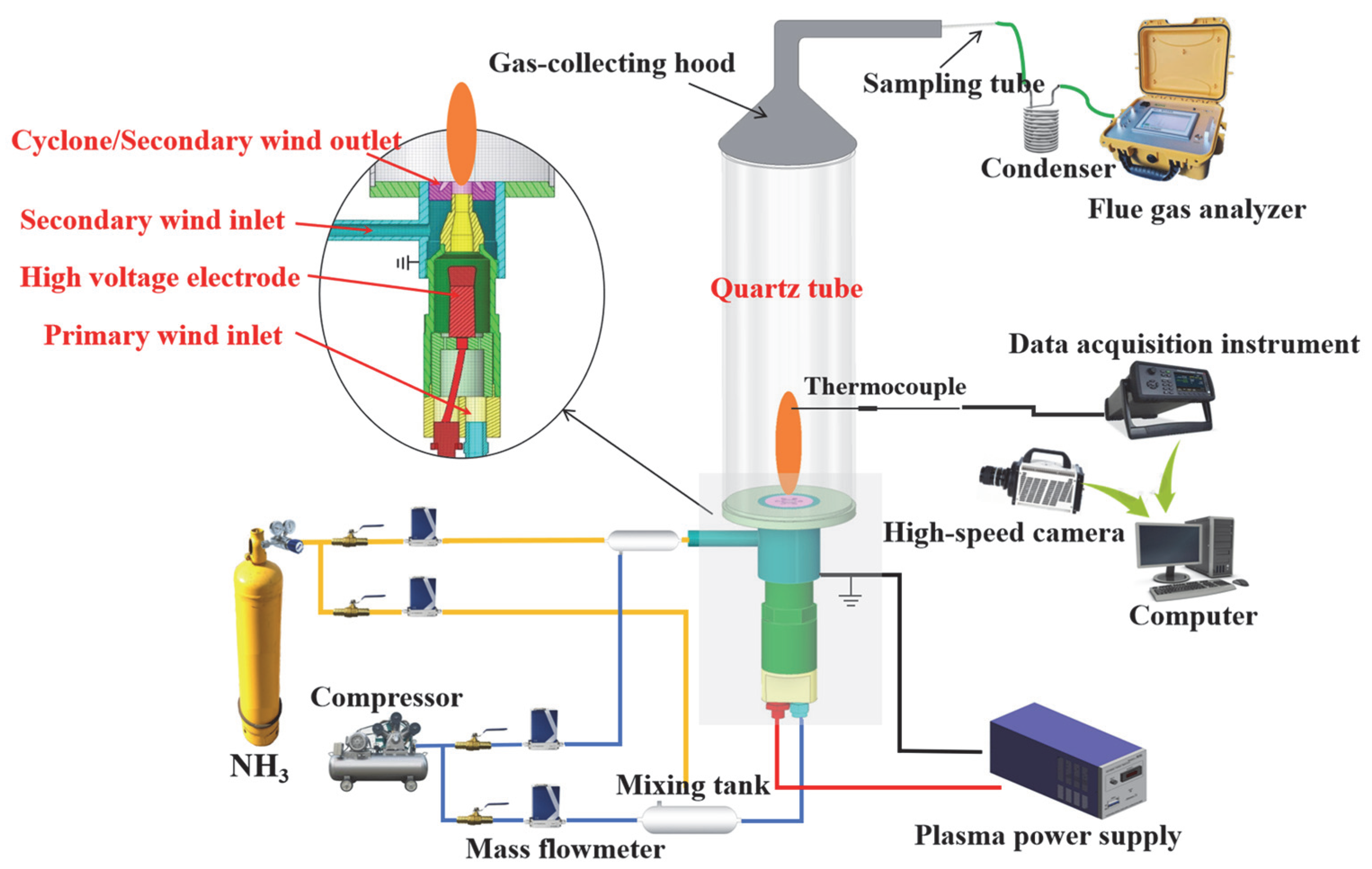
In previous work [13], our group developed an experimental setup for plasma-assisted ammonia combustion using gliding arc, as shown in Figure 3. The flame characteristics and NO emission patterns of NH3/air premixed combustion assisted by the GAD plasma were then systematically analyzed. The results indicated a significant effect of equivalence ratio on NO emissions, showing that the NO concentration initially increased and then decreased, and peaked at 769.22 ppm at an equivalence ratio of 0.8. Furthermore, the characteristics of air-staged combustion and ammonia-staged based on plasma-assisted combustion were investigated. Experimental results demonstrated that both staged combustion methods effectively reduce NOx emissions.
Chen et al. [49] investigated O2 and NOx emissions in DBD plasma-assisted ammonia combustion and explored the mechanisms of NOx formation. The results further confirmed the significant impact of the equivalence ratio on NOx emissions. Notably, within an equivalence ratio range of 0.75–1.05, NOx emissions decreased by 40–45%, representing the optimal reduction condition. Furthermore, analysis indicated that the NOx generated from ammonia combustion was primarily fuel-type NOx, with the reaction process shown in Equation (5). Further analysis indicated that the abundant reactive intermediates of NHi· (NH· and NH2· radicals) generated during the DBD process effectively reduced nitrogen oxide emissions through reaction pathways such as NO + NHi· → N2, NHi· + NHi· → N2H2· → NNH· → N2.
4NH3 + 5O2 → 6H2O + 4NO

3.3. Fuel Cracking and Activation

The high energy of the N–H bond in ammonia is the main reason for its high molecular stability [75,76], making it difficult to decompose and ignite. In conventional combustion, complete decomposition of ammonia typically requires high temperatures around 800–1000 °C [77,78]. In a plasma environment, however, high-energy particles transfer energy to ammonia through molecular collisions, enabling its cleavage at lower temperatures. This leads to the generation of active radicals and intermediates such as NH2·, NH·, N· and H·, which are crucial for enhancing ammonia combustion [63,79,80].
Li et al. [81] concluded from a synthesis of the literature that the plasma generated in mixed Ar/NH3 contained not only reactive ions such as NH+, NH2+, NH3+, and NH4+ ions, but also a variety of excited neutral species, including N2, H2, NH2·, NH·, N·, and H· radicals. This makes plasma exhibit unique properties and has led to its wide application in carbon nanotube synthesis, environmental protection, thin-film deposition, portable hydrogen generation, and other areas. Sekiguchi [63] conducted an experimental study on ammonia cracking using a rod-electrode microwave plasma source, without catalysts or diluents. The research focused on the influence of ammonia flow rate and the average transmitted power of the rod-electrode microwave plasma on the cracking efficiency of ammonia. The results showed that the ammonia cracking efficiency increased with decreasing ammonia flow rate and increasing average power, consistent with the findings of Zhang et al. [82]. Moreover, the ammonia cracking efficiency reached a maximum of approximately 84% with a corresponding hydrogen yield of around 90% under the optimal conditions of 0.2 L/min ammonia flow rate and 112 W average power.
It was found that the excited species (e.g., N2*, O(1D), N(2D)) and radicals in plasma attacked and dissociated ammonia molecules, producing highly active fragments, such as H· and NH2·. Acting as powerful initiators of chain reactions, these fragments significantly enhanced combustion reaction kinetics, thereby improving low-temperature ignition performance and shortening the ignition delay time [83]. From a microscopic perspective, the highly reactive fragments facilitate Equations (1), (6) and (7). This leads to the generation of a large amount of OH, which then accelerates NH3 oxidation through reaction (8), enhancing the reaction kinetics. However, reactions (9) and (10) coexist and inhibit the ignition process.
H· + O2 → O· + OH·
NH· + O2 → NO + OH·
NH3 + OH· → NH2· + H2O
NH· + NO → N2O + H·
NH2· + HO2· → NH3 + O2
Thus, plasma facilitates the decomposition of ammonia, thereby enhancing its ignition. In addition, it should be noted that plasma is more effective in enhancing ignition under fuel-lean conditions [83]. This can be attributed to the following reasons: the active O(1D) species and O radicals generate OH· active species through Equations (11)–(13), while the high concentration of NO also accelerates the formation of NNH· and OH·, further enhancing the ignition effect. When the ammonia concentration is high and oxygen is insufficient, the combustion process typically relies on auto-ignition, where the reaction is initiated by the self-generated heat of ammonia. In this case, the excitation effect of plasma may become redundant in the auto-ignition process, and it could even disrupt the ignition pathway by introducing excessive high-energy particles. This, in turn, alters the temperature-driven reaction mechanism, leading to instability or deviation from the normal auto-ignition process.
O(1D) + NH3 → NH2· + OH·
NH3 + O· → NH2· + OH·
NH2· + O· → NH· + OH·

3.4. Mechanisms of Plasma Enhancement

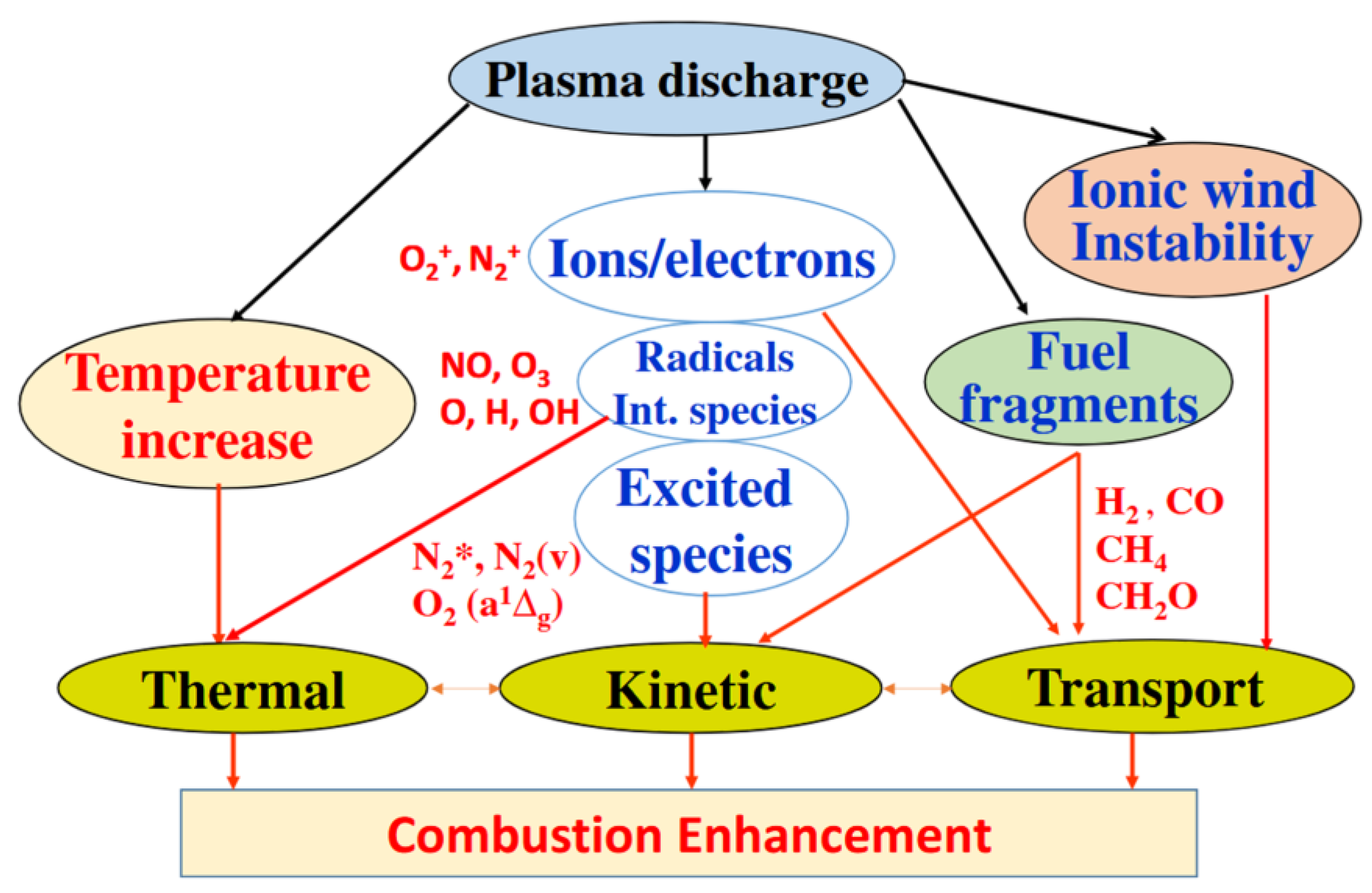
Previous studies [36,37,64,69,84,85] suggest that plasma-enhanced combustion is governed mainly by three mechanisms: thermal effects, kinetic effects, and enhanced transport effects, as illustrated in Figure 4. The thermal effect of non-thermal plasma primarily arises from two parallel and intertwined physical processes: Joule heating and particle relaxation [36,37,85,86]. When an external electric field is applied to the discharge region, the field does work on charged particles and free electrons. As a result, these particles are accelerated, gaining more kinetic energy. Subsequently, the energy transfer occurs along two pathways. One pathway involves electrons transferring a small portion of their energy to heavier particles through elastic collisions, increasing their translational kinetic energy and raising the gas temperature. This process can be considered as Joule heating.
In another pathway, electrons undergo frequent inelastic collisions with heavier particles, causing a significant portion of the energy to be deposited into non-equilibrium energy channels such as molecular vibration, electronic excitation, dissociation, and ionization. This results in the generation of a large number of excited molecules (e.g., N2(v), O(1D), O2(b1Σ+)) and free radicals (e.g., H·, O·, N·, OH·, HO2·, NH2·, NH·), as well as active ions (e.g., N2+, O2+, NH3+). Following this, the excitation energy is converted into translational energy through processes like vibrational–translational relaxation (e.g., V–T thermalization of N2(v)), quenching of excited particles (e.g., thermalization of O(1D) during quenching), and recombination of free radicals (e.g., H· + H·→H2, OH· + H·→H2O). This process manifests as an increase in gas temperature, but under non-thermal discharge conditions, the temperature of the electrons (Te) typically remains much higher than that of the gas (Tg), resulting in a relatively limited overall gas temperature increase. Thus, the entire heat conversion process can be summarized as Joule heating (direct thermalization) and relaxation heating (indirect thermalization).
For non-thermal plasma, its role in enhancing combustion is primarily driven by chemical kinetic effects [36], which manifest as the deep modulation of the reaction pathways. High-energy electrons in the plasma generate a large number of active species by dissociating, ionizing, and exciting ammonia, as well as oxygen and nitrogen in the air. The dissociation of NH3 generates NH2· radicals through hydrogen abstraction, as shown in reactions (14)–(16). Ionization and recombination of NH3 produce NH2·, NH·, N·, and H· radicals, as illustrated in reactions (17)–(19) [13,87]. Under excitation, electrons transition to higher energy levels, an unstable state, and when they return to the ground state, they emit photons and release energy, further activating surrounding reactants.
NH3 + OH· → NH2· + H2O
NH3 + O· → NH2· + OH·
NH3 + H· → NH2· + H2
NH3 + e →NH2· + H· + e
NH2· + e → NH· + H· + e
NH· + e →N· + H· + e
The enhanced transport effects can be divided into two components: diffusion transport enhancement and convective transport enhancement. Diffusion transport enhancement results from low-temperature oxidation and fuel decomposition, while convective transport enhancement is caused by ion wind generated by the plasma, fluid dynamic instabilities, and flow induced by Coulomb and Lorentz forces. During plasma-assisted ammonia combustion, non-equilibrium ionization near the flame front significantly increases the concentration of active particles (ranging from 100 to 1000 ppm), which promotes the development of the chemical chain ahead of the flame front and significantly accelerates flame propagation [64].

3.5. Experimental Diagnostic Methods for Plasma-Assisted Ammonia Combustion

In the study of plasma-assisted ammonia combustion, a synergistic application of multiple diagnostic techniques is typically employed to comprehensively characterize flame properties and chemical reactions. Visualization studies are conducted via high-speed photography and schlieren imaging; short-lived radicals and critical intermediates are probed using planar laser-induced fluorescence (PLIF), chemiluminescence, and emission spectroscopy; while final combustion products are analyzed with flue gas analyzers, Fourier-transform infrared spectroscopy (FTIR), and gas chromatography (GC). A comparative summary of the strengths and weaknesses of these techniques is provided in Table 2.
Table 2. A brief summary of experimental diagnostic methods for plasma-assisted ammonia combustion.
FocusDiagnostic MethodsData AcquiredTechnical Limitations
Flame morphology and stabilityHigh-speed camera [39,49,50,61,62,71], schlieren imaging [12,17,71]Direct visualization of flame structure; calculation of propagation speed, extinction limits, stretch rate.High-speed photography captures only macroscopic morphology.
Critical intermediates and reaction pathwaysPlanar Laser-Induced Fluorescence (PLIF) [50,57,58,72], ChemiLuminescence (CL) [39,58,72,88], Emission spectroscopy (ES) [41,58,62]PLIF and CL enable the capture of two-dimensional distributions of specific radicals (e.g., OH, NH), elucidating the role of reactive species. Emission spectroscopy is used to identify excited-state species in the plasma.PLIF involves complex equipment, high costs, and significant challenges in quantitative calibration. ES has limitations in quantitative analysis.
Combustion efficiency and emission productsGas analyzers [39,41,49,56], Fourier transform infrared (FTIR) [50,62], Gas chromatography (GC) [89]Precise measurement of final exhaust composition, such as unburned NH3, NO, NO2, N2O, etc., providing direct evidence for assessing the emission reduction effectiveness of PAC.Limited temporal response and spatial resolution.
Plasma characteristics and energy couplingElectrical characterization (voltage–current probes) [50,58,61,71,88]Acquisition of key parameters, including discharge power, energy deposition efficiency, and electron density.Accurate diagnosis of plasma parameters is highly challenging in complex combustion environments.

4. Industrial Applications and Developments

4.1. Internal Combustion Engine (ICE)

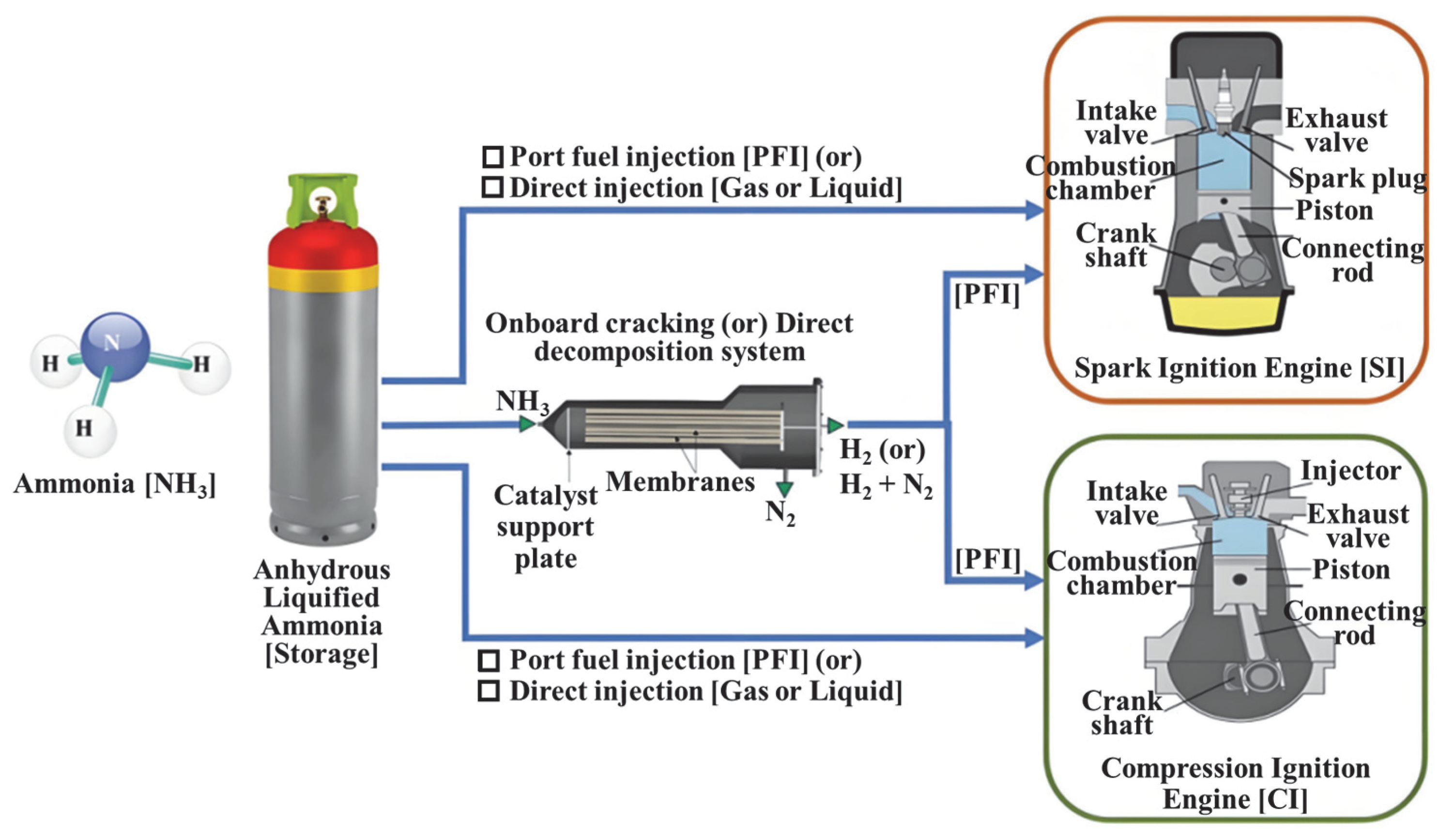
The technological breakthrough in plasma-assisted ammonia combustion has greatly expanded the industrial application of ammonia, with internal combustion engines (ICEs) being one of the key areas. In ICEs, ammonia finds its main application in spark ignition (SI) and compression ignition (CI) engines, shown in Figure 5. The common issues in traditional SI and CI engines mainly stem from their dependence on fossil fuels, concerns about energy security, and the greenhouse effect caused by CO2 emissions. Additionally, traditional SI engines face specific challenges such as misfire, cycle-to-cycle variability, and slow flame propagation under lean combustion and high EGR (exhaust gas recirculation) conditions. Traditional CI engines are burdened by problems such as dependence on petroleum-based fuels, high NOx and particulate emissions, and poor adaptability to low-reactivity fuels. Ammonia offers a solution to challenges related to energy diversification and carbon emissions, although it shows some unavoidable issues, such as ignition difficulty and slow flame speed. For this reason, ammonia, as a promising zero-carbon energy carrier, has garnered significant attention in ICE research. To overcome its combustion limitations and fully harness its potential, exploring effective strategies for ammonia fuel utilization has become a key technological focus.
Gopinathan et al. [90] found that CI engines offer higher thermal efficiency than SI engines when fueled with a mixture of ammonia, whereas a key disadvantage is the difficulty in NOx and particulate emissions controlling. This challenge is further complicated by the high latent heat required for ammonia vaporization to form a combustible mixture, along with the high auto-ignition temperature and low flame speed of ammonia. In contrast to CI engines, SI engines are equipped with the necessary components to generate plasma, known as a spark plug, whereas CI engines lack this. As a result, the issues of low laminar flame speed, narrow flammability limits, high ignition energy requirements, and elevated NOx emissions during ammonia combustion can be greatly alleviated with plasma assistance in SI engines. In 2007, the University of Michigan [91] developed an SI engine fueled by a mixture of ammonia and gasoline. The characteristics of ammonia/gasoline mixed combustion and engine performance were discussed. It was found that the introduction of ammonia enabled the ICEs to operate without knocking and achieve stable ignition, while pure ammonia could also operate stably under certain high-pressure conditions.
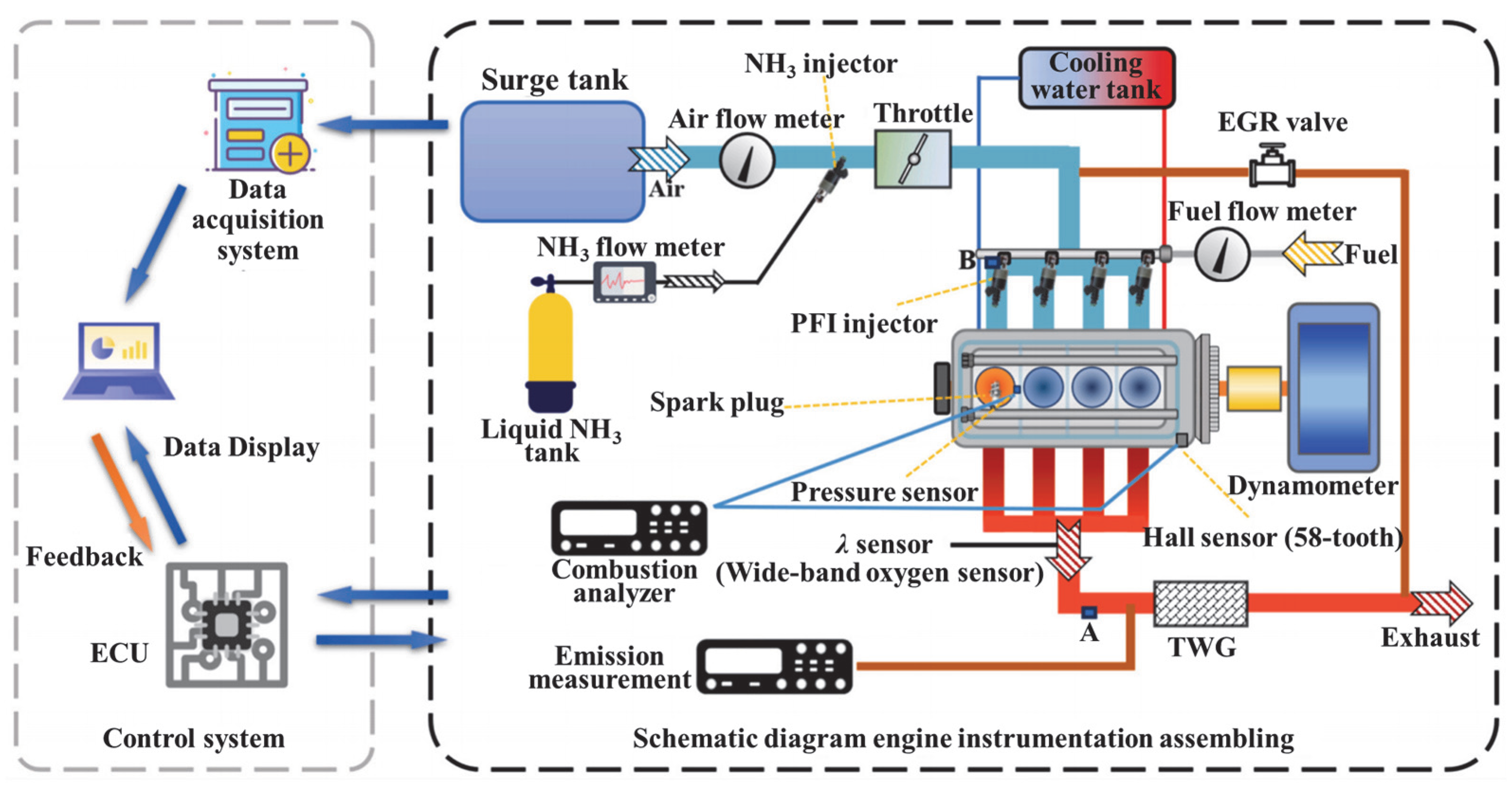
Liu et al. [92] modified a 1.5 L inline 4-cylinder engine (from BYD Co., Ltd. In China) to study the combustion performance and exhaust emissions of an ammonia/gasoline mixed fuel in a single-cylinder SI engine under various operating conditions. The experimental platform is briefly illustrated shown in Figure 6. The results demonstrated that stable and efficient combustion of pure ammonia was achieved in an SI engine equipped with a spark plug (with ignition energy of approximately 90 mJ), reaching a thermal efficiency of 41%. The effect of mixed ammonia on flame kernel development was more pronounced under high temperature, high pressure, and strong turbulence conditions. Furthermore, the addition of ammonia to gasoline was beneficial for knock suppression due to its long ignition delay. Ultimately, a method was developed that maintains a moderate-to-high ammonia mixing ratio, increases the compression ratio, and raises the engine load. This approach enables efficient combustion and low emissions of NOx, unburned ammonia, and N2O in ammonia/gasoline engines.
To extend the application of ammonia in ICEs, the Institute of Energy, Hefei Comprehensive National Science Center (Hefei, Anhui province, China) has developed an engine system based on plasma-assisted ammonia combustion coupled with ammonia catalytic cracking. This system utilizes an air plasma jet generated by a plasma generator to energize ammonia combustion, while also acting as a combustion-supporting agent that mixes with ammonia in the burner for combustion. On one hand, it promotes stable ammonia combustion; on the other hand, the heat produced further facilitates the catalytic thermal cracking of ammonia. This approach addresses the issue in traditional ammonia engines, where electric heating requires additional battery systems or dual-fuel systems. Moreover, the waste heat from engine exhaust can be utilized for vaporizing liquid ammonia, enabling effective heat recovery. Additionally, by controlling the combustion system, the ammonia content in the exhaust can be adjusted for denitrification purposes, thereby achieving low NOx emissions. Through the collaborative efforts, the first vessel powered by a pure ammonia ICE successfully completed its maiden voyage on June, 2025, marking a significant breakthrough in the industrial application of ammonia fuel in both the shipping and ICE sectors.

4.2. Industrial Boiler

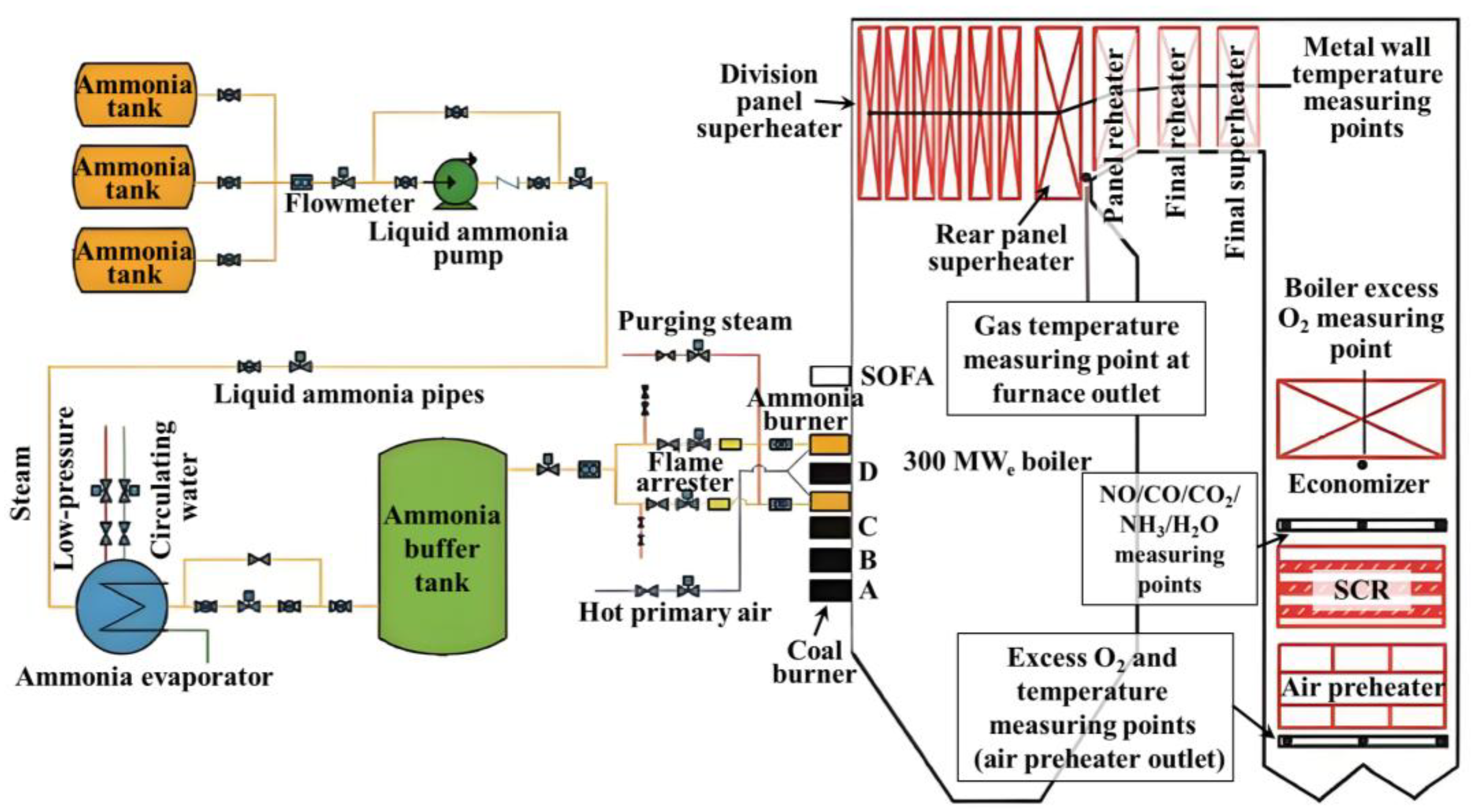
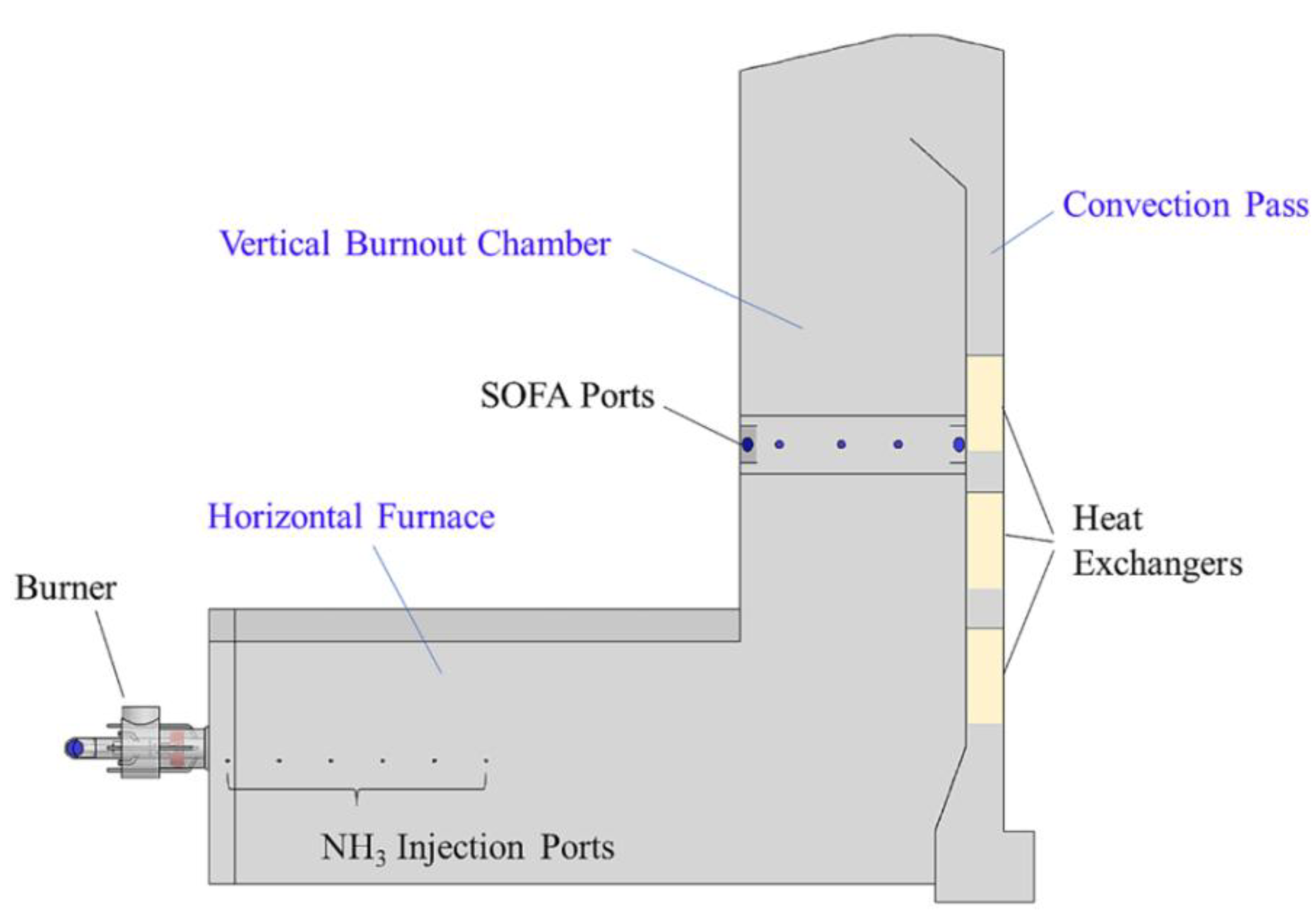
In 2021, a 1000 MW-scale project led by NEDO (The New Energy and Industrial Technology Development Organization) in Japan proposed the goal of achieving 20% ammonia co-firing in thermal power plants by 2030. In the currently known reports, experiments were conducted by relevant institutions in Japan [14,93], including pilot tests on ammonia–coal co-firing in a 1.2 MW pulverized coal boiler and a 10 MW ammonia–coal co-firing system [94]. However, plasma-assisted combustion was not involved in these studies, and it was consistently reported that NOx emissions in the combustion exhaust increased. In China, an ammonia–coal co-firing experimental system, which was then the world’s largest, was designed and built in 2021, with a capacity of 40 MW, as shown in Figure 7 [95]. With this system, the combustion of 0–25% ammonia-blended fuel in a 40 MW coal-fired boiler was successfully achieved, validating the feasibility of ammonia–coal co-firing technology for coal boilers. The results showed that the combustion efficiency of ammonia-blended fuel was higher than that of pure coal under the same load conditions, and the NOx concentration at the boiler exit was lower than that of pure coal combustion. Additionally, compared to pure coal fuel, ammonia–coal co-firing achieved more than a 35% reduction in carbon emissions, marking a breakthrough in low-carbon combustion technology for the thermal power industry. However, it is important to note that this system did not incorporate plasma to enhance ammonia combustion.
Subsequently, Li et al. [56] conducted research on plasma-assisted ammonia–coal co-firing using a sliding arc plasma-assisted combustion system. Experiments showed that when the air consumption coefficient was set to 1.2, NOx emissions reached the lowest level while the overall combustion efficiency remained high. In this setup, the sliding arc plasma provided energy for ignition and ionization of ammonia, thereby enhancing the stability of the ammonia–coal blended combustion. For coal-fired boilers, Lin et al. [96] developed a plasma-assisted combustion system to achieve ammonia co-firing and ultra-low NOx emissions, shown in Figure 8. In this system, ammonia was supplied to the furnace through two pathways. In the first, it was mixed with pulverized coal and injected into the furnace, where an air plasma torch enhanced ignition and combustion. In the second, a plasma-thermal synergistic cracker produced a hydrogen-ammonia mixture for furnace injection. In this role, ammonia served as both a reburning fuel and a NOx-reducing agent, lowering emissions. In April 2022, an 8.3 MW pure ammonia burner was successfully ignited and operated stably for over two hours in the 300 MW coal-fired power unit at WanNeng Group Tongling Power Generation Company in China. It also proved stable operation across a 10–35% ammonia blending range, enabling the future adoption of high-percentage ammonia co-firing in coal-fired boilers. In 2023, the State Energy Group in China successfully conducted ammonia co-firing tests on a 600 MW coal-fired unit. By integrating technologies like ammonia–coal gas–solid phase combustion enhancement and plasma cracking, stable operation was achieved across various loads, including 500 MW and 300 MW. The ammonia burn-out rate reached 99.99%, and there was no noticeable increase in NOx emissions.

5. Conclusions

The preceding sections have summarized the key role of plasma in ammonia combustion, detailing its action mechanisms and confirming its necessity. However, several associated issues remain to be addressed. Although plasma-assisted ammonia combustion technology demonstrates promising application prospects [24,96,97], it still faces several technical challenges, which also highlight key research directions for the future.
(1)
Energy efficiency and economics
The energy cost presents a critical challenge, impacting the economic viability of plasma-assisted combustion technology. Plasma generation consumes electrical energy and requires a high-frequency, high-voltage power supply to sustain plasma discharge. The power requirements of the supply depend on the type, specifications, and other parameters of the plasma generator, ranging from tens of watts to several kilowatts [41,89,98]. The additional energy supply reduces the overall efficiency of the system, making the reduction in plasma energy consumption a key area of research. This issue can be addressed by developing new discharge methods and optimizing the reactor design. Additionally, exploring the synergistic effects between plasma and other combustion enhancement technologies, such as oxygen-enriched combustion, catalytic combustion, and staged combustion, is also feasible. All these approaches serve to enhance the energy efficiency of the plasma-assisted combustion system and reduce the energy consumption for combustion assistance.
(2)
System integration
The design of plasma reactors should consider plasma discharge characteristics, fluid flow dynamics within the reactor, fuel mixing and combustion, as well as pollutant emissions [54,80]. Additionally, the large-scale application of plasma is also limited by several challenges, including the integration of the plasma generator with the reactor, the miniaturization and reliability of the high-voltage power supply, and the dynamic response characteristics of the system. The system integration of plasma-assisted ammonia combustion can be enhanced by exploring strategies such as plasma coupling with fuels like hydrogen or methane, and plasma–catalyst synergy. Alternatively, for specific applications (e.g., gas turbines, internal combustion engines, industrial boilers), dedicated plasma generators and high-frequency high-voltage power supplies can be developed to continuously optimize system integration.
(3)
Long-term stability and reliability
During plasma-assisted combustion, electrode discharge creates localized high temperatures, making the electrodes susceptible to corrosion or failure due to both elevated temperatures and the abrasion of active particles [99]. This issue is more pronounced in sliding arc discharge and spark discharge. Therefore, it is crucial to ensure the long-term stability and reliability of the plasma discharge system. An effective solution could be developing electrode-less discharge methods, such as microwave discharge or dielectric barrier discharge.
(4)
Complexity of emission control
Ammonia combustion increases fuel-type NOx emissions. While the introduction of plasma can help reduce NOx emission in some cases, it also increases the complexity of the reaction [23,54,100]. Due to the transient nature of radical generation and consumption in reactions, existing detection methods struggle to capture intermediate species effectively. Meanwhile, mechanism analysis using tools like Chemkin [101,102,103] relies on models that cannot fully replicate real conditions. Therefore, further studies are required on both complex reaction mechanisms and the fundamental science of reaction diagnostics. Additionally, ammonia combustion carries a risk of ammonia slip. Thus, continuously optimizing combustion strategies and controlling the system are essential to ensure complete ammonia combustion. Future work should utilize advanced laser diagnostics and artificial intelligence (AI) to probe reaction mechanisms and enable intelligent, adaptive control. Concurrently, high-fidelity plasma-combustion models incorporating vibrational and non-equilibrium effects should be developed.
(5)
Expansion of application
Current research indicates that plasma-assisted ammonia combustion is feasible for industrial applications. Building on existing ICEs and coal-fired industrial boilers, efforts should be made to actively explore their application in energy-intensive industries such as steel and cement, where pollution emissions are difficult to reduce, in order to promote their low-carbon transformation.

Author Contributions

Conceptualization, S.W. and R.S.; Methodology, S.W.; Formal analysis, S.W. and L.M.; Investigation, L.M. and S.L.; Data curation, L.G.; Writing—original draft, S.W.; Writing—review and editing, D.Y. and R.S.; Supervision, M.G.; Funding acquisition, M.G. All authors have read and agreed to the published version of the manuscript.

Funding

This work was supported by the National Natural Science Foundation of China [Grant number 52376088].

Data Availability Statement

No new data were created or analyzed in this study.

Conflicts of Interest

The authors declare no conflicts of interest.

References

  1. Fetting, C. The European green deal. ESDN Rep. 2020, 2, 53. [Google Scholar]
  2. Ovaere, M.; Proost, S. Cost-effective reduction of fossil energy use in the European transport sector: An assessment of the Fit for 55 Package. Energy Policy 2022, 168, 113085. [Google Scholar] [CrossRef]
  3. Lagouvardou, S.; Psaraftis, H.N. Implications of the EU Emissions Trading System (ETS) on European container routes: A carbon leakage case study. Marit. Transp. Res. 2022, 3, 100059. [Google Scholar] [CrossRef]
  4. Tian, J.; Chai, Y.; Cui, Y.; Xing, Y.; Wang, X.; Su, W. Construction and technological progress of CCUS whole-process carbon reduction system in iron and steel industry. Iron Steel 2024, 59, 226–235. (In Chinese) [Google Scholar] [CrossRef]
  5. Li, W.; Ma, S.; Shen, X. A Preliminary Discussion on the Practical Path of Carbon Reduction Technology in China’s Cement Industry. Cem. Guide New Epoch 2021, 27, 12–17. (In Chinese) [Google Scholar] [CrossRef]
  6. Available online: https://en.people.cn/n3/2025/0928/c90000-20371914.html (accessed on 1 November 2025).
  7. Available online: http://en.ce.cn/main/latest/202509/t20250927_2493745.shtml (accessed on 1 November 2025).
  8. Kobayashi, H.; Hayakawa, A.; Somarathne, K.D.K.A.; Okafor, E.C. Science and technology of ammonia combustion. Proc. Combust. Inst. 2019, 37, 109–133. [Google Scholar] [CrossRef]
  9. Kang, L.; Pan, W.; Zhang, J.; Wang, W.; Tang, C. A review on ammonia blends combustion for industrial applications. Fuel 2023, 332, 126150. [Google Scholar] [CrossRef]
  10. Li, J.; Lai, S.; Chen, D.; Wu, R.; Kobayashi, N.; Deng, L.; Huang, H. A review on combustion characteristics of ammonia as a carbon-free fuel. Front. Energy Res. 2021, 9, 760356. [Google Scholar] [CrossRef]
  11. Liu, X.; Lei, L.; Zhou, Z.; Xu, Y.; Hu, Y.; Xu, M. Research progress and prospect of ammonia-doped combustion in coal-fired power plants under the background of dual carbon. Proc. CSEE 2024, 44, 7221–7235. (In Chinese) [Google Scholar] [CrossRef]
  12. Hayakawa, A.; Goto, T.; Mimoto, R.; Arakawa, Y.; Kudo, T.; Kobayashi, H. Laminar burning velocity and Markstein length of ammonia/air premixed flames at various pressures. Fuel 2015, 159, 98–106. [Google Scholar] [CrossRef]
  13. Wang, S.; Wei, X.; Gu, M.; Lin, Q.; Luo, G.; Hu, F. Flame characteristics and NO emission law of sliding arc plasma-assisted ammonia combustion. Combust. Flame 2025, 274, 114000. [Google Scholar] [CrossRef]
  14. Gao, Z.; Tu, A.; Li, T.; Duan, L. Recent advances on ammonia combustion technology for zero-carbon power. Clean Coal Technol. 2022, 28, 173–184. (In Chinese) [Google Scholar] [CrossRef]
  15. Chai, W.S.; Bao, Y.; Jin, P.; Tang, G.; Zhou, L. A review on ammonia, ammonia-hydrogen and ammonia-methane fuels. Renew. Sustain. Energy Rev. 2021, 147, 111254. [Google Scholar] [CrossRef]
  16. Acker, K.; Beysens, D.; Möller, D. Nitrite in dew, fog, cloud and rain water: An indicator for heterogeneous processes on surfaces. Atmos. Res. 2008, 87, 200–212. [Google Scholar] [CrossRef]
  17. Lhuillier, C.; Brequigny, P.; Lamoureux, N.; Contino, F.; Mounaïm-Rousselle, C. Experimental investigation on laminar burning velocities of ammonia/hydrogen/air mixtures at elevated temperatures. Fuel 2020, 263, 116653. [Google Scholar] [CrossRef]
  18. Ichikawa, A.; Hayakawa, A.; Kitagawa, Y.; Kunkuma Amila Somarathne, K.D.; Kudo, T.; Kobayashi, H. Laminar burning velocity and Markstein length of ammonia/hydrogen/air premixed flames at elevated pressures. Int. J. Hydrogen Energy 2015, 40, 9570–9578. [Google Scholar] [CrossRef]
  19. Rocha, R.C.; Ramos, C.F.; Costa, M.; Bai, X. Combustion of NH3/CH4/air and NH3/H2/air mixtures in a porous burner: Experiments and kinetic modeling. Energy Fuels 2019, 33, 12767–12780. [Google Scholar] [CrossRef]
  20. Jabłońska, M.; Palkovits, R. Copper based catalysts for the selective ammonia oxidation into nitrogen and water vapour—Recent trends and open challenges. Appl. Catal. B Environ. 2016, 181, 332–351. [Google Scholar] [CrossRef]
  21. Zhou, G.; Zhang, Y.; Zhao, X.; Gui, Y.; Wang, X. FSP synthesized core-shell CuOx@SiO2 catalyst with excellent thermal stability for catalytic combustion of ammonia. Fuel 2023, 334, 126824. [Google Scholar] [CrossRef]
  22. Liu, H.; Zhao, Y.; Zhang, C.; Wang, Z.; Bin, F.; Wei, X.; Dou, B. Evolution of reaction mechanism in the catalytic combustion of ammonia on copper-cerium mixed oxide. J. Catal. 2023, 425, 20–31. [Google Scholar] [CrossRef]
  23. Popov, N.A. Kinetics of plasma-assisted combustion: Effect of non-equilibrium excitation on the ignition and oxidation of combustible mixtures. Plasma Sources Sci. Technol. 2016, 25, 043002. [Google Scholar] [CrossRef]
  24. Shah, Z.A.; Mehdi, G.; Congedo, P.M.; Mazzeo, D.; De Giorgi, M.G. A review of recent studies and emerging trends in plasma-assisted combustion of ammonia as an effective hydrogen carrier. Int. J. Hydrogen Energy 2024, 51, 354–374. [Google Scholar] [CrossRef]
  25. Li, H.; Xiao, H.; Sun, J. Laminar burning velocity, Markstein length, and cellular instability of spherically propagating NH3/H2/Air premixed flames at moderate pressures. Combust. Flame 2022, 241, 112079. [Google Scholar] [CrossRef]
  26. Zitouni, S.; Brequigny, P.; Mounaïm-Rousselle, C. Influence of hydrogen and methane addition in laminar ammonia premixed flame on burning velocity, Lewis number and Markstein length. Combust. Flame 2023, 253, 112786. [Google Scholar] [CrossRef]
  27. Han, X.; Wang, Z.; Costa, M.; Sun, Z.; He, Y.; Cen, K. Experimental and kinetic modeling study of laminar burning velocities of NH3/air, NH3/H2/air, NH3/CO/air and NH3/CH4/air premixed flames. Combust. Flame 2019, 206, 214–226. [Google Scholar] [CrossRef]
  28. Ciccarelli, G.; Jackson, D.; Verreault, J. Flammability limits of NH3–H2–N2–air mixtures at elevated initial temperatures. Combust. Flame 2006, 144, 53–63. [Google Scholar] [CrossRef]
  29. Zhang, K.; Shang, S.; Li, X.; Gao, W. Lower flammability limits of NH3/H2 mixtures under different initial temperatures and initial pressures. Fuel 2023, 331, 125982. [Google Scholar] [CrossRef]
  30. Hinokuma, S.; Shimanoe, H.; Kawabata, Y.; Kiritoshi, S.; Araki, K.; Machida, M. Supported and unsupported manganese oxides for catalytic ammonia combustion. Catal. Commun. 2018, 105, 48–51. [Google Scholar] [CrossRef]
  31. Hinokuma, S.; Shimanoe, H.; Matsuki, S.; Kawano, M.; Kawabata, Y.; Machida, M. Catalytic activity and selectivities of metal oxides and Pt/Al2O3 for NH3 combustion. Chem. Lett. 2016, 45, 179–181. [Google Scholar] [CrossRef]
  32. Li, Z.; Guan, B.; Shu, K.; Zhu, L.; Zhu, T.; Zhuang, Z.; Hu, X.; Zhu, C.; Zhao, S.; Chen, J.; et al. Frontiers in hydrogen storage materials: Advances and systemic applications. Int. J. Hydrogen Energy 2026, 204, 153160. [Google Scholar] [CrossRef]
  33. Zhang, Y.; Lin, J.; Wang, H.; Yamaguchi, K.; Ishida, T.; Zhang, J.; Xiu, G.; Murayama, T.; Lin, M. Mo anchor as promoter to initiate selective catalytic ammonia oxidation to nitrogen at 40 °C. Catal. Today 2025, 460, 115472. [Google Scholar] [CrossRef]
  34. Jiang, M.; Sun, W.; Zhang, H.; Guo, L.; Li, D.; Qu, D.; Yang, M.; Liu, P.; Su, X. Optical diagnostic study on improving ammonia combustion in a compression ignition engine using CeO2 nano-catalysts. Int. J. Hydrogen Energy 2025, 136, 294–309. [Google Scholar] [CrossRef]
  35. Bulat, M.P.; Bulat, P.V.; Denissenko, P.V.; Esakov, I.I.; Grachev, L.P.; Lavrov, P.V.; Volkov, K.N.; Volobuev, I.A. Plasma-assisted ignition and combustion of lean and rich air/fuel mixtures in low-and high-speed flows. Acta Astronaut. 2020, 176, 700–709. [Google Scholar] [CrossRef]
  36. Ju, Y.; Sun, W. Plasma assisted combustion: Dynamics and chemistry. Prog. Energy Combust. Sci. 2015, 48, 21–83. [Google Scholar] [CrossRef]
  37. Wu, Y.; Zhang, Z.; Zhu, Y.; Jia, M.; Li, Y. Research progress and outlook of plasma combustion control. Acta Aeronaut. Astronaut. Sin. 2025, 46, 73–111. (In Chinese) [Google Scholar] [CrossRef]
  38. Tang, Y.; Xie, D.; Shi, B.; Wang, N.; Li, S. Flammability enhancement of swirling ammonia/air combustion using AC powered gliding arc discharges. Fuel 2022, 313, 122674. [Google Scholar] [CrossRef]
  39. Choe, J.; Sun, W.; Ombrello, T.; Carter, C. Plasma assisted ammonia combustion: Simultaneous NOx reduction and flame enhancement. Combust. Flame 2021, 228, 430–432. [Google Scholar] [CrossRef]
  40. Taneja, T.S.; Johnson, P.N.; Yang, S. Nanosecond pulsed plasma assisted combustion of ammonia-air mixtures: Effects on ignition delays and NOx emission. Combust. Flame 2022, 245, 112327. [Google Scholar] [CrossRef]
  41. Lin, Q.; Jiang, Y.; Liu, C.; Chen, L.; Zhang, W.; Ding, J.; Li, J. Controllable NO emission and high flame performance of ammonia combustion assisted by non-equilibrium plasma. Fuel 2022, 319, 123818. [Google Scholar] [CrossRef]
  42. Shahsavari, M.; Konnov, A.A.; Valera-Medina, A.; Jangi, M. On nanosecond plasma-assisted ammonia combustion: Effects of pulse and mixture properties. Combust. Flame 2022, 245, 112368. [Google Scholar] [CrossRef]
  43. Li, H.; Yu, D.; Sun, W.; Liu, D.; Li, J.; Han, X.; Li, Z.; Sun, B.; Wu, Y. State-of-the-art of atmospheric discharge plasmas. High Volt. Eng. 2016, 42, 3697–3727. (In Chinese) [Google Scholar] [CrossRef]
  44. Li, Z.; Bian, C.; Liu, C.; Bai, X.; Wang, M.; He, Y.; Liu, Z.; Han, F. Research on the progress of ammonia synthesis technology using dielectric barrier discharge plasma catalysis. Chem. Saf. Environ. 2025, 38, 3–9. (In Chinese) [Google Scholar]
  45. Abedi, M.; Kuskov, K.; Moskovskikh, D.; Zakharova, E.V.; Belov, D.; Mukasyan, A. Reactive spark plasma sintering of NiAl intermetallics: A comparative study. Intermetallics 2023, 152, 107750. [Google Scholar] [CrossRef]
  46. Wang, T.; Wang, Z.; Xu, X.; Shi, L.; Li, M.; Rao, S. Progress of research in surface microfabrication technology using atmospheric-pressure cold plasma jet. China Surf. Eng. 2025, 38, 23–41. (In Chinese) [Google Scholar] [CrossRef]
  47. Zhao, C.; Du, J.; Yuan, Z. Research progress of cold plasma in promoting skin wound healing. Chin. J. New Clin. Med. 2024, 17, 1302–1305. (In Chinese) [Google Scholar] [CrossRef]
  48. Qu, G.; Xu, Y.; Zhao, C.; Ning, P.; Li, J. Non-thermal Plasma for VOCs Abatement: Recent Advance. ChemistrySelect 2024, 9, e202303822. [Google Scholar] [CrossRef]
  49. Chen, L.; Shen, J.; Jiang, Y.; Wu, J.; Chen, J.; Fang, S. Experimental study on premixed ammonia/air swirl combustion assisted by dielectric barrier discharge. Clean Coal Technol. 2023, 29, 1–7. (In Chinese) [Google Scholar] [CrossRef]
  50. Ju, R.; Wang, J.; Zhang, M.; Mu, H.; Zhang, G.; Yu, J.; Huang, Z. Stability and emission characteristics of ammonia/air premixed swirling flames with rotating gliding arc discharge plasma. Energy 2023, 277, 127649. [Google Scholar] [CrossRef]
  51. Ju, R.; Wang, J.; Mu, H.; Zhang, G.; Lei, J.; Yu, J.; Huang, Z. Effect of rotating gliding arc discharge plasma on stability of ammonia/air swirling flames. J. Eng. Thermophys. 2022, 43, 2225–2233. (In Chinese) [Google Scholar]
  52. Wen, T.; Xiang, N.; Zhang, C.; Sha, Z.; Shao, T. Research status and development trend of high voltage discharge plasma. High Volt. Eng. 2023, 49, 3226–3239. (In Chinese) [Google Scholar] [CrossRef]
  53. Conrads, H.; Schmidt, M. Plasma generation and plasma sources. Plasma Sources Sci. Technol. 2000, 9, 441. [Google Scholar] [CrossRef]
  54. Ju, Y.; Sun, W. Plasma assisted combustion: Progress, challenges, and opportunities. Combust. Flame 2015, 162, 529–532. [Google Scholar] [CrossRef]
  55. Ma, F.; Guo, L.; Li, Z.; Zeng, X.; Zheng, Z.; Li, W.; Zhao, F.; Yu, W. A review of current advances in ammonia combustion from the fundamentals to applications in internal combustion engines. Energies 2023, 16, 6304. [Google Scholar] [CrossRef]
  56. Li, S.; Gu, M.; Wei, X.; Wang, S.; Huang, X. Study on NOx emission characteristics during plasma-assisted ammonia-coal co-combustion process. Coal Convers. 2025, 48, 92–100. (In Chinese) [Google Scholar] [CrossRef]
  57. Sun, J.; Huang, Q.; Tang, Y.; Li, S. Stabilization and emission characteristics of gliding arc-assisted NH3/CH4/air premixed flames in a swirl combustor. Energy Fuels 2022, 36, 8520–8527. [Google Scholar] [CrossRef]
  58. Tang, Y.; Sun, J.; Shi, B.; Li, S.; Yao, Q. Extension of flammability and stability limits of swirling premixed flames by AC powered gliding arc discharges. Combust. Flame 2021, 231, 111483. [Google Scholar] [CrossRef]
  59. Starikovskii, A.Y.; Anikin, N.B.; Kosarev, I.N.; Mintoussov, E.I.; Nudnova, M.M.; Rakitin, A.E.; Roupassov, D.V.; Starikovskaia, S.M.; Zhukov, V.P. Nanosecond-pulsed discharges for plasma-assisted combustion and aerodynamics. J. Propuls. Power 2008, 24, 1182–1197. [Google Scholar] [CrossRef]
  60. Faingold, G.; Lefkowitz, J.K. A numerical investigation of NH3/O2/He ignition limits in a non-thermal plasma. Proc. Combust. Inst. 2021, 38, 6661–6669. [Google Scholar] [CrossRef]
  61. Kong, D.; Tian, J.; Pekris, M.; Cheng, Y.; Zhao, Q.; Tian, G. The effects of equivalence ratio, pressure, and temperature on nanosecond surface dielectric barrier discharge ignition for ammonia/air mixtures. Fuel 2025, 402, 135873. [Google Scholar] [CrossRef]
  62. Sekiguchi, H. Experimental investigations of plasma-assisted ammonia combustion using rod-electrode-type microwave plasma source. Int. J. Hydrogen Energy 2024, 65, 66–73. [Google Scholar] [CrossRef]
  63. Sekiguchi, H. Pure ammonia direct decomposition using rod-electrode-type microwave plasma source. Int. J. Hydrogen Energy 2024, 57, 1010–1016. [Google Scholar] [CrossRef]
  64. Starikovskiy, A.; Aleksandrov, N. Plasma-assisted ignition and combustion. Prog. Energy Combust. Sci. 2013, 39, 61–110. [Google Scholar] [CrossRef]
  65. Rong, W.; Hu, Y.; Yu, W.; Zhao, F. Design of a nanosecond pulsed plasma power supply and ammonia ignition experiment. Chin. Intern. Combust. Engine Eng. 2025, 46, 48–54+68. (In Chinese) [Google Scholar] [CrossRef]
  66. Peng, C.; Yang, H.; Liu, Y.; Jiang, S.; Li, Y.; Li, W. Exploratory test on ignition with rotating gliding arc swirlers. J. Aerosp. Power 2023, 38, 769–776. (In Chinese) [Google Scholar] [CrossRef]
  67. Liu, X.; He, L.; Dai, W.; Zhao, Z.; Chen, G.; Zhang, H. Experimental Study on Characteristics of DC Gliding Arc Plasma Igniter. J. Propuls. Technol. 2020, 41, 1550–1559. (In Chinese) [Google Scholar] [CrossRef]
  68. Opacich, K.C.; Heyne, J.; Braun, E.; Ombrello, T. Investigating the use of Low-Voltage Nanosecond-Pulsed Discharges for Cavity Ignition in Supersonic Flow. In Proceedings of the AIAA SCITECH 2024 Forum, Orlando, FL, USA, 8–12 January 2024; p. 0180. [Google Scholar] [CrossRef]
  69. Zhang, Y.; Zhao, Y.; Zeng, G.; Zhang, W.; Zhang, L.; Sun, S. A review of the research progress of ammonia combustion enhancement technology. Energy Environ. Prot. 2023, 37, 129–144. (In Chinese) [Google Scholar] [CrossRef]
  70. Zare, S.; Lo, H.W.; Roy, S.; Askari, O. On the low-temperature plasma discharge in methane/air diffusion flames. Energy 2020, 197, 117185. [Google Scholar] [CrossRef]
  71. Hu, Y.; Rong, W.; Zheng, Z.; Cao, R.; Zhao, F.; Yu, W. Investigation on enhancement of the combustion flame speed and stability of ammonia-air mixture using nanosecond surface dielectric barrier discharge (nSDBD). Combust. Flame 2025, 281, 114432. [Google Scholar] [CrossRef]
  72. Choe, J.; Sun, W. Experimental investigation of non-equilibrium plasma-assisted ammonia flames using NH2* chemiluminescence and OH planar laser-induced fluorescence. Proc. Combust. Inst. 2023, 39, 5439–5446. [Google Scholar] [CrossRef]
  73. Wang, Y.; Kong, C.; Wu, X.; Zhang, Z. Plasma-extended lean blowout limit of ammonia/air premixed swirl flame. J. Combust. Sci. Technol. 2024, 30, 457–465. (In Chinese) [Google Scholar] [CrossRef]
  74. Rakopoulos, D.C.; Rakopoulos, C.D.; Kosmadakis, G.M.; Tutak, W.; Gruca, M. Investigating the combustion, NO emissions and cyclic variability (CCV) in SI engine fueled with ammonia-hydrogen blends by two-zone quasi-dimensional model with two CCV governing mechanisms. Int. J. Hydrogen Energy 2025, 184, 151889. [Google Scholar] [CrossRef]
  75. Zheng, Z.; Wang, C.; Xin, Z.; Hu, Y.; Zhu, Q.; Yang, W.; Zhao, F.; Yu, W. Kinetic modelling of non-equilibrium plasma enhanced catalytic ammonia decomposition. J. Energy Inst. 2024, 116, 101715. [Google Scholar] [CrossRef]
  76. Bezdek, M.J.; Guo, S.; Chirik, P.J. Coordination-induced weakening of ammonia, water, and hydrazine X–H bonds in a molybdenum complex. Science 2016, 354, 730–733. [Google Scholar] [CrossRef]
  77. Wang, W.; Padban, N.; Ye, Z.; Andersson, A.; Bjerle, I. Kinetics of ammonia decomposition in hot gas cleaning. Ind. Eng. Chem. Res. 1999, 38, 4175–4182. [Google Scholar] [CrossRef]
  78. Huang, X.; Lei, K.; Mi, Y.; Fang, W.; Li, X. Recent progress on hydrogen production from ammonia decomposition: Technical roadmap and catalytic mechanism. Molecules 2023, 28, 5245. [Google Scholar] [CrossRef] [PubMed]
  79. Zhang, M.; Chen, Q.; Zhou, G.; Sun, J.; Lin, H. Low-temperature chemistry in plasma-driven ammonia oxidative pyrolysis. Green Energy Environ. 2024, 9, 1477–1488. [Google Scholar] [CrossRef]
  80. Lin, Q.F.; Jiang, Y.; Liu, C.; Chen, L.; Zhang, W.; Li, J. Instantaneous hydrogen production from ammonia by non-thermal arc plasma com-bining with catalyst. Energy Rep. 2021, 7, 4064–4070. [Google Scholar] [CrossRef]
  81. Li, Y.; Zhang, X. Progress of Ar/NH3 mixture discharge plasma. Chinses J. Vac. Sci. Technol. 2017, 37, 1091–1101. (In Chinese) [Google Scholar] [CrossRef]
  82. Zhang, X.; Cha, M.S. Ammonia cracking for hydrogen production using a microwave argon plasma jet. J. Phys. D Appl. Phys. 2023, 57, 065203. [Google Scholar] [CrossRef]
  83. Mao, X.; Zhong, H.; Liu, N.; Wang, Z.; Ju, Y. Ignition enhancement and NOx formation of NH3/air mixtures by non-equilibrium plasma discharge. Combust. Flame 2024, 259, 113140. [Google Scholar] [CrossRef]
  84. Ju, Y.; Lefkowitz, J.K.; Reuter, C.B.; Won, S.H.; Yang, X.; Yang, S.; Sun, W.; Jiang, Z.; Chen, Q. Plasma assisted low temperature combustion. Plasma Chem. Plasma Process. 2016, 36, 85–105. [Google Scholar] [CrossRef]
  85. Popov, N.A.; Starikovskaia, S.M. Relaxation of electronic excitation in nitrogen/oxygen and fuel/air mixtures: Fast gas heating in plasma-assisted ignition and flame stabilization. Prog. Energy Combust. Sci. 2022, 91, 100928. [Google Scholar] [CrossRef]
  86. Starikovskiy, A. Physics and chemistry of plasma-assisted combustion. Philos. Trans. R. Soc. A Math. Phys. Eng. Sci. 2015, 373, 20150074. [Google Scholar] [CrossRef] [PubMed]
  87. Shioyoke, A.; Hayashi, J.; Murai, R.; Nakatsuka, N.; Akamatsu, F. Numerical investigation on effects of nonequilibrium plasma on laminar burning velocity of ammonia flame. Energy Fuels 2018, 32, 3824–3832. [Google Scholar] [CrossRef]
  88. Lacoste, D.A.; Xu, D.A.; Moeck, J.P.; Laux, C.O. Dynamic response of a weakly turbulent lean-premixed flame to nanosecond repetitively pulsed discharges. Proc. Combust. Inst. 2013, 34, 3259–3266. [Google Scholar] [CrossRef]
  89. Zang, Y.; Jia, M.; Zhang, Z.; Cui, W. Experimental investigation on gliding arc plasma ignition and assisted combustion actuator. IEEE Trans. Plasma Sci. 2023, 51, 127–139. [Google Scholar] [CrossRef]
  90. Gopinathan, R.L.; Ibrahim, M.M. Ammonia as a sustainable fuel for diesel engines: Exploring advanced combustion strategies for green transportation. J. Energy Inst. 2025, 121, 102159. [Google Scholar] [CrossRef]
  91. Grannell, S.M.; Assanis, D.N.; Bohac, S.V.; Gillespie, D.E. The operating features of a stoichiometric, ammonia and gasoline dual fueled spark ignition engine. In Proceedings of the ASME International Mechanical Engineering Congress and Exposition, Chicago, IL, USA, 5–10 November 2006; Volume 47837, pp. 15–27. [Google Scholar] [CrossRef]
  92. Liu, S.; Lin, Z.; Qi, Y.; Wang, Z.; Yang, D.; Lu, G.; Wang, B. Combustion and emission characteristics of a spark ignition engine fueled with ammonia/gasoline and pure ammonia. Appl. Energy 2024, 369, 123538. [Google Scholar] [CrossRef]
  93. Hadi, K.; Ichimura, R.; Hashimoto, G.; Xia, Y.; Hashimoto, N.; Fujita, O. Effect of fuel ratio of coal on the turbulent flame speed of ammonia/coal particle cloud co-combustion at atmospheric pressure. Proc. Combust. Inst. 2021, 38, 4131–4139. [Google Scholar] [CrossRef]
  94. Zou, P.; Wang, X.; Wang, G.; Gong, Z.; Niu, T.; Zheng, Y.; Jiang, Y.; Qin, Y. Research progress on ammonia-mixed combustion technology for coal-fired boilers. Energy Conserv. 2024, 43, 113–116. (In Chinese) [Google Scholar] [CrossRef]
  95. Zhang, W.; Liu, X.; Zhang, C.; Li, M.; Niu, T.; Xie, Y.; Wang, H. Industrial scale testing on the combustion and NOx emission characteristics of ammonia cofiring in a 40 MWth coal-fired boiler. Fuel 2024, 359, 130471. [Google Scholar] [CrossRef]
  96. Lin, Q.; Sun, W.; Li, H.; Liu, Y.; Chen, Y.; Liu, C.; Jiang, Y.; Cheng, Y.; Ma, N.; Ya, H.; et al. Experimental study on ammonia Co-firing with coal for carbon reduction in the boiler of a 300-MW coal-fired power station. Engineering 2024, 40, 247–259. [Google Scholar] [CrossRef]
  97. Zhao, Z.; Qi, Y.; Cai, K. Research on the combustion mechanism of plasma-induced ammonia-hydrogen jet ignition engine. Int. J. Hydrogen Energy 2024, 65, 398–409. [Google Scholar] [CrossRef]
  98. Zhang, L.; Yu, J.; Zhao, B.; Zhang, D.; Wang, X.; Hu, Y. Study on ignition and combustion Characteristics of gliding arc plasma combustion dome. J. Eng. Thermophys. 2024, 46, 300–309. (In Chinese) [Google Scholar]
  99. Sun, Q.; Zhou, Q.; Yang, W.; Dong, Y.; Zhang, H.; Song, M.; Zhou, M.; Yang, W. Modeling of electrode erosion process in gas spark switch. Plasma Chem. Plasma Process. 2023, 43, 1195–1215. [Google Scholar] [CrossRef]
  100. Wang, Y.; Sun, J.; Liu, Q.; Chen, L.; Gu, M.; Liu, D.; Huang, X.; Wang, S. NOx formation mechanism of plasma assisted ammonia combustion: A reactive molecular dynamics study. Energy 2024, 293, 130706. [Google Scholar] [CrossRef]
  101. Kee, R.J.; Rupley, F.M.; Miller, J.A. The Chemkin Thermodynamic Data Base; Sandia National Lab. (SNL-CA): Livermore, CA, USA, 1990. Available online: https://www.osti.gov/biblio/7073290 (accessed on 15 November 2025).
  102. Kee, R.J.; Rupley, F.M.; Miller, J.A. Chemkin-II: A Fortran Chemical Kinetics Package for the Analysis of Gas-Phase Chemical Kinetics; Sandia National Lab. (SNL-CA): Livermore, CA, USA, 1989. Available online: https://www.osti.gov/biblio/5681118 (accessed on 15 November 2025).
  103. Kee, R.J.; Rupley, F.M.; Meeks, E.; Miller, J.A. CHEMKIN-III: A FORTRAN Chemical Kinetics Package for the Analysis of Gas-Phase Chemical and Plasma Kinetics; Sandia National Lab. (SNL-CA): Livermore, CA, USA, 1996. Available online: https://www.osti.gov/biblio/481621 (accessed on 15 November 2025).
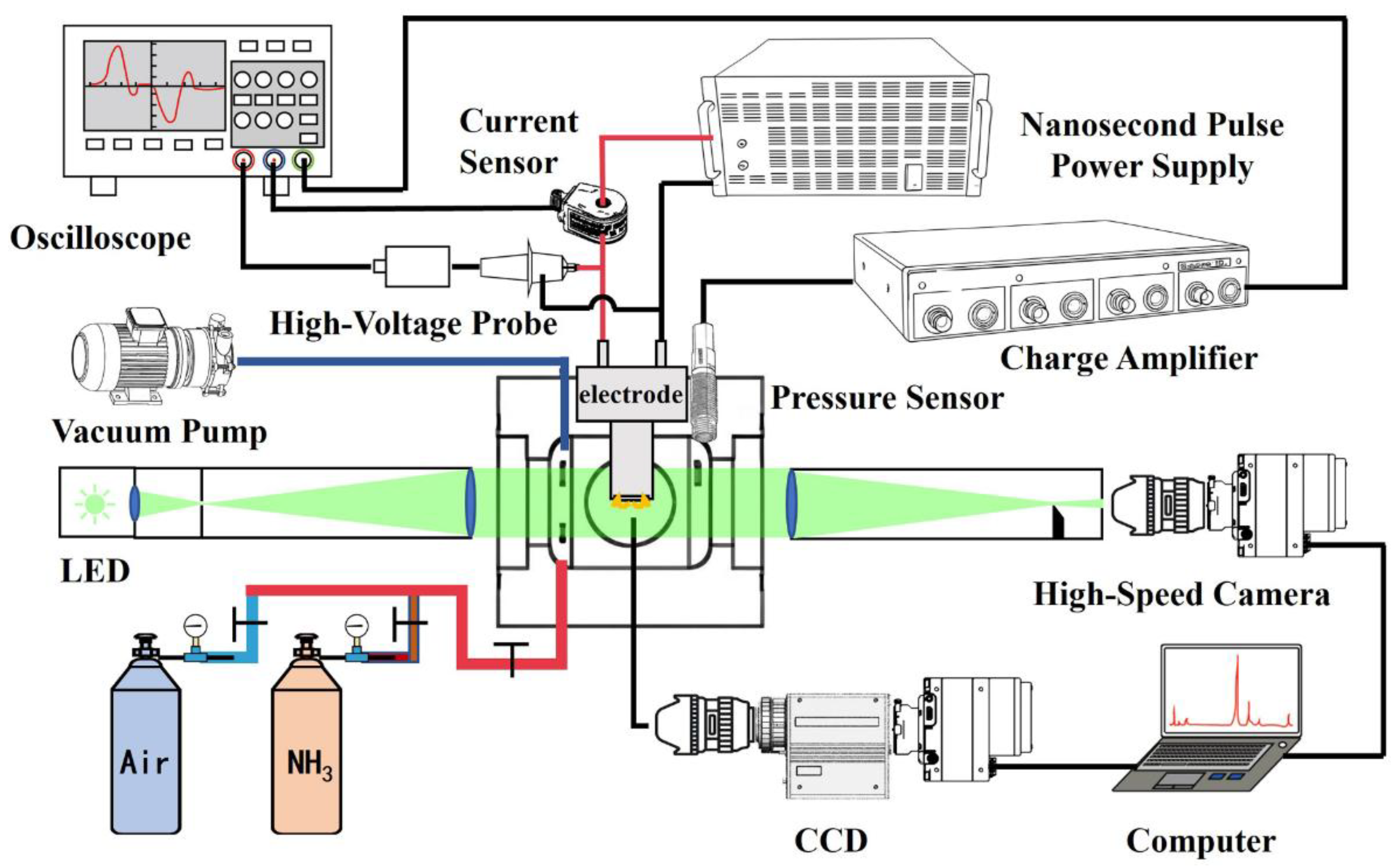
Figure 2. Experimental setup of DBD spark plug using nanosecond-duration pulse power supply [71].
Processes 14 00458 g002
Figure 3. A brief illustration of the setup for GAD plasma-assisted ammonia combustion [13].
Processes 14 00458 g003
Figure 4. Key pathways to enhanced combustion via plasma assistance [84].
Processes 14 00458 g004
Figure 5. Application of ammonia in internal combustion engines (ICEs) [90].
Processes 14 00458 g005
Figure 6. Experimental platform for single cylinder spark ignition engine using ammonia/gasoline blended fuel [92].
Processes 14 00458 g006
Figure 7. Schematic of a 40 MW coal-fired boiler with ammonia–coal co-firing [95].
Processes 14 00458 g007
Figure 8. Plasma-assisted ammonia combustion and NOx ultra-low emission system for coal-fired boilers [96].
Processes 14 00458 g008
Disclaimer/Publisher’s Note: The statements, opinions and data contained in all publications are solely those of the individual author(s) and contributor(s) and not of MDPI and/or the editor(s). MDPI and/or the editor(s) disclaim responsibility for any injury to people or property resulting from any ideas, methods, instructions or products referred to in the content.