


Abstract
Hard carbon is widely recognized as a viable anode candidate for sodium-ion batteries (SIBs) owing to its electrochemical advantages, yet simultaneously enhancing specific capacity and rate capability, arising from insufficient plateau capacity, remains a long-standing challenge. Herein, we present a strategy for fabricating ZnCl2-modified hard carbon (HCMZ-X) using waste macadamia shells and ZnCl2 as a multifunctional structural modifier through a facile high-temperature carbonization. This approach effectively expands the graphite interlayer spacing to 0.394 nm, reduces microcrystalline size, and induces abundant closed pores, synergistically improving sodium-ion storage kinetics within the hard carbon framework. Mechanistic investigations confirm an “adsorption-intercalation-filling” storage mechanism. Hence, the optimized HCMZ-3 delivers a high reversible capacity of 382.05 mAh g−1 at 0.05 A g−1, with the plateau region contributing approximately 70%, significantly outperforming that of unmodified hard carbon (262.64 mAh g−1). Remarkably, it achieves stable rate performance, delivering 190 mAh g−1 at 1 A g−1, along with excellent cycling stability, retaining over 90% after 500 cycles. By rational pore-structure modulation rather than excessive surface activation, this cost-effective method utilizing agricultural waste and ZnCl2 dual-functional modification partially alleviates the intrinsic energy-density limitation of hard carbon anodes, advancing the development of high-performance, eco-friendly anodes for scalable energy storage systems.
1. Introduction
The escalating demand for sustainable and cost-effective energy storage solutions has propelled significant attempts at alternatives to conventional lithium-ion batteries (LIBs) [1,2,3]. Owing to the natural abundance and low cost of sodium resources, sodium-ion batteries (SIBs) demonstrate potential as a highly compelling candidate. Sharing similar electrochemical working principles with LIBs, SIBs hold substantial potential for application in large-scale energy storage and electric devices [4,5,6]. However, a critical bottleneck hindering their widespread commercialization is the development of high-performance anode materials capable of efficiently accommodating the larger ionic radius of Na+ compared to Li+ [7,8,9].
Hard carbon (HC), classified as a non-graphitizable carbon material, is commonly considered an attractive candidate for SIBs because of its favorable structural characteristics and cost advantages. Typically, HC exhibits a highly disordered microstructure with enlarged interlayer spacing (d002 > 0.40 nm), which is beneficial for Na+ intercalation and storage [10,11,12]. As an example, Zhou et al. [13] reported coal-derived HC by eliminating SiO2 impurities during carbonization, which demonstrated an outstanding Na+ storage capacity of 341 mAh g−1 along with an initial Coulombic efficiency of 85%. Moreover, HC can be synthesized from inexpensive and readily available precursors, including biomass residues, resins [14], and pitch [15], through relatively simple pyrolysis processes. Biomass-derived HC, in particular, offers additional advantages, including environmental benignity, tunable porosity, and alignment with waste valorization and carbon neutrality goals [16]. Coconut shell, prized for its low impurity and robust structure, has been a primary industrial precursor, yielding HC with good structural stability and electrochemical performance under optimized carbonization conditions [17]. However, the large-scale application of coconut-shell-based HC is restricted by raw material supply limitations. Consequently, research has expanded to include alternative shell biomass products like walnut shells [18], hazelnut shells [19], peanut shells [20], and olive shells [21], demonstrating stable cycling performance after suitable structural regulation. Other agricultural waste such as corncob [22] and bamboo [23] have also shown promising performance. Importantly, carbonization temperature plays a decisive role in the electrochemical properties of the resulting hard carbon anodes, with optimal capacities over 230 mAh g−1 generally achieved at 1300 °C [24]. These results collectively highlight the broad potential of HC derived from diverse biomass precursors in developing high-performance and sustainable anodes for SIBs.
Although the variety of biomass-derived HC applications has been continuously broadened, their electrochemical performance still requires further enhancement. Structural optimization of HC is crucial for improving electrochemical metrics, including initial Coulombic efficiency (ICE), reversible capacity, and rate performance. To date, research indicates that systematically modulating the pore structure (particularly within the 0.3 to 2 nm size range) facilitates additional active Na+ storage sites within the HC, thereby enhancing the reversible capacity and kinetics of SIBs [25]. Hence, various modification approaches have been investigated. Heteroatom doping (such as N, S, P, or O) enhances sodium-ion storage by introducing additional active sites, improving electronic conductivity, optimizing defect structures, and expanding the interlayer spacing [26,27]. Studies have demonstrated that tailored heteroatom doping (such as N or O), achieved either through precise control of carbonization temperature or via emulsion-based synthetic design, effectively enhances the capacitive performance of carbon materials by synergistically combining high surface area with electrochemically active sites [28,29]. Recently, zinc-based modification has shown remarkable promise. For instance, Zn-doped HC synthesized via Zn(AC)2 polymerization exhibited expanded graphitic domains (d002 = 0.408 nm) and optimized nanopores [30]. Recent work has demonstrated that ZnBr2-assisted biomass fractionation can efficiently separate lignocellulose components, achieving an 88.0% yield of glucan oligomers and 92.4% lignin purity [31]. The resulting lignin, enriched with polar functional groups, exhibited excellent electrochemical performance as HC anodes in sodium-ion batteries, delivering a high specific capacity of 358.1 mAh g−1 and an ICE of 88.4%. Wen et al. [32] reported that zinc salt-templated synthesis enables the formation of size-controlled ZnO microcrystals along with abundant closed pores in HC, enabling reversible capacities above 340 mAh g−1 and ICE exceeding 90%. These structural enhancements synergistically boost Na+ storage kinetics and capacity. Despite these advances, the sodium storage capacity and rate performance of lower-cost biomass-derived HC still require substantial improvement to satisfy the requirements of practical applications.
Herein, we utilize waste macadamia shells, an abundant agricultural byproduct, as the precursor material and ZnCl2 as a cost-effective and efficient structural modifier. Through a straightforward mixing and high-temperature carbonization procedure, the zinc-modified hard carbon (denoted as HCMZ-X) was synthesized. Systematic characterization confirms that ZnCl2 introduction successfully expands the graphite interlayer spacing (up to 0.394 nm), reduces microcrystalline size, and generates abundant closed pores. These synergistic structural modifications lead to significantly optimized sodium storage performance. The optimal sample (HCMZ-3) delivers a high reversible capacity of 382.05 mAh g−1 at 0.05 A g−1, with an impressive plateau capacity contribution of 262.64 mAh g−1, substantially outperforming the unmodified counterpart. Furthermore, the modified sample exhibits outstanding rate capability, maintaining 190 mAh g−1 at 1.0 A g−1, along with exceptional long-term cycling stability over 1000 cycles at the same current density. Mechanistic investigations, including electrochemical analysis and post-mortem characterization, robustly confirm that the sodium storage behavior in ZnCl2-modified HC follows the “adsorption-intercalation-filling” model. This work not only presents a sustainable and economical strategy for synthesizing high-performance HC anodes from underutilized biomass waste but also provides fundamental insights into structure–property relationships and sodium storage mechanisms, laying a solid foundation for their application in sustainable SIBs.
2. Materials and Methods
2.1. Synthesis of Hard Carbon
Macadamia nutshells (MSs) (sourced from Yunnan Province, China) were pulverized and then acid-washed with 18 vol% hydrochloric acid (HCl) aqueous solution for 24 h to remove inorganic impurities and soluble organic components. The residue was filtered, rinsed with distilled water to neutrality, and dried at 80 °C for 24 h to yield a dark brown powder. This powder was subsequently blended with ZnCl2 (98.0%) at mass ratios of 100:1, 100:3, and 100:5. The mixtures were transferred to a graphite crucible and carbonized in a tube furnace under an argon atmosphere. The temperature was increased at a rate of 5 °C min−1 until reaching 1300 °C, where it was held constant for 2 h. The resulting hard carbon products were labeled HCMZ-X, where X denotes the ZnCl2 content. For comparison, parallel experiments were carried out in the absence of ZnCl2, and the resulting material was named HCMZ.
2.2. Materials Characterization
The pyrolytic behavior of the precursor was investigated using thermogravimetric analysis (TGA, TGA2, METTLER TOLEDO, Shanghai, China) at a heating rate of 10 °C min−1. The surface morphology of the samples was examined via field emission scanning electron microscopy (SEM, Apreo 2, Thermo Fisher Scientific, Shanghai, China), while their detailed internal structures were characterized using high-resolution transmission electron microscopy (HR-TEM, Talos F200S, Thermo Fisher Scientific, Shanghai, China). Phase composition was studied via X-ray diffraction measurements (XRD, λ = 0.15418 nm) at 2θ of 10–60°, along with Fourier transform infrared spectroscopy (FTIR, Nicolet iS50, Thermo Fisher Scientific, Shanghai, China). Defect features were detected via Raman spectroscopy (Raman, DXRxi spectrometer, Thermo Fisher Scientific, Shanghai, China). Surface chemical composition was determined by X-ray photoelectron spectroscopy (XPS, K-Alpha, Thermo Fisher Scientific, Shanghai, China). The specific surface area and pore structure were determined from N2 adsorption–desorption testing using a Brunauer–Emmett–Teller (BET, ASAP 2460, Micromeritics, Norcross, GA, USA) analyzer, along with the sample’s porosity.
2.3. Electrochemical Tests
HCMZ-X was coated with super P and polytetrafluoroethylene (PVDF) in a weight ratio of 8:1:1, then uniformly cast onto copper foil. The resulting electrodes were dried in a vacuum oven at 80 °C for 12 h to prepare anode sheets. CR2032 coin cells were assembled using sodium metal as the counter electrode and glass fiber as the separator, with 1 M NaPF6 in diethyl carbonate (DEC) as the electrolyte (Figure S1). All cell assembly procedures were carried out in an argon-filled glovebox, where the concentrations of oxygen and moisture were maintained below 0.1 ppm. Galvanostatic charge–discharge (GCD) tests were conducted on a Neware battery testing system within a potential window of 0.01–2.0 V. Cyclic voltammetry (CV) and electrochemical impedance (EIS) spectroscopy measurements were performed using a CHI660E workstation, with CV scan rates varying from 0.1 to 1 mV s−1 and an AC impedance frequency range of 0.01–105 Hz. For full-cell evaluations, sodium-ion cells were constructed using Na3V2(PO4)3 (NVP) as the cathode and the HCMZ-X as the anode (Figure S1). The NVP half-cell was tested between 2.2 and 3.8 V (vs. Na+/Na), while the electrochemical performance of the full cell was assessed over a voltage range of 1.5–3.8 V.
3. Results and Discussion
3.1. Morphological and Structural Properties
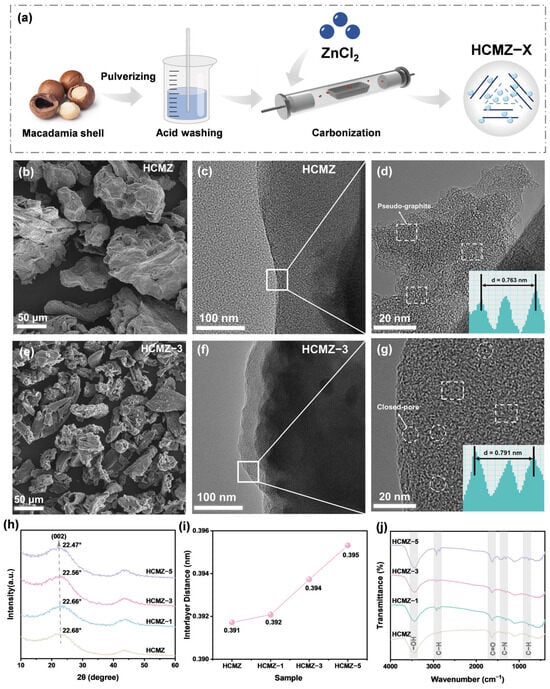
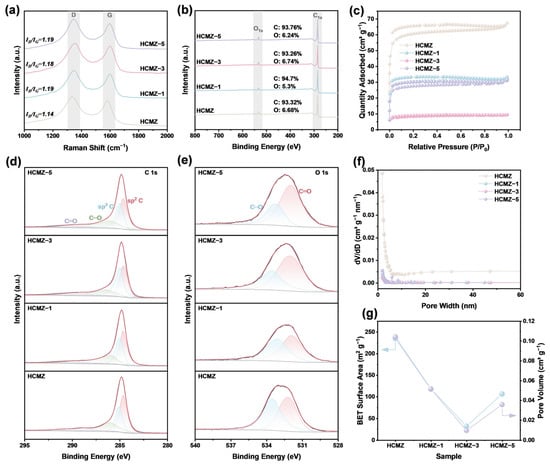
MSs are abundant agriculture waste. The conventional synthesis of typical ZnCl2-modified hard carbon (i.e., HCMZ-X) derived from MSs is schematically illustrated in Figure 1a. Initially the MS shells were pulverized into powder and subjected to HCl acid treatment to eliminate inorganic impurities. Subsequently, the resulting precursors were blended with ZnCl2 and thermally treated at 1300 °C under an argon atmosphere, yielding a black hard carbon product. During heating, ZnCl2 melts to form ZnO, which contributes to the modulation of the carbon framework [33]. As temperature rises, ZnO reacts with carbon [34], as in the following Equation (1):
and the resulting products evaporate. This process optimizes the pore structure of the carbon framework, thereby enhancing sodium-ion storage characteristics. For comparison, the pristine material (HCMZ) was prepared by carbonizing the acid-treated MS precursor under identical conditions but without the incorporation of ZnCl2.
Figure 1.
(a) Schematic representation of the preparation routes for HCMZ and HCMZ-X; SEM images of (b) HCMZ and (e) HCMZ-3; TEM images of (c) HCMZ and (f) HCMZ-3; HR-TEM images of (d) HCMZ and (g) HCMZ-3 (inset: corresponding SAED patterns); (h) XRD patterns of HCMZ-X and HCMZ; (i) Interlayer distance of all samples based on XRD calculations; (j) FITR spectra of HCMZ-X and HCMZ.
Thermogravimetric analysis (TGA) was employed to investigate the thermal decomposition processes of different precursors (Figure S2). A slight weight loss occurs around 80 °C, consistent with the evaporation of physically adsorbed moisture form the surface of the MS precursor [35]. Subsequently, a substantial weight reduction is observed around 350 °C, mainly associated with the decomposition of cellulose and hemicellulose in the MSs, along with the thermal decomposition of polymer chains [36]. Additionally, lignin decomposes into smaller molecular compounds such as eugenol due to the cleavage of ether bonds between 150 and 400 °C [18]. Furthermore, the carbon yield of HCMZ-3 after high-temperature carbonization at 1300 °C is around 30%, exceeding that of the unmodified HCMZ sample (27%). Scanning electron microscopy (SEM) observations reveal that HCMZ-3 exhibits slightly smaller micro-dimensions compared with HCMZ, though both of the samples display distinct irregular shapes (Figure 1b,e). Moreover, HR-TEM analysis depicted in Figure 1f indicates a cross-linked carbon layer arrangement in HCMZ-3, implying that ZnCl2 incorporation alters the carbon framework compared with HCMZ (Figure 1c). As illustrated in Figure 1d,g, the HC anode materials obtained through high-temperature carbonization of the precursors exhibit a pseudo-graphite structure, which is defined as locally ordered sp2 carbon domains with graphitic interlayer spacing but lacking long-range crystallinity. Moreover, based on the selected area electron diffraction (SAED) patterns of the two samples, it was determined that HCMZ-3 possesses a wider interlayer spacing compared to HCMZ. Specifically, HCMZ-3 contains more closed pores in contrast to HCMZ.
The X-ray diffraction (XRD) reveals the crystalline structure of HCMZ and HCMZ-X. As demonstrated in Figure 1h, XRD profiles of all samples display distinctive diffraction peaks at approximately 23° and 43°, which can be indexed to the (002) and (100) crystallographic planes of graphite carbon, characteristic of hard carbon structures. A systematic shift of the (002) diffraction peaks to lower angles from 22.66° to 22.47° was observed in HCMZ-X samples with increasing ZnCl2 precursor content, compared to the sharp peak at 22.68° for HCMZ. This broadening phenomenon, combined with the absence of distinct diffraction peaks, indicates reduced crystallinity and expanded interlayer spacing in HCMZ-X, which can be attributed to structural disorders induced by ZnCl2 incorporation. The increased interlayer spacing significantly enhances Na+ intercalation kinetics and ionic transport efficiency. According to the Bragg equation, the layer spacing (d002) of HCMZ-3 is 0.394 nm, whereas the layer spacing of HCMZ without ZnCl2 is only 0.391 nm (Figure 1i). Furthermore, an increase in ZnCl2 content facilitates the enlargement of the interlayer spacing. Based on these diffraction features, the average graphite domain length and thickness using the Scherrer relationship is given in Equation (2) [37]:
where denotes the wavelength of the X-ray radiation (0.15418 nm), indicates the full width at half maximum of the (100) and (002) diffraction peaks, and is the position of the corresponding peaks. is the Scherrer’s value, which is set to 1.84 and 0.89 [38]. The results (Figure S3) show that the and values of HCMZ-3 are the smallest, indicating that the addition of ZnCl2 effectively limits graphitization. As shown in Figure 1j, functional groups in different samples were analyzed via FITR spectroscopy. The absorption band observed at 3500 cm−1 is assigned to -OH functional groups within the materials [38,39]. The absorption band located near 1600 cm−1 is assigned to C=O vibrations, whereas the feature appearing around 780 cm−1 is mainly related to C-H functional groups associated with aromatic rings [40]. Additionally, a slight C-N stretching vibration is observed at 1320 cm−1. The FTIR spectra of all samples present similar characteristic bands, indicating that the fundamental functional groups are preserved after carbonization. However, noticeable differences in peak intensity and transmittance are observed with increasing ZnCl2 content, suggesting variations in the relative abundance and chemical environment of these functional groups. This variation is likely associated with ZnCl2-assisted dehydration and condensation reactions during carbonization, which regulate surface chemistry rather than completely removing functional groups [41].
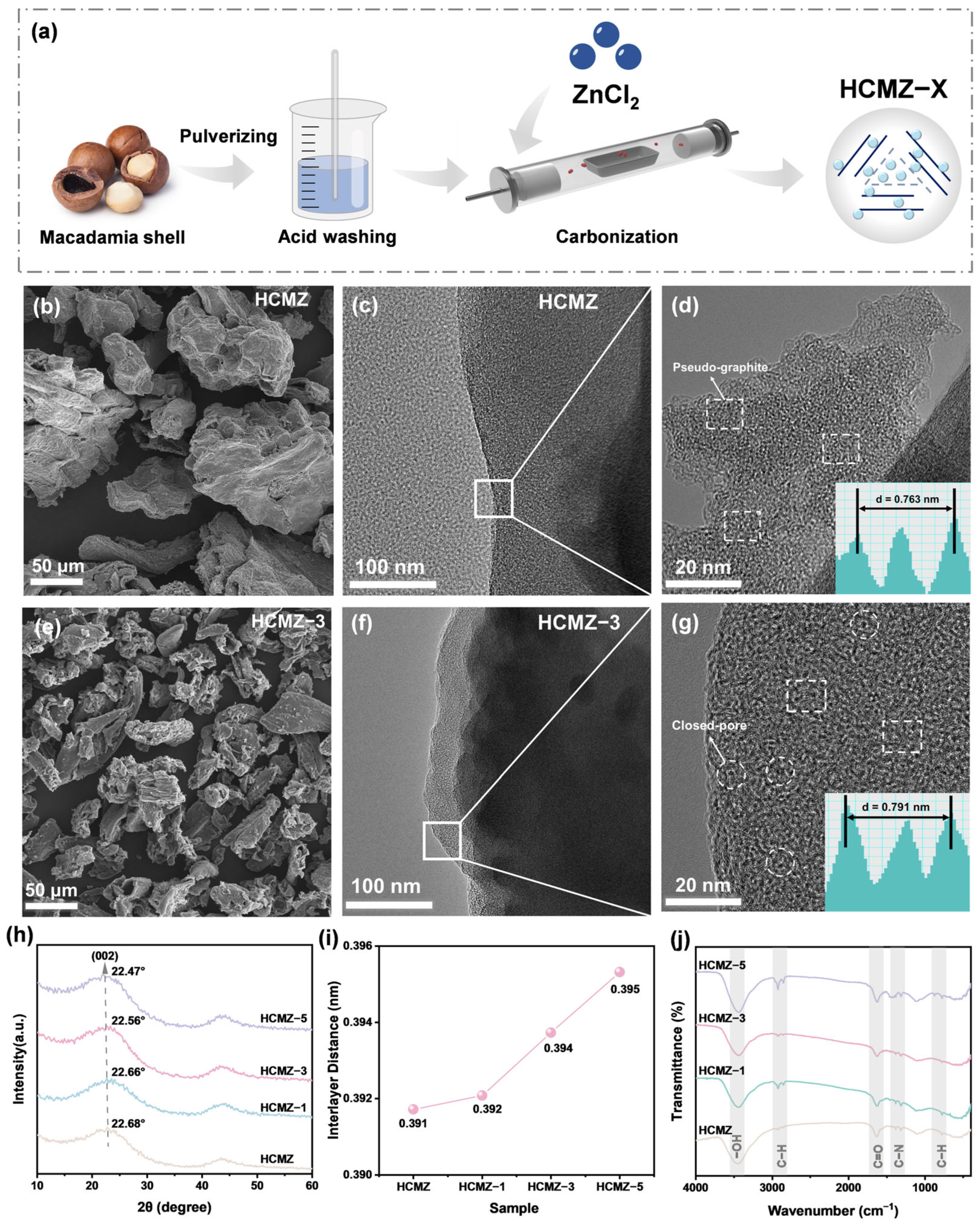
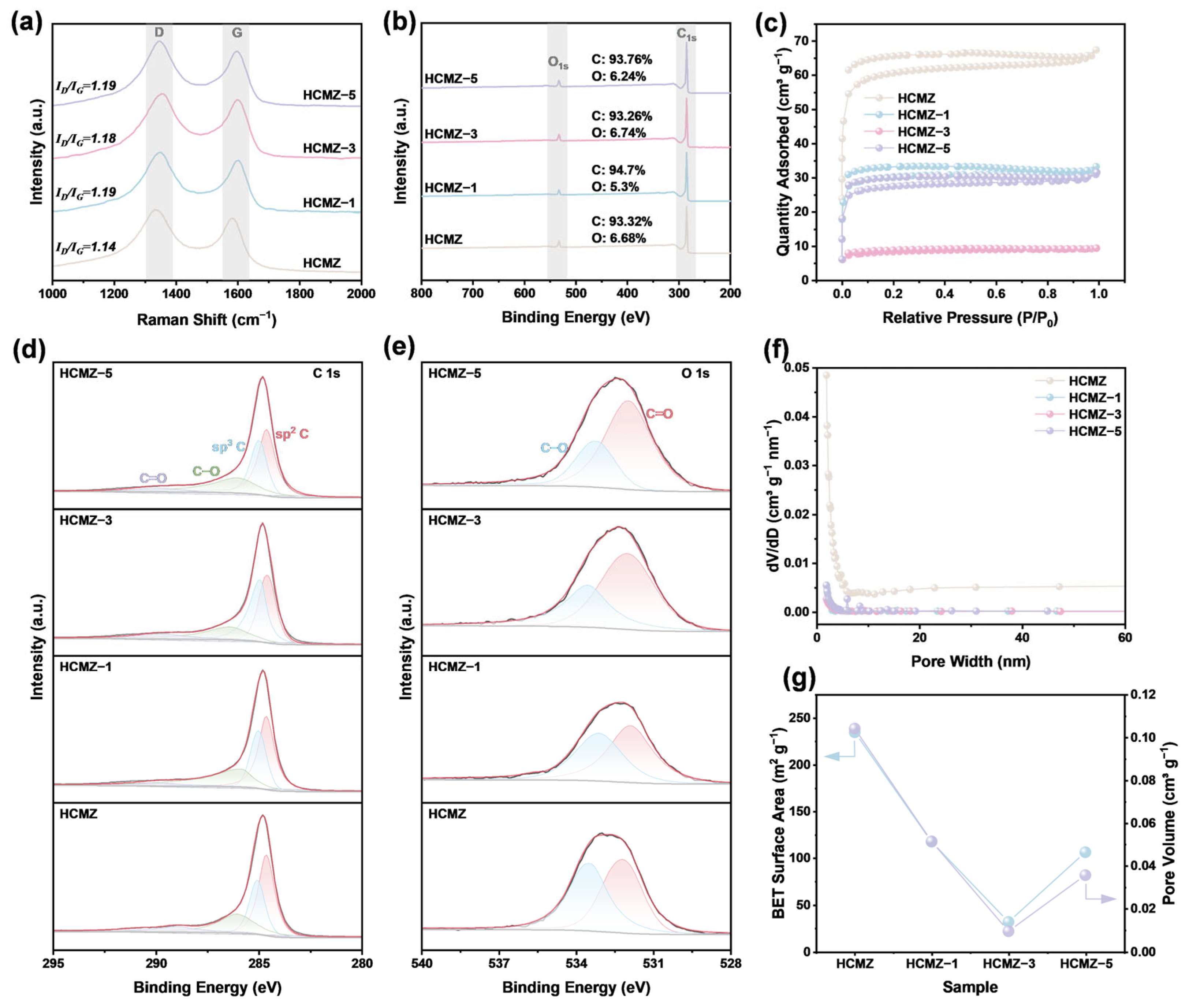
Raman spectroscopy (Figure 2a) analysis reveals the presence of distinct D and G bands in the samples, which are attributed to disordered defect and graphite-like sp2-bonded carbon domains, respectively [39]. The ratio of ID/IG is indicative of the defect density. The significantly elevated ID/IG values of three HCMZ-X samples compared to HCMZ demonstrate enhanced surface defect density and structural disorder induced by ZnCl2 incorporation. Compared to HCMZ, HCMZ-X exhibits lower ID/IG values, indicating a higher degree of sp2 carbon ordering, consistent with HR-TEM results. The Raman spectra could be deconvoluted into four peaks of D4 peaks, D1 peaks, D3 peaks, and G peaks (Figure S4) [38]. Notably, the D3 peak area (AD3) of HCMZ-3 is larger, suggesting an increase in sp3 carbon within the disordered structure. This indicates an increase in interlayer spacing, being consistent with the XRD results [38].
Figure 2.
(a) Raman spectra of HCMZ-X and HCMZ; (b) XPS spectra of HCMZ-X and HCMZ; (c) N2 adsorption–desorption isotherms; (d) C1s spectra of samples; (e) O1s spectra of individual samples; (f) corresponding pore size distribution calculated from N2 sorption isotherms; (g) BET specific surface area and pore volume of HCMZ and HCMZ-X.
The surface element composition was analyzed by X-ray photoelectron spectroscopy (XPS). As illustrated in Figure 2b, all spectra display distinct signals corresponding to C1s at 284.80 eV and O1s at 532.40 eV. Importantly, HCMZ-X do not exhibit significant Zn-related signals, suggesting that there are no Zn residues in the samples during carbonization at 1300 °C. The C1s peaks can be deconvoluted into four peaks at 284.55 eV, 284.91 eV, 286.40 eV, and 289.72 eV, which are attributed to sp2C, sp3C, C-O, and C=O, respectively (Figure 2d) [38]. The XPS fitting results (Table S3 and Figure S5a) show that HCMZ exhibits the highest sp2C content (44.51%), indicating a predominantly graphite-like structure. In contrast, the Zn-modified samples exhibit an increased fraction of sp3 carbon, with HCMZ-3 showing a maximum sp3C content of 37.68%. Combined with the HRTEM, XRD, and Raman results, these findings suggest that ZnCl2 introduction generates abundant structure defects within the carbon layers and promotes the transformation of sp2C to sp3C [38,42]. Additionally, high-resolution O1s XPS spectrum (Figure 2e) reveals two distinct components centered at 531.8 eV and 533.2 eV with a binding energy separation of 1.4 eV, which are characteristic of oxygen-containing functional groups such as C-O and C=O in polymeric carbonyl structures. The results verify that, in HCMZ and HCMZ-X, oxygen is predominantly present in the form of C–O and C=O functional groups. Furthermore, incorporation of ZnCl2 leads to a pronounced increase in the C=O component contribution in HCMZ-X compared to HCMZ, with the fitted C=O content of HCMZ-X increasing sequentially from 49.80% to 72.17% (Figure S5b).
Pore structure features were further characterized by N2 adsorption–desorption measurements (Figure 2c,f,g) to reveal the specific surface areas and pore size distributions of samples. The specific data based on Brunauer–Emmett–Teller (BET) model measurements are illustrated in Table S4. As shown in Figure 2c, both HCMZ and HCMZ-X display type IV isotherms with a distinct H4 hysteresis loop (0.1 < P/P0 < 1), indicative of a pore structure comprising both micropores and mesopores [38]. Specifically, both the BET surface area and total pore volume of the HCMZ-X samples are markedly reduced compared with those of HCMZ. Among them, HCMZ-3 exhibits the lowest values, with a specific surface area of 31.18 m2 g−1 and a pore volume of 0.0093 cm3 g−1 (Figure 2g). Specifically, ZnCl2, as an activator, alters the carbon structure through dehydration condensation and the melt template effect, promotes the formation of a denser carbon framework, and suppresses the development of excessive open micropores [43,44]. Therefore, the BET surface area varies nonlinearly with the content of ZnCl2. In addition, the pore size distribution (Figure 2f) reveals a significant decrease in open pores, further indicating that ZnCl2 modification introduces more disordered microcrystalline structures. This facilitates the conversion of accessible mesopores into closed pores, which in turn leads to a decrease in the surface area [38,45]. The reduced specific surface area provides increased reversible sodium-ion storage sites, leading to potential enhancement of the electrochemical Na+ storage performance.
3.2. Electrochemical Properties
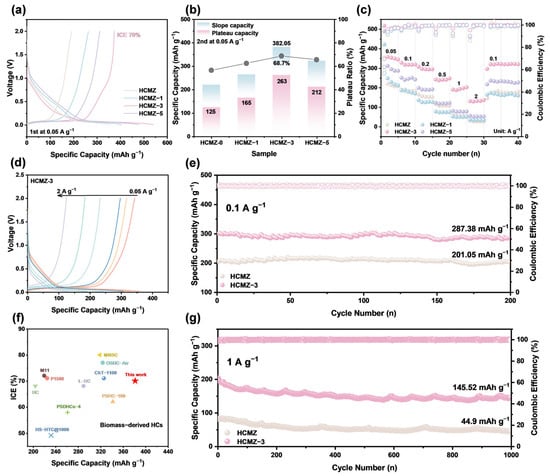
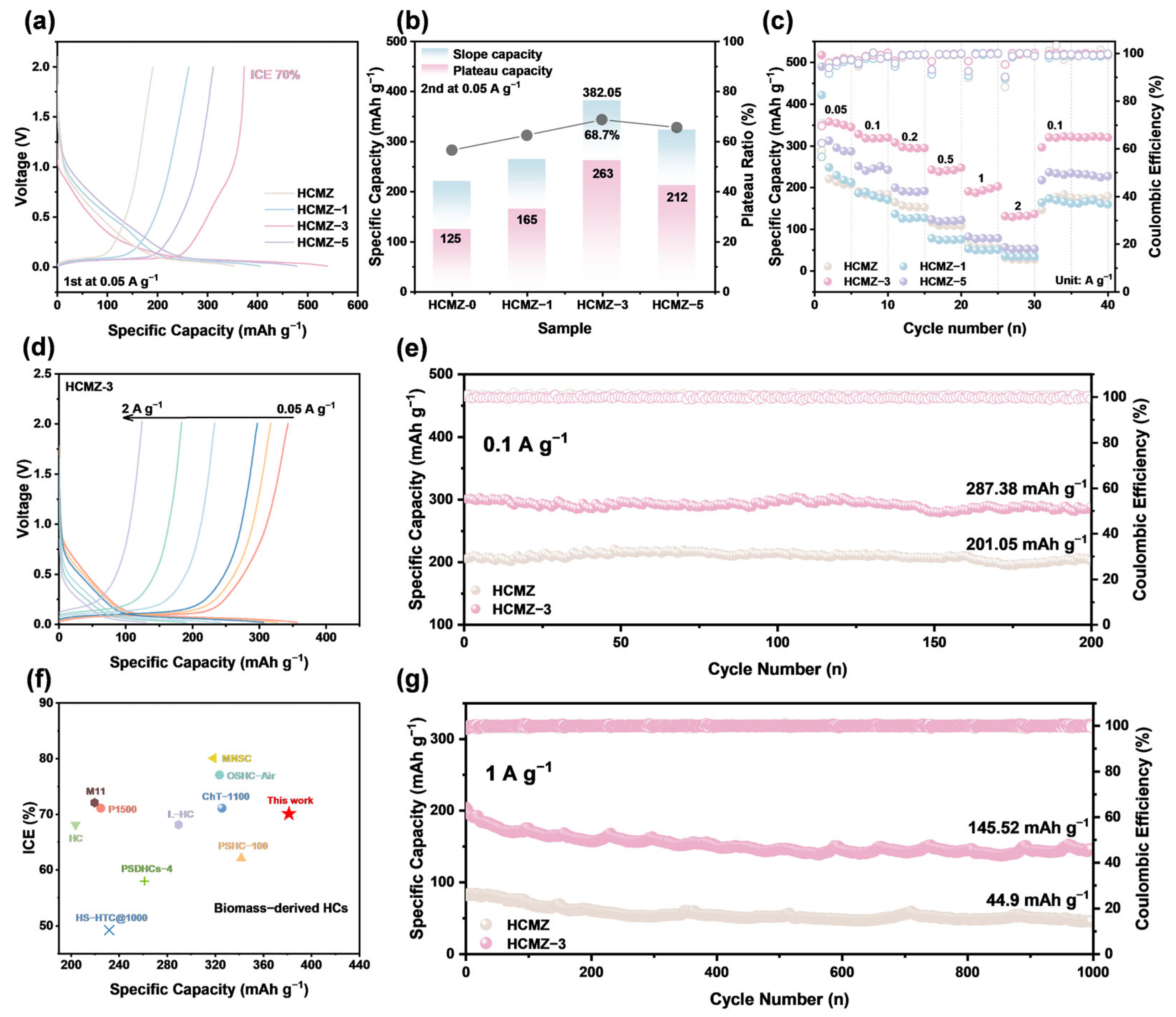
To investigate and compare the sodium storage performance of HCMZ and HCMZ-X, half coin cells were assembled for electrochemical performance measurements employing metallic sodium as the counter electrode. The first three charge/discharge profiles of the four electrodes are presented in Figure 3a and Figure S6. The results indicate that, under a current density of 0.05 A g−1, HCMZ-3 delivers a maximum reversible capacity of 382.05 mAh g−1 with an ICE of 70%, whereas HCMZ shows a minimum value of 220.67 mAh g−1 and an ICE of 59.1%. Specifically, the second charge/discharge profiles can be separated into two characteristic regions: the plateau region (<0.1 V), which is associated with Na+ intercalation between graphitic layers as well as the occupation of closed pore structures, and the slope region (>0.1 V) related to Na+ adsorption on the electrode surface. It is evident that the introduction of ZnCl2 predominantly enhances the capacity associated with the low-voltage plateau region. In particular, the high specific capacity of HCMZ-3 originates mainly from the pronounced expansion of this plateau contribution. Relative to HCMZ, the plateau capacity of HCMZ-3 increases from 124.56 to 262.64 mAh g−1, with a 12.26% increase in plateau region contribution. This enhancement is attributed to ZnCl2 promoting graphite domain formation and expanding interlayer spacing, which synergistically facilitates Na+ intercalation and migration. Concurrently, ZnCl2 modification generates abundant closed pores, significantly augmenting Na+ storage capacity within these confined spaces. Notably, a relatively low BET surface area is not necessarily detrimental to sodium-ion storage. On the contrary, excessive surface area in hard carbon anodes often leads to severe electrolyte decomposition and increased irreversible Na+ consumption due to extensive SEI formation, resulting in low ICE [44]. More importantly, sodium storage in hard carbon is not dominated by surface area but by specific pore types. The closed pores and pseudo-graphitic domains are critical for reversible Na+ storage via pore filling and insertion mechanisms. Therefore, the reduced surface area observed in this work is beneficial for improving ICE while maintaining effective Na+ storage through regulated pore structure and carbon microdomains, which is consistent with BET results.
Figure 3.
(a) The first GCD curves at 0.05 A g−1; (b) slope and plateau contribution of discharge capacity during the second cycle; (c) rate performance; (d) GCD profiles of HCMZ-3 recorded under various current densities; (e) cycling stabilities at 0.1 A g−1 of HCMZ and HCMZ-3; (f) comparison of specific capacity and ICE with previously reported biomass-derived HCs; (g) long-term cycling stabilities of HCMZ and HCMZ-3 at 1.0 A g−1.
As depicted in Figure 3c, the rate performance of HCMZ and HCMZ-X is quantified through galvanostatic charge/discharge cycling at different current densities. The HCMZ-X anode demonstrates superior rate capability, maintaining high specific capacities across current densities from 0.05 to 2 A g−1. Notably, HCMZ-3 delivers 357.94 mAh g−1 at 0.05 A g−1, significantly exceeding HCMZ (220.8 mAh g−1). Even at an elevated current density of 1 A g−1, HCMZ-3 still retains 190 mAh g−1 while HCMZ decreases to 50 mAh g−1. Additionally, when reverting to 0.05 A g−1, HCMZ-3 exhibited over 95% capacity recovery, confirming exceptional structural stability. Furthermore, HCMZ-3 delivers outstanding cycling stability with capacities of 287.38 mAh g−1 (200 cycles, 0.1 A g−1, Figure 3e) and 145.52 mAh g−1 (1000 cycles, 1.0 A g−1, Figure 3f), significantly surpassing HCMZ. This excellent cycling performance demonstrates that ZnCl2 modification is beneficial to enhancement of sodium storage kinetics. Notably, it is also observed that the second cycle reversible capacity of both electrodes is lower than that of the initial cycle, which can be attributed to the formation of a solid electrolyte interphase (SEI) arising from irreversible reactions between Na+ and the abundant active sites. As illustrated in Figure 3f and Table S5, compared with other reported biomass-derived hard carbons, HCMC-3 exhibits considerable specific capacity and ICE. Unmodified hard carbon anodes generally exhibit limited energy density due to their moderate plateau capacity. Recent studies indicate that microstructural regulation, including closed-pore control and heteroatom-assisted optimization, is an effective strategy to enhance sodium storage efficiency without excessive surface area increase. In this work, the regulated pore structure contributes to improved reversible capacity and Coulombic efficiency, while further enhancement of energy density may rely on microstructure–electrolyte matching and full-cell optimization.
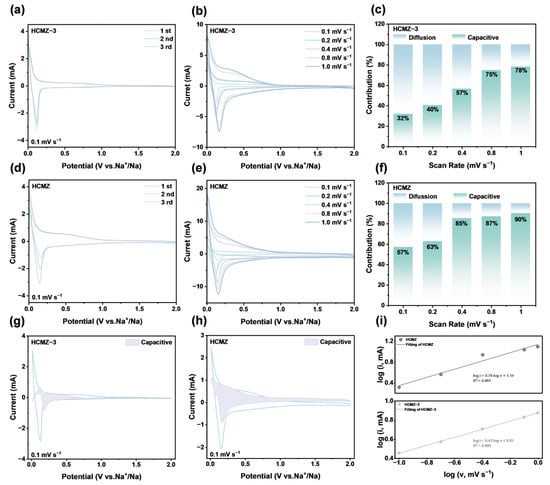
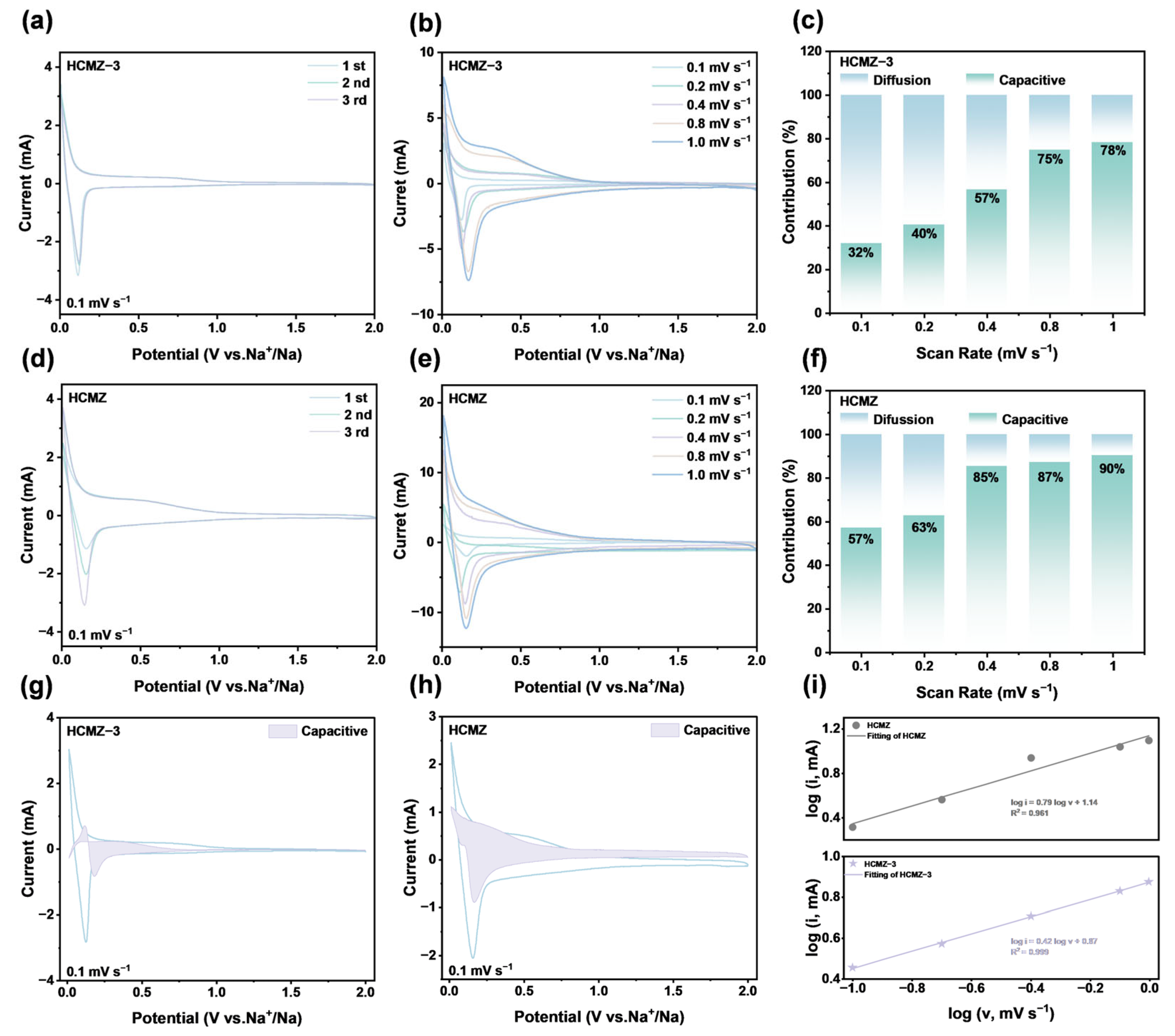
To gain deeper insight into how ZnCl2 incorporation influences the electrochemical performance of HC, cyclic voltammetry (CV) analyses were carried out on HCMZ and HCMZ-X samples. Figure 4a,d and Figure S7 depict the initial three CV cycles of HCMZ and HCMZ-X at a scan rate of 0.1 mV s−1. During the discharge process, all samples display pronounced cathodic current peaks at 0.01 V, while distinct anodic peaks appear around 0.1 V upon charging, together constituting typical redox couples associated with Na+ intercalation and deintercalation. Notably, ZnCl2-modified HCMZ-X electrodes show overlapping profiles in subsequent cycles, demonstrating enhanced electrochemical reversibility during charge/discharge processes. To further elucidate the sodium storage kinetics and capacitive contribution in both HCMZ-X and HCMZ electrodes, CV measurements of HCMZ and HCMZ-3 were subsequently recorded at different scan rates from 0.1 to 1.0 mV s−1, as shown in Figure 4b,e. The anodic/cathodic peak positions demonstrate negligible shift across different scan rates, while the peak current density increases proportionally, suggesting enhanced electrochemical reversibility and diffusion-controlled charge transfer kinetics in HCMZ-3.
Figure 4.
The first three CV curves of (a) HCMZ-3 and (d) HCMZ at 0.1 mV s−1; CV profiles of (b) HCMZ-3 and (e) HCMZ at different scan rates; diffusion and capacitive contribution for (c) HCMZ-3 and (f) HCMZ; pseudo-capacitive contribution of (g) HCMZ-3 and (h) HCMZ at 0.1 mV s−1; (i) relationship between peak current () and scan rate ().
The Na+ storage mechanism was analyzed by distinguishing capacitive and diffusion-controlled contributions across various scan rates, based on the relationship described in Equation (3) [37]:
where and are constants fitted by linearity and and denote surface-controlled capacitive behavior and diffusion-induced battery behavior, respectively. Figure 4g,h demonstrate that, at a scan rate of 0.1 mV s−1, HCMZ-3 exhibits a lower capacitive contribution than HCMZ. In addition, Figure 4c,f illustrate the capacitive contributions of HCMZ-3 and HCMZ across different scan rates, respectively. As the scan rate increases, the capacitance contribution of HCMZ-3 gradually increases from 32% to 78%, suggesting a shift in the dominant Na+ storage mechanism from graphite intercalation and closed-hole filling to surface adsorption. In addition, the dependence between peak current () and scan rate () can be derived from the following formula [37]:
The parameter, obtained from the linear relationship between log() and log(), reflects the relative contribution of different Na+ storage processes. A value approaching 1.0 signifies predominantly capacitive-controlled behavior, while a value nearing 0.5 corresponds to a diffusion-controlled mechanism. As depicted in Figure 4i, the calculated values are 0.79 for HCMZ and 0.42 for HCMZ-3. This indicates that Na+ storage in HCMZ is mainly capacitive, whereas in HCMZ-3, Na+ transport is predominantly diffusion-controlled.
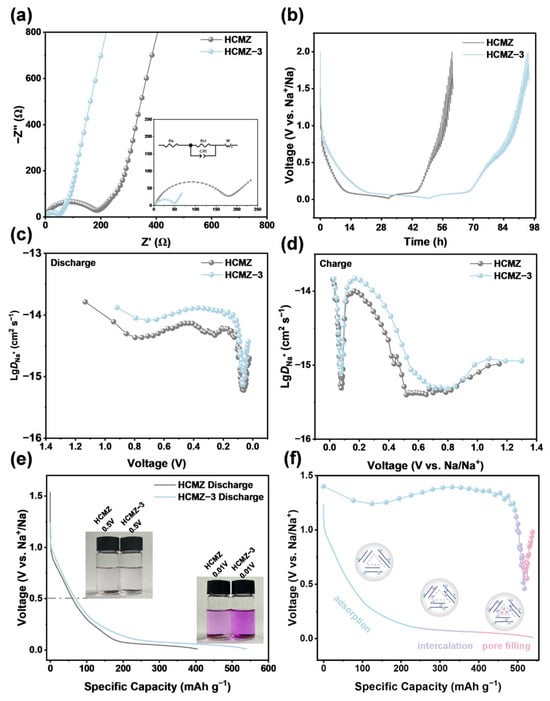
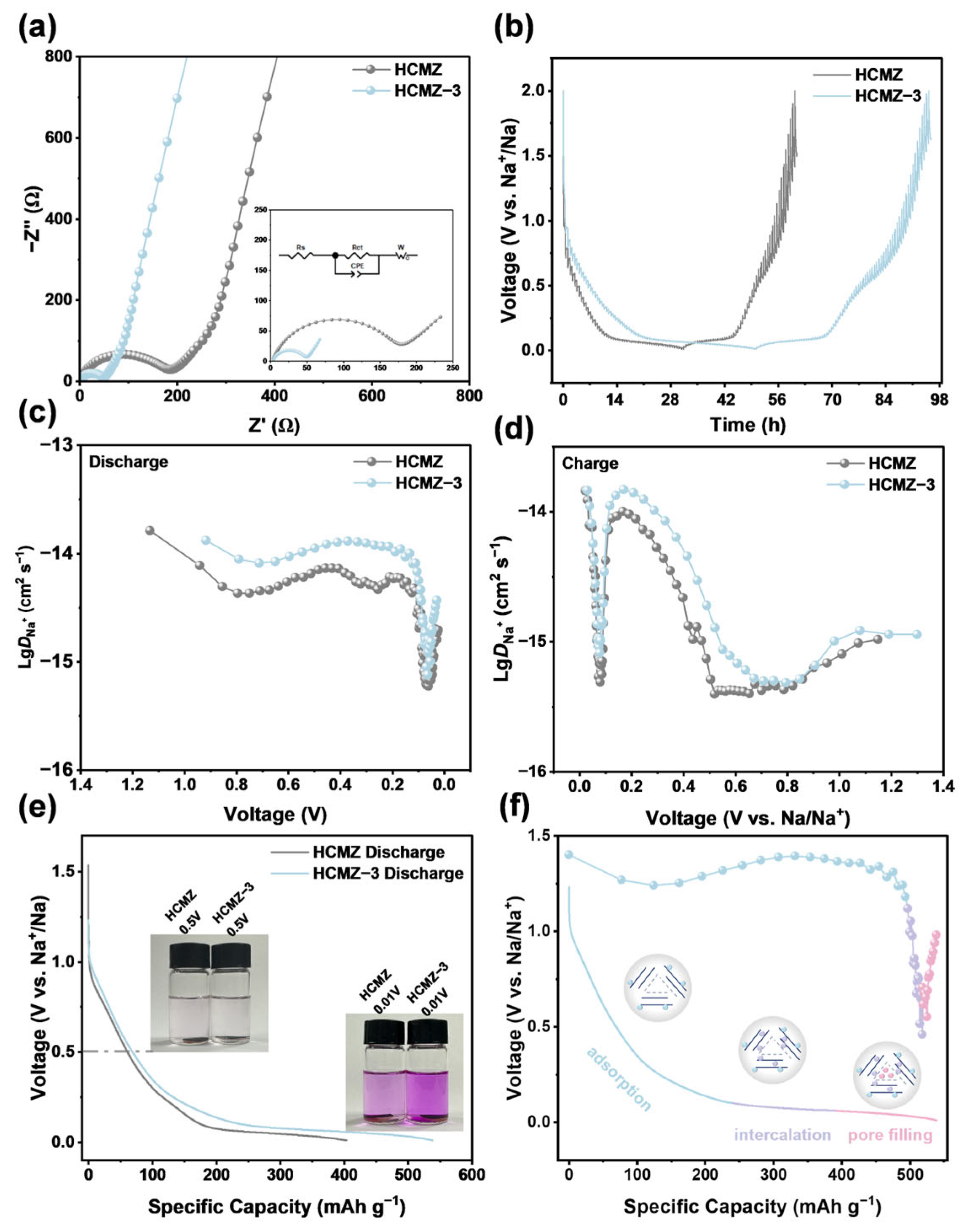
Nyquist plots from electrochemical impedance spectroscopy (Figure 5a) show semicircles in high and medium frequencies corresponding to charge transfer resistance (Rct). The activated HCMZ-X exhibits lower total impedance and enhanced charge transfer capability versus unmodified HCMZ. Specifically, HCMZ-3 achieves an Rct of 40.19 Ω at the electrode–electrolyte interface, with a 70% reduction relative to HCMZ (165.3 Ω, Table S6). To clarify the differences in Na+ storage kinetic among samples, the Na+ diffusion coefficient was assessed using the galvanostatic intermittent titration technique (GITT). As shown in Figure 5b, the Na+ diffusion coefficient () is determined from Equation (4) based on Fick’s second law [46]:
where denotes the duration of the applied current pulse; and represent the mass and molar mass of the active material, respectively; corresponds to the molar volume; refers to the active surface area of HC electrodes; and and indicate the steady-state and pulse-induced voltage variation extracted from the GITT profiles. GITT profiles of HCMZ and HCMZ-3 (Figure 5c,d) exhibit analogous variation trends during sodiation/de-sodiation, indicating comparable Na+ storage kinetics. During the discharge process (Figure 5c), both samples display a consistent decrease in . The elevated values persisting down to 0.1 V (Figure 5d) originate from rapid Na+ adsorption at active sites on the carbon surface defects. Upon saturation of these surface adsorption sites, Na+ must overcome repulsion barriers to intercalate into graphitic interlayers, causing a sharp decline in between 0.1~0.06 V. The subsequent rapid increase (0.06~0.01 V) corresponds to Na+ filling closed pores. This three-stage process aligns with the “adsorption-intercalation-filling” storage mechanism. For HCMZ-3, the synergistic interplay of elevated surface defects, enlarged interlayer spacing (0.394 nm), and plentiful closed pores collectively accelerates Na+ surface adsorption while enhancing interlayer diffusion kinetics. Consequently, HCMZ-3 maintains the highest throughout the progress, suggesting that ZnCl2 promoted sodium ion diffusion kinetics, consistent with its electrochemical performance and CV results.
Figure 5.
(a) Nyquist plots for HCMZ-3 and HCMZ; (b) GITT profiles of HCMZ-3 and HCMZ; (c,d) calculated Na+ diffusion coefficient during the discharge and charge process derived from GITT; (e) GDC curves of HCs at 0.5 A g−1 (inset: optical images of the electrodes immersed in a phenolphthalein–ethanol solution at two different states of discharge); (f) schematic illustration depicting the Na+ storage stages in the HCMZ-X anode.
Quasi-metallic sodium reacts with ethanol to generate H2 and CH3CH2ONa, inducing red coloration in phenolphthalein solutions. As verified in Figure 5e, HCMZ and HCMZ-3 electrodes, discharged to 0.5 V and 0.01 V, respectively, were immersed in 1.0 wt% phenolphthalein/ethanol solution. Upon discharging to 0.5 V, the HCMZ electrode produced a few bubbles with light pink coloration, confirming that the Na+ is mainly stored through surface adsorption in this stage. Due to weak adsorption, the Na+ easily desorbed into the solution, forming CH3CH2ONa and causing the color change. Conversely, HCMZ-3 exhibited vigorous H2 evolution upon immersion. When discharged to 0.01 V, the solution of HCMZ-3 developed a dark purple color compared to the HCMZ’s pale pink (Figure 5e inset), which demonstrates much more quasi-metallic sodium presence in HCMZ-3 as well as a closed-pore filling Na+ storage mechanism. As illustrated in Figure 5f, the Na+ storage mechanism of HCMZ-3 can be interpreted as a three-step process. Within the slope region above 0.1 V, Na+ primarily adsorbs on the surface and defect active sites of hard carbon. In the plateau region below 0.1 V, Na+ intercalates into graphitic interlayers with progressive filling of interlayer spaces. With further discharge to lower potentials (from 0.06 to 0.01 V), nucleation of sodium species takes place, resulting in the generation of quasi-metallic sodium clusters that subsequently filled the closed pores.
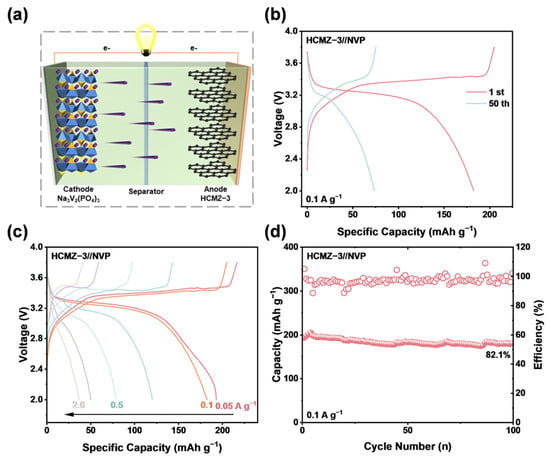
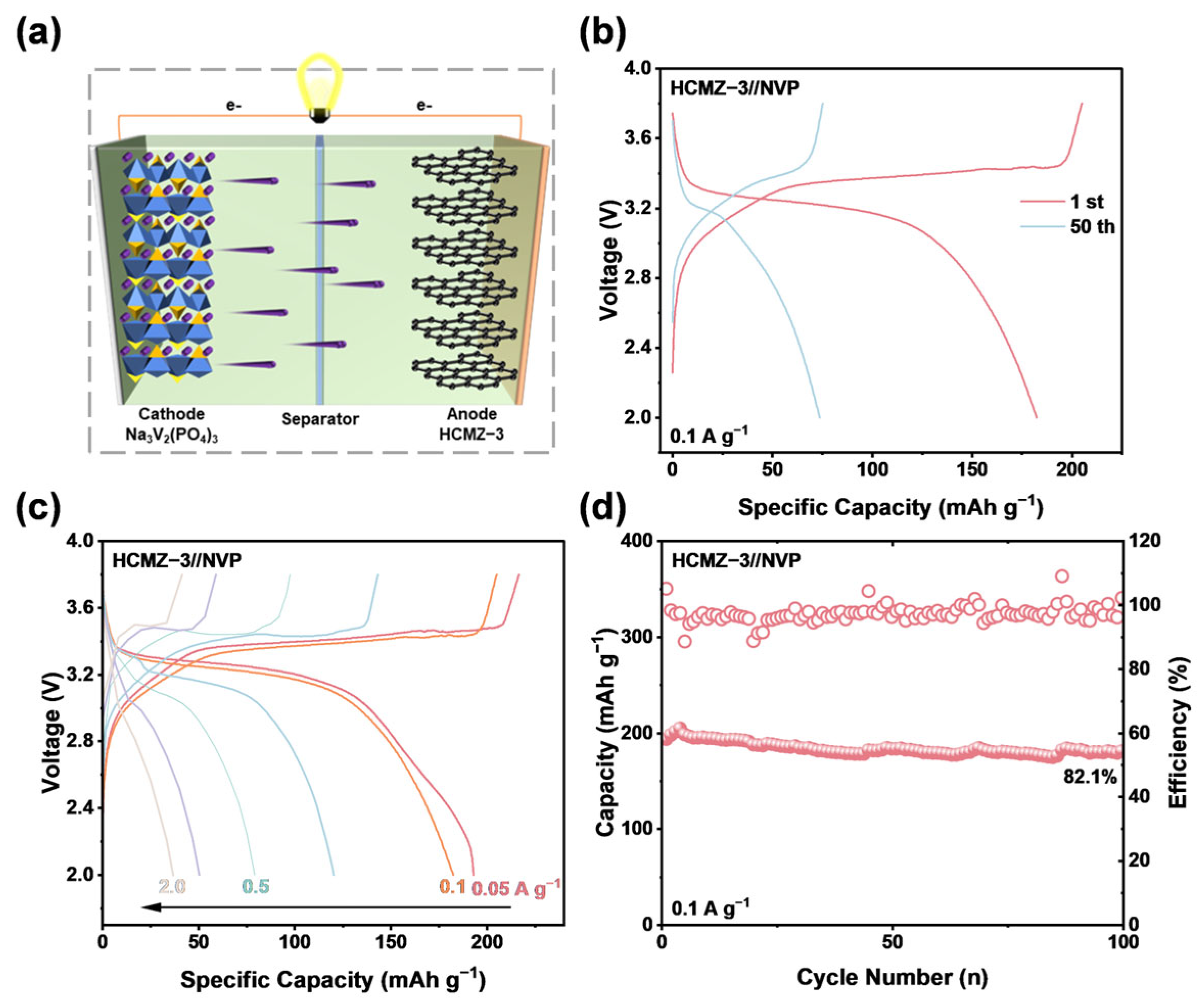
Given the outstanding electrochemical performance of HCMZ-3 in half-cells, a full cell was assembled using HCMZ-3 as the anode and commercial Na3V2(PO4)3 (NVP) as the cathode, with the corresponding schematic structure shown in Figure 6a. Electrochemical evaluation was carried out over a voltage window of 2.0 to 2.8 V at current densities ranging from 0.05 to 1.0 A g−1. Initially, the electrochemical behavior of NVP was assessed in a half-cell over a potential window of 1.5–3.8 V, where it delivered a specific charge capacity of 163.08 mAh g−1 at 0.1 A g−1 (Figure S8a). Distinct voltage plateaus appearing around 3.38 V and 3.4 V can be attributed to the V3+/V4+ redox reaction and local redox environment changes induced by Na+ relocation, respectively. At 0.05 A g−1, the assembled HCMZ-3//NVP full cell exhibited initial charge and discharge capacities of 216.57 and 193.14 mAh g−1 (Figure S8b). Irreversible capacity loss may result from anode-side SEI film formation and Na+ depletion during SEI reactions. After 50 cycles at 0.1 A g−1, the GCD curve of the HCMZ-3//NVP full cell maintained stable morphology (Figure 6b). The rate performance of the full cell is summarized in Figure 6c. At rates of 0.05, 0.1, 0.5, 0.8, 1.0, and 2.0 A g−1, the corresponding specific capacities obtained were 216.57, 172.59, 143.21, 97.55, 59.05, and 41.38 mAh g−1, respectively. Notably, as shown in Figure 6d, the full battery exhibited an exceptional cycling stability, retaining approximately 82% of its capacity after 100 cycles.
Figure 6.
(a) Schematic of HCMZ-3//NVP full cell; (b) initial charge/discharge profiles of HCMZ-3//NVP full cell at 0.1 A g−1; (c) GCD curves of HCMZ-3//NVP full cell at various current densities; (d) cycling performance of HCMZ-3//NVP full cell at 0.1 A g−1.
4. Conclusions
In summary, hard carbon anode materials were prepared using renewable and readily available macadamia shells as precursors, along with ZnCl2 introduced as a structural modifier. The electrochemical results revealed that the HCMZ-3 material modified with ZnCl2 delivers a reversible specific capacity of 382.05 mAh g−1, with 262.64 mAh g−1 contributed by the plateau region. This performance markedly exceeds that of the pristine sample, which shows a total reversible capacity of 220.67 mAh g−1 and a corresponding plateau contribution of 124.56 mAh g−1. By systematically correlating pore-structure and sodium storage behavior, it is clarified that ZnCl2-modified HC stores Na+ through a sequential “adsorption-intercalation-filling” mechanism, which is closely associated with the enlarged interlayer spacing, regulated microcrystalline domains, and generation of closed pores. Such rational pore-structure modulation enhances sodium storage efficiency without excessive surface activation, thereby partially alleviating the intrinsic energy-density limitation of unmodified hard carbon anodes. Overall, this work highlights a feasible way of ZnCl2-assisted microstructure regulation in biomass-derived hard carbon and provides a sustainable and scalable pathway toward the design of high-performance anode materials for sodium-ion batteries. Future efforts may further improve energy density through electrode densification and full-cell configuration optimization.
Supplementary Materials
The following supporting information can be downloaded at: https://www.mdpi.com/article/10.3390/pr14030419/s1, Figure S1: Schematic illustration of coin battery; Figure S2: TG and DTG analysis of (a) HCMZ and (b) HCMZ-3 precursors; Figure S3: Calculated and of individual samples based on XRD; Figure S4: Raman fitting curves of individual samples; Figure S5: Histograms of the area ratios from (a) C 1s spectra and (b) O 1s spectra deconvolution; Figure S6: The first three GCD curves for each sample; Figure S7: The first three curves of (a) HCMZ-1 and (b) HCMZ-5; Figure S8: (a) The initial charge/discharge curve of NVP half-cell at 0.1 A g-1, (b) The initial charge/discharge curve of HCMZ-3//NVP full-cell at 0.05 A g-1; Table S1: The XRD characteristic parameters of HCMZ and HCMZ-X; Table S2: The Raman characteristic parameters of HCMZ and HCMZ-X; Table S3: The XPS C1s characteristic parameters of HCMZ and HCMZ-X; Table S4: The specific data based on BET model measurements; Table S5: Comparison of specific capacity and ICE between this work and previous publication [47,48,49,50,51,52]; Table S6: The fitting data of EIS testing.
Author Contributions
Conceptualization, X.W. and H.W.; methodology, X.W. and H.W.; resources, X.W.; data curation, X.W., K.L., and Y.Z.; writing—original draft preparation, X.W.; writing—review and editing, X.W., H.W., K.L., and Y.Z.; visualization, X.W.; supervision, H.W.; project administration, H.W.; funding acquisition, H.W. All authors have read and agreed to the published version of the manuscript.
Funding
This research was funded by the National Natural Science Foundation of China (21878192), the 1000 Talents Program of Sichuan Province, the Sichuan Provincial Department of Science and Technology (No. 2024ZDZX0033), and the Sichuan Province Science and Technology Support Program (No. 2025ZNSFSC0365).
Data Availability Statement
The authors declare that the data supporting the findings of this study are available within the paper and its Supplementary Information files. Should any raw data files be needed in another format, they are available from the corresponding author upon reasonable request.
Acknowledgments
The authors appreciate Can Liu from Central Lab of the College of Materials Science and Engineering in Sichuan University for help with XRD measurements.
Conflicts of Interest
The authors declare no conflicts of interest.
References
- Tian, Y.; Zeng, G.; Rutt, A.; Shi, T.; Kim, H.; Wang, J.; Koettgen, J.; Sun, Y.; Ouyang, B.; Chen, T.; et al. Promises and Challenges of Next-Generation “Beyond Li-ion” Batteries for Electric Vehicles and Grid Decarbonization. Chem. Rev. 2020, 121, 1623–1669. [Google Scholar] [CrossRef] [Scilit]
- Hwang, J.-Y.; Myung, S.-T.; Sun, Y.-K. Sodium-ion batteries: Present and future. Chem. Soc. Rev. 2017, 46, 3529–3614. [Google Scholar] [CrossRef] [Scilit]
- Shi, C.; Wang, T.; Liao, X.; Qie, B.; Yang, P.; Chen, M.; Wang, X.; Srinivasan, A.; Cheng, Q.; Ye, Q.; et al. Accordion-like stretchable Li-ion batteries with high energy density. Energy Storage Mater. 2019, 17, 136–142. [Google Scholar] [CrossRef] [Scilit]
- Delmas, C. Sodium and Sodium-Ion Batteries: 50 Years of Research. Adv. Energy Mater. 2018, 8, 1703137. [Google Scholar] [CrossRef] [Scilit]
- Saurel, D.; Orayech, B.; Xiao, B.; Carriazo, D.; Li, X.; Rojo, T. From Charge Storage Mechanism to Performance: A Roadmap toward High Specific Energy Sodium-Ion Batteries through Carbon Anode Optimization. Adv. Energy Mater. 2018, 8, 1703268. [Google Scholar] [CrossRef] [Scilit]
- Xiao, L.; Lu, H.; Fang, Y.; Sushko, M.L.; Cao, Y.; Ai, X.; Yang, H.; Liu, J. Low-Defect and Low-Porosity Hard Carbon with High Coulombic Efficiency and High Capacity for Practical Sodium Ion Battery Anode. Adv. Energy Mater. 2018, 8, 1703238. [Google Scholar] [CrossRef] [Scilit]
- Li, Y.; Qian, J.; Zhang, M.; Wang, S.; Wang, Z.; Li, M.; Bai, Y.; An, Q.; Xu, H.; Wu, F.; et al. Co-Construction of Sulfur Vacancies and Heterojunctions in Tungsten Disulfide to Induce Fast Electronic/Ionic Diffusion Kinetics for Sodium-Ion Batteries. Adv. Mater. 2020, 32, e2005802. [Google Scholar] [CrossRef] [Scilit]
- Dong, R.; Wu, F.; Bai, Y.; Li, Q.; Yu, X.; Li, Y.; Ni, Q.; Wu, C. Tailoring Defects in Hard Carbon Anode towards Enhanced Na Storage Performance. Energy Mater. Adv. 2022, 2022, 9896218. [Google Scholar] [CrossRef] [Scilit]
- Gabriel, E.; Ma, C.; Graff, K.; Conrado, A.; Hou, D.; Xiong, H. Heterostructure engineering in electrode materials for sodium-ion batteries: Recent progress and perspectives. eScience 2023, 3, 100139. [Google Scholar] [CrossRef] [Scilit]
- Zhao, L.F.; Hu, Z.; Lai, W.H.; Tao, Y.; Peng, J.; Miao, Z.C.; Wang, Y.X.; Chou, S.L.; Liu, H.K.; Dou, S.X. Hard Carbon Anodes: Fundamental Understanding and Commercial Perspectives for Na-Ion Batteries beyond Li-Ion and K-Ion Counterparts. Adv. Energy Mater. 2020, 11, 2002704. [Google Scholar] [CrossRef] [Scilit]
- Li, Z.; Chen, Y.; Jian, Z.; Jiang, H.; Razink, J.J.; Stickle, W.F.; Neuefeind, J.C.; Ji, X. Defective Hard Carbon Anode for Na-Ion Batteries. Chem. Mater. 2018, 30, 4536–4542. [Google Scholar] [CrossRef] [Scilit]
- Luo, X.; Chen, S.; Hu, T.; Chen, Y.; Li, F. Renewable biomass-derived carbons for electrochemical capacitor applications. SusMat 2021, 1, 211–240. [Google Scholar] [CrossRef] [Scilit]
- Zhou, Z.; Wang, Z.; Zhang, Y.; Lin, Q.; Jing, Q.; Yan, S.; Guo, J.; Shuai, Y.; Fan, L. Microcrystalline reconfiguration assisted pore structure regulation towards high performance coal-derived hard carbon anodes for sodium-ion batteries. Compos. Part B Eng. 2025, 303, 112562. [Google Scholar] [CrossRef] [Scilit]
- Wang, Y.; Feng, Z.; Zhu, W.; Gariépy, V.; Gagnon, C.; Provencher, M.; Laul, D.; Veillette, R.; Trudeau, M.L.; Guerfi, A.; et al. High Capacity and High Efficiency Maple Tree-Biomass-Derived Hard Carbon as an Anode Material for Sodium-Ion Batteries. Materials 2018, 11, 1294. [Google Scholar] [CrossRef] [Scilit]
- Wang, Y.; Xiao, N.; Wang, Z.; Tang, Y.; Li, H.; Yu, M.; Liu, C.; Zhou, Y.; Qiu, J. Ultrastable and high-capacity carbon nanofiber anodes derived from pitch/polyacrylonitrile for flexible sodium-ion batteries. Carbon 2018, 135, 187–194. [Google Scholar] [CrossRef] [Scilit]
- Zhong, B.; Liu, C.; Xiong, D.; Cai, J.; Li, J.; Li, D.; Cao, Z.; Song, B.; Deng, W.; Peng, H.; et al. Biomass-Derived Hard Carbon for Sodium-Ion Batteries: Basic Research and Industrial Application. ACS Nano 2024, 18, 16468–16488. [Google Scholar] [CrossRef] [Scilit]
- Tian, W.; Wang, L.; Huo, K.; He, X. Red phosphorus filled biomass carbon as high-capacity and long-life anode for sodium-ion batteries. J. Power Sources 2019, 430, 60–66. [Google Scholar] [CrossRef] [Scilit]
- Shang, L.; Yuan, R.; Liu, H.; Li, X.; Zhao, B.; Liu, X.; Li, A.; Chen, X.; Song, H. Precursor screening of fruit shell derived hard carbons for low-potential sodium storage: A low lignin content supports the formation of closed pores. Carbon 2024, 223, 119038. [Google Scholar] [CrossRef] [Scilit]
- Wang, J.; Zhao, J.; He, X.; Qiao, Y.; Li, L.; Chou, S.-L. Hard carbon derived from hazelnut shell with facile HCl treatment as high-initial-coulombic-efficiency anode for sodium ion batteries. Sustain. Mater. Technol. 2022, 33, e00446. [Google Scholar] [CrossRef] [Scilit]
- Yan, B.; Han, C.; Dai, Y.; Li, M.; Wu, Z.; Gao, X. Biomass derived hard carbon materials for sodium ion battery anodes: Exploring the influence of carbon source on structure and sodium storage performance. Fuel 2024, 371, 132141. [Google Scholar] [CrossRef] [Scilit]
- Zhou, L.; Cui, Y.; Niu, P.; Ge, L.; Zheng, R.; Liang, S.; Xing, W. Biomass-derived hard carbon material for high-capacity sodium-ion battery anode through structure regulation. Carbon 2025, 231, 119733. [Google Scholar] [CrossRef] [Scilit]
- Tang, Y.; He, J.; Peng, J.; Yang, J.; Wu, Z.; Liu, P.; Zhou, K.; Hu, S.; Hu, L.; Wang, X. Electrochemical Behavior of the Biomass Hard Carbon Derived from Waste Corncob as a Sodium-Ion Battery Anode. Energy Fuels 2024, 38, 7389–7398. [Google Scholar] [CrossRef] [Scilit]
- Wu, C.; Yang, Y.; Zhang, Y.; Xu, H.; Huang, W.; He, X.; Chen, Q.; Dong, H.; Li, L.; Wu, X.; et al. Industrial-Scale Hard Carbon Designed to Regulate Electrochemical Polarization for Fast Sodium Storage. Angew. Chem. Int. Ed. 2024, 63, e202406889. [Google Scholar] [CrossRef] [Scilit]
- Zhang, S.; Li, Y.; Li, M. Porous Hard Carbon Derived from Walnut Shell as an Anode Material for Sodium-Ion Batteries. JOM 2018, 70, 1387–1391. [Google Scholar] [CrossRef] [Scilit]
- Li, Q.; Liu, X.; Tao, Y.; Huang, J.; Zhang, J.; Yang, C.; Zhang, Y.; Zhang, S.; Jia, Y.; Lin, Q.; et al. Sieving carbons promise practical anodes with extensible low-potential plateaus for sodium batteries. Natl. Sci. Rev. 2022, 9, nwac084. [Google Scholar] [CrossRef] [Scilit]
- Antorán, D.; Alvira, D.; Sebastián, V.; Manyà, J.J. Scalable synthesis of heteroatom-doped carbons from waste hemp hurd with enhanced sodium-ion and potassium-ion storage capabilities. Biomass Bioenergy 2025, 194, 107633. [Google Scholar] [CrossRef] [Scilit]
- Yuan, Y.; Chen, Z.; Yu, H.; Zhang, X.; Liu, T.; Xia, M.; Zheng, R.; Shui, M.; Shu, J. Heteroatom-doped carbon-based materials for lithium and sodium ion batteries. Energy Storage Mater. 2020, 32, 65–90. [Google Scholar] [CrossRef] [Scilit]
- Pal, A.; Ghosh, S.; Singha, D.; Nandi, M. Morphology Controlled Synthesis of Heteroatom-Doped Spherical Porous Carbon Particles Retaining High Specific Capacitance at High Current Density. ACS Appl. Energy Mater. 2021, 4, 10810–10825. [Google Scholar] [CrossRef] [Scilit]
- Pal, A.; Pal, M.; Ghosh, S.; Nandi, M. Nanoemulsion Technique for the Syntheses of N-Doped Porous Carbon Nanospheres and Their Application in Energy Storage Devices. Energy Fuels 2022, 36, 12285–12298. [Google Scholar] [CrossRef] [Scilit]
- Chen, R.; Cheng, Z.; Hu, Y.; Jiang, L.; Pan, P.; Mao, J.; Ni, C. Discarded clothing acrylic yarns: Low-cost raw materials for deformable c nanofibers applied to flexible sodium-ion batteries. Electrochim. Acta 2020, 359, 136988. [Google Scholar] [CrossRef] [Scilit]
- Wang, X.; Li, L.; Xie, X.; Ouyang, X.; Qiu, X.; Fan, Q.; Cheng, L. Fractionation of birch sawdust into carbohydrates and high purity lignin by ZnBr2 molten salt hydrates under mild conditions. Int. J. Biol. Macromol. 2025, 307, 142241. [Google Scholar] [CrossRef] [Scilit]
- Wen, C.; Huang, M.; Feng, C.; Kong, N.; Hou, K.; Xie, R.; Shao, Z.; Tan, R.; Han, F. Construction of microporous structure in hard carbon via adjustable Zn salt templates for high-performance sodium-ion batteries. Carbon 2024, 230, 119702. [Google Scholar] [CrossRef] [Scilit]
- Ge, P.; Hou, H.; Cao, X.; Li, S.; Zhao, G.; Guo, T.; Wang, C.; Ji, X. Multidimensional Evolution of Carbon Structures Underpinned by Temperature-Induced Intermediate of Chloride for Sodium-Ion Batteries. Adv. Sci. 2018, 5, 1800080. [Google Scholar] [CrossRef] [Scilit]
- Luo, X.; Yuan, P.; Xiao, H.; Li, S.; Luo, J.; Li, J.; Lai, W.; Chen, Y.; Li, D. Effects of Intrinsic Defects in Pt-Based Carbon Supports on Alkaline Hydrogen Evolution Reaction. ACS Appl. Mater. Interfaces 2024, 16, 26044–26056. [Google Scholar] [CrossRef] [Scilit] [PubMed]
- Yin, X.; Lu, Z.; Wang, J.; Feng, X.; Roy, S.; Liu, X.; Yang, Y.; Zhao, Y.; Zhang, J. Enabling Fast Na+ Transfer Kinetics in the Whole-Voltage-Region of Hard-Carbon Anodes for Ultrahigh-Rate Sodium Storage. Adv. Mater. 2022, 34, 2109282. [Google Scholar] [CrossRef] [Scilit]
- Xu, S.-D.; Zhao, Y.; Liu, S.; Ren, X.; Chen, L.; Shi, W.; Wang, X.; Zhang, D. Curly hard carbon derived from pistachio shells as high-performance anode materials for sodium-ion batteries. J. Mater. Sci. 2018, 53, 12334–12351. [Google Scholar] [CrossRef] [Scilit]
- Zhang, P.; Shu, Y.; Wang, Y.; Ye, J.; Yang, L. Simple and efficient synthesis methods for fabricating anode materials of sodium-ion batteries and their sodium-ion storage mechanism study. J. Mater. Chem. A 2023, 11, 2920–2932. [Google Scholar] [CrossRef] [Scilit]
- Liu, Y.; Dai, S.; Deng, J.; Jiang, D.; Ji, X.; Meng, Q.; Wang, H.; Liu, L. Precise control of the resin-based hard carbon pseudo graphite and closed pores structure to enhance sodium storage capacity. J. Colloid Interface Sci. 2025, 686, 136–150. [Google Scholar] [CrossRef] [Scilit]
- Zhang, H.; Ming, H.; Zhang, W.; Cao, G.; Yang, Y. Coupled Carbonization Strategy toward Advanced Hard Carbon for High-Energy Sodium-Ion Battery. ACS Appl. Mater. Interfaces 2017, 9, 23766–23774. [Google Scholar] [CrossRef] [Scilit] [PubMed]
- Zhou, S.; Tang, Z.; Pan, Z.; Huang, Y.; Zhao, L.; Zhang, X.; Sun, D.; Tang, Y.; Dhmees, A.S.; Wang, H. Regulating closed pore structure enables significantly improved sodium storage for hard carbon pyrolyzing at relatively low temperature. SusMat 2022, 2, 357–367. [Google Scholar] [CrossRef] [Scilit]
- Li, B.; Hu, J.; Xiong, H.; Xiao, Y. Application and Properties of Microporous Carbons Activated by ZnCl2: Adsorption Behavior and Activation Mechanism. ACS Omega 2020, 5, 9398–9407. [Google Scholar] [CrossRef] [Scilit]
- Tang, Z.; Zhang, R.; Wang, H.; Zhou, S.; Pan, Z.; Huang, Y.; Sun, D.; Tang, Y.; Ji, X.; Amine, K.; et al. Revealing the closed pore formation of waste wood-derived hard carbon for advanced sodium-ion battery. Nat. Commun. 2023, 14, 6024. [Google Scholar] [CrossRef] [Scilit] [PubMed]
- Fan, M.; Shao, Y.; Wang, Y.; Sun, J.; He, H.; Jiang, Y.; Zhang, S.; Wang, Y.; Hu, X. Preparation of activated carbon with recycled ZnCl2 for maximizing utilization efficiency of the activating agent and minimizing generation of liquid waste. Chem. Eng. J. 2024, 500, 157278. [Google Scholar] [CrossRef] [Scilit]
- Beda, A.; Vaulot, C.; Rabuel, F.; Morcrette, M.; Matei Ghimbeu, C. The role of specific and active surface areas in optimizing hard carbon irreversible capacity loss in sodium ion batteries. Energy Adv. 2022, 1, 185–190. [Google Scholar] [CrossRef] [Scilit]
- Zheng, Z.; Hu, S.; Yin, W.; Peng, J.; Wang, R.; Jin, J.; He, B.; Gong, Y.; Wang, H.; Fan, H.J. CO2-Etching Creates Abundant Closed Pores in Hard Carbon for High-Plateau-Capacity Sodium Storage. Adv. Energy Mater. 2023, 14, 2303064. [Google Scholar] [CrossRef] [Scilit]
- Xiao, H.; Wang, F.; Peng, J.; Luo, J.; Li, H.; Wang, Z.; Luo, X.; Chen, Y. Zinc-assisted modification of hard carbon for enhanced sodium-ion storage. J. Electroanal. Chem. 2025, 978, 118889. [Google Scholar] [CrossRef] [Scilit]
- Kim, K.; Lim, D.G.; Han, C.W.; Osswald, S.; Ortalan, V.; Youngblood, J.P.; Pol, V.G. Tailored Carbon Anodes Derived from Biomass for Sodium-Ion Storage. ACS Sustain. Chem. Eng. 2017, 5, 8720–8728. [Google Scholar] [CrossRef] [Scilit]
- Nanaji, K.; Rao, T.N. A High-Performance Dual-Carbon Na-Ion Capacitor Fabricated from a Single Biowaste Precursor. Energy Technol. 2023, 11, 2300493. [Google Scholar] [CrossRef] [Scilit]
- Kumar, U.; Wu, J.; Sharma, N.; Sahajwalla, V. Biomass Derived High Areal and Specific Capacity Hard Carbon Anodes for Sodium-Ion Batteries. Energy Fuels 2021, 35, 1820−1830. [Google Scholar] [CrossRef] [Scilit]
- Dou, X.; Hasa, I.; Hekmatfar, M.; Diemant, T.; Behm, R.J.; Buchholz, D.; Passerini, S. Pectin, Hemicellulose, or Lignin? Impact of the Biowaste Source on the Performance of Hard Carbons for Sodium-Ion Batteries. ChemSusChem 2017, 10, 2668–2676. [Google Scholar] [CrossRef] [Scilit]
- Ren, X.; Xu, S.-D.; Liu, S.; Chen, L.; Zhang, D.; Qiu, L. Lath-shaped biomass derived hard carbon as anode materials with super rate capability for sodium-ion batteries. J. Electroanal. Chem. 2019, 841, 63–72. [Google Scholar] [CrossRef] [Scilit]
- Canbaz, E.; Aydin, M.; Çakan, R.D. Investigation of Hazelnut Shells Driven Hard Carbons as Anode For Sodium-Ion Batteries Produced By Hydrothermal Carbonization Method. Turk. J. Chem. 2022, 46, 356–366. [Google Scholar] [CrossRef] [Scilit] [PubMed]
Disclaimer/Publisher’s Note: The statements, opinions and data contained in all publications are solely those of the individual author(s) and contributor(s) and not of MDPI and/or the editor(s). MDPI and/or the editor(s) disclaim responsibility for any injury to people or property resulting from any ideas, methods, instructions or products referred to in the content. |
© 2026 by the authors. Licensee MDPI, Basel, Switzerland. This article is an open access article distributed under the terms and conditions of the Creative Commons Attribution (CC BY) license.