


Abstract
The objective of this study was to evaluate the insecticidal potential of custard apple (Annona squamosa L.) seed extract against Chrysodeixis includens, a major soybean pest, and to assess its toxicological effects on a non-target organism. The extract was obtained by ultrasound-assisted extraction using water as the solvent. Ingestion bioassays exposed C. includens larvae to aqueous extract concentrations ranging from 0.25 to 10.0 g/L, with Dipel WG® (5 g/L) and an untreated diet used as positive and negative controls, respectively. Mortality rates ranged from 40 to 97%, increasing with exposure time and concentration up to 1 g/L and remaining statistically stable at higher concentrations after 120 h. Extract concentrations from 1 to 10 g/L did not differ significantly from the positive control. Ecotoxicological assays were conducted using zebrafish (Danio rerio) exposed to extract concentrations of 0.84–16.80 µg/L, and biomarkers of neurotoxicity and oxidative stress were evaluated. At 16.8 µg/L, the extract caused lower biomarker alterations than Dipel WG®, indicating reduced oxidative damage. Overall, A. squamosa seed extract effectively controls C. includens at low concentrations with minimal environmental risk to non-target organisms.
1. Introduction
The excessive use of chemical pesticides in agricultural management has been associated with environmental impacts and risks to human health due to their persistence and bioaccumulation potential, which lead to ecosystem contamination and the degradation of soil, water, and air, with negative effects on biodiversity and the safety of food systems [1]. The associated impacts and side effects include the development of resistance and the mortality of non-target organisms with high economic value, such as pollinators, honey-producing species, and beneficial insects that assist farmers in the natural control of pests [2,3]. Furthermore, the continuous input of pesticides into freshwater environments exerts adverse effects on the aquatic microbiome by reducing species richness and evenness, altering microbial community composition and enzymatic activities, and interfering with the biogeochemical processes of aquatic ecosystems [4]. The impacts caused by the indiscriminate use of pesticides are most often incalculable due to the contamination of these substances, high levels of toxicity, and chemical persistence in the environment. In this way, estimates of the impacts and harmful effects of the use of pesticides increase and are evidenced by studies and scientific research that report the constant environmental degradation that is occurring [5,6]. The need to prevent the negative impact of some pesticides on human health and the environment and consumer expectations in terms of chemical residues in food has stimulated research into innovative tools and methods for sustainable pest management [7,8].
The need for alternative control methods for the management of agricultural pests has become a central issue in achieving a balance between agricultural productivity and sustainable development. This represents a fundamental action to ensure human quality of life, food security, and the right to an ecologically balanced environment. In this segment, promising reports on the use of botanical extracts have been increasingly disseminated in the search for control methods with less environmental aggressiveness and yet efficient in the replacement of chemical products [9,10,11,12,13].
Plants produce a series of defense compounds with natural insecticidal, herbicidal, and fungicidal potential [9,14]. Often, the use of bioactive compounds in pest and disease control has advantages over synthetic products. Some advantages of plant extracts in relation to pesticides can be cited, such as the use of new compounds that pests are not yet able to inactivate, less toxicity than synthetic chemical compounds, multiple modes of action, and rapid biodegradation. The combination of these factors allows multiple uses of plant extracts, in addition to their selective action within each pest class [15].
In the search for promising plants with insecticidal activity, Annona squamosa L., commonly known as custard apple, represents a suitable natural resource for pest control. The literature indicates that plant-derived pesticides have high potential as alternatives to chemically synthesized pesticides, with A. squamosa standing out due to the presence of acetogenins in its plant tissues and fruits, which are associated with natural pesticidal activity [16]. The fruits, and particularly the seeds, contain high concentrations of annonaceous acetogenins, which may confer antibacterial, antiparasitic, antifungal, molluscicidal, insecticidal, and acaricidal properties to the extracts [17,18]. Studies further demonstrate that seeds and leaf extracts of A. squamosa L. exhibit a high diversity of phytochemicals, including alkaloids, triterpenoids, phenolic compounds, peptides, acetogenins, essential oils, and fixed oils, which together represent a substantial fraction of the chemical profile of the species [16,19,20]. Although no phytochemical quantification was performed in the present study, there is extensive literature demonstrating that seeds of Annona squamosa L. are particularly rich in annonaceous acetogenins, which are considered the main bioactive compounds responsible for insecticidal activity. More than 70 acetogenins have been isolated from A. squamosa seeds, and HPLC-DAD analyses report total acetogenin contents in the 2.29 mg g−1 of supercritical CO2 extracts [17,21]. Consequently, formulations that use the extract of custard apple can become an alternative for controlling extremely important pests, especially for pests that attack crops of great commercial interest, as is the case of Chrysodeixis includens, which attacks mainly the soybean crop and causes significant reductions in productivity and quality.
For this control, extraction techniques should be used to obtain the target compounds with biological activities found in plants. One example is the ultrasound-assisted extraction technique, which is based on the action of low-frequency mechanical waves. Cavitation, a phenomenon responsible for the formation and collapse of bubbles, plays an important role in the process of extracting solutes. The mechanical effects of ultrasound allow the penetration of the solvent into cellular materials and improve mass transfer due to the effects of microextraction. Furthermore, a reduction in particle size, mass transfer across cell membranes, shear forces, and microjets are reported effects [22]. This technique is an alternative for improving the efficiency of biotechnological processes [23] and an option to extracting bioactive compounds from plants, as it increases the extraction yield, working at lower temperatures and for a shorter time than in conventional techniques such as Soxhlet extraction [24].
Based on this background, the main objective of this work was to evaluate the insecticidal effect of custard apple seeds extract on one of the main agricultural pests that attack the soybean crop: the Chrysodeixis includens caterpillar. In addition, looking for field applications, the evaluation of toxicological safety for non-target organisms through aquatic toxicology experiments was a complementary specific objective.
2. Materials and Methods
2.1. Raw Material
Fruits of custard apple (Annona squamosa L.) were collected in the city of Vale Real (Brazil; 29°23′52″ S, 51°15′14″ W). Initially, the fruits were washed with water and sanitized with a sodium hypochlorite solution (10%). Subsequently, the fruits were manually separated, according to their state of maturation, into three parts: seed, peel, and pulp. After separation and classification, the seeds were stored under refrigeration at −18 °C for further use.
2.2. Ultrasound-Assisted Extraction
The seeds of custard apple were ground in a common blender. Thereafter, 20 g of milled seeds were mixed with distilled water at a 1:4 mass ratio in the extraction vessel. The mixture was inserted into an ultrasound-assisted extraction apparatus (QR500, Eco-Sonics, Indaiatuba, Brazil) coupled to an ultrathermostatic bath (SL 152, Solab, Piracicaba, Brazil) for maintaining the jacketed extraction vessel under constant refrigeration of 5 °C. The probe used was the Hielscher model UP400S (Hielscher Ultrasonics GmbH, Teltow, Germany) with a 22 mm diameter and an acoustic power density of 85 W/cm2. The extraction was performed for 1 h with 400 W power, a working frequency of 24 kHz, and a pulse cycle of 0.5.
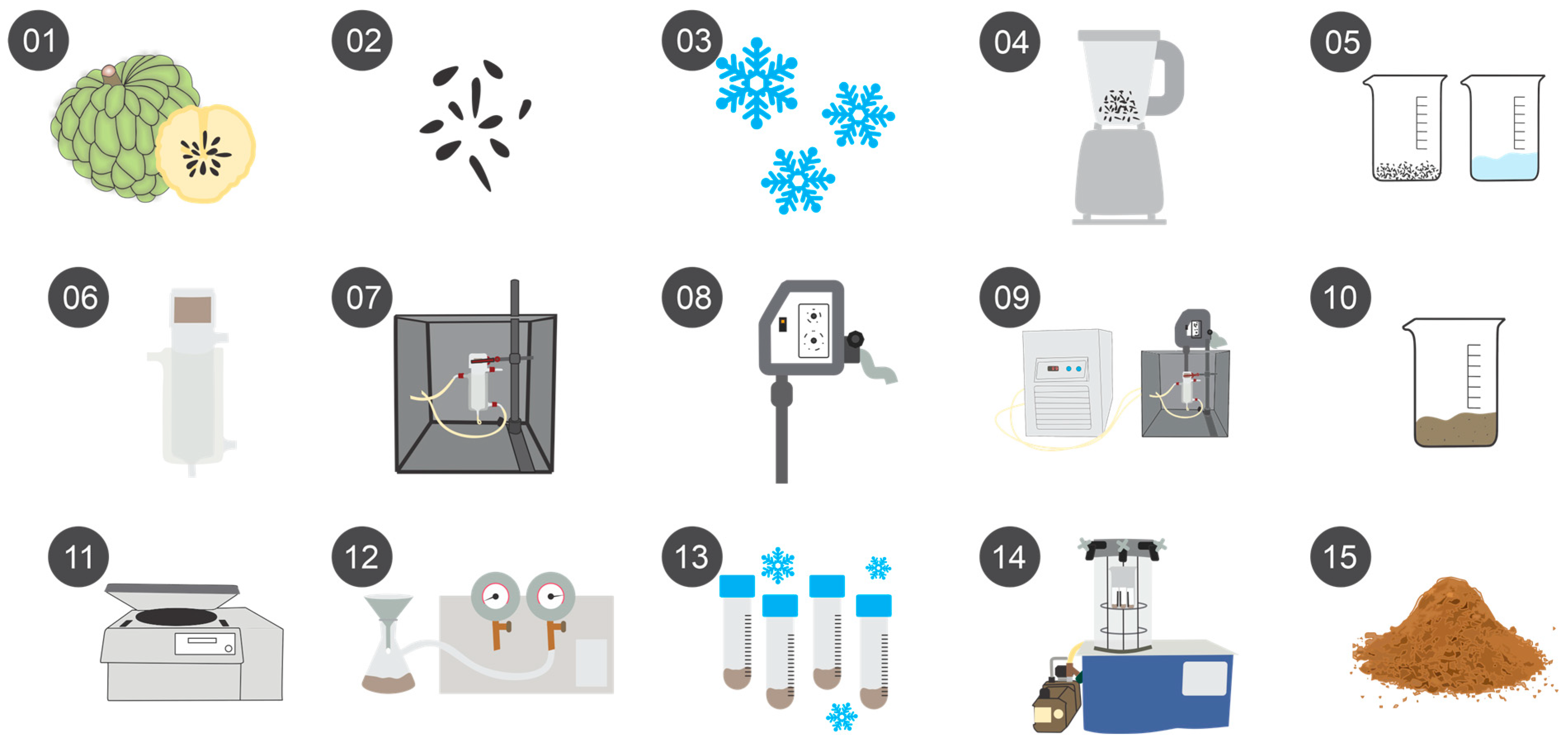
After extraction, the samples were centrifuged (5804R, Eppendorf, Hamburg, Germany) at 4000 rpm for 10 min at 10 °C. The fractions were separated, and the supernatant was transferred to a beaker, which was filtered through a filter paper inserted into a Buchner funnel with a vacuum pump to obtain the extract. After filtration, the extract was dried to obtain the dry powder extract. A freeze-dryer (L101, Liotop, São Carlos, Brazil) was used for freeze-drying the sample for 48 h. At the end of the lyophilization process, the material obtained was macerated for later use, producing a powder. For the bioassays, the lyophilized extract was reconstituted in distilled water to obtain the desired test concentrations. The extraction process resulted in a yield of 1.25% (w/w) relative to the initial dry seed mass. In Figure 1, it is possible to visualize the steps involved to obtain the seed extract.
2.3. Ingestion Bioassays with Chrysodeixis Includens
The caterpillars used for the bioassays were obtained from a susceptible population created at the Entomology Laboratory at the Department of Plant Protection of the Federal University of Santa Maria. The caterpillars were maintained on an artificial diet proposed by Portela, Moro, Santana, Baldoni, Castro, Antoniolli, Dalcol, and Jacques [25] until performing the bioassays. For the experiments, caterpillars in the 3rd growth instar were used. To quantify the concentrations, a spray volume of 100 L/ha was considered. The pests were exposed to the extract of custard apple under different concentrations: 0.25, 0.5, 1.0, 1.5, 2.0, 2.5, and 5.0 g/L. These concentrations are equivalent to treatments of 25, 50, 100, 150, 200, 250, and 500 g/ha, named as BE25–BE500. As a positive control, the commercial insecticide Dipel WG® (Valent BioSciences, Libertyville, IL, USA) was used, classified as a microbiological insecticide for ingestion. For comparison purposes, Dipel insecticide bioassays were performed at a concentration of 5 g/L (Dipel treatment of 500 g/ha). For the negative control (CTL), the pests did not receive any treatment during the evaluation; that is, they were only maintained on an artificial diet.
For the ingestion bioassays, based on a spray volume of 100 L/ha and considering the area of the pot, 290 µL of each treatment was applied on the surface of the diet and allowed to dry. The products were diluted in distilled water to achieve the stipulated concentrations. The caterpillars were exposed to a specific diet in transparent pots with a lid and kept under temperature conditions of 25 ± 2 °C, 60 ± 10% relative humidity, and a photoperiod of 14:10 h (light/dark). The treatments BE25, BE50, BE100, BE150, BE200, BE250, and BE500 were performed with ten replications, each one containing ten caterpillars. The mortality was evaluated every 24 h until 5 days after exposure to treatments. Caterpillars that did not show any movement to the touch were considered dead. At the end of the experiment (120 h), corrected mortality was calculated according to Abbott’s formula [26].
Figure 1.
Steps used for obtaining powder extract from Annona squamosa L. seeds. 01: Annona squamosa; 02: separation/classification of seeds; 03: seed freezing; 04: grinding; 05: fractions of milled seeds and water; 06: extraction vessel; 07: ultrasound apparatus; 08: probe; 09: extraction apparatus; 10: crude extract; 11: centrifugation; 12: supernatant filtration; 13: extract freezing; 14: lyophilization; 15: powder extract.
2.4. Aquatic Toxicology
Six zebrafish (Danio rerio) were placed in aquariums, each one containing 4 L of solution, under different concentrations of seed extract (0.84, 1.68, 2.52, 3.36, and 16.8 µg/L), Dipel WG (16.8 µg/L), and the negative control (no product, only water). The specification of each treatment can be seen in Table 1. Studies have reported the presence of pesticides in surface waters at environmentally relevant concentrations, typically in the µg L−1 range, and evidence indicates that exposure at these levels may be associated with sublethal effects in aquatic organisms, including Danio rerio [27]. In addition, ecotoxicological evidence shows that environmentally realistic concentrations of pesticides such as atrazine (e.g., 1, 2, 5, 10, 15, and 20 µg L−1) are capable of inducing physiological and genotoxic responses in fish [28]. Field surveys further confirm the occurrence of pesticides in aquatic systems receiving runoff from agricultural areas, highlighting the ecological relevance of testing concentrations within this range [29]. Each concentration adopted in the experiment was performed in triplicate. The fish were placed in the aquariums under constant aeration throughout the 5 days. The investigation of the experiment was carried out every 12 h for 5 days to assess the possible occurrence of lethal effects on fish.
Table 1.
Assays performed in the aquatic toxicology experiment.
After exposure, zebrafish were anesthetized using an ice bath and euthanized by spinal cord section. Brain and muscle tissues were removed and homogenized in 50 mmol/L Tris-HCl buffer at pH 7.5. Homogenates were centrifuged at 3000× g for 10 min and frozen at −80 °C for further analysis.
2.5. Biochemical Analyses
The enzyme acetylcholinesterase (AChE) was measured in triplicate in the brain and muscle due to its importance in neuromuscular transmission, following the methodology described by Ellman, Courtney, Andres, and Featherstone [30]. Enzyme activity was expressed as µmol hydrolyzed ASCh/(min mg protein).
The enzyme glutathione-S-transferase (GST) was measured according to the methodology described by Habig, Pabst, and Jakoby [31]. The reaction medium contained 1 mmol of 1-chloro-2, 4-dinitrobenzene (CDNB) prepared in ethyl alcohol, 10 mmol reduced glutathione (GSH), and 20 mmol of phosphate buffer (pH 6.5). A content of 10 µL of the brain homogenate was added to this reaction medium. One enzymatic unit was defined as the amount of enzyme required to catalyze the conjugation of 1 mmol of CDNB with GSH per minute in a reaction medium at 25 °C. Enzyme activity was expressed as µmol GS-DNB/(min mg protein).
Lipid peroxidation was estimated through the concentration of thiobarbituric acid reactive substances (TBARSs) and the estimate of lipid peroxidation that occurs through the production of TBARSs, which represents the oxidation of lipids. Following the methodology described by Draper and Hadley [32], 80 µL of brain homogenate was mixed with 160 µL of trichloroacetic acid (10%) and centrifuged (3000× g) for 10 min. The resulting supernatant was used to measure lipid peroxidation. For the assay, 100 µL of homogenate was used, mixed with 100 µL of thiobarbituric acid (TBA) at a concentration of 0.67%. After brief stirring, the mixture was placed in a water bath at 100 °C for 30 min. TBARS levels were expressed as nmol malondialdehyde (MDA)/mg tissue.
The determination of carbonyl protein concentration was carried out using the methodology described by Parvez and Raisuddin [33]. The proteins of the samples were determined with Coomassie blue reagent, using bovine albumin as a standard, according to the method of Bradford [34]. Carbonyl protein was expressed as nmol carbonyl/mg protein.
2.6. Statistical Analysis
The data obtained at the end of the evaluation period (after 120 h) were submitted to a one-way analysis of variance (ANOVA), expressed as mean ± deviation standard, to determine the mortality of caterpillars in the different treatments performed during the ingestion bioassays. The occurrence of toxicological effects from the biochemical analyses was assessed through a one-way ANOVA, expressed as mean ± standard deviation. After performing the ANOVA, the significant results of both experiments were analyzed using Tukey’s test at a 95% confidence level, and significant results were considered with p ≤ 0.05.
3. Results and Discussion
3.1. Insecticidal Effects
The insecticidal bioassays with different concentrations of Annona squamosa L. extract against Chrysodeixis includens were evaluated every 24 h over a 5-day period. The counts of dead insects are presented in Table 2, along with the final mortality at 120 h corrected according to Abbott’s formula. The occurrence of the lethal effect of the extract on the caterpillars gradually increased over time. Also, high concentrations caused high mortality, especially in the first 48 h. Thereafter, the mortality indices tended to equalize from the BE100 assay (equivalent to 100 g/ha or a concentration of 1 g/L (0.1% w/v)).
Table 2.
Mortality of Chrysodeixis includens for different treatments using extracts from Annona squamosa L. and comparison with Dipel WG®, including corrected mortality at 120 h calculated using Abbott’s formula.
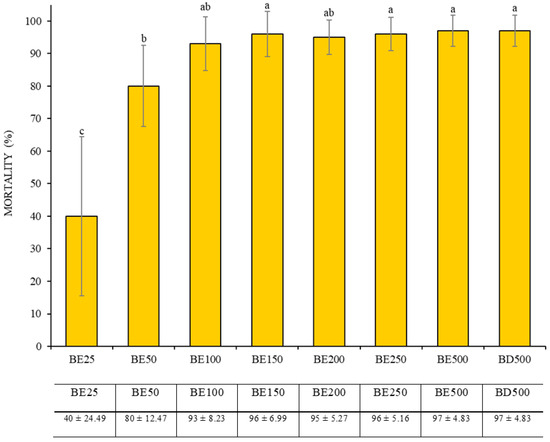
The data of mortality presented in Table 2 for assays with 10 replications were adjusted according to the verification of the control mortality to carry out the statistical analysis; that is, the mortality of the negative control was discounted. Therefore, after 120 h of exposure to different assays, these results with standard deviation and mean comparison are shown in Figure 2.
Figure 2.
Mortality of Chrysodeixis includens after 120 h of Annona squamosa L. extract or Dipel WG® exposure; the bars indicate standard deviation (n = 10). Different letters indicate significant differences among treatments (Tukey test, p < 0.05). ANOVA: Pr > Fc: 0.0000; CV(%): 12.71.
Five assays (BE100, BE150, BE200, BE250, and BE500) did not show difference in mortality among them when compared to the BD500 treatment (positive control with Dipel WG®). The assays BE50, BE100, and BE200 did not differ among them as well. Only assay BE25 was different from the others and presented the lowest mortality: 40%. Otherwise, for assays with concentrations equal to or higher than 1 g/L (equivalent to 100 g/ha), the average mortality indices were higher than 93%. Therefore, for controlling the Chrysodeixis includens caterpillar that intensively attacks soybean and other crops, the concentration of Annona squamosa L. seed extract of 1 g/L is as efficient as the higher concentrations tested for the extract and also for the BD500 treatment (commercial Dipel WG®).
At the laboratory level, the concentration of 0.5 g/L presents an efficiency of control of caterpillars of 80%, which satisfactorily meets the control in the minimum level of mortality needed in field applications. For concentrations higher than 1 g/L, the mortality stabilizes even with increasing concentrations.
Overall, the extract of custard apple seeds was demonstrated to be efficient in the control of the Chrysodeixis includens caterpillar. Elsewhere, other scientific works also report the efficiency of extracts of this plant species for controlling pests that attack soybean and other crops. For example, the microencapsulation of custard apple seed extract was efficient in the mortality of the two-spotted spider mite (Tetranychus urticae) [35]. Aqueous extracts of custard apple seeds induced toxicity against all stages of Aedes aegypti, Anopheles stephensi, and Culex quinquefasciatus mosquitoes. In addition to being safe on non-target aquatic organisms, the results demonstrated that the seed extract can act as an alternative insecticidal agent for the control of target mosquitoes [36]. The same trend was observed with custard apple extracts on Aedes albopictus. Adulticidal, ovicidal, larvicidal, ovipositional deterrent, and chemosterilant activities of the fraction on Aedes albopictus were demonstrated. The extracts were also stable on exposure to solar radiation and high temperature [37].
The extract of custard apple seeds presented a lethal and sublethal effect against the corn weevil (Sitophilus zeamais), the Mexican bean weevil (Zabrotes subfasciatus), and the cowpea weevil (Callosobruchus maculatus). In addition to the acute toxicity effect, the extract showed efficacy superior to the commercial bioinsecticide Anoson® [38]. The extract of this plant also showed efficiencies of 80 and 76% control against the cotton aphid (Aphis gossypii Glov.) and the two-spotted mite (Tetranychus urticae Koch.), respectively [39]. In a review, 35 studies that used parts of custard apple as an insecticide against different insect species were compiled. Approximately 43% (15 studies) reported insecticidal action of custard apple seeds, demonstrating this part of the plant has potential compounds to control insects and other pests [40].
Specifically regarding the control of the Chrysodeixis includens caterpillar, other extracts have been investigated. For instance, black pepper (Piper aduncum L.) essential oil presented an insecticidal effect on 3rd-instar caterpillars in ingestion bioassays. In that study, the treatments consisted of the application of Piper aduncum L. essential oil diluted in acetone at concentrations of 0.5, 1.0, 2.0, 4.0, and 8.0% and two controls with water and acetone. At the end of 120 h of exposure, both controls with water and acetone showed 6.7% mortality, while the treatment of essential oil diluted in acetone at a concentration of 0.5% did not show mortality. For concentrations of 1.0, 2.0, 4.0, and 8.0%, mortality indices of 33.3, 73.3, 100, and 100%, respectively, were reported [41]. Indirectly comparing such results with our study, the control of such caterpillars in the third instar using Annona squamosa L. was also high using lower product concentrations (1 g/L, which is equivalent to 0.1% (w/v)), diluted only in water, which is a GRAS solvent.
Crude extract of Annona crassiflora Mart. at a concentration of 8% showed mortality indices of Chrysodeixis includens of 60, 33.3, and 26.6% when testing the first, third, and fifth instar, respectively, after 120 h, in ingestion bioassays exposure [42]. In another work, eleven plant extracts were tested for controlling Chrysodeixis includens, such as Cedrela fissilis, Piper sp., Ricinus communis, Syzygium jambolanum, and Eugenia uniflora, among others. The extract that caused the highest mortality (56.7%), after 120 h, was obtained from Ricinus communis (fruits and seeds) using a hydroalcoholic solution (10% concentration). The other mortality indices ranged from 31.6 to 48.3% [43]. In the same trend, the mortality indices of the target caterpillar in the third instar obtained in this study with Annona squamosa L. seed extract were better at lower aqueous concentrations than those presented with Ricinus communis and Annona crassiflora Mart. extracts.
3.2. Toxicological Effects
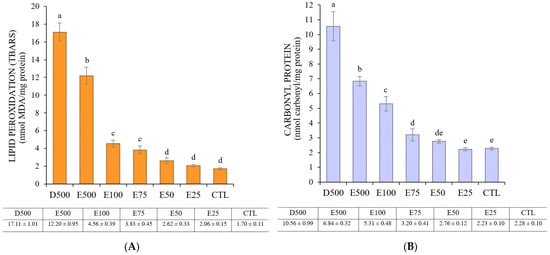
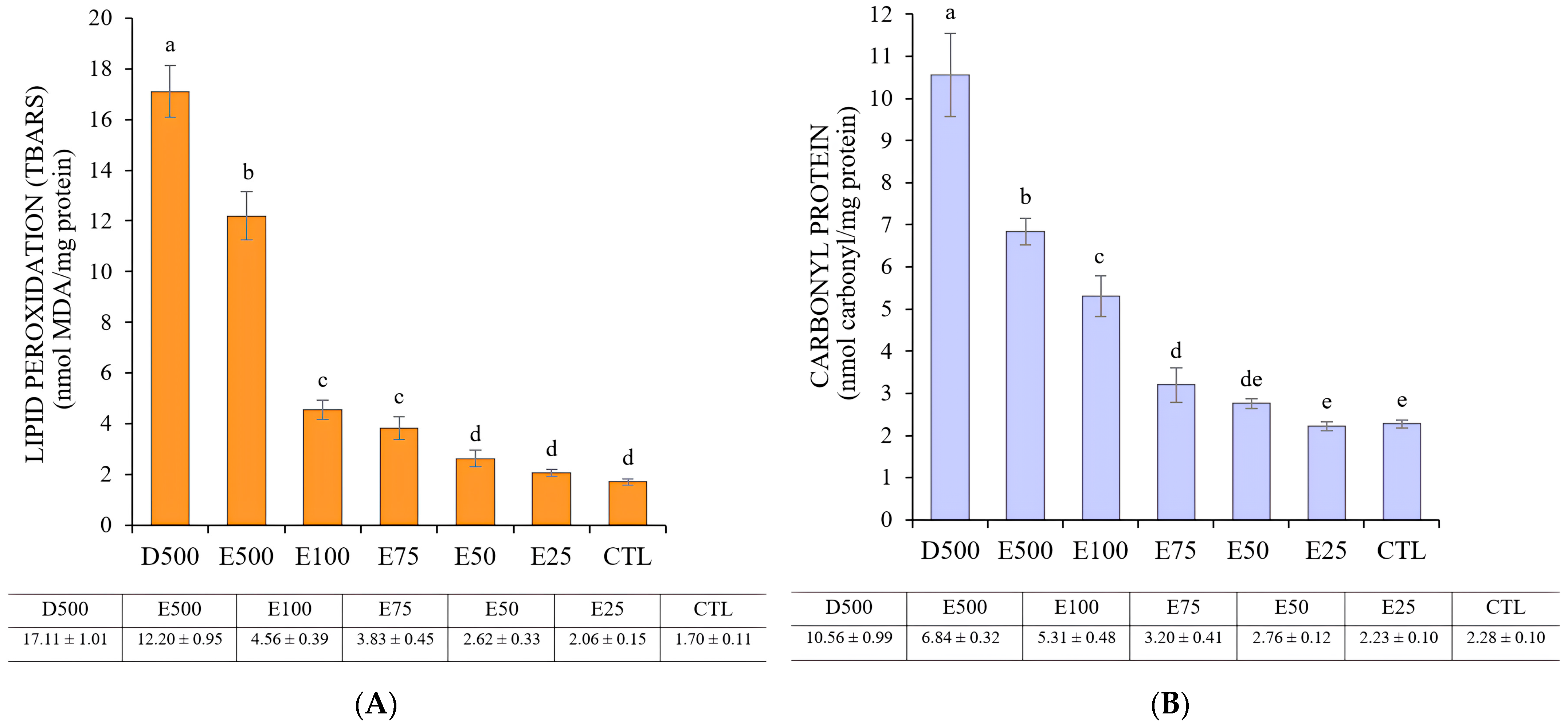
The behavior of the levels of lipid peroxidation and carbonyl protein recorded after exposure of the zebrafish (Danio rerio) to different concentrations of custard apple seed extract (E25, E50, E75, E100, and E500) and the commercial bioinsecticide Dipel WG® (D500) is seen in Figure 3. Lipid peroxidation levels were estimated by the production of thiobarbituric acid reactive substance (TBARS). According to Severo, Marins, Cerezer, Silva, Nunes, Prestes, Zanella, and Loro [44], lipid peroxidation is a common response seen after exposure to pesticides. According to the results (Figure 3A), the assays E25 and E50 did not differ significantly from the negative control treatment (CTL). Therefore, they did not present oxidative damage during exposure. There was not a significant difference between assays E75 and E100, but they showed a difference from the other treatments. The E500 assay showed a higher mean of TBARS in relation to CTL, E25, E50, E75, and E100 assays, but it presented significantly lower values (approximately 29% lower) when compared to the D500 treatment (positive control with Dipel WG®).
Figure 3.
Lipid peroxidation (A) and carbonyl protein (B) of different concentrations of extract (E25–E500) and comparison with Dipel WG® (D500) and negative control (CTL); the bars indicate standard deviation (n = 3). Different letters indicate significant differences among treatments (Tukey test, p < 0.05). ANOVA: (A) Pr > Fc: 0.0000; CV(%): 9.32 (B) Pr > Fc: 0.0000 CV(%): 9.81.
Figure 3B shows the changes in carbonyl protein in zebrafish after exposure to extract concentrations. The levels of carbonyl protein production in treatments D500, E500, E100, and E75 coincide with the change in TBARS levels. The production of protein carbonyl from the E25 and E50 assays did not differ significantly from the CTL treatment. The assays E75, E100, E500, and D500 showed a significant difference with the CTL treatment and also among themselves. The highest average production of carbonyl protein was observed in the D500 assay. Considering that Dipel WG® is a biological product with low toxicological effects, the extract concentrations evaluated in this study are even lesser remarkable regarding the oxidative stress of zebrafish.
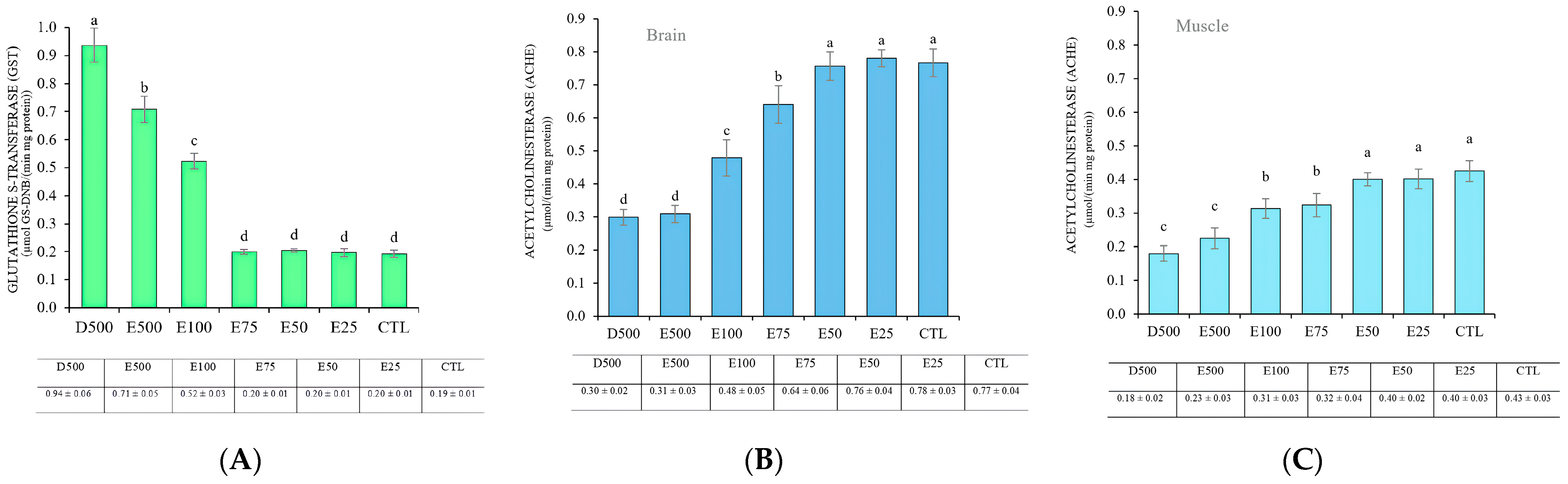
In Figure 4, it is shown that the GST activity differs from the negative control (CTL) assay for E100, E500, and D500 assays, with all extracts presenting lower GST activity than the commercial Dipel WG. Assays E25, E50, and E75 did not differ significantly from the CTL, indicating that under these conditions the exposure of non-target aquatic organisms to these substances could be safe and there would be no toxicological effect on zebrafish. The increase in GST values indicates that the enzyme transformed to excrete xenobiotics, which can indicate the occurrence of a toxicological effect on fish. However, the values presented in Figure 4A are in the range of 30–180 times lower than those presented for exposure of zebrafish to different concentrations of deep eutectic solvents, which were reported as non-toxic systems [45].
Figure 4.
Glutathione S-transferase (A) acetylcholinesterase—brain (B) and acetylcholinesterase—muscle (C) of different concentrations of extract (E25–E500) and comparison with Dipel WG® (D500) and the negative control (CTL); the bars indicate standard deviation (n = 3). Different letters indicate significant differences among treatments (Tukey test, p < 0.05). ANOVA: (A) Pr > Fc: 0.0000; CV(%): 7.57 (B) Pr > Fc: 0.0000; CV(%): 7.14 (C) Pr > Fc: 0.0000; CV(%): 8.83.
Different from the GST enzyme, where the alteration occurs when its levels increase in the presence of a certain contaminant, in the AChE, the alteration occurs by a decrease in the enzyme values. Some pesticides cause a decrease in the activity of this enzyme, which causes muscle and behavioral changes in aquatic organisms such as fish [46,47]. The results obtained from the analysis of zebrafish biological tissues, brain (Figure 4B), and muscle (Figure 4C) regarding AChE activity are presented. The results obtained through the analysis of AChE showed a significant difference for both brain and muscle in relation to the negative control (CTL) in assays E75, E100, E500, and D500. The data obtained from AChE for assays D500 and E500 do not show significant differences between them, which were the lowest mean values. The data indicate these treatments caused higher damage to the fish compared with the other treatments. The results of the AChE analysis in brain tissue showed a decrease in enzyme activity for treatments E100 and E75. However, the treatments differed significantly from each other, with E100 showing a lower value than E75, indicating a higher occurrence of damage. In muscle tissue, the decrease in AChE activity was not observed to differ significantly between treatments E100 and E75. Overall, the biomarker analyses (lipid peroxidation, protein carbonyls, glutathione S-transferase, and acetylcholinesterase) showed that treatments E25 and E50 (≤0.5 g/L) did not differ significantly from the control group, indicating no evidence of relevant oxidative stress in this concentration range. In contrast, higher concentrations induced increases in TBARS and protein carbonyl levels, consistent with mild oxidative effects. However, these responses remained lower than those observed for the commercial bioinsecticide. Therefore, the use of the extract at concentrations up to 1 g/L, as proposed in Section 3.1, should be considered with caution, acknowledging that mild oxidative responses may occur at higher concentrations, although less pronounced than Dipel.
4. Conclusions
Custard apple seed extract presented satisfactory insecticidal activity against the Chrysodeixis includens caterpillar, which is one of the main pests that affect the soybean crop. An efficient and practical technology was adopted to obtain the extract, which consisted of ultrasound-assisted extraction using only water as a solvent. Therefore, there is no interference from organic solvents in mortality indices, in addition to the low cost and high availability of water used in the process. The evaluations of different concentrations of extract indicated that it is possible to reach mortality indices higher than 80% with 0.5 g/L or higher than 93% with 1 g/L, which is equivalent to applying 100 g/ha. Thus, the control of such caterpillars can be carried out with low concentrations of a natural extract, which brings many advantages, including a new option of control, since this pest can acquire resistance to some already-used synthetic substances, and the low toxicity of compounds in the environment.
Author Contributions
F.S.R.: Conceptualization; Data Curation; Formal analysis; Investigation; Methodology; Roles/Writing—original draft. J.S.B.: Investigation; Methodology. A.C.R.: Investigation. V.L.L.: Visualization. T.R.S.: Investigation. J.A.: Investigation. O.B.: Methodology; Resources; Validation; Visualization. A.A.M.: Conceptualization; Formal analysis; Methodology; Validation; Visualization. M.A.M.: Resources. M.V.T.: Resources; Visualization. G.L.Z.: Conceptualization; Formal analysis; Funding acquisition; Methodology; Project administration; Resources; Supervision; Validation; Visualization; Writing—Review and editing. All authors have read and agreed to the published version of the manuscript.
Funding
This work was supported by the Coordination for the Improvement of Higher Education Personnel (CAPES, 001), the National Council of Technological and Scientific Development (CNPq: 404308/2023-6 and 406054/2022-3), and the Research Support Foundation of the State of Rio Grande do Sul (FAPERGS: 24/2551-0001977-4 and 22/2551-0000398-2). G. L. Zabot (308067/2021-5), M. A. Mazutti, and M. V. Tres thank CNPq for the productivity grants.
Data Availability Statement
The original contributions presented in this study are included in the article. Further inquiries can be directed to the corresponding authors.
Conflicts of Interest
The authors declare no conflicts of interest.
Abbreviations
The following abbreviations are used in this manuscript:
| AChE | Acetylcholinesterase |
| ANOVA | Analysis of variance |
| CDNB | 1-chloro-2,4-dinitrobenzene |
| CTL | Control |
| GSH | Glutathione |
| GST | Glutathione-S-transferase |
| TBA | Thiobarbituric Acid |
| TBARS | Thiobarbituric Acid Reactive Substances |
References
- Zhou, W.; Li, M.; Achal, V. A Comprehensive Review on Environmental and Human Health Impacts of Chemical Pesticide Usage. Emerg. Contam. 2025, 11, 100410. [Google Scholar] [CrossRef] [Scilit]
- Motaung, T.E. Chloronicotinyl insecticide imidacloprid: Agricultural relevance, pitfalls and emerging opportunities. Crop Prot. 2020, 131, 105097. [Google Scholar] [CrossRef] [Scilit]
- Albayrak, T.; Yorulmaz, S.; İnak, E.; Toprak, U.; Van Leeuwen, T. Pirimicarb resistance and associated mechanisms in field-collected and selected populations of Neoseiulus californicus. Pestic. Biochem. Physiol. 2022, 180, 104984. [Google Scholar] [CrossRef] [Scilit] [PubMed]
- Basapuram, G.; Duttagupta, S.; Dutta, A. Pesticides Impact Microbial Communities in the Freshwater Ecosystem: Implications on Biogeochemical Cycles. J. Hazard. Mater. 2025, 500, 140403. [Google Scholar] [CrossRef] [Scilit]
- Gonçalves, C.; Marins, A.T.; do Amaral, A.M.B.; Nunes, M.E.M.; Müller, T.E.; Severo, E.; Feijó, A.; Rodrigues, C.C.R.; Zanella, R.; Prestes, O.D.; et al. Ecological Impacts of Pesticides on Astyanax jacuhiensis (Characiformes: Characidae) from the Uruguay River, Brazil. Ecotoxicol. Environ. Saf. 2020, 205, 111314. [Google Scholar] [CrossRef] [Scilit]
- Batista, M.S.; Brum, B.R.; Hurtado, T.C.; Ignácio, A.R.A. Pesticides in insectivorous birds: A quantitative analysis of the contaminatin outlook. Res. Soc. Dev. 2020, 9, e142996483. [Google Scholar] [CrossRef] [Scilit]
- Pertot, I.; Caffi, T.; Rossi, V.; Mugnai, L.; Hoffmann, C.; Grando, M.S.; Gary, C.; Lafond, D.; Duso, C.; Thiery, D.; et al. A critical review of plant protection tools for reducing pesticide use on grapevine and new perspectives for the implementation of IPM in viticulture. Crop Prot. 2017, 97, 70–84. [Google Scholar] [CrossRef] [Scilit]
- Ju, D.; Mota-Sanchez, D.; Fuentes-Contreras, E.; Zhang, Y.L.; Wang, X.Q.; Yang, X.Q. Insecticide Resistance in the Cydia pomonella (L): Global Status, Mechanisms, and Research Directions. Pestic. Biochem. Physiol. 2021, 178, 104925. [Google Scholar] [CrossRef] [Scilit]
- Confortin, T.C.; Todero, I.; Soares, J.F.; Luft, L.; Brun, T.; Rabuske, J.E.; Nogueira, C.U.; Mazutti, M.A.; Zabot, G.L.; Tres, M.V. Extracts from Lupinus albescens: Antioxidant power and antifungal activity in vitro against phytopathogenic fungi. Environ. Technol. 2019, 40, 1668–1675. [Google Scholar] [CrossRef] [Scilit] [PubMed]
- Roy, T.K.; Biswas, M.A.; Tonmoy, S.M.M.S.; Nayeem, A.; Hossain, M.M.; Sannal, A. Management of Rice Leaf Folder (Cnaphalocrocis Medinalis Guenée) in Bangladesh: Evaluating the Pesticidal Efficacy of Some Botanicals an Eco-Friendly Alternative. J. Nat. Pestic. Res. 2025, 14, 100152. [Google Scholar] [CrossRef] [Scilit]
- Valdez-Baro, O.; Cruz-Lachica, I.; Tovar-Pedraza, J.M.; Heredia, J.B.; Bastidas-Bastidas, P.d.J.; Manjarrez-Quintero, J.P.; García-Estrada, R.S. Optimization of Mexican Oregano Essential Oil (Lippia graveolens) Extraction with Fungicidal and Oomyceticidal Effects Against Plant Pathogens. Processes 2025, 13, 490. [Google Scholar] [CrossRef] [Scilit]
- Viswakethu, V.; Ramasamy, V.; Balakrishnan, P.; Narayanasamy, B.; Karthic, R. Efficacy of Botanical Pesticides in Insecticidal Activity against the Banana Fruit Scarring Beetle Basilepta subcostata an In Vitro Analysis. J. Nat. Pestic. Res. 2025, 11, 100101. [Google Scholar] [CrossRef] [Scilit]
- Zou, T.; Zheng, F.; Wang, L.; Xian, J. Botanical pesticides as sustainable alternatives for managing lychee fruit borer (Conopomorpha sinensis): Balancing pest control and biodiversity Conservation. J. Asia-Pac. Entomol. 2025, 28, 102430. [Google Scholar] [CrossRef] [Scilit]
- Oliveira, O.A.; Ferreira, S.R.; Ribeiro, E.d.S.; Ferreira, A.T.S.; Perales, J.; Fernandes, K.V.S.; Oliveira, A.E.A. Deleterious Effects of Schinus terebinthifolius Raddi Seed Flour on Cowpea Weevil, Callosobruchus maculatus (F.), Larval Development. Pestic. Biochem. Physiol. 2022, 183, 105082. [Google Scholar] [CrossRef] [Scilit] [PubMed]
- Micheten, M.V.C.; Pessenti, I.L. Vegetable extracts in the control of Brevicoryne brassicae in brassicaceans. Res. Soc. Dev. 2021, 10, e57710313681. [Google Scholar] [CrossRef] [Scilit]
- Moussa, A.Y.; Siddiqui, S.A.; Elhawary, E.A.; Guo, K.; Anwar, S.; Xu, B. Phytochemical Constituents, Bioactivities, and Applications of Custard Apple (Annona squamosa L.): A Narrative Review. Food Chem. 2024, 459, 140363. [Google Scholar] [CrossRef] [Scilit] [PubMed]
- Champy, P. Acetogenins from the seeds of the custard apple (Annona squamosa L.) and their health outcomes. In Nuts and Seeds in Health and Disease Prevention; Preedy, V., Watson, R., Eds.; Academic Press: London, UK, 2011; pp. 429–437. [Google Scholar] [CrossRef] [Scilit]
- de Souza, C.M.; Baldin, E.L.L.; Ribeiro, L.d.P.; dos Santos, T.L.B.; da Silva, I.F.; Morando, R.; Vendramim, J.D. Antifeedant and Growth Inhibitory Effects of Annonaceae Derivatives on Helicoverpa armigera (Hübner). Crop Prot. 2019, 121, 45–50. [Google Scholar] [CrossRef] [Scilit]
- Leite, D.O.D.; Camilo, C.J.; Nonato, C.d.F.A.; de Carvalho, N.K.G.; Salazar, G.J.T.; de Morais, S.M.; da Costa, J.G.M. Chemical Profile and evaluation of the antioxidant and anti-acetylcholinesterase activities of Annona squamosa L. (Annonaceae) extracts. Foods 2021, 10, 2343. [Google Scholar] [CrossRef] [Scilit]
- Al Kazman, B.S.M.; Harnett, J.E.; Hanrahan, J.R. Traditional Uses, Phytochemistry and Pharmacological Activities of Annonacae. Molecules 2022, 27, 3462. [Google Scholar] [CrossRef] [Scilit]
- Yang, H.; Li, X.; Tang, Y.; Zhang, N.; Chen, J.; Cai, B. Supercritical fluid CO2 extraction and simultaneous determination of eight annonaceous acetogenins in Annona genus plant seeds by HPLC-DAD method. J. Pharm. Biomed. Anal. 2009, 49, 140–144. [Google Scholar] [CrossRef] [Scilit]
- Shirsath, S.R.; Sonawane, S.H.; Gogate, P.R. Intensification of Extraction of Natural Products Using Ultrasonic Irradiations—A Review of Current Status. Chem. Eng. Process. Process Intensif. 2012, 53, 10–23. [Google Scholar] [CrossRef] [Scilit]
- Mezadri, E.T.; Kuhn, R.K.; Schmaltz, S.; Tres, M.V.; Zabot, G.L.; Kuhn, R.C.; Mazutti, M.A. Evaluation of Ultrasound Waves for the Production of Chitinase and β-1,3 Glucanase by Trichoderma harzianum through SSF. 3 Biotech 2022, 12, 122. [Google Scholar] [CrossRef] [Scilit]
- Confortin, T.C.; Todero, I.; Luft, L.; Teixeira, A.L.; Mazutti, M.A.; Zabot, G.L.; Tres, M.V. Valorization of Solanum viarum dunal by extracting bioactive compounds from roots and fruits using ultrasound and supercritical CO2. Braz. J. Chem. Eng. 2019, 36, 1689–1702. [Google Scholar] [CrossRef] [Scilit]
- Portela, V.O.; Moro, A.; Santana, N.A.; Baldoni, D.B.; Castro, I.A.d.; Antoniolli, Z.I.; Dalcol, I.I.; Jacques, R.J.S. First report on the production of phytotoxic metabolites by Mycoleptodiscus indicus under optimized conditions of submerged fermentation. Environ. Technol. 2022, 43, 1458–1470. [Google Scholar] [CrossRef] [Scilit]
- Abbott, W.S. A method of computing the effectiveness of an insecticide. J. Econ. Entomol. 1925, 18, 265–267. [Google Scholar] [CrossRef] [Scilit]
- Khoshnood, Z. A Review on Toxic Effects of Pesticides in Zebrafish, Danio rerio and Common Carp, Cyprinus carpio, Emphasising Atrazine Herbicide. Toxicol. Rep. 2024, 13, 101694. [Google Scholar] [CrossRef] [Scilit]
- Souza, V.V.; Souza, T.S.; Campos, J.M.S.; Oliveira, L.A.; Ribeiro, Y.M.; Hoyos, D.C.M.; Xavier, R.M.P.; Charlie-Silva, I.; Lacerda, S.M.S.N. Ecogenotoxicity of Environmentally Relevant Atrazine Concentrations: A Threat to Aquatic Bioindicators. Pestic. Biochem. Physiol. 2023, 189, 105297. [Google Scholar] [CrossRef] [Scilit]
- Qin, Y.-H.; Cao, H.-J.; Zhou, L.; Cheng, C.; Jiang, R.-R.; Zhou, X.; Li, X.-H.; Liu, J.-C. Occurrence and ecological risk of typical pesticides in a river–lake system. Water Sci. Eng. 2025, 18, 422–430. [Google Scholar] [CrossRef] [Scilit]
- Ellman, G.L.; Courtney, K.D.; Andres, V.; Featherstone, R.M. A new and rapid colorimetric determination of acetylcholinesterase activity. Biochem. Pharmacol. 1961, 7, 91–94. [Google Scholar] [CrossRef] [Scilit] [PubMed]
- Habig, W.H.; Pabst, M.J.; Jakoby, W.B. Glutathione S-transferases. The first enzymatic step in mercapturic acid formation. J. Biol. Chem. 1974, 249, 7130–7139. [Google Scholar] [CrossRef] [Scilit]
- Draper, H.H.; Hadley, M. Malondialdehyde determination as index of lipid peroxidation. Methods Enzymol. 1990, 186, 421–431. [Google Scholar] [CrossRef] [Scilit]
- Parvez, S.; Raisuddin, S. Protein Carbonyls: Novel biomarkers of exposure to oxidative stress-inducing pesticides in freshwater fish Channa punctata (Bloch). Environ. Toxicol. Pharmacol. 2005, 20, 112–117. [Google Scholar] [CrossRef] [Scilit]
- Bradford, M.M. A rapid and sensitive method for the quantitation of microgram quantities of protein utilizing the principle of protein-dye binding. Anal. Biochem. 1976, 72, 248–254. [Google Scholar] [CrossRef]
- Maciel, A.G.S.; Trindade, R.C.P.; Basílio, I.D.; Santana, A.E.G.; Silva, J.P.; Santos, L.A.T.; Silva, E.S.; Freitas, J.D.; Nascimento, T.G. Microencapsulation of Annona squamosa L. (Annonaceae) seed extract and lethal toxicity to Tetranychus urticae (Koch, 1836) (Acari: Tetranychidae). Ind. Crops & Prod. 2019, 127, 251–259. [Google Scholar] [CrossRef] [Scilit]
- Ravichandran, R.; Ezhumalai, P.; Madakkannu, B. Effect of seed kernel aqueous extract from Annona squamosa against three mosquito vectors and its impact on non-target aquatic organisms. Asian Pac. J. Trop. Dis. 2016, 6, 741–745. [Google Scholar] [CrossRef] [Scilit]
- Kempraj, V.; Bhat, S.K. Acute and Reproductive Toxicity of Annona squamosa to Aedes albopictus. Pestic. Biochem. Physiol. 2011, 100, 82–86. [Google Scholar] [CrossRef] [Scilit]
- Ribeiro, L.; Zanardi, O.; Gonçalves, G.; Ansante, T.; Yamamoto, P.; Vendramim, J. Toxicity of an annonin-based commercial bioinsecticide against three primary pest species of stored products. Neotrop. Entomol. 2018, 47, 145–151. [Google Scholar] [CrossRef] [Scilit]
- Saleem, M.S.; Batool, S.; Faheem Akbar, M.; Raza, S.; Shahzad, S. Efficiency of botanical pesticides against some pests infesting hydroponic cucumber, cultivated under greenhouse conditions. Egypt. J. Biol. Pest Control 2019, 29, 29–37. [Google Scholar] [CrossRef] [Scilit]
- Krinski, D.; Massaroli, A.; Machado, M. Insecticidal potential of the Annonaceae family plants. Rev. Bras. Frutic. 2014, 36, 225–242. [Google Scholar] [CrossRef] [Scilit]
- Sanini, C.; Massarolli, A.; Krinski, D.; Butnariu, A.R. Essential oil of spiked pepper, Piper aduncum L. (Piperaceae), for the control of caterpillar soybean looper, Chrysodeixis includens Walker (Lepidoptera: Noctuidae). Rev. Bras. Bot. 2017, 40, 399–404. [Google Scholar] [CrossRef] [Scilit]
- Massarolli, A.; Pereira, M.J.B.; Foerster, L.A. Annona classiflora Mart. (Annonaceae): Effect of crude extract of seeds on larvae of soybean looper Chrysodeixis includens (Lepidoptera: Noctuidae). Plant Protec. 2017, 76, 398–405. [Google Scholar] [CrossRef] [Scilit]
- Warmling, J.V. Lethal and Sublethal Effects of Alcoholics Extracts on Chrysodeixis includens (Walker, 1858) (Lepidoptera: Noctuidae). Master’s Thesis, Universidade Tecnológica Federal do Paraná, Dois Vizinhos, Brazil, 2018. [Google Scholar]
- Severo, E.S.; Marins, A.T.; Cerezer, C.; Costa, D.; Nunes, M.; Prestes, O.D.; Zanella, R.; Loro, V.L. Ecological risk of pesticide contamination in a Brazilian river located near a rural area: A study of biomarkers using zebrafish embryos. Ecotoxicol. Environ. Saf. 2020, 190, 110071. [Google Scholar] [CrossRef] [Scilit] [PubMed]
- Ferreira, I.J.; Meneses, L.; Paiva, A.; Diniz, M.; Duarte, A.R.C. Assessment of deep eutectic solvents toxicity in zebrafish (Danio rerio). Chemosphere 2022, 299, 134415. [Google Scholar] [CrossRef] [Scilit] [PubMed]
- Amaral, A.M.B.; Gomes, J.d.L.C.; Weimer, G.H.; Marins, A.T.; Loro, V.L.; Zanella, R. Seasonal Implications on Toxicity Biomarkers of Loricariichthys anus (Valenciennes, 1835) from a Subtropical Reservoir. Chemosphere 2018, 191, 876–885. [Google Scholar] [CrossRef] [Scilit]
- De Anna, J.S.; Darraz, L.A.; Painefilú, J.C.; Cárcamo, J.G.; Moura-Alves, P.; Venturino, A.; Luquet, C.M. The insecticide chlorpyrifos modifies the expression of genes involved in the PXR and AhR pathways in the rainbow trout, Oncorhynchus mykiss. Pestic. Biochem. Physiol. 2021, 178, 104920. [Google Scholar] [CrossRef] [Scilit]

Disclaimer/Publisher’s Note: The statements, opinions and data contained in all publications are solely those of the individual author(s) and contributor(s) and not of MDPI and/or the editor(s). MDPI and/or the editor(s) disclaim responsibility for any injury to people or property resulting from any ideas, methods, instructions or products referred to in the content. |
© 2026 by the authors. Licensee MDPI, Basel, Switzerland. This article is an open access article distributed under the terms and conditions of the Creative Commons Attribution (CC BY) license.