


Abstract
This study employed a design of experiments (DoE) approach to optimize the extraction of bioactive phenolic compounds from the bark of Quercus robur using a glucose-/lactic-acid-based deep eutectic solvent (DES). The effects of extraction time and temperature on extraction yield, total phenolic content, and DPPH radical scavenging capacity were evaluated under DES extraction and microwave-assisted extraction with the participation of a DES (MAE–DES). Under conventional heating (60–180 min), extraction yields ranged from 11.10% to 16.91%, while total phenolic contents ranged from 167.66 to 375.56 mg GAE/g of extract. Although MAE–DES slightly reduced extraction yield, it drastically shortened the required extraction time (from 60–180 min down to 1–30 min) and increased radical scavenging activity by 14.5% compared with DES extraction, reaching a maximum of 88.2%. MAE–DES drastically shortened the extraction time, indicating potential for process intensification and reduced energy demand. Qualitative and quantitative high-performance liquid chromatography with diode-array revealed that the choice of heating mode serves as a key process parameter for tuning extraction selectivity: conventional DES heating favored the recovery of low-molecular-weight monomeric flavonoids, particularly catechin (up to 21.07 mg CA/g of extract), whereas MAE–DES significantly enhanced the solubilization of oligomeric procyanidins (up to 59.30 mg PA/g of extract, a 7.5-fold increase).
1. Introduction
The transition toward a circular bioeconomy and low-carbon industrial production has intensified the search for environmentally friendlier alternatives to synthetic chemicals. In forestry, increasing attention is being paid to the valorization of lignocellulosic by-products, particularly tree bark, as a renewable source of high-value bioactive compounds. Once regarded as a low-value by-product primarily used for energy generation, bark is now increasingly recognized as an important feedstock for biorefinery processes, owing to its abundance and rich content of secondary metabolites. Among these, phenolic compounds have attracted considerable interest because of their antioxidant, anti-inflammatory, antimicrobial, and other biological activities [1,2,3].
Pedunculate oak (Quercus robur) is among the most widespread broadleaved tree species in European forests and represents economically important resources for the forestry and wood-processing industries [4,5]. During wood processing, bark accounts for approximately 10–20% of harvested logs, increasing to 20–35% in the upper stem and crown sections, thus generating substantial quantities of underutilized biomass. Chemically, oak bark is a complex lignocellulosic matrix composed primarily of cellulose, hemicelluloses, and lignin, but it also contains a considerable proportion of extractives, representing approximately 16% of its dry mass. These extractives are particularly rich in phenolic compounds, including hydrolysable and condensed tannins, phenolic acids, flavonoids, coumarins, lignans, and other secondary metabolites that contribute to the high biological activity of oak bark [6,7].
Numerous studies have demonstrated that oak bark extracts exhibit remarkable antioxidant, antimicrobial, anti-inflammatory, and anticancer properties, making them attractive for applications in the food, pharmaceutical, and cosmetic industries [8,9,10]. High-performance liquid chromatography (HPLC) analyses have consistently identified catechin, gallic acid, ellagic acid, protocatechuic acid, vanillic acid, and ellagitannins as the major phenolic constituents responsible for these biological effects [9,11].
The efficient recovery of these valuable compounds strongly depends on the extraction technique employed. Conventional organic solvent extraction remains widely used; however, increasing environmental concerns have stimulated the development of a bio-based and environmentally conscious biorefinery approach. Among these, ultrasound-assisted extraction (UAE) and microwave-assisted extraction (MAE) have demonstrated superior extraction efficiency, shorter processing times, and lower solvent consumption compared with conventional methods. Previous studies on Q. robur bark have shown that MAE and UAE effectively enhance the recovery of phenolic compounds while maintaining high DPPH radical scavenging capacity [12,13].
Recently, deep eutectic solvents (DESs) have emerged as a promising class of environmentally friendly extraction media. Their low toxicity, biodegradability, negligible volatility, and tunable physicochemical properties make them attractive alternatives to conventional organic solvents for the extraction of plant bioactive compounds [14]. In particular, natural DESs prepared from renewable components have demonstrated excellent ability to dissolve and recover phenolic compounds while reducing the environmental impact of extraction processes. Furthermore, combining a DES with MAE (MAE–DES) may further enhance extraction efficiency by accelerating heat and mass transfer, substantially reducing extraction time without compromising extract quality [14,15]. Although the extraction of phenolic compounds from Q. robur bark has been investigated using conventional solvents as well as UAE and MAE [16,17], systematic optimization of glucose-/lactic-acid-based DES extraction using a design of experiments (DoE) approach remains unexplored. Furthermore, the effect of microwave irradiation versus conventional heating on the extraction selectivity toward specific phenolic fractions has not yet been systematically compared. Therefore, the aim of this study was to optimize the glucose/lactic acid DES extraction of bioactive phenolics from Q. robur bark using DoE; intensify the process via MAE–DES; and evaluate their impacts on extraction yield, total phenolic content, radical scavenging activity, and HPLC–DAD phenolic profiles.
2. Materials and Methods
2.1. Plant Material and Chemicals
Bark samples of pedunculate oak (Q. robur) were used as the experimental material. The bark was obtained from F-DENTAL Hodonín, s.r.o. (Hodonín; Czech Republic). Upon receipt, the samples were air-dried under laboratory conditions to a constant weight (equilibrium moisture content). The dried bark was then milled using a hammer mill with a motor power of 7.5 kW (Pallmann; Germany). The ground material was fractionated using a vibrating sieve, and the particle size fraction of 0.5–1.0 mm was selected for all experiments. The prepared samples were stored in sealed high-density polyethylene containers at room temperature until further analysis. The average moisture content of the bark samples during all experiments was 6.38 ± 0.20%. Methanol (p.a. grade); sodium carbonate (p.a. grade) and Folin–Ciocalteu reagent were purchased from Centralchem, s.r.o. (Bratislava; Slovakia). The compound 2,2-diphenyl-1-picrylhydrazyl (DPPH) was purchased from Sigma-Aldrich (St. Louis, MO, USA). Lactic acid (90 wt.% aqueous solution, Sigma-Aldrich; USA) and anhydrous D-glucose (Centralchem, s.r.o.; Bratislava; Slovakia) were used as received. The intrinsic water content of the resulting DES was governed by the water present in the commercial lactic acid reagent. The water content was not determined experimentally.
Analytical reference standards for HPLC analysis, including gallic acid (≥98.0%), vanillic acid (≥97.0%), (+)-catechin (≥98.0%), and taxifolin (≥97.0%), were obtained from Sigma-Aldrich (St. Louis, MO, USA). All other chemicals and HPLC-grade solvents were of analytical purity.
2.2. DES Synthesis
A glucose-/lactic-acid-based DES was prepared at a 1:3 molar ratio. The components were mixed according to stoichiometric calculations and heated in the water bath of a rotary evaporator (Heidolph; Schwabach; Germany) under atmospheric pressure (without vacuum). The mixture was heated at 80–95 °C for approximately 1 h until a homogeneous, transparent, and viscous liquid was obtained. The prepared DES was stored in sealed glass bottles at room temperature until use.
The selection of the glucose and lactic acid DES (glucose/lactic acid in a 1:3 molar ratio) was based on preliminary screening of various hydrogen bond acceptors and hydrogen bond donors, including choline chloride-based and carbohydrate-based mixtures. The glucose/lactic acid DES (1:3) exhibited superior solubilization capacity for bark polyphenols, low melting point, and favorable rheological behavior upon moderate heating. Furthermore, as both components are derived from natural, food-grade, and fully renewable biomass feedstocks, DES based on glucose/lactic acid represents a safe, non-toxic, and biocompatible natural DES compliant with green chemistry principles.
The classification of the glucose/lactic acid DES (1:3) as an environmentally friendlier alternative to conventional organic solvents relies on the intrinsic properties of its constituents. Both D-glucose and L-lactic acid are fully renewable, non-toxic, biodegradable, and biocompatible primary metabolites. Furthermore, owing to their extremely low vapor pressure, DESs eliminate volatile organic compound (VOC) emissions during heating, thereby enhancing occupational safety and reducing atmospheric impact during extraction.
2.3. DES Characteristics
The physicochemical properties of DES, density, viscosity, and refractive index, significantly influence their performance as extraction media for bioactive compounds [18], particularly phenolic compounds from the bark of European tree species. Therefore, the basic physicochemical characteristics of the prepared DES were evaluated prior to extraction.
Viscosity was measured using a rheometer HAAKE MARS iQ (Thermo Scientific; Waltham; MA, USA) in plate–plate geometry (C20 2°/Ti) with a 0.1 mm gap. Measurements were performed over a temperature range of 30–80 °C, with a heating rate of 10 °C/min and an equilibration time of 60 s at each temperature step. Viscosity values were recorded in Pa·s.
Density was determined using 25 mL pycnometers designed for viscous liquids. Each pycnometer was labeled and weighed empty (m0). It was then filled with DES, excess liquid was removed through the stopper opening, and the exterior was cleaned before weighing. Initial measurements were performed at laboratory temperature 25 °C.
To determine the temperature dependence of density, DES samples were heated in a water bath from 30 to 80 °C in 10 °C increments. At each temperature, samples were equilibrated for 10–15 min to ensure uniform temperature distribution. Two parallel measurements were performed at each temperature, and average density values were calculated according to Equation (1). Density values were obtained at seven temperatures, enabling the determination of density–temperature relationships:
where (1–7) represents the average mass of the pycnometer filled with DES, m0 represents the mass of the empty pycnometer, and V represents the volume of the pycnometer.
The refractive index was measured using a digital refractometer ORD 92HM (Kernoptics; Balingen, Germany). Before measuring the extraction reagents, the refractometer was calibrated with a standard triethyl citrate solution. DES sample was measured twice, and the average refractive index at a laboratory temperature was calculated.
2.4. Extracts Preparation Using DES
A five-level, two-factor DoE was applied to optimize the extraction of phenolic compounds from the bark of pedunculate oak (Q. robur) using DES. The experimental design followed a central composite design consisting of factorial points, star points, and replicated center points. The parameters of the five-level, two-factor DoE were defined as follows: (a) The core factorial design (NC), representing the number of basic combinations of factor levels, was calculated according to NC = 2k = 22 = 4; (b) the number of star points (NS), representing extreme factor combinations at the boundaries of the experimental range, was calculated as NS = 2 × k = 2 × 2 = 4; (c) the number of replicated center points (N0), representing repeated measurements at the center of the experimental domain, was selected as N0 = 5; (d) the distance of the star points from the center of the experimental domain (α value) was defined as α = 1.414; (e) the total number of experimental runs (N) was calculated as N = NC + NS + N0 = 4 + 4 + 5 = 13, where k represents the number of investigated factors.
The selected ranges of the investigated factors, namely, extraction temperature (30–100 °C) and extraction time (60–180 min) for conventional DES extraction, as well as extraction time (1–30 min) for MAE–DES, were incorporated into the mathematical model. Based on the generated design matrix, individual extraction conditions were calculated, and they are presented in Table 1, Table 2, Table 3 and Table 4.
Table 1.
Experimental matrix and response values for the optimization of phenolic compounds extraction from Quercus robur bark using glucose–lactic acid DES (1:3) under conventional heating conditions.
Table 2.
Experimental design matrix (factorial and axial points with center point replicates) for evaluating the combined effect of temperature and time on YE, TPC, and RSA during DES extraction.
Table 3.
Experimental matrix and response values for the optimization of phenolic compounds extraction from Quercus robur bark using glucose–lactic acid DES (1:3) under microwave heating conditions.
Table 4.
Experimental design matrix (factorial and axial points with center point replicates) for evaluating the combined effect of temperature and time on YE, TPC, and RSA during MAE–DES extraction.
Mathematical calculations and determination of optimal conditions were performed using Excel Solver and Exper statistical software (version 10; Microsoft Corporation; Redmond; WA, USA). The measured experimental outputs were evaluated by analysis of variance (ANOVA). Full quadratic regression models were fitted using the method of least squares [19,20]. Factor ranges were selected based on literature and preliminary tests [21,22].
For both extraction approaches, a solid-to-liquid ratio (bark sample/DES) of 1:10 (w/w) was applied. Approximately 3 g of dried bark was weighed into the extraction vessels, followed by the addition of 30 g of the prepared DES. DES extraction was performed using a WTB Binder hot-air oven (Binder; Tuttlingen; Germany) as the heat source. The extraction mixtures were prepared in sealable 50 mL polypropylene tubes and placed in a rotary shaker (Thermo Fisher Scientific; Waltham; MA, USA) at speed setting 10 to ensure continuous mixing. MAE–DES was performed using a Milestone ETHOS 1 microwave extraction system (Milestone SpA; Sorisole; Italy) equipped with Teflon extraction vessels and magnetic stirrers set to maximum speed. Vessels were sealed with a torque wrench at 20 N.m. An internal temperature sensor was used for continuous monitoring.
The system was operated with a maximum magnetron power limit of 1000 W and SM power limit of 700 W, applying an optimized working microwave power of 500 W. Magnetic stirring was set to 100% capacity to ensure continuous and uniform homogenization of the extraction mixture within the sealed Teflon vessels. Extractions were executed using a programmed method structured into two timed steps: Step 1 (heating ramp): t = 1 min at 500 W to reach the target extraction temperature (T1 set between 30 °C and 100 °C according to the DoE plan) without thermal overshoot. Step 2 (isothermal hold): Maintaining the target temperature T1 for the designated extraction duration (ranging from 1 to 30 min) under continuous power modulation. The internal reaction temperature was monitored in real-time via integrated fiber-optic sensors with active safety thresholds (maximum temperature jump sensitivity of 20 °C/s and feedback check ranges of 0.1 °C below 50 °C and 0.5 °C above 50 °C). The system automatically regulated power delivery through PID feedback control to maintain the set temperature constant throughout the extraction process.
2.5. Determination of Extraction Yield
After extraction, the DES extract was separated from the bark residue by vacuum filtration through a sintered glass filter (porosity S2). The filtrate was not further fractionated, and the phenolic compounds were not isolated from the DES; all analyses (Section 2.6 and Section 2.7) were performed directly on the DES extracts after appropriate dilution. Because the DES components are non-volatile and cannot be separated from the liquid extract without altering the mixture, the extraction yield (YE) was determined from the solid residue: the bark retained on the filter was washed thoroughly with distilled water to remove adhering DES, dried at 105 ± 3 °C to constant mass, and YE was calculated from the mass loss of the oven-dry bark (Equation 2). This mass loss corresponds directly to the dry mass of soluble extractives transferred into the solution and was utilized as the reference mass for expressing TPC (mg GAE/g of extract) and individual phenolic concentrations. The total amount of phenolics in each extract was obtained by multiplying the concentration in the DES extract (corrected for dilution) by the volume of the DES extract, calculated from its mass and density:
where mi represents the mass of absolutely dry bark before extraction (g), and mj represents the mass of absolutely dry bark after extraction (g).
2.6. Phytochemical Screening
2.6.1. Determination of Total Phenolic Content
Total phenolic content (TPC) was determined using the Folin–Ciocalteu method according to Singleton and Rossi [23], adapted for microplate analysis following Martinović et al. [24]. Briefly, 0.02 mL of DES extract was mixed with 0.10 mL of Folin–Ciocalteu reagent and 0.30 mL of 20% (w/v) Na2CO3 solution, then diluted with 1.58 mL of deionized water (total volume 2 mL). After 1 h incubation in the dark, absorbance was measured at wavelength 750 nm using an Epoch 2 UV-VIS microplate reader (BioTek; Winooski; USA). Calibration curves were prepared using gallic acid standards (125–3000 ). TPC was expressed as gallic acid equivalents (GAE) per gram of extract (mg GAE/g of extract) and per 100 g of dry bark (mg GAE/100 g dry bark).
2.6.2. Phenolic Compound Profiling
Qualitative and quantitative analysis of phenolic compounds was performed using an Agilent Technologies 1260 Infinity series HPLC system equipped with a binary pump, micro-degasser, autosampler, diode-array detector (DAD), and ChemStation software (Rev. B.04.03-SP1; Agilent Technologies; Santa Clara; CA, USA). Separation was carried out on a Nucleodur C18ec column (250 × 4 mm i.d., particle size; Macherey-Nagel; Düren; Germany) at 23 °C. The mobile phase consisted of 1% acetic acid in water (solvent A) and 1% methanol/acetic acid (80:20, v/v; solvent B) at a flow rate of 1 mL/min and injection volume of 20 . The gradient profile followed Table 5. Detection was performed at 280 and 320 nm (UV spectra recorded between 210 and 400 nm).
Table 5.
Mobile phase gradient profile and chromatographic conditions used for the HPLC–DAD separation and quantification of phenolic compounds in Quercus robur bark extracts.
Gallic acid, vanillic acid, ferulic acid, catechin (Sigma-Aldrich, USA; purities as listed in Section 2.1) and taxifolin (≥96%, Supelco, USA) were quantified by external calibration with authentic standards. No commercial procyanidin standard was available. The compound reported as procyanidin corresponds to a single chromatographic peak that was tentatively assigned to a procyanidin (flavan-3-ol oligomer) on the basis of its UV spectrum, which is characteristic of flavan-3-ols (λmax ≈ 280 nm), and its retention behavior. It was quantified using the catechin calibration curve and is expressed as catechin equivalents (mg CA/g of extract). It therefore does not represent an individually identified compound or the total procyanidin content of the extract. The notation has been unified throughout the manuscript (CA equivalents) to accurately reflect the identification capabilities of HPLC–DAD.
2.7. Determination of DPPH Radical Scavenging Capacity
DPPH Assay
The DPPH radical scavenging capacity of extracts was evaluated using the 2,2-diphenyl-1-picrylhydrazyl (DPPH) radical scavenging assay according to Brand-Williams et al. 1995 [25], modified by Jablonský et al. 2020 [21]. Extracts were diluted with methanol to 0.09 mg/mL and mixed with a 0.4 mg/mL DPPH methanol solution at a 1:1 volume ratio in 96-well microplates. Absorbance was monitored at 490 nm using an Epoch 2 UV-VIS microplate reader (BioTek; Winooski; VT, USA) at 0, 5, 10, 15, 20, 25, and 30 min. Gallic acid solution (18 μg/mL) was used as a reference antioxidant corresponding to 100% radical scavenging capacity (RSA). The RSA was calculated according to Equation (3):
where A0 represents the initial absorbance of the DPPH solution in methanol, Atest represents the absorbance of the tested extract solution containing DPPH, and Aref represents the absorbance of the GA reference solution (18 μg/mL).
2.8. Statistical Analysis and Experimental Design
Comparative and preliminary single-factor experiments (Figure 1 and Figure 2) were carried out in triplicate (n = 3), and results are reported as mean values ± standard deviation (sD). For the optimization study, a DoE approach was generated. In line with DoE protocol, individual factorial and axial design points were executed once, while experimental error, repeatability, and model variance were evaluated using five independent replicates at the center point (n = 5). Statistical evaluation of the response surface models was performed using ANOVA at a confidence level of 95% (α = 0.05). Model adequacy was confirmed by the coefficient of determination (R2, adjusted R2), F-tests, and lack-of-fit testing.
Figure 1.
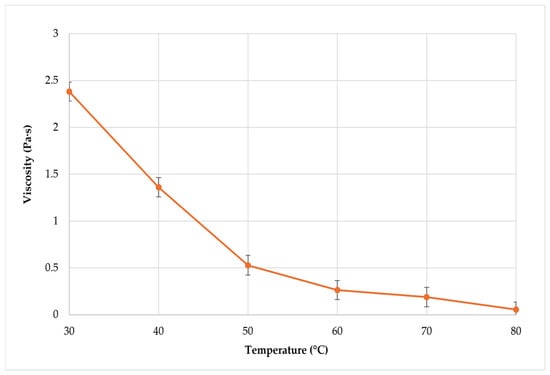
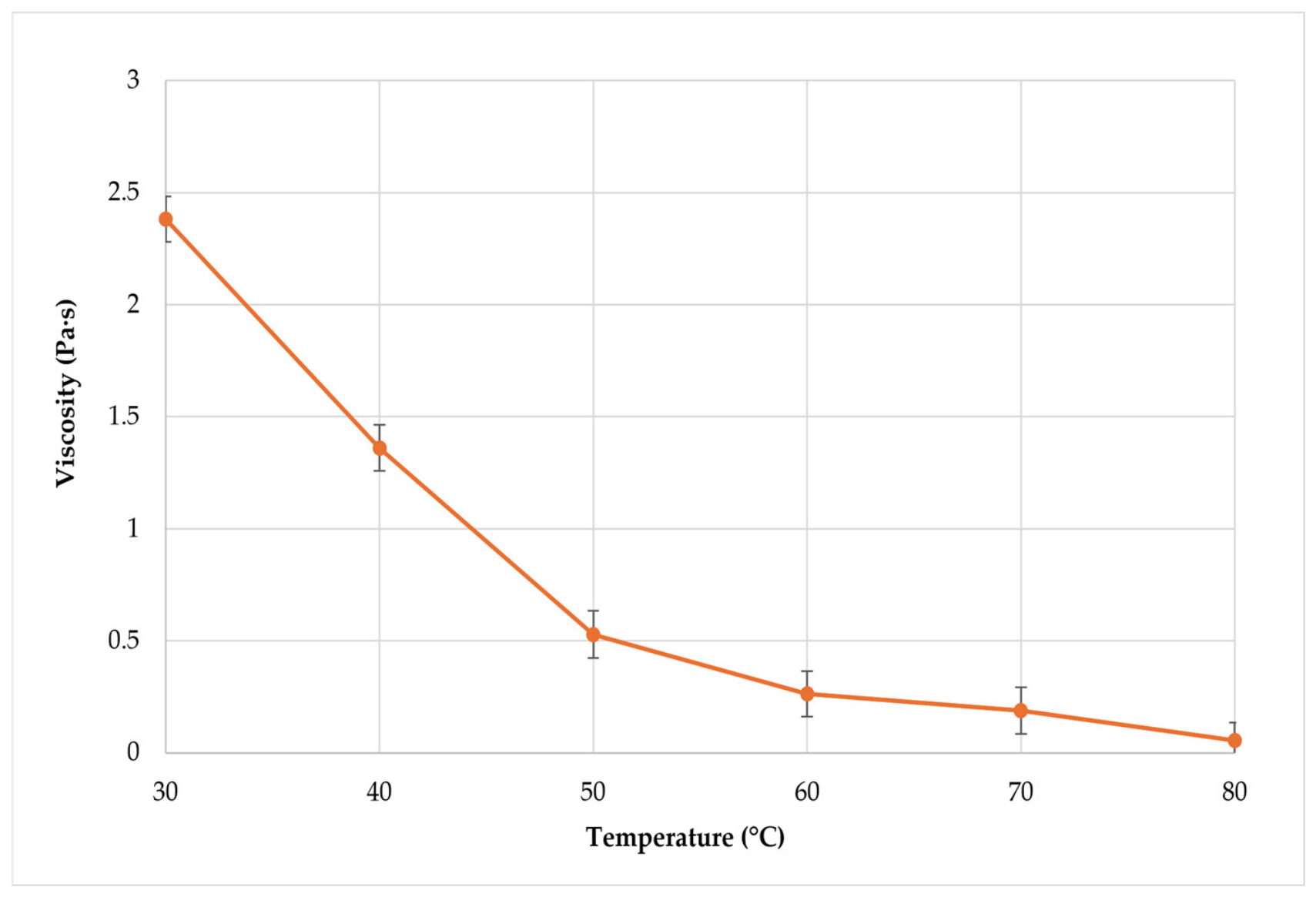
Temperature dependence of viscosity of the glucose/lactic acid DES (1:3).
Figure 2.
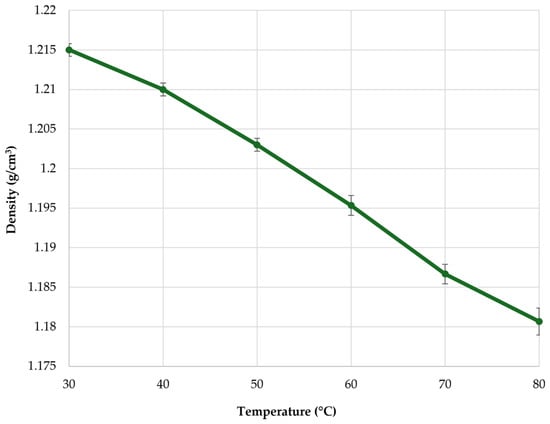
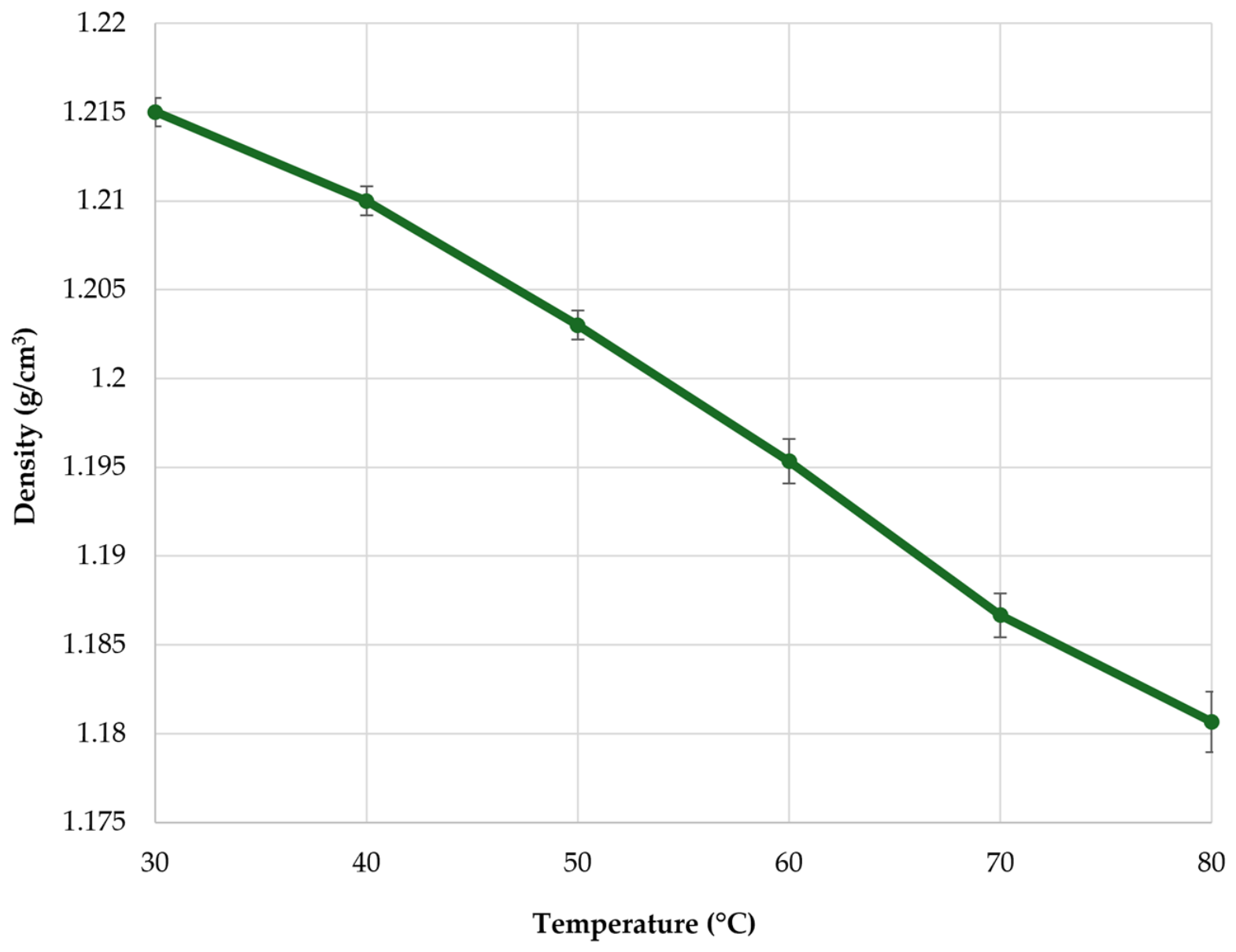
Dependence of DES density based on glucose/lactic acid on temperature.
3. Results
3.1. Basic Characteristics of DES
3.1.1. Viscosity
Viscosity is a critical physical parameter of DES, as high viscosity restricts mass transfer rates and mass diffusion during solid–liquid extraction. In general, DES viscosity decreases significantly with increasing temperature [26,27]. Figure 1 displays the temperature dependence of viscosity for the glucose/lactic acid DES (1:3 molar ratio). As the temperature increased from 30 to 80 °C, the viscosity decreased markedly from approximately 2.3 Pa∙s at 30 °C to below 0.1 Pa∙s at 80 °C, indicating a substantial reduction in flow resistance. The decrease followed a non-linear trend: the most rapid drop occurred between 30 and 50 °C, whereas at higher temperatures (60–80 °C), the viscosity values stabilized. This behavior is attributed to the thermal disruption of the extensive intermolecular hydrogen-bond network that characterizes DES [26]. Lower viscosity at elevated temperatures enhances matrix penetration, accelerating the leaching of phenolic compounds into the solvent [27].
The physicochemical characteristics of a DES, particularly dynamic viscosity, density and surface tension, play a governing role in solid–liquid extraction kinetics. The DES based on glucose/lactic acid (1:3) relies on a dense network of intermolecular hydrogen bonds established between the hydroxyl and carboxyl groups of lactic acid and glucose molecules. At lower operational temperatures (30–40 °C), this structural network results in high viscosity (~2.3 Pa·s), which restricts mass transport, imposes high hydrodynamic resistance, and diminishes the molecular diffusion coefficient of phenolic compounds according to the Stokes–Einstein equation [26,27,28].
Elevating the extraction temperature to 60–100 °C supplies the activation energy required to weaken these intermolecular hydrogen bonds, inducing a sharp rheological transition and dropping solvent viscosity below 0.1 Pa·s. This structural relaxation significantly lowers surface tension, promoting effective solvent wetting, boundary-layer disruption, and capillary penetration into the microporous lignocellulosic matrix of Q. robur bark. Consequently, the solubilization and mass transfer rates of target polyphenols across the cell wall are greatly accelerated. This fundamental thermo-rheological transition directly explains why temperature (b1) exerted the most dominant statistically significant effect (p < 0.001) across all ANOVA models for TPC and YE [26,27].
3.1.2. Density and Refractive Index
The density of the glucose/lactic acid DES decreased moderately and in a near-linear manner with increasing temperature (Figure 2). Increasing the temperature expands liquid volume due to heightened molecular motion and weakening hydrogen bonds, while the total mass remains constant [27].
The density decreased from 1.23 g/cm3 at 30 °C to 1.16 g/cm3 at 80 °C. Compared to viscosity, density exhibited considerably lower temperature sensitivity. This moderate reduction is governed by thermal expansion, which increases the molar volume of the mixture. In DES systems, this expansion is partially restricted by strong attractive interactions between hydrogen-bond donors (lactic acid) and hydrogen-bond acceptors (glucose) [21,26,27].
The refractive index is an indicator used to assess structural packing, molecular polarizability, and purity in DES systems [26,28]. The refractive index of the prepared glucose/lactic acid DES (1:3 molar ratio) was 1.46 at 27.5 °C. While the refractive index reflects changes in composition, molecular packing, and water content, it is not a direct measure of hydrogen-bond strength. Intermolecular interaction strength is more accurately reflected by density and viscosity [29]. Nevertheless, confirming a refractive index of 1.46 serves as a benchmark for solvent purity and structural stability prior to extraction [28,29].
3.2. The Effects of DES on the Phenolic Compounds Recovery from Oak Bark
The extraction of value-added phenolic compounds from oak bark was optimized using a DoE to evaluate the influence of extraction temperature and time on the properties of the obtained extracts. The boundaries of the monitored parameters were set based on preliminary testing: extraction temperature (30–100 °C) and extraction time (60–180 min for DES extraction). The bark particle size was kept constant at 0.5–1.0 mm for all extraction experiments. The DoE plan is presented in Table 2, which includes both the coded values generated by the mathematical model and the corresponding real values of the investigated factors. The DoE comprised 13 experimental runs, including five central point replications (coded level 0) to evaluate process repeatability and determine the experimental error.
Within the DoE plan, the effects of extraction temperature and time on three key response parameters were evaluated: YE, TPC and RSA. In addition to operational parameters, the extraction performance of DES is strongly governed by its physical characteristics, such as viscosity, density, and refractive index, which directly affect mass transfer and solvent–solute interactions [14,26,27,28,29].
3.2.1. Extraction Efficiency of DES
The first parameter evaluated to assess DES extraction efficiency was extraction yield (YE). Within the DoE framework, bark samples of pedunculate oak (Q. robur) were extracted using the glucose/lactic acid DES (1:3 molar ratio). The obtained extracts were quantified gravimetrically, and YE was expressed as a percentage relative to the dry weight of the initial bark sample.
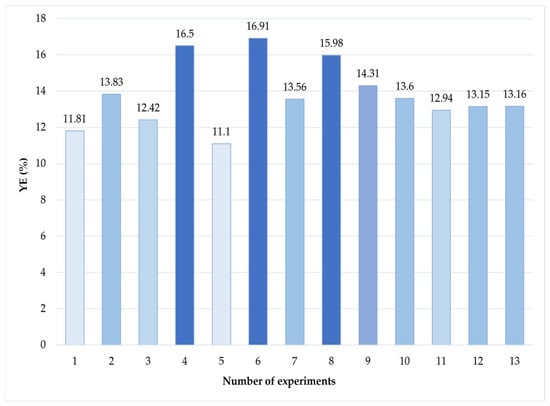
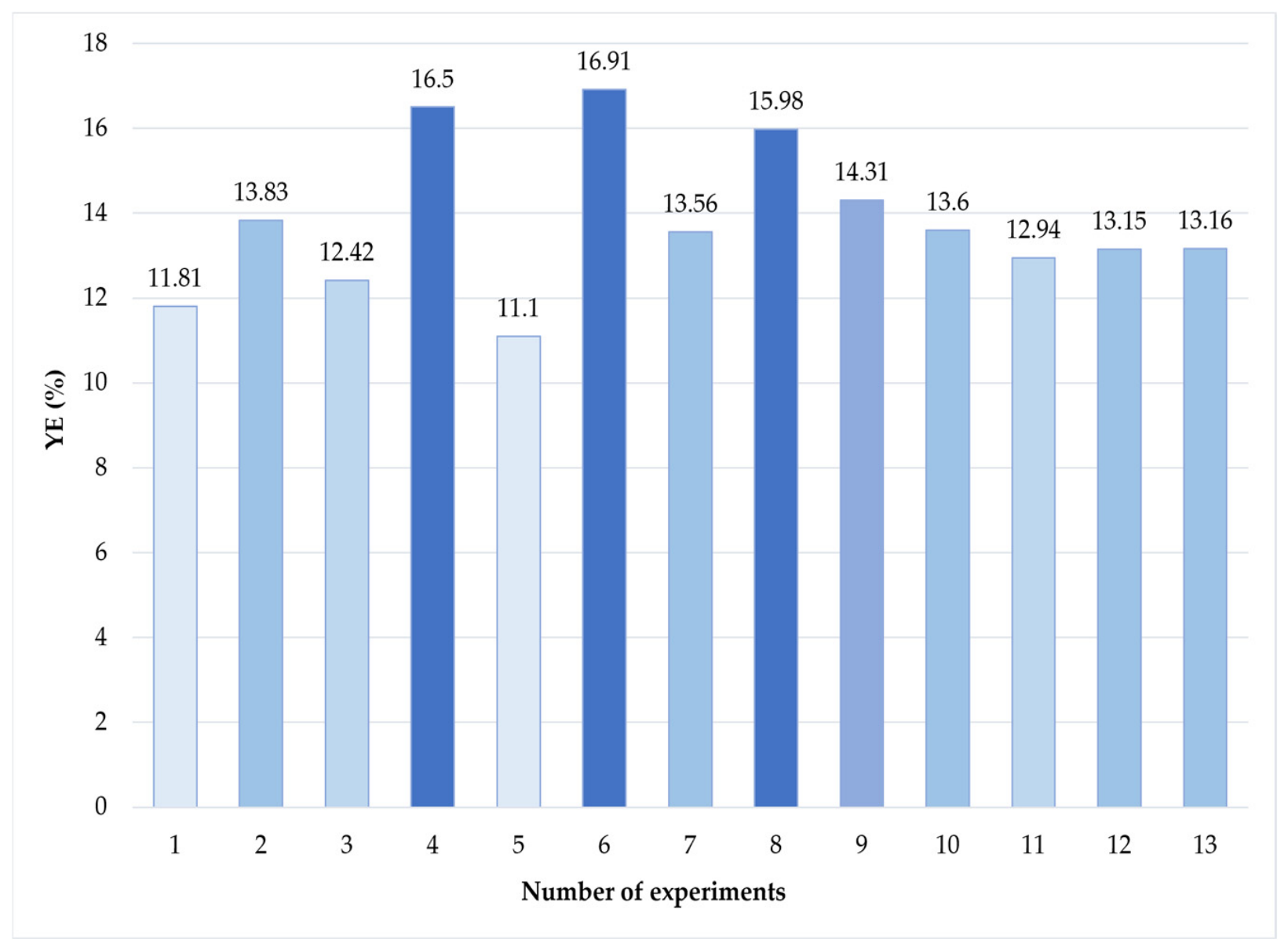
As illustrated in Figure 3, the highest YE reached 16.91% in Experiment 6 (conducted at 100 °C for 120 min, followed closely by Experiment 4 (16.50% at 90 °C, 162.43 min) and Experiment 8 (15.98% at 65 °C, 180 min). Notably, the extraction temperature and time showed an interactive effect, indicating that extending the extraction period may help maintain extraction efficiency under milder temperature conditions [30,31].
Figure 3.
YE of Q. robur bark extracts across DoE plan. Colour intensity reflects the YE value (darker shades indicate higher yields).
The quadratic mathematical model describing the effect of extraction temperature and time on YE was statistically significant (p = 0.00099) with high model accuracy, explaining 92.07% of the response variability (R2 = 0.9207). ANOVA (Table 6) confirmed that the linear regression component (s1) was statistically significant (F = 52.82 > Fc = 6.94), whereas the non-linear/interaction terms (s2) and the lack-of-fit component (sLF) were non-significant (F < Fc), confirming the high predictive power and adequacy of the linear-dominant quadratic model.
Table 6.
Analysis of variance (ANOVA) for the second-order polynomial response surface model fitting the effect of extraction parameters (temperature and time) on YE from Quercus robur bark using glucose/lactic acid DES (1:3).
Evaluation of individual regression coefficients (Table 7) revealed that both linear factors—extraction temperature (b1 = 0.0179, p < 0.001) and extraction time (b2 = 0.0084, p < 0.01)—had positive and statistically significant effects on YE (|bi| > bcrit). However, temperature proved to be the dominant factor, exerting more than twice the effect of extraction time. The quadratic (b11, b22) and interaction (b12) terms were not statistically significant at the α = 0.05 significance level. From a process design perspective, targeting thermolabile bioactive compounds can benefit from prolonged extraction at moderate temperatures. This approach represents a suitable alternative to high-temperature processing, mitigating thermal degradation while maintaining optimal overall YE [14,32].
Table 7.
Regression coefficients of the mathematical model for YE and their critical values.
3.2.2. Effect of Extraction Conditions on the TPC of DES Extracts
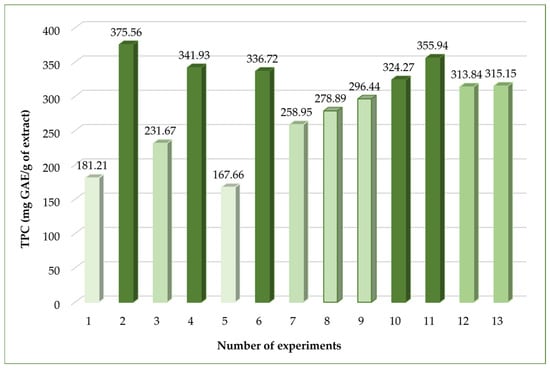
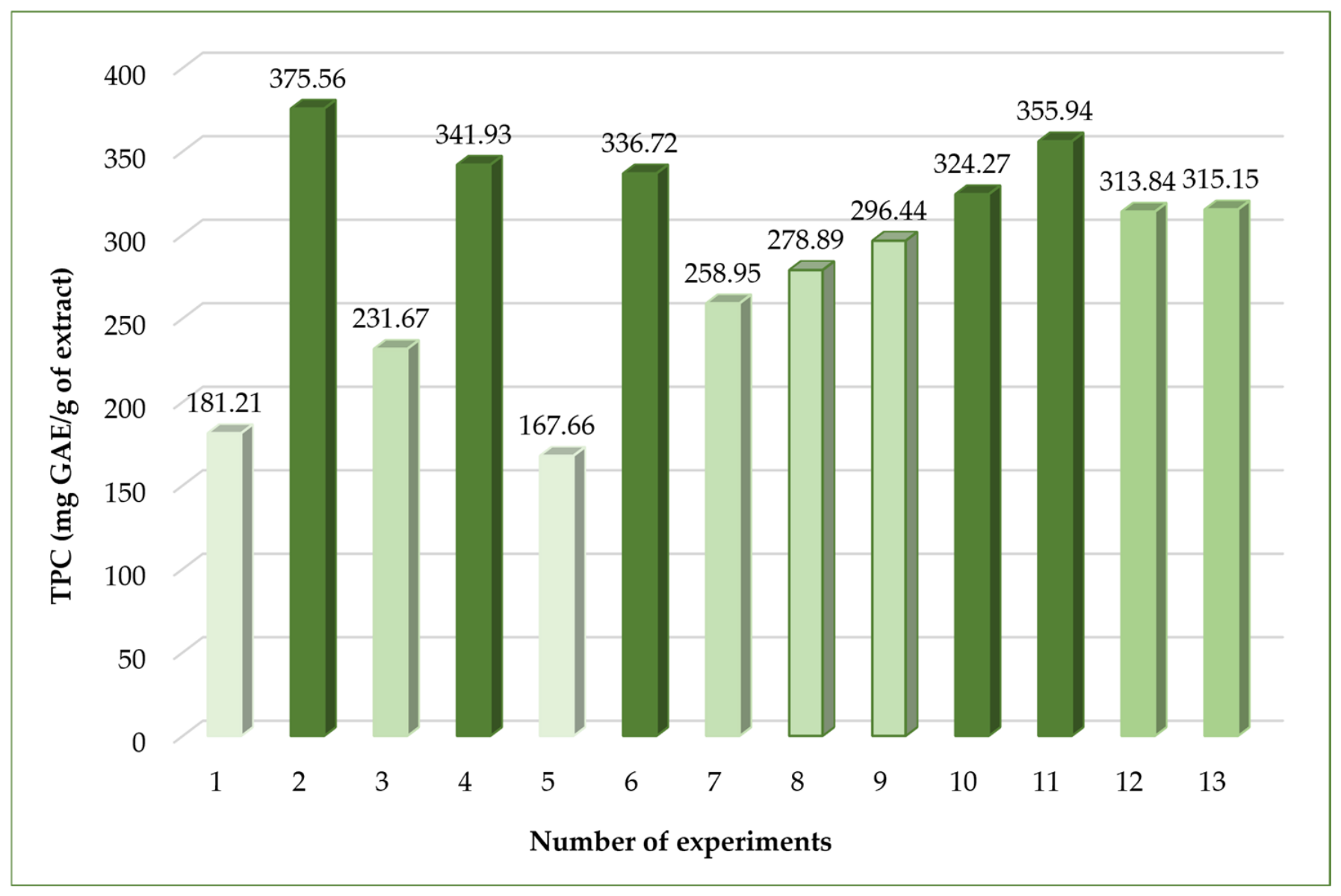
Softwood bark generally contains higher proportions of lipophilic extractives (such as terpenes, resins, and waxes); in contrast, hardwood bark is characterized by a richer and more diverse spectrum of hydrophilic phenolic compounds, particularly phenolic acids, flavonoids, and tannins. Although phenolic acids are widely represented in hardwoods, they often exhibit lower reducing capacities compared to flavonoids, stilbenes, or their glycosides [33]. Consequently, when evaluating TPC via the Folin–Ciocalteu method, the nominal concentration of phenolics may appear lower than the expressed GAE, given that gallic acid possesses one of the highest reducing potentials among monomeric phenolic acids. Despite these analytical characteristics, the bark of Q. robur represents an exceptional source of bioactive phenolic constituents, as evidenced by the high TPC values obtained using the glucose/lactic acid DES (1:3 molar ratio) (Figure 4). This high extractability is largely driven by the abundance of flavonoids, particularly (+)-catechin, which alone accounts for approximately 1% of the total extractives. Because flavonoids exert a substantially stronger reducing effect in the Folin–Ciocalteu assay than phenolic acids, their predominant presence directly translates into elevated GAE values, underscoring the high extraction performance of the saccharide–organic acid DES system for this lignocellulosic biomass [34,35].
Figure 4.
TPC values of Q. robur bark extracts across DoE plan. Colour intensity reflects the TPC value (darker shades indicate higher values).
The Figure 4 shows the TPC values expressed in mg GAE/g of extract for 13 experimental conditions. Quite significant variability is visible between the individual experiments. The lowest TPC was recorded in experiment 5 (167.66 mg GAE/g of extract), followed by experiment 1 with a value of 181.21 mg GAE/g of extract. Conversely, the highest TPC was achieved in experiment 2 (375.56 mg GAE/g of extract). High values were also observed in experiments 11 (355.94 mg GAE/g of extract), 4 (341.93 mg GAE/g of extract) and 6 (336.72 mg GAE/g of extract). From experiment 7 onwards, generally higher and more stable TPC values can be observed, ranging from approximately 259 to 356 mg GAE/g of extract. Experiments 10–13 achieved 313.84–355.94 mg GAE/g of extract, indicating a relatively high extraction efficiency in terms of polyphenolic compounds. Overall, TPC ranged from 167.66 to 375.56 mg GAE/g of extract. The results thus show that the experimental conditions used had a significant impact on the amount of polyphenols extracted. It is also interesting to compare with the previous Figure 3, as the highest YE does not necessarily mean the highest TPC—for example, experiment 2 had both high TPC and high YE, while experiment 6 had the highest YE and high TPC, which may indicate a suitable combination of conditions for obtaining a polyphenol-rich extract.
Optimization analysis using the DoE methodology demonstrated that extraction temperature is the governing factor influencing TPC. The quadratic model describing the relationship between extraction parameters and TPC was statistically highly significant (p = 0.00061), explaining 93.13% of the response variability (R2 = 0.9313). ANOVA (Table 8) showed that the linear component (s1) had a dominant impact (F = 38.76≫Fc = 6.94). The non-linear component (s2) was also statistically significant (F = 6.67 > Fc = 6.59), whereas the lack-of-fit term (sLF) was non-significant (F = 1.06 < Fc = 6.59), confirming the mathematical validity and high predictive accuracy of the model.
Table 8.
Analysis of variance (ANOVA) for the second-order polynomial response surface model fitting the effect of extraction parameters (temperature and time) on TPC from Quercus robur bark using glucose/lactic acid DES (1:3).
Evaluation of individual regression coefficients (Table 9) further clarified the parameter dynamics. The linear temperature term exerted a strong positive impact (b1 = 67.97, |b1| > bcrit = 21.51), making temperature the primary driver of phenolic yield. In addition, the quadratic temperature term was statistically significant (b11 = −28.96, |b11| > bcrit = 23.07), indicating a negative curvature (plateau effect) at higher extraction temperatures. In contrast, linear extraction time (b2 = 5.63), temperature–time interaction (b12 = −21.02), and quadratic extraction time (b22 = −20.60) were not statistically significant at the α = 0.05 significance level (|bi| < bcrit).
Table 9.
Regression coefficients of the mathematical model for TPC and their respective critical values.
The pronounced positive influence of temperature during DES extraction is directly connected to the temperature-dependent reduction in solvent viscosity. As demonstrated in Section 3.1.1, heating markedly lowers viscosity, which enhances solvent penetration into the complex bark cell walls, reduces mass transfer resistance, and accelerates the leaching of phenolics. Furthermore, hydrogen bonding within the eutectic network promotes the dissolution of polar phenolic constituents, including ellagic acid and flavonoids. Crucially, the extracted phenolics maintained high stability even at elevated temperatures, demonstrating the protective, stabilizing effect of the DES medium against thermal degradation [14,32,36,37].
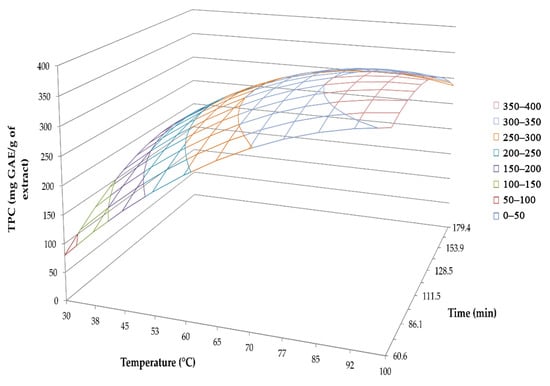
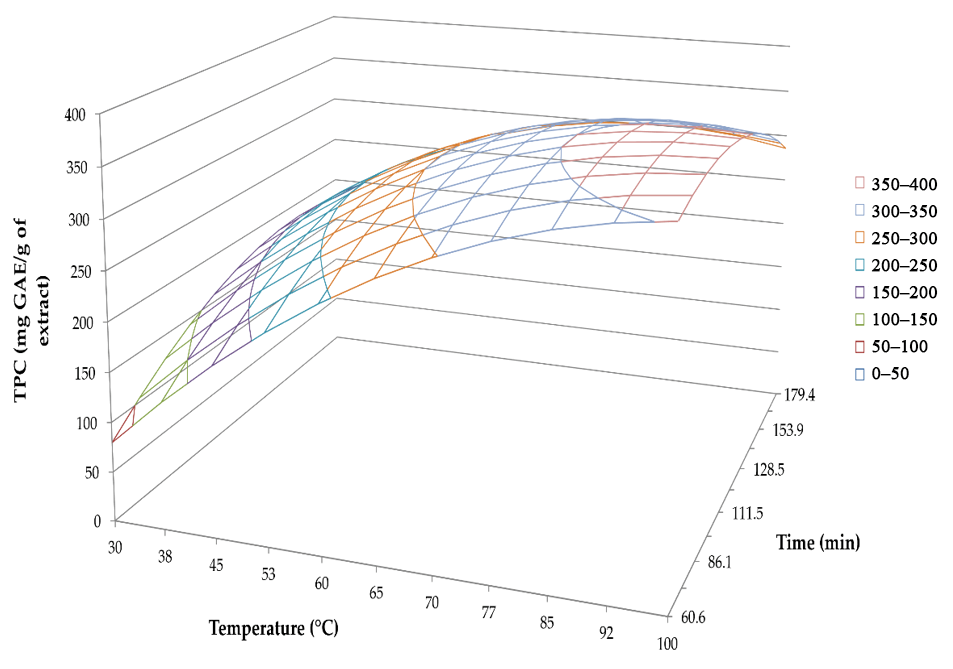
This three-dimensional response surface plot (Figure 5) illustrates the interactive effects of extraction temperature (30–100 °C) and time (60.6–179.4 min) on the total phenolic content (TPC, 0–400 mg GAE/g of extract). As evidenced by the surface profile and color-coded regions, extraction temperature exerts a dominant influence on process efficiency. At lower temperatures (up to 45 °C), TPC remains at a minimum (<150 mg GAE/g of extract); however, elevating the temperature leads to a sharp increase in phenolic yield, driven primarily by the reduced DES viscosity and enhanced mass transfer kinetics. The maximum TPC values, ranging from 350 to 400 mg GAE/g of extract (highlighted in light pink/salmon), are achieved at higher temperature regimes (85–100 °C) combined with extended extraction times (exceeding 120 min), where prolonged duration facilitates optimal equilibrium yield.
Figure 5.
Influence of time and temperature on TPC of DES extracts.
3.2.3. Influence of Extraction Parameters on the DPPH Radical Scavenging Capacity of DES Extracts
The DES extracts were evaluated based on their radical scavenging capacity (RSA) against DPPH radicals.. The DPPH assay was used to assess the ability of the extracts to neutralize free radicals, with the DPPH radical scavenging capacity expressed as the percentage of RSA (%). The obtained results were subsequently evaluated in relation to applied extraction parameters to determine their influence on the antioxidant potential of the resulting DES extracts. Oak bark is recognized as a rich source of bioactive polyphenols, including condensed and hydrolyzable tannins (such as ellagic acid, gallic acid, and vescalagin), alongside a broad spectrum of flavonoids. The strong correlation observed between TPC and RSA indicates that the majority of phenolic constituents solubilized by the glucose/lactic acid DES act directly as potent antioxidant species [38].
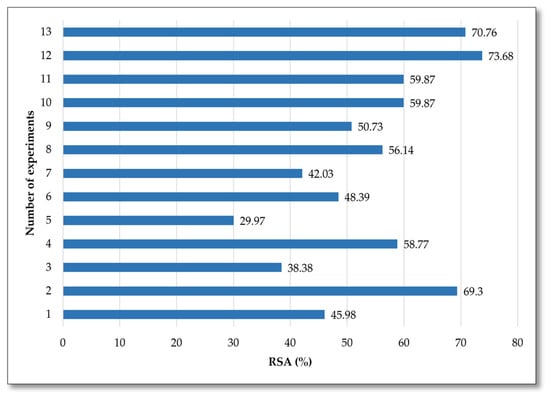
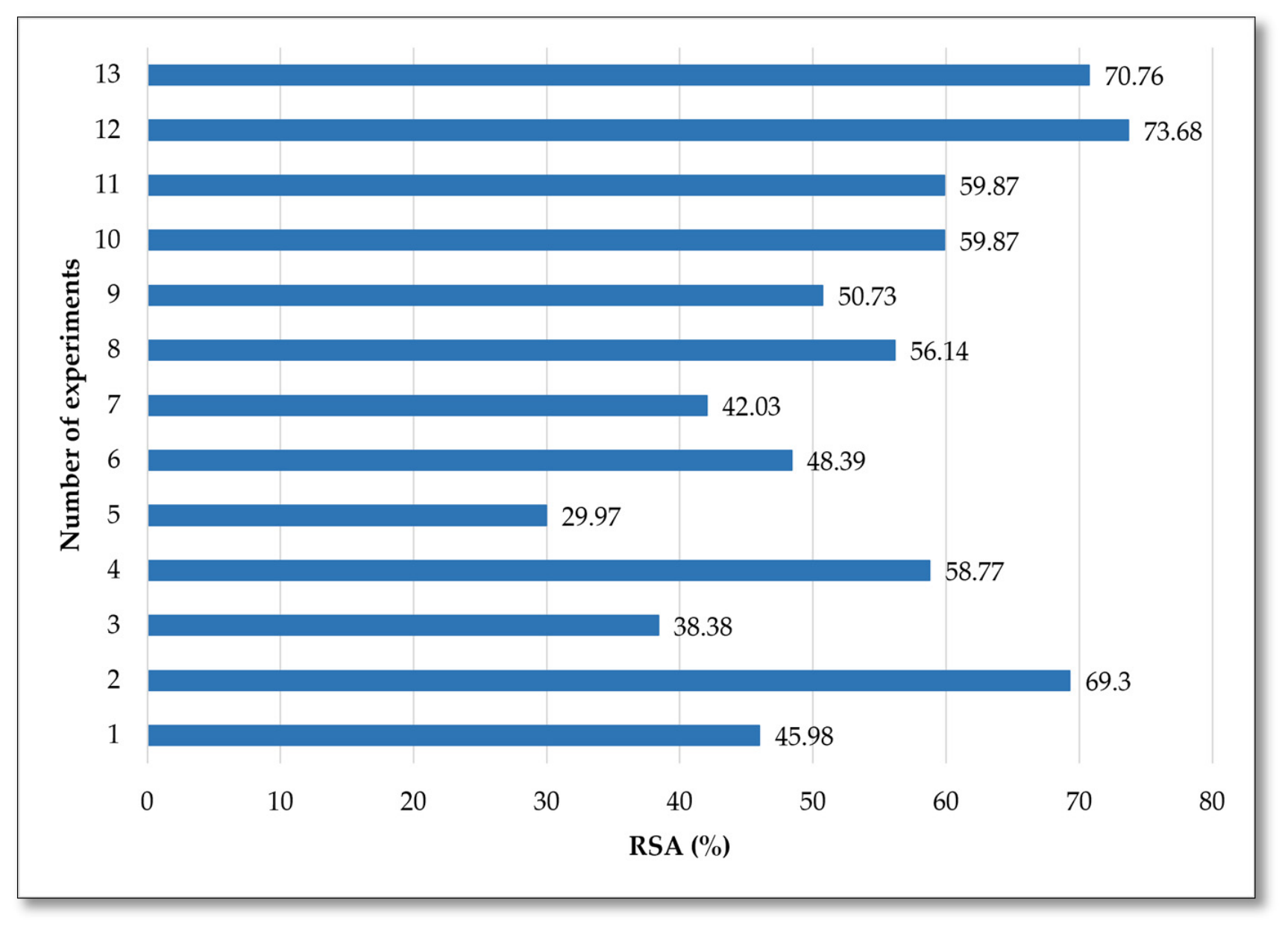
The glucose/lactic acid DES system (1:3 molar ratio) achieved high efficiency in extracting active antioxidants from Q. robur bark, with experimental RSA values ranging from 29.97% to 73.68% across the DoE runs (Figure 6).
Figure 6.
RSA of Q. robur bark extracts across DoE plan.
The highest RSA was observed in experiment 12 (73.68%), followed by experiment 13 (70.76%) and experiment 2 (69.30%). This high antioxidant capacity is attributed to the strong affinity between target phenolics/flavonoids and the saccharide–organic acid DES matrix, where dense hydrogen-bonding networks facilitate the dissolution and stabilization of polar antioxidants, including ellagic acid [38,39].
Statistical evaluation of the full quadratic model yielded a coefficient of determination R2 = 0.6466, accounting for 64.66% of the variability in the experimental data. Overall, the full quadratic regression model was not statistically significant at the α = 0.05 significance level (p = 0.1261). Analysis of variance (Table 10) confirmed that all calculated F-values remained below their respective critical thresholds (s1:F = 3.53 < Fc = 6.94; s2:F = 2.84 < Fc = 6.59; sLF:F = 1.48 < Fc = 6.59).
Table 10.
Analysis of variance (ANOVA) for the second-order polynomial response surface model fitting the effect of extraction parameters (temperature and time) on RSA from Quercus robur bark using glucose/lactic acid DES (1:3).
Inspection of individual regression coefficients (Table 11) showed that only the model intercept was statistically significant (b0 = 0.63,|b0| > bcrit = 0.12). Linear and quadratic terms for extraction temperature (b1 = 0.09,b11 = −0.10) reached the boundary threshold of critical values (bcrit = 0.09 and 0.10, respectively), reflecting a slight positive temperature effect that levels off at higher thermal inputs without achieving overall model significance. Extraction time (b2 = 0.00) and interaction terms (b12 = −0.01) showed no significant impact. Importantly, the high, dominant baseline constant (b0 = 0.63) relative to the small parameter coefficients underscores that antioxidant capacity remains high and exceptionally stable across the entire tested operational window (30 to 100 °C, 60 to 180 min). This suggests that the antioxidant capacity of the extracts was relatively stable within the investigated temperature range [14,37].
Table 11.
Regression coefficients of the mathematical model for RSA and their respective critical values.
In this study, the antioxidant potential of the extracts was evaluated using the 2,2-diphenyl-1-picrylhydrazyl (DPPH) radical scavenging assay as a primary screening tool within the DoE framework. While the DPPH assay provides a reliable measurement of hydrogen- or electron-donating capacity, it reflects a specific mechanism of radical neutralization. Therefore, the values reported herein represent DPPH radical scavenging capacity rather than total overall antioxidant activity across multiple biological pathways.
3.3. The Influence of the MAE–DES Process on the Isolation of Phenolic Compounds from Oak Bark
To enhance overall process efficiency, MAE was integrated with DES treatment for the bark of pedunculate oak (Q. robur). Microwave heating was applied to drastically reduce extraction time and energy consumption while optimizing key qualitative parameters: YE, TPC and RSA. A direct comparison between DES and MAE–DES revealed important thermodynamic and kinetic distinctions. Although MAE–DES provides rapid, volumetric, and uniform heating of the bark–solvent matrix, overall YE and TPC values at lower temperatures (30 to 40 °C) were lower than those obtained via conventional heating. At these lower thermal levels, MAE–DES predominantly isolated low-molecular-weight phenolic acids (e.g., p-coumaric acid, syringic acid), which exhibit lower intrinsic reducing capacity in the Folin–Ciocalteu assay compared with gallic acid standards [40,41] (Figure 7).
Figure 7.
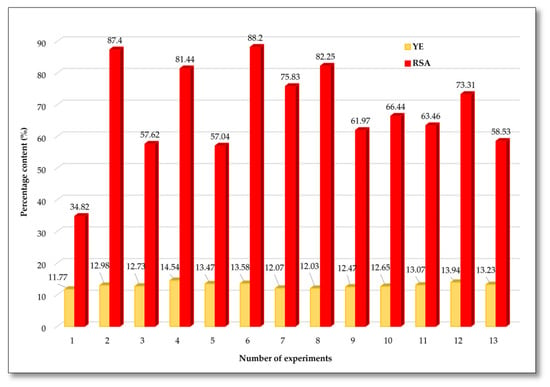
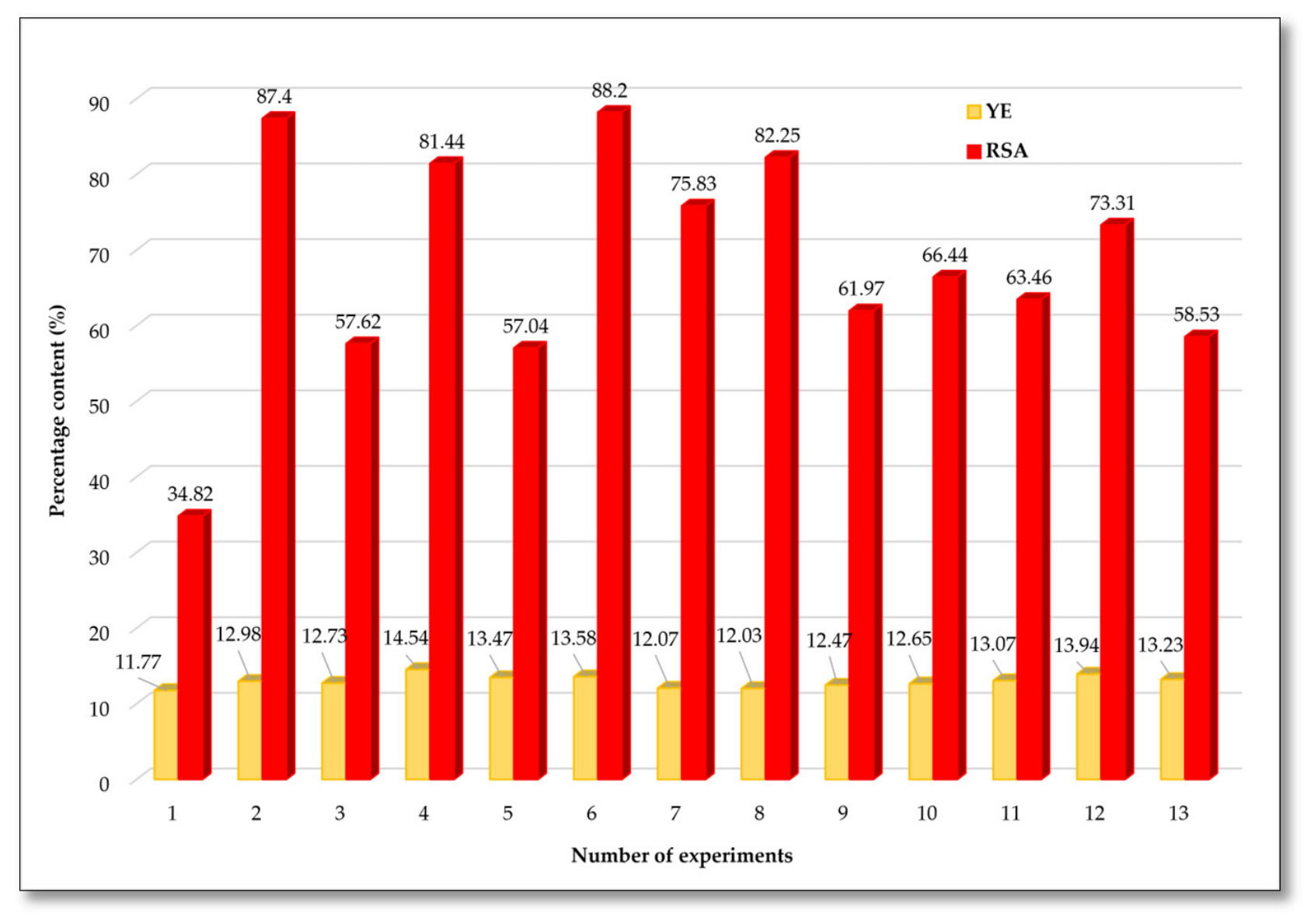
YE and RSA values of Q. robur bark extracts via MAE–DES across DoE plan.
However, as extraction temperature increased, MAE–DES demonstrated pronounced superiority in selectivity and antioxidant potency. At elevated temperatures, the combined thermal energy and microwave radiation significantly reduce DES viscosity, facilitating deeper solvent penetration into the lignocellulosic bark structure [41]. This enhanced solubility enables the selective extraction of complex polyphenols, particularly flavonoids, stilbenes, and their glycosides. Consequently, extracts obtained at higher temperatures and shorter irradiation times exhibited exceptional antioxidant capacities, with maximum RSA values exceeding those of conventional DES extraction by up to 14.52% (relative to an 18 μg/mL gallic acid standard).
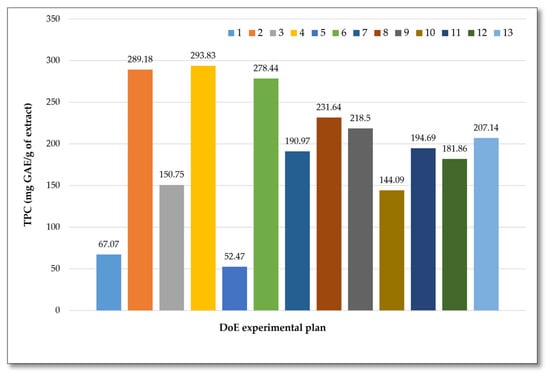
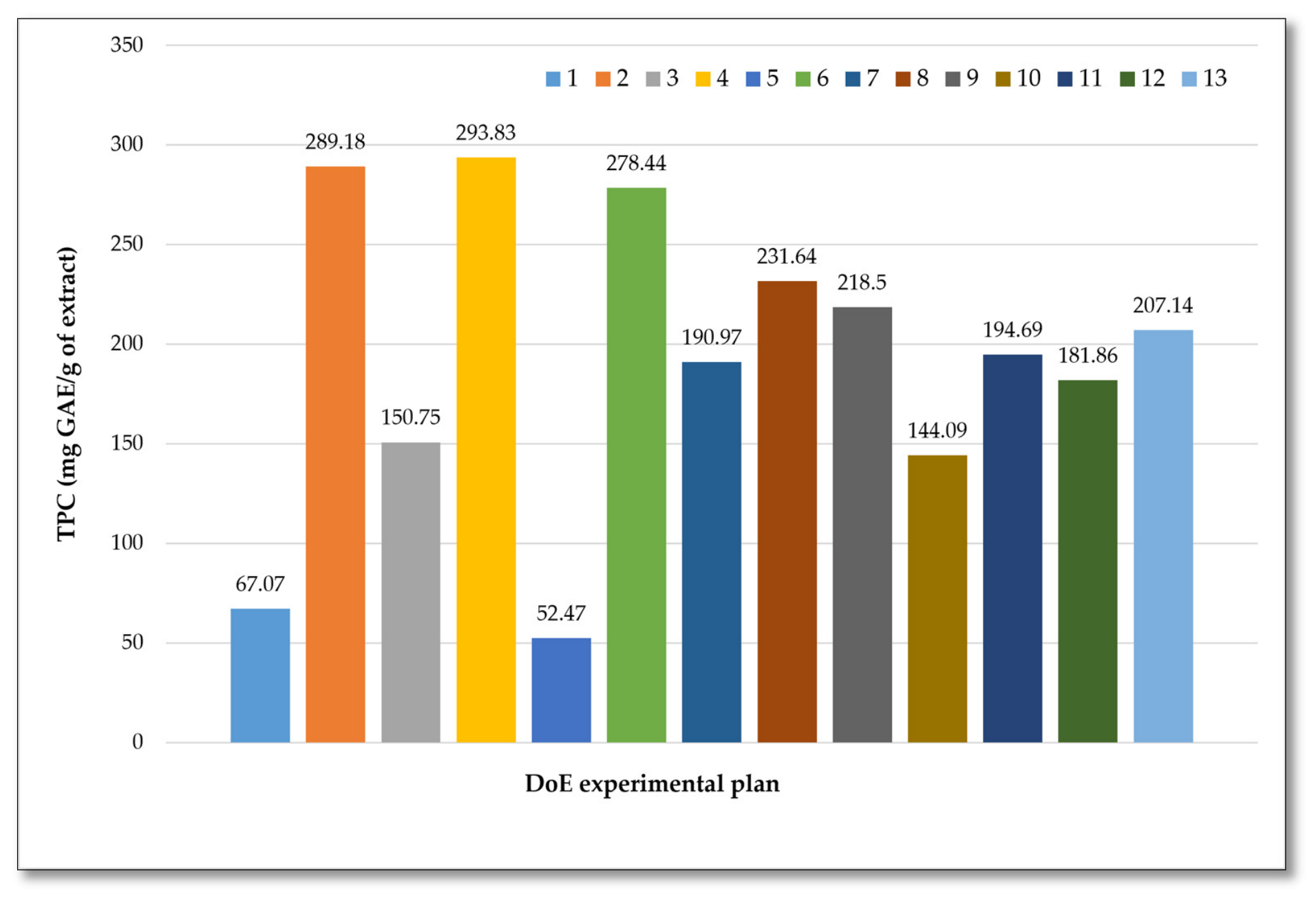
The extraction performance of the MAE–DES process for the recovery of bioactive compounds from oak bark was evaluated using a 13-run DoE layout, focusing on YE, RSA and TPC (Figure 7 and Figure 8). Across all experimental runs, the YE remained remarkably stable, ranging strictly between 11.77% and 14.54%, indicating that the overall matrix dissolution capacity was consistent regardless of the varying process parameters [12]. In contrast, the TPC and RSA values exhibited significant sensitivity to the experimental conditions. The highest TPC values were achieved in experiment 4 (293.83 mg GAE/g of extract), experiment 2 (289.18 mg GAE/g of extract), and experiment 6 (278.44 mg GAE/g of extract), which directly correlated with maximum antioxidant capacities (RSA) reaching up to 88.20% (experiment 6) and 87.40% (experiment 2). Conversely, experiment 1 and 5 yielded the lowest TPC values (67.07 mg GAE/g of extract and 52.47 mg GAE/g of extract, respectively) along with depressed RSA values (34.82% in experiment 1). This pronounced variation can be attributed to the physical properties of the DES, particularly its viscosity, surface tension, and polarity [13,42]. High solvent viscosity restricts mass transfer rates and slows down molecular diffusion from the oak bark matrix into the solvent phase [43]. Under optimized conditions, the synergy between microwave irradiation and DES polarity accelerates cell wall rupture via localized internal heating, facilitating the selective diffusion of polyphenolic compounds (e.g., ellagitannins, catechins, and phenolic acids) into the extract without significantly altering the total dry matter yield [12,44]. Furthermore, the strong linear association observed between TPC and RSA highlights that polyphenols are the primary drivers of the RSA of oak bark extracts [13,45].
Figure 8.
TPC values of Q. robur bark extracts via MAE–DES across DoE approach.
Statistical evaluation via DoE methodology (Table 12 and Table 13) confirmed these underlying kinetic and thermodynamic mechanisms: YE: None of the monitored process parameters exerted a statistically significant influence (|bi| < bcrit for all factors; s1:F = 3.06 < Fc = 6.94), maintaining a relatively constant baseline yield determined by the model intercept (b0 = 0.131, i.e., ~13.1%). TPC: The linear temperature factor (b1 = 85.602,|b1| > bcrit = 28.194) showed overwhelming statistical significance (F = 37.14≫Fc = 6.94,p = 0.0004), with the model explaining 94.08% of the variability (R2 = 0.9408). Comparing low- and high-temperature experiments, YE remained comparable (11.77 − 14.54%), whereas TPC surged 2- to 4-fold at higher temperatures, reaching up to 293.83 mg GAE/g extract in experiment 4. RSA: Similarly, RSA was predominantly governed by extraction temperature (b1 = 0.151,|b1| > bcrit = 0.055;F = 30.57≫Fc = 6.94,p = 0.0317;R2 = 0.7816), rising to a maximum of 88.20% in experiment 6.
Table 12.
ANOVA for YE, TPC, and RSA of pedunculate oak (Q. robur) bark extracts under MAE–DES conditions.
Table 13.
Regression coefficients of the mathematical models and their respective critical values for YE, TPC, and RSA under MAE–DES conditions.
These findings demonstrate that while overall YE is largely temperature-independent under microwave irradiation, extraction temperature plays a decisive role in modulating solvent viscosity and mass transfer selectivity, favoring the recovery of highly reactive polyphenols over low-activity phenolic acids. For example, when comparing experiments with identical extraction times but different temperatures (experiments 1 vs. 2 or experiments 3 vs. 4 in Figure 8 and Figure 9), YE values remain almost identical, whereas TPC values increase dramatically at elevated temperatures. This behavior is enabled by reduced DES viscosity, enhanced solvent penetration into the cell matrix, and higher affinity of target polyphenols for the saccharide-based DES medium [40,41].
Figure 9.
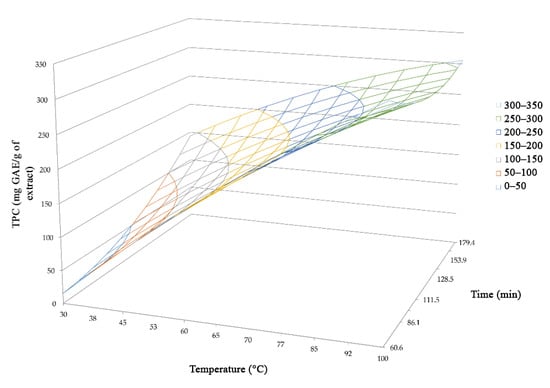
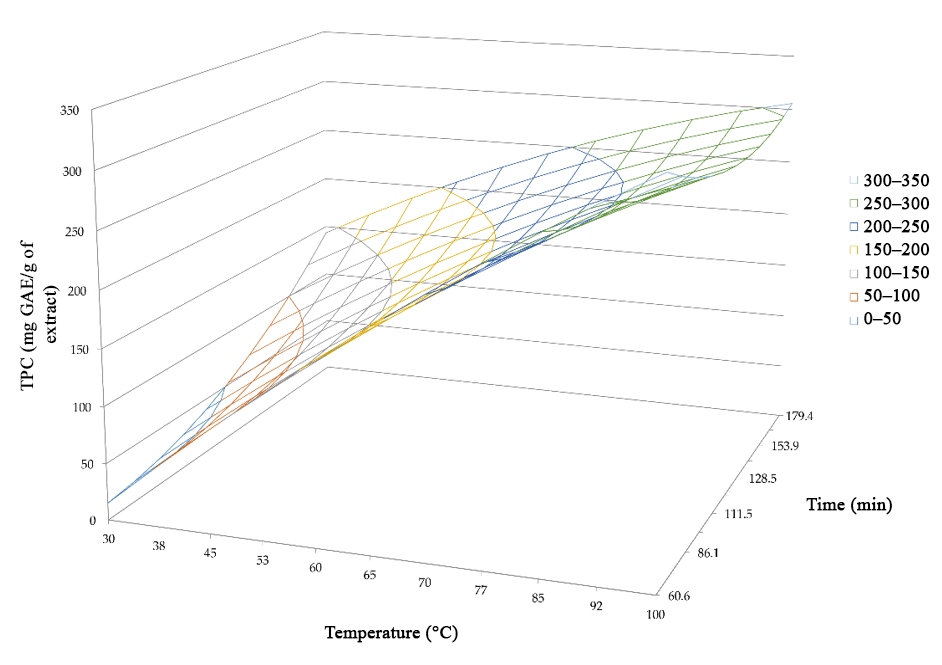
Influence of time and temperature on TPC of MAE–DES extracts.
Statistical Assessment of Process Parameters in MAE–DES Extraction of Oak Bark Phenolic Compounds via ANOVA
For YE, the quadratic response surface model describing the combined effect of temperature and time was statistically significant (p = 0.0032). The model demonstrated strong explanatory power, accounting for 88.82% of the experimental variability (R2 = 0.8882), with an adjusted coefficient of determination () of 0.8084.
Evaluation of individual process parameters showed that while the model as a whole effectively captures the response surface, the yield remains exceptionally stable across the evaluated experimental region. The baseline yield is defined by a dominant, statistically significant intercept (b0 = 0.131,|b0| > bcrit = 0.007). Individual linear terms for temperature (b1 = 0.004) and time (b2 = 0.003), as well as interaction (b12 = 0.001) and quadratic terms (b11 = 0.003,b22 = −0.005), remained within their critical threshold boundaries, confirming that overall mass yield is largely independent of operational variations under microwave irradiation (~13.1% baseline yield).
For TPC, the quadratic regression model exhibited excellent agreement with experimental data (p = 0.00035), explaining 94.08% of the total variance (R2 = 0.9408), with an adjusted determination coefficient () of 0.8985. Regression analysis (Table 13) established extraction temperature as the primary governing factor. The linear temperature coefficient exerted an overwhelming positive effect (b1 = 85.602,|b1|≫bcrit = 28.194,p < 0.001), reflecting a 2- to 4-fold increase in extracted phenolics at elevated thermal conditions. In contrast, the linear time factor (b2 = 18.233), temperature–time interaction (b12 = −19.755), and quadratic terms for temperature (b11 = −8.946) and time (b22 = 13.987) did not exceed their respective critical thresholds (|bi| < bcrit) at α = 0.05. This indicates that the positive temperature effect operates linearly across the investigated range without significant high-temperature plateauing or degradation.
For RSA, the quadratic response surface model was statistically significant (p = 0.0317), explaining 78.16% of the response variability (R2 = 0.7816), with an adjusted coefficient () of 0.6256. The antioxidant potency was primarily driven by extraction temperature (p = 0.0084). The linear temperature term was statistically significant (b1 = 0.151,|b1| > bcrit = 0.055), confirming that higher temperatures promote the selective extraction of highly active flavonoids and stilbenes. The interaction term (b12 = −0.072) and quadratic temperature term (b11 = 0.013) were not statistically significant at α = 0.05 (|bi| < bcrit). Extraction time showed no statistically significant effect within the investigated experimental range.
This 3D response surface plot (Figure 9) depicts the combined effect of extraction temperature (30–100 °C) and extraction time (60.6–179.4 min) on the total phenolic content (TPC, ranging from 0 to 350 mg GAE/g of extract). The surface profile displays a steep, continuous increase in TPC values as the temperature rises. At a low extraction temperature of 30 °C, TPC remains below 50 mg GAE/g of extract regardless of the extraction duration. Elevating the temperature significantly enhances phenolic recovery due to reduced DES viscosity and improved solute diffusivity, yielding maximum TPC values between 300 and 350 mg GAE/g of extract (highlighted in dark green in the upper right region) at the upper boundary conditions of 100 °C and extended times (exceeding 150 min). Extraction time shows a synergistic positive effect on TPC predominantly at elevated temperatures, whereas its effect is negligible at lower thermal levels.
3.4. HPLC–DAD Phytochemical Profiling and Identification of Key Bioactive Compounds in Oak Bark Extracts
Extracts of pedunculate oak (Q. robur) bark prepared using the glucose/lactic acid DES system (1:3 molar ratio) were analyzed by HPLC–DAD. Representative samples were selected based on their optimized values for YE, TPC and RSA. DoE methodology was subsequently applied to evaluate process dynamics for the two predominant bioactive polyphenols: catechin and procyanidin. Quantitative chromatographic profiling allowed the identification of major hydrophilic phenolics, including monomeric flavonoids, oligomeric proanthocyanidins, and phenolic acids (Table 14). Their relative concentrations were highly dependent on both the operational heating method (conventional conduction vs. microwave irradiation) and the applied extraction parameters [14].
Table 14.
Concentrations of catechin and procyanidin in pedunculate oak (Q. robur) bark extracts obtained across DoE plans via DES and MAE–DES processes.
As detailed in Table 14, conventional DES extraction yielded markedly higher catechin concentrations compared with MAE–DES across all experimental runs. The maximum catechin concentration of 21.07 mg CA/g of extract was achieved in experiment 2 under conventional heating (90 °C, 77.57 min). Under microwave heating, the maximum catechin concentration reached only 2.99 mg CA/g of extract (experiment 4). This difference highlights distinct extraction kinetics. Flavonoids such as (+)-catechin exhibit high affinity for carbohydrate-based DES matrices due to extensive hydrogen-bonding interactions and the potential formation of glycosidic association complexes [36,46,47].
However, effective solubilization of monomeric catechin requires extended contact times. Under conventional heating, the prolonged residence time allows complete mass transfer through cell wall channels. Conversely, under MAE–DES, extraction time was the governing parameter for catechin recovery, as observed in experiments 2, 4, 6, and 8. For instance, experiment 4 (90 °C, 25.75 min) yielded a higher catechin concentration (2.99 mg CA/g of extract) than experiment 6 (100 °C, 15.5 min, yielding 2.20 mg CA/g of extract), demonstrating that extended irradiation duration is essential to compensate for short processing times when isolating monomeric flavonoids. Procyanidins, comprising a complex mixture of condensed tannin oligomers, were quantified using equivalent calibration (expressed as CA equivalents). Consequently, the observed enhancement under MAE–DES reflects a substantial increase in the extractability of the oligomeric procyanidin fraction rather than isolated individual molecular species.
Procyanidins, homo-oligomeric condensed tannins composed of catechin and epicatechin units, exhibit profound bioactivity, including radical scavenging potential up to 20 times greater than vitamin C and 50 times greater than vitamin E, alongside recognized antiproliferative effects [48,49,50]. In contrast to catechin, procyanidin recovery was substantially enhanced under microwave irradiation (Table 14). Under MAE–DES, procyanidin yield peaked at 59.30 mg CA/g of extract in experiment 6 (100 °C, 15.5 min), representing a 7.5-fold increase over the maximum yield obtained via conventional DES extraction (7.95 mg CA/g of extract in Experiment 6).
This pronounced reversal in selectivity stems from the fundamental heat-transfer mechanism of microwave energy. This effect may be associated with the rapid volumetric heating characteristic of microwave irradiation, which can enhance solvent penetration and mass transfer within the lignocellulosic matrix. This structural rupture facilitates the liberation of higher-molecular-weight condensed tannins (procyanidins) into the DES medium. In contrast, gentle conductive heating primarily promotes the diffusion of low-molecular-weight monomeric species like catechin [51,52,53].
An important finding of this study was that the heating mode influenced not only the extraction rate but also the composition of the recovered phenolic fraction. Conventional DES heating favored the recovery of monomeric flavonoids, with catechin reaching a maximum concentration of 21.07 mg CA/g of extract. In contrast, MAE–DES extraction promoted the recovery of oligomeric proanthocyanidins, with the procyanidin content reaching 59.30 mg CA/g of extract, corresponding to a 7.5-fold increase compared with conventional DES heating. This difference suggests that the heating mode may be used as a process parameter to influence the selectivity of phenolic compound recovery from Q. robur bark. The enhanced recovery of procyanidins under MAE–DES conditions may be associated with the rapid volumetric heating characteristic of microwave irradiation, which can improve solvent penetration and mass transfer within the lignocellulosic matrix. However, the observed difference in phenolic profiles may also reflect the combined effects of temperature, extraction time, and matrix–solvent interactions rather than microwave irradiation alone. From a process-design perspective, these results indicate that conventional DES heating may be preferable when the target compounds are predominantly monomeric flavonoids such as catechin, whereas MAE–DES may be more suitable for the intensified recovery of oligomeric proanthocyanidins.
This difference suggests that the choice of heating technique, operating parameters, and extraction duration serves as a key process parameter for tuning extraction selectivity. While conventional DES heating favored the recovery of low-molecular-weight monomeric flavonoids, whereas MAE–DES significantly enhanced the solubilization of oligomeric procyanidins, these distinct profiles represent the collective outcome of the tested extraction conditions and process configuration rather than an isolated effect of the microwave heating mechanism alone.
Selectivity Profile of High-TPC Extracts
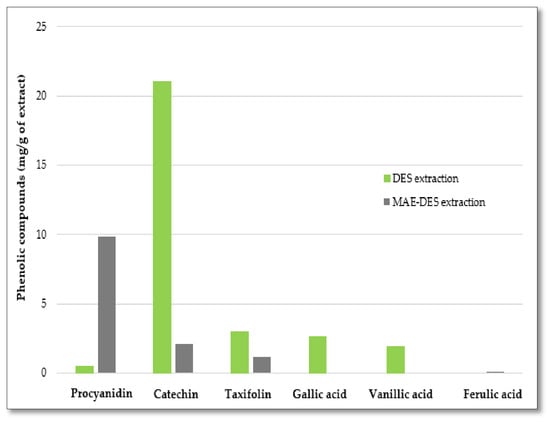
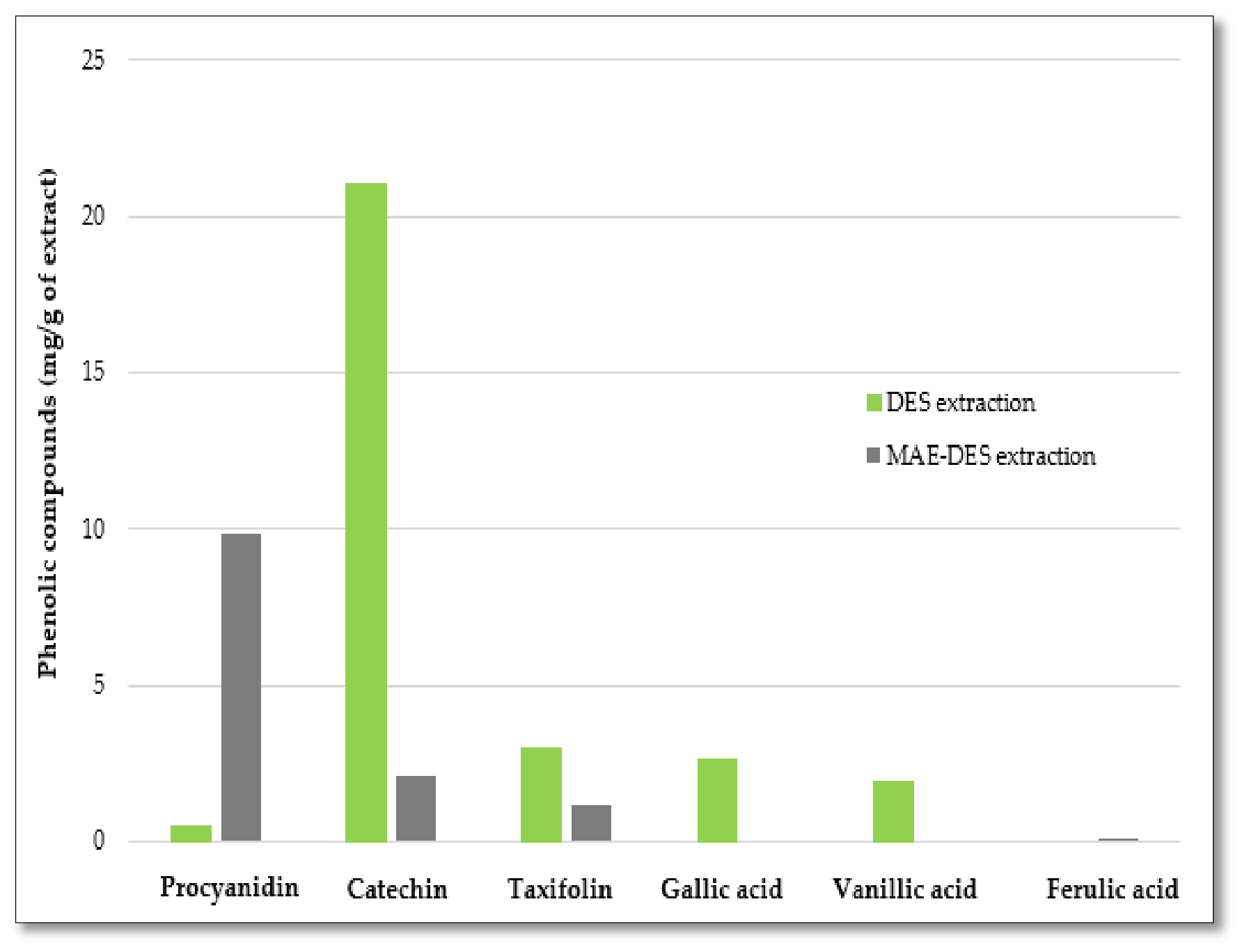
Quantitative comparison of extracts corresponding to maximum TPC (Figure 8) further illustrates this operational selectivity: Conventional DES: Promoted exceptionally high selectivity toward monomeric catechin (21.07 mg/g of extract), accompanied by taxifolin (2.97 mg/g of extract), gallic acid (2.63 mg/g of extract), vanillic acid (1.91 mg/g of extract), and minor procyanidin (0.51 mg/g of extract). Ferulic acid was not detected. MAE–DES: Shifted selectivity dramatically toward oligomeric procyanidin (9.86 mg/g of extract), while catechin decreased to 2.11 mg/g of extract and taxifolin to 1.20 mg/g of extract. Gallic and vanillic acids were below detection limits, while ferulic acid was detected in trace quantities (mg/g of extract) (Figure 10).
Figure 10.
Concentration (mg/g of extract) of individual phenolic compounds identified via HPLC–DAD in Q. robur bark extracts: Comparison between conventional DES extraction and MAE–DES extraction. [Conventional DES: catechin = 21.07, procyanidin = 0.51, taxifolin = 2.97, gallic acid = 2.63, vanillic acid = 1.91, ferulic acid = ND] [MAE–DES: catechin = 2.11, procyanidin = 9.86, taxifolin = 1.20, ferulic acid = 0.02, gallic acid = ND, vanillic acid = ND].
These results confirm that overall TPC reflects the cumulative sum of reducing species rather than individual component yields. Consequently, target-specific extraction strategies must be selected: conventional heating with glucose-based DES at 90 °C for 77.57 min is optimal for isolating catechin-enriched fractions (~21 mg/g of extract), whereas MAE–DES at 100 °C for 30 min is superior for the rapid, high-yield isolation of procyanidin-enriched fractions (~60 mg/g of extract).
The observed shift in phenolic profile demonstrates that conventional thermal heating and microwave irradiation interact differently with the lignocellulosic matrix. While conventional heating relies on conduction and slowly liberates monomeric polyphenols such as catechin and phenolic acids, microwave heating induces rapid localized volumetric heating and cell wall disruption. This rapidly reduces solvent viscosity and enhances the penetration of the hydrogen-bond donor/acceptor network into internal pores, thereby facilitating the mass transfer and dissolution of higher-molecular-weight oligomeric procyanidins.
In summary, the comparative analysis demonstrates that the optimization of extraction parameters must account for both overall efficiency (YE and TPC) and target compound selectivity. While temperature controls solvent viscosity and mass transfer kinetics—thereby driving overall phenolic recovery—the heating modality fundamentally dictates compound integrity and molecular weight distribution. Conventional DES extraction is well suited for targeting monomeric flavonoids like catechin under prolonged thermal treatment, whereas MAE–DES offers process intensification, drastically reducing extraction time from hours to minutes while selectively enriching the extract with oligomeric procyanidins.
3.5. Study Limitations
Although the findings of this study provide valuable insights into the optimization and selectivity of DES- and MAE–DES-based extraction of phenolic compounds from Q. robur bark, several limitations should be acknowledged: Scope of bioactivity assessment: The evaluation of antioxidant potential was limited to the 2,2-diphenyl-1-picrylhydrazyl (DPPH) radical scavenging assay. While the DPPH assay serves as a robust and widely accepted tool for screening electron-/hydrogen-donating capacity, it reflects a specific radical-scavenging mechanism. Future studies will incorporate complementary assays (e.g., ABTS, FRAP, and ORAC) to provide a broader mapping of the antioxidant mechanisms and biological activity of the extracts. Absence of quantitative green metrics: Although the DES based on glucose/lactic acid is composed of renewable, non-toxic, and bio-derived constituents, formal quantitative sustainability frameworks (such as AGSA-Prep, GEARS, or LCA) were not performed in this work. Consequently, claims regarding environmental impact are qualitative, and formal eco-scale metrics accounting for energy consumption during heating will be addressed in scale-up research. Fixed solvent stoichiometry: The DoE specifically focused on evaluating the effects of extraction temperature and time at a fixed glucose/lactic acid molar ratio (1:3). The influence of varying the hydrogen bond acceptor to hydrogen bond donor (HBA/HBD) stoichiometry, as well as the initial water content on solvent viscosity and extraction thermodynamics, was beyond the scope of this experimental design and warrants further systematic study.
4. Conclusions
This study demonstrated the effectiveness of a deep eutectic solvent (glucose/lactic acid; 1:3) combined with conventional and microwave-assisted heating for recovering high-value phenolic compounds from Quercus robur bark. Optimization via design of experiments highlighted temperature as the key variable governing extraction yield and total phenolic content due to its effect on deep eutectic solvent viscosity and solute diffusivity.
Overall, the results demonstrate the potential of integrating biodegradable saccharide-based deep eutectic solvents with microwave-assisted extraction as a promising, rapid approach for recovering phenolic compounds from Quercus robur bark. While the investigated techniques show strong potential for tailoring extract profiles—favoring monomeric flavonoids or oligomeric procyanidin fractions under specific conditions—broader claims regarding absolute molecular selectivity, comprehensive antioxidant activity, and quantified environmental advantages represent promising possibilities that warrant further systematic investigation and formal lifecycle assessment within the circular bioeconomy framework.
Importantly, the choice of heating technique provides a powerful lever for selective extraction: conventional heating favors monomeric catechin recovery, whereas microwave-assisted extraction drastically reduces process time to a few minutes while achieving a 7.5-fold increase in the extractability of the oligomeric procyanidin fraction (quantified as reference equivalents). These findings highlight the potential of deep eutectic solvents-based biorefinery approaches to valorize forestry bark residues into tailored, bioactive extracts for pharmaceutical, cosmetic, or nutraceutical applications. Consequently, the operational heating method should be strategically selected based on the target bioactive molecules: conductive deep eutectic solvents heating for monomeric flavonoids versus microwave-assisted deep eutectic solvents extraction for oligomeric procyanidins (evaluated via equivalent calibration). Deep eutectic solvents are not simply replaced by microwave-assisted deep eutectic solvents; the choice of heating mode can be used as a tool for target-selective extraction. The operational extraction setup—combining the heating modality, temperature, and time—should be strategically selected based on the target bioactive molecules: conventional conductive DES heating applied over longer durations for monomeric flavonoids versus rapid microwave-assisted DES extraction for oligomeric procyanidins. These differences stem from the combined influence of the tested process conditions rather than the heating mechanism in isolation.
Author Contributions
Conceptualization, M.Š. and A.H.; methodology, M.Š. K.H., R.F. and A.H.; software, M.M.; validation, A.H., M.Š. and V.J.; formal analysis, M.Š. and V.J.; investigation, M.Š.; resources, M.Š.; data curation, M.Š.; writing—original draft preparation, M.Š. and V.J.; writing—review and editing, V.J.; visualization, V.J. and A.H.; supervision, A.H. and M.M.; project administration, A.H.; funding acquisition, A.H. All authors have read and agreed to the published version of the manuscript.
Funding
This work was supported by the Slovak Research and Development Agency under contract No. APVV–22–0388 and VEGA Grant 1/0743/24. The authors would like to thank the financial assistance from the STU Grant support schemes for young researchers under the contract No. 1334, 1336 and 1388.
Data Availability Statement
The original contributions presented in this study are included in the article. Further inquiries can be directed to the corresponding author.
Conflicts of Interest
The authors declare no conflicts of interest.
References
- Escobar-Avello, D.; Oñate-Valdés, T.; Ferrer, V.; Fuentealba, C.; Benavides-Valenzuela, S.; Cabrera-Barjas, G.; Bravo-Arrepol, G.; Giordano, A.; Gullón, B.; Santos, J. Optimization of Emerging Extraction Techniques for Phenolic Compounds from Pinus radiata Bark: Antioxidant, Thermal Stability and Antibacterial Properties. Antioxidants 2026, 15, 565. [Google Scholar] [CrossRef] [Scilit] [PubMed]
- Nisca, A.; Tanase, C. Approaches to Extracting Bioactive Compounds from Bark of Various Plants: A Brief Review. Plants 2025, 14, 2929. [Google Scholar] [CrossRef] [Scilit] [PubMed]
- Tbatou, W.; Laaroussi, H.; Ousaaid, D.; Eto, B.; Lyoussi, B.; Ouaritini, Z.B. Sustainable Valorization of Bio-Valuable Compounds From Pinus By-Products: From Green Extracion Process to Potential Industrial Applications. Phytochem. Anal. 2026, 37, 182–215. [Google Scholar] [CrossRef] [Scilit] [PubMed]
- Dedrie, M.; Jacquet, N.; Bombeck, P.L.; Hébert, J.; Richel, A. Oak barks as raw materials for the extraction of polyphenols for the chemical and pharmaceutical sectors: A regional case study. Ind. Crops Prod. 2015, 70, 316–321. [Google Scholar] [CrossRef] [Scilit]
- Eaton, E.; Caudullo, G.; Oliveira, S.; de Rigo, D. Quercus robur and Quercus petraea in Europe: Distribution, habitat, usage and threats. In European Atlas of Forest Tree Species; San-Miguel-Ayanz, J., de Rigo, D., Caudullo, G., Houston Durrant, T., Mauri, A., Eds.; Publications Office of the European Union: Luxembourg, 2016. [Google Scholar]
- Sakar, M.K.; Şöhretoğlu, D.; Özalp, M.; Ekizoğlu, M.; Piacente, S.; Pizza, C. Polyphenolic compounds and antimicrobial activity of Quercus aucheri leaves. Turk. J. Chem. 2005, 29, 555–559. [Google Scholar]
- Şöhretoğlu, D.; Renda, G. The polyphenolic profile of Oak (Quercus) species: A phytochemical and pharmacological overview. Phytochem. Rev. 2020, 19, 1379–1426. [Google Scholar] [CrossRef] [Scilit]
- Andrenšek, S.; Simonovska, B.; Vovk, I.; Fyhrquist, P.; Vuorela, H.; Vuorela, P. Antimicrobial and antioxidative enrichment of oak (Quercus robur) bark by rotation planar extraction using ExtraChrom®. Int. J. Food Microbiol. 2004, 92, 181–187. [Google Scholar] [CrossRef] [Scilit] [PubMed]
- Elansary, H.O.; Szopa, A.; Kubica, P.; Ekiert, H.; Mattar, M.A.; Al-Yafrasi, M.A.; El-Ansary, D.O.; Zin El-Abedin, T.K.; Yessoufou, K. Polyphenol profile and pharmaceutical potential of Quercus spp. bark extracts. Plants 2019, 8, 486. [Google Scholar] [CrossRef] [Scilit] [PubMed]
- Burlacu, E.; Nisca, A.; Tanase, C. A comprehensive review of phytochemistryand biological activities of Quercus species. Forests 2020, 11, 904. [Google Scholar] [CrossRef] [Scilit]
- Dróżdż, P.; Pyrzynska, K. Assessment of polyphenol content and antioxidant activity of oak bark extracts. Eur. J. Wood Wood Prod. 2018, 76, 793–795. [Google Scholar] [CrossRef] [Scilit]
- Ștefănescu, R.; Ciurea, C.N.; Mare, A.D.; Man, A.; Nisca, A.; Nicolescu, A.; Mocan, A.; Babotă, M.; Coman, N.A.; Tanase, C. Quercus robur Older Bark—A Source of Polyphenolic Extracts with Biological Activities. Appl. Sci. 2022, 12, 11738. [Google Scholar] [CrossRef] [Scilit]
- Nisca, A.; Ștefănescu, R.; Mocan, A.; Babotă, M.; Nicolescu, A.; Mare, A.D.; Ciurea, C.N.; Man, A.; Tanase, C. A Comparative Analysis of Polyphenol Content and Biological Potential of Quercus petraea Matt. and Q. pubescens Willd. Bark Extracts. Forests 2023, 14, 116. [Google Scholar] [CrossRef] [Scilit]
- Štosel, M.; Ház, A.; Nadányi, R.; Jančíková, V. Deep Eutectic Solvents as a Potential Alternative Extraction Technique for the Isolation of Phenolic Compounds from Economically Important European Tree Species. Processes 2026, 14, 1877. [Google Scholar] [CrossRef] [Scilit]
- Adepoju, F.O.; Shevyrin, V.A.; Kovaleva, E.G.; Mondragón, A.C.; Cepeda, A.; Miranda, J.M. Natural Deep Eutectic Solvents for the Green Extraction of Betulin from Birch Bark: Chemical Characterization and Evaluation of Antioxidant Activity. Clean Technol. 2026, 8, 49. [Google Scholar] [CrossRef] [Scilit]
- Imtiaz, F.; Ahmed, D. RSM-based microwave- and ultrasound-assisted bioactive compounds extraction and isolation from Quercus infectoria and anti-viral docking studies. Arab J. Basic Appl. Sci. 2026, 33, 27–47. [Google Scholar] [CrossRef] [Scilit]
- Gonzalez-Iglesias, D.; Martinez-Vazquez, F.; Rubio, L.; Vielba, J.M.; de Miguel, T.; Lores, M. Comparative Analysis of Phytochemical Profile and Antioxidant and Antimicrobial Activity of Green Extracts from Quercus ilex and Quercus robur Acorns. Molecules 2026, 31, 277. [Google Scholar] [CrossRef] [Scilit] [PubMed]
- Airouyuwa, J.O.; Souka, U.; Maqsood, S. Utilization of accelerated solvent extraction and deep eutectic solvents as synergistic green extraction technique for the recovery of bioactive compounds from date palm (Phoenix dactylifera L.) seeds. J. Mol. Liq. 2025, 425, 127185. [Google Scholar] [CrossRef] [Scilit]
- Jančíková, V.; Jablonský, M.; Szadkowska, D.; Szadkowski, J.; Gemeiner, P. DES-like mixtures based on choline chloride and lactic acid for fractionation of hemp fibers. J. Ion. Liq. 2024, 4, 100091. [Google Scholar] [CrossRef] [Scilit]
- Ház, A.; Honzová, N.; Jančíková, V.; Majerčiak, M.; Šurina, I. Catalytic Conversion of Lignin for the Selective Preparation of Valuable Compounds. Processes 2026, 14, 894. [Google Scholar] [CrossRef] [Scilit]
- Jablonský, M.; Majová, V.; Strižincová, P.; Šima, J.; Jablonský, J. Investigation of Total Phenolic Content and Antioxidant Activities of Spruce Bark Extracts Isolated by Deep Eutectic Solvents. Crystals 2020, 10, 402. [Google Scholar] [CrossRef] [Scilit]
- Duarte, H.; Gomes, V.; Aliaño-González, M.J.; Faleiro, L.; Romano, A.; Medronho, B. Ultrasound-Assisted Extraction of Polyphenols from Maritime Pine Residues with Deep Eutectic Solvents. Foods 2022, 11, 3754. [Google Scholar] [CrossRef] [Scilit] [PubMed]
- Singleton, V.L.; Rossi, J.A., Jr. Colorimetry of Total Phenolics with Phosphomolybdic-Phosphotungstic Acid Reagents. Am. J. Enol. Vitic. 1965, 16, 144–158. [Google Scholar] [CrossRef] [Scilit]
- Martinović, M.; Krgović, N.; Nešić, I.; Žugić, A.; Tadić, V.M. Conventional vs. Green Extraction Using Natural Deep Eutectic Solvents—Differences in the Composition of Soluble Unbound Phenolic Compounds and Antioxidant Activity. Antioxidants 2022, 11, 2295. [Google Scholar] [CrossRef] [Scilit] [PubMed]
- Brand-Williams, W.; Cuvelier, M.E.; Berset, C. Use of a Free Radical Method to Evaluate Antioxidant Activity. LWT 1995, 28, 25–30. [Google Scholar] [CrossRef] [Scilit]
- Omar, K.A.; Sadeghi, R. Novel Nonanol-Based Deep Eutectic Solvents: Thermophysical Properties and Their Applications in Liquid-Liquid Extraction and Amino Acid Detection. J. Mol. Liq. 2021, 336, 116359. [Google Scholar] [CrossRef] [Scilit]
- Hansen, B.B.; Spittle, S.; Chen, B.; Poe, D.; Zhang, Y.; Klein, J.M.; Horton, A.; Adhikari, L.; Zelovich, T.; Doherty, B.W.; et al. Deep Eutectic Solvents: A Review of Fundamentals and Applications. Chem. Rev. 2021, 121, 1232–1285. [Google Scholar] [CrossRef] [Scilit] [PubMed]
- Pozharitskaya, O.N.; Obluchinskaya, E.D.; Shikova, V.A.; Flisyuk, E.V.; Vishnyakov, E.V.; Makarevich, E.V.; Shikov, A.N. Physicochemical and Antimicrobial Properties of Lactic Acid-Based Natural Deep Eutectic Solvents as a Function of Water Content. Appl. Sci. 2024, 14, 10409. [Google Scholar] [CrossRef] [Scilit]
- Luan, J.; Cheng, Y.; Xue, F.; Cui, L.; Wang, D. Refractive Index of 48 Neat Deep Eutectic Solvents and of Selected Mixtures: Effect of Temperature, Hydrogen-Bonding Donors, Hydrogen-Bonding Acceptors, Mole Ratio, and Water. ACS Omega 2023, 8, 25582–25591. [Google Scholar] [CrossRef] [Scilit] [PubMed]
- Radmard, J.; Mohamadi Sani, A.; Arianfar, A.; Mahmoodzadeh Vaziri, B. Efficient extraction of oleoresin from Ferula gummosa roots by natural deep eutectic solvent and its structure and chemical characterizations. Sci. Rep. 2024, 14, 148. [Google Scholar] [CrossRef] [Scilit] [PubMed]
- Wang, L.; Wang, Y.; Chen, M.; Zhu, Y.; Qin, Y.; Zhou, Y. Tetrabutylammonium bromide-based hydrophobic deep eutectic solvent for the extraction and separation of dihydromyricetin from vine tea and its inhibitory efficiency against xanthine oxidase. RSC Adv. 2022, 12, 28659–28676. [Google Scholar] [CrossRef] [Scilit] [PubMed]
- Bhadange, Y.A.; Carpenter, J.; Saharan, V.K. A Comprehensive Review on Advanced Extraction Techniques for Retrieving Bioactive Components from Natural Sources. ACS Omega 2024, 9, 31274–31297. [Google Scholar] [CrossRef] [Scilit] [PubMed]
- Platzer, M.; Kiese, S.; Herfellner, T.; Schweiggert-Weisz, U.; Miesbauer, O.; Eisner, P. Common Trends and Differences in Antioxidant Activity Analysis of Phenolic Substances Using Single Electron Transfer Based Assays. Molecules 2021, 26, 1244. [Google Scholar] [CrossRef] [Scilit] [PubMed]
- Ashraf, W.; Rehman, A.; Hussain, A.; Karim, A.; Sharif, H.R.; Siddiquy, M.; Zhang, L. Optimization of Extraction Process and Estimation of Flavonoids from Fenugreek Using Green Extracting Deep Eutectic Solvents Coupled with Ultrasonication. Food Bioprocess Technol. 2024, 17, 887–903. [Google Scholar] [CrossRef] [Scilit]
- Li, W.; Zhang, X.; Wang, S.; Gao, X.; Zhang, X. Research Progress on Extraction and Detection Technologies of Flavonoid Compounds in Foods. Foods 2024, 13, 628. [Google Scholar] [CrossRef] [Scilit] [PubMed]
- Dai, Y.; van Spronsen, J.; Witkamp, G.J.; Verpoorte, R.; Choi, Y.H. Ionic Liquids and Deep Eutectic Solvents in Natural Products Research: Mixtures of Solids as Extraction Solvents. J. Nat. Prod. 2013, 76, 2162–2173. [Google Scholar] [CrossRef] [Scilit] [PubMed]
- Jablonský, M.; Škulcová, A.; Malvis, A.; Šima, J. Extraction of value-added components from food industry based and agro-forest biowastes by deep eutectic solvents. J. Biotechnol. 2018, 282, 46–66. [Google Scholar] [CrossRef] [Scilit] [PubMed]
- Alfaleh, A.A.; Sindi, H.A. Systematic study on date palm seeds (Phoenix dactylifera L.) extraction optimisation using natural deep eutectic solvents and ultrasound technique. Sci. Rep. 2024, 14, 16622. [Google Scholar] [CrossRef] [Scilit] [PubMed]
- Jiménez-Ortega, L.A.; Kumar-Patra, J.; Kerry, R.G.; Das, G.; Mota-Morales, J.D.; Heredia, J.B. Synergistic Antioxidant Activity in Deep Eutectic Solvents: Extracting and Enhancing Natural Products. ACS Food Sci. Technol. 2024, 4, 2776–2798. [Google Scholar] [CrossRef] [Scilit]
- Inamdar, A.; Bugadannavar, P.; Gurupadayya, B.; Mukherjee, T.; Mohanty, S. Microwave-assisted extraction: Fast and efficient. In Handbook of Natural Bioactive Compounds: Extraction, Isolation, and Identification; Sindhu, R., Singh, S., Kumar, D., Eds.; De Gruyter: Berlin, Germany, 2026; pp. 135–154. [Google Scholar]
- Martins, L.C.; Rocha, F.R.P. Microwave-Assisted Green Extraction of Bioactive Compounds from Berries. ACS Food Sci. Technol. 2026, 6, 486–497. [Google Scholar] [CrossRef] [Scilit]
- Negi, T.; Kumar, A.; Sharma, S.K.; Rawat, N.; Saini, D.; Sirohi, R.; Prakash, O.; Dubey, A.; Dutta, A.; Shahi, N.C. Deep eutectic solvents: Preparation, properties, and food applications. Heliyon 2024, 10, e28784. [Google Scholar] [CrossRef] [Scilit] [PubMed]
- Zdanowicz, M.; Wilpiszewska, K.; Spychaj, T. Deep eutectic solvents for polysaccharides processing. Carbohydr. Polym. 2018, 200, 361–380. [Google Scholar] [CrossRef] [Scilit] [PubMed]
- Mardokić, A.; Hrenović, J.; Radošević, K.; Cvjetko Bubalo, M.; Redovniković, I.R. Application of Natural Deep Eutectic Solvents for the Extraction of Bioactive Compounds from Satureja montana L. and Assessment of Their Antioxidant and Antimicrobial Activities. Antioxidants 2023, 12, 1175. [Google Scholar] [PubMed]
- Sirgedaitė-Šėžienė, V.; Čėsnienė, I.; Leleikaitė, G.; Baliuckas, V.; Vaitiekūnaitė, D. Phenolic and Antioxidant Compound Accumulation of Quercus robur Bark Diverges Based on Tree Genotype, Phenology and Extraction Method. Life 2023, 13, 710. [Google Scholar] [CrossRef] [Scilit] [PubMed]
- Paiva, A.; Craveiro, R.; Aroso, I.; Martins, M.; Reis, R.L.; Duarte, A.R.C. Natural Deep Eutectic Solvents–Solvents for the 21st Century. ACS Sustain. Chem. Eng. 2014, 2, 1063–1071. [Google Scholar] [CrossRef] [Scilit]
- Cui, Q.; Liu, J.Z.; Wang, L.T.; Kang, Y.F.; Meng, Y.; Jiao, J.; Fu, Y.J. Sustainable deep eutectic solvents preparation and their efficiency in extraction and enrichment of main bioactive flavonoids from sea buckthorn leaves. J. Clean. Prod. 2018, 184, 826–835. [Google Scholar] [CrossRef] [Scilit]
- Rice-Evans, C.A.; Miller, N.J.; Paganga, G. Structure-Antioxidant Activity Relationships of Flavonoids and Phenolic Acids. Free Radic. Biol. Med. 1996, 20, 933–956. [Google Scholar] [CrossRef] [Scilit] [PubMed]
- Bagchi, D.; Bagchi, M.; Stohs, S.J.; Das, D.K.; Ray, S.D.; Kuszynski, C.A.; Joshi, S.S.; Pruess, H.G. Free Radicals and Grape Seed Proanthocyanidin Extract: Importance in Human Health and Disease Prevention. Toxicology 2000, 148, 187–197. [Google Scholar] [CrossRef] [Scilit] [PubMed]
- Rosales-Castro, M.; González-Laredo, R.F.; Rocha-Guzmán, N.E.; Gallegos-Infante, J.A.; Moreno-Jiménez, M.R.; Karchesy, J.J. Chromatographic Analysis of Bioactive Proanthocyanidins from Quercus durifolia and Quercus eduardii Barks. Ind. Crops Prod. 2012, 38, 73–79. [Google Scholar]
- Aron, P.M.; Kennedy, J.A. Compositional investigation of phenolic polymers isolated from Vitis vinifera L. cv. Pinot Noir during fermentation. J. Agric. Food Chem. 2007, 55, 5670–5680. [Google Scholar] [CrossRef] [Scilit] [PubMed]
- Mandal, V.; Mohan, Y.; Hemalatha, S. Microwave Assisted Extraction—An Innovative and Promising Extraction Tool for Medicinal Plant Research. Pharmacogn. Rev. 2007, 1, 7–18. [Google Scholar]
- Routray, W.; Orsat, V. Microwave-Assisted Extraction of Flavonoids: A Review. Food Bioprocess Technol. 2012, 5, 409–424. [Google Scholar] [CrossRef] [Scilit]

Disclaimer/Publisher’s Note: The statements, opinions and data contained in all publications are solely those of the individual author(s) and contributor(s) and not of MDPI and/or the editor(s). MDPI and/or the editor(s) disclaim responsibility for any injury to people or property resulting from any ideas, methods, instructions or products referred to in the content. |
© 2026 by the authors. Licensee MDPI, Basel, Switzerland. This article is an open access article distributed under the terms and conditions of the Creative Commons Attribution (CC BY) license.