


Abstract
Bulk micro-nanobubbles (BMNBs) have shown great potential for enhancing fine particle flotation; however, the evolution of BMNB-induced structures under different hydrodynamic conditions remains unclear. In this study, the effects of stirring intensity (1000–1900 rpm) and conditioning time (1–10 min) on quartz flotation were investigated using flotation tests, FBRM-PVM analysis, rheological measurements, dissolved oxygen (DO) concentration monitoring, and high-speed imaging. BMNBs improved quartz flotation under all tested conditions. However, in the absence of BMNBs, flotation recovery generally increased with conditioning time, particularly at high stirring intensities. In contrast, the BMNB-treated system exhibited a markedly different time-dependent response, with flotation recovery decreasing with conditioning time at 1000–1200 rpm but increasing at 1500–1900 rpm. FBRM-PVM results showed that BMNB-induced bubble–particle flocs progressively disintegrated under low-intensity stirring, while coarse structures increased with conditioning time under high-intensity stirring despite the rapid disruption of the initial flocs. DO content measurements and high-speed imaging revealed that BMNB-treated water was supersaturated and that strong agitation promoted dissolved gas release and secondary bubble nucleation. Under high stirring intensities, continuous bubble generation compensated for floc disruption, establishing a dynamic balance between floc breakage and bubble regeneration. These results suggest that the flotation enhancement mechanism gradually shifts from BMNB-induced bubble–particle flocculation to gas-release-induced bubble regeneration as stirring intensity increases. This work provides new insights into the hydrodynamic regulation of BMNB-assisted flotation systems.
1. Introduction
The efficient recovery of fine and ultrafine particles remains a long-standing challenge in mineral flotation [1]. As particle size decreases, the probability of effective collision and attachment between particles and conventional bubbles is significantly reduced, leading to poor flotation performance [2]. To address this issue, various strategies have been proposed, including increasing reagent dosage, optimizing hydrodynamic conditions, and promoting particle aggregation [3,4,5]. For instance, enhanced reagent schemes and polymer-induced flocculation have been reported to improve the recovery of fine particles to a certain extent [6]. However, these approaches often suffer from limitations such as high reagent consumption, reduced selectivity, or limited effectiveness for ultrafine particles. Therefore, developing alternative approaches that can enhance bubble–particle interactions in a more efficient and sustainable manner remains an important objective.
In this context, micro-nanobubbles (MNBs) have attracted increasing attention as a promising means to improve flotation performance [7,8,9]. Owing to their small size, large specific surface area, and long residence time, MNBs exhibit physicochemical characteristics distinct from those of conventional bubbles [10,11]. Previous studies have demonstrated that the introduction of MNBs can significantly enhance the flotation of fine minerals such as quartz, coal, and sulfide ores [12,13,14]. Recent investigations have further extended the application of MNBs to different mineral systems and particle size ranges. For example, Rubio et al. [15] demonstrated that amine-coated nanobubbles could promote the formation of quartz aggregates and improve flotation performance across different particle size fractions. Jiang et al. [16] further investigated the influence of impeller speed on nanobubble-assisted flotation of ultrafine coal, revealing that stirring conditions affected aggregate size and flotation efficiency. More recently, Ren et al. [17] reported that nano-microbubble pretreatment enhanced the selective aggregation and flotation separation of fine cassiterite particles through interfacial gas enrichment. These findings highlight the potential of MNBs to improve fine particle flotation through multiple interrelated mechanisms.
Several mechanisms have been proposed to explain these improvements. For example, MNBs have been reported to promote particle aggregation through bubble bridging effects, thereby increasing the effective particle size and collision probability [18,19,20,21]. In addition, studies have suggested that MNBs can modify interfacial properties, leading to improved wettability and enhanced bubble–particle attachment efficiency [8,16]. Furthermore, the presence of MNBs has been linked to improved gas–liquid mass transfer and altered local hydrodynamic conditions, which may also contribute to flotation enhancement [22].
It should be noted that MNBs can generally be classified into interfacial (surface) nanobubbles (SMNBs) and bulk micro-nanobubbles (BMNBs), which differ fundamentally in their formation, stability, and mode of action [8]. Considerable progress has been made in understanding interfacial nanobubbles [23,24,25,26]. For example, SMNBs formed on hydrophobic substrates have been shown to reduce the energy barrier for bubble–particle attachment and to influence wettability and interfacial forces [26]. These mechanisms have been relatively well established in the context of flotation and interfacial science. In contrast, BMNBs exist as dispersed entities in the liquid phase [11], and their behavior is more strongly influenced by hydrodynamic conditions such as stirring and turbulence. Recent studies have shown that BMNBs can induce the aggregation of fine quartz particles, with aggregate characteristics being influenced by bubble population properties and solution chemistry [14,27]. In particular, the number and size distribution of BMNBs have been associated with variations in particle size distribution and aggregate structure [27]. Variations in stirring intensity can directly affect BMNB dispersion, bubble–particle collision frequency, and the formation and stability of particle aggregates [16]. Consequently, hydrodynamic conditions are expected to play an important role in determining the flotation performance of fine particles in BMNB systems.
Despite the growing number of studies on BMNB-assisted flotation, most existing investigations primarily focus on flotation recovery or isolated mechanisms such as aggregation enhancement and collision probability improvement [28,29,30]. Comparatively limited attention has been paid to the influence of hydrodynamic conditions on particle aggregation behavior in BMNB systems. In particular, the relationship between stirring intensity, aggregate evolution, and flotation performance remains insufficiently understood. Since particle aggregation strongly influences the effective particle size and bubble–particle interaction behavior, clarifying these coupled effects is essential for understanding the mechanisms governing BMNB-assisted flotation of fine particles.
In this study, the effect of stirring intensity on BMNB-assisted flotation of fine quartz was systematically investigated. Flotation experiments were conducted under different stirring conditions, and the corresponding changes in particle size distribution were analyzed to elucidate the aggregation behavior of fine particles in BMNB systems. In addition, slurry rheological measurements were performed to further characterize the suspension behavior under different stirring conditions. The relationships among hydrodynamic conditions, particle aggregation, and flotation performance were further discussed to provide new insights into the mechanisms of BMNB-assisted fine particle flotation.
2. Experimental Materials and Methods
2.1. Experimental Materials
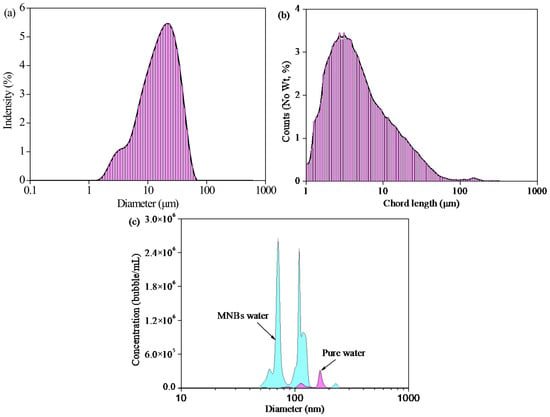
The quartz samples used in this study were supplied by China Resources Mining Co., Ltd. The samples underwent only physical processing procedures, including crushing, washing, sieving, and drying, and no chemical reagents were applied during sample preparation. The mineralogical composition of the quartz samples was previously characterized by X-ray diffraction in our earlier study. The results confirmed that quartz was the dominant crystalline phase, with no significant impurity mineral phases detected, indicating the high mineralogical purity of the samples [31]. As illustrated in Figure 1a, the quartz sample exhibited a positively skewed unimodal particle size distribution, with a dominant peak at approximately 15–20 μm and a relatively narrow size range of 1–60 μm. The particle size distribution was measured using a GSL-1000 particle size analyzer (Liaoning Instrument Research Institute Co., Ltd., Dandong, China). Analytical-grade hexadecyltrimethylammonium bromide (CTAB) was purchased from Sinopharm Chemical Reagent Co., Ltd., Shanghai, China Quartz plates (20 × 20 × 0.5 mm), serving as silica substrates in the interaction measurements, were obtained from Nanjing Youtuopu Technology Co., Ltd., Nanjing, China. The slides consisted predominantly of high-purity silica. Their chemical composition was characterized by X-ray fluorescence, and the detailed results are available in our previous publication [30].
Figure 1.
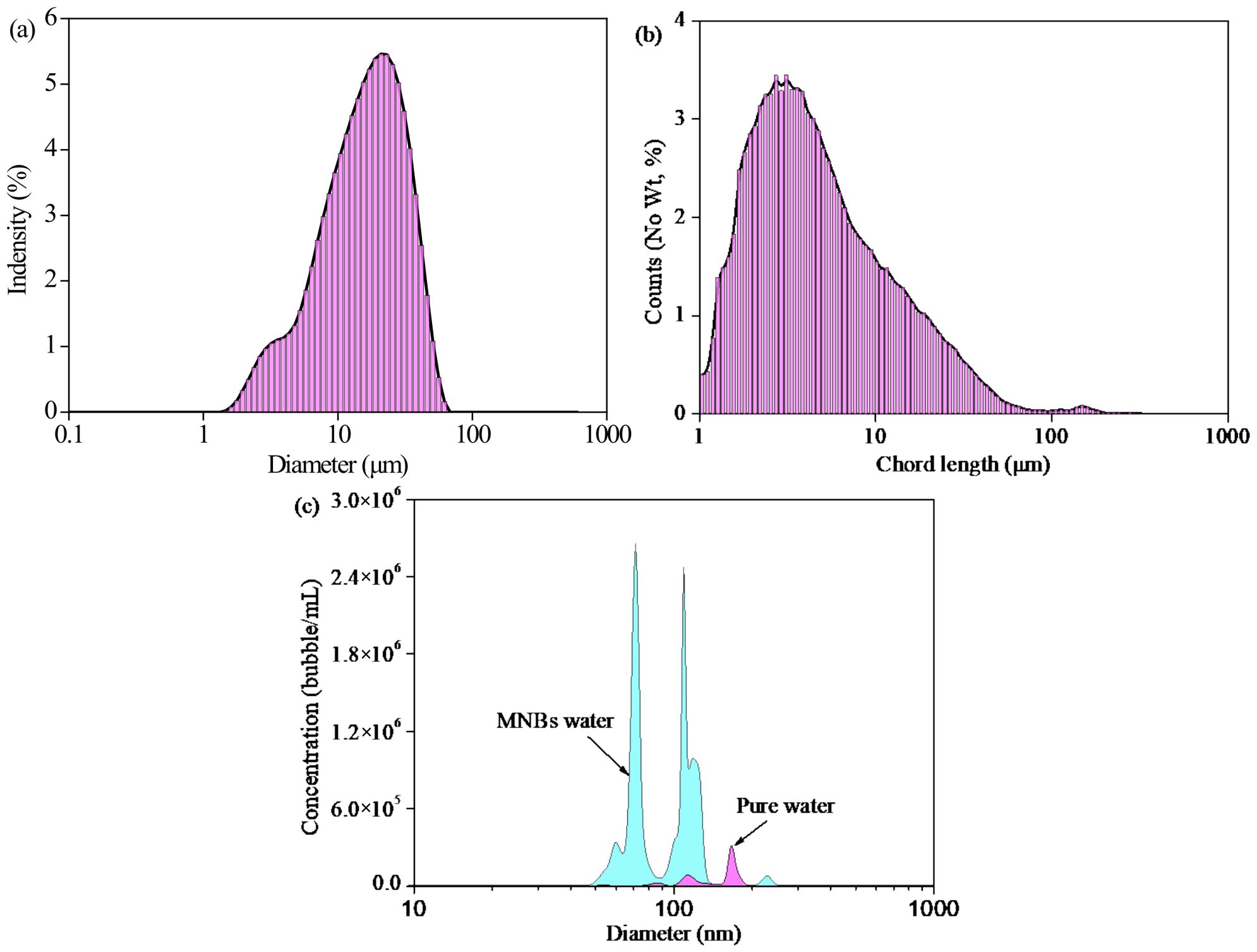
Characterization of quartz particles and BMNBs: (a) particle size distribution of quartz; (b) size distribution of microbubbles; and (c) size distribution of bulk nanobubbles.
BMNB water was generated using a micro-nanobubble generator (Langpai Technology Co., Ltd., Jinan, China) comprising a Venturi mixer and a micro-nanobubble nozzle. Ultrapure water and gas were mixed in the Venturi tube and subsequently dispersed through the nozzle to produce BMNBs. The preparation was carried out in a 1 L beaker at a gas flow rate of 10 mL/min for 6 min. The size distributions of microbubbles and bulk nanobubbles were characterized using focused beam reflectance measurement (FBRM, G400, Mettler-Toledo, Greifensee, Switzerland) and nanoparticle tracking analysis (NTA, NS300, Malvern, UK), respectively.
As shown in Figure 1b, the generated microbubbles exhibited a positively skewed unimodal size distribution, with a dominant peak at approximately 4–6 μm. Most microbubbles were distributed within the range of 2–30 μm, while only a small fraction exceeded 100 μm. In contrast, the bulk nanobubbles were primarily distributed between 50 and 150 nm, with the highest concentrations observed in the range of 70–110 nm (Figure 1c). Compared with pure water, the BMNB water exhibited a substantially higher bubble concentration, indicating the successful generation of abundant nanobubbles.
2.2. Experimental Methods
2.2.1. Flotation Experiment
Flotation experiments were conducted in an XFG-5 laboratory flotation machine (Nanchang Jianfeng Mining Machinery Manufacturing Co., Ltd., Nanchang, China) equipped with a rectangular mechanically agitated flotation cell. The impeller had a diameter of 30 mm. Four impeller speeds (1000, 1200, 1500, and 1900 rpm) were selected as experimental operating levels to establish different agitation intensities. The corresponding impeller tip speeds were calculated using the relationship (Utip = πDN/60), where (D) is the impeller diameter (m) and (N) is the rotational speed (rpm). The calculated tip speeds were 1.57, 1.88, 2.36, and 2.98 m/s, respectively. Conditioning times of 1, 3, 5, and 10 min were employed to investigate the effects of conditioning time on bubble–particle aggregation and subsequent flotation performance. The actual power transferred to the slurry was not directly measured; therefore, the specific energy input was not quantified. All flotation experiments were independently performed in triplicate. The reported recovery values represent the mean values, and the error bars indicate the standard deviations of the replicate measurements.
For each test, 5 g of quartz sample was added to the flotation cell containing 10 mL of ultrapure water and conditioned for 1 min. Subsequently, CTAB was added to obtain a concentration of 1 × 10⁻⁵ M, followed by an additional 1 min of conditioning. Thereafter, 30 mL of either pure water (without BMNBs) or freshly prepared BMNB water was introduced into the flotation cell. The pulp was then conditioned under the designated impeller speed for the specified conditioning time (1, 3, 5, or 10 min). The freshly prepared BMNB water was used immediately after generation. At each impeller speed, experiments with and without BMNBs were conducted under otherwise identical conditions, with the CTAB concentration and reagent addition sequence kept constant. After conditioning, flotation was conducted for 2 min at an aeration rate of 40 mL/min. The floated products and tailings were collected separately, filtered, and dried overnight for recovery determination. All experiments were carried out at a natural pH of approximately 7.
2.2.2. Particle Size Distribution Measurements
The particle size distribution and aggregation behavior of quartz particles under different hydrodynamic conditions were investigated using a focused beam reflectance measurement (FBRM, G400, Mettler-Toledo, Greifensee, Switzerland) system coupled with a particle vision and measurement (PVM, V19, Mettler-Toledo, Greifensee, Switzerland) system. FBRM was employed to monitor the real-time chord length distribution of quartz particles, while PVM was used to observe the corresponding microscopic morphology and aggregation state.
For each experiment, 1 g of quartz sample was dispersed in 30 mL of ultrapure water, followed by the addition of CTAB to achieve a concentration of 1 × 10⁻⁵ M. The suspension was conditioned at 500 rpm for 2 min to ensure uniform reagent adsorption. Subsequently, 100 mL of either pure water or freshly prepared BMNB water was added to the suspension. The slurry was then agitated at predetermined impeller speeds of 1000, 1200, 1500, or 1900 rpm for 1, 3, 5, or 10 min. Upon the addition of water and initiation of agitation, the FBRM and PVM systems were simultaneously activated to continuously record changes in particle size distribution and particle aggregation behavior throughout the conditioning process.
2.2.3. Measurement of Slurry Rheological Properties
The rheological properties of quartz slurries subjected to different hydrodynamic conditions were characterized using a Discovery Hybrid Rheometer (DHR, TA Instruments, New Castle, DE, USA). Detailed information regarding the rheological measurement procedure can be found in our previous study. A parallel-plate geometry with a diameter of 40 mm was employed, and the measurement temperature was maintained at 25 °C using a circulating water bath.
Prior to rheological measurements, quartz slurries were prepared following the same conditioning procedure used in the flotation tests. Briefly, the slurry was conditioned in either pure water or BMNB water at impeller speeds of 1000 or 1900 rpm for 1 or 10 min. Immediately after conditioning, approximately 1.5 mL of slurry was transferred onto the rheometer plate. The gap between the parallel plates was adjusted to 500 μm to ensure complete filling of the measuring geometry without overflow. Flow curves were obtained by varying the shear rate from 0.01 to 100 s−1, and the corresponding viscosity data were recorded using Trios software (v5.4, TA Instruments, New Castle, DE, USA).
2.2.4. Dissolved Oxygen Concentration Measurement and Bubble Nucleation Observation
The evolution of DO concentration under different hydrodynamic conditions was monitored using a DO meter (HQ30D, Hach Company, Loveland, CO, USA). Freshly prepared BMNB-treated water and pure water were transferred into a beaker and stirred using a magnetic stirrer (JK-DMS-H, Shanghai Precision Scientific Instrument Co., Ltd., Shanghai, China) at rotational speeds of 1000 and 1900 rpm. The DO probe was positioned at a fixed location in the liquid, and the DO concentration was continuously recorded for 10 min immediately after the onset of stirring. All measurements were conducted at room temperature.
Bubble nucleation and gas release behaviors were visualized using a high-speed imaging system consisting of an optical microscope (Olympus Corporation, Tokyo, Japan) coupled with a high-speed camera (i-SPEED 713, Olympus, Japan). A quartz plate (contact angle of approximately 65°) was employed as a model surface for heterogeneous bubble nucleation. The detailed modification procedure and contact angle results can be found in our previous work [30]. During the experiments, the quartz plate was horizontally mounted on two supporting edges located at the top of a transparent acrylic cell, with its lower surface in direct contact with the liquid. The solution level was carefully adjusted to fully immerse the quartz plate while maintaining optical access for side-view observation.
3. Results and Discussion
3.1. Flotation Results
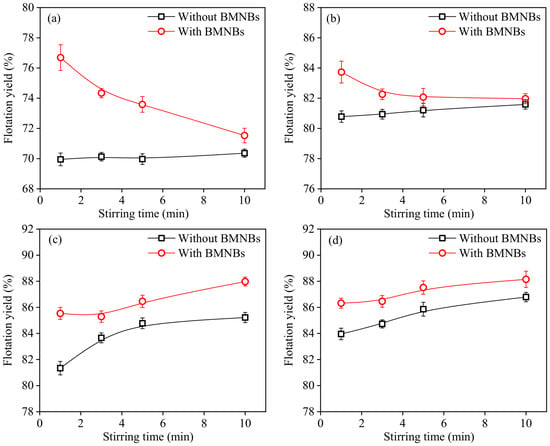
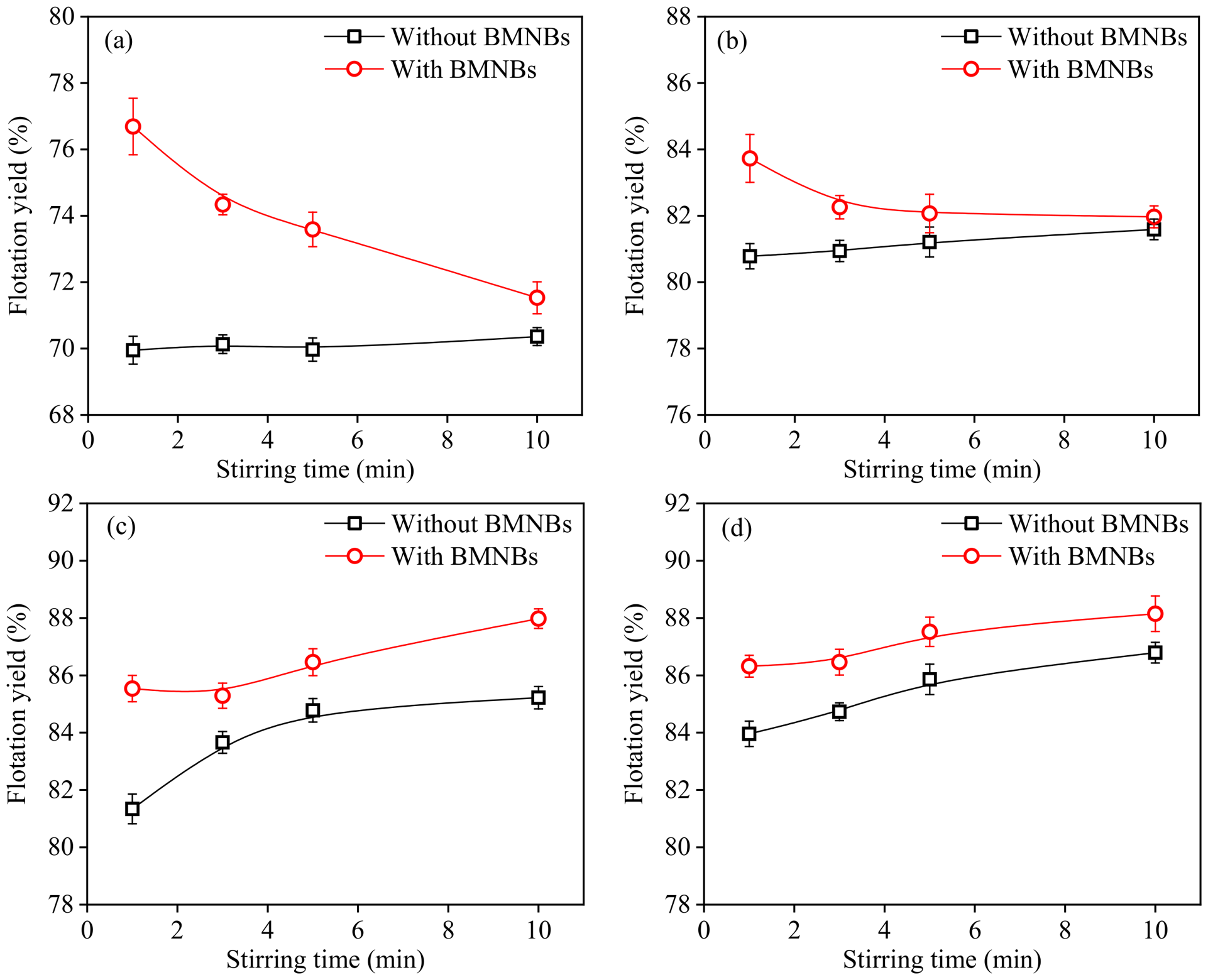
The flotation results obtained under different stirring intensities and conditioning times are presented in Figure 2. At each stirring speed, the flotation performance of the BMNB-containing system was compared with that of the BMNB-free system under otherwise identical experimental conditions. This comparison was designed to evaluate the contribution of BMNBs to quartz flotation under different hydrodynamic conditions. In the absence of BMNBs, quartz recovery generally increased with increasing stirring speed and conditioning time, indicating that enhanced hydrodynamic conditions promoted collector dispersion and particle–bubble interactions. However, the influence of BMNBs exhibited a strong dependence on stirring intensity.
Figure 2.
Effect of stirring speed on quartz flotation performance mediated by BMNBs: (a) 1000 rpm; (b) 1200 rpm; (c) 1500 rpm; (d) 1900 rpm.
At a stirring speed of 1000 rpm (Figure 2a), the flotation recovery in the presence of BMNBs decreased markedly from 76.7% to 71.6% as the conditioning time increased from 1 to 10 min. In contrast, the recovery obtained without BMNBs remained nearly constant at approximately 70%. Consequently, the recovery advantage provided by BMNBs decreased from about 6.7 percentage points at 1 min to only 1.2 percentage points at 10 min. This result suggests that prolonged conditioning under weak hydrodynamic conditions gradually diminished the beneficial effect of BMNBs.
At 1200 rpm (Figure 2b), a similar trend was observed, although the decline became less pronounced. The recovery obtained with BMNBs decreased from approximately 83.8% to 82.0% with increasing conditioning time, whereas the recovery without BMNBs showed a slight increase from 80.8% to 81.5%. As a result, the flotation enhancement induced by BMNBs continuously weakened and nearly disappeared after 10 min of conditioning.
A different trend was observed at 1500 rpm (Figure 2c). In the absence of BMNBs, the flotation recovery increased steadily from 81.3% to 85.2% as the conditioning time was extended from 1 to 10 min. In contrast, the recovery obtained in the presence of BMNBs remained nearly unchanged during the initial 3 min of conditioning and subsequently increased to 88.0% after 10 min. Although the flotation enhancement provided by BMNBs gradually decreased from approximately 4.2 to 2.8 percentage points with increasing conditioning time, a distinct recovery advantage was maintained throughout the entire conditioning period.
At 1900 rpm (Figure 2d), both flotation systems exhibited a continuous increase in recovery with conditioning time. The recovery without BMNBs increased from 83.9% to 86.8%, while that with BMNBs increased from 86.3% to 88.1%. The difference between the two systems remained relatively constant at approximately 1.3–2.4 percentage points, indicating that the BMNB effect became less sensitive to conditioning time under intense agitation. It should be noted that the prolonged conditioning time of 10 min was primarily used to investigate the effects of extended agitation on gas release from BMNB-containing water and its subsequent influence on flotation performance, rather than to represent a typical conditioning period in conventional flotation.
Overall, the comparison between the BMNB-containing and BMNB-free systems at each fixed stirring speed demonstrates that the contribution of BMNBs to flotation recovery depended on both stirring intensity and conditioning time. Under relatively low stirring intensities (1000–1200 rpm), the recovery advantage provided by BMNBs progressively diminished with prolonged conditioning. In contrast, under higher stirring intensities (1500–1900 rpm), the recovery advantage was maintained throughout the conditioning period. These results indicate that the hydrodynamic conditions influenced the extent to which BMNBs enhanced quartz flotation, although the individual contributions of particle–bubble collision, attachment, and detachment were not independently quantified in this study.
3.2. Evolution of Particle Size Distribution
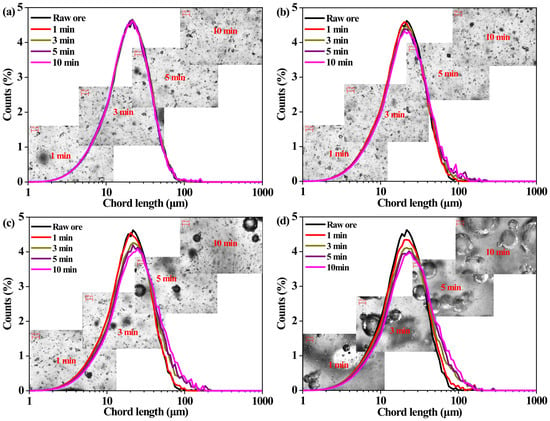
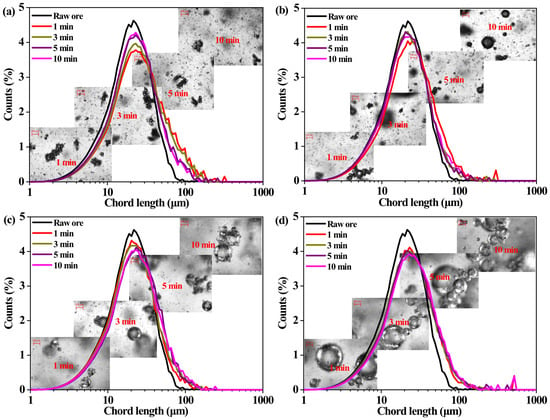
The evolution of quartz particle size distribution and particle morphology under different stirring intensities and conditioning times is shown in Figure 3. At 1000 rpm (Figure 3a), the FBRM chord length distributions exhibited minimal variation with conditioning time, indicating that the particle size distribution remained relatively stable. Correspondingly, the PVM images showed predominantly dispersed fine particles with no obvious structural changes. When the stirring speed increased to 1200 rpm (Figure 3b), slight changes in the particle size distribution were observed, accompanied by the appearance of locally concentrated particle regions in the PVM images. This suggests that moderate particle interactions began to occur under the enhanced hydrodynamic conditions.
Figure 3.
Evolution of chord-length distributions and slurry morphology under different stirring intensities in the absence of BMNBs: (a) 1000 rpm; (b) 1200 rpm; (c) 1500 rpm; (d) 1900 rpm.
More pronounced changes were observed at 1500 rpm (Figure 3c). The chord length distributions gradually broadened with increasing conditioning time, while the PVM images revealed a noticeable increase in the occurrence of coarse particle structures. These observations indicate enhanced particle collision and aggregation under intermediate stirring intensity. At 1900 rpm (Figure 3d), further broadening of the chord length distribution was observed. Meanwhile, numerous large spherical objects appeared in the PVM images, particularly after prolonged conditioning. These structures are likely associated with bubbles generated or entrained under intense agitation. The results suggest that strong hydrodynamic conditions substantially altered the slurry microenvironment and influenced the measured particle size characteristics. Overall, the FBRM and PVM results demonstrate that stirring intensity significantly affects the evolution of quartz slurry structure.
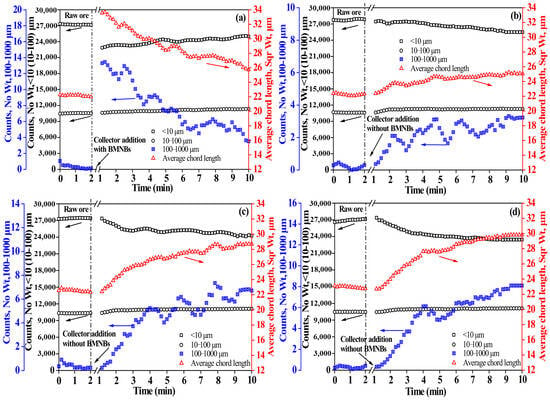
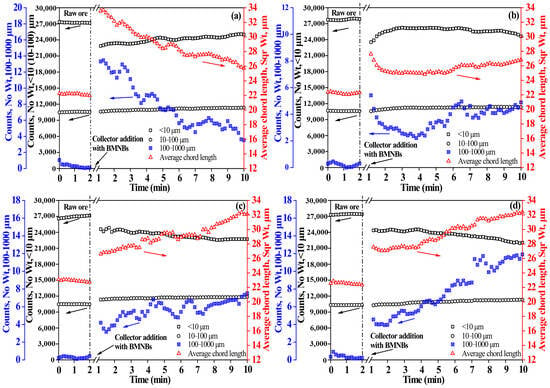
To quantitatively evaluate the influence of stirring intensity on slurry structure evolution, the particle populations in different size classes together with the average chord length were monitored by FBRM, and the results are presented in Figure 4. Following collector addition, the evolution of particle populations became strongly dependent on stirring intensity. At 1000 rpm (Figure 4a), only minor variations were observed in all size classes. The number of particles smaller than 10 μm remained nearly constant at approximately 27,000, while the population of particles larger than 100 μm remained negligible. Consequently, the average chord length showed almost no change throughout the conditioning period. At 1200 rpm (Figure 4b), the number of particles smaller than 10 μm gradually decreased from approximately 27,000 to 26,000, accompanied by a moderate increase in the population of coarse particles (>100 μm). Correspondingly, the average chord length increased from approximately 22 to 25 μm.
Figure 4.
Evolution of FBRM chord-length populations in different size classes and average chord length under varying stirring intensities in the absence of BMNBs: (a) 1000 rpm; (b) 1200 rpm; (c) 1500 rpm; (d) 1900 rpm. The initial 2 min represents the baseline measurement of the raw quartz slurry.
More pronounced changes were observed at 1500 rpm (Figure 4c). The population of fine particles (<10 μm) decreased by more than 3.0 × 10³ particles, whereas the number of particles larger than 100 μm increased continuously during conditioning. As a result, the average chord length increased from approximately 22 μm to nearly 29 μm. At 1900 rpm (Figure 4d), the reduction in fine-particle population became even more significant, with the number of particles smaller than 10 μm decreasing to approximately 24,000. Simultaneously, the population of coarse particles continued to increase, leading to a further increase in average chord length to approximately 30 μm. However, combined with the PVM observations (Figure 3), part of the coarse-size signal under this condition may be associated with large bubbles generated under intense agitation.
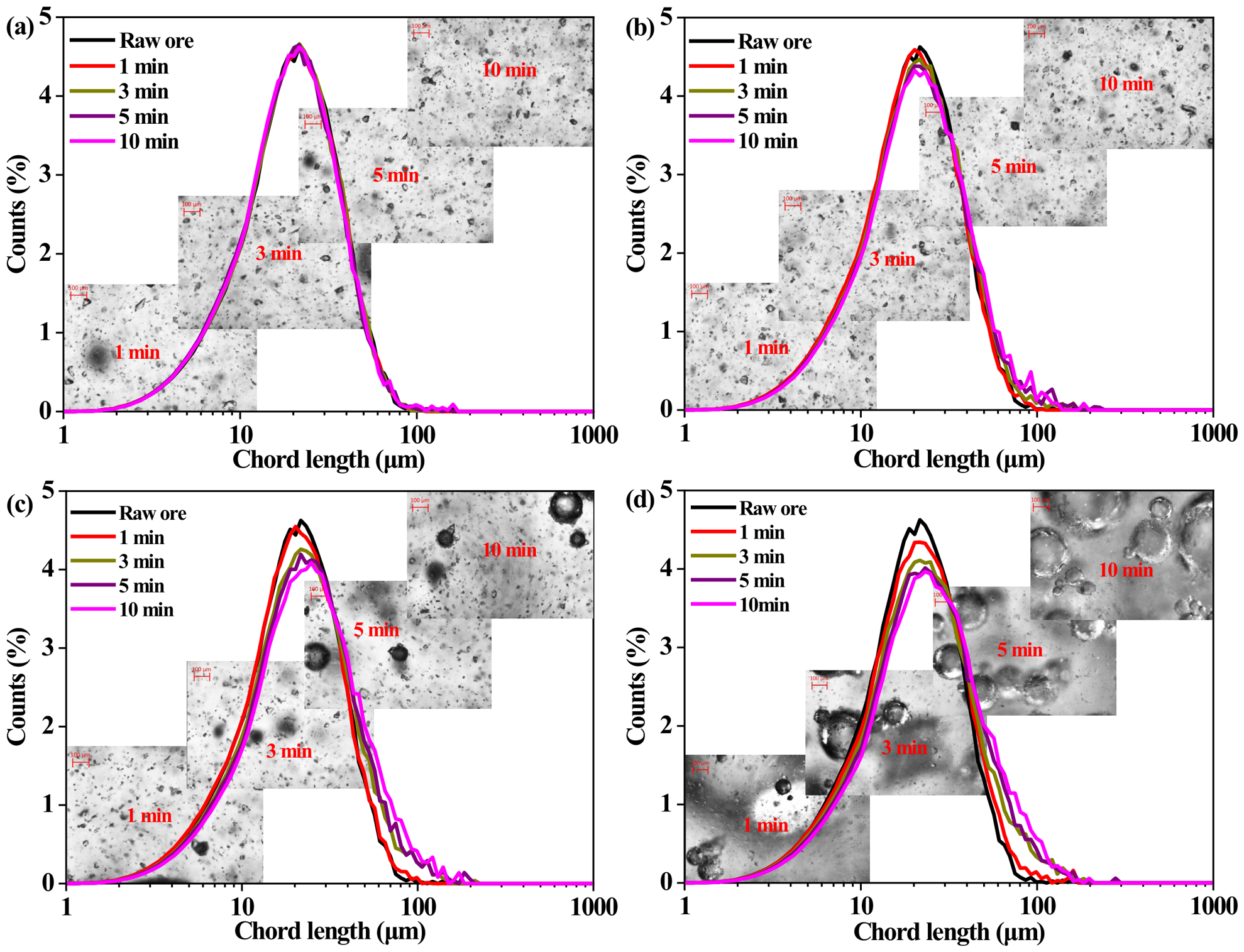
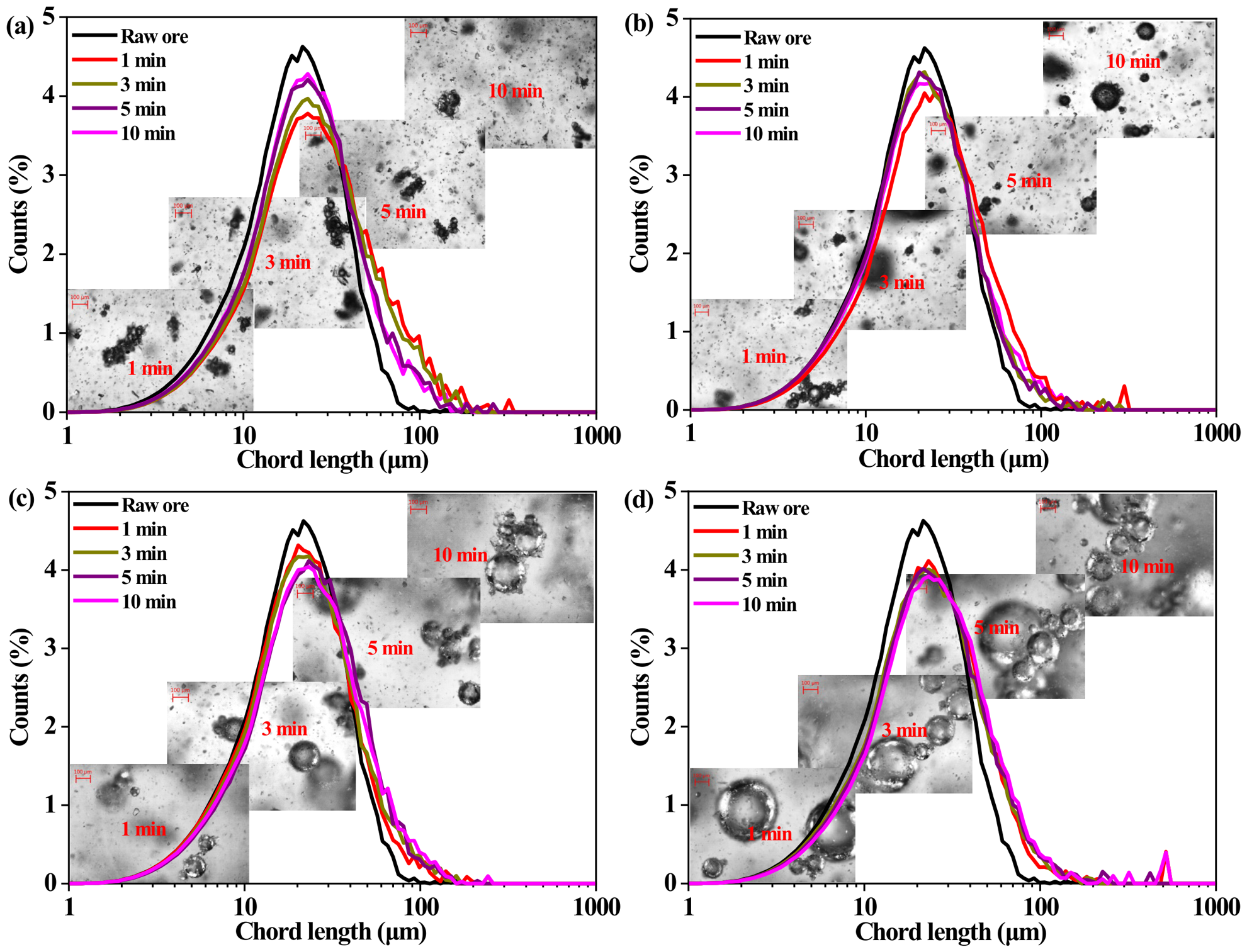
The evolution of chord-length distributions and slurry morphology in the presence of BMNBs under different stirring intensities is presented in Figure 5. Distinctly different behaviors were observed under low- and high-intensity stirring conditions, indicating that the evolution of slurry structure was governed by different mechanisms.
Figure 5.
Evolution of chord-length distributions and slurry morphology under different stirring intensities in the presence of BMNBs: (a) 1000 rpm; (b) 1200 rpm; (c) 1500 rpm; (d) 1900 rpm.
At 1000 rpm (Figure 5a) and 1200 rpm (Figure 5b), the chord length distributions gradually shifted toward smaller sizes with increasing conditioning time. The corresponding PVM images showed that the initially formed bubble–particle floc structures became progressively less apparent during conditioning. These observations suggest that the bubble–particle flocs generated immediately after BMNB addition were gradually disrupted by continuous agitation. Because the hydrodynamic intensity was relatively weak, the energy input was insufficient to induce significant gas nucleation from the supersaturated solution. Consequently, the destruction of pre-existing flocs dominated the structural evolution of the slurry, resulting in a progressive reduction in apparent particle size.
In contrast, different trends were observed at 1500 rpm (Figure 5c) and 1900 rpm (Figure 5d). Under these high-intensity stirring conditions, no obvious bubble–particle flocs were observed at the initial stage, suggesting that the floc structures formed immediately after BMNB addition were rapidly disrupted by strong hydrodynamic shear. Although the initially formed bubble–particle flocs were also rapidly disrupted under stronger hydrodynamic conditions, the chord length distributions gradually shifted toward larger sizes as conditioning proceeded. Simultaneously, the PVM images revealed the appearance of numerous spherical structures whose abundance increased with conditioning time. Compared with the BMNB-free system (Figure 3), the number of these structures was substantially higher.
The spherical structures observed under high-intensity stirring are consistent with gas release and secondary bubble formation from the supersaturated BMNB-containing slurry. Strong agitation can generate intense turbulence and local pressure fluctuations, potentially accelerating dissolved gas release and promoting bubble formation. As conditioning time increased, the contribution of these bubble-related structures may have progressively increased, partially offsetting the reduction caused by the disruption of pre-existing floc-like structures. This provides a possible explanation for the gradual shift in the chord length distributions toward larger sizes at 1500 and 1900 rpm.
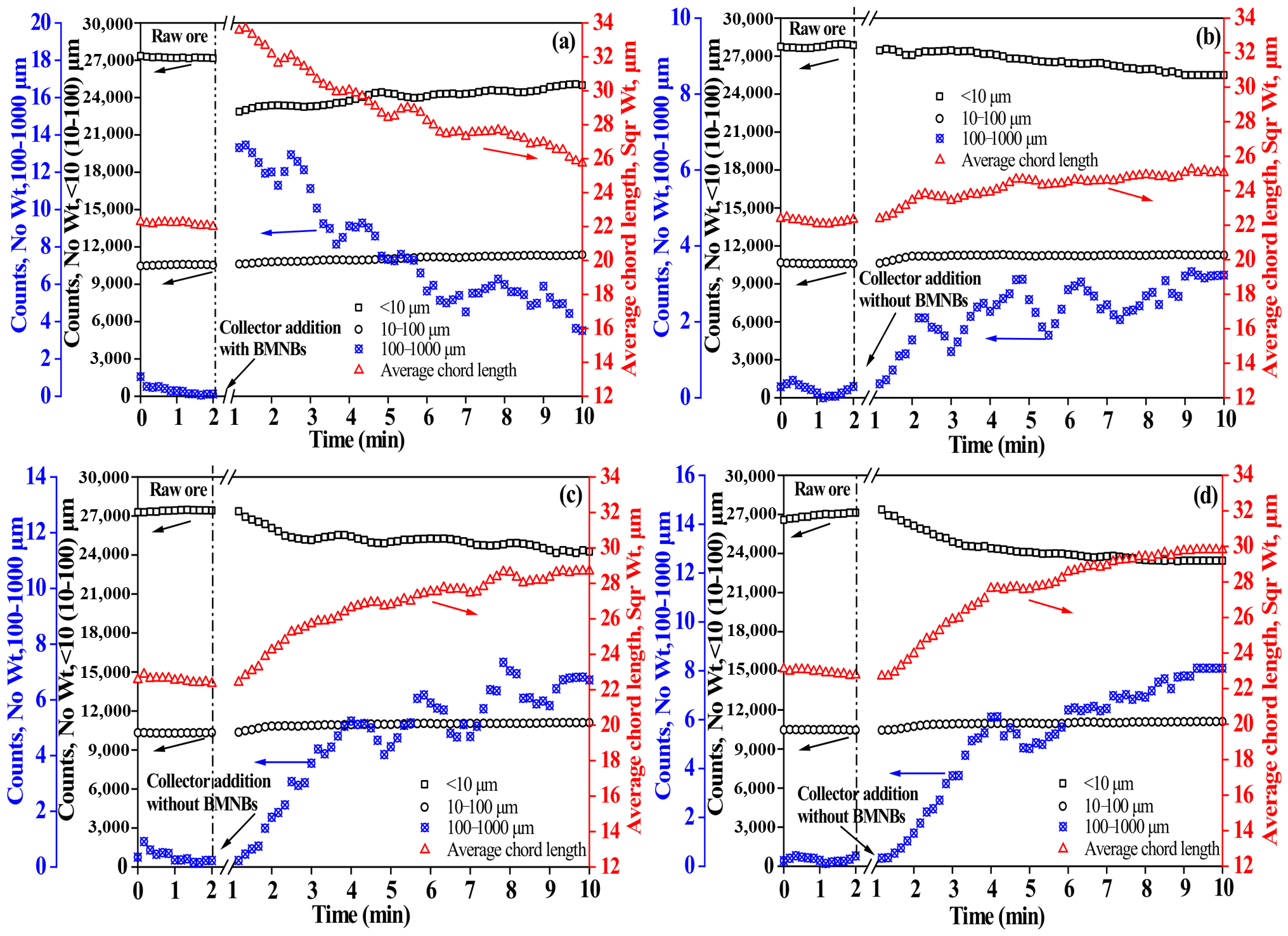
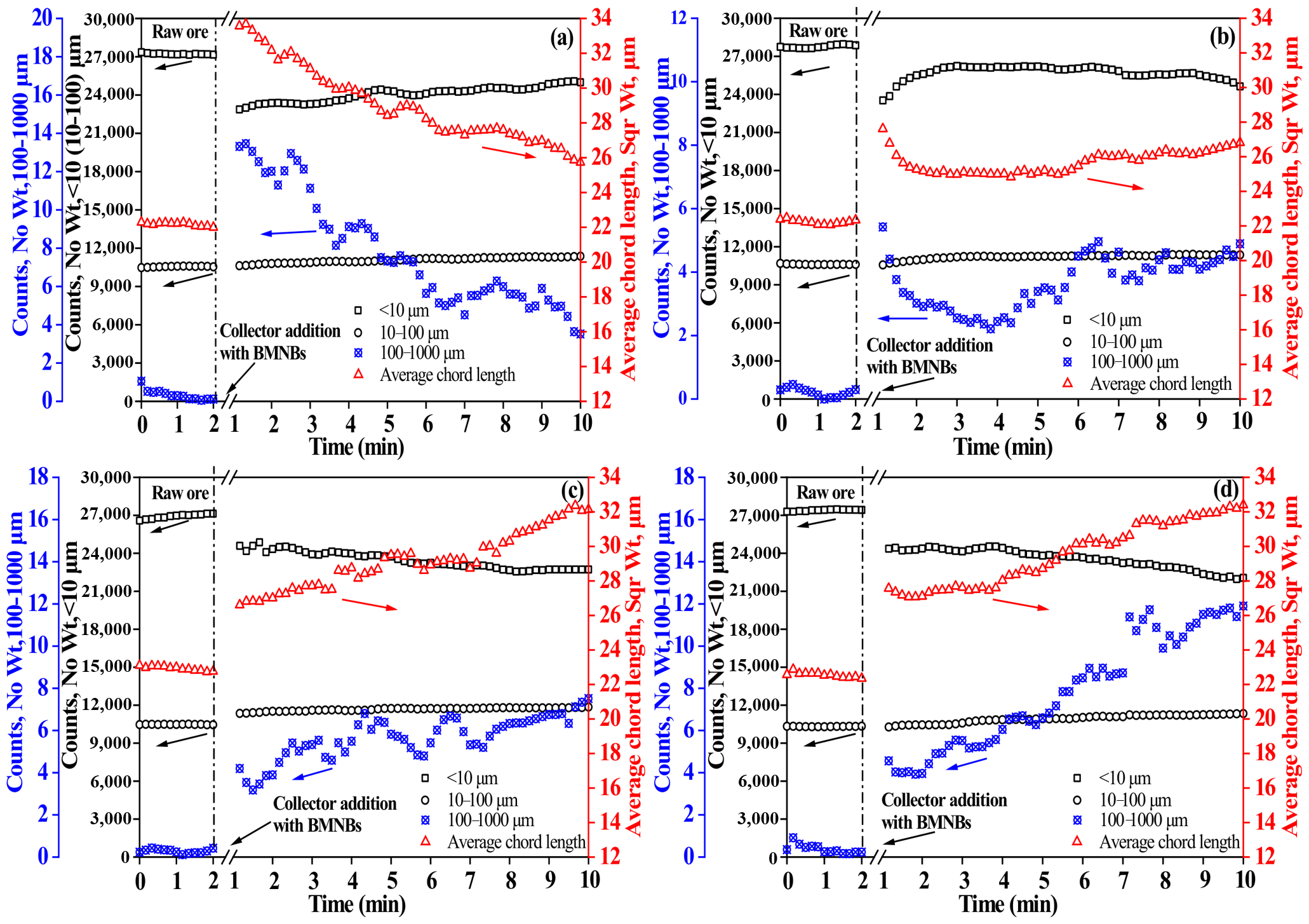
To further quantify the structural evolution of BMNB-containing slurries, the populations of different particle size classes and the average chord length were monitored by FBRM, as shown in Figure 6. At 1000 rpm (Figure 6a), the average chord length decreased continuously from approximately 34 μm to 26 μm with increasing conditioning time. Simultaneously, the number of coarse structures in the 100–1000 μm size range decreased gradually, whereas the populations of particles smaller than 100 μm remained nearly unchanged. Similar behavior was observed at 1200 rpm (Figure 6b), where the average chord length initially decreased from approximately 28 μm to 25 μm and subsequently remained relatively stable. The number of coarse structures also decreased during the early stage of conditioning. The simultaneous decrease in average chord length and coarse-size signal population quantitatively demonstrates the reduction in larger dispersed structures. Combined with the PVM observations in Figure 5, these results indicate that the initially formed bubble–particle floc-like structures were progressively disrupted under relatively low stirring intensities.
Figure 6.
Evolution of FBRM chord-length populations in different size classes and average chord length under varying stirring intensities in the presence of BMNBs: (a) 1000 rpm; (b) 1200 rpm; (c) 1500 rpm; (d) 1900 rpm. The initial 2 min represents the baseline measurement of the raw quartz slurry.
In contrast, different trends were observed at 1500 rpm (Figure 6c) and 1900 rpm (Figure 6d). At both stirring intensities, the average chord length increased continuously with conditioning time, reaching approximately 33 μm after 10 min, respectively. Meanwhile, the number of coarse structures in the 100–1000 μm size range increased substantially. At 1900 rpm, this population increased from approximately 4 at 2 min to nearly 12 at 10 min. Thus, the increase in average chord length was accompanied by a substantial increase in coarse-size signals, indicating a progressive shift in the overall chord-length population toward larger dispersed structures.
Combined with the PVM observations shown in Figure 5, these coarse-size signals may be partly associated with newly formed bubble-related structures rather than solely with particle aggregates. Under high-intensity stirring conditions, the initially formed bubble–particle flocs were rapidly disrupted, resulting in relatively small chord lengths during the early stage of conditioning. However, strong turbulence and pressure fluctuations promoted gas release from the supersaturated BMNB-containing slurry, leading to continuous secondary bubble nucleation. As conditioning proceeded, the generation of new bubbles gradually became dominant, producing an increasing number of coarse-size signals and a corresponding increase in average chord length.
Overall, the FBRM measurements quantitatively demonstrate two distinct trends in the evolution of dispersed structures: at low stirring intensities (1000–1200 rpm), the reduction in coarse-size signal populations and average chord length indicates that structural disruption predominated; in contrast, at high stirring intensities (1500–1900 rpm), the continuous increase in these parameters suggests an increasing contribution from gas-related structures. These findings, together with the complementary PVM observations, support the proposed competition between the disruption of initially formed bubble–particle floc-like structures and gas release with subsequent bubble formation in the BMNB-containing slurry.
3.3. Rheological Properties of Slurry
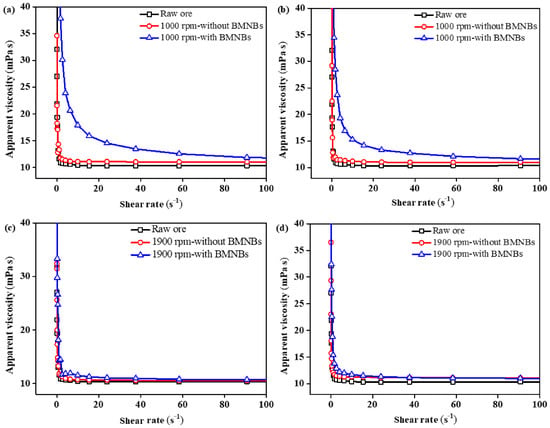
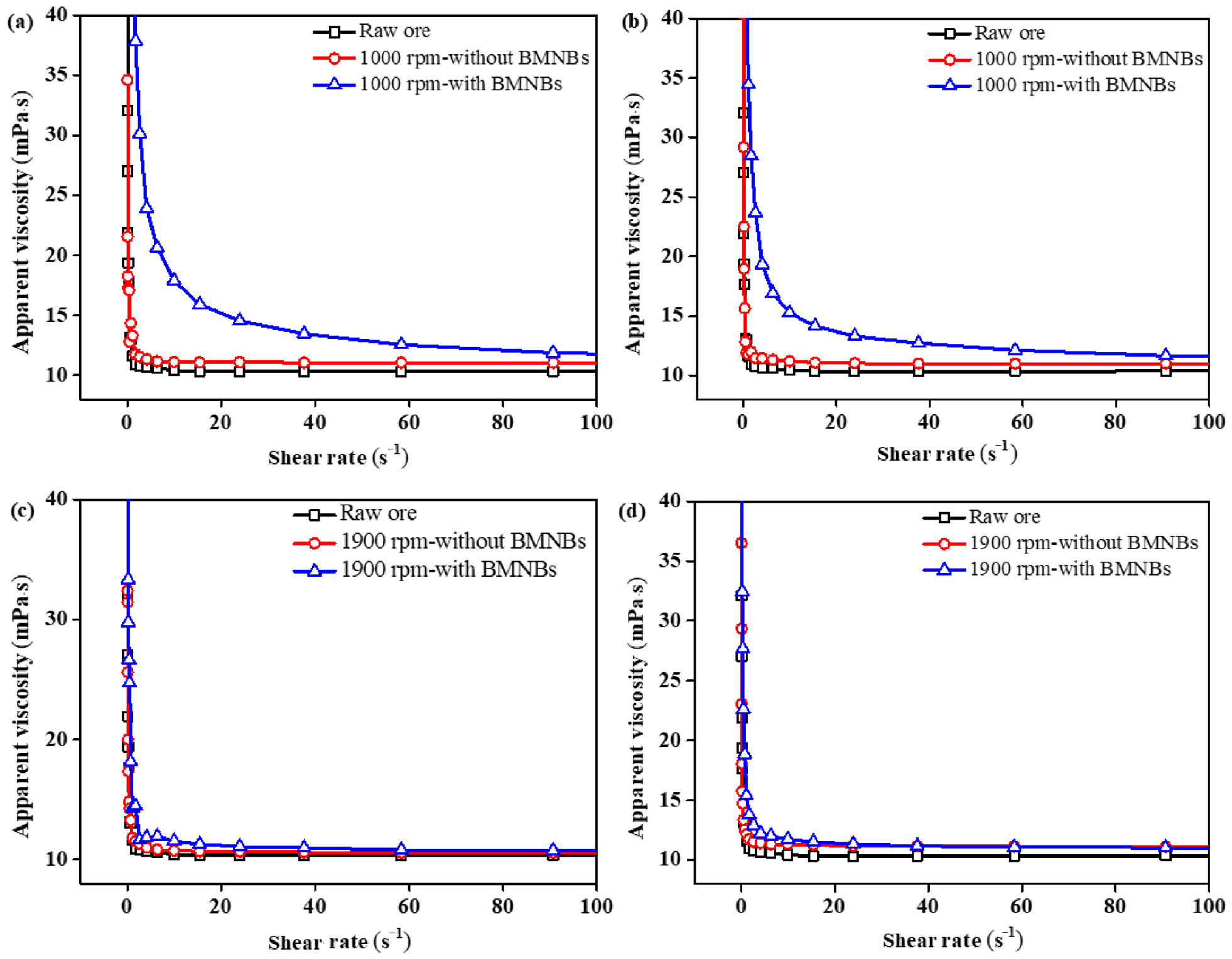
The rheological behavior of quartz slurries conditioned under different stirring intensities and conditioning times is presented in Figure 7. All slurry samples exhibited typical shear-thinning behavior, with the apparent viscosity decreasing rapidly as the shear rate increased and gradually approaching a relatively stable value at high shear rates. This indicates that the quartz slurries exhibited pseudoplastic behavior under all conditioning conditions.
Figure 7.
Apparent viscosity of quartz slurries conditioned under different stirring intensities and conditioning times: (a) 1000 rpm, 1 min; (b) 1000 rpm, 10 min; (c) 1900 rpm, 1 min; and (d) 1900 rpm, 10 min.
At 1000 rpm (Figure 7a,b), the BMNB-treated slurry exhibited a noticeably higher apparent viscosity than both the raw ore slurry and the BMNB-free slurry, particularly in the low-shear-rate region. The increased apparent viscosity suggests enhanced structural interactions within the slurry, potentially associated with the formation of bubble–particle aggregates. Such aggregates may increase the effective hydrodynamic volume of the dispersed structures and consequently enhance the resistance to flow. However, the viscosity difference between the BMNB-containing and BMNB-free systems became less pronounced after 10 min of conditioning. This suggests that prolonged agitation may have altered the initially formed aggregate structures, reducing their contribution to the macroscopic rheological response. This trend is consistent with the decreases in average chord length and coarse-size chord-length populations observed in Figure 5 and Figure 6, which suggest a reduction in the contribution of larger dispersed structures.
At 1900 rpm (Figure 7c,d), the rheological differences between the BMNB-containing and BMNB-free systems were less pronounced than those observed at 1000 rpm, particularly at higher shear rates. Nevertheless, the BMNB-treated slurry still exhibited a higher apparent viscosity in the low-shear-rate region after 1 min of conditioning (Figure 7c). After 10 min of conditioning (Figure 7d), the difference between the two systems became less evident. These results suggest that the influence of BMNBs on the internal structure of the slurry was dependent on both stirring intensity and conditioning time. Under high-intensity stirring, the disruption and rearrangement of existing aggregates may weaken their contribution to the overall rheological response. Meanwhile, the increased coarse-size chord-length signals observed in Figure 5 and Figure 6 at prolonged conditioning times may reflect changes in gas-related dispersed structures. However, these changes did not result in a corresponding increase in apparent viscosity, indicating that the formation of larger gas-related structures does not necessarily lead to a stronger interconnected structure throughout the slurry.
Overall, the rheological results provide complementary macroscopic evidence for the structural changes induced by BMNBs in quartz slurries. At relatively low stirring intensity, BMNBs enhanced the structural interactions within the slurry, potentially promoting the formation of bubble–particle aggregates and increasing the apparent viscosity. At higher stirring intensity, the contribution of these structures to the rheological response became less pronounced, particularly after prolonged conditioning. Combined with the FBRM and PVM observations, these results suggest that the structural evolution of BMNB-containing slurries is influenced by the interplay between aggregate disruption and changes in gas-related dispersed structures under different hydrodynamic conditions. Such structural changes may affect particle transport and particle–bubble interactions during flotation, thereby contributing to the observed differences in flotation performance. Nevertheless, apparent viscosity reflects the combined effects of particle dispersion, aggregation, and bubble–particle interactions and cannot independently confirm the formation or quantify the abundance of bubble–particle aggregates.
3.4. Discussion
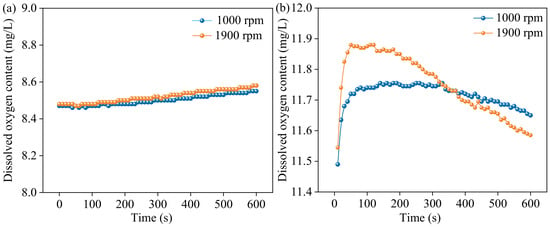
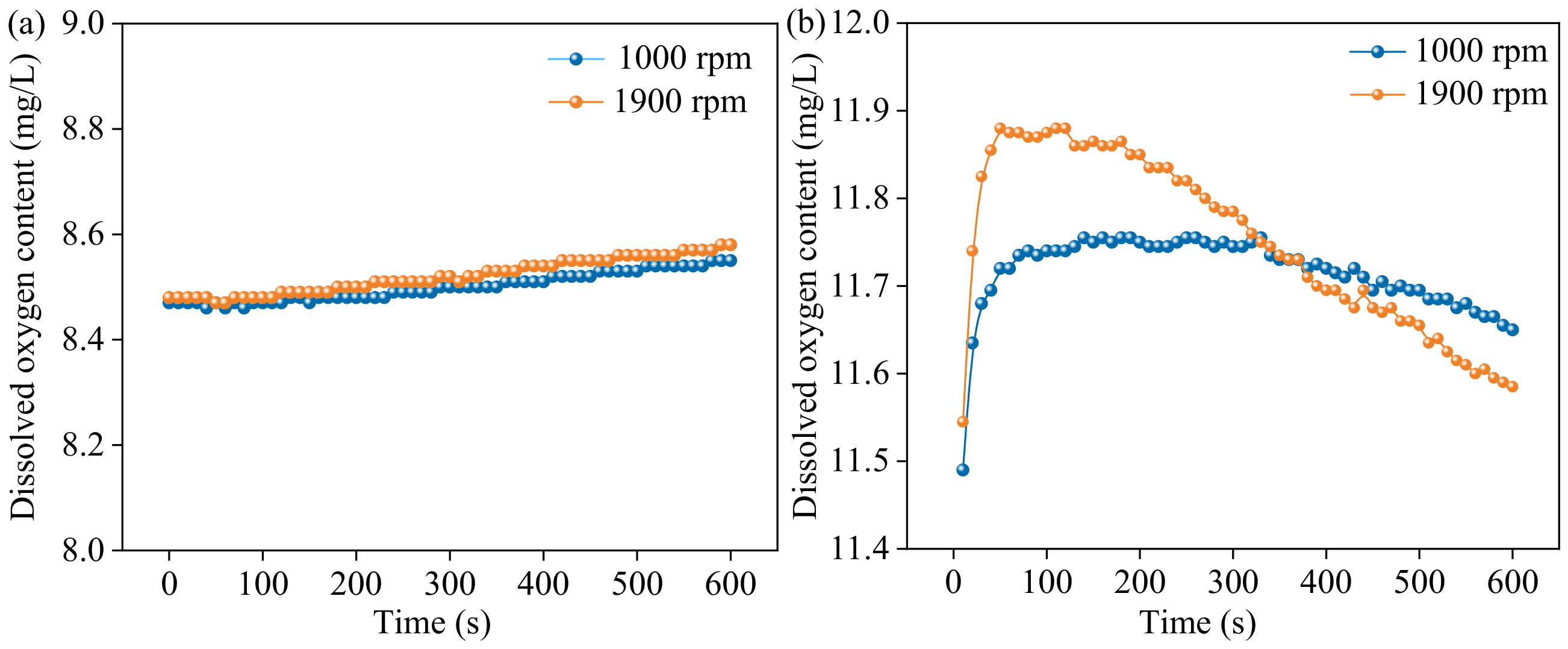
The evolution of DO concentration in pure water and BMNB-treated water under different stirring intensities is presented in Figure 8. For pure water (Figure 8a), the DO concentration remained nearly constant throughout the experiment, increasing only slightly from approximately 8.47 to 8.57 mg/L. Moreover, negligible differences were observed between 1000 and 1900 rpm, indicating that stirring intensity had little influence on the DO level in the absence of BMNBs.
Figure 8.
Evolution of dissolved oxygen concentration in (a) pure water and (b) BMNB-treated water under stirring at 1000 and 1900 rpm.
In contrast, BMNB-treated water exhibited substantially higher DO concentrations (Figure 8b), with initial values of approximately 11.5 mg/L, confirming the supersaturated nature of the system. Following the onset of stirring, the DO concentration increased rapidly and reached peak values within the first minute. The maximum DO concentration obtained at 1900 rpm was noticeably higher than that at 1000 rpm. This initial increase suggests that the BMNB system underwent a rapid gas redistribution process during the early stage of agitation. The disruption of microbubbles and the enhanced gas–liquid mass transfer promoted the conversion of oxygen stored within BMNBs into the dissolved phase, resulting in a temporary increase in the measured DO concentration. The more pronounced increase observed at 1900 rpm indicates that stronger hydrodynamic conditions accelerated bubble disruption and gas transfer.
After reaching the maximum value, the DO concentration gradually decreased with time, indicating a transition from gas dissolution-dominated behavior to gas release-dominated behavior. This decline was significantly more pronounced at 1900 rpm than at 1000 rpm. Specifically, the DO concentration decreased by approximately 0.30 mg/L at 1900 rpm, compared with only about 0.10 mg/L at 1000 rpm over the same conditioning period. Once the DO concentration exceeded its metastable equilibrium level, dissolved gas gradually escaped from the supersaturated liquid through nucleation and bubble growth processes. The accelerated oxygen depletion under high-intensity stirring therefore suggests that strong turbulence and local pressure fluctuations promoted the release of dissolved gas from the supersaturated BMNB-containing water.
Combining these observations with the FBRM and PVM results (Figure 5 and Figure 6), the decrease in DO concentration at high stirring intensity is consistent with the appearance of numerous spherical structures in the slurry. This suggests that part of the DO stored in the BMNB system was continuously released and converted into newly generated bubbles during conditioning. Consequently, the increase in coarse-size signals observed under high-intensity stirring is likely associated with secondary bubble nucleation rather than solely with particle aggregation.
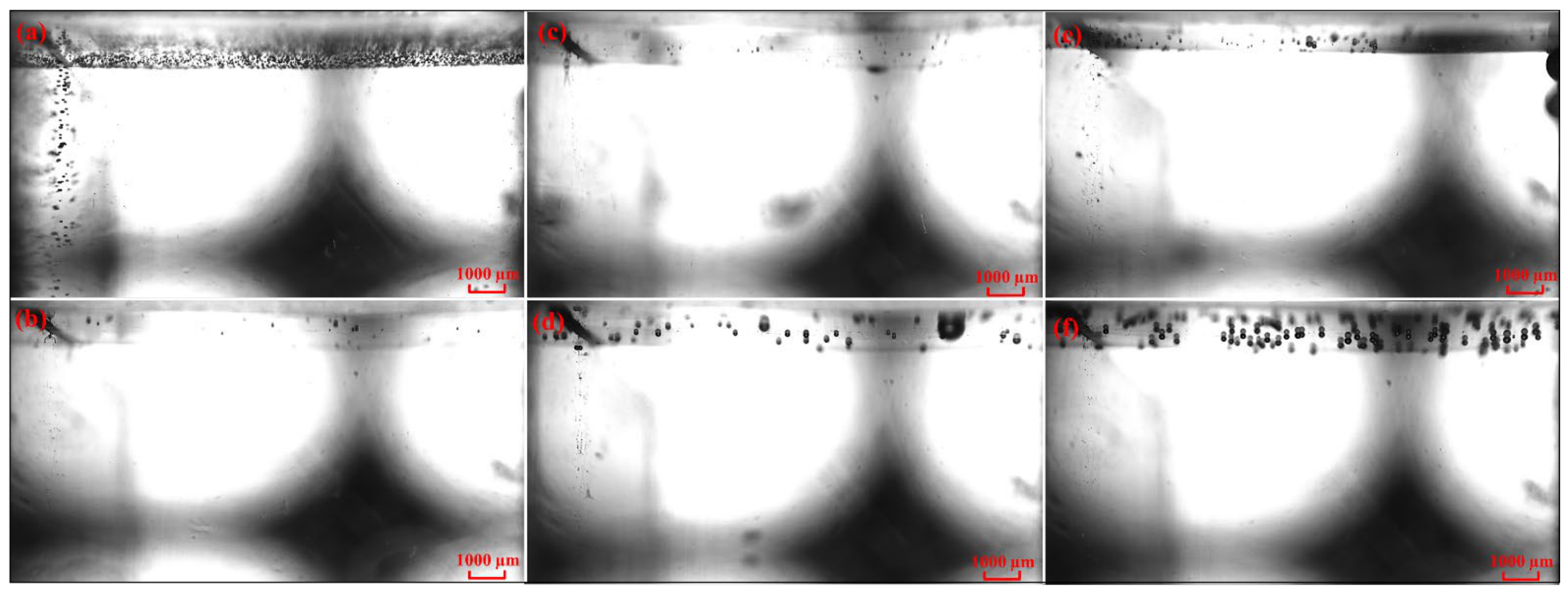
To further investigate gas release and the possibility of secondary bubble nucleation in BMNB-derived supersaturated solutions, high-speed imaging was conducted on a hydrophobic quartz surface under different hydrodynamic conditions, as shown in Figure 9. In the freshly prepared BMNB-treated water (Figure 9a), numerous microbubbles were observed around and attached to the hydrophobic quartz surface, indicating preferential bubble accumulation at the hydrophobic interface.
Figure 9.
Visualization of bubble nucleation and accumulation on a hydrophobic quartz surface in BMNB-derived supersaturated solutions under different stirring conditions: (a) freshly prepared BMNB-treated water; (b) supersaturated solution after standing for 10 min; (c) pure water stirred at 1000 rpm for 10 min; (d) supersaturated solution stirred at 1000 rpm for 10 min; (e) pure water stirred at 1900 rpm for 10 min; and (f) supersaturated solution stirred at 1900 rpm for 10 min.
After the visible microbubbles had disappeared, the quartz plate was immersed in the remaining supersaturated solution and left undisturbed for 10 min (Figure 9b). Under these quiescent conditions, only a few isolated bubbles were observed on the surface, indicating that spontaneous bubble nucleation was limited despite the persistence of gas supersaturation in the liquid phase. This result suggests that the supersaturated state alone was insufficient to produce substantial bubble accumulation on the hydrophobic surface in the absence of external disturbances.
The behavior changed when hydrodynamic agitation was introduced. In pure water, only a small number of bubbles appeared on the hydrophobic surface after stirring at either 1000 rpm (Figure 9c) or 1900 rpm (Figure 9e). In contrast, stirring the supersaturated solution resulted in more pronounced bubble formation and accumulation. At 1000 rpm (Figure 9d), a limited number of bubbles appeared on the quartz surface after 10 min. When the stirring intensity increased to 1900 rpm (Figure 9f), considerably more bubbles accumulated near the hydrophobic interface. These comparisons suggest that hydrodynamic agitation, particularly at high intensity, promotes gas release and heterogeneous bubble nucleation on hydrophobic quartz surfaces in BMNB-derived supersaturated solutions. The hydrophobic surface may provide favorable sites for gas nucleation by reducing the energy barrier associated with bubble formation.
It should be noted that the visualization experiments were conducted using a stationary hydrophobic quartz plate as a simplified interfacial model. This configuration facilitates direct observation of bubble nucleation and accumulation at the mineral–water interface, while minimizing the additional effects of particle motion and particle–bubble collisions. However, it does not fully reproduce the dynamic conditions of freely suspended mineral particles during flotation. Therefore, the observed bubble accumulation provides qualitative evidence for the possibility of heterogeneous gas nucleation on hydrophobic quartz surfaces, rather than direct evidence of bubble formation and attachment on suspended particles under actual flotation conditions.
The DO measurements in Figure 8 provide complementary information on the gas-transfer behavior of the BMNB-containing solutions. While the DO concentration in pure water remained relatively stable under different stirring conditions, BMNB-treated water exhibited a more pronounced decrease in DO concentration during prolonged stirring, particularly at 1900 rpm. This decrease indicates enhanced changes in the dissolved-gas content under high-intensity stirring. Considered together, the DO measurements and the visualization results suggest that intense stirring promotes gas redistribution and release in BMNB-derived supersaturated solutions, with heterogeneous bubble nucleation and accumulation occurring at hydrophobic quartz interfaces.
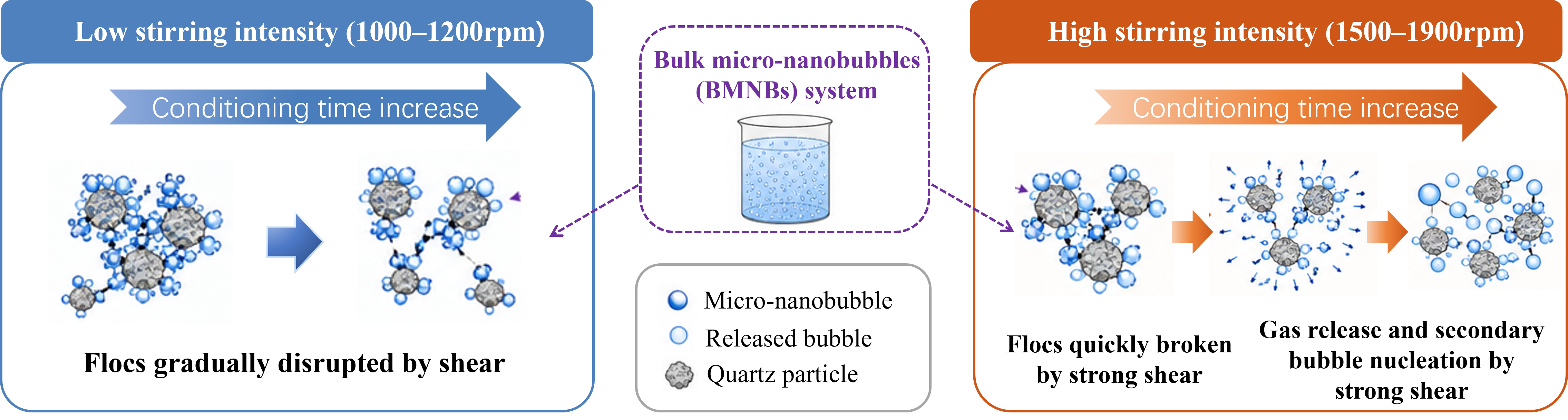
Combining the DO measurements with the FBRM-PVM observations and the visualization results, a stirring-intensity-dependent mechanism of BMNB-assisted flotation is proposed, as illustrated in Figure 10. Under relatively low stirring intensities (1000–1200 rpm), BMNBs initially promote the formation of bubble–particle aggregates, contributing to enhanced quartz flotation. As conditioning time increases, these aggregates are progressively disrupted by continuous shear. Meanwhile, the relatively weak hydrodynamic agitation may limit the extent of gas release and subsequent bubble-related structural regeneration. Consequently, the average chord length decreases progressively, accompanied by a gradual reduction in the flotation enhancement provided by BMNBs.
Figure 10.
Schematic illustration of the stirring intensity-dependent evolution of BMNB-assisted quartz flotation mechanisms.
In contrast, under high stirring intensities (1500–1900 rpm), the initially formed bubble–particle aggregates are more susceptible to disruption by strong hydrodynamic shear during conditioning. Meanwhile, the visualization experiments suggest that intense agitation can promote gas release and heterogeneous bubble nucleation at hydrophobic quartz interfaces in BMNB-derived supersaturated solutions. Such gas-related processes may contribute to the formation or reorganization of bubble-associated structures in the slurry. Although the present experiments do not directly establish the attachment of newly generated bubbles to freely suspended quartz particles, the changes observed in the FBRM-PVM measurements are consistent with the possible evolution of gas-related dispersed structures under high-intensity stirring. This may help explain why the flotation enhancement provided by BMNBs can be maintained, or slightly improved, with increasing conditioning time despite the disruption of initially formed aggregates. Overall, the role of BMNBs may evolve from predominantly promoting bubble–particle aggregation under relatively low stirring intensity to involving more pronounced gas release and bubble-related structural reorganization under high stirring intensity.
4. Conclusions
This study demonstrated that the effect of BMNBs on quartz flotation depended strongly on stirring intensity and conditioning time. At low stirring intensities, the recovery in the BMNB-containing system decreased from 76.7% to 71.6% at 1000 rpm and from 83.8% to 82.0% at 1200 rpm as conditioning time increased from 1 to 10 min. In contrast, at higher stirring intensities, recovery at 1500 rpm increased to 88.0% after an initially stable period, while that at 1900 rpm increased progressively from 86.3% to 88.1%. These results indicate that the flotation enhancement provided by BMNBs progressively weakened under low-intensity stirring but was better maintained under high-intensity stirring.
DO measurements showed that BMNB-treated water existed in a supersaturated state, with an initial DO concentration of approximately 11.5 mg/L, significantly higher than that of pure water (8.5 mg/L). Under strong agitation, the DO concentration first increased and then decreased, indicating continuous gas redistribution and release from the supersaturated solution. Combined with high-speed imaging observations, these results confirmed that high-intensity stirring promoted secondary bubble nucleation on hydrophobic surfaces.
The results suggest that BMNB-assisted flotation is governed by two distinct mechanisms. Under low stirring intensities, flotation enhancement is dominated by bubble–particle floc formation. Under high stirring intensities, continuous gas release from the supersaturated solution generates new bubbles that compensate for floc disruption, establishing a dynamic balance between floc breakage and bubble regeneration. This mechanism is responsible for the sustained flotation enhancement observed under strong hydrodynamic conditions and provides new insights into the optimization of BMNB-assisted fine particle flotation.
Author Contributions
S.W. and J.G. contributed equally to this work. S.W.: investigation and writing—original draft. J.G.: writing—original draft, and funding acquisition. S.Z.: conceptualization, formal analysis, methodology, software, validation, investigation, writing—original draft. R.G.: methodology, investigation, formal analysis. G.X.: resources and supervision. All authors have read and agreed to the published version of the manuscript.
Funding
This work was supported by the National Natural Science Foundation of China (Grant No. U23B2077) and China Postdoctoral Science Foundation (Grant No. 2024M763555).
Data Availability Statement
The original contributions presented in this study are included in the article. Further inquiries can be directed to the corresponding author.
Conflicts of Interest
Author Jixuan Gao was employed by China Coal (Tianjin) Design Engineering Co., Ltd. The remaining authors declare that the research was conducted in the absence of any commercial or financial relationships that could be construed as a potential conflict of interest.
References
- Miettinen, T.; Ralston, J.; Fornasiero, D. The Limits of Fine Particle Flotation. Miner. Eng. 2010, 23, 420–437. [Google Scholar] [CrossRef] [Scilit]
- Farrokhpay, S.; Filippov, L.; Fornasiero, D. Flotation of Fine Particles: A Review. Miner. Process. Extr. Metall. Rev. 2021, 42, 473–483. [Google Scholar] [CrossRef] [Scilit]
- Ahn, S.; Patil, S.; Rudolph, M. Ultrafine Particle Recycling—Efficiency of the Hydrophobic Double Emulsion Technique for the Selective Agglomeration and Froth Flotation of Ultrafine Cathode Catalyst Particles from PEM Water Electrolyzers. ACS Eng. Au 2025, 5, 57–65. [Google Scholar] [CrossRef] [Scilit]
- van Netten, K.; Borrow, D.J.; Galvin, K.P. Fast Agglomeration of Ultrafine Hydrophobic Particles Using a High-Internal-Phase Emulsion Binder Comprising Permeable Hydrophobic Films. Ind. Eng. Chem. Res. 2017, 56, 10658–10666. [Google Scholar] [CrossRef] [Scilit]
- Zhou, S.; Wang, X.; Bu, X.; Shao, H.; Hu, Y.; Alheshibri, M.; Li, B.; Ni, C.; Peng, Y.; Xie, G. Effects of Emulsified Kerosene Nanodroplets on the Entrainment of Gangue Materials and Selectivity Index in Aphanitic Graphite Flotation. Miner. Eng. 2020, 158, 106592. [Google Scholar] [CrossRef] [Scilit]
- Eardley, J.C.; Ng, W.S.; Franks, G.V. Quantifying Entrapment in Selective Flocculation-Flotation: Model and Measurement Method. Miner. Eng. 2026, 235, 109816. [Google Scholar] [CrossRef] [Scilit]
- Farrokhpay, S.; Filippova, I.; Filippov, L.; Picarra, A.; Rulyov, N.; Fornasiero, D. Flotation of Fine Particles in the Presence of Combined Microbubbles and Conventional Bubbles. Miner. Eng. 2020, 155, 106439. [Google Scholar] [CrossRef] [Scilit]
- Tao, D. Recent Advances in Fundamentals and Applications of Nanobubble Enhanced Froth Flotation: A Review. Miner. Eng. 2022, 183, 107554. [Google Scholar] [CrossRef] [Scilit]
- Zhang, F.; Sun, L.; Yang, H.; Gui, X.; Schönherr, H.; Kappl, M.; Cao, Y.; Xing, Y. Recent Advances for Understanding the Role of Nanobubbles in Particles Flotation. Adv. Colloid Interface Sci. 2021, 291, 102403. [Google Scholar] [CrossRef] [Scilit] [PubMed]
- Han, G.; Chen, S.; Su, S.; Huang, Y.; Liu, B.; Sun, H. A Review and Perspective on Micro and Nanobubbles: What They Are and Why They Matter. Miner. Eng. 2022, 189, 107906. [Google Scholar] [CrossRef] [Scilit]
- Zhou, S.; Nazari, S.; Hassanzadeh, A.; Bu, X.; Ni, C.; Peng, Y.; Xie, G.; He, Y. The Effect of Preparation Time and Aeration Rate on the Properties of Bulk Micro-Nanobubble Water Using Hydrodynamic Cavitation. Ultrason. Sonochem. 2022, 84, 105965. [Google Scholar] [CrossRef] [Scilit] [PubMed]
- Li, C.; Xu, M.; Zhang, H. Efficient Separation of High-Ash Fine Coal by the Collaboration of Nanobubbles and Polyaluminum Chloride. Fuel 2020, 260, 116325. [Google Scholar] [CrossRef] [Scilit]
- Rulyov, N.N.; Filippov, L.O.; Kravchenko, O.V. Combined Microflotation of Glass Beads. Colloids Surf. A 2020, 598, 124810. [Google Scholar] [CrossRef] [Scilit]
- Zhou, S.; Gu, R.; Bu, X.; Alheshibri, M.; Xie, G. Aggregation Behavior of Fine Quartz Particles Induced by Bulk Micro-Nanobubbles: A Fractal Perspective. Miner. Eng. 2025, 234, 109671. [Google Scholar] [CrossRef] [Scilit]
- Rubio, J.; Azevedo, A.; Rodrigues, R.T.; Rojas Olivares, G. Amine-Coated Nanobubbles-Assisted Flotation of Fine and Coarse Quartz. Miner. Eng. 2024, 218, 108983. [Google Scholar] [CrossRef] [Scilit]
- Jiang, H.; Yang, H.; Xing, Y.; Cao, Y.; Gui, X. The Effect of Impeller Speeds on the Nanobubbles Flotation Efficiency of Ultrafine Coal Particles. Powder Technol. 2025, 449, 120431. [Google Scholar] [CrossRef] [Scilit]
- Ren, L.; Zhang, X.; Liu, J.; Huang, L.; Bao, S.; Zhang, Y.; Nguyen, A.V. Interfacial Gas Enrichment Mechanism for Enhancing Selective Separation of Fine Particles Using Nano-Microbubble Technology. Chem. Eng. J. 2025, 519, 165140. [Google Scholar] [CrossRef] [Scilit]
- Liu, L.; Hu, S.; Wu, C.; Liu, K.; Weng, L.; Zhou, W. Aggregates Characterizations of the Ultra-Fine Coal Particles Induced by Nanobubbles. Fuel 2021, 297, 120765. [Google Scholar] [CrossRef] [Scilit]
- Wang, L.; Wang, M.; Li, M.; Su, J.; Ni, Z.; Gui, X. A Novel Approach to the Separation of Macerals in Inertinite-Rich Coal: Charged Micro-Nanobubble Flotation. Colloids Surf. A Physicochem. Eng. Asp. 2024, 699, 134707. [Google Scholar] [CrossRef] [Scilit]
- Wang, Y.; Pan, Z.; Jiao, F.; Qin, W. Understanding Bubble Growth Process under Decompression and Its Effects on the Flotation Phenomena. Miner. Eng. 2020, 145, 106066. [Google Scholar] [CrossRef] [Scilit]
- Zhang, Z.; Ren, L.; Zhang, Y. Role of Nanobubbles in the Flotation of Fine Rutile Particles. Miner. Eng. 2021, 172, 107140. [Google Scholar] [CrossRef] [Scilit]
- Yang, H.; Ding, E.; Zhang, F.; Xing, Y.; Gui, X.; Cao, Y. The Stability and Geometrical Characteristics of Solid-Liquid Interfacial Nanobubbles in Complex Aqueous Solution Environments. Surf. Interfaces 2024, 46, 104027. [Google Scholar] [CrossRef] [Scilit]
- Xiao, W.; Zhao, Y.; Yang, J.; Ren, Y.; Yang, W.; Huang, X.; Zhang, L. Effect of Sodium Oleate on the Adsorption Morphology and Mechanism of Nanobubbles on the Mica Surface. Langmuir 2019, 35, 9239–9245. [Google Scholar] [CrossRef] [Scilit] [PubMed]
- Yang, H.; Xing, Y.; Zhang, F.; Gui, X.; Cao, Y. Contact Angle and Stability of Interfacial Nanobubble Supported by Gas Monolayer. Fundam. Res. 2024, 4, 35–42. [Google Scholar] [CrossRef] [Scilit] [PubMed]
- Zhang, F.; Xing, Y.; Chang, G.; Yang, Z.; Cao, Y.; Gui, X. Enhanced Lignite Flotation Using Interfacial Nanobubbles Based on Temperature Difference Method. Fuel 2021, 293, 120313. [Google Scholar] [CrossRef] [Scilit]
- Zhang, F.; Cai, H.; Fan, G.; Gui, X.; Xing, Y.; Cao, Y. The Role of Interfacial Nanobubbles in the Flotation Performance of Microfine Particles. Colloids Surf. A Physicochem. Eng. Asp. 2024, 699, 134633. [Google Scholar] [CrossRef] [Scilit]
- Zhou, S.; Gu, R.; Bu, X.; Ulusoy, U.; Xie, G. In-Depth Investigation of Fine Quartz Slurry Containing Bulk Micro-Nano Bubbles by PSD and Fractal Analysis: The Effect of Ionic Strength. Colloids Surf. A Physicochem. Eng. Asp. 2025, 726, 137794. [Google Scholar] [CrossRef] [Scilit]
- Azevedo, A.; Oliveira, H.; Rubio, J. Bulk Nanobubbles in the Mineral and Environmental Areas: Updating Research and Applications. Adv. Colloid Interface Sci. 2019, 271, 101992. [Google Scholar] [CrossRef] [Scilit] [PubMed]
- Li, C.; Xu, M.; Zhang, H. The Interactions between Coal Particles with Different Hydrophobicity and Bulk Nanobubbles in Natural Water. Int. J. Coal Prep. Util. 2022, 42, 463–474. [Google Scholar] [CrossRef] [Scilit]
- Zhou, S.; Wang, S.; Wang, X.; Xie, G. Role of Bulk Micro-Nanobubbles in Particle–Bubble Attachment Kinetics. Miner. Eng. 2026, 236, 109964. [Google Scholar] [CrossRef] [Scilit]
- Zhou, S.; Li, Y.; Nazari, S.; Bu, X.; Hassanzadeh, A.; Ni, C.; He, Y.; Xie, G. An Assessment of the Role of Combined Bulk Micro- and Nano-Bubbles in Quartz Flotation. Minerals 2022, 12, 944. [Google Scholar] [CrossRef] [Scilit]
Disclaimer/Publisher’s Note: The statements, opinions and data contained in all publications are solely those of the individual author(s) and contributor(s) and not of MDPI and/or the editor(s). MDPI and/or the editor(s) disclaim responsibility for any injury to people or property resulting from any ideas, methods, instructions or products referred to in the content. |
© 2026 by the authors. Licensee MDPI, Basel, Switzerland. This article is an open access article distributed under the terms and conditions of the Creative Commons Attribution (CC BY) license.