


Abstract
A novel deep eutectic surfactant (DESU) was synthesized from an imidazolium-based Gemini surface-active ionic liquid (GSAIL) and 1,3-dimethylurea (DMU) for enhanced oil recovery (EOR) purposes. Density functional theory (DFT) analyses confirmed the spontaneous formation of a strong hydrogen-bonding network between the imidazolium group of the GSAIL and the carbonyl group of the DMU, resulting in a stable supramolecular structure. Energy decomposition analysis (EDA) indicated that electrostatic and orbital contributions dominated over Pauli repulsion, confirming the thermodynamic stability of the product. Further, natural bond orbital (NBO) analysis revealed significant energy delocalization up to 19.32 kCal·mol−1 and a Wiberg bond index within the range of 0.05–0.09, validating interactions that enhance the product’s amphiphilic nature. Results showed that the DESU remarkably reduced the oil–water interfacial tension (IFT) by up to 99.85%, near the critical micelle concentration (CMC). Temperature further lowered the CMC and IFT. The DESU adsorption data matched well with the Frumkin adsorption isotherm model, suggesting strong intermolecular interactions at the interface. Wettability tests demonstrated a significant transition from oil-wet (137°) to strongly water-wet (33°) and that emulsions with 72% stability could be formed after one day and 66% after one week. The results totally confirm the incredible interfacial activity of the DESU.
1. Introduction
Global energy demand is on the rise while the natural productivity of the oil reservoirs is declining steadily [1]. Enhanced oil recovery (EOR) technologies have become increasingly vital to extend the economic life of mature reservoirs. Among them, chemical EOR methods, often with the use of surfactants, are particularly attractive because of their ability to influence interfacial properties, release trapped oil in rock reservoirs, and improve oil recovery [2,3].
Conventional surfactants, including anionic, cationic, and non-ionic ones, have been extensively investigated for EOR applications. However, their field-scale deployment has often been constrained by several drawbacks, such as high cost, limited tolerance to reservoir conditions (e.g., elevated salinity and temperature), and environmental concerns [4,5]. These limitations highlight the need to explore new classes of surfactants that are both efficient and environmentally sustainable.
Deep eutectic surfactants (DESUs) have recently gained attention as green alternatives due to their simple synthesis, tunable physicochemical properties, and environmental compatibility [6]. DESUs are typically formed by mixing a hydrogen bond acceptor (HBA) with a hydrogen bond donor (HBD), resulting in a eutectic product with unique surfactant properties, distinct from its individual components [7]. Based on this concept, DESUs can be engineered by integrating the tunable hydrogen-bonding networks of DESUs with amphiphilic structural features, thereby creating a novel class of active agents with strong potential for EOR [8]. In cases where a component of the DESU is a surface-active ionic liquid (SAIL), the eutectic product may not only combine the surface-active properties of the SAIL, but also benefit from the electrostatic stability of the amphiphilic product and provide better stereo orientation at the interface zone due to hydrogen bond formation [9]. The efficiency of surfactant-assisted EOR is primarily governed by three mechanisms. First, they reduce the interfacial tension (IFT), enhance the capillary number and enable the release of oil trapped in rock reservoirs that would otherwise remain within pore spaces [10]. Second, the alteration of rock wettability from oil-wet to water-wet facilitates spontaneous water imbibition into the pore structure, which promotes the displacement of trapped oil and improves microscopic displacement efficiency. This improvement can contribute to an overall enhancement in macroscopic sweep efficiency during the oil recovery. Third, emulsion formation could be relevant, which facilitates the detachment of oil drops from rock surfaces and improves the mobility ratio by increasing the apparent viscosity of the displacing fluid and enhancing macroscopic sweep efficiency [11].
In recent years, DESUs made up of choline chloride and urea have shown promising potential in reducing IFT, altering rock wettability, and enhancing crude oil mobility. However, previous studies have revealed that the use of choline chloride-urea based DESUs has not established sufficiently low IFT values for efficient EORs [12,13,14].
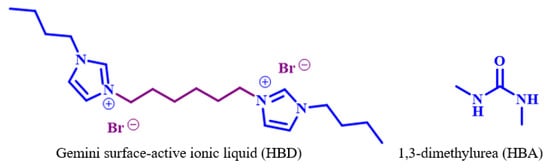
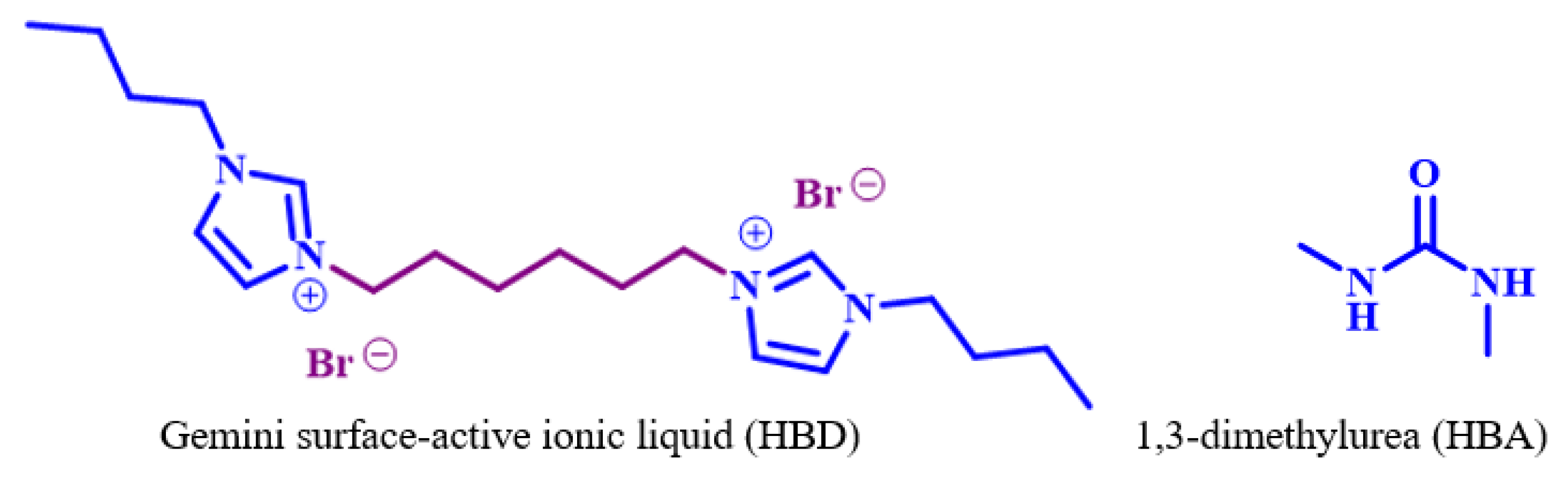
The present study aims to systematically evaluate the performance of a newly designed DESU for crude oil recovery. Accordingly, a novel DESU composed of a twin-head imidazolium Gemini surface-active ionic liquid (GSAIL) as the HBD and 1,3-dimethylurea (DMU) as the HBA was utilized (Figure 1). The reason behind this design lies in the synergistic combination of the amphiphilic ionic liquid moieties with the hydrogen-bonding capability of DMU.
Figure 1.
Molecular structure of raw materials for the synthesis of the deep eutectic surfactant (DESU): the hydrogen bond donor (HBD) and hydrogen bond acceptor (HBA).
The proposed imidazolium DESU offers key advantages over conventional surfactants due to its strong hydrogen-bonding network and dual imidazolium head groups. This feature enhances interfacial adsorption, provides ultralow interfacial tension, and promotes wettability alteration. The resulting elastic interfacial film also stabilizes emulsions, a key parameter in oil mobility. To investigate the molecular structure of the product, a complementary density functional theory (DFT) analysis is employed here to provide direct molecular-level insights into hydrogen bonding and electrostatic stabilization of the DESU structure. The twin imidazolium framework provides two cationic head groups and hydrophobic tails, which adsorb efficiently at the oil–water interface, resulting in stronger surface activity than conventional single-head surfactants [15]. DMU forms hydrogen bonds with the imidazolium groups, stabilizing interfacial assemblies and lowering the free energy of adsorption. This configuration enhances micelle-like aggregation at low concentrations and intensifies the IFT reduction.
The developed DESU has also economic and environmental advantages. Its synthesis involves a simple, solvent-free process that involves mixing rather inexpensive and available components. Furthermore, low-volatility and non-toxic constituents, along with the avoidance of hazardous organic solvents, make it a promising candidate within the framework of green chemistry. To the best of our knowledge, such a sustainable and environmentally friendly deep eutectic surfactant has not been previously reported for EOR purposes.
2. Experimental Section
2.1. Materials and Methods
All chemicals used in this study were of analytical grade and were used without further purification. The main components for the synthesis of the DESU were a twin-head imidazolium-based ionic liquid, used as the HBD, and DMU, used as the HBA. These reagents were purchased from Merck (Darmstadt, Germany) and Exir Chemical Company (Tehran, Iran). Deionized water with a conductivity lower than 0.08 µS·cm−1 was used for the solution preparations. The names, suppliers, and purities of the chemicals are summarized in Table 1. Additionally, the utilized GSAIL, by itself, has already demonstrated a strong surfactant capability [11].
Table 1.
The supplier, purity percentage and the application of the chemicals utilized.
The crude oil sample employed in the experiments was obtained from an oil field located in southern Iran. The main physicochemical properties of the crude oil, including density, viscosity, acid number, and chemical composition, are listed in Table 2. These parameters were used to evaluate the interfacial, wettability tests and emulsifying capabilities. The tested crude oil can be classified as a moderate oil with moderate viscosity and low asphaltene content, suitable for evaluating the interfacial behavior of DESU-based surfactants [5].
Table 2.
Physicochemical properties of the used crude oil.
FT-IR spectra of samples were recorded utilizing KBr pellets on a Perkin Elmer spectrometer (Waltham, MA, USA). The melting points during the preparation of DESU were determined using capillary tubes and a Stuart melting point apparatus. The advancement of the synthesis of GSAIL was monitored through thin-layer chromatography (TLC). NMR spectra were acquired using a Bruker Ultrashield spectrometer operating at a frequency of 250 MHz.
The IFTs between the crude oil and aqueous solutions containing DESU were measured using a pendant drop tensiometer (Fars EOR Technol, CA-ES10 model). The methodology is based on forming drops at the ends of stainless-steel needles that were immersed in the aqueous phase. The specifics of the experimental setup are described in a prior investigation [11]. In the pendant drop method, the IFT (denoted as ) is determined by establishing a balance between gravitational forces and interfacial forces that sustain a drop. This evaluation is conducted by investigating the relationship between the drop profile formation and the IFT value as [16]. In this equation, signifies the density difference between the two phases, represents the acceleration due to gravity, denotes the equatorial diameter of the drop, and refers to the shape parameter. The parameter is contingent upon the shape factor , defined as , where is the diameter of the drop measured at a distance from the apex of the drop. Details of determining values are given in Ref. [17]. The parameter is a dimensionless geometric factor derived from the relationship between the drop shape factor and the interfacial curvature in pendant-drop analysis. It is obtained from the correlation between the shape factor () and the interfacial curvature, as tabulated for standard pendant-drop analysis [17].
The IFT measuring apparatus was equipped with the functionality to assess the contact angle. Consequently, an image analysis of the oil drops on a solid substrate (specifically, a quartz plate) was conducted, and the contact angle at the interface of the three involved phases of water, crude oil, and quartz was determined from captured figures [18].
To assess the capacity for stable emulsion formation, equal volumes of 2 cm3 of crude oil and aqueous DESU solutions at a concentration of 0.29 mol·dm−3 at the critical micelle concentration (CMC) (corresponding to the intermediate IFT) were placed into glass vials. These mixtures were subjected to sonication in a SONICA 2400ETH S3 ultrasound bath operating at 40 kHz and 305 W for a duration of 30 min. Following sonication, the samples were allowed to rest at 298.2 K for periods of one day and one week. Subsequently, the emulsion stability was quantified by calculating the emulsion index as , where denotes the volume of the emulsion phase and represents the total sample volume [19]. Additionally, microscopic examination of the emulsions was conducted to evaluate drop dispersion. Images were captured using a Nikon eclipse E200 microscope at 45× magnification on glass slides.
2.2. Gemini Ionic Liquid Synthesis
The Gemini ionic liquid [C4im-C6-C4im][Br]2 was prepared following the established procedure reported in a previous study [20]. The product quality was examined by NMR and FT-IR analyses. The 13C NMR and 1H NMR spectra exhibited only the peaks corresponding to the GSAIL product, with no signals indicative of the starting materials or by-products, as illustrated in Figures S1 and S2 of the Supplementary Materials. The 1H NMR spectra information is as follows. FT-IR analysis is described in the subsequent section.
1H NMR (300 MHz, DMSO, δ, ppm) 0.87 (t, 6H, J = 9 Hz, CH3), 1.74–1.83 (m, 8H, CH2), 1.17–1.27 (m, 8H, CH2), 4.24 (t, 8H, J = 6 Hz, CH2), 9.61 (brs, 2H, imidazolium ring), 7.95–7.98 (m, 4H, imidazolium ring). 13C NMR (75 MHz, DMSO, δ, ppm) 13.8, 25.2, 19.2, 31.8, 29.5, 49.0 (2C), 122.9 (2C), 136.5.
3. Results and Discussion
3.1. Characterization
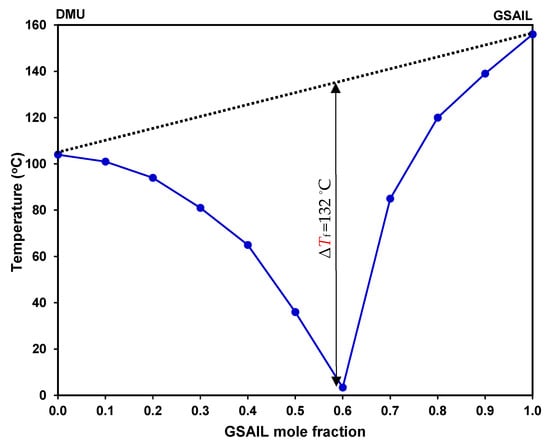
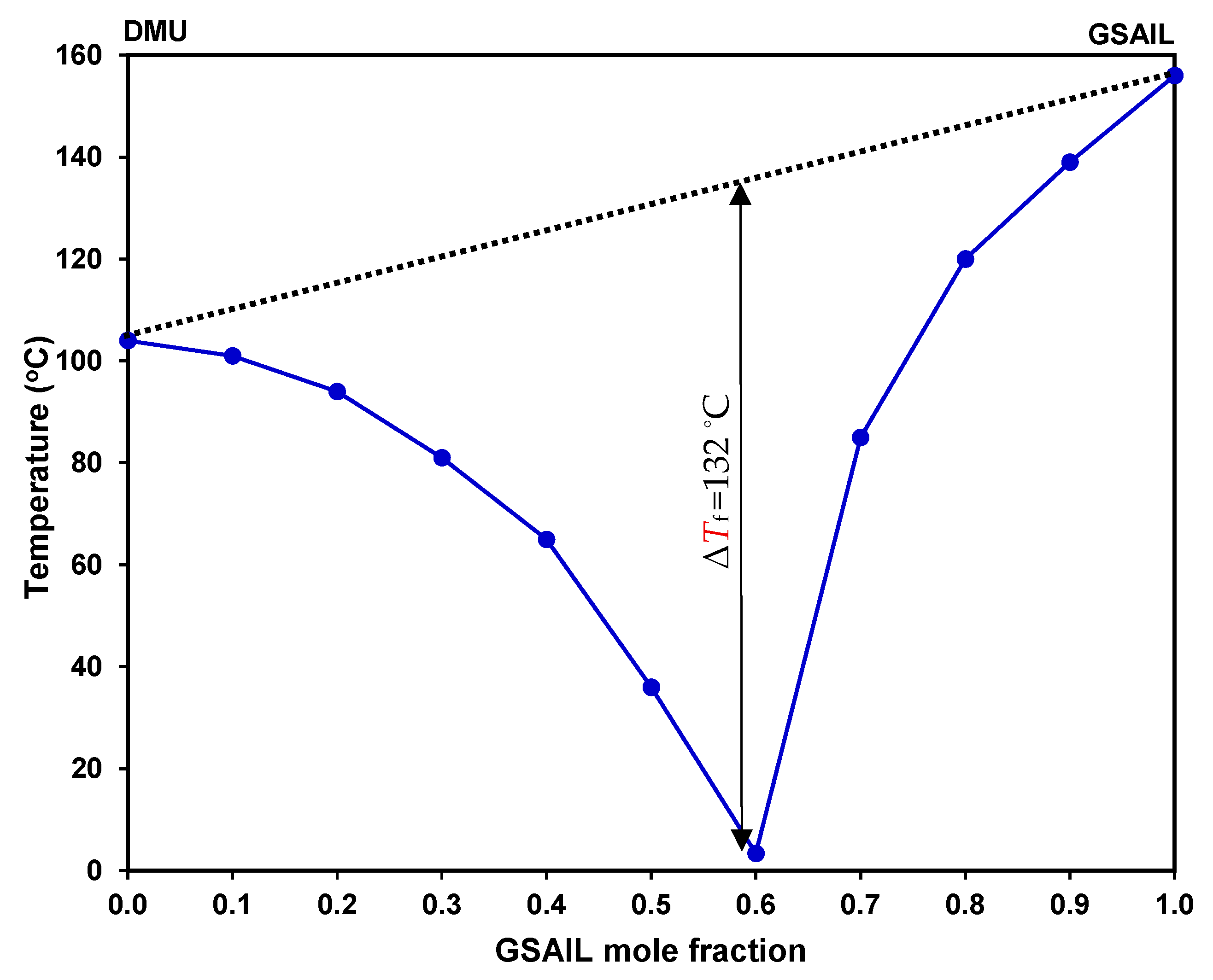
Various molar ratios of the DESU molecule, GSAIL:DMU, were gradually heated in a jacketed glass vessel to the melting point of the components while being stirred magnetically. This process was continued until a homogeneous and transparent solution was achieved. Subsequently, the temperature was lowered gently until turbidity appeared, indicating a change in the solution’s clarity at a certain temperature. The DESU synthesis was carried out following the method described in previous research [7,21,22]. The solid–liquid phase diagram, presented in Figure 2, illustrates the formation of the DESU product resulting from the combination of GSAIL with DMU in a molar ratio of 3:2. The diagram shows a distinct eutectic point at 3.4 °C. The melting points of the pure components were determined as 156.3 °C for the GSAIL and 104.1 °C for DMU. From these values, the significant depression in melting point compared to the linear contribution of pure components ( = 132 °C) confirms strong non-ideal interactions between the two species. These interactions primarily arise from hydrogen bonding between the imidazolium ring protons (as HBDs) and the carbonyl oxygen atoms of DMU (as HBAs). Such extensive hydrogen-bonding networks disrupt the crystalline lattice of both components and stabilize a homogeneous liquid phase at near-ambient temperature [23]. This molecular reorganization enhances fluidity and dynamic hydrogen-bond exchange, which are expected to promote interfacial adsorption and surface activity, as later confirmed by the experimental IFT results.
Figure 2.
Phase diagram of the DESU product from the GSAIL and 1,3-dimethylurea (DMU) components.
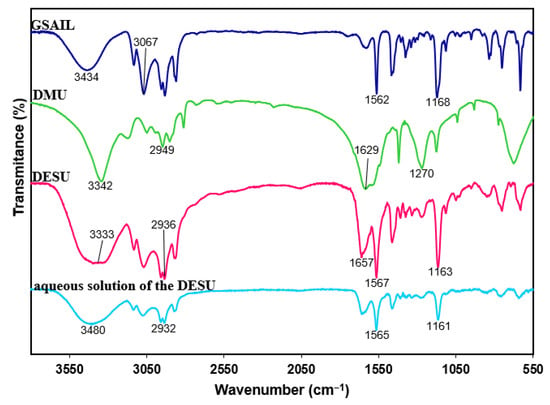
The FTIR spectra of the individual components (GSAIL and DMU), the synthesized DESU, and its aqueous solution of 0.29 mol·dm−3 (CMC) are presented in Figure 3. A comparative spectral analysis confirms both the formation of hydrogen bonding within the DESU and its structural stability upon dissolution in water.
Figure 3.
FT-IR of GSAIL, DMU, DESU and an aqueous solution of the DESU at a concentration of 0.29 mol·dm−3 as the critical micelle concentration (CMC).
In the DESU spectrum, the broad absorption band in the region of 3200–3450 cm−1, corresponding to N–H stretching vibrations (originating from DMU), is red-shifted and significantly broadened compared to the spectrum of pure DMU [24]. This shift indicates the involvement of N–H groups in hydrogen bonding. Additionally, the C=O stretching vibration of DMU, normally observed near 1630 cm−1, also shifts to lower wavenumbers, further supporting hydrogen bond formation.
The characteristic C–H stretching vibrations of the imidazolium ring in GSAIL (around 3000–3150 cm−1) show noticeable changes in intensity and slight shifts in the DESU spectrum, suggesting the involvement of the acidic hydrogen atoms on the imidazolium ring in hydrogen bonding with the electron-rich sites of DMU (e.g., carbonyl group) [25]. Furthermore, changes in the fingerprint region (1000–1600 cm−1) in the DESU spectrum, compared to both pure components, reflect the formation of a new supramolecular network stabilized via hydrogen bonding.
Upon dissolution of DESU in water, the spectrum retains the major hydrogen-bonding signatures of the DESU. Although minor shifts and broadening due to water interactions are expected, the characteristic bands in the 1400–1650 cm−1 and 2800–3500 cm−1 regions remain consistent, indicating that the DESU structure is preserved in aqueous medium. Notably, the absence of component-resolved peaks from DMU or GSAIL in the aqueous spectrum suggests that no significant dissociation occurs. This structural stability enhances the practical applicability of the DESU in aqueous-phase systems such as EOR, where robustness in water is important. To provide quantitative support for the spectral interpretation, the key FTIR vibrational bands and their corresponding wavenumber shifts for the GSAIL, DMU, DESU, and the DESU in an aqueous system are summarized in Table 3.
Table 3.
Key FTIR wavenumber positions and shifts for GSAIL, DMU, DESU, and DESU in aqueous solution.
3.2. Computational Study
A theoretical investigation was conducted to gain a molecular-level understanding of the interactions governing the stability of the DESU. For this purpose, Density Functional Theory (DFT) was employed to characterize the nature and strength of the hydrogen-bonding and electronic interactions responsible for the formation and stabilization of the eutectic product. The DESU system is constructed from three GSAIL fragments that incorporate six imidazolium cations, six bromide anions, and two DMU molecules. The stoichiometry of the DESU compound was accordingly considered as [GSAIL]3[DMU]2 (see Figure 2).
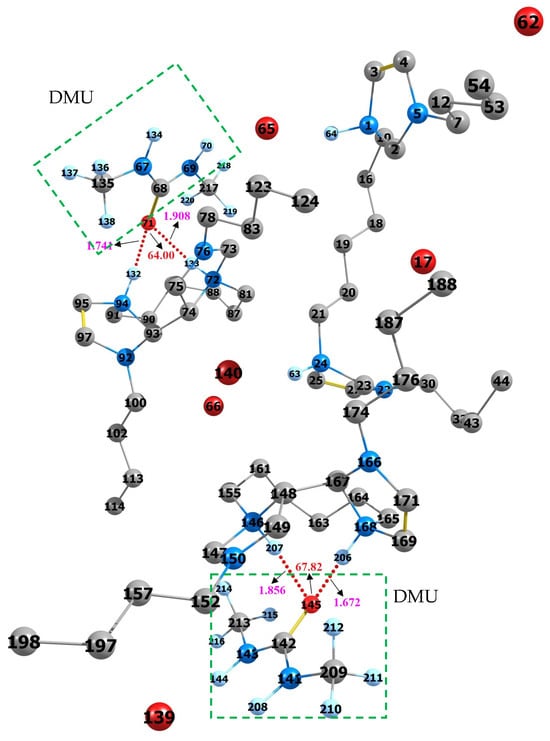
For clarity, the DESU system is represented as ([LH2]2+[Br2]2−)3[DMU]2, where ([LH2]2+[Br2]2−) corresponds to the GSAIL unit and [DMU] denotes 1,3-dimethylurea. The geometry of the DESU complex was fully optimized in the gas phase using the CAM-B3LYP-D3/def2-SVP level of theory as implemented in Gaussian 09, Rev. D.01 [26]. The bonding interactions between two interacting fragments [LH2]2+[Br2]2− and [DMU] were analyzed using energy decomposition analysis (EDA) at the CAM-B3LYP/def2-TZVP level, natural bond orbital (NBO) and atoms in molecules (AIM). Figure 4 illustrates the optimized geometry of DESU, highlighting the key bond lengths and angular features between the two interacting [LH2]2+[Br2]2− and [DMU] fragments.
Figure 4.
Illustration of the optimized geometry of DESU, highlighting the key bond lengths (Å) and angular features between the two interacting fragments, [LH2]2+[Br2]2− and [DMU], at the B3LYP-D3/def2-SVP level. For clarity, hydrogen atoms have been omitted, except for those carrying a positive charge and those bonded to the urea moiety.
The interaction energy between the two fragments ([LH2]2+[Br2]2−)3 as (A) and [DMU]2 as (B) was computed based on the following equation [27] at the CAM-B3LYP-D3/def2-SVP//CAM-B3LYP-D3/def2-TZVP level of theory. The resulting value of approximately −104.82 kCal·mol−1 aligns with the following NBO and AIM-derived data, confirming the existence of an O…H bond interaction between the interacting fragments.
The interaction energy equation (Equation (1)) is employed to quantify the net stabilization arising from the noncovalent interactions between fragments A and B. Here, denotes the total electronic energy of the full optimized complex, while and correspond to the energies of the isolated fragments extracted from the optimized geometry. A negative value of indicates a thermodynamically favorable interaction, consistent with hydrogen bond formation. This approach is widely used to characterize intermolecular interactions in multi-component ionic liquids and deep eutectic systems.
EDA is a corresponding computational technique used to investigate the total interaction energy between molecular fragments into physically meaningful components. Typically, the total bonding energy is partitioned into: Electrostatic contribution (), associated with the classical Coulomb interaction between the unperturbed charge densities of the fragments; Pauli repulsion (), representing the steric repulsive effect that arises when occupied orbitals of the fragments overlap; Orbital interaction term (), which reflects covalent, donor–acceptor, and charge-transfer interactions; Dispersion energy (), accounting for long-range correlation and van der Waals forces [28]. The interaction energies between the ([LH2]2+[Br2]2−)3 and [DMU]2 fragments in the DESU structure (see Figure 4) were calculated at the BP86-D3/TZP level of theory. These energies were decomposed according to the standard EDA scheme:
The obtained results, summarized in Table 4, indicate excellent agreement with the corresponding interaction energies obtained from the CAM-B3LYP-D3/def2-SVP//CAM-B3LYP-D3/def2-TZVP level of theory. The EDA results also confirm that the electrostatic interaction, contributing 48.31%, is the dominant term in the interaction energy, followed by the orbital interaction at 34.93%. This suggests that the O···H bonding interactions between the fragments in the DESU structure play a key role in stabilizing the complex.
Table 4.
Energy decomposition (kCal·mol−1) of the DESU structure at BP86-D3/TZP level.
NBO analysis is another valuable computational tool for exploring the electronic structure and bonding of molecules [29,30]. In this study, the bond order [31], charge transfer [32], and the most significant donor–acceptor interactions [33,34] were investigated using NBO analysis. NBO analysis was carried out at the CAM-B3LYP-D3/Def2-SVP//CAM-B3LYP-D3/Def2-TZVP level of theory for the DESU structure. The natural charges associated with the oxygen and hydrogen atoms involved in these O···H interactions, along with the corresponding charge transfer between fragments, are listed in Table 5. The data reveal a charge transfer of approximately −1.606 e from the GSAIL units to the two DMU molecules. The reported values for the two oxygen atoms and four hydrogen atoms are averaged, with each value representing a single atom of the corresponding type.
Table 5.
Natural charges and calculated charge-transfer values for the DESU system.
The Wiberg bond index (WBI) values, derived from NBO analysis, provide numerical measures of bond order. For the studied systems, O···H interactions were assessed based on both bond order and interatomic distance at the CAM-B3LYP-D3/Def2-SVP//CAM-B3LYP-D3/Def2-TZVP level of theory. The resulting bond orders and corresponding bond lengths are presented in Table 6. As shown, the optimized structure reveals an intramolecular O···H bond interaction between the DMU and N-H fragment of the imidazolium in the optimized structure of DESU. These results are in agreement with the WBI values determined for the interacting fragments in the DESU structure (Table 6).
Table 6.
Wiberg bond index and corresponding O···H bond lengths for the DESU structure. The O···H bond lengths are highlighted in Figure 4.
Donor–acceptor interactions in NBO analysis represent the transfer of electron density from a filled (donor) orbital to an empty (acceptor) orbital. In the DESU model, the predominant donor–acceptor interaction involves electron transfer from the lone pairs of oxygen atoms in DMU into the antibonding σ* orbitals of the imidazolium N–H groups. The most pronounced stabilization (19.32 kCal·mol−1) occurs for the O145 → N168–H206 interaction, emphasizing the importance of hydrogen bonding in maintaining structural stability (Table 7).
Table 7.
Most important donor–acceptor interactions analysis of the DESU structure.
Finally, the bond critical points (BCPs) formed between the interacting fragments ([LH2]2+[Br2]2−)3 and [DMU]2 fragments in the DESU structure were also investigated within the framework of Bader’s AIM theory [35]. At these critical points, the topological parameters, specifically the electron density and the Laplacian of the electron density were determined for the O···H interactions present in the DESU system. A combination of low electron density ( < 0.1 a.u.) and a positive Laplacian characterizes the O···H bonds as van der Waals-type interactions between the interacting fragments in the DESU system. The obtained topological parameters are listed in Table 8.
Table 8.
Topological characteristics (a.u.) of the DESU structure.
The computed interaction energy of the DESU (−104.82 kCal·mol−1) together with a net charge transfer of −1.606 e indicates a strongly stabilized association, that favors lower adsorption free energy and thermodynamically favors interfacial localization of the DESU. NBO and Wiberg metrics (second-order stabilization energies E(2) up to 19.32 kCal·mol−1 and WBI values of (0.05–0.09) confirm multiple moderately strong hydrogen bonds that enable compact interfacial packing and thus increased interfacial affinity. To verify the hypothesis, IFT data show consistent variation as discussed in the following section.
3.3. IFT Variation
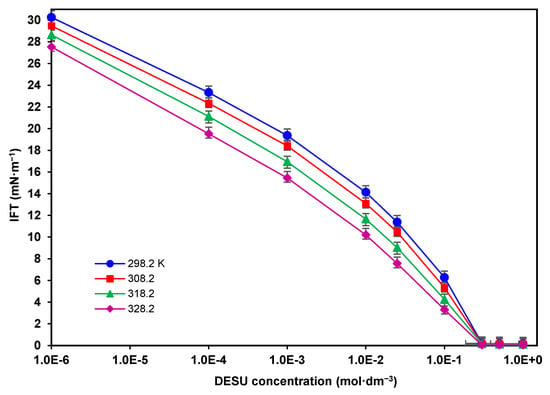
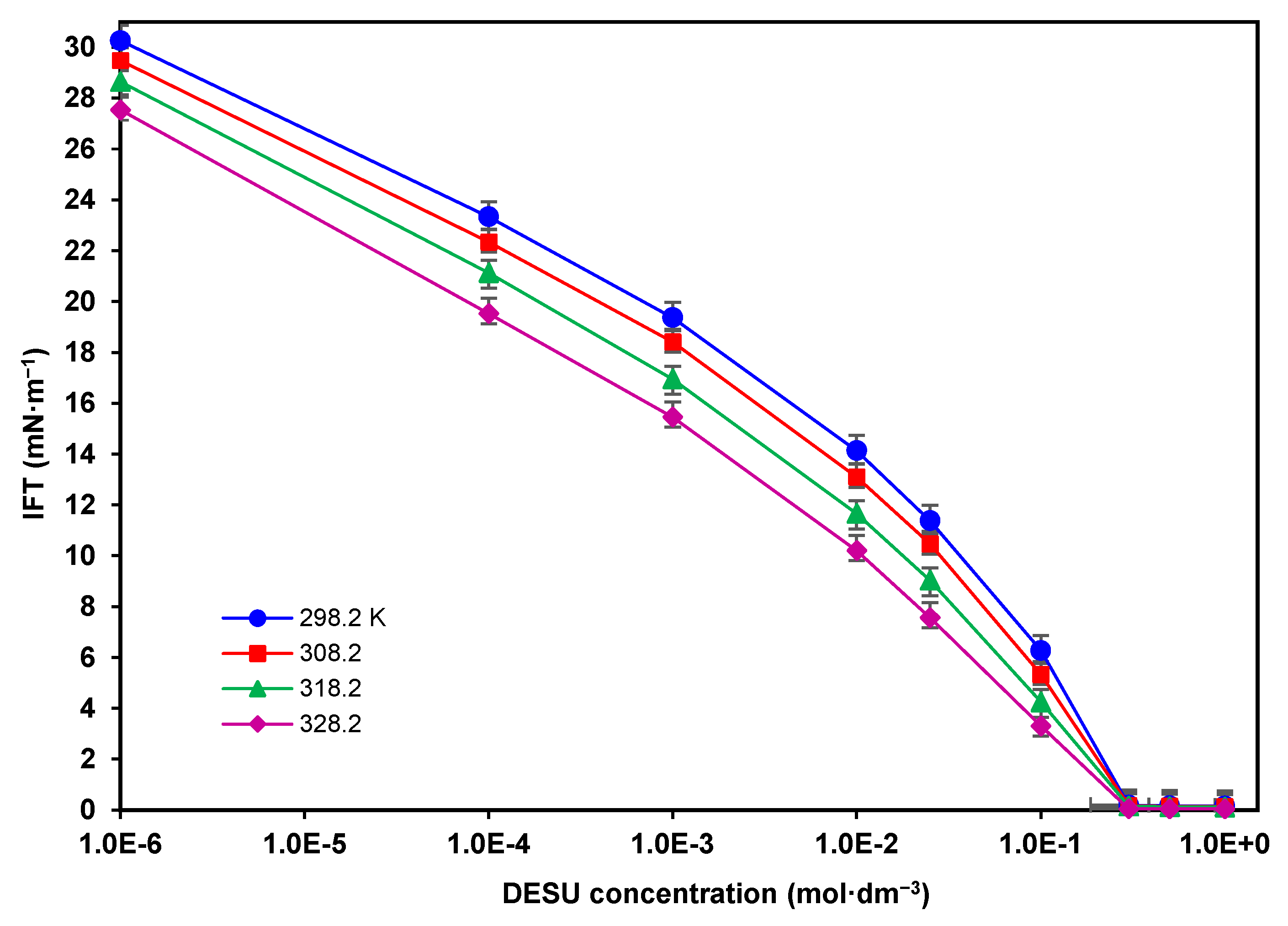
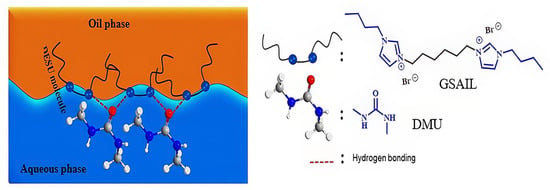
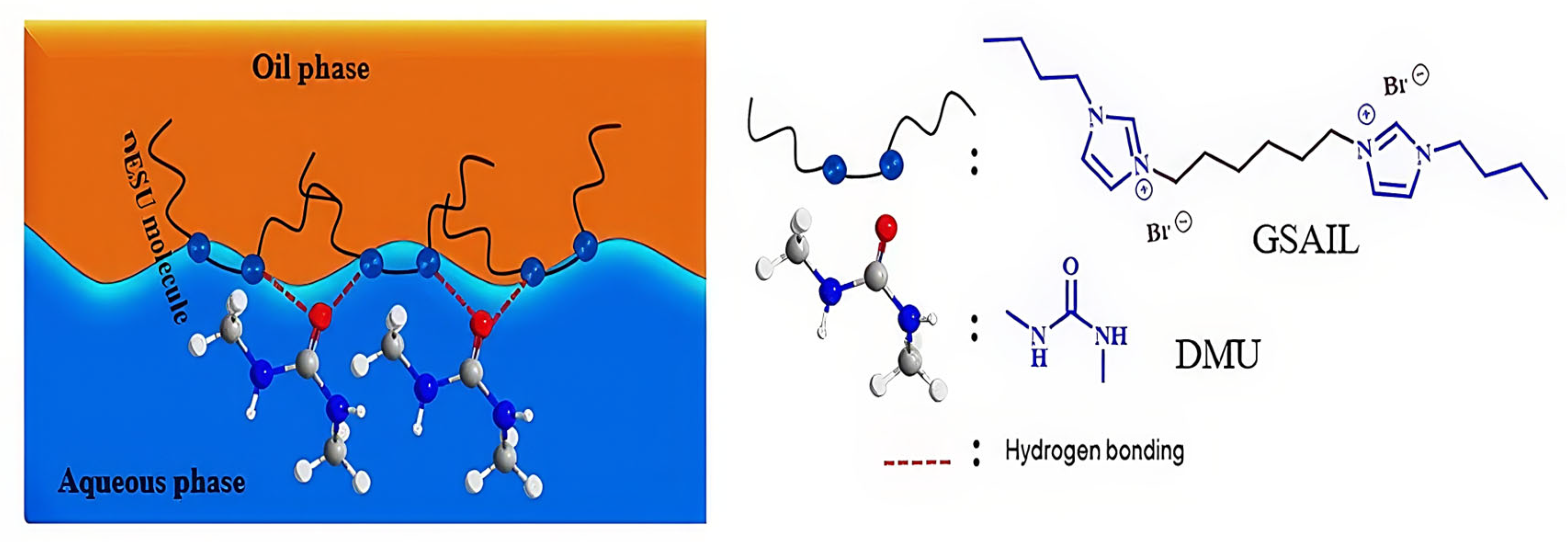
To evaluate the interfacial performance of the synthesized DESU, IFT measurements were carried out at different temperatures ranging from 298.2 to 328.2 K under atmospheric pressure. Figure 5 illustrates the relationship between IFT and the concentration of DESU. It is evident from the data that IFT decreases with the addition of DESU, even at low concentrations, and continues to decline until the CMC is reached. The remarkable reduction in IFT can be attributed to the unique amphiphilic architecture of the synthesized DESU. The hydrophilic domain, primarily composed of the imidazolium head groups and the DMU-based hydrogen-bonding network, exhibits strong affinity toward the aqueous phase through electrostatic and hydrogen-bonding interactions [36]. This allows rapid adsorption of DESU molecules at the oil–water interface and stabilizes the interfacial film by lowering the interfacial free energy. In contrast, the hydrophobic domain, formed by the alkyl chains of the imidazolium GSAIL, extends into the oil phase and enhances compatibility with oil hydrocarbon molecules (Figure 6). The cooperative alignment of these polar and nonpolar segments facilitates the formation of a compact interfacial layer, minimizing IFT and promoting the detachment and mobilization of trapped oil drops [37,38]. The DFT results support this mechanism, indicating that the strong hydrogen-bonding interactions between imidazolium cations and DMU contribute to the high interfacial affinity and stability of the DESU structure.
Figure 5.
Interfacial tension (IFT) variation versus the DESU concentration at different temperatures.
Figure 6.
The schematic of the DESU configuration in the oil–water system.
Additionally, as shown in Figure 5, the IFT decreases significantly with increasing temperature, which can be attributed to enhanced molecular mobility and interfacial adsorption of the DESU molecules. Higher temperature promotes faster diffusion from the bulk phase to the oil–water interface and facilitates molecular reorientation, leading to more efficient packing and stronger interfacial film formation. Moreover, the thermal disruption of structured water around the hydrophobic chains increases system entropy, making interfacial organization thermodynamically more favorable. As a result, the interfacial free energy decreases, leading to a pronounced reduction in IFT values [39].
Table 9 presents the relevant values for the pure system (no surfactant addition) IFT, CMC, IFT at the CMC, and the maximum IFT reduction for the utilized DESU across various temperatures. The DESU shows the lowest IFT value of approximately 0.04 mN·m−1 at a CMC of 0.22 mol·dm−3 (99.85%) at 328.2 K, indicating strong effectiveness. Notably, the CMC decreased from 0.29 mol·dm−3 at 298.2 K to 0.22 mol·dm−3 at 328.2 K, confirming the thermally enhanced interfacial activity of the DESU.
Table 9.
The reduction in IFT with DESU was observed at various temperatures.
The presence of two methyl groups increases the amphiphilicity of the DMU-based DESU, which facilitates adsorption at the crude oil–water interface. Additionally, branching contributes to the formation of more stable and organized hydrogen bonds between the DMU and the GSAIL, thereby enhancing the molecular arrangement at the interface.
Kumar et al. [14] have reported the effects of a specific DESU of choline chloride:urea (molar ratio of 1:2) on EOR. The IFT was reduced from 53.5 with pure water to 39.7 mN·m−1 with 0.77 mol·dm−3 of the DESU solution on heavy crude oil at a temperature of 298.2 K. The IFT reduction was attributed to the enhanced hydrogen bonding and electrostatic interaction between adsorbed species at the interface. In another study, El-hoshoudy et al. [12] reported the effects of a DESU consisting of choline chloride:urea (molar ratio of 1:2) on EOR. The IFT was reduced from 52.0 with pure water to 4.3 mN·m−1 using 0.27 mol·dm−3 of the DESU solution on light crude oil at a temperature of 313.2 K. Although both studies investigated choline chloride:urea DESU, the reported minimum IFT differed significantly. This discrepancy can be attributed to differences in oil type, DESU concentration, temperature, and measurement methods, all of which affect the formation and stability of hydrogen-bonding networks and the interaction of DESU with the oil–water interface. In contrast, the imidazolium-based DESU employed here could give a very low IFT of 0.15 mN·m−1, at 298.2 K, using a very low concentration of 0.29 mol·dm−3 and without any co-surfactant.
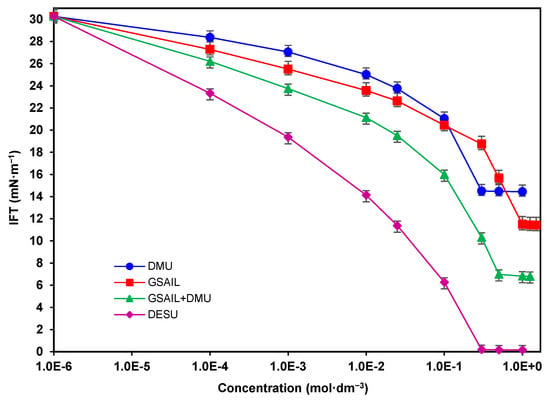
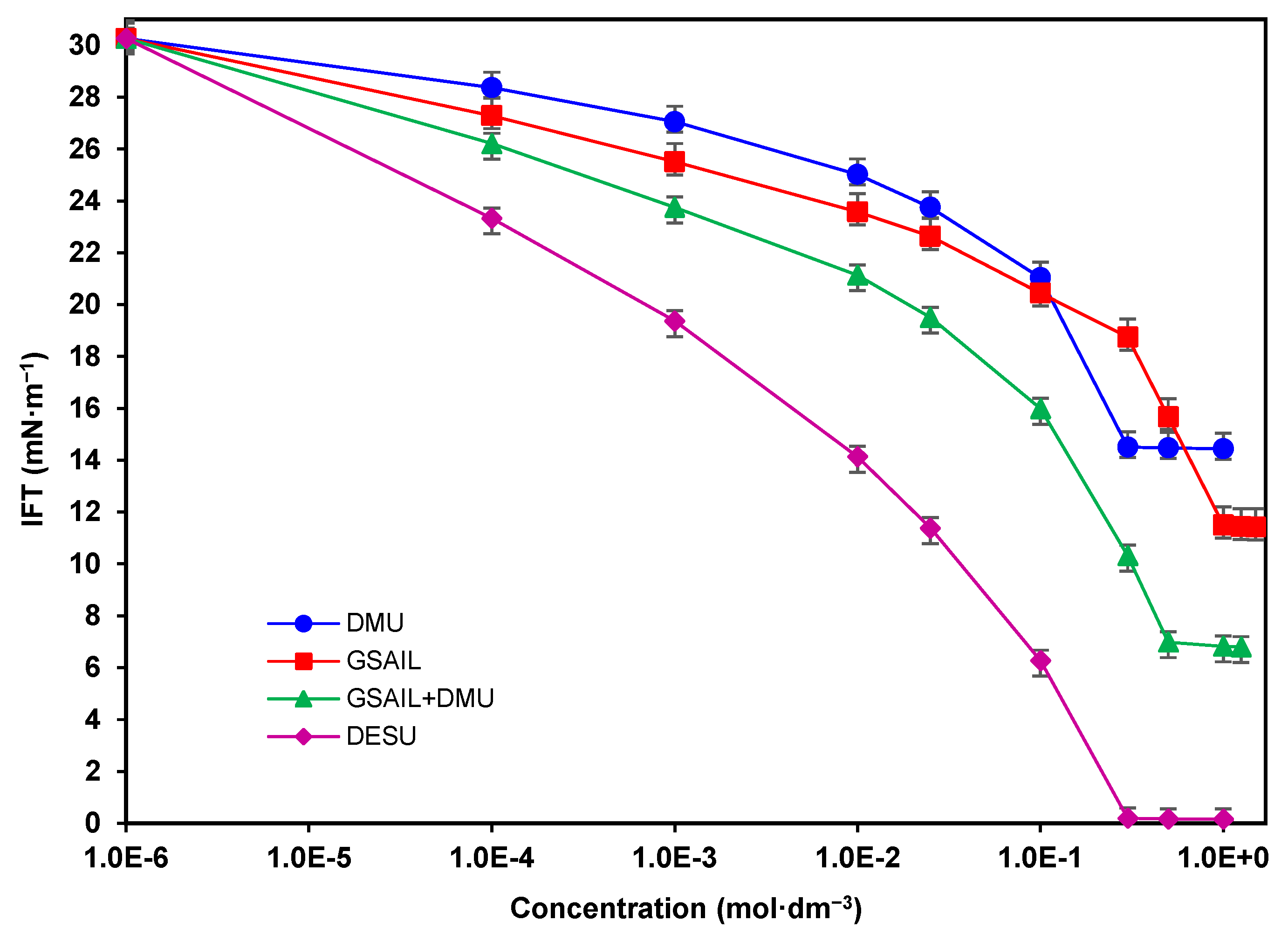
To conduct a comprehensive analysis of the performance of DESU, the IFT variations were examined for individual precursors, GSAIL and DMU, as well as for their combination in a molar ratio of 3:2, which did not yield a DESU product, all at a temperature of 298.2 K. As illustrated in Figure 7, at CMC concentration, the individual components of DESU, DMU at 0.29 mol·dm−3, and GSAIL at approximately 1.0 mol·dm−3, the minimum IFT values were 14.50 mN·m−1 and 11.49 mN·m−1, respectively. In contrast, their mixture was able to reduce the IFT to 6.98 mN·m−1 at 0.5 mol·dm−3. In comparison, the minimum IFT achieved with the DESU, at 0.15 mN·m−1, was significantly lower.
Figure 7.
Variation of the crude oil–water IFT versus concentration of the DESU and the individual precursors at 298.2 K.
In a prior study involving the same crude oil at a consistent temperature of 298.2 K, IFT values of 1.55 and 1.21 mN·m−1 were recorded when utilizing conventional surfactants, specifically SDS and SDBS, at concentrations of 0.25 and 0.20 mol·dm−3, respectively. In contrast, the current study reports an IFT value of approximately 2.21 mN·m−1 at a concentration of 0.20 mol·dm−3, suggesting that conventional surfactants exhibit superior performance at moderate concentrations. However, at a higher concentration of 0.48 mol·dm−3, the performance of the DESU becomes comparable, as the IFT is reduced to 0.15 mN·m−1. It is important to note that the environmental benefits associated with the use of DESU must also be considered [40,41].
3.4. Theoretical Consideration
The well-known Frumkin adsorption isotherm effectively represented the experimental IFT data at concentrations lower than the CMC across the different temperatures studied. This isotherm accounts for the non-ideal interactions (either attractive or repulsive) between adsorbed particles at the interfaces [42]. Given the presence of two positively charged imidazole rings and DMU, which promote the formation of a stable hydrogen-bonding network near the interface, creating strong interfacial interactions among DESU adsorbates, applying this isotherm is appropriate. The equation of state and the isotherm are as follows [43]:
In these equations, , referred to as interfacial pressure, indicates the difference between the IFT of the pure system, , and the measured value, . Additionally, represents the coverage of the interface. Other parameters are defined based on the Gibbs dividing interface theory [43], which underpins the Frumkin isotherm. These include the maximum interface excess concentration in the Frumkin model, , the van der Waals molecular interaction parameter, , the Frumkin adsorption constant, , and the activity coefficient of ions, . The accuracy of the fit of the experimental data to the Frumkin isotherm is validated by achieving the lowest value of the objective function () as follows [44]:
Here, and denote the discrepancies between the experimental and calculated concentrations and interfacial pressure values for the ith data point. Additionally, refers to the highest interfacial pressure in relation to the of the final IFT in a dataset comprising m data points. The IsoFit software was utilized for the calculations. As shown in Figure S3, the Frumkin adsorption isotherm aligns well with the data. The fitting parameters obtained and the values at each temperature are detailed in Table 10.
Table 10.
Obtained parameters based on the Frumkin isotherm at different temperatures for DESU.
The objective function values for the DESU ranged from 0.32 to 0.50 within the temperature range, indicating that the fits were satisfactory. It is evident that the of the DESU aligns with the previously mentioned findings. This can be explained by the increased hydrophobicity and adsorption propensity discussed in Section 3.3. The negative values of the molecular interaction parameter, , substantiate the presence of electrostatic repulsion among the adsorbed DESU molecules and the positively charged imidazolium rings. Similarly, a more compact interfacial arrangement of the adsorbed particles, observed at elevated temperatures, indicates an increase in electrostatic repulsion, as reflected by higher values. Conversely, the Frumkin adsorption equilibrium constant, , decreases with rising temperature, which can be attributed to the enhancement of electrostatic repulsion at higher temperatures. Notably, the minimum area occupied at the interface by each adsorbed molecule, , is defined as
Here, represents Avogadro’s number. An increase in temperature elevates the interfacial concentration, promoting a more compact arrangement of particles within the adsorption layer. Consequently, this results in a relatively smaller area occupied by each molecule, denoted as . As observed, the parameter exhibits an increase with rising temperature. This phenomenon can be attributed to the enhanced thermal mobility of the DESU particles, in addition to the dehydration of their hydrophilic regions within the bulk phase.
The thermodynamic parameters of and , which pertain to the Gibbs free energies associated with adsorption and micellization, respectively, and indicate the tendencies for adsorption and aggregation, are established by [44,45]:
in which the molar concentration of water is represented by . According to the data presented in Table 10, the negative values of Gibbs free energy indicate that the adsorption of the DESU at the crude oil–water interface, as well as the process of micellization, occurs spontaneously. Notably, the broader distribution of molecular charge contributes to stronger interactions for DESU. At elevated temperatures, increased thermal mobility results in a rise in the total free energy of adsorption. Additionally, the dehydration of the hydrophilic components of the DESU in the bulk phase enhances their tendency to aggregate with increasing temperature. Furthermore, the absolute values of are significantly greater than those of , suggesting a preference for the DESU to adsorb rather than to form aggregates in the bulk phase.
In conclusion, the alterations in interface entropy, denoted as , along with the changes in energy, represented as , were determined using the following equations [46]:
The variations of and with respect to temperature are illustrated in Figure S4 and Figure S5, respectively. The specific alterations in as a function of temperature can be attributed to the competing phenomena of enhanced particle agitation and the dehydration of the DESU molecules at the interface [47]. The former phenomenon leads to an increase in entropy, while the latter results in a significant van der Waals attraction among the DESU molecules, thereby reducing the entropy values [48]. A similar trend in variation is observed for the energy, , in relation to .
3.5. Wettability Alteration and Emulsifying Capabilities
Wettability refers to the interaction between crude oil and water in contact with the rock surface of a reservoir, and it is recognized as a critical parameter influencing the residual original oil in place (OOIP). A transition in wettability from oil-wet to water-wet facilitates the separation of residual oil from reservoir rocks, thereby enhancing the mobility of crude oil and significantly improving EOR outcomes. Wettability can be determined by measuring the contact angle of liquids on the surface. In the context of crude oil–water–rock systems, reservoirs are categorized based on their wettability: hydrophilic (water-wet) with contact angles ranging from 0 to 80°, intermediate-wet with contact angles between 80 and 100°, and hydrophobic (oil-wet) with contact angles spanning from 100 to 180° [49]. It is important to highlight that, in the case of an oil drop forming within an aqueous medium, the external contact angle that is established at the interface with the surrounding aqueous phase is taken into consideration.
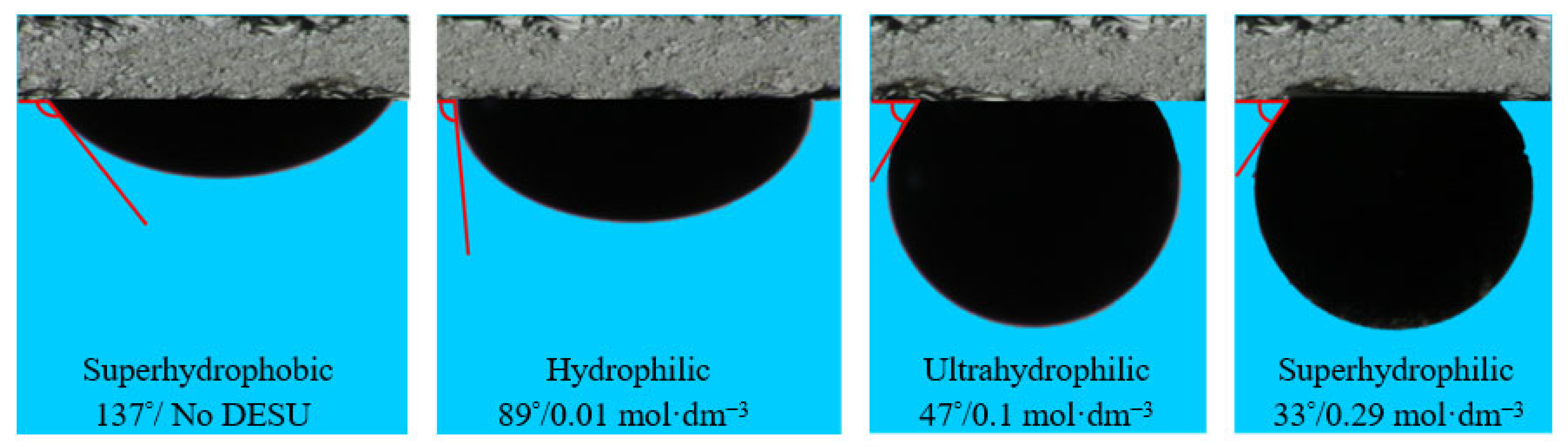
Figure 8 displays the contact angle measurements in this study, revealing a clear transition from a superhydrophobic to a superhydrophilic surface with increasing DESU concentration at a temperature of 298.2 K. In the absence of DESU, the crude oil drop exhibits a high contact angle of 137°, indicating strong oil-wet conditions on the quartz surface. As the DESU concentration increases, the contact angle progressively decreases to 33° at 0.29 mol·dm−3, demonstrating a significant shift toward water-wet behavior.
Figure 8.
The contact angles of crude oil drops surrounded by DESU aqueous solutions on the quartz surface, measured at 298.2 K.
This remarkable wettability alteration can be attributed to the adsorption of DESU molecules at the solid–liquid interface, where the polar imidazolium headgroups and hydrogen-bonding interactions anchor to the quartz surface, while the hydrophobic tails orient toward the oil phase. The cooperative alignment of these amphiphilic structures reduces the surface energy imbalance, promotes water spreading, and displaces the adsorbed oil film from the rock surface. Consequently, the surface becomes increasingly superhydrophilic, assisting greatly in oil detachment and displacement during EOR processes [50].
The results are comparable to the findings of Guo et al. [51], who used a DESU composed of choline chloride and urea (choline chloride:urea). In their work, the contact angle was reduced from 137.0 to 54.3° at a concentration of 0.5 mol·dm−3. However, this reduction in contact angle was less efficient compared to the GSAIL-based DESU in the current study. In this regard, Rao et al. [2] also used a DESU composed of choline chloride and urea together with a co-surfactant (cetyl trimethyl ammonium bromide, CTAB). In their work, the contact angle was reduced from 90.1 to 69.3° at a concentration of 0.07 mol·dm−3. The resultant wettability alteration of the thin-section surface induced by the DESU was ascribed to electrostatic and hydrophobic interactions between DESU components and the tails of the surfactants. Further, Mohsenzadeh et al. [6] used a DESU composed of choline chloride and urea. In their work, the contact angle was reduced from 152.0 to 128.0° at a concentration of 7.59 mol·dm−3. These studies, in comparison with the present study, support the importance of rationally designing the DESU structure. Reasonably, the selection of appropriate HBDs and HBAs is crucial to optimize wettability alteration processes in EOR applications.
In the context of crude oil extraction, it is essential to facilitate the transfer of surfactants to low-permeability zones and to dissolve residual crude oil and create stable oil-in-water (O/W) or water-in-oil (W/O) emulsions. It is important to highlight that the formation of these emulsions diminishes the adsorption of crude oil onto the surfaces of reservoir rocks, thereby enhancing the mobility of the residual crude oil [52]. Furthermore, emulsions enhance the movement of injection fluids in regions that have not been effectively swept, obstruct permeable pathways to prevent the backflow of crude oil, and significantly increase both the mobility and sweeping efficiency [53]. Indeed, a low IFT is crucial for the development of a stable emulsion.
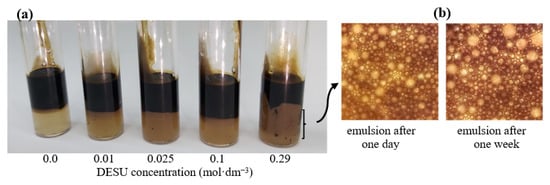
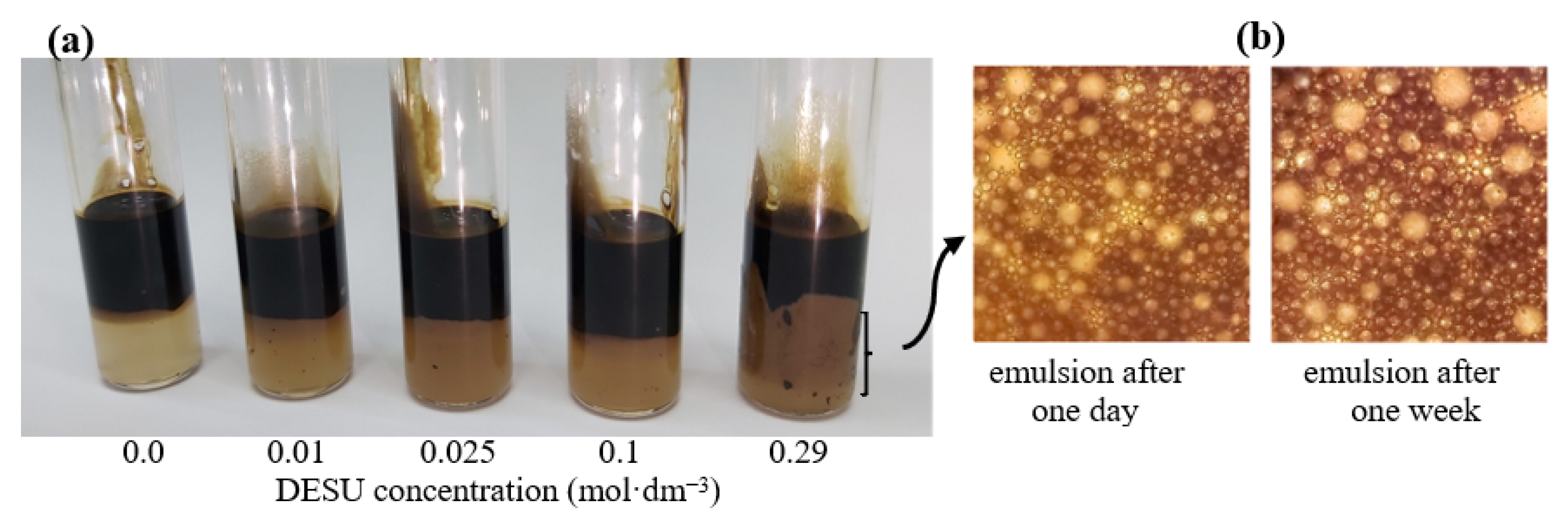
Figure 9 presents images of the crude oil–water emulsions at different concentrations of DESU, as well as the emulsion in the presence of approximately 0.29 mol·dm−3 of DESU (at the CMC) after one day and one week. The corresponding microscopic images are also included. As shown in Figure 10, the emulsification indices for the DESU reached a maximum of 72% after one day and 66% after one week. Microscopic imaging clearly demonstrates that the presence of surface-active agents, such as the DESU, facilitates a nearly uniform distribution of water drops within crude oil drops. This phenomenon can be attributed to the pronounced amphiphilic characteristics of the DESU, which facilitate its directional adsorption at the interface of crude oil drops, bringing about the formation of hydrophilic protective films that significantly contribute to the dispersion of crude oil in aqueous environments. Meanwhile, the long hydrophobic alkyl chains of the involved GSAIL provide steric stabilization within the oil phase, preventing drop coalescence. The strong hydrogen bonding in the DESU structure also promotes the formation of a coherent and elastic interfacial film, reducing interfacial mobility and promoting kinetic stability of the emulsion. Collectively, these features explain the high emulsification efficiency and long-term stability observed by utilizing the DESU [54].
Figure 9.
(a) The crude oil–water emulsions at different DESU concentrations and (b) the microscopic images (45× magnification) of the DESU at 0.29 mol·dm−3 and 298.2 K.
Figure 10.
The emulsion index versus DESU concentration at 298.2 K.
Notably, this study was conducted under controlled laboratory conditions, and accordingly, several limitations should be acknowledged. Only one crude oil sample and a specific GSAIL–DMU-based DESU structure were investigated, which may not fully represent the behavior of different reservoir fluids or DESU chemistries. The experiments were performed at ambient pressure, and high-pressure reservoir conditions were not considered.
4. Conclusions
In this study, a novel deep eutectic surfactant was successfully developed from a Gemini imidazolium-based ionic liquid and dimethylurea. DFT calculations confirmed the spontaneous formation of a stable hydrogen-bonding network between the imidazolium cations and the carbonyl oxygen of DMU, leading to a strong supramolecular association with a high interaction energy. The deep eutectic structure exhibited enhanced amphiphilicity and interfacial affinity due to the efficient interactions between the components. It reduced the oil–water IFT by up to 99.85% and showed a decreasing CMC with increasing temperature. The hydrogen bonding in the product facilitates molecular alignment at the oil–water boundary, enabling efficient adsorption, compact packing, and the formation of a stable interfacial film. The adsorption behavior, analyzed by the Frumkin adsorption isotherm model, confirms strong interactions among adsorbed molecules at the interface.
Furthermore, wettability tests revealed a pronounced shift from oil-wet to strongly water-wet conditions with increasing concentration, confirming efficient surface adsorption of the amphiphilic molecules at the solid–liquid interface. Emulsification experiments also showed the formation of a stable oil-in-water emulsion after one day and one week, attributed to the formation of a viscoelastic interfacial film and a hydrogen-bond-reinforced interfacial network.
Overall, the combination of theoretical and experimental results demonstrated that the synergistic hydrogen-bonding and amphiphilic design of the deep eutectic product effectively reduces interfacial free energy, alters rock wettability, and stabilizes emulsions, making it a promising and greener alternative benign surfactant candidate for EOR applications.
Future studies expanding on the findings of this work may involve evaluating the performance of the introduced DESU under reservoir-relevant pressure, as well as examining different crude oil types with various viscosity and asphaltene content. In addition, investigating the core-flooding or porous-media experiments, and exploring DESU structural modifications could provide deeper insight into the interfacial behavior and practical application in EOR processes.
Supplementary Materials
The following supporting information can be downloaded at: https://www.mdpi.com/article/10.3390/pr14213450/s1, Figure S1: 1H NMR spectrum of 3,3′-(hexane-1,6-diyl)bis(1-butyl-1H-imidazol-3-ium) bromide, Figure S2: 13C NMR spectrum of 3,3′-(hexane-1,6-diyl)bis(1-butyl-1H-imidazol-3-ium) bromide, Figure S3: Fitting the experimental data with the Frumkin adsorption isotherm for the system containing DESU at the temperature of 298.2 K, Figure S4: The variation of entropy changes of the DESU adsorption process versus temperature, Figure S5: The variation of energy change of the DESU adsorption process versus temperature.
Author Contributions
S.Y.: Experiments, Methodology, Visualization, Software, Data curation, Orignial draft preparation. J.S.: Supervision, Methodology, Funding acquisition, Formal analysis, Wrinting-review and editing. M.K.: Visualization, Investigation, Software, Writing initial draft. E.A.: Software, Original draft preparation. M.B.: Softwere, Methodology. All authors have read and agreed to the published version of the manuscript.
Funding
This research was financial supported by Bu-Ali Sina University authorizes.
Data Availability Statement
The data that support the findings of this study are available from the corresponding author upon reasonable request.
Acknowledgments
The authors would like to acknowledge the Bu-Ali Sina University for support of this research.
Conflicts of Interest
The authors declare that they have no known competing financial interests or personal relationships that could have appeared to influence the work reported in this paper.
References
- Atilhan, M.; Aparicio, S. Review on chemical enhanced oil recovery: Utilization of ionic liquids and deep eutectic solvents. J. Pet. Eng. 2021, 205, 108746. [Google Scholar] [CrossRef] [Scilit]
- Rao, G.L.P.; Mandal, A.; Pal, N. Choline chloride-Urea based deep eutectic Solvent: Characterization, interfacial behavior and Synergism in binary (surfactant) systems. Chem. Phys. 2025, 588, 112496. [Google Scholar] [CrossRef] [Scilit]
- Sanati, A.; Malayeri, M.; Busse, O.; Weigand, J. Utilization of ionic liquids and deep eutectic solvents in oil operations: Progress and challenges. J. Mol. Liq. 2022, 361, 119641. [Google Scholar] [CrossRef] [Scilit]
- Liu, Z.; Zhao, G.; Brewer, M.; Lv, Q.; Sudhölter, E.J. Comprehensive review on surfactant adsorption on mineral surfaces in chemical enhanced oil recovery. Adv. Colloid Interface Sci. 2021, 294, 102467. [Google Scholar] [CrossRef] [Scilit]
- Pal, N.; Hoteit, H.; Mandal, A. Structural aspects, mechanisms and emerging prospects of Gemini surfactant-based alternative enhanced oil recovery technology: A review. J. Mol. Liq. 2021, 339, 116811. [Google Scholar] [CrossRef] [Scilit]
- Mohsenzadeh, A.; Al-Wahaibi, Y.; Jibril, A.; Al-Hajri, R.; Shuwa, S. The novel use of deep eutectic solvents for enhancing heavy oil recovery. J. Pet. Sci. Eng. 2015, 130, 6–15. [Google Scholar] [CrossRef] [Scilit]
- Abbott, A.P.; Boothby, D.; Capper, G.; Davies, D.L.; Rasheed, R.K. Deep eutectic solvents formed between choline chloride and carboxylic acids: Versatile alternatives to ionic liquids. J. Am. Chem. Soc. 2004, 126, 9142−9147. [Google Scholar] [CrossRef] [Scilit]
- Wong, L.N.; Imberti, S.; Warr, G.G.; Atkin, R. Bulk nanostructure of a deep eutectic solvent with an amphiphilic hydrogen bond donor. Phys. Chem. Chem. Phys. 2023, 25, 31068–31076. [Google Scholar] [CrossRef] [Scilit]
- Nandwani, S.K.; Malek, N.I.; Chakraborty, M.; Gupta, S. Insight into the application of surface-active ionic liquids in surfactant based enhanced oil recovery processes–a guide leading to research advances. Energy Fuels 2020, 34, 6544−6557. [Google Scholar] [CrossRef] [Scilit]
- Giraldo, L.J.; Galeano-Caro, D.; Franco, C.A.; Archila, J.; Villamil, F.; Cortés, F.B.; Franco, C.A. Development of a novel green bio-nanofluid from Sapindus saponaria for enhanced oil recovery processes. Processes 2022, 10, 1057. [Google Scholar] [CrossRef] [Scilit]
- Saien, J.; Eghtenaei, A.; Kharazi, M. Qualifying interfacial properties of crude oil−water system with the synergistic action of a nano Gemini ionic liquid and conventional surfactants. Sci. Rep. 2024, 14, 19833. [Google Scholar] [CrossRef] [Scilit]
- El-Hoshoudy, A.; Soliman, F.; Mansour, E.; Zaki, T.; Desouky, S. Experimental and theoretical investigation of quaternary ammonium-based deep eutectic solvent for secondary water flooding. J. Mol. Liq. 2019, 294, 111621. [Google Scholar] [CrossRef] [Scilit]
- Raut, D.S.; Joshi, V.A.; Khan, S.; Kundu, D. A-Priori screening of deep eutectic solvent for enhanced oil recovery application using COSMO-RS framework. J. Mol. Liq. 2023, 377, 121482. [Google Scholar] [CrossRef] [Scilit]
- Kumar, A.; Medha, S.; Chakraborty, D.; Kundu, D.; Khan, S. Enhanced oil recovery promoted by aqueous deep eutectic solvents on silica and calcite surfaces: A molecular dynamics study. Phys. Chem. Chem. Phys. 2025, 27, 9573−9589. [Google Scholar] [CrossRef] [Scilit]
- Shayestehpour, O.; Zahn, S. Molecular features of reline and homologous deep eutectic solvents contributing to nonideal mixing behavior. J. Phys. Chem. B 2020, 124, 7586−7597. [Google Scholar] [CrossRef] [Scilit]
- Stauffer, C.E. The measurement of surface tension by the pendant drop technique. J. Phys. Chem. 1965, 69, 1933−1938. [Google Scholar] [CrossRef] [Scilit]
- Drelich, J.; Fang, C.; White, C. Measurement of interfacial tension in fluid-fluid systems. Colloids Surf. 2002, 3, 3158−3163. [Google Scholar]
- Kharazi, M.; Saien, J.; Javadi, A.; Miller, R. Innovations in Ionic Liquid-Based Surfactants and Interfacial Phenomena; CRC Press: Boca Raton, FL, USA, 2025; ISBN 9781032748078. [Google Scholar]
- Amani, H. Evaluation of biosurfactants and surfactants for crude oil contaminated sand washing. J. Pet. Technol. 2015, 33, 510−519. [Google Scholar] [CrossRef] [Scilit]
- Saien, J.; Kharazi, M. Chemical Enhanced Oil Recovery Using Ionic Liquid-Based. In Surfactants: Fundamental Concepts and Emerging Perspectives; Owoseni, O., Ed.; IntechOpen: London, UK, 2023. [Google Scholar] [CrossRef] [Scilit]
- Tang, B.; Row, K.H. Recent developments in deep eutectic solvents in chemical sciences. Monatsh. Chem. 2013, 144, 1427−1454. [Google Scholar] [CrossRef] [Scilit]
- Jenkin, G.R.; Al-Bassam, A.Z.; Harris, R.C.; Abbott, A.P.; Smith, D.J.; Holwell, D.A.; Chapman, R.J.; Stanley, C.J. The application of deep eutectic solvent ionic liquids for environmentally-friendly dissolution and recovery of precious metals. Miner. Eng. 2016, 87, 18−24. [Google Scholar] [CrossRef] [Scilit]
- Smith, E.L.; Abbott, A.P.; Ryder, K.S. Deep eutectic solvents (DESs) and their applications. J. Chem. Rev. 2014, 114, 11060−11082. [Google Scholar] [CrossRef] [Scilit]
- Sultana, K.; Rahman, M.T.; Habib, K.; Das, L. Recent advances in deep eutectic solvents as shale swelling inhibitors: A comprehensive review. ACS Omega 2022, 7, 28723−28755. [Google Scholar] [CrossRef] [Scilit]
- Zhu, S.; Li, H.; Zhu, W.; Jiang, W.; Wang, C.; Wu, P.; Zhang, Q.; Li, H. Vibrational analysis and formation mechanism of typical deep eutectic solvents: An experimental and theoretical study. J. Mol. Graph. 2016, 68, 158−175. [Google Scholar] [CrossRef] [Scilit]
- Frisch, M. Gaussian 09, Revision d. 01; Gaussian, Inc.: Wallingford, CT, USA, 2009; Volume 201. [Google Scholar]
- Jeziorski, B.; Moszynski, R.; Ratkiewicz, A.; Rybak, S.; Szalewicz, K.; Williams, H.L. SAPT: A program for many-body symmetry-adapted perturbation theory calculations of intermolecular interaction energies. J. Comput. Chem. 1993, 94, 79−129. [Google Scholar]
- Ziegler, T.; Rauk, A.; Baerends, E.J. On the calculation of multiplet energies by the hartree-fock-slater method. Theor. Chim. Acta. 1977, 43, 261–271. [Google Scholar] [CrossRef] [Scilit]
- Foster, J.P.; Weinhold, F. Natural hybrid orbitals. J. Am. Chem. Soc. 1980, 102, 7211−7218. [Google Scholar] [CrossRef] [Scilit]
- Weinhold, F.; Landis, C.; Glendening, E. What is NBO analysis and how is it useful? Int. Rev. Phys. Chem. 2016, 35, 399−440. [Google Scholar] [CrossRef] [Scilit]
- Wiberg, K.B. Application of the pople-santry-segal CNDO method to the cyclopropylcarbinyl and cyclobutyl cation and to bicyclobutane. Tetrahedron 1968, 24, 1083–1096. [Google Scholar] [CrossRef] [Scilit]
- Khan, A.A.; Esrafili, M.D.; Ahmad, A.; Hull, E.; Ahmad, R.; Jan, S.U.; Ahmad, I. A computational study on the characteristics of open-shell H-bonding interaction between carbamic acid (NH2COOH) and HO2, HOS or HSO radicals. J. Mol. Model. 2019, 25, 189. [Google Scholar] [CrossRef] [Scilit]
- Sedghi, A.; Bayat, M.; Sabounchei, S.J.; Khodabandehloo, M. A comparison of donor–acceptor interactions of N-heterocyclic carbenes and sulfonium ylides in coordination with coinage metal ions. Polyhedron 2019, 157, 208–218. [Google Scholar] [CrossRef] [Scilit]
- Reed, A.E.; Curtiss, L.A.; Weinhold, F. Intermolecular interactions from a natural bond orbital, donor-acceptor viewpoint. J. Chem. Rev. 1988, 88, 899−926. [Google Scholar] [CrossRef] [Scilit]
- Richard, F.; Bader, R. Atoms in Molecules: A Quantum Theory; Oxford University Press: Oxford, UK, 1990. [Google Scholar]
- Asadabadi, S.; Saien, J.; Kharazi, M. Enhanced interfacial activity by maximizing synergy between long-chain ionic liquid and conventional surfactant for enhanced oil recovery. RSC Adv. 2024, 14, 18942–18949. [Google Scholar] [CrossRef] [Scilit]
- Hammond, O.S.; Mudring, A.V. Ionic liquids and deep eutectics as a transformative platform for the synthesis of nanomaterials. Chem. Commun. 2022, 58, 3865−3892. [Google Scholar] [CrossRef] [Scilit]
- Chen, Y.; Chen, W.; Fu, L.; Yang, Y.; Wang, Y.; Hu, X.; Wang, F.; Mu, T. Surface tension of 50 deep eutectic solvents: Effect of hydrogen-bonding donors, hydrogen-bonding acceptors, other solvents, and temperature. Ind. Eng. Chem. Res. 2019, 58, 12741−12750. [Google Scholar] [CrossRef] [Scilit]
- Asadabadi, S.; Kharazi, M.; Saien, J. Salinity and alkalinity impacts on the interfacial activity of crude oil–water systems using individual and mixtures of a surface-active ionic liquid and conventional surfactant. RSC Adv. 2025, 15, 36050–36064. [Google Scholar] [CrossRef] [Scilit]
- Saien, J.; Kharazi, M. The Properties and Applications of Surface-Active Ionic Liquids. In Properties and Applications of Ionic Liquids; Nova Science: Hauppauge, NY, USA, 2023. [Google Scholar] [CrossRef] [Scilit]
- Saien, J.; Shokri, B.; Kharazi, M. Effective synergistic action of benzimidazolium nano Gemini ionic liquid and conventional surfactant for chemical enhanced oil recovery. ACS Omega 2024, 9, 22336–22344. [Google Scholar] [CrossRef] [Scilit]
- Birdi, K. Surface and Colloid Chemistry: Principles and Applications; CRC press: Boca Raton, FL, USA, 2009. [Google Scholar]
- Stubenrauch, C.; Fainerman, V.; Aksenenko, E.; Miller, R. Adsorption behavior and dilational rheology of the cationic alkyl trimethylammonium bromides at the water/air interface. J. Phys. Chem. B 2005, 109, 1505−1509. [Google Scholar] [CrossRef] [Scilit]
- Möbius, D.; Miller, R.; Fainerman, V.B. Surfactants: Chemistry, Interfacial Properties, Applications; Elsevier: Amsterdam, The Netherlands, 2001. [Google Scholar]
- Liu, G.; Gu, D.; Liu, H.; Ding, W.; Luan, H.; Lou, Y. Thermodynamic properties of micellization of sulfobetaine-type zwitterionic Gemini surfactants in aqueous solutions–A free energy perturbation study. J. Colloid Interface Sci. 2012, 375, 148−153. [Google Scholar] [CrossRef] [Scilit]
- Motomura, K.; Iwanaga, S.I.; Yamanaka, M.; Aratono, M.; Matuura, R. Thermodynamic studies on adsorption at interaces: V. Adsorption from micellar solution. J. Colloid Interface Sci. 1982, 86, 151−157. [Google Scholar] [CrossRef] [Scilit]
- Kharazi, M.; Saien, J.; Miller, R. The surface activity of surfactants at liquid interfaces: The role of CMC, decrease in surface tension, HLB, thermodynamic adsorption models. J. Surfactants Deterg. 2025, 29, 65–90. [Google Scholar] [CrossRef] [Scilit]
- Matsubara, H.; Onohara, A.; Imai, Y.; Shimamoto, K.; Takiue, T.; Aratono, M. Effect of temperature and counterion on adsorption of imidazolium ionic liquids at air–water interface. Colloids Surf. A Physicochem. Eng. Asp. 2010, 370, 113−119. [Google Scholar] [CrossRef] [Scilit]
- He, L.; Lin, F.; Li, X.; Sui, H.; Xu, Z. Interfacial sciences in unconventional petroleum production: From fundamentals to applications. Chem. Soc. Rev. 2015, 44, 5446−5494. [Google Scholar] [CrossRef] [Scilit]
- Gbadamosi, A.O.; Junin, R.; Manan, M.A.; Agi, A.; Yusuff, A.S. An overview of chemical enhanced oil recovery: Recent advances and prospects. Int. Nano Lett. 2019, 9, 171−202. [Google Scholar] [CrossRef] [Scilit]
- Guo, J.H.; Bai, Y.F.; Du, L.; Wei, L.Y.; Zhao, Y.; Zheng, X.B.; Yang, E.L.; Wang, Z.G.; Huang, H.; Zhang, W.T. Experimental investigation on the effects of deep eutectic solvents (DES) on the wettability of sandstone samples. J. Pet. Sci. 2024, 22, 1380–1390. [Google Scholar] [CrossRef] [Scilit]
- Guang, Z.; Caili, D.; Qing, Y. Characteristics and displacement mechanisms of the dispersed particle gel soft heterogeneous compound flooding system. Pet. Explor. Dev. 2018, 45, 481−490. [Google Scholar] [CrossRef] [Scilit]
- Mandal, A.; Samanta, A.; Bera, A.; Ojha, K. Characterization of oil−water emulsion and its use in enhanced oil recovery. Ind. Eng. Chem. Res. 2010, 49, 12756−12761. [Google Scholar] [CrossRef] [Scilit]
- Li, Z.; Xu, D.; Yuan, Y.; Wu, H.; Hou, J.; Kang, W.; Bai, B. Advances of spontaneous emulsification and its important applications in enhanced oil recovery process. Adv. Colloid Interface Sci. 2020, 277, 102119. [Google Scholar] [CrossRef] [Scilit]

Disclaimer/Publisher’s Note: The statements, opinions and data contained in all publications are solely those of the individual author(s) and contributor(s) and not of MDPI and/or the editor(s). MDPI and/or the editor(s) disclaim responsibility for any injury to people or property resulting from any ideas, methods, instructions or products referred to in the content. |
© 2026 by the authors. Licensee MDPI, Basel, Switzerland. This article is an open access article distributed under the terms and conditions of the Creative Commons Attribution (CC BY) license.