


Abstract
Cast body-centred-cubic (BCC) high-entropy alloys (HEAs) such as AlCrFeMnNiW0.1 offer solid-solution strengthening and thermal stability; however, the response of cast alloys to post-solidification heat treatment across a broad temperature range remains insufficiently reported. Here, we investigated the cast HEA in the as-cast condition and after heat treatment at 800, 1000, and 1200 °C using SEM and XRD. EDS mapping at 1200 °C and an existing CALPHAD equilibrium calculation for the as-cast condition provided complementary evidence. The as-cast alloy exhibited a dendritic/interdendritic morphology and a diffraction pattern dominated by a reflection set consistent with a BCC lattice based on interplanar-spacing ratios. Heat treatment promoted microstructural refinement and progressive compositional homogenization, while the dendritic structure remained evident at 800–1200 °C. EDS mapping indicated comparatively higher elemental heterogeneity for W and Ni among the six mapped elements at 1200 °C. Vickers hardness decreased from 490 HV in the as-cast state to 371 HV at 800 °C, followed by recovery to 398 and 418 HV at 1000 and 1200 °C, respectively.
1. Introduction
High-entropy alloys (HEAs), defined by the co-existence of five or more principal elements in near-equiatomic proportions, were introduced as a distinct alloy-design strategy in the mid-2000s [1,2,3]. Rather than a single dominant lattice-forming element diluted by minor additions, HEAs favour the formation of simple, often single-phase solid solutions, typically face-centred-cubic (FCC), body-centred-cubic (BCC), or a mixture of the two, stabilized in part by a large configurational entropy of mixing [1,2,4,5,6,7,8,9]. This departure from conventional alloy design has motivated two decades of work aimed at understanding how composition, processing route, and thermal history jointly determine phase selection, microstructure, and resulting mechanical and functional properties [4,5,10,11]. Recent studies further demonstrate that the mechanical response of HEAs is strongly governed by microstructural features such as phase constitution, precipitation, grain-boundary chemistry, and deformation mechanisms [7,12,13,14,15].
Within the broader HEA family, aluminium- and tungsten-containing systems occupy a particular niche. Aluminium is a well-established BCC stabilizer in multi-principal-element alloys, so that increasing Al content tends to drive a transition from FCC towards BCC or dual-phase BCC + FCC structures [16,17,18,19]. The importance of controlling phase constitution and microstructural stability is also evident in recent high-entropy alloy studies, where compositional modification and thermal/mechanical processing have been shown to produce substantial changes in phase distribution and strengthening mechanisms [6,20,21]. Tungsten contributes a very high melting point, a large atomic radius relative to the 3d transition metals typically used in HEAs, and substantial solid-solution strengthening, at the cost of processing difficulty and, in some systems, a tendency to promote topologically close-packed intermetallic phases (e.g., σ-phase) formation on annealing [22,23,24]. Such composition-dependent phase stability is particularly important in refractory and W-containing HEAs, where strengthening and ductility can be controlled through precipitation, grain-boundary segregation, and secondary-phase evolution [12,25,26,27].
The AlCrFeMnNiWx system specifically has been investigated by several groups using mechanical alloying followed by spark plasma sintering (SPS): nanocrystalline AlCrFeMnNiWx (x = 0, 0.05, 0.1, 0.5) powders consolidated by SPS retain a primary BCC solid-solution phase after sintering at 900 °C, together with a σ-rich tetragonal phase, ordered B2, and minor FCC constituents, with hardness and elastic modulus strongly dependent on tungsten content [28,29,30,31,32,33]. The same series has also been examined for isothermal oxidation up to 850 °C [34] and for machine-learning-assisted prediction of hardness and oxidation response [28,35]. More broadly, recent HEA investigations have confirmed that alloy chemistry and processing history can substantially modify phase stability, strengthening, and functional response [12,36,37]. Related W-containing HEA systems (e.g., AlCrFeCuNiWx, CoCrFeNiWx, NiMnCrMoWx) consistently report a BCC-dominant or dual BCC + FCC structure whose morphology and secondary-phase content are sensitive to tungsten content and thermal history [38,39]. The sensitivity of HEA microstructures to thermal exposure is further demonstrated by recent studies of precipitation-strengthened and eutectic HEAs, in which phase evolution and nanoscale precipitation strongly influence the resulting mechanical properties [13,26,27].
A gap that motivates the present study is that the great majority of AlCrFeMnNiWx characterization to date has been carried out on powder-metallurgy-processed (mechanically alloyed and spark-plasma-sintered) material, whose starting powder morphology, sintering-induced densification, and rapid Joule heating during SPS differ substantially from a conventionally cast, as-solidified microstructure [28,40]. The distinction between processing routes is important because alloy synthesis and subsequent thermal treatment can strongly influence phase formation, microstructural heterogeneity, and final properties [41,42,43]. Cast HEAs solidify through dendritic growth with associated micro-segregation, producing a starting condition of lattice strain, non-equilibrium solute partitioning between dendrite cores and interdendritic regions, and a dendritic length scale set by solidification rate rather than powder particle size that is mechanistically distinct from a sintered powder compact even where the nominal alloy composition is identical. Recent studies on high-entropy alloys likewise emphasize the strong coupling between composition, solidification/microstructural evolution, and mechanical response [13,25,26,27]. How such a cast microstructure and its associated diffraction signature evolve upon subsequent heat treatment across a wide temperature window (800–1200 °C) has, to the authors’ knowledge, not been reported for this specific alloy in comparable multimodal depth.
CALPHAD (CALculation of PHAse Diagrams) modelling has become a standard complementary tool for rationalizing phase selection in HEAs, allowing candidate equilibrium phase assemblages to be estimated from composition and temperature without full experimental screening [41,44]. Its predictive value for HEAs is, however, contingent on database coverage of the relevant multicomponent system and on independent experimental verification, particularly for non-equilibrium as-cast states that need not correspond to the equilibrium phase assemblage predicted at any single temperature. Recent high-entropy alloy studies involving phase evolution, precipitation, and microstructural modelling further highlight the importance of combining computational predictions with experimental characterization to establish reliable composition–processing–structure relationships. Therefore, integrating CALPHAD predictions with X-ray diffraction, microstructural characterization, and mechanical-property measurements provides a more robust basis for evaluating the thermal stability and phase evolution of cast AlCrFeMnNiW0.1 HEA.
2. Materials and Methods
The CALPHAD equilibrium calculation was performed using Thermo-Calc® software (version 2019a/2019b; Thermo-Calc Software AB, Stockholm, Sweden) with the TCHEA2 database for the nominal AlCrFeMnNiW0.1 composition. The calculated phase fractions discussed in Section 3.3 are expressed as mole fractions and represent the equilibrium phase constitution as a function of temperature.
The AlCrFeMnNiW0.1 HEA was prepared by arc melting high-purity constituent metals (98–99.9% purity) under a high-purity Ar atmosphere. After achieving a vacuum of 10−6 Pa, the chamber was backfilled with Ar to 0.01 atm before melting. The alloy was remelted five times to promote compositional homogeneity and subsequently solidified on a water-cooled copper hearth, producing an approximately 20 g ingot. The measured composition (wt.%) was Al 10.11, Cr 19.49, Mn 20.59, Ni 22.00, Fe 20.93, and W 6.89. Specimens were sectioned from the solidified ingot for subsequent characterization and heat treatment.
The resulting material was investigated in the as-cast condition and following post-solidification heat treatments at 800, 1000, and 1200 °C. A tubular vacuum furnace (Nabertherm RSV 120/500/13) was used for annealing. Specimens were heat-treated for 4 h under vacuum conditions, followed by furnace cooling to room temperature. The same heat-treatment and cooling procedures were applied to all specimens, with annealing temperature being the only intentionally varied parameter. Prior to microstructural characterization, the specimens were sequentially ground using abrasive papers of different grit sizes and polished to a mirror-like finish.
The microstructural characterization was performed using scanning electron microscopy (SEM) in backscattered-electron (BSE) mode. SEM observations were conducted using the available SEM systems at accelerating voltages of 5 and 20 kV. Energy-dispersive X-ray spectroscopy (EDS) was employed for elemental characterization and elemental mapping to evaluate the compositional distribution across the alloy microstructure. The BSE contrast was used to distinguish and examine the dendritic and interdendritic regions and their associated microstructural features.
Phase identification and structural characterization of the as-cast and heat-treated alloy samples were carried out using an X-ray diffractometer (Bruker D2 PHASER, Bruker AXS GmbH, Karlsruhe, Germany) equipped with a Cu radiation source. Diffraction patterns were recorded over a (2θ) range of 20–90° at a scanning rate of 3° min−1 to investigate the phase constitution and structural changes associated with heat treatment. In addition, SEM micrographs were analyzed using ImageJ (version 1.54), a freely available, open-source image-processing software, to distinguish the dendritic and inter-dendritic regions and facilitate the assessment of microstructural evolution associated with heat treatment (shown in red).
Vickers microhardness measurements were performed using a microhardness tester (Bareiss D89610, Bareiss Prüfgerätebau GmbH, Oberdischingen, Germany) under a load of 200 gf with a dwell time of 10 s. Ten measurements were taken for each sample condition, and the mean hardness and standard deviation were calculated to assess the hardness and measurement variability.
3. Results
3.1. XRD Evolution with Heat Treatment
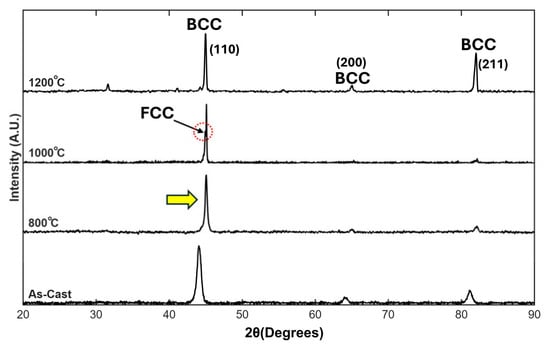
The as-cast XRD pattern of AlCrFeMnNiW0.1 is dominated by a reflection at 44.06° 2θ, with a normalized intensity of 1.00 and FWHM of approximately 0.64° (Figure 1). Two substantially weaker reflections are observed at approximately 63.98° and 81.10°, with relative intensities of 0.106 and 0.224, respectively. The corresponding d-spacing ratios are approximately 0.708 and 0.577 relative to the principal reflection. These values closely agree with the theoretical ratios expected for the (110), (200), and (211) reflections of a BCC structure, supporting a BCC-consistent diffraction signature. Under the Cu Kα working assumption, the estimated lattice parameter is approximately 2.904 Å. In addition, the XRD patterns exhibit a dominant AlFe-type ordered BCC structure, indexed as the (110), (200), and (211) reflections, consistent with JCPDS Card No. 00-033-0020 (reported lattice parameter: 290.37 pm). The corresponding BCC peak positions are indicated in Figure 1.
Figure 1.
XRD pattern of the as-cast and different heat treatment conditions of AlCrFeMnNiW0.1 HEA.
Heat treatment at 800 °C produces a pronounced sharpening of the dominant reflection. Its FWHM decreases from 0.64° in the as-cast condition to approximately 0.30°, corresponding to a reduction of about 53%. The main reflection shifts from 44.06° to approximately 45.08° 2θ. The corresponding apparent lattice parameter decreases to approximately 2.842 Å, representing a contraction of about 2.1% relative to the as-cast estimate. The relative intensities of the weaker reflections near 65° and 82° also decrease to approximately 0.054 and 0.105, respectively.
At 1000 °C, the dominant BCC reflection becomes considerably narrower, reaching a FWHM of approximately 0.22°, representing a reduction of about 66% relative to the as-cast condition. The peak position remains essentially unchanged from the 800 °C condition, occurring near 45.10° 2θ, with an estimated lattice parameter of approximately 2.841 Å. The substantial reduction in FWHM indicates relaxation of lattice distortion and defect-related broadening following heat treatment, although the present analysis does not separate crystallite-size and microstrain contributions. The lattice parameter decreases from 2.904 Å in the as-cast condition to approximately 2.841–2.842 Å after heat treatment, which is attributed primarily to residual-strain relaxation accompanied by elemental redistribution and compositional homogenization within the BCC matrix. Notably, the appearance of a weak FCC diffraction contribution after heat treatment indicates the formation or stabilization of an FCC phase, likely promoted by thermally activated phase transformation and elemental partitioning. Such phase redistribution can further modify the composition of the BCC matrix and contribute to the observed lattice-parameter change. Thus, the decrease in lattice parameter is considered to arise from the combined effects of lattice-strain relaxation and thermally induced compositional/phase redistribution rather than from a single mechanism. The slightly narrower BCC peak further suggests improved crystallinity and/or microstructural homogenization.
The 1200 °C pattern is distinctly different from the other conditions. The principal reflection remains near 44.98° 2θ with a FWHM of approximately 0.24°, corresponding to an overall reduction of about 63% relative to the as-cast condition. More importantly, the reflection near 82° increases markedly in relative intensity to approximately 0.664. Additional reflections appear near 31.64°, 41.10°, and as a shoulder near 44.22°. These features indicate a significant modification of the diffraction response at 1200 °C. The available XRD data alone cannot uniquely attribute the changes to a specific phase transformation. In particular, the increased intensity near 82° may involve changes in phase constitution and/or crystallographic orientation, while the additional reflections may originate from an additional constituent. Interestingly, the FCC peak observed after intermediate-temperature heat treatment disappears at 1200 °C, suggesting that the FCC phase becomes thermodynamically unstable at this temperature and undergoes transformation into the more stable phase(s), accompanied by elemental redistribution during prolonged thermal exposure. Therefore, the present XRD results establish a clear heat-treatment-dependent structural evolution without assigning the newly observed reflections to a specific phase.
3.2. SEM Microstructural Evolution
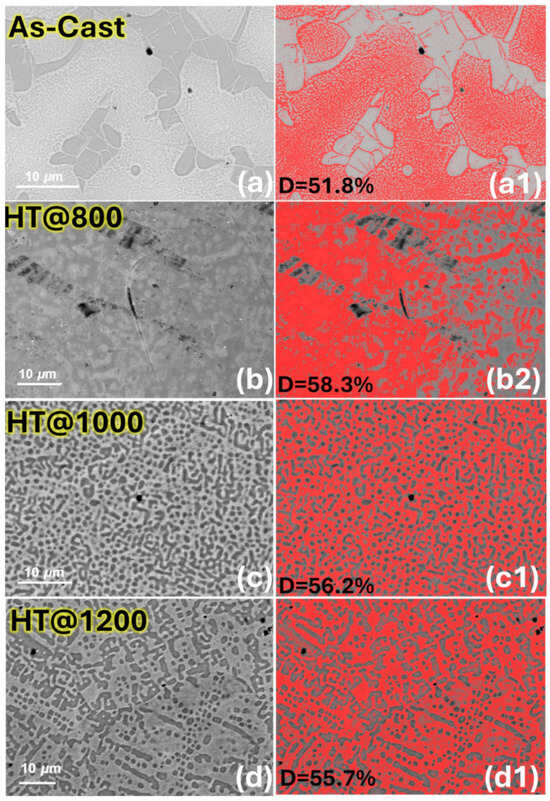
The as-cast AlCrFeMnNiW0.1 alloy exhibits a distinct two-contrast dendritic/interdendritic morphology, consisting of a relatively continuous matrix with coarser angular regions distributed between the dendritic features (Figure 2a). A small number of isolated faceted micrometre-scale particles are also visible; however, their chemical identity was not independently established, and therefore no specific phase assignment is made. Based on the adopted image-segmentation criterion, the bright/white regions were considered the dendritic phase, whereas the darker regions correspond to the interdendritic phase. Quantitative segmentation of the analysed field gave a dendritic area fraction of approximately 51.8%. To better distinguish the dendritic and interdendritic phases, red colour is used to show the evolution obtained from ImageJ processing in Figure 2(a1–d1).
Figure 2.
SEM micrographs and corresponding segmented images of the AlCrFeMnNiW0.1 alloy in the (a) as-cast, (b) 800 °C, (c) 1000 °C, and (d) 1200 °C heat-treated conditions. Panels (a1–d1) show the corresponding image segmentation, where the red regions represent the identified dendritic regions used for quantitative area-fraction analysis. The values of D indicate the measured dendritic area fraction: 51.8% (as-cast), 58.3% (800 °C), 56.2% (1000 °C), and 55.7% (1200 °C). The scale bars correspond to 10 μm.
After heat treatment at 800 °C (Figure 2b), the morphology changes considerably, developing a finer acicular, fan-shaped, or rosette-like cellular structure. These features appear to be associated with regions corresponding to the original interdendritic structure. The segmented dendritic fraction increases to approximately 58.3%. At 1000 °C (Figure 2c), the microstructure develops a finer mottled or dot-and-worm-like morphology. The measured dendritic fraction remains close to that at 800 °C, at approximately 56.2%. The lower number of detected regions should, however, be interpreted cautiously because the 1000 °C micrograph was obtained at a higher nominal magnification than the other conditions. Consequently, the field-of-view area and feature sampling differ between conditions.
At 1200 °C (Figure 2d), the microstructure changes toward a more interconnected and modulated morphology containing elongated as well as approximately equiaxed features. The dendritic fraction is approximately 55.7%, with an equivalent diameter of 0.287 ± 1.638 µm. Thus, the SEM observations indicate a pronounced modification of the as-cast dendritic/interdendritic morphology during heat treatment, with the finest measured features occurring at 1000 °C followed by a slight increase in feature size at 1200 °C. Because the analysis is based on individual fields of view acquired at different magnifications, these values should primarily be considered quantitative descriptions of the analysed fields rather than definitive bulk grain or phase-size statistics.
3.3. CALPHAD Analysis
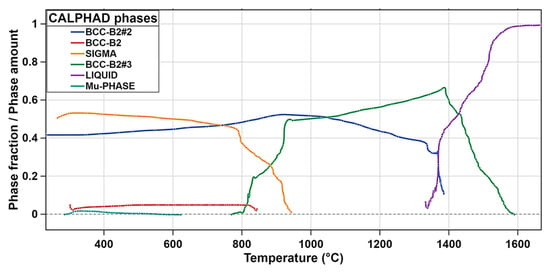
The CALPHAD equilibrium calculation provides a thermodynamic reference for interpreting the possible phase stability of the AlCrFeMnNiW0.1 alloy (in Figure 3). The calculation predicts six phases, designated as phases in the available thermodynamic output. Their stability ranges and predicted fractions vary substantially with temperature.
Figure 3.
CALPHAD prediction for AlCrFeMnNiW0.1 high-entropy alloy.
BCC-B2#2 exhibits a relatively broad stability range from approximately 232 to 1385 °C, with its predicted mole fraction varying from approximately 0.108 to 0.524. SIGMA is predicted between approximately 265 and 943 °C and reaches a maximum mole fraction of approximately 0.532. Thus, Phases BCC-B2#2 and SIGMA represent the principal predicted constituents over substantial portions of the low- and intermediate-temperature ranges.
BCC-B2 remains comparatively minor, with a predicted fraction of approximately 0.020–0.049 between about 302 and 844 °C. Mu-PHASE is also minor, with values close to zero to approximately 0.016, between approximately 286 and 623 °C. The slightly negative minimum extracted for Mu-PHASE is treated as effectively zero because it occurs close to the stability limit and is attributable to numerical/extraction uncertainty rather than a physically meaningful negative phase fraction.
At higher temperatures, BCC-B2#2 becomes increasingly important, increasing to a predicted fraction of approximately 0.665 between about 770 and 1590 °C. The liquid phase becomes prominent only at still higher temperatures, increasing from approximately 0.032 at 1333 °C to approximately 0.994 at 1668 °C. Consequently, the CALPHAD calculation predicts a substantial change in equilibrium phase constitution with increasing temperature, particularly in the high-temperature region.
The CALPHAD prediction should be considered a thermodynamic reference rather than direct experimental evidence of the phases present in the heat-treated specimens. In particular, the calculation represents equilibrium behaviour, whereas the investigated alloy is experimentally evaluated after casting and subsequent heat treatment. Therefore, kinetic effects, incomplete transformation, segregation, and retention of non-equilibrium constituents may cause the experimental microstructure to differ from the equilibrium prediction.
3.4. EDS Analysis After Heat Treatment
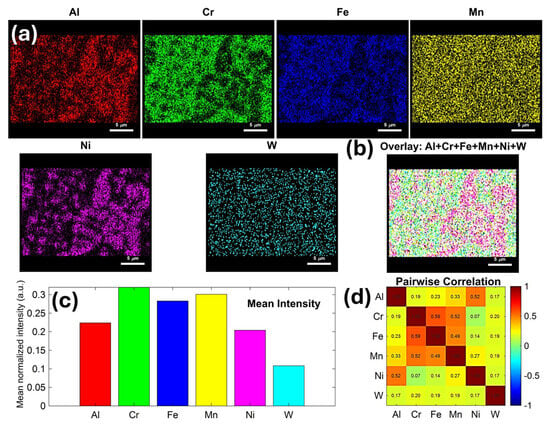
EDS elemental mapping (in Figure 4a) was performed for the 1200 °C heat-treated condition to examine the spatial distribution of the constituent elements. The elemental maps show that the six analysed elements are not distributed identically throughout the microstructure. Cr, Fe and Mn exhibit comparatively broad and relatively uniform spatial distributions, whereas stronger local contrast is observed in the W, Ni and Al maps. Further, the overlay map (Figure 4b) shows the superimposed elemental distributions.
Figure 4.
SEM−EDS elemental distribution and compositional correlation analysis of the AlCrFeMnNiW0.1 alloy: (a) individual elemental maps of Al, Cr, Fe, Mn, Ni, and W; (b) combined elemental overlay; (c) normalized mean intensity of the constituent elements; and (d) pairwise elemental correlation matrix.
The W map particularly shows localized high-intensity regions against a comparatively low background, indicating that W is concentrated in specific microstructural locations rather than being completely homogeneous at the scale of the EDS map. Ni and Al also exhibit noticeable spatial variations, with localized regions of enhanced intensity. In contrast, Cr, Fe and Mn display comparatively continuous distributions across the analysed area.
The elemental maps therefore indicate chemical heterogeneity within the 1200 °C microstructure, particularly for W, Ni and Al. The observed elemental variations are consistent with the contrast variations identified in the corresponding SEM image and suggest that heat treatment at 1200 °C does not produce complete chemical homogenization at the analysed length scale. However, the EDS mapping result alone does not establish the crystallographic identity of the chemically enriched regions. However, the mean intensity plot shows individual intensities that are very close to a uniform distribution across the alloy. Consequently, the observed W-, Ni-, and Al-rich regions are discussed as compositional heterogeneities rather than being assigned to specific intermetallic or secondary phases.
4. Discussion
Discussion of Heat–Treatment Effect on Microstructure and Hardness
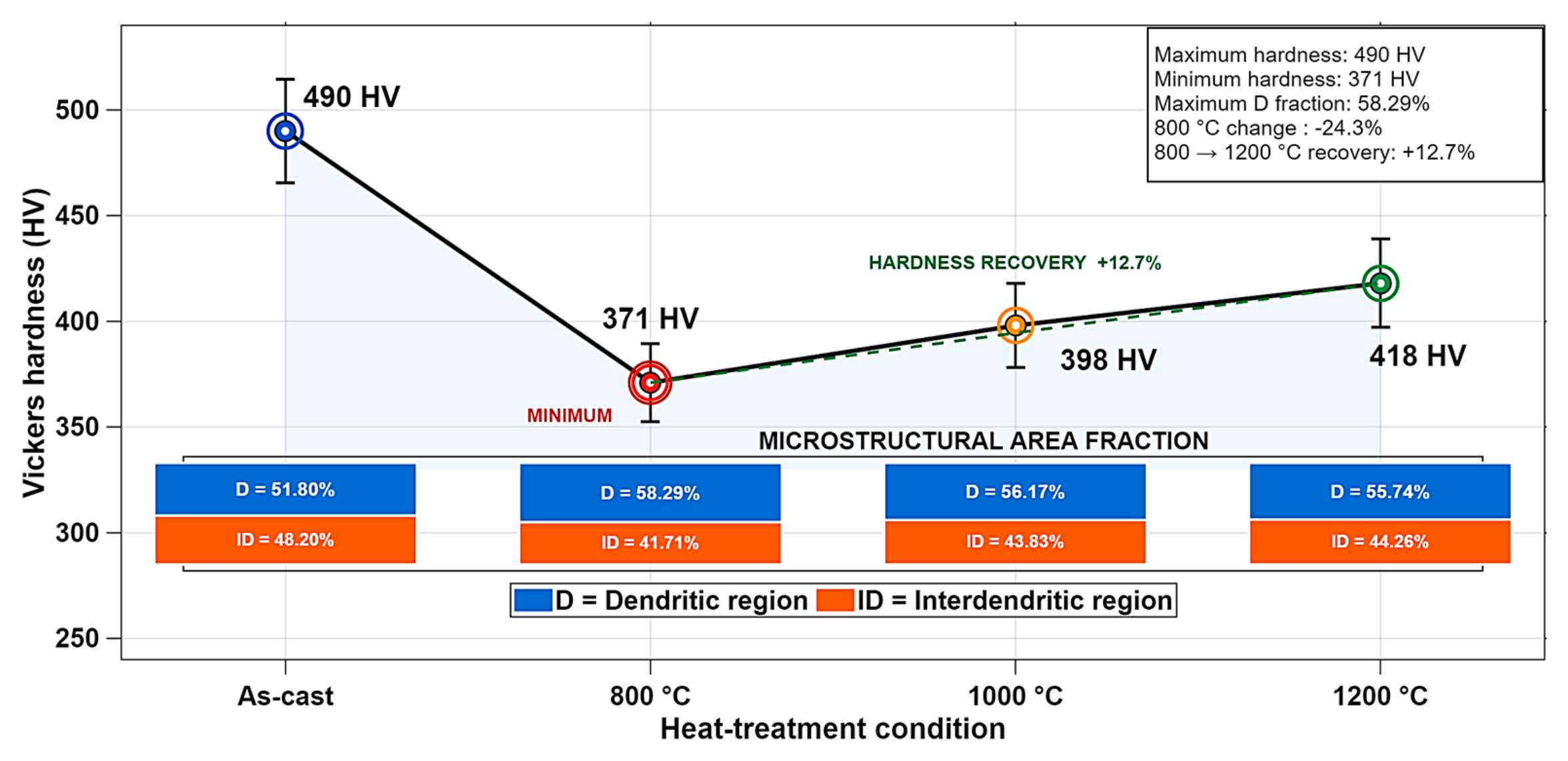
Figure 5 summarizes the evolution of dendritic/interdendritic area fraction and Vickers hardness with heat-treatment temperature. The as-cast alloy exhibits the highest hardness of 490 HV, which decreases sharply to 371 HV at 800 °C (−24.3%). With further heat treatment, hardness partially recovers to 398 HV at 1000 °C and 418 HV at 1200 °C, corresponding to a 12.7% recovery from 800 to 1200 °C, although the hardness remains below the as-cast value. The corresponding dendritic fraction changes from 51.80% (as-cast) to 58.29% (800 °C), and then gradually decreases to 56.17% and 55.74% at 1000 and 1200 °C, respectively. Thus, the hardness variation cannot be explained solely by the measured dendritic/interdendritic fraction.
Figure 5.
Variation in the hardness before and after the heat treatment at different temperatures with respect to the microstructural area fraction of AlCrFeMnNiW0.1 high−entropy alloy.
The pronounced hardness reduction at 800 °C occurs concurrently with substantial XRD peak sharpening, with FWHM decreasing by 53–66% after heat treatment. This behavior is consistent with partial recovery of the as-cast strain/dislocation state, reduction in lattice heterogeneity, and/or compositional homogenization. However, the subsequent hardness increases at 1000–1200 °C despite similarly narrow XRD peaks indicate that additional microstructural changes contribute to strengthening. In particular, the 1200 °C condition, which shows a modestly higher hardness of 418 HV, also exhibits distinct additional XRD reflections and increased local W/Ni compositional heterogeneity. These observations suggest that thermally induced elemental redistribution and phase evolution may contribute to the hardness recovery, potentially through the development or stabilization of a secondary or compositionally enriched constituent. However, the present XRD and SEM-EDS results do not permit direct identification or quantitative determination of such a strengthening constituent. Therefore, the observed hardening is interpreted as the combined effect of phase evolution, local compositional redistribution, and microstructural changes rather than being attributed exclusively to a specific secondary phase. Quantitative phase-fraction analysis and region-specific nanoscale mechanical or microscopic characterization would be required to further establish this mechanism. Inclusively, the results demonstrate a non-monotonic hardness response to heat treatment, involving initial softening followed by partial hardness recovery. Error bars represent ±5% of the corresponding measured hardness.
The quantitative EDS results further demonstrate significant elemental redistribution during heat treatment (Table 1). In the as-cast condition, the bright phase is strongly enriched in Ni (45.4 ± 1.0 wt.%) and Al (18.1 ± 0.6 wt.%), whereas the dark phase contains considerably higher Cr (32.8 ± 0.8 wt.%), Fe (35.8 ± 0.9 wt.%), and W (3.3 ± 1.3 wt.%). After heat treatment at 1200 °C, this compositional partitioning is substantially modified: the bright phase becomes enriched in Cr (30.56 ± 2.19 wt.%) and Fe (25.15 ± 1.82 wt.%), while the dark phase becomes enriched in Al (19.85 ± 1.45 wt.%) and Ni (28.23 ± 2.18 wt.%). These changes confirm significant thermally activated elemental redistribution and modification of the dendritic/interdendritic phase chemistry. Such redistribution, together with recovery and phase evolution, can alter the contributions from solid-solution and phase-related strengthening and therefore provides a quantitative basis for the observed non-monotonic hardness evolution.
Table 1.
Quantitative EDS compositions of the bright and dark phases in the as-cast and heat-treated (1200 °C) AlCrFeMnNiW0.1 high-entropy alloy.
Further, despite this substantial redistribution, some compositional heterogeneity, particularly for W and Ni, remains after treatment at 1200 °C. This residual heterogeneity can be attributed to the original solidification-induced segregation and elemental partitioning between dendritic and interdendritic regions, together with differences in elemental diffusivity and the finite holding time. Thus, although enhanced diffusion at 1200 °C substantially reduces the dendritic/interdendritic chemical contrast, complete homogenization is not achieved. The results therefore indicate substantial but incomplete chemical homogenization, with residual non-equilibrium segregation persisting after the highest-temperature treatment.
The XRD results (Table 2) further support structural recovery. The FWHM decreases from 0.64° in the as-cast state to 0.30°, 0.22°, and 0.24° at 800, 1000, and 1200 °C, respectively, indicating reduced lattice distortion/defect-related broadening. The lattice parameter also decreases from 2.904 Å to 2.842–2.848 Å, reflecting changes in local lattice chemistry. No clear peak splitting or strong additional reflections were observed after heat treatment. These results support the retention of a predominantly BCC-type structure, although the available XRD data cannot unambiguously distinguish BCC-A2 from BCC-B2 ordering or exclude minor overlapping phases. Thus, the present results indicate structural recovery and phase-chemical evolution rather than providing definitive evidence of a single BCC phase throughout the investigated temperature range.
Table 2.
Dominant-reflection XRD summary. Lattice parameter (a) estimated from the dominant (110).
In summary, the addition of W can influence phase stability through its large atomic size, chemical interactions, and electronic contribution. In AlCrFeMnNiW0.1, W increases the atomic-size mismatch and slightly modifies the overall VEC, while its strong chemical interactions with the transition-metal constituents can promote chemical partitioning and stabilize refractory BCC-based constituents. At intermediate temperatures, these effects, together with the Cr/Fe-rich chemistry, can favor σ-phase formation. The CALPHAD results support this interpretation by predicting σ-phase stability over an intermediate-temperature range.
5. Conclusions
A cast AlCrFeMnNiW0.1 HEA was investigated in the as-cast and heat-treated conditions (800, 1000, and 1200 °C) using SEM, XRD, 1200 °C EDS mapping, CALPHAD, and Vickers hardness.
- •
- The cast AlCrFeMnNiW0.1 HEA exhibited a dendritic/interdendritic microstructure, while the as-cast XRD pattern showed a dominant BCC-consistent reflection set.
- •
- Heat treatment at 800–1200 °C reduced the dominant BCC peak FWHM by 53–66% and decreased the lattice parameter from 2.904 to 2.842 Å (≈2.1%), indicating reduced lattice distortion and defect density. The additional reflections, particularly at 1200 °C, are consistent with FCC-related phase formation/stabilization due to thermally induced elemental redistribution.
- •
- The 1200 °C condition showed the most distinct structural response, with new XRD reflections near 31.6°, 41.1°, and 44.2° and a strong increase in the ~82° reflection.
- •
- Hardness decreased from 490 HV (as-cast) to 371 HV at 800 °C, followed by partial recovery to 398 HV at 1000 °C and 418 HV at 1200 °C; at 1200 °C, W and Ni also showed the highest EDS heterogeneity.
- •
- Overall, the heat treatment produced a non-monotonic microstructure–property response, with 1200 °C showing the most significant diffraction, compositional, and hardness changes and therefore warranting further phase and compositional investigation.
Funding
This research was supported by the Basic Science Research Program through the National Research Foundation of Korea (NRF) funded by the Ministry of Education (RS-2021-NR060141).
Data Availability Statement
All data supporting the findings of this study are available within the article. No additional data are required to support the findings of this study.
Acknowledgments
The authors sincerely express their gratitude to Dr. Vinod Kumar, Department of Metallurgical Engineering and Materials Science at the Indian Institute of Technology Indore (IIT Indore), for his valuable guidance and support.
Conflicts of Interest
The author declares no conflicts of interest.
Abbreviations
The following abbreviations are used in this manuscript:
| HEA | High-Entropy Alloy |
| HT | Heat Treatment |
| BCC | Body-Centered Cubic |
| FCC | Face-Centered Cubic |
| XRD | X-Ray Diffraction |
| SEM | Scanning Electron Microscopy |
| EDS | Energy-Dispersive X-Ray Spectroscopy |
| FWHM | Full Width at Half Maximum |
| CALPHAD | Calculation of Phase Diagrams |
| HV | Vickers Hardness |
| VEC | Valence Electron Concentration |
| SFE | Stacking Fault Energy |
| at. % | Atomic Percent |
| °C | Degree Celsius |
References
- Yeh, J.W.; Chen, S.K.; Lin, S.J.; Gan, J.Y.; Chin, T.S.; Shun, T.T.; Tsau, C.H.; Chang, S.Y. Nanostructured High-Entropy Alloys with Multiple Principal Elements: Novel Alloy Design Concepts and Outcomes. Adv. Eng. Mater. 2004, 6, 299–303. [Google Scholar] [CrossRef] [Scilit]
- Cantor, B.; Chang, I.T.H.; Knight, P.; Vincent, A.J.B. Microstructural Development in Equiatomic Multicomponent Alloys. Mater. Sci. Eng. A 2004, 375–377, 213–218. [Google Scholar] [CrossRef] [Scilit]
- Suryanarayana, C.; Al-Joubori, A.A.; Wang, Z. Nanostructured Materials and Nanocomposites by Mechanical Alloying: An Overview. Met. Mater. Int. 2022, 28, 41–53. [Google Scholar] [CrossRef] [Scilit]
- Zhang, Y.; Zuo, T.T.; Tang, Z.; Gao, M.C.; Dahmen, K.A.; Liaw, P.K.; Lu, Z.P. Microstructures and Properties of High-Entropy Alloys. Prog. Mater. Sci. 2014, 61, 1–93. [Google Scholar] [CrossRef] [Scilit]
- Miracle, D.B.; Senkov, O.N. A Critical Review of High Entropy Alloys and Related Concepts. Acta Mater. 2017, 122, 448–511. [Google Scholar] [CrossRef] [Scilit]
- Li, Y.; Martín, D.S.; Wang, J.; Wang, C.; Xu, W. A Review of the Thermal Stability of Metastable Austenite in Steels: Martensite Formation. J. Mater. Sci. Technol. 2021, 91, 200–214. [Google Scholar] [CrossRef] [Scilit]
- Chen, X.; Yan, L.; Zhang, H.; Tong, Y.; Sang, W.; Zhang, H.; Liu, Z.; Zhang, D.; Zhang, M. Thermophysical and Mechanical Performances of (Nd0.2Sm0.2Gd0.2Yb0.2Y0.2)3TaO7 and (Nd0.2Sm0.2Gd0.2Yb0.2Y0.2)3Ta0.5Nb0.5O7 High-Entropy Compounds. J. Alloys Compd. 2025, 1039, 183097. [Google Scholar] [CrossRef] [Scilit]
- Ananiadis, E.; Lentzaris, K.; Georgatis, E.; Mathiou, C.; Poulia, A.; Karantzalis, A.E. AlNiCrFeMn Equiatomic High Entropy Alloy: A Further Insight in Its Microstructural Evolution, Mechanical and Surface Degradation Response. Met. Mater. Int. 2020, 26, 793–811. [Google Scholar] [CrossRef] [Scilit]
- Alshataif, Y.A.; Sivasankaran, S.; Al-Mufadi, F.A.; Alaboodi, A.S.; Ammar, H.R. Manufacturing Methods, Microstructural and Mechanical Properties Evolutions of High-Entropy Alloys: A Review. Met. Mater. Int. 2020, 26, 1099–1133. [Google Scholar] [CrossRef] [Scilit]
- Tsai, M.H.; Yeh, J.W. High-Entropy Alloys: A Critical Review. Mater. Res. Lett. 2014, 2, 107–123. [Google Scholar] [CrossRef] [Scilit]
- Ye, T.; Wang, Y.; Qiu, S.; Guo, P.; Tang, W.; Wang, C.; Li, L. Dynamic Recrystallization Behavior and Microstructural Transformation of As-Forged 7085 Aluminum Alloy during Isothermal Compression. J. Alloys Compd. 2026, 1076, 189476. [Google Scholar] [CrossRef] [Scilit]
- Nie, R.; Tan, J.; Li, Y.; Liu, X.; Qian, C. Tribological Properties of Non-Equiatomic FeCoCrNiMn High Entropy Alloys: Molecular Dynamics Simulations and Machine Learning Predictions. Tribol. Int. 2026, 217, 111656. [Google Scholar] [CrossRef] [Scilit]
- Guo, K.; Zhang, J.; Gu, J.; Bai, J.; Zhang, Y.; Morley, N.; Yang, J.; Ma, Q.; Gao, Q.; Zuo, L. Transformation Induced Plasticity and Hetero-Deformation Induced Strengthening Enable Superior Strength-Ductility Combination of a Novel Ni-Mn-Ti-Fe-Co Eutectic High Entropy Alloy. J. Alloys Compd. 2026, 1070, 188718. [Google Scholar] [CrossRef] [Scilit]
- Park, J.M.; Yang, D.C.; Kim, H.J.; Kim, D.G.; Lee, S.; Kim, H.S.; Sohn, S.S. Ultra-Strong and Strain-Hardenable Ultrafine-Grained Medium-Entropy Alloy via Enhanced Grain-Boundary Strengthening. Mater. Res. Lett. 2021, 9, 315–321. [Google Scholar] [CrossRef] [Scilit]
- Sathiyamoorthi, P.; Basu, J.; Kashyap, S.; Pradeep, K.G.; Kottada, R.S. Thermal Stability and Grain Boundary Strengthening in Ultrafine-Grained CoCrFeNi High Entropy Alloy Composite. Mater. Des. 2017, 134, 426–433. [Google Scholar] [CrossRef] [Scilit]
- Nagarjuna, C.; Lee, H.; Dewangan, S.K.; Rao, K.R.; Pillai, G.M.; Kumar, V.; Ahn, B. Understanding the Role of Si Alloying on the Structural, Mechanical, Wear and High Temperature Oxidation Behavior of CrFeNiTiX (X=Si) High Entropy Alloys. J. Mater. Res. Technol. 2024, 33, 5119–5135. [Google Scholar] [CrossRef] [Scilit]
- Gasan, H.; Ozcan, A. New Eutectic High-Entropy Alloys Based on Co–Cr–Fe–Mo–Ni–Al: Design, Characterization and Mechanical Properties. Met. Mater. Int. 2020, 26, 1152–1167. [Google Scholar] [CrossRef] [Scilit]
- Lin, L.; Xian, X.; Zhong, Z.; Wu, Y.; Liaw, P.K. Microstructure Stability and Its Influence on the Mechanical Properties of CrMnFeCoNiAl0.25 High Entropy Alloy. Met. Mater. Int. 2020, 26, 1192–1199. [Google Scholar] [CrossRef] [Scilit]
- Chen, X.; Gao, D.; Hu, J.X.; Liu, Y.; Tang, C.P. Evolution of Microstructures and Properties in AlxCrFeMn0.8Ni2.1 HEAs. Met. Mater. Int. 2019, 25, 1135–1144. [Google Scholar] [CrossRef] [Scilit]
- Liu, Y.; Shao, L.; Zhang, S.; Hu, L.; Wu, Y.; Liu, C.; Huang, Y.; Le, P.; Li, W.; Xue, N.; et al. Effect of Chemical Composition and Heat Treatment on the Microstructure and Performance of Ag-Based Alloy Wires. Mater. Des. 2025, 258, 114728. [Google Scholar] [CrossRef] [Scilit]
- Wang, Z.; Ning, Y.; Xie, B.; Fan, X.; Zhan, M.; Fu, M. Coalescence-Ripening Mechanism of γ′−Ni 3 (Al, Ti) During Long-Term/High-Temperature Operation of Ni-Based Superalloy Discs. Rare Met. 2026, 45, e70130. [Google Scholar] [CrossRef] [Scilit]
- Dewangan, S.K.; Kumar, V. Heat Treatment and Processing Route Consequences on the Microstructure and Hardness Behavior of Tungsten-Containing High-Entropy Alloys. J. Alloys Compd. 2022, 923, 166167. [Google Scholar] [CrossRef] [Scilit]
- Dong, Y.; Lu, Y. Effects of Tungsten Addition on the Microstructure and Mechanical Properties of Near-Eutectic AlCoCrFeNi2 High-Entropy Alloy. J. Mater. Eng. Perform. 2018, 27, 109–115. [Google Scholar] [CrossRef] [Scilit]
- Chen, S.; Qi, C.; Liu, J.; Zhang, J.; Wu, Y. Recent Advances in W-Containing Refractory High-Entropy Alloys—An Overview. Entropy 2022, 24, 1553. [Google Scholar] [CrossRef] [Scilit]
- Luo, G.; Chen, X.; Liu, Y.; Ma, Y.; Liu, W.; Liang, C. Modulating Strength and Ductility Trade-off through Grain Boundary Carbon Segregation to Carbide Precipitation in Refractory High-Entropy Alloys. Int. J. Plast. 2026, 202, 104704. [Google Scholar] [CrossRef] [Scilit]
- Sheng, C.; Yang, H.; Ma, P.; Li, H.; Prashanth, K.G.; Gargarella, P.; Wang, G.; Jia, Y. Synergistic Strengthening and Toughening of a Harmonic-Structured (FeCoNi)86Al7Ti7 High-Entropy Alloy via Nanoscale Precipitation. Mater. Sci. Eng. A 2026, 971, 150463. [Google Scholar] [CrossRef] [Scilit]
- Guo, K.-L.; Zhang, Y.; Gu, J.-L.; Bai, J.; Liu, D.; Morley, N.; Ma, Q.-S.; Gao, Q.-Z.; Zuo, L. Ultralarge Elastic Strain and Near-Constant Stress Temperature Dependence of Ni–Mn–Ti–Fe–Co Eutectic High-Entropy Alloy. Trans. Nonferrous Met. Soc. China 2026, 36, 1597–1609. [Google Scholar] [CrossRef] [Scilit]
- Dewangan, S.K.; Kumar, D.; Samal, S.; Kumar, V. Microstructure and Mechanical Properties of Nanocrystalline AlCrFeMnNiWx (x = 0, 0.05, 0.1, 0.5) High-Entropy Alloys Prepared by Powder Metallurgy Route. J. Mater. Eng. Perform. 2021, 30, 4421–4431. [Google Scholar] [CrossRef] [Scilit]
- Gao, R.; Ye, X.-X.; Yan, S.; Lu, Y.; Jiang, L.; Li, Z.; Zhou, X. Effects of Tungsten Content on the High-Temperature Oxidation Behavior of Ni-XW-6Cr Alloys. Corros. Sci. 2019, 149, 87–99. [Google Scholar] [CrossRef] [Scilit]
- Wang, X.; Huang, H.; Shi, J.; Xu, H.-Y.; Meng, D.-Q. Recent Progress of Tungsten-Based High-Entropy Alloys in Nuclear Fusion. Tungsten 2021, 3, 143–160. [Google Scholar] [CrossRef] [Scilit]
- Ryu, H.J. Tungsten-Based High Entropy Alloys and Composites for Plasma Facing Materials Research Areas; Korea Advanced Institute of Science and Technology (KAIST): Seoul, Republic of Korea, 2015; pp. 8–11. [Google Scholar]
- Bose, A.; Sadangi, R.; German, R.M. A Review on Alloying in Tungsten Heavy Alloys. Suppl. Proc. 2012, 1, 453–465. [Google Scholar] [CrossRef] [Scilit]
- Fu, T.; Cui, K.; Zhang, Y.; Wang, J.; Shen, F.; Yu, L.; Qie, J.; Zhang, X. Oxidation Protection of Tungsten Alloys for Nuclear Fusion Applications: A Comprehensive Review. J. Alloys Compd. 2021, 884, 161057. [Google Scholar] [CrossRef] [Scilit]
- Dewangan, S.K.; Kumar, V. Application of Artificial Neural Network for Prediction of High Temperature Oxidation Behavior of AlCrFeMnNiWx (X = 0, 0.05, 0.1, 0.5) High Entropy Alloys. Int. J. Refract. Met. Hard Mater. 2022, 103, 105777. [Google Scholar] [CrossRef] [Scilit]
- Dewangan, S.K.; Samal, S.; Kumar, V. Microstructure Exploration and an Artificial Neural Network Approach for Hardness Prediction in AlCrFeMnNiWx High-Entropy Alloys. J. Alloys Compd. 2020, 823, 153766. [Google Scholar] [CrossRef] [Scilit]
- Rogachev, A.S. Structure, Stability, and Properties of High-Entropy Alloys. Phys. Met. Metallogr. 2020, 121, 733–764. [Google Scholar] [CrossRef] [Scilit]
- Karati, A.; Guruvidyathri, K.; Hariharan, V.S.; Murty, B.S. Scripta Materialia Thermal Stability of AlCoFeMnNi High-Entropy Alloy. Scr. Mater. 2019, 162, 465–467. [Google Scholar] [CrossRef] [Scilit]
- Dewangan, S.K.; Mangish, A.; Kumar, S.; Sharma, A.; Ahn, B.; Kumar, V. A Review on High-Temperature Applicability: A Milestone for High Entropy Alloys. Eng. Sci. Technol. Int. J. 2022, 35, 101211. [Google Scholar] [CrossRef] [Scilit]
- Nagarjuna, C.; Dewangan, S.K.; Lee, H.; Ahn, B. Evolution of Phase Stability and Structural Properties in CrFeNiTiV High-Entropy Alloy under High-Temperature Heat Treatment Conditions. Mater. Sci. Eng. A 2023, 886, 145680. [Google Scholar] [CrossRef] [Scilit]
- Chen, B.; Wang, S.; Li, W.; Zheng, H.; Lu, Y.; Qi, Z.; Wang, Q.; Zhang, S.; Yao, J.; Li, Y. Investigation on the Atomization Mechanism of Alloy Powder by Dual-Gas Nozzle and the Powder Defects Formation. Powder Technol. 2026, 469, 121768. [Google Scholar] [CrossRef] [Scilit]
- Pickering, E.J.; Jones, N.G. High-Entropy Alloys: A Critical Assessment of Their Founding Principles and Future Prospects. Int. Mater. Rev. 2016, 61, 183–202. [Google Scholar] [CrossRef] [Scilit]
- Vaidya, M.; Muralikrishna, G.M.; Murty, B.S. High-Entropy Alloys by Mechanical Alloying: A Review. J. Mater. Res. 2019, 34, 664–686. [Google Scholar] [CrossRef] [Scilit]
- Munitz, A.; Meshi, L.; Kaufman, M.J. Heat Treatments’ Effects on the Microstructure and Mechanical Properties of an Equiatomic Al-Cr-Fe-Mn-Ni High Entropy Alloy. Mater. Sci. Eng. A 2017, 689, 384–394. [Google Scholar] [CrossRef] [Scilit]
- Wang, K.; Yang, W.; Lei, P.; Hou, H.; Zhao, Y. Modulating the Microstructure of β′ Phase in Mg-Nd Alloys: A Phase-Field Study. J. Magnes. Alloys 2026, 21, 102163. [Google Scholar] [CrossRef] [Scilit]

Disclaimer/Publisher’s Note: The statements, opinions and data contained in all publications are solely those of the individual author(s) and contributor(s) and not of MDPI and/or the editor(s). MDPI and/or the editor(s) disclaim responsibility for any injury to people or property resulting from any ideas, methods, instructions or products referred to in the content. |
© 2026 by the author. Licensee MDPI, Basel, Switzerland. This article is an open access article distributed under the terms and conditions of the Creative Commons Attribution (CC BY) license.