


Abstract
For the present study, a triple-distribution-function lattice Boltzmann model was developed to simulate immiscible multiphase thermal flows with coupled interfacial dynamics and heat transfer in droplet-laden Rayleigh–Bénard convection. Within the single-relaxation-time lattice Boltzmann framework, three sets of mesoscopic lattice Boltzmann equations for density, order parameter, and temperature distribution functions were systematically coupled to recover the macroscopic governing equations including the Navier–Stokes equations, the Cahn–Hilliard equation, and the energy equation. The macroscopic equations could be accurately recovered through Chapman–Enskog expansion analysis. Compared with existing multiphase lattice Boltzmann approaches, the present scheme suppresses mass dissipation at phase interfaces and enables concurrent computation of flow field evolution, complex interface deformation, and thermal transport for immiscible multiphase thermal systems with high-fidelity. Owing to these favorable numerical properties, we first validated the model against the benchmark of single-phase Rayleigh–Bénard convection, and the predicted temperature contours and volume-averaged Nusselt numbers (Nuave) showed good consistency with the theoretical and published numerical benchmarks. Furthermore, systematic numerical investigations were performed for droplet-laden Rayleigh–Bénard convection to reveal the effects of the droplet diameter and the thermal conductivity ratio. The present numerical simulations demonstrate that larger droplets settling on the hot bottom wall produce a blocking effect that suppresses hot plume ejection and monotonically decreases Nuave. In addition, the thermal conductivity ratio induces non-monotonic variation of the heat transfer performance. The relatively smaller ratios enhance heat transfer as the droplet acts as a local thermal fin, while a critical threshold around 30–40 triggers local instability and a sharp drop in Nuave. On further increasing the ratio, reorganization is driven of the small vortices back into large convection cells for the numerical cases of D = 0.3. These results confirm the accuracy and robustness of the triple-distribution-function lattice Boltzmann model for immiscible two-phase thermal convection and offer theoretical guidance for engineering applications such as thermal management and phase-change heat transfer.
1. Introduction
High-power integrated circuits are essential for next-generation electronic systems, such as microprocessors or communication modules in supercomputers, which require miniaturization, high processing speed, and robustness [1]. As integrated circuits have rapidly developed toward high-density integration and better energy efficiency, the heat flux generated by these devices has increased exponentially. The management of such extreme heat flux density now poses a critical bottleneck in maintaining the reliability and performance of these technologies. The microchannel-based heat exchanger shows great potential for efficiently managing extreme heat flux densities in high-power integrated circuits, thereby addressing the critical thermal management challenges posed by their miniaturization and rising power density [1,2,3,4,5,6]. There are three main types of microchannel-based heat exchangers, categorized by their working fluid properties as single-phase, phase change (boiling), and immiscible multiphase flows. Compared with the boiling thermal flow, the immiscible multiphase thermal flow introduces less gas blockage or etching effect inside microchannels. The Rayleigh–Bénard convection cell serves as the fundamental unit of thermal flow in confined channels and cavities, and thus the investigation of droplet-laden Rayleigh–Bénard convection provides essential physical understanding for the design and optimization of practical immiscible cooling systems. Additionally, single-phase and boiling microchannel-based heat exchangers were extensively investigated in previous research, but the multiphase thermal flows and their underlying heat transfer mechanisms are not yet fully understood [3,7,8,9,10].
While numerical simulation is indispensable for unraveling the mechanisms of multiphase thermal flows, developing a stable and efficient numerical method remains highly challenging. Most existing approaches either struggle to capture fluid interfaces with high fidelity during heat transfer or fail to resolve heat transfer in multiphase systems, leaving a critical gap in predictive modeling [9,11]. Over the past decades, numerous mathematical models and numerical schemes have been developed to accurately describe the complex behaviors of multiphase flows, which can be categorized into sharp interface methods [12,13,14,15,16] and diffuse interface methods [17,18,19,20]. The sharp interface branch includes the level-set method [12,13], the immersed boundary method [14], and the volume of fluid method [15,16], which can obtain a distinct interface. Conversely, the diffuse interface branch is based on the phase-field theory [17,18,19,20], which treats the interfaces as diffuse regions by the Cahn–Hilliard equation [21] or Allen–Cahn equation [22]. These mathematical models and numerical schemes, often coupled with advanced solvers for the Navier–Stokes or lattice Boltzmann equations, have been successfully applied to model multiphase flows [17,23].
Recently, increasing interest has focused on coupling the diffuse interface method with the lattice Boltzmann method for efficient prediction of multiphase flows. Historically, discontinuities in density and pressure at the interface of two-phase flows have posed significant challenges to the numerical stability of the lattice Boltzmann method. These challenges have been partially addressed by recent advancements such as multiphase lattice Boltzmann models [24,25,26,27,28], lattice Boltzmann flux solvers [29,30,31,32], and fractional step lattice Boltzmann methods [33,34,35,36,37]. Although the lattice Boltzmann flux solver and fractional step lattice Boltzmann method incorporate advantages from both the lattice Boltzmann method and mature traditional methods, their computational efficiency and mesoscopic kinetic performances are compromised. He et al. [38] proposed a double-distribution-function-based lattice Boltzmann model to simulate the complex interface behaviors of Rayleigh–Taylor instability by mean-field theory (free energy method). Then, Zheng et al. [24] developed a Galilean-invariance lattice Boltzmann model and solved the Cahn–Hilliard equation using a lattice Boltzmann equation with an order parameter distribution function. However, Huang et al. [26] identified that this phase-field model exhibited a mass dissipation problem, originating from the diffusion term in the Cahn–Hilliard equation. Niu et al. [27] overcame this drawback by introducing a mass-correction term into the interface region. This mass-conserving lattice Boltzmann model has been widely used in multi-physical field coupling multiphase flows [39,40].
Although interface interactions and multiphase flow properties have been successfully modelled by various lattice Boltzmann models, the heat transfer phenomenon and droplet motion during convection remain challenging and daunting obstacles in the numerical simulation of immiscible multiphase thermal flows [41]. Chen et al. [42] proposed an isotherm-evolution-based phase-change interface tracking algorithm, and verified the applicability to three-dimensional simulations. However, this numerical method cannot solve the immiscible multiphase flows and capture the larger interface deformation. Thomas et al. [43] investigated the effect of dimensionless parameters on the cloudy Rayleigh–Bénard convection, but overlooked the interfacial interactions of the cloudy droplet. Then, Pelusi et al. [44] analyzed the heat transfer fluctuations in the Rayleigh–Bénard convection of droplet emulsions, where droplets were treated as clusters of solid particles. The above studies ignore interfacial deformations and interactions. Therefore, only a few numerical models have been developed thus far, and these models cannot fully capture immiscible multiphase thermal flows while resolving both heat transfer and interfacial dynamics. To bridge this gap, the main purpose of this study was to develop a triple-distribution-function-based lattice Boltzmann model that couples interfacial dynamics with heat transfer to characterize complex droplet dynamics in multiphase Rayleigh–Bénard convection. The model was developed within the single-relaxation-time lattice Boltzmann framework, where three mesoscopic lattice Boltzmann equations based on density, order parameter, and temperature distribution functions are systematically coupled to solve the Navier–Stokes equations for fluid flow, the Cahn–Hilliard equation for interfacial dynamics, and the energy equation for heat transfer, respectively. To deal with the wettability of the solid surface, a geometric surface energy wetting boundary condition [45,46] was imposed in the present simulations.
The remainder of this work is organized as follows. In Section 2, the macroscopic governing equations for immiscible multiphase thermal flows and the corresponding formulation of the triple-distribution-function lattice Boltzmann model are presented. The wetting boundary condition for solid–fluid interfaces is also specified. In Section 3, a series of numerical tests are carried out. The capability and accuracy of the present model are first validated against the benchmark case of single-phase Rayleigh–Bénard convection. Then, the effects of interfacial interactions by varying droplet diameter are investigated, and the effects of thermal conductivity ratios between the dispersed droplet and the continuous phase on the flow patterns and the heat transfer performance of droplet-laden Rayleigh–Bénard convection are further explored. Finally, conclusions are drawn in Section 4.
2. Methodology
2.1. Macroscopic Governing Equations
The macroscopic governing equations for the immiscible multiphase thermal flow include the incompressible Navier–Stokes equations (mass conservation, momentum conservation, and energy conservation equations) and the Cahn–Hilliard equation with a mass-correction term Qm, which read as follows:
where ρ, u, p, and μ denote the fluid density, velocity, pressure, and dynamic viscosity, respectively. T is the temperature, and the thermal diffusivity χ is defined by the thermal conductivity λ and the specific heat cp as χ = λ/ρcp. The nabla operator ∇ denotes gradient, divergence, and curl operations in vector calculus. C and M are the order parameter and the mobility coefficient of the Cahn–Hilliard equation, respectively. In this work, each fluid phase is intrinsically incompressible, the physical variables of interface are given by order parameter, and thus the divergence-free assumption ∇·u = 0 is satisfied within each individual phase. The external force terms consist of the gravitational force Fg, the buoyancy force (Boussinesq approximation) Fb, and the surface tension force Fs and are calculated by
where g is the gravity, β is the coefficient of thermal expansion. In addition, the gravitational term accounts for the density difference between the two phases, while the Boussinesq buoyancy term describes the thermal expansion effect of the continuous phase with a reference density. The two body-force contributions are physically independent and not double-counted. The reference density and thermal expansion coefficient associated with the Boussinesq term are also explicitly specified. The chemical potential μC is given as
where A and κ are two constant parameters, which can be defined by the interface thickness W and the surface tension coefficient σ as
Fg = ρg,
Fb = ρgβ(T − T0),
Fs = −C∇μC,
μC = 2AC(C − 1)(2C − 1) − κ∇2C,
The mass-correction term Qm in Equation (4) only corrects the mass on the interface and vanishes as zero in the flow field. The detailed derivation can be referred to in our past works [19,27,28], the mass-correction term Qm in the present simulation is calculated as
where δV, , and δρ represent the volume occupied by the interface layer, the mass loss rate from the lighter density phase, and the density difference between two fluids. The relative mass error is limited to within 1% for all numerical cases in the present work, and the validation for this mass correction term can be found in our previous works [19,27,28].
2.2. Triple-Distribution-Function-Based Lattice Boltzmann Model
In the triple distribution function strategy-based multiphase LB framework, the flow field, the interface field, and the temperature field are governed by the evolution of the distribution functions of density, order parameter, and temperature, respectively. The triple-distribution-function-based lattice Boltzmann equations for solving Equations (1)–(4), i.e., the Navier–Stokes equations for fluid flow, the Cahn–Hilliard equation for interfacial dynamics, and the energy equation for heat transfer, are given as
with
where fα(r,t), gα(r,t), and hα(r,t) are the triple distribution functions of density, order parameter, and temperature with the lattice discrete velocities eα and the weighting coefficient ωα. The corresponding equilibrium distribution functions , , and are given as Equations (18)–(20), respectively. Sα and Gα represent the external force term of Equation (12) and the mass-correction term of Equation (13), respectively. The single-relaxation parameters in the lattice Boltzmann equations for flow, interface, and temperature field are given as
where cs is the speed of sound, and Qd is the diffusion parameter to adjust the relaxation parameter; δt is the time interval. The single-relaxation parameters for the density, order parameter, and temperature distribution functions recover the continuity of density and heat flux at the two-phase interface and satisfy thermal energy conservation across the diffuse interface. The D2Q9 model [47] is employed in this work; the lattice discrete velocities eα and the weighting coefficient ωα are written as
where the lattice speed c = δr/δt is equal to 1.0 in the present simulation, and δr is the lattice spacing. The lattice Boltzmann equations—Equations (12)–(14)—can be recovered to the macroscopic governing equations—Equations (1)–(4)—using the Chapman–Enskog expansion analysis; the detailed derivation can be referred to in our previous works [27,28]. Additionally, to deal with the wettability of the solid surface, the wetting boundary condition [45,46] is imposed in the present simulation. The relation of the contact angle θ and the order parameter C is written as
where n is the unit outward normal defined at the solid surface. The discrete formula of the order parameter on the solid surface is given by
where Ci,0, Ci,1, and Ci,2 represent the order parameter on the boundary nodes in the computational domain, the physical wall boundary nodes for solid surface, and the fluid nodes, respectively. The subscript i denotes the node index along the tangential direction of the wall, and i − 1 and i + 1 correspond to its left and right neighboring nodes.
The macroscopic physical variables can be calculated by the various moments of distribution functions of flow, phase (order parameter), and temperature fields, which are written as
2.3. Computational Procedure
To clarify the implementation of the proposed triple-distribution-function lattice Boltzmann method, the computational procedure for droplet-laden thermal convection simulation is outlined as follows:
- (1)
- Initialize all physical parameters of the flow, phase (order parameter), and temperature fields, and set the initial conditions and boundary constraints of the computational domain.
- (2)
- Determine the streaming distance and calculate the relaxation parameters for each distribution function according to Equations (21)–(23).
- (3)
- Calculate the external force terms, i.e., the gravitational force Fg, the buoyancy force Fb, and the surface tension force Fs using Equations (5), (6), and (7), respectively.
- (4)
- Obtain the flow, phase (order parameter), and temperature fields through the evolution of Equations (12), (13), and (14), respectively.
- (5)
- Implement the appropriate boundary conditions for the intermediate physical properties.
- (6)
- Update the macroscopic physical variables by using the various moments of distribution functions shown in Equations (28)–(31).
- (7)
- Implement the same boundary conditions as those in step (5).
- (8)
- Repeat steps (2)–(7) until the maximum iteration step is reached or the convergence criterion is satisfied.
3. Results and Discussion
3.1. Numerical Validation
In the present work, the double-distribution-function-based lattice Boltzmann model is extended to a triple-distribution-function-based lattice Boltzmann model for the thermal multiphase flows. Typical numerical cases of multiphase flows, such as the Laplace law, a single bubble rising, a stationary droplet on a wetting solid wall, droplet merging, droplet impact on a liquid membrane, and the mass conservation law were verified in our previous studies [27,28]. In addition, all the numerical simulations in the present work satisfy the mesh independence criteria. Here, a typical single-phase Rayleigh–Bénard convection case is simulated to evaluate the accuracy of the present model in thermal flow simulations.
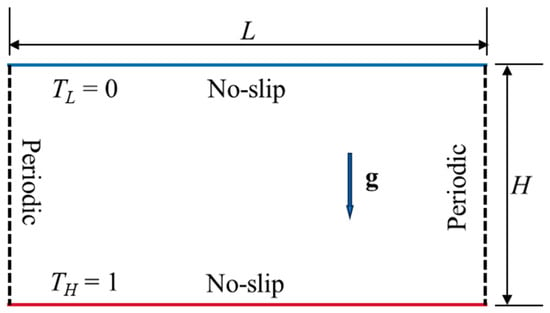
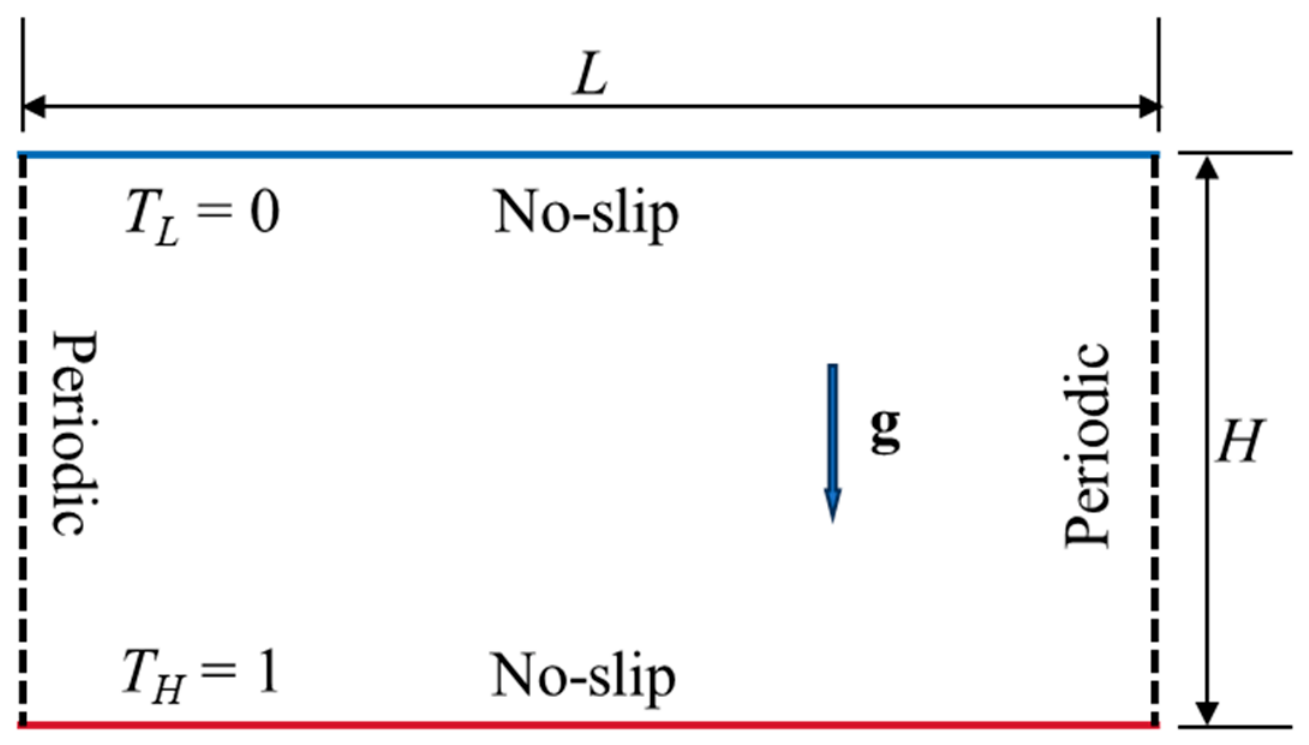
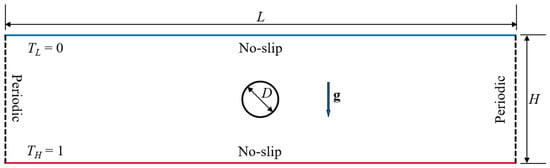
As depicted in Figure 1, the Newtonian fluid is confined between two horizontal solid walls, with high temperature TH and low temperature TL maintained at the bottom and top solid walls, respectively. No-slip boundary conditions are imposed on both the top and bottom solid walls, while periodic boundary conditions are applied to the left and right lateral boundaries of the computational domain. Under such a thermal gradient, the fluid undergoes buoyancy driven convection and is characterized by the dimensionless Prandtl number and Rayleigh number , where ν is the kinematic viscosity and H is the channel height. Under the Boussinesq assumption, when the Ra exceeds the critical value Rac = 1707.76, the flow becomes unstable, and the heat transfer mechanism shifts from heat conduction to convective heat transfer [48,49]. The characteristic velocity , the viscosity , and the initial perturbation along the horizontal centerline is defined as ρ(x,H/2) = ρ0 + 0.001ρ0cos(2πx/L), where the initial density ρ0 = 1.0. In the present work, the density field and temperature field are coupled through the buoyancy term. Imposing a small-amplitude density perturbation is equivalent to introducing an initial buoyancy imbalance, which effectively triggers the development of thermal convection. All cases eventually reach a statistically steady state, and the final steady results are independent of the initial perturbation form. In the present simulation, the physical domain is L × H = 2 × 1, and the physical parameters are set as Pr = 0.71, TH = 1, TL = 0, and uc = 0.01.
Figure 1.
The sketch of the single-phase Rayleigh–Bénard convection.
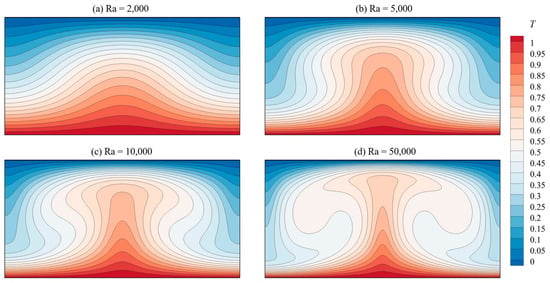
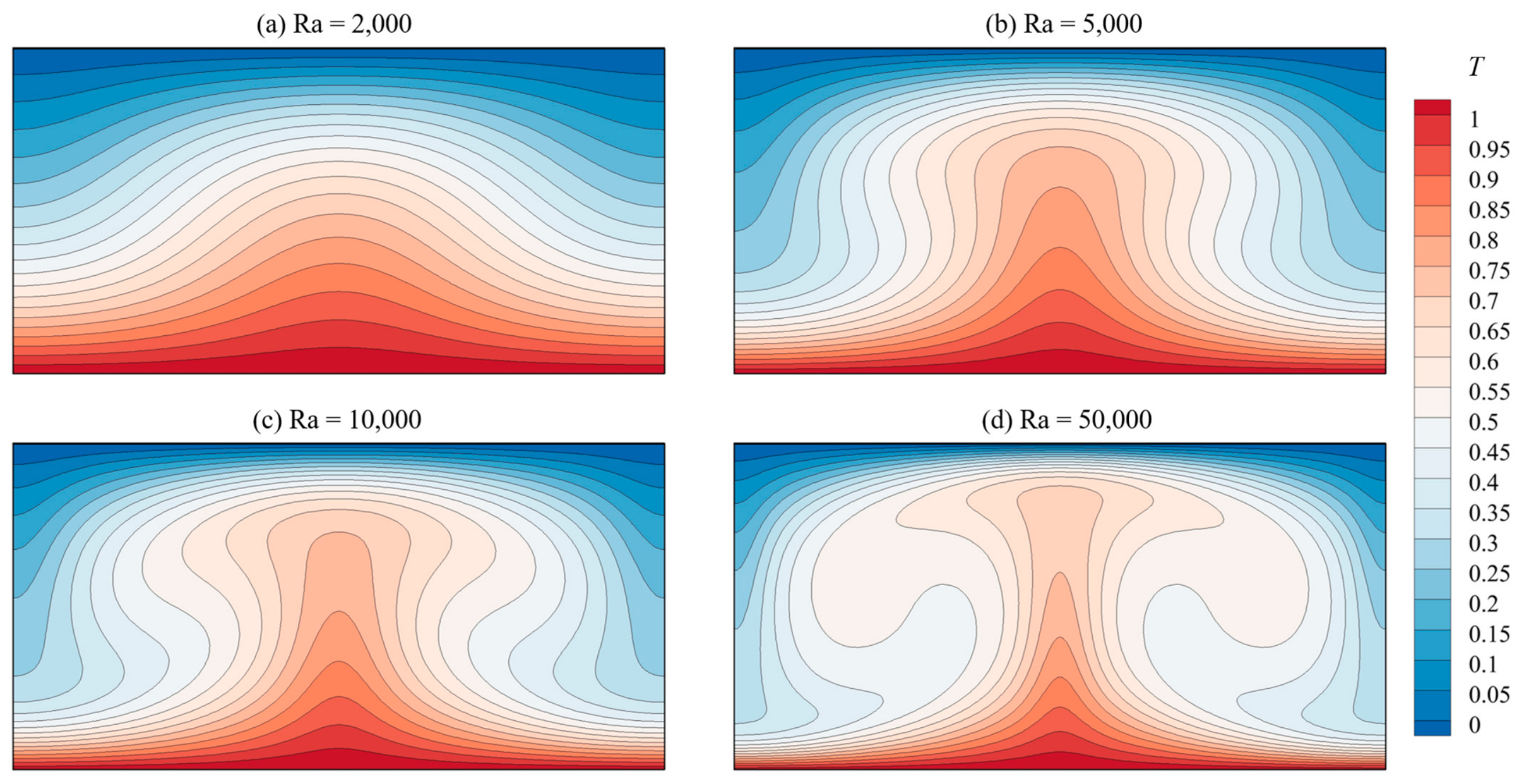
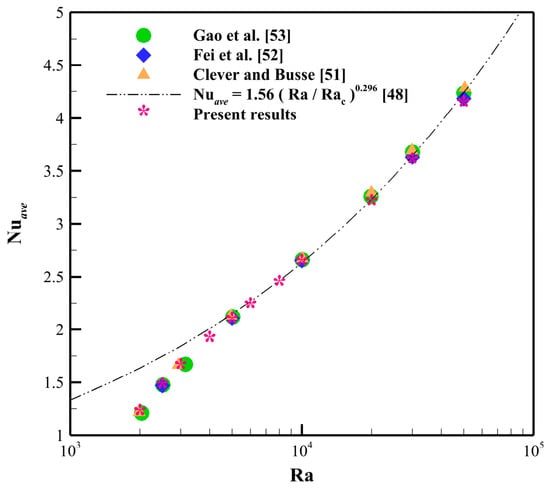
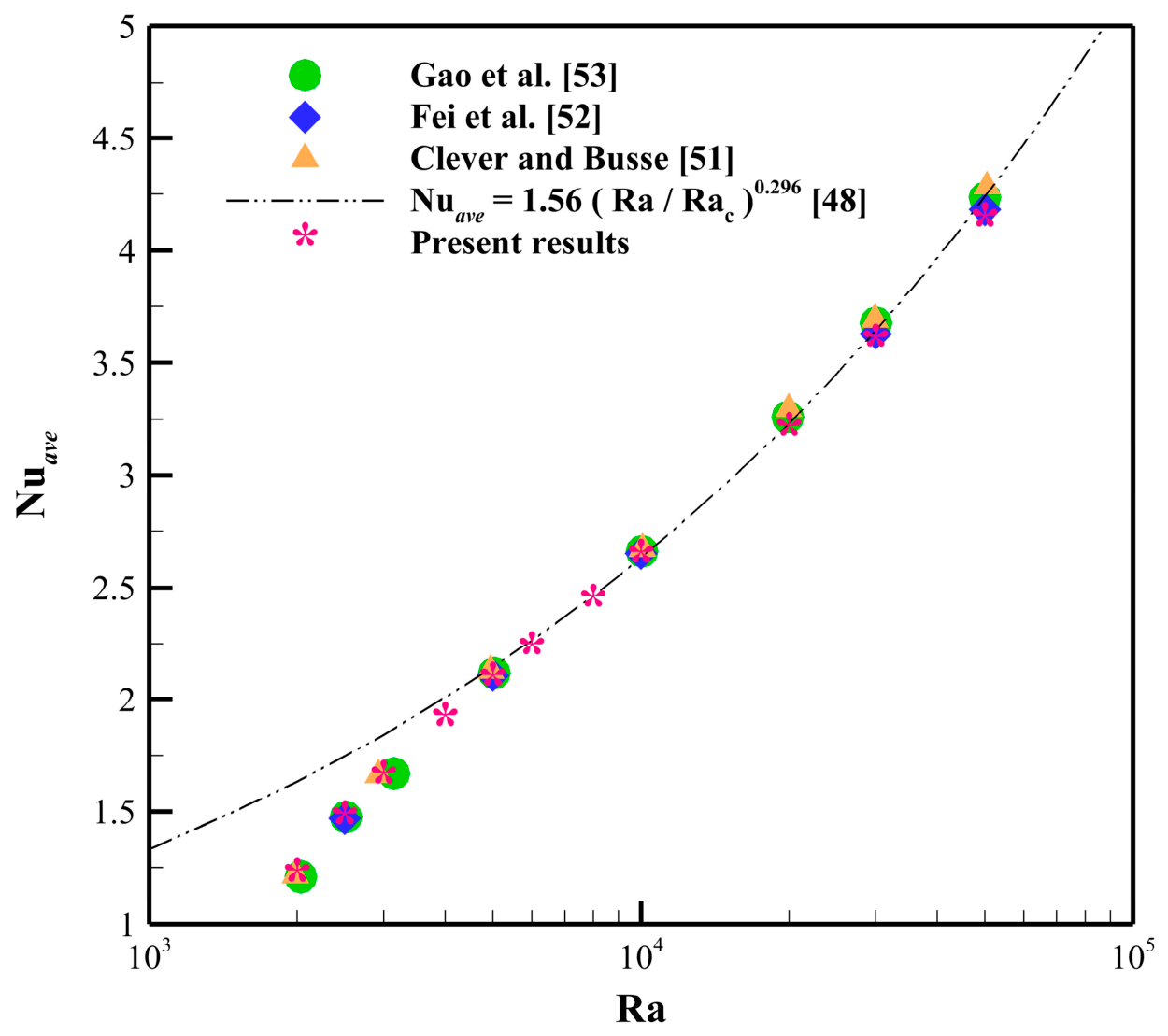
To balance computational efficiency and grid independent requirement, the grid resolution is set to 200 × 100 when Ra ≤ 10,000, and 400 × 200 when 10,000 < Ra ≤ 50,000. These resolution settings are consistent with those reported in previous studies [48,49,50]. The isotherms of single-phase Rayleigh–Bénard convection at different Ra are presented in Figure 2. As Ra increases, the convection activity intensifies, and the temperature gradients near the bottom and top solid walls become more pronounced. The present results agree well with the convection phenomenon reported in prior studies [48,49,50]. Additionally, the volume-averaged Nusselt number is used to quantitatively describe the heat transfer rate, where ⟨⋅⟩ denotes the average over the entire fluid domain, uy is the velocity component in the y-direction (aligned with the gravitational acceleration g). Figure 3 compares Nuave calculated by the present numerical model with the theoretical predictions [48] and the published numerical results [51,52,53]. Clearly, Nuave (heat transfer rate) increases monotonically with Ra, and the present results show excellent agreement with both the theoretical and numerical benchmarks.
Figure 2.
The isotherms of the single-phase Rayleigh–Bénard convection at different Ra of 2000, 5000, 10,000, and 50,000.
Figure 3.
The relation between volume-averaged Nusselt number and Rayleigh number of single-phase Rayleigh–Bénard convection [48,51,52,53].
To quantitatively validate the accuracy of the present model, the predicted average Nusselt numbers were compared with classical benchmark results, as shown in Table 1. Good agreement was achieved across all tested Rayleigh numbers. The maximum relative deviation is approximately 2.42% at Ra = 50,000, while deviations for most other cases remain within 2%. This quantitative comparison confirms the reliability and numerical precision of the present lattice Boltzmann model for thermal convection simulations.
Table 1.
Comparison of Nuave with benchmark results.
3.2. The Effect of Interface Interaction
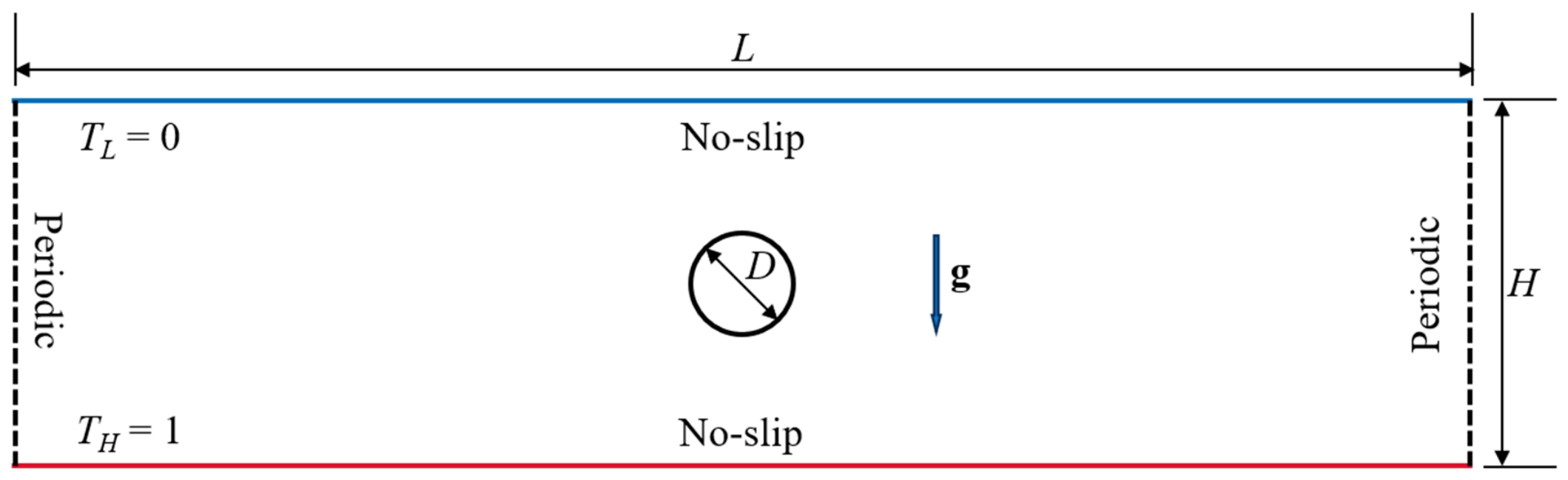
To investigate the effect of interface interactions on the Rayleigh–Bénard convection process, a single immiscible droplet with a different diameter D is set at the center of the physical domain, as shown in Figure 4. The density ratio and viscosity ratio between the oil droplet and the surrounding liquid are 10 and 1.25, respectively, while the specific heat capacities are set equal for simplicity. To eliminate the thermal conductivity contrast between the two fluids and thereby isolate the contributions of droplet motion and interfacial effects, the thermal conductivity ratio is set to 1.0. Note that while the two fluids share the same thermal conductivity, their density-dependent thermal diffusivities χ differ, giving rise to different relaxation times in the lattice Boltzmann equation for the temperature field across the two-phase region. In this work, the relaxation time is interpolated through the order parameter across the interface, i.e., τh = (1 − C)τh−liquid + Cτh−droplet, thereby preventing a sharp jump at the boundary. Key dimensionless numbers in this numerical case are the Froude number , the Reynolds number , the Eotvos number , and the Rayleigh number . The normalized time is defined as , where t denotes the iteration time. In this numerical simulation, the oil droplet is simulated under the conditions of Fr = 1, Re = 35, Eo = 10, Ra = 5000 with the characteristic velocity of U = 0.01. The mobility coefficient and the interface thickness are 15 and 3 lattice units. The physical domain is L × H = 4 × 1, and the computational domain is discretized into 800 × 200 lattice units, which is sufficiently fine according to the grid independence test. The no-slip boundary condition and wetting boundary condition with a contact angle of 120° are implemented at the top and bottom boundaries, while the periodic boundary condition is imposed at the left and right boundaries.
Figure 4.
The sketch of droplet-laden Rayleigh–Bénard convection.
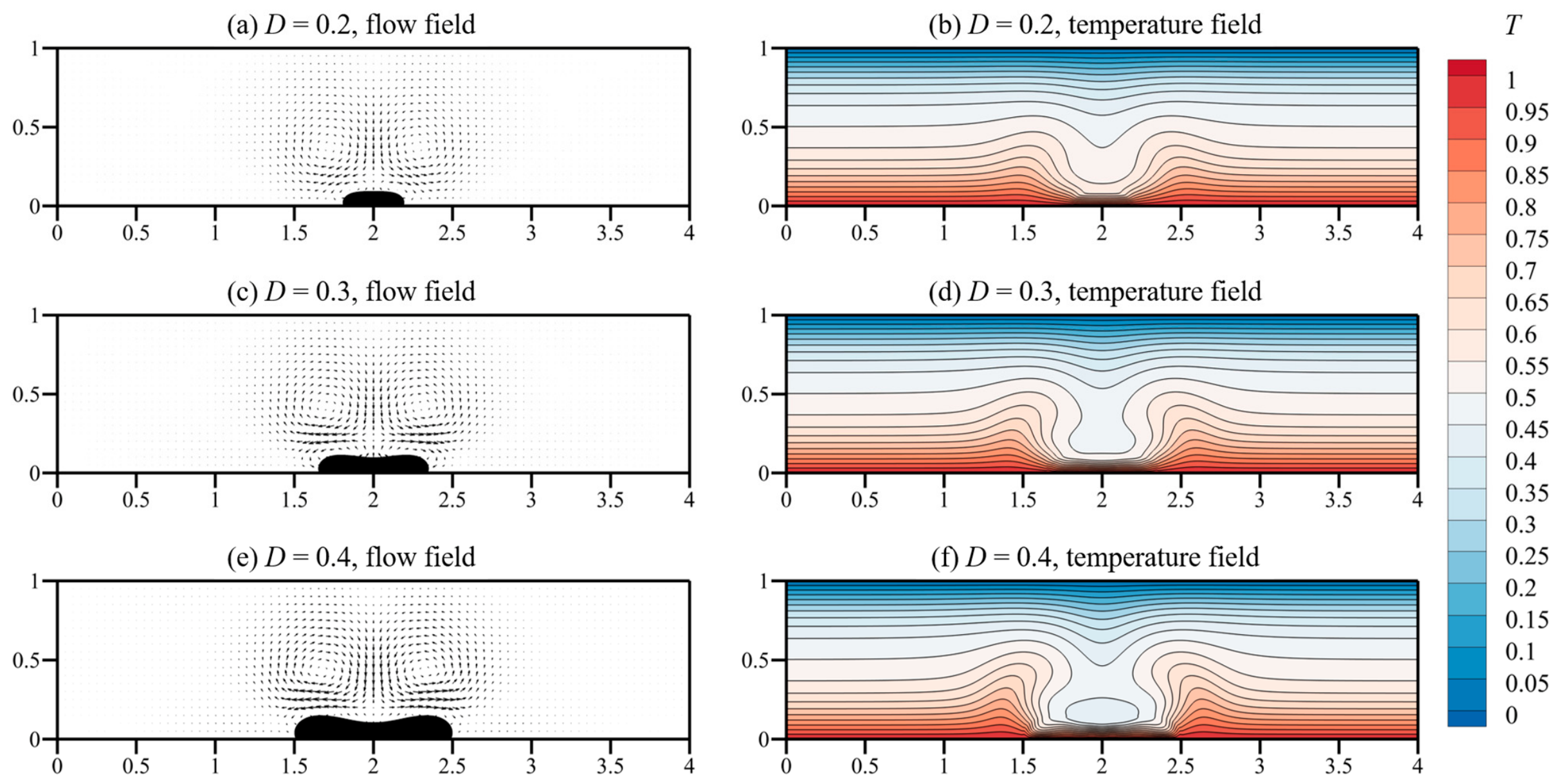
The instantaneous interface deformation, velocity fields, and temperature contours of droplet-laden Rayleigh–Bénard convection at t* = 1.5 under three droplet diameters are illustrated in Figure 5. As the droplet falls from the center of the physical domain, the immersed droplet disturbs the bulk flow and squeezes the thermal boundary layers near the bottom wall. With a fixed Eo, the surface tension decreases for droplets of larger diameters. The increase in droplet diameter weakens the capability of the droplet to retain a semicircular profile upon impact with the solid wall, and a notable central indentation emerges, as shown in Figure 5c,e. In addition, as the droplet diameter increases, the perturbation to both the flow field and temperature distribution becomes more pronounced, inducing stronger distortion of the isotherms above the droplet, as shown in Figure 5d,f. This demonstrates that the presence of the droplet interrupts the upward motion of the hot plumes originating from the hot bottom boundary, resulting in obvious deformation of the isotherm distribution directly above the droplet.
Figure 5.
The flow and temperature fields of droplet-laden Rayleigh–Bénard convection at t* = 1.5: (a) D = 0.2, flow field; (b) D = 0.2, temperature field; (c) D = 0.3, flow field; (d) D = 0.3, temperature field; (e) D = 0.4, flow field; and (f) D = 0.4, temperature field.
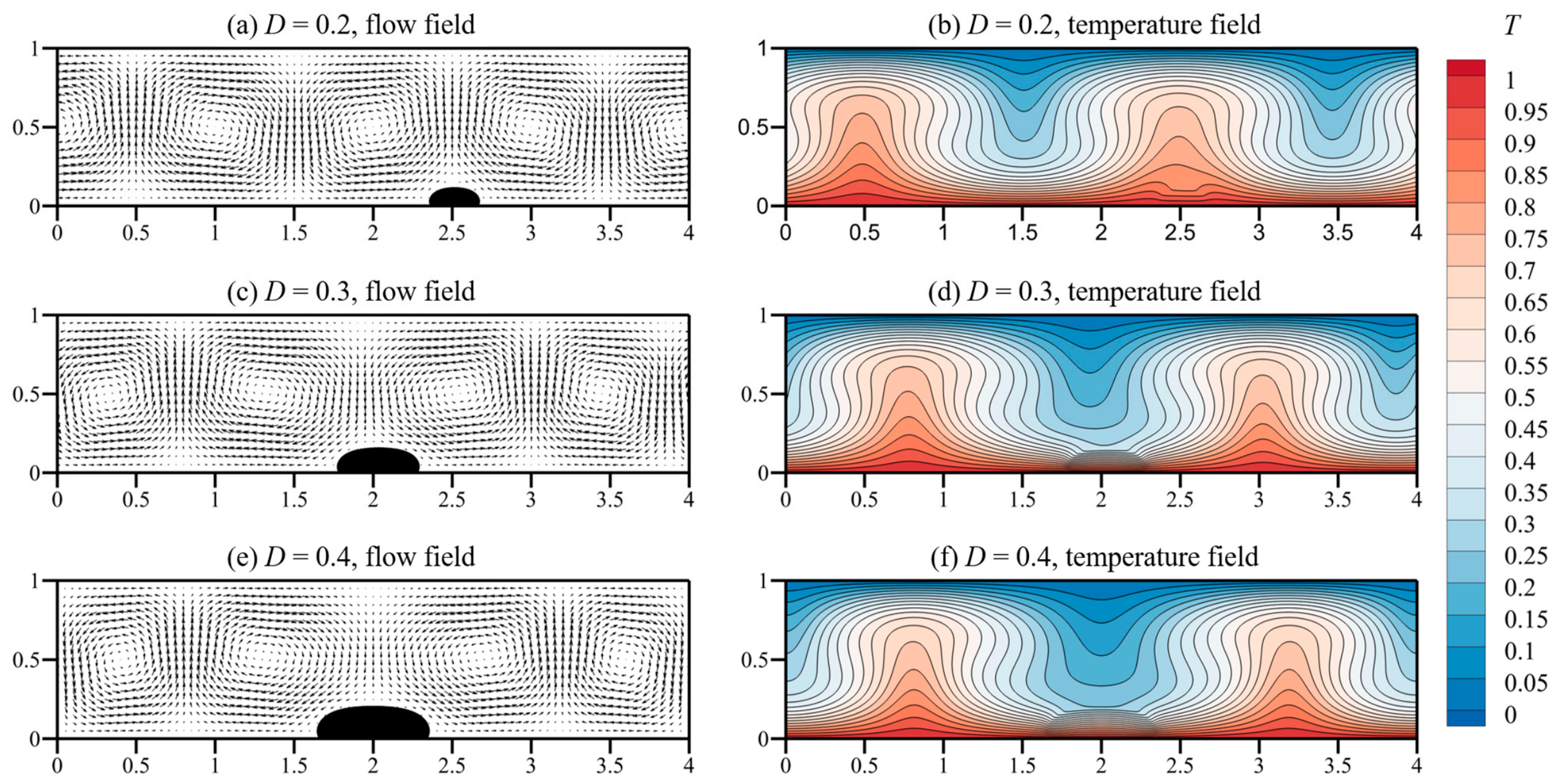
Figure 6 shows the fully developed flow and temperature fields for droplet-laden Rayleigh–Bénard convection at t* = 150 under three droplet diameters. When the droplet diameter satisfies D ≤ 0.3, the droplet slides rightward after impacting the solid wall under the thermal convection shear force, and the sliding distance exhibits a decreasing trend with increasing droplet diameter, as shown in Figure 6a,c. When D = 0.4, the thermal convection shear force is insufficient to overcome the inertial resistance of the larger droplet, and thus the rightward migration is not observed in Figure 6e. After the flow reaches a statistically steady state, the large recirculating convection rolls occupy the entire computational domain, forming the characteristic cellular flow pattern of Rayleigh–Bénard convection. The droplet mounted on the bottom hot wall acts as a local flow obstacle, which modifies the near-wall flow structure and distorts the thermal isotherms in its vicinity. As the droplet diameter increases, the blocking effect of the droplet strengthens. Quantitatively, the steady-state droplet-wall contact lengths for D = 0.2, 0.3, and 0.4 are 0.312, 0.506, and 0.695, respectively. The corresponding blocked wall fraction, defined as the ratio of the contact length to the total width of the bottom hot wall, increases nearly linearly from 7.8% to 12.6% and further to 17.4% with increasing droplet diameter, which perturbs the arrangement and size of the adjacent convection vortices and induces greater deformation of the near-wall temperature contours, as shown in Figure 6b,d,f. The larger droplet occupies more space on the hot bottom boundary, partially suppressing the upward motion of the hot plumes originating from the hot wall. This suppression alters the spatial distribution of hot and cold fluid, resulting in more pronounced bending of the isotherms directly above the droplet and further modulating the large roll structure across the domain.
Figure 6.
The flow and temperature fields of droplet-laden Rayleigh–Bénard convection at t* = 150: (a) D = 0.2, flow field; (b) D = 0.2, temperature field; (c) D = 0.3, flow field; (d) D = 0.3, temperature field; (e) D = 0.4, flow field; and (f) D = 0.4, temperature field.
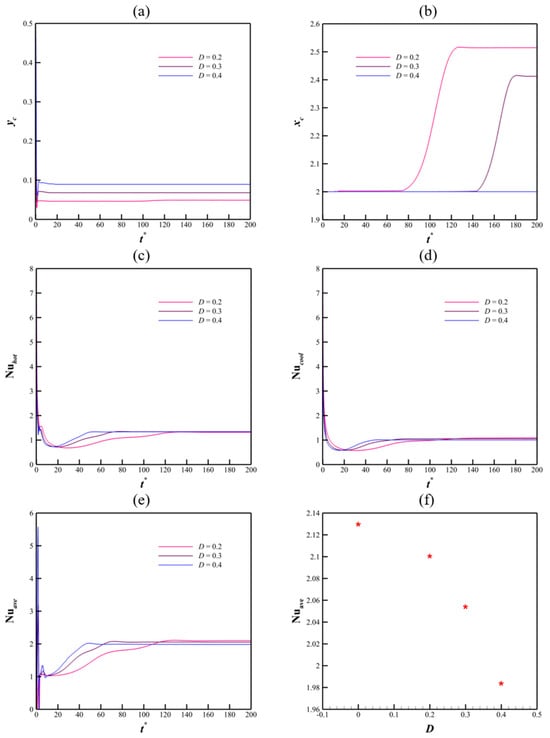
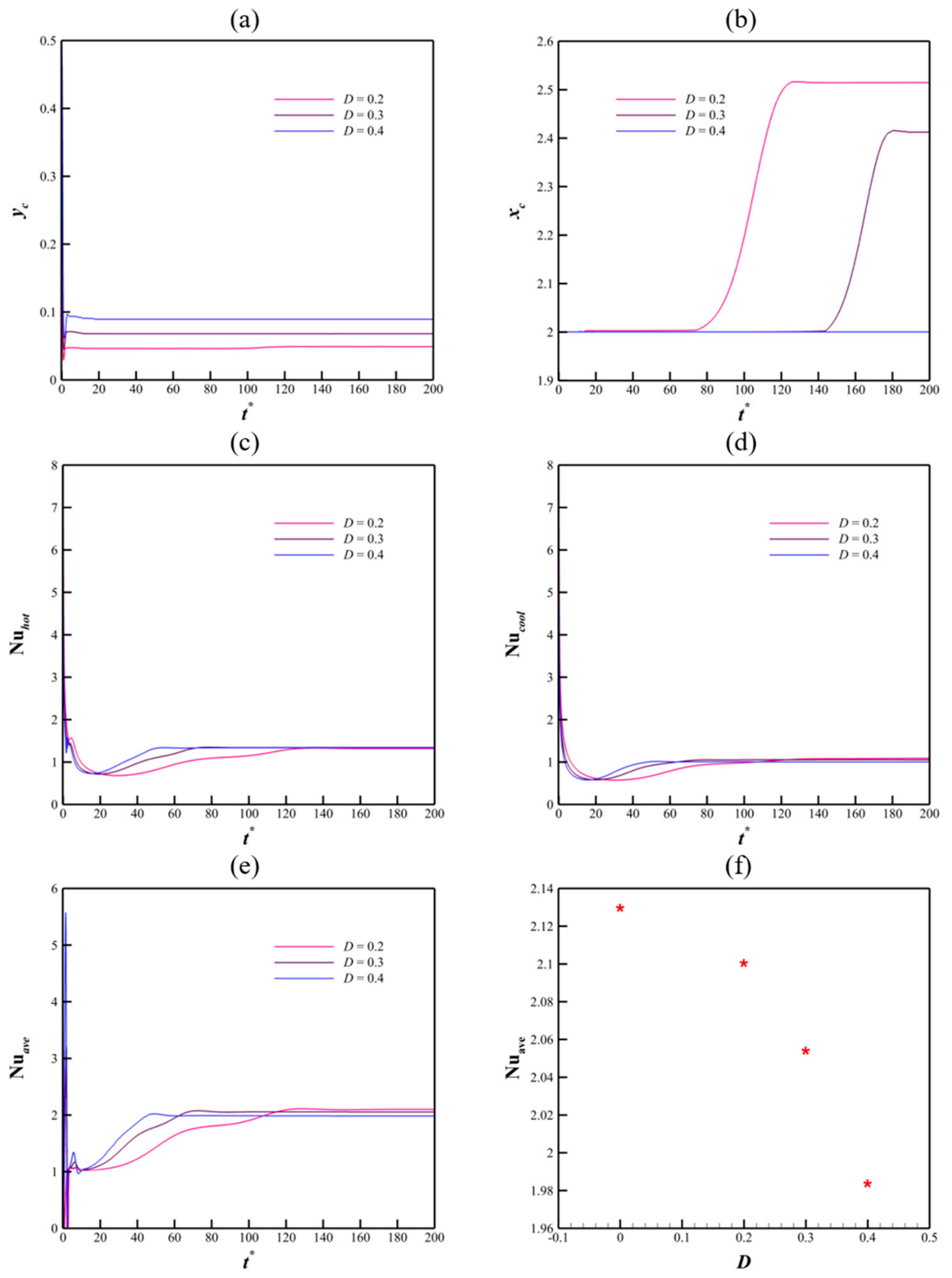
To quantitively describe the droplet motion of droplet-laden Rayleigh–Bénard convection, the center of mass in the y-direction and x-direction are calculated by and and recorded in Figure 7a and Figure 7b, respectively. After initialization, the oil droplet starts to fall rapidly and then impacts the solid wall. It can be observed that yc reaches its lowest point, then undergoes a slight rebound and eventually stabilizes at an equilibrium position, as shown in Figure 7a. When the droplet diameter is large (D = 0.4), xc remains unchanged throughout the whole simulation. In contrast, for D ≤ 0.3, xc remains unchanged before and shortly after wall impact, and is subsequently migrated rightward by the thermal convective shear force exerted by the surrounding flow.
Figure 7.
The droplet position and heat transfer characteristics of droplet-laden Rayleigh–Bénard convection: (a) yc varies with t*; (b) xc varies with t*; (c) Nuhot varies with t*; (d) Nucool varies with t*; (e) Nuave varies with t*; and (f) Nuave varies with D.
The hot-wall Nusselt number Nuhot and the cool-wall Nusselt number Nucool are calculated by and , respectively. The temporal evolutions of Nuhot, Nucool, and Nuave are illustrated in Figure 7c,e, respectively, revealing the coupling effects between droplet motion and heat transfer performance throughout the droplet-laden Rayleigh–Bénard convection process.
In the initial transient stage (t* ≤ 20), the linear temperature profile between the two walls establishes a steep near-wall temperature gradient and an extremely thin thermal boundary layer, resulting in high initial heat flux and elevated Nusselt numbers. As the thermal boundary layers gradually thicken along both walls, the wall heat flux drops markedly, driving a fast decline of Nuhot and Nucool. During this period, the droplet accelerates downward from the center of physical domain, but its perturbation to the bulk flow is not sufficient to offset the boundary layer thickening effect. Thus, Nuave shows the same decreasing trend with Nuhot and Nucool. Notably, the larger droplet diameter (D = 0.4) yields a higher initial peak of Nuave, as its larger volume induces stronger initial disturbance to the temperature field during descent.
Subsequently, in the post-impact recovery stage (20 < t* ≤ 120), the Nusselt numbers reach their minimum values and then gradually recover. This turning point corresponds to the moment when the droplet stirs the near-wall fluid and disrupts the thermal boundary layer on the hot wall, enhancing local convective heat transfer and causing Nuhot to stop decreasing and start increasing. However, the larger droplet occupies more space on the hot bottom boundary, partially suppressing the upward motion of the hot plumes originating from the hot wall, and thus the recovery process takes longer. Meanwhile, the larger recirculating convection rolls gradually develop across the entire domain, which strengthens the heat exchange between the hot and cold walls. Nuave in Figure 7e increases accordingly, reflecting the overall enhancement of convective heat transfer in the droplet-laden Rayleigh–Bénard convection system.
After t* > 120, the heat transfer reaches a statistically steady state. For D ≤ 0.3, the droplet completes its rightward sliding, driven by thermal convective shear force, and stabilizes at a fixed horizontal position, while the convection rolls remain fully developed. In this stage, Nuhot, Nucool, and Nuave converge to constant steady values. The comparison across different diameters shows that the steady Nusselt numbers decrease monotonically with increasing droplet diameter. This is because a larger droplet occupies a wider area of the hot bottom wall and acts as a thermal barrier, inhibiting the formation and upward motion of hot plumes from the wall. Although the transverse sliding of smaller droplets can enhance local near-wall mixing, the wall-blocking effect dominates as the diameter increases, resulting in a continuous reduction in the overall heat transfer performance of the system. The steady Nuave is summarized in Figure 7f. As the droplet diameter D increases, Nuave decreases monotonically, demonstrating that larger droplets suppress the overall heat transfer performance of the Rayleigh–Bénard system.
3.3. The Effect of the Thermal Conductivity Ratio
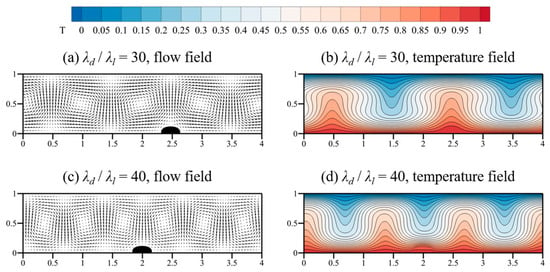
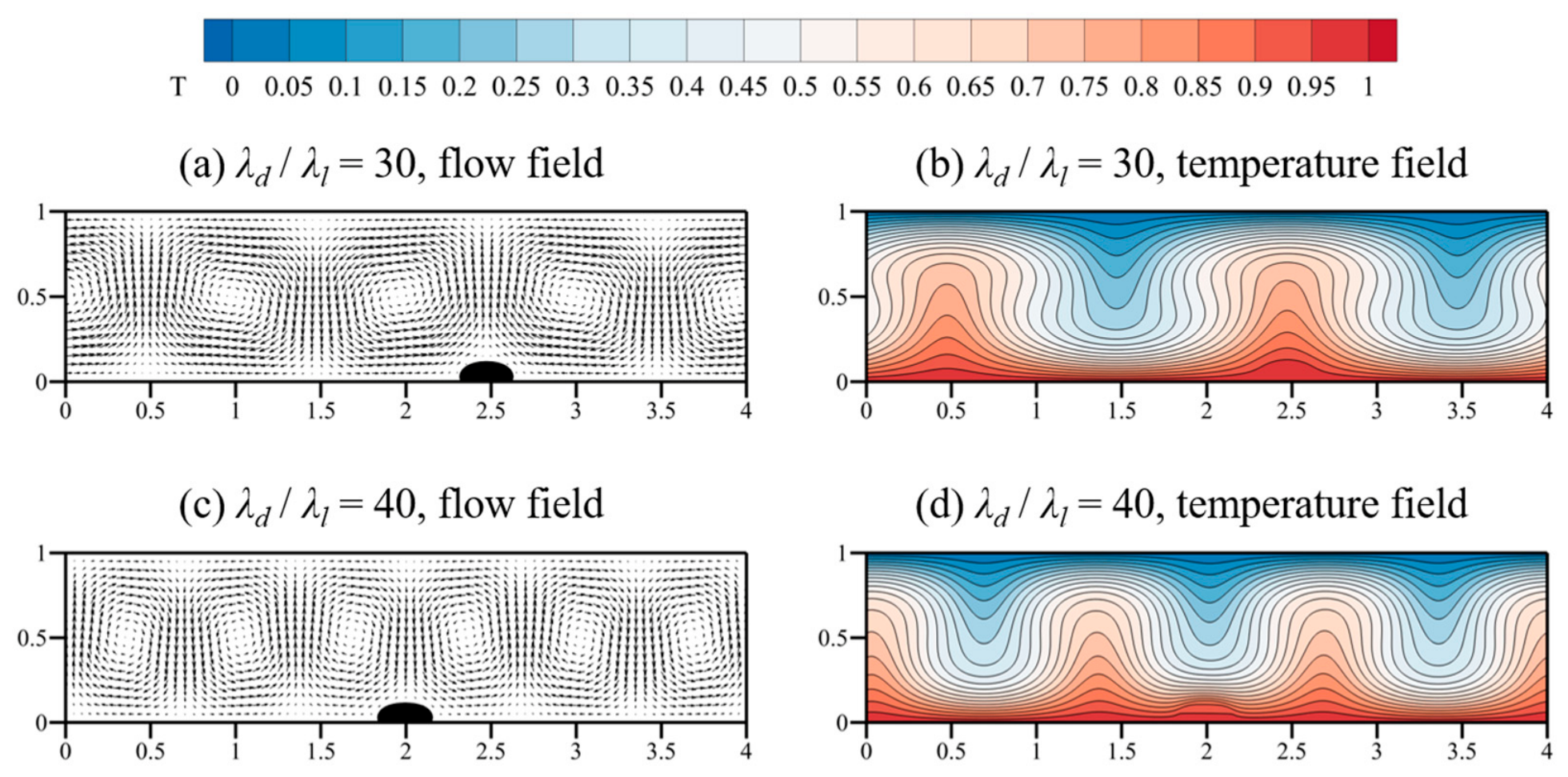
To investigate the effect of the thermal conductivity ratio between the oil droplet and the surrounding liquid, i.e., λd/λl, on the droplet-laden Rayleigh–Bénard convection process, a series of numerical simulations are carried out in this section. All physical parameters except the thermal conductivity ratio are identical to those used in the preceding sections. The steady flow and temperature fields of droplet-laden Rayleigh–Bénard convection with a fixed droplet diameter of D = 0.2 under two thermal conductivity rations, i.e., λd/λl = 30 and 40, are illustrated in Figure 8.
Figure 8.
The steady flow and temperature fields of droplet-laden Rayleigh–Bénard convection with a fixed droplet diameter of D = 0.2: (a) λd/λl = 30, flow field; (b) λd/λl = 30, temperature field; (c) λd/λl = 40, flow field; and (d) λd/λl = 40, temperature field.
The comparison of the flow field in Figure 8a,c, increasing λd/λl leads to a clear reduction in the horizontal scale of the convection rolls and a corresponding increase in vortex number. When λd/λl = 30, the flow field is dominated by large recirculating convection rolls. When λd/λl rises to 40, the original large rolls split into multiple smaller convection cells, forming a more compact and densely distributed vortex structure. This morphological evolution arises because the droplet with higher thermal conductivity transfers more heat from the bottom hot wall into the overlying fluid, generating stronger local buoyancy gradients that destabilize the large roll pattern and promote the formation of additional small-scale vortices. The temperature fields in Figure 8b,d exhibit consistent trends with the flow structures. For λd/λl = 30, the ascending thermal plumes are broad, and the isotherms above the droplet display moderate upward bulging, reflecting the heat conduction effect of the droplet. As λd/λl increases to 40, the thermal plumes become narrower and more numerous, and the isotherms directly above the droplet bulge more prominently toward the cold top wall. This confirms that a higher thermal conductivity ratio enhances the heat transfer capability of the droplet, allowing more heat to be transported upward through the droplet and intensifying the local thermal plume.
The local wall Nusselt number is physically defined as the dimensionless form of the normal temperature gradient at the solid boundary Accordingly, the spatial distribution of the local Nusselt number along the bottom hot wall is fully consistent with the near-wall isotherms. Quantitatively, at thermal conductivity ratios of 30 and 40, the local Nusselt number at the center of the droplet-wall contact region reaches 1.42 and 3.3 times the peak value in the surrounding pure fluid region, respectively. This pronounced local heat transfer enhancement is qualitatively corroborated by the temperature contours. The isotherms immediately above the droplet contact area are markedly compressed and bulge upward, which directly verifies that the droplet acts as a local thermal fin to intensify wall heat extraction.
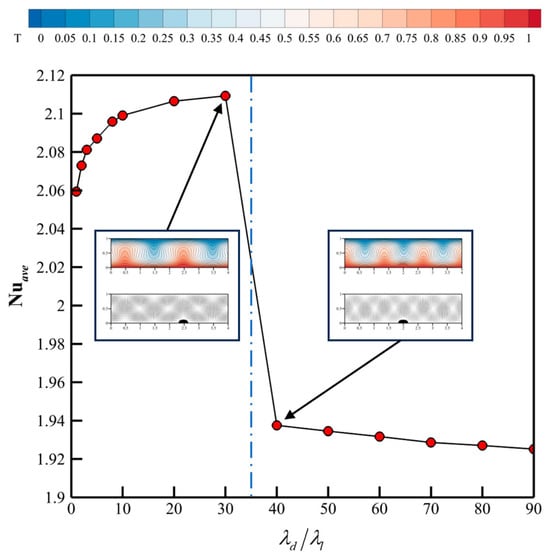
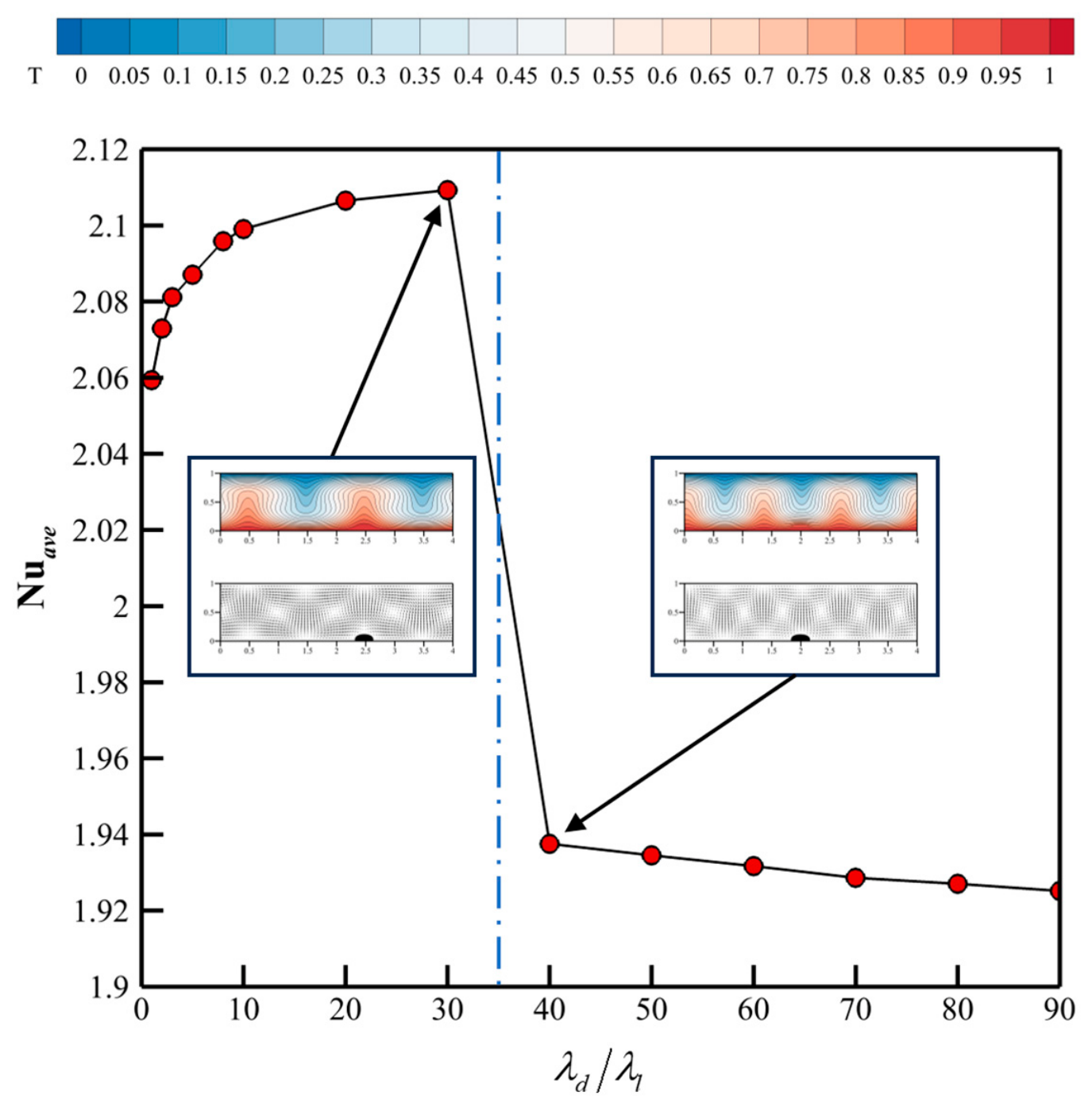
However, the vortex proliferation differs fundamentally from that induced by an increasing Ra, which corresponds to enhanced convection and higher Nuave. Here, the increase in convection cells stems from local flow destabilization caused by enhanced droplet heat conduction, rather than an overall enhancement of the convective driving force, and it ultimately leads to a decreased Nuave, with values of 2.109 and 1.937 for λd/λl = 30 and 40, respectively. Variation of the steady Nuave with λd/λl in droplet-laden Rayleigh–Bénard convection at a fixed droplet diameter of D = 0.2 is presented in Figure 9. For λd/λl ≤ 30, Nuave increases gradually with increasing λd/λl and reaches its maximum value at λd/λl = 30. The droplet acts as a local thermal fin that conducts more heat from the hot bottom wall into the overlying fluid, strengthens the near-wall buoyancy effect, and promotes convective mixing, thus improving the overall heat transfer performance. As λd/λl exceeds the critical range of 30–40, Nuave drops abruptly from the peak and then decreases slowly at higher ratios. This abrupt decline is closely related to the structural transformation of convection rolls, as verified by the insets. When λd/λl ≥ 40, despite the increased number of vortices, the large circulations that dominate cross-domain heat transport are significantly weakened, resulting in a continuous decrease in Nu.
Figure 9.
Variation of the steady Nuave with λd/λl in droplet-laden Rayleigh–Bénard convection at a fixed droplet diameter of D = 0.2. The insets display the corresponding temperature and flow fields at two typical ratios across the critical transition range.
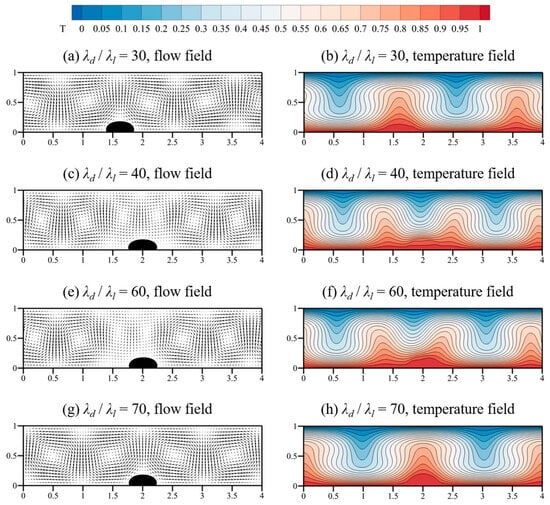
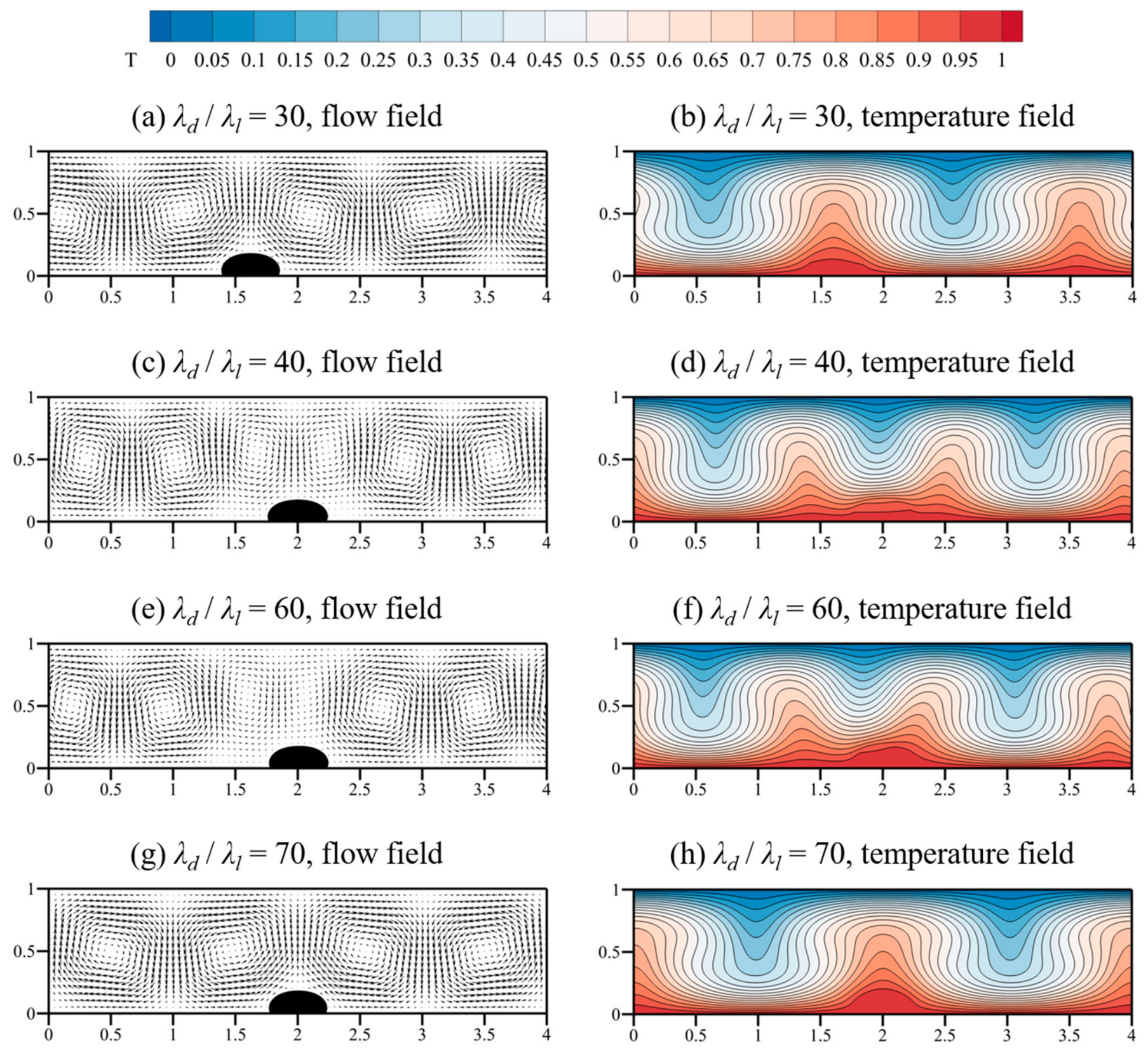
The steady flow and temperature fields of droplet-laden Rayleigh–Bénard convection for a fixed droplet diameter of D = 0.3 at four different thermal conductivity ratios of λd/λl = 30, 40, 60, and 70 are presented in Figure 10. For λd/λl = 30, the flow domain is dominated by recirculating convection rolls, with the droplet attached to the bottom hot wall acting as a local heat source. The corresponding temperature field in Figure 10b shows thermal plumes between adjacent rolls, and the isotherms directly above the droplet bulge moderately upward. The droplet with relatively high thermal conductivity extracts heat efficiently from the hot wall and transfers it into the overlying fluid, strengthening the buoyancy drive of the convection rolls and thus maintaining high overall heat transfer efficiency.
Figure 10.
The steady flow and temperature fields of droplet-laden Rayleigh–Bénard convection with a fixed droplet diameter of D = 0.3: (a) λd/λl = 30, flow field; (b) λd/λl = 30, temperature field; (c) λd/λl = 40, flow field; (d) λd/λl = 40, temperature field; (e) λd/λl = 60, flow field; (f) λd/λl = 60, temperature field; (g) λd/λl = 70, flow field; and (h) λd/λl = 70, temperature field.
For λd/λl increasing to 40, the convection structure undergoes an obvious morphological mutation, which is similar to Figure 8c. As shown in Figure 10c, the original convection rolls are disrupted and split into multiple smaller and distributed vortices. The temperature field in Figure 10d reveals that the originally broad thermal plumes split into narrower, more fragmented plumes with weakened upward penetration capability. This transition appears because the excessively enhanced local heat input from the droplet creates an overly strong buoyancy gradient near the wall, which destabilizes the large roll pattern. Although the number of vortices increases, the large circulations that dominate overall heat transport are severely weakened, resulting in the sharp drop of Nuave.
As λd/λl further rises to 60 and 70, the small vortices gradually redistribute and reform larger convection cell structures, as shown in Figure 10e,g. The flow field becomes more organized with the redeveloped large convection cells, which effectively recover the convective transport performance of the system. The corresponding temperature fields in Figure 10f,h show that the thermal plumes become denser and more continuous, and the upward bulging of isotherms above the droplet becomes more pronounced again. The continuously improved thermal conductivity of the droplet further strengthens local heat transfer and convective mixing, leading to the gradual increase of Nuave in the high-ratio regime.
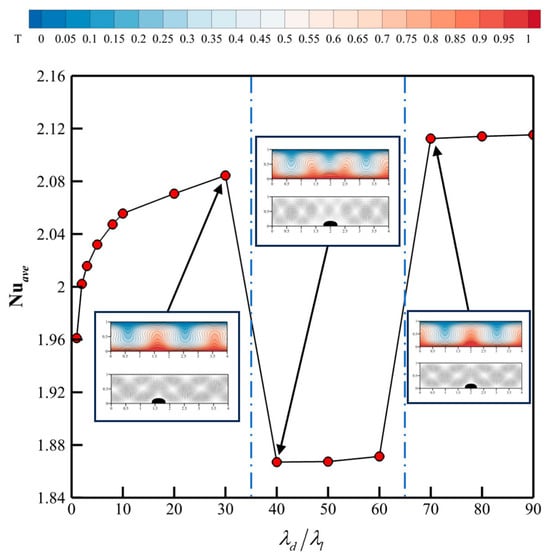
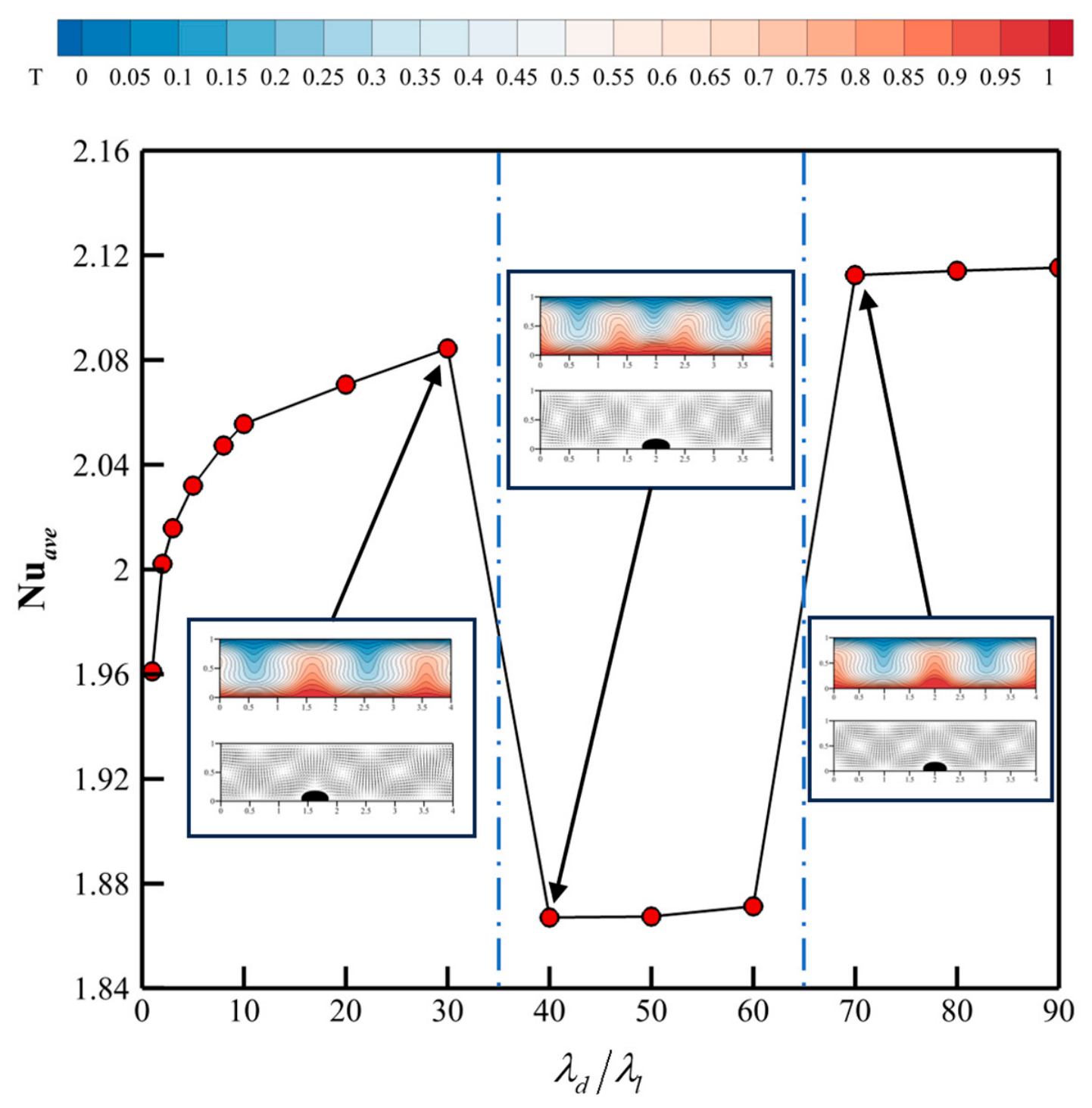
The non-monotonic evolution of the steady Nuave with λd/λl in droplet-laden Rayleigh–Bénard convection at a fixed droplet diameter of D = 0.3 is presented in Figure 11. For λd/λl ≤ 30, Nuave increases continuously and reaches its first peak at λd/λl = 30. Within this regime, the high-conductivity droplet mounted on the hot bottom wall acts as a local thermal fin, extracting heat from the hot wall and strengthening the buoyancy to large convection cells. Once λd/λl exceeds 30, Nuave drops sharply and enters a plateau of minimum value. This abrupt deterioration of heat transfer corresponds to the breakdown of the coherent large convection cells. The excessive local heat flux generated by the highly conductive droplet destabilizes the original roll structure, fragmenting the global circulation into scattered small vortices. Although local thermal mixing near the droplet is intensified, the large-scale vertical heat transport, which dominates the overall heat transfer, is significantly suppressed, resulting in a marked decreasing of Nuave. A further increase in λd/λl beyond 60 triggers another dramatic jump in Nuave. The fragmented small vortices reorganize and reform large convection cells. The restored coherent circulation, combined with the strong local heat supply from the droplet, substantially boosts the thermal transport.
Figure 11.
Variation of the steady Nuave with λd/λl in droplet-laden Rayleigh–Bénard convection at a fixed droplet diameter of D = 0.3. The insets display the corresponding temperature and flow fields at three typical ratios across the critical transition range.
4. Conclusions
In the present work, a triple-distribution-function lattice Boltzmann model was developed to simulate immiscible multiphase thermal flows featuring coupled interfacial dynamics and heat transfer. Within the single-relaxation-time lattice Boltzmann framework, three sets of mesoscopic lattice Boltzmann equations corresponding to density, order parameter, and temperature distribution functions were systematically coupled to solve the Navier–Stokes equations for fluid motion, the Cahn–Hilliard equation with a mass-correction term for interface evolution, and the energy equation for thermal transport, respectively. A geometric surface-energy-based wetting boundary condition was further implemented to account for the wettability effects at physical boundaries. The macroscopic governing equations could be accurately recovered from the present lattice Boltzmann formulation through the Chapman–Enskog expansion analysis. Compared with existing multiphase lattice Boltzmann approaches reported in the literature, the proposed model avoids notable mass dissipation at phase interfaces and enables simultaneous resolution of flow field, interface deformation, and heat transfer behaviors for immiscible multiphase thermal systems. These favorable properties render the triple-distribution-function scheme a reliable numerical tool for complex multiphase thermal convection problems.
The capability and accuracy of the present model were first validated against the benchmark case of single-phase Rayleigh–Bénard convection. Good agreements on temperature contours and Nuave profiles were achieved between the present simulation results and the published theoretical and numerical benchmarks. A series of numerical investigations were then carried out for droplet-laden Rayleigh–Bénard convection with a suspended immiscible droplet. The droplet diameter and thermal conductivity ratio between the dispersed droplet and the surrounding liquid were selected as key control parameters. The numerical results demonstrated that an increase in droplet diameter strengthens the blocking effect once the droplet settles on the hot bottom wall. Larger droplets suppress the upward motion of the hot thermal plumes, perturb the adjacent convection rolls, and monotonically decrease the steady Nuave. For moderate droplet sizes of D ≤ 0.3, the deposited droplet can slide horizontally driven by the shear force from large convective circulations, which enhances local near wall mixing.
Furthermore, the thermal conductivity ratio of the droplet exerts non-monotonic effects on the flow structure and overall heat transfer performance. At relatively smaller thermal conductivity ratios, the droplet acts as an effective local thermal fin, extracting heat from the hot wall and increasing the buoyancy driven convection, which yields improved heat transfer efficiency. When the thermal conductivity ratio exceeds a critical threshold around 30 to 40, excessive local heat input near the wall destabilizes the original large convection rolls, splitting them into numerous small vortices. Although the vortex quantity increases, the large circulations dominating vertical heat transport are substantially weakened, leading to a sharp drop of Nuave. With further growth of the thermal conductivity ratio for the case of D = 0.3, fragmented small vortices reorganize into large convection cells again, and the overall heat transfer performance partially recovers. For the smaller droplet of D = 0.2, no obvious heat transfer recovery was observed within the studied parameter range.
In addition, the precise bifurcation thresholds of the flow-pattern transitions and their underlying physical mechanisms merit further systematic investigation. In subsequent work, numerical simulations with experimental measurements will be performed to accurately locate these critical points and reveal the relevant transition mechanisms in depth. All numerical simulations illustrate that the developed triple-distribution-function lattice Boltzmann model can capture the intricate interaction among the droplet motion, interfacial deformation, flow structure reorganization and heat transfer performance in droplet-laden multiphase Rayleigh–Bénard convection. This work provides physical insights for understanding multiphase thermal convection and offers a feasible numerical framework for further studies on thermal management involving immiscible multiphase flows, which contributes to both SDG 7 and SDG 9.
Author Contributions
Conceptualization, X.L. and Z.-Q.D.; Methodology, X.L. and Z.-Q.D.; Software, X.L.; Validation, X.L.; Formal analysis, X.L.; Investigation, X.L.; Resources, X.L. and Z.-Q.D.; Data curation, X.L.; Writing—original draft, X.L.; Writing—review and editing, Z.-Q.D., X.-R.Z. and H.Y.; Visualization, X.L. All authors have read and agreed to the published version of the manuscript.
Funding
This work was supported by the National Natural Science Foundation of China (NSFC, Grant Nos. 12302361, 12402328), the Shenzhen Science and Technology Innovation Commission, China (Grant Nos. RCBS20231211090722037, JCYJ20240813094221028), and the Department of Science and Technology of Guangdong Province (Grant Nos. 2025A1515010156, 2025A1515012960). Numerical simulations in this work were supported by the Center for Computational Science and Engineering at Southern University of Science and Technology.
Data Availability Statement
The data supporting the findings of this study are available from the corresponding author upon reasonable request.
Conflicts of Interest
The authors declare that there are no conflicts of interest.
References
- Drummond, K.P.; Back, D.; Sinanis, M.D.; Janes, D.B.; Peroulis, D.; Weibel, J.A.; Garimella, S.V. A hierarchical manifold microchannel heat sink array for high-heat-flux two-phase cooling of electronics. Int. J. Heat Mass Transf. 2018, 117, 319. [Google Scholar] [CrossRef] [Scilit]
- Urbant, P.; Leshansky, A.; Halupovich, Y. On the forced convective heat transport in a droplet-laden flow in microchannels. Microfluid. Nanofluid. 2008, 4, 533. [Google Scholar] [CrossRef] [Scilit]
- Abdollahi, A.; Norris, S.E.; Sharma, R.N. Fluid flow and heat transfer of liquid-liquid Taylor flow in square microchannels. Appl. Therm. Eng. 2020, 172, 115123. [Google Scholar] [CrossRef] [Scilit]
- Harirchian, T.; Garimella, S.V. Effects of channel dimension, heat flux, and mass flux on flow boiling regimes in microchannels. Int. J. Multiph. Flow 2009, 35, 349. [Google Scholar] [CrossRef] [Scilit]
- Lin, P.H.; Fu, B.R.; Pan, C. Critical heat flux on flow boiling of methanol–water mixtures in a diverging microchannel with artificial cavities. Int. J. Heat Mass Transf. 2011, 54, 3156. [Google Scholar] [CrossRef] [Scilit]
- Karayiannis, T.G.; Mahmoud, M.M. Flow boiling in microchannels: Fundamentals and applications. Appl. Therm. Eng. 2017, 115, 1372. [Google Scholar] [CrossRef] [Scilit]
- Xie, W.; Lv, X.; Liu, D.; Li, L.; Yao, W. Numerical investigation of flow boiling in manifold microchannel-based heat exchangers. Int. J. Heat Mass Transf. 2020, 163, 120493. [Google Scholar] [CrossRef] [Scilit]
- Ibrahim, M.; Aref, O.; Zhang, C.; Rajamuni, M.; Chen, L.; Young, J.; Tian, F.-B. Effects of surface morphologies on boiling heat transfer in droplet impingement on superheated surfaces. Phys. Fluids 2025, 37, 013627. [Google Scholar] [CrossRef] [Scilit]
- Xu, X.; Yu, P. Extension of SPH to simulate non-isothermal free surface flows during the injection molding process. Appl. Math. Model. 2019, 73, 715. [Google Scholar] [CrossRef] [Scilit]
- Ma, J.; Li, Y.; Zhang, D. An improved immersed boundary-lattice Boltzmann method for boiling simulation on curved boundary. Phys. Fluids 2025, 37, 023351. [Google Scholar] [CrossRef] [Scilit]
- Kharangate, C.R.; Mudawar, I. Review of computational studies on boiling and condensation. Int. J. Heat Mass Transf. 2017, 108, 1164. [Google Scholar] [CrossRef] [Scilit]
- Sussman, M.; Smereka, P.; Osher, S. A Level Set Approach for Computing Solutions to Incompressible Two-Phase Flow. J. Comput. Phys. 1994, 114, 146. [Google Scholar] [CrossRef] [Scilit]
- Yuan, H.Z.; Chen, Z.; Shu, C.; Wang, Y.; Niu, X.D.; Shu, S. A free energy-based surface tension force model for simulation of multiphase flows by level-set method. J. Comput. Phys. 2017, 345, 404. [Google Scholar] [CrossRef] [Scilit]
- Meng, W.; Yu, C.-h.; Li, J.; An, R. A coupling algorithm of the coupled level set and volume of fluid/immersed boundary method and adaptive mesh refine method for simulating multiphase flows. Phys. Fluids 2024, 36, 092128. [Google Scholar] [CrossRef] [Scilit]
- Scardovelli, R.; Zaleski, S. Direct Numerical Simulation of Free-Surface and Interfacial Flow. Annu. Rev. Fluid Mech. 1999, 31, 567. [Google Scholar] [CrossRef] [Scilit]
- He, J.-H.; Li, M.-G.; Chen, J.-J.; Li, J.; Zhen, L. A novel liquid–gas–solid computational fluid dynamics-discrete element method-volume of fluid coupling method with compressible fluid phases. Phys. Fluids 2025, 37, 043359. [Google Scholar] [CrossRef] [Scilit]
- Anderson, D.M.; McFadden, G.B.; Wheeler, A.A. Diffuse-Interface Methods in Fluid Mechanics. Annu. Rev. Fluid Mech. 1998, 30, 139. [Google Scholar] [CrossRef] [Scilit]
- Wang, H.; Yuan, X.; Liang, H.; Chai, Z.; Shi, B. A brief review of the phase-field-based lattice Boltzmann method for multiphase flows. Capillarity 2019, 2, 32. [Google Scholar] [CrossRef] [Scilit]
- Li, X.; Dong, Z.-Q.; Li, Y.; Wang, L.-P.; Niu, X.-D.; Yamaguchi, H.; Li, D.-C.; Yu, P. A fractional-step lattice Boltzmann method for multiphase flows with complex interfacial behavior and large density contrast. Int. J. Multiph. Flow 2022, 149, 103982. [Google Scholar] [CrossRef] [Scilit]
- Li, X.; Dong, Z.-Q.; Wang, L.-P.; Niu, X.-D.; Yamaguchi, H.; Li, D.-C.; Yu, P. A magnetic field coupling fractional step lattice Boltzmann model for the complex interfacial behavior in magnetic multiphase flows. Appl. Math. Model. 2023, 117, 219. [Google Scholar] [CrossRef] [Scilit]
- Cahn, J.W.; Hilliard, J.E. Free Energy of a Nonuniform System. I. Interfacial Free Energy. J. Chem. Phys. 1958, 28, 258. [Google Scholar] [CrossRef] [Scilit]
- Allen, S.M.; Cahn, J.W. Mechanisms of phase transformations within the miscibility gap of Fe-rich Fe-Al alloys. Acta Metall. 1976, 24, 425. [Google Scholar] [CrossRef] [Scilit]
- Chen, S.; Doolen, G.D. Lattice Boltzmann Method for Fluid Flows. Annu. Rev. Fluid Mech. 1998, 30, 329. [Google Scholar] [CrossRef] [Scilit]
- Zheng, H.W.; Shu, C.; Chew, Y.T. A lattice Boltzmann model for multiphase flows with large density ratio. J. Comput. Phys. 2006, 218, 353. [Google Scholar] [CrossRef] [Scilit]
- Liu, H.; Zhang, Y. Lattice Boltzmann Simulation of Droplet Generation in a Microfluidic Cross-Junction. Commun. Comput. Phys. 2011, 9, 1235. [Google Scholar] [CrossRef] [Scilit]
- Huang, H.; Huang, J.-J.; Lu, X.-Y. A mass-conserving axisymmetric multiphase lattice Boltzmann method and its application in simulation of bubble rising. J. Comput. Phys. 2014, 269, 386. [Google Scholar] [CrossRef] [Scilit]
- Niu, X.-D.; Li, Y.; Ma, Y.-R.; Chen, M.-F.; Li, X.; Li, Q.-Z. A mass-conserving multiphase lattice Boltzmann model for simulation of multiphase flows. Phys. Fluids 2018, 30, 013302. [Google Scholar] [CrossRef] [Scilit]
- Li, X.; Yu, P.; Niu, X.-D.; Li, D.-C.; Yamaguchi, H. A magnetic field coupling lattice Boltzmann model and its application on the merging process of multiple-ferrofluid-droplet system. Appl. Math. Comput. 2021, 393, 125769. [Google Scholar] [CrossRef] [Scilit]
- Wang, Y.; Shu, C.; Shao, J.Y.; Wu, J.; Niu, X.D. A mass-conserved diffuse interface method and its application for incompressible multiphase flows with large density ratio. J. Comput. Phys. 2015, 290, 336. [Google Scholar] [CrossRef] [Scilit]
- Yuan, H.Z.; Wang, Y.; Shu, C. An adaptive mesh refinement-multiphase lattice Boltzmann flux solver for simulation of complex binary fluid flows. Phys. Fluids 2017, 29, 123604. [Google Scholar] [CrossRef] [Scilit]
- Zhang, D.; Li, Y.; Gong, L.; Zhu, C.; Shu, C. Three-dimensional lattice Boltzmann flux solver for three-phase/component flow. Phys. Fluids 2024, 36, 083350. [Google Scholar] [CrossRef] [Scilit]
- Yang, L.; Hu, C.; Zhang, Z.; Wang, K.; Yu, Y. A consistent axisymmetric multiphase lattice Boltzmann flux solver for flows with super-large density ratio. Phys. Fluids 2025, 37, 053303. [Google Scholar] [CrossRef] [Scilit]
- Shu, C.; Niu, X.D.; Chew, Y.T.; Cai, Q.D. A fractional step lattice Boltzmann method for simulating high Reynolds number flows. Math. Comput. Simul. 2006, 72, 201. [Google Scholar] [CrossRef] [Scilit]
- Chen, Z.; Shu, C.; Wang, Y.; Yang, L.M.; Tan, D. A Simplified Lattice Boltzmann Method without Evolution of Distribution Function. Adv. Appl. Math. Mech. 2017, 9, 1. [Google Scholar] [CrossRef] [Scilit]
- Chen, Z.; Shu, C.; Tan, D.; Niu, X.D.; Li, Q.Z. Simplified multiphase lattice Boltzmann method for simulating multiphase flows with large density ratios and complex interfaces. Phys. Rev. E 2018, 98, 063314. [Google Scholar] [CrossRef] [Scilit]
- Zhang, C.; Guo, Z.; Li, Y. A fractional step lattice Boltzmann model for two-phase flow with large density differences. Int. J. Heat Mass Transf. 2019, 138, 1128. [Google Scholar] [CrossRef] [Scilit]
- Li, X.; Dong, Z.-Q.; Yu, P.; Niu, X.-D.; Wang, L.-P.; Li, D.-C.; Yamaguchi, H. Numerical investigation of magnetic multiphase flows by the fractional-step-based multiphase lattice Boltzmann method. Phys. Fluids 2020, 32, 083309. [Google Scholar] [CrossRef] [Scilit]
- He, X.; Chen, S.; Zhang, R. A Lattice Boltzmann Scheme for Incompressible Multiphase Flow and Its Application in Simulation of Rayleigh–Taylor Instability. J. Comput. Phys. 1999, 152, 642. [Google Scholar] [CrossRef] [Scilit]
- Jiang, F.; Liu, H.; Chen, X.; Tsuji, T. A coupled LBM-DEM method for simulating the multiphase fluid-solid interaction problem. J. Comput. Phys. 2022, 454, 110963. [Google Scholar] [CrossRef] [Scilit]
- Xiao, Y.; Zeng, Z.; Zhang, L.; Zhang, D.; Sun, M. Accelerated calculation of phase-variable for numerical simulation of multiphase flows. Int. J. Multiph. Flow 2024, 181, 105006. [Google Scholar] [CrossRef] [Scilit]
- Chen, J.; Wang, J.; Deng, Z.; Liu, X.; Chen, Y. Experimental study on Rayleigh-Bénard-Marangoni convection characteristics in a droplet during mass transfer. Int. J. Heat Mass Transf. 2021, 172, 121214. [Google Scholar] [CrossRef] [Scilit]
- Chen, Z.; Shu, C.; Liu, Y.Y.; Zhang, L.Q.; Zhang, Z.L.; Yuan, Z.Y. Isotherm-evolution-based interface tracking algorithm for modelling temperature-driven solid-liquid phase-change in multiphase flows. Int. J. Therm. Sci. 2022, 177, 107541. [Google Scholar] [CrossRef] [Scilit]
- Thomas, S.; Prabhakaran, P.; Yang, F.; Cantrell, W.H.; Shaw, R.A. Dimensionless parameters for cloudy Rayleigh-Bénard convection: Supersaturation, Damköhler, and Nusselt numbers. Phys. Rev. Fluids 2022, 7, 010503. [Google Scholar] [CrossRef] [Scilit]
- Pelusi, F.; Ascione, S.; Sbragaglia, M.; Bernaschi, M. Analysis of the heat transfer fluctuations in the Rayleigh–Bénard convection of concentrated emulsions with finite-size droplets. Soft Matter 2023, 19, 7192. [Google Scholar] [CrossRef] [Scilit] [PubMed]
- Ding, H.; Spelt, P.D.M.; Shu, C. Diffuse interface model for incompressible two-phase flows with large density ratios. J. Comput. Phys. 2007, 226, 2078. [Google Scholar] [CrossRef] [Scilit]
- Liang, H.; Liu, H.; Chai, Z.; Shi, B. Lattice Boltzmann method for contact-line motion of binary fluids with high density ratio. Phys. Rev. E 2019, 99, 063306. [Google Scholar] [CrossRef] [Scilit] [PubMed]
- Qian, Y.H.; Humières, D.D.; Lallemand, P. Lattice BGK Models for Navier-Stokes Equation. Europhys. Lett. 1992, 17, 479. [Google Scholar] [CrossRef] [Scilit]
- Fromm, J.E. Numerical Solutions of the Nonlinear Equations for a Heated Fluid Layer. Phys. Fluids 1965, 8, 1757, Correction in Phys. Fluids 1966, 9, 828. [Google Scholar] [CrossRef] [Scilit]
- Shan, X. Simulation of Rayleigh-Bénard convection using a lattice Boltzmann method. Phys. Rev. E 1997, 55, 2780. [Google Scholar] [CrossRef] [Scilit]
- Yang, L.M.; Shu, C.; Yang, W.M.; Wu, J. Development of an efficient gas kinetic scheme for simulation of two-dimensional incompressible thermal flows. Phys. Rev. E 2018, 97, 013305. [Google Scholar] [CrossRef] [Scilit] [PubMed]
- Clever, R.M.; Busse, F.H. Transition to time-dependent convection. J. Fluid Mech. 1974, 65, 625. [Google Scholar] [CrossRef] [Scilit]
- Fei, L.; Luo, K.H.; Lin, C.; Li, Q. Modeling incompressible thermal flows using a central-moments-based lattice Boltzmann method. Int. J. Heat Mass Transf. 2018, 120, 624. [Google Scholar] [CrossRef] [Scilit]
- Gao, Y.; Yu, Y.; Yang, L.; Qin, S.; Hou, G. Development of a coupled simplified lattice Boltzmann method for thermal flows. Comput. Fluids 2021, 229, 105042. [Google Scholar] [CrossRef] [Scilit]

Disclaimer/Publisher’s Note: The statements, opinions and data contained in all publications are solely those of the individual author(s) and contributor(s) and not of MDPI and/or the editor(s). MDPI and/or the editor(s) disclaim responsibility for any injury to people or property resulting from any ideas, methods, instructions or products referred to in the content. |
© 2026 by the authors. Licensee MDPI, Basel, Switzerland. This article is an open access article distributed under the terms and conditions of the Creative Commons Attribution (CC BY) license.