1. Introduction
Load frequency control (LFC) is a fundamental strategy designed to restore the balance between load and generation, while maintaining system frequency and regulating tie-line power exchanges among interconnected control areas [
1]. LFC has been proven effective and is widely adopted in both the design and operation of modern power systems. However, the increasing penetration of wind power in recent decades has posed significant challenges for LFC systems [
2]. Although wind energy is efficient and cost-effective, it is inherently fluctuating and intermittent. Consequently, high levels of wind power penetration may reduce system inertia, especially when conventional synchronous generators are replaced by wind turbines. The reduction in inertia complicates frequency regulation, making it more difficult to mitigate the impacts of disturbances [
3,
4]. In addition, LFC systems typically rely on open communication networks for transmitting control and measurement signals [
5]. Such reliance introduces vulnerabilities, including network congestion and potential cyber-attacks, which may result in packet loss, data out-of-sequence issues, and communication delays [
6,
7]. Such disruptions extend the sampling period of control signals, introducing uncertainty in the timing of measurements. The increased uncertainty in the sampling period can have detrimental effects on the stability of the frequency of the system [
4]. Therefore, it is essential to study the combined impact of both wind power integration and communication delays on LFC performance [
8,
9]. A robust control strategy must be designed to mitigate these effects, ensuring stable frequency regulation despite these challenges.In practical implementations, the tie-line power and frequency measurements are sampled at regular intervals (typically 1–3 s) and transmitted to the system control centre via communication channels [
10,
11]. In practical load frequency control implementations, measurement acquisition and control signal updates are performed through communication networks and digital control platforms. As a result, communication delays and timing variations are unavoidable. In existing LFC systems, the control update interval is typically on the order of one to several seconds, while communication delays are generally much shorter but may still vary due to network congestion or scheduling effects. Such variations introduce sampling jitter, which further motivates the adoption of sampled-data control frameworks capable of explicitly accounting for nonuniform update instants. LFC systems often use discrete controllers, which operate in the discrete-time domain, while the underlying power system dynamics remain in the continuous-time domain [
12]. Consequently, the controller must be designed to account for the sampling characteristics of the system, ensuring that it can maintain effective performance even in the presence of a large sampling period or other communication-related issues [
13].
Over the years, significant efforts have been made to investigate the frequency stability and controller design for power systems, particularly in the context of LFC. Various analysis and synthesis methods, including frequency-domain analysis [
14], time-domain methods,
μ-synthesis [
15], robust control strategies, and optimal control approaches, have been applied to address these challenges. In recent research, LFC systems have been enhanced to accommodate the complexities introduced by high wind power penetration and the dynamics of modern power systems [
16]. For instance, Zeng et al. [
17] explored delay-dependent stability for LFC systems incorporating wind power and electric vehicles, using time-domain analysis based on Lyapunov stability theory. Others have focused on the effects of network-induced delays, such as data packet loss and disorder, treating them as time-varying delays that impact LFC performance [
18,
19,
20]. These studies led to the development of robust PI/PID control strategies based on
control theory [
21,
22] to counteract the adverse effects of communication disruptions.Additionally, several robust LFC designs have been proposed to deal with wind power’s effect on system inertia. For example, Bevrani et al. suggested a fuzzy logic-based LFC approach for systems with high wind power penetration, ensuring stable operation despite fluctuating generation [
23]. In another study, an exponential stability analysis was conducted for LFC systems with wind power and time delays, leading to the development of a PID-type controller with robustness against reduced inertia [
24,
25]. Despite the successes of these methods, many of the LFC schemes discussed are based on continuous-time system models, which do not fully capture the dynamics of practical power systems. Real-world systems, particularly in the digital age, rely on sampled-data-based LFC schemes, where continuous-time system plants interact with discrete-time controllers, often implemented on embedded digital processors [
26,
27,
28]. A typical power system employs a sampling period ranging from 2 to 4 s, but network delays, packet losses, or transmission issues can lead to further increases in the sampling interval [
29]. These uncertainties necessitate the design of sampled-data-based LFC schemes to reduce the impact of these variations on system stability.
Scholars have made significant efforts in designing LFC schemes for power systems. Moreover, the design of discrete LFC controllers has evolved, with two primary methods being employed [
30,
31]. One approach involves designing controllers in continuous-time, which are then discretized for implementation in embedded systems. Although these methods provide effective control in systems with small sampling periods, their performance degrades as the sampling period increases, potentially leading to instability. To address this issue, researchers like Tan et al. [
32] have incorporated unmodeled dynamics into the design process, enhancing robustness against larger sampling periods. In addition, some modern control methods, such as fuzzy control, have also been employed to design robust LFC schemes in continuous-time mode [
33]. Considering the phenomena of packet loss and/or disorder in communication transmission, Jiang et al. regarded these as time-varying and random time delays, and then analyzed the stability of the time-delay LFC system based on Lyapunov theory and designed an
robust PID-type frequency controller [
19,
20]. Furthermore, various LFC schemes for power systems with wind power integration, such as those based on doubly fed induction generators and fuzzy logic controllers, have been proposed to improve system performance in the presence of renewable energy fluctuations [
34]. However, the LFC schemes designed in the continuous-time mode are only effective within a relatively small discrete period or sampling period. As the sampling period increases, especially in the actual LFC system where there is a typical control signal update cycle of 2 to 4 s, these designed control schemes will lead to a decline in the performance of the LFC system during operation or even instability.The other is based on the theory of discretization; for example, Jaleeli et al. [
26] addressed the design of a discrete-time controller for a two-area LFC system, explicitly incorporating Generation Rate Constraints (GRC). Subsequently, Vrdoljak et al. [
35] devised a LFC scheme based on sliding mode control. As an improvement, Hiyama et al. [
36] proposed an event-triggered communication strategy incorporated into a sliding mode control-based LFC scheme for multi-area power systems. However, these designs were developed based on directly discretized models of the LFC system. In summary, while continuous-time LFC controllers have been effective in many scenarios, their application in systems with longer sampling periods or in the presence of network-induced delays can result in degraded performance or instability. Therefore, there is a growing need to focus on the development of sampled-data-based LFC schemes that can better handle the increasing complexity and variability introduced by wind power and communication challenges in modern power systems.
To achieve rapid frequency regulation, battery energy storage systems (BESS) have been considered for grid frequency control due to their ability to provide sufficiently fast responses in the event of generation-load imbalances [
37]. Additionally, the use of demand response has been proposed to rapidly adjust system frequency by directly reducing or increasing electricity consumption on the user side when generation-load imbalances cause frequency instability, thereby ensuring grid stability [
38]. It is worth noting that most designed LFC schemes focus on primary frequency control. Although these control strategies can quickly generate effective actions to restore balance, primary frequency control is a droop-based regulation and remains static. Therefore, it is necessary to combine the aforementioned research to propose a novel secondary frequency controller design method that meets the expected requirements for rapid frequency regulation.
Motivated by the needs of practical secondary frequency control with high wind penetration, this paper develops a sampled-data LFC framework for power systems with wind power (PSWP). We first build a sampled-data description of the closed loop in which a continuous-time plant is regulated by a discrete-time PI-type LFC through a sampler/hold channel subject to aperiodic sampling and external disturbances. On top of this model, an augmented two-sided looped Lyapunov functional together with a free-matrix-based inequality is employed to derive sampling-interval-dependent LMIs that guarantee stability and a prescribed performance level. These LMIs lead directly to a synthesis procedure that (i) returns the PI gains and (ii) computes the admissible maximum sampling period and EDR through a simple bisection routine. The proposed method is validated on a one-area PSWP and a three-area PSWP to demonstrate effectiveness and engineering relevance.
Motivated by the above discussions, this paper advances a discrete and fast sampled-data-based LFC for PSWP under open communication network along the five contributions as follows:
Realistic sampled-data modeling. The closed loop of PSWP equipped with a PI-type LFC is formulated as a sampled-data control system that explicitly captures aperiodic sampling instants and unknown external disturbances. This setting reflects field implementations where a continuous-time plant, communication-induced sampling, and discrete-time control coexist.
A relaxed Lyapunov construction for design. Building on a two-sided looped Lyapunov functional, the paper proposes a design framework that utilizes state information on both subintervals and . Unlike classical functionals that enforce positive definiteness at every instant, the augmented construction extracts richer interval information, which translates into less conservative stability and synthesis conditions.
Sampling-interval–dependent criteria and margins. New LMI conditions are established that depend explicitly on the sampling interval. For any fixed LFC structure, these conditions yield an upper bound—termed the sampling margin—on the admissible maximum sampling period ensuring stability and the specified level. In practice, operating with a larger certified sampling period reduces communication load and is often simpler to deploy than event-triggered schemes.
PI controller synthesis with robustness. A sampled-data PI controller is designed that simultaneously accounts for the sampling period and disturbance attenuation. The resulting controller enlarges the feasible sampling range while enhancing robustness to load fluctuations, wind intermittency, reduced inertia, and sampling jitter. Compared with high-order dynamic or full state-feedback designs, the PI structure relies on readily available measurements and is well suited to large-scale PSWP.
Integrating sampling period and exponential decay rate. A methodological approach to LFC is proposed that incorporates both the sampling period and the EDR as design variables.By calibrating these settings, one can satisfy design goals, such as mitigating network traffic and enhancing the rapidity of frequency dynamics.
Notations: Throughout the manuscript, the symbols and denote the transpose and inverse of a matrix. For a matrix R, the notation (or ) indicates that R is positive definite (respectively, positive semidefinite). The operators and refer to the construction of block-diagonal matrices and block-column matrices (or vectors). For any matrix D, the symmetric part is written as . The symbols , and denote, respectively, a real scalar, the n-dimensional Euclidean space, and the space of real matrices. The sets and stand for the cones of symmetric matrices and symmetric positive definite matrices. The identity matrix of dimension n is represented by , and denotes the zero matrix. Unless otherwise stated, all matrices are assumed to have compatible sizes for the algebraic operations involved. The operator denotes mathematical expectation. The space contains vector-valued functions on whose squared norms are integrable.
Remark 1. In this study, transmission delays in measurement and control channels are not explicitly modeled. This choice is motivated by the fact that, in typical load frequency control applications, the communication delay is much smaller than the control update interval, which usually ranges from one to several seconds. Therefore, the dominant dynamic effect originates from sampling and zero-order-hold behavior rather than from transmission delays.
For multi-area power systems, tie-line power exchanges are treated as bounded external disturbances acting on each control area. This modeling approach allows the analysis to focus on local frequency dynamics while still capturing the influence of inter-area power interactions on frequency stability.
The turbine dynamics are modeled using a non-reheat turbine representation, which is commonly adopted in load frequency control studies for analytical tractability. This assumption simplifies the system model and highlights the impact of sampling effects. Extensions to more detailed turbine models can be addressed within the same framework with appropriate modifications.
3. Dynamic Model of Discrete Sampled-Data-Based PSWP Scheme
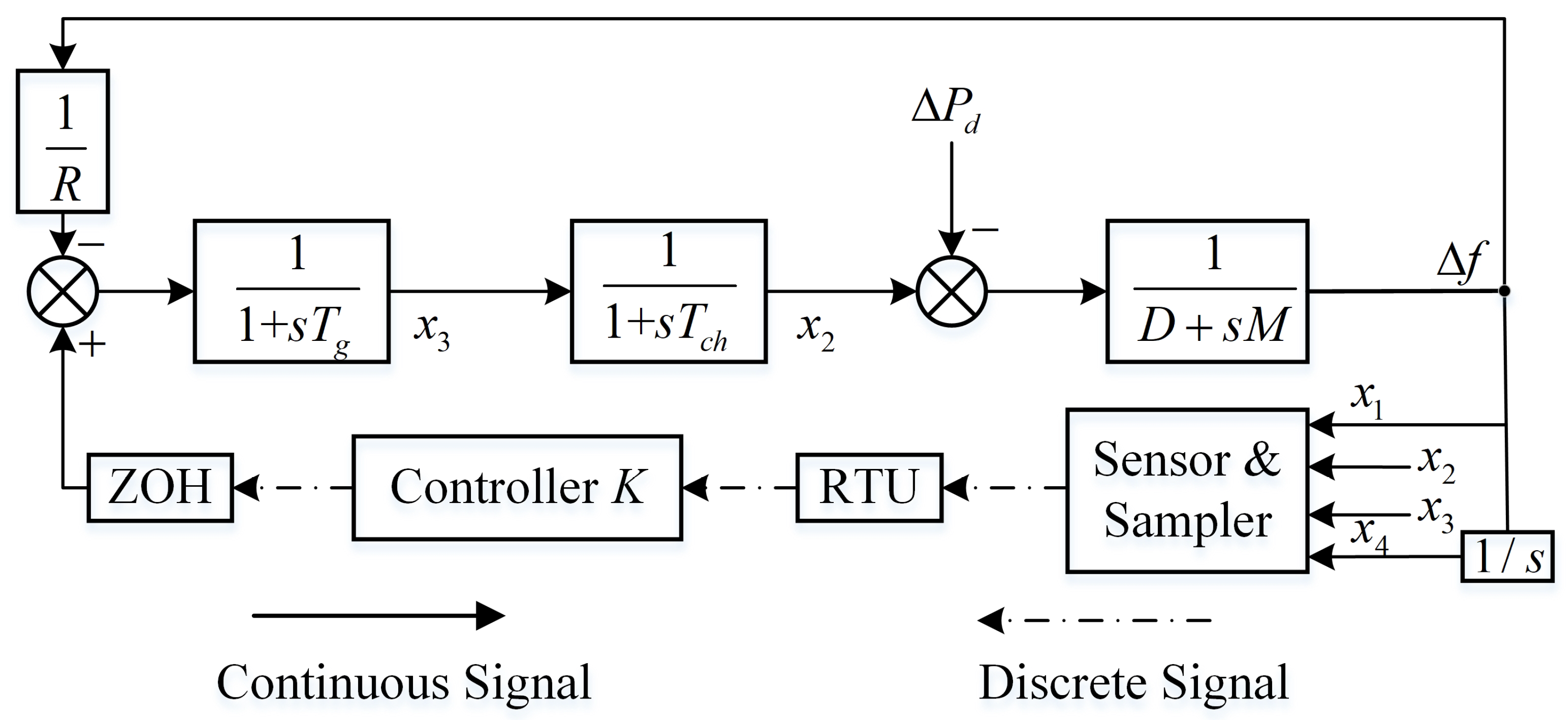
This section presents a sampled-data-based LFC model for PSWP, focusing on one-area and deregulated multi-area LFC schemes. As illustrated in
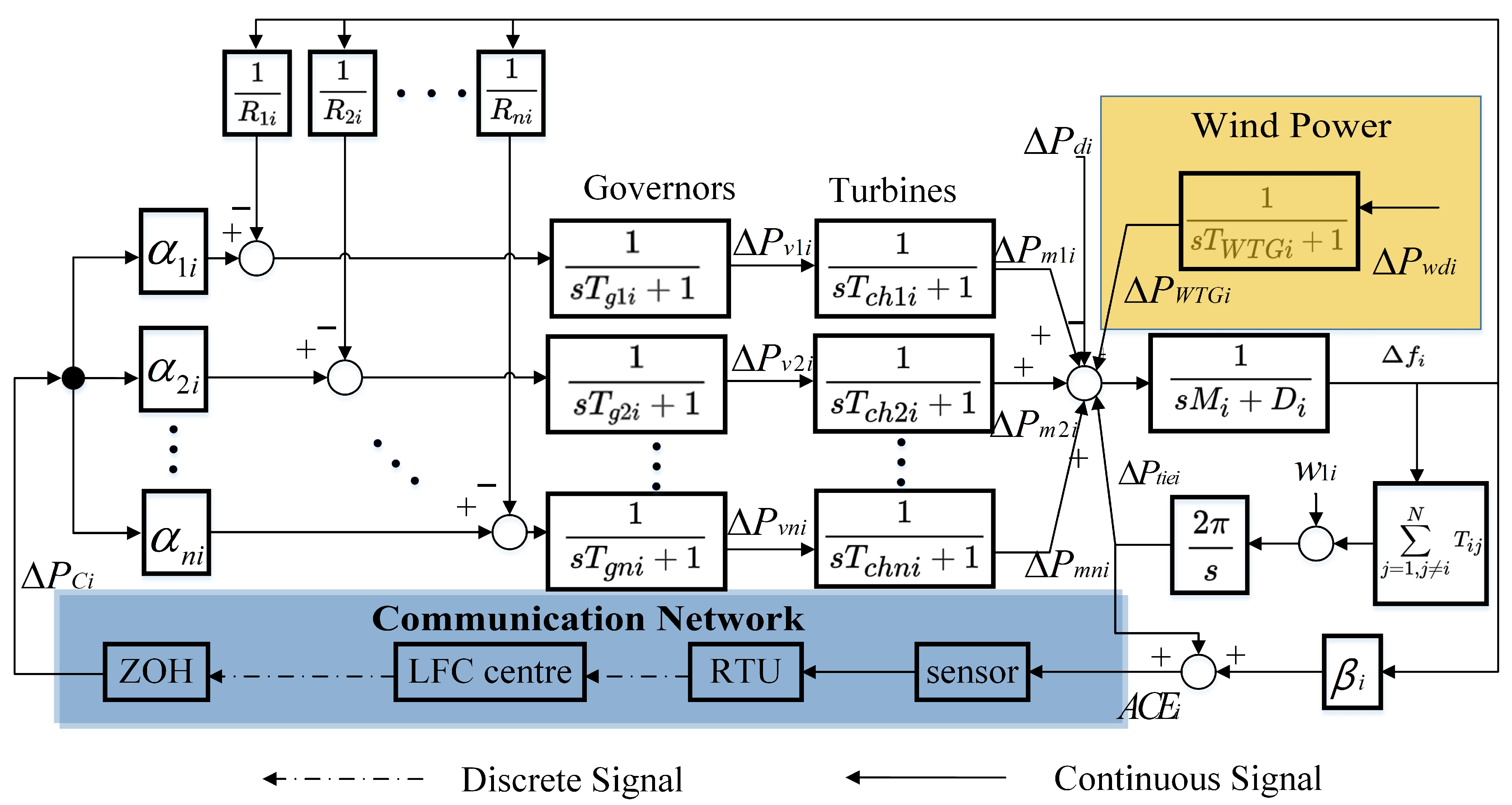
Figure 1, the LFC structure of each control area consists of various components, including governors, turbines, rotating masses, loads, wind power, and tie-lines for inter-area power exchange. In addition, the system includes sensors, samplers, LFC centers, ZOH, and communication networks. In the traditional LFC scheme, the generation units represent conventional power plants, whereas, in the deregulated scheme, they are modeled as generation companies (Gencos). For simplicity, it is assumed that all traditional generators are equipped with non-reheat turbines, and the time delays in signal transmission are negligible for update periods between 1 and 3 s.
In the case of a multi-area PSWP, the model considers N control areas, each with a similar structure. The LFC design for each area only requires local system information, allowing for a decentralized control strategy where the design of each control area’s LFC scheme can be treated independently. The exchange of tie-line power between control areas is modeled as an external load disturbance, simplifying the overall system design. This approach allows the LFC design for a multi-area PSWP to be treated as repetitive design tasks for each individual control area, where the scheme for a single-area system is extended to the multi-area context. In this manner, the sampled-data-based LFC model for a single area is introduced as a foundational step for the multi-area system design.
3.1. Continuous-Time Model of One-Area LFC Model
The dynamic model of the one-area LFC system in “
Figure 1” can be derived from [
41] as follows:
where
and,
,
,
, and
represent the variations in system frequency, turbine valve position, mechanical power output of the generator, and electrical load, respectively. The parameters
M,
,
D,
, and
R correspond to the generator’s rotational inertia, turbine time constant, damping factor of the generator, governor time constant and speed regulation coefficient, respectively. And,
and
denote the proportional control coefficient and integral control coefficient, respectively. The control gain matrix can be expressed as
. The weighting coefficients
and
are tunable parameters that can be adjusted to achieve a desired level of robust performance.
In this control scheme, the Area Control Error (ACE) is formulated as , where represents the frequency bias coefficient. In a one-area LFC system, since no inter-area power transfer occurs through tie-lines, the ACE simplifies to . To ensure the steady-state convergence of both frequency deviation () and tie-line power deviation (), an integral term of ACE is incorporated as an auxiliary state variable, expressed as .
3.2. Continuous-Time Model of Multi-Area LFC Model
The dynamic model of the discrete LFC scheme for control area
i, which integrates wind power and
n conventional generating units, is presented in
Figure 1 and can be expressed as follows:
where
with
where
is the tie-line synchronizing coeffient between the control area of
ith and
jth. And
and
represent the ramp rate factor and wind turbine generator.
3.3. Sampled-Data-Based LFC Model via Input Delay Method
In the continuous-time framework, control signals are generated directly using the system state variables
. When moving to a discrete-time context, only sampled values of
are available for use in the LFC strategy. In sampled-data-based LFC schemes, only the states
measured at discrete sampling times
are utilized. As illustrated in
Figure 1, these state values are first quantized and sampled by the sensors at each
, after which the data are sent from the RTU to the control center. There, the discrete-time controller processes the received measurements to compute the control input. This signal
is then applied to the continuous-time plant through a ZOH. The sampling instants
(with
) are assumed to meet the following condition:
where
denotes the maximum allowable sampling period. Using the input-delay approach [
42], the discrete controller is formulated at each sampling instant
as follows:
Combing (
3) and (
6), the discrete model of the corresponding closed-loop with a sampled-data-based LFC scheme as follows:
where
Remark 3. The considered sampled-data system allows aperiodic sampling with time-varying sampling intervals . Therefore, the derived stability conditions are robust against sampling jitter as long as the upper bound is respected.
4. Design of Sampled-Data LFC Scheme
In this section, a discrete LFC strategy for power systems is developed. For single-area systems, the controller design is guided by a performance index, and only local system information is required to achieve effective regulation. To enhance the robustness of the proposed method, a sampled-data control framework is introduced, where the system stability is analyzed using a two-side augmented looped Lyapunov functional combined with a free-matrix-based inequality technique. This approach enables the derivation of two novel sampling-interval-dependent stability conditions, applicable to both disturbance-free and disturbance-affected scenarios. On the basis of these stability results, a disturbance-aware stabilization criterion is further formulated. Finally, an algorithm is proposed to compute the parameters of a sampled-data-based PI-type LFC controller, along with the maximum admissible sampling interval, ensuring system stability under discrete implementation. For multi-area systems, the design procedure can be independently applied to each area by relying solely on its local system data, thus maintaining a decentralized control structure. To simplify the presentation, the following notations are adopted for matrices and vectors.
4.1. Notation and Preliminaries
For clarity, the main symbols used throughout this paper are summarized as follows.
Let denote the continuous-time state vector of the system, and let represent the sampled state at the sampling instant . The sampling interval is defined as .
The auxiliary vectors and are introduced to describe the deviation between the current state and the sampled state, and the sampled state itself, respectively. These vectors are used to construct the augmented state representation required in the looped Lyapunov functional.
The vector denotes an augmented vector that collects the current state, sampled state, and additional integral-related terms over the sampling interval. It is introduced to compactly express the Lyapunov functional and its time derivative in a quadratic form.
The matrices are constant selection matrices with compatible dimensions, employed to extract specific components from .
The matrices and , together with the vectors and , are weighting or selection matrices/vectors used in the construction of integral inequalities and boundary terms of the Lyapunov functional.
Throughout the paper, all matrices are assumed to have compatible dimensions, and the superscripts and denote matrix transpose and inverse, respectively. The notation represents a block-diagonal matrix.
The auxiliary vector represents the deviation between the current system state and the most recently sampled state, which characterizes the sampling-induced error under the zero-order-hold mechanism.The vector corresponds to the sampled state available to the controller and serves as a reference state in the construction of the looped Lyapunov functional.
These auxiliary vectors do not introduce additional system dynamics but are algebraic variables employed to capture the effect of sampling and facilitate the Lyapunov-based stability analysis.
Table 1 provides a concise overview of the main variables, auxiliary vectors, and matrices introduced in the stability analysis. The table is intended to serve as a reference for the notation appearing in the Lyapunov functional construction and the associated LMI conditions, thereby reducing the need for repeated cross-referencing throughout the manuscript. It is worth emphasizing that the auxiliary vectors
–
and the augmented vector
are analytical constructs rather than additional physical states of the power system. They are introduced to compactly represent sampling-induced deviations, boundary information at sampling instants, and interval-dependent effects within a unified framework. The dimensional information reported in the table is included to facilitate the interpretation of matrix structures involved in the stability conditions.
4.2. The Introduction of Sampling-Interval-Dependent Stability Criterion
Theorem 1. Consider system (7) with , for given performance index γ, sampling period h, PI-LFC controller and EDR λ, if there exist matrices , , ; are symmetric matrices and any appropriately dimensioned matrices , such that the following holds:where
and
i = 1, 2. The system (
7) is guaranteed to be exponentially stable and achieves a dynamic performance index
.
Proof of Theorem 1. For the system (
7), the following augmented two-side looped Lyapunov–Krasovskii functional is introduced:
with
Remark 4. Let the Lyapunov matrix be positive definite, then and . Following Theorem 1 in [43], fulfills the looped-functional requirement since , . This guarantees the asymptotic stability condition established in [43]. Motivated by [44,45], the construction of incorporates the information of two-side intervals, from to and from to , together with both single integrations of over and . Another important feature of is the inclusion of an augmented vector . Compared with conventional Lyapunov functionals [19], the proposed does not impose strict positivity requirements such as , , . This relaxation makes the derived stability and stabilization conditions significantly less conservative. For , since , , and , it follows that Therefore, the positivity of can be ensured.Although individual components are not required to be positive definite, the looped boundary condition together with ensures that the total Lyapunov functional remains positive over the entire sampling interval, thereby guaranteeing asymptotic (exponential) stability.
Taking the time derivative of V(t) along the trajectories of system (
7) yields
In order to facilitate the subsequent analysis process, we have the following:
where
with
By applying the generalized free-matrix-based inequality (
1) in Lemma 1 which introduces additional free matrices to flexibly bound the integral of
and
,the integral term
and
appearing in
can be estimated, leading to the following result:
where
and
are defined in Theorem 1. By employing the free-weighting-matrix technique, the following zero-equality conditions are satisfied for any given matrices
and
:
After inserting Equations (
19)–(
21), which equal zero, into
and performing an algebraic rearrangement, the result is the following:
where
,
and
and
are defined in Theorem 1, without the subscript
i. Then, by using the Schur complement,
From inequality (
26), integrating both sides over the interval
,
, we obtain the following result:
Since
and
is continuous with respect to
t, it follows that
Letting
and recalling that
under zero initial condition, inequality (
28) gives
Define
. Since
, system (
7) can be expressed in the following polytopic form:
where
According to Theorem 1, inequalities (
8) and (
9) describe an affine combination of the system matrices. To guarantee the asymptotic stability of system (
30), it is necessary to ensure stability at both endpoints,
and
. By solving inequalities (
8) and (
9) to verify stability at these two endpoints, the same variable matrices can be applied. Based on the above stability proof, for
, if
and
hold simultaneously, system (
30) is guaranteed to be asymptotically stable at both endpoints. Consequently, system (
7) is exponentially stable with the EDR index
. The proof is thus complete. □
Corollary 1. Consider system (7) with , for given performance index γ, PI-LFC controller and EDR λ, if there exist matrices , , ; are symmetric matrices and any appropriately dimensioned matrices , such that the following holds:where the notations used here follows the same conventions established in Theorem 1. 4.3. The Introduction of Sampling-Interval-Dependent Controller Design Criterion
Theorem 2. Consider system (7) with , for given performance index γ, sampling period h, if there exist matrices , , ; are symmetric matrices and any appropriately dimensioned matrices , and a and b are the tuning parameters such that the following holds:where , and the other parameters are as defined in Theorem 1 without superscript ^. The system (7) is exponentially stable and the controller can be computed by Proof of Theorem 2. Define
pre and post multiply (
8) and (
9) by
and its transpose, respectively. This completes the proof. □
The stability conditions derived in this study establish a clear and quantifiable criterion for evaluating the stability of sampled-data load frequency control systems under bounded sampling intervals. From an engineering perspective, the derived upper limit of the sampling interval defines the maximum allowable update period that the closed-loop system can withstand while maintaining frequency stability. This finding holds significant practical value for modern power systems with high wind power integration, where data acquisition, signal transmission, and control command updates are inherently discrete processes and prone to timing fluctuations. Consequently, the proposed stability conditions provide a feasible reference for determining appropriate sampling rates and communication frequencies in actual LFC system deployments.
4.4. Procedure for Designing the Discrete LFC Scheme
4.4.1. Model Setup
Derive the discrete-time model of LFC system and specify all system parameters.
4.4.2. Controller Synthesis Route
4.4.3. Fixed and : Search the Maximal EDR
Initialize the search interval with , a sufficiently large , and tolerance .
Let
. Test the feasibility of (
33) and (
34) with
and
.
If feasible, set ; otherwise set .
Repeat Steps 2 and 3 until
. Then take
and compute the controller gains from (
35).
4.4.4. Fixed and : Search the Maximal Sampling Period
Initialize with , a sufficiently large , and tolerance .
Let
. Test the feasibility of (
8) and (
9) or (
31) and (
32) with
and
.
If feasible, set ; otherwise set .
Repeat Steps 2 and 3 until
. Then take
and obtain the controller gains from (
35).
4.4.5. Both and Are Given:
Search the Admissible Minimum Performance Index
With
, execute
Section 4.4.3 to compute the minimum achievable decay rate
.
4.4.6. Verification
Conduct simulations to validate closed-loop stability and performance under the designed controller and to illustrate the impact of different design specifications.