You are currently on the new version of our website. Access the old version .
ProcessesProcesses
  • Article
  • Open Access

10 January 2026

Quantitative Source Identification of Heavy Metals in Soil via Integrated Data Mining and GIS Techniques

,
and
1
School of Civil and Hydraulic Engineering, Bengbu University, Bengbu 233030, China
2
School of Electronic and Electrical Engineering, Bengbu University, Bengbu 233030, China
3
School of Earth and Space Sciences, University of Science and Technology of China, Hefei 230026, China
4
Hefei Institute of Technology Innovation Engineering, Chinese Academy of Sciences, Hefei 230088, China
Processes2026, 14(2), 248;https://doi.org/10.3390/pr14020248 
(registering DOI)
This article belongs to the Section Environmental and Green Processes

Abstract

Soil heavy metal contamination poses significant risks to ecological safety and human health, particularly in rapidly industrializing cities. Effectively identifying pollution sources is crucial for risk management and remediation. GIS coupled with data mining techniques, provide a powerful tool for quantifying and visualizing these sources. This study investigates the concentration, spatial distribution, and sources of heavy metals in urban soils of Bengbu City, an industrial and transportation hub in eastern China. A total of 139 surface soil samples from the urban core were analyzed for nine heavy metals. Using integrated GIS and PCA-APCS-MLR data mining techniques, we systematically determined their contamination characteristics and apportioned sources. The results identified widespread Hg enrichment, with concentrations exceeding background levels at all sampling sites, and a Cd exceedance rate of 28.06%, leading to a moderate ecological risk level overall. Spatial patterns revealed significant heterogeneity. Quantitative source apportionment identified four primary sources: industrial source (37.1%), which was the dominant origin of Cr, Cu, and Ni, primarily associated with precision manufacturing and metallurgical activities; mixed source (26.7%) governing the distribution of Mn, As, and Hg, mainly from coal combustion and the natural geological background; traffic source (22.3%) significantly contributing to Pb and Zn; and a specific cadmium source (13.9%) potentially originating from non-ferrous metal smelting, electroplating, and agricultural activities. These findings provide a critical scientific basis for targeted pollution control and sustainable land-use management in analogous industrial cities.

1. Introduction

Soil heavy metal contamination has emerged as a critical environmental challenge due to its persistence, bioaccumulation potential, and associated health risks [1,2,3]. In China, rapid industrialization and urbanization have significantly elevated soil concentrations of toxic metals through multiple anthropogenic pathways including industrial emissions, agricultural activities, and urban expansion [4,5,6,7,8]. Similar to certain persistent organic pollutants, these inorganic contaminants exhibit environmental persistence and biomagnification, necessitating precise source identification for effective risk management.
Heavy metal sources are influenced by both natural and anthropogenic factors. Geological background such as bedrock composition and soil parent materials constitutes the primary natural origin, while anthropogenic activities—including industrial emissions (waste gas, wastewater, and solid residues), coal combustion, as well as agricultural practices involving wastewater irrigation and excessive fertilizer application—are key contributors to the exacerbation of heavy metal contamination [9,10]. Within this context, precise source apportionment serves as an essential foundation for effective pollution control and remediation strategy. Currently, multiple methodologies including geostatistical analysis, Positive Matrix Factorization (PMF), UNMIX receptor modeling, Chemical Mass Balance (CMB), and the Principal Component Analysis–Absolute Principal Component Scores–Multiple Linear Regression (PCA-APCS-MLR) have been employed for source apportionment of soil heavy metals [11,12,13,14,15,16,17,18,19,20]. Among these, PCA-APCS-MLR has become a mainstream technique for source apportionment [21,22]. This approach establishes robust zero-concentration reference factors via PCA and subsequently quantifies source contributions through MLR. It requires no a priori assumptions about pollution sources, offers strong experimental tractability, and yields results that objectively quantify the contributions of identified sources. In recent years, this model has been successfully applied to quantitatively apportion the sources of heavy metals (including Cr, Ni, Cu, Zn, As, Pb, Mn, Co) in park soils across different urban planning districts of Xi’an City, Shaanxi Province, China [23]. Their analysis identified anthropogenic factors as the predominant contributors, with mixed and natural sources playing minor roles. Notably, the APCS-MLR effectively captured the spatial heterogeneity in source contributions, particularly for Co, highlighting its utility in resolving complex pollution patterns within urban environments. For potential toxic elements in soils surrounding the Barapukuria coal mine, Bangladesh, PCA-APCS-MLR analysis has quantitatively attributed Mn, Fe, and Ni to geogenic sources, identified coal mine effluents as the primary anthropogenic source of As, Cr, Zn, Pb, U, S, and Th, and traced Zn/P to agricultural practices, effectively resolving natural–anthropogenic source mixtures [24].
While the PCA-APCS-MLR model has demonstrated robust capabilities in diverse environments, its integrated application with GIS spatial analysis and comprehensive health risk assessment in rapidly urbanizing industrial cities—especially those within ecologically critical watersheds—remains insufficiently explored. This gap hinders the development of targeted mitigation strategies for such complex settings. Bengbu city, a major industrial hub and national transportation node within the densely populated and economically vital Huai River Basin, epitomizes these pressures. Therefore, this study aims to fill this gap by applying the PCA-APCS-MLR model coupled with GIS and risk assessment to quantitatively identify the specific sources, contributions, and associated health risks of heavy metals in Bengbu’s urban soils. The findings are expected to provide a replicable framework for similar watershed cities facing intertwined developmental and environmental challenges.

2. Materials and Methods

2.1. Study Area

Bengbu City (32°43′–33°30′ N, 116°45′–118°04′ E), a prefecture-level industrial center in northern Anhui Province, is situated within the transitional zone between North and South China and serves as a key node within the Huai River Basin. Geologically, the urban area is situated on the Huaibei Plain, underlain by thick Quaternary alluvial deposits (primarily silt and clay) transported by the Huai River system, with the bedrock consisting predominantly of Precambrian metamorphic rocks (schist and gneiss) of the Wuhe Group. The dominant soil types derived from these parent materials are Fluvo-aquic soils (Cambosols) across the plains and Anthrosols (Stagnic Anthrosols) in paddy fields, which collectively form the natural geochemical baseline for heavy metals.
Spanning an area of approximately 5952 km2 with a population of 3.3 million (2020 census), the city serves as a national comprehensive transportation hub and an important industrial base in East China. In 2022, Bengbu’s Gross Domestic Product (GDP) accounted for approximately 4.5% of Anhui Province’s total. Since the mid-20th century, the city’s industrial development has left a distinct spatial footprint, characterized by a distribution pattern along the Huai River. Traditional manufacturing clusters, encompassing sectors such as metallurgy, chemical production, and machinery manufacturing, were historically concentrated in the western (e.g., the former Yuhui industrial zone) and eastern (e.g., the former Longzihu industrial park) sectors of the urban core. In recent decades, the city has undergone significant industrial transformation and relocation driven by the “Tui Shi Jin Yuan” (Relocating Industries from City to Park) policy. Consequently, while the original factory structures have been largely repurposed, the historical industrial footprint remains a critical factor for investigating soil heavy metal accumulation. Modern pillar industries now include silicon-based new materials, high-end equipment manufacturing (e.g., intelligent sensors), and bio-chemical production.
Bengbu has a monsoon-influenced humid subtropical climate (Köppen Cfa), located in the transitional zone between the northern subtropical and warm temperate regions of East Asia. The Huai River, a major hydrological artery, flows through the urban area, shaping the alluvial plains that dominate the local topography. Administratively, the urban core comprises four districts: Yuhui, Bengshan, and Longzihu on the south bank, and Huaishang on the north bank. The study area is characterized by a typical land use pattern of the Huaihe River Basin, with cultivated land (primarily wheat-rice rotation) as the dominant type, accompanied by significant urban-industrial expansion and a network of water bodies and wetlands..
This study focuses on the urban core of Bengbu, specifically investigating these four administrative districts, where the interplay between historical industrial legacies, current urban activities, and natural geochemical backgrounds shapes the contemporary soil environment.

2.2. Sample Collection and Laboratory Analysis

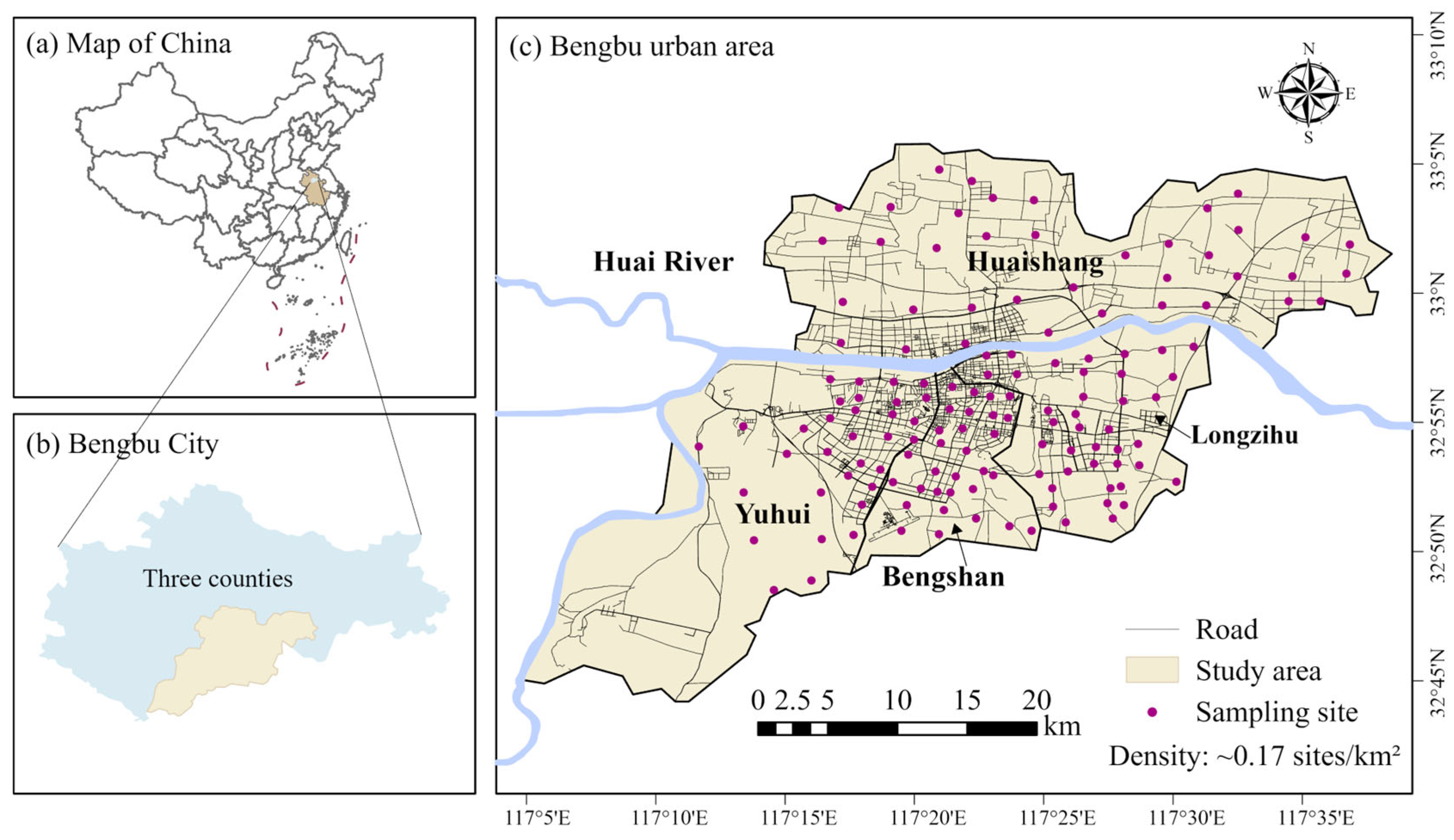
A total of 139 topsoil samples (0–20 cm depth) were collected from the urban core of Bengbu, covering four administrative districts: Yuhui (32 samples), Bengshan (30 samples), Longzihu (39 samples), and Huaishang (38 samples). The sampling design was purposive and non-uniform, aiming to capture the spatial heterogeneity of potential anthropogenic pollution. Specifically, a higher sampling density was applied in areas with intensive human activities, such as along major transportation networks, within commercial/residential zones, and around historical industrial complexes, as these are hotspots for heavy metal emissions. Conversely, a lower density was used in urban parks and peri-urban greenspaces to represent background conditions. This strategy ensures that the sampling effort is weighted towards locations where anthropogenic impacts are most pronounced, thereby improving the efficiency of source identification. The spatial distribution of sampling sites is presented in Figure 1.
Figure 1. Sampling point distribution.
Sample locations were recorded with GPS. In the field, each composite sample (approximately 1 kg) was collected from a 1 m × 1 m area using a pre-cleaned stainless- steel shovel. After collection, each sample was immediately sealed in a pre-cleaned polyethylene bag, labeled with a unique ID, and transported to the laboratory at 4 °C for preservation. Prior to analysis, samples were air-dried at room temperature for 72 h, manually homogenized using agate mortar, and sieved through 0.149 mm nylon mesh for chemical analysis. Visible plant residues and anthropogenic particles were removed during sieving. Processed samples were stored in acid-washed glass containers until further treatment.
The analysis targeted nine elements of environmental concern: eight heavy metals (Cd, Cr, Cu, Hg, Mn, Ni, Pb, Zn) and the metalloid arsenic (As). Hereafter, they are collectively referred to as “heavy metals” for brevity, in accordance with common practice in environmental studies.
The soil samples were analyzed for the total concentrations of heavy metals. Initially, the concentrations of Cr, Ni, Cu, Pb, Zn, and Mn were determined by atomic absorption spectrometry (AAS), As by hydride generation-atomic fluorescence spectrometry (HG-AFS), and Hg by cold vapor-atomic fluorescence spectrometry (CV-AFS), following aqua regia digestion [25]. To ensure the highest data quality for cadmium (Cd), this key pollutant was analyzed using the latest standard (HJ 1315-2023) in conjunction with ICP-MS [26]. These samples underwent total digestion using a mixed acid system (HCl-HNO3-HF-HClO4) on an electric hotplate, in accordance with HJ 1315-2023, and the resulting digests were analyzed for Cd by inductively coupled plasma mass spectrometry. A comprehensive quality assurance/quality control (QA/QC) protocol was implemented, which included the analysis of certified reference material QXBW-2 in each batch, along with procedural blanks and duplicate samples (10%). The recoveries for all elements ranged from 92% to 103%, confirming the accuracy of the entire analytical process.

2.3. Potential Ecological Risk Assessment (PERA)

PERA is a quantitative methodology designed to evaluate the ecological hazards posed by heavy metals by integrating concentration data, toxicity parameters, and environmental behavior [27]. The risk is quantified through two hierarchical indices: Single-Element Risk Coefficient E r i and Composite Risk Index (RI), with its calculation formula expressed as follows:
RI = i = 1 n E r i = i = 1 n ( T r i × C i C i b )
where T r i is the toxic response factor with the following values: Cr = 2, Cu = Pb = Ni = 5, Mn = Zn = 1, As = 10, Hg = 40, and Cd = 30 [28]. C i represents measured concentration of heavy metal i (mg/kg). C i b is the reference value, using the soil background value (mg/kg). The risk grading criteria for E r i and RI are specified in Table 1 [27].
Table 1. Grading criteria for E r i and RI.

2.4. APCS-MLR Model

The Absolute Principal Component Scores–Multiple Linear Regression (APCS-MLR) model is a receptor modeling approach that combines principal component analysis (PCA) with multivariate linear regression to quantify contamination source contributions [29]. Prior to analysis, all heavy metal concentrations were normalized through Z-score standardization to eliminate scale effects:
Z ij = X ij μ j σ j
where X i j represents the measured concentration of element j in ith soil sample, and μ j and σ j are the mean and standard deviation of element j, respectively.
Subsequently, principal component analysis (PCA) was applied to the standardized data to extract pollution sources, followed by calculation of absolute principal component scores (APCS) through origin adjustment:
Z = FL T + E     and     A = F F 0
where F = factor scores (sample projections), L = loadings (variable contributions), and E = residuals. F0 represents the factor scores of a synthetic zero-concentration sample, transforming the relative PCA scores into absolute values.
These APCS values were then employed as independent variables in multiple linear regression against measured metal concentrations:
X ij = p = 1 k β p A ip + ε i
where β p is the regression coefficient for source p, and ε i is the residual error.
The contribution (Cpj) of source p to element j was calculated as:
C pj = β p × A ¯ p p = 1 k β p × A ¯ p × 100 %
where A ¯ p means APCS value of source p. Residuals (<10%) indicated unexplained variability.

3. Results and Discussion

3.1. Descriptive Statistics of Heavy Metal Concentrations and Risk Assessment

Soil heavy metal concentrations in research area are shown in Table 2. Quantitative analysis reveals the following mean concentrations (mg/kg): manganese (Mn, 421.354) > zinc (Zn, 60.704) > chromium (Cr, 40.937) > nickel (Ni, 32.279) > copper (Cu, 32.238) > lead (Pb, 30.869) > arsenic (As, 1.247) > mercury (Hg, 0.164) > Cadmium (Cd, 0.095). This sequence notably deviates from the typical geochemical abundance sequence observed in uncontaminated soils of China (Mn > Zn > Cr > Ni > Pb > Cu > As > Cd > Hg) [30]. Specifically, the positions of copper (Cu) and lead (Pb), as well as mercury (Hg) and cadmium (Cd), are reversed compared to the abundance sequence. This discrepancy strongly suggests an alteration of the natural geochemical baseline due to anthropogenic inputs.
Table 2. Summary statistics of heavy metal concentrations (mg/kg).
Furthermore, in terms of mean concentrations, a comparison with the background values of the Jianghuai River Basin [31] reveals that Pb, Zn, Cu, Ni, and Hg all exceed background levels, measuring 1.19, 1.14, 1.29, 1.29, and 4 times the background values, respectively. The ratios of samples exceeding the local background levels for Cr, Cu, Mn, Ni, Pb, Zn, As, Hg, and Cd were 0%, 88.49%, 9.35%, 87.05%, 69.06%, 47.48%, 0%, 100%, and 28.06% respectively. The maximum concentration of lead (Pb) exceeded the trigger values for preliminary risk screening of certain land use types specified in the Soil Environmental Quality-Risk Control Standard for Soil Contamination of Agricultural Land [32], indicating that detailed risk assessment and source identification are required. The consistently elevated mercury (Hg) levels are of particular concern, as atmospheric deposition from coal combustion and historical industrial activities is likely a major contributing factor in this industrial city.
In this study, CV values ranged from 18.5% (Cr) to 74.8%(Hg), exhibiting a distinct hierarchy: Hg (74.8%) > Cd (52.8%) > Zn (45.1%) > Pb (44.5%) > As (38%) > Cu (24%) > Ni (21%) > Mn (19.8%) > Cr (18.5%). The spatial heterogeneity, indicated by high CV values for Hg and Cd, not only confirms strong anthropogenic influence but also suggests that these pollutants originate from localized historical activities (e.g., specific industrial plants, waste sites) rather than uniform diffuse sources. Conversely, the low CV of Cr and Mn strengthens the argument for a homogeneous natural origin, serving as a stable geochemical baseline against which anthropogenic pollution can be measured.
Within China, Bengbu’s pollution profile is distinct. Compared to mega-industrial hubs in the Yangtze River Delta like Nanjing and Shanghai [33,34] (Table 2), concentrations of most elements were substantially lower, reflecting differences in industrial intensity and more recent environmental governance. A more telling contrast emerges with the nearby resource city of Suzhou (Anhui) [35], where Bengbu shows markedly lower levels of Cr, Mn, and Ni but higher Pb. This directly points to divergent dominant sources: mining and mineral processing in Suzhou versus traffic and legacy industry in Bengbu. Furthermore, Bengbu’s Pb level is comparable to that in the Guangzhou-Foshan area [36], a common signature of urbanization. Interestingly, compared to the northern heavy industrial base of Tangshan [37], Bengbu’s profile shows lower levels of typical smelting-related pollutants like Zn and Cd, but higher Cu and Hg, underscoring how regional industrial legacy shapes distinct elemental signatures. In a broader Asian context, Bengbu’s profile again highlights source-specific contrasts. Its higher Cr and Ni but lower Pb and Cd than India may reflect varied industrial composition and earlier phase-out of leaded fuels [38]. The dramatically lower concentrations (especially As and Cd) compared to a Vietnamese mining district simply reaffirm that local, intensive extractive activities create uniquely severe contamination, unlike Bengbu’s more diffuse urban-industrial pattern [39].
This comparative analysis confirms that Bengbu’s urban soils exhibit a moderate but distinct pattern of heavy metal enrichment, characteristic of a developing industrial city within a watershed. The levels are sufficient to warrant concern and source control but are not among the highest regionally.
The single-element potential ecological risk assessment for heavy metals in the soil are shown in Table 3. It can be seen that the E r i values for Cr, Cu, Mn, Ni, Pb, Zn, and As were all below 40, indicating a low ecological risk level. For Cd, 85.61% of sites were at low risk and 14.39% were at moderate risk. In contrast, Hg posed a significantly higher potential ecological risk, primarily classified as high risk. The proportion of sampling sites exhibiting high risk reached 64.75%, while sites with moderate risk, very high risk, and catastrophic risk accounted for 7.19%, 18.71%, and 9.35%, respectively.
Table 3. E r i statistical values of soil heavy metal.
The comprehensive potential ecological risk index (RI) for soil in the main urban area of Bengbu City ranges from 73.55 to 851.83, with an average value of 210.3. Among the samples, 45 (32.37%) exhibited a risk index (RI) < 150, while 74 (53.24%) had RI values ≥ 150 but <300. Additionally, 18 samples (12.95%) showed RI levels ≥ 300 but <600, and 2 samples (1.44%) demonstrated RI values ≥ 600 (Table 4). Overall, the regional average ecological risk index (RI) is 210.30, categorized as a moderate risk level.
Table 4. RI statistical values of soil heavy metal.
The ecological risk assessment quantitatively confirms that Hg is the primary risk driver in the region, contributing disproportionately to the comprehensive risk index (RI). This aligns with its high concentration and toxicity factor. The fact that a substantial portion of samples fall into the “high” to “very high” risk categories for Hg alone necessitates immediate attention to mercury-emitting sources. While Cd and other metals currently pose lower collective risk, the presence of sites with moderate Cd risk warrants pre-emptive monitoring to prevent future escalation. These risk results directly inform priority areas for the subsequent source apportionment analysis, emphasizing the need to pinpoint and quantify Hg and Cd sources.

3.2. Spatial Distribution of Heavy Metals Using Kriging Interpolation

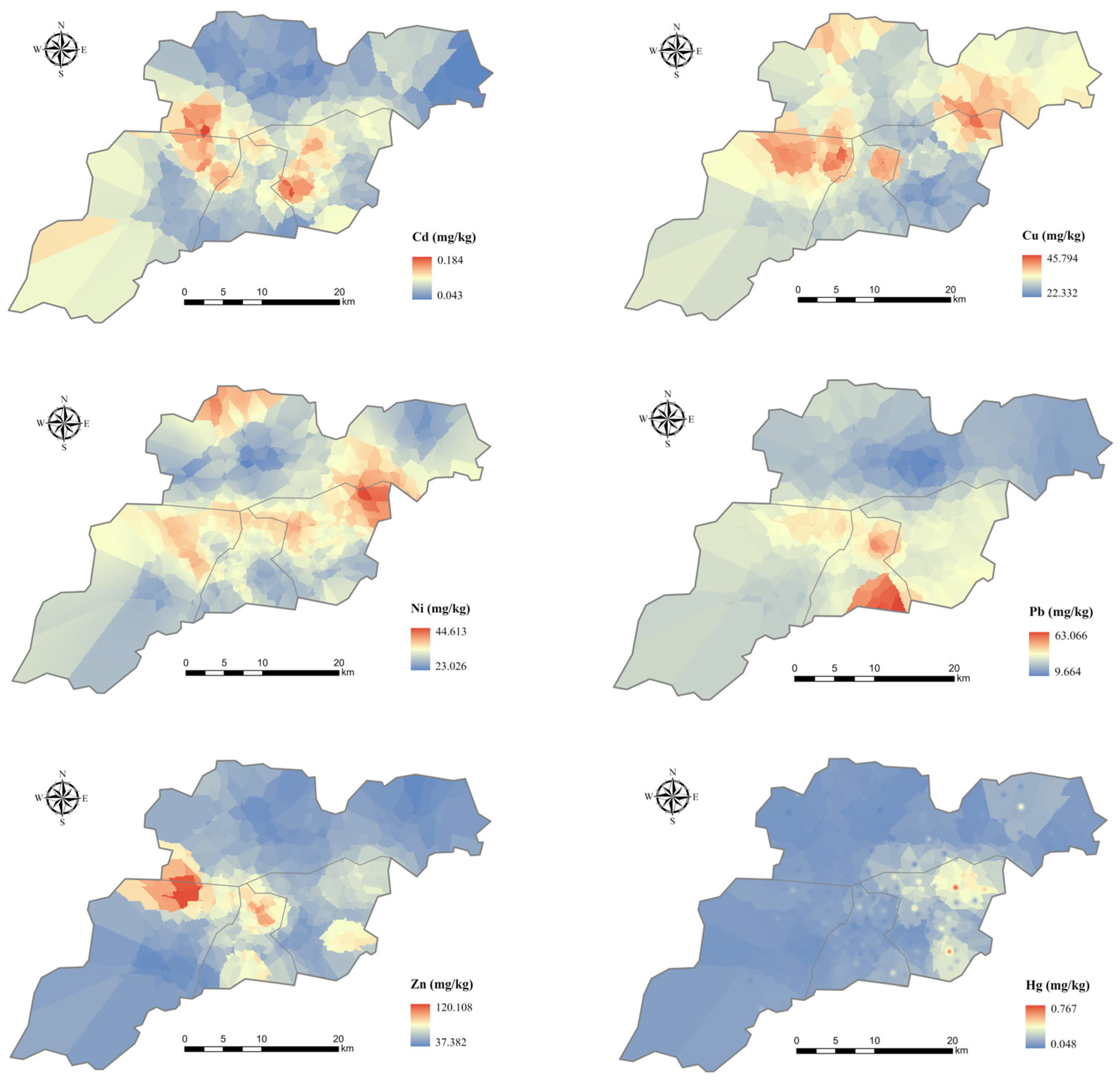
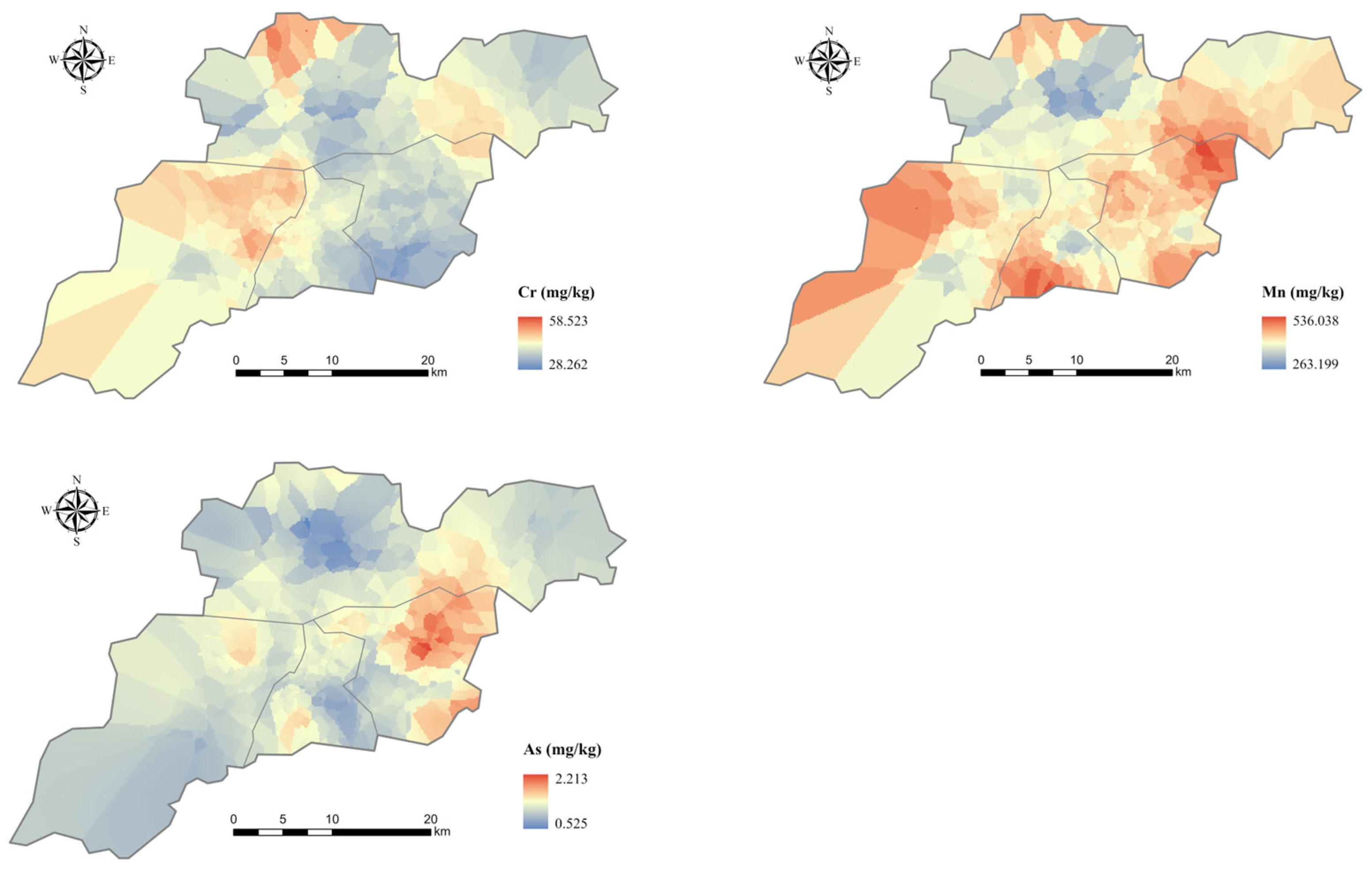
Spatial interpolation via the Kriging method of the nine heavy metals are shown in Figure 2. Based on the above analysis, the content of Cr and As at all sampling points within the study area is below the soil background values, indicating a clean and uncontaminated status. For the element Mn, the average concentration across all sampling points is significantly lower than the background value, with only 9.35% of sites exceeding the background concentration, indicating minimal contamination. Therefore, particular attention should be given to the spatial distribution of the remaining six elements (Cd, Cu, Pb, Zn, Ni and Hg), whose distribution maps are presented in the preceding sections, to identify pollution hotspots.
Figure 2. Kriging-based spatial analysis map of heavy metals.
Observations reveal varying concentrations of the six heavy metals across the four administrative districts (Longzihu, Bengshan, Yuhui, and Huaishang), as illustrated in Figure 2. The spatial distributions of Ni and Cu exhibit a distinct pattern along the Huai River, while the high-value zones of Pb and Zn demonstrate notable similarity. Specifically, elevated Zn concentrations are observed near the old industrial zone in the western Yuhui District along the Huai River, a characteristic also shared by Cd. In contrast, the high-value area for Pb is located in the Qianshan Village, south of Bengshan District, where the presence of a lead mine has contributed to the formation of this pollution hotspot.
Compared to these districts, Huaishang District shows relatively lower concentrations of Ni, Pb, Zn, and Hg. This can be attributed to the historical concentration of industrial activities in the old urban areas on the south bank of the Huai River, while the north bank (where Huaishang is situated) has historically had less industrial development. Notably, Longzihu District recorded the highest Hg concentrations, with elevated values clustered near its eastern old industrial zone. These findings underscore the necessity for developing region-specific pollution mitigation strategies.

3.3. Source Apportionment of Soil Heavy Metals

3.3.1. Principal Component Analysis

Prior to principal component analysis, the initial concentration data of heavy metals were standardized (converted to Z-scores) to achieve a mean of zero and a standard deviation of one. The suitability of this processed dataset for factor analysis was confirmed by a Kaiser-Meyer-Olkin (KMO) value of 0.708 and a significant Bartlett’s test of sphericity (p < 0.001). Principal Component Analysis (PCA) with Varimax rotation was performed, extracting four principal components. These components collectively accounted for 74.627% of the total variance, providing an adequate representation of the underlying data structure. The variance explained and rotated component matrix are presented in Table 5 and Table 6, respectively.
Table 5. Total Variance Explained.
Table 6. Rotated Component Matrix.
The primary component (PC1), accounting for the largest proportion of total variance, exhibits a distinct industrial fingerprint characterized by high loadings of Cr (0.889), Ni (0.776), and Cu (0.756) [40,41]. This elemental association is geochemically coherent, as Cr, Ni, and Cu are classic siderophile (iron-loving) elements that commonly coexist in mafic minerals and are released together during the weathering of local bedrock. This elemental triad aligns with emissions from precision manufacturing and metallurgical activities prevalent in Bengbu’s industrial zones (e.g., machinery production parks and electronic waste recycling facilities). The exceedance rates of Cu (88.49%) and Ni (87.05%) over background values clearly demonstrate a clear superimposition of anthropogenic point-source pollution (e.g., from electroplating, alloy processing, and e-waste dismantling) onto this pre-existing geogenic association, amplifying their concentrations above the natural baseline. The low background concentration of Cr highlights the extent of its anthropogenic enrichment. Although industrial emissions may include toxic hexavalent chromium [Cr(VI)], it is readily reduced to less mobile and less toxic trivalent chromium [Cr(III)] in most soils and immobilized through adsorption or precipitation. This geochemical attenuation process explains the presence of significant industrial Cr inputs with currently constrained direct environmental risks.
In Principal Component 2 (PC2), Mn (0.742) and As (0.727) are the dominant elements. The former (Mn) is typically associated with the weathering of natural parent materials, while the latter (As) is a characteristic tracer for coal combustion [42,43]. This interpretation is further supported by the significant loading of Hg (0.693) [44]. Although As shows no exceedance over the background value, its significant loading reflects that it is strongly coupled with Hg and Mn. This association can be understood through classic geochemical concepts: As and Hg are both chalcophile (sulfur-loving) elements, which predisposes them to co-migrate and associate under reducing conditions. Meanwhile, manganese, as a redox-sensitive element, forms oxides and hydroxides that are powerful adsorbents in soils, capable of co-scavenging and immobilizing both As and Hg released from combustion sources. The identification of this coal combustion signal is consistent with Bengbu’s historical context as a traditional industrial city with a coal-dominated energy infrastructure. Consequently, PC2 likely represents a mixed source where emissions from historical coal combustion have been filtered and recorded by the natural geochemical processes of the local soil environment.
Principal Component 3 (PC3), dominated by Pb and Zn with loadings of 0.766 and 0.854, respectively, was identified as a traffic emission source [45,46]. This identification is consistent with numerous studies that have successfully traced Pb (historically from leaded gasoline) and Zn (primarily from tire and brake wear) to vehicular sources in urban environments [47,48,49]. Spatial distribution mapping further revealed that the high-value areas represented by PC3 (i.e., the hotspots of Pb and Zn) exhibited significant spatial overlap and were predominantly concentrated within the densely populated urban center. The co-localization of Pb and Zn pollution hotspots in central urban areas has been widely reported in other cities, reinforcing the link to high-density traffic and human activities [50]. The high factor loadings and spatially coupled hotspots of Pb and Zn are not coincidental but reflect the legacy of intensive, long-term transportation activities in Bengbu’s urban core. Designated as “a city born from the railway”, this area has sustained the highest density of human mobility and associated infrastructure for over a century. Consequently, it has accumulated a historical reservoir of Pb, for which leaded gasoline combustion during the automobile era was an important source [51]. Notably, the long-term fate of these traffic-derived metals in soils diverges due to their distinct geochemical behaviors: Pb immobilizes strongly through adsorption and precipitation, forming a persistent ‘legacy’ pool, whereas Zn is relatively more mobile. This legacy Pb is now continually re-suspended and mixed with contemporary non-exhaust emissions like Zn from tire and brake wear, creating the persistent hotspots observed today [52]. Their spatial co-localization, despite divergent geochemical mobility, underscores the intensity and historical continuity of the traffic source in the urban core. This pattern, where a city’s industrial and transportation legacy cumulatively shapes its contemporary soil pollution profile, has been observed in other historical industrial or transportation hubs [53].
A pivotal finding of this study is the identification of a unique source for cadmium (Cd). In the rotated component matrix, Cd formed an independent Principal Component 4 (PC4) with an extremely high loading (0.988). This clear segregation indicates that the sources of Cd contamination in Bengbu’s urban soils are decoupled from other heavy metals. This decoupling is geochemically significant: cadmium, a volatile chalcophile element, often separates from its geochemical analogs (e.g., Zn) during high- temperature anthropogenic processes. Consequently, PC4 is defined as a ‘Specific Cadmium Source’. The spatial distribution pattern provides critical clues to its nature: elevated concentrations were primarily clustered at the border between Yuhui and Huaishang Districts along the Huai River, as well as near the university town in Longzihu District. This clustered, non-diffuse pattern suggests inputs from localized historical activities, rather than a widespread, uniform source. The elevated concentrations may thus be related to localized historical agricultural practices (e.g., use of specific fertilizers or irrigation water) and/or distinct industrial legacy points along the Huai River [54,55].

3.3.2. Further Quantitative Analysis Based on APCS-MLR

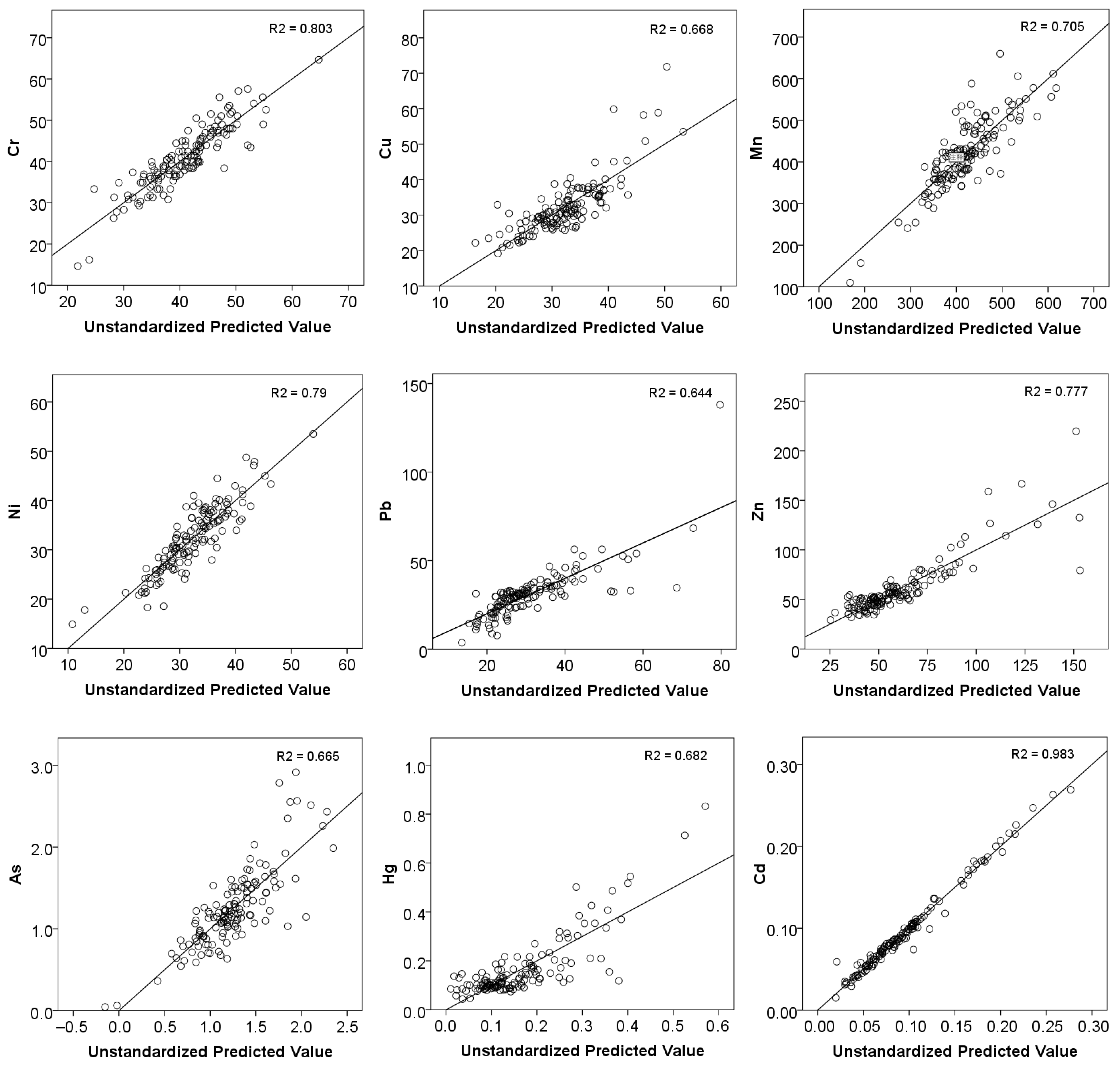
The absolute principal component scores (APCS) for the three main factors were calculated from the principal component analysis (PCA). Subsequently, multiple linear regression (MLR) was performed using the measured concentrations of heavy metals in the soil as the dependent variable and the absolute factor scores as the independent variables. The coefficient of determination R2 was used to evaluate the correlation between the model and the observed values. A value closer to 1 indicates a stronger linear fit and better model performance. In this study, the R2 values of the regression models for Cr, Cu, Mn, Ni, Pb, Zn, As, Hg, and Cd were 0.803, 0.668, 0.705, 0.79, 0.644, 0.777, 0.665, 0.682, and 0.983, respectively. Figure 3 shows a strong agreement between the measured and predicted concentrations of the heavy metal. The data points are closely distributed along the line of perfect agreement (y = x), demonstrating a good fit of the model.
Figure 3. Scatter Plot of Observed vs. Predicted Values.
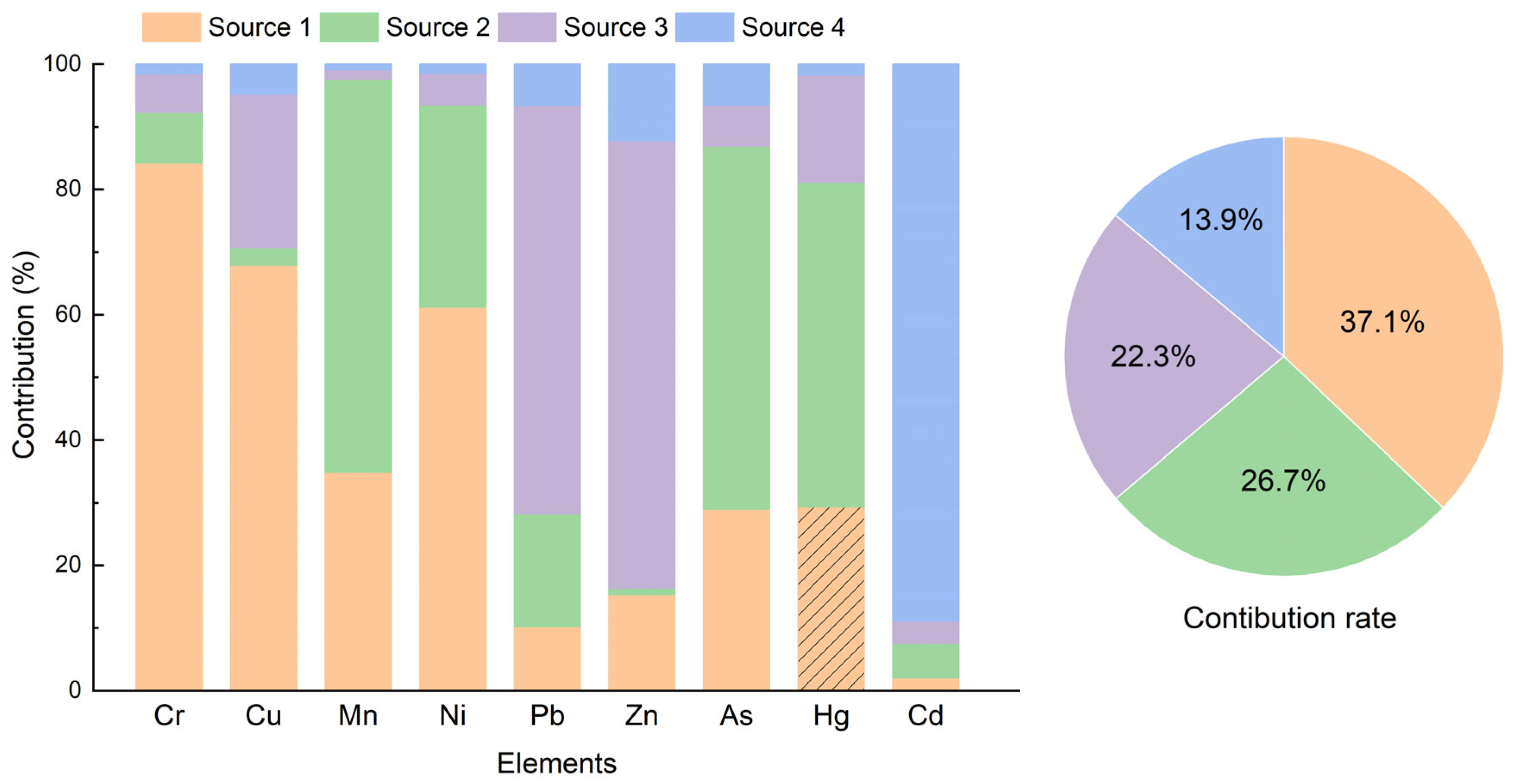
Quantitative calculations revealed the contribution rates of the four sources to both the individual heavy metals and the total pollution load in the study area, as detailed in Figure 4. When combined with the prior principal component analysis, Source 1 was dominated by industrial emissions (precision manufacturing and metallurgical activities), contributing substantially to heavy metals Cr, Cu, and Ni at 84.20%, 67.87%, and 61.25%, respectively. Notably, while Source 1 accounted for 29.33% of Hg contamination, it functioned as a suppressing source, indicated by hatched patterns in the Source 1 bar for Hg (Figure 4). Source 2 represented a mixed source, contributing 62.77% to Mn, 57.90% to As, and 51.78% to Hg. Source 3, identified as a traffic emission source, showed dominant contributions to Pb (65.17%) and Zn (71.36%). Source 4, as a special cadmium source, contributes up to 88.92% of the total cadmium, which may be related to non-ferrous metal smelting, electroplating, and historical agricultural practices. Collectively, Sources 1, 2, 3, and 4 contributed 37.1%, 26.7%, 22.3% and 13.9% to total heavy metal contamination in the study area.
Figure 4. Contribution rate of different sources to soil heavy metal content. (The hatched pattern indicates a suppressing source.)

4. Conclusions

This study provides a systematic investigation into the contamination characteristics, ecological risks, and sources of heavy metals in the urban soils of Bengbu, a representative industrial city in the Huai River Basin. By integrating geostatistical analysis, ecological risk assessment, and receptor modeling, the main findings and their broader implications are summarized as follows:
The contamination profile is characterized by moderate multi-element enrichment. Mercury (Hg) was identified as a pervasive and priority pollutant, exceeding local background values in all samples, making it the primary driver of ecological risk. Cadmium (Cd) also contributed significantly to risk due to its high toxicity. In contrast, elements like Mn, Cr and As remained at or below background levels, highlighting the dominant control of natural pedogenesis for these elements at the regional scale. This pattern underscores that in post-industrial cities, the foremost environmental risk may not stem from the most abundant metals, but from trace yet highly toxic contaminants.
Source apportionment via receptor modeling and GIS identified four primary sources: industrial activities (contributing 37.1%) loaded with Cr, Cu, and Ni, reflecting the superimposition of precision manufacturing emissions on their shared siderophile geochemical background; a mixed source (26.7%) characterized by Mn, As, and Hg, where the coal combustion signal is captured and modulated by natural soil adsorption processes; traffic emissions (22.3%) represented by Pb and Zn, demonstrating a persistent spatial legacy of long-term urban mobility; and a specific cadmium source (13.9%), whose statistical independence and clustered spatial pattern point to localized historical inputs distinct from other diffuse sources. This quantitative and mechanistic understanding of sources provides a direct scientific basis for developing targeted pollution control strategies.
The contamination profile of Bengbu urban area—moderate enrichment, Hg-dominant risk, a clear transportation legacy, and the presence of independent, localized pollutants like Cd—exemplifies a common scenario for many rapidly urbanizing industrial cities within watersheds. The key conceptual insight that “pollution sources are stratified upon and interact with the natural geochemical background” is universally applicable. This study thus provides a replicable scientific template for environmental assessment in similar urban settings undergoing industrial transition.

Author Contributions

Conceptualization, Methodology, Data curation and Writing—original draft, L.M.; Software, Resources and Visualization, X.L.; Investigation, Validation and Writing—review and editing, J.W. All authors have read and agreed to the published version of the manuscript.

Funding

This research was funded by Outstanding Young Scholars Research Project of Anhui Provincial Department of Education, China, 2022AH020098; Natural Science Research Project of Anhui Provincial Department of Education, China, 2022AH051912; University-Enterprise Cooperative Project, 00013411 & 00012719; Scientific Research Project of Bengbu University, 2024YYX40pj.

Institutional Review Board Statement

Not applicable.

Data Availability Statement

The data that support the findings of this study are available from the corresponding authors, upon reasonable request.

Conflicts of Interest

The authors declare no conflicts of interest.

References

  1. Yang, Q.; Li, Z.; Lu, X.; Duan, Q.; Huang, L.; Bi, J. A review of soil heavy metal pollution from industrial and agricultural regions in China: Pollution and risk assessment. Sci. Total Environ. 2018, 642, 690–700. [Google Scholar] [CrossRef]
  2. Han, Q.; Liu, Y.; Feng, X.; Mao, P.; Sun, A.; Wang, M.; Wang, M. Pollution effect assessment of industrial activities on potentially toxic metal distribution in windowsill dust and surface soil in central China. Sci. Total Environ. 2021, 759, 144023. [Google Scholar] [CrossRef]
  3. Nagajyoti, P.C.; Lee, K.D.; Sreekanth, T.V.M. Heavy metals, occurrence and toxicity for plants: A review. Environ. Chem. Lett. 2010, 8, 199–216. [Google Scholar] [CrossRef]
  4. Hu, B.; Shao, S.; Ni, H.; Fu, Z.; Shi, Z. Current status, spatial features, health risks, andpotential driving factors of soil heavy metal pollution in China at province level. Environ. Pollut. 2020, 266, 114961. [Google Scholar] [CrossRef]
  5. Chen, H.; Wang, L.; Hu, B.; Xu, J.; Liu, X. Potential driving forces and probabilistic health risks of heavy metal accumulation in the soils from an e-waste area, southeast China. Chemosphere 2022, 289, 133182. [Google Scholar] [CrossRef] [PubMed]
  6. Zhang, J.; Peng, W.; Huang, X.; Lin, M. Health risk assessment of soil heavy metals in the urban-rural area of lanzhou city, Gansu province, China. Pol. J. Environ. Stud. 2025, 34, 917–927. [Google Scholar] [CrossRef]
  7. Hong, N.; Yang, B.; Tsang, D.C.; Liu, A. Comparison of pollutant source tracking approaches: Heavy metals deposited on urban road surfaces as a case study. Environ. Pollut. 2020, 266, 115253. [Google Scholar] [CrossRef] [PubMed]
  8. Pan, C.; Yu, F.; Tao, X.; Guo, J.; Yu, Y. Contamination, spatial distribution and source analysis of heavy metals in surface soil of Anhui Chaohu economic development zone, China. Sustainability 2020, 12, 8117. [Google Scholar] [CrossRef]
  9. Bhuiyan, M.A.H.; Parvez, L.; Islam, M.A.; Dampare, S.B.; Suzuki, S. Heavy metal pollution of coal mine-affected agricultural soils in the northern part of Bangladesh. J. Hazard. Mater. 2010, 173, 384–392. [Google Scholar] [CrossRef]
  10. Konstantinova, E.; Minkina, T.; Sushkova, T.; Konstantinov, A.; Rajput, V.D.; Sherstnev, A. Urban soil geochemistry of an intensively developing Siberian city: A case study of Tyumen. Russia. J. Environ. Manag. 2019, 239, 366–375. [Google Scholar] [CrossRef] [PubMed]
  11. Yang, Y.; Tian, Q.; Niu, Y.; Wang, Z. Soil heavy metal source apportionment and environmental differentiation study in Dulan County, Qinghai Province, using geodetector analysis. Environ. Monit. Assess. 2024, 196, 70. [Google Scholar] [CrossRef]
  12. Song, H.; Hu, K.; An, Y.; Chen, C.; Li, G. Spatial distribution and source apportionment of the heavy metals in the agricultural soil in a regional scale. J. Soils Sediments 2018, 18, 852–862. [Google Scholar] [CrossRef]
  13. Chen, T.; Zhang, R.; Wang, H.; Dong, X.; Zheng, S.; Chang, Q. Source governance-oriented zoning for heavy metal pollution in farmland soil: A case study of an industrial park in mid-western Shaanxi province, China. Water Air Soil Pollut. 2024, 235, 330. [Google Scholar] [CrossRef]
  14. Fei, X.; Lou, Z.; Xiao, R.; Ren, Z.; Lv, X. Source analysis and source-oriented risk assessment of heavy metal pollution in agricultural soils of different cultivated land qualities. J. Clean. Prod. 2022, 341, 130942. [Google Scholar] [CrossRef]
  15. Guan, Q.; Zhao, R.; Pan, N.; Wang, F.; Yang, Y.; Luo, H. Source apportionment of heavy metals in farmland soil of Wuwei, China: Comparison of three receptor models. J. Clean. Prod. 2019, 237, 117792. [Google Scholar] [CrossRef]
  16. Zhang, S.; Wang, L.; Zhang, W.; Wang, L.; Shi, X.; Lu, X.; Li, X. Pollution assessment and source apportionment of trace metals in urban topsoil of Xi’an City in northwest China. Arch. Environ. Contam. Toxicol. 2019, 77, 575–586. [Google Scholar] [CrossRef] [PubMed]
  17. Wang, Z.; Hong, N.; Chen, Y.; Cheng, G.; Liu, A.; Huang, X.; Tan, Q. Systematic evaluations of receptor models in source apportionment of particulate solids in road deposited sediments: A practical application for tracking heavy metal sources on urban road surfaces. J. Hazard. Mater. 2025, 485, 136912. [Google Scholar] [CrossRef]
  18. He, Y.; Zhang, Q.; Wang, W.; Hua, J.; Li, H. The multi-media environmental behavior of heavy metals around tailings under the influence of precipitation. Ecotoxicol. Environ. Saf. 2023, 266, 115541. [Google Scholar] [CrossRef]
  19. Habib, M.A.; Islam, A.M.T.; Varol, M.; Phoungthong, K.; Khan, R.; Islam, M.S.; Hasanuzzaman, M.; Mia, M.Y.; Costache, R.; Pal, S.C. Receptor model-based source-specific health risks of toxic metal(loid)s in coal basin-induced agricultural soil in northwest Bangladesh. Environ. Geochem. Health 2023, 45, 8539–8564. [Google Scholar] [CrossRef] [PubMed]
  20. Wang, Y.; Yang, S.; Xiao, J.; Zhao, S.; Wang, Y.; Luo, M.; Uddin, M.; Zhang, Y. Using PCA-APCS-MLR and Monte-Carlo models to quantify the source and ecological-health risk of soil potentially toxic elements in a typical agricultural area. Stoch. Environ. Res. Risk Assess. 2025, 39, 3313–3332. [Google Scholar] [CrossRef]
  21. Wang, M. Source analysis of heavy metals in typical farmland soils based on PCA-APCS-MLR and geostatistics. Environ. Sci. 2023, 44, 3509–3519. (In Chinese) [Google Scholar]
  22. Zhang, W.; Yan, Y.; Yu, R.; Hu, G. The sources-specific health risk assessment combined with APCS/MLR model for heavy metals in tea garden soils from south Fujian Province, China. Catena 2021, 203, 105306. [Google Scholar] [CrossRef]
  23. Guo, B.; Su, Y.; Pei, L.; Wang, X.; Zhang, B.; Zhang, D.; Wang, X. Ecological risk evaluation and source apportionment of heavy metals in park playgrounds: A case study in Xi’an, Shaanxi Province, a northwest city of China. Environ. Sci. Pollut. Res. 2020, 27, 24400–24412. [Google Scholar] [CrossRef]
  24. Jahan, I.; Reza, A.H.M.S.; Haque, M.M.; Reza, M.S.; Hasan, M.I. Soil pollution and elemental sources along Barapukuria coal mine, Bangladesh: Implications for eco-environmental and health risk assessment. Heliyon 2024, 10, e32620. [Google Scholar] [CrossRef]
  25. NY/T 1613-2008; Soil Quality-Analysis of Soil Heavy Metals-Atomic Absorption Spectrometry with Aqua Regia Digestion. Ministry of Agriculture of the People’s Republic of China: Beijing, China, 2008.
  26. HJ 1315-2023; Determination of Total 19 Metal Elements in Soil and Sediment by Inductively Coupled Plasma Mass Spectrometry. Ministry of Ecology and Environment of the People’s Republic of China: Beijing, China, 2023.
  27. Håkanson, L. An ecological risk index for aquatic pollution control. A sedimentological approach. Water Res. 1980, 14, 975–1001. [Google Scholar] [CrossRef]
  28. Tang, Z.; Zhou, M.; Zhang, M.; Zhang, X.; Tian, F.; Liu, B.; Zhou, Q.; Weng, B.; Jiang, H. Source analysis and ecological risk assessment of heavy metals in soil of the Yifeng County, Jiangxi Province based on APCS-MLR model. Environ. Sci. 2025, 46, 4674–4683. (In Chinese) [Google Scholar]
  29. Deng, S.; Luo, S.; Lin, Q.; Shen, L.; Gao, L.; Zhang, W.; Chen, J.; Li, C. Analysis of Heavy Metal and Arsenic Sources in Mangrove Surface Sediments at Wulishan Port on Leizhou Peninsula, China, Using the APCS-MLR Model. Ecotoxicol. Environ. Saf. 2024, 283, 116788. [Google Scholar] [CrossRef]
  30. Wei, F.; Chen, J.; Wu, Y.; Zhen, C. Study on the background contents on 61 Elements of Soils in China. China J. Environ. Sci. 1991, 12, 12–19. (In Chinese) [Google Scholar]
  31. Chen, X.; Chen, F.; Jia, S.; Chen, Y. Soil geochemical baseline and background in Yangtze River-Huai River basin of Anhui Province. Geol. China 2012, 39, 302–310. (In Chinese) [Google Scholar]
  32. GB15618-2018; Soil environmental quality risk control standard for soil contamination of agricultural land. Ministry of Ecology and Environment of the People’s Republic of China & State Administration for Market Regulation: Beijing, China, 2018.
  33. Li, Y.; Feng, D.; Ji, M.; Li, Z.; Zhang, R.; Gu, C. The risk characteristics of heavy metals in urban soil of typical developed cities in China. Environ. Monit. Assess. 2022, 194, 132. [Google Scholar] [CrossRef]
  34. Shen, C.; Huang, S.; Wang, M.; Wu, J.; Su, J.; Lin, K.; Chen, X.; He, T.; Li, Y.; Sha, C.; et al. Source-oriented health risk assessment and priority control factor analysis of heavy metals in urban soil of shanghai. J. Hazard. Mater. 2024, 480, 135859. [Google Scholar] [CrossRef]
  35. Chen, Y.; Ma, J.; Yang, Y.; Liu, X.; Wang, D.; Wu, C.; Dai, H. Geochemical baseline, pollution evaluation, and source apportionment of topsoil heavy metals in eastern Yongqiao District of Suzhou City, China. Sustainability 2025, 17, 9128. [Google Scholar] [CrossRef]
  36. Xiao, Y.; Guo, M.; Li, X.; Luo, X.; Pan, R.; Ouyang, T. Spatial distribution, pollution, and health risk assessment of heavy metal in agricultural surface soil for the Guangzhou-Foshan urban zone, South China. PLoS ONE 2020, 15, e0239563. [Google Scholar] [CrossRef]
  37. Sun, L.; Guo, D.; Liu, K.; Meng, H.; Zheng, Y.; Yuan, F.; Zhu, G. Levels, sources, and spatial distribution of heavy metals in soils from a typical coal industrial city of Tangshan, China. Catena 2019, 175, 101–109. [Google Scholar] [CrossRef]
  38. Sonkar, V.; Jaswal, V.; Chenlak, S.; Nandabalan, Y.K. Pollution status and health risk assessment of heavy metals in the soil of Sahibzada Ajit Singh (SAS) Nagar district of Punjab, India and its source apportionment. J. Geochem. Explor. 2024, 261, 107453. [Google Scholar] [CrossRef]
  39. Tran, T.; Dinh, V.; Nguyen, T.; Kim, K. Soil contamination and health risk assessment from heavy metals exposure near mining area in Bac Kan province, Vietnam. Environ. Geochem. Health 2022, 44, 1189–1202. [Google Scholar] [CrossRef]
  40. Kang, X.; Song, J.; Yuan, H.; Li, X.; Li, N.; Duan, L. Historical trends of anthropogenic metals in sediments of Jiaozhou Bay over the last century. Mar. Pollut. Bull. 2018, 135, 176–182. [Google Scholar] [CrossRef] [PubMed]
  41. Liu, X.; Huajian Chi, H.J.; Tan, Z.Q.; Yang, X.F.; Sun, Y.P.; Li, Z.T.; Hu, K.; Hu, F.F.; Liu, Y.; Yang, S.C.; et al. Heavy metals distribution characteristics, source analysis, and risk evaluation of soils around mines, quarries, and other special areas in a region of northwestern Yunnan, China. J. Hazard. Mater. 2023, 458, 132050. [Google Scholar] [CrossRef]
  42. Wei, R.; Meng, Z.; Zerizghi, T.; Luo, J.; Guo, Q. A comprehensive method of source apportionment and ecological risk assessment of soil heavy metals: A case study in Qingyuan city, China. Sci. Total Environ. 2023, 882, 163555. [Google Scholar] [CrossRef]
  43. Gao, F.; Zhou, J.; Jiang, J.; Sun, G. Heavy Metals Research in the Black Soil Region of Liaoning Province, China: Spatial Patterns, Risk Assessment, and Sources Apportionment. Processes 2025, 13, 57. [Google Scholar] [CrossRef]
  44. Gao, W.; Jiang, W.; Zhou, M. The spatial and temporal characteristics of mercury emission from coal combustion in China during the year 2015. Atmos. Pollut. Res. 2019, 10, 776–783. [Google Scholar] [CrossRef]
  45. Dong, W.; Niu, B.; Li, H.; Yan, D.; Li, J.; Xu, Z.; Wang, D.; Yang, X.; Zhang, Y.; Chen, Y.; et al. Sources, Contamination and Risk Assessment of Heavy Metals in Riparian Soils of the Weihe River Based on a Receptor Model and Monte Carlo Simulation. Sustainability 2024, 16, 10779. [Google Scholar] [CrossRef]
  46. Pan, L.; Ma, J.; Wang, X.; Hou, H. Heavy metals in soils from a typical county in Shanxi Province, China: Levels, sources and spatial distribution. Chemosphere 2016, 148, 248–254. [Google Scholar] [CrossRef] [PubMed]
  47. Liu, Z.; Wang, L.; Yan, M.; Ma, B.; Cao, R. Source apportionment of soil heavy metals based on multivariate statistical analysis and the PMF model: A case study of the Nanyang Basin, China. Environ. Technol. Innov. 2024, 33, 103537. [Google Scholar] [CrossRef]
  48. Men, C.; Liu, R.; Xu, L.; Wang, Q.; Guo, Q.; Miao, Y.; Shen, Z. Source-specific ecological risk analysis and critical source identification of heavy metals in road dust in Beijing, China. J. Hazard. Mater. 2020, 388, 121763. [Google Scholar] [CrossRef]
  49. Hou, S.; Zheng, N.; Tang, L.; Ji, X.; Li, Y.; Hua, X. Pollution characteristics, sources, and health risk assessment of human exposure to Cu, Zn, Cd and Pb pollution in urban street dust across China between 2009 and 2018. Environ. Int. 2019, 128, 430–437. [Google Scholar] [CrossRef]
  50. Sun, C.; Zhao, W.; Zhang, Q.; Yu, X.; Zheng, X.; Zhao, J.; Lv, M. Spatial distribution, sources apportionment and health risk of metals in Topsoil in Beijing, China. Int. J. Environ. Res. Public Health 2016, 13, 727. [Google Scholar] [CrossRef] [PubMed]
  51. Guo, G.; Lei, M.; Chen, T.; Song, B.; Li, X. Effect of road traffic on heavy metals in road dusts and roadside soil. Int. J. Acta Sci. Circumstantiae 2018, 10, 1937–1945. (In Chinese) [Google Scholar]
  52. Kang, J.; Liu, X.; Dai, B.; Liu, T.; Haider, F.U.; Zhang, P.; Habiba; Cai, J. Tyre wear particles in the environment: Sources, toxicity, and remediation Approaches. Sustainability 2025, 17, 5433. [Google Scholar] [CrossRef]
  53. Gong, M.; Wu, L.; Bi, X.; Ren, L.; Wang, L.; Ma, Z.; Bao, Z.; Li, Z. Assessing heavy-metal contamination and sourcesby GIS-based approach and multivariate analysisof urban–rural topsoils in Wuhan, central China. Environ. Geochem. Health 2010, 32, 59–72. [Google Scholar] [CrossRef]
  54. Fei, X.; Lou, Z.; Xiao, R.; Ren, Z.; Lv, X. Contamination assessment and source apportionment of heavy metals in agricultural soil through the synthesis of PMF and GeogDetector models. Sci. Total Environ. 2020, 747, 141293. [Google Scholar] [CrossRef] [PubMed]
  55. Du, J.; Wang, Z.; Liu, J.; Zhong, S.; Wei, C. Distribution characteristics of soil heavy metals, their source identiffcation and their changes inffuenced by anthropogenic cultivation activities in purple hilly regions of Sichuan Basin, China. J. Soil Sci. Plant Nutr. 2020, 20, 1080–1091. [Google Scholar] [CrossRef]
Disclaimer/Publisher’s Note: The statements, opinions and data contained in all publications are solely those of the individual author(s) and contributor(s) and not of MDPI and/or the editor(s). MDPI and/or the editor(s) disclaim responsibility for any injury to people or property resulting from any ideas, methods, instructions or products referred to in the content.

Article Metrics

Citations

Article Access Statistics

Multiple requests from the same IP address are counted as one view.