Article

Micromechanical Properties of Deep Carbonate Investigated by Coupling Nanoindentation and SEM-EDS

1
Research Institute of Petroleum Engineering and Technology, Northwest Oilfield Company, Sinopec, Kelamayi 834000, China
2
State Key Laboratory of Geomechanics and Geotechnical Engineering, Institute of Rock and Soil Mechanics, Chinese Academy of Sciences, Wuhan 430071, China
3
School of Petroleum Engineering, Yangtze University, Wuhan 430100, China
4
Key Laboratory of Intelligent Health Perception and Ecological Restoration of Rivers and Lakes, Ministry of Education, Hubei University of Technology, Wuhan 430068, China
*
Author to whom correspondence should be addressed.
Processes 2026, 14(2), 251; https://doi.org/10.3390/pr14020251 (registering DOI)
Submission received: 24 November 2025 / Revised: 26 December 2025 / Accepted: 31 December 2025 / Published: 10 January 2026
(This article belongs to the Section Petroleum and Low-Carbon Energy Process Engineering)

Abstract

As energy exploration and development continue to advance into deep and ultradeep formations, systematic studies of rock mechanical properties face significant challenges due to high core acquisition costs and sample damage under extreme conditions. To overcome these challenges, high-precision, minimally invasive, or non-destructive testing methods are urgently needed. This study systematically characterizes the microstructural features and mechanical heterogeneity of deep carbonate rocks from the Shunbei area by integrating XRD, SEM-EDS, and nanoindentation techniques. The results show that these rocks are primarily composed of a continuous calcite phase, with quartz as the secondary phase occurring in regional aggregates embedded within the calcite matrix. The two phases commonly exhibit an intergrown texture, and mineral distribution displays notable spatial heterogeneity and sample-to-sample variation. Nanoindentation tests reveal that the quartz phase exhibits excellent mechanical stability, with elastic moduli ranging from 70.6 to 101.8 GPa and hardness values between 10.8 and 13.5 GPa. The data are tightly clustered, indicating structural homogeneity and strong resistance to deformation. In contrast, the calcite phase shows lower and more scattered mechanical parameters, with elastic moduli of 27.4~76.0 GPa and hardnesses of 0.7~2.3 GPa, reflecting pronounced microscale heterogeneity. Furthermore, a strong negative correlation exists between hardness and maximum indentation depth, further confirming the dominant influence of mineral composition on local mechanical response. Notably, despite similar mineralogical compositions among samples A13, A15, and A18, their micromechanical performance follows the order A15 > A18 > A13, indicating that subtle differences in diagenetic history, crystal development, and local stress conditions can significantly affect rock mechanical behavior.

1. Introduction

Carbonate rocks are among the most widely distributed sedimentary rocks on Earth, accounting for about 20% of the total area of global sedimentary rocks [1,2]. In China, they account for nearly one-third of the land area, and are particularly well-developed in the Tarim Basin, Sichuan Basin, and Ordos Basin [3,4,5]. As an important oil and gas reservoir, carbonate rocks contain abundant oil and gas resources, with great potential for exploration and development. According to reports, about 40~60% of the world’s oil and gas reserves are stored in carbonate rocks [6], highlighting their key position in the energy landscape. In recent years, with the development of carbonate rock resources, deep and ultradeep marine carbonate rocks have become a key area for oil and gas resource exploration, and deep oil and gas resources account for about 40% of China’s total oil and gas reserves now [5].
The Shunbei target region is located in the northwestern part of the Shuntuoguole Lower Uplift, within the transition zone between the central and northern Tarim Basin [7]. It stands as a typically successful ultradeep carbonate oil and gas field developed in China, with its primary reservoir burial depth exceeding 7500 m [8,9]. The ultradeep burial depth not only increases development difficulties but also limits the understanding of the reservoir’s rock mechanical properties [10,11]. As the development depth increases, the difficulty and cost of obtaining high-quality rock samples rise significantly, while the rock properties become progressively more complex [12]. Therefore, conventional methods relying on cylindrical core samples prove inadequate and face inherent limitations when processing rock samples from deep and ultradeep layers [13,14]. Furthermore, there are formidable challenges in precisely quantifying mechanical properties of rocks by conducting conventional methods. These macroscopic tests are destructive in nature and yield only bulk-scale parameters, failing to capture the microscopic changes and internal deformation mechanisms within the rock, as well as its underlying mineralogical composition and microstructural characteristics [15,16].
The instrumented nanoindentation introduced by Ulm and Abousleiman [17] has been proved to be an approach evaluating the micro- and mesoscale mechanical properties of materials, and can overcome the limitations of conventional tests [18,19,20]. In recent years, with the deepening understanding of multiscale mechanical behaviors of geological materials, nanoindentation has been widely applied in rock physics and geotechnical engineering as a high-precision, microscale, in situ mechanical testing technique [21,22,23,24]. By means of a depth-sensing system, it enables continuous control of load and displacement, allowing accurate measurement of key mechanical parameters such as hardness [25], elastic modulus [26], and fracture toughness [27] of minerals or microstructural phases. With spatial resolution down to the nanometer scale, this technique is particularly suitable for characterizing local mechanical properties of heterogeneous, multiphase materials. In particular, nanoindentation has been integrated with scanning electron microscopy (SEM) [28,29], energy-dispersive spectroscopy (EDS) [30,31,32,33], X-ray micro-computed tomography [34,35], and other imaging techniques [36]. This multimodal approach has significantly enhanced the understanding of the relationship between microscale mechanical behavior and structural characteristics of materials. It has proven highly valuable in studying the mechanical properties of mineral components in both synthetic materials such as cement-based systems [37,38] and geological materials including shale [39,40,41], granite [42,43], coal [44], and mudstone [45,46].
Nanoscale mechanical properties of constituent minerals in shales were investigated by combined nanoindentation statistical analyses and SEM-EDS-XRD techniques.
Compared to other rock types, nanoindentation studies on carbonate rocks are still limited [18]. Current research on carbonates using nanoindentation has mainly focused on evaluating the microscale mechanical heterogeneity of carbonate rocks [19,20,47] and the effects of chemical fluids on their properties [48,49,50], with few studies combining nanoindentation and SEM-EDS techniques for mineral-scale investigations. Moreover, most existing studies have been conducted on outcrop samples or carbonate rocks from shallow depths, lacking research on the micromechanical properties of deep or ultradeep carbonate rocks at the mineral scale [18,19,20,47,48,49,50].

2. Materials and Methods

2.1. Site Location and Sample Preparation

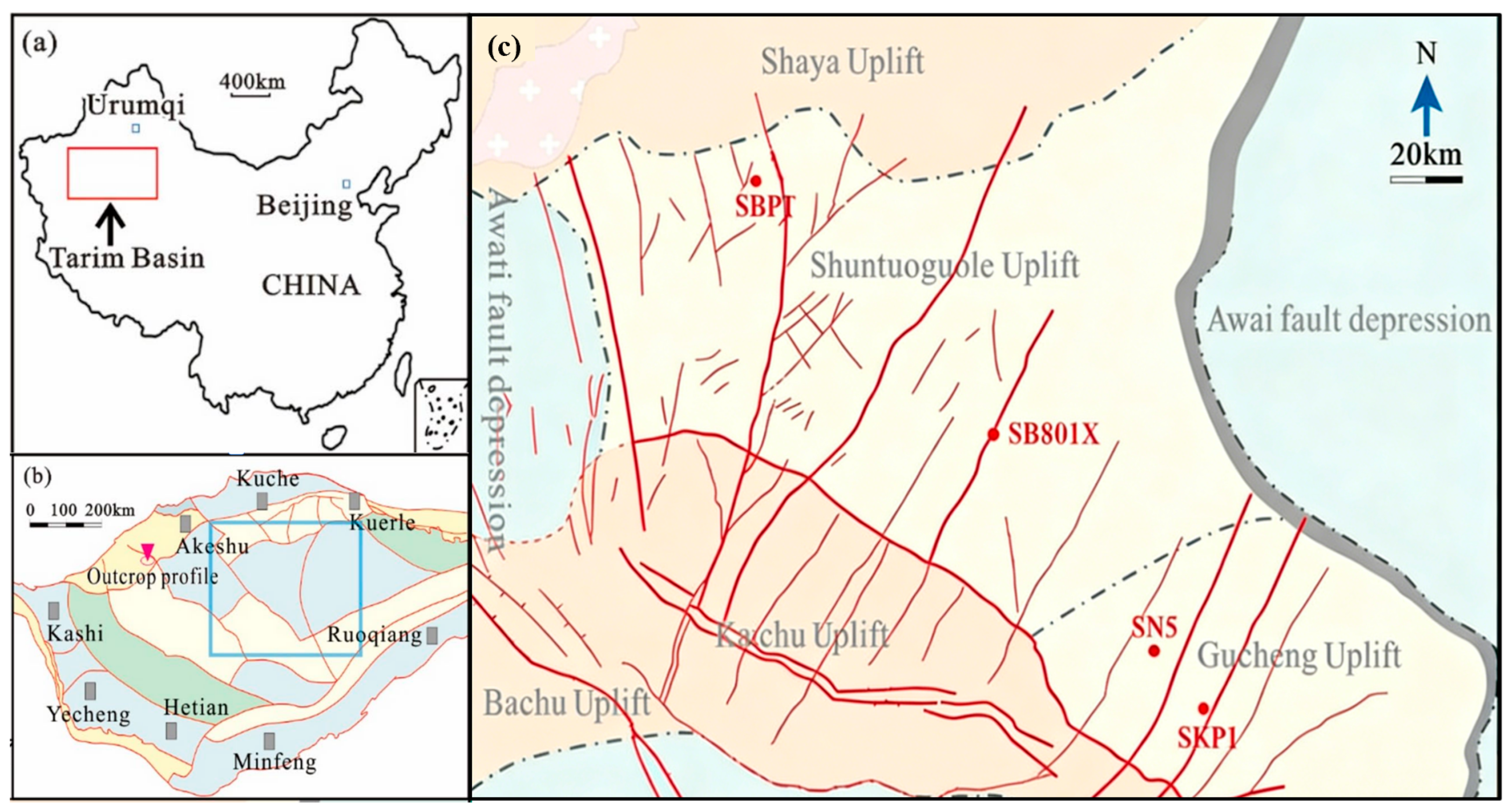
Figure 1 shows the location of Shunbei area in Xinjiang, China, where carbonate cores were collected. The Tarim Basin is located at the northwestern margin of China (Figure 1a) and represents a large cratonic composite basin formed through multiphase tectonic evolution, characterized by a complex structural framework and abundant oil and gas resources. The Shuntuoguole Uplift, situated in the central part of the basin (Figure 1b), is a key tectonic unit. It is bounded by the Shaya Uplift to the north and the Katake and Gucheng Uplifts to the south, and is adjacent to the Awati Depression to the east and the Manjiaer Depression to the west. Tectonically, it lies at the junction of multiple structural units, exhibiting typical characteristics of a tectonic hinge zone or transfer zone (Figure 1c). This unique structural position has subjected the area to complex stress adjustments and extensive fracture development throughout its prolonged geological evolution, exerting significant control on the formation and distribution of deep reservoirs.
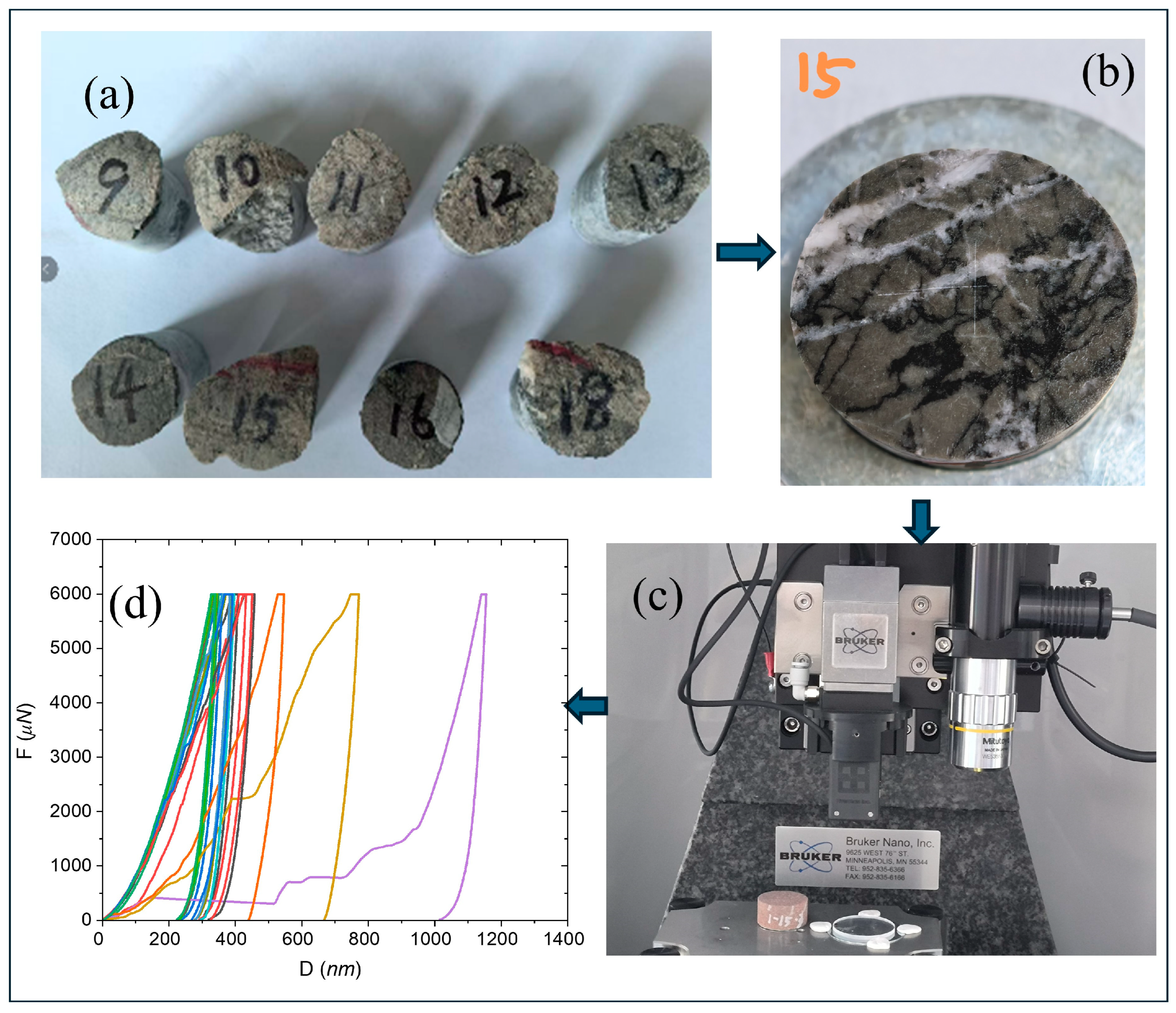
Figure 2 presents the sample preparation procedure. The core samples, sourced from Well 805× in the Shunbei region and shown in Figure 2a, were retrieved from burial depths greater than 7000 m. Due to the extreme temperature and pressure conditions at such depths, the recovered cores are highly fragmented, existing as small blocks that cannot be used to fabricate standard-sized specimens for conventional rock mechanical testing. In this study, three representative core fragments—labeled 13, 15, and 18—were selected and designated as samples A13, A15, and A18, respectively, for nanoindentation testing and energy-dispersive spectroscopy (EDS) analysis. These core fragments were first cut into regular cubic and cylindrical shapes. Initial surface smoothing was performed using an angle grinder, followed by a stepwise polishing process with sandpapers of increasing fineness—600, 800, 1500, 2000, 3000, 5000, and 7000 grit. This meticulous polishing ensured that the average surface roughness was reduced to below 100 nm, meeting the stringent surface quality requirements necessary for accurate micromechanical characterization [53]. The polished sample of A15 is shown in Figure 2b.

2.2. Mineralogy Information

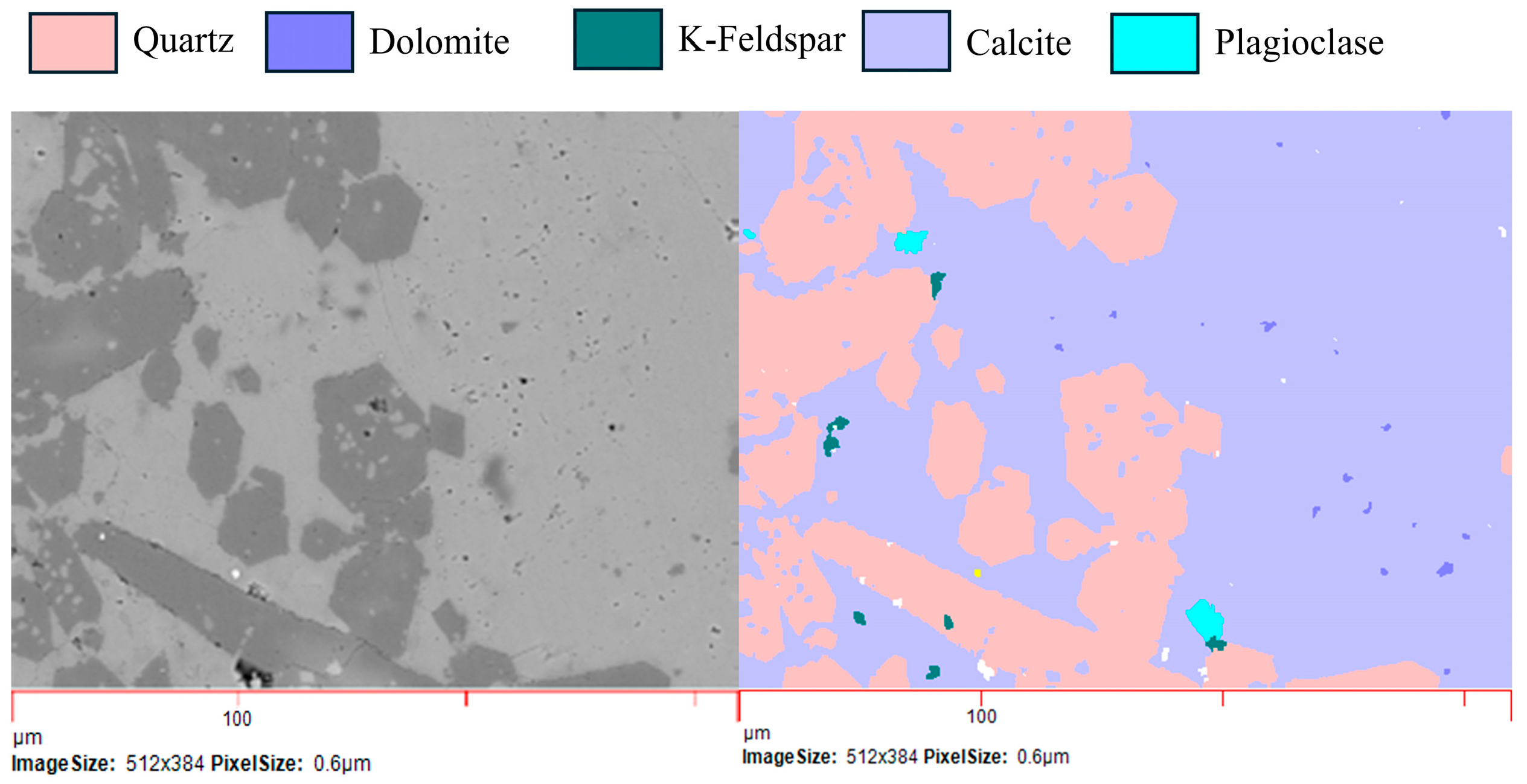
The mineralogy information is mainly about fractions and distributions of the mineral compositions in deep carbonate rocks, which were analyzed by XRD and SEM-EDS. Small fragments cut from three core fragments—labeled 13, 15, and 18—were ground into 325-mesh powder and analyzed using X-ray diffraction (Bruker D8 ADVANCE, Bruker AXS GmbH, Karlsruhe, Germany) to obtain XRD mineralogical information. To systematically characterize the microstructure and mineral composition of the carbonate rock samples, this study used an MEB-FEG Quanta 650 (FEI) microscope (Thermo Fisher Scientific, Hillsboro, OR, USA)to conduct the SEM-EDS analyses. Energy-dispersive X-ray spectroscopy (EDS), as an important means of electron probe microanalysis (EPMA), enables qualitative and quantitative analysis of local chemical compositions by detecting the characteristic X-ray energies excited by the electron beam bombarding the sample. In EDS analysis, X-ray signals are classified by energy, and the detection depth is influenced by the accelerating voltage, the material density, and the interaction volume of the electron beam, making it suitable for elemental distribution imaging at the micrometer scale. Since the carbonate rock lithology in this study has a relatively simple mineral composition and is dominated by large mineral grains, the QEMSCAN method can clearly distinguish different mineral phases and exhibits excellent quantitative characterization capabilities. Figure 3 shows the typical SEM and EDS analysis results of the sample. The SEM image clearly presents the heterogeneous microstructural features of the local rock grains. The EDS elemental distribution map shows the spatial distribution of each chemical element in different colors.

2.3. Nanoindentation Tests

2.3.1. Nanoindentation Test Equipment

The nanoindentation tests in this study were conducted using a Hysitron TI Premier nanoindenter (Bruker Nano Surfaces Division, Goleta, CA, USA) at the Institute of Rock and Soil Mechanics, Chinese Academy of Sciences. The testing apparatus has a load resolution of 75 n N , a maximum indentation load exceeding 10 m N , and a maximum displacement greater than 5 μ m , with a displacement resolution better than 0.006 n m . A Berkovich diamond indenter—a three-sided pyramidal tip—was employed for the nanoindentation tests. The nanoindenter is equipped with an integrated high-resolution scanning probe microscopy (SPM) imaging system, enabling in situ surface characterization. The SPM operates within a scanning frequency range of 0.01 Hz to 3.0 Hz, with a scanning resolution of up to 4096 × 4096 pixels. The positional accuracy of the in situ probe is ±10 nm. During the test, the instrument provides real-time monitoring of the load–displacement curves and other relevant data throughout the indentation process, allowing for precise control and immediate feedback on mechanical response. Figure 2c, d present the indentation instrument and some typical p-h curves of carbonate rocks.

2.3.2. Nanoindentation Test Principles

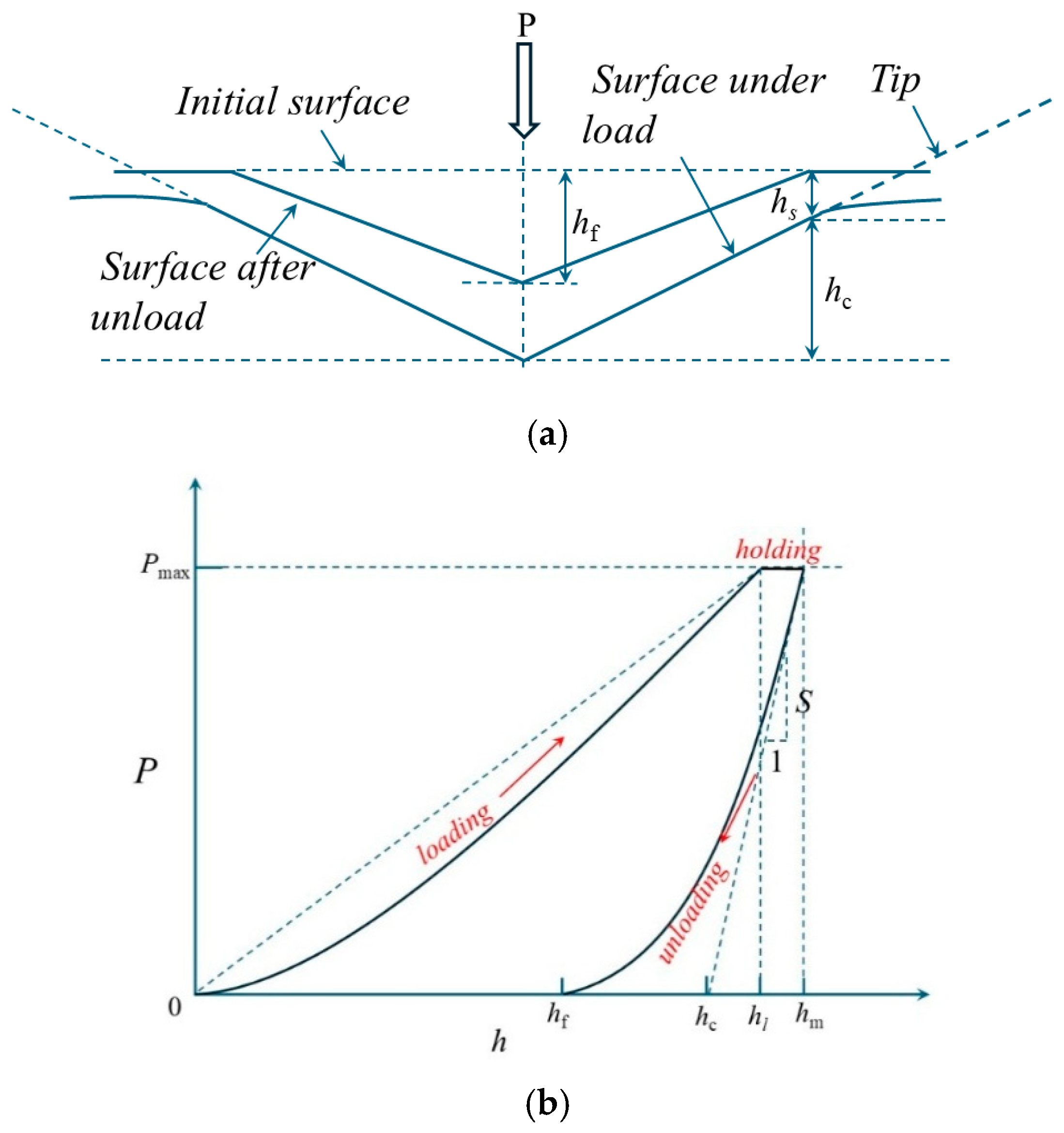
During nanoindentation, the indenter is pressed into the pristine sample surface as both the applied load and the penetration depth increase simultaneously, forming an indentation that replicates the geometry of the indenter tip. Upon unloading, the elastic component of the deformation recovers, while the plastic deformation remains, resulting in a permanent imprint that defines the final surface topography (Figure 4a). The continuous record of load and displacement data throughout the loading–unloading cycle was used to construct the load–displacement curve shown in Figure 4b, from which the elastic modulus and hardness of the rock can be determined. In this study, the Oliver–Pharr method [54] was used to calculate the H and Er.
(1)
Young’s modulus
The load–indentation depth curve measured by the nanoindentation test is an important datum to obtain the mechanical parameters of materials. In the initial section of the unloading curve, the contact stiffness of the material can be obtained by solving the slope of the curve by correlating the applied loading force P and the indentation depth h : S = d P d h h = h m , where h m is the maximum indentation depth. The reduced or indentation modulus E r is determined as follows:
E r = π 2 β S A c
where β = 1.034 is a dimensionless geometric constant of the Berkovich indenter and A c is the projected contact area and can be calculated from the contact area-to-contact depth ( h c ) relation:
A c = 24.5 h c 2
h c = h m a x ε P m a x S
where ε = 0.75 is a dimensionless constant related to the indenter geometry. For a Berkovich indenter, ε is typically taken as 0.75.
Therefore, the Young’s modulus of the test sample is determined as follows:
E = 1 v 2 1 E r 1 v i 2 E i 1
where E i is the indenter Young’s modulus, ν i is the indenter Poisson’s ratio, E is the test sample Young’s modulus, and v is the test sample Poisson’s ratio [48].
(2)
Hardness
The hardness of the test sample is defined as the ratio of the maximum applied loading force P max   to the projected contact area A c :
H = P m a x A c

3. Results

3.1. Mineral Composition and Microstructure

The weight percentages of different mineral compositions of three deep carbonate rock samples were determined by XRD tests and are summarized in Table 1. As shown in Table 1, the main mineral components of the three rock samples are calcite and quartz, and calcite is the primary mineral component. The contents of calcite in the three carbonate rock samples account for the single largest proportions, with ~88.5% (A13), ~91.3% (A15), and ~89.5% (A18). The quartz contents of the three rock samples are ~10.4% (A13), ~8.1% (A15), and ~9.6% (A18). Some other minerals such as dolomite, illite, pyrite, K-feldspar, and plagioclase were also identified, and their contents are minor and less than 1.0% in all three rock samples.
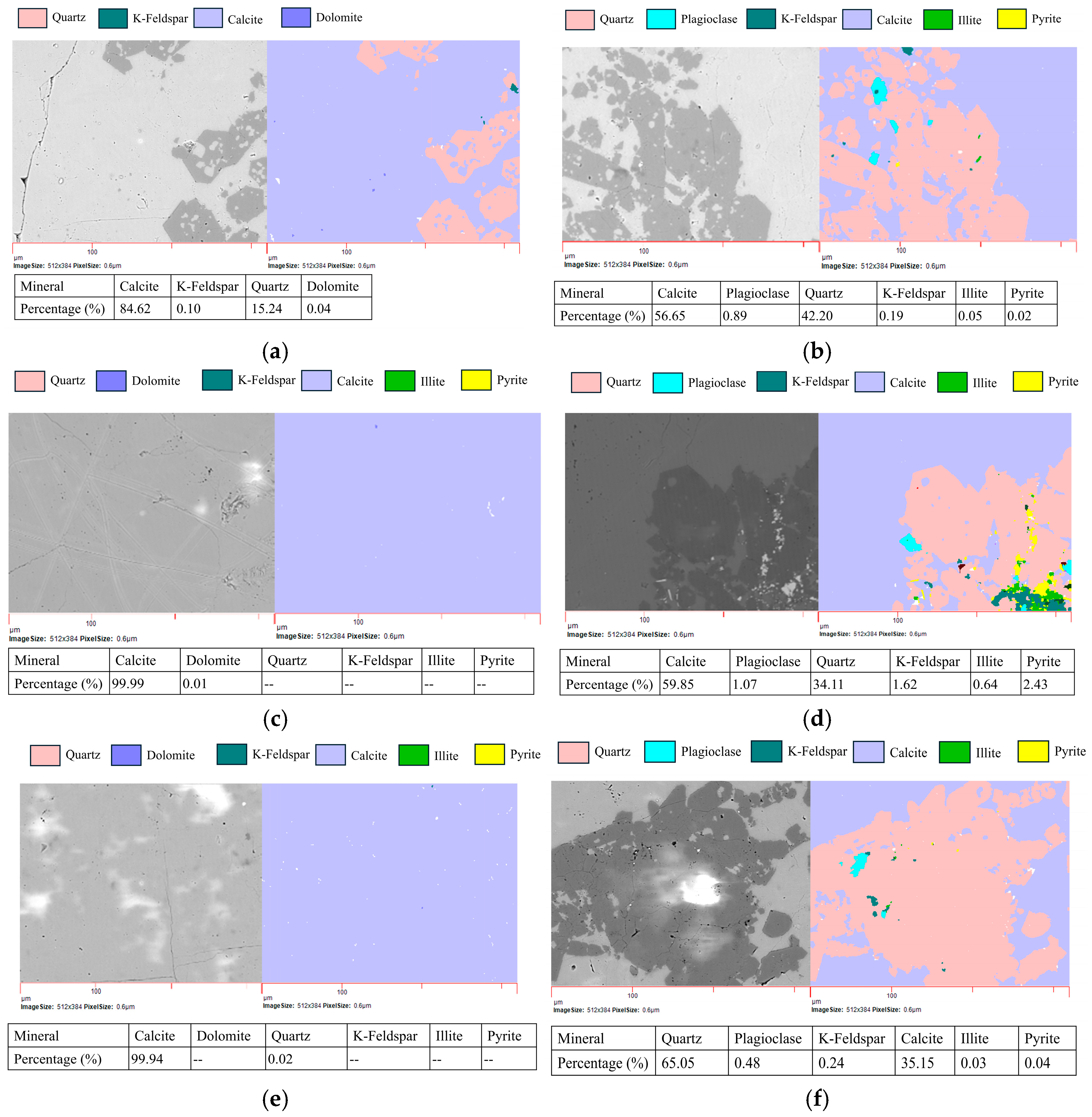
According to the XRD results, the dominant mineral in the three carbonate rock samples is calcite, with quartz present as a subordinate phase. In order to identify morphological features of different mineral phases distributed in the rock samples, the SEM-EDS technique was employed to analyze the micro-area element distribution of the rock samples and further identify their mineral composition. Figure 5 presents some typical results of SEM-EDS images of the three carbonate rock samples. As shown in Figure 5, a continuous calcite phase is identified in all of the three rock samples, and a quartz phase can be observed in this phase. The quartz phase is the second most abundant after the calcite phase, exhibiting a regional aggregation pattern embedded within the continuous calcite matrix. Other phases occasionally appear in different images, embedded either in the calcite phase or within the quartz phase, but their occurrence frequency is uncertain and their content is very low. The quartz phase embedded in the calcite matrix mostly does not appear as isolated grains, but rather shows an intergrown and intertwined morphology with the calcite phase. All quartz phase regions contain embedded calcite portions. The distribution of the quartz phase within the calcite matrix is highly irregular, with significant variation in the size of distributed areas. As observed in A15 and A18, shown in Figure 5c,d, no obvious quartz phase was detected. In all other images, the quartz phase is present within the calcite phase, exhibiting both scattered and concentrated distribution patterns.

3.2. Load–Displacement Curves

According to XRD and SEM-EDS results, the dominate mineral is calcite, with minor quartz present in the three carbonate rock samples. In this study, indentation was performed on the quartz zone, calcite zone, and interface zone of these two phases of these three samples. A 4× 4 grid of 16 loading points was designed to obtain the micromechanical properties of each zone. The total number of nanoindentation tests performed on each sample (A13, A15, A18) is 48.
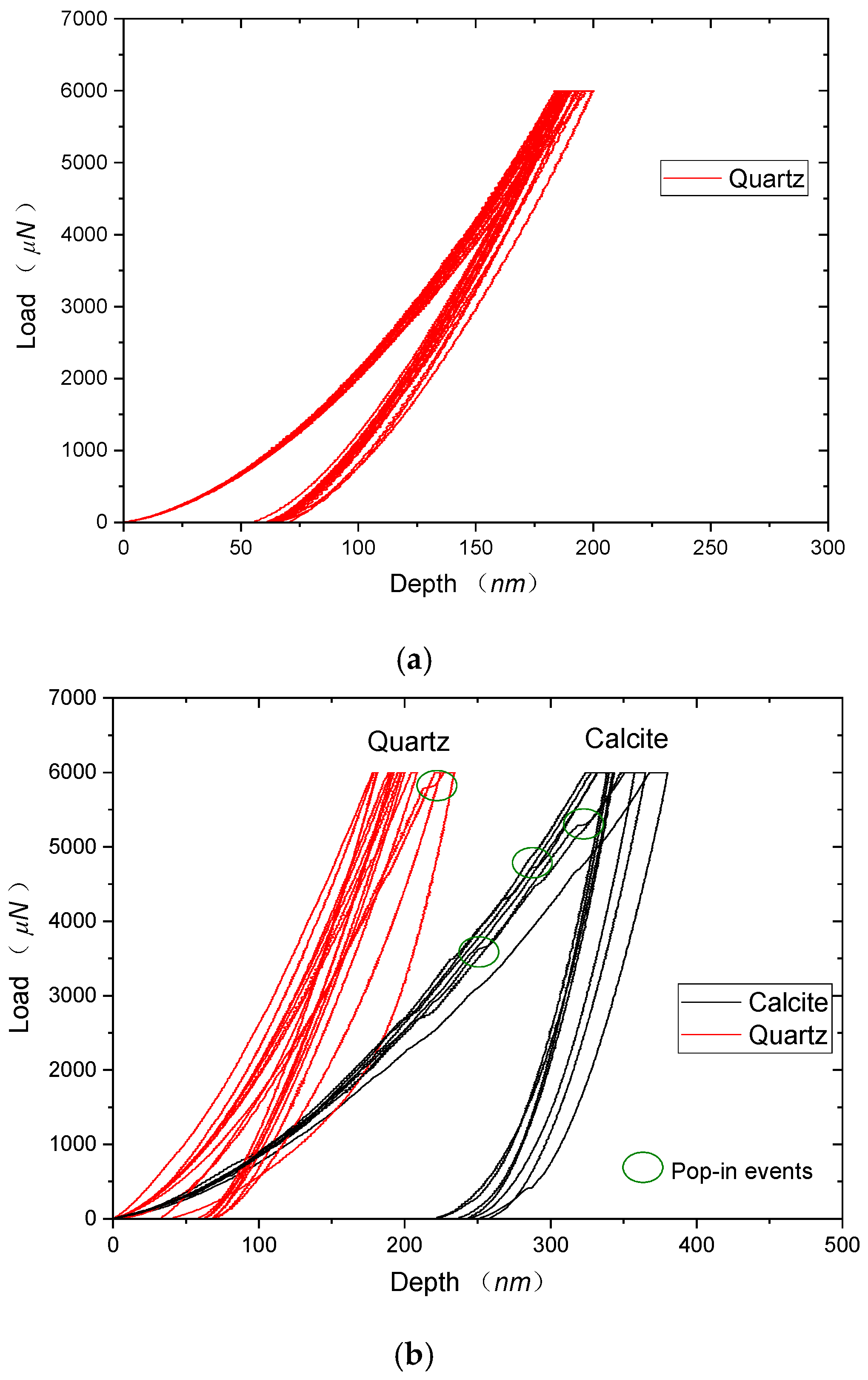
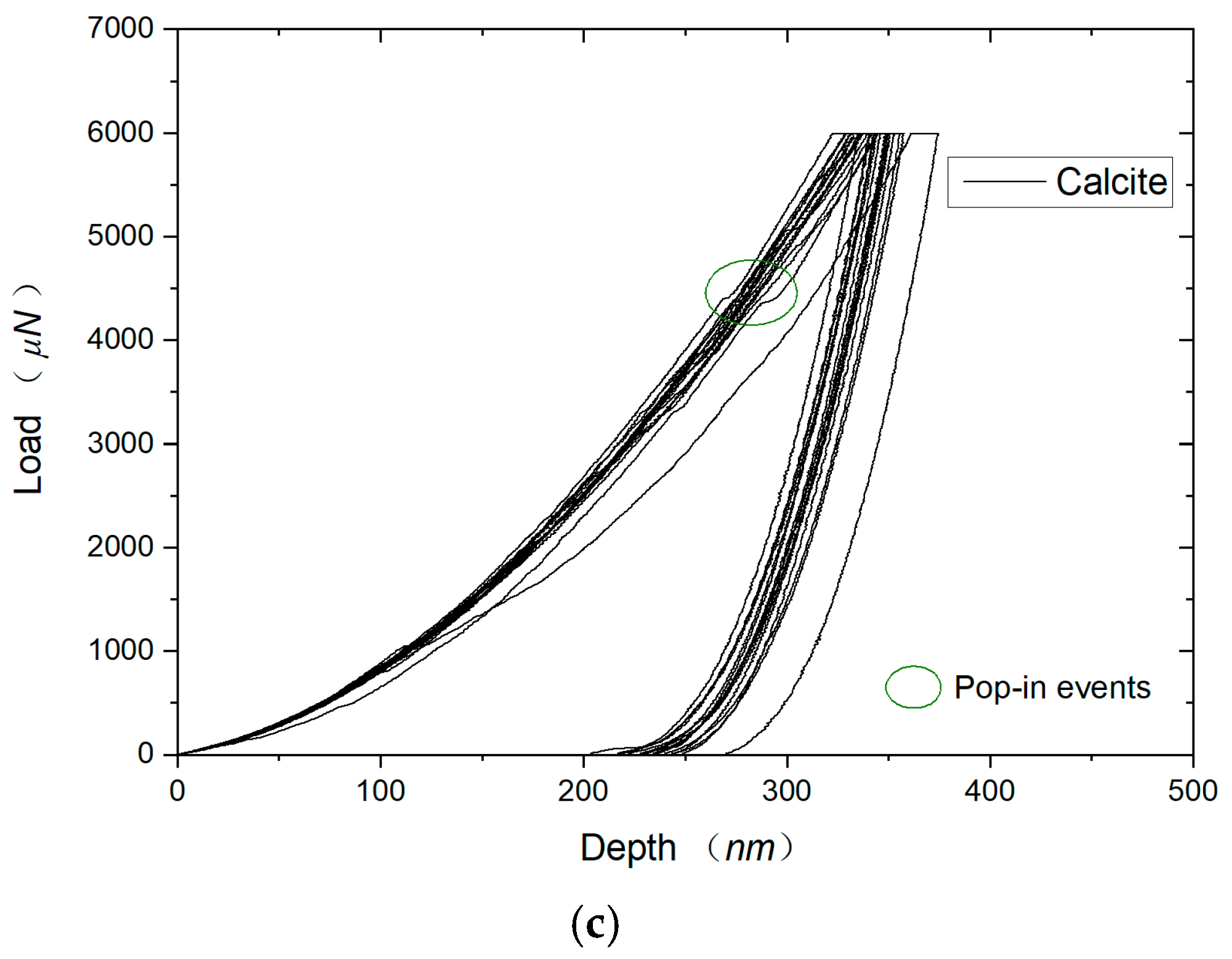
Since the mineral compositions of the three carbonate rock samples are nearly the same, typical load–displacement curves selected from A18 are illustrated in Figure 6. By implementing the loading–holding–unloading scheme, it was found that both the nonlinear loading and unloading curves exhibit an upward concave shape, as shown in Figure 6. The maximum load for all load–displacement curves was preset at 6000 μN, while the corresponding localized deformations vary depending on the mechanical properties of the material at each indentation site. Figure 6a,c show the representative nanoindentation load–displacement curves for the quartz phase and calcite phase, respectively. The high degree of consistency observed in the curves of these two phases suggests that the microscale mechanical behavior within each mineral phase exhibits good structural homogeneity. In contrast, the load–displacement curves in Figure 6b are more scattered, indicating significantly more pronounced heterogeneity and anisotropy. This is because, at the interfaces between different phases, there is a significant difference in material properties, along with spatial overlap, leading to variations in the observed results.
In Figure 6b,c, at the interface regions between the two phases as well as within the calcite phase, some loading curves exhibit sudden displacement increases marked by open green elliptical symbols. This phenomenon of an abrupt displacement jump observed during load-controlled nanoindentation is referred to as “pop-in”. There are various causes for pop-in events in nanoindentation tests on rock samples, such as cracking of brittle minerals, a transition from a stiffer constituent to a softer one along the loading direction, and the presence of pores or microcracks in the rock [20]. In this study, the pop-in events observed in the load–displacement curves in Figure 6b are likely caused by the transition from a harder to a softer component, whereas those in Figure 6c may be attributed to small pores or microcracks within the calcite phase.

3.3. Elastic Modulus and Hardness

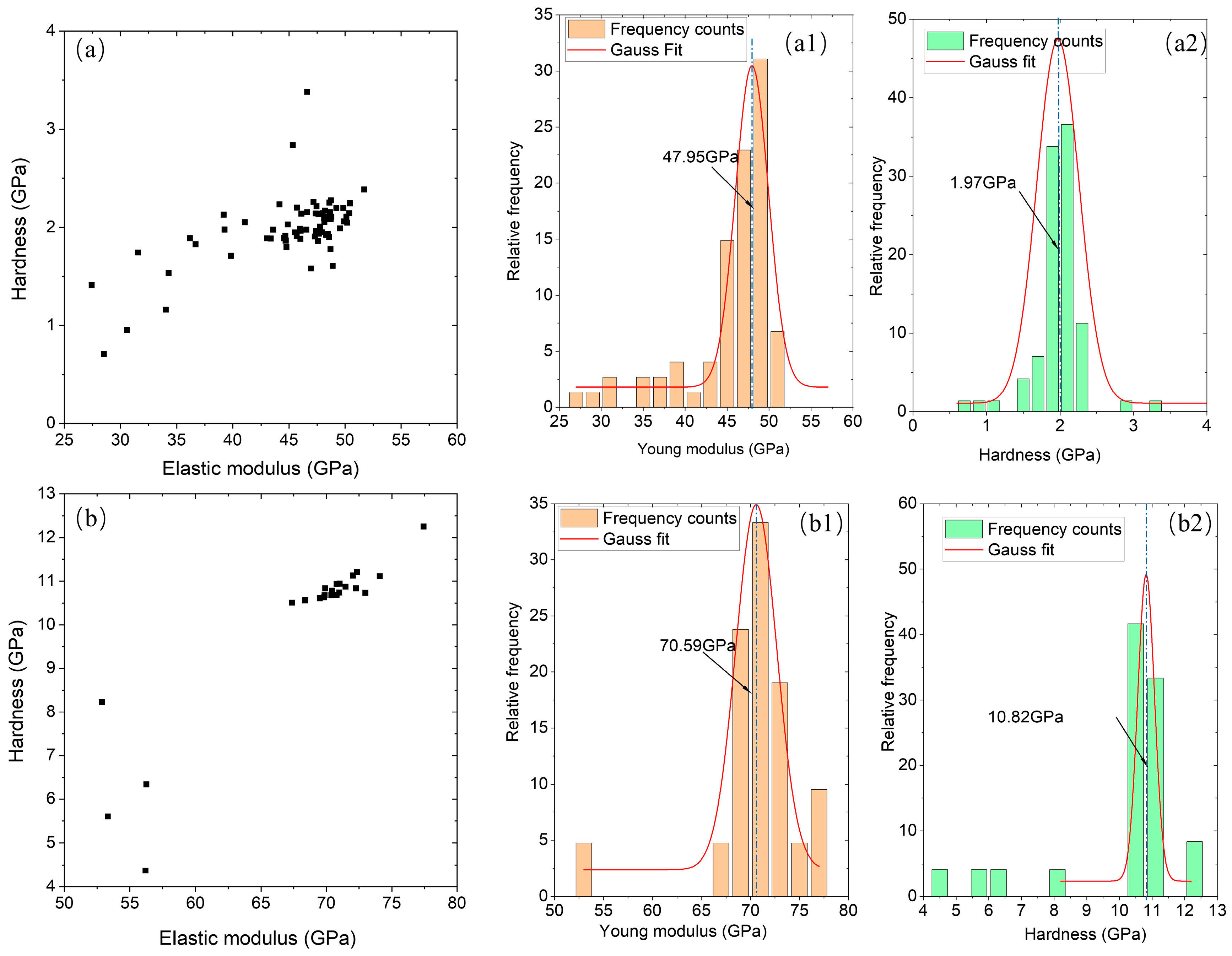
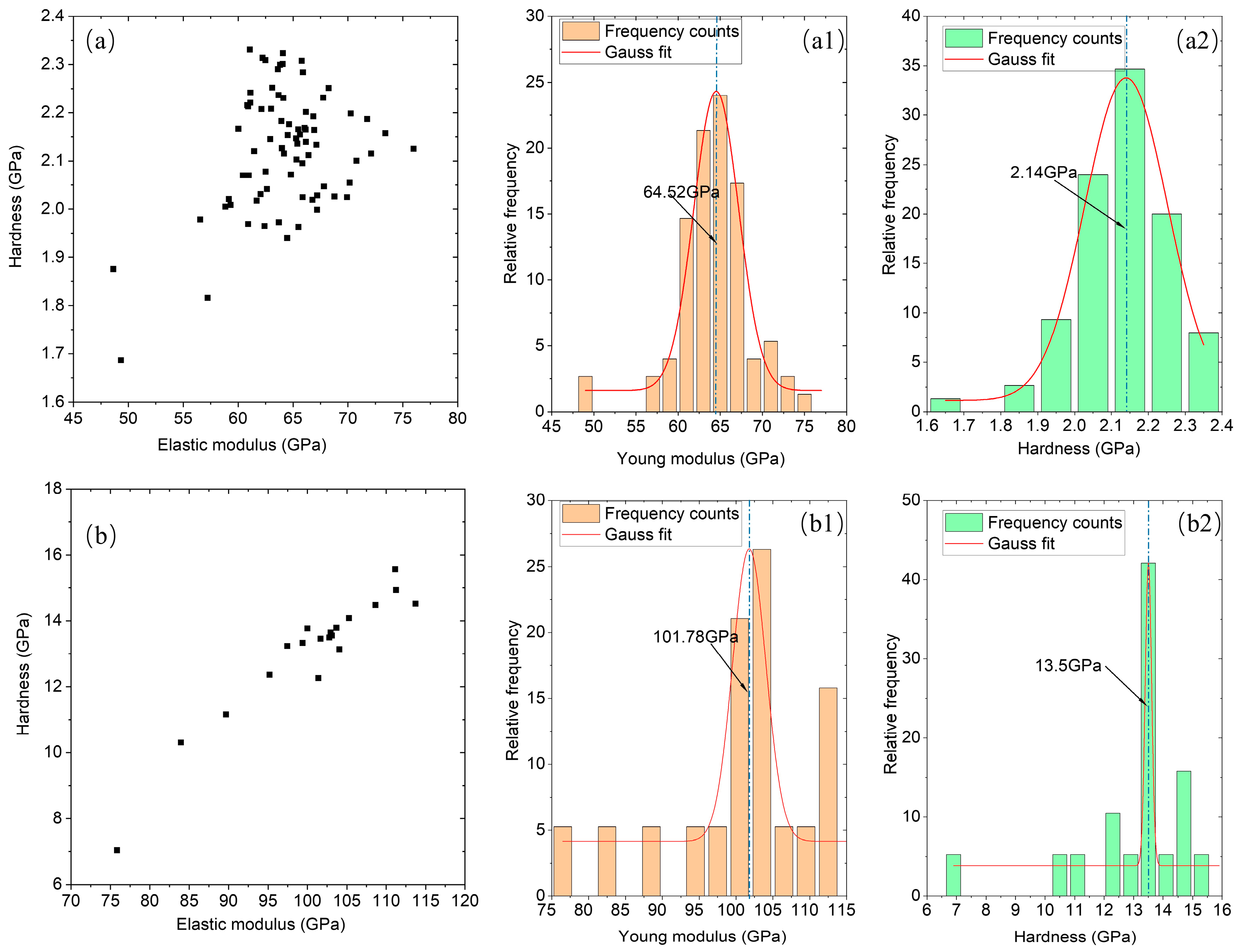
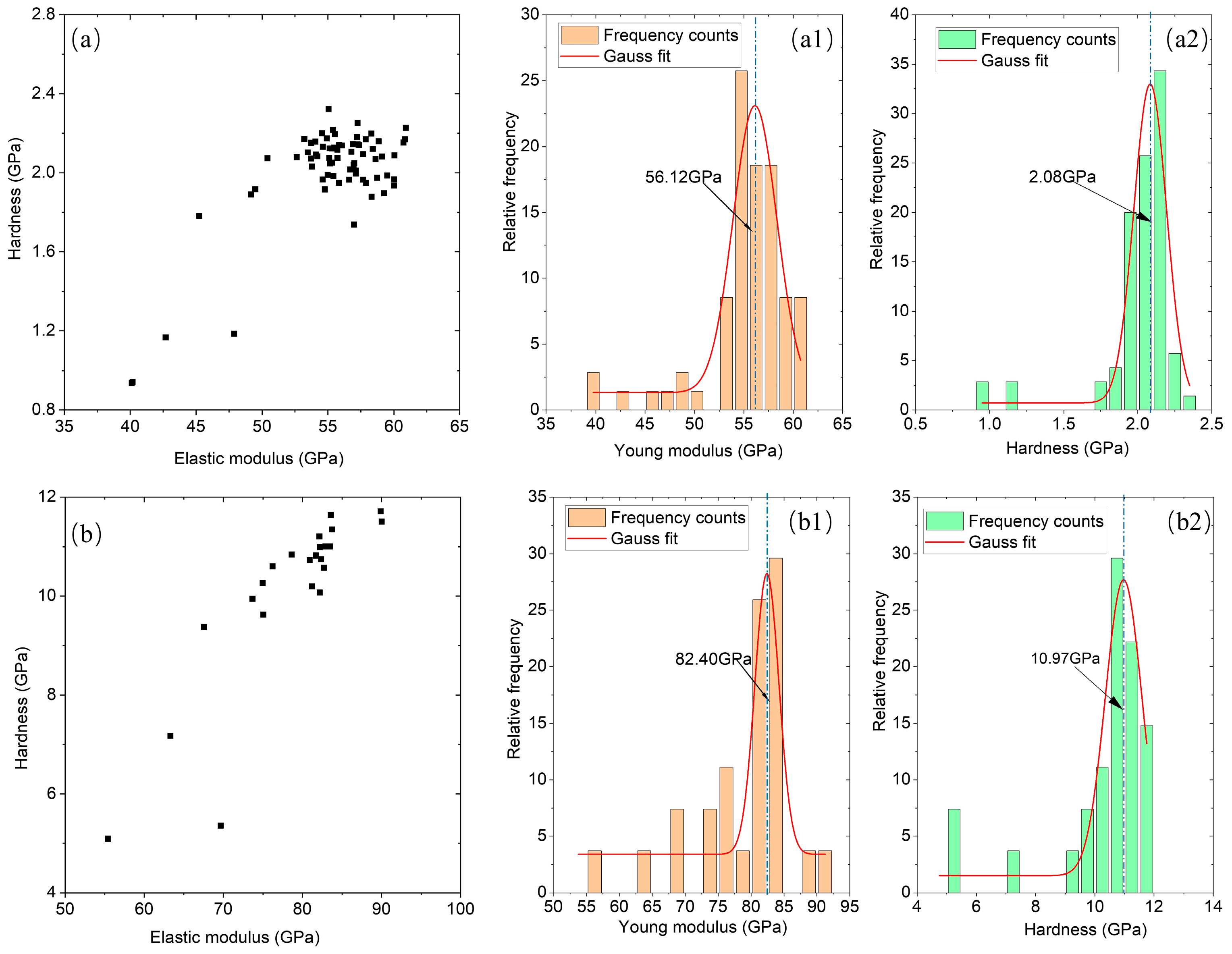
Based on Equations (1) and (3), the Young’s moduli and hardnesses of the three deep carbonate rock samples A13, A15, and A18 were calculated, and the results are presented in Figure 7, Figure 8 and Figure 9. The microscopic elastic modulus of sample A13 was statistically analyzed by using the Gaussian distribution and is presented in Figure 7a. The Young’s modulus of the selected areas in the calcite phase ranges from ~27.44 GPa to ~51.70 GPa, with an average microscopic elastic modulus of 47.95 GPa. The frequency distribution is mainly concentrated in the range of 40~52 GPa, while for the quartz phase, the Young’s modulus ranges from ~52.86 GPa to ~77.43 GPa, with an average microscopic elastic modulus of 70.59 GPa. The frequency distribution is mainly concentrated in the range of 65~75 GPa. For sample A15, the Young’s modulus in the calcite phase ranges from ~48.63 GPa to ~75.97 GPa, with an average microscopic elastic modulus of 64.62 GPa, while for the quartz phase, the Young’s modulus ranges from ~75.82 GPa to ~113.72 GPa, with an average microscopic elastic modulus of 101.78 GPa. For sample A18, the Young’s modulus in the calcite phase ranges from ~40.12 GPa to ~60.91 GPa, with an average microscopic elastic modulus of 56.12 GPa, while for the quartz phase, the Young’s modulus ranges from ~55.40 GPa to ~90.01 GPa, with an average microscopic elastic modulus of 82.40 GPa. As shown in Figure 5, the mineral compositions and microstructures from the SEM-EDS data of the three carbonate rock samples share nearly the same characteristics. However, the Young’s modulus results of the three samples show a certain degree of dispersion.
Figure 7(a2,b2), Figure 8(a2,b2) and Figure 9(a2,b2) show the Gaussian distribution characteristics of the hardness data of the three carbonate rock samples. The calcite phase hardness range of sample A13 is 0.71~3.37 GPa, with an average microscopic hardness of 1.97 GPa. The quartz phase hardness range of sample A13 is 5.61~12.25 GPa, with an average microscopic hardness of 10.82 GPa. For samples A15 and A18, the hardness ranges of the calcite phase are 1.69~2.33 GPa and 0.94~2.33 GPa, respectively, with average hardness values of 2.14 GPa and 2.08 GPa. The hardness ranges of the quartz phase are 7.04~14.5 GPa and 5.09~11.51 GPa, respectively, with average hardness values of 13.5 GPa and 10.97 GPa. The hardness values of the quartz phase are significantly higher than those of the calcite phase, and its hardness distribution is wider with greater dispersion, which may be attributed to limited testing site availability due to the low abundance of quartz. The hardness of the calcite phase is relatively concentrated across different samples, with similar average values, indicating good consistency and low variability. Due to the limited extent of the quartz regions, nanoindentation sites may be concentrated in areas with different crystallographic orientations or at phase boundaries, thereby increasing the scatter in the data.
The relationship between the elastic modulus and hardness of the three different samples of two mineral phases were also analyzed and are presented in Figure 7, Figure 8 and Figure 9. It can be observed from these figures that the relationship between elastic modulus and hardness in the quartz phase exhibits a more regular distribution, whereas the relationship in the carbonate phase is more scattered, indicating greater randomness in the results of the carbonate phase and suggesting that the microstructure and material properties of the carbonate phase are more heterogeneous.
Although the three deep carbonate rock samples A13, A15, and A18 were collected from the same well section and exhibit highly similar mineral compositions and microstructures as revealed by SEM-EDS, their microscopic elastic moduli and hardnesses still show significant dispersion, indicating notable spatial variability in micromechanical properties even under identical geological conditions. Statistical analysis shows that the quartz phase consistently exhibits higher elastic modulus and hardness values, with data points concentrated and following a clear Gaussian distribution, suggesting a more homogeneous and stable internal structure. In contrast, the mechanical parameters of the calcite phase are more scattered—particularly in sample A13, where the elastic modulus (27.44~51.70 GPa) and hardness (0.71~3.37 GPa) exhibit large variations—indicating stronger influences from heterogeneity-inducing factors such as grain boundary defects, microcracks, or localized dissolution. Systematic differences are also observed among the samples: A15 displays the highest overall mechanical performance, followed by A18, with A13 showing the lowest values. This suggests that even with similar bulk compositions, subtle differences in diagenetic history, crystal development, or local stress conditions can lead to significantly different mechanical responses. Furthermore, the correlation plots between elastic modulus and hardness reveal tightly clustered data for quartz, while those for the carbonate phase are widely scattered, further confirming the more random and heterogeneous nature of carbonate minerals. These findings highlight that in deep rock mechanical modeling, reliance on averaged parameters is insufficient; microscale heterogeneity must be considered to improve the accuracy of reservoir fracturing simulations and deformation predictions in geotechnical applications.

3.4. Deformations Beneath the Indenter

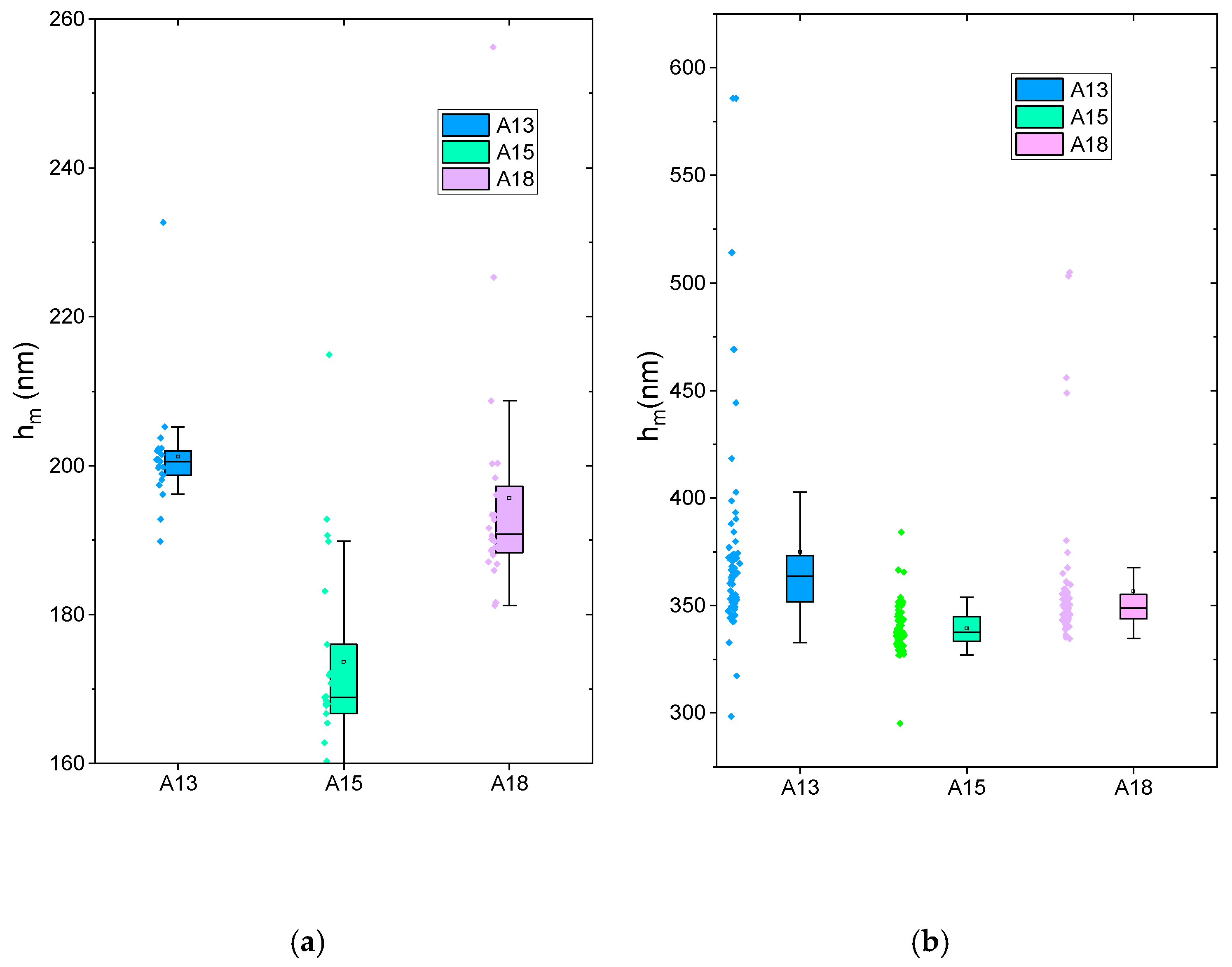
In the load–displacement curve, the mechanical deformation beneath the conical indenter can be used to reflect the local displacement or failure behavior under in situ stress conditions. In this study, the maximum indentation depth at the end of the loading stage was extracted, and based on the SEM-EDS results, the mineral composition at each indentation point was identified. On this basis, the statistical characteristics of the maximum indentation depth for different mineral phases in the three deep carbonate rock samples were analyzed and are shown in a box in Figure 10. It can be observed that the main distribution ranges of the maximum indentation depth vary noticeably in different mineral phases. The ranges of maximum indentation depth of the quartz phase are 189.8 nm~232.6 nm (A13), 159.2 nm~214.9 nm (A15), and 181.2 nm~256.2 nm (A18), respectively. Maximum indentation depths in the calcite phase are much larger than those in the quartz phase. The results in the calcite phase are 298.4 nm~585.7 nm (A13), 295.3 nm~384.2 nm (A15), and 333.6 nm~504.9 nm (A18), respectively. The maximum indentation depth range of the quartz phase is significantly smaller than that of the calcite phase, indicating that the quartz phase has higher resistance to deformation, which is consistent with its characteristics of high hardness and high elastic modulus. Across different samples, the indentation depth of the quartz phase shows less variation, whereas the calcite phase exhibits not only larger indentation depths but also a wider distribution range, reflecting greater variability in its mechanical response.
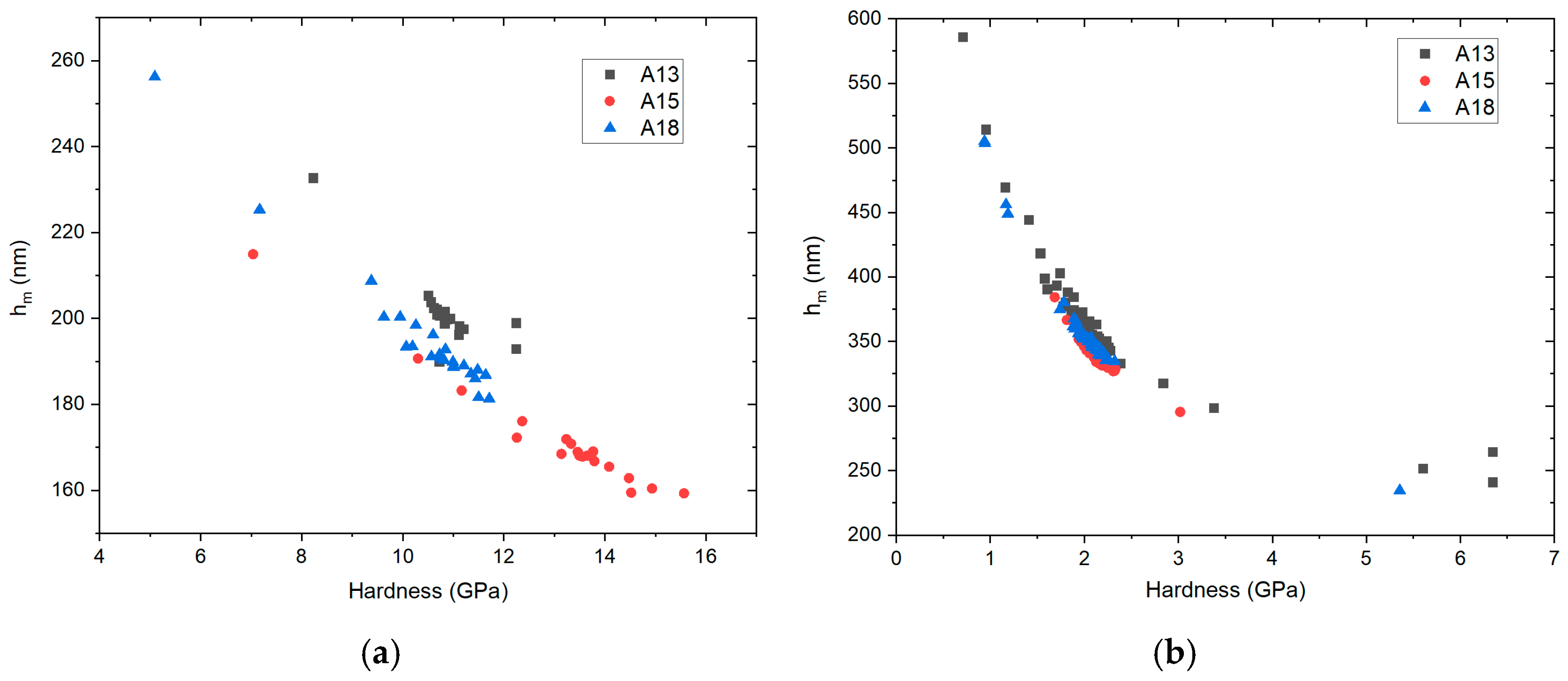
Figure 11 illustrates the relationships between the maximum indenter depth and hardness of the quartz phase and calcite phase. A clear negative correlation is observed: the higher the hardness, the smaller the maximum indentation depth, indicating a stronger resistance to deformation. In all samples, the quartz phase exhibits significantly higher hardness than the calcite phase—for example, in A15, the average hardness of quartz is 13.5 GPa compared to 2.14 GPa for calcite—and correspondingly smaller indentation depths, reflecting greater stiffness and better resistance to plastic deformation. In contrast, the calcite phase, with lower hardness, shows larger indentation depths (e.g., 298~586 nm in A13), indicating a greater tendency for local deformation and a relatively “softer” mechanical response.
In terms of data dispersion, both the indentation depth and the hardness of the calcite phase exhibit wider distributions, especially in sample A13 (hardness: 0.71~3.37 GPa; indentation depth: 298~586 nm), suggesting strong microstructural heterogeneity, possibly due to grain boundary defects, microporosity, or localized dissolution. Sample A15 shows the most concentrated data, with the smallest indentation depths and highest hardness values, reflecting a more uniform and compact structure. In comparison, the quartz phase in all three samples displays low data variability and a more clustered distribution, indicating stable material properties and structural homogeneity.
Overall, the consistent mechanical trends across the three samples confirm the strong inverse relationship between hardness and indentation depth, while differences in dispersion among phases and samples reveal the widespread presence of microstructural heterogeneity in deep carbonate rocks—particularly within the calcite phase.

4. Discussion

This study carried out an investigation combining nanoindentation and SEM-EDS on ultradeep carbonate rocks from the Shunbei area. The SEM-EDS and nanoindentation results showed that this kind of carbonate has a “soft-matrix-embedding-hard-inclusions” heterogeneous structure. A continuous calcite phase with relatively weak mechanical properties and pronounced plastic characteristics serves as the matrix (content > 90%), within which are embedded clusters of a quartz phase exhibiting high hardness and high elastic modulus. This significant microscale mechanical contrast implies that the macroscopic response of the rock under deep subsurface conditions is highly complex. Its influence on two critical engineering aspects—hydraulic fracturing stimulation and wellbore stability in ultradeep wells—is particularly pronounced and cannot be overlooked.

4.1. Effects on the Initiation and Propagation Behavior of Hydraulic Fracturing

SEM-EDS results show that although the quartz phase is minor in abundance, it appears relatively intact and contains few microfractures, whereas microcracks are frequently observed within the calcite phase. As a result, the calcite matrix—being mechanically weaker and enriched with microcracks—serves as the preferential pathway for hydraulic fracture initiation and propagation. Moreover, nanoindentation tests reveal numerous “pop-in” events in calcite, which are microscale manifestations of brittle–ductile deformation mechanisms such as cleavage plane sliding and microcrack nucleation [44]. Therefore, during macroscopic hydraulic fracturing, stress concentrations induced by fluid pressure at the wellbore wall or pre-existing natural flaws tend to preferentially activate these mechanically weak zones, facilitating fracture initiation within the calcite matrix. Consequently, the initial breakdown pressure may reflect the tensile strength of the calcite matrix rather than the average tensile strength of the bulk rock.
The subsequent fracture propagation is strongly influenced by the quartz clusters. Nanoindentation results demonstrate that the quartz phase exhibits significantly higher elastic modulus and hardness compared to the calcite phase. For instance, in sample A13, the average elastic modulus and hardness of the quartz phase are 70.59 GPa and 10.82 GPa, respectively, whereas the corresponding values for calcite are 47.95 GPa and 1.97 GPa. Consequently, during hydraulic fracturing, when a propagating fracture tip encounters a stiff quartz cluster, direct penetration requires extremely high energy input. As a result, the fracture tends to deflect, propagate around the inclusion, or undergo branching—preferentially extending through the weaker calcite matrix with lower resistance. This “deflect-around-hard-inclusions” propagation mechanism leads to highly irregular and tortuous macroscopic fracture surfaces.

4.2. Effects on the Wellbore Instability Mechanisms

The Shunbei ultradeep carbonate reservoirs are buried at depths exceeding 8000 m. During drilling of ultradeep wells, upon wellbore formation, the in situ stress field is perturbed, inevitably leading to stress concentration at the borehole wall. The mechanically weak calcite matrix—particularly where microcracks are present—is prone to yielding first under such concentrated stresses. Especially in the direction of maximum horizontal principal stress, the tangential stress acting on the borehole wall reaches its peak value. Under these conditions, plastic deformation of the calcite matrix, combined with coalescence and extension of internal microcracks, can easily lead to rock fragmentation and the development of slabbing failures—manifesting as plate-like spalling parallel to the borehole axis. Although the quartz phase possesses higher mechanical strength, its low abundance (less than 10%) and dispersed distribution within the dominant soft matrix limit its ability to reinforce the wellbore or effectively stabilize the surrounding rock. Consequently, wellbore instability exhibits pronounced anisotropy: the long axis of spallation cavities typically aligns with the direction of maximum horizontal principal stress, revealing not only the orientation of the far-field stress field but also the preferred orientation of mechanically weak planes within the rock.
Furthermore, the calcite phase exhibits a significantly greater maximum indentation depth compared to the quartz phase in nanoindentation tests, indicating a stronger tendency for plastic deformation and material flow. Notably, the calcite phase also displays distinct “pop-in” events during loading, which may reflect the initiation of dislocation activity or microcracking along weak crystallographic planes under localized stress concentration. These micromechanical features suggest that, at the macroscopic scale and over long timescales, the calcite-rich matrix is prone to time-dependent deformation—manifesting as significant creep behavior. Under the high-temperature and high-pressure conditions characteristic of the Shunbei ultradeep reservoirs, differential stresses acting on the calcite matrix can drive sustained lattice glide and progressive plastic flow. This matrix-dominated creep mechanism may lead to gradual, time-dependent borehole shrinkage during well completion, formation testing, or prolonged shut-in periods. Such continuous deformation poses potential risks to casing integrity, allowable open-hole exposure duration, and subsequent workover operations. Therefore, this time-dependent geomechanical behavior must be fully accounted for in engineering design and operational planning.

4.3. Limitations and Outline of Future Work

Although this study reveals the mechanical heterogeneity among mineral phases in Shunbei carbonate rocks through nanoindentation and provides insights into their macroscopic engineering behavior, several limitations remain. Future work should aim to overcome these constraints to establish a more comprehensive and realistic multiscale understanding of ultradeep carbonate rock performance.
(1) The current experiments were conducted under ambient temperature and pressure conditions, whereas the Shunbei reservoirs are subject to high in situ temperatures, confining stresses, and pore fluid pressures. Under actual downhole conditions, elevated confining pressure can significantly suppress microcrack opening and propagation, while pore pressure alters the effective stress state and may induce coupled hydro-chemo-mechanical processes such as stress corrosion or mineral dissolution. As a result, the observed “pop-in” events, hardness, and modulus values for calcite—measured under laboratory conditions—may not fully represent its mechanical behavior under true reservoir thermo-hydro-mechanical (THM) conditions. Future nanoindentation tests should therefore be performed within high-pressure, high-temperature (HPHT) chambers that simulate in situ confining stress and pore pressure, enabling direct measurement of micromechanical properties under geologically relevant environments.
(2) Nanoindentation characterizes material properties at the micrometer scale, representing localized mechanical behavior within individual mineral phases. In contrast, engineering processes such as hydraulic fracture propagation and wellbore instability operate at the meter scale or larger, involving continuum-level responses. How to effectively upscale microscale mechanical parameters into equivalent constitutive models suitable for macroscopic numerical simulations remains a key challenge in rock mechanics. Although numerous upscaling approaches based on homogenization assumptions have been developed and applied in various rock types, studies specifically focused on ultradeep carbonate rocks are still limited. Moreover, the applicability of existing upscaling methods to the unique microstructure and mechanical heterogeneity of ultradeep carbonates—such as the “soft-matrix-embedding-hard-inclusions” architecture observed in Shunbei reservoirs—remains to be fully validated.
(3) A multiscale integrated framework is proposed that combines advanced experimental characterization, 3D structural imaging, and physics-based numerical simulation. This approach involves spatially co-registering the phase-specific mechanical properties obtained from nanoindentation with the three-dimensional mineral distribution, pore networks, and microfracture architecture derived from micro-CT scanning, enabling precise mapping of mechanical properties onto real microstructures in 3D. This integration allows for the identification of spatially distributed mechanical weak zones—such as microcrack-rich calcite regions—and provides a realistic representation of heterogeneity for predictive modeling. Additionally, dynamic geophysical techniques such as ultrasonic velocity measurements and acoustic emission (AE) monitoring are employed during mechanical loading to establish quantitative relationships between microscale mechanical heterogeneity (e.g., stiffness contrast between calcite and quartz) and macroscale wave propagation characteristics, anisotropy, and energy release patterns. Finally, these multi-source datasets serve as input for cross-scale numerical simulations—such as finite element method (FEM) or discrete element method (DEM)—that explicitly incorporate realistic microstructural features. By constructing meso- to microscale mechanical models based on actual mineral distributions, this approach enables a quantitative upscaling from localized indentation data to volume-averaged mechanical responses, bridging the gap between nanoscale measurements and continuum-scale engineering behavior.

5. Conclusions

(1) XRD-EDS analysis confirmed that deep carbonate rocks from the Shunbei area are predominantly composed of a continuous calcite phase, with quartz as the secondary phase, occurring in regional aggregates embedded within the calcite matrix. The two phases commonly exhibit an intergrown texture, with irregular and heterogeneous distribution patterns and notable local variations, indicating significant sample-to-sample variability and spatial heterogeneity in mineral distribution.
(2) Nanoindentation tests reveal that the calcite and quartz phases in deep carbonate rocks exhibit good mechanical homogeneity within their respective domains, while the interface regions show significant heterogeneity and “pop-in” events due to material property contrasts and structural transitions. Pop-ins at the interfaces are primarily attributed to the transition from harder to softer components, whereas those within the calcite phase are likely caused by micropores or microcracks, reflecting distinct local deformation mechanisms in different regions.
(3) Despite similar mineral compositions, deep carbonate rock samples A13, A15, and A18 show distinct micromechanical behaviors: quartz exhibits high, consistent properties (E = 70.6~101.8 GPa, H = 10.8~13.5 GPa), indicating homogeneity, while calcite shows lower, more variable values (E = 27.4~76.0 GPa, H = 0.7~2.3 GPa), reflecting heterogeneity. Mechanical performance ranks as A15 > A18 > A13, revealing significant microscale variability even under similar geological conditions, underscoring the need to incorporate phase-specific and structural heterogeneity in rock mechanics modeling.
(4) The quartz phase exhibits smaller and more stable indentation depths due to its high hardness and modulus, indicating superior deformation resistance. In contrast, the calcite phase shows greater indentation depth and higher dispersion, reflecting weaker mechanical properties and significant microstructural heterogeneity. The strong negative correlation between hardness and indentation depth highlights the dominant influence of mineral composition on local mechanical behavior.

Author Contributions

Conceptualization, Z.X. and H.M.; Methodology, H.M.; Validation, P.L.; Formal analysis, H.Z.; Investigation, P.L. and Z.G.; Resources, H.Z. and P.L.; Data curation, Y.L.; Writing—original draft, Z.X. and Y.L.; Writing—review and editing, H.M. and Z.G.; Visualization, P.L.; Supervision, Z.X. and H.M.; Project administration, Z.X. and H.M. All authors have read and agreed to the published version of the manuscript.

Funding

This work was funding by the Hubei Provincial Department of Science and Technology-Special Project for Technological Innovation Platforms Grants No. 2025CGB003, and the Natural Science Foundation of China Grants No. 51808204.

Data Availability Statement

The original contributions presented in this study are included in the article. Further inquiries can be directed to the corresponding author.

Conflicts of Interest

Authors Z.X., H.Z. and P.L. were employed by the company Northwest Oilfield Company. The remaining authors declare that the research was conducted in the absence of any commercial or financial relationships that could be construed as a potential conflict of interest.

References

  1. Wilkinson, B.H.; McElroy, B.J.; Kesler, S.E.; Peters, S.E.; Rothman, E.D. Global geologic maps are tectonic speedometers—Rates of rock cycling from area-age frequencies. Geol. Soc. Am. Bull. 2009, 121, 760–779. [Google Scholar] [CrossRef]
  2. Zhang, R.; Sun, J.; Cheng, Z.; Xin, B.; Chen, H. Mechanical Behavior and Microstructural Characteristics of Ultradeep Tight Carbonate Rocks With Different Burial Depths. Front. Earth Sci. 2022, 10, 858899. [Google Scholar] [CrossRef]
  3. Zhang, Y.; Zhang, L.; He, J.; Zhang, H.; Zhang, X.; Liu, X. Fracability evaluation method of a fractured-vuggy carbonate reservoir in the shunbei block. ACS Omega 2023, 8, 15810–15818. [Google Scholar] [CrossRef]
  4. Wei, G.; Yang, W.; Xie, W.; Su, N.; Xie, Z.; Zeng, F.; Ma, S.; Jin, H.; Wang, Z.; Zhu, Q.; et al. Formation mechanisms, potentials and exploration practices of large lithologic gas reservoirs in and around an intracratonic rift: Taking the sinian—Cambrian of Sichuan Basin as an example. Pet. Explor. Dev. 2022, 49, 530–545. [Google Scholar] [CrossRef]
  5. Xiong, R.; Fu, H.; Li, Y.; Xie, C.; Wang, R.; Zhao, S.; Xu, C.; Xiao, C. Sequence of middle-lower Ordovician in Shunbei area of Tarim Basin, China, and its geological significance. Carbonates Evaporites 2025, 40, 116. [Google Scholar] [CrossRef]
  6. Flügel, E.; Munnecke, A. Microfacies of Carbonate Rocks: Analysis, Interpretation and Application; Springer: Berlin, Germany, 2010. [Google Scholar]
  7. Ma, D.C.; Li, W.J.; Chen, Z.Y.; Fang, X.; Cheng, J.F.; Jia, X.L. Middle to Upper Ordovician stable carbon isotope stratigraphy and sedimentary facies in the Shunbei and Tahe areas, northern-central Tarim, China. Palaeoworld 2024, 33, 870–883. [Google Scholar] [CrossRef]
  8. Deng, S.; Li, H.; Zhang, Z.; Zhang, J.; Yang, X. Structural characterization of intracratonic strike-slip faults in the central Tarim Basin. AAPG Bull. 2019, 103, 109–137. [Google Scholar] [CrossRef]
  9. Yang, H.J.; Chen, Y.Q.; Tian, J.; Du, J.H.; Zhu, Y.F.; Li, H.H.; Pan, W.Q.; Yang, P.F.; Li, Y.; An, H.T. Great discovery and its significance of ultra-deep oil and gas exploration in well Luntan-1 of the Tarim Basin. China Pet. Explor. 2020, 25, 62–72. [Google Scholar]
  10. Liu, J.; Huang, C.; Zhou, L.; Chen, Q.; Zhang, S. Estimation of the rock mechanics and in-situ stress parameters of carbonate reservoirs using array sonic logging: A case study of Shunbei No. 4 block. J. Geomech. 2024, 30, 394–407. [Google Scholar]
  11. Xie, H.; Li, C.; He, Z.; Li, C.; Lu, Y.; Zhang, R.; Gao, M.; Gao, F. Experimental study on rock mechanical behavior retaining the in situ geological conditions at different depths. Int. J. Rock Mech. Min. Sci. 2021, 138, 104548. [Google Scholar] [CrossRef]
  12. Luo, Y.; Zhang, Y.; Wang, Q.; Song, J.; Hu, D.; Zhou, H. Assessment of Young’s modulus of small-sized rock samples based on macroindentation testing. Acta Geotech. 2025, 20, 2257–2278. [Google Scholar] [CrossRef]
  13. Huang, H.; Yuan, S.; Zhang, Y.; Zeng, J.; Mu, W. Use of nonlinear chaos inversion in predicting deep thin lithologic hydrocarbon reservoirs: A case study from the Tazhong oil field of the Tarim Basin, China. Geophysics 2016, 81, B221–B234. [Google Scholar] [CrossRef]
  14. Farouk, S.; Abdeldaim, A.; Qteishat, A.; Ahmad, F.; Mohammed, I.; Al-Kahtany, K.; Powell, J.H. Orbital forcing and paleoenvironmental changes across the upper Ordovician glaciation-lower Silurian hot shale in the Risha gas field, northeast Jordan. Mar. Pet. Geol. 2024, 168, 107040. [Google Scholar] [CrossRef]
  15. Chen, Y.; Tang, S.; Xi, Z.; Sun, S.; Jiao, P.; Mei, X.; Zhou, T.; Sun, J.; Zeng, F. A Machine Learning Approach for Estimating Shale Micro-Mechanical Properties from High Resolution SEM–EDS Images. Rock Mech. Rock Eng. 2025, 58, 13999–14019. [Google Scholar] [CrossRef]
  16. Charlton, T.S.; Rouainia, M.; Aplin, A.C.; Fisher, Q.J.; Bowen, L. Nanoindentation of Horn River Basin shales: The micromechanical contrast between overburden and reservoir formations. J. Geophys. Res. Solid Earth 2023, 128, e2022JB025957. [Google Scholar] [CrossRef]
  17. Ulm, F.J.; Abousleiman, Y. The nanogranular nature of shale. Acta Geotech. 2006, 1, 77–88. [Google Scholar] [CrossRef]
  18. Abdallah, Y.; Vandamme, M.; Chateau, C.; Garnier, D.; Jolivet, I.; Onaisi, A.; Richard, D.; Zandi, S. Linking elastic properties of various carbonate rocks to their microstructure by coupling nanoindentation and SEM-EDS. Int. J. Rock Mech. Min. Sci. 2023, 170, 105456. [Google Scholar] [CrossRef]
  19. Zheng, M.; Gu, Z.; Dong, H.; Ma, T.; Wu, Y. Nanoindentation-Based Characterization of Mesoscale Mechanical Behavior in Dolomite Crystals. Processes 2025, 13, 1203. [Google Scholar] [CrossRef]
  20. Deng, T.; Zhao, J.; Yin, H.; Xie, Q.; Gou, L. Mechanical Characterization of Main Minerals in Carbonate Rock at the Micro Scale Based on Nanoindentation. Processes 2024, 12, 2727. [Google Scholar] [CrossRef]
  21. Zhao, J.; Zhang, W.; Zhang, D. Elastic characterization of shale at microscale: A comparison between modulus mapping, PeakForce quantitative nanomechanical mapping, and contact resonance method. SPE J. 2022, 27, 3136–3157. [Google Scholar] [CrossRef]
  22. Zhao, J.; Zhang, W.; Zhang, D.; Wei, R.; Wang, Y. Influence of geochemical features on the mechanical properties of organic matter in shale. J. Geophys. Res. Solid Earth 2020, 125, e2020JB019809. [Google Scholar] [CrossRef]
  23. Huang, H.; Zhang, W.; Shi, H.; Ni, J.; Ding, L.; Yang, B.; Zheng, Y.; Li, X. Experimental investigation of microscale mechanical alterations in shale induced by fracturing fluid contact. Gas Sci. Eng. 2024, 124, 205264. [Google Scholar] [CrossRef]
  24. Xie, X.; Deng, H.; Hu, L.; Li, Y.; Mao, J.; Liu, J. Assessing the effect of oriented structure characteristics of laminated shale on its mechanical behaviour with the aid of nano-indentation and FE-SEM techniques. Int. J. Rock Mech. Min. Sci. 2024, 173, 105625. [Google Scholar] [CrossRef]
  25. Cheng, P.; Zhang, C.P.; Ma, Z.Y.; Zhou, J.P.; Zhang, D.C.; Liu, X.F.; Chen, H.; Ranjith, P.G. Experimental study of micromechanical properties alterations of shale matrix treated by ScCO2-Water saturation using nanoindentation tests. Energy 2022, 242, 122965. [Google Scholar] [CrossRef]
  26. Luo, Y.; Zhang, S.; Zhu, Y.; Huang, F.; Wu, Q. Micromechanical properties and homogenization of sandstone based on nanoindentation. Phys. Fluids 2024, 36, 087112. [Google Scholar] [CrossRef]
  27. Ma, Z.; Pathegama Gamage, R.; Zhang, C. Application of nanoindentation technology in rocks: A review. Geomech. Geophys. Geo-Energy Geo-Resour. 2020, 6, 60. [Google Scholar] [CrossRef]
  28. Zhang, M.; Zhang, G.; Peng, Y. Characterizing the micro-fracture in quasi-brittle rock using nanoindentation. Eng. Fract. Mech. 2024, 308, 110378. [Google Scholar] [CrossRef]
  29. Pan, H.; Kang, Y.; Hu, Y.; Liu, F.; Xu, J.; Li, D.; Li, J. Determination of the property evolution in rock after laser irradiation by nanoindentation and nuclear magnetic resonance. Int. J. Rock Mech. Min. Sci. 2024, 174, 105638. [Google Scholar] [CrossRef]
  30. Liu, Y.; Liu, A.; Liu, S.; Kang, Y. Nano-scale mechanical properties of constituent minerals in shales investigated by combined nanoindentation statistical analyses and SEM-EDS-XRD techniques. Int. J. Rock Mech. Min. Sci. 2022, 159, 105187. [Google Scholar] [CrossRef]
  31. Veytskin, Y.B.; Tammina, V.K.; Bobko, C.P.; Hartley, P.G.; Clennell, M.B.; Dewhurst, D.N.; Dagastine, R.R. Micromechanical characterization of shales through nanoindentation and energy dispersive x-ray spectrometry. Geomech. Energy Environ. 2017, 9, 21–35. [Google Scholar] [CrossRef]
  32. Li, T.; Yao, M.; Xia, Y.; Feng, X.; Cong, W.; Shi, Y.; Tang, C.A. The influences of mineral components and pore structure on hydraulic fracture propagation in shale. Rock Mech. Rock Eng. 2025, 58, 2929–2952. [Google Scholar] [CrossRef]
  33. Cong, W.; Li, T.; Shi, Y.; Tang, C.A. Study on the Mechanical Properties and Failure Characteristics of Heterogenous Shale Based on CT Scanning. SPE J. 2024, 29, 7088–7107. [Google Scholar] [CrossRef]
  34. Krakowiak, K.J.; Wilson, W.; James, S.; Musso, S.; Ulm, F.J. Inference of the phase-to-mechanical property link via coupled X-ray spectrometry and indentation analysis: Application to cement-based materials. Cem. Concr. Res. 2015, 67, 271–285. [Google Scholar] [CrossRef]
  35. Liu, X.Y.; Xu, D.P.; Li, S.J.; Qiu, S.L.; Jiang, Q. An insight into the mechanical and fracture characterization of minerals and mineral interfaces in granite using nanoindentation and micro X-ray computed tomography. Rock Mech. Rock Eng. 2023, 56, 3359–3375. [Google Scholar] [CrossRef]
  36. Ahmadov, R.; Vanorio, T.; Mavko, G. Confocal laser scanning and atomic-force microscopy in estimation of elastic properties of the organic-rich Bazhenov Formation. Lead. Edge 2009, 28, 18–23. [Google Scholar] [CrossRef]
  37. Kamboj, R.; Debbarma, S. Nano-indentation and SEM analysis of the interfacial transition zone in RAP-concrete. Constr. Build. Mater. 2025, 492, 142854. [Google Scholar] [CrossRef]
  38. Li, L.; Mao, L.; Yang, J. A review of principles, analytical methods, and applications of SEM-EDS in cementitious materials characterization. Adv. Mater. Technol. 2025, 10, 2401175. [Google Scholar] [CrossRef]
  39. Yu, H.; Zheng, W.; Cui, X.; Zhou, J. Influence of mineralogical characteristics on mechanical properties of Montney tight formations using instrumented indentation test and SEM–EDS analysis. Rock Mech. Rock Eng. 2024, 57, 8777–8794. [Google Scholar] [CrossRef]
  40. Charlton, T.S.; Rouainia, M.; Aplin, A.C. Stochastic homogenization of the elastic properties of highly anisotropic shales. In Proceedings of the 57th U.S. Rock Mechanics/Geomechanics Symposium, Santa Fe, NM, USA, 25–28 June 2023; American Rock Mechanics Association (ARMA): Golden, CO, USA, 2023; p. ARMA-2023. [Google Scholar]
  41. Sheng, M.; Cheng, S.Z.; Lu, Z.H.; Zhang, Y.; Tian, S.C.; Li, G.S. Influence of formation in-situ stress on mechanical heterogeneity of shale through grid nanoindentation. Pet. Sci. 2022, 19, 211–219. [Google Scholar] [CrossRef]
  42. Zhou, P.; Li, C.; Xie, H. Micromechanical properties of granite with insights into mineral interface mechanics. Int. J. Min. Sci. Technol. 2025, in press. [Google Scholar] [CrossRef]
  43. Ma, Z.; Zhang, C.; Gamage, R.P.; Zhang, G. Uncovering the creep deformation mechanism of rock-forming minerals using nanoindentation. Int. J. Min. Sci. Technol. 2022, 32, 283–294. [Google Scholar] [CrossRef]
  44. Liu, A.; Liu, S.; Liu, Y.; Liu, B.; Liu, T. Characterizing mechanical heterogeneity of coal at nano-to-micro scale using combined nanoindentation and FESEM-EDS. Int. J. Coal Geol. 2022, 261, 104081. [Google Scholar] [CrossRef]
  45. Zhang, Q.; Liu, Z.; Tang, Y.; Deng, Y.; Luo, T.; Wang, Y. Mechanical property characterization of mudstone based on nanoindentation technique combined with upscaling method. Environ. Earth Sci. 2023, 82, 485. [Google Scholar] [CrossRef]
  46. Yang, R.; Cong, R.; Gong, Y.; Pang, Z.; Huang, Z.; Li, G. Micromechanical Contrast of Ordos Basin Sandstone-Mudstone Interbedded Layered Rocks. J. Geophys. Res. Solid Earth 2023, 128, e2023JB027190. [Google Scholar] [CrossRef]
  47. Zhang, Y.; Lebedev, M.; Al-Yaseri, A.; Yu, H.; Nwidee, L.N.; Sarmadivaleh, M.; Barifcani, A.; Iglauer, S. Morphological evaluation of heterogeneous oolitic limestone under pressure and fluid flow using X-ray microtomography. J. Appl. Geophys. 2018, 150, 172–181. [Google Scholar] [CrossRef]
  48. Liu, Y.; Liu, S.; Liu, A.; Kang, Y. Determination of mechanical property evolutions of shales by nanoindentation and high-pressure CO2 and water treatments: A nano-to-micron scale experimental study. Rock Mech. Rock Eng. 2022, 55, 7629–7655. [Google Scholar] [CrossRef]
  49. Li, S.; Jiao, B.; Deng, B.; Huang, J.; Pang, J. Impact of water–rock interaction on microstructure damage of carbonate rocks and alteration of its micromechanical properties. Phys. Fluids 2025, 37, 077108. [Google Scholar] [CrossRef]
  50. Gou, X.; Peng, H.; Liu, X.; Yang, X.; Li, D.; Liu, Z. Study on the effect of supercritical carbon dioxide on rock mechanical properties of carbonate reservoirs. J. Phys. Conf. Ser. 2025, 3048, 012183. [Google Scholar] [CrossRef]
  51. Xiong, C.; Cai, Z.; Ma, B.; Tian, W.; Shen, C.; Zhao, Y.; Zhao, L.; Zhao, X. Controls of strike-slip faults on condensate gas accumulation and enrichment in the Ordovician carbonate reservoirs of the central Tarim Basin, NW China. J. Asian Earth Sci. 2024, 263, 106019. [Google Scholar] [CrossRef]
  52. Fu, H.; Han, J.; Meng, W.; Feng, M.; Hao, L.; Gao, Y.; Guan, Y. Forming mechanism of the Ordovician karst carbonate reservoirs on the northern slope of central Tarim Basin. Nat. Gas Ind. B 2017, 4, 294–304. [Google Scholar] [CrossRef]
  53. Zhang, P.; Zhang, D.; Zhao, J. Control of fracture toughness of kerogen on artificially-matured shale samples: An energy-based nanoindentation analysis. Gas Sci. Eng. 2024, 124, 205266. [Google Scholar] [CrossRef]
  54. Oliver, W.C.; Pharr, G.M. Measurement of hardness and elastic modulus by instrumented indentation: Advances in understanding and refinements to methodology. J. Mater. Res. 2004, 19, 3–20. [Google Scholar] [CrossRef]
Figure 1. The location of the samples collected: (a) the Tarim Basin [51]; (b) Shuotuogouole Uplift [52]; and (c) Shuntuoguole structural geological map [5].
Processes 14 00251 g001
Figure 2. Nanoindentation test set-up: (a) collected cores from Well 805×; (b) polished sample; (c) indentation instrument; and (d) typical p-h curves.
Processes 14 00251 g002
Figure 3. Typical SEM and EDS elemental images.
Processes 14 00251 g003
Figure 4. Schematic diagram of (a) the load–indentation depth curve and (b) the indentation deformation with various parameters for indentation.
Processes 14 00251 g004
Figure 5. Selected SEM images and EDS layered images of carbonate rock samples (a,b) A13, (c,d) A15, and (e,f) A18 in areas of different mineral phases.
Processes 14 00251 g005
Figure 6. Load–displacement curves of (a) quartz zone, (b) mineral interface, and (c) calcite zone in A18.
Processes 14 00251 g006aProcesses 14 00251 g006b
Figure 7. Distributions of Young’s moduli and hardnesses of (a) calcite and (b) quartz for sample A13. Note: a1 and a2 are the distribution pattern and Gaussian fitting for Young’s moduli and hardnesses of calcite phase, and b1 and b2 are the distribution pattern and Gaussian fitting for Young’s moduli and hardnesses of quartz phase.
Processes 14 00251 g007
Figure 8. Distributions of Young’s moduli and hardnesses of (a) calcite and (b) quartz for sample A15. Note: a1 and a2 are the distribution pattern and Gaussian fitting for Young’s moduli and hardnesses of calcite phase, and b1 and b2 are the distribution pattern and Gaussian fitting for Young’s moduli and hardnesses of quartz phase.
Processes 14 00251 g008
Figure 9. Distributions of Young’s moduli and hardnesses of (a) calcite and (b) quartz for sample A18. Note: a1 and a2 are the distribution pattern and Gaussian fitting for Young’s moduli and hardnesses of calcite phase, and b1 and b2 are the distribution pattern and Gaussian fitting for Young’s moduli and hardnesses of quartz phase.
Processes 14 00251 g009
Figure 10. The statistical characteristics of the maximum indenter depth: (a) quartz phase and (b) calcite phase.
Processes 14 00251 g010
Figure 11. Relationships between the maximum indenter depth and hardness: (a) quartz phase and (b) calcite phase.
Processes 14 00251 g011
Table 1. Weight percentages of the mineral compositions in carbonate rock samples ( w t % ).
ComponentsCalcite QuartzDolomiteIllitePlagioclaseK-FeldsparPyrite
A1388.510.40.300.80
A1591.38.100.50
A1889.59.60.400.5
Disclaimer/Publisher’s Note: The statements, opinions and data contained in all publications are solely those of the individual author(s) and contributor(s) and not of MDPI and/or the editor(s). MDPI and/or the editor(s) disclaim responsibility for any injury to people or property resulting from any ideas, methods, instructions or products referred to in the content.