


Abstract
Existing experimental findings often prove insufficient for guiding the design of water mist fire extinguishing systems, primarily due to the multitude of interacting factors that influence extinguishing performance. This paper systematically synthesizes these factors and delineates their logical interrelationships based on the extinguishing mechanisms of water mist and a review of the existing literature. The analysis focuses on direct influencing factors by modeling the motion, heat transfer and mass transfer of water mist within the flame zone. The results indicate that, when the influence of the fire flame is negligible, the required velocity and droplet diameter of water mist entering the zone can be determined based on the flame temperature differential and flame height. When plume effects are significant, water mist predominantly enters the flame zone from the top and periphery. Under such conditions, determining the mist velocity and diameter should aim to maximize the total heat absorption power of droplets entering via these two pathways. This study provides a theoretical foundation for the design of a water mist fire extinguishing system.
1. Introduction
Water is among the most prevalent fire-extinguishing agents, and water-based firefighting systems are extensively deployed. However, conventional systems such as hydrant systems and automatic sprinklers exhibit significant drawbacks. Their primary disadvantage is the potential for collateral damage to protected assets. Additional limitations include high water consumption and substantial residual water stains. In recent years, improving the efficiency and reducing the damage of water-based systems have become focal points in fire suppression research [1,2]. Water mist fire extinguishing technology has garnered significant attention due to its reduced water consumption, reduced residue, and its capability to extinguish even the electrical fire [3,4,5,6].
The core research objective in water mist technology is to elucidate the coupling relationship between a fire source and the water mist system parameters, thereby identifying optimal design criteria. Simulation and experimentation are the two primary research methods. The Fire Dynamics Simulator (FDS) is an important simulation tool. However, its extinguishing criteria are primarily based on surface cooling and oxygen displacement mechanisms. This simplified modeling approach may lead to an underestimation of water mist’s actual performance, resulting in discrepancies between simulation outcomes and empirical data.
Experimental study remains an indispensable method for probing the complex interaction relationship between fire sources and water mist systems. Representative research findings can be categorized into three main groups, as summarized in Table 1.

Table 1.
Categories of representative research on fire source-water mist coupling.
Sprinkler operating mode includes working pressure, flow rate, and injection mode, as listed in Table 1. The working pressure used in experiments typically ranges from 0.3 MPa to 10 MPa or higher. While most studies [8,10,11,16] indicate that higher pressure generates finer droplets with greater initial velocity, thereby enhancing flame cool, increasing system pressure also presents significant engineering challenges for overall system operation.
The fire extinguishing performance of water mist is also affected by flow rate. Experimental results from Arvidson [15] show that a water discharge density of at least 10 mm/min is necessary to suppress fires in heavy cargo vehicles. In contrast, Gupta’s experiments [14] on small-scale indirect-contact fire extinguishing suggest an optimal flow rate of 210 mL/min for a 6.5 KW fire source. It is evident that different researchers employ varying metrics to describe flow, and the required flow is highly dependent on the specific fire scenario.
Injection mode is another key aspect of sprinkler operating. Research in this area covers single-phase versus multiphase flow [12,13,17], continuous versus periodic spray [19,20], and vertical versus horizontal spray orientation [7,9].
Sprinkler structural parameters include internal design, number of nozzles, aperture size, and spray angle. Studies show that a narrower spray angle can increase water mist concentration in the flame zone and improve extinguishing efficiency [21,22].
Research on sprinkler location focuses on the vertical height and horizontal distance relative to the fire source. Due to the relatively low momentum of water mist droplets, reducing the installation height generally improves fire suppression effectiveness [23,26,27].
The selection of experimental parameters varies widely across studies, and the presence of numerous influencing factors with differing priorities makes direct comparison of results challenging. Consequently, the logical relationship between these factors and fire extinguishing performance has not been clearly established.
In this paper, factors affecting the fire extinguishing performance of water mist are summarized based on pool fire extinguishing mechanisms and existing studies. A model describing the motion, heat transfer, and mass transfer of water mist in the flame zone is established to analyze the quantitative relationship between direct influencing factors and extinguishing performance. The results provide a theoretical basis for designing efficient water mist systems.
2. Materials and Methods
2.1. Key Factors Influencing Pool Fire Extinguishing Efficiency
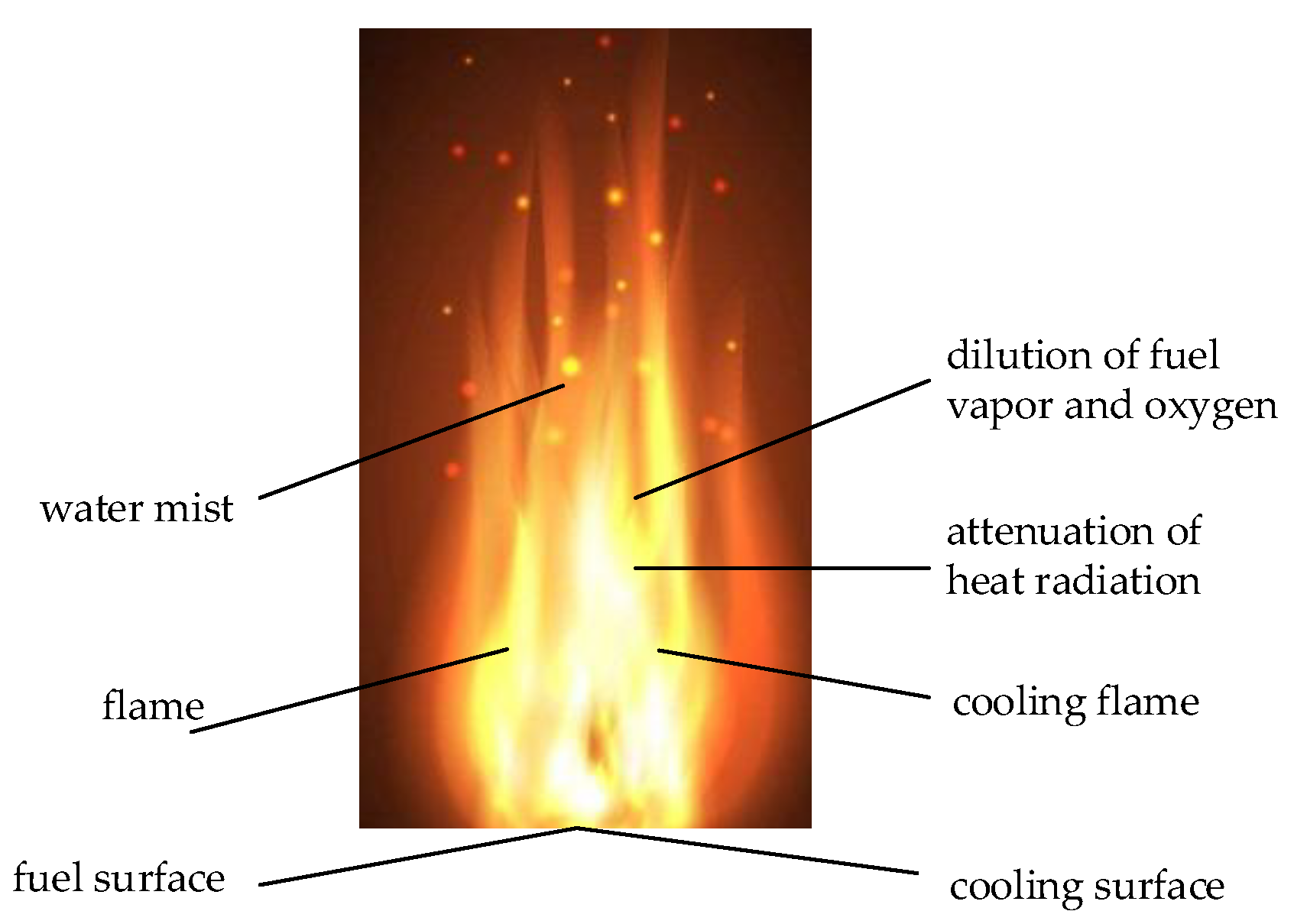
Research findings [28,29] indicate that the mechanism of pool fire extinguishing by water mist involves multiple physical processes, cooling of the flame, attenuation of heat radiation, dilution of fuel vapor and oxygen, and cooling of the fuel surface, as illustrated in Figure 1. In an unconfined space, oxygen dilution by water mist rarely contributes significantly to fire extinguishment even upon complete vaporization. Under such conditions, suppression primarily relies on either flame cooling or surface cooling.
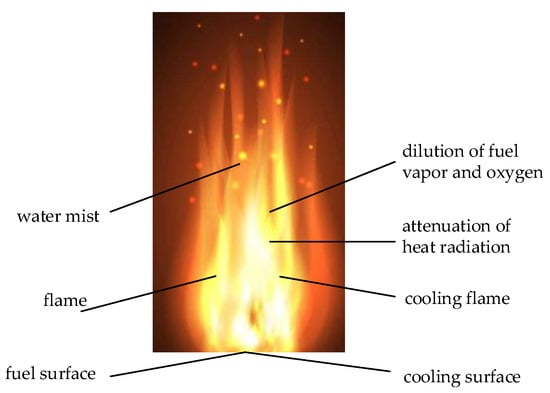
Figure 1.
Schematic diagram of the interaction between water mist and flame.
For liquid fuels with a higher flash point (above ambient temperature, such as diesel), extinguishment can still be achieved through surface cooling even if water mist fails to directly suppress the flame within the combustion zone. In contrast, for fuels with a low flash point (below ambient temperature, such as alcohol or gasoline), water mist is ineffective at reducing the fuel temperature below its flash point. In these cases, extinguishment depends almost entirely on flame cooling.
The heat feedback from the flame supplies the energy required for liquid fuel evaporation. Combustion intensity cannot be reduced unless the flame temperature is lowered. Therefore, the flame cooling effect is critical to the extinguishing performance for liquid pool fire, particularly for fuels with a lower flash point.
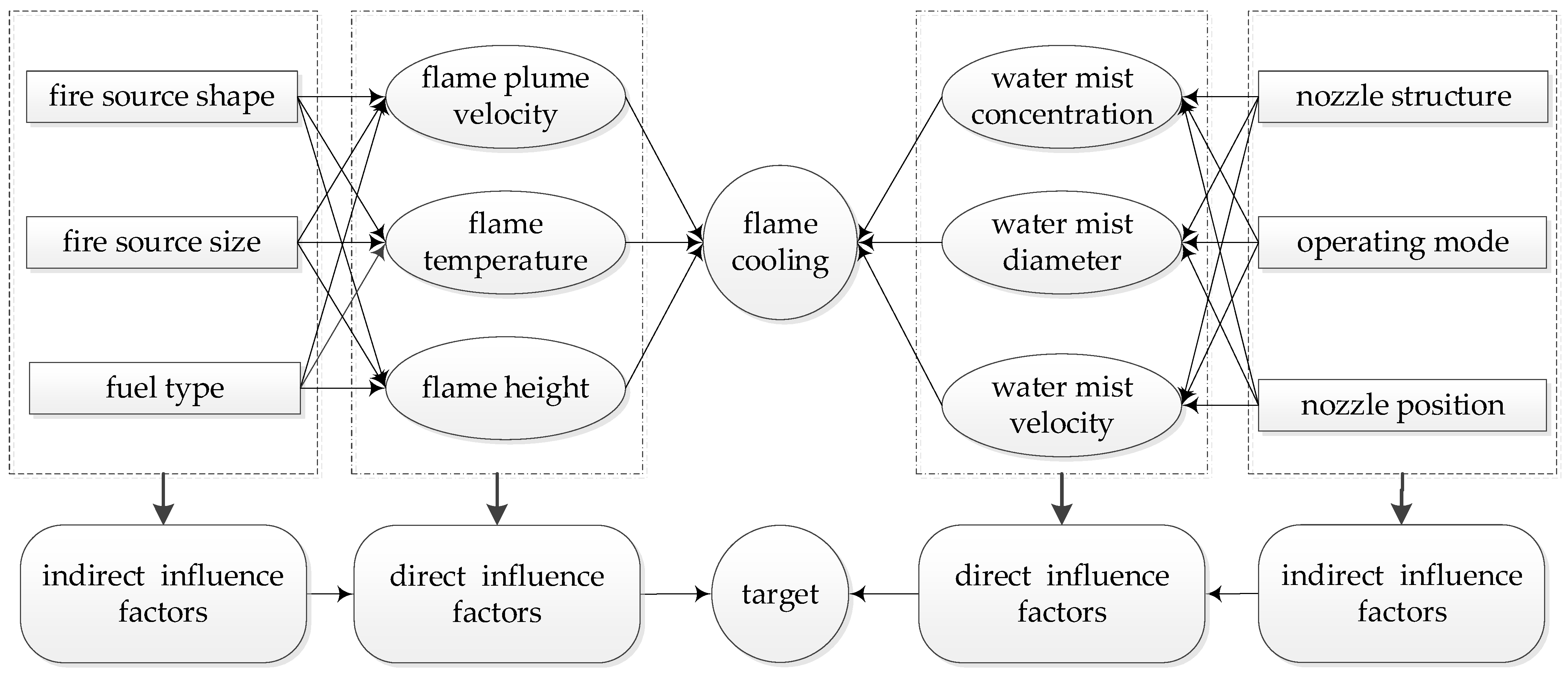
The efficiency of water mist utilization and flame cooling effect are closely related to the degree of vaporization, as the latent heat of water vaporization provides a heat absorption capacity approximately 7.2 times greater than sensible heating at room temperature. As illustrated in Figure 1, vaporization within the flame zone depends on both flame characteristics and water mist properties. Flame characteristics (such as velocity, temperature, and height) are determined by the fire source. Water mist characteristics (including concentration, droplets diameter, and velocity) are governed by the spray system.
Based on the analysis above and the parameters outlined in Table 1, the factors influencing the fire extinguishing performance of water mist are summarized in Figure 2.
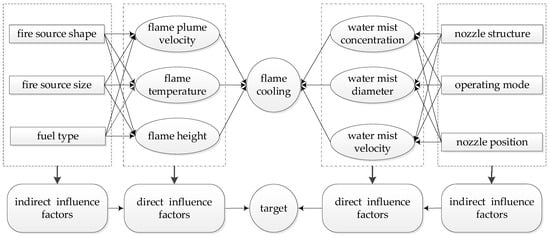
Figure 2.
Relationship of factors affecting fire extinguishing efficiency of water mist.
As illustrated in Figure 2, the factors affecting the fire extinguishing performance of water mist can be categorized as either direct or indirect factors. The mechanism by which indirect factors influence performance is complex. However, existing experimental studies primarily focus on establishing correlations between indirect factors themselves, or between indirect and direct factors. Consequently, the conclusions drawn from such research are often applicable only to specific fire scenarios. Identifying the relationships between the direct factors themselves would be more beneficial. This approach would help clarify the overall interaction network among all influencing factors and, in turn, facilitate a more straightforward and reliable design process for water mist systems.
2.2. Models
2.2.1. Droplet Motion Model
The following assumptions are made regarding water mist entering the flame zone:
- (1)
- Water mist enters the flame zone from the top of the flame, with all droplets possessing identical initial diameter and velocity. Only the vertical velocity component is considered upon entry into the flame zone.
- (2)
- Droplet-droplet interactions are neglected.
Based on these assumptions, the primary forces acting on a droplet within the flame zone are gravity, buoyancy, and viscous drag. The equation of motion is given as follows.
where mp is the mass of a droplet, kg; up is the droplet velocity, m/s; t is the droplet’s moving time, s; F is the viscous resistance of the airflow to the droplets, N; g is the gravity acceleration, m/s2; ρp is the density of droplets, kg/m3; ρ is the density of the surrounding airflow, kg/m3.
Viscous resistance of airflow to a droplet can be expressed as [30]:
Here, cd is the coefficient of motion resistance; Ap = πdp2/4 is the cross-sectional area of the droplet, m2, where dp is the diameter of the droplet, m; us is the velocity of airflow, m/s.
The mass of a droplet can be expressed as:
Resistance coefficient is a function of the local Reynolds number [31].
Reynolds number is:
Here, μs is gas dynamic viscosity coefficient, Pa⸱s.
Replace Formulas (2)–(5) with (1), the equation of motion is:
where γs is the viscosity coefficient of gas motion, m2/s, it can be expressed as:
2.2.2. Heat and Mass Transfer Between Water Mist and Flame
The following assumptions are made for the heat and mass exchange processes within the flame zone:
- (1)
- The temperature of the flame zone is stable, and heat transfer between the droplet and the flame is steady-state.
- (2)
- The heating process of water mist prior to vaporization is neglected.
Under forced convection condition, the mass vaporization rate of an individual droplet can be expressed as [32]:
Here, Nu is the Nusselt number of droplets; λ is the gas thermal conductivity, w/m⸱K; cp is the specific heat at constant pressure of gas, kJ/kg⸱K; B is transferring parameter.
Nu can be calculated from the following equation [33]:
Here, Pr ≈ 0.7, is the Prandtl number of air.
λ and cp can be determined by the characteristic temperature. The characteristic temperature can be determined by 1/3 rule, which can be expressed as [34]:
where Tf is the flame zone temperature, K; Ts is the boiling point of water, K.
B can be approximate calculated using the following formula [35]:
where hv is the latent heat of vaporization of water at Ts, kJ/kg.
Replace Formulas (5), (9) and (11) with (8), the vaporization equation of a droplet can be expressed as:
2.2.3. Heat Exchange Distance of a Droplet
Droplets within the flame zone undergo continuous vaporization. The distance traveled prior to complete vaporization can be calculated using the following formula.
Here, tlife is the time of complete vaporization of a droplet, s.
2.2.4. Validity and Applicability of Model Assumptions
The assumptions adopted in this study are intended to simplify the complex multiphase flow and heat/mass transfer processes for analytical tractability, while retaining the essential physics governing water mist–flame interactions.
The unidirectional top-entry assumption (Section 2.2.1) is employed to decouple and specifically analyze the influence of initial droplet parameters—namely velocity and diameter—on their penetration depth and subsequent vaporization dynamics. Furthermore, the neglect of droplet-droplet interactions (e.g., coalescence and breakup) is justified given the low volumetric concentration of water mist (<1 vol.%) characteristic of typical suppression scenarios; under such dilute conditions, inter-droplet phenomena are considered secondary to the dominant droplet-flame interactions. For the thermal analysis, a steady-state heat transfer model with a uniform flame temperature (Section 2.2.2) serves as a first-order approximation to estimate droplet vaporization time. This quasi-steady approach is validated by the significant timescale disparity since the droplet heating time (~10−2 s) is orders of magnitude shorter than the period of flame pulsation (~1 s), meaning droplets vaporize in an effectively constant thermal environment. Finally, the sensible heating phase of the droplets prior to vaporization is neglected, a simplification supported by the high flame-to-droplet temperature differential and the short convective heating time, which collectively ensure that the energy demand is dominated by the latent heat of vaporization.
These simplifications allow the model to highlight the direct influence of droplet diameter and velocity on heat exchange distance and vaporization efficiency, which is the primary focus of this study. The model is most applicable to pool fires with stable diffusion flames and low to moderate plume velocities.
2.2.5. Model Calculation and Data Analysis
An analytical solution cannot be derived directly from the system of equations comprising (6), (12), and (13). Therefore, representative numerical solutions were obtained using MATLAB 2014b (MathWorks, Inc., MA, USA). A custom computational program was written to facilitate solving the equations. The parameters used in the calculations are listed in Table 2. Data visualization was achieved using Origin 2017 (OriginLab Corporation, MA, USA).
Table 2.
Parametric values in the equations.
3. Results
3.1. Results Without Considering Plume Velocity
3.1.1. Effect of Initial Velocity
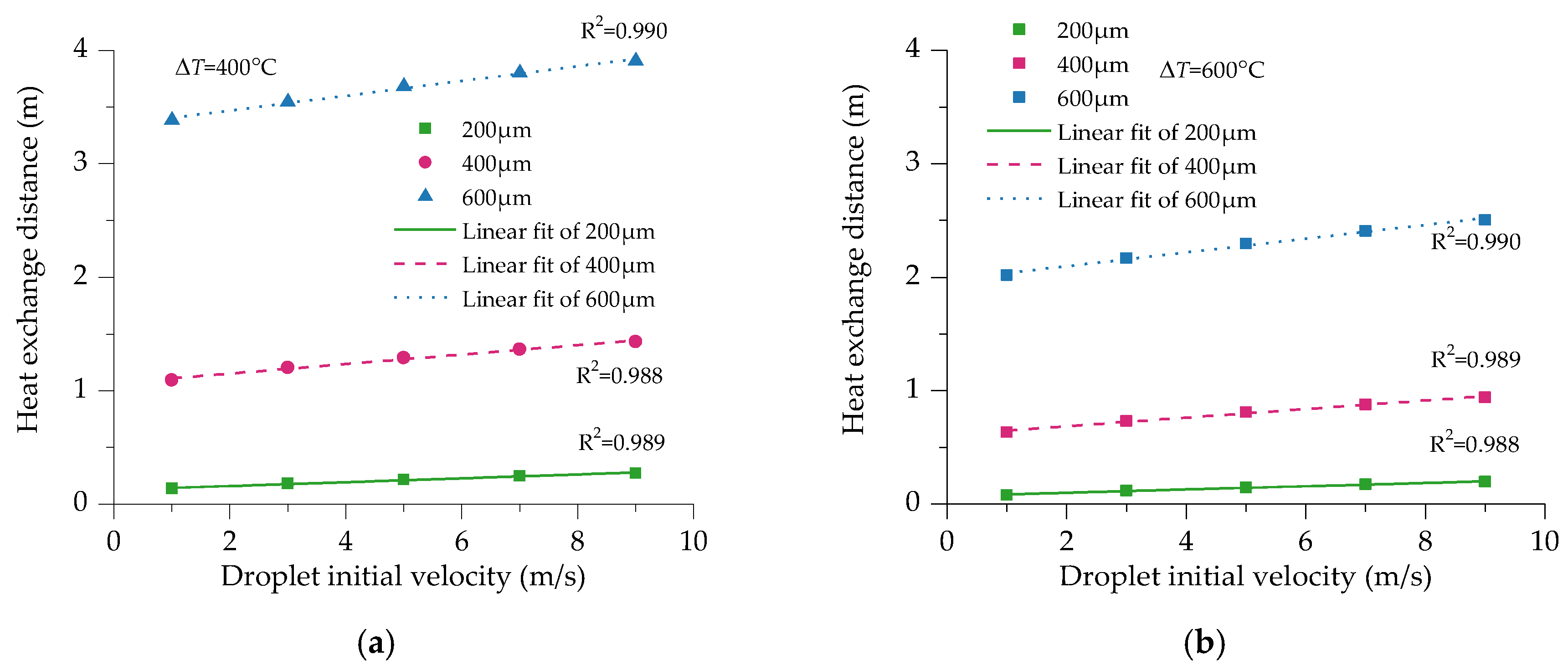
Figure 3 illustrates the influence of droplet initial velocity on heat exchange distance. It can be seen that the heat exchange distance increases approximately linearly with initial velocity, though the slope of the fitting line is relatively small. Notably, this slope remains nearly constant across different initial droplet diameters. These results indicate that increasing the initial velocity of water mist does not effectively extend the heat exchange distance. Consequently, raising the nozzle working pressure, which primarily affects initial velocity, would not significantly enhance this parameter.
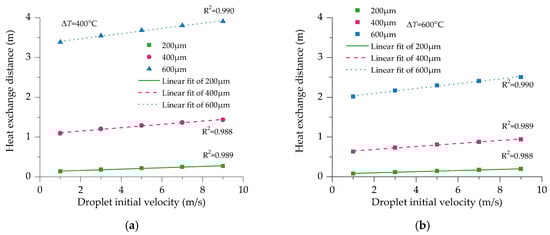
Figure 3.
Effect of initial velocity on heat exchange distance (flame plume velocity is 0; temperature difference is 400 °C and 600 °C, respectively).
Comparing Figure 3a,b, the linear relationship between initial velocity and heat exchange distance persists even when the heat transfer temperature difference increases. However, the heat exchange itself decreases markedly under the higher temperature difference condition.
3.1.2. Effect of Initial Diameter
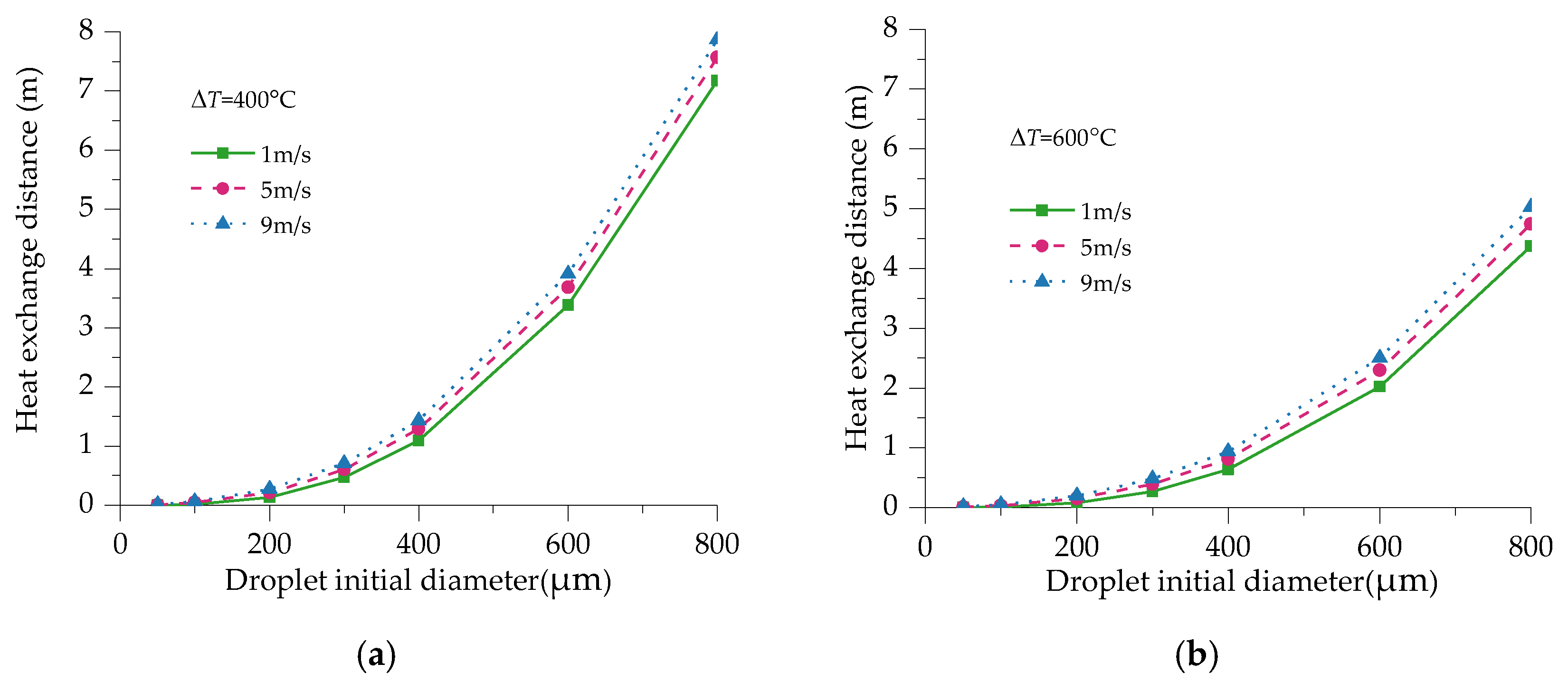
As shown in Figure 4, the heat exchange distance exhibits an exponential relationship with the initial droplet diameter. Diameter directly influences specific surface area, which in turn governs the heat transfer rate between the water mist and the flame. While increasing the initial droplet size can significantly enhance the penetration ability of water mist through the flame, it concurrently reduces the specific surface area, thereby weakening the overall heat transfer capacity. Furthermore, the heat exchange distance decreases as the heat transfer temperature difference increases.
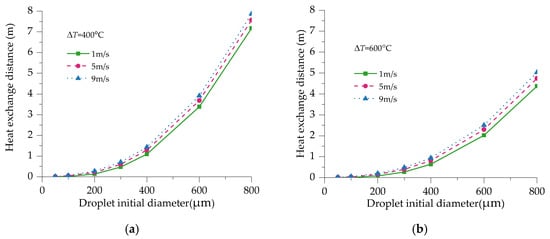
Figure 4.
Effect of initial diameter on heat exchange distance (flame plume velocity is 0; temperature difference is 400 °C and 600 °C, respectively).
3.2. Results Considering Plume Velocity
3.2.1. Effect of Initial Velocity
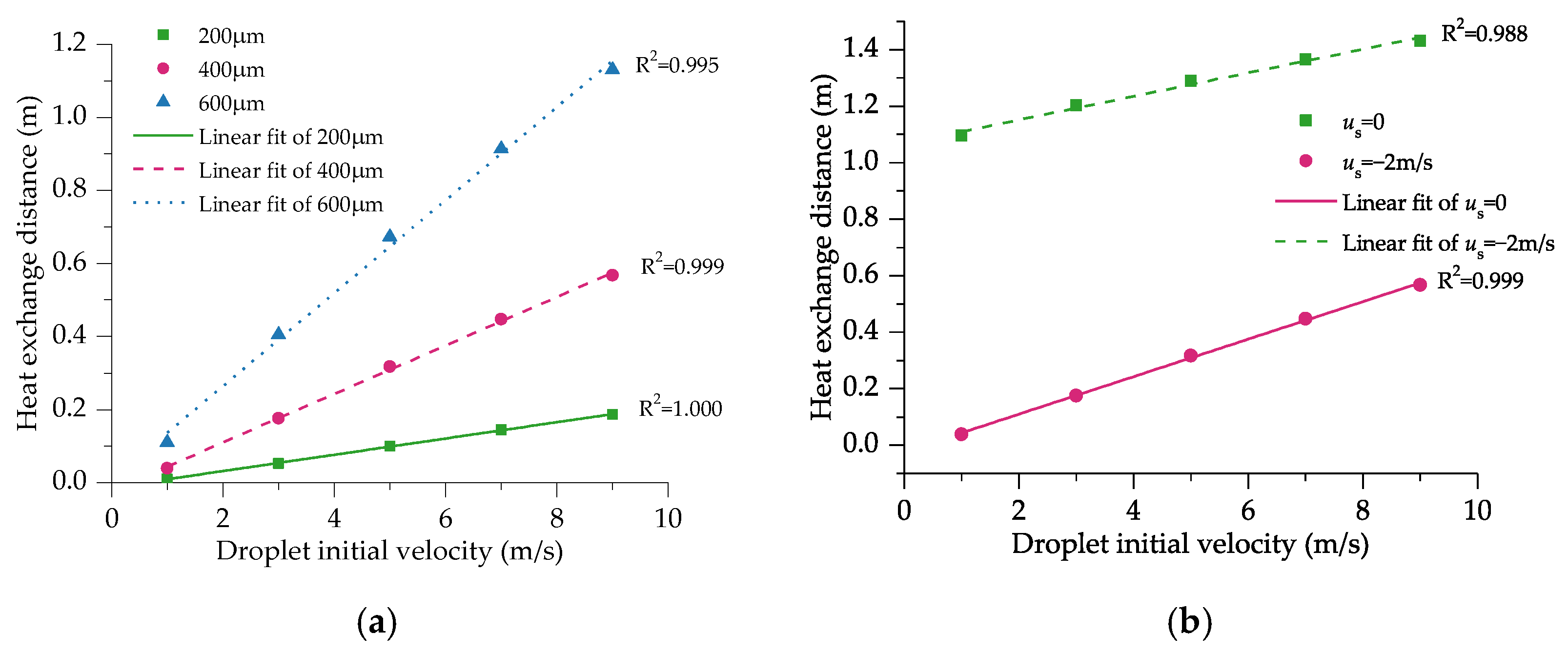
Figure 5a illustrates the influence of droplet initial velocity on heat exchange distance under conditions of a flame plume velocity of −2 m/s and a heat transfer temperature difference of 400 °C. The heat exchange distance remains approximately proportional to the initial velocity. However, the slope of the fitted line varies considerably with initial droplet diameters. Larger diameters correspond to steeper slopes. Consequently, increasing the initial velocity can substantially extend the heat exchange distance for droplets with larger initial diameter.
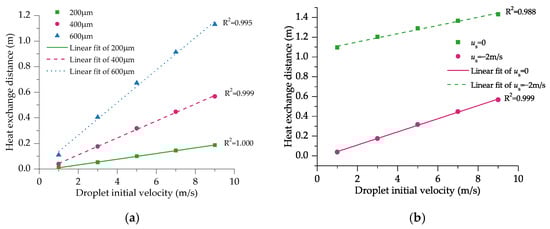
Figure 5.
(a) Effect of initial velocity on heat exchange distance (flame plume velocity is −2 m/s; temperature difference is 400 °C. (b) Effect of the flame plume velocity and initial velocity of water mist on heat exchange distance (temperature difference is 400 °C; initial diameter of the droplet is 400 μm).
Figure 5b compares the effect of initial velocity on heat exchange distance at different plume velocities. The presence of a plume significantly reduces the heat exchange distance. Even at an initial velocity of 9 m/s, the penetration distance of water mist is limited to only 0.284 m under plume influence.
3.2.2. Effect of Initial Diameter
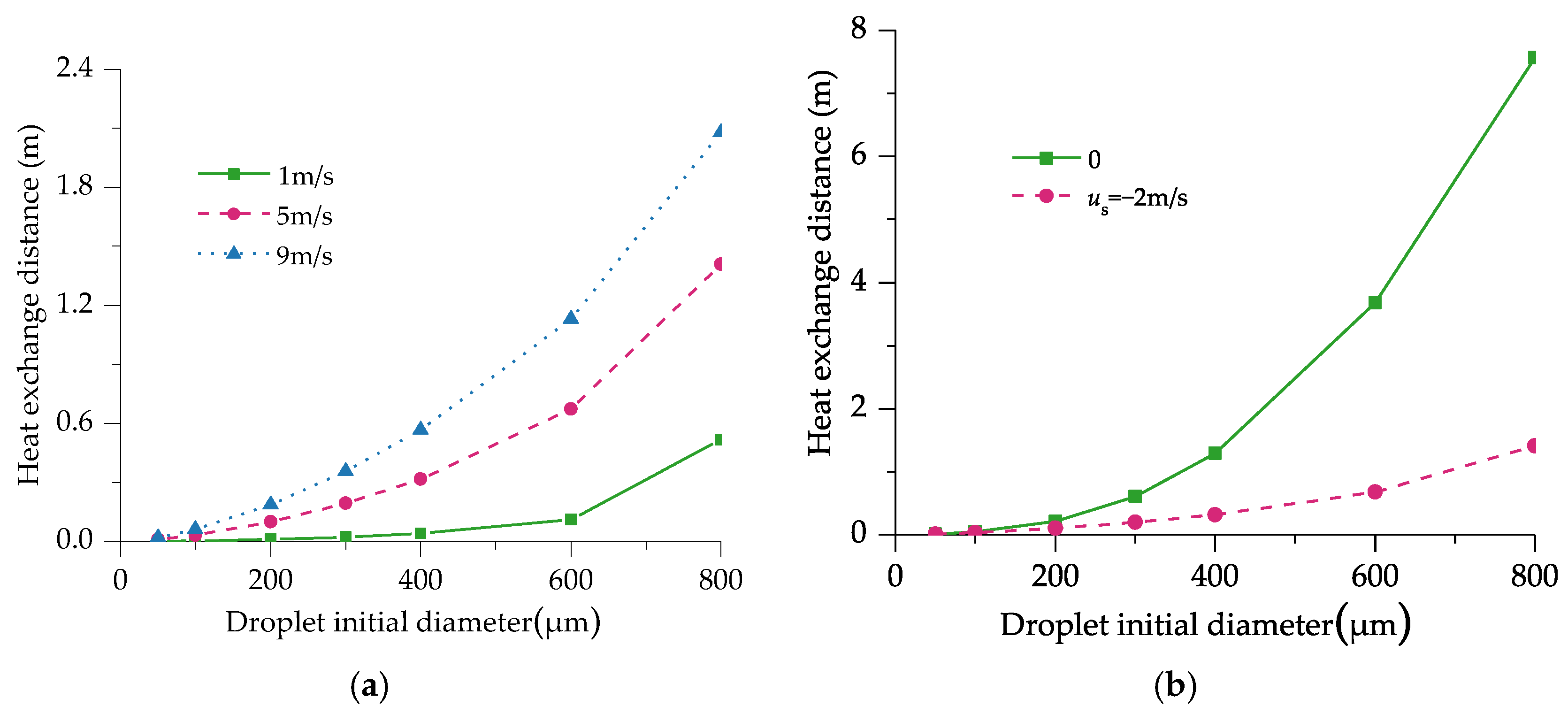
Figure 6a demonstrates an exponential relationship between the initial droplet diameter and the heat exchange distance. The heat exchange distance increases gradually as the initial diameter rises below 400 μm, whereas it exhibits a more rapid increase once the diameter exceeds 400 μm.
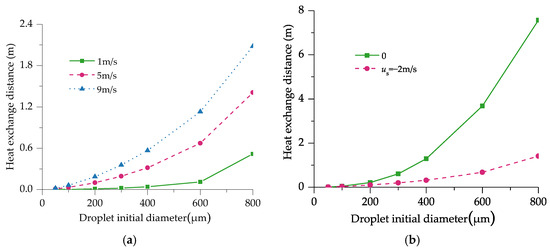
Figure 6.
(a) Effect of the initial diameter on heat exchange distance (velocity of the flame plume is −2 m/s; temperature difference is 400 °C). (b) Effect of the flame plume velocity and initial diameter of water mist on heat exchange distance (temperature difference is 400 °C; initial velocity of the droplet is 5 m/s).
Figure 6b compares the influence of initial droplet diameter on heat exchange distance under different plume velocities. The presence of a flame plume significantly reduces the heat exchange distance, with the reduction being more pronounced for droplets with larger initial diameters. Consequently, under plume-influenced conditions, increasing the initial droplet diameter proves ineffective for substantially enhancing the flame penetration capability of water mist.
3.2.3. Vaporization Efficiency
Vaporization efficiency is defined as the ratio of the mass of water mist vaporized within the flame zone to the total mass entering the zone. Under the influence of the flame plume, water mist may be carried out of the flame zone before complete vaporization occurs.
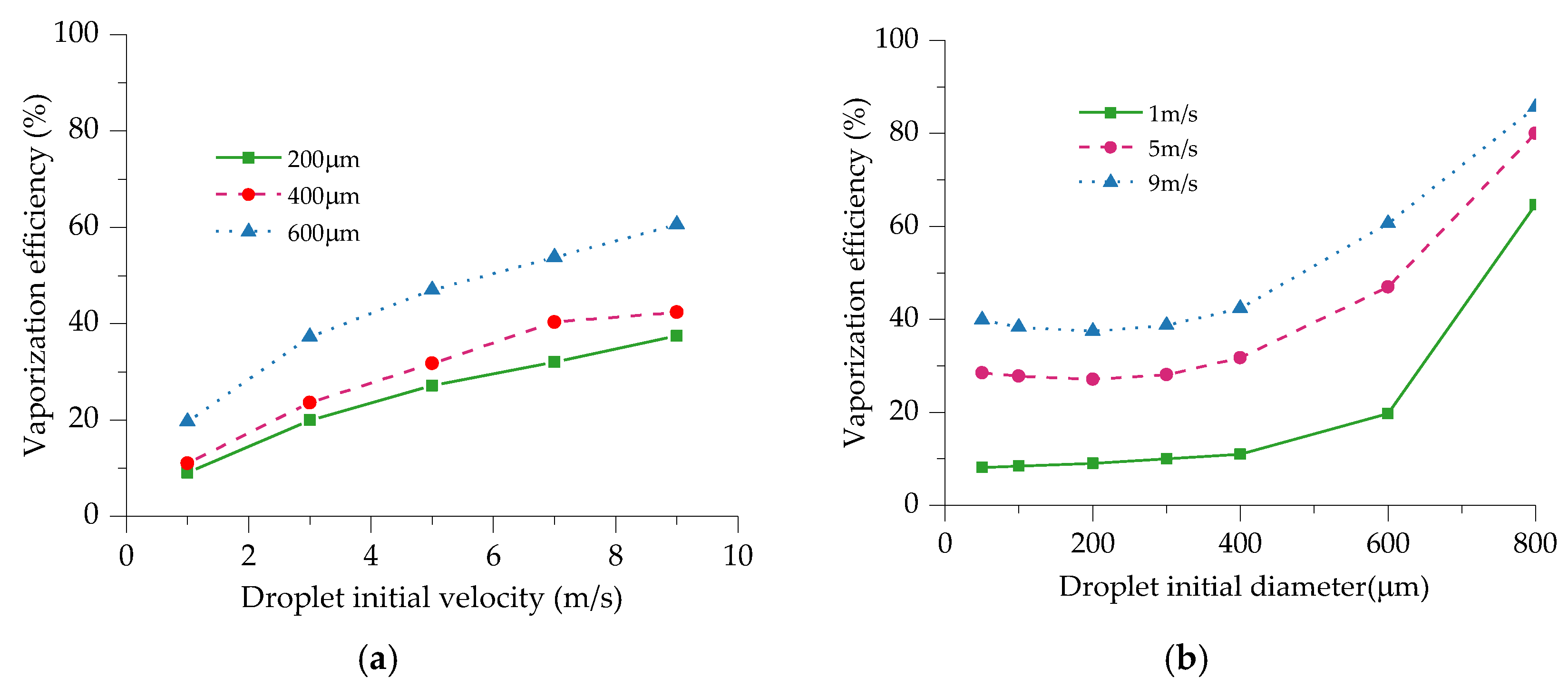
Figure 7a illustrates the effect of initial velocity on the vaporization efficiency. The efficiency increases with higher initial velocity, but the rate improvement diminishes as velocity rises.
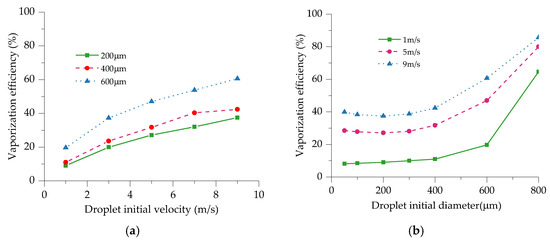
Figure 7.
(a) Effect of the initial velocity on vaporization efficiency (velocity of flame plume is −2 m/s; temperature difference is 400 °C). (b) Effect of the initial diameter on vaporization efficiency (velocity of flame plume is −2 m/s; temperature difference is 400 °C).
Figure 7b presents the effect of initial droplet diameter on vaporization efficiency. While efficiency generally increases with larger diameters, the trend exhibits two distinct regimes. The increase is marginal for diameters below 400 μm, but efficiency rises rapidly once the diameter exceeds 400 μm.
It should be noted that although increasing droplet diameter can improve vaporization efficiency, it simultaneously reduces both the total droplet count and specific surface area for a fixed total water mass within the flame zone. This leads to a marked decrease in the overall heat transfer rate. Consequently, the heat from the flame zone cannot be removed rapidly enough to achieve effective flame cooling and fire suppression.
4. Discussion
4.1. Optimum Initial Velocity and Diameter Without Considering Plume Velocity
Research indicates that fire suppression through flame cooling can be achieved when 30–60% of the combustion generated is removed [36]. The utilization efficiency of water mist depends on the total mass vaporized, while the cooling rate is governed by the vaporization rate. Therefore, effective flame cooling and extinguishment can be expected when the water mist penetrates at least 1/3~2/3 of the flame height and removes all heat within the penetrated region per unit time. To maximize efficiency, water mist should undergo complete vaporization. These conditions define the optimal performance criteria for water mist.
When the heat transfer temperature difference and flame height are known, the optimum initial velocity and droplet diameter can be determined using Figure 3 and Figure 4. If these parameters are unknown, the following empirical formulas may be applied for estimation.
(1) Mean flame temperature [37,38]:
For pool fire [39],
where Tp is the average temperature of flame plume at the height of z, K; Tz is the thermodynamic temperature of ambient air at the height of z, K; Qc is the convection part of the total heat release rate Q of the fire source, KW; is the mass flow of plume at the height of z, kg/s; Q is the total heat release rate of fire source, KW; z is the height of calculated cross-section, m; ΔH is the combustion heat of fuel, kJ/kg; is the mass loss rate of infinite oil tank, kg/m2⸱s; κ is the light absorption coefficient of flame; β is the correction of effective thickness of gases; D is the oil basin diameter, m; S is the oil basin area, m2.
(2) The height of the natural diffusion flame [40]:
where zf is the average height of flame, m; C7 ≈ 0.235 is the empirical constant; Df is the diameter of fire source, m.
It should be noted that the results presented in Figure 3 and Figure 4 are numerical solutions obtained under the assumption of sustained heat transfer conditions. The values derived from these figures do not guarantee complete vaporization of water mist before reaching the fuel surface in practice, due to actual variations in flame temperature.
4.2. Optimum Initial Velocity and Diameter Considering Plume Velocity
Under the influence of the flame plume, water mist enters the flame zone both from above and laterally. The heat exchange distance for droplets entering from above increases with higher initial velocity and diameter. Conversely, the quantity of water mist entering laterally decreases as initial velocity and diameter increase. Consequently, an optimal combination of velocity and diameter must exist to maximize the total heat absorption capacity of water mist delivered through both pathways. The study of Shrigondekar [27] provides experimental evidence for the existence of such an optimum.
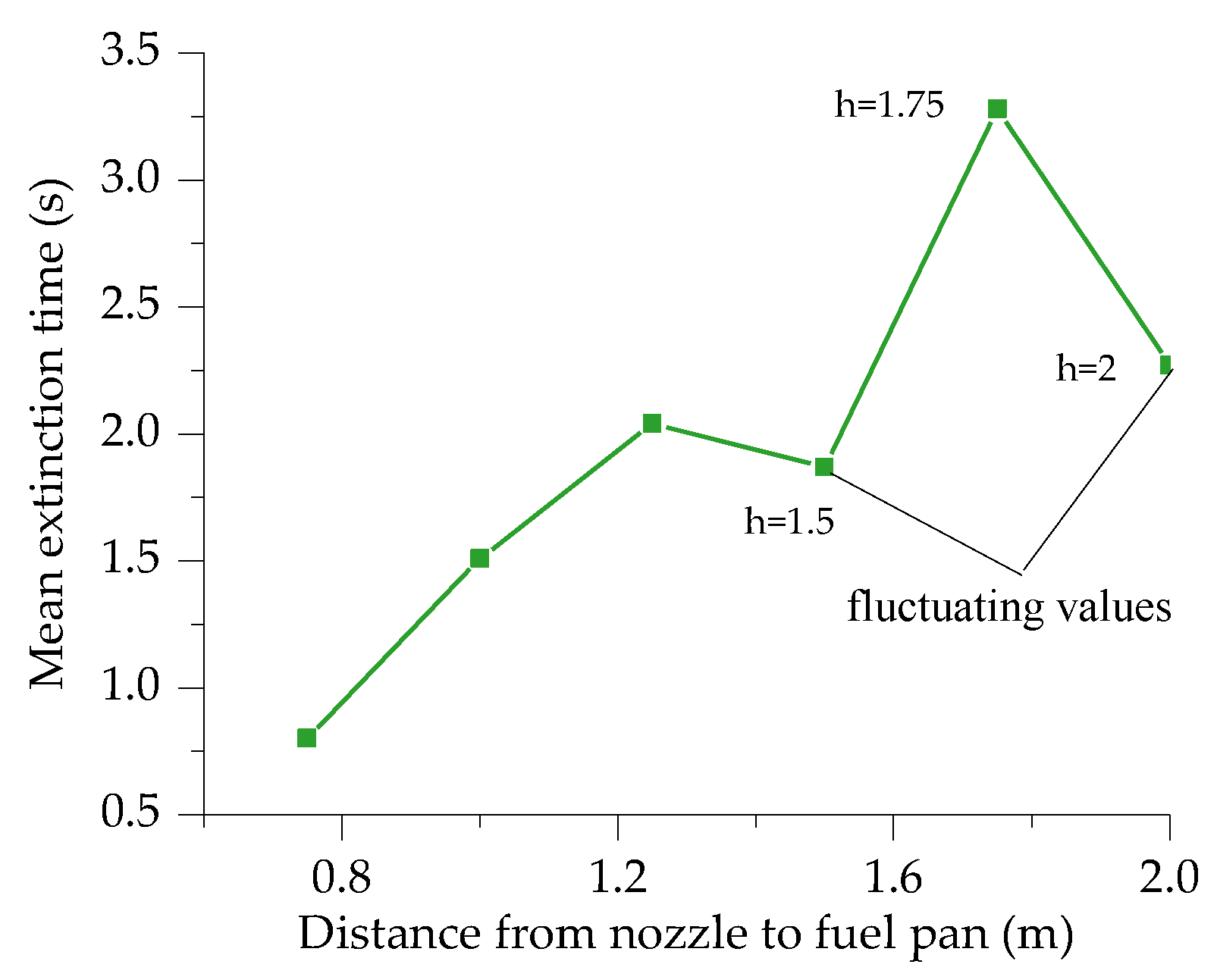
Figure 8 presents experimental results showing the relationship between nozzle-to-pan distance and mean extinguishing time for a diesel pool fire (pan diameter: 0.1 m). Notably, the mean extinguishing time does not increase monotonically with distance. Fluctuations observed at distances of 1.5 m and 2.0 m suggest enhanced water mist penetration into the flame zone under these conditions. Further analysis of plume entrainment dynamics is required to precisely determine the optimum water mist velocity and diameter.
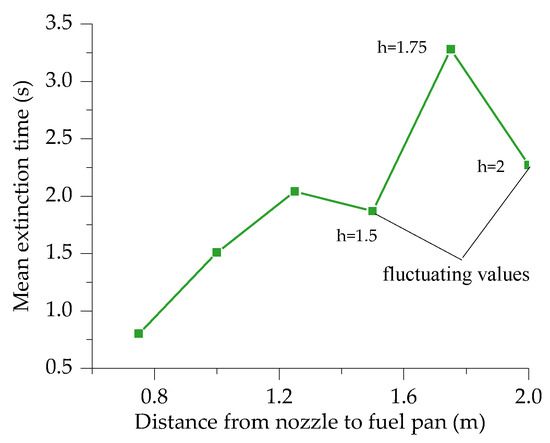
Figure 8.
Effect of nozzle height on fire extinguishing time.
4.3. Water Mist Mass Flow
The analysis presented here focuses on the mass flow rate of water mist entering the flame zone. In practical suppression scenarios, the vaporization efficiency of water mist is influenced by multiple factors, including the type of fire source, the mode of water mist entry, and the intrinsic characteristics of the mist itself. Two limiting cases can be considered, complete vaporization of the water mist and no vaporization at all. The rate of heat removal by water mist can be expressed as:
where Q′ is the heat taken away by water mist, KW; m is the mass flow that actually enters the flame zone, kg/s; cw is the specific heat of water, 4.19 kJ/kg⸱°C; T0 is the temperature of the water mist as it enters the flame, °C; η is the vaporization ratio of water mist in the flame zone.
As noted earlier in the article, flame cooling can extinguish a fire when 30%~60% of the combustion-generated heat is removed. For a 100 KW fire at T0 = 20 °C, assuming 60% of the heat is extracted per unit time, the minimum required water mist mass flow rate is 0.023 kg/s, while the maximum reaches 3.14 kg/s, a difference of 137 times. To improve the utilization efficiency of water mist, its vaporization rate must be increased.
4.4. Implications for Water Mist System Design
The findings from this model provide quantitative insights for optimizing key design parameters in practical water mist suppression systems.
For fires where plume influence is negligible (low-to-moderate intensity), this model provides a direct methodology for system optimization. It can be used to determine the optimal initial droplet velocity and diameter. The analysis shows that the heat exchange distance scales approximately with for a given velocity (refer to Figure 4 and Figure 6). This scaling implies, for instance, that reducing the Sauter Mean Diameter (SMD) from 400 μm to 200 μm could shorten the required effective penetration distance by nearly an order of magnitude, significantly improving suppression efficiency in confined spaces. Consequently, nozzle selection and placement must be based on their performance characteristics to ensure that the generated droplets satisfy these optimal velocity and diameter criteria upon entering the flame zone. It is important to note that the benefit of a smaller droplet size must be balanced against the trade-offs of longer evaporation time and reduced droplet momentum.
For high-intensity fires where plume effects cannot be neglected, ensuring that the water mist possesses sufficient momentum to penetrate the flame plume is critical for successful suppression. This model provides support for predicting the necessary droplet momentum. The quantitative relationship between plume velocity and mist penetration decay offers designers a correlative tool to estimate the required initial velocity-diameter combination to overcome a given plume strength. Conservative design margins (e.g., increased flow density or reduced nozzle spacing) should be incorporated to compensate for the reduced predictability of droplet trajectories.
4.5. Limitations
It should be noted that the present model relies on several simplifying assumptions, which may result in deviations from actual fire conditions. In real fire environments, droplets can undergo secondary breakup due to aerodynamic forces or coalesce upon collision, both of which significantly influence droplet size distribution, trajectory, and vaporization behavior. Additionally, the model assumes that water mist enters the flame zone from the top of the flame. In real fire scenarios, droplets may also enter from the periphery due to plume entrainment.
5. Conclusions
The factors influencing the fire-extinguishing efficiency of water mist can be categorized as direct or indirect. Direct factors include flame temperature, flame height, flame velocity, water mist concentration, droplet diameter, and droplet velocity.
When flame plume effects are neglected, droplet initial diameter has a greater influence on heat exchange distance than initial velocity. The optimum velocity and diameter for water mist entering the flame zone can be determined based on the heat transfer temperature difference and flame height.
Under the influence of a flame plume, water mist enters the flame zone both from above and from the periphery. Utilization efficiency and cooling capacity are significantly reduced because mist entering from above may be carried out of the flame zone by the plume before fully vaporizing. However, some mist is also entrained into the flame zone by the plume. Therefore, to maximize total heat absorption, both the directly injected mist and the plume-entrained mist must be considered when determining the optimal droplet velocity and diameter.
Increasing the vaporization rate of water mist within the flame zone can enhance utilization efficiency and reduce water consumption.
Future studies should incorporate droplet breakup/coalescence models and account for transient flame-droplet interactions to enhance the model’s predictive accuracy and practical applicability. In addition, further analysis of plume entrainment dynamics is necessary to more precisely determine the optimum water mist velocity and diameter.
Author Contributions
Conceptualization, J.L.; methodology, J.L.; software, M.H.; writing—original draft preparation, J.L.; writing—review and editing, M.H.; project administration, M.H. All authors have read and agreed to the published version of the manuscript.
Funding
This research was funded by the Provincial Teaching Research Project of Colleges and Universities of Hubei Province (2023489), Science and Technology Research Project of the Education Department of Hubei Province (D20244504), Research Project of Education and Teaching Reform in Hubei Polytechnic University (2025A08).
Data Availability Statement
The original contributions presented in the study are included in the article, further inquiries can be directed to the corresponding author.
Conflicts of Interest
The authors declare no conflicts of interest.
References
- Dasgotra, A.; Rangarajan, G.; Tauseef, S. CFD-based study and analysis on the effectiveness of water mist in interacting pool fire suppression. Process Saf. Environ. Prot. 2021, 152, 614–629. [Google Scholar] [CrossRef]
- Zhao, X.; Zhao, J.; Zhu, X.; Xu, W.; Zhang, G.; Wang, C.; Wang, X. Study on the suppression of hydrogen-air explosions by ultrafine water mist containing KCl K2CO3, or NaCl. Fire Saf. J. 2025, 153, 104356. [Google Scholar] [CrossRef]
- Zhu, N. Experimental Performance Evaluation of Water Mist Fire Suppression System. Ph.D. Thesis, Hong Kong Polytechnic University, Hong Kong, China, 2009. [Google Scholar]
- Robinet, A.; Chetehouna, K.; Sellami, I.; Hamidouche, S.; Gascoin, N.; Guedal, D. Case study on thermal and flow analysis of a water mist on a pool fire in a ventilated engine compartment. Appl. Therm. Eng. 2025, 258, 124694. [Google Scholar] [CrossRef]
- He, M.; Zhang, G.; Hu, S.; Wang, C. Assessment of a method to enhance the momentum of water mist: Co-flow jet water mist system. Fire Technol. 2021, 58, 435–455. [Google Scholar] [CrossRef]
- Liu, L.; Luo, Z.; Wang, T.; Yang, X.; Su, B.; Su, Y. Inhibitory effects of water mist containing alkali metal salts on hydrogen–natural gas diffusion flames. Int. J. Hydrog. Energy 2024, 51, 754–764. [Google Scholar] [CrossRef]
- Rasbash, D.J.; Rogowski, Z.W.; Stark, G.W.V. Mechanisms of extinction of liquid fires with water sprays. Combust. Flame 1960, 4, 223–234. [Google Scholar] [CrossRef]
- Kim, M.B.; Jang, Y.J.; Kim, J.K. Burning rate of a pool fire with downward-directed sprays. Fire Saf. J. 1996, 27, 37–48. [Google Scholar] [CrossRef]
- Ndubizu, C.C.; Ananth, R.; Tatem, P.A. The effects of droplet size and injection orientation on water mist suppression of low and high boiling point liquid pool fires. Combust. Sci. Technol. 2000, 157, 63–86. [Google Scholar] [CrossRef]
- Liu, J.H.; Liao, G.X.; Fan, W.C.; Yao, B.; Lu, X. Study of liquid pool fire suppression with water mists by cone calorimeter. J. Fire Sci. 2002, 20, 465–477. [Google Scholar] [CrossRef]
- Cong, B.H.; Liao, G.X.; Huang, Z. Extinction limit of diesel pool fires suppressed by water mist. J. Fire Sci. 2009, 27, 5–26. [Google Scholar] [CrossRef]
- Huang, X.; Wang, X.S.; Liao, G.X. Characterization of an effervescent atomization water mist nozzle and its fire suppression tests. Proc. Combust. Inst. 2011, 33, 2573–2579. [Google Scholar] [CrossRef]
- Gupta, M.; Rajora, R.; Sahai, S.; Shankar, R.; Ray, A.; Kale, S. Experimental evaluation of fire suppression characteristics of twin fluid water mist system. Fire Saf. J. 2012, 54, 130–142. [Google Scholar] [CrossRef]
- Gupta, M.; Pasi, A.; Ray, A.; Kale, S. An experimental study of the effects of water mist characteristics on pool fire suppression. Exp. Therm. Fluid Sci. 2013, 44, 768–778. [Google Scholar] [CrossRef]
- Arvidson, M. Large-scale water spray and water mist fire suppression system tests for the protection of ro–ro cargo decks on ships. Fire Technol. 2014, 50, 589–610. [Google Scholar] [CrossRef]
- Liang, T.; Liu, M.; Liu, Z.; Zhong, W.; Xiao, X.; Lo, S. A study of the probability distribution of pool fire extinguishing times using water mist. Process Saf. Environ. Prot. 2015, 93, 240–248. [Google Scholar] [CrossRef]
- Yu, H.-Z.; Kasiski, R.; Daelhousen, M. Characterization of Twin-Fluid (Water Mist and Inert Gas) Fire Extinguishing Systems by Testing and Modeling. J. Fire Technol. 2015, 51, 923–950. [Google Scholar] [CrossRef]
- Pancawardani, F.; Arini, D.; Yunindar, R.P.; Ramadhan, M.L.; Imran, F.A.; Nugroho, Y.S. Analysis of water mist fire suppression system applied on cellulose fire. Procedia Eng. 2017, 170, 344–351. [Google Scholar] [CrossRef]
- Zhou, Y.; Bu, R.; Gong, J.; Zhang, X.; Fan, C.; Wang, X. Assessment of a clean efficient fire-extinguishing technique: Continuous cycling discharge water mist system. J. Clean. Prod. 2018, 182, 682–693. [Google Scholar] [CrossRef]
- Deng, Y.; Gu, B.; Zhang, R.; Li, L.; Niu, L. Numerical Simulation on Effect of Pulsed Water Mist on Temperature and Thermal Radiation in Long and Narrow Underground Space During Fire. Fire 2025, 8, 350. [Google Scholar] [CrossRef]
- Liu, Z.; Carpenter, D.; Kim, A.K. Cooling characteristics of hot oil pool by water mist during fire suppression. Fire Saf. J. 2008, 43, 269–281. [Google Scholar] [CrossRef]
- Liu, Y.; Jiang, Z.; Wang, D.; Li, X. Experimental research on the water mist fire suppression performance in an enclosed space by changing the characteristics of nozzles. Exp. Therm. Fluid Sci. 2014, 52, 174–181. [Google Scholar] [CrossRef]
- Kim, M.B.; Jang, Y.J.; Yoon, M.O. Extinction limit of a pool fire with a water mist. Fire Saf. J. 1997, 28, 295–306. [Google Scholar] [CrossRef]
- Liao, G.; Liu, J.; Qin, J.; Yao, B. Experimental study on the interaction of fine water spray with liquid pool fires. J. Therm. Sci. 2001, 10, 377. [Google Scholar] [CrossRef]
- Wang, X.S.; Liao, G.X.; Yao, B.; Fan, W.; Wu, X. Preliminary study on the interaction of water mist with pool fires. J. Fire Sci. 2001, 19, 45–61. [Google Scholar] [CrossRef]
- Wang, X.S.; Liao, G.X.; Qin, J.; Fan, W. Experimental study on the effectiveness of the extinction of a pool fire with water mist. J. Fire Sci. 2002, 20, 279–295. [Google Scholar] [CrossRef]
- Shrigondekar, H.; Chowdhury, A.; Prabhu, S.V. Characterization of a simplex water mist nozzle and its performance in extinguishing liquid pool fire. Exp. Therm. Fluid Sci. 2018, 93, 441–455. [Google Scholar] [CrossRef]
- Ge, X.X.; Zhang, X.K. Review on water mist fire suppression system. China Public Secur. 2006, 5, 170–175. [Google Scholar]
- Richardson, J.R.M.J.K. A Review of Water Mist Fire Suppression Research and Development, 1996. Fire Technol. 1997, 33, 54–90. [Google Scholar] [CrossRef]
- Thomas, G.O. The quenching of laminar methane-air flames by water mists. Combust. Flame 2002, 130, 147–160. [Google Scholar] [CrossRef]
- Ramírez, C.A. Summary of frictional drag coefficient relationships for spheres: Evolving solution strategies applied to an old problem. Chem. Eng. Sci. 2017, 168, 339–343. [Google Scholar] [CrossRef]
- Sazhin, S.S. Advanced models of fuel droplet heating and evaporation. Prog. Energy Combust. Sci. 2006, 32, 162–214. [Google Scholar] [CrossRef]
- Novozhilov, V.; Harvie, D.; Kent, J.; Apte, V.; Pearson, D. Acomputational fluid dynamics study of wood fire extinguishment by water sprinkler. Fire Saf. J. 1997, 29, 259–282. [Google Scholar] [CrossRef]
- Cooper, L.Y. The interaction of an isolated sprinkler spray a two-layer compartment fire environment. Int. J. Heat Mass Transf. 1995, 38, 679–690. [Google Scholar] [CrossRef]
- Vaari, J. Atransient one-zone computer model for total flooding water mist fire suppression in ventilated enclosures. Fire Saf. J. 2002, 37, 229–257. [Google Scholar] [CrossRef]
- Wighus, R. Extinguishment of enclosed gas fires with water sprays. Nasa Sti/Recon Tech. Rep. N 1991, 94, 997–1006. [Google Scholar] [CrossRef]
- Heskestad, G. Fire Plumes Flame Height Air Entrainment. In SFPE Handbook of Fire Protection Engineering; Hurley, M.J., Gottuk, D., Hall, J.R., Harada, K., Kuligowski, E., Puchovsky, M., Torero, J., Watts, J.M., Wieczorek, C., Eds.; Springer: New York, NY, USA, 2016; pp. 396–428. [Google Scholar]
- McCaffrey, B.J. Purely Buoyant Diffusion Flames: Some Experimental Results; Department of Commerce: Washington, DC, USA, 1979; pp. 5–11. [Google Scholar]
- Ditch, B.D.; de Ris, J.L.; Blanchat, T.K.; Chaos, M.; Bill, R.G., Jr.; Dorofeev, S.B. Pool fires—An empirical correlation. Combust. Flame 2013, 160, 2964–2974. [Google Scholar] [CrossRef]
- Heskestad, G. Engineering relations for fire plumes. Fire Saf. J. 1984, 7, 25–32. [Google Scholar] [CrossRef]
Disclaimer/Publisher’s Note: The statements, opinions and data contained in all publications are solely those of the individual author(s) and contributor(s) and not of MDPI and/or the editor(s). MDPI and/or the editor(s) disclaim responsibility for any injury to people or property resulting from any ideas, methods, instructions or products referred to in the content. |
© 2026 by the authors. Licensee MDPI, Basel, Switzerland. This article is an open access article distributed under the terms and conditions of the Creative Commons Attribution (CC BY) license.