


Abstract
Cloudy hawthorn juice contains pectin and a polydisperse pulp phase that readily separates during storage. This study examined how high-pressure homogenization (HPH) pressure and pass number affected its physical stability and quality. Juice was treated at 30–150 MPa for one to five passes. Data were analyzed using mixed-effects models for repeated sedimentation measurements and appropriate multiple comparisons for treatment comparisons. The apparent DLS Z-average decreased from approximately 4.5 µm in the untreated juice to 2.0–2.6 µm after one pass and 0.65–0.90 µm after five passes. After 7 d at 4 °C, the sedimentation index was 43% in the control and 71–83% after one pass. At 30 MPa, increasing the treatment from one to two–five passes raised the day-7 index from about 71% to 83–88%, an additional gain of 12–17 percentage points. Total flavonoid content was 25.97 mg RE/100 mL in the control, 22.73–25.50 mg RE/100 mL after one pass, and 18.18–19.84 mg RE/100 mL after four or five passes. DPPH activity remained within 64.98–67.56% (control, 66.95%), whereas ABTS activity was 55.64–58.20% (control, 55.37%). Among the one- to three-pass treatments evaluated sensorially, 90 MPa for one pass showed the most favorable mean sensory profile. Under the laboratory conditions tested, a moderate single-pass treatment offered a better quality–stability balance than repeated homogenization; it should be regarded as a preliminary quality-oriented condition rather than a validated preservation process.
1. Introduction
Hawthorn (Crataegus pinnatifida) is widely cultivated in China and is rich in organic acids, phenolic compounds, and pectin [1,2]. Pectin isolated from cloudy hawthorn juice has been identified as low-methoxyl pectin, and pressure treatment can alter its aggregation and molecular characteristics [3]. Together with suspended pulp and cell-wall fragments, this pectin-containing serum makes cloudy hawthorn juice a complex colloidal matrix in which particle size, interparticle interactions, and the continuous phase all contribute to sedimentation. The untreated juice prepared in this study had a pH of 3.91 and a titratable acidity of 0.85% (expressed as malic acid), providing a quantitative indication of its acidity. Improving physical stability without intensifying the tart taste or losing phenolic quality is therefore a relevant processing problem.
High-pressure processing (HPP) and high-pressure homogenization (HPH) are distinct technologies. HPP exposes a packaged or bulk food to nearly uniform hydrostatic pressure in a pressure vessel and is used mainly for microbial and enzyme inactivation [4,5]. HPH, by contrast, pumps a liquid through a narrow valve; the accompanying shear, turbulence, impact, and cavitation disrupt suspended particles and can modify macromolecular interactions [6,7]. Published work on cloudy hawthorn juice has focused chiefly on HPP and thermal processing, including shelf life, phenolic bioaccessibility, pectin structure, and flavor [3,4,5,8]. Those findings cannot be transferred directly to HPH because the dominant mechanical environment and treatment mode are different.
Studies of pomegranate, blueberry, apple, orange, grapefruit, and Gonggan juices show that HPH can alter cloud stability, color, bioactive compounds, and sensory quality, but the direction and magnitude of the response depend on both the matrix and the processing conditions [9,10,11,12,13,14]. What remains unclear for cloudy hawthorn juice is whether pressure and repeated passes produce equivalent effects, whether their benefits are additive, and at what point further particle disruption is offset by changes in composition and sensory quality. The present study therefore used a 5 × 5 pressure–pass design (30–150 MPa; one to five passes) to evaluate physical stability, physicochemical properties, organic acids, total flavonoids, antioxidant capacity, and sensory attributes. We hypothesized that both factors would reduce apparent particle size and delay sedimentation, but that the marginal improvement would diminish as treatment intensity increased and repeated passes would cause greater quality changes than a moderate single-pass treatment.
2. Materials and Methods
2.1. Preparation of Cloudy Hawthorn Juice
Dajinxing hawthorn (Crataegus pinnatifida Bunge) from Laiwu, Shandong, China, was supplied by Laiwu Wanbang Food Co., Ltd. (Laiwu, Shandong, China) as pitted and dried slices. The slices were approximately 3–4 mm in thickness, with a moisture content of 9.2%, and were stored at 4 °C until use. After sorting and washing, 100 g of dried hawthorn slices were mixed with 2000 mL of purified water, giving a solid-to-liquid ratio of 1:20 (w/v). The mixture was heated in a covered small-scale cooking kettle to 100 °C and held at boiling for 1 h with continuous stirring at 60 rpm. The kettle remained covered during heating, and no water was added to compensate for evaporation. The mixture was then cooled to 20–25 °C and filtered through a 300-mesh nylon filter cloth to obtain cloudy hawthorn juice. The final juice volume was approximately 1.66 L per 100 g of dried hawthorn, equivalent to a yield of approximately 16.6 mL/g.
2.2. High-Pressure Homogenization
HPH was performed using a laboratory-scale high-pressure homogenizer (JN-02HC, Guangzhou Juneng Biology & Technology Co., Ltd., Guangzhou, Guangdong, China; maximum pressure, 200 MPa). Cloudy hawthorn juice (200 mL) was precooled to 4 °C and treated at 30, 60, 90, 120, or 150 MPa for 1–5 passes, yielding 25 pressure–pass combinations. After each pass, the sample temperature increased to approximately 25 °C and, for multiple-pass treatments, was cooled to 4 °C in an ice–water bath before the next pass. The untreated juice served as the control (CK). Three independently prepared batches were used as biological replicates, with each treatment performed in triplicate (n = 3).
2.3. Total Soluble Solids and pH
TSS was measured at 20 ± 1 °C using a digital refractometer (WZB 45, Shanghai Electronic Analytical Instruments Co., Ltd., Shanghai, China) and expressed as °Brix. The pH was measured at 20 ± 1 °C using a calibrated pH meter (Mettler Toledo, Greifensee, Switzerland).
2.4. Particle Size and Ζ-Potential
Particle size and ζ-potential were measured at 25 °C using a Zetasizer Nano ZS90 (Malvern Instruments Ltd., Worcestershire, UK). Samples were diluted 40-fold with purified water and equilibrated at 25 °C for 60 s. The Z-average hydrodynamic diameter was determined by DLS at a scattering angle of 90°, using refractive indices of 1.50 and 1.330 for the particles and dispersant, respectively, and a dispersant viscosity of 0.8872 mPa·s. ζ-Potential was measured by electrophoretic light scattering using a dielectric constant of 78.5.
2.5. Color
Color was measured using a ColorQuest XT colorimeter (Hunter Associates Laboratory, Inc., Reston, VA, USA). The CIELAB parameters L* (lightness), a* (redness/greenness), and b* (yellowness/blueness) were recorded. Total color difference (ΔE) was calculated relative to the untreated control (CK) using Equation (1).
where L*, a*, and b* are the color parameters of the HPH-treated sample, and L0*, a0*, and b0* are the corresponding color parameters of CK.
ΔE = √[(L* − L0*)2 + (a* − a0*)2 + (b* − b0*)2]
2.6. Turbidity and Sedimentation Stability
Samples were centrifuged at 3000× g for 10 min at 20 °C, and absorbance at 650 nm was measured using a UV–visible spectrophotometer (UV-754N, Shanghai Youke Instrumentation Co., Ltd., Shanghai, China) as the turbidity index [7].
For the sedimentation test, 10 mL of each sample was transferred into a transparent 15 mL graduated centrifuge tube, capped, and stored upright and undisturbed at 4 °C. One tube was prepared for each independent process replicate. The same tube was examined once daily from day 0 through day 7, and the measurement was non-destructive. The volume of the upper suspended phase was read directly from the tube graduations without disturbing the sample:
where Vs is the volume of the upper suspended juice phase above the clearly visible sediment boundary (mL), and Vt is the total sample volume (10 mL).
IS (%) = (Vs/Vt) × 100
2.7. Titratable Acidity
Titratable acidity was determined by potentiometric titration according to GB 12456-2021 [15]. A 5 mL sample was mixed with 45 mL distilled water and titrated with 0.1 mol/L NaOH to pH 8.2 ± 0.1.
where V1 is the volume of NaOH used (mL), CNaOH is the NaOH concentration (mol/L), k is the conversion factor for malic acid (0.067), and V0 is the sample volume (mL).
TA (%) = (V1 × CNaOH × k/V0) × 100
2.8. Organic Acid Analysis
Organic acids were analyzed using the method of Lou et al. [4] with minor modifications. A 10 mL sample was mixed with 15 mL ultrapure water and sonicated for 30 min. The mixture was centrifuged at 4500× g for 10 min at 4 °C. Organic acids were separated using an Agilent 1260 HPLC-DAD system (Agilent Technologies, Santa Clara, CA, USA) equipped with an Atlantis C18 column (250 mm × 4.6 mm, 5 μm). Detection was performed at 210 nm. The injection volume was 10 μL. The mobile phase was 0.02 mol/L potassium dihydrogen phosphate buffer adjusted to pH 2.80. The flow rate was 0.7 mL/min, and the column temperature was 35 °C. The injection volume was 10 μL, and detection was performed at 210 nm. Succinic, tartaric, malic, citric, and oxalic acids were identified by comparison of their retention times with those of authentic standards and quantified by external calibration. The calibration equations and linear ranges were as follows: oxalic acid, y = 0.0023x − 0.0029 (R2 = 0.9994, 5–100 mg/L); tartaric acid, y = 0.0032x + 0.045 (R2 = 0.9992, 5–100 mg/L); malic acid, y = 0.0031x + 0.0021 (R2 = 0.9991, 10–500 mg/L); citric acid, y = 0.0188x − 0.0398 (R2 = 0.9997, 100–2000 mg/L); and succinic acid, y = 0.0739x + 0.0310 (R2 = 0.9990, 10–500 mg/L), where x represents the standard concentration (mg/L) and y represents the peak area. The measured concentrations were corrected using a dilution factor of 2.5 and expressed as mg/L of the original juice.
2.9. Antioxidant Capacity
2.9.1. DPPH Radical-Scavenging Assay
DPPH radical-scavenging activity was measured with minor modifications to the method of Brand-Williams et al. [16]. A 1 mL sample was mixed with 2 mL DPPH methanolic solution (0.045 mg/mL). After incubation in the dark for 30 min, absorbance was measured at 517 nm using a UV-754N spectrophotometer. Radical-scavenging activity (RSA) was calculated as follows:
where A0 is the absorbance of the DPPH solution without sample and As is the absorbance of the reaction mixture.
DPPH RSA (%) = [(A0 − As)/A0] × 100
2.9.2. ABTS Radical-Scavenging Assay
ABTS radical-scavenging activity was determined using the method of Re et al. [17] with minor modifications. ABTS•+ was generated by mixing 7 mmol/L ABTS with 2.45 mmol/L potassium persulfate and incubating the mixture in the dark at room temperature for 12 h. Before use, the solution was diluted with ethanol to an absorbance of 0.70 ± 0.02 at 734 nm. A 300 μL sample was mixed with 5 mL of diluted ABTS•+ solution, and absorbance was measured at 734 nm. RSA was calculated as follows:
where A0 is the absorbance of the ABTS•+ solution without sample and As is the absorbance of the reaction mixture.
ABTS RSA (%) = [(A0 − As)/A0] × 100
2.10. Total Flavonoid Content
Total flavonoid content was determined by the sodium nitrite–aluminum nitrate colorimetric method using rutin as the standard [18]. Sample (1.0 mL) was mixed sequentially with 0.4 mL of 5% (w/v) NaNO2 and, after 6 min, 0.4 mL of 10% (w/v) Al(NO3)3. After another 6 min, 4.0 mL of 4% (w/v) NaOH was added, and the volume was adjusted to 10.0 mL with 90% (v/v) ethanol. Absorbance was measured at 510 nm after 15 min. Quantification was based on a rutin calibration curve (0–0.0208 mg/mL; y = 10.927x − 0.0035, R2 = 0.9937), and results were expressed as mg rutin equivalents (RE)/100 mL of cloudy hawthorn juice.
2.11. Sensory Evaluation Method
Hedonic sensory evaluation was conducted on the control (CK) and HPH-treated samples subjected to 1–3 passes at each pressure level. Twenty-five panelists aged 22–30 years were familiarized with the sensory attributes and scoring procedure before testing. Samples were coded with random three-digit numbers and presented in randomized order. Appearance, color, aroma, and taste were rated on a 0–100 hedonic scale (0 = dislike extremely; 100 = like extremely), with purified water provided for palate cleansing between samples. The study was approved by the Institutional Review Board of Shandong Agricultural University, and written informed consent was obtained from all participants.
2.12. Statistical Analysis
Three independent batches of cloudy hawthorn juice were used as experimental replicates (n = 3), with technical measurements within each batch averaged before analysis. Results are expressed as mean ± SD. Statistical analyses were performed using SAS 9.4 (SAS Institute Inc., Cary, NC, USA). Pressure–pass treatment effects were analyzed using mixed-effects models with batch as a random effect, followed by Tukey-adjusted pairwise comparisons where appropriate. Comparisons between individual HPH treatments and CK were performed separately using Dunnett-adjusted contrasts. The sedimentation index was analyzed using a repeated-measures mixed-effects model with treatment, storage day, and their interaction as fixed effects, batch as a random effect, and batch × treatment tube as the repeated subject. Statistical significance was set at p < 0.05.
3. Results and Discussion
3.1. Color and Ζ-Potential
HPH affected the color characteristics of cloudy hawthorn juice (Table 1). The control sample exhibited an L* value of 26.93. After one pass of HPH treatment, L increased to 27.72–28.89, whereas increasing the number of passes generally reduced L*, reaching 24.23–26.52 after four or five passes. All HPH-treated samples showed lower a* values (2.19–2.48) than the control (2.66), while b* values exhibited no consistent trend with pressure or pass number. The calculated ΔE values ranged from 0.51 to 2.76, indicating relatively small color differences under most HPH conditions. Overall, the color changes were not linearly associated with pressure intensity. Pass number appeared to exert a greater influence on lightness than pressure intensity, with a single pass increasing L* and repeated passes generally causing a decline. Similar effects of HPH processing conditions on color variation have been reported in other cloudy fruit juices [12,19].
Table 1.
Effects of HPH pressure and pass number on the color parameters of cloudy hawthorn juice.
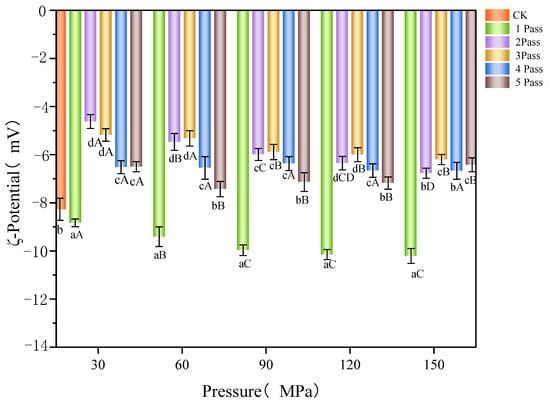
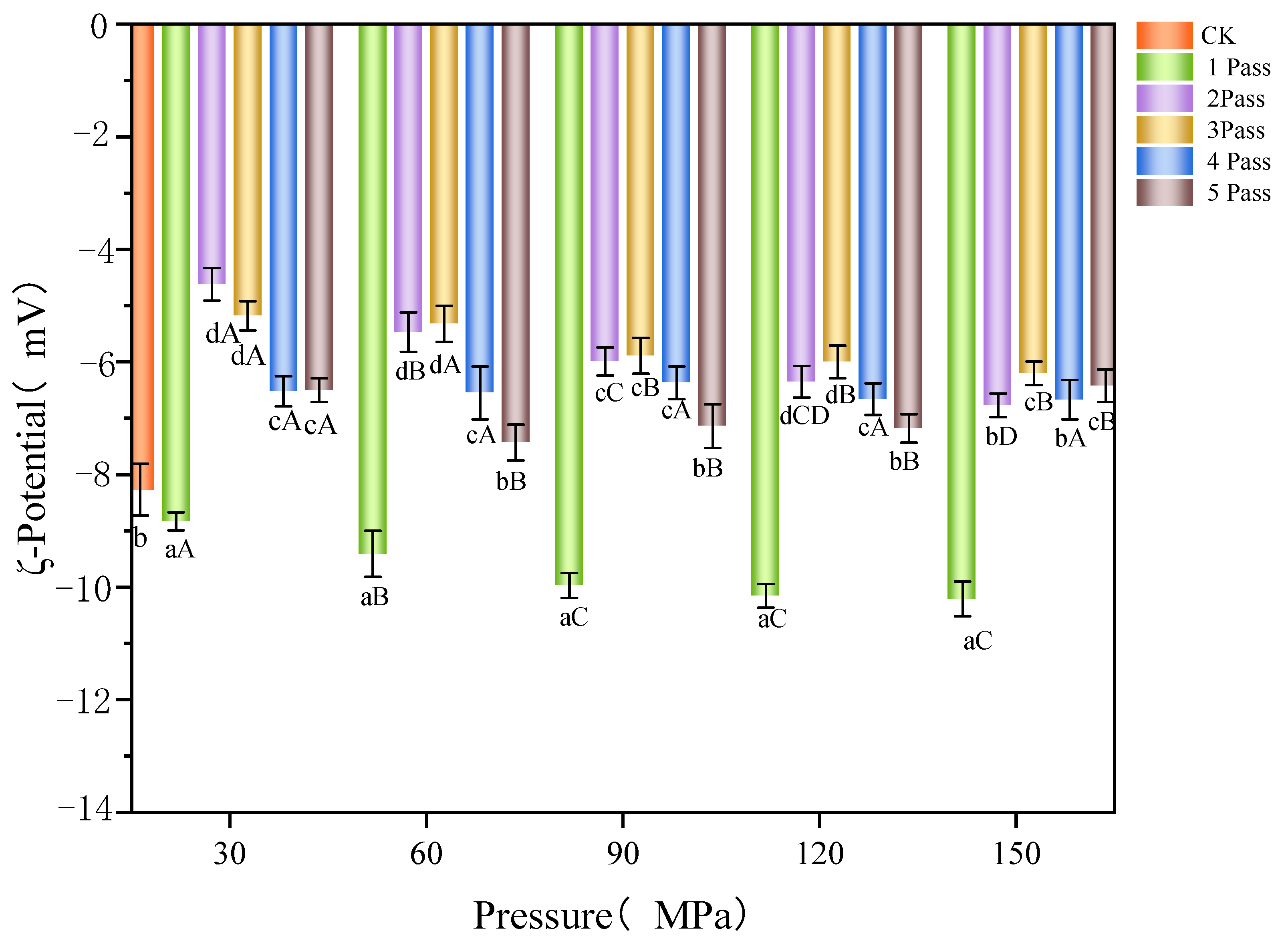
The untreated juice had a ζ-potential of approximately −8.4 mV, whereas one-pass treatments ranged from approximately −8.8 to −10.8 mV and generally became more negative as pressure increased (Figure 1). In contrast, samples treated with two to five passes showed ζ-potential values of approximately −4.7 to −7.5 mV. Thus, the effect of HPH on ζ-potential depended on both pressure and pass number and did not vary monotonically with overall treatment intensity. The more negative ζ-potential observed after one pass may enhance electrostatic repulsion among suspended particles; however, the absolute values remained below approximately 11 mV. Electrostatic repulsion is therefore unlikely to be the sole explanation for the marked improvement in sedimentation stability. The reduction in particle size may also contribute to the improved stability, while pectic substances and other macromolecular components may provide additional hydration and steric stabilization effects [7,11].
Figure 1.
Effects of HPH pressure and pass number on the ζ-potential of cloudy hawthorn juice. Values are mean ± SD (n = 3 independent process replicates). Different lowercase letters indicate significant differences among pass numbers at the same pressure, and different uppercase letters indicate differences among pressures at the same pass number (p < 0.05). CK was excluded from these within-factor comparisons.
3.2. Particle Size
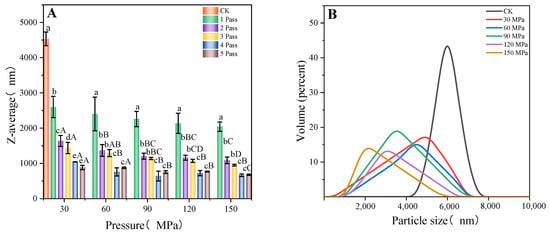
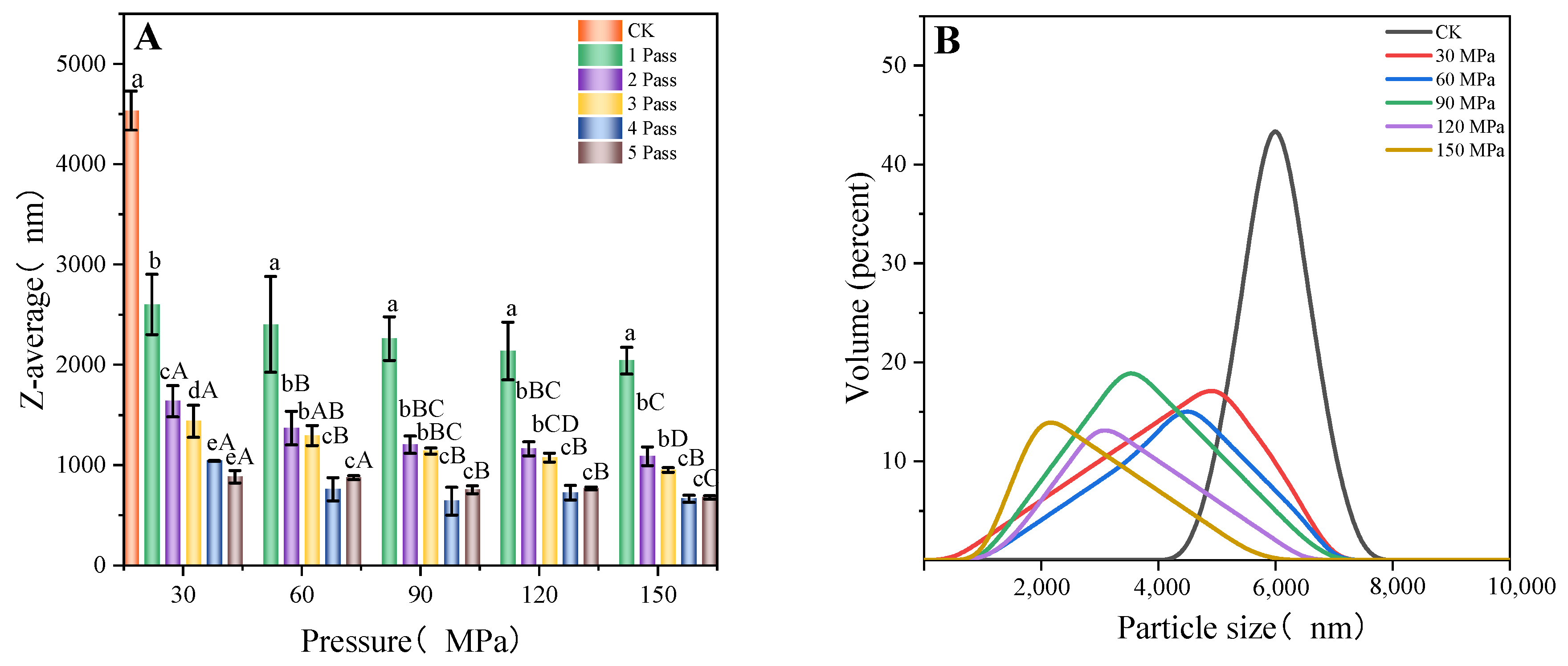
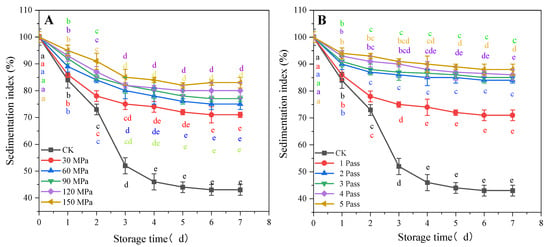
HPH substantially reduced the apparent DLS Z-average of cloudy hawthorn juice (Figure 2A). The untreated juice had a Z-average of approximately 4500 nm, which decreased to roughly 2000–2600 nm after one pass and to 650–900 nm after five passes. A large proportion of the particle-size reduction occurred during the first pass. Additional passes further reduced the apparent particle size, although the magnitude of the reduction gradually decreased and the trend was not strictly monotonic across all pressure levels. After one pass, the particle-size distributions of all HPH-treated samples shifted toward smaller diameters compared with the untreated juice (Figure 2B), but the distributions remained broad, reflecting the heterogeneous nature of suspended particles in cloudy juice. The reduction during the first pass may be attributed to the disruption of large pulp fragments and aggregates by shear, impact, turbulence, and cavitation during HPH. As these larger structures were progressively disrupted, additional passes produced smaller changes in particle size [7,12,20]. The reduction in apparent particle size may partly explain the improved sedimentation stability shown in Figure 3, because smaller suspended particles generally sediment more slowly under comparable conditions. However, sedimentation in cloudy hawthorn juice may also be influenced by other properties of the dispersed phase and serum. Given the complex and nonspherical nature of suspended particles, the DLS-derived Z-average was interpreted mainly as a comparative hydrodynamic size parameter rather than an absolute geometric diameter.
Figure 2.
Effects of HPH on (A) Z-average particle size and (B) volume-based particle-size distributions of one-pass treatments. For panel (A), values are mean ± SD (n = 3 independent process replicates). Different lowercase letters indicate significant differences among pass numbers at the same pressure, and different uppercase letters indicate differences among pressures at the same pass number (p < 0.05). CK was excluded from these within-factor comparisons.
Figure 3.
Changes in sedimentation index during storage at 4 °C as affected by (A) HPH pressure after one pass and (B) pass number at 30 MPa. Values are expressed as mean ± SD (n = 3 independent process replicates) from day 0 to day 7. Different lowercase letters indicate significant differences among treatments at the same storage time (p < 0.05). A higher sedimentation index indicates better suspension stability.
3.3. Total Soluble Solids, Turbidity, and Sedimentation Stability
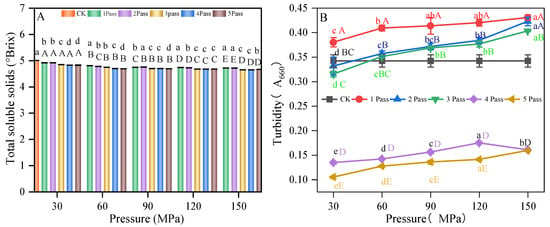
The control juice had a TSS of approximately 4.9 °Brix (Figure 4A). After HPH treatment, TSS remained within a relatively narrow range of approximately 4.6–4.9 °Brix. One-pass treatments generally retained values close to 4.7–4.9 °Brix, whereas four- and five-pass treatments showed slightly lower values, mostly around 4.6–4.8 °Brix. Overall, the effect of HPH on TSS was modest, although increasing pass number tended to produce a somewhat greater reduction than increasing pressure alone. This is broadly consistent with previous studies reporting limited changes in TSS following HPH treatment of fruit juices [20,21]. Because no water was added during HPH, the small decrease cannot be attributed to dilution. Refractometric °Brix is a sucrose-equivalent optical measurement and, in a turbid and compositionally heterogeneous juice, may also be influenced by changes in the distribution of suspended and colloidal material induced by homogenization. Therefore, the observed variation is more appropriately interpreted as a modest, matrix-dependent apparent TSS response rather than evidence of substantial degradation or loss of soluble constituents.
Figure 4.
Effects of HPH on (A) total soluble solids and (B) turbidity of cloudy hawthorn juice. Values are mean ± SD (n = 3 independent process replicates). Different lowercase letters indicate significant differences among pass numbers at the same pressure, and different uppercase letters indicate differences among pressures at the same pass number (p < 0.05). CK was excluded from these within-factor comparisons.
One HPH pass increased A650 from 0.34 in the control to 0.38–0.43, with higher values at higher pressures (Figure 4B). After two or three passes, most samples remained close to or above the control. Four or five passes, however, reduced A650 below the control at every pressure. Particle fragmentation can increase light scattering while the particles remain within an effective size range. With further size reduction, scattering can decrease and more light can pass through the system. Comparable links between HPH, particle size, and cloud properties have been reported for cloudy orange and apple juices [7,12].
HPH delayed phase separation during 7 d of refrigerated storage (Figure 3), with higher IS values indicating a larger suspended fraction and greater physical stability. By day 7, the IS of the control had decreased to approximately 43%, whereas samples treated with one pass at 30–150 MPa retained IS values of 71–83%. At 30 MPa, increasing the treatment from one pass to two to five passes raised the day-7 IS from approximately 71% to 83–88%, corresponding to an additional improvement of 12–17 percentage points. Most of the decline in IS occurred during the first three days, particularly in the control, after which the values changed relatively little. Under the conditions evaluated in Figure 4, the first HPH pass contributed substantially to the improvement in suspension stability, whereas subsequent passes provided smaller additional benefits. This trend is consistent with the reduction in apparent particle size observed in the present study. Pectin-mediated steric effects and particle–serum interactions may also contribute to the improved stability, as reported previously for cloudy juice systems [7,11].
3.4. pH, Titratable Acidity, and Organic Acids
The pH of the untreated juice was 3.91 (Table 2). HPH-treated samples ranged from 3.62 to 3.88, with no monotonic response to either pressure or pass number. Titratable acidity decreased from 0.85% in the control to 0.60–0.82% after HPH. The decrease was generally greater after repeated passes, while pressure showed no consistent trend. Small or matrix-dependent changes in pH and titratable acidity have also been reported in HPH-treated fruit juices [9,21].
Table 2.
Effects of HPH pressure and pass number on pH, titratable acidity, and organic acids in cloudy hawthorn juice.
Citric acid was the predominant organic acid in all samples (Table 2), followed generally by malic and succinic acids, while oxalic and tartaric acids were present at lower concentrations. One-pass HPH generally increased the HPLC-determined concentrations of citric, malic, and succinic acids compared with the control, whereas repeated passes tended to decrease citric and tartaric acid levels. These changes did not parallel the response of titratable acidity because the two measurements reflect different properties of the juice. HPLC quantifies individual organic acids after chromatographic separation, whereas titratable acidity reflects the total amount of base required to reach the endpoint of pH 8.2 and is also influenced by acid dissociation, salts, and other buffering components. The increase in some acids after one pass may partly reflect greater release or analytical accessibility of acids from disrupted pulp and cell-wall material. Therefore, higher HPLC-determined concentrations of individual acids can occur together with lower titratable acidity. Overall, the response to HPH differed among individual organic acids and between analytical approaches and should not be interpreted as direct evidence of net synthesis or degradation of organic acids [4,5].
3.5. Total Flavonoids and Antioxidant Capacity
Total flavonoid content decreased from 25.97 mg RE/100 mL in the control to 22.73–25.50 mg RE/100 mL after one pass and to 18.18–19.84 mg RE/100 mL after four or five passes (Table 3). In contrast, DPPH radical-scavenging activity remained within a narrow range of 64.98–67.56% (66.95% in the control), whereas ABTS activity increased slightly from 55.37% in the control to 55.64–58.20% after HPH. These differences reflect the different analytical principles of the three assays. The NaNO2–Al(NO3)3 colorimetric method provides an estimate of total flavonoids expressed as rutin equivalents, whereas DPPH and ABTS assays measure radical-scavenging capacity and differ in reaction chemistry and sensitivity to individual antioxidants. Therefore, the decrease in total flavonoid content did not necessarily result in a proportional decrease in DPPH or ABTS activity. HPH may also affect the extractability or reactivity of nonflavonoid phenolics and other reducing compounds, which may partly explain the different responses among the assays. Similar differences among antioxidant assays after HPH treatment have been reported previously [9,10,13,22]. Because individual antioxidant compounds were not quantified, their specific contributions cannot be determined from the present results.
Table 3.
Effects of HPH pressure and pass number on total flavonoid content and antioxidant capacity of cloudy hawthorn juice.
3.6. Sensory Evaluation
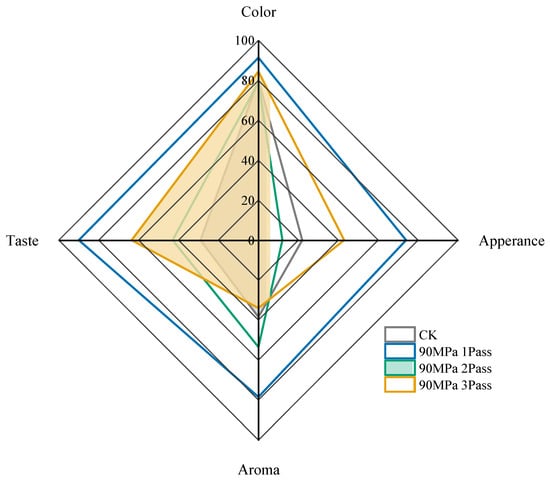
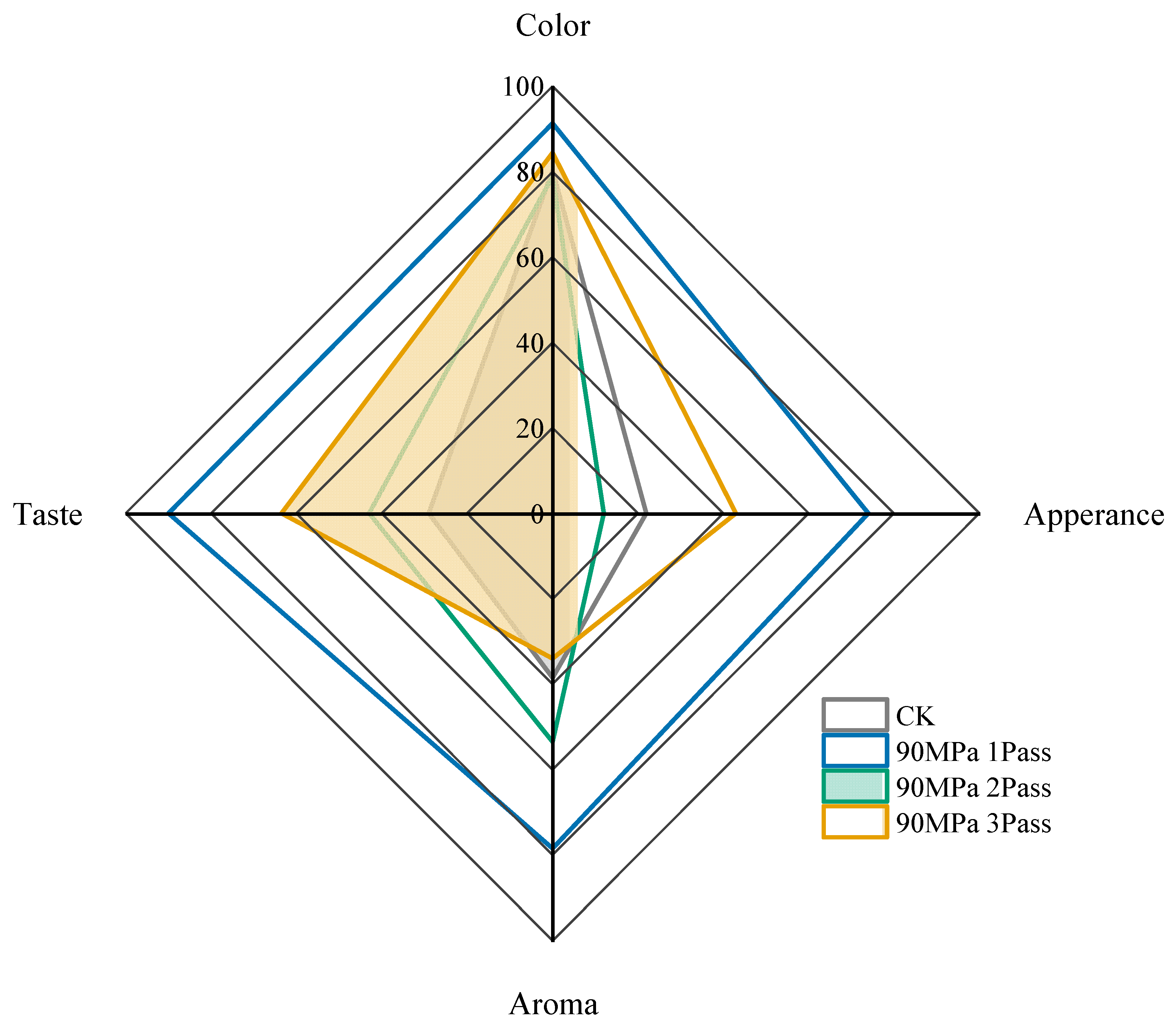
Sensory scores for color, appearance, aroma, and taste for all HPH treatments included in the sensory evaluation are provided in Table A1. Among the representative treatments shown in Figure 5, appearance and taste scores varied more markedly, whereas differences in aroma scores were relatively small. Increasing the number of passes did not consistently improve taste scores. For descriptive comparison, the four sensory attributes were given equal weight, and their arithmetic mean was calculated for each treatment. The 90 MPa one-pass treatment had the highest descriptive mean score (91.95) among the treatments evaluated. This value was used only as a descriptive summary and was not treated as a prespecified composite sensory endpoint. The finding is limited to the one- to three-pass treatments and the 25-member panel used in the present study, as four- and five-pass samples were not evaluated sensorially. Although the differences in aroma scores were relatively small, HPH has been reported to affect juice aroma depending on the processing conditions and fruit matrix [8,14].
Figure 5.
Sensory scores of cloudy hawthorn juice subjected to different HPH treatments.
3.7. Integrated Assessment of HPH Process Conditions
The effects of HPH on cloudy hawthorn juice depended on both pressure and pass number, and increasing either factor did not uniformly improve all measured attributes. The first pass produced the greatest reduction in apparent particle size and the largest improvement in suspension stability, whereas subsequent passes yielded progressively smaller gains in sedimentation stability. At the same time, repeated homogenization was associated with greater decreases in lightness, apparent TSS, and total flavonoid content. These findings indicate a trade-off between improved physical stability and changes in several quality attributes as the number of passes increased. Pressure and pass number represent distinct processing parameters. Increasing pressure modifies the mechanical stress applied during a single passage through the homogenizing valve, whereas each additional pass subjects the juice to another cycle of shear, impact, turbulence, cavitation, pumping, and temperature change. The greater variation may partly reflect the cumulative effects of repeated processing. The diminishing reduction in apparent particle size after the first pass further suggests that the largest suspended structures were disrupted early, leaving less material available for further size reduction during subsequent passes. Changes in pectin-mediated interactions and other colloidal properties may also contribute to the observed responses, as reported for other cloudy juice systems [7,9,12,19,20]. Although the approximate inlet and outlet temperatures were recorded, continuous temperature profiles and treatment-specific maximum temperatures were not measured. Among the one- to three-pass treatments included in the sensory evaluation, one pass at 90 MPa showed the most favorable overall sensory profile. Together with the substantial reduction in apparent particle size and improvement in short-term suspension stability obtained after the first pass, this condition provided a favorable balance among the measured physical and sensory attributes under the present laboratory conditions. Further validation would be required before this condition could be recommended for practical processing.
4. Conclusions
HPH improved the short-term physical stability of cloudy hawthorn juice, with a substantial proportion of the improvement occurring during the first pass. After 7 d at 4 °C, the sedimentation index increased from 43% in the untreated control to 71–83% after one HPH pass. At 30 MPa, increasing the treatment to two to five passes further raised the day-7 sedimentation index to 83–88%; however, repeated homogenization was also associated with decreases in lightness, apparent TSS, and total flavonoid content. DPPH radical-scavenging activity remained close to the control level, ABTS activity increased slightly, and the organic acid responses were nonlinear and depended on both acid identity and the pressure–pass combination. Among the one- to three-pass treatments included in the sensory evaluation, one pass at 90 MPa showed the most favorable overall sensory profile and provided a favorable balance between suspension stability and the measured quality attributes. However, this finding does not establish a universally optimal or commercially validated processing condition. The present study was a laboratory-scale quality assessment and did not evaluate sensory acceptance beyond three passes, microbial inactivation, enzyme activity, rheological properties, storage stability beyond 7 d, energy consumption, or pilot-scale reproducibility. Therefore, 90 MPa for one pass should be considered only as a candidate condition for further validation. Future studies should examine microbial safety, enzyme stability, rheological behavior, extended shelf life, energy requirements, and reproducibility during scale-up before industrial application.
Author Contributions
X.T.: Investigation, Methodology, Data curation, Validation, Writing—review and editing; W.Z.: Investigation, Methodology, Writing—original draft; J.Z.: Investigation, Methodology, Data curation, Validation, Writing—original draft; Y.L.: Investigation, Methodology, Data curation, Validation, Writing—original draft; Y.Z.: Methodology, Data curation, Writing—original draft; C.Z.: Conceptualization, Project administration, Funding acquisition, Supervision, Visualization, Writing—review and editing. All authors have read and agreed to the published version of the manuscript.
Funding
This work was supported by the Key R&D Program of Shandong Province, China (2024TZXD004 and 2023TZXD030).
Data Availability Statement
The original contributions presented in this study are included in the article. Further inquiries can be directed to the corresponding author.
Conflicts of Interest
The authors declare no conflicts of interest.
Appendix A
Table A1.
Sensory scores of all HPH-treated samples.
References
- Cui, M.; Cheng, L.; Zhou, Z.; Zhu, Z.; Liu, Y.; Li, C.; Liao, B.; Fan, M.; Duan, B. Traditional uses, phytochemistry, pharmacology, and safety concerns of hawthorn (Crataegus genus): A comprehensive review. J. Ethnopharmacol. 2024, 319, 117229. [Google Scholar] [CrossRef] [Scilit]
- Li, T.; Ji, W.; Dong, H.; Wu, Y.; Guo, L.; Chen, L.; Wang, X. A comprehensive review on the isolation, bioactivities, and structure–activity relationship of hawthorn pectin and its derived oligosaccharides. Foods 2024, 13, 2750. [Google Scholar] [CrossRef] [Scilit]
- Tian, H.; Xiong, J.; Yu, H.; Chen, C.; Xu, H.; Lou, X. Characterize the physicochemical properties and microstructure of pectin from high-pressure and thermal processed cloudy hawthorn (Crataegus pinnatifida) juice based on acid heating extraction. Food Chem. 2023, 407, 135199. [Google Scholar] [CrossRef] [Scilit]
- Lou, X.M.; Jin, Y.; Tian, H.X.; Yu, H.Y.; Chen, C.; Hanna, M.; Lin, Y.W.; Yuan, L.; Wang, J.; Xu, H.D. High-pressure and thermal processing of cloudy hawthorn berry (Crataegus pinnatifida) juice: Impact on microbial shelf-life, enzyme activity and quality-related attributes. Food Chem. 2022, 372, 131313. [Google Scholar] [CrossRef] [Scilit]
- Lou, X.M.; Xiong, J.J.; Tian, H.X.; Yu, H.Y.; Chen, C.; Huang, J.; Yuan, H.B.; Hanna, M.; Yuan, L.; Xu, H.D. Effect of high-pressure processing on the bioaccessibility of phenolic compounds from cloudy hawthorn berry (Crataegus pinnatifida) juice. J. Food Compos. Anal. 2022, 110, 104540. [Google Scholar] [CrossRef] [Scilit]
- Pandiselvam, R.; Özaslan, Z.T.; Sahni, P.; Khanashyam, A.C.; Kutlu, N.; Yilmaz, M.S.; Isleroglu, H.; Ramniwas, S.; Rustagi, S. High pressure homogenization for preservation of liquid foods—Mechanisms, molecular modifications and recent developments. Future Foods 2024, 10, 100488. [Google Scholar] [CrossRef] [Scilit]
- Yu, W.T.; Cui, J.F.; Zhao, S.J.; Feng, L.P.; Wang, Y.Q.; Liu, J.M.; Zheng, J.K. Effects of high-pressure homogenization on pectin structure and cloud stability of not-from-concentrate orange juice. Front. Nutr. 2021, 8, 647748. [Google Scholar] [CrossRef] [Scilit]
- Lou, X.; Sun, J.; Liu, S.; Yang, H.; Yu, H.; Chen, C.; Tian, H. Effects of high-pressure processing and thermal processing on odor-active compounds and sensory attributes of cloudy hawthorn (Crataegus pinnatifida) juice through flavoromics. Food Chem. 2025, 495, 146246. [Google Scholar] [CrossRef] [Scilit]
- Turan, E.; Aslantaş, R.; Bilgin, J.; Aksu, M.I. High-pressure homogenization of pomegranate juice: Impact on physicochemical, antioxidant, antimicrobial, and in vitro bioaccessibility properties. Food Sci. Nutr. 2024, 12, 10315–10329. [Google Scholar] [CrossRef] [Scilit]
- Adhikari, J.; Araghi, L.R.; Singh, R.; Adhikari, K.; Patil, B.S. Continuous-flow high-pressure homogenization of blueberry juice enhances anthocyanin and ascorbic acid stability during cold storage. J. Agric. Food Chem. 2024, 72, 11629–11639. [Google Scholar] [CrossRef] [Scilit]
- Yu, X.; Wang, Z.; Wu, Y.; Chen, Q.; Zhang, Y.; Zhang, F. Rheological effects of high-pressure processing and high-pressure homogenization on not-from-concentrate orange juice. J. Sci. Food Agric. 2025, 105, 4433–4442. [Google Scholar] [CrossRef] [Scilit]
- Zanchin, A.; Perbellini, A.; De Iseppi, A.; Rilievo, G.; Fabris, M.; Gabardi, N.; Biada, E.; Luzzini, M.; Guerrini, L. Physicochemical stability of ‘Kissabel® Rouge’ apple juice: The role of filtration and high-pressure homogenization. Appl. Sci. 2025, 15, 11697. [Google Scholar] [CrossRef] [Scilit]
- Adhikari, J.; Araghi, L.R.; Jha, D.K.; Singh, R.K.; Adhikari, K.; Patil, B.S. Continuous flow high-pressure homogenization enhances nutrient retention, antioxidant activity, and probiotic growth potential in grapefruit juice during cold storage. Food Res. Int. 2025, 221, 117571. [Google Scholar] [CrossRef] [Scilit]
- Liu, D.; Liu, Z.; Chen, Y.; Xie, X.; Wang, Y.; Wang, F.; Ma, L.; Xiao, G.; Wang, Q. Modulation of aroma in Gonggan cloudy juice by high-pressure homogenization. LWT 2026, 243, 119175. [Google Scholar] [CrossRef] [Scilit]
- GB 12456-2021; National Food Safety Standard—Determination of Total Acid in Foods. National Health Commission of the People’s Republic of China: Beijing, China, 2021.
- Brand-Williams, W.; Cuvelier, M.E.; Berset, C. Use of a free radical method to evaluate antioxidant activity. LWT-Food Sci. Technol. 1995, 28, 25–30. [Google Scholar] [CrossRef] [Scilit]
- Re, R.; Pellegrini, N.; Proteggente, A.; Pannala, A.; Yang, M.; Rice-Evans, C. Antioxidant activity applying an improved ABTS radical cation decolorization assay. Free Radic. Biol. Med. 1999, 26, 1231–1237. [Google Scholar] [CrossRef] [Scilit]
- Chang, T.T.; Bi, Y.J.; Jing, L.L.; Liu, X.L.; Fan, M.T.; Yao, S.S.; Feng, L.; Zhao, Y.P. Simultaneous adsorption of acid and flavonoids from hawthorn juice onto resins. J. Food Eng. 2021, 291, 110195. [Google Scholar] [CrossRef] [Scilit]
- Kruszewski, B.; Zawada, K.; Karpiński, P. Impact of high-pressure homogenization parameters on physicochemical characteristics, bioactive compounds content, and antioxidant capacity of blackcurrant juice. Molecules 2021, 26, 1802. [Google Scholar] [CrossRef] [Scilit]
- Wellala, C.K.D.; Bi, J.F.; Liu, X.; Liu, J.N.; Lyu, J.; Zhou, M. Effect of high pressure homogenization on mixed juice stability, rheology, physicochemical properties and microorganism reduction. J. Food Sci. Technol. 2020, 57, 1944–1953. [Google Scholar] [CrossRef] [Scilit]
- Liu, Y.; Liao, M.; Rao, L.; Zhao, L.; Wang, Y.; Liao, X. Effect of ultra-high pressure homogenization on microorganism and quality of composite pear juice. Food Sci. Nutr. 2022, 10, 3072–3084. [Google Scholar] [CrossRef] [Scilit]
- Adhikari, J.; Singh, R.K.; Adhikari, K.; Patil, B.S. Continuous flow high-pressure homogenization for preserving the nutritional quality and stability of watermelon juice under simulated market storage conditions. Innov. Food Sci. Emerg. Technol. 2024, 97, 103783. [Google Scholar] [CrossRef] [Scilit]

Disclaimer/Publisher’s Note: The statements, opinions and data contained in all publications are solely those of the individual author(s) and contributor(s) and not of MDPI and/or the editor(s). MDPI and/or the editor(s) disclaim responsibility for any injury to people or property resulting from any ideas, methods, instructions or products referred to in the content. |
© 2026 by the authors. Licensee MDPI, Basel, Switzerland. This article is an open access article distributed under the terms and conditions of the Creative Commons Attribution (CC BY) license.