


Abstract
Coupling renewable energy with seawater electrolysis is a highly promising strategy for sustainable hydrogen production. However, the practical application of direct seawater electrolysis remains challenging due to severe anode corrosion and the competitive chlorine evolution reaction (CER) induced by chloride ions. Herein, we report a facile cation-etching strategy to synthesise Fe@ZIF-67 catalysts at room temperature, using ZIF-67 as the sacrificial template and Fe2+ salts as the etching agent. The as-prepared Fe@ZIF-67 exhibits superior electrocatalytic activity for the oxygen evolution reaction (OER) in a simulated alkaline saline electrolyte (1.0 M KOH + 0.5 M NaCl). Specifically, it achieves a current density of 10 mA cm−2 at a low overpotential of 259 mV, outperforming commercial RuO2. Furthermore, an alkaline saline electrolyser assembled with Fe@ZIF-67 as the anode and Pt/C as the cathode requires a cell voltage of only 1.57 V to reach 10 mA cm−2, which is significantly lower than that of the RuO2||Pt/C benchmark (1.65 V). This work demonstrates that the cation-doping strategy effectively modulates the surface electronic structure of metal–organic frameworks (MOF)-based catalysts, providing a new perspective for optimising their performance in seawater electrolysis.
1. Introduction
Hydrogen gas is regarded as a highly prospective energy carrier, owing to its high energy density, clean combustion, and absence of carbon emissions. The generation of high-purity hydrogen gas through the process of electrochemical water splitting is regarded as one of the most promising and sustainable clean hydrogen energy systems. This is due to the fact that it can be powered by intermittent electricity from renewable resources, such as solar and wind energy [1,2,3]. The overall water splitting process comprises two fundamental half-reactions: the oxygen evolution reaction (OER) at the anode and the hydrogen evolution reaction (HER) at the cathode [4,5]. The kinetics of OER are sluggish. Consequently, the splitting of water is frequently enhanced by the utilisation of an electrocatalyst, which serves to reduce the energy required for the process [6]. The majority of water-splitting systems require high-purity fresh water; however, the scarcity of freshwater resources and the costly purification process could impede the commercialisation of electrochemical water-splitting technology [7]. Conversely, seawater is widely regarded as an inexhaustible natural resource, constituting approximately 96.5% of the world’s water sources. The utilisation of seawater for water splitting purposes has the potential to achieve sustainable energy storage and conversion, as well as the production of high-purity water from seawater. This is of particular significance to arid coastal regions [8,9,10].
Presently, noble metal catalysts are efficient OER catalysts; however, their high cost and limited stability hinder their large-scale practical application [11,12,13]. Consequently, there has been a concerted effort to develop non-noble metal-based OER electrocatalysts as alternatives. These include metal (or metal compound) carbon nanocomposites, metal compounds (such as oxides, sulfides, nitrides, phosphides, etc.) and metal–organic frameworks (MOFs) nanomaterials [14,15,16]. Among them, MOFs-based catalysts have attracted more and more attention because of their high catalytic efficiency, adjustable nanoporous structure, and good dispersion. Nevertheless, their electrical conductivity remains inadequate, with organic ligands hindering the metal catalytic active centre. This, in turn, gives rise to sluggish reaction kinetics, which in turn severely compromise the OER performance of the majority of MOF electrocatalysts [17,18]. Consequently, researchers have sought to address the limitations of MOF catalysts through various approaches to enhance their catalytic performance. One such method involves the conversion of MOFs into carbon-based nanocomposites through the process of high-temperature pyrolysis. However, it should be noted that high-temperature pyrolysis typically necessitates substantial energy consumption and results in the destruction of the coordination environment of the metal centre within the MOFs. Moreover, the unavoidable reduction in active centres during the pyrolysis process hinders the ability of MOFs to fulfil their potential in electrocatalysis [17]. In recent years, ion doping engineering has been identified as a valuable strategy for enhancing the catalytic efficiency of metal–organic frameworks (MOFs) in water oxidation reactions. Among these materials, cobalt-based zeolitic imidazolate framework-67 (ZIF-67), a subclass of metal–organic frameworks, offers advantages such as mild synthesis conditions, a high specific surface area, and tunable structure and active components, and has been widely used in electrocatalysis [19,20]. For instance, the Liu research group subjected ZIF-Zn-Co nanoparticles to a boric acid solution in order to prepare a new type of B-type MOF (B-MOF-Zn-Co) [21]. The B-MOF-Zn-Co@NF catalyst demonstrates high catalytic activity and rapid OER kinetics, exhibiting an overpotential of 362 mV at 100 mA cm−2 and a Tafel slope of 64.8 mV dec−1. In addition, the introduction of boron (B) into the B-MOF-Zn-Co@NF catalyst results in higher intrinsic OER activity than that observed for ZIF-Zn-Co@NF, suggesting that B plays a crucial role in enhancing its OER performance. While conventional strategies predominantly utilise trivalent iron ions (Fe3+) to dope ZIF-67 for synthesising layered double hydroxides (LDHs) [22] or bimetallic zeolitic imidazolate frameworks and their derivatives [23,24], this study employs divalent iron ions (Fe2+) to initiate a cation etching process. This approach enables the direct fabrication of an efficient catalyst for seawater oxidation without the necessity of subsequent high-temperature thermal treatment.
In this work, the Fe@ZIF-67 catalyst was prepared by a room-temperature solution-based method using ZIF-67 as the substrate template. A ferrous metal salt was added to it and stirred at room temperature for 5 h. When Fe2+ is introduced into the substrate, the incorporated Fe2+ alters the surface electron distribution of ZIF-67 and accelerates its electron migration rate, thereby significantly enhancing the electrochemical performance in the electrolysis of seawater. The as-prepared Fe@ZIF-67 exhibits excellent OER performance in 1.0 M KOH + 0.5 M NaCl electrolyte. It requires an overpotential of merely 259 mV to achieve a current density of 10 mA cm−2, surpassing many other catalysts. Additionally, chronoamperometric tests at 10 mA cm−2 revealed that the current remained stable with no significant increase over 35 h, indicating that it possesses satisfactory preliminary operational stability under the tested conditions. When coupled with Pt/C to form a water electrolysis cell, the Fe@ZIF-67||Pt/C system attains a current density of 10 mA cm−2 at a low cell voltage of 1.57 V, outperforming the commercial RuO2||Pt/C electrode (1.65 V). This study demonstrates that doping divalent cations can tailor the surface electronic structure of MOF catalysts, offering new insights for enhancing MOF-based electrocatalysts in seawater electrolysis.
2. Materials and Methods
2.1. Materials
All chemicals were directly used without further purification. 2-Methyl imidazole (98%), Iron (II) chloride tetrahydrate (FeCl2∙4H2O, ≥98%), Ruthenium dioxide (RuO2, 99.9%) were bought from Shanghai Macklin Biochemical Technology Co., Ltd., Shanghai, China. Platinum-carbon catalyst (Pt/C, 20 wt.%) were purchased from Zhengzhou Feynman Biotechnology Co., Ltd., Zhengzhou, China. Hexadecyltrimethylammonium bromide (CTAB, AR, 99%), cobalt (II) nitrate hexahydrate (Co(NO3)2∙6H2O, AR, 99%), sodium chloride (NaCl, 99.5%) and potassium hydroxide (KOH, AR) were bought from Shanghai Aladdin Co., Ltd., Shanghai, China Absolute ethanol (AR) were bought from Sinopharm Chemical Reagent Co., Ltd., Shanghai, China. Naphthol (Nafion, 5 wt.%) were purchased from E.I. du Pont de Nemours and Company, Wilmington, DE, USA.
2.2. Synthesis of ZIF-67
To prepare solution A, 2.724 g of 2-methylimidazole (2-MeIM) was ultrasonically dissolved in 42 mL of deionised water for 2 min. Solution B was made by dissolving 3 mg of cetyltrimethylammonium bromide and 0.174 g of Co(NO3)2∙6H2O in 6 mL of deionised water via ultrasonication. Solution B was slowly added to solution A, followed by ultrasonication for 3 min at room temperature. The mixture was then stirred on a magnetic stirrer for 0.5 h at room temperature. After that, the product was centrifuged at 8000 rpm for washing with anhydrous ethanol twice. Finally, the washed product was dried in a vacuum oven at 60 °C for 6 h to obtain ZIF-67.
2.3. Synthesis of Fe@ZIF-67
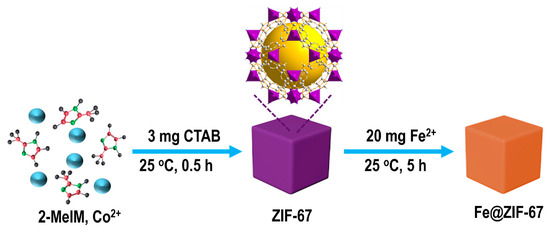
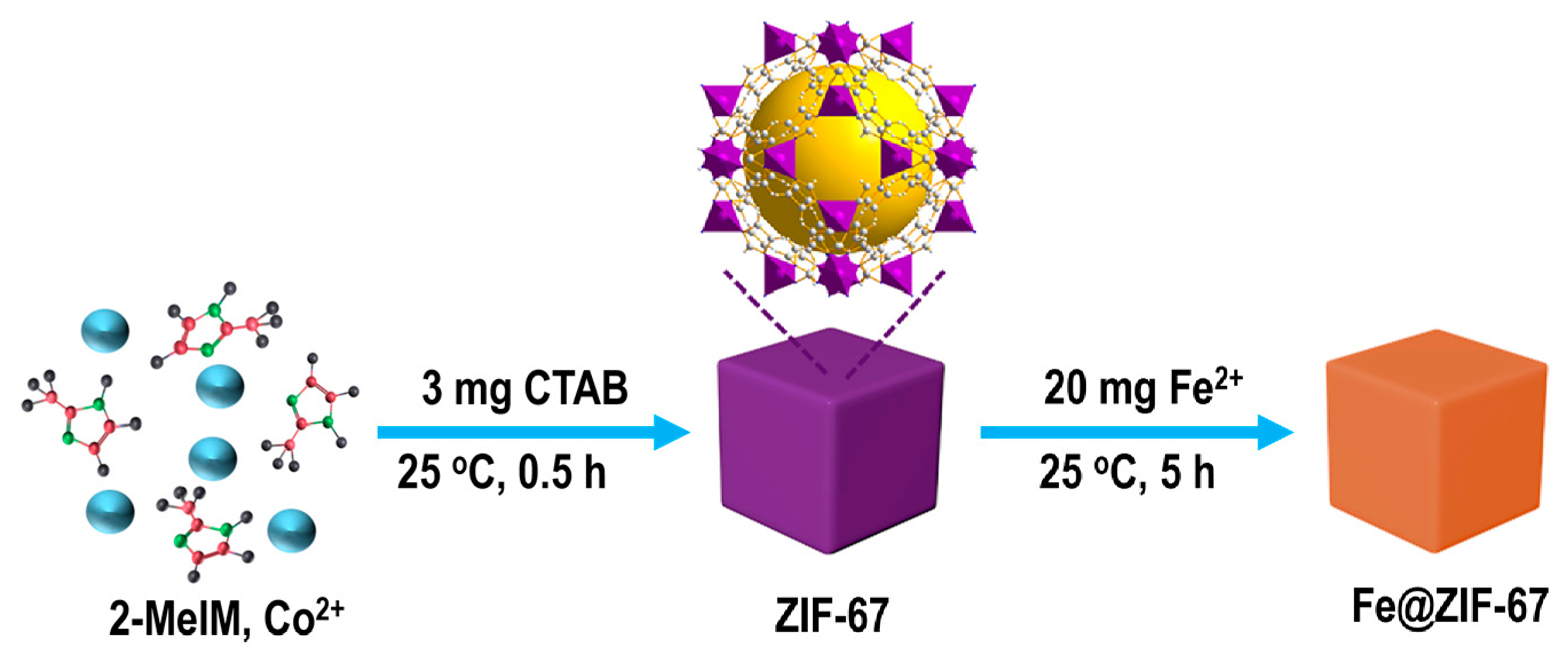
The synthesis process was adjusted accordingly based on previous work [25]. To prepare the Fe@ZIF-67 electrode, 40 mg of ZIF-67 was sonicated for 1 min in 30 mL of anhydrous ethanol in a round-bottom flask to form solution A. Solution B was made by sonicating 20 mg of FeCl2∙4H2O in 30 mL of H2O. Solution B was slowly added to solution A, followed by stirring at room temperature for 5 h. The resulting product was centrifuged at 8000 rpm several times with anhydrous ethanol. After vacuum drying at 60 °C for 6 h, Fe@ZIF-67 was obtained. Additionally, the effects of doping time and FeCl2·4H2O amount were explored. For doping time, the mixture was stirred for 1, 3, 5, or 7 h, yielding Fe1@ZIF-67 to Fe4@ZIF-67, respectively. For the FeCl2·4H2O amount, 15, 20, 25, 30, or 35 mg was used, producing Fe31@ZIF-67 to Fe35@ZIF-67. Fe@ZIF-67 refers to Fe32@ZIF-67. All other procedures matched the Fe@ZIF-67 synthesis. All preparative steps were carried out with the round-bottom flask sealed to minimise atmospheric O2 ingress.
2.4. Characterisation
Scanning electron microscopy (SEM), high-resolution transmission electron microscopy (TEM), EDS and high-resolution transmission electron microscopy (HRTEM) were used to characterise the morphology and elemental distribution of the synthesised catalyst. X-ray powder diffractometry (XRD) and X-ray photoelectron spectroscopy (XPS) analysed its crystal structure and surface elemental state. Fourier transform infrared spectroscopy (FT-IR) (400–4000 cm−1) identified functional groups in the catalyst.
2.5. Electrochemical Measurements
All electrochemical tests were performed on a CHI 760E workstation at 25 °C using a standard three-electrode system. It comprises a working electrode (prepared sample), a counter electrode (carbon rod) and a reference electrode (Hg/HgO). The preparation procedure for the catalyst ink applied to the working electrode is described as follows: 8 mg of Fe@ZIF-67 catalyst was sonicated for 45 min in a mixed solution of 600 μL anhydrous ethanol, 370 μL deionised water, and 30 μL Nafion until completely dispersed to form solution A. Then, 5 μL of the catalyst mixture was dropped onto the glassy carbon electrode (3 mm diameter) surface in two portions, yielding consistent mass loadings of 0.57 mg cm−2 across all specimens (Fe@ZIF-67, RuO2, and ZIF-67). Finally, the electrode was dried with an infrared lamp to obtain the Fe@ZIF-67 electrode. Additionally, the preparation method for RuO2 and Pt/C electrodes is the same as that for the Fe@ZIF-67 electrode. In an H-type electrolytic cell with a working electrode area of 1 cm × 1 cm, the overall seawater splitting test was carried out, where Fe@ZIF-67 served as the anode electrode, Pt/C as the cathode electrode, among them, carbon paper is employed as the catalyst support, with a mass loading of 1 mg cm−2, respectively, and an anion exchange membrane (Sustainion X37-50 Grade RT, Dioxide Materials, Boca Raton, FL, USA) was placed in the middle compartment.
The electrolyte pH was ~14, with solutions of 1.0 M KOH, 1.0 M KOH + 0.5 M NaCl, and 1.0 M KOH + Seawater. All potentials obtained using the Hg/HgO electrode should be converted to the reversible hydrogen electrode (RHE) scale. As shown in (Equation (1)):
E(RHE) = E(Hg/HgO) + 0.0591 × pH + 0.098
In the overall water-splitting system, the cathode was a Pt/C electrode, and the anode was Fe@ZIF-67, with tests conducted in a single electrolysis. The electrolytes used were identical to those in the three-electrode system: 1.0 M KOH, 1.0 M KOH + 0.5 M NaCl, and 1.0 M KOH + Seawater. The natural seawater was subjected only to simple settling and no further treatment and was stored at room temperature and atmospheric pressure. The detailed ionic compositions are shown in Table S1.
To calculate the Faradaic efficiency (FE), an H-cell with an anion exchange membrane was used. The electrolyte was 1.0 M KOH + Seawater, and the constant current density was 50 mA cm−2. The total gas volume generated at the anode and cathode was measured by the water displacement method. The specific formula for calculating FE is shown in Equation (2):
FE% = Qprod/Qtotal × 100 = V × n × F/(Vm × Q) × 100%
In the formula, V: volume of the gaseous product (L). n: the number of electrons required to produce a gas molecule (2 for H2 and 4 for O2). F: the Faraday constant (96,485 C mol−1). Vm: the standard molar gas volume (24.4 L mol−1, 25 °C, 101.325 kPa). Q: the charge (C).
Linear sweep voltammetry (LSV) describes the relationship between current density and potential. Polarisation curves under 95% iR compensation were measured at a scan rate of 5 mV s−1 in 1.0 M KOH, 1.0 M KOH + 0.5 M NaCl and 1.0 M KOH + Seawater electrolytes using LSV. The Tafel slope, a key parameter for assessing electrochemical performance and describing electrode reaction kinetics, is obtained by fitting the LSV curve. The specific relationship is shown in Equation (3):
η = a + blog|j|
η: the overpotential, b: Tafel slope, j: current density. A smaller Tafel slope indicates that, for the same change in current density, the increase in overpotential is smaller and the electrochemical kinetics are faster.
There is a direct correlation between the electrochemically active surface area and the electrochemical double-layer capacitance (Cdl). To estimate the electrochemically active surface area of the material, cyclic voltammetry (CV) was used to measure CV curves at different scan rates (20, 40, 60, 80, 100, and 120 mV s−1) between 1.064~1.164 V vs. RHE. The catalytic cycle was evaluated based on the relationship between the current density difference (Δj/2) from the CV curves and the scan rate. The electrochemically active surface area (ECSA) was determined by dividing the double-layer capacitance (Cdl) by the specific capacitance (Cs = 0.04 mF cm−2) in a 1.0 M alkaline electrolyte. Electrochemical impedance spectroscopy (EIS) was subjected to testing within the frequency range of 1 Hz to 100 kHz, with an amplitude value of 5 mV.
An accurately measured volume of the electrolysed alkaline seawater was transferred into an iodine flask, followed by the addition of an appropriate amount of hydrochloric acid to acidify the solution. An excess of solid KI was then added, and the flask was tightly stoppered and gently shaken to dissolve the KI completely. The mixture was allowed to react in the dark for 5 min. After the hypochlorite oxidised iodide to iodine, the released iodine was titrated with a standard sodium thiosulfate solution (e.g., 0.01 mol L−1 Na2S2O3) until the solution turned pale yellow. Subsequently, 1–2 mL of starch indicator was added, upon which the solution became blue, and the titration was continued until the blue colour just disappeared, marking the endpoint. The volume of Na2S2O3 consumed was recorded. Based on the stoichiometric relationship (1 mol NaClO corresponds to 2 mol S2O32−), the concentration of sodium hypochlorite in seawater was calculated. For improved accuracy, the titration was repeated three times, and the average volume was used for the calculation.
3. Results and Discussion
Utilising an etching strategy, iron-doped zeolitic imidazolate framework derivatives were synthesised at room temperature as highly efficient electrocatalysts for seawater oxidation. The specific synthesis process is illustrated in Scheme 1.
Scheme 1.
Schematic illustration of the synthesis of the Fe@ZIF-67 catalyst.
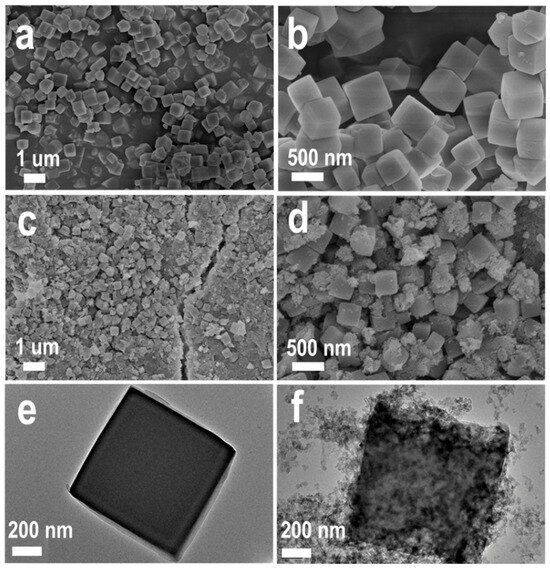
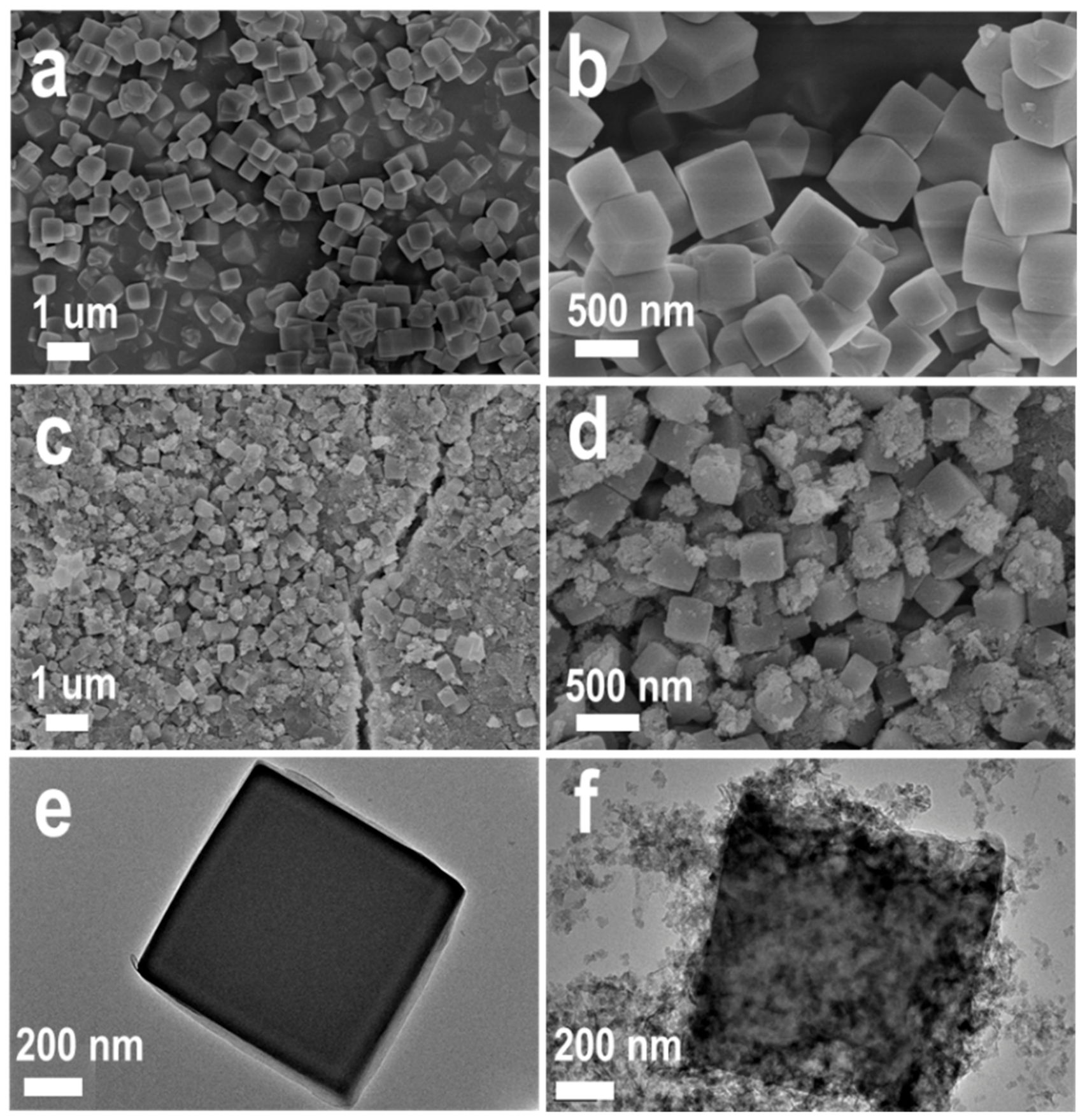
To analyse the micro-morphology of ZIF-67 and Fe@ZIF-67, a series of SEM and TEM tests were performed on the catalyst materials at varying magnifications. As demonstrated in Figure 1a–d, the results of the SEM test indicate that, in comparison with the original ZIF-67, the surface of the catalyst becomes considerably rough and exhibits the formation of gaps in specific locations following the introduction of divalent iron ions [26]. As demonstrated in Figure 1e,f, the TEM images of ZIF-67 and Fe@ZIF-67 reveal that the surface of ZIF-67 material is smooth and intact, while the surface of Fe@ZIF-67 is relatively rough and exhibits an obvious pore structure. This is in good agreement with the above SEM results. The surface structure of Fe@ZIF-67 is characterised by a rough texture, which affords an enlarged active surface area, thus facilitating the process of decomposition in seawater. The impact of these two morphological advantages on the efficiency of the Fe@ZIF-67 catalyst in the electrolytic reaction of seawater is significant. The phase structure of the catalyst is of crucial importance for the material composition.
Figure 1.
(a,b) SEM images of ZIF-67 and (c,d) Fe@ZIF-67 at different magnifications; (e) TEM images of ZIF-67 and (f) Fe@ ZIF-67 electrode material.
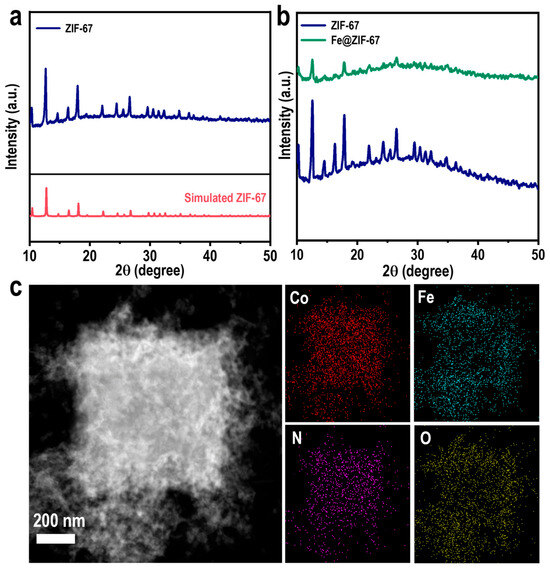
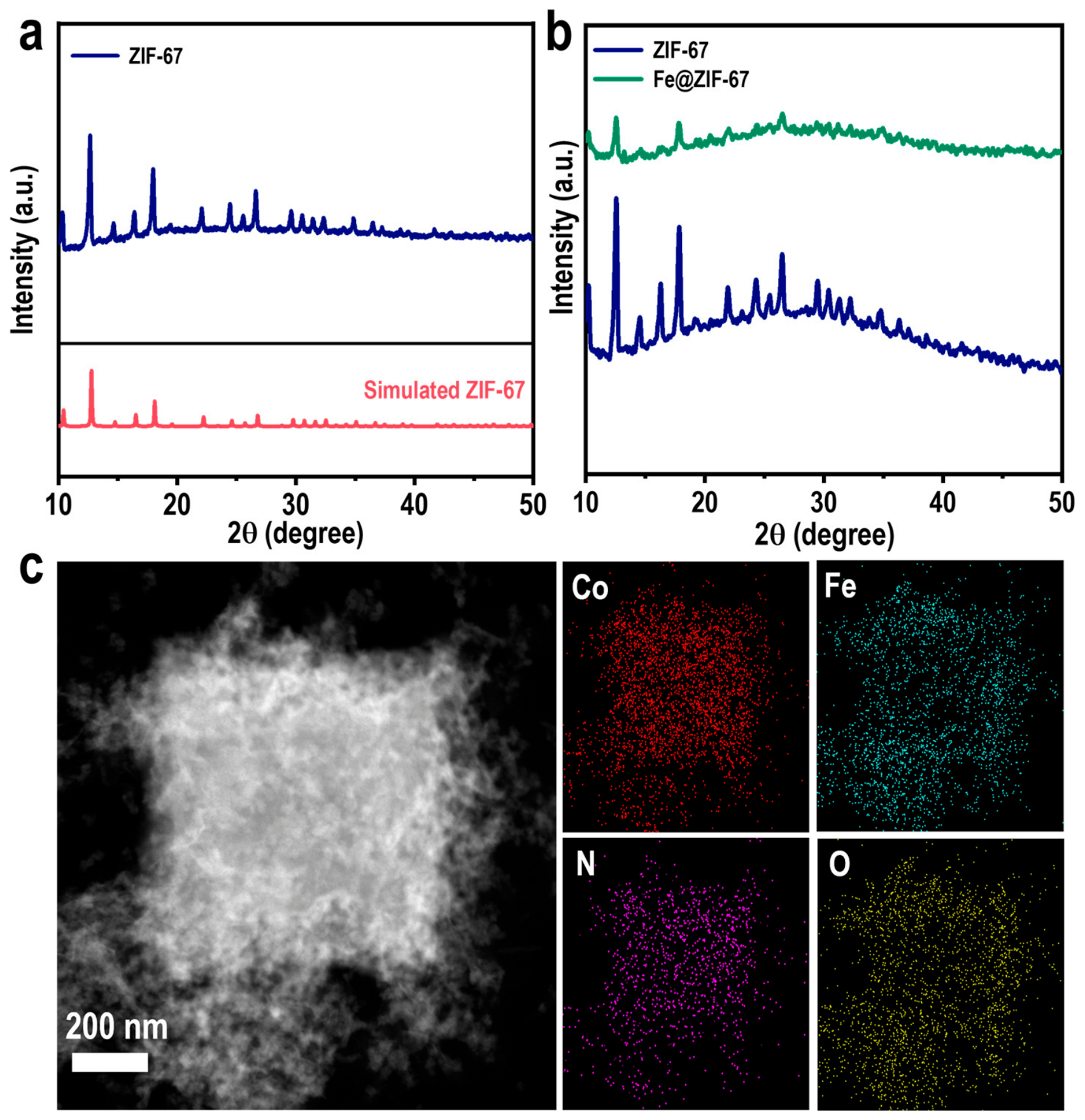
The crystal structure of the catalyst was analysed qualitatively using an X-ray diffractometer (XRD). As demonstrated in Figure 2a, the crystal matching between the experimentally prepared ZIF-67 and the simulated ZIF-67 was found to be good through the XRD spectrum. The XRD spectrum of the prepared ZIF-67 displays diffraction peaks at 10.4°, 12.7°, 16.5°, and 18.1°, which correspond to the (002), (112), (013), and (222) planes of the simulated ZIF-67, respectively [27]. As demonstrated in Figure 2b, upon the introduction of Fe2+ into ZIF-67, it was observed that the number of diffraction peaks of Fe@ZIF-67 diminished in comparison to the crystal structure of ZIF-67. The incorporation of Fe2+ may be the cause of the decrease in crystallinity of Fe@ZIF-67 and the subsequent occurrence of lattice distortion [28]. The distribution state of each element inside the catalyst can be better understood by the relevant element mapping test of Fe@ZIF-67. As illustrated in Figure 2c, the elements of cobalt (Co), iron (Fe), nitrogen (N) and oxygen (O) are distributed uniformly throughout the catalyst. As shown in Figure S2, the energy-dispersive X-ray spectroscopy (EDS) elemental mapping of Fe@ZIF-67 indicates that iron was successfully incorporated into ZIF-67.
Figure 2.
(a) XRD patterns of ZIF-67; (b) XRD patterns of ZIF-67 and Fe@ZIF-67; (c) STEM image and corresponding elemental mapping of Co, Fe, N and O for Fe@ZIF-67.
The Fourier transform infrared spectroscopy (FT-IR) test was performed in order to obtain information regarding the functional groups present within the catalyst. As demonstrated in Figure S1, a slight alteration in the functional groups within the Fe@ZIF-67 material was observed upon the introduction of the bivalent iron salt. However, the majority of the functional group structure of ZIF-67 remained preserved. In the case of Fe@ZIF-67, the peak at 527 cm−1 was attributed to the stretching vibration of Co-OH, and the peak at 726 cm−1 indicated the out-of-plane bending mode of 2-methylimidazole [29]. The two peaks observed at 1037 and 1192 cm−1 are attributed to the in-plane bending of the imidazole [30]. The result at 1480 cm−1, which is close to the left, is attributable to the C=N stretching vibration in ZIF-67 and Fe@ZIF-67 [31]. This may be related to the nitrate added during the material synthesis process [32,33]. In addition, the peak at 2952 cm−1 was assigned to the stretching vibration of the C-H bond [34].
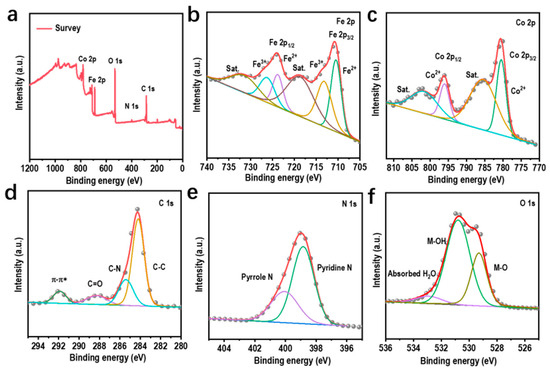
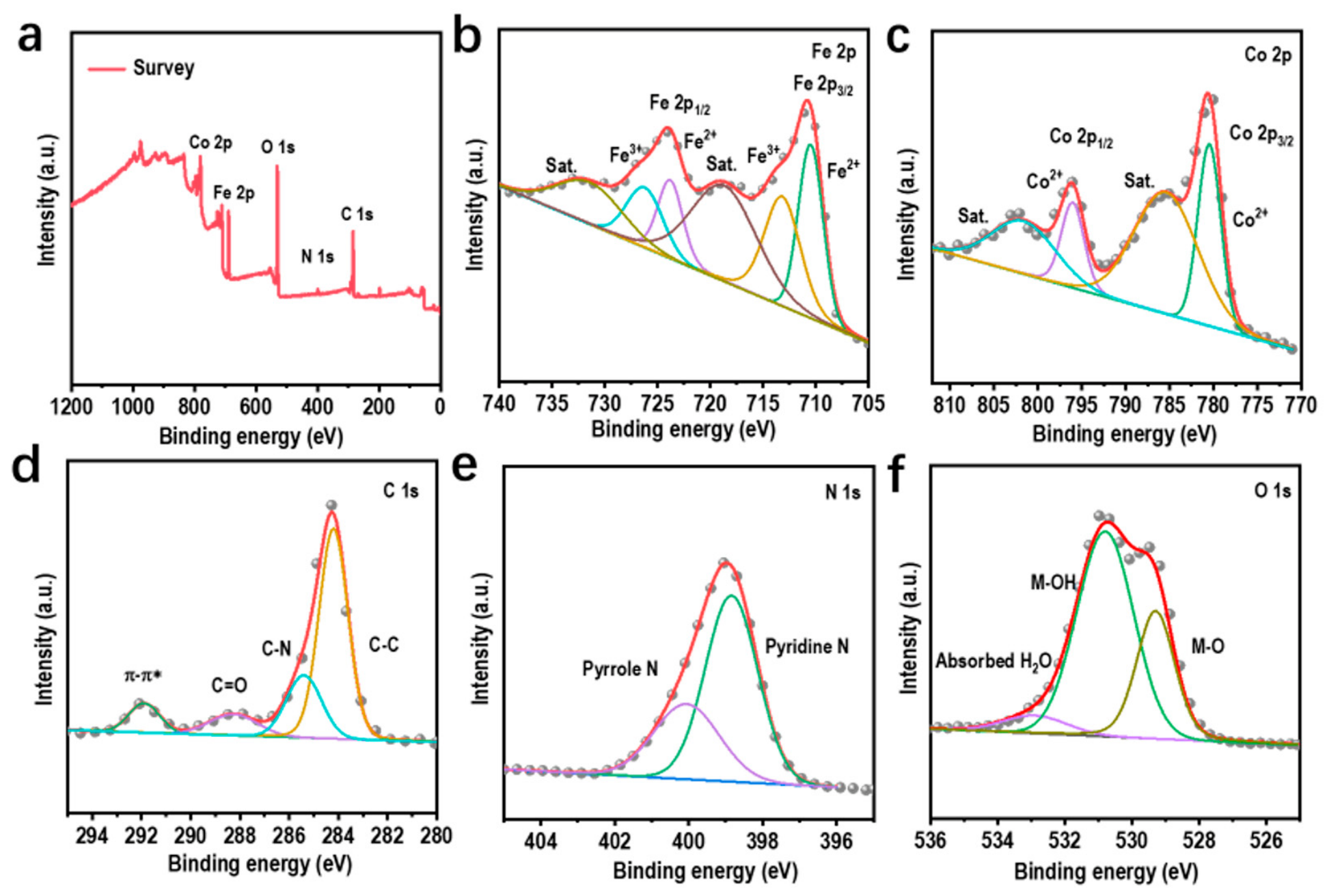
The surface elements, composition and chemical state of Fe@ZIF-67 were characterised by X-ray photoelectron spectroscopy (XPS), and the interaction between elements was investigated. As demonstrated in Figure 3a, the complete XPS spectrum reveals the presence of the elements Co, Fe, O, N and carbon (C) in Fe@ZIF-67. The Fe 2p spectrum of Fe@ZIF-67 displays three pairs of distinct peaks: Fe2+ (723.9 eV and 710.4 eV), Fe3+ (726.6 eV and 713.3 eV), and two additional satellite peaks (732.6 eV and 719.2 eV) [35]. As demonstrated in Figure 3b, it has been demonstrated that the area of Fe2+ is greater than that of Fe3+. This finding suggests that Fe2+ is the predominant form of Fe in the catalyst. The presence of a trace quantity of Fe3+ can be attributed to the oxidation of Fe2+ by atmospheric oxygen during the designated chemical reaction [36]. As illustrated in Figure 3c, the Co 2p spectrum displays a pair of split peaks at 780.3 eV and 796.3 eV, which correspond to the Co 2p3/2 and Co 2p1/2 orbitals, respectively. The chemical existence state of the Co element is primarily Co2+ [37]. Furthermore, a pair of satellite peaks is evident at 785.5 eV and 802.3 eV. As shown in Figure 3d, the C 1s spectrum of Fe@ZIF-67 reveals the presence of four distinct forms of carbon atom bonds: C–C (284.2 eV), C–N (285.4 eV), C=O (288.0 eV) and π–π* (291.8 eV) [38]. The N 1s high-resolution spectrum of Fe@ZIF-67 exhibits two peaks, primarily pyridine N (398.8 eV) and pyrrole N (400.1 eV), which are characteristic of the imidazolate-based framework, as demonstrated in Figure 3e [23,31,38,39]. As illustrated in Figure 3f, the O1s XPS spectrum displays three discernible peaks at 529.3 eV, 530.8 eV and 533.1 eV, corresponding to O in M-O, M-OH and adsorbed water, respectively [40,41]. Specifically, Fe2+ ions undergo ion exchange with Co2+ ions, which diminishes the structural density of the ZIF-67 interior [25]. Simultaneously, ZIF-67 is prone to hydrolysis in aqueous solution, yielding Co2+ and 2-methylimidazole. This process facilitates the coordination between Fe2+ and 2-methylimidazole, which is responsible for the loss of surface smoothness [42]. These synergistic effects of ion exchange and coordination-driven etching collectively contribute to the modified morphology and enhanced electrochemical activity. Furthermore, to further verify the mass fractions of Co and Fe in Fe@ZIF-67, as summarised in Table S2, inductively coupled plasma mass spectrometry (ICP-MS) analysis revealed that the mass fractions of Co and Fe in Fe@ZIF-67 were 26.1% and 18.5%, respectively. This result further confirms the successful incorporation of Fe into ZIF-67.
Figure 3.
(a) Wide-scan XPS spectra of Fe@ZIF-67; High-resolution XPS spectra of (b) Fe, (c) Co, (d) C, (e) N and (f) O in Fe@ZIF-67. The colors denote the valence states; the same color represents the same valence state.
To assess the electrochemical activity of the catalyst, the prepared catalyst materials were subjected to OER polarisation curve tests in a three-electrode system using 1.0 M KOH + 0.5 M NaCl electrolyte. As shown in Figure S3a, the OER activity initially increases with the addition time of the divalent iron salt. However, when the stirring time reaches 7 h, the OER performance starts to decline. The overpotential of Fe3@ZIF-67 is only 259 mV to reach a current density of 10 mA cm−2, while that of Fe1@ZIF-67 is as high as 270 mV, as shown in Figure S3b. The Tafel slope, a key indicator of electrochemical efficiency, reflects the kinetics of electrochemical processes. Figure S3c shows that Fe3@ZIF-67 has the smallest Tafel value (107 mV dec−1), while Fe1@ZIF-67 has the largest (113 mV dec−1). As shown above, the doping time of Fe2+ significantly impacts the OER activity of Fe@ZIF-67. The OER performance of Fe@ZIF-67 first increases and then decreases with the extension of Fe2+ introduction time. The optimal Fe2+ doping time was determined through experiments. Subsequently, to study the effect of Fe2+ doping amount on the OER performance of Fe@ZIF-67, experiments with varying doping amounts (15, 20, 25, 30, 35 mg) were carried out. As illustrated in Figure S4a, the Fe@ZIF-67 prepared with 20 mg of Fe2+ dopant exhibits optimal electrochemical performance, with an overpotential of 259 mV at 10 mA cm−2. In contrast, a doping mass of 35 mg leads to the worst OER performance, with the overpotential rising to 293 mV at 10 mA cm−2 (Figure S4b). As demonstrated in Figure S4c, when the doping mass is ≤20 mg, the catalyst’s Tafel slope decreases with increasing dopant amount. When the doping mass exceeds 20 mg, the Tafel slope increases, indicating that higher Fe2+ doping masses slow the reaction kinetics in the electrochemical process. As per the abovementioned experiments on Fe2+ doping mass, the OER activity of Fe@ZIF-67 decreases with increasing dopant mass when it exceeds 20 mg.
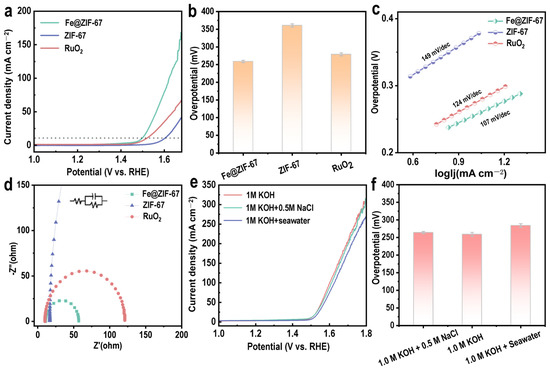
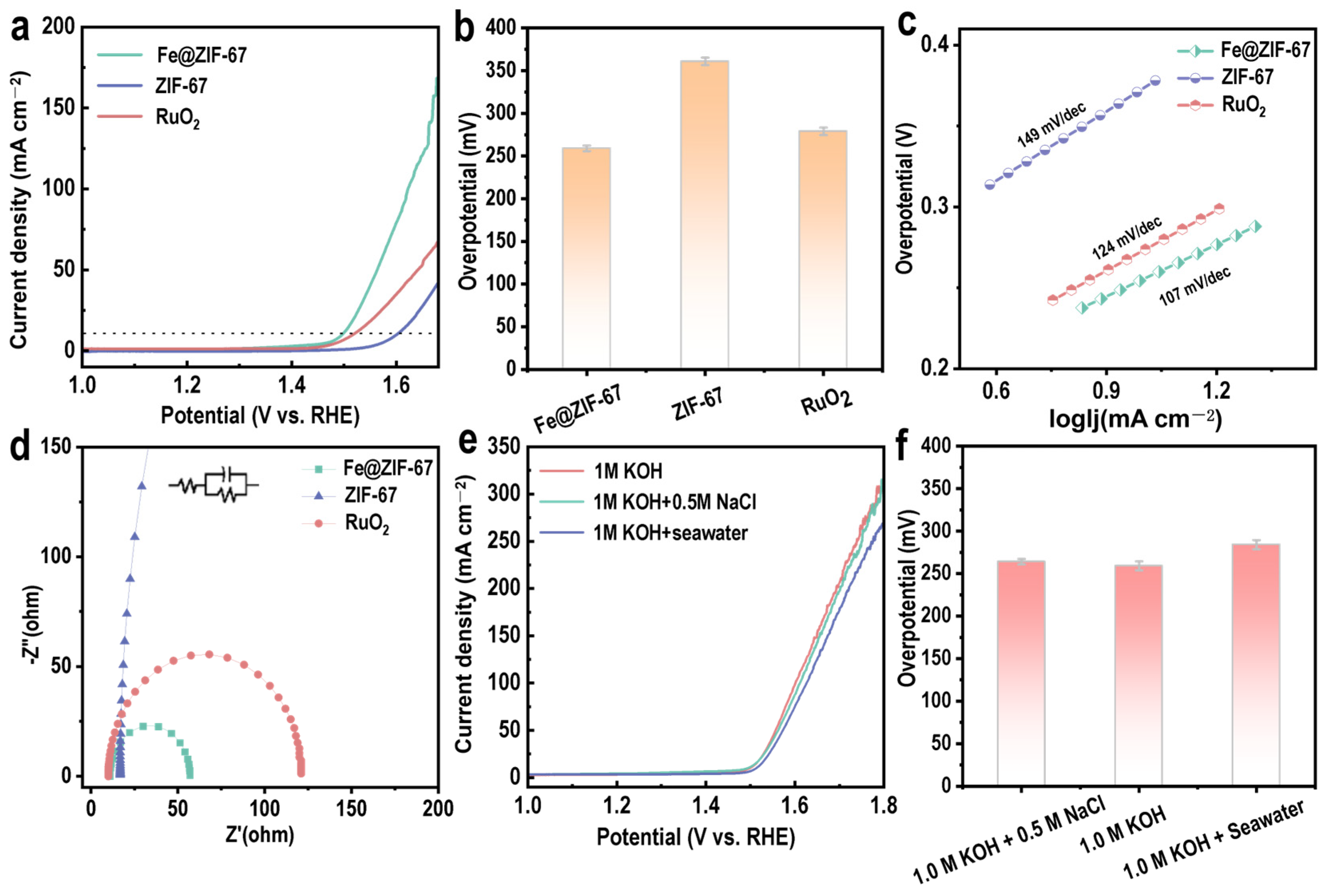
Following the execution of the aforementioned series of experiments, it was determined that Fe32@ZIF-67 exhibited the optimal OER performance, characterised by a doping time of 5 h and a doping mass of 20 mg. To further understand the electrocatalytic activity of Fe@ZIF-67, it was placed in an anode-electrode system for electrochemical testing once more, with ZIF-67 and a commercial precious metal catalyst, RuO2, serving as the control samples. As demonstrated in Figure 4a, Fe@ZIF-67 exhibits the optimal OER performance among the ZIF-67 and RuO2 samples. Specifically, at a current density of 10 mA cm−2, the overpotentials of ZIF-67, RuO2 and Fe@ZIF-67 are 361, 279 and 259 mV, respectively (Figure 4b). The evaluation of the catalytic activity of the catalyst in the electrochemical process was achieved through the plotting of the Tafel slope, as depicted in Figure 4c, according to the polarisation curve of the test. The Tafel slopes of ZIF-67, RuO2, and Fe@ZIF-67 are measured at 149, 124 and 107 mV dec−1, respectively. It has been demonstrated that the magnitude of the Tafel value can be used to predict the effect of the addition of Fe2+ into ZIF-67 on the rate of kinetics in the electrochemical process of Fe@ZIF-67. This, in turn, has been shown to accelerate the rate of alkaline simulated saline electrolysis. Electrochemical impedance is a significant parameter for the evaluation of the performance of catalysts. It has been demonstrated that electrochemical impedance is capable of reflecting the charge transfer rate and the conductivity of the catalyst material during the process of the electrochemical reaction. As illustrated in Figure 4d, it was determined that the impedance value of Fe@ZIF-67 was the smallest, followed by that of RuO2, and that of ZIF-67 was the largest. Moreover, the presence of Fe ions has been demonstrated to accelerate the rate of charge transfer in Fe@ZIF-67 during the electrochemical reaction process, thus accelerating the reaction rate of the OER [28]. Mechanistic insights for this process are exclusively provided by XPS characterisation, electrochemical evaluations, and corroborating findings in the existing literature.
Figure 4.
(a) LSV curves for catalysing OER, (b) the overpotential at 10 mA cm−2, (c) Tafel plots and (d) Nyquist plots for Fe@ZIF-67, ZIF-67 and RuO2 in 1.0 M KOH + 0.5 M NaCl; (e) OER polarisation curves and (f) the overpotential at 10 mA cm−2 for Fe@ZIF-67 in 1.0 M KOH, 1.0 M KOH + 0.5 M NaCl, and 1.0 M KOH + Seawater.
To investigate the OER performance of Fe@ZIF-67 in a variety of electrolytes, the LSV curve was tested in 1.0 M KOH, 1.0 M KOH + 0.5 M NaCl and 1.0 M KOH + Seawater, respectively. Figure 4e reveals that Fe@ZIF-67 exhibits little difference in OER activity in 1.0 M KOH and 1.0 M KOH + 0.5 M NaCl. When the electrolyte is switched to 1.0 M KOH + Seawater, the electrochemical performance of Fe@ZIF-67 undergoes a decline, which may be attributed to the attachment of Ca2+- and Mg2+-induced precipitates and the adsorption of biological species (e.g., microorganisms and bacteria) from seawater onto the catalyst surface [43,44]. The insoluble precipitates, along with other microbes and bacteria in seawater, can cover the active sites on the catalyst surface, causing catalyst deactivation and reducing OER activity [45]. It was highlighted that the OER performance varied in different electrolyte solutions. The overpotentials of Fe@ZIF-67 in 1.0 M KOH, 1.0 M KOH + 0.5 M NaCl and 1.0 M KOH + Seawater were 264, 259, and 284 mV, respectively, at a current density of 10 mA cm−2 (Figure 4f). The currently provided experimental results indicate that Fe@ZIF-67 exhibits superior OER performance compared to ZIF-67 and RuO2. Based on the information from the table, Fe@ZIF-6 shows higher catalytic ability than most similar OER catalysts. The enhanced performance may be attributed to the introduction of Fe2+, which alters the electronic configuration of the ZIF-67 surface and accelerates electron transfer, thereby improving its electrochemical reaction kinetics.
The size of a catalyst’s Cdl value indirectly reflects the number of electrochemically active sites and the size of electrochemical active surface areas it can provide during electrochemical reactions. The Cdl values of ZIF-67, RuO2, and Fe@ZIF-67 were determined from CV curves of the catalysts at different scan rates, as shown in Figure S5. Specifically, their Cdl values are 2.58, 4.08, and 6.33 mF cm−2, respectively, as presented in Figure S6a, corresponding to ECSA values of 64.5, 102, and 158.3 cm2. The relatively large ECSA value of Fe@ZIF-67 implies a greater active surface area, which accelerates the OER process. To accurately assess the intrinsic catalytic performance, the polarisation curves of Fe@ZIF-67 were normalised with respect to the ECSA. Figure S7 reveals that Fe@ZIF-67 displayed a markedly enhanced specific activity relative to ZIF-67 and RuO2, confirming its outstanding intrinsic catalytic activity [46].
Beyond activity, catalyst stability is also critical. Figure S6b shows LSV curves of Fe@ZIF-67 before and after 2000 CV cycles. The high overlap of these curves indicates good OER stability in 1.0 M KOH + 0.5 M NaCl. The experimental findings demonstrated a high degree of congruence between the two polarisation curves, thereby providing an indirect indication of the superior OER stability of Fe@ZIF-67 in 1.0 M KOH + 0.5 M NaCl. In addition, the stability of Fe@ZIF-67 was examined once more via chronoamperometry, as illustrated in Figure S6c. The results demonstrated that the current density value (10 mA cm−2) of the test curve remained constant over a 35 h period, thereby substantiating the hypothesis that the Fe@ZIF-67 catalyst exhibits excellent catalytic stability during the OER. As illustrated in Figure S8a, the originally sharp characteristic diffraction peaks of the as-fabricated fresh Fe@ZIF-67 material significantly disappear after the OER stability test, and the post-OER XRD pattern becomes overall broadened and diffused. This phenomenon can be reasonably attributed to the electrochemical reconstruction process occurring on the catalyst surface. Moreover, the SEM images (Figure S8b) and XPS analysis (Figure S9) demonstrate that the catalyst maintains its intrinsic cubic morphology, and the chemical valence states of the elements exhibit no obvious change before and after the electrochemical test. Accordingly, surface reconstruction of Fe@ZIF-67 during the electrolysis process probably generates active species belonging to Co/Fe oxyhydroxide.
In addition, the concentration of sodium hypochlorite generated during the alkaline saline electrolysis process was further examined in the electrolyte after the stability test using a potassium iodide–starch colourimetric assay [46]. As shown in Figure S10, no obvious colour change was observed in the post-electrolysis solution, indicating a negligible amount of hypochlorite. Moreover, titration analysis further confirmed that the concentration of sodium hypochlorite in the electrolyte was 1.42 × 10⁻⁶ mol L−1. These results indicate that the NaClO concentration in the electrolyte was very low, further demonstrating the high oxygen evolution selectivity of the Fe@ZIF-67 catalyst.
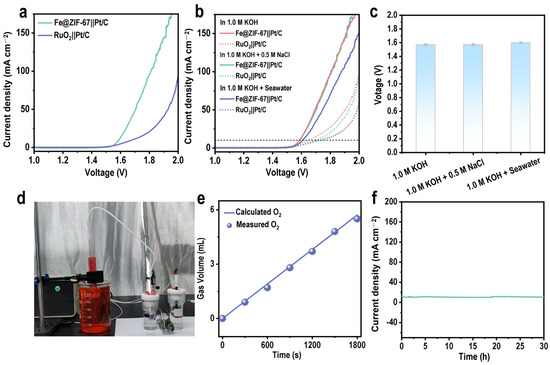
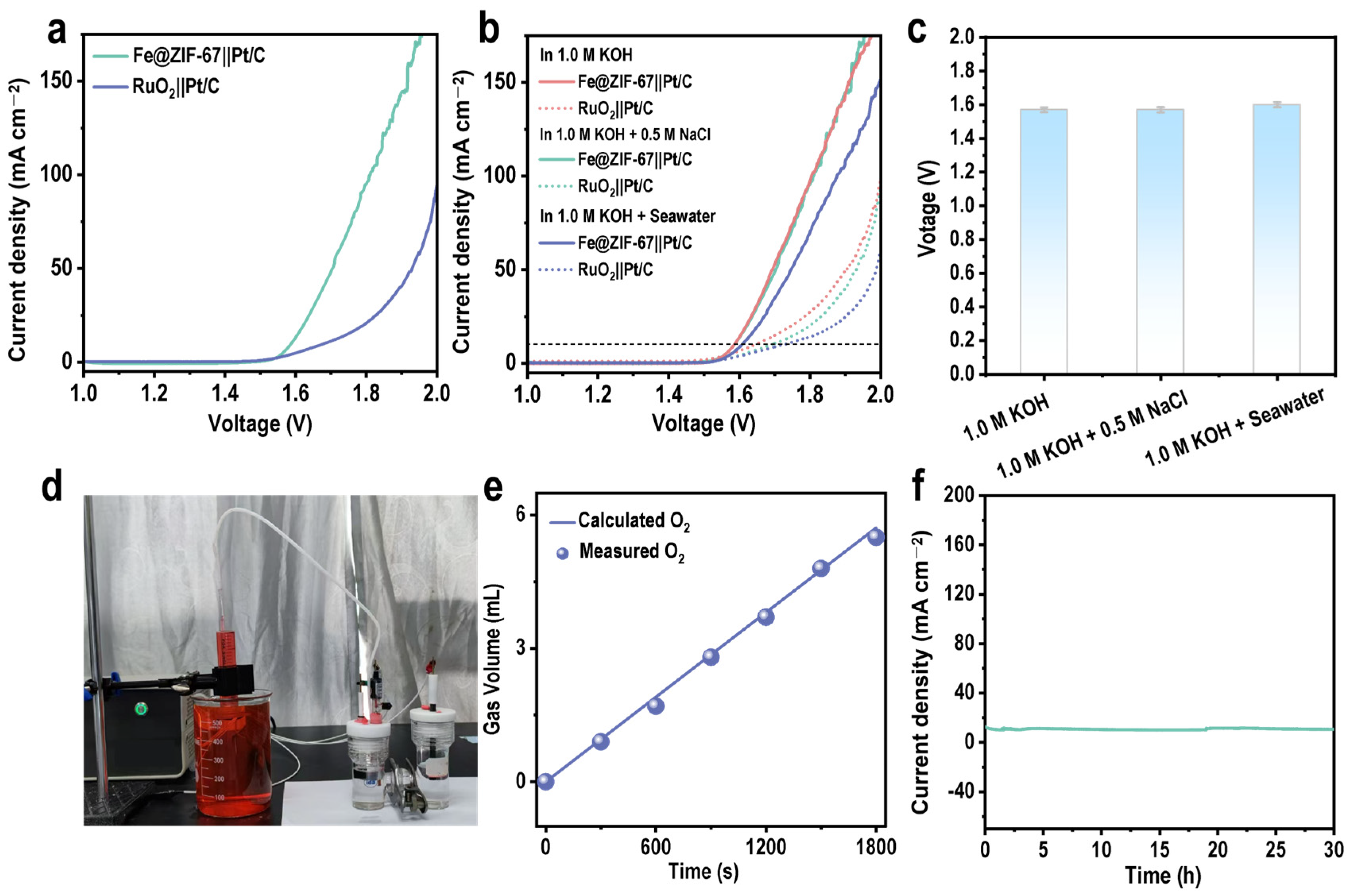
To evaluate the overall seawater splitting capability of Fe@ZIF-67 in 1.0 M KOH + 0.5 M NaCl, the Fe@ZIF-67 catalyst was placed in a two-electrode test system. In this system, the Fe@ZIF-67 was used as the anode and a commercial Pt/C electrode was used as the cathode. Together, these components constituted the Fe@ZIF-67||Pt/C full water-splitting electrode. The commercial RuO2||Pt/C electrode served as a contrast. Figure 5a shows that Fe@ZIF-67||Pt/C has superior overall seawater-splitting ability to RuO2||Pt/C, requiring lower voltages (1.57 V vs. 1.65 V) at 10 mA cm−2. Figure 5b shows that in all tested electrolytes (1.0 M KOH, 1.0 M KOH + 0.5 M NaCl, and 1.0 M KOH + Seawater), Fe@ZIF-67||Pt/C exhibits better catalytic ability, with full water splitting voltages of 1.57, 1.57, and 1.60 V at 10 mA cm−2 (Figure 5c). The slight performance difference in 1.0 M KOH and 1.0 M KOH + 0.5 M NaCl may be due to the complex seawater composition causing partial deactivation of active sites during seawater splitting.
Figure 5.
(a) LSV plots of the Fe@ZIF-67||Pt/C and RuO2||Pt/C for overall seawater splitting in 1.0 M KOH + 0.5 M NaCl; (b) overall seawater splitting polarisation curves and (c) the voltage at 10 mA cm−2 for Fe@ZIF-67||Pt/C in different electrolytes; (d) optical photo of gas collection device for the FE test; (e) measured and theoretical gas amount for Fe@ZIF-67; (f) chronoamperometry measurement of Fe@ZIF-67||Pt/C.
The Faradaic efficiency of a catalyst is an important indicator of its selectivity for the OER. In this study, Fe@ZIF-67 was placed in an H-shaped electrolytic cell, and the OER Faradaic efficiency was calculated via the water displacement method at a current density of 50 mA cm−2, as shown in Figure 5d. Figure 5e presents the relationship between the actual and theoretical oxygen production during the water electrolysis process with Fe@ZIF-67 over 1800 s. The actual oxygen output of Fe@ZIF-67 at 300, 600, 900, 1200, 1500, and 1800 s was 0.9, 1.7, 2.8, 3.7, 4.8, and 5.5 mL, respectively. Under normal temperature and pressure conditions, we adopted the galvanostatic test mode and applied the water drainage gas collection method to collect the volume of oxygen produced during the anodic electrolysis process, based on which the Faradaic efficiency of this process was calculated. Accordingly, the Faradaic efficiency of the oxygen evolution reaction over Fe@ZIF-67 reaches 96.3%, which is consistent with the experimental observation of low hypochlorite generation at the anode side. This result demonstrates that the catalyst possesses favourable oxygen evolution selectivity during the electrolysis process.
Stability, in addition to electrode activity and selectivity, is also a key parameter for evaluating catalyst performance. Chronoamperometric testing of Fe@ZIF-67||Pt/C in 1.0 M KOH + 0.5 M NaCl for 30 h showed no significant change in current density, indicating good stability during overall water splitting. These experimental results demonstrate that Fe@ZIF-67 has high activity, selectivity, and stability, offering a new approach for designing electrolytic seawater catalysts.
4. Conclusions
In summary, smooth-surfaced ZIF-67 was first prepared at room temperature. Subsequently, a ferrous salt was introduced into the system via a cation etching strategy. Through the investigation of Fe2+ doping time and specific mass, the Fe@ZIF-67 catalyst with the best electrochemical performance was selected. Fe@ZIF-67 exhibits excellent OER activity in 1.0 M KOH + 0.5 M NaCl, with an overpotential of just 259 mV at 10 mA cm−2 and a Tafel slope of 107 mV dec−1. When Fe@ZIF-67 and Pt/C serve as the anode and cathode of an overall water-splitting device, the device shows good performance. The Fe@ZIF-67||Pt/C catalyst shows an overall water-splitting voltage of merely 1.57 V at 10 mA cm−2 and maintains good activity over 30 h of electrolysis. The doping of Fe2+ alters the surface electronic configuration of ZIF-67 and accelerates electron transfer during seawater electrolysis, enhancing the electrochemical reaction rate of Fe@ZIF-67. This work offers effective strategies and perspectives for designing non-precious-metal-based catalysts for seawater electrolysis.
Supplementary Materials
The following supporting information can be downloaded at: https://www.mdpi.com/article/10.3390/pr14162652/s1, Figure S1. FT-IR spectrum of ZIF-67 and Fe@ZIF-67. Figure S2. TEM-EDS of Fe@ZIF-67. Figure S3. (a) LSV curves for catalysing OER, (b) the overpotential at 10 mA cm−2, and (c) Tafel plots for Fe1@ZIF-67, Fe2@ZIF-67, Fe3@ZIF-67, and Fe4@ZIF-67 in 1.0 M KOH + 0.5 M NaCl. Figure S4. (a) LSV curves for catalysing OER, (b) the overpotential at 10 mA cm−2, and (c) Tafel plots for Fe31@ZIF-67, Fe32@ZIF-67, Fe33@ZIF-67, and Fe34@ZIF-67 in 1.0 M KOH + 0.5 M NaCl. Table of Comparison between Fe@ZIF-67 and reported similar electrocatalysts for OER. Figure S5. CV plots at different scan rates (20 to 120 mV s−1) and charge current density difference versus different scan rates for (a) ZIF-67, (b) RuO2, and (c) Fe@ZIF-67. Figure S6. (a) Cdl assessed at different current densities versus scan rate of ZIF-67, RuO2, and Fe@ZIF-67; (b) OER polarisation curves of Fe@ZIF-67 initial and after 2000 CV cycles; (c) The durability test of OER for Fe@ZIF-67. Figure S7. LSV normalised by ECSA for Fe@ZIF-67, RuO2, and ZIF-67. Figure S8. (a) XRD pattern and (b) SEM image of Fe@ZIF-67 after stability test for OER. Figure S9. The high-resolution XPS spectra of Fe@ZIF-67 in (a) Co 2p and (b) Fe 2p regions after the stability test for OER. Figure S10. The potassium iodide-starch test on the electrolyte after the stability test of Fe@ZIF-67. Table S1. The main ion composition of the natural seawater was obtained from Zhoushan, Zhejiang Province. Table S2. Co and Fe content determined by ICP-MS for ZIF-67 and Fe@ZIF-67.
Author Contributions
Conceptualization, L.X.; Methodology, Z.C. and Y.W.; Software, S.Y.; Validation, L.X. and M.H.; Formal analysis, L.W.; Investigation, S.Y. and Q.D.; Resources, L.W.; Data curation, Y.Z.; Writing―original draft, Z.C., Y.W., L.W., S.Y., Q.D. and Y.Z.; Writing―review & editing, L.X., M.H., Q.D. and Y.Z. All authors have read and agreed to the published version of the manuscript.
Funding
The Zhoushan major industrial science and technology research and development project (No. 2024C03009); CNPC Fundamental & Forward-Looking Science and Technology Project, grant number 2023ZZ11.
Data Availability Statement
Data are available from the corresponding authors upon reasonable request.
Conflicts of Interest
The authors declare that this study received funding from CNPC Fundamental & Forward-Looking Science and Technology Project, grant number 2023ZZ11. The funder had the following involvement with the study: chemicophysical characterisation of prepared material Fe@ZIF-67. The author Lei Wang was employed by CNOOC China Limited, Shanghai Branch, and the author Siqi Yang was employed by CNPC Tubular Goods Research Institute. The remaining authors declare that the research was conducted in the absence of any commercial or financial relationships that could be construed as potential conflicts of interest.
References
- Turner, J.A. Sustainable hydrogen production. Science 2004, 305, 972–974. [Google Scholar] [CrossRef] [Scilit] [PubMed]
- Jin, H.; Wang, X.; Tang, C.; Vasileff, A.; Li, L.; Slattery, A.; Qiao, S.-Z. Stable and highly efficient hydrogen evolution from seawater enabled by an unsaturated nickel surface nitride. Adv. Mater. 2021, 33, 2007508. [Google Scholar] [CrossRef] [Scilit] [PubMed]
- Jia, H.; Zhang, M.; Meng, T.; An, S.; Wang, H.; Yang, X.; Zhang, Y. Facile synthesis of Fe, Co bimetal embedded nanoporous carbon polyhedron composites for an efficient oxygen evolution reaction. J. Colloid Interface Sci. 2020, 563, 189–196. [Google Scholar] [CrossRef] [Scilit] [PubMed]
- Jia, H.; Shang, N.; Chen, J.; Yang, Q.; Su, M.; Li, M.; Zhang, Y. Facile synthesis of N-doped carbon nanoframes encapsulated by CoP nanoparticles for hydrogen evolution reaction. J. Colloid Interface Sci. 2021, 601, 338–345. [Google Scholar] [CrossRef] [Scilit] [PubMed]
- Qi, H.; Zhang, P.; Wang, H.; Cui, Y.; Liu, X.; She, X.; Wen, Y.; Zhan, T. Cu2Se nanowires shelled with NiFe layered double hydroxide nanosheets for overall water-splitting. J. Colloid Interface Sci. 2021, 599, 370–380. [Google Scholar] [CrossRef] [Scilit] [PubMed]
- Seh, Z.W.; Kibsgaard, J.; Dickens, C.F.; Chorkendorff, I.; Nørskov, J.K.; Jaramillo, T.F. Combining theory and experiment in electrocatalysis: Insights into materials design. Science 2017, 355, eaad4998. [Google Scholar] [CrossRef] [Scilit] [PubMed]
- Ros, C.; Murcia-López, S.; Garcia, X.; Rosado, M.; Arbiol, J.; Llorca, J.; Morante, J.R. Facing seawater splitting challenges by regeneration with Ni-Mo-Fe bifunctional electrocatalyst for hydrogen and oxygen evolution. ChemSusChem 2021, 14, 2872–2881. [Google Scholar] [CrossRef] [Scilit] [PubMed]
- Dresp, S.; Dionigi, F.; Klingenhof, M.; Strasser, P. Direct electrolytic splitting of seawater: Opportunities and challenges. ACS Energy Lett. 2019, 4, 933–942. [Google Scholar] [CrossRef] [Scilit]
- Yu, X.; Yu, Z.Y.; Zhang, X.L.; Zheng, Y.R.; Duan, Y.; Gao, Q.; Wu, R.; Sun, B.; Gao, M.-R.; Wang, G.; et al. “Superaerophobic” nickel phosphide nanoarray catalyst for efficient hydrogen evolution at ultrahigh current densities. J. Am. Chem. Soc. 2019, 141, 7537–7543. [Google Scholar] [CrossRef] [Scilit] [PubMed]
- Wu, L.; Yu, L.; Zhu, Q.; McElhenny, B.; Zhang, F.; Wu, C.; Xing, X.; Bao, J.; Chen, S.; Ren, Z. Boron-modified cobalt iron layered double hydroxides for high efficiency seawater oxidation. Nano Energy 2021, 83, 105838. [Google Scholar] [CrossRef] [Scilit]
- Xu, K.; Chen, P.; Li, X.; Tong, Y.; Ding, H.; Wu, X.; Chu, W.; Peng, Z.; Wu, C.; Xie, Y. Metallic nickel nitride nanosheets realizing enhanced electrochemical water oxidation. J. Am. Chem. Soc. 2015, 137, 4119–4125. [Google Scholar] [CrossRef] [Scilit] [PubMed]
- Wang, Q.; Zhang, Z.; Cai, C.; Wang, M.; Zhao, Z.L.; Li, M.; Huang, X.; Han, S.; Zhou, H.; Feng, Z.; et al. Single iridium atom doped Ni2P catalyst for optimal oxygen evolution. J. Am. Chem. Soc. 2021, 143, 13605–13615. [Google Scholar] [CrossRef] [Scilit] [PubMed]
- Wang, S.H.; Jiang, Q.; Ju, S.H.; Hsu, C.S.; Chen, H.M.; Zhang, D.; Song, F. Identifying the geometric catalytic active sites of crystalline cobalt oxyhydroxides for oxygen evolution reaction. Nat. Commun. 2022, 13, 6650. [Google Scholar] [CrossRef] [Scilit] [PubMed]
- Shu, X.; Chen, Q.; Yang, M.; Liu, M.; Ma, J.; Zhang, J. Tuning Co-catalytic sites in hierarchical porous N-doped carbon for high-performance rechargeable and flexible Zn-air battery. Adv. Energy Mater. 2023, 13, 2202871. [Google Scholar] [CrossRef] [Scilit]
- Haase, F.T.; Rabe, A.; Schmidt, F.P.; Herzog, A.; Jeon, H.S.; Frandsen, W.; Narangoda, P.V.; Spanos, I.; Ortega, K.F.; Timoshenko, J.; et al. Role of nanoscale inhomogeneities in Co2FeO4 catalysts during the oxygen evolution reaction. J. Am. Chem. Soc. 2022, 144, 12007–12019. [Google Scholar] [CrossRef] [Scilit] [PubMed]
- Yin, J.; Li, Y.; Lv, F.; Lu, M.; Sun, K.; Wang, W.; Wang, L.; Cheng, F.; Li, Y.; Xi, P.; et al. Oxygen vacancies dominated NiS2/CoS2 interface porous nanowires for portable Zn-air batteries driven water splitting devices. Adv. Mater. 2017, 29, 1704681. [Google Scholar] [CrossRef] [Scilit] [PubMed]
- Cheng, F.; Peng, X.; Hu, L.; Yang, B.; Li, Z.; Dong, C.L.; Chen, J.-L.; Hsu, L.-C.; Lei, L.; Zheng, Q.; et al. Accelerated water activation and stabilized metal-organic framework via constructing triangular active-regions for ampere-level current density hydrogen production. Nat. Commun. 2022, 13, 6486. [Google Scholar] [CrossRef] [Scilit] [PubMed]
- Yin, S.H.; Yang, J.; Han, Y.; Li, G.; Wan, L.Y.; Chen, Y.H.; Chen, C.; Qu, X.; Jiang, Y.; Sun, S. Construction of highly active metal-containing nanoparticles and FeCo-N4 composite sites for the acidic oxygen reduction reaction. Angew. Chem. 2020, 132, 21976–21979. [Google Scholar] [CrossRef] [Scilit]
- Zhao, S.; Wang, Y.; Dong, J.; He, C.T.; Yin, H.; An, P.; Zhao, K.; Zhang, X.; Gao, C.; Zhang, L.; et al. Ultrathin metal-organic framework nanosheets for electrocatalytic oxygen evolution. Nat. Energy 2016, 1, 16184. [Google Scholar] [CrossRef] [Scilit]
- Zheng, Z.; Rong, Z.; Nguyen, H.L.; Yaghi, O.M. Structural chemistry of zeolitic imidazolate frameworks. Inorg. Chem. 2023, 62, 20861–20873. [Google Scholar] [CrossRef] [Scilit] [PubMed]
- Lin, X.; Li, X.; Shi, L.; Ye, F.; Liu, F.; Liu, D. In situ electrochemical restructuring B-doped metal-organic frameworks as efficient OER electrocatalysts for stable anion exchange membrane water electrolysis. Small 2024, 20, 2308517. [Google Scholar] [CrossRef] [Scilit] [PubMed]
- Maurya, P.; Vyas, V.; Singh, A.N.; Indra, A. Iron(iii) ion-assisted transformation of ZIF-67 to a self-supported FexCo-layered double hydroxide for improved water oxidation. Chem. Commun. 2023, 59, 7200–7203. [Google Scholar] [CrossRef] [Scilit] [PubMed]
- Sankar, S.S.; Keerthana, G.; Manjula, K.; Sharad, J.H.; Kundu, S. Electrospun Fe-incorporated ZIF-67 nanofibers for effective electrocatalytic water splitting. Inorg. Chem. 2021, 60, 4034–4046. [Google Scholar] [CrossRef] [Scilit] [PubMed]
- He, X.; Chang, L.; Wu, H.; Liu, G.; Zhang, Y.; Zhou, A. Design of ZIF-67-derived Fe, N and F co-doped porous carbon material and evaluation of its ORR and OER performance. J. Alloys Compd. 2023, 967, 171709. [Google Scholar] [CrossRef] [Scilit]
- Huang, Y.; Zhang, S.L.; Lu, X.F.; Wu, Z.P.; Luan, D.; Lou, X.W. Trimetallic spinel NiCo2−xFexO4 nanoboxes for highly efficient electrocatalytic oxygen evolution. Angew. Chem. 2021, 133, 11947. [Google Scholar] [CrossRef] [Scilit]
- Lin, Z.; Wang, L.; Jia, T.; Wang, X.; Li, C.; Wang, H.; Li, L.; Zhou, Y.; Zhai, C.; Tao, H.; et al. ZIF-67-derived FeCoNi-LDH with a 3D nanoflower hierarchical structure for highly efficient oxidation of 5-hydroxymethylfurfural and coupling seawater splitting hydrogen production. Chem. Eng. J. 2024, 481, 148429. [Google Scholar] [CrossRef] [Scilit]
- Li, Z.; Zhang, X.; Kang, Y.; Yu, C.C.; Wen, Y.; Hu, M.; Meng, D.; Song, W.; Yang, Y. Interface engineering of Co-LDH@MOF heterojunction in highly stable and efficient oxygen evolution reaction. Adv. Sci. 2021, 8, 2002631. [Google Scholar] [CrossRef] [Scilit] [PubMed]
- Liu, W.; Jiang, K.; Hu, Y.; Li, Q.; Deng, Y.; Bao, J.; Lei, Y. Zr-doped CoFe-layered double hydroxides for highly efficient seawater electrolysis. J. Colloid Interface Sci. 2021, 604, 767–775. [Google Scholar] [CrossRef] [Scilit] [PubMed]
- Han, T.T.; Liu, Y.Y.; Yang, G.C.; Ma, J.F. One-step encapsulation of functionalized EAQ and TBAQ molecules inside zeolite imidazolate framework-67 and their electrochemical characterizations. Microporous Mesoporous Mater. 2017, 247, 177–183. [Google Scholar] [CrossRef] [Scilit]
- Li, S.; Zhang, J.; Liu, Z.; Wang, T.; Guo, R.; Yang, Z.; Wu, Y.A.; Xu, W.; Pan, S. Hollow nanopompoms engineered via a weak-strong coetching strategy for high-performance electrocatalysts. Chem. Eng. J. 2022, 446, 136815. [Google Scholar] [CrossRef] [Scilit]
- Lo, K.H.; Anuratha, K.S.; Cheng, C.C.; Wu, S.J.; Juan, H.Y.; Su, C.H.; Lin, J.-Y.; Hsieh, C.-K. In situ synthesis of ZIF-67 thin films using low temperature chemical vapor deposition to fabricate all-solid-state flexible interdigital in-planar microsupercapacitors. Int. J. Energy Res. 2023, 2023, 3754111. [Google Scholar] [CrossRef] [Scilit]
- Liu, Y.; Teng, X.; Mi, Y.; Chen, Z. A new architecture design of Ni-Co LDH-based pseudocapacitors. J. Mater. Chem. A 2017, 5, 24407–24415. [Google Scholar] [CrossRef] [Scilit]
- Shahrokhian, S.; Sanati, E.K.; Hosseini, H. Advanced on-site glucose sensing platform based on a new architecture of free-standing hollow Cu(OH)2 nanotubes decorated with CoNi-LDH nanosheets on graphite screen-printed electrode. Nanoscale 2019, 11, 12655–12671. [Google Scholar] [CrossRef] [Scilit] [PubMed]
- Zhao, J. Air-flow impacting: A new mechanochemical method for continuous, highly efficient, large-scale synthesis of metal-organic frameworks and mechanistic research. Front. Mater. 2021, 8, 800820. [Google Scholar] [CrossRef] [Scilit]
- Yao, J.; Xu, D.; Ma, X.; Xiao, J.; Zhang, M.; Gao, H. Trimetallic CoNiFe-layered double hydroxides: Electronic coupling effect and oxygen vacancy for boosting water splitting. J. Power Sources 2022, 524, 231068. [Google Scholar] [CrossRef] [Scilit]
- Sun, J.; Song, P.; Zhou, H.; Lang, L.; Shen, X.; Liu, Y.; Cheng, X.; Fu, X.; Zhu, G. A surface configuration strategy to hierarchical Fe-Co-S/Cu2O/Cu electrodes for oxygen evolution in water/seawater splitting. Appl. Surf. Sci. 2021, 567, 150757. [Google Scholar] [CrossRef] [Scilit]
- Wu, L.; Yu, L.; McElhenny, B.; Xing, X.; Luo, D.; Zhang, F.; Bao, J.; Chen, S.; Ren, Z. Rational design of core-shell-structured CoPx@FeOOH for efficient seawater electrolysis. Appl. Catal. B Environ. 2021, 294, 120256. [Google Scholar] [CrossRef] [Scilit]
- Du, Z.; Yu, P.; Wang, L.; Tian, C.; Liu, X.; Zhang, G.; Fu, H. Cubic imidazolate frame-works-derived CoFe alloy nanoparticles-embedded N-doped graphitic carbon for discharging reaction of Zn-air battery. Sci. China Mater. 2020, 63, 327–338. [Google Scholar] [CrossRef] [Scilit]
- Zhai, P.; Wang, C.; Zhao, Y.; Zhang, Y.; Gao, J.; Sun, L.; Hou, J. Regulating electronic states of nitride/hydroxide to accelerate kinetics for oxygen evolution at large current density. Nat. Commun. 2023, 14, 1873. [Google Scholar] [CrossRef] [Scilit] [PubMed]
- Zhang, M.; Wang, J.; Ma, L.; Gong, Y. Spontaneous synthesis of silver nanoparticles on cobalt-molybdenum layer double hydroxide nanocages for improved oxygen evolution reaction. J. Colloid Interface Sci. 2022, 628, 299–307. [Google Scholar] [CrossRef] [Scilit] [PubMed]
- Shen, K.; Tang, Y.; Zhou, Q.; Zhang, Y.; Ge, W.; Shai, X.; Deng, S.; Yang, P.; Deng, S.; Wang, J. Metal-organic framework-derived S-NiFe PBA coupled with NiFe layered double hydroxides as Mott-Schottky electrocatalysts for efficient alkaline oxygen evolution reaction. Chem. Eng. J. 2023, 471, 144827. [Google Scholar] [CrossRef] [Scilit]
- Zhang, W.; Fan, M.; Liu, J.; Liu, S.; Zuo, Q.; Gong, L. Fe doping strategy induces peroxymonosulfate activation by ZIF-67 through a non-radical reaction pathway with dominant 1O2 generation. Sep. Purif. Technol. 2024, 343, 127158. [Google Scholar] [CrossRef] [Scilit]
- Guo, J.; Zheng, Y.; Hu, Z.; Zheng, C.; Mao, J.; Du, K.; Jaroniec, M.; Qiao, S.-Z.; Ling, T. Direct seawater electrolysis by adjusting the local reaction environment of a catalyst. Nat. Energy 2023, 8, 264–272. [Google Scholar] [CrossRef] [Scilit]
- Tiwari, J.N.; Bhaskaran, G.; Kumar, K.; Huh, Y.S.; Han, Y.K. Auto-generated valence states in electrocatalysts for boosting oxygen and hydrogen evolution kinetics in alkaline water/alkaline seawater/simulated seawater/natural seawater. Adv. Funct. Mater. 2026, 36, e19158. [Google Scholar] [CrossRef] [Scilit]
- Khan, M.; Al-Attas, T.; Roy, S.; Rahman, M.M.; Ghaffour, N.; Thangadurai, V.; Larter, S.; Hu, J.; Ajayan, P.M.; Kibria, G. Seawater electrolysis for hydrogen production: A solution looking for a problem? Energy Environ. Sci. 2021, 14, 4831–4839. [Google Scholar] [CrossRef] [Scilit]
- Ge, S.; Cheng, P.; Zhao, Y.; Jin, H.; Su, Y.; Li, N.; Li, J.; Xiong, Z.; Feng, C.; Shi, D. Promoting the corrosion resistance of Mo-FeCoP@MnOx/NF via double protection mechanisms toward electrolysis of seawater at ampere-level current density. Small 2024, 21, 2406578. [Google Scholar] [CrossRef] [Scilit] [PubMed]
Disclaimer/Publisher’s Note: The statements, opinions and data contained in all publications are solely those of the individual author(s) and contributor(s) and not of MDPI and/or the editor(s). MDPI and/or the editor(s) disclaim responsibility for any injury to people or property resulting from any ideas, methods, instructions or products referred to in the content. |
© 2026 by the authors. Licensee MDPI, Basel, Switzerland. This article is an open access article distributed under the terms and conditions of the Creative Commons Attribution (CC BY) license.