


Abstract
Backfilling the industrial solid waste coal gangue into deep coal mine goafs for CO2 geological sequestration is a crucial pathway to achieve the synergistic effect of pollution reduction and carbon mitigation. However, in complex deep geological environments, the chemical evolution of multiple mineral phases of coal gangue under gas–water–rock coupling effects and the carbon-controlling mechanism of residual total organic carbon (TOC) remain unclear. In this study, coal gangue from the goaf of the Xiaobaodang Coal Mine was used as the research object. Relying on a customized high-temperature and high-pressure reaction system to simulate the deep in situ environment (45 °C, 10 MPa), and combined with X-ray diffraction (XRD), total organic carbon determination, and isothermal CO2 adsorption experiments, the geochemical mechanism by which inorganic minerals and organic residual carbon synergistically control the ultimate CO2 adsorption potential was systematically revealed. The results show that the modification of the CO2 adsorption potential of coal gangue by gas–water–rock reactions exhibits strong mineral phase differentiation. Systems rich in active silicates generate a large amount of secondary clay minerals through intense carbonation alteration, achieving a significant increase in micro–nano pores and absolute adsorption capacity. Systems rich in carbonates steadily release deep primary adsorption potential by widening mass transfer channels through mineral dissolution. In contrast, systems rich in primary clay minerals face an irreversible attenuation of adsorption space due to physical clogging of pore throats caused by fluid migration. Furthermore, the initial organic carbon content exerts a significant non-linear regulatory effect on the development of the micropore network. The physical adsorption sites provided by the high relative content of layered clay minerals (>41%), coupled with the interfacial enhancement effect exerted by a moderate organic carbon content (0.12~0.16%), constitute an optimal physicochemical synergistic enhancement network, which is the core geological reason for stimulating the ultimate carbon sequestration capacity of coal gangue. The results of this study not only enrich the multiphase interfacial thermodynamic theory of complex heterogeneous geological bodies but also provide solid theoretical support for the precise optimization of target areas and the long-term evaluation of carbon sinks in goaf CO2 sequestration engineering.
1. Introduction
Carbon capture, utilization, and storage (CCUS) technology is a key pathway for addressing global climate change and achieving the dual carbon goals [1,2,3,4,5,6,7,8]. Specifically, CO2 sequestration in coal mine goafs serves as a highly viable alternative to traditional geological storage in depleted hydrocarbon reservoirs or deep saline aquifers [9]. Backfilling the industrial waste coal gangue into deep coal mine goafs and injecting CO2 can not only effectively consume difficult-to-treat solid waste but also realize large-scale geological sequestration of greenhouse gases, yielding significant ecological and economic benefits [6,9]. In the past two years, numerous studies have increasingly focused on enhancing the CO2 sequestration capacity and mineral carbonation efficiency of gangue-based backfill materials in deep environments [10,11,12,13,14,15]. However, a goaf is a complex deep geological environment rich in multiphase fluids. The injected high-pressure CO2 dissolves in groundwater to form a weakly acidic CO2-rich fluid, which will undergo a long-term CO2–water–rock geochemical reaction with the backfilled coal gangue [2,5,7]. This dynamic process will profoundly modify the physicochemical structure of the reservoir, thereby determining the actual capacity and safety of long-term CO2 sequestration [3,4,10].
Coal gangue, as a highly complex heterogeneous mixed solid waste, contains a large amount of inorganic minerals (such as quartz, feldspar, calcite, and clay minerals) as well as varying contents of organic carbon [11,12,13,14]. Currently, research on CO2 geological sequestration mostly focuses on pure coal or homogeneous shale systems [16,17,18,19,20,21], primarily exploring the single physical expansion or compression effect of supercritical fluids on the physical pore structure. However, for coal gangue, a special multi-component medium, existing studies often ignore the differentiated chemical behaviors of its internal complex inorganic mineral phases in acidic fluids [12,13,14,15]. In fact, the rapid dissolution of highly active carbonates and the secondary alteration of unstable silicates will not only trigger severe mass displacement but also cause fundamental changes in surface adsorption capacity and adsorption ability at the solid–gas interface [16,17,18].
More critically, the acting mechanism of the residual organic carbon (TOC) within the system during the gas–water–rock reaction process has long been debated [19,20,21,22,23,24,25]. Some macroscopic thermodynamic perspectives suggest that organic carbon components can provide additional micro–nano physical adsorption sites for fluids, whereas other microscopic kinetic phenomena indicate that excessive hydrophobic organic carbon may form a coating film on the mineral surface, blocking the effective contact between the acidic fluid and the inorganic mineral interface, and conversely inhibiting the generation of secondary pores [25,26]. To date, how the depth of geochemical evolution of inorganic minerals restricts the macroscopic adsorption capacity, and whether there is a non-linear synergistic carbon-sequestration mechanism between the initial organic carbon abundance and secondary inorganic phases such as clay [27,28], are core scientific questions that directly determine the actual carbon sequestration potential of goafs and have not yet been fully explored [29,30].
In this study, coal gangue from the Xiaobaodang Coal Mine goaf was investigated under simulated deep geological conditions (45 °C, 10 MPa) [31,32]. Utilizing a customized high-pressure dynamic reaction system coupled with XRD, TOC analysis, and isothermal CO2 adsorption, this work aims to (1) elucidate the distinct alteration pathways of silicate, carbonate, and clay minerals in weakly acidic CO2 fluids; (2) quantify the non-linear regulatory impact of initial TOC on micropore development; and (3) establish the synergistic mechanism between inorganic minerals and organic carbon in controlling CO2 adsorption capacity. The findings provide critical thermodynamic insights and quantitative criteria for optimizing coal gangue selection in goaf CO2 sequestration projects.
2. Materials and Methods
2.1. Samples
The engineering geological background of this study focuses on the goaf of the Xiaobaodang Coal Mine, aiming to explore the multi-mechanism synergistic carbon sequestration potential of the coal gangue backfill in this area under a deep, enclosed geological environment. To ensure the representativeness and multi-source nature of the experimental samples, the raw gangue used in this study was collected from the factory processing site and classified into three series, CSD, OCX, and FC, based on the different mechanical sampling nodes. Among them, the FC series samples were taken from scattered mechanical dust, macroscopically presenting as loose powder with a uniform and fine particle size distribution; the CSD series samples were taken from the mechanical belt, presenting a heterogeneous morphology of mixed blocks and powder; and the OCX series samples were taken from the desliming screw, mostly manifesting as dense agglomerated blocks with relatively high moisture content and strong cohesiveness. To eliminate the interference of the heterogeneity of raw rock particle size on fluid mass transfer and the subsequent kinetic processes of gas–water–rock coupling reactions, all blocky raw samples were subjected to standardized crushing treatments using a laboratory jaw crusher (PE-60×100, Hongxing Machinery Co., Ltd., Zhengzhou, China) before the experiment. Subsequently, the crushed materials were passed through a standard test sieve (Endecotts Ltd., London, UK) to obtain coal gangue powder samples with uniform particle size, thereby ensuring that the experimental variables were solely controlled by the pulping parameters and mineral compositions.
2.2. Experimental Apparatus and Gas–Water–Rock Reaction
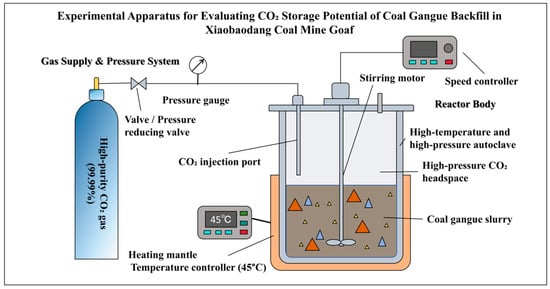
Targeting the deep in situ environment of the Xiaobaodang Coal Mine goaf, this study relied on a customized high-temperature and high-pressure reaction system (Figure 1) to conduct a simulated experiment of CO2 curing and sequestration in coal gangue slurry [1,2]. The core of the reaction system is composed of two interacting parts: a gas supply module and a reaction module. The gas supply module continuously provides carbon dioxide gas with a purity of up to 99.99%, and regulates the absolute gas injection pressure through precision pressure-reducing valves and pressure gauges to simulate a maximum formation burial confinement pressure condition of 10 MPa [4,5]. The exterior of the reactor body is fitted with a heating mantle equipped with a high-precision temperature controller. The constant temperature was set to 45 °C throughout the experiment, closely simulating the geothermal gradient characteristics of the target goaf [6,7]. During the gas–water–rock coupling reaction process, the pretreated coal gangue powder and deionized water were mixed at a solid-to-liquid mass ratio of 1:10 to prepare a homogeneous slurry and placed inside the reactor. The gas–water–rock coupling experiment was continuously run for 48 h to ensure the system reached a sufficient reaction state. During the reaction, a speed-adjustable stirring motor equipped at the top of the reactor continuously drove the impeller to rotate. This fluid dynamic disturbance greatly enhanced the dissolution and diffusion mass transfer efficiency from the high-pressure carbon dioxide gas phase at the top to the coal gangue slurry liquid phase at the bottom. This dynamic stirring mechanism not only broke the mass transfer resistance at the gas–liquid interface but also accelerated the process of achieving sufficient contact between the carbon dioxide fluid and the coal gangue mineral phase interfaces in a homogeneous system, thereby ensuring the thoroughness of phase evolution reactions such as carbonate dissolution and secondary mineral precipitation.
Figure 1.
Schematic diagram of the customized high-temperature and high-pressure dynamic reaction system for simulating CO2–water–rock interactions.
2.3. Material Composition Characterization and CO2 Adsorption Experiments
To quantify the mineral and structural evolution of coal gangue before and after the gas–water–rock coupling reaction and its impact on carbon sequestration potential, this study conducted a comprehensive characterization of the material composition and pore topological structure of the samples prior to the isothermal adsorption tests [19,20]. After the high-pressure reaction, the solid samples were separated from the slurry and dried in a vacuum oven at 80 °C for 24 h to remove residual moisture. This moderate drying temperature was strictly controlled to ensure no secondary thermal alteration or additional chemical reactions occurred prior to characterization. Total organic carbon (TOC) testing was conducted using an American LECO CS844 infrared carbon–sulfur analyzer (LECO Corporation, St. Joseph, MI, USA) to quantify the non-linear control effect of initial organic carbon content on the microscopic interface and gas adsorption behavior [22]. The evolution characteristics of inorganic mineral phases were accurately analyzed using a Bruker D8 Advance X-ray diffractometer (Bruker AXS, Karlsruhe, Germany) to investigate the dissolution and secondary reaction mechanisms of minerals such as quartz, carbonates, and silicates before and after the reaction [23,24]. Regarding pore structure characterization, after degassing pretreatment at 150 °C, the low-temperature nitrogen adsorption method was used to obtain isotherms, and the BJH geometric model was applied to invert the specific surface area and pore volume of mesopores (2 to 50 nm) to evaluate the changes in the physical connectivity of fluid mass transfer channels. By measuring discrete data of isothermal carbon dioxide adsorption amounts under different absolute pressure gradients, the ultimate CO2 adsorption capacity of each sample at the maximum test pressure point was directly extracted. The accurate acquisition of this macroscopic adsorption indicator provides the most reliable experimental data support for intuitively evaluating the multi-component synergistic carbon sequestration potential of the coal gangue system under the extreme enclosed environment of high temperature and high pressure.
3. Results
3.1. Material Composition Characteristics of Coal Gangue
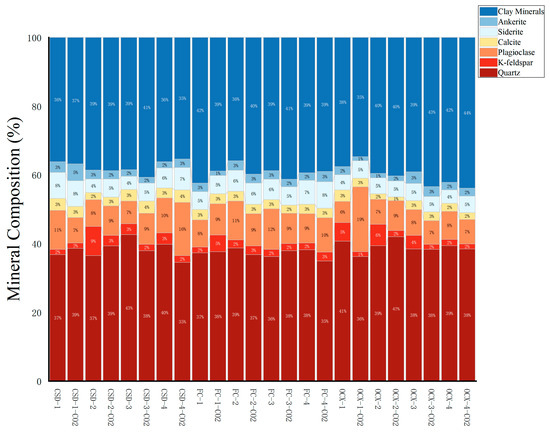
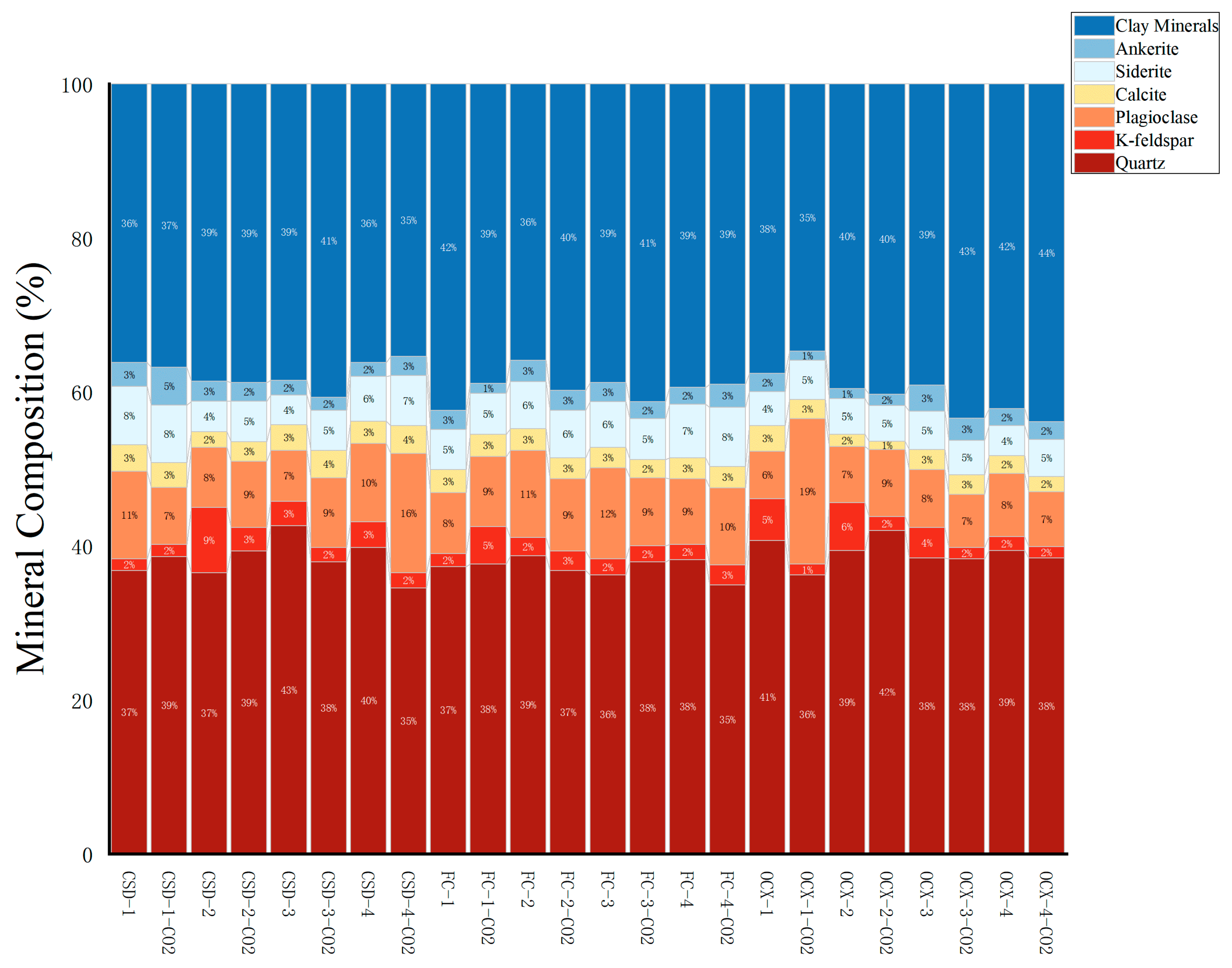
The macroscopic mineral composition of coal gangue from the Xiaobaodang Coal Mine goaf was studied using the accurate quantitative analysis of X-ray diffraction (XRD) patterns and stacked bar charts of material compositions (Figure 2). Various groups of coal gangue samples exhibited high consistency in mineral types, primarily composed of two major crystal chemical families: silicate minerals and carbonate minerals. By relative percentage, quartz and clay minerals constituted the absolute dominant mineral phases of this system (individual content ≥ 30%), and the sum of their percentages stably accounted for between 70% and 85% of the total rock mass, forming a solid thermodynamic physical framework and CO2 adsorption storage space for the coal gangue. Secondary mineral phases (1~15%) included plagioclase, siderite, K-feldspar, and calcite, while ankerite, as a trace mineral phase (≤5%), was only sporadically hosted within the matrix. This multi-mineral phase composite system, dominated by silicates and supplemented by carbonates, laid an abundant material foundation for the subsequent complex multi-phase interfacial carbonate mineralization and silicate mineralization reactions of CO2–water–rock.
Figure 2.
Evolution of macroscopic mineral compositions of different coal gangue samples before and after the CO2–water–rock interaction based on quantitative XRD analysis.
Controlled by the initial state and original provenance differences of the three series of samples, the three groups of samples exhibited significant inter-group differences in their initial mineral compositions. The OCX series samples possessed the most developed primary silicate framework, with an average quartz proportion as high as 39.6%, which was the highest proportion among the mineral compositions of the three series of samples, and the primary K-feldspar content was also relatively high. In contrast, the FC series samples exhibited the characteristics of being rich in clay minerals and iron-rich carbonates; their average clay mineral percentage was 39.1%, the siderite content was the highest among the three groups, and the quartz content was the weakest. The phase composition of the CSD series samples reflected certain mixed transitional characteristics, but the absolute abundance of calcite, a highly active carbonate phase, represented the highest proportion among the three series of samples. The different mineral compositions of these initial samples directly determined the differentiated reaction kinetics exhibited by the various series of samples when facing deep, high-pressure carbon dioxide fluids.
After the high-pressure carbon dioxide–water–rock coupling reaction under deep simulated conditions, obvious chemical reactions occurred in the mineral components within the system. As shown by the paired data comparison before and after the treatment in Figure 2, as the most stable silicate component in the system, the absolute content of quartz only fluctuated slightly before and after the reaction due to its stability. However, the highly reactive carbonate mineral phase underwent significant dissolution consumption; about 70% of the samples showed a clear downward trend in calcite content after treatment with carbon dioxide fluid (e.g., the calcite proportion of the OCX-2 sample attenuated from 1.6% to 1.1%), confirming the dissolution behavior of carbonate minerals in acidic environments. At the same time, the active silicate phase also underwent intense secondary alteration. K-feldspar in the OCX series samples reacted significantly (e.g., K-feldspar in OCX-1 sharply decreased from 5.4% to 1.4%), accompanied by drastic reorganization and fluctuation of the plagioclase component. Along with the reaction consumption of feldspar minerals, the relative percentage content of clay minerals in most samples showed an upward trend (e.g., OCX-4 increased from 42.2% to 43.9%). This crystal chemical evolution not only confirmed the geochemical change of silicate minerals transforming into secondary clay phases but also provided a more abundant micro–nano pore storage space for the subsequent adsorption of carbon dioxide molecules.
3.2. Pore Structure Characteristics
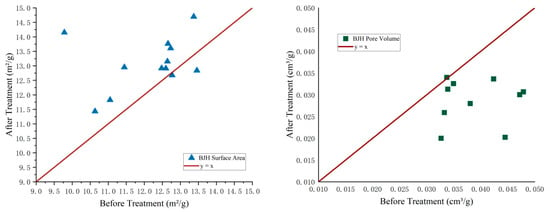
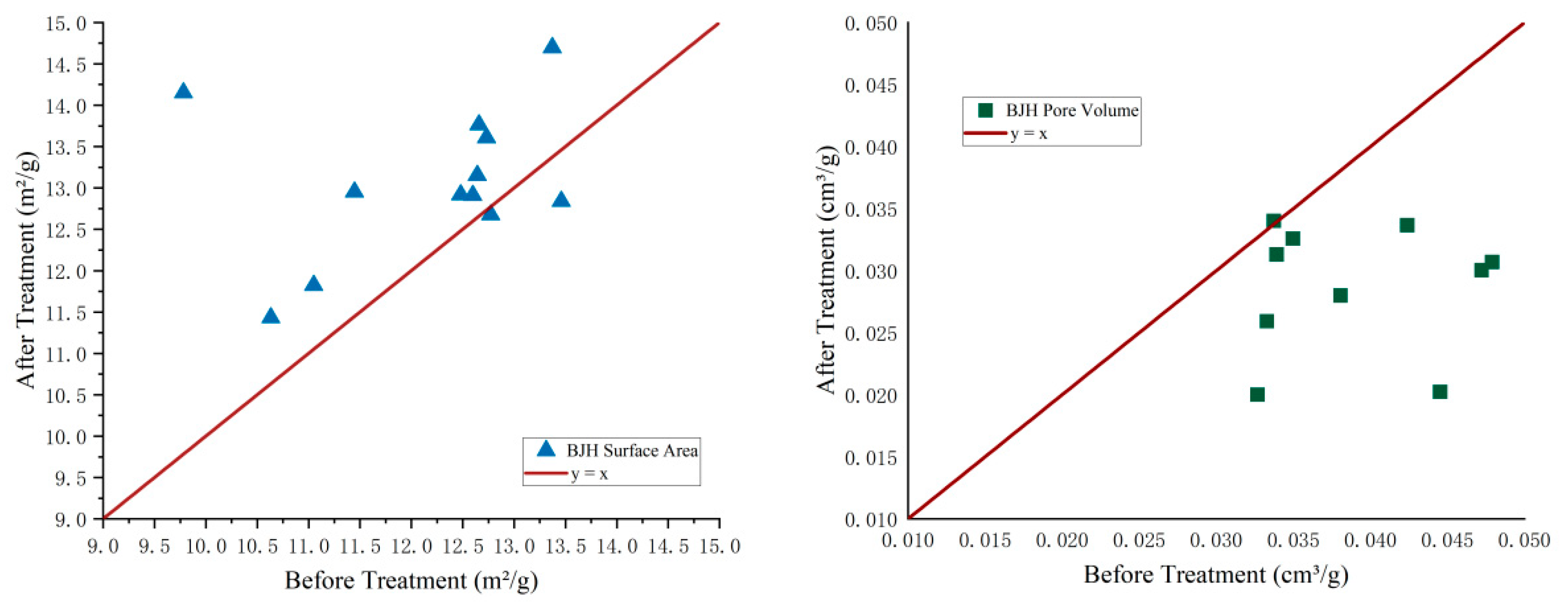
To deeply explore the physical modification effects of the carbon dioxide–water–rock reaction on the pore system of coal gangue, this study compared in detail the mesopore structural parameters before and after the reaction. Observing the scatter distribution characteristics in Figure 3, it can be seen that in the BJH specific surface area comparison plot (left), which represents the mesopore wall area, the vast majority of data points clearly fall above the y = x baseline. This indicates that after the high-pressure carbon dioxide fluid treatment, the mesopore specific surface area of coal gangue generally exhibits a significant expansion trend. The mineralization and dissolution effect of the acidic fluid effectively widened the internal pore network, providing more abundant interfacial space for the adsorption and free-state storage of carbon dioxide molecules. However, in the BJH pore volume scatter plot (right), the distribution of data points showed significant differentiation, with the pore volume of a considerable portion of the samples after treatment being paradoxically lower than the initial state (located below the baseline). This phenomenon of pore volume decreasing rather than increasing confirms the complexity of the mineralization reaction: during the dissolution of minerals (especially carbonates), detached fine mineral precipitates may migrate with the fluid and block some originally unblocked pore channels, or the in situ precipitation of newly formed secondary minerals may occupy the original larger pore volumes, thereby leading to the shrinkage of overall pore volume data.
Figure 3.
Scatter plots comparing the BJH mesopore surface area (left) and pore volume (right) of coal gangue samples before and after fluid treatment.
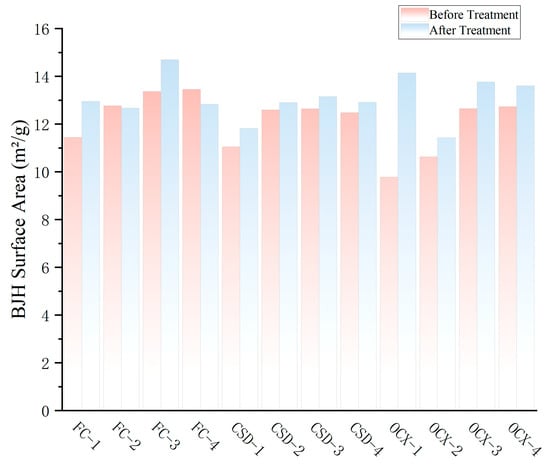
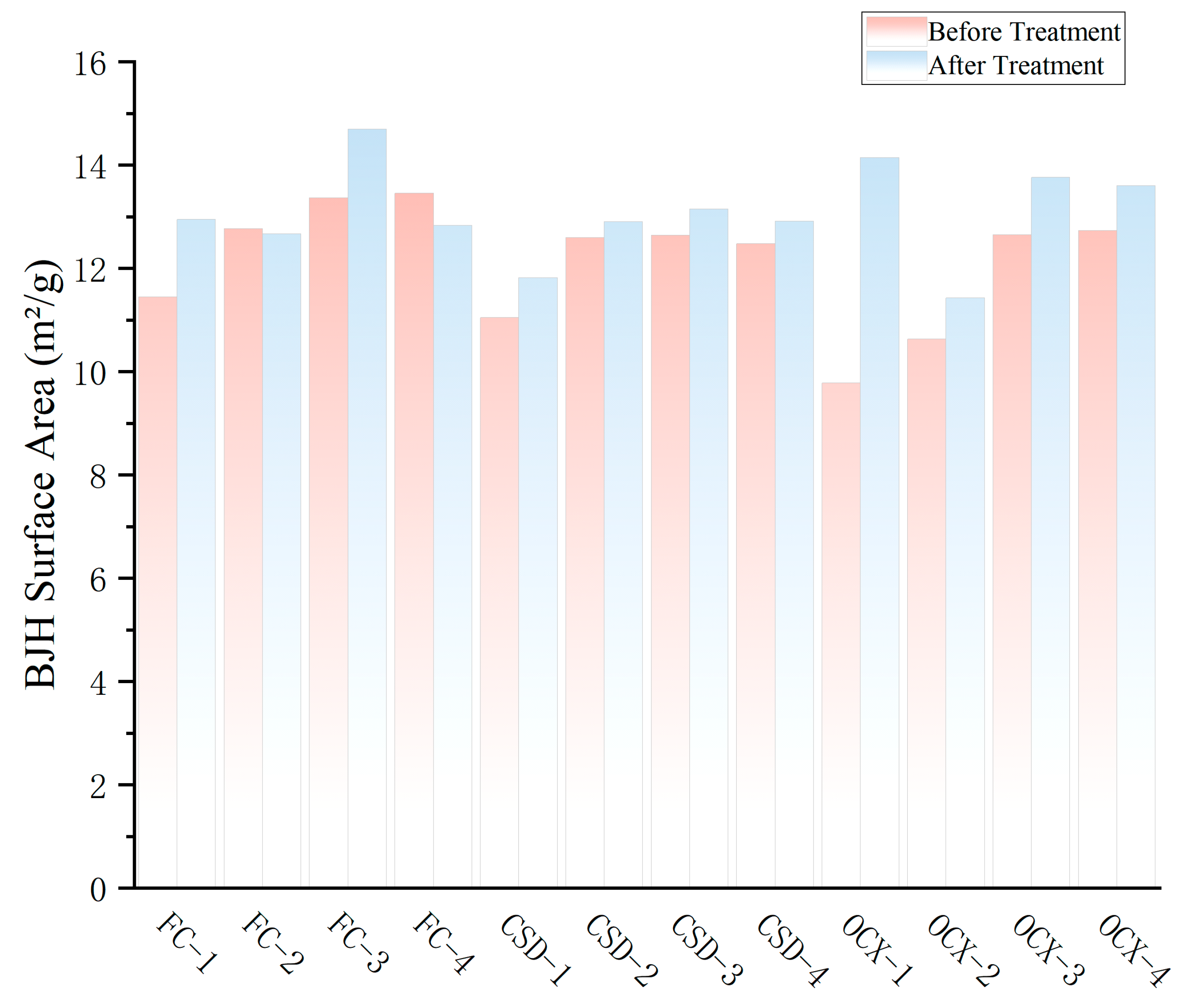
Further combining the bar chart in Figure 4 to analyze the specific performance of different series of samples, it can be seen that differences in initial mineral compositions directly determine the effectiveness of pore modification. Among them, the pore optimization effect of the OCX series samples was the most notable. After the reaction, the BJH specific surface area of all samples in this series achieved a significant increase (for example, the increment of the OCX-1 sample was extremely significant). This is primarily attributed to the fact that this series possessed the most developed primary silicate framework, which underwent an intense carbonation reaction in an acidic environment and massively transformed into secondary clay minerals. This process generated a large number of fine mesopores with excellent connectivity within the samples. The CSD series samples also demonstrated a stable and consistent surface area growth trend after treatment, reflecting the synergistic pore-expanding effect of its mixed mineral system during dissolution and secondary evolution. In contrast, the pore evolution of the FC series samples was relatively flat, and some samples (such as FC-2 and FC-4) even experienced a slight reduction in specific surface area. This is because the FC series itself is rich in clay minerals, and its primary pore framework is already very well developed. Under weakly acidic CO2-rich fluid interaction at 45 °C and 10 MPa, the reaction activity is limited, and it is difficult for the fluid to further create pores; minor physical disturbances may even cause partial closure of the primary pores.
Figure 4.
Variations in the BJH specific surface area across the FC, CSD, and OCX series samples before and after the reaction.
In summary, the modification of coal gangue pores by carbon dioxide–water–rock coupling effects exhibits significant differentiated characteristics. For coal gangue with relatively closed primary pores and high silicate content (such as the OCX series), the mineralization reaction can play a critical role in expanding the volume and changing the pore structure, greatly improving mesopore connectivity and increasing adsorption sites, thereby effectively reducing the resistance to the inward diffusion of greenhouse gases. For samples whose primary pores are already very mature, the fluid treatment is more reflected as a dynamic fine-tuning of the micro-structure. This pore evolution law dominated by mineral composition provides direct proof for studying the impact of a series of characteristics on CO2 adsorption capacity.
3.3. Macroscopic Response of CO2 Adsorption Performance Under Gas–Water–Rock Coupling Effects
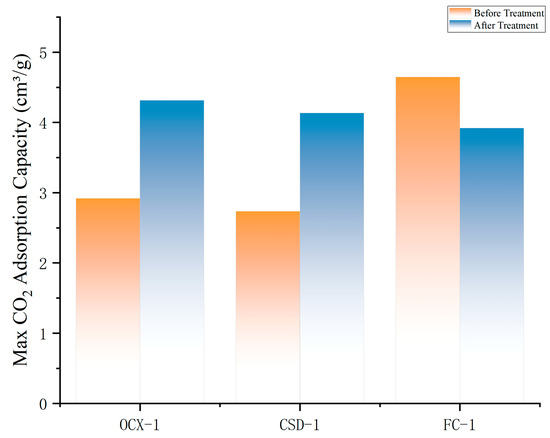
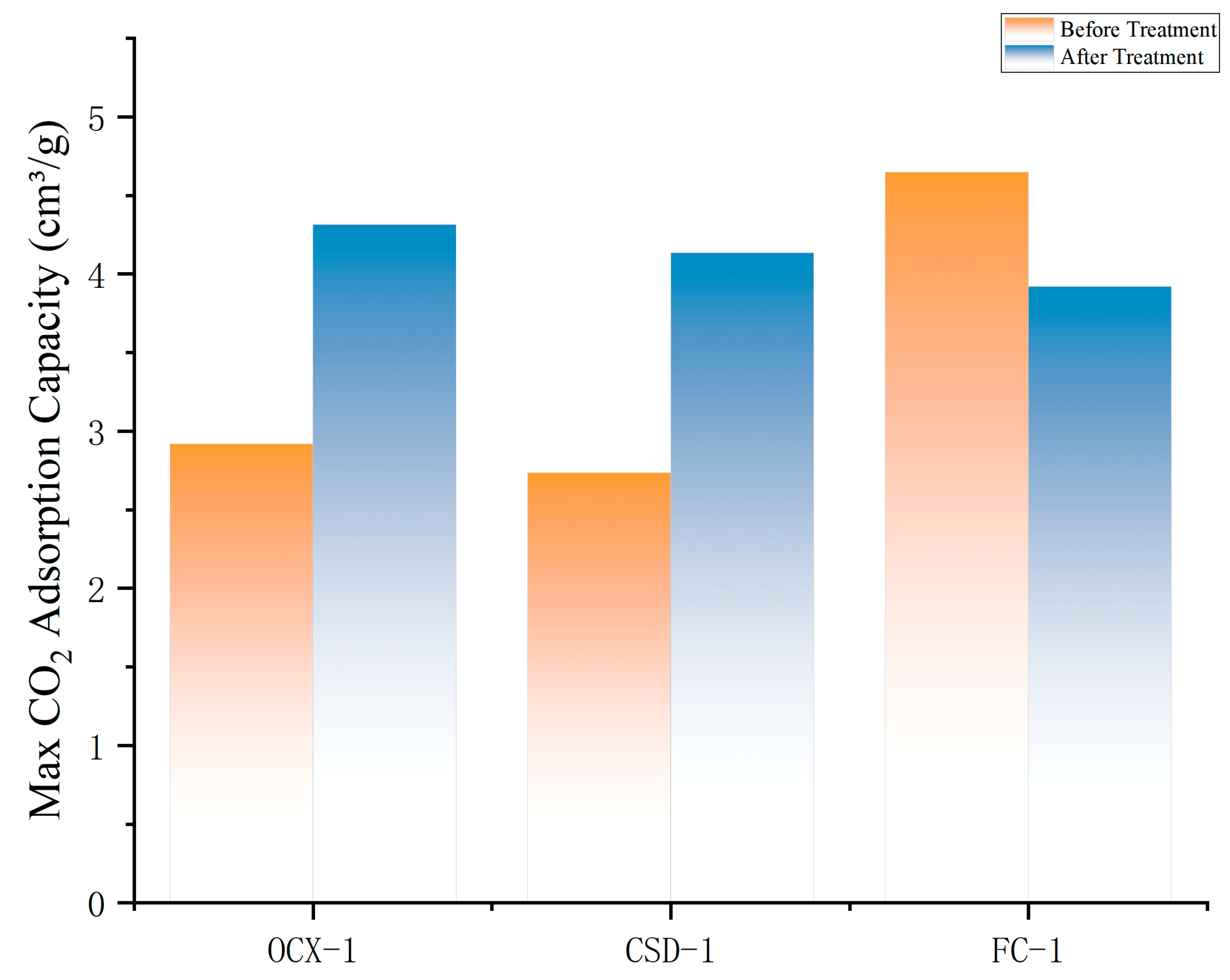
To intuitively evaluate the actual carbon sequestration potential of coal gangue with different mineral compositions in deep geological environments, this section extracted and compared the ultimate CO2 adsorption capacities of representative samples from each series at the maximum test pressure point (as shown in Figure 5). The experimental results indicate that the modification effect of the gas–water–rock reaction on the adsorption potential presents an extremely strong mineral composition differentiation. Among them, the OCX series initially rich in active silicates such as feldspar (e.g., OCX-1) achieved a significant enhancement in adsorption performance after the reaction, with the most notable increase in adsorption capacity. Combined with the aforementioned mineral phase evolution laws, this is mainly attributed to the fact that the intense silicate alteration reaction not only broke the structure of the primary dense pores but was also accompanied by the generation of a large amount of secondary clay minerals, providing massive newly formed high-energy adsorption sites for CO2 molecules at the solid–gas interface.
Figure 5.
Comparison of the maximum CO2 adsorption capacity for representative coal gangue samples (OCX-1, CSD-1, and FC-1) before and after the reaction.
In contrast, the CSD series characterized by calcite (e.g., CSD-1) primarily widened the mass transfer channels through the dissolution and pore expansion of carbonates, achieving stable and substantial growth in adsorption capacity. Meanwhile, for the FC series with an extremely high abundance of primary clay minerals (e.g., FC-1), its maximum adsorption capacity after the reaction decreased instead of increasing. This is not only because its inorganic framework exhibited strong chemical inertness in the weakly acidic fluid and failed to produce pore structure changes, but also because fluid action caused detachment and secondary precipitation of some fine mineral particles, clogging the originally well-developed primary micropore channels and resulting in an irreversible loss of effective adsorption space. The inter-group differentiation of this macroscopic adsorption law is highly coupled with the chemical evolution of microscopic mineral compositions, fully proving that the CO2 sequestration potential of coal gangue is not static physical space filling but is controlled by the complex geochemical processes of the dynamic evolution of fluid–mineral phase interfaces. This adsorption behavior dominated by inorganic mineral differences also establishes a solid foundation for further exploring the non-linear synergistic carbon-sequestration mechanism of residual organic carbon (TOC) within the system.
4. Discussion
4.1. Control Effect of TOC on Micropore Development and Adsorption in Coal Gangue
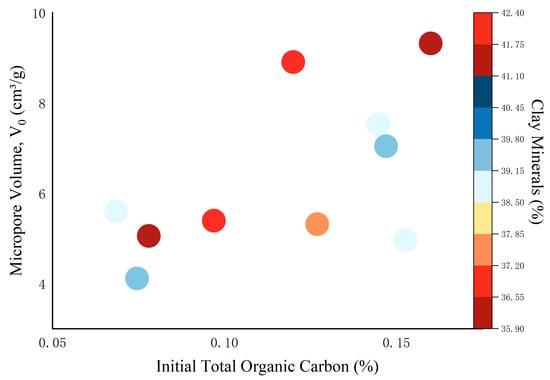
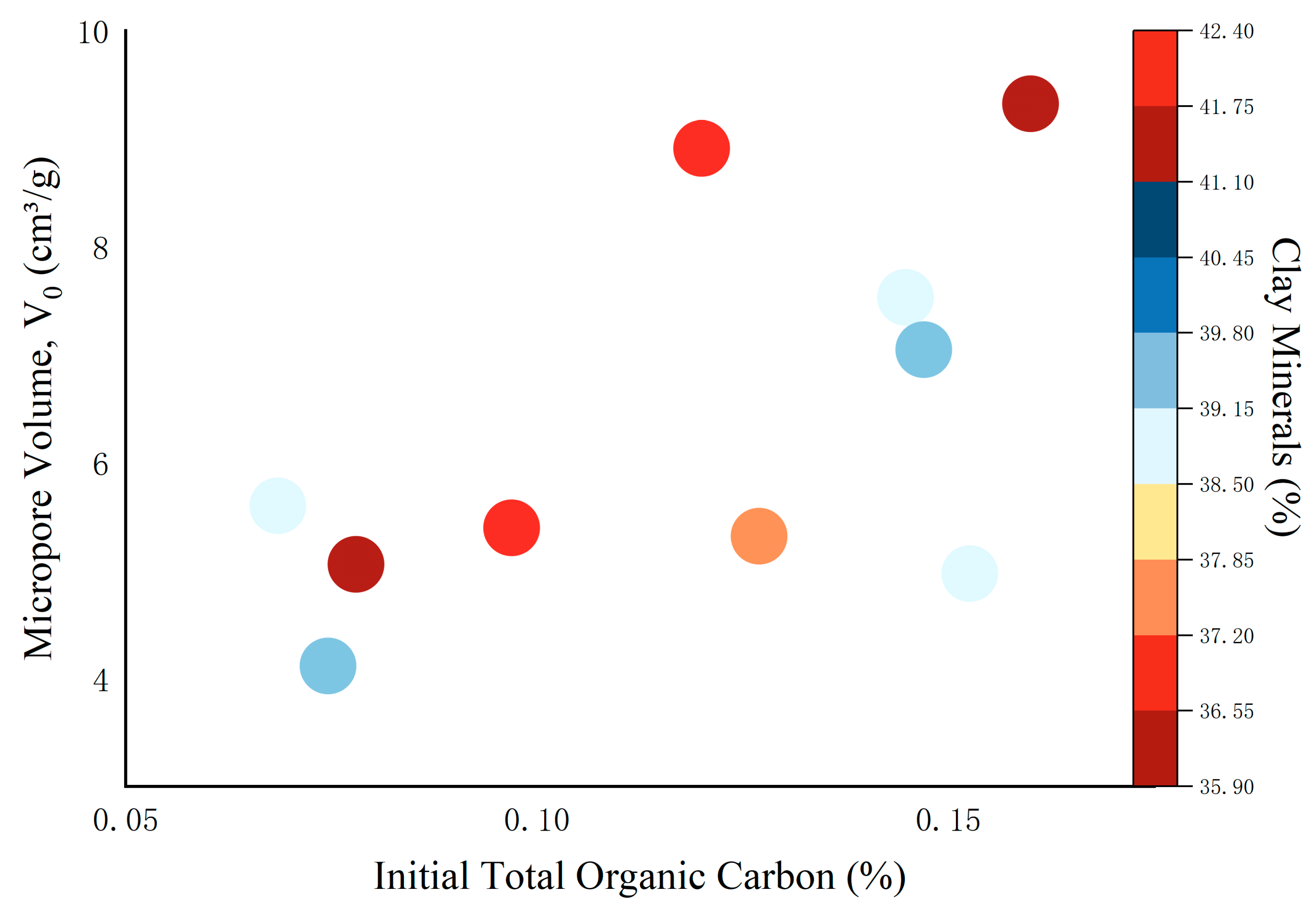
To deeply explore the control effect of residual organic carbon (TOC) within the coal gangue system on micropore reconstruction and carbon sequestration potential, this study cross-mapped the initial organic carbon mass fraction of different samples with the theoretical ultimate micropore volume () to construct a 2D bubble scatter plot (Figure 6). From the data distribution on the horizontal and vertical axes in the figure, it can be intuitively observed that there is a significant non-linear correlation between the ultimate micropore volume and the initial organic carbon content. When the organic carbon content is at a low level (less than 0.10%), the micropore volume of the samples is generally restricted, with its values basically clustering in the low range of 4.0 to 6.0 cm3/g. This indicates that in an environment lacking sufficient organic carbon components, the physicochemical modification of inorganic minerals by the fluid struggles to stimulate a large-scale secondary micropore network. With the increase in initial organic carbon content in the system (between 0.12% and 0.16%), the upper limit of the micropore volume is greatly expanded, and the of some samples even breaks through 9.0 cm3/g. During the reaction process, a moderate amount of organic carbon can not only physically block the dense consolidation of inorganic mineral particles, but its surface-rich polar micro-domains also provide advantageous sites for the occurrence of carbon dioxide molecules. However, it is worth noting that in the high organic carbon range (e.g., around 0.14% to 0.16%), the data points exhibit a huge dispersion vertically (the span of jumps from 5.0 to over 9.0 cm3/g). This wide-amplitude fluctuation phenomenon profoundly reveals that although the increase in organic carbon content provides the thermodynamic and kinetic potential space for the explosion of micropore volume, it is not the sole controlling factor determining the adsorption capacity; mere organic carbon enrichment is insufficient to ensure the formation of an efficient carbon-sequestration structure.
Figure 6.
2D bubble scatter plot illustrating the non-linear synergistic effects of initial total organic carbon (TOC) and clay mineral content on the ultimate micropore volume ().
4.2. Synergistic Enhancement Mechanism of Clay Minerals and TOC
To further explain the deeper mechanism causing the huge dispersion of micropore volumes in the high organic carbon range, this study introduced clay mineral content as a third-dimensional color mapping in the scatter plot (Figure 6). Through the cross-coupling analysis of multidimensional data, the non-linear synergistic enhancement mechanism between clay minerals and organic carbon (TOC) during micropore development can be clearly identified. The data points with the most notable performance on the vertical axis ( greater than 8.5 cm3/g) are not only concentrated in the higher organic carbon range, but their color mappings also accurately fall into the dark red high-value area at the top of the scale (i.e., clay mineral percentage greater than 41%). In contrast, under a similar high organic carbon background (e.g., TOC around 0.15%), samples whose clay mineral contents are at a medium-to-low level (about 38% to 40%, corresponding to the light blue and white bubbles in the figure) have their ultimate micropore volumes strictly limited to a medium-to-low plateau of 5.0 to 7.5 cm3/g. This distinctly different distribution pattern conclusively proves that the construction of an efficient carbon sequestration network in coal gangue is highly dependent on the coupling mechanism of inorganic minerals and organic carbon. Relying on its natural layered silicate structure, the high relative content of clay minerals provides a massive amount of primary nano-scale interlayer pores for the system, constituting the physical structure of the adsorption space. Meanwhile, moderately enriched organic carbon is embedded between layers or on mineral surfaces; on the one hand, it prevents the softening and collapse of layered minerals during high-temperature and high-pressure water–rock reactions through steric hindrance effects, and on the other hand, it enhances the microscopic adsorption ability for carbon dioxide molecules through interfacial modification. Conversely, lacking a sufficient clay inorganic framework as a support, mere organic carbon accumulation is highly prone to evolving into pore channel blockages under fluid erosion, unable to achieve a leap in adsorption capacity. Therefore, the exquisite physicochemical synergy between high contents of clay minerals and moderate organic carbon is the core geological reason for stimulating the ultimate carbon sequestration potential of coal gangue.
4.3. Control Mechanism of Mineralization Reactions on CO2 Adsorption Potential of Coal Gangue
The carbon sequestration potential of coal gangue in deep enclosed environments is essentially the macroscopic adsorption response of the dynamic balance among mineral phase dissolution, reaction, and precipitation under gas–water–rock coupling effects. Combined with the aforementioned isothermal adsorption and mineral composition evolution laws, the geochemical reaction pathways of different active minerals produce entirely different microscopic regulatory effects on the adsorption and capture ability for carbon dioxide molecules. For the OCX series initially rich in active silicates such as feldspar, intense carbonation dissolution reactions occurred in the weakly acidic CO2 fluid. This reaction prompted the dense silicate framework to change and massively transform into secondary clay minerals with layered structures (such as kaolinite). This chemical reconstruction process generated a vast number of secondary micro–nano pores within the coal gangue. These newly generated pores not only fundamentally expanded the theoretical micropore volume but also provided carbon dioxide molecules with dense microscopic physical adsorption and surface binding sites, thereby resulting in a significant enhancement in the absolute adsorption capacity of this series of samples after the reaction.
In contrast, the CSD series, represented by calcite as the characteristic mineral, followed another adsorption enhancement pathway. Highly reactive carbonate minerals are extremely prone to rapid dissolution in acidic fluids, generating soluble bicarbonates that migrate locally with the fluid. Although this selective dissolution effect is not as drastic as silicate alteration in terms of the number of newly generated micropores, it effectively destroyed the surface integrity of primary mineral particles and widened the originally narrow and blocked mesopore mass transfer channels. The opening of pore throats significantly reduced the mass transfer spatial blockage for non-polar carbon dioxide gas molecules diffusing toward the deep micropore network of the minerals, activating a large number of deep primary adsorption sites that were originally in a semi-closed state, which then macroscopically manifested in adsorption thermodynamics as a stable and substantial growth in adsorption capacity.
However, this adsorption expansion effect based on fluid erosion is not applicable to all samples. For the FC series with an extremely high relative content of primary clay minerals, because its inorganic framework lacks sufficient highly active reactive phases, fluid movement and weak chemical reactions not only failed to produce effective pore-creating effects but also conversely destroyed the local structural stability of the minerals. Under the dual action of reaction and movement, detached fine mineral particles and trace secondary precipitates are highly prone to precipitation during fluid transport, thereby firmly blocking critical pore throat nodes. This microscopic physical clogging effect directly cut off the diffusion paths for carbon dioxide molecules to enter deep micropores, causing a large amount of originally effective adsorption space to be forced into isolation, ultimately manifesting macroscopically as an irreversible attenuation of isothermal adsorption capacity. The profound differentiation of this inter-group mechanism indicates that the type and evolutionary depth of mineralization reactions at the gas–water–rock interface constitute the fundamental driving force determining the increase or decrease in adsorption performance of the coal gangue system after gas injection.
4.4. Limitations and Future Perspectives
While this study provides valuable quantitative insights into the mineral-dependent CO2 adsorption behavior of coal gangue, several limitations must be acknowledged. First, the proposed mechanisms regarding secondary clay mineral formation and physical pore-throat clogging are primarily inferred from macroscopic pore structure analysis and XRD bulk composition changes. Direct microstructural imaging evidence, such as in situ Scanning Electron Microscopy (SEM), is currently lacking and will be necessary in future studies. Second, the batch-reactor experiments were conducted for a fixed duration (48 h) without time-resolved sampling, limiting the extraction of precise kinetic data. Third, the complex dissolution–precipitation pathways were not validated through geochemical modeling (e.g., PHREEQC). Finally, translating these laboratory-scale slurry experiments to field-scale goaf CO2 sequestration engineering involves highly coupled hydro–mechanical–chemical processes. Future research will focus on integrating kinetic sampling, thermodynamic simulations, and large-scale core-flooding experiments.
5. Conclusions
This study systematically investigated the multiphase geochemical evolution of coal gangue under simulated deep goaf conditions (45 °C, 10 MPa) and its control over CO2 adsorption capacity. The main conclusions are as follows:
- Mineral-dependent pore reconstruction dictates adsorption capacity: The gas–water–rock interaction strongly depends on the initial mineral phase. Active silicate-rich systems enhance absolute adsorption capacity through massive secondary clay mineral generation via carbonation. Carbonate-rich systems improve adsorption by dissolving minerals and widening mass transfer channels. Conversely, systems dominated by primary clay minerals experience an irreversible reduction in effective adsorption space due to physical pore-throat clogging by migrating fine particles.
- Non-linear regulation of micropore volume by TOC: The initial organic carbon content exhibits a significant non-linear relationship with ultimate micropore development. At low TOC levels (<0.10%), micropore generation is severely restricted. Moderate TOC enrichment (0.12–0.16%) drastically expands the micropore volume upper limit, demonstrating that while organic carbon provides essential thermodynamic potential, it must be coupled with an appropriate inorganic framework to maximize efficiency.
- Synergistic mechanism and engineering implications: The core driver of maximizing coal gangue’s carbon sequestration capacity relies on the physicochemical synergy between high clay mineral content and optimal organic carbon. Based on these findings, we propose a quantitative material selection criterion for deep goaf CO2 sequestration projects: coal gangue with a native clay mineral content exceeding 41% and a moderate TOC content of 0.12–0.16% should be prioritized as the optimal backfill material. This specific configuration effectively prevents pore clogging while maximizing structural support and interfacial binding sites, achieving a robust ultimate micropore volume (micropore volume greater than 8.5 cm3/g)for long-term carbon sinks.
Author Contributions
Conceptualization, B.G., X.G., S.Z. and Z.W.; Methodology, B.G., D.F., D.H., X.G., S.Z. and Z.W.; Software, B.G., D.F., D.H., S.Z. and Z.W.; Validation, D.F., K.Z. and S.Z.; Formal analysis, K.Z.; Data curation, D.H. and X.G.; Writing—original draft, B.G. All authors have read and agreed to the published version of the manuscript.
Funding
This research was funded by the Shaanxi Provincial Key Research and Development Program (grant number 2025SF-YBXM-516), Shaanxi Coalfield Geology Group Co., Ltd. “Challenge-Based R&D” Project (SMDZ-2025ZD-13).
Data Availability Statement
The original contributions presented in this study are included in the article. Further inquiries can be directed to the corresponding author.
Conflicts of Interest
Authors B.G., D.F., X.G. and S.Z. were employed by Shaanxi Tiandi Geology Co., Ltd. Authors D.F., K.Z. and D.H. were employed by Shaanxi Coal Geology Group Co., Ltd. The remaining authors declare that the research was conducted in the absence of any commercial or financial relationships that could be construed as a potential conflict of interest. The authors declare that this study received funding from Shaanxi Coalfield Geology Group Co., Ltd. The funder had no role in the design of the study; in the collection, analyses, or interpretation of data; in the writing of the manuscript; or in the decision to publish the results.
References
- Bachu, S. CO2 storage in geological media: Role, means, status and barriers to deployment. Prog. Energy Combust. Sci. 2008, 34, 254–273. [Google Scholar] [CrossRef] [Scilit]
- Zhang, L.; Zhang, T.; Zhao, Y.; Hu, H.; Wen, S.; Wu, J.; Cao, C.; Wang, Y.; Fan, Y. A review of interaction mechanisms and microscopic simulation methods for CO2-water-rock system. Pet. Explor. Dev. 2024, 51, 223–238. [Google Scholar] [CrossRef] [Scilit]
- Abdolhosseini Qomi, M.J.; Miller, Q.R.S.; Zare, S.; Schaef, H.T.; Kaszuba, J.P.; Rosso, K.M. Molecular-scale mechanisms of CO2 mineralization in nanoscale interfacial water films. Nat. Rev. Chem. 2022, 6, 598–613. [Google Scholar] [CrossRef] [Scilit] [PubMed]
- Zuo, Q.; Zhang, Y.; Zhang, M.; Ju, B.; Ning, W.; Deng, X.; Yang, L.; Pang, C. Numerical Simulation of CO2 Dissolution and Mineralization Storage Considering CO2-Water-Rock Reaction in Aquifers. ACS Omega 2024, 9, 45983–45995. [Google Scholar] [CrossRef] [Scilit] [PubMed]
- Rathnaweera, T.D.; Ranjith, P.G.; Perera, M.S.A. Experimental investigation of geochemical and permeability behaviour of CO2-rich brine in reservoir rock. J. Pet. Sci. Eng. 2016, 146, 634–644. [Google Scholar] [CrossRef] [Scilit]
- Gislason, S.R.; Wolff-Boenisch, D.; Stefansson, A.; Oelkers, E.H.; Gunnlaugsson, E.; Sigurdardottir, H.; Sigfusson, B.; Broecker, W.S.; Matter, J.M.; Stute, M. Mineral sequestration of carbon dioxide in basalt: A pre-injection overview of the CarbFix project. Int. J. Greenh. Gas. Control 2010, 4, 537–545. [Google Scholar] [CrossRef] [Scilit]
- Matter, J.M.; Stute, M.; Snæbjörnsdottir, S.Ó.; Oelkers, E.H.; Gislason, S.R.; Aradottir, E.S.; Sigfusson, B.; Gunnarsson, I.; Sigurdardottir, H.; Gunnlaugsson, E.; et al. Rapid carbon mineralization for permanent disposal of anthropogenic carbon dioxide emissions. Science 2016, 352, 1312–1314. [Google Scholar] [CrossRef] [Scilit] [PubMed]
- Bui, M.; Adjiman, C.S.; Bardow, A.; Anthony, E.J.; Boston, A.; Brown, S.; Fennell, P.S.; Fuss, S.; Galindo, A.; Hackett, L.A.; et al. Carbon capture and storage (CCS): The way forward. Energy Environ. Sci. 2018, 11, 1062–1176. [Google Scholar] [CrossRef] [Scilit]
- Hou, Z.; Bacon, D.H.; Engel, D.W.; Lin, G.; Fang, Y.; Ren, H.; Fang, Z. Uncertainty analyses of CO2 plume expansion subsequent to wellbore CO2 leakage into aquifers. Int. J. Greenh. Gas. Control. 2014, 27, 69–80. [Google Scholar] [CrossRef] [Scilit]
- Chen, Q.; Zhu, L.; Wang, Y.; Chen, J.; Qi, C. The carbon uptake and mechanical property of cemented paste backfill carbonation curing for low concentration of CO2. Sci. Total Environ. 2022, 852, 158516. [Google Scholar] [CrossRef] [Scilit] [PubMed]
- Dou, G.; Zhang, T.; Liu, G.; Wang, J. Alkali-activated CO2-capturing backfill material for coal mining incorporating municipal solid waste incinerated bottom ash. ACS Omega 2025, 10, 26776–26790. [Google Scholar] [CrossRef] [Scilit] [PubMed]
- Gao, L.; Liu, Y.; Xu, K.; Bai, L.; Guo, N.; Li, S. A short review of the sustainable utilization of coal gangue in environmental applications. RSC Adv. 2024, 14, 39285–39296. [Google Scholar] [CrossRef] [Scilit] [PubMed]
- Chen, Y.; Chen, Y.; Xu, H.; Zhao, W.; Feng, G.; Xiao, C. Green Synthesis of Coal Gangue-Derived NaX Zeolite for Enhanced Adsorption of Cu2+ and CO2. Materials 2025, 18, 1443. [Google Scholar] [CrossRef] [Scilit] [PubMed]
- Liu, C.; Rao, F.; Guo, Y.; Lu, Z.; Deng, W.; Li, G.; Zhang, H.; Qi, T.; Hu, G. CO2 capture using low silica X zeolite synthesized from low-grade coal gangue via a two-step activation method. J. Environ. Chem. Eng. 2024, 12, 112074. [Google Scholar] [CrossRef] [Scilit]
- Fan, W.; Chen, Y.; Zhang, R.; Chen, X.; Li, J.; Gu, Z.; Wang, J. Impacts of Thermal Activation on Physical Properties of Coal Gangue: Integration of Microstructural and Leaching Data. Buildings 2025, 15, 159. [Google Scholar] [CrossRef] [Scilit]
- Yi, D.; Du, H.; Li, Y.; Gao, Y.; Liu, S.; Xu, B.; Huang, H.; Kang, L. Study on green controllable preparation of coal gangue-based 13-X molecular sieves and its CO2 capture application. Coatings 2023, 13, 1886. [Google Scholar] [CrossRef] [Scilit]
- Zang, X.; Zhang, L.; Zhu, D.; Li, Z.; Li, T.; Ren, Y.; Nehdi, M.L. Effects of CO2 curing on hydration behavior, strength development, and microstructural evolution of coal gangue-based cementitious materials. Mater. Rep. Solid Waste Ecomater. 2026, 2, 9520024. [Google Scholar] [CrossRef] [Scilit]
- Cao, C.; Li, Y.; Zhao, Y.; Wen, S.; Tian, Y.; Zhang, L.; Li, Q.; Zhou, S.; Zhang, D.; Liu, L.; et al. The mechanism of wettability changes of carbonate rocks under supercritical CO2-water-rock interaction: Implications for CO2-enhanced gas recovery and geo-sequestration. J. CO2 Util. 2025, 102, 103252. [Google Scholar] [CrossRef] [Scilit]
- Hu, X.; Deng, H.; Lu, C.; Tian, Y.; Jin, Z. Characterization of CO2/CH4 Competitive Adsorption in Various Clay Minerals in Relation to Shale Gas Recovery from Molecular Simulation. Energy Fuels 2019, 33, 8202–8214. [Google Scholar] [CrossRef] [Scilit]
- Rani, S.; Padmanabhan, E.; Prusty, B.K. Review of gas adsorption in shales for enhanced methane recovery and CO2 storage. J. Pet. Sci. Eng. 2019, 175, 634–643. [Google Scholar] [CrossRef] [Scilit]
- Xie, W.; Chen, S.; Vandeginste, V.; Yu, Z.; Wang, H.; Wang, M. Review of the effect of diagenetic evolution of shale reservoir on the pore structure and adsorption capacity of clay minerals. Energy Fuels 2022, 36, 4728–4745. [Google Scholar] [CrossRef] [Scilit]
- Li, X.; Kang, D.; Li, Z.; Zhou, N.; Chen, Q. Effects of Steel Slag and Ethylenediaminetetraacetic Acid (EDTA) on Enhancing the CO2 Sequestration Performance of Gangue-Based Cemented Backfill Materials. Materials 2025, 18, 4852. [Google Scholar] [CrossRef] [Scilit] [PubMed]
- Johannesson, B.; Utgenannt, P. Microstructural investigations of carbonated cement paste. Cem. Concr. Res. 2001, 31, 925–927. [Google Scholar] [CrossRef] [Scilit]
- Min, Y.; Jun, Y.S. Wollastonite carbonation in water-bearing supercritical CO2: Effects of water saturation conditions, temperature, and pressure. Chem. Geol. 2018, 483, 239–246. [Google Scholar] [CrossRef] [Scilit]
- Kelemen, P.B.; Matter, J.; Streit, E.E.; Rudge, J.F.; Curry, W.B.; Blusztajn, J. Rates and mechanisms of mineral carbonation in peridotite: Natural processes and recipes for enhanced, in situ CO2 capture and storage. Annu. Rev. Earth Planet. Sci. 2011, 39, 545–576. [Google Scholar] [CrossRef] [Scilit]
- Bearat, H.; McKelvy, M.J.; Chizmeshya, A.V.G.; Gormley, D.; Nunez, R.; Carpenter, R.W.; Squires, K.; Wolf, G.H. Carbon sequestration via aqueous olivine mineral carbonation: Role of passivating layer formation. Environ. Sci. Technol. 2006, 40, 4802–4808. [Google Scholar] [CrossRef] [Scilit] [PubMed]
- Wu, J.; Yan, X.; Li, L.; Gu, J.; Zhang, T.; Tian, L.; Su, X.; Lin, Z. High-efficiency adsorption of Cr(VI) and RhB by hierarchical porous carbon prepared from coal gangue. Chemosphere 2021, 275, 130008. [Google Scholar] [CrossRef] [Scilit] [PubMed]
- Zhang, Q.; Zhang, X.; Wang, L.; Zhang, S. Synthesis, characterization, and cementitious activity of the magnesium silicate hydrate and calcium silicate hydrate from coal gangue. Molecules 2025, 30, 1725. [Google Scholar] [CrossRef] [Scilit] [PubMed]
- Guo, J.; Wu, H.; Wei, Y.; Miao, Y.; Qu, J.; Wang, P. Synthesis of a high-iron fly-ash-based Na-X molecular sieve and its application in the adsorption of low concentration of CO2. RSC Adv. 2024, 14, 1686–1696. [Google Scholar] [CrossRef] [Scilit] [PubMed]
- Seo, S.; Lages, B.; Kim, M. Catalytic CO2 absorption in an amine solvent using nickel nanoparticles for post-combustion carbon capture. J. CO2 Util. 2020, 36, 244–252. [Google Scholar] [CrossRef] [Scilit]
- Dumitrache, L.; Suditu, S.; Branoiu, G.; Neagu, D.; Alecu, M.D. Carbon Management and Storage for Oltenia: Tackling Romania’s Decarbonization Goals. Sustainability 2025, 17, 6793. [Google Scholar] [CrossRef] [Scilit]
- Zarrouk, S.J.; Moon, H. Efficiency of geothermal power plants: A worldwide review. Geothermics 2014, 51, 142–153. [Google Scholar] [CrossRef] [Scilit]
Disclaimer/Publisher’s Note: The statements, opinions and data contained in all publications are solely those of the individual author(s) and contributor(s) and not of MDPI and/or the editor(s). MDPI and/or the editor(s) disclaim responsibility for any injury to people or property resulting from any ideas, methods, instructions or products referred to in the content. |
© 2026 by the authors. Licensee MDPI, Basel, Switzerland. This article is an open access article distributed under the terms and conditions of the Creative Commons Attribution (CC BY) license.