


Abstract
In response to the challenges of deep peak shaving of coal-fired power plants and co-firing with combustible gases for achieving carbon neutrality and peaking emissions, this paper synthesizes combustion and ignition models for pulverized coal, with particular emphasis on volatilization analysis, gas-phase combustion, solid-phase combustion, and NOx formation mechanisms. It reviews studies on the combustion behaviors of pulverized coal when co-firing with gases such as CH4, H2, and NH3, as well as the application of typical co-firing gases in pulverized coal furnaces. The ignition process hinges on whether the concentration of released combustible gases reaches the combustion range and ignition temperature, necessitating detailed volatilization analysis models and simplified gas-phase reaction models. Co-firing enhances combustion stability by facilitating gas ignition and sustained combustion, while pulverized coal achieves extended burning duration. Fuel-type NOx serves as a critical factor in ensuring the reliability of NOx numerical simulations and should be integrated with carbon combustion models.
1. Introduction
Due to China’s resource endowment characterized by abundant coal, insufficient oil, and scarce natural gas, coal has long maintained a dominant position in China. China announced its goals of carbon peak and carbon neutrality, with the targets of reaching the peak of carbon emissions by 2030 and achieving carbon neutrality by 2060 [1]. Accordingly, rapid development has been achieved in China for renewable energy technologies like wind power and photovoltaic generation. That said, their built-in intermittency and fluctuating nature create difficulties for ensuring the stability and reliability of the power system [2]. Power-generating units must strengthen their flexible peak shaving capability to optimize energy resource allocation, reduce power grid fluctuations, and minimize the curtailment of wind and photovoltaic power [3]. Flexible peak shaving refers to meeting the power grid load demand by adjusting unit output. Power generating units must enhance their capabilities of rapid start-up, rapid response to load changes, and low-load operation [4].
Historically, coal-fired power plants have served as the primary energy source in China. As the core component of the unit, the boiler exhibits pronounced thermal inertia attributed to heat transfer delay during the flexible peak-shaving process [5]. To meet the dynamic requirements of the peak-shaving process, it is necessary to timely adjust the boiler feedwater flow, pulverized coal supply, and supporting air supply [6]. Thus, the primary constraint in enhancing the flexible peak shaving capacity of coal-fired power units is represented by boilers. Technical difficulties in flexible peak shaving of boilers encompass: combustion stability under low-load operating conditions [7], energy supply capacity [5], coordination between the boiler and its auxiliary system [8,9], safety protection of heating surfaces [10,11], adaptability of the control system [9,12], coal consumption [13], and pollutant emission control [14]. Operating under low-load and ultra-low load conditions poses a serious threat to the safety and operational efficiency of coal-fired power-generating units. The typical problem is that when the unit load significantly deviates from the design operating conditions, the reduced coal and air supply lead to a mismatch in the rated capacity between the boiler and the burner, and at this point, key operating parameters such as the fuel/air ratio become ambiguous.
To enhance the stability of combustion for pulverized coal jets during low load operation, researchers have proposed various optimization schemes, including adjusting coal quality characteristics, improving burner structures, and optimizing air/oxygen supply. From a basic theoretical standpoint, flame stability in pulverized coal jets mainly depends on the dynamic equilibrium between chemical reactions and turbulent mixing. Classic research has shown that the flow recirculation zone plays a crucial role in transporting high-temperature products to the flame front anchoring position [15,16]. In addition, the turbulent eddy dissipation rate generally governs the combustion rate, which requires a strongly reactive and sufficient mixing environment [17,18]. Nevertheless, the mature flame stabilization mechanisms depend heavily on the elevated momentum and intense turbulence characteristics under high-load operating conditions. In the absence of these conditions, there is currently a lack of a clear explanation for how the flame maintains the combustion state and why it becomes unstable.
With the increasing societal focus on environmental protection, the adoption of clean gases as combustion-supporting fuels has become a crucial technical measure for the stable operation of pulverized coal power plants during low-load operation, while also effectively reducing carbon emissions. For instance, natural gas, as a widely used gas fuel, is already utilized in the coal-fired power units to promote ignition and improve combustion stability of pulverized coal [19,20]. Benefiting from its safe and convenient storage and transportation characteristics, ammonia produced from renewable energy sources can not only enhance the combustion stability in co-fired boilers but also substantially lower carbon emissions [21,22]. Additionally, during deep peak shaving, thermal power units utilize surplus electricity for water electrolysis to produce H2 and O2, and the products are then utilized to improve combustion conditions of pulverized coal [23]. Owing to its fast flame speed and high flame temperature, the co-firing of hydrogen can enhance the ignition of coal particles and increase the temperature in the combustion zone. However, the effect brought by the increase in water vapor needs to be avoided [24].
To further investigate the operational performance of pulverized coal-fired power plant boilers under low and ultra-low load conditions, it is essential to review the numerical and experimental studies on the pulverized coal ignition and combustion models, examine the impact of critical parameters on combustion stability, especially the mechanism of gas co-firing on combustion. This paper is structured as follows: Section 2 is dedicated to pulverized coal ignition and combustion models, and Section 3 discusses characteristics of gas-coal co-combustion and examines the characteristics of gas-coal co-firing boilers.
2. Pulverized Coal Combustion and Ignition Mechanism
2.1. Pulverized Coal Combustion Model
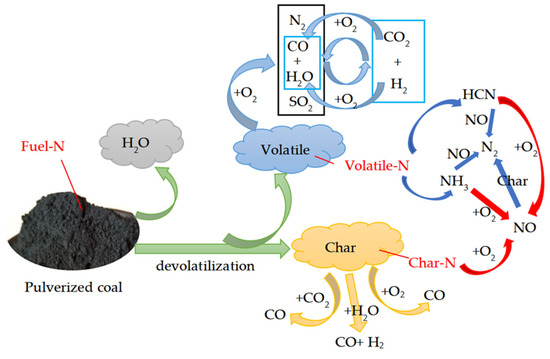
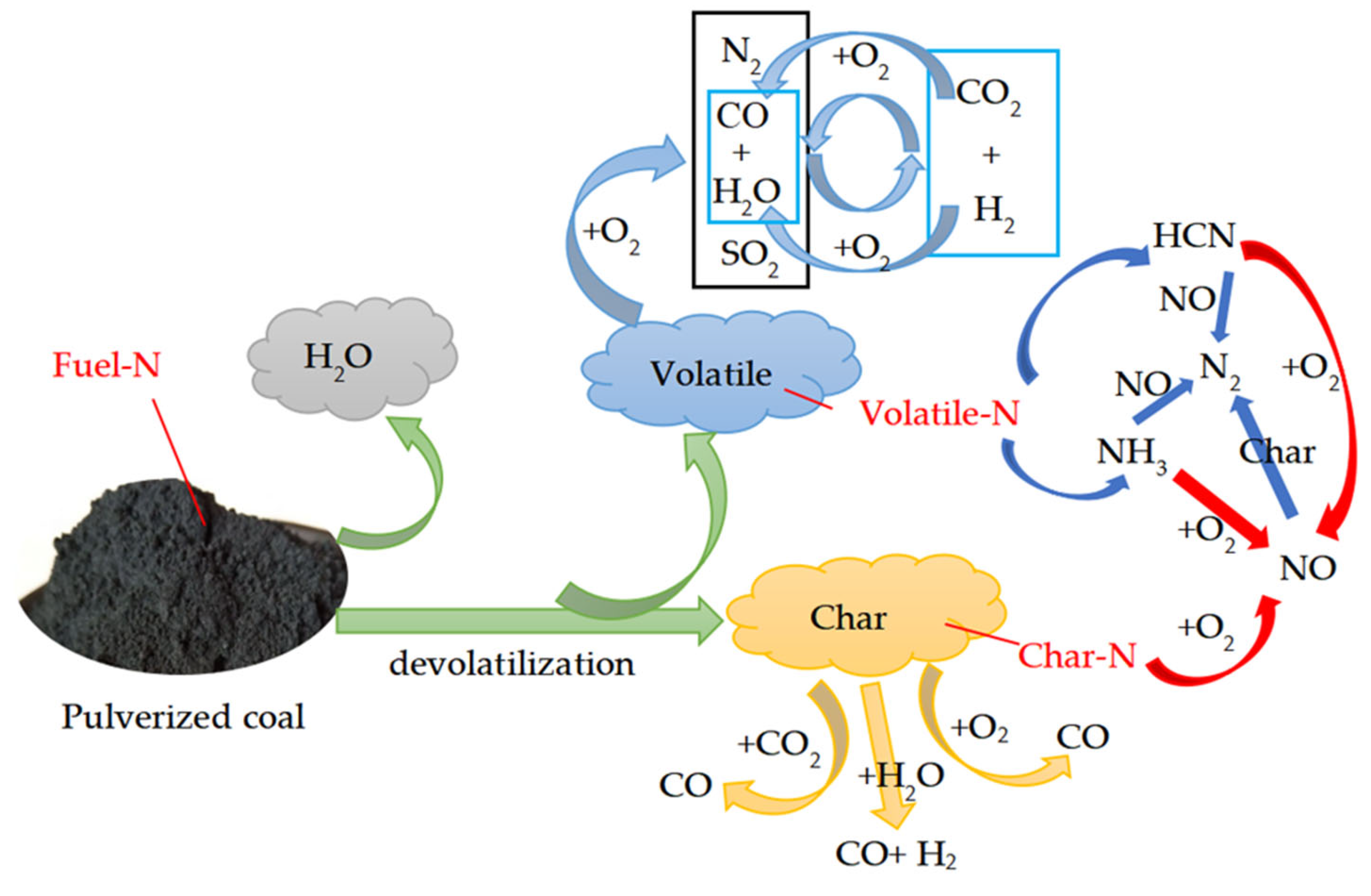
The combustion of pulverized coal within boilers involves a complex process [25]. Generally, it can be simplified into four stages as shown in Figure 1: moisture evaporation, devolatilization, volatile combustion and char combustion [26]. Numerous researchers have studied combustion models, especially those involving gas co-firing, as shown in Table 1. In the first stage, heating of coal particles occurs, with moisture starting to evaporate. Vapor and devolatilization are described by general boundary conditions at the particle surface, which simultaneously account for convection and diffusion phenomena during devolatilization [27]. The curve depicting the heating rate of particles is derived through the calculation of heat transfer processes, which includes both the thermal interactions among particles themselves and the heat exchange occurring between particles and their surrounding environment. The temporal evolution of volatile release is captured by calculating the devolatilization rate using the average particle temperature, employing the one-step model, two-step model [28], as well as the chemical percolation devolatilization (CPD) model [29], respectively. The CPD model relies on the parent coal’s chemical structure, with its volatile constituents consisting of light gases and heavier hydrocarbons that serve to characterize tar, including the production of CH4, CO, H2, CO2, H2O, C2H4, C2H6, C3H6, C3H8, as well as tar. To quantitatively analyze the chemical structure of coal, solid-state 13C nuclear magnetic resonance (NMR) spectroscopy is employed [30]. Li et al. [31] investigated the properties of coal devolatilization products at different temperatures through the use of a drop tube furnace. Regarding the devolatilization gas, a notable increase in H2 and CO concentrations was observed with rising temperatures, while other components such as CH4, CO2, and C2–C3 hydrocarbons exhibited a decreasing trend. The light aromatics decrease as the pyrolysis temperature raises from 600 °C to 1000 °C. There is condensation polymerization between light aromatics. The composition of polycyclic aromatic hydrocarbons (PAHs) is complex, and their concentration exhibits an upward trend as the pyrolysis temperature elevates. Andrew et al. [29] examined the correlation between total volatile yield, ultimate volatile yield, and temperature. After assessing the advantages and disadvantages of various simple model forms, a modified two-step model featuring distributed activation energies was found to demonstrate the closest consistency with the predictions of the CPD model.
Figure 1.
Schematic diagram of the pulverized coal and fuel-NO combustion mechanism.
The volatile matter reacts with oxygen at high temperatures, usually called gas combustion. If the oxygen is sufficient, the reaction generates H2O and CO2. If the oxygen is insufficient, the reaction generates partial CO and H2. For the volatile combustion, the finite rate/eddy dissipation model is usually utilized, which includes the volatile combustion mechanism and gas reaction model. Yuan et al. [32] developed a gas-phase reduction reaction mechanism derived from GRI-mech 3.0 for pulverized coal combustion, containing 27 substances and 58 reactions involving key C2 species. This mechanism accurately predicts the heterogeneous ignition behavior of anthracite, as well as the homogeneous-heterogeneous ignition mode of lignite and bituminous coal under conditions of 20% O2 and 1800 K. Tufano et al. [27] developed a reduced kinetic mechanism for the oxidation of coal volatiles, which includes 52 chemical species and 452 elementary reactions. Tropin et al. [33] employed a simplified detailed kinetic mechanism that contains 92 reversible reactions involving 15 species.
When all volatile components have been fully released from pulverized coal particles, the residual solid material is referred to as char. Char continues to react with oxygen at high temperatures, generating CO2 and CO. In cases of insufficient oxygen, char may also undergo gasification reactions, producing gases such as CO and H2. A numerical model was established by Li et al. [34] rooted in the unsteady convection–diffusion equation, utilizing a random pore model (RPM) to locally forecast changes in intraparticle pore surface area. Their simulation results indicate that the accumulation of H2 within char particles diminishes the char-H2O gasification rate, with a more pronounced effect particularly in the outer regions. For O2/water combustion, experimental results demonstrate that water promotes total carbon conversion under low stoichiometric ratio (SR) conditions, while exhibiting an inhibitory effect under high SR conditions. As SR increases, the contribution of char–O2 combustion rises, amplifying the suppressive impact of water on the char–O2 combustion rate.
NOx exerts minimal influence on the temperature, velocity, and species distribution profiles during combustion, as its concentration is far lower compared to the other products (such as CO2, H2O). Consequently, a post-processing method is typically adopted to forecast NOx generation. The formation mechanisms of NOx encompass thermal-NO, prompt-NO, intermediate-N2O, and fuel-NO [35,36], alongside the NO abatement mechanism (NO-reburning) [37]. The extended Zeldovich mechanism serves as the defining characteristic of thermal NOx, involving the reaction between N2 and O/OH radicals at elevated temperatures. Prompt-NO is formed via the reaction of N2 and CH radicals in fuel-rich environments, and the semi-empirical model developed by De Soete et al. enables the prediction of its formation [38]. The pathway of intermediate-N2O is modeled based on the mechanism proposed by Melte et al. [39]. Fuel-NO is the primary contributor to NO formation, produced via the oxidation of nitrogen-containing components in pulverized coal [28]. The NO-reburning mechanism comprises homogeneous reduction in NO by unburned species (e.g., CO, H2) and heterogeneous reduction in NO by char. To derive the homogeneous NO reduction rate, unburned components are substituted with the equivalent CH4 fuel [40], while the heterogeneous C-NO reaction rate is determined based on char particle concentration and specific surface area [41]. Li et al. [42] found that added H2O accelerates nitrogen release under oxygen-lean conditions, whereas it inhibits this process in oxygen-rich environments. Additionally, H2O significantly decreases the rate constant for heterogeneous char-NO reduction while slightly increasing pore surface area. The C-NO reaction serves as the primary NO reduction pathway: most HCN produced during the C-N-H2O reaction tends to diffuse from char particles and transforms into NO via the HCN → NH3 → NO pathway in the ambient flow.
Table 1.
Overview of research about gas co-firing with pulverized coal.
2.2. The Pulverized Coal Ignition Model
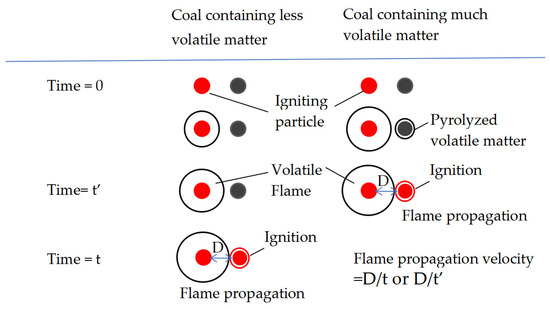
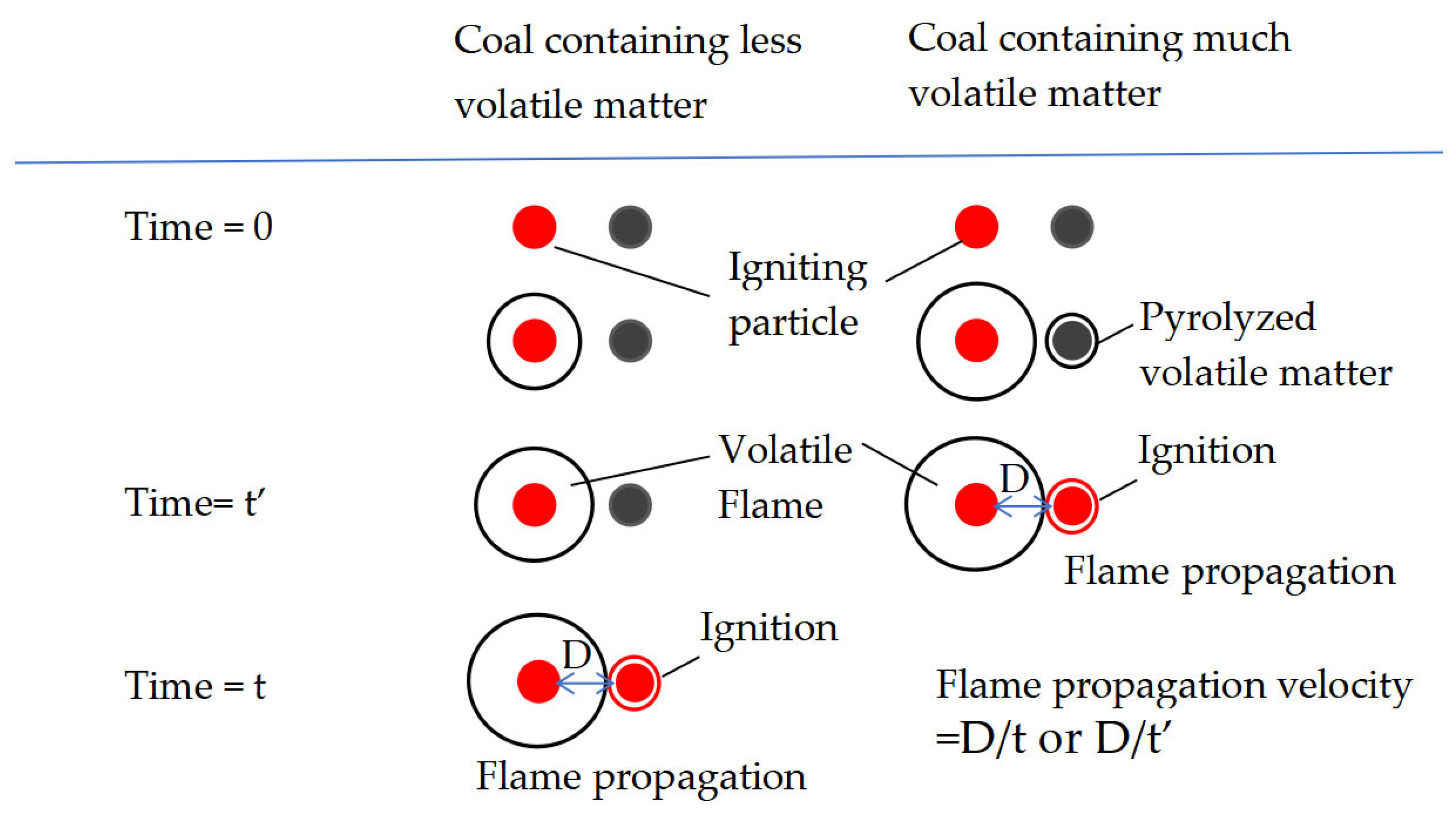
A number of scholars have established ignition and combustion models for individual coal particles, grounding their work on steady-state, quasi-steady-state, or transient assumptions, respectively [53,54,55]. Figure 2 summarizes the basic phenomenon of flame propagation: combustion initiates on one side of the two particles initially, and the heat released by the burning particle subsequently ignites the opposing side. Upon ignition of the first particle, the volatile components undergo a pyrolysis reaction, forming a volatile flame around it. Due to pyrolysis, the flame continues to expand and heat the adjacent unignited particles. During the transfer of flame from the first burning particle to subsequent particles, the flame propagation phenomenon is observed. Conditions such as ambient temperature affect the pyrolysis rate, thereby changing the flame propagation speed.
Figure 2.
Basic model of flame propagation.
Tufano et al. [27] concluded that ignition delay time is influenced by the following factors: (i) the characterization of gas-phase chemical processes, (ii) transient relative velocity and particle Reynolds number, and (iii) initial particle temperature. Reddy et al. [56] investigated ignition delay times for coal particles with sizes spanning 35–115 mm, furnace temperatures in the range of 1000–1700 K, and oxygen concentrations ranging from 12% to 20%. The results indicate that ignition delay time increases as furnace temperature decreases and particle size increases. Xu et al. [57] experimentally studied the ignition characteristics of pulverized coal particle clouds in a jet under varying conditions of turbulence intensity, oxygen concentration, and coal concentration via an entrained flow reactor. As the Reynolds number of the main flow increases, the morphology of the coal cloud flame transitions from narrow and ordered to broad and turbulent. Concurrently, the intensification of particle dispersion leads to a reduction in flame brightness. Elevated oxygen concentrations in either the primary or secondary flow promote the ignition of cloud flames. For laminar coal cloud flames, the sensitivity of the ignition distance is more pronounced with respect to variations in primary flow oxygen concentration, showing a minimum value at a specific coal concentration. In contrast, for turbulent coal cloud flames, the ignition distance is shorter, and no distinct non-monotonic trend is observed across the tested coal concentration range.
Some early single coal particle ignition models are based on steady-state models with simplified assumptions, which facilitates the analysis of ignition temperature and ignition modes. The volatilization process of coal occurs first; as the coal particle temperature increases, volatile components are liberated from the particle surface and diffuse into the surrounding environment. The heating rate, heating duration of coal particles, as well as ambient gas temperature can influence the quantity and composition of released volatile matter. Heat transfer involves three mechanisms: radiation, convection, and source terms (including carbon combustion rate and heat-absorbing release of volatile components). For solid-phase radiation, the Stefan–Boltzmann model is employed [58]. The gas-phase radiation heat transfer considers the reabsorption of components such as CO2, H2O, and CO. Approximately 10–30% of the total radiant heat is absorbed by pulverized coal. Based on the heat balance between heat transfer and heat generated by combustion, this criterion includes the main factors affecting the ignition of pulverized coal flow, such as the initial temperature of pulverized coal flow, the temperature inside the furnace, the flow rate of primary air, secondary air and recirculated flue gas [59]. Broadly speaking, ignition delay depends on the local oxygen concentration and the rate of volatile emission (dictated by particle temperature) [60].
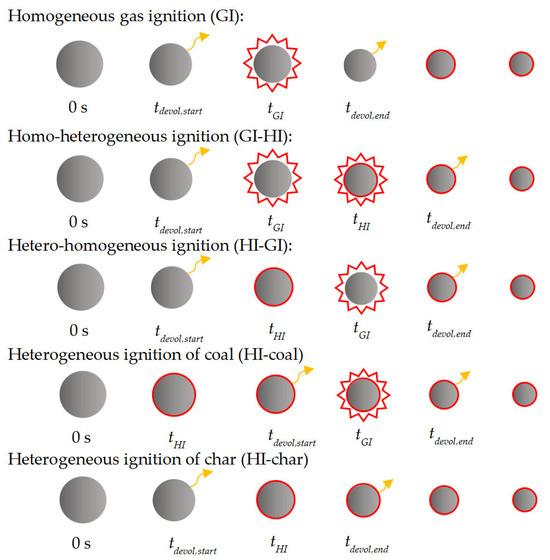
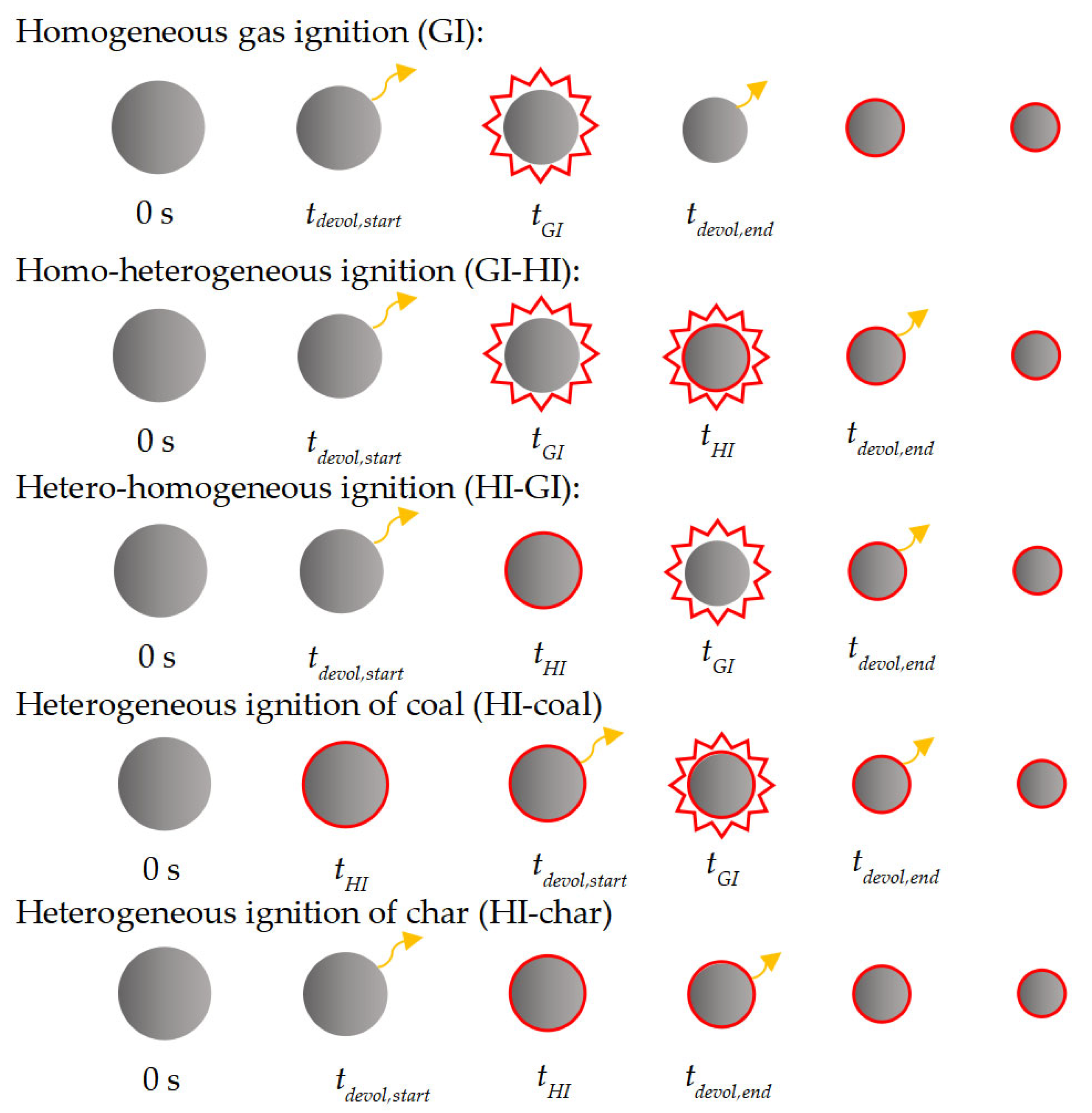
Based on previous experimental studies [61], five distinct ignition modes for coal particles have been categorized: (1) homogeneous gas phase ignition (GI: characterized by flaming ignition via homogeneous combustion of volatile components); (2) homo-heterogeneous ignition (GI-HI: involving concurrent ignition of volatiles and coal particles during volatile combustion); (3) hetero-homogeneous ignition (HI-GI: initiating with heterogeneous char ignition followed by secondary homogeneous ignition of volatiles); (4) heterogeneous ignition of coal (HI-coal: sparking ignition by heterogeneous oxidation of the whole coal particle); (5). heterogeneous ignition of char (HI-char: glowing surface ignition by heterogeneous oxidation of char). The specific ignition processes for coal particles with different ignition modes [54] are illustrated in Figure 3.
Figure 3.
Typical ignition modes of coal particle. The red polygon lines is homogeneous reactions, the red border lines is heterogeneous ignition and combustion process, and the long and short yellow arrows refer to the begin and the end of the coal devolatilization.
A number of researchers recorded coal particle ignition phenomena via various optical techniques, including high-speed cameras, planar laser-induced fluorescence (PLIF), and intensified charge-coupled device (ICCD) [22,57,62]. During the initial ignition phase, individual coal particles may undergo homogeneous ignition via prior devolatilization followed by volatile combustion, or heterogeneous ignition through direct oxygen interaction with the entire coal or char particle. If the volatile components initially ignite and burn while coal particles simultaneously initiate combustion, they exhibit a hetero-homogeneous ignition mode. Therefore, the formation of a specific ignition mode for coal particles depends on the relative ratio of heat and mass transfer rates to chemical reaction rates. In addition, gas-phase ignition is defined as an ignition process occurring within a narrow region in which the concentration of the oxygen–volatile mixture attains its flammability limit under the local temperature.
The ignition and combustion behaviors of coal particles are constrained by multiple key factors, including pulverized coal characteristics, particle size, concentration, oxygen level, ambient temperature, and gas flow velocity. A higher volatile matter content in coal results in greater heat released during combustion; conversely, a higher moisture content increases the efficiency of heat storage through water vapor evaporation. Finer coal particles exhibit a larger contact area, which accelerates both heat absorption and devolatilization processes simultaneously. Excessively high pulverized coal concentration may lead to insufficient oxygen content, while excessively high gas flow velocity shortens residence time and reduces heat absorption efficiency.
Further research on the ignition model is summarized in Table 2. Zhang et al. [54] developed a transient mathematical model to describe the ignition and combustion processes of stationary coal particles by integrating the governing equations of mass, energy, and species transport across the particle and gas phases. Ignition delay periods of individual coal particles were computed via the chemical percolation devolatilization (CPD) model and the Kobayashi–Sarofim devolatilization model [61]. As the ambient molar oxygen fraction rose from 5% to 21%, the ignition modes of single coal particles transitioned from homogeneous gas ignition to homo-heterogeneous ignition; with further increases to 40% and 70%, the modes shifted to hetero-homogeneous ignition and heterogeneous ignition, respectively. Zhu et al. [53] concluded that for smaller particles, the primary ignition mechanism is heterogeneous ignition, while larger particles exhibit homogeneous ignition characteristics. This difference depends on factors such as oxygen concentration, ambient temperature, and the consideration of intraparticle heat conduction. Research findings indicate that homogeneous ignition takes place under low oxygen concentration conditions, whereas heterogeneous ignition is formed in high oxygen concentration environments. Additionally, research has demonstrated that the temperature required for homogeneous ignition is marginally lower than that for heterogeneous ignition.
Table 2.
Research about ignition modes of coal particles.
Yuan et al. [55] suggested that gas-phase reactions begin with volatile combustion, progress to a stage where volatile and CO burn simultaneously, and ultimately end with exclusive CO combustion. Meanwhile, char oxidation is recognized as the primary contributor to CO formation. In homogeneous and heterogeneous ignition scenarios, CO exerts a significant influence on gas-phase reactions during intense volatile combustion, leading to an initial increase followed by a decrease in flame intensity. By comparison, under homo-heterogeneous ignition, the participation of CO in gas-phase reactions becomes more pronounced as volatile combustion weakens, causing a secondary elevation in flame intensity. With increasing oxygen concentration, both volatile and char combustion intensify, leading the flame front to shift toward the particle surface. This reduces the duration of volatile combustion and limits the time available for gas–solid interactions, a key factor in maintaining flame stability.
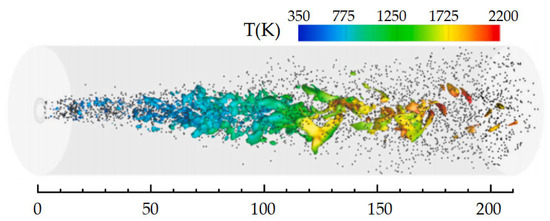
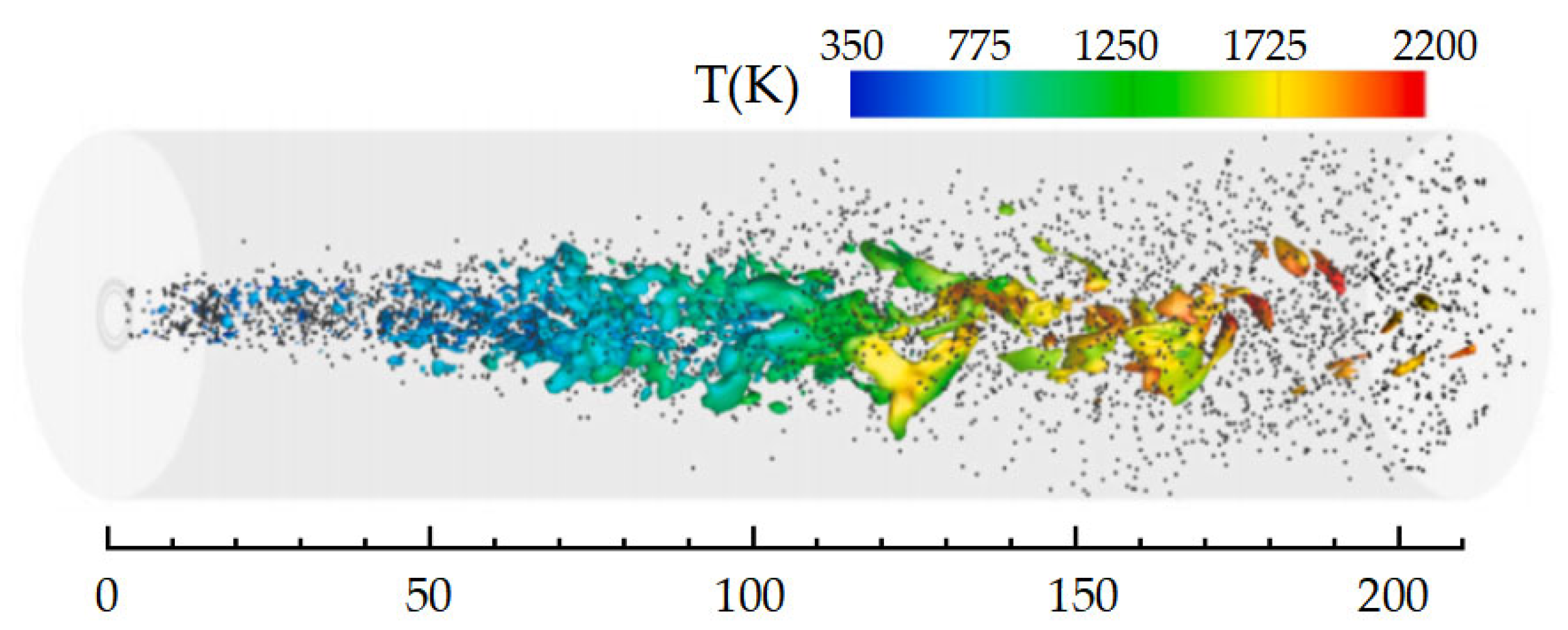
Li et al. [63] developed a quantitative method based on Large Eddy Simulation (LES)—Discrete Phase Model (DPM) numerical simulations, which identified heat-release cores and employed a coefficient of variation to evaluate their spatial continuity, to characterize the flame evolution process and evaluate the combustion stability of pulverized coal jets. The findings indicate that the core mechanism of stable pulverized coal jet combustion is rooted in the formation of sustained high-intensity heat release zones (referred to as heat-release cores within the jet). The formation, merging, and fragmentation of these cores are strongly influenced by gas–solid diffusion and fuel–oxidant mixing processes. Under low-load operation, decreased coal feed rates and air supply—coupled with low intensity gas–solid turbulence—result in inhomogeneous fuel and heat distribution within the jet region. As a result, heat-release cores are unable to coalesce, causing the flame to exhibit marked spatiotemporal fluctuations. Enhancing air/oxygen supply under low-load conditions can boost combustion efficiency to a certain degree, but does not notably improve flame stability. Typical heat-release core distributions are shown in Figure 4.
Figure 4.
Typical heat-release core distribution. (from Li et al. [63]).
In summary, the normal ignition and combustion of pulverized coal involve various factors, such as coal type, coal particle size, primary flow velocity, and temperature. The key ignition factors include whether the concentration of released combustible gases reaches the flammability limit, whether the temperature meets the ignition threshold, and whether the residence time is sufficient. Combustible gases consist of volatile matter, carbon gasification products, and co-combustion gases. The volatilization rate of volatile matter is determined by its composition (related to coal type) and primarily depends on the temperature of the solid phase and the heating rate. The temperature of the solid phase results from external convective and radiative heating in combination with heat released during pyrolysis. Both the solid-phase temperature and surrounding gas composition (e.g., water vapor and carbon dioxide content in the gas flow) are critical factors affecting carbon gasification. Primary flow also significantly influences volatile matter concentration through its composition, velocity, and temperature: excessive primary flow dilutes volatile matter concentration, while flue gas recirculation reduces it. Higher temperatures increase the solid-phase temperature. Therefore, the ignition model should employ a detailed chemical percolation devolatilization model and accurate kinetic parameters to simulate volatile matter release, while simultaneously using solid-phase mass and energy equations to precisely characterize carbon gasification processes. To enhance computational efficiency and accurately capture the influence of gas composition on combustion and ignition, the combustion model should be simplified using the CHEMKIN approach, resulting in a tailored gas-phase combustion model for specific coal types and co-firing scenarios.
3. Co-Firing with Hydrogen-Containing Gases
The development of zero-carbon fuel (H2/NH3) co-firing technology in conjunction with pulverized coal can alleviate low-load combustion instability and reduce pollutant emissions during the peak-load regulation. It is considered that gas ignites before coal, creating a high-temperature environment surrounding the coal particles. Upon rapid heating, the release of volatiles from pulverized coal is promoted, accelerating the ignition and combustion processes. Hence, the critical scientific issue in gas/coal co-firing lies in the gas-gas homogeneous and gas–solid heterogeneous ignition mechanisms. The fundamental key properties of various hydrogen-containing gases are shown in Table 3. Characteristics of hydrogen-containing gases are as follows: (1) the combustion product is water vapor, which primarily participates in endothermic reactions with C, CO2, and CO, thereby limiting the combustion temperature in the flame zone; (2) water vapor exhibits a relatively high specific heat capacity.
Table 3.
Fundamental key properties of various hydrogen-containing gases [64,65].
3.1. Co-Firing with CH4
3.1.1. Combustion Characteristics
Methane serves as a vital clean energy source, extensively utilized in residential heating and industrial production, attributed to its high combustion efficiency and minimal greenhouse gas emissions. Nevertheless, CH4 ranks as the second-largest greenhouse gas globally after CO2, accounting for approximately 25% of global warming.
Tropin et al. [33] established a physico-mathematical model incorporating comprehensive kinetic mechanisms for the oxidation of methane–hydrogen–air gaseous mixtures and thermal degradation processes of coal particles. This model includes volatile release (e.g., CH4 and H2) into the gas phase, subsequent ignition and combustion of the volatiles, and heterogeneous carbon oxidation reactions. The findings indicate that coal particles within the temperature range of 900–1450 K shorten the ignition delay time; furthermore, they induce a shift in the gas mixture’s ignition limit toward lower temperatures. Leshchevich et al. [66] conducted experimental research on the ignition of stoichiometric methane–air mixtures containing coal particles with diameters of 20–32 μm. They observed that particle ignition occurs when the oxidant temperature exceeds 850 K. Meanwhile, at temperatures over 1000 K, combusting particles reduce both the ignition time and the limiting temperature of the methane and air mixture. Based on the thermal theory of ignition, Wall et al. [67] analyzed the critical conditions for coal particle ignition and identified two key scenarios: (1) spherical particles fail to ignite in the gas phase if pyrolysis proceeds with insufficient intensity to prevent the flame from approaching the endothermic coal surface, and (2) heterogeneous ignition of spherical coal particles does not occur if the chemical reaction’s heat release rate cannot balance heat losses to the ambient environment.
Moiseeva et al. [68] performed a numerical investigation of flame propagation velocity in suspended coal particles within a lean methane and air mixture. Studies have demonstrated that introducing a small quantity of methane enhances the propagation velocity; more precisely, the velocity first rises and subsequently declines, with the peak value corresponding to the stoichiometric ratio. It was also found that the release of volatile matter from the coal–air suspension during combustion has an insignificant effect on propagation velocity. Increasing coal particle size in a lean methane and air mixture ambiguously affects propagation velocity: it decreases at low coal concentrations, while increasing at high coal concentrations. Bermúdez et al. [69] established a mathematical model to characterize the group combustion characteristics of pulverized coal particles with an annular methane pilot flame. This model employed a generalized Burke–Schumann framework to address the competitive oxidation of volatiles, CO, and H2 with O2, integrated an analysis of particle dynamics (primarily governed by aerodynamic drag and gravity), and incorporated their dispersion via a stochastic model. Variations in both the oxidation reactions of the three fuels and the spatial distribution of their formation markedly complicate the analysis of pulverized coal combustion, even under the practical condition of rapid oxidation reactions. The BFL model, presented in [58], is applied to direct numerical simulation of the laminar and transitional group combustion using swirling or non-swirling pulverized coal jets. The new model includes particles with low ash content, fractured ash layers, and consequently variable radii. Two kinds of diffusion flames appear in their models: one is associated with the annular pilot methane flame, and the second is found downstream or in the form of closed diffusion flames.
Li et al. [70] experimentally studied the pulverized coal and methane co-firing in swirl combustion. Pulverized coal particles were carried by a methane–air mixture through an annular pipe. The study primarily concentrated on the characteristics of the inner recirculation zone and exhaust tube vortex, which serve as key factors in NO reduction. In a pulverized coal flame, both temperature and OH radical intensity exhibited a decreasing trend as coal particle size increased, whereas the inner recirculation zone and exhaust tube vortex expanded with smaller particle sizes. Coal particles experienced longer residence times within the inner recirculation zone and exhaust tube vortex, creating a reducing environment and fuel-rich conditions, which led to less NOx emissions.
3.1.2. Typical Cases
To investigate the combustion behavior and pollutant emission characteristics, Liu et al. [20] performed a numerical simulation on a 350 MW tangential boiler, under 20% ultra-low load conditions with methane co-firing ratios spanning 0–20%. Methane is injected into the main combustion zone via primary air nozzles. Utilizing only the bottom two burner layers yields a higher average flue gas temperature (1540 K) and reduced NO emissions (294 mg/m3). When the co-firing ratio of methane increases from 0% to 20%, the mean flue gas temperature increases by 50 K, with NO and CO2 emissions decreasing by 15.3% and 6.2%, respectively. Concurrently, H2O concentration rises by 21.3%, which may potentially induce low-temperature corrosion issues. The suggested optimal methane co-firing ratio is 15%.
Kim et al. [48] investigated a 550 MW tangentially fired pulverized coal boiler, where methane served as the heat input source of the existing coal-fired system. The study analyzed combustion behavior, nitrogen oxide (NOx) emissions, and in-boiler changes in heat transfer profiles. Additionally, changes in the stoichiometric ratio within the burner zone were simulated to recover the diminished heat absorption of the furnace water wall, demonstrating that air distribution is capable of modifying the heat absorption characteristics of both the water wall and tube bundles. Increasing the burner stoichiometric ratio led to a logarithmic rise in water wall heat absorption, while NOx emissions increased exponentially.
Zhao et al. [19] developed an oxygen-enriched, low-NOx burner incorporating liquefied natural gas (LNG) to mitigate unstable combustion as well as high nitrogen oxide emissions in a 330 MW subcritical boiler at ultra-low load conditions. Post-retrofit deep peak shaving tests showed that furnace combustion remains stable at loads of 50% or higher, with NOx levels at the furnace outlet below 350 mg/m3 (6% O2, dry basis). At 25% load, the LNG-integrated oxygen-rich burner is employed, where pulverized coal flow enters the furnace with high-intensity combustion, effectively enhancing furnace combustion stability.
3.2. Co-Firing with H2
3.2.1. Combustion Characteristics
Hydrogen is a promising candidate for decarbonizing energy systems due to its high energy density and emits no carbon dioxide during combustion. Hydrogen has garnered significant interest as an environmentally sustainable and clean alternative, yet it possesses properties such as low ignition temperature and rapid flame propagation, presenting critical safety challenges (e.g., flashback) that impede its large-scale deployment. Gaseous hydrogen exhibits high reactivity, resulting in an extremely high laminar flame speed attributed to kinetic, thermal, and diffusive mechanisms. Among these, kinetic mechanisms contribute the most to flame speed enhancement, whereas diffusive effects are negligible due to their minimal impact.
Ueki et al. [71] carried out an experiment on pulverized coal combustion using a drop tube furnace to examine the impact of hydrogen addition on coal combustibility. When H2 gas was injected at a flow rate of 0.10 L/min, the char particle combustion ratio increased compared with the case without hydrogen. This happens because hydrogen burns vigorously, raising coal particle temperatures, which increases volatile release from coal and boosts char combustion. However, when hydrogen flow exceeds 0.21 L/min, char combustion rate drops significantly compared to no hydrogen added. Studies show coal burns better with an optimal hydrogen flow rate.
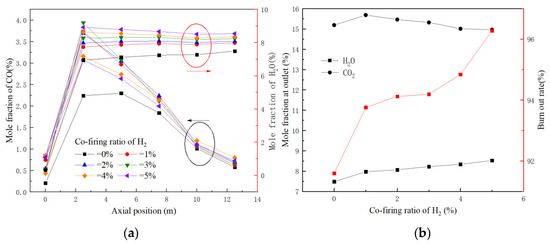
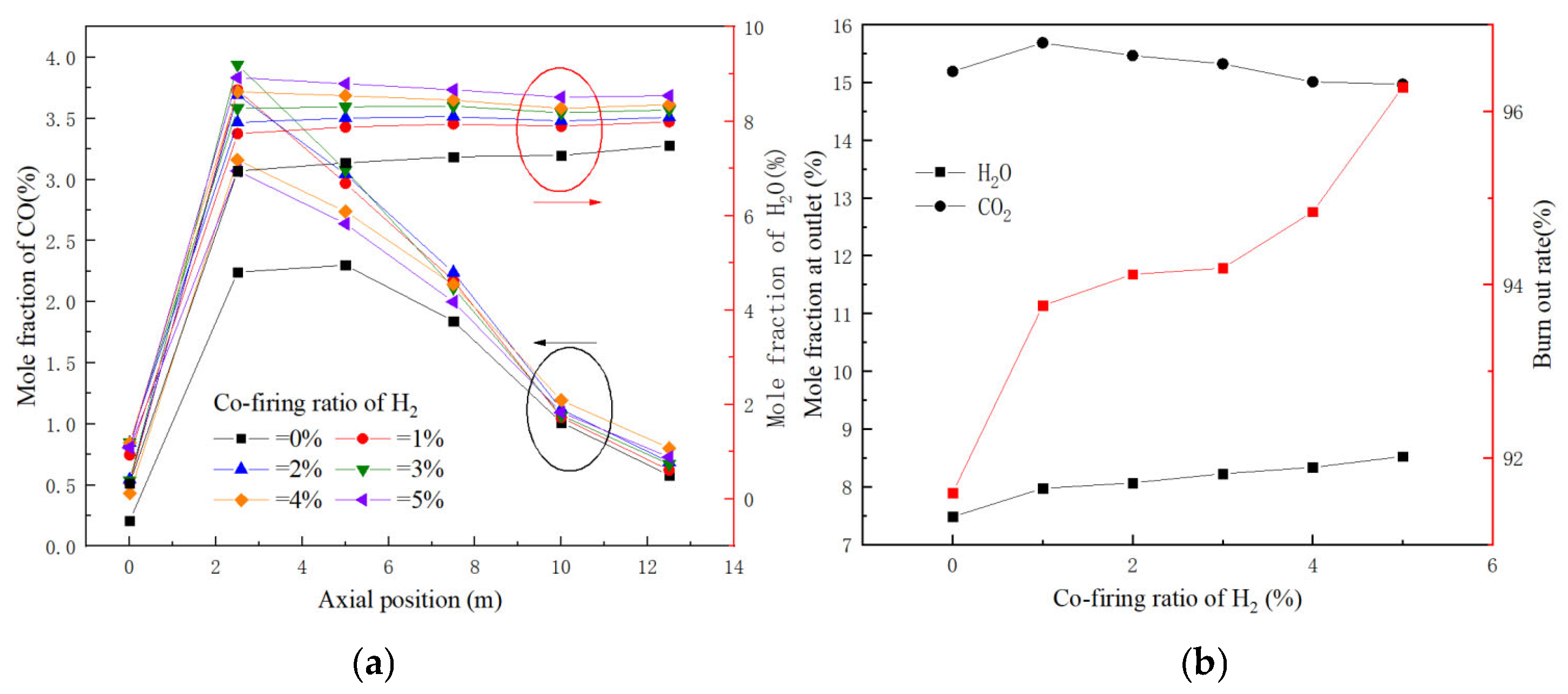
The characteristics of pulverized coal and hydrogen co-firing in swirl burners were conducted by Lin et al. [24], with a co-firing ratio of hydrogen from 0 to 5% (quantified by heat input). The critical data along the axial and at the outlet of the furnace are extracted in Figure 5. The rising co-firing ratio promotes the burnout of pulverized coal, as the burnout ratio of pulverized coal in the condition of the 5% co-firing ratio is 5.08% higher than that of the condition of the 0% co-firing ratio. Water vapor from hydrogen combustion has three effects: it creates a low-temperature area near the burner outlet, prolongs wet pulverized coal’s combustion time, and forms a high-temperature zone near the furnace outlet. More hydrogen co-firing means more water vapor. At a 1–3% ratio, water vapor reacts with furnace carbon to make lots of CO. Above 3%, extra moisture in the furnace lowers the burner outlet temperature and reduces CO production. It should be noted that the swirl burner’s ignition distance becomes shorter as the load drops [72]. After adding hydrogen, it becomes even shorter, which may cause excessive temperature at the burner outlet.
Figure 5.
The critical data (a) along the furnace axis and (b) at the outlet of the furnace. (from Lin et al. [24]).
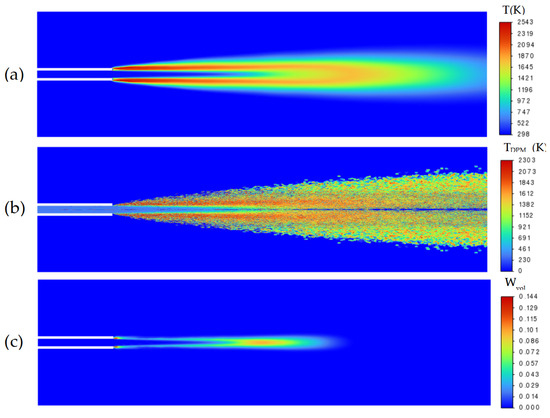
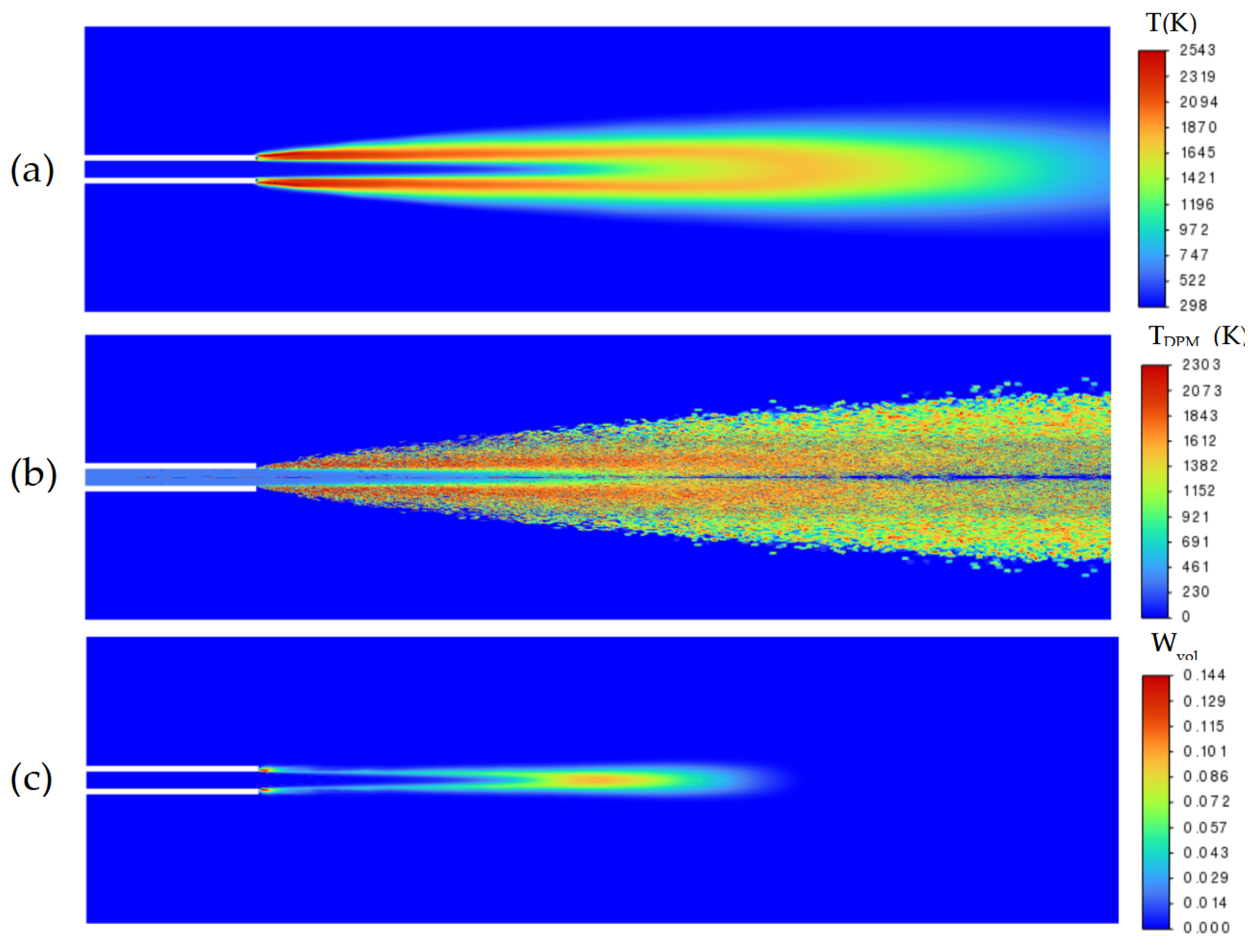
Ahn et al. [18] conducted numerical and experimental investigations on a turbulent pulverized coal combustion flame supported by hydrogen to examine the combustion characteristics. The injected pulverized coal particles are confined to a restricted region, even in downstream areas, resulting in a linear flame configuration. In the upstream zone of the flame, particles move in a cloud-like pattern. However, this cloud disintegrates downstream upon traversing the flame surface. Particle movement characteristics and the combustion impact were examined through analyzing the particle velocity and momentum transfer. A similar numerical method was detected to solve the effect of hydrogen on pulverized coal combustion. Figure 6 presents contour plots of (a) instantaneous gas temperature, (b) particle temperature, and (c) volatile mass fraction. The results demonstrate similarities to the closed diffusion zone in the BRF model proposed by Bermúdez et al. [69], with pulverized coal pyrolysis occurring predominantly in the flame zone, particularly at the flame tip. Rapid heating of the pulverized coal by heat released from hydrogen combustion is mainly observed in the coal injection zone. Due to hydrogen’s fast ignition rate, combustion generates substantial heat, leading to elevated temperatures in the vicinity of the burner outlet and uneven temperature distribution within the furnace.
Figure 6.
Contour plots of (a) instantaneous gas temperature, (b) particle temperature, and (c) mass fraction of volatile.
3.2.2. Typical Cases
The combustion of hydrogen and pulverized coal co-firing in a 660 MW tangential boiler was investigated by Dong et al. [49]. Hydrogen is blended from the burners in layer B. Accordingly, the tangent circle diameter at the B layer increases significantly with rising hydrogen co-firing ratios, while the flow field in the upper burners (D–F layers) remains unchanged. At a 1% hydrogen co-firing ratio, the overall temperature exhibits no marked variation. When the ratio rises to 5% and 10%, the localized high-temperature zones appear in smaller boiler wall areas. With the introduction of hydrogen into combustion, the temperature of the Layer B burner declines progressively as the hydrogen co-firing ratio increases. Combustion-generated water absorbs significant heat, and in the combustion zone, CO2 levels at the Layer B burner drop markedly due to hydrogen co-firing. Additionally, as the hydrogen co-firing ratio increases, O2 and CO concentrations at the furnace outlet rise.
3.3. Co-Firing with HHO
Water electrolysis gas (HHO), a hydrogen–oxygen mixture derived from water electrolysis, exhibits a strict stoichiometric H2:O2 ratio of 2:1. It undergoes combustion without requiring external oxidizers, attaining a flame temperature of up to 3000 K. With water vapor as its sole byproduct, HHO is recognized as a clean, efficient, and carbon-free fuel. Zhang et al. [47,73] carried out experiments using a one-dimensional downward-fired system to investigate the impacts of HHO injection strategies and flow rates on combustion intensity, the influence of air staging on flue gas emissions, and auxiliary combustion behaviors during lignite load reduction and ultra-low load operation. HHO injection methods include gas premixed mode and staged injection mode. The results show that co-firing HHO with lean coal and lignite significantly improves combustion temperature, with maximum temperature increases of 108 °C and 95 °C after co-firing, respectively [73]. As the HHO flow rate increases, the staged mode (SM) promotes CO conversion to CO2 and lowers CO emissions, whereas CO emissions under the premixed mode stay constant at 10 ppm. While opposite trends are observed for lean coal. Elevated excess air levels contribute to elevated NO emissions and reduced CO emissions. Air staging controls CO and NOx emissions during load reduction, achieving a 40.49% decrease in NO under 30% load. At ultra-low load conditions, HHO raises the furnace oxygen concentration, resulting in increased NO emissions. The impact of premixed mode on NO formation is less pronounced than that of staged mode. Air staging enhances combustion stability under ultra-low load but inhibits HHO auxiliary combustion. In ultra-low load co-firing scenarios with HHO, 11% over-fire air (OFA) also reduces CO and NOx emissions.
3.4. Co-Firing with Biogas
3.4.1. Combustion Characteristics
Biomass is a renewable energy source, and its utilization has been widely discussed. Biogas, biomass gasification gas, is affected by the type of raw material, the type of gasification agent (air, oxygen, water vapor, etc.) and the gasification temperature. Its core combustible components are carbon monoxide, hydrogen, and methane. Yang et al. [74] demonstrated that H2-enriched flames exhibit shortened lengths, characterized by a narrower reaction zone that shifts toward the flame outlet. When H2-CO is added to pulverized coal, the flame remains shortened while the reaction zone elongates. Meanwhile, the flame temperature increases, forming an expanded high-temperature region. Additionally, as the increases in H2 content, the CO and CO2 concentrations decrease, and NO initially decreases, then increases. Higher hydrogen content contributes to higher concentrations of O, H, and OH radicals, which accelerate elementary combustion reactions (e.g., CO + OH → CO2 + H) and enhance pulverized coal combustion processes (including volatile matter and char combustion), thereby significantly promoting combustion rates. Li et al. [75,76] observed that increased hydrogen content elevated reaction temperature, leading to higher molecular collision frequencies and accelerating OH radical chain reactions, which markedly enhance pulverized coal combustion efficiency and heat release capacity. However, excessive H2 concentrations generate substantial water vapor, triggering the reaction C + H2O → CO + H2. This suppresses the conversion of carbon to CO, ultimately reducing pulverized coal combustion rates.
Li et al. [36,77] investigated the effects of CH4, H2, and CO on the solid-phase combustion of pulverized coal. The findings show that syngas tempering increases the specific surface area of char by 54.2% and its total pore volume by 51.2%. At the same time, the relative content of oxygen-containing functional groups decreases by about 5.7%, while alkyl groups exhibit a relative content rise of about 14.8%, and the disorder degree rises by about 20.68%. Syngas composition has a synergistic tempering effect with O2. For tempering effectiveness, CH4 works better than H2, while CO’s impact is less significant. Among reducing intermediates, CHi has the biggest effect on char, with H ranking second.
3.4.2. Typical Cases
The impacts of the co-firing ratio, burner tilt angle, and biogas nozzle height on combustion characteristics were investigated by Shang et al. [52] in a 300 MW tangential-fired boiler. Their findings demonstrate that the NO concentration at the furnace outlet exhibits a monotonic decline as the co-firing ratio increases. Biogas injection was found to reduce both the peak temperature in the boiler furnace and the NO concentration at the outlet. For all biogas types, NO emission levels decrease as the co-firing ratio rises. Sawdust biogas co-firing yields the lowest NO emissions at a given ratio. Additionally, decreasing the furnace height or tilting the burner downward leads to higher NO concentrations at the furnace outlet.
A numerical investigation of pulverized coal and biogas co-firing in a 300 MW boiler was conducted by An et al. [50]. They focused on the heat transfer characteristics of furnace heating surfaces. Their results showed that increasing the biogas co-firing ratio from 0% to 30% improves fuel combustion completeness and reduces the peak carbon monoxide concentration in the primary combustion zone from 2.5% to 0.93%, which indicates a lower risk of high-temperature corrosion on the water walls. Additionally, co-firing 30% biogas raises the working fluid dryness at the water wall outlet from 0.39 to 0.53, resulting in enhanced heat absorption within the furnace and reduced heat uptake at the tail convective heating surfaces.
3.5. Co-Firing with NH3
3.5.1. Combustion Characteristics
Ammonia produced from renewable energy sources is likely to become a competitive energy carrier, considering its good safety and capability for long-term large-scale application in the future. Compared with coal, ammonia (NH3) is a low-heating-value fuel (18.6 MJ/kg) and is considered a promising alternative fuel for coal-fired power plants. As ammonia is blended into a pulverized coal boiler, the fuel composition changes. Under the condition of complete NH3 combustion, the carbon emissions reduced by ammonia–coal co-firing are proportional to the ammonia blending amount, and the carbon reduction effect is significant. However, due to the slow burning velocity of ammonia and its high nitrogen content, there may be a problem of high NOx emissions. The combustion characteristics and carbon reduction potential of ammonia have attracted great attention from researchers, mainly involving the ignition time, combustion rate, and ignition mode of pulverized coal combustion.
The ignition behaviors of individual coal particles co-firing with ammonia were studied by Chen et al. [78]. Coal particles’ ignition delay time is much shorter, while the time from ignition to peak and the burnout time of combustible parts are both longer. This happens because the NH3 flame accelerates devolatilization and combustion reactions in coal particles. Regarding ignition modes of NH3 co-firing cases, the homogeneous ignition characteristics of lignite particles are further intensified, whereas bituminous particles shifted to a combined homogeneous-heterogeneous ignition mode.
Wei et al. [79] systematically investigated characteristic temperatures, reactivity, ignition, stabilization, burnout, and integrated combustion index, based on thermogravimetric conditions and kinetic models of typical coal samples. Co-firing ammonia markedly extends the reaction time of coal combustion, leading to a 9.89–55.78% increase in characteristic temperatures along with a significant reduction in reaction rate and combustion-related parameters. Under co-firing conditions, the average activation energy of coal samples rises notably, with this trend becoming more pronounced as the co-firing ratio rises. NH3 and coal co-firing suppress the combustion of coal and shift the thermogravimetric curve toward the high-temperature region. As the co-firing ratio of NH3 increases, (1) ignition temperature slightly changes, (2) burnout temperature turns to a higher temperature, and (3) maximum and average mass loss rates significantly decrease while ignition temperature increases.
Yang et al. [80] studied the ignition characteristics of pulverized coal particles in a Hencken burner. The findings demonstrate that the mean velocity of pulverized coal particles first declines and subsequently rises with rising ammonia co-firing ratios. Importantly, at higher ammonia co-firing ratios, particle velocity rises sharply before ignition. This trend becomes more obvious as oxygen levels go up, and it then affects both ignition delay distance and time. Ammonia co-firing markedly increases the area and aspect ratio of the volatile flame relative to pure coal combustion. Moreover, adding ammonia creates a new phenomenon, in which volatile flames separate from char particles. Pulverized coal particles’ ignition mode gradually changes from separated homogeneous ignition to separated heterogeneous ignition as oxygen levels increase. Also, the volatile flame’s trailing becomes clearer as ammonia co-firing ratios go up, and volatile flame separation becomes more noticeable.
Ma et al. [46] introduced an enhanced Euler–Lagrange framework integrated with detailed solid-phase pyrolysis kinetics and gas-phase reaction mechanisms, validated against experimental results in a two-stage flat flame burner. A comprehensive gas-phase reaction mechanism, comprising 116 species and 1513 elementary reactions, was developed by integrating volatile and ammonia reaction pathways. The findings indicate that raising the co-firing ratio from 0.0 to 1.0 leads to a gradual increase in ignition delay times under oxygen-lean conditions. Additional analysis reveals that ammonia addition enhances the coal particle heating rate, attributed to both the reduced coal particle number density and elevated gas-phase temperature from ammonia reactions, thereby boosting coal devolatilization rates. They also investigated the effects of coal rank (including lignite, sub-bituminous, bituminous, and anthracite) and particle size (spanning 63–120 µm) on combustion behavior. When ammonia is co-fired in a hot gas environment, it has both good and bad effects on later pulverized coal burning. The positive impact involves increased ambient temperature, while the negative effect arises from oxygen depletion in the reaction zone resulting from ammonia reactions.
Cui et al. [81] developed a high-resolution optical measurement system, which is coupled with image processing algorithms to examine the flame brightness, ignition distance, and morphological characteristics of pulverized coal particles. Ignition distance, resulting from competing time dynamics between the coal heating and ammonia product diffusion, exhibits significant sensitivity to the ammonia co-firing ratio. This is because the coal particle heating rate rises notably with increasing temperature. The diffusion of effective combustion species from the surrounding environment to the coal particle surface is impeded as the ammonia mixing ratio increases, thus suppressing pulverized coal ignition.
3.5.2. Typical Cases
Lin et al. [82] performed experimental research on co-firing pulverized coal with ammonia in a 300 MW boiler. A 10–20% co-firing ratio was achieved by retrofitting the boiler structure and installing two burner layers (eight pure ammonia burners per layer). Findings show that as boiler oxygen content fluctuates, furnace outlet NOx emissions are more significantly reduced compared to pure coal combustion. Furthermore, ammonia burners positioned in the center of the main combustion zone outperform those in the upper region in both high-temperature performance and emission reduction.
Zeng et al. [51] investigated and evaluated two innovative fuel mixing approaches for ammonia and pulverized coal co-firing in a 500 MW utility boiler, namely burner mixing and in-boiler mixing. Experimental data show that compared with pure coal combustion, total heat absorption by the water walls and heat exchanger decreases by 4.58% using the burner blending method and 2.27% using the in-boiler blending method. However, the in-boiler mixing method exhibits better NO reduction performance, resulting in a NO emission reduction of 13.48 ppm in comparison with the burner mixing approach. Furthermore, the in-boiler mixing method demonstrates enhanced combustion stability, featuring faster ignition speed and a 0.97% reduction in unburned carbon content in fly ash relative to the burner method.
3.6. Summary
In summary, co-firing in combustion stability includes gas ignition and flame stabilization, and extension of coal combustion duration. Gas ignition and flame stabilization: Gaseous fuels (e.g., natural gas and coal gas) feature low ignition energy and high combustion speed, enabling rapid formation of stable flames under low-temperature or low-load conditions. This provides continuous heat sources for coal particle heating, volatile release, and ignition, addressing issues like difficult ignition and poor low-load flame stability in coal-only combustion. Extension of coal combustion duration: Coal particles have longer combustion cycles, and their char-phase combustion maintains high-temperature furnace environments, compensating for the short duration and temperature fluctuations of gas combustion—particularly enhancing system stability under high loads.
Synergy in heat and mass transfer involves high-temperature flue gas enhancing coal devolatilization and coal particles intensifying turbulent mixing. High-temperature gas enhancing coal devolatilization: The high heat released by gas combustion rapidly heats coal particles via radiation and convection, accelerating moisture evaporation, volatile matter (e.g., CO, H2, hydrocarbons) release, and improving coal reactivity. Coal particles intensifying turbulent mixing: Coal dispersion in airflow disturbs flow fields, enhancing turbulent mixing of gas and air to promote oxygen diffusion to reaction zones. Additionally, char particle surfaces from coal combustion act as heterogeneous reaction sites for gas combustion, accelerating chemical reaction rates.
4. Recommendations for Further Research
Most researchers have primarily focused on macroscopic studies of combustion characteristics in co-firing processes, including temperature distribution patterns, component concentration fields, NOx formation mechanisms, and burnout rate trends. However, there has been limited attention to sensitivity analysis of ignition mechanisms, with even fewer studies conducting quantitative research on critical factors. Key parameters such as the relationship between hydrogen blending ratios and coal types, combustion range and velocity, as well as reaction pathways in co-firing gases and measures to reduce CO and NOx emissions in burnout zones, have received insufficient attention. While most studies employ numerical simulations of combustion behavior, they lack in-depth analysis from perspectives like high-temperature corrosion resistance in water-cooled furnace walls and temperature field optimization for steam heating requirements. Furthermore, existing co-firing models remain simplistic in equipment modifications, failing to fully leverage the advantages of high-quality, cost-effective gas in achieving stable ignition and localized temperature control. These aspects warrant further in-depth investigation.
Numerical models primarily consist of pyrolysis models, gas-phase reaction models, solid-phase reaction models, and NO models. For coal powder pyrolysis, the CPD model is recommended with detailed volatile components. This is particularly crucial for studying ignition characteristics of coal powder, analyzing the mechanism of thermal release during combustion affecting flame stability, and investigating the impact of internal circulation flue gas on ignition stability. The interaction between volatile components and co-firing gas is critical for gas-phase combustion. Simplified mechanistic models should be developed based on detailed reaction models, especially considering the roles of H2O and CO2 in gas-phase reactions to enhance simulation efficiency. Fuel-NO is key to the reliability of NO numerical simulations and should be integrated with carbon combustion models.
5. Conclusions
Hydrogen-containing gases co-firing in pulverized coal furnaces is a key pathway to enhance the peak-shaving capacity of coal-fired power plants, reduce carbon emissions, and accommodate new energy power generation. According to existing research, co-firing gas with pulverized coal can improve gas ignition, flame stability, and extend coal combustion duration.
Natural gas can provide a pilot flame to ignite a coal particle. Simultaneously, it increased the overall temperature level in the boiler furnace, thereby raising the pulverized coal burnout rate. Co-firing of natural gas creates a reducing environment and fuel-rich conditions, which leads to less NOx emissions. However, as the co-firing ratio increases, the water vapor content rises, thereby increasing the risk of low-temperature corrosion issues. The optimal methane co-firing ratio is around 15%. Hydrogen co-firing aligns with the above conclusions. Moreover, as hydrogen is carbon-free, its effect on reducing carbon dioxide emissions is more pronounced. The recommended hydrogen blending ratio may be around 10%.
Existing research shows that co-firing 30% biogas in boilers can significantly improve the combustion conditions inside the furnace and reduce emissions such as nitrogen oxides and carbon dioxide. Renewable-powered ammonia production is primarily used for fuel substitution in coal-fired boilers, which shows outstanding potential in low-carbon emissions. However, due to the slow burning velocity and high nitrogen content, there is a problem of high NOx emissions. Research shows that when the ammonia co-firing ratio is below 20%, it will not cause an increase in nitrogen oxides emissions.
From a technical perspective, the co-firing of hydrogen-rich gas is highly beneficial for coal-fired boilers. However, from an economic standpoint, there is still a long way to go. In China, natural gas is relatively expensive due to resource constraints. In contrast, as technological advancements and equipment maturation drive down production, storage, and transportation costs, renewable-powered gas production will become more competitive.
Author Contributions
Conceptualization, H.C. and B.Z.; formal analysis, G.Z.; writing—original draft preparation, L.Z., H.C., B.Z. and G.Z.; writing—review and editing, C.Y.; funding acquisition, L.Z. and G.Z. All authors have read and agreed to the published version of the manuscript.
Funding
This research was funded by the Shandong Provincial Natural Science Foundation of China, grant numbers ZR2021QE273 and ZR2022ME003.
Data Availability Statement
The data presented in this study are available on request from the corresponding authors (C.Y. and L.Z.).
Conflicts of Interest
Author Hongzhen Cao and Bin Zhang were employed by the company Shandong Electric Power Engineering Consulting Institute Corp., Ltd. The remaining authors declare that the re-search was conducted in the absence of any commercial or financial relationships that could be construed as a potential conflict of interest.
References
- Liu, L.B.; Wang, Z.; Wang, Y.; Wang, J.; Chang, R.; He, G.; Tang, W.J.; Gao, Z.Q.; Li, J.T.; Liu, C.Y.; et al. Optimizing wind/solar combinations at finer scales to mitigate renewable energy variability in China. Renew. Sustain. Energy Rev. 2020, 132, 110151. [Google Scholar] [CrossRef] [Scilit]
- Güneş, H.; Simba, H.M.A.; Karadağ, H.; Şit, M. Global Energy Transformation and the Impacts of Systematic Energy Change Policy on Climate Change Mitigation. Sustainability 2023, 15, 14298. [Google Scholar] [CrossRef] [Scilit]
- Alizadeh, M.I.; Parsa Moghaddam, M.; Amjady, N.; Siano, P.; Sheikh-El-Eslami, M.K. Flexibility in future power systems with high renewable penetration: A review. Renew. Sustain. Energy Rev. 2016, 57, 1186–1193. [Google Scholar] [CrossRef] [Scilit]
- Uddin, M.; Romlie, M.F.; Abdullah, M.F.; Abd Halim, S.; Abu Bakar, A.H.; Chia Kwang, T. A review on peak load shaving strategies. Renew. Sustain. Energy Rev. 2018, 82, 3323–3332. [Google Scholar] [CrossRef] [Scilit]
- Ding, N.; Duan, J.; Xue, S.; Zeng, M.; Shen, J. Overall review of peaking power in China: Status quo, barriers and solutions. Renew. Sustain. Energy Rev. 2015, 42, 503–516. [Google Scholar] [CrossRef] [Scilit]
- Zhao, Y.; Wang, C.; Liu, M.; Chong, D.; Yan, J. Improving operational flexibility by regulating extraction steam of high-pressure heaters on a 660 MW supercritical coal-fired power plant: A dynamic simulation. Appl. Energy 2018, 212, 1295–1309. [Google Scholar] [CrossRef] [Scilit]
- Yuan, L.Y.; Zhong, W.Q.; Chen, X.; Li, J.; Liu, G.Y.; Tian, W.J. Three-dimensional numerical simulation of variable load combustion of supercritical coal-fired boiler for deep peak load regulation. J. Southeast Univ. Nat. Sci. Ed. 2019, 49, 535–541. [Google Scholar] [CrossRef]
- Zhao, Y.; Xu, P.; Ju, W.; Chen, F.; Liu, M.; Wang, Z.; Yan, J. Overview of theoretical and technical research on flexible and efficient synergistic operation of coal-fired power units during transient processes. Proc. Chin. Soc. Electr. Eng. 2023, 43, 2080–2100. [Google Scholar] [CrossRef]
- Wang, J.; Huo, J.; Zhang, S.; Teng, Y.; Li, L.; Han, T. Flexibility transformation decision-making evaluation of coal-fired thermal power units deep peak shaving in China. Sustainability 2021, 13, 1882. [Google Scholar] [CrossRef] [Scilit]
- Wan, L.; Yang, D.; Zhou, X.; Dong, L.; Li, J. Thermal-hydraulic calculation and analysis on evaporator system of a 1000 MW ultra-supercritical pulverized combustion boiler with double reheat. J. Therm. Sci. 2021, 30, 807–816. [Google Scholar] [CrossRef] [Scilit]
- Wang, Y.; Tao, Q.; Xiao, J.; Chen, B. Water-wall temperature control of a 1000 MW dual circle tangential firing boiler during wet-dry transferring period. Electr. Power 2019, 52, 161. [Google Scholar] [CrossRef]
- Yang, Z.; Sun, Y.; Wen, Z.; Cheng, L.; Li, Z. Research on dry-wet conversion strategy of supercritical thermal power units under deep peaking condition. Power Gener. Technol. 2024, 45, 233–239. [Google Scholar] [CrossRef]
- Wang, S.; Lyu, Z. Quantitative valuation of coal-fired units under deep peak regulation conditions. J. Chin. Soc. Power Eng. 2020, 40, 701–706. [Google Scholar] [CrossRef]
- Du, H.; Li, Z.; Liu, Z.; Zhang, M.; Huang, C.; Jiang, G.; Chen, Z.; Song, J.; Fang, F.; Su, J. Industrial Measurement of Combustion and NOx Formation Characteristics on a Low-Grade Coal-Fired 600MWe FW Down-Fired Boiler Retrofitted with Novel Low-Load Stable Combustion Technology. Fuel 2022, 321, 123926. [Google Scholar] [CrossRef] [Scilit]
- Corrêa da Silva, R.; Kangwanpongpan, T.; Krautz, H.J. Flame pattern, temperatures and stability limits of pulverized oxy-coal combustion. Fuel 2014, 115, 507–520. [Google Scholar] [CrossRef] [Scilit]
- Liu, J.; Liu, Z.; Chen, S.; Santos, S.O.; Zheng, C. A numerical investigation on flame stability of oxy-coal combustion: Effects of blockage ratio, swirl number, recycle ratio and partial pressure ratio of oxygen. Int. J. Greenh. Gas Control 2017, 57, 63–72. [Google Scholar] [CrossRef] [Scilit]
- Bai, Y.; Luo, K.; Qiu, K.; Fan, J. Numerical investigation of two-phase flame structures in a simplified coal jet flame. Fuel 2016, 182, 944–957. [Google Scholar] [CrossRef] [Scilit]
- Ahn, S.; Tainaka, K.; Watanabe, H.; Kitagawa, T. Experimental and numerical analysis of turbulent pulverized coal flame in a coaxial burner. Energy 2019, 179, 727–735. [Google Scholar] [CrossRef] [Scilit]
- Zhao, H.J.; Li, W.Q.; Zhang, J.; Ding, X.; Kang, Z.Z. Retrofit and application of pulverized coal burners with LNG and oxygen ignition in utility boiler under ultra-low load operation. Heliyon 2024, 10, e29154. [Google Scholar] [CrossRef] [Scilit]
- Liu, T.; Wang, Y.G.; Zou, L.; Bai, Y.Y.; Shen, T.; Wei, Y.W.; Li, F.X.; Zhao, Q.X. Numerical investigation of stable combustion at ultra-low load for a 350 MW wall tangentially fired pulverized-coal boiler: Effect of burner adjustments and methane co-firing. Appl. Therm. Eng. 2024, 246, 122980. [Google Scholar] [CrossRef] [Scilit]
- Valera-Medina, A.; Vigueras-Zuniga, M.O.; Shi, H.; Mashruk, S.; Alnajideen, M.; Alnasif, A.; Davies, J.; Wang, Y.; Zhu, X.; Yang, W.; et al. Ammonia combustion in furnaces: A review. Int. J. Hydrogen Energy 2024, 49, 1597–1618. [Google Scholar] [CrossRef] [Scilit]
- Ma, P.; Huang, Q.; Wu, Z.; Lyu, J.; Li, S. Optical diagnostics on coal ignition and gas-phase combustion in co-firing ammonia with pulverized coal on a two-stage flat flame burner. Proc. Combust. Inst. 2022, 39, 3457–3466. [Google Scholar] [CrossRef] [Scilit]
- Zhang, Y.; Wu, Q.; Zhu, Y.; Kang, X.; Hou, B.; Zhou, H. Combustion stability and emission characteristics of a pulverized coal furnace operating at ultra-low loads assisted by clean gas (HHO) from water electrolysis. Fuel 2024, 370, 131811. [Google Scholar] [CrossRef] [Scilit]
- Lin, X.; Lei, X.; Wang, C.; Jing, X.H.; Liu, W.; Dong, L.J.; Wang, Q.Z.; Lu, H.; Esposito, G. Numerical Simulation Study of Hydrogen Blending Combustion in Swirl Pulverized Coal Burner. Energies 2024, 17, 248. [Google Scholar] [CrossRef] [Scilit]
- Huang, S.; Li, D.; Que, Z.; Miao, J.; Liu, P. Numerical simulation of combustion process of 600 MW supercritical tangentially fired boiler. Clean Coal Technol. 2023, 29, 167–175. [Google Scholar] [CrossRef]
- Zhang, Z.; Lu, B.; Zhang, L.; Li, X.; Luo, C.; Xu, Y.; Zhao, Z.; Zheng, C. Computational study on the effect of gasification reaction on pulverized coal MILD combustion diluted by N2 and CO2. Appl. Therm. Eng. 2019, 158, 113806. [Google Scholar] [CrossRef] [Scilit]
- Tufano, G.L.; Stein, O.T.; Kronenburg, A.; Frassoldati, A.; Faravelli, T.; Deng, L.; Kempf, A.M.; Vascellari, M.; Hasse, C. Resolved flow simulation of pulverized coal particle devolatilization and ignition in air- and O2/CO2-atmospheres. Fuel 2016, 186, 285–292. [Google Scholar] [CrossRef] [Scilit]
- Jones, J.M.; Patterson, P.M.; Pourkashanian, M.; Williams, A.; Arenillas, A.; Rubiera, F.; Pis, J.J. Modelling NOx formation in coal particle combustion at high temperature: An investigation of the devolatilisation kinetic factors. Fuel 1999, 78, 1171–1179. [Google Scholar] [CrossRef] [Scilit]
- Richards, A.P.; Fletcher, T.H. A comparison of simple global kinetic models for coal devolatilization with the CPD model. Fuel 2016, 185, 171–180. [Google Scholar] [CrossRef] [Scilit]
- Fletcher, T.H. Solid state 13C and 1H NMR studies of the evolution of the chemical structure of coal char and tar during devolatilization. Symp. (Int.) Combust. 1991, 23, 1231–1237. [Google Scholar] [CrossRef] [Scilit]
- Li, Q.; Ye, H.; Wang, Z.; Zhou, H.; Wei, J. Characteristics and evolution of products under moderate and high temperature coal pyrolysis in drop tube furnace. J. Energy Inst. 2021, 96, 121–127. [Google Scholar] [CrossRef] [Scilit]
- Yuan, M.; Zhu, W.; Meng, X.; Sun, R. Development and validation of a gas-phase reduced mechanism for pulverized coal ignition and combustion. Fuel 2025, 393, 135028. [Google Scholar] [CrossRef] [Scilit]
- Tropin, D.A.; Fedorov, A.V. Physicomathematical Modeling of Ignition of a Heterogeneous Mixture of Methane, Hydrogen, and Coal Microparticles. Combust. Explos. Shock. Waves 2018, 54, 664–672. [Google Scholar] [CrossRef] [Scilit]
- Li, Y.; Sun, R.; Wang, M.; Wang, Z.; Xu, J.; Ren, X. Reaction kinetics of char-O2/H2O combustion under high-temperature entrained flow conditions. Fuel 2019, 243, 172–184. [Google Scholar] [CrossRef] [Scilit]
- Yao, G.; Han, X.; Tang, H.; Sun, L.; Liu, G. Investigation of the gas-solid and Fuel-N conversion characteristics during pulverized coal preheating with an improved char model. Case Stud. Therm. Eng. 2025, 65, 105686. [Google Scholar] [CrossRef] [Scilit]
- Li, Y.; Feng, D.; Sun, S.; Zhao, Y.; Miao, D.; Wu, J. Reburning pulverized coal with natural gas/syngas upgrading: NO reducing ability and physicochemical structure evolution of coal char. Sci. Total Environ. 2022, 852, 158517. [Google Scholar] [CrossRef] [Scilit] [PubMed]
- Zha, X.; Zhang, Z.; Zhao, Z.; Yang, L.; Mao, W.; Lai, G.; Luo, C.; Zhang, L. Numerical study of the combustion behaviors and NOx formation in NH3/coal co-combustion under MILD mode: Effect of NH3 injection modes. Appl. Therm. Eng. 2025, 278, 127499. [Google Scholar] [CrossRef] [Scilit]
- De Soete, G.G. Overall reaction rates of NO and N2 formation from fuel nitrogen. Symp. (Int.) Combust. 1975, 15, 1093–1102. [Google Scholar] [CrossRef] [Scilit]
- Malte, P.C.; Pratt, D.T. Measurement of atomic oxygen and nitrogen oxides in jet-stirred combustion. Symp. (Int.) Combust. 1975, 15, 1061–1070. [Google Scholar] [CrossRef] [Scilit]
- Fordoei, E.E.; Mazaheri, K.; Mohammadpour, A. Numerical study on the heat transfer characteristics, flame structure, and pollutants emission in the MILD methane-air, oxygen-enriched and oxy-methane combustion. Energy 2021, 218, 119524. [Google Scholar] [CrossRef] [Scilit]
- Levy, J.M.; Chan, L.K.; Sarofim, A.F.; Beér, J.M. NO/char reactions at pulverized coal flame conditions. Symp. (Int.) Combust. 1981, 18, 111–120. [Google Scholar] [CrossRef] [Scilit]
- Li, Y.; Sun, R.; Wu, J.; Wang, Z.; Wang, M.; Song, Z. Effect of H2O on char-nitrogen conversion during char-O2/H2O combustion under high-temperature entrained flow conditions. Combust. Flame 2019, 207, 391–405. [Google Scholar] [CrossRef] [Scilit]
- Vascellari, M.; Xu, H.; Hasse, C. Flamelet modeling of coal particle ignition. Proc. Combust. Inst. 2013, 34, 2445–2452. [Google Scholar] [CrossRef] [Scilit]
- Nicolai, H.; Li, T.; Geschwindner, C.; Mare, F.D.; Hasse, C.; Bhm, B.; Janicka, J. Numerical investigation of pulverized coal particle group combustion using tabulated chemistry. Proc. Combust. Inst. 2021, 38, 4033–4041. [Google Scholar] [CrossRef] [Scilit]
- Goshayeshi, B.; Sutherland, J.C. A comparison of various models in predicting ignition delay in single-particle coal combustion. Combust. Flame 2014, 161, 1900–1910. [Google Scholar] [CrossRef] [Scilit]
- Ma, P.; Nicolai, H.; Huang, Q.; Debiagi, P.; Berkel, L.L.; Stagni, A.; Yang, Y.; Hasse, C.; Li, S. Numerical investigation on pyrolysis and ignition of ammonia/coal blends during co-firing. Combust. Flame 2024, 261, 113268. [Google Scholar] [CrossRef] [Scilit]
- Zhang, Y.; Wu, Q.; Zhu, Y.; Kang, X.; Hou, B.; Zhou, H. Experimental study on the effects of co-firing mode and air staging on the ultra-low load combustion assisted by water electrolysis gas (HHO) in a pulverized coal furnace. J. Energy Inst. 2024, 117, 101828. [Google Scholar] [CrossRef] [Scilit]
- Kim, K.-M.; Kim, G.-B.; Lee, B.-H.; Bae, Y.-H.; Jeon, C.-H. CFD Evaluation of Heat Transfer and NOx Emissions When Converting a Tangentially Fired Coal Boiler to Use Methane. Energies 2022, 15, 246. [Google Scholar] [CrossRef] [Scilit]
- Dong, L.; Huang, S.; Qian, B.; Wang, K.; Gao, N.; Lin, X.; Shi, Z.; Lu, H. Numerical Simulation of Hydrogen–Coal Blending Combustion in a 660 MW Tangential Boiler. Processes 2024, 12, 415. [Google Scholar] [CrossRef] [Scilit]
- An, F.; Shen, F.; Zhong, Z.; Chen, Y. Combustion and heat transfer characteristics of a 300 MW pulverized-coal boiler retrofitted with biogas co-combustion. Therm. Sci. Eng. Prog. 2025, 64, 103758. [Google Scholar] [CrossRef] [Scilit]
- Zeng, Y.; Jo, H.Y.; Kim, S.M.; Lee, B.H.; Jeon, C.H. NH3 co-firing strategy in 500 MW tangential utility boiler: Impact of blending methods. J. Energy Inst. 2024, 117, 101854. [Google Scholar] [CrossRef] [Scilit]
- Shang, X.; Xie, J.; Chen, J.; Gu, Y. Numerical Study on Combustion Characteristics of Biogas Cocombustion in a 300MW Coal-Fired Boiler Furnace. ACS Omega 2024, 9, 20378–20387. [Google Scholar] [CrossRef] [Scilit] [PubMed]
- Zhu, M.; Zhang, H.; Zhang, Z.; Zhang, D. A Numerical Modeling Study of Ignition of Single Coal Particles Under Microgravity Conditions. Combust. Sci. Technol. 2011, 183, 1221–1235. [Google Scholar] [CrossRef] [Scilit]
- Zhang, T.; Hu, Z.; Zhou, Y. The determination method of the ignition modes of single coal particle with a transient coal ignition and combustion model. Combust. Flame 2022, 241, 112092. [Google Scholar] [CrossRef] [Scilit]
- Yuan, M.; Zhu, W.; Sun, R. Numerical study on the effect of oxygen concentration on flame evolution of a single coal particle in a flue gas environment. Fuel 2026, 405, 136454. [Google Scholar] [CrossRef] [Scilit]
- Penchala Reddy, M.; Shankar Singh, A.; Mahendra Reddy, V.; Elwardany, A.; Reddy, H. Computational analysis of influence of particle size, oxygen concertation, and furnace temperature on the ignition characteristics of pulverized high ash and high moisture coal particle. Alex. Eng. J. 2022, 61, 6169–6180. [Google Scholar] [CrossRef] [Scilit]
- Xu, K.; Wu, Y.; Wang, Z.; Yang, Y.; Zhang, H. Experimental study on ignition behavior of pulverized coal particle clouds in a turbulent jet. Fuel 2016, 167, 218–225. [Google Scholar] [CrossRef] [Scilit]
- Bermudez, A.; Ferrin, J.L.; Linan, A.; Saavedra, L. Numerical simulation of group combustion of pulverized coal. Combust. Flame 2011, 158, 1852–1865. [Google Scholar] [CrossRef] [Scilit]
- Zhou, Q.; Zhao, Q.; Xu, T.; Hui, S.E. The Ignition Criterion of Pulverized Coal Flow and Its Experimental Verification. In Proceedings of the International Conference on Power Engineering, Setubal, Portugal, 12–14 April 2007. [Google Scholar]
- Chen, G.; Wang, H.; Luo, K.; Fan, J. A DNS study of pulverized coal combustion in a hot turbulent environment: Effects of particle size, mass loading and preferential concentration. Combust. Flame 2023, 254, 112839. [Google Scholar] [CrossRef] [Scilit]
- Liu, Y.; Geier, M.; Molina, A.; Shaddix, C.R. Pulverized coal stream ignition delay under conventional and oxy-fuel combustion conditions. Int. J. Greenh. Gas Control. 2011, 5, S36–S46. [Google Scholar] [CrossRef] [Scilit]
- Ma, P.; Huang, Q.; Wu, Z.; Si, T.; Lv, Z.; Li, S. Comprehensive effect of the coal rank and particle size on ammonia/coal stream ignition. Proc. Combust. Inst. 2024, 40, 105464. [Google Scholar] [CrossRef] [Scilit]
- Li, Y.; Zhong, W.; Liu, X.; Chen, X.; Zhou, G.; Shao, Y.; Liu, Q.; Liu, Q. Combustion characteristics and instability mechanisms of the pulverized coal jet with low loads. Powder Technol. 2026, 467, 121552. [Google Scholar] [CrossRef] [Scilit]
- Chai, W.S.; Bao, Y.; Jin, P.; Tang, G.; Zhou, L. A review on ammonia, ammonia-hydrogen and ammonia-methane fuels. Renew. Sustain. Energy Rev. 2021, 147, 111254. [Google Scholar] [CrossRef] [Scilit]
- Li, J.; Huang, H.; Kobayashi, N.; Wang, C.; Yuan, H. Numerical study on laminar burning velocity and ignition delay time of ammonia flame with hydrogen addition. Energy 2017, 126, 796–809. [Google Scholar] [CrossRef] [Scilit]
- Leschevich, V.V.; Penyazkov, O.G.; Shimchenko, S.Y.; Yaumenchykau, M.L. The influence of coal particles on self-ignition of methane–air mixture at temperatures 950–1200 K. J. Phys. Conf. 2016, 74, 012084. [Google Scholar] [CrossRef] [Scilit]
- Wall, T.F.; Gururajan, V.S. Combustion kinetics and the heterogeneous ignition of pulverized coal. Combust. Flame 1986, 66, 151–157. [Google Scholar] [CrossRef] [Scilit]
- Moiseeva, K.M.; Yu, K.A.; Krainov, D.A. On the Velocity of Propagation of a Flame in a Coal–Methane–Air Suspension. J. Eng. Phys. Thermophys. 2023, 96, 678–687. [Google Scholar] [CrossRef] [Scilit]
- Bermúdez, A.; Ferrín, J.L.; Liñán, A. The modelling of the generation of volatiles, H2 and CO, and their simultaneous diffusion controlled oxidation, in pulverized coal furnaces. Combust. Theory Model. 2007, 11, 949–976. [Google Scholar] [CrossRef] [Scilit]
- Li, X.; Choi, M.; Kim, K.; Park, Y.; Choi, G. Effects of pulverized coal particle size on flame structure in a methane-assisted swirl burner. Fuel 2019, 242, 68–76. [Google Scholar] [CrossRef] [Scilit]
- Ueki, Y.; Yoshiie, R.; Naruse, I.; Matsuzaki, S. Effect of hydrogen gas addition on combustion characteristics of pulverized coal. Fuel Process. Technol. 2017, 161, 289–294. [Google Scholar] [CrossRef] [Scilit]
- Chen, Z.; Wang, Q.; Wang, B.; Zeng, L.; Che, M.; Zhang, X.; Li, Z. Anthracite combustion characteristics and NOx formation of a 300MWe down-fired boiler with swirl burners at different loads after the implementation of a new combustion system. Appl. Energy 2017, 189, 133–141. [Google Scholar] [CrossRef] [Scilit]
- Zhang, Y.; Wu, Q.; Kang, X.; Hou, B.; Zhu, Y.; Zhou, H. Comparative experimental study on the co-firing characteristics of water electrolysis gas (HHO) and lean coal/lignite with different injection modes in a one-dimensional furnace. Fuel 2024, 378, 132968. [Google Scholar] [CrossRef] [Scilit]
- Yang, F.; Xue, Q.; Zuo, H.; Wang, J. Effects of H2 enrichment on pulverized coal combustion, flame morphology, OH∗ radicals, CO/CO2 concentration, and NOx in turbulent partially premixed H2/CO-air flames. Int. J. Hydrogen Energy 2025, 163, 150836. [Google Scholar] [CrossRef] [Scilit]
- Li, X.; Kang, D.; Zhang, L.; Chen, J.; Huang, S.; Zou, Q.; He, Z. Effect of Surface Reaction on the Distribution Characteristics of Temperature and OH Radicals in Microchannel Combustion. Fire 2024, 7, 71. [Google Scholar] [CrossRef] [Scilit]
- Tu, Y.; Liu, H.; Su, K.; Chen, S.; Liu, Z.; Zheng, C.; Li, W. Numerical study of H2O addition effects on pulverized coal oxy-MILD combustion. Fuel Process. Technol. 2015, 138, 252–262. [Google Scholar] [CrossRef] [Scilit]
- Li, Y.; Sun, S.; Feng, D.; Zhang, W.; Zhao, Y.; Qin, Y. Syngas tempered pulverized coal reburning: Effect of different reaction gas components. Energy 2023, 271, 127080. [Google Scholar] [CrossRef] [Scilit]
- Chen, C.; Wang, Z.; He, Y.; Weng, W.; Cen, K. Ignition characteristics of single coal particles under ammonia co-firing conditions. Combust. Flame 2024, 263, 113385. [Google Scholar] [CrossRef] [Scilit]
- Wei, Y.; Xi, Z.; Xia, Y.; Cai, J.; Chen, J.; Li, J.; Lu, Z.; Yao, S. Behavior and kinetic analysis of coal combustion under ammonia atmosphere based on thermogravimetric experiment. Fuel 2025, 385, 134077. [Google Scholar] [CrossRef] [Scilit]
- Yang, C.; Zhou, Y.; Chen, G.; Peng, A. An observation of the ignition behavior of pulverized coal particles during co-combustion with ammonia under the well-controlled co-flow conditions. Fuel 2025, 400, 135660. [Google Scholar] [CrossRef] [Scilit]
- Cui, M.; Liang, X.; Di, Y.; Niu, F.; Wang, S. Study on the effect of ammonia mixing ratio on process of ammonia and coal co-combustion. J. Energy Inst. 2025, 120, 102040. [Google Scholar] [CrossRef] [Scilit]
- Lin, Q.; Sun, W.; Li, H.; Liu, Y.; Chen, Y.; Liu, C.; Jiang, Y.; Cheng, Y.; Ma, N.; Ya, H. Experimental Study on Ammonia Co-Firing with Coal for Carbon Reduction in the Boiler of a 300-MW Coal-Fired Power Station. Engineering 2024, 40, 247–259. [Google Scholar] [CrossRef] [Scilit]

Disclaimer/Publisher’s Note: The statements, opinions and data contained in all publications are solely those of the individual author(s) and contributor(s) and not of MDPI and/or the editor(s). MDPI and/or the editor(s) disclaim responsibility for any injury to people or property resulting from any ideas, methods, instructions or products referred to in the content. |
© 2025 by the authors. Licensee MDPI, Basel, Switzerland. This article is an open access article distributed under the terms and conditions of the Creative Commons Attribution (CC BY) license.