


Abstract
Selecting the appropriate academic track is a critical decision for students, as misalignment between program requirements and individual cognitive, personality, and competency profiles can significantly impact academic performance, persistence, and overall educational outcomes. Traditional educational recommender systems often rely solely on skill matching or on the correlation of interests, failing to account for the dimension of competency that is required for success in specific academic tracks. This paper introduces a novel Multi-Dimensional Psychometric Alignment (MDPA) algorithm that moves beyond simple rank-order correlation between skills and programs by jointly integrating multiple psychometric perspectives and evaluating both preference similarity and competency sufficiency. Based on a structured synthesis of Cognitive Preferences (MBTI), Cognitive Modalities (Gardner’s Multiple Intelligences), and Personality Stability (Big Five), the proposed profile captures complementary dimensions of student readiness that are usually examined separately in prior educational recommender systems. Then applies an alignment algorithm-which is based on a hybrid similarity metric that fuses Spearman’s Rank Correlation (Interest Shape) with Weighted Euclidean Distance (Competency Magnitude), enforced by non-linear threshold penalties for critical traits- in order to find the best options for students. This approach constitutes a deterministic, explainable recommender system whose novelty lies in combining heterogeneous psychometric evidence with an explicit magnitude–shape matching mechanism and threshold-based academic viability constraints. Our approach is validated through a case study of university students in Kazakhstan, and the results demonstrate how “academic fit” is better modeled as a function of both interest pattern and trait sufficiency, offering a robust alternative to “black-box” skill-based recommenders.
1. Introduction
Choosing an academic specialization or study track is one of the most important decisions in a student’s educational trajectory, with long-term implications for academic success, employability, income prospects, and personal development. Prior research in higher education and career psychology emphasizes that this decision is rarely made in isolation: it is shaped by a complex interaction of individual interests and competencies, parental expectations, peer influence, socio-economic factors, media narratives, and institutional constraints [1]. Empirical studies have shown that parental background and home environment have a strong influence, often outweighing students’ intrinsic preferences, while peer groups and perceived labor-market outcomes further bias specialization choices.
At the same time, students frequently face a pronounced “Paradox of Choice” when navigating an expanding landscape of academic tracks and interdisciplinary programs [2]. Unlike the job market—where selection is typically governed by explicit skill requirements and formal screening—academic track selection is largely based on perceived potential and subjective notions of fit. As a result, many students enter disciplines for which they are insufficiently prepared in terms of cognitive demands, learning modalities, or personality traits, increasing the risk of poor performance, dissatisfaction, or eventual dropout. This misalignment between student profiles and track requirements often necessitates complex trajectories (such as degree transfers), which have been widely recognized as contributing factors to inefficiencies in higher education systems, including extended time-to-degree, and low graduation rates, particularly in demanding fields such as engineering and computer science [3]. Therefore, academic-track selection should not be treated merely as a preference-selection problem, but as an early educational decision in which interests, skills, cognitive readiness, and long-term academic viability must be considered jointly.
These challenges have motivated the development of decision support and recommender systems in higher education, aimed at guiding students toward subjects or tracks that better align with their abilities and likelihood of success [4]. Existing approaches commonly attempt to address this challenge by matching students’ skills, academic histories, stated interests, or personality-related indicators with course or program profiles. Such systems demonstrate the practical relevance of recommender technologies in higher education and provide an important foundation for automated academic guidance. While data-driven recommender systems have demonstrated potential in improving subject enrollment decisions and reducing dropout rates [5], most existing approaches focus primarily on historical performance data or predictive modeling of success, rather than on proactively assessing a student’s underlying psychological and cognitive suitability for a given specialization. However, matching based only on skills or interests may overlook whether the student satisfies the minimum trait levels required for sustained success in a specific academic track. This distinction is central to our work: rather than recommending the track that merely appears similar to a student profile, the proposed model evaluates whether the match is also viable in terms of competency sufficiency.
Recent works have explored the use of Large Language Models (LLMs) to semantically match curricula vitae with job descriptions or educational offerings [6]. Although such approaches are effective in recruitment and skill-based matching scenarios, they are ill-suited for academic counseling contexts. First, LLM-based systems are inherently stochastic and susceptible to hallucinations, which undermines their reliability in high-stakes educational decision-making. Second, semantic similarity alone lacks the granularity required to assess whether a student possesses the necessary depth or sufficiency of traits demanded by a specific academic discipline.
Similarly, traditional psychometric matching methods in education often rely on rank-order–based scaling and correlation-oriented analyses of student preferences, such as the use of rank-order judgments to infer relative preference structures among educational options [7]. While such approaches are well suited for identifying collective or individual preference hierarchies (i.e., which options are favored over others), they primarily capture the relative ordering—or “shape”—of preferences rather than absolute levels of preparedness or suitability. Consequently, a student may appear to be well-matched to a track in terms of expressed preferences or evaluation styles, despite lacking the minimum threshold levels of cognitive readiness, personality stability, or learning modality alignment required for sustained academic success. This limitation results in recommendations that are informative about what students prefer, but potentially misleading when used for high-stakes academic guidance, as they offer alignment in preference without ensuring academic viability or competency sufficiency.
In this work, we address these limitations by proposing a deterministic decision-support framework for academic track selection whose novelty is threefold: (i) the integration of complementary psychometric families into a unified 24-dimensional representation, (ii) a hybrid scoring mechanism that separates preference shape from competency magnitude, and (iii) explicit threshold constraints that prevent academically risky recommendations. The main contributions of this work are as follows:
- We define a comprehensive 24-dimensional psychometric vector space that unifies cognitive preferences, learning modalities, and personality traits into a single computational representation for academic guidance.
- We introduce a novel Hybrid Magnitude–Shape matching algorithm that explicitly separates relative preference alignment from absolute competency sufficiency, overcoming a key limitation of correlation-only recommenders.
- We implement explicit thresholding mechanisms that encode minimum academic viability requirements and eliminate recommendations that are attractive but unsuitable.
- We demonstrate the applicability of the proposed framework by developing a Telegram-based application interface for collecting student information and for enabling real-time, explainable interaction and feedback for students during the decision-making process.
By shifting the focus from purely predictive or correlational models to a deterministic, explainable alignment framework, this approach aims to support more informed, autonomous, and sustainable academic track decisions, ultimately improving student outcomes and institutional effectiveness. It is important to note that this study primarily focuses on the algorithmic design and architectural implementation of the proposed framework based on self-reported student profiles, paving the way for future empirical validation involving standardized psychometric instruments and extensive user testing.
The remainder of this paper is organized as follows. Section 2 reviews the state of the art in educational recommender systems and identifies the limitations of existing correlation-based and semantic matching approaches. Section 3 details the proposed Multi-Dimensional Psychometric Alignment (MDPA) framework, formally defining the 24-dimensional vector space, the hybrid matching algorithm, and the thresholding mechanisms. Section 4 describes the technical architecture and the deployment of the system via a Telegram-based interface. Section 5 presents a comparative case study to validate the efficacy of the proposed model against a baseline approach. Finally, Section 6 discusses the implications of the findings and future research directions, and Section 7 concludes the paper.
2. Related Work
Decision support and recommender systems in higher education have been widely investigated as mechanisms to improve student outcomes, particularly in settings marked by high dropout rates and misaligned academic choices. Early work largely emphasized performance prediction and academic risk modeling, leveraging historical records to forecast success or attrition and to enable reactive institutional interventions [8]. Although effective at scale, these approaches typically treat students as homogeneous entities and provide limited support for proactive, individualized guidance prior to specialization or track selection. Recent studies have begun to integrate more personalized and multidimensional inputs—such as career profiles, academic preferences, and personality-related factors—into recommendation models, employing techniques ranging from probabilistic classifiers to similarity-based matching and deep neural networks [9]. Recent reviews of educational recommender systems further show that the field has expanded from generic learning-resource recommendation toward advising-oriented systems that support course, program, and career decisions, while still facing recurring challenges related to explainability, evaluation design, and generalizability across institutions [10,11,12,13]. This broader perspective is important because it places academic-track recommendation within the wider evolution of educational decision-support systems, where personalization must be balanced with fairness, interpretability, and evidence-based evaluation. While these systems report encouraging predictive accuracy or user satisfaction, they are often constrained by narrow disciplinary scopes, small or localized samples, reliance on psychometric instruments of debated validity, and the absence of explicit multi-objective modeling of person–environment fit, satisfaction, and long-term academic success. Consequently, despite methodological advances, there remains a need for decision support systems that combine psychometrically grounded personalization with rigorous, longitudinal evaluation to support informed academic pathway selection in higher education.
To address this limitation, a growing body of research has shifted toward recommender systems that assist students directly in choosing courses or programs rather than merely predicting outcomes [14,15]. These systems commonly employ data mining and machine learning techniques such as collaborative filtering, classification, and sequence modeling to recommend subjects aligned with prior performance or peer similarity. Systematic reviews focused specifically on academic-choice and course-selection recommenders confirm that most existing systems rely on enrollment histories, grades, questionnaire data, or peer similarity to guide subject selection, but comparatively fewer systems address earlier and higher-stakes decisions such as choosing an academic trajectory before rich university-level performance records are available [5,16]. Recent degree- and course-planning models have begun to integrate socioeconomic indicators, standardized test data, academic histories, and performance prediction into the recommendation process [17,18]. This distinction is particularly relevant for first-year entrants or students selecting among specializations, where historical grades alone may be sparse, unavailable, or poor proxies for latent aptitude and long-term fit. Although such approaches can improve short-term academic alignment and graduation rates, they rely heavily on historical behavioral data and implicitly assume that past performance sufficiently captures a student’s underlying potential—an assumption that is particularly fragile at early decision points when limited academic data are available.
Parallel to data-driven approaches, psychometric-based guidance systems have been proposed to capture deeper aspects of student fit, including interests, learning styles, and personality traits. Many of these systems operationalize fit through similarity or correlation between student profiles and program archetypes, drawing on established models such as Holland’s interests, MBTI, or related preference inventories [9,19]. Other work has explored preference elicitation through rank-order judgments and scaling methods to identify students’ relative evaluation or learning preferences [20]. Empirical study-orientation and personality-driven recommender systems demonstrate that psychometric constructs can provide useful signals for educational guidance when they are treated as decision-support features rather than deterministic labels [15,19,21]. At the same time, the broader literature on personality measurement, including recent meta-analytic evidence on Big Five traits, underlines that personality dimensions are context-sensitive behavioral tendencies and should therefore be interpreted cautiously when used for educational recommendation [22]. In this context, the selection of MBTI, Gardner’s Multiple Intelligences, and the Big Five in the present study is motivated by complementarity rather than exclusivity. MBTI is used to approximate cognitive and decision-style preferences, Gardner’s framework captures heterogeneous learning modalities and strengths, while the Big Five contributes robust behavioral dimensions such as conscientiousness, openness, and emotional stability that are frequently associated with academic persistence and self-regulation. Combined, these instruments offer a broader representation of student readiness than any single framework in isolation. We nevertheless acknowledge that these instruments are not without controversy. MBTI has been criticized for categorical typing and test–retest instability, Gardner’s theory is debated regarding psychometric operationalization, and even widely adopted trait models such as the Big Five depend on self-report and contextual interpretation. For this reason, our framework does not treat psychometric scores as diagnostic truths, but as approximate decision-support signals that should be interpreted alongside advising judgment, student agency, and, where available, objective academic evidence. These methods are effective for uncovering preference structures and comparative tendencies, but their analytical foundation remains predominantly ordinal, emphasizing relative ordering rather than absolute readiness or trait sufficiency.
Recent advances in artificial intelligence have further introduced semantic and skill-based matching approaches, including the use of Large Language Models to align student profiles or curricula vitae with educational offerings or career paths [21,23]. The emerging literature on AI-supported career counselling also suggests that intelligent advising systems can broaden access to guidance services, but it emphasizes the need for transparency, human oversight, and validation when such systems are used in university counselling contexts [24]. Accordingly, deterministic and explainable recommendation mechanisms remain especially valuable in educational settings where students and advisors must understand why a recommendation was produced and how it may be improved. While such systems offer flexibility and surface-level personalization, they inherit the limitations of stochastic inference and semantic similarity. In academic counseling contexts—where decisions have long-term consequences—these properties raise concerns regarding reliability, explainability, and the absence of explicit mechanisms to enforce minimum competency requirements. As a result, recommendations may appear plausible while overlooking whether students possess the cognitive, personality, or learning modality characteristics required for sustained success.
A related stream of predictive student analytics focuses on estimating academic performance, retention risk, and learning outcomes from educational data. Updated surveys in educational data mining and learning analytics show that prediction models have become increasingly sophisticated, while recent interpretable machine-learning studies emphasize the importance of explaining recommendations and predictions to students, advisors, and institutional decision makers [25,26,27]. However, such approaches are still primarily data-intensive predictive models: they generally require prior behavioral or performance records and therefore provide limited support for students who are making initial academic-track choices. This reinforces the importance of hybrid systems that can support early-stage decisions before longitudinal data accumulate, while later incorporating real academic outcomes for recalibration and continuous improvement.
Recent work has also moved beyond single-outcome prediction by modeling heterogeneous student behaviors and relationships among related educational tasks. For example, Liu et al. proposed a profile-aware LSTM with soft attention to model daily campus behaviors and a co-attention-based multi-task interaction unit to jointly predict academic performance, book-borrowing behavior, and failed courses [28]. In a broader predictive-analysis setting, Liu et al. further incorporated heterogeneous user behaviors and social influences through context-aware sequence modeling, projection mechanisms for multi-faceted behavior relationships, and attention mechanisms for identifying informative periods [29]. These studies are particularly relevant because they show that academic outcomes can be improved by integrating multiple behavioral signals and modeling interactions among prediction targets, rather than relying only on isolated historical grades.
Taken together, existing approaches reveal a clear gap in the literature. Current educational recommender systems tend to emphasize either prediction without psychological grounding, or preference alignment without competency sufficiency. Psychometric methods capture what students like, while performance-driven systems infer what students might pass, but few frameworks explicitly integrate both interest patterns and trait magnitudes within a deterministic, explainable decision model. This limitation is especially important in academic pathway recommendation, where a system should not only identify attractive or semantically related options, but also verify whether the student profile satisfies the cognitive, behavioral, and learning-modality requirements of the target track. The proposed framework is therefore positioned as a practical hybrid model: it combines insights from established psychometric traditions with explicit computational constraints, while recognizing that no single instrument can fully capture the complexity of student potential or future success. The present work addresses this gap by introducing a Multi-Dimensional Psychometric Alignment framework that jointly models interest shape and competency magnitude, enforces explicit threshold constraints for critical traits, and reframes academic fit as a sufficiency-aware alignment problem rather than a purely correlational or predictive task. This positions the proposed system as a complementary and conceptually distinct contribution to the state of the art in higher-education decision support.
3. Methodology
This section describes the proposed Multi-Dimensional Psychometric Alignment (MDPA) framework, including the construction of student and track representations, the hybrid matching algorithm, and the decision constraints used to ensure academically viable recommendations.
3.1. The 24-Dimensional Vector Space
Unlike single-model approaches that rely on a single psychometric or skills-based representation (e.g., Gallup-only profiling [30]), the current work constructs a hybrid user profile vector that integrates multiple complementary psychological domains. The vector is composed of three distinct but jointly modeled components:
- 1.
- Cognitive Processing (MBTI): The first component comprises 10 scales capturing information acquisition, decision-making preferences, and cognitive orientation [31].
- 2.
- Cognitive Modalities (Gardner): The second component contains 9 scales representing dominant intelligences (e.g., Logical-Mathematical, Linguistic, Spatial, Interpersonal) [32].
- 3.
- Behavioral Stability (Big Five): The third and last component comprises 5 scales measuring personality stability and self-regulation traits, including conscientiousness and emotional stability [33].
The novelty of this representation is not the reuse of the individual psychometric frameworks themselves, which are well established, but their operational combination into a single alignment space designed specifically for explainable academic-path recommendation.
The integration of these three construct families is intended for computational decision support rather than clinical or diagnostic psychometric assessment. Each family contributes a different aspect of academic readiness: MBTI-derived dimensions approximate information-processing and decision-making preferences, Gardner-based dimensions represent learning modality strengths (i.e., the types of cognitive tasks in which students may perform best), and Big Five dimensions capture relatively stable behavioral tendencies related to persistence and self-regulation under sustained academic pressure. Their combination is therefore motivated by complementarity, with each framework providing non-identical signals relevant to student–track fit.
Accordingly, the proposed 24-dimensional space should be interpreted as an engineering representation that enables heterogeneous student characteristics to be compared with expert-defined academic-track requirements in a transparent and explainable manner, rather than as a unified latent psychological construct. We do not claim that this combination is psychometrically superior to other validated educational guidance frameworks.
Because the three frameworks originate from different theoretical traditions, their integration requires methodological caution. We do not assume identical psychometric status across all dimensions, nor that the resulting vector reflects a single underlying factor.
The equal inclusion of dimensions across the three construct families is an initial design choice made to preserve interpretability and to avoid unsupported weighting assumptions at this stage. These fixed dimensional weights are not claimed to be optimal. Future validation with larger educational datasets will be used to recalibrate the relative contribution of each dimension and to compare the proposed representation with alternative psychometric or data-driven frameworks.
3.2. Student Profile Acquisition and Normalization
Student profiles are assumed to be collected through structured self-report questionnaires mapped to the 24 psychometric dimensions.
The questionnaire is organized into three blocks corresponding to the three components of the vector space. The first block contains items related to cognitive processing preferences, including information acquisition, decision orientation, structure preference, and interaction style. The second block contains items associated with learning modalities, such as logical-mathematical, linguistic, spatial, interpersonal, intrapersonal, musical, bodily-kinesthetic, naturalistic, and existential tendencies. The third block contains items associated with Big Five personality traits, including openness, conscientiousness, extraversion, agreeableness, and emotional stability.
Raw questionnaire scores are linearly normalized to the interval to ensure comparability across scales and psychometric instruments.
For each dimension, multiple questionnaire items may contribute to the same trait score. Positively worded items are mapped directly, while reverse-worded items are inverted before aggregation. The raw score for each dimension is computed as the arithmetic mean of the corresponding item responses. Let denote the normalized response to item k associated with dimension i, and let be the number of items mapped to that dimension. The dimension score is computed as:
The resulting score is then rescaled to the interval. This procedure ensures that dimensions originating from different questionnaire blocks can be represented on a common numerical scale before being used by the MDPA matching algorithm.
The resulting normalized vector is denoted as:
where higher values indicate stronger expression of the corresponding trait.
The aggregation procedure assumes that each dimension can be treated as a continuous indicator of relative trait expression. This assumption is necessary for distance-based comparison but should not be interpreted as evidence that the underlying psychological constructs are naturally interval-scaled or directly interchangeable. The normalization step only creates computational comparability; it does not eliminate differences in construct validity, reliability, or theoretical interpretation across the three psychometric families.
Several validity limitations follow from this design. First, all student inputs are self-reported and may be influenced by social desirability, inaccurate self-perception, response fatigue, or misunderstanding of questionnaire items. Second, the mapping from questionnaire responses to the 24-dimensional space is an operational approximation rather than a fully validated psychometric instrument. Third, the combination of MBTI, Gardner-based modalities, and Big Five traits introduces construct heterogeneity. For these reasons, MDPA scores should be interpreted as advisory alignment indicators rather than diagnostic labels or deterministic predictions of future academic success. In practical deployment, these scores should be used together with academic records, advisor judgment, student goals, and, where possible, standardized assessment data.
3.3. Ground Truth Construction
For each academic track j, domain experts define the idealized psychometric profile represented as a target vector . Each trait i in vector is assigned a target score:
These target vectors encode the minimum and optimal cognitive, personality, and learning modality requirements for sustained success in the corresponding academic track. Importantly, does not represent an average student profile but a requirement-oriented reference model grounded in curriculum structure, assessment formats, and disciplinary cognitive demands.
3.4. The Hybrid Matching Algorithm
To overcome the limitations of correlation-only or magnitude-only approaches, we propose a three-stage hybrid scoring mechanism that explicitly separates interest alignment from competency sufficiency.
Unlike prior systems that rely on a single similarity notion, the proposed method decomposes academic fit into two complementary components: whether the student profile follows a similar preference structure and whether the required trait levels are actually satisfied.
3.4.1. Feature Weighting
Not all traits are equally relevant for every academic track. To reflect this, we compute a dynamic weight vector for each track j, where traits that deviate strongly from neutrality (50) are assigned higher importance:
where is a small smoothing constant to avoid zero-weight traits. This formulation ensures that traits with extreme requirements (e.g., high logical reasoning in Computer Science) exert a stronger influence on the final score than traits that are largely non-critical.
3.4.2. Shape Alignment (Interest)
We first evaluate whether the relative ordering of traits in the student profile matches the ordering implied by the academic track requirements. This is captured using Spearman’s Rank Correlation Coefficient:
where is Spearman’s rank correlation between student traits and track requirements. reflects interest alignment, i.e., whether the student prioritizes similar strengths and preferences as the track demands, independent of absolute trait levels.
3.4.3. Magnitude Sufficiency (Competence)
To ensure that the student possesses sufficient levels of required traits, we compute the weighted Euclidean distance between the student vector and the track target vector:
where is the student’s score on trait i, is the required score on trait i for track j and is the importance of trait i for track j. This measures how far the student is from the required competency profile, penalizing gaps in critical traits more strongly.
The distance is normalized into a bounded similarity score:
where represents the maximum plausible weighted distance in the space. explicitly models competency sufficiency, penalizing profiles that fall far below required trait magnitudes.
3.4.4. The Hybrid Score
The final raw compatibility score combines interest alignment and competency sufficiency using a convex combination:
where is defined between 0 and 1 to balance between alignment in interest structure and competency adequacy.
3.4.5. Threshold Penalty (Deal-Breakers)
To prevent false-positive recommendations, we introduce explicit deal-breaker constraints. For each track j, we define the set of critical traits:
If a student falls below a tolerance margin on any critical trait, a non-linear penalty is applied:
where is an acceptable deviation margin and is a penalty factor per violated critical trait. This mechanism ensures that fundamental deficiencies (e.g., low logical reasoning for engineering tracks) cannot be compensated by unrelated strengths, thereby enforcing academic viability.
3.5. Recommendation Generation
For a given student, final scores are computed across all academic tracks. Tracks are ranked in descending order, and only those exceeding a minimum acceptability threshold are presented to the student, accompanied by explanatory feedback highlighting strengths, gaps, and deal-breaker traits. This design supports transparent, explainable, and actionable academic guidance.
3.6. Algorithmic Overview
Algorithm 1 summarizes the full Multi-Dimensional Psychometric Alignment (MDPA) procedure for computing academically viable track recommendations.
| Algorithm 1 Multi-Dimensional Psychometric Alignment (MDPA) |
|
4. System Implementation
The proposed Multi-Dimensional Psychometric Alignment (MDPA) framework was implemented as a lightweight and modular decision-support system for real-time academic advising. The system follows a microservice-oriented architecture and integrates user interaction, psychometric processing, alignment computation, and explainable output generation within a single, scalable pipeline.
4.1. System Architecture Overview
The system is implemented in Python 3.14 and deployed as a stateless service. User interaction is handled through a Telegram-based conversational interface implemented using the python-telegram-bot framework. This choice enables low-friction access, cross-platform availability, and asynchronous interaction suitable for student advising scenarios.
Psychometric computation and alignment logic are implemented using standard scientific libraries, including NumPy and SciPy, ensuring numerical stability and reproducibility. Academic track profiles and expert-defined requirement vectors are stored in a structured tabular format, which acts as a lightweight vector repository and allows domain experts to update track definitions without modifying the system code.
4.2. System Architecture Diagram
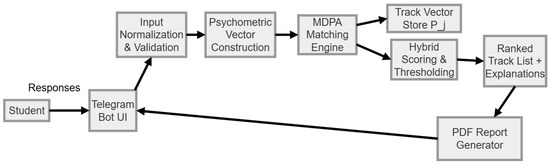
The system operates in the following stages, as shown in Figure 1 that illustrates the end-to-end data flow of the system.
Figure 1.
System architecture and data flow of the MDPA-based academic guidance platform.
- 1.
- User Input Collection: Students respond to structured psychometric questions via the Telegram interface.
- 2.
- Normalization and Vectorization: Raw responses are normalized to the range and assembled into the 24-dimensional student vector U.
- 3.
- Alignment Computation: For each academic track j, the MDPA algorithm computes , , , and as described in Section 3.
- 4.
- Ranking and Filtering: Tracks are ranked by , and those failing critical threshold constraints are deprioritized.
- 5.
- Explainable Output: The system generates a ranked list accompanied by explanatory feedback highlighting strengths, gaps, and deal-breaker traits. A personalized PDF report is optionally generated and returned to the student.
4.3. Implementation Details
All experiments reported in this study use fixed, deterministic parameter values to ensure reproducibility. With respect to the parameters defined in Section 3 the following values have been chosen:
- Hybrid Weight : This value prioritizes interest alignment (shape) while still enforcing competency sufficiency (magnitude). Empirically, values above were found to overemphasize preference similarity, leading to academically risky recommendations, whereas lower values overly penalized motivated students with minor skill gaps. The chosen value reflects a balanced counseling-oriented trade-off rather than a purely predictive objective.
- Penalty Factor : The multiplicative penalty applied to violated critical traits introduces a soft but compounding constraint. A value of was selected to significantly reduce the final score without collapsing it to zero, allowing advisors and students to still observe near-miss scenarios while clearly signaling insufficiency.
- Tolerance Threshold : This margin allows for reasonable variability in self-reported measures while still enforcing minimum requirements. Smaller values were found to be overly strict given the noise inherent in psychometric self-assessment.
- Smoothing Constant : Prevents zero-weight traits and ensures numerical stability in distance computations.
To verify that these choices were robust and not arbitrarily selected, we conducted a sensitivity analysis over a predefined parameter grid: , , , and . For each configuration, we repeated the Monte Carlo validation experiment described in Section 5 and evaluated selectivity, high-confidence matches, Top-3 recommendation overlap, and ranking stability. The results, reported in Section 5.2, confirm that the default configuration provides a robust compromise between conservative recommendation behavior, ranking consistency, and resistance to inflated match scores under overly permissive settings.
4.4. Computational Complexity and Performance
For each student query, the system computes alignment scores across all available tracks. The time complexity is: , where N is the number of academic tracks and is the fixed dimensionality of the psychometric space. In practice, with tens to hundreds of tracks, the system achieves sub-second latency on commodity hardware, making it suitable for real-time academic advising scenarios.
4.5. Design Considerations
The implementation deliberately avoids black-box models and online learning components. All recommendations are reproducible, auditable, and traceable to explicit psychometric dimensions and expert-defined requirements. This design choice aligns with the high-stakes nature of academic guidance and supports transparency for students, advisors, and institutions alike.
5. Case Study and Validation
To evaluate the efficacy and robustness of the proposed Multi-Dimensional Psychometric Alignment (MDPA) framework, we conducted a two-fold validation strategy: a qualitative single-subject analysis and a quantitative large-scale simulation.
5.1. Subject Profile Analysis (Qualitative)
We first analyzed the profile of a third-year undergraduate student (“Student A”) enrolled in the School of Digital Technologies. Student A completed the 24-dimensional psychometric inventory, and the resulting profile vector U exhibited distinct characteristics:
- Cognitive Modalities: High magnitude in Logical-Mathematical intelligence ().
- Personality Traits: Significant inclination toward Introversion within the Big Five spectrum.
- Interpersonal Competency: Moderate to low scores in Interpersonal skills and Extraversion ().
We performed a comparative analysis between the baseline rank-order method (Spearman’s Rank Correlation, representing “Interest Shape”) and the proposed MDPA Hybrid Method (incorporating Magnitude Sufficiency and Deal-Breaker Thresholds). The results for three distinct academic tracks are presented in Table 1.
Table 1.
Comparative Analysis: Baseline vs. MDPA (Student A).
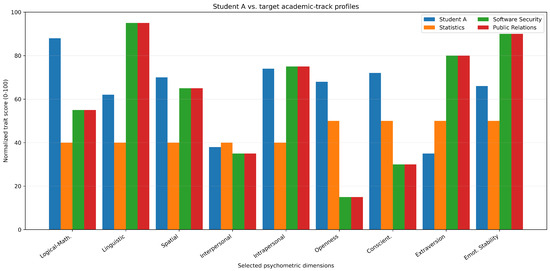
To improve interpretability, we also visualize the discrepancy between Student A’s profile vector and the target vectors of representative academic tracks. This profile-level comparison allows advisors and students to inspect which dimensions contribute to a high or low recommendation score, rather than relying only on the final numerical output.
The comparative data in Table 1, together with the profile comparison in Figure 2, highlights the critical function of the magnitude-based constraints. Under the Baseline method, the “Public Relations” track yielded a similarity score of 60%, suggesting a viable match. This false positive occurred because the “shape” of the student’s preferences—the relative prioritization of certain traits—superficially aligned with the track’s structure.
Figure 2.
Profile-level comparison between Student A and three representative academic tracks. The visualization highlights trait-level discrepancies between the student vector and target track vectors, showing that the Statistics track is broadly aligned with the student’s logical-mathematical profile, whereas the Public Relations track requires substantially higher interpersonal and extraversion-related traits than the student currently reports.
However, the MDPA algorithm correctly identified a competency deficit. The Public Relations track imposes a “Deal-Breaker” threshold on Extraversion (target ). Since the student’s absolute score fell significantly below the tolerance threshold , the non-linear penalty mechanism (Equation (6)) was triggered. Consequently, the final suitability score collapsed to 12%, effectively filtering out a track for which the student lacked the necessary behavioral traits for sustained success, despite superficial interest alignment. Conversely, the “Statistics” track maintained a high score, as the student satisfied both the interest pattern (Shape) and the required competency levels (Magnitude).
As shown in Figure 2, Student A’s strongest alignment occurs with the Statistics track, where the student’s high logical-mathematical score corresponds closely to the target profile. In contrast, the Public Relations profile requires substantially stronger interpersonal and extraversion-related traits. This visual gap explains why the baseline correlation score alone is misleading: although the relative pattern of preferences may appear partially similar, the absolute magnitude of critical traits is insufficient. The visualization therefore makes the MDPA penalty mechanism more transparent and supports explainable academic advising.
5.2. Sensitivity Analysis of Hyperparameters
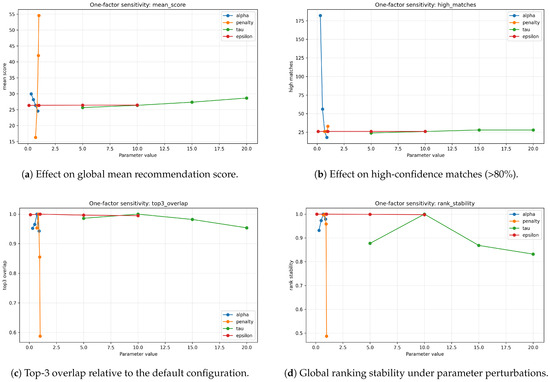
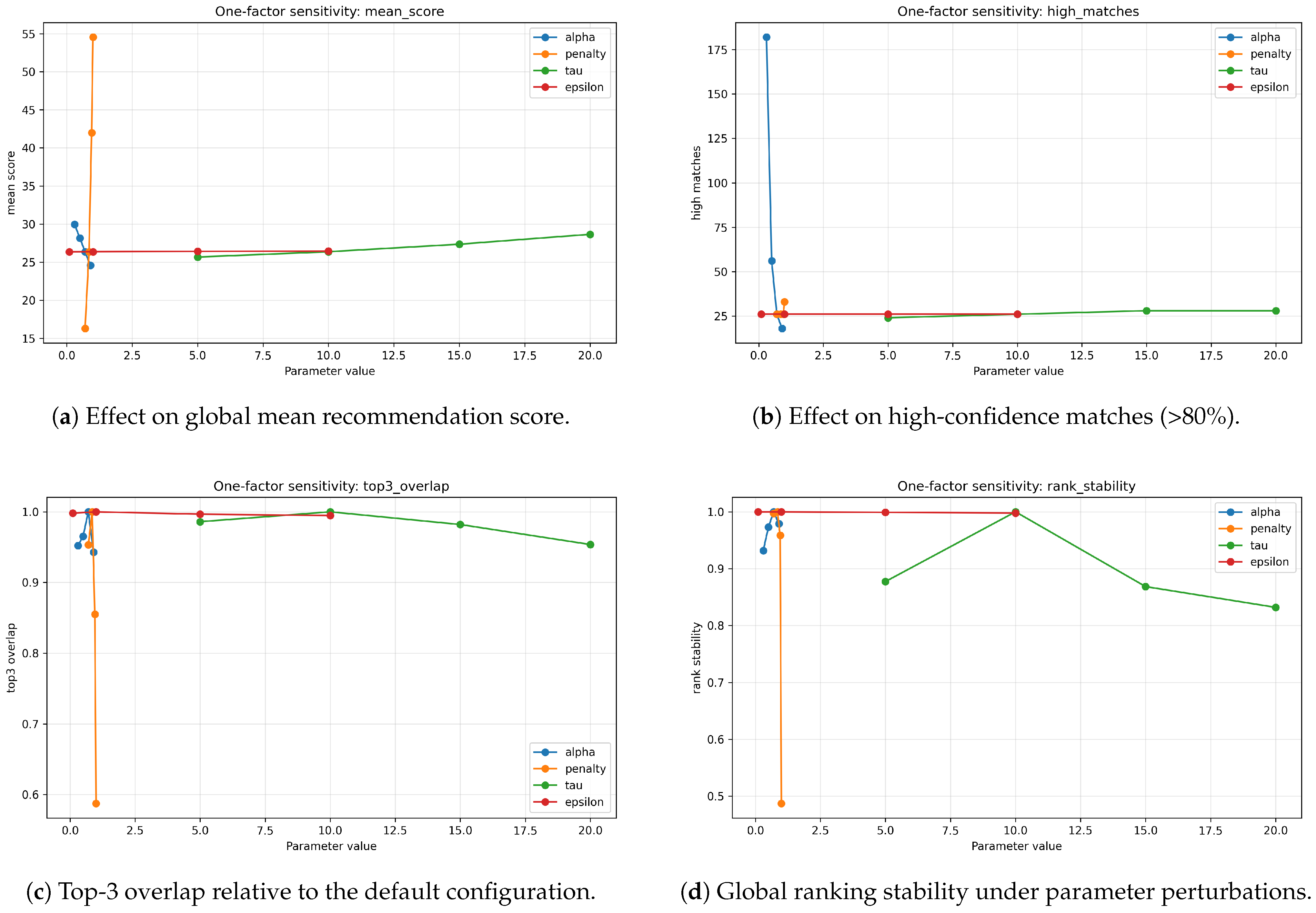
To further justify the empirically selected hyperparameters, we conducted a one-factor-at-a-time sensitivity analysis using the same Monte Carlo protocol described in Section 5. For each experiment, one parameter was varied while all others were held at their default values . We report four complementary criteria: (i) mean recommendation score across all student–track pairs, (ii) number of high-confidence matches above 80%, (iii) Top-3 overlap with the default ranking, and (iv) global rank stability. These measures jointly capture selectivity, robustness, and recommendation consistency.
The results in Figure 3 confirm that the proposed defaults provide a balanced operating point. Parameters that are too permissive increase the number of high-confidence matches and inflate average scores, whereas overly restrictive settings suppress potentially valid recommendations. In contrast, stable configurations preserve the ranking structure of recommended tracks while maintaining conservative selectivity.
Figure 3.
One-factor sensitivity analysis of the MDPA hyperparameters. Panels show the effect of varying , penalty factor, , and on recommendation selectivity and ranking robustness: (a) mean score, (b) high-confidence matches, (c) Top-3 overlap, and (d) rank stability.
The hybrid weight had the strongest influence on recommendation selectivity. Lower values substantially increased the number of high-confidence matches (up to 182 when ), indicating that overemphasis on magnitude alone can weaken discriminative power. Conversely, values near the selected default retained high ranking consistency while avoiding excessive optimism.
The penalty factor controlled the sharpness of the deal-breaker mechanism. A weak penalty () caused a dramatic rise in mean score (54.6%) and reduced rank stability to 0.49, indicating that insufficient penalization allows many unrealistic matches to survive. By contrast, the adopted value preserved conservative filtering while maintaining stable rankings.
The tolerance threshold showed moderate sensitivity. Larger margins gradually increased mean scores and the number of accepted matches, as expected, since more students were allowed to fall below critical trait targets without penalty. However, values above the default slightly reduced ranking consistency, supporting as a practical compromise between flexibility and rigor.
Finally, the smoothing constant had negligible impact across all metrics. This confirms that its role is primarily numerical rather than behavioral, validating the use of for stable weight computation.
5.3. Aggregate Simulation Study (Quantitative)
To validate the system’s selectivity and resistance to random noise, we conducted a Monte Carlo simulation. We generated synthetic student profiles using a Gaussian distribution () and matched them against ground-truth academic tracks defined by experts in our study. We defined a “High Match” as a score exceeding 80%. Since we had 32 ground truth vectors, this resulted in 32,000 total simulation events.
Importantly, the sensitivity results in Table 2 show that these gains are robust under moderate parameter perturbations. The observed reduction in false positives is therefore not an artifact of a single hand-picked configuration, but a consistent property of the proposed magnitude–shape alignment framework.
Table 2.
Sensitivity analysis of MDPA hyperparameters.
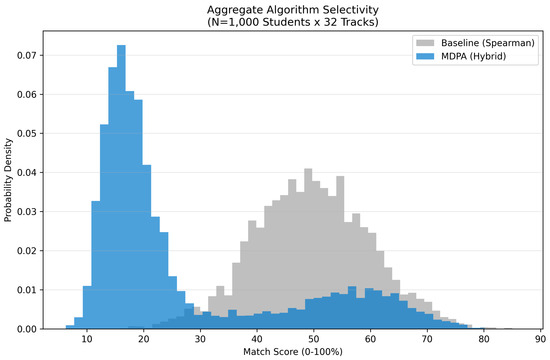
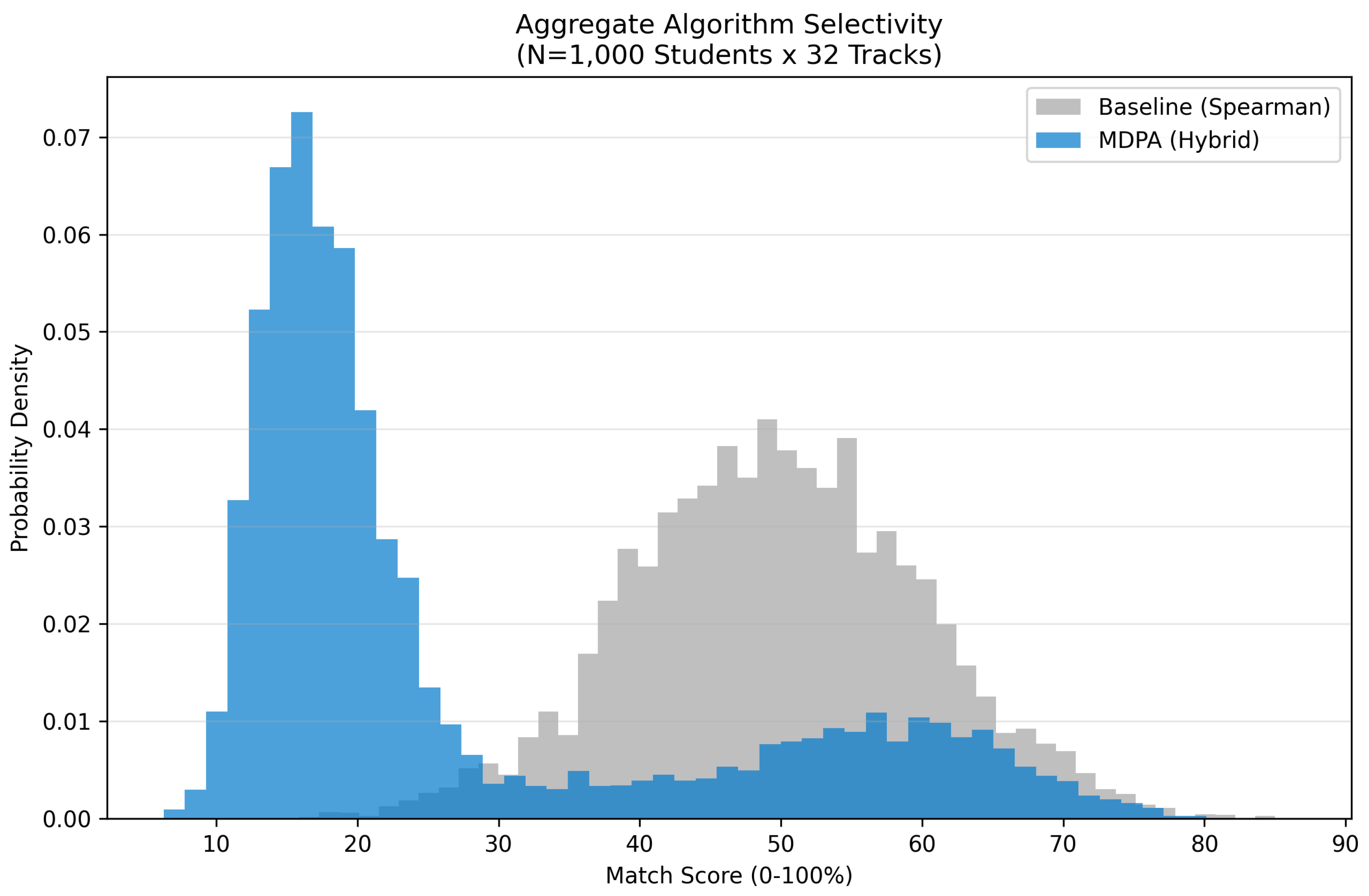
The distribution of compatibility scores is presented in Figure 4.
Figure 4.
Aggregate Algorithm Selectivity ( Students × 32 Tracks). The Baseline distribution (Gray) centers around 50%, indicating high noise sensitivity. The MDPA distribution (Blue) is significantly left-skewed, demonstrating the suppression of candidates who lack competency sufficiency.
6. Analysis of Results and Future Work
The results (Table 3 and Figure 4) demonstrate a significant improvement in algorithmic robustness. More specifically:
Table 3.
Simulation Results: Selectivity Analysis (N = 32,000).
- Noise Suppression: The Global Mean Score dropped from ≈50% in the Baseline to ≈27% in the MDPA. This indicates that the MDPA framework correctly identifies and penalizes candidates who lack specific trait sufficiency, whereas the Baseline method tends to overestimate fit based on random correlation. The baseline correlation-only model tends to assign moderate viability scores even to random profiles, creating a “false hope” effect for unprepared students. In contrast, the MDPA algorithm effectively acts as a conservative filter.
- False Positive Reduction: In the randomized dataset, the Baseline method yielded 32 spurious “High Match” recommendations (>) purely by chance. The MDPA mechanism successfully filtered out 93.8% of these cases, reducing the number of false positives to just 2.
These findings confirm that the inclusion of Magnitude Sufficiency and Deal-Breaker Thresholds creates a significantly safer and more discriminative recommender system, minimizing the risk of guiding students into tracks for which they are fundamentally unprepared. The “Deal-Breaker” penalty converts the recommendation problem from a continuous correlation task into a discontinuous sufficiency task. The long tail observed in the MDPA distribution (Figure 4, Blue) corresponds to the rare “valid matches” where both interest shape and competency magnitude are satisfied, while the bulk of unfit candidates are correctly shifted to the low-score region (<).
6.1. Discussion and Ethical Considerations
The results underscore the limitations of relying solely on semantic similarity, as seen in LLM-based approaches, or rank-order correlation for academic guidance. While stochastic models offer flexibility, they often lack the deterministic precision required for high-stakes decision-making. The MDPA framework addresses this by anchoring recommendations in a quantifiable, explainable vector space where rejection reasons are mathematically traceable to specific trait deficits.
However, three key limitations must be acknowledged. First, the validity of the recommendations is currently bounded by the reliability of self-reported psychometric data, which may be influenced by the Dunning-Kruger effect [34]. Future implementations could address this by integrating objective performance metrics (e.g., entrance exam scores) alongside self-reports. We agree that self-reported psychometric data alone is insufficient for fully reliable academic guidance. Such data may reflect subjective perception, social desirability, limited self-awareness, or temporary motivational states rather than stable academic readiness. Therefore, the current system should be interpreted as a decision-support prototype rather than a complete predictive advising model. A more robust implementation should combine self-reported profiles with objective educational data, including prior grades, entrance examination scores, course performance, attendance patterns, learning-management-system activity, assessment histories, and longitudinal progression indicators. These sources would allow the system to learn from actual academic behavior and outcomes, reducing dependence on subjective perception and improving calibration of the recommendation scores.
Second, the empirical component of this study is limited in scale. The qualitative validation is based on an illustrative case study involving students from a single university context in Kazakhstan. Therefore, the case study should not be interpreted as sufficient evidence of broad institutional or cross-cultural generalizability. Rather, the present work should be understood primarily as a methodological and system-design contribution, supported by an illustrative case analysis and a Monte Carlo simulation. Larger multi-institutional deployments involving diverse student populations are required to validate the framework under real-world advising conditions.
Third, the enforcement of rigid thresholds raises ethical questions regarding algorithmic gatekeeping. To prevent discouraging students with a “growth mindset,” this system is designed to function strictly as a decision-support tool rather than a decision-maker; scores represent a snapshot of current readiness rather than a definitive prediction of potential.
For this reason, MDPA recommendations should not be used as automatic admission, exclusion, or tracking decisions. They should instead support human advisors by highlighting possible strengths, risks, and developmental gaps, while final academic decisions remain under student and advisor control.
In addition, construct validity remains a central limitation of the current implementation. The 24-dimensional profile combines heterogeneous constructs for computational alignment, and the resulting scores should not be interpreted as validated psychological measurements. Future work should therefore include formal reliability analysis, factor-structure examination, and comparison against standardized psychometric instruments.
6.2. Future Work
Future research will focus on longitudinal empirical validation. A priority will be to extend the evaluation beyond the current single-university context by conducting multi-cohort and multi-institutional studies. Such deployments will allow us to examine whether the proposed alignment mechanism remains reliable across different academic systems, cultural contexts, disciplines, and advising practices. We intend to track the academic performance (GPA) and retention rates of the initial cohort of students utilizing the MDPA system over a four-year period. This longitudinal dataset will enable the transition from expert-defined heuristics to data-driven optimization. Specifically, we aim to employ regression analysis to empirically calibrate the hybrid weighting factor and the penalty tolerance , thereby refining the mathematical balance between interest-based motivation and competency-based resilience. Future work will also examine whether the relative weights assigned to MBTI, Gardner-based modalities, and Big Five dimensions should be adjusted using longitudinal student outcomes, and whether alternative validated guidance frameworks provide stronger predictive or advisory value. It will extend the framework toward a data-enriched hybrid model that combines psychometric alignment with educational data mining. In this setting, objective student records can be used to validate and recalibrate the expert-defined track vectors, estimate the predictive contribution of each psychometric dimension, and identify whether particular trait gaps are actually associated with lower performance, dropout risk, or track switching. In addition, larger datasets could support machine-learning or large-model components for pattern discovery, while preserving the explainable MDPA layer as the final decision-support interface. This would allow the system to benefit from data-driven evidence without becoming an opaque black-box recommender.
7. Conclusions
This paper introduced the Multi-Dimensional Psychometric Alignment (MDPA) recommender system, a novel decision-support framework designed to optimize academic track selection. By synthesizing Cognitive Preferences, Learning Modalities, and Personality Stability into a unified 24-dimensional vector space, we established a robust alternative to “black-box” skill matchers.
Additional hyperparameter sensitivity experiments further confirmed that the default MDPA configuration achieves a stable trade-off between selectivity, robustness, and recommendation consistency.
The primary contribution of this work is the formulation of a deterministic “Magnitude-Shape” hybrid metric.
Equally important is the unified modeling of multiple psychometric perspectives within a transparent recommendation framework tailored to academic pathway decisions.
Unlike traditional approaches that conflate preference with ability, this algorithm explicitly distinguishes between a student’s relative interest structure and their absolute competency sufficiency. Simulation results demonstrate that this approach reduces false-positive recommendations by 93.8% compared to baseline methods, effectively filtering out candidates who pose high academic risks despite superficial interest alignment. At the same time, these findings should be interpreted with caution because the empirical case component remains limited to a single institutional setting. The present study therefore establishes the feasibility and methodological value of MDPA rather than providing definitive evidence of generalizability across universities or national contexts.
Ultimately, the MDPA framework provides students with transparent, scientifically grounded guidance. By enforcing explicit “Deal-Breaker” thresholds, the system ensures that academic choices are aligned not only with what students enjoy but also with the cognitive and behavioral prerequisites essential for their long-term academic success. Nevertheless, future validation must incorporate objective educational data and longitudinal outcomes to reduce self-report bias and confirm whether the proposed alignment scores predict real academic success across cohorts and institutions. Future large-scale validation with multiple universities, larger student cohorts, longitudinal outcome tracking, and objective educational records will be necessary to confirm the practical impact and external validity of the proposed approach.
Author Contributions
Conceptualization, S.S. and B.R.; methodology, S.S.; software, Y.K.; validation, S.S. and B.R.; formal analysis, I.V.; investigation, S.S.; resources, I.V.; data curation, C.T. and Y.K.; writing—original draft preparation, I.V.; writing—review and editing, C.T.; visualization, Y.K. and B.R.; supervision, I.V. and C.T.; project administration, S.S. All authors have read and agreed to the published version of the manuscript.
Funding
This research received no external funding.
Institutional Review Board Statement
Not applicable.
Informed Consent Statement
Not applicable.
Data Availability Statement
The datasets presented in this article are not readily available because the data are part of an ongoing study. Requests to access the datasets should be directed to shakhmar.sarsenbay@narxoz.kz.
Acknowledgments
During the preparation of this manuscript, the authors used ChatGPT 4 for the purposes of polishing the use of English. The authors have reviewed and edited the output and take full responsibility for the content of this publication.
Conflicts of Interest
Authors Shakhmar Sarsenbay, Bobir Razhametov and Yermek Kazym were employed by the company Tanu.ai. The remaining authors declare that the research was conducted in the absence of any commercial or financial relationships that could be construed as a potential conflict of interest.
References
- Kazi, A.S.; Akhlaq, A. Factors affecting students’ career choice. J. Res. Reflect. Educ. 2017, 2, 187–196. [Google Scholar]
- Schwartz, B. The paradox of choice. In Positive Psychology in Practice: Promoting Human Flourishing in Work, Health, Education, and Everyday Life; Harper Perennial: New York, NY, USA, 2015; pp. 121–138. [Google Scholar]
- Pêgo, J.P.; Miguéis, V.L.; Soeiro, A. Students’ complex trajectories: Exploring degree change and time to degree. Int. J. Educ. Technol. High. Educ. 2024, 21, 8. [Google Scholar] [CrossRef] [Scilit]
- Fernández-García, A.J.; Rodríguez-Echeverría, R.; Preciado, J.C.; Manzano, J.M.C.; Sánchez-Figueroa, F. Creating a recommender system to support higher education students in the subject enrollment decision. IEEE Access 2020, 8, 189069–189088. [Google Scholar] [CrossRef] [Scilit]
- Algarni, S.; Sheldon, F. Systematic review of recommendation systems for course selection. Mach. Learn. Knowl. Extr. 2023, 5, 560–596. [Google Scholar] [CrossRef] [Scilit]
- Sarsenbay, S.; Kabdiyev, A.; Varlamis, I.; Sardianos, C.; Turan, C.; Razhametov, B.; Kazym, Y. Generating Job Recommendations Based on User Personality and Gallup Tests. Algorithms 2025, 18, 275. [Google Scholar] [CrossRef] [Scilit]
- Ozbası, D. Using rank-order judgments scaling to determine students’ evaluation preferences. Eurasian J. Educ. Res. 2019, 19, 63–80. [Google Scholar] [CrossRef] [Scilit]
- Siswipraptini, P.C.; Warnars, H.L.H.S.; Ramadhan, A.; Budiharto, W. Personalized career-path recommendation model for information technology students in Indonesia. IEEE Access 2024, 12, 49092–49105. [Google Scholar] [CrossRef] [Scilit]
- Anupama, V.; Elayidom M, S. Recurrent academic path recommendation model for engineering students using MBTI indicators and optimization enabled recurrent neural network. Sci. Rep. 2025, 15, 24361. [Google Scholar] [CrossRef] [Scilit]
- Urdaneta-Ponte, M.C.; Mendez-Zorrilla, A.; Oleagordia-Ruiz, I.; Garcia-Zubia, J. Recommendation Systems for Education: A Systematic Review. Electronics 2021, 10, 1611. [Google Scholar] [CrossRef] [Scilit]
- Roy, D.; Dutta, M. A Systematic Review and Research Perspective on Recommender Systems in E-Learning Environments. Educ. Inf. Technol. 2022, 27, 7489–7520. [Google Scholar] [CrossRef] [Scilit]
- Aucancela, M.; Gonzalez-Briones, A.; Chamoso, P. Educational Recommender Systems: A Systematic Literature Review. Educ. Sci. 2023, 13, 921. [Google Scholar] [CrossRef] [Scilit]
- da Cruz, A.K.B.S.; Neto, C.d.S.S.; Teixeira, M.A.M.; da Cruz, P.T.M.B. Individualized Recommender Systems for Teaching: A Systematic Mapping Study. Braz. J. Educ. Technol. Soc. 2024, 17, 878–908. [Google Scholar] [CrossRef] [Scilit]
- Wan, J.; Sun, Q.; Li, X.; Ding, J.; Zhu, Q. Personalized professional recommendation system based on undergraduate questionnaires. In Proceedings of the 2018 17th International Symposium on Distributed Computing and Applications for Business Engineering and Science (DCABES); IEEE: New York, NY, USA, 2018; pp. 140–143. [Google Scholar]
- Su, J.H.; Liao, Y.W.; Chen, L.N. An Intelligent Course Decision Assistant by Mining and Filtering Learners’ Personality Patterns. Appl. Sci. 2019, 9, 4665. [Google Scholar] [CrossRef] [Scilit]
- Kamal, N.; Sarker, F.; Rahman, A.; Hossain, S.; Mamun, K.A. Recommender System in Academic Choices of Higher Education: A Systematic Review. IEEE Access 2024, 12, 45521–45549. [Google Scholar] [CrossRef] [Scilit]
- Delahoz-Domínguez, E.J.; Hijón-Neira, R. Recommender System for University Degree Selection: A Socioeconomic and Standardised Test Data Approach. Appl. Sci. 2024, 14, 8311. [Google Scholar] [CrossRef] [Scilit]
- Kord, A.; Aboelfetouh, A.; Shohieb, S.M. Academic course planning recommendation and students’ performance prediction multi-modal based on educational data mining techniques. J. Comput. High. Educ. 2026, 38, 38–76. [Google Scholar] [CrossRef] [Scilit]
- Su, J.H.; Liao, Y.W.; Xu, J.Z.; Zhao, Y.W. A Personality-Driven Recommender System for Cross-Domain Learning Based on Holland Code Assessments. Sustainability 2021, 13, 3936. [Google Scholar] [CrossRef] [Scilit]
- Maridueña-Arroyave, M.R.; Febles-Estrada, A. A college degree recommendation model. Dyna 2016, 83, 29–34. [Google Scholar] [CrossRef] [Scilit]
- Schelfhout, S.; Wille, B.; Fonteyne, L.; Roels, E.; De Fruyt, F.; Duyck, W. From Interest Assessment to Study Orientation: An Empirical Advice Set Engine. J. Exp. Educ. 2021, 89, 169–195. [Google Scholar] [CrossRef] [Scilit]
- Lin, H.; Wang, C.; Sun, Y. How big five personality traits influence information sharing on social media: A meta analysis. PLoS ONE 2024, 19, e0303770. [Google Scholar] [CrossRef] [Scilit]
- Qamhieh, M.; Sammaneh, H.; Demaidi, M.N. PCRS: Personalized career-path recommender system for engineering students. IEEE Access 2020, 8, 214039–214049. [Google Scholar] [CrossRef] [Scilit]
- Sarmurzin, Y.; Azhenov, A.; Kudysheva, A.; Ualikhanova, B.; Saparbekova, I.; Besbayev, A. Implementation of AI in career counselling for university students: A systematic review. Front. Educ. 2026, 11, 1787689. [Google Scholar] [CrossRef] [Scilit]
- Romero, C.; Ventura, S. Educational data mining and learning analytics: An updated survey. WIREs Data Min. Knowl. Discov. 2020, 10, e1355. [Google Scholar] [CrossRef] [Scilit]
- Duan, C.; Wan, X.; Zhang, W.; Wang, Y.; Wang, J.; Zhang, M. Predicting Student Performance Using Machine Learning Techniques: A Systematic Literature Review. In Proceedings of the 2025 7th International Conference on Computer Science and Technologies in Education (CSTE); IEEE: New York, NY, USA, 2025; pp. 362–368. [Google Scholar] [CrossRef] [Scilit]
- Guevara-Reyes, R.; Ortiz-Garcés, I.; Andrade, R.; Cox-Riquetti, F.; Villegas-Ch, W. Machine learning models for academic performance prediction: Interpretability and application in educational decision-making. Front. Educ. 2025, 10, 1632315. [Google Scholar] [CrossRef] [Scilit]
- Liu, H.; Zhu, Y.; Zang, T.; Xu, Y.; Yu, J.; Tang, F. Jointly modeling heterogeneous student behaviors and interactions among multiple prediction tasks. ACM Trans. Knowl. Discov. Data 2021, 16, 1–24. [Google Scholar] [CrossRef] [Scilit]
- Liu, H.; Zhu, Y.; Wang, C.; Ding, J.; Yu, J.; Tang, F. Incorporating heterogeneous user behaviors and social influences for predictive analysis. IEEE Trans. Big Data 2022, 9, 716–732. [Google Scholar] [CrossRef] [Scilit]
- Sarsenbay, S.; Varlamis, I.; Turan, C.; Zhalgassova, Z. Job recommendation systems and the benefits from the use of Gallup Tests. Int. J. Web Eng. Technol. 2024, 21. [Google Scholar] [CrossRef] [Scilit]
- Myers, I.B. The Myers-Briggs Type Indicator; Consulting Psychologists Press: Palo Alto, CA, USA, 1962; Volume 34. [Google Scholar]
- Gardner, H. Frames of Mind: A Theory of Multiple Intelligences; Basic Books: New York, NY, USA, 1983. [Google Scholar]
- Roccas, S.; Sagiv, L.; Schwartz, S.H.; Knafo, A. The big five personality factors and personal values. Personal. Soc. Psychol. Bull. 2002, 28, 789–801. [Google Scholar] [CrossRef] [Scilit]
- Dunning, D. The Dunning–Kruger effect: On being ignorant of one’s own ignorance. In Advances in Experimental Social Psychology; Elsevier: Amsterdam, The Netherlands, 2011; Volume 44, pp. 247–296. [Google Scholar]

Disclaimer/Publisher’s Note: The statements, opinions and data contained in all publications are solely those of the individual author(s) and contributor(s) and not of MDPI and/or the editor(s). MDPI and/or the editor(s) disclaim responsibility for any injury to people or property resulting from any ideas, methods, instructions or products referred to in the content. |
© 2026 by the authors. Licensee MDPI, Basel, Switzerland. This article is an open access article distributed under the terms and conditions of the Creative Commons Attribution (CC BY) license.