Fidgety Movement Classification in Preterm Infants Without Major Structural Brain Abnormalities: Associations with Gestational Age, Birth Weight, and Neonatal Morbidity

Highlights
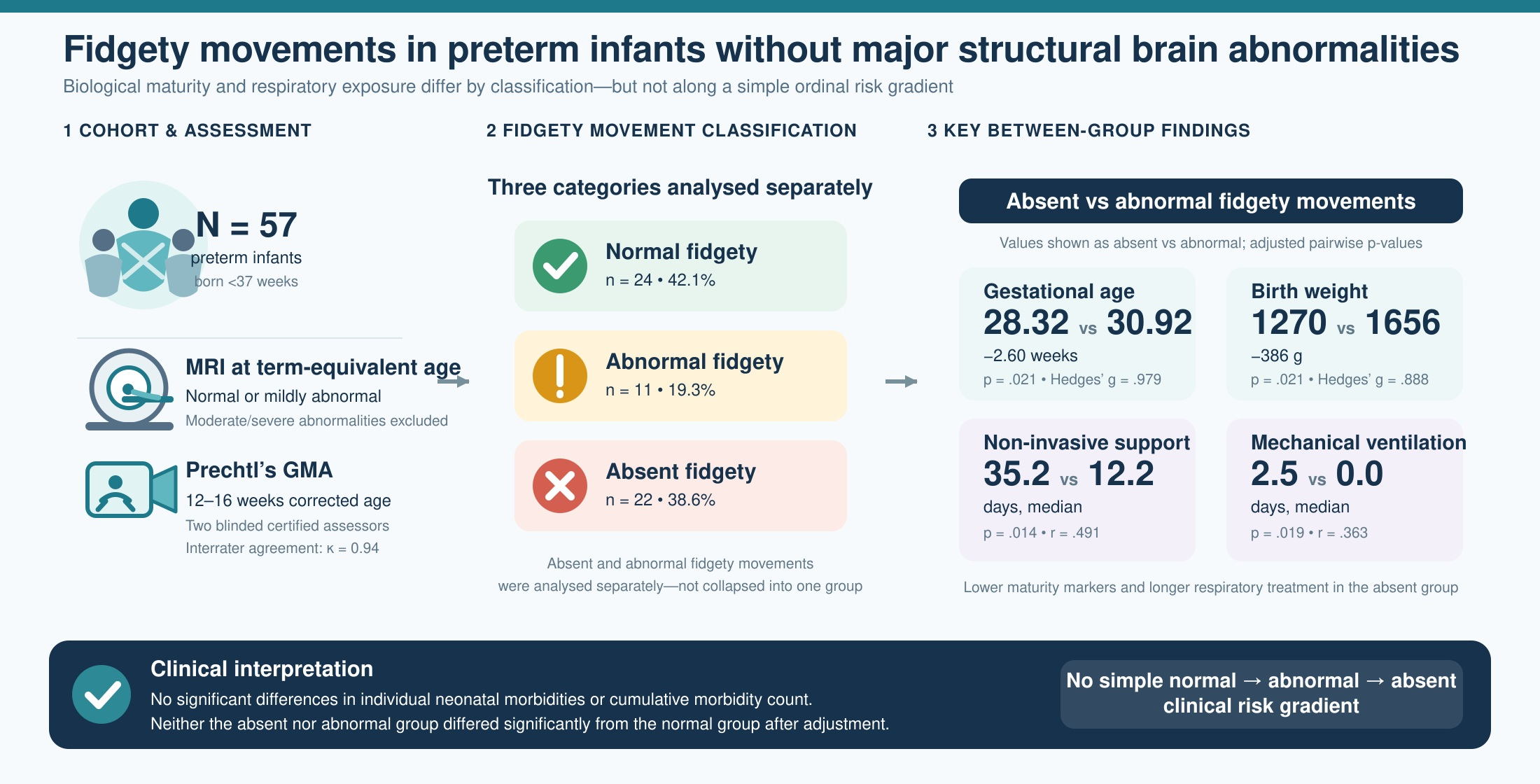
- Infants with absent fidgety movements had lower gestational age and birth weight and longer respiratory treatment than those with abnormal fidgety movements.
- Infants with abnormal fidgety movements descriptively had the highest gestational age and birth weight and the shortest respiratory treatment among the three groups.
- Abnormal and absent fidgety movements should be analysed separately.
- Clinical factors do not indicate an ordinal risk gradient across fidgety movement classifications.
Abstract
1. Introduction
2. Materials and Methods
2.1. Study Design and Setting
2.2. Participants
2.3. General Movements Assessment
2.4. Clinical Variables
2.5. Statistical Analysis
3. Results
3.1. Sample Characteristics
3.2. Biological Maturity
3.3. Neonatal Morbidity
4. Discussion
Strengths and Limitations
5. Conclusions
Author Contributions
Funding
Institutional Review Board Statement
Informed Consent Statement
Data Availability Statement
Conflicts of Interest
Abbreviations
| BPD | bronchopulmonary dysplasia |
| BW | birth weight |
| CA | corrected age |
| GA | gestational age |
| GMs | general movements |
| GMA | General Movements Assessment |
| MRI | magnetic resonance imaging |
| NEC | necrotizing enterocolitis |
| NICU | neonatal intensive care unit |
| ROP | retinopathy of prematurity |
References
- Edelman, G.M. Neural Darwinism: The Theory of Neuronal Group Selection; Basic Books: New York, NY, USA, 1987. [Google Scholar]
- Hadders-Algra, M. Early Human Motor Development: From Variation to the Ability to Vary and Adapt. Neurosci. Biobehav. Rev. 2018, 90, 411–427. [Google Scholar] [CrossRef] [Scilit] [PubMed]
- Einspieler, C.; Prechtl, H.F.R. Prechtl’s Assessment of General Movements: A Diagnostic Tool for the Functional Assessment of the Young Nervous System. Ment. Retard. Dev. Disabil. Res. Rev. 2005, 11, 61–67. [Google Scholar] [CrossRef] [Scilit] [PubMed]
- Einspieler, C.; Bos, A.F.; Krieber-Tomantschger, M.; Alvarado, E.; Barbosa, V.M.; Bertoncelli, N.; Burger, M.; Chorna, O.; Del Secco, S.; DeRegnier, R.-A.; et al. Cerebral Palsy: Early Markers of Clinical Phenotype and Functional Outcome. J. Clin. Med. 2019, 8, 1616. [Google Scholar] [CrossRef] [Scilit] [PubMed]
- Einspieler, C.; Peharz, R.; Marschik, P.B. Fidgety Movements–Tiny in Appearance, but Huge in Impact. J. Pediatr. 2016, 92, S64–S70. [Google Scholar] [CrossRef] [Scilit] [PubMed]
- Bosanquet, M.; Copeland, L.; Ware, R.; Boyd, R. A Systematic Review of Tests to Predict Cerebral Palsy in Young Children. Dev. Med. Child Neurol. 2013, 55, 418–426. [Google Scholar] [CrossRef] [Scilit] [PubMed]
- Novak, I.; Morgan, C.; Adde, L.; Blackman, J.; Boyd, R.N.; Brunstrom-Hernandez, J.; Cioni, G.; Damiano, D.; Darrah, J.; Eliasson, A.-C.; et al. Early, Accurate Diagnosis and Early Intervention in Cerebral Palsy: Advances in Diagnosis and Treatment. JAMA Pediatr. 2017, 171, 897–907. [Google Scholar] [CrossRef] [Scilit] [PubMed]
- Datta, A.N.; Furrer, M.A.; Bernhardt, I.; Hüppi, P.S.; Borradori-Tolsa, C.; Bucher, H.U.; Latal, B.; Grunt, S.; Natalucci, G.; The GM Group. Fidgety Movements in Infants Born Very Preterm: Predictive Value for Cerebral Palsy in a Clinical Multicentre Setting. Dev. Med. Child Neurol. 2017, 59, 618–624. [Google Scholar] [CrossRef] [Scilit] [PubMed]
- Salavati, S.; Bos, A.F.; Doyle, L.W.; Anderson, P.J.; Spittle, A.J. Very Preterm Early Motor Repertoire and Neurodevelopmental Outcomes at 8 Years. Pediatrics 2021, 148, e2020049572. [Google Scholar] [CrossRef] [Scilit] [PubMed]
- Allotey, J.; Zamora, J.; Cheong-See, F.; Kalidindi, M.; Arroyo-Manzano, D.; Asztalos, E.; van der Post, J.; Mol, B.; Moore, D.; Birtles, D.; et al. Cognitive, Motor, Behavioural and Academic Performances of Children Born Preterm: A Meta-Analysis and Systematic Review Involving 64 061 Children. BJOG 2018, 125, 16–25. [Google Scholar] [CrossRef] [Scilit] [PubMed]
- Anderson, P.J. Neuropsychological Outcomes of Children Born Very Preterm. Semin. Fetal. Neonatal Med. 2014, 19, 90–96. [Google Scholar] [CrossRef] [Scilit] [PubMed]
- Twilhaar, E.S.; Wade, R.M.; de Kieviet, J.F.; van Goudoever, J.B.; van Elburg, R.M.; Oosterlaan, J. Cognitive Outcomes of Children Born Extremely or Very Preterm Since the 1990s and Associated Risk Factors: A Meta-Analysis and Meta-Regression. JAMA Pediatr. 2018, 172, 361–367. [Google Scholar] [CrossRef] [Scilit] [PubMed]
- Niutanen, U.; Harra, T.; Lano, A.; Metsäranta, M. Systematic Review of Sensory Processing in Preterm Children Reveals Abnormal Sensory Modulation, Somatosensory Processing and Sensory-Based Motor Processing. Acta Paediatr. 2020, 109, 45–55. [Google Scholar] [CrossRef] [Scilit] [PubMed]
- Song, I.G. Neurodevelopmental Outcomes of Preterm Infants. Clin. Exp. Pediatr. 2023, 66, 281–287. [Google Scholar] [CrossRef] [Scilit] [PubMed]
- Back, S.A.; Miller, S.P. Brain Injury in Premature Neonates: A Primary Cerebral Dysmaturation Disorder? Ann. Neurol. 2014, 75, 469–486. [Google Scholar] [CrossRef] [Scilit] [PubMed]
- Volleritsch, N.; Sappler, M.; Hammerl, M.; Mangesius, S.; Pupp Peglow, U.; Griesmaier, E.; Kiechl-Kohlendorfer, U.; Neubauer, V. Cognitive Outcomes at Preschool Age in Very Preterm Infants with Normal MRI Findings at Term-Equivalent Age: Identification of a Vulnerable Subgroup. BMJ Paediatr. Open 2026, 10, e004774. [Google Scholar] [CrossRef] [Scilit] [PubMed]
- Kostović, I.; Radoš, M.; Kostović-Srzentić, M.; Krsnik, Ž. Fundamentals of the Development of Connectivity in the Human Fetal Brain in Late Gestation: From 24 Weeks Gestational Age to Term. J. Neuropathol. Exp. Neurol. 2021, 80, 393–414. [Google Scholar] [CrossRef] [Scilit] [PubMed]
- Volpe, J.J. Brain Injury in Premature Infants: A Complex Amalgam of Destructive and Developmental Disturbances. Lancet Neurol. 2009, 8, 110–124. [Google Scholar] [CrossRef] [Scilit] [PubMed]
- Hadders-Algra, M. Neural Substrate and Clinical Significance of General Movements: An Update. Dev. Med. Child Neurol. 2018, 60, 39–46. [Google Scholar] [CrossRef] [Scilit] [PubMed]
- Stoll, B.J.; Hansen, N.I.; Adams-Chapman, I.; Fanaroff, A.A.; Hintz, S.R.; Vohr, B.; Higgins, R.D.; National Institute of Child Health and Human Development Neonatal Research Network. Neurodevelopmental and Growth Impairment among Extremely Low-Birth-Weight Infants with Neonatal Infection. JAMA 2004, 292, 2357–2365. [Google Scholar] [CrossRef] [Scilit] [PubMed]
- Rees, C.M.; Pierro, A.; Eaton, S. Neurodevelopmental Outcomes of Neonates with Medically and Surgically Treated Necrotizing Enterocolitis. Arch. Dis. Child. Fetal Neonatal Ed. 2007, 92, F193–F198. [Google Scholar] [CrossRef] [Scilit] [PubMed]
- Msall, M.E.; Phelps, D.L.; Hardy, R.J.; Dobson, V.; Quinn, G.E.; Summers, C.G.; Tremont, M.R.; Cryotherapy for Retinopathy of Prematurity Cooperative Group. Educational and Social Competencies at 8 Years in Children with Threshold Retinopathy of Prematurity in the CRYO-ROP Multicenter Study. Pediatrics 2004, 113, 790–799. [Google Scholar] [CrossRef] [Scilit] [PubMed]
- Galinsky, R.; Lear, C.A.; Dean, J.M.; Wassink, G.; Dhillon, S.K.; Fraser, M.; Davidson, J.O.; Bennet, L.; Gunn, A.J. Complex Interactions between Hypoxia-Ischemia and Inflammation in Preterm Brain Injury. Dev. Med. Child Neurol. 2018, 60, 126–133. [Google Scholar] [CrossRef] [Scilit] [PubMed]
- Di Fiore, J.M.; Vento, M. Intermittent Hypoxemia and Oxidative Stress in Preterm Infants. Respir. Physiol. Neurobiol. 2019, 266, 121–129. [Google Scholar] [CrossRef] [Scilit] [PubMed]
- Leviton, A.; Dammann, O.; Engelke, S.; Allred, E.; Kuban, K.C.K.; O’Shea, T.M.; Paneth, N.; ELGAN study investigators. The Clustering of Disorders in Infants Born before the 28th Week of Gestation. Acta Paediatr. 2010, 99, 1795–1800. [Google Scholar] [CrossRef] [Scilit] [PubMed]
- Ma, L.; Meng, L.D.; Chen, Y.H.; Yi, M.J.; Wang, J.W.; Cao, A.H. Risk Factors Associated with General Movement Quality in Infants. Hong Kong J. Paediatr. 2018, 23, 225–232. [Google Scholar]
- Peyton, C.; Yang, E.; Msall, M.E.; Adde, L.; Støen, R.; Fjørtoft, T.; Bos, A.F.; Einspieler, C.; Zhou, Y.; Schreiber, M.D.; et al. White Matter Injury and General Movements in High-Risk Preterm Infants. AJNR Am. J. Neuroradiol. 2017, 38, 162–169. [Google Scholar] [CrossRef] [Scilit] [PubMed]
- Merino-Andrés, J.; Pérez-Nombela, S.; Hidalgo-Robles, Á.; Pérez-Domínguez, M.D.P.; Prieto-Sánchez, L.; Fernández-Rego, F.J. The Relationship between General Movements and Risk Factors in Moderate-Late Preterm Infants: A Prospective Cohort Study. J. Clin. Med. 2023, 12, 7763. [Google Scholar] [CrossRef] [Scilit] [PubMed]
- Domagalska-Szopa, M.; Szopa, A.; Serrano-Gómez, M.E.; Hagner-Derengowska, M.; Behrendt, J. Identification of Risk Factors in Pre-Term Infants with Abnormal General Movements. Front. Neurol. 2022, 13, 850877. [Google Scholar] [CrossRef] [Scilit] [PubMed]
- Fjørtoft, T.; Evensen, K.A.I.; Øberg, G.K.; Songstad, N.T.; Labori, C.; Silberg, I.E.; Loennecken, M.; Møinichen, U.I.; Vågen, R.; Støen, R.; et al. High Prevalence of Abnormal Motor Repertoire at 3 Months Corrected Age in Extremely Preterm Infants. Eur. J. Paediatr. Neurol. 2016, 20, 236–242. [Google Scholar] [CrossRef] [Scilit] [PubMed]
- Kidokoro, H.; Neil, J.J.; Inder, T.E. New MR Imaging Assessment Tool to Define Brain Abnormalities in Very Preterm Infants at Term. AJNR Am. J. Neuroradiol. 2013, 34, 2208–2214. [Google Scholar] [CrossRef] [Scilit] [PubMed]
- Jobe, A.H.; Bancalari, E. Bronchopulmonary Dysplasia. Am. J. Respir. Crit. Care Med. 2001, 163, 1723–1729. [Google Scholar] [CrossRef] [Scilit] [PubMed]
- Walsh, M.C.; Kliegman, R.M. Necrotizing Enterocolitis: Treatment Based on Staging Criteria. Pediatr. Clin. N. Am. 1986, 33, 179–201. [Google Scholar] [CrossRef] [Scilit] [PubMed]
- Shane, A.L.; Sánchez, P.J.; Stoll, B.J. Neonatal Sepsis. Lancet 2017, 390, 1770–1780. [Google Scholar] [CrossRef] [Scilit]
- Chiang, M.F.; Quinn, G.E.; Fielder, A.R.; Ostmo, S.R.; Chan, R.V.P.; Berrocal, A.; Binenbaum, G.; Blair, M.; Campbell, J.P.; Capone, A.; et al. International Classification of Retinopathy of Prematurity, 3rd Edition. Ophthalmology 2021, 128, e51–e68. [Google Scholar] [CrossRef] [Scilit] [PubMed]
- IBM Corp. IBM SPSS Statistics for Windows, Version 27.0; IBM Corp.: Armonk, NY, USA, 2020. [Google Scholar]
- Porro, M.; Fontana, C.; Giannì, M.L.; Pesenti, N.; Boggini, T.; De Carli, A.; De Bon, G.; Lucco, G.; Mosca, F.; Fumagalli, M.; et al. Early Detection of General Movements Trajectories in Very Low Birth Weight Infants. Sci. Rep. 2020, 10, 13290. [Google Scholar] [CrossRef] [Scilit] [PubMed]
- Behrman, R.E.; Butler, A.S. (Eds.) Institute of Medicine (US) Committee on Understanding Premature Birth and Assuring Healthy Outcomes. Preterm Birth: Causes, Consequences, and Prevention; National Academies Press: Washington, DC, USA, 2007. [Google Scholar]
- Einspieler, C.; Marschik, P.B.; Milioti, S.; Nakajima, Y.; Bos, A.F.; Prechtl, H.F.R. Are Abnormal Fidgety Movements an Early Marker for Complex Minor Neurological Dysfunction at Puberty? Early Hum. Dev. 2007, 83, 521–525. [Google Scholar] [CrossRef] [Scilit] [PubMed]
- de Graaf-Peters, V.B.; Hadders-Algra, M. Ontogeny of the Human Central Nervous System: What Is Happening When? Early Hum. Dev. 2006, 82, 257–266. [Google Scholar] [CrossRef] [Scilit] [PubMed]
- Boonzaaijer, M.; Suir, I.; Mollema, J.; Nuysink, J.; Volman, M.; Jongmans, M. Factors Associated with Gross Motor Development from Birth to Independent Walking: A Systematic Review of Longitudinal Research. Child Care Health Dev. 2021, 47, 525–561. [Google Scholar] [CrossRef] [Scilit] [PubMed]
- Lee, J.-M.; Choi, Y.-H.; Hong, J.; Kim, N.Y.; Kim, E.B.; Lim, J.-S.; Kim, J.D.; Park, H.-K.; Lee, H.J. Bronchopulmonary Dysplasia Is Associated with Altered Brain Volumes and White Matter Microstructure in Preterm Infants. Neonatology 2019, 116, 163–170. [Google Scholar] [CrossRef] [Scilit] [PubMed]
- Grelli, K.N.; Keller, R.L.; Rogers, E.E.; Partridge, J.C.; Xu, D.; Barkovich, A.J.; Gano, D. Bronchopulmonary Dysplasia Precursors Influence Risk of White Matter Injury and Adverse Neurodevelopmental Outcome in Preterm Infants. Pediatr. Res. 2021, 90, 359–365. [Google Scholar] [CrossRef] [Scilit] [PubMed]
- Turesky, T.K.; Vanderauwera, J.; Gaab, N. Imaging the Rapidly Developing Brain: Current Challenges for MRI Studies in the First Five Years of Life. Dev. Cogn. Neurosci. 2021, 47, 100893. [Google Scholar] [CrossRef] [Scilit] [PubMed]
- Back, S.A. White Matter Injury in the Preterm Infant: Pathology and Mechanisms. Acta Neuropathol. 2017, 134, 331–349. [Google Scholar] [CrossRef] [Scilit] [PubMed]


| Characteristic | Total Sample (n = 57) |
|---|---|
| Male sex, n (%) | 33 (57.9) |
| Gestational age, weeks, median (IQR) | 29.1 (27.4–32.0) |
| <28 weeks, n (%) | 16 (28.1%) |
| 28–<32 weeks, n (%) | 24 (42.1%) |
| 32–<37 weeks, n (%) | 17 (29.8%) |
| Birth weight, g, mean ± SD | 1389 ± 396 |
| Caesarean delivery, n (%) | 35 (61.4) |
| Bronchopulmonary dysplasia, n (%) | 15 (26.3) |
| Mild | 10 (17.5) |
| Moderate | 5 (8.8) |
| Neonatal sepsis, n (%) | 12 (21.1) |
| Necrotizing enterocolitis (Bell stage III), n (%) | 4 (7.0) |
| Retinopathy of prematurity, n (%) | 16 (28.1) |
| Stage 1–2 | 12 (21.1) |
| Treatment-requiring ROP | 4 (7.0) |
| Non-invasive respiratory support, days, median (IQR) | 24.9 (8.2–38.0) |
| Mechanical ventilation, days, median (IQR) | 0.5 (0.0–5.0) |
| Clinically relevant neonatal morbidity count, median (IQR) | 0 (0–1) |
| MRI Findings | Total Sample (n =57) | Normal FM (n = 24) | Abnormal FM (n = 11) | Absent FM (n = 22) |
|---|---|---|---|---|
| Corrected age at GMA, weeks | 13.0 (12.1–14.3) | - | - | - |
| Normal MRI, n (%) | 29 (50.9) | 15 (62.5) | 6 (54.5) | 8 (36.4) |
| Mildly abnormal MRI, n (%) | 28 (49.1) | 9 (37.5) | 5 (45.5) | 14 (63.6) |
| Variable | Normal Fidgety (n = 24) | Abnormal Fidgety (n = 11) | Absent Fidgety (n = 22) | Test Statistics | p | Effect Size |
|---|---|---|---|---|---|---|
| Gestational age, wks | 29.90 ± 2.49 | 30.92 ± 2.57 | 28.32 ± 2.60 | F (2,54) = 4.35 | 0.018 | η2 = 0.139 |
| Birth weight, g | 1375 ± 302.7 | 1656 ± 502 | 1270 ± 381 | F (2,54) = 3.87 | 0.027 | η2 = 0.125 |
| Moderate BPD, n (%) | 2 (8.3) | 0 (0.0) | 3 (13.6) | χ2 = 1.714 | 0.505 | V = 0.173 |
| Neonatal sepsis, n (%) | 5 (20.8) | 1 (9.1) | 6 (27.3) | χ2 = 1.460 | 0.535 | V = 0.160 |
| NEC Bell stage III, n (%) | 1 (4.2) | 1 (9.1) | 2 (9.1) | χ2 = 1.315 | 0.595 | V = 0.152 |
| Treatment-requiring ROP, n (%) | 1 (4.2) | 0 (0.0) | 3 (13.6) | χ2 = 2.606 | 0.403 | V = 0.214 |
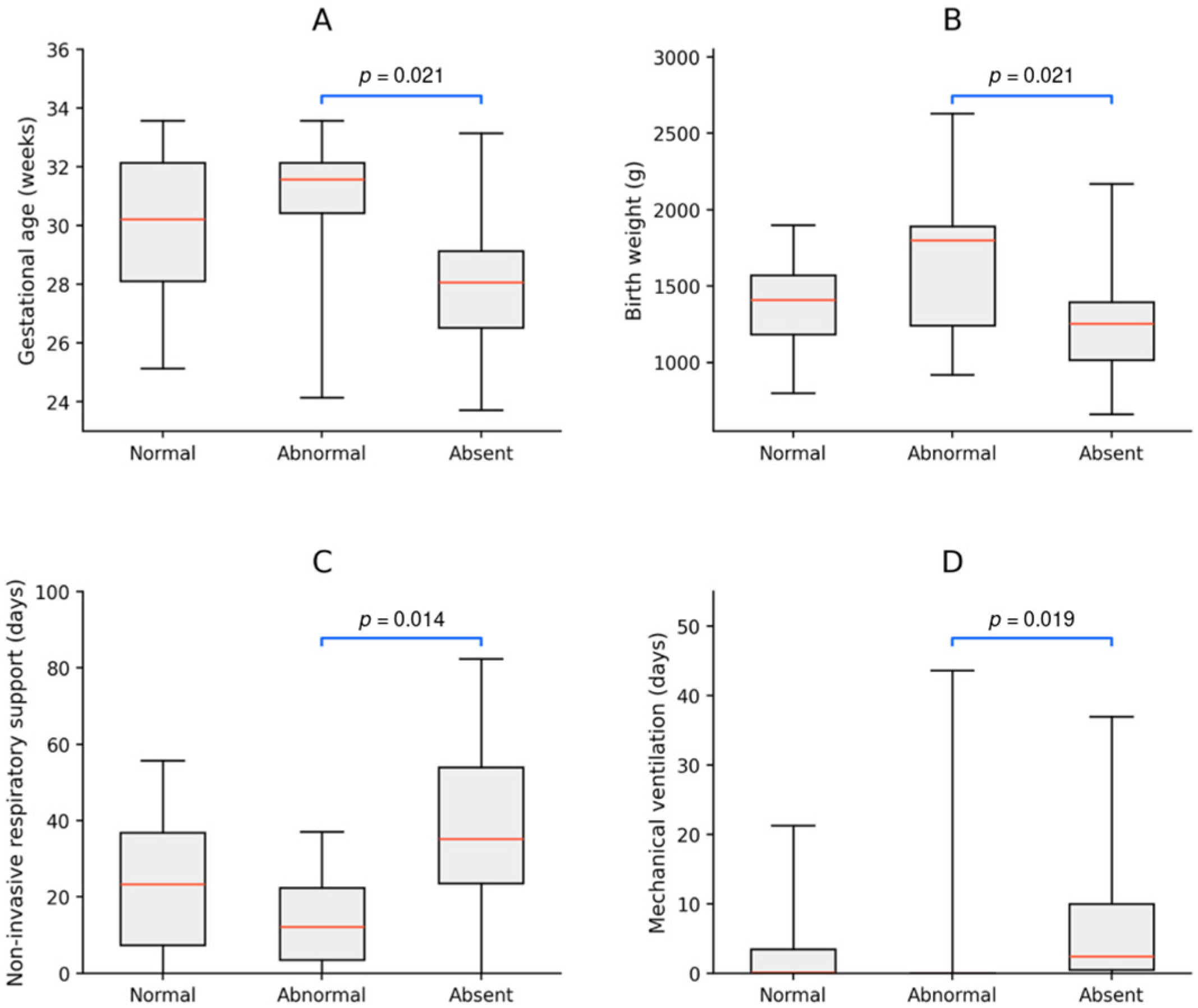
| Non-invasive respiratory support, days | 23.3 [7.4–36.9] | 12.2 [3.5–22.4] | 35.2 [23.6–54.0] | H (2) = 8.52 | 0.014 | ε2 = 0.121 |
| Mechanical ventilation, days | 0.13 [0.0–3.5] | 0.0 [0.0–0.8] | 2.5 [0.5–9.9] | H (2) = 8.25 | 0.016 | ε2 = 0.116 |
| Clinically relevant neonatal morbidity count | 1 [0–1] | 0 [0–0.5] | 1 [0–1] | H (2) = 2.25 | 0.324 | ε2 = 0.005 |
| Variable | Comparison | Mean Difference | T | Unadjusted p | Tukey-Adjusted p | Hedges’ g |
|---|---|---|---|---|---|---|
| Gestational age, wks | Normal vs. Abnormal | −1.02 | −1.104 | 0.274 | 0.516 | −0.398 |
| Normal vs. Absent | 1.57 | 2.094 | 0.041 | 0.101 | 0.609 | |
| Abnormal vs. Absent | 2.60 | 2.763 | 0.008 | 0.021 | 0.979 | |
| Birth weight, g | Normal vs. Abnormal | −281.61 | −2.050 | 0.045 | 0.110 | −0.734 |
| Normal vs. Absent | 104.48 | 0.938 | 0.352 | 0.619 | 0.300 | |
| Abnormal vs. Absent | 386.09 | 2.772 | 0.008 | 0.021 | 0.888 |
| Variable | Comparison | Z | Unadjusted p | Holm-Adjusted p | r = Z/√N |
|---|---|---|---|---|---|
| Non-invasive respiratory support, days | Normal vs. Abnormal | 1.35 | 0.178 | 0.178 | 0.228 |
| Normal vs. Absent | −1.87 | 0.062 | 0.124 | 0.275 | |
| Abnormal vs. Absent | −2.819 | 0.004 | 0.014 | 0.491 | |
| Mechanical ventilation, days | Normal vs. Abnormal | 1.21 | 0.228 | 0.228 | 0.160 |
| Normal vs. Absent | −1.94 | 0.053 | 0.106 | 0.256 | |
| Abnormal vs. Absent | −2.74 | 0.006 | 0.019 | 0.363 |
Disclaimer/Publisher’s Note: The statements, opinions and data contained in all publications are solely those of the individual author(s) and contributor(s) and not of MDPI and/or the editor(s). MDPI and/or the editor(s) disclaim responsibility for any injury to people or property resulting from any ideas, methods, instructions or products referred to in the content. |
© 2026 by the authors. Licensee MDPI, Basel, Switzerland. This article is an open access article distributed under the terms and conditions of the Creative Commons Attribution (CC BY) license.
Share and Cite
Bašić, B.; Katušić, A.; Grizelj, R.; Bohaček, A.-M. Fidgety Movement Classification in Preterm Infants Without Major Structural Brain Abnormalities: Associations with Gestational Age, Birth Weight, and Neonatal Morbidity. Children 2026, 13, 1259. https://doi.org/10.3390/children13091259
Bašić B, Katušić A, Grizelj R, Bohaček A-M. Fidgety Movement Classification in Preterm Infants Without Major Structural Brain Abnormalities: Associations with Gestational Age, Birth Weight, and Neonatal Morbidity. Children. 2026; 13(9):1259. https://doi.org/10.3390/children13091259
Chicago/Turabian StyleBašić, Bruna, Ana Katušić, Ruža Grizelj, and Ana-Marija Bohaček. 2026. "Fidgety Movement Classification in Preterm Infants Without Major Structural Brain Abnormalities: Associations with Gestational Age, Birth Weight, and Neonatal Morbidity" Children 13, no. 9: 1259. https://doi.org/10.3390/children13091259
APA StyleBašić, B., Katušić, A., Grizelj, R., & Bohaček, A.-M. (2026). Fidgety Movement Classification in Preterm Infants Without Major Structural Brain Abnormalities: Associations with Gestational Age, Birth Weight, and Neonatal Morbidity. Children, 13(9), 1259. https://doi.org/10.3390/children13091259