


Highlights
What are the main findings?
- Genetic variants in the 17q21 locus are strongly associated with asthma at 7 years in children with a history of preschool wheeze.
- Rhinovirus-induced wheeze at preschool age and rs6967330 (CDHR3, coding for Rhinovirus C receptor) are associated with asthma at 7 years among children with specific genotypes in the 17q21 locus.
What are the implications of the main findings?
- Rhinovirus-induced wheeze is a significant marker of underlying susceptibility.
- There might be differential patterns of association between 17q21 variants and asthma according to rhinovirus exposure, warranting further investigation in larger cohorts.
Abstract
Background: Previously identified asthma-susceptibility genes account for a small part of asthma heritability and their role in asthma pathogenesis is unclear. We explored associations between genetic variants in the 17q21 locus, CDHR3 (cadherin-related family member 3), coding a receptor for Rhinovirus-C, preschool wheeze and asthma at 7 years. Methods: Four genetic variants in the 17q21 locus (rs8076131, rs12603332, rs8079416, rs3859192) and rs6967330 in CDHR3 were studied regarding associations with preschool wheeze and asthma at 7 years. We compared 125 cases, enrolled during an acute wheezing episode, with 96 healthy controls at preschool age (6–45 months). A total of 99 of 125 children attended the follow-up at 7 years old. Cases with asthma (N = 68) and without asthma (N = 31) at 7 years old were compared regarding genetic variants and other clinical parameters. Results: Rs8076131 (AA vs. GG) was associated with preschool wheeze (OR 3.50, p = 0.001), and asthma at 7 years (OR 8.55, p = 0.002). Rs12603332 (CC vs. TT) was related to asthma at 7 years irrespective of rhinovirus infection at inclusion or current signs of airborne allergy (aOR 7.17, p = 0.016). The association of rs6967330 with asthma was restricted to children with specific genotypes in the 17q21 locus; rs8076131-AA (p = 0.028), rs8079416-CC (p = 0.006), and rs3859192-TT (p = 0.042). Rhinovirus infection at inclusion was significantly related to asthma exclusively in homozygotes rs8079416-CC (p = 0.032) and rs3859192-TT (p = 0.027). Conclusions: Our results highlight the impact of asthma heritability by reporting strong associations between the 17q21 locus and asthma in a high-risk cohort. The association of rs6967330 in CDHR3 and early-life rhinovirus infection with asthma at school age might be dependent on specific genotypes in the 17q21 locus.
1. Introduction
Asthma is a multifactorial disease, with heterogeneous clinical presentation and pathogenesis. Fifty percent of individuals with asthma report wheeze during the first 6 years of life [1]. Conversely, 40% of wheezy children at preschool age continue to wheeze later in childhood while the remaining 60% outgrow their symptoms [1]. Multiple factors are shown to be associated with persistent asthma in preschool wheezers: genetic predisposition, atopic disease, tobacco smoke exposure, vitamin D insufficiency, and respiratory tract infections in early life [2,3,4,5,6].
Although several genetic variants are shown to be associated with childhood asthma, their effect sizes and contribution to asthma heritability are small [7]. This could be explained by interactions between environmental and genetic factors [3,8,9], gene–gene interactions as well as the age-dependent manifestation and the phenotypical diversity of asthma [10]. Genetics seem to contribute to asthma to a greater extent in childhood than in adulthood, which is evidenced by the reported inverse relationship between estimates of heredity and age of asthma onset [11].
Genome-wide association studies (GWAS) have revealed several asthma-susceptibility genetic variants in the 17q21 locus. The associations between genetic variants and asthma in this locus might be influenced by the age of onset [12]. Some variants of orosomucoid-like 3 (ORMDL3) and gasdermin B (GSDMB) genes in the 17q21 locus have been associated exclusively with childhood-onset asthma [3,13]. However, the exact physiologic role of ORMDL3 and GSDMB in asthma pathogenesis is not fully understood yet [14].
The effect of some genetic variants in 17q21 on the risk of asthma is evident among children with Rhinovirus (RV)-induced wheeze at preschool age [15]. A genetic variant in Cadherin-related family member 3 (CDHR3), coding a receptor for RV-C, and highly expressed in airway epithelium, has been shown to be associated with RV-C illness, early-life wheezing as well as asthma at school age [16,17,18]. Nevertheless, the contribution of CDHR3-related genetic risk to asthma persistence is still ambiguous [19].
Given the phenotypical heterogeneity of asthma and the complexity of its pathogenesis, investigating risk factors in homogeneous groups of children with wheezing illness or asthma might shed light on specific etiological pathways [20]. In this study, 125 children were included during an episode of acute preschool wheeze and followed prospectively to age 7 years. We selected a panel of genetic variants in the 17q21 locus, based on published GWAS [3,13], and investigated them in our cohort using a candidate gene approach. Our aim was to study the association between these genetic variants in the 17q21 locus as well as CDHR3 with preschool wheeze (PW) and asthma at school age.
2. Materials and Methods
2.1. Study Base and Design
The study population included in this study is a subset of the ‘Gene Expression in Wheezing and Asthmatic Children’ (GEWAC) cohort. ‘Gene Expression in Wheezing and Asthmatic Children’ (GEWAC) is a cohort of 156 preschool wheezers (cases) and 102 age-matched healthy controls. The cases (age 6–48 months) were enrolled at the pediatric emergency ward at Astrid Lindgren’s Children’s Hospital, Stockholm, Sweden, between 2008 and 2012 when seeking care for acute wheeze. Exclusion criteria were prematurity (birth before 36 gestational weeks), other chronic diseases or any simultaneous complications such as sepsis, bacterial pneumonia or diabetes at the time point of inclusion. Enrollment took place from October 2008 until June 2012. The cases were assessed at inclusion, and they were invited to follow-ups after 2–3 months, one year and at age 7 years [21]. Blood samples were drawn at the emergency visit and at later revisits. A large proportion of cases (81%) needed hospitalization due to severe symptoms, 52% had a diagnosis of asthma already at the first follow-up and 70.8% was diagnosed with asthma at age 7 years [21], which supports the high-risk nature of the GEWAC cohort. The controls were enrolled at the Surgical Day-care Ward, Astrid Lindgren Children’s Hospital, where they had minor surgery performed, and blood was drawn at the same time as an intravenous line was inserted prior to surgery and anesthesia. Exclusion criteria were prematurity (birth before 36 gestational weeks) and/or a history of bronchial obstruction/asthma or known sensitization to airborne allergens [4]. Inclusion and exclusion criteria are listed in Table 1.
Table 1.
Inclusion and exclusion for cases and controls enrolled in GEWAC cohort.
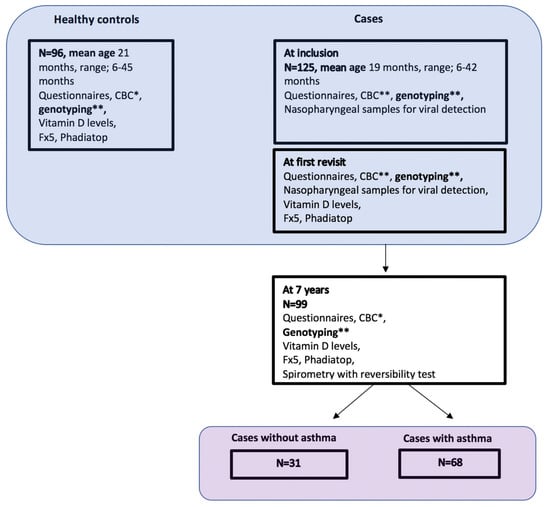
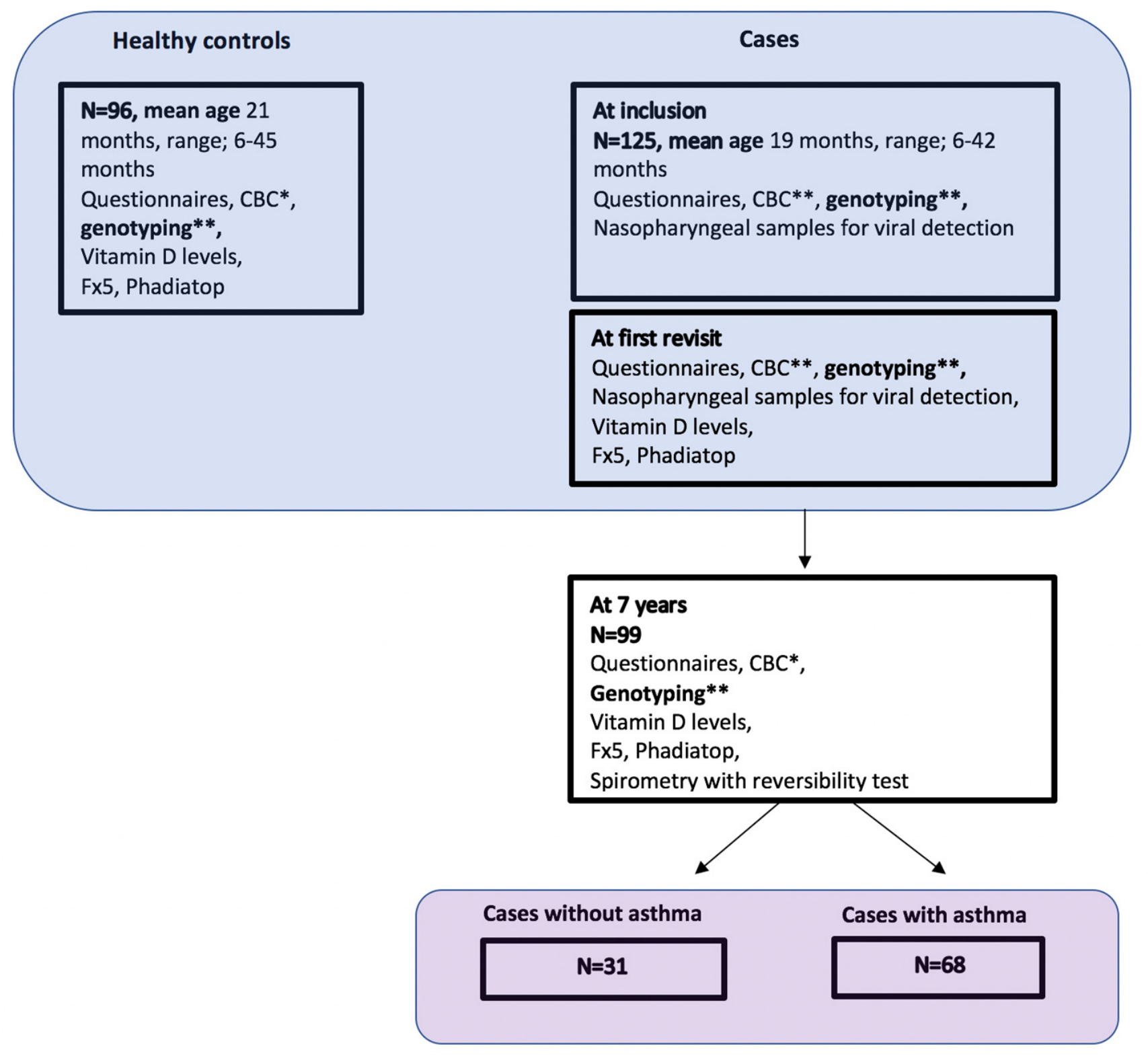
The study population of this study consisted of 125 cases and 96 controls with genotypes available for at least one of the studied genetic variants in the 17q21 locus (Figure 1, Table S1). A total of 99 of 125 children had available genotype data and information on asthma status at the follow-up at 7 years old and were included in the analyses of genetic associations with asthma at 7 years. We compared cases with asthma at 7 years (68/99) and cases without asthma at 7 years (31/99) with respect to all studied genetic variants.
Figure 1.
Flow-chart of the GEWAC population included in the current study; The coloured boxes represent the comparisons performed between pairs of groups. Blue indicates the groups and assessments at inclusion, whereas purple indicates asthma status among cases at 7 years of age. * CBC complete blood count, ** Genotypes for studied genetic variants in the 17q21 locus included in Figure 2. All children included in the study have available genotype(s) for at least one of the studied genetic variants. Phadiatop; allergen-specific IgE against common airborne allergens birch, timothy, mug worth, cat, dog, horse, molds (Cladosporium herbarum), dust mites (Dermatophagoides pteronyssinus, Dermatophagoides farina), Fx5; allergen-specific IgE against common food allergens cow’s milk, egg white, soy bean, peanut, cod fish and wheat.
2.2. Data Sources
Standardized questionnaires regarding ethnicity, lifestyle, family history of asthma and allergies, breastfeeding, exposure to tobacco smoke, pets and previous infections as well as occurrence of atopic and asthma symptoms and use of asthma medication was filled out by the legal guardians at all visits. The study physician interviewed the guardians and filled out a standardized questionnaire concerning the number of days the child had suffered from asthma symptoms at home (cough, wheeze and/or shortness of breath), use of medication (inhaled corticosteroids (ICS), leukotriene receptor antagonist (LTRA) or oral corticosteroids), as well as any emergency visits between the acute and follow-up visits. The reported number of emergency visits was checked against medical journals, and the guardians’ personal diaries of days spent away from work when the child had respiratory symptoms.
2.3. Asthma Definition
The definition of asthma at 7 years of age was based on Global Initiative for Asthma (GINA) guidelines [22] and included one mandatory criterion (a diagnosis of asthma by the study doctor, a pediatric allergist) and one out of three additional criteria: lower respiratory symptoms, medication for treatment of wheeze for 5 days or longer in the preceding 12 months (ICS or LTRA), or airway reversibility >12% after the use of bronchodilator with salbutamol, as previously described [21]. Lower respiratory symptoms were defined as cough, shortness of breath, or nocturnal awakening caused by wheeze for 5 days or longer in the preceding 12 months. All children that fulfilled the compulsory and at least one of the additional criteria (symptoms, medication, or reversibility) were classified as having asthma. Children with a doctor’s diagnosis of asthma were diagnosed by different doctors, before or after inclusion in the study according to national guidelines. Spirometry and airway reversibility were tested using the Medikro Pro spirometer (Medikro Oy, Kuopio, Finland). Reversibility was evaluated 15 min after inhalation with 400 micrograms salbutamol using a spacer. The patient’s technique and quality of the spirometry were evaluated according to international guidelines, and if the test criteria were not fulfilled, the test result was not included in the analyses [21].
2.4. Sample Collection and Laboratory Analyses
Nasal swab tests for the presence of virus were obtained from the cases at the emergency department and again at the 3-month follow-up, and transported within two hours after collection in a standardized virus medium (Sigma-Virocult, Medical Wire & Equipment Co Ltd., Corsham, Wiltshire, UK). The swabs were analyzed according to standard procedures by real-time PCR using a 15 virus platform developed in 2007 (including Adenovirus, Bocavirus, Coronavirus (229E, HKU1, NL63), Influenza A, Influenza A/H1N1 and Influenza B, Parainfluenza virus (1,2,3), Metapneumovirus, Enterovirus, Rhinovirus and Respiratory Syncytial virus) [23], and then stored in the biobank at the Department of Clinical Microbiology, Karolinska University Hospital.
Levels of Vitamin D 25(OH)D were analyzed at the Karolinska University Hospital Laboratory using a standard procedure involving direct, competitive chemiluminescence analysis (CLIA, DiaSorin Inc, Stillwater, MN, USA) for the blood samples from the 3-month revisit, and using competitive immunoassay (Roche Diagnostics Vitamin D total assay) for the blood samples at the follow-up at 7 years old. Allergen-specific IgE against common airborne allergens (Phadiatop; birch, timothy, mug worth, cat, dog, horse, molds (Cladosporium herbarum), house dust mites (Dermatophagoides pteronyssinus, Dermatophagoides farina)) and food allergens (Fx5; cow’s milk, egg white, soy bean, peanut, codfish and wheat) (Thermo Fisher Scientific, Uppsala, Sweden), were analyzed in blood samples at the first follow-up visit and at 7 years. Vitamin D insufficiency was defined as 25(OH)D 50 to 75 nmol/L and allergic sensitization as IgE ≥ 0.35 kUA/L against Phadiatop and/or Fx5.
DNA was extracted from whole blood using standard methods. The 13 most frequently studied genetic variants in the 17q21 locus and CDHR3 (rs6967330) were selected (Table S2) based on major GWAS [3,13] and genotyped using TaqMan allelic discrimination according to the manufacturer’s protocol (Thermo Fisher Scientific, Uppsala, Sweden). DNA quality and quantity was assessed using Nanodrop 8000 (ThermoFisher Scientific). All TaqMan assays showed satisfactory performance, all with less than 1.5% missing genotypes (genotyping call rate >98.5%). Genotype calling was performed automatically by the genotyping platform and the laboratory staff was blinded to the clinical data.
2.5. Statistical Analyses
SPSS version 26 (IBM) was used. An un-paired t-test was used to analyze continuous variables with normal distribution and Mann–Whitney or Kruskal–Wallis (nonparametric tests) were applied for skewed continuous variables. We checked for Hardy–Weinberg equilibrium in cases (N = 125) and controls (N = 96) and for linkage disequilibrium (LD, calculation of r2) in Haploview. Chi-square test was used to compare the distribution of genotypes and allele frequencies of genetic variants between cases and controls as well as between cases with and without asthma at the same age. Fisher’s exact test was applied when sample sizes were limited.
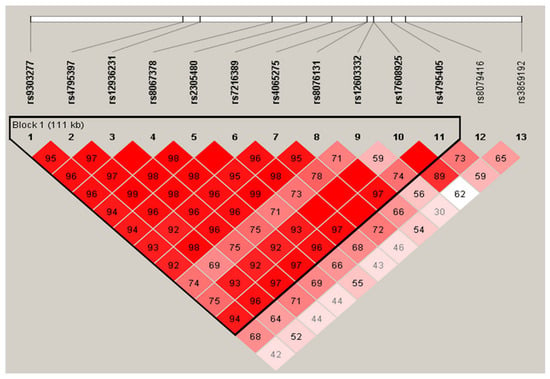
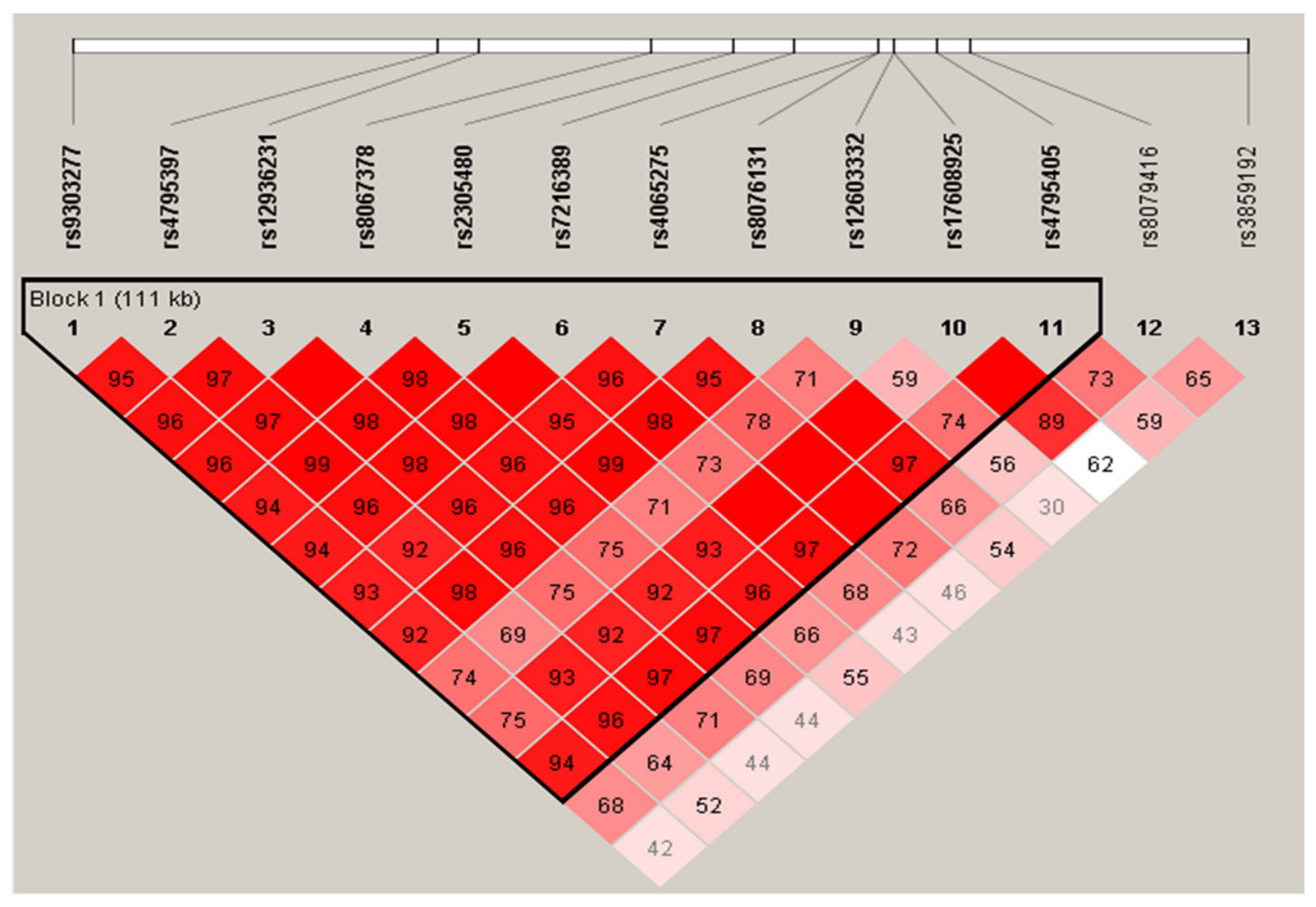
Thirteen genetic variants within the 17q21 locus were selected a priori for the initial analyses (Table S1, Figure 2), based on previously reported associations with childhood asthma or their location within the 17q21 asthma-susceptibility region, with the aim of capturing genetic variation across the locus. Four variants were subsequently selected for further analyses based on the LD structure of the region and their ability to provide complementary representation of the locus, independently of their observed associations with the study outcomes. These included rs8076131, selected as a proxy for nine highly correlated variants within the high-LD block; rs12603332, which showed the lowest pairwise r2 with the other variants within this block; and rs8079416 and rs3859192, which were located in the flanking regions (Figure 2). The maximum pairwise r2 among the four selected variants was 0.71.
Figure 2.
The genetic variants in the 17q21 locus included in the current study are shown, with higher linkage disequilibrium (LD) observed between the first eight genetic variants (from the left). Color intensity represents the strength of LD, with darker red indicating higher pairwise r2 values, while numbers within the diamonds indicate the corresponding pairwise r2 values.
Logistic regression was used to assess the associations between the genetic variants and preschool wheeze and asthma at 7 years. Variables significantly associated with preschool wheeze or asthma at 7 years in the univariate analyses (Table S2) were included in multivariable logistic regression models to calculate adjusted odds ratios (aORs) for the respective outcomes.
3. Results
A higher proportion of cases (N = 125) had heredity for asthma and/or allergy, and eczema at inclusion than controls (N = 96, Table S2). No differences were seen between cases included in the analyses at 7 years (N = 99) and cases that were lost to follow-up (N = 26, Table S3). Forty-nine genotyped controls, not included in this study population, were assessed at 7 years and one of them (N = 1/49) was diagnosed with asthma at this age.
Among 99 children with PW, 68 (68.7%) were diagnosed with asthma at 7 years. Rhinovirus (RV) infection at inclusion and current allergic rhinitis or conjunctivitis at age 7 years were significantly overrepresented among asthmatics (N = 68) compared to non-asthmatics (N = 31) at 7 years (Table S2). Nine genetic variants in the 17q21 locus were associated with both preschool wheeze and asthma at 7 years. Rs12603332 was associated with asthma at 7 years but not with PW. Rs17608925 and rs8079416 were related to PW but not to asthma at 7 years. Rs3859192 was neither associated with PW nor with asthma at 7 years (Table 2).
Table 2.
Associations of genotypes in studied genetic variants with preschool wheeze (statistical analyses performed in cases (Ν = 123–125) and healthy controls (N = 94–96) who could be genotyped for the respective genetic variant) and asthma at 7 years (cases without (N = 30–31) and with asthma (N = 67–68) included in the analyses).
3.1. Associations Between Genetic Variants in the 17Q21 Locus with Preschool Wheeze
The associations of rs8076131 (AA vs. GG; OR= 3.50, 95% CI 1.60–7.66, p = 0.001), and rs8079416 (CC vs. TT; OR = 2.42, 95% CI 1.12–5.23, p = 0.024) with PW (Table 2) remained significant after adjustment for other risk factors for PW (Table S2 and Table 3). In the adjusted analysis, increasing numbers of effect alleles in rs8076131 (aOR = 2.36, 95% CI 1.47–3.78, p < 0.001) and rs8079416 (aOR = 1.78, 95% CI 1.12–2.84, p = 0.015, Table 3) carried by an individual were significantly associated with PW. The rs6967330-A (CDHR3) was significantly associated with PW (Table S4).
Table 3.
The relationship between genetic variants in the 17q21 locus (genotypes)/number of effect alleles (additive model) and preschool wheeze (PW) as well as asthma at 7 years when adjusting for other significant factors for PW and for asthma at 7 years.
3.2. Associations Between Genetic Variants in the 17Q21 Locus and Asthma at 7 Years
The associations of rs8076131 (AA vs. GG; OR= 8.55, 95% CI 2.18–33.59, p = 0.002), and rs12603332 (CC vs. TT; OR= 4.50, 95% CI 1.27–15.90, p = 0.016) with asthma at 7 years (Table 2) remained significant after adjustment for RV infection at inclusion and current allergic rhinitis or conjunctivitis at 7 years (Table 3). When stratifying by genotype, RV infection at inclusion significantly increased the risk of asthma at 7 years in cases with rs8079416-CC (p = 0.032) or rs3859192-TT (p = 0.027).
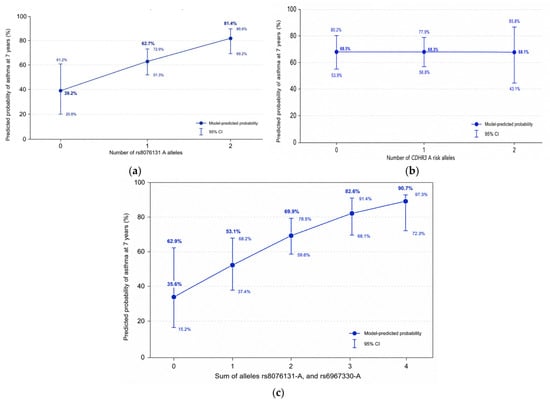
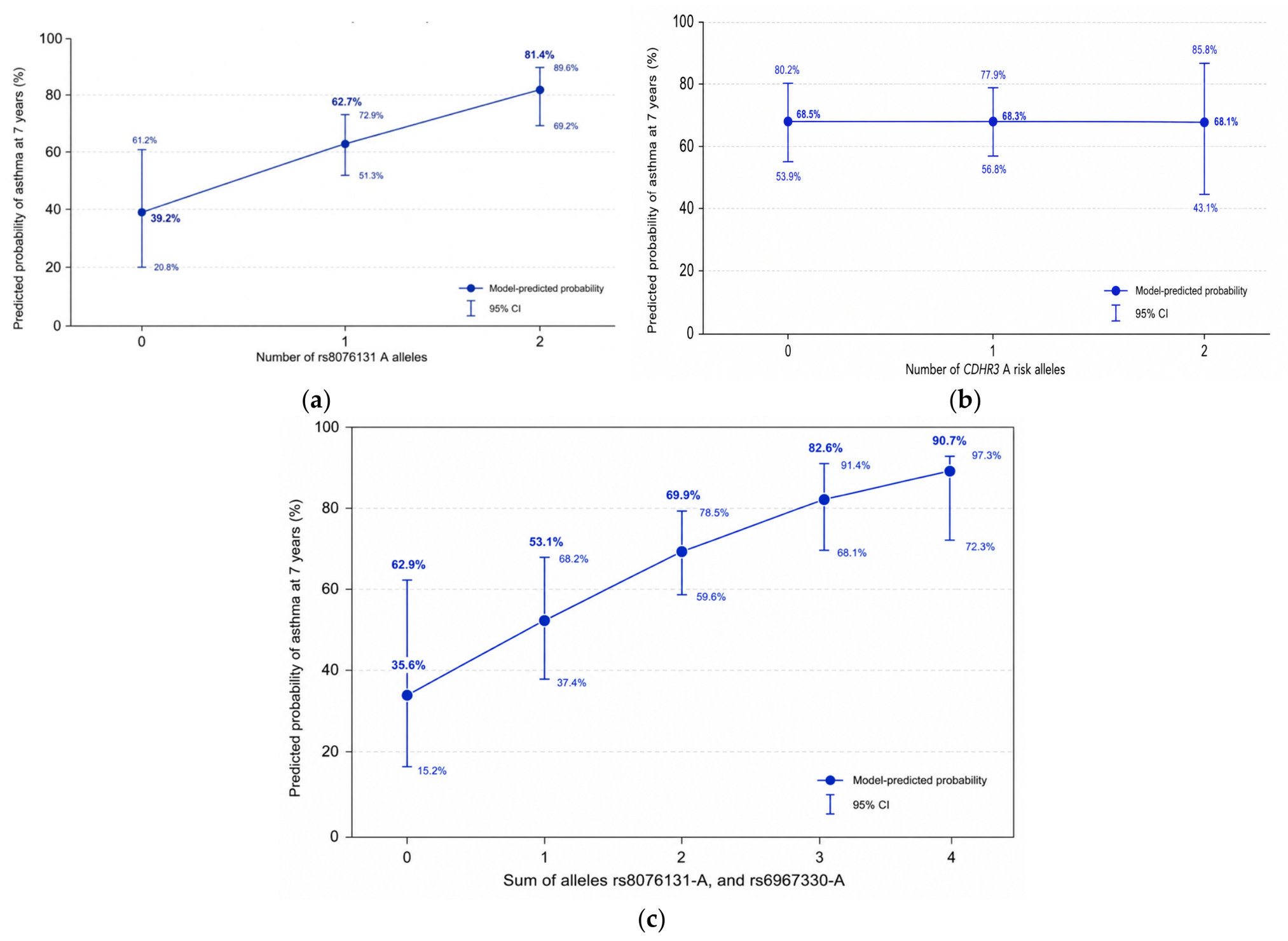
No association was found for rs6967330 and asthma at 7 years, but children carrying at least one A allele were more likely to have asthma at 7 years if they also were homozygotes rs8076131-AA, rs8079416-CC or rs3859192-TT (Table 4). The sum of the number of rs6967330-A and rs8076131-A alleles carried by an individual, was positively related to asthma at 7 years (OR = 2.05 (1.16–3.62), p = 0.013, Figure 3).
Table 4.
Relationship between rs6967330 and asthma at 7 years in the whole study population (a) and in strata defined by genotypes for genetic variants in 17q21 locus (b). Children with rs6967330-AA or AG had greater risk for asthma at 7 years than homozygotes GG if they also carried specific genotypes in 17q21 locus.
Figure 3.
Predicted probability for asthma at 7 years in relation to; (a). the number of alleles rs8076131-A (ORMDL3) analyzed in N = 99 cases; OR = 2.61, 95% CI 1.38–4.94, p = 0.003. (b). The number of alleles A in rs6967330 (CDHR3) analyzed in N = 98 cases; OR = 0.99, 95% CI 0.49–1.99, p = 0.980. (c). The sum of alleles rs8076131-A, and rs6967330-A, analyzed in N = 98 cases; OR = 2.05, 95% CI 1.16–3.62, p = 0.013. Observed sample sizes: n = 1, 29, 40, 26, and 2 for 0–4 risk alleles, respectively. Points and connecting lines represent probabilities of asthma at 7 years predicted from an additive logistic regression model. Error bars represent the 95% confidence intervals (CIs) for the model-predicted probabilities. The number of rs8076131 A alleles, alleles A in rs6967330 (CDHR3) and the sum of alleles rs8076131-A, and rs6967330-A were included in the respective model as continuous additive genetic variables.
3.3. Associations Between Genetic Variants in the 17Q21 Locus and Medication
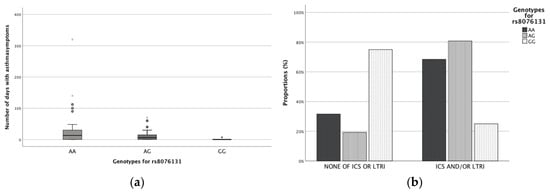
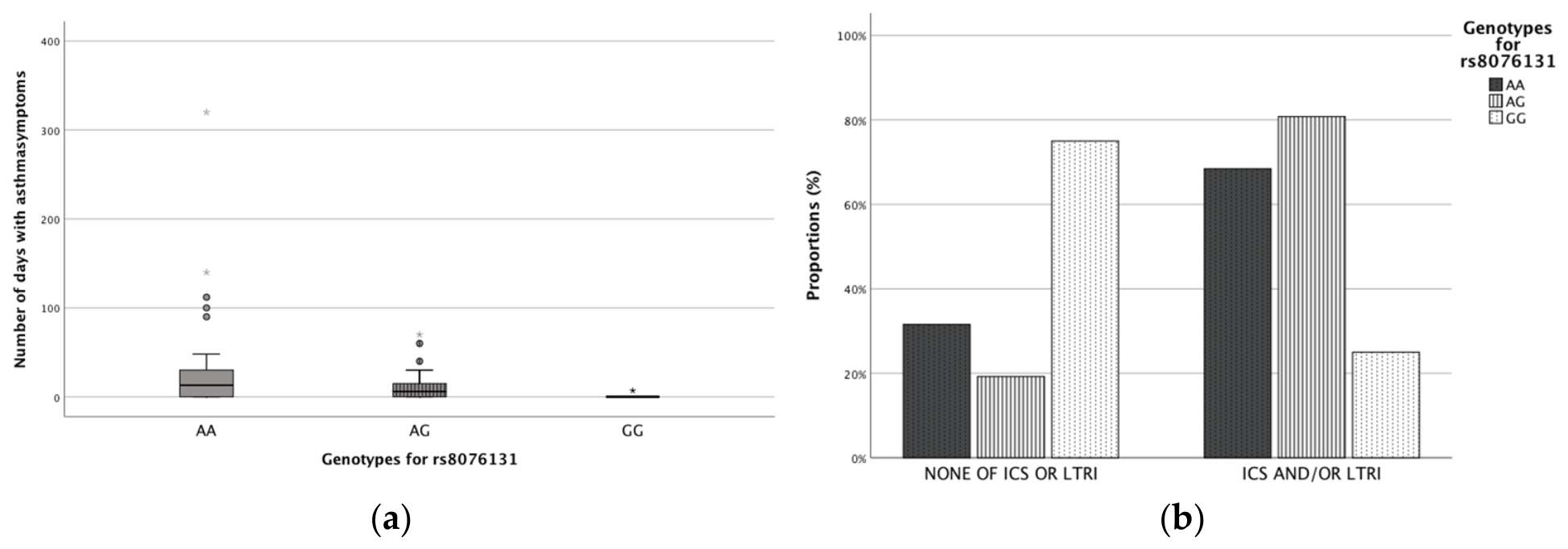
Rs8079416 (CC vs. CT; p = 0.046) and rs3859192 (TT vs. CT; p = 0.045, TT vs. CC; p = 0.032) were associated with the number of days with oral corticosteroids treatment during the first year after inclusion. Furthermore, rs8076131 was associated with the use of ICS or LTRA (AG vs. GG; OR = 12.6 (1.07–148.13), p = 0.048) as well as the number of days with asthma symptoms during the year prior to the follow-up at 7 years old (AA vs. GG; p = 0.011, AG vs. GG; p = 0.023, Figure 4).
Figure 4.
Association of rs8076131 genotypes with (a). number of days with asthma symptoms during the year prior to the follow-up at 7 years old (AA; median 13 days (IQR; 0–30), AG; median 6 days (IQR; 0–15), GG; median 0 days (IQR; 0–0). N = 66 children included in the analysis. Pairwise comparisons performed with Mann–Whitney U test; AA vs. GG; p = 0.011, AG vs. GG; p = 0.023), (symbols indicate outliers, defined as observations more than 1.5 × IQR below the first quartile or above the third quartile), and (b). use of inhaled corticosteroids (ICS) or leukotriene receptor antagonists (LTRAs) during the year prior to the follow-up at 7 years old (analysis performed with Chi-square test; AG vs. GG; OR = 12.6 (1.07–148.13), p = 0.048).
4. Discussion
We focused on four genetic variants in the 17q21 locus: rs8076131 and rs12603332 located in the core LD block as well as rs8079416 and rs3859192 in the flanking region 17q21 locus. Rs8076131, a proxy for nine other variants in the high-LD region of 17q21 locus, was associated both with PW and asthma at 7 years. Rs12603332, although not related to PW, is shown to be significantly associated with asthma at 7 years among preschool wheezers. None of these four genetic variants is located in the coding regions in the 17q21 locus. Nevertheless, several studies support the importance of intronic variants for splicing efficiency or regulation of gene transcription [24,25]. While no association was found between rs8079416, rs3859192 (17q21 locus) or rs6967330 (CDHR3) and asthma at 7 years, subgroups of children with specific combinations of genotypes in these genetic variants had increased risk of asthma. Moreover, RV infection at inclusion was significantly related to asthma in strata of children with genotypes rs8079416-CC and rs3859192-TT.
Multiple genetic variants at the 17q21 locus have reproducibly been shown to be linked to childhood asthma [26] in ethnically diverse populations [25] but extensive linkage disequilibrium in this region has impeded identification of variants with causal association to asthma susceptibility. In children younger than 6 years with African American ancestry characterized by a shorter LD block at the 17q locus, the associations were scaled down to two genetic variants: rs2305480 and rs8076131 [27]. The association of the 17q21 locus with childhood asthma might be dependent on the time course of wheezing or differ among longitudinal wheezing phenotypes [28,29].
In our cohort, rs8076131-A was associated with both PW and asthma at 7 years whereas rs12603332-C was solely associated with increased risk of asthma at 7 years. Both of these genetic variants are located in the intronic region of ORMDL3 and implicated in the expression of the same gene [30,31]. ORMDL3 is a transmembrane protein in the endoplasmic reticulum and regulates downstream pathways including sphingolipids, and may play a role in epithelial cell remodeling [32,33]. ORMDL3 is expressed in cell types involved in asthma pathogenesis [26]. In line with our results, Granell et al. have demonstrated varying associations of genetic variants in chromosome 17 with different wheezing phenotypes and shown that rs8076131-A is related to wheeze with onset from 18 months’ age and with persistent wheeze up to the age of 7.5 years in a cohort with central-European origin [30]. Ober et al. have shown a significant association of rs8076131-A with asthma in African American children (EVE cohort) [27], although in a study by Galanter et al., significance for this association in the same ethnic group was not reached [25].
Rs12603332-C is associated with increased ORMDL3 expression in human immune cells [34]. E47, a transcription factor which is shown to inhibit the expression of several genes, binds in vitro to the rs12603332-T but does not bind to the rs12603332-C [34]. Rs12603332-T has been found to reduce the levels of ORMDL3 mRNA in immune cells [34]. ORMDL3 expression in peripheral blood leucocytes has been shown to be increased in children with asthma [35]. Therefore, there might be a biologically plausible link between rs12603332-C and asthma. Our findings are supported by a study by Sordillo et al. who highlighted the association of rs12603332-C with persistent wheeze throughout mid childhood but no clear relationship to transient wheeze in a multiethnic cohort recruited in USA [28]. Associations of genetic variants with asthma differ depending on age of onset and the severity of the disease [30,31,36,37]. Absence of association between rs12603332-C and PW in our cohort might be explained by a considerable proportion of preschool wheezers who had grown out of their symptoms by the age of 7 years, varying age at first wheezing episode or by an overall low power.
Our results point towards higher effect sizes of both rs8076131 and rs12603332 on asthma at 7 years compared to other studies [26]. This could be explained by our hospital-based cohort possibly being more clinically homogeneous and consisting of predominantly severe preschool wheeze with high prevalence of hospitalization at inclusion and a high risk of subsequent asthma at school age [38,39]. The modest odds ratios for the associations of the 17q21 locus with asthma, identified by GWAS, could be attributed to the clinical diversity of asthma, wide spectrum of age of onset or co-occurrence of other risk factors [31].
Rs8079416-C was associated with preschool wheeze but not with asthma at 7 years in the GEWAC cohort. Nor was there an association between rs3859192 and asthma. Rs8079416-C is shown to be related to asthma in a large study population including children with German and Austrian origin with a mean age of 11 years at inclusion [40,41], and in an adult cohort [42]. However, no significant association of the same genetic variant with asthma was found in a French cohort of individuals aged 6–65 years [36]. The rs8079416-C is associated with increased ORMDL3 expression [30,41]. Rs3859192 (TT) is related to asthma in adults [42] but conflicting results are reported by studies in pediatric cohorts [19,36,40,43]. Rs3859192 is located in GSDMA, distal to the high-LD block of 17q locus and can have effects that are independent of genetic variants at the core region of 17q locus. It is shown to be a strong eQTL (expression Quantitative Trait locus) for GSDMA in lung tissue cells, correlated with lower expression of GSDMA [31]. However, GSDMA expression is found to be low in lung cells [31] and its association with asthma has not been established so far [31].
Among children with rs8079416-CC or rs3859192-TT, wheeze with RV infection at inclusion and rs6967330-AA or AG (CDHR3) genotypes were significantly associated with asthma at 7 years in our cohort. Effect alleles in the high-LD region of 17q21 locus are shown to confer increased asthma risk, especially in children who had RV-induced wheezing illness in early childhood [15]. Enhanced expression of ORMDL3 may act in favor of viral replication in respiratory epithelial cells or even affect the repair of these cells after RV infection [15]. Rs8079416-C is associated with increased expression of ORMDL3 [41] but there are, to our knowledge, no other previous reports about asthma-related combinations of genetic variants distally to the high-LD frame of 17q21 locus and rs6967330 (CDHR3).
While rs6967330-A (CDHR3) was related to PW in our cohort, as previously shown [44], the association of the same allele with asthma at 7 years was restricted to specific genotypes in the 17q21 locus. A significant association of rs6967330-A with asthma was genotype-specific for rs8076131-AA homozygotes. CDHR3 is a gene known to code for the RV-C receptor, and is found to be related to early-life wheezing and asthma at school age by other studies [18,44]. The rs6967330-A (CDHR3) is shown to increase the expression of CDHR3 as well as the risk of early-life wheezing episodes and their severity [17,38]. However, conflicting results are reported by a Finnish cohort [19]. The effect of rs6967330-A (CDHR3) on asthma is shown to be age-dependent, strongest among children with asthma onset until the age of 2 years, and modified by the GSDMB genotype, located in the high-LD region of 17q locus [39]. The role of CDHR3 in the context of infections and asthma susceptibility is supposed to implicate the airway epithelium and is also found to be expressed in immune cells [39]. Similarly, GSDMB and ORMDL3 also seem to play a functional role in immune cells [39]. In our cohort, a similar pattern of genotype-specific associations of rs6967330 (CDHR3) with asthma was expanded beyond the high-LD frame in the 17q21 locus as it was seen in rs3859192-TT (GSDMA) as well as rs8079416-CC homozygotes (LRRC3C).
Strengths of this study were the extensive phenotypical characterization of the recruited preschool wheezers and the longitudinal design that allowed analyses of multiple associations at different age points. Some associations were shown to differ between preschool age and the age of 7 years. Another asset is the hospital-based enrolment of the cohort, thus minimizing misclassification of outcomes. The linkage disequilibrium in the region is high, and we have focused on four genetic variants, but their effects might still be at least partly dependent on each other. There is a possibility that the lack of significance for associations of rs8079416, or rs3859192 or other variants with asthma is due to limited sample size. However, the relatively high prevalence of doctor’s asthma diagnosis at preschool age and of asthma at 7 years in GEWAC reflects a more severe wheezing phenotype, thereby increasing the chance of detecting associations and interactions [38,39] despite their relatively low effect sizes.
The relatively small sample size, particularly within stratified subgroups, resulted in wide confidence intervals for some of the estimated associations. Accordingly, the large effect estimates observed in certain subgroups should be interpreted with caution, as they may partly reflect unstable subgroup estimates. In addition, the possibility of false-positive findings due to multiple testing cannot be excluded. This is particularly relevant for associations with borderline statistical significance or very wide 95% confidence intervals. Therefore, these findings should be interpreted cautiously and require confirmation in larger, independent cohorts. The effect sizes observed in our study should also be considered in the context of the more modest effect sizes reported in large genome-wide association studies of the 17q21 locus. Moreover, our cohort was a selected hospital-based population and may therefore represent children with more severe or persistent wheezing phenotypes rather than the broader spectrum of wheezing and asthma in the community, limiting the generalizability of the findings.
The stratified analyses identified patterns suggesting that the associations between specific genetic variants and asthma may differ according to clinical or environmental characteristics, such as rhinovirus infection. However, logistic regression models including interaction terms (genotype for rs3859192 and rs8079416 × rhinovirus infection) should be performed in larger groups to provide proof of interaction. Therefore, the observed patterns suggest potential effect modification that warrants further investigation. Larger studies with adequate power for interaction testing are needed to determine whether these associations represent true gene–environment or gene–gene interactions. An additional limitation is the time elapsed after cohort recruitment and statistical analysis. Although the cohort was recruited during an earlier period (2008–2012), the genetic variants investigated represent stable inherited characteristics, and the prospective longitudinal design remains relevant to understanding the relationship between early-life wheezing, genetic susceptibility and subsequent asthma development. The specific role of the 17q21 locus in asthma development following early-life wheezing remains of biological and clinical interest.
Despite these limitations, the present findings provide informative, potentially hypothesis-generating observations regarding the relationship between genetic susceptibility and early-life clinical exposures in children with wheezing. The consistency of some associations across clinically relevant subgroups, together with the biological plausibility of the 17q21 locus and CDHR3 in childhood respiratory disease, supports further investigation in larger and more diverse cohorts.
5. Conclusions
In our longitudinal, hospital-based cohort we could replicate associations of genetic variants in the 17q21 locus with preschool wheeze and school-age asthma. Some of these associations might be phenotype- or age-specific. Our study highlights the importance of asthma heritability by reporting higher magnitudes of associations than reported before, possibly owing to the homogeneity and severity of wheezing phenotypes included. Our findings suggest previously unreported patterns of association between genetic variants in the 17q21 locus, CDHR3-rs6967330 and asthma according to rhinovirus exposure. Future studies with larger sample sizes are warranted to investigate these potential interactions.
Supplementary Materials
The following supporting information can be downloaded at https://www.mdpi.com/article/10.3390/children13091188/s1. Table S1: Genetic variants included in the study; Table S2: Baseline characteristics in cases and controls. Clinical as well as laboratory parameters at inclusion and 7 years in cases with and without asthma at 7 years. Table S3: Drop-out analysis of cases lost to follow-up. Table S4: Relationship between rs6967330 and preschool wheeze in the whole study population (a) and in strata defined by genotypes for genetic variants in 17q21 locus (b).
Author Contributions
Conceptualization, A.F., C.S., J.R.K. and G.H.; methodology, A.F., C.S. and J.R.K.; formal analysis, A.F. and C.S.; investigation, A.F. and C.S.; data curation, A.F. and C.S.; writing—original draft preparation, A.F.; writing—review and editing, A.F., A.H., I.H., M.v.H., B.N., G.H., J.R.K. and C.S.; funding acquisition, A.F. and C.S. All authors have read and agreed to the published version of the manuscript.
Funding
This work was funded by the Swedish Heart-Lung Foundation (20180170, 20190252, 20210165) and the Swedish Asthma Allergy Association’s Research Foundation (F2020-0015 and F2022-0017), the Hesselman Foundation (award dated 7 June 2013), and Princess Lovisa’s Foundation (2023-00791).
Institutional Review Board Statement
The study protocol was approved by the Regional Ethics Committee of Stockholm (Dnr 2008/378-31/4 and Dnr 2014/399-31/3), approved on 22 April 2008 and (complementary application) 9 April 2014.
Informed Consent Statement
Written informed consent was obtained from all parents or legal guardians. More specifically, consent for genetic testing, for long-term follow-up, storage and handling of biologicals samples was obtained.
Data Availability Statement
Due to the nature of this research, participants of this study did not agree for their data to be shared publicly, so supporting data are not available.
Acknowledgments
We would like to thank all children and parents participating in this study, Katarina Stenberg Hammar for recruitment and clinical characterization of the cohort and Ann Berglind for excellent assistance in recruitment and collecting data and biological samples.
Conflicts of Interest
M.v.H. reports personal fees from Thermo Fisher Scientific, and lecture fees from Thermo Fisher Scientific, ALK and AstraZeneca, all outside the submitted work. A.F., I.H., S.C., G.H. and A.H. have no conflicts of interest to report. J.R.K. and C.S. have received nonfinancial support from Thermo Fisher Scientific in other research projects, but not to complete this particular project.
Abbreviations
The following abbreviations are used in this manuscript:
| aOR | Adjusted odds ratio |
| CDHR3 | Cadherin-related family member 3 |
| GEWAC | Gene Expression in Wheezing and Asthmatic Children |
| GSDMA | Gasdermin A |
| GSDMB | Gasdermin B |
| GEWAS | Genome-wide association studies |
| eQTL | Expression Quantitative Trait locus |
| ICS | Inhaled corticosteroids |
| IKZF3 | IKAROS Family Zinc Finger 3 |
| LD | Linkage disequilibrium |
| LRRC3C | Leucine Rich Repeat Containing 3C |
| LTRA | Leukotriene receptor antagonist |
| MED24 | Mediator Complex Subunit 24 |
| ORMDL3 | Orosomucoid-like 3 |
| PW | Preschool wheeze |
| RSV | Respiratory syncytial virus |
| RV | Rhinovirus |
| ZPBP2 | Zona Pellucida Binding Protein 2 |
References
- Martinez, F.D.; Wright, A.L.; Taussig, L.M.; Holberg, C.J.; Halonen, M.; Morgan, W.J. Asthma and wheezing in the first six years of life. Group Health Med. Assoc. N. Engl. J. Med. 1995, 332, 133–138. [Google Scholar] [CrossRef] [Scilit]
- Martinez, F.D. Genes, environments, development and asthma: A reappraisal. Eur. Respir. J. 2007, 29, 179–184. [Google Scholar] [CrossRef] [Scilit]
- Ober, C.; Yao, T.C. The genetics of asthma and allergic disease: A 21st century perspective. Immunol. Rev. 2011, 242, 10–30. [Google Scholar] [CrossRef] [Scilit]
- Stenberg Hammar, K.; Hedlin, G.; Konradsen, J.R.; Nordlund, B.; Kull, I.; Giske, C.G.; Pedroletti, C.; Söderhäll, C.; Melén, E. Subnormal levels of vitamin D are associated with acute wheeze in young children. Acta Paediatr. 2014, 103, 856–861. [Google Scholar] [CrossRef] [Scilit]
- Bao, Y.; Chen, Z.; Liu, E.; Xiang, L.; Zhao, D.; Hong, J. Risk Factors in Preschool Children for Predicting Asthma During the Preschool Age and the Early School Age: A Systematic Review and Meta-Analysis. Curr. Allergy Asthma Rep. 2017, 17, 85. [Google Scholar] [CrossRef] [Scilit]
- Jartti, T.; Gern, J.E. Role of viral infections in the development and exacerbation of asthma in children. J. Allergy Clin. Immunol. 2017, 140, 895–906. [Google Scholar] [CrossRef] [Scilit]
- Ober, C. Asthma Genetics in the Post-GWAS Era. Ann. Am. Thorac. Soc. 2016, 13, S85–S90. [Google Scholar] [CrossRef] [Scilit]
- Nystad, W.; Røysamb, E.; Magnus, P.; Tambs, K.; Harris, J.R. A comparison of genetic and environmental variance structures for asthma, hay fever and eczema with symptoms of the same diseases: A study of Norwegian twins. Int. J. Epidemiol. 2005, 34, 1302–1309. [Google Scholar] [CrossRef] [Scilit]
- Thomsen, S.F.; van der Sluis, S.; Kyvik, K.O.; Skytthe, A.; Backer, V. Estimates of asthma heritability in a large twin sample. Clin. Exp. Allergy J. Br. Soc. Allergy Clin. Immunol. 2010, 40, 1054–1061. [Google Scholar] [CrossRef] [Scilit]
- Anderson, G.P. Endotyping asthma: New insights into key pathogenic mechanisms in a complex, heterogeneous disease. Lancet 2008, 372, 1107–1119. [Google Scholar] [CrossRef] [Scilit]
- Thomsen, S.F.; Duffy, D.L.; Kyvik, K.O.; Backer, V. Genetic influence on the age at onset of asthma: A twin study. J. Allergy Clin. Immunol. 2010, 126, 626–630. [Google Scholar] [CrossRef] [Scilit]
- Ferreira, M.A.R.; Vonk, J.M.; Baurecht, H.; Marenholz, I.; Tian, C.; Hoffman, J.D.; Helmer, Q.; Tillander, A.; Ullemar, V.; Lu, Y.; et al. Age-of-onset information helps identify 76 genetic variants associated with allergic disease. PLoS Genet. 2020, 16, e1008725. [Google Scholar] [CrossRef] [Scilit]
- Moffatt, M.F.; Gut, I.G.; Demenais, F.; Strachan, D.P.; Bouzigon, E.; Heath, S.; von Mutius, E.; Farrall, M.; Lathrop, M.; Cookson, W.O. A large-scale, consortium-based genomewide association study of asthma. N. Engl. J. Med. 2010, 363, 1211–1221. [Google Scholar] [CrossRef] [Scilit]
- Das, S.; Miller, M.; Broide, D.H. Chromosome 17q21 Genes ORMDL3 and GSDMB in Asthma and Immune Diseases. Adv. Immunol. 2017, 135, 1–52. [Google Scholar] [CrossRef] [Scilit]
- Calışkan, M.; Bochkov, Y.A.; Kreiner-Møller, E.; Bønnelykke, K.; Stein, M.M.; Du, G.; Bisgaard, H.; Jackson, D.J.; Gern, J.E.; Lemanske, R.F.J.; et al. Rhinovirus wheezing illness and genetic risk of childhood-onset asthma. N. Engl. J. Med. 2013, 368, 1398–1407. [Google Scholar] [CrossRef] [Scilit]
- Bønnelykke, K.; Coleman, A.T.; Evans, M.D.; Thorsen, J.; Waage, J.; Vissing, N.H.; Carlsson, C.J.; Stokholm, J.; Chawes, B.L.; Jessen, L.E.; et al. Cadherin-related Family Member 3 Genetics and Rhinovirus C Respiratory Illnesses. Am. J. Respir. Crit. Care Med. 2018, 197, 589–594. [Google Scholar] [CrossRef] [Scilit]
- Basnet, S.; Bochkov, Y.A.; Brockman-Schneider, R.A.; Kuipers, I.; Aesif, S.W.; Jackson, D.J.; Lemanske, R.F.; Ober, C.; Palmenberg, A.C.; Gern, J.E. CDHR3 Asthma-Risk Genotype Affects Susceptibility of Airway Epithelium to Rhinovirus C Infections. Am. J. Respir. Cell Mol. Biol. 2019, 61, 450–458. [Google Scholar] [CrossRef] [Scilit]
- Leung, T.F.; Tang, M.F.; Leung, A.S.Y.; Kong, A.P.S.; Liu, T.C.; Chan, R.W.Y.; Ma, R.C.W.; Sy, H.Y.; Chan, J.C.N.; Wong, G.W.K. Cadherin-related family member 3 gene impacts childhood asthma in Chinese children. Pediatr. Allergy Immunol. 2020, 31, 133–142. [Google Scholar] [CrossRef] [Scilit]
- Forsström, V.; Toivonen, L.; Homil, K.; Waris, M.; Pedersen, C.T.; Bønnelykke, K.; Jartti, T.; Peltola, V. Association of Asthma Risk Alleles with Acute Respiratory Tract Infections and Wheezing Illnesses in Young Children. J. Infect. Dis. 2023, 228, 990–998. [Google Scholar] [CrossRef] [Scilit]
- Bønnelykke, K.; Ober, C. Leveraging gene-environment interactions and endotypes for asthma gene discovery. J. Allergy Clin. Immunol. 2016, 137, 667–679. [Google Scholar] [CrossRef] [Scilit]
- Holmdahl, I.; Filiou, A.; Stenberg Hammar, K.; Asarnoj, A.; Borres, M.P.; van Hage, M.; Hedlin, G.; Söderhäll, C.; Konradsen, J.R. Early Life Wheeze and Risk Factors for Asthma-A Revisit at Age 7 in the GEWAC-Cohort. Children 2021, 8, 488. [Google Scholar] [CrossRef] [Scilit]
- Global Initiative for Asthma (GINA). GINA Main Report Global Strategy for Asthma Management and Prevention; Global Initiative for Asthma: Fontana, WI, USA, 2021. [Google Scholar]
- Tiveljung-Lindell, A.; Rotzen-Ostlund, M.; Gupta, S.; Ullstrand, R.; Grillner, L.; Zweygberg-Wirgart, B.; Allander, T. Development and implementation of a molecular diagnostic platform for daily rapid detection of 15 respiratory viruses. J. Med. Virol. 2009, 81, 167–175. [Google Scholar] [CrossRef] [Scilit]
- Hull, J.; Campino, S.; Rowlands, K.; Chan, M.S.; Copley, R.R.; Taylor, M.S.; Rockett, K.; Elvidge, G.; Keating, B.; Knight, J.; et al. Identification of common genetic variation that modulates alternative splicing. PLoS Genet. 2007, 3, e99. [Google Scholar] [CrossRef] [Scilit]
- Galanter, J.; Choudhry, S.; Eng, C.; Nazario, S.; Rodríguez-Santana, J.R.; Casal, J.; Torres-Palacios, A.; Salas, J.; Chapela, R.; Watson, H.G.; et al. ORMDL3 gene is associated with asthma in three ethnically diverse populations. Am. J. Respir. Crit. Care Med. 2008, 177, 1194–1200. [Google Scholar] [CrossRef] [Scilit]
- Zhao, C.N.; Fan, Y.; Huang, J.J.; Zhang, H.X.; Gao, T.; Wang, C.; Wang, T.; Hou, L.-F. The Association of GSDMB and ORMDL3 Gene Polymorphisms with Asthma: A Meta-Analysis. Allergy Asthma Immunol. Res. 2015, 7, 175–185. [Google Scholar] [CrossRef] [Scilit]
- Ober, C.; McKennan, C.G.; Magnaye, K.M.; Altman, M.C.; Washington, C., 3rd; Stanhope, C.; Naughton, K.A.; Rosasco, M.G.; Bacharier, L.B.; Billheimer, D.; et al. Expression quantitative trait locus fine mapping of the 17q12-21 asthma locus in African American children: A genetic association and gene expression study. Lancet Respir. Med. 2020, 8, 482–492. [Google Scholar] [CrossRef] [Scilit]
- Sordillo, J.E.; Coull, B.A.; Rifas-Shiman, S.L.; Wu, A.C.; Lutz, S.M.; Hivert, M.F.; Oken, E.; Gold, D.R. Characterization of longitudinal wheeze phenotypes from infancy to adolescence in Project Viva, a prebirth cohort study. J. Allergy Clin. Immunol. 2020, 145, 716–719.e8. [Google Scholar] [CrossRef] [Scilit]
- Koppelman, G.H.; Kersten, E.T.G. Understanding How Asthma Starts: Longitudinal Patterns of Wheeze and the Chromosome 17q Locus. Am. J. Respir. Crit. Care Med. 2021, 203, 793–795. [Google Scholar] [CrossRef] [Scilit]
- Granell, R.; Henderson, A.J.; Timpson, N.; St Pourcain, B.; Kemp, J.P.; Ring, S.M.; Ho, K.; Montgomery, S.B.; Dermitzakis, E.T.; Evans, D.M.; et al. Examination of the relationship between variation at 17q21 and childhood wheeze phenotypes. J. Allergy Clin. Immunol. 2013, 131, 685–694. [Google Scholar] [CrossRef] [Scilit]
- Stein, M.M.; Thompson, E.E.; Schoettler, N.; Helling, B.A.; Magnaye, K.M.; Stanhope, C.; Igartua, C.; Morin, A.; Washington, C.; Nicolae, D.; et al. A decade of research on the 17q12-21 asthma locus: Piecing together the puzzle. J. Allergy Clin. Immunol. 2018, 142, 749–764.e3. [Google Scholar] [CrossRef] [Scilit]
- Breslow, D.K.; Collins, S.R.; Bodenmiller, B.; Aebersold, R.; Simons, K.; Shevchenko, A.; Ejsing, C.S.; Weissman, J.S. Orm family proteins mediate sphingolipid homeostasis. Nature 2010, 463, 1048–1053. [Google Scholar] [CrossRef] [Scilit]
- Cantero-Recasens, G.; Fandos, C.; Rubio-Moscardo, F.; Valverde, M.A.; Vicente, R. The asthma-associated ORMDL3 gene product regulates endoplasmic reticulum-mediated calcium signaling and cellular stress. Hum. Mol. Genet. 2010, 19, 111–121. [Google Scholar] [CrossRef] [Scilit]
- Weng, N.; Miller, M.; Pham, A.K.; Komor, A.C.; Broide, D.H. Single-base editing of rs12603332 on chromosome 17q21 with a cytosine base editor regulates ORMDL3 and ATF6α expression. Allergy 2022, 77, 1139–1149. [Google Scholar] [CrossRef] [Scilit]
- Acevedo, N.; Reinius, L.E.; Greco, D.; Gref, A.; Orsmark-Pietras, C.; Persson, H.; Pershagen, G.; Hedlin, G.; Melén, E.; Scheynius, A.; et al. Risk of childhood asthma is associated with CpG-site polymorphisms, regional DNA methylation and mRNA levels at the GSDMB/ORMDL3 locus. Hum. Mol. Genet. 2015, 24, 875–890. [Google Scholar] [CrossRef] [Scilit]
- Bouzigon, E.; Corda, E.; Aschard, H.; Dizier, M.H.; Boland, A.; Bousquet, J.; Chateigner, N.; Gormand, F.; Just, J.; Le Moual, N.; et al. Effect of 17q21 variants and smoking exposure in early-onset asthma. N. Engl. J. Med. 2008, 359, 1985–1994. [Google Scholar] [CrossRef] [Scilit]
- Halapi, E.; Gudbjartsson, D.F.; Jonsdottir, G.M.; Bjornsdottir, U.S.; Thorleifsson, G.; Helgadottir, H.; Williams, C.; Koppelman, G.H.; Heinzmann, A.; Boezen, H.M.; et al. A sequence variant on 17q21 is associated with age at onset and severity of asthma. Eur. J. Hum. Genet. (EJHG) 2010, 18, 902–908. [Google Scholar] [CrossRef] [Scilit]
- Bønnelykke, K.; Sleiman, P.; Nielsen, K.; Kreiner-Møller, E.; Mercader, J.M.; Belgrave, D.; Dekker, H.T.D.; Husby, A.; Sevelsted, A.; Faura-Tellez, G.; et al. A genome-wide association study identifies CDHR3 as a susceptibility locus for early childhood asthma with severe exacerbations. Nat. Genet. 2014, 46, 51–55. [Google Scholar] [CrossRef] [Scilit]
- Eliasen, A.U.; Pedersen, C.E.T.; Rasmussen, M.A.; Wang, N.; Soverini, M.; Fritz, A.; Stokholm, J.; Chawes, B.L.; Morin, A.; Bork-Jensen, J.; et al. Genome-wide study of early and severe childhood asthma identifies interaction between CDHR3 and GSDMB. J. Allergy Clin. Immunol. 2022, 150, 622–630. [Google Scholar] [CrossRef] [Scilit]
- Moffatt, M.F.; Kabesch, M.; Liang, L.; Dixon, A.L.; Strachan, D.; Heath, S.; Depner, M.; von Berg, A.; Bufe, A.; Rietschel, E.; et al. Genetic variants regulating ORMDL3 expression contribute to the risk of childhood asthma. Nature 2007, 448, 470–473. [Google Scholar] [CrossRef] [Scilit]
- Toncheva, A.A.; Potaczek, D.P.; Schedel, M.; Gersting, S.W.; Michel, S.; Krajnov, N.; Gaertner, V.D.; Klingbeil, J.M.; Illig, T.; Franke, A.; et al. Childhood asthma is associated with mutations and gene expression differences of ORMDL genes that can interact. Allergy 2015, 70, 1288–1299. [Google Scholar] [CrossRef] [Scilit]
- Marinho, S.; Custovic, A.; Marsden, P.; Smith, J.A.; Simpson, A. 17q12-21 variants are associated with asthma and interact with active smoking in an adult population from the United Kingdom. Ann. Allergy Asthma Immunol. Off. Publ. Am. Coll. Allergy Asthma Immunol. 2012, 108, 402–411.e9. [Google Scholar] [CrossRef] [Scilit]
- Sleiman, P.M.; Annaiah, K.; Imielinski, M.; Bradfield, J.P.; Kim, C.E.; Frackelton, E.C.; Glessner, J.T.; Eckert, A.W.; Otieno, F.G.; Santa, E.; et al. ORMDL3 variants associated with asthma susceptibility in North Americans of European ancestry. J. Allergy Clin. Immunol. 2008, 122, 1225–1227. [Google Scholar] [CrossRef] [Scilit]
- Stenberg Hammar, K.; Niespodziana, K.; van Hage, M.; Kere, J.; Valenta, R.; Hedlin, G.; Söderhäll, C. Reduced CDHR3 expression in children wheezing with rhinovirus. Pediatr. Allergy Immunol. 2018, 29, 200–206. [Google Scholar] [CrossRef] [Scilit]

Disclaimer/Publisher’s Note: The statements, opinions and data contained in all publications are solely those of the individual author(s) and contributor(s) and not of MDPI and/or the editor(s). MDPI and/or the editor(s) disclaim responsibility for any injury to people or property resulting from any ideas, methods, instructions or products referred to in the content. |
© 2026 by the authors. Licensee MDPI, Basel, Switzerland. This article is an open access article distributed under the terms and conditions of the Creative Commons Attribution (CC BY) license.