


Highlights
What are the main findings?
- Intact-cord resuscitation was feasible in 76% of eligible infants born before 32 weeks’ gestation, with no procedure-related adverse events or detectable compromise in immediate stabilisation.
- Infants receiving intact-cord resuscitation had lower admission temperatures and more hypothermia; exploratory outcomes showed higher haemoglobin concentrations and more frequent phototherapy, whereas peak bilirubin, major neonatal morbidities and mortality did not differ detectably.
What are the implications of the main findings?
- Intact-cord resuscitation can be incorporated into the care of most eligible very preterm infants, although rapid delivery and timely equipment preparation remain important implementation challenges.
- Thermal protection should be a priority when implementing intact-cord resuscitation, particularly when radiant heat is unavailable; the haematological and phototherapy findings require confirmation in larger multicentre studies.
Abstract
Background/Objectives: Delayed cord clamping is recommended for preterm infants, but it can be challenging when immediate stabilisation is required. Intact-cord resuscitation (ICR) enables respiratory support before cord clamping, but implementation data in very preterm infants are limited. We assessed the feasibility and safety of ICR in infants born before 32 weeks’ gestation, focusing on thermal safety, and explored clinical outcomes. Methods: This single-centre ambispective before–after cohort study included inborn infants <32 weeks requiring respiratory support at birth. Historical controls (2022–2023; immediate cord clamping) were compared with intervention-period infants (2024–2026; ICR for ≥60 s). Stabilisation during ICR was performed using a LifeStart® trolley without radiant heating. The primary comparison included infants receiving ICR versus controls. Selected outcomes were adjusted for gestational age; sensitivity analysis included all intervention-period infants. Results: ICR was performed in 22/29 eligible intervention-period infants (76%; median intact-cord time, 111 s), with no procedure-related adverse events recorded. No significant differences in immediate stabilisation measures were observed between ICR recipients and the 29 controls. Infants receiving ICR had lower admission temperature (36.0 vs. 36.4 °C; adjusted mean difference, −0.47 °C; 95% CI, −0.87 to −0.07) and more hypothermia (77% vs. 38%; unadjusted RR, 2.04; 95% CI, 1.21–3.42). Admission haemoglobin was higher (adjusted mean difference, +1.44 g/dL), and phototherapy was more frequent (86% vs. 52%; unadjusted RR, 1.67; 95% CI, 1.13–2.46). No statistically significant differences were detected in peak bilirubin, other major neonatal morbidities, or mortality. Conclusions: ICR was feasible in most eligible very preterm infants without a detectable signal of compromised immediate stabilisation. Strategies to improve thermal protection during ICR warrant further evaluation, while haematological and phototherapy findings were exploratory and require confirmation in larger multicentre studies. Only four ICR recipients were born before 28 weeks’ gestation, limiting the generalisability of our findings to this subgroup.
1. Introduction
Delayed cord clamping (DCC) is currently the recommended practice for term and preterm infants who do not require immediate resuscitation [1,2]. By allowing continued placental transfusion during transition, DCC is associated with higher haemoglobin concentrations, a reduced need for blood transfusion and, in preterm infants, a lower incidence of intraventricular haemorrhage (IVH) and a reduction in mortality [3,4,5]. On this basis, international neonatal resuscitation guidelines recommend deferring cord clamping for at least 60 s [1,2].
Applying this strategy is, however, more difficult in infants who require immediate stabilisation after birth. Traditionally, the need to initiate respiratory support has led to early cord clamping and transfer of the infant to a resuscitation platform [6,7]. This is particularly relevant in very preterm infants, in whom a greater need for respiratory support coincides with the potential benefits of maintaining placental circulation during transition [8,9]. Intact-cord resuscitation (ICR) has been proposed as a strategy that combines early respiratory support with the benefits of DCC [10].
The available evidence on ICR remains limited. A recent systematic review found no significant differences compared with initiating resuscitation after cord clamping in mortality, delivery-room stabilisation parameters or major neonatal complications, although the interpretation of these findings was limited by the small number of included studies, their heterogeneity and small sample sizes [11]. More recently, the multicentre ABC3 trial evaluated intact-cord stabilisation in very preterm infants and did not demonstrate a significant difference in its primary clinical outcome, defined as survival without major brain injury or necrotising enterocolitis [12]. Despite these advances, additional implementation data are needed to assess the reproducibility of ICR across different care settings and to identify potential safety concerns, particularly in very preterm infants, for whom published implementation experience is limited, with maintenance of normothermia remaining an important consideration [11,13,14].
The aim of this study was to assess the feasibility of implementing ICR in infants born before 32 weeks of gestation during its introduction into routine clinical practice, to characterise its safety with particular attention to thermal safety, and to explore associated clinical outcomes.
2. Materials and Methods
2.1. Study Design and Setting
This was a single-centre, ambispective observational cohort study with a before–after design, conducted in the neonatal intensive care unit of a tertiary hospital.
Two periods were compared: a historical control period, from 1 January 2022 to 31 December 2023, during which usual practice consisted of immediate cord clamping followed by conventional resuscitation, and an intervention period, from 1 January 2024 to 30 June 2026, following formal implementation of an ICR protocol. Data for the control cohort were obtained retrospectively from clinical records, whereas data for the intervention period were collected prospectively using a dedicated case report form. The study is reported in accordance with the STROBE recommendations for observational studies.
2.2. Participants
Inborn infants below 32 weeks of gestation who required respiratory support at birth, defined as the need for at least continuous positive airway pressure (CPAP), were eligible. Infants from multiple gestations (owing to the greater logistical complexity), those with major congenital malformations, and those with severe congenital conditions that could substantially affect stabilisation at birth were excluded. During 2023, four ICR procedures were performed as part of the learning phase and were excluded from the analysis.
2.3. Intervention and Study Groups
Implementation of ICR was preceded by information sessions for the neonatology and obstetrics teams, and an infographic was distributed to facilitate and standardise the procedure. The procedure was carried out by a team of at least four professionals (three neonatologists and one nurse), in addition to the obstetric staff, and required prior transfer and preparation of the necessary equipment. ICR was activated for deliveries before 34 weeks’ gestation, given their greater likelihood of requiring resuscitation, and was available 24 h a day; the present study analyses the subgroup of infants below 32 weeks.
During the intervention period, respiratory support was initiated with the umbilical cord intact and maintained for a minimum of 60 s before clamping. Stabilisation was performed next to the mother using a purpose-built mobile resuscitation trolley (LifeStart®, Inspiration Healthcare, Crawley, UK), equipped with a thermal mattress but without radiant heating. Thermal protection during ICR consisted of the thermal mattress, polyethylene wrapping and a hat. During the control period, the cord was clamped immediately (<15 s) and the infant was transferred to a conventional resuscitation cot (Panda®, GE Healthcare, Laurel, MD, USA), where thermal protection included radiant heating, polyethylene wrapping, a hat and pre-warmed towels. Delivery-room respiratory management, admission temperature targets, phototherapy thresholds and transfusion criteria remained unchanged throughout the study period.
For the primary comparative analysis, infants who received ICR were compared with historical controls who had received immediate cord clamping and conventional resuscitation. Because receipt of ICR during the intervention period depended on delivery circumstances, potentially introducing selection bias, a complementary analysis by period of birth was performed. This analysis included all eligible intervention-period infants, irrespective of whether ICR was ultimately performed, and was intended to provide a more representative assessment of outcomes following protocol implementation.
2.4. Outcomes
Feasibility: The proportion of eligible intervention-period infants in whom ICR could be performed for at least 60 s was determined, together with the reasons for non-performance.
Safety-related outcomes: The immediate adequacy of stabilisation was assessed by Apgar scores at 1, 5 and 10 min, the maximum level of respiratory support required in the delivery room and the maximum fraction of inspired oxygen. Thermal safety was assessed by admission temperature and the incidence of hypothermia, defined as a temperature <36.5 °C. Procedure-related adverse events or incidents were also recorded.
Exploratory clinical outcomes: These included admission haemoglobin concentration, the need for red-cell transfusion, phototherapy and peak bilirubin, the need for invasive mechanical ventilation and surfactant, and the incidence of intraventricular haemorrhage, bronchopulmonary dysplasia, the composite of death or bronchopulmonary dysplasia, retinopathy of prematurity, necrotising enterocolitis and mortality.
2.5. Statistical Analysis
Continuous variables were presented as mean ± standard deviation when approximately normally distributed and as median [interquartile range] otherwise. Categorical variables were expressed as absolute frequencies and percentages.
Study size was determined by the number of eligible infants during the predefined study periods. Unadjusted between-group comparisons were performed using Student’s t-test for continuous variables with an approximately normal distribution and the Mann–Whitney U test for the remainder; categorical variables were compared using Fisher’s exact test. For continuous variables analysed with Student’s t-test, effect estimates were expressed as mean differences (ICR - control) with 95% confidence intervals. For binary outcomes, relative risks (RR) were calculated with 95% confidence intervals. For binary outcomes subsequently analysed with logistic regression, the unadjusted odds ratio (OR) was also calculated to allow direct comparison with the adjusted estimate.
In the primary comparative analysis, gestational-age-adjusted analyses were performed for the outcomes selected a priori. Linear regression was used for continuous outcomes and logistic regression for binary outcomes. Because of the small sample size, adjustment was restricted to gestational age to avoid overfitted and unstable models; outcomes with a small number of events were not subjected to multivariable analysis. A non-adjusted sensitivity analysis by period of birth was performed for these same outcomes, including all intervention-period infants irrespective of whether ICR was ultimately performed. An exploratory within-ICR subgroup analysis assessed admission hypothermia according to mode of delivery.
Analyses were performed on complete cases, and the specific denominators reflect the data available for each outcome. Bronchopulmonary dysplasia and retinopathy of prematurity could not be assessed in infants who died before the corresponding evaluation time points. This affected two infants in each group for bronchopulmonary dysplasia, and two ICR recipients and three historical controls for retinopathy of prematurity. A two-sided p-value <0.05 was considered statistically significant. No correction for multiple comparisons was applied; exploratory outcomes were interpreted as hypothesis-generating. Analyses were performed with Stata® 17.0 (StataCorp LLC, College Station, TX, USA).
3. Results
3.1. Study Population and Feasibility
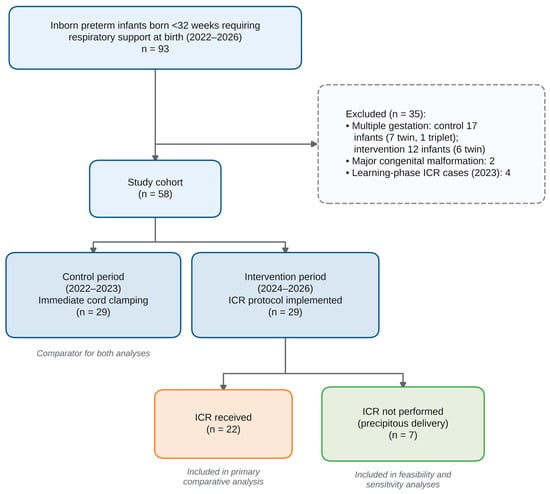
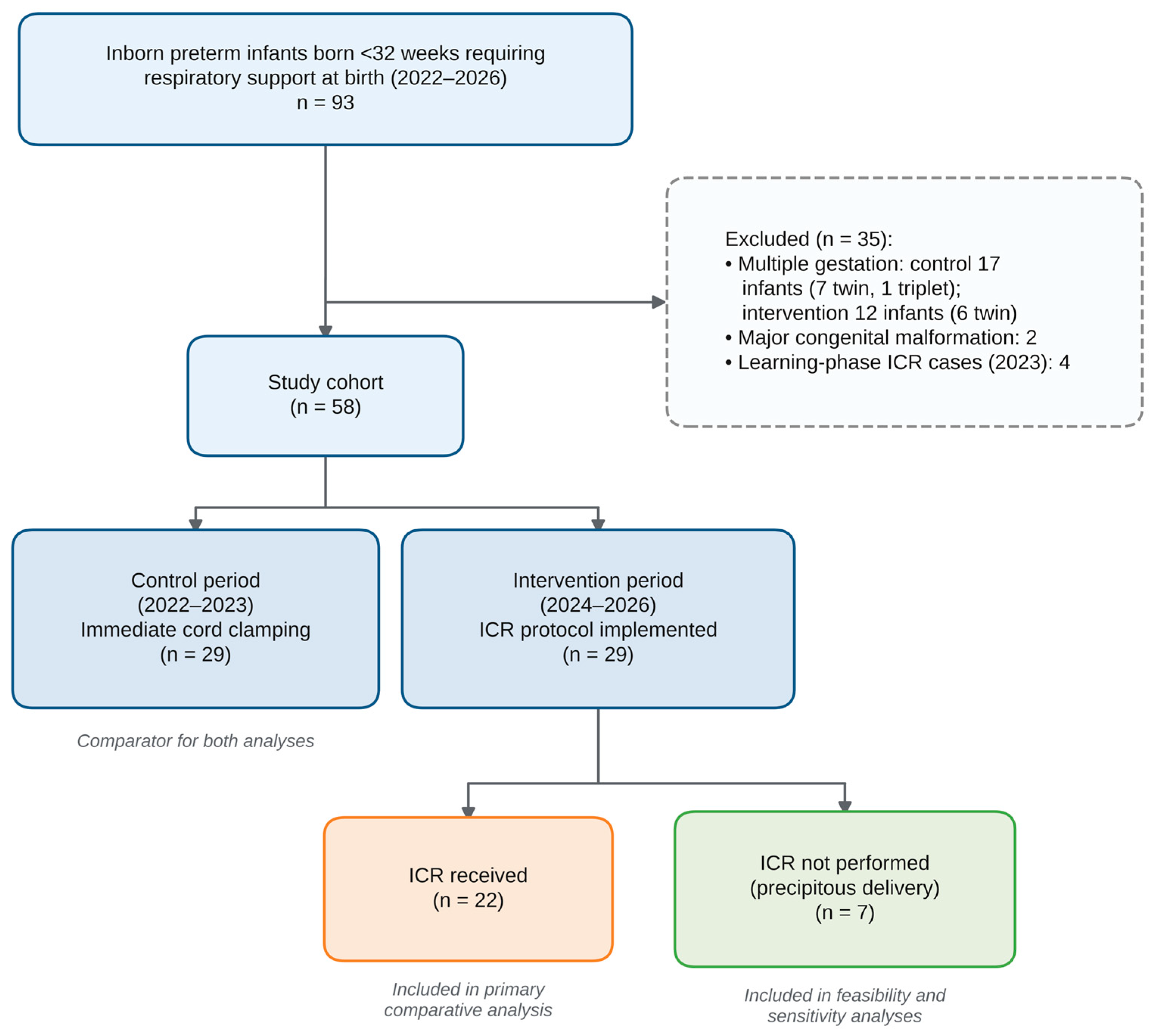
During the study period, 93 infants below 32 weeks of gestation were assessed. Thirty-five were excluded: 29 from multiple gestations (17 in the control period and 12 in the intervention period), 2 with major congenital malformations or severe congenital conditions, and 4 who had received ICR during the 2023 learning phase. The final population comprised 58 infants: 29 in the control period and 29 in the intervention period (Figure 1). The primary comparative analysis therefore included 22 infants who received ICR and 29 controls.
Figure 1.
Flow diagram of study participants. ICR, intact-cord resuscitation.
The baseline characteristics and antenatal co-interventions of the groups in the primary analysis are shown in Table 1. Median gestational age was 30.1 weeks in the ICR recipients and 29.9 weeks in the controls, and mean birth weight was 1154 and 1250 g, respectively. No statistically significant differences were observed in the baseline characteristics or the antenatal co-interventions assessed. Baseline characteristics of intervention-period infants according to whether ICR was performed are provided in Table S1. Given the small number of infants in whom ICR was not performed, these data are presented descriptively.
Table 1.
Baseline characteristics and co-interventions (ICR received vs. control).
ICR could be performed for at least 60 s in 22 of the 29 eligible intervention-period infants (76%). In the remaining 7 (24%), rapid delivery left insufficient time for equipment preparation. The proportion of eligible infants receiving ICR increased over the intervention period (11/16 [69%] in 2024, 9/11 [82%] in 2025 and 2/2 in the first half of 2026). Among infants who received ICR, the cord remained intact for a median of 111 s (range 90–145). No procedure-related adverse events or incidents were recorded among the 22 infants who underwent ICR.
3.2. Safety
3.2.1. Adequacy of Resuscitation
No statistically significant differences were observed between groups in Apgar scores at 1, 5 and 10 min, maximum FiO2 or the maximum level of respiratory support required in the delivery room (Table 2). Intubation was required in 2/22 (9%) infants in the ICR group and in 4/29 (14%) controls. Chest compressions and adrenaline were each recorded in one infant across the whole study population.
Table 2.
Outcomes (ICR received vs. control).
3.2.2. Thermal Safety
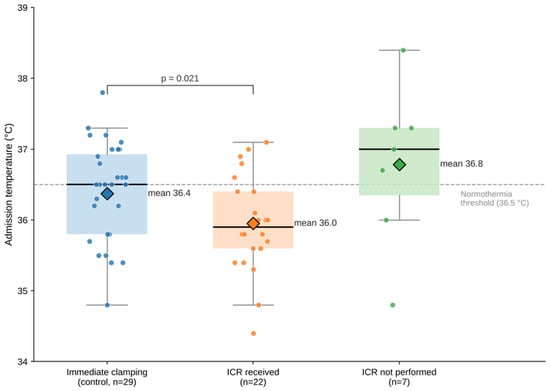
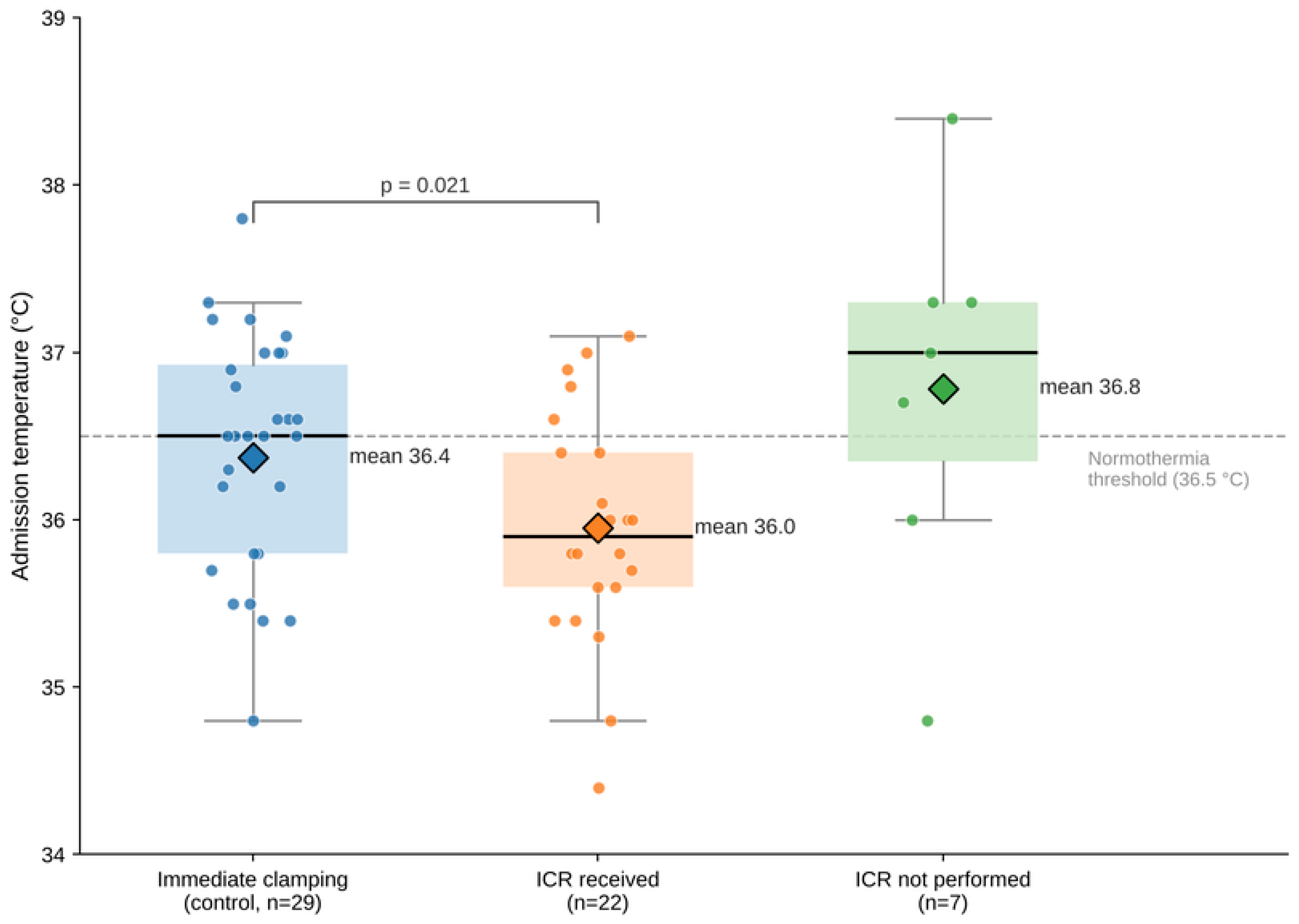
Infants who received ICR had a lower admission temperature than controls (36.0 ± 0.7 vs. 36.4 ± 0.7 °C; mean difference −0.47 °C; 95% CI −0.87 to −0.08; p = 0.021). After adjustment for gestational age, the adjusted mean difference was −0.47 °C (95% CI −0.87 to −0.07).
Admission hypothermia (<36.5 °C) was observed in 17/22 (77%) infants who received ICR versus 11/29 (38%) controls (RR 2.04; 95% CI 1.21 to 3.42). Among the 7 intervention-period infants in whom ICR was not performed, it was observed in 2/7 (29%) (Figure 2). The unadjusted OR was 5.56 (95% CI 1.60 to 19.38), and the gestational-age-adjusted OR was 5.56 (95% CI 1.60 to 19.46). Within the ICR group, hypothermia was observed in 14/15 (93%) infants born by caesarean section and in 3/7 (43%) born vaginally (p = 0.021) (Table 2). In the historical control group, hypothermia occurred in 8/21 (38%) infants born by caesarean section and 3/8 (38%) born vaginally. Admission temperatures below 36.0 °C were recorded in 11/22 (50%) ICR recipients and 8/29 (28%) historical controls.
Figure 2.
Admission temperature according to the resuscitation actually received. Boxes represent the median and interquartile range; dots correspond to individual values and diamonds indicate the mean of each group. The third group comprises intervention-period infants in whom ICR could not be performed and who were stabilised after cord clamping on the conventional resuscitation cot. ICR, intact-cord resuscitation.
In the sensitivity analysis by period of birth, the differences were attenuated: mean admission temperature was 36.2 ± 0.9 °C in the intervention period and 36.4 ± 0.7 °C in the control period (difference −0.27 °C; 95% CI −0.69 to 0.15; p = 0.202), whereas hypothermia occurred in 19/29 (66%) versus 11/29 (38%), respectively (RR 1.73; 95% CI 1.01 to 2.95; p = 0.065) (Table S2).
3.3. Exploratory Clinical Outcomes
Admission haemoglobin concentration was higher in infants who received ICR (16.2 ± 2.4 vs. 14.7 ± 2.3 g/dL; mean difference +1.46 g/dL; 95% CI 0.12 to 2.81; p = 0.034). After adjustment for gestational age, the difference was +1.44 g/dL (95% CI 0.12 to 2.75). In the sensitivity analysis by period of birth, the difference attenuated to +0.98 g/dL (95% CI −0.30 to 2.27; p = 0.131) (Table S2).
Phototherapy was more frequent among infants who received ICR than among controls (19/22 [86%] vs. 15/29 [52%]; RR 1.67; 95% CI 1.13 to 2.46; p = 0.015), with no detectable difference in peak bilirubin (median 10.3 vs. 11.4 mg/dL; p = 0.668). The unadjusted OR was 5.91 (95% CI 1.43 to 24.43), and the gestational-age-adjusted OR was 6.45 (95% CI 1.51 to 27.60) (Table 2). No exchange transfusions were required in either group. In the sensitivity analysis by period, phototherapy remained more frequent during the intervention period (24/29 [83%] vs. 15/29 [52%]; RR 1.60; 95% CI 1.08 to 2.36; p = 0.024) (Table S2). Among the seven intervention-period infants who did not receive ICR, mean admission haemoglobin was 14.2 ± 2.6 g/dL, and 5/7 (71%) received phototherapy.
No statistically significant differences were observed between groups in the need for red-cell transfusion, invasive mechanical ventilation or surfactant, or in the incidence of intraventricular haemorrhage, bronchopulmonary dysplasia, the composite outcome of death or bronchopulmonary dysplasia, retinopathy of prematurity, necrotising enterocolitis or mortality (Table 2).
4. Discussion
In this single-centre ambispective cohort study, intact-cord resuscitation could be performed in 22 of the 29 eligible intervention-period infants (76%), with the cord kept intact for a median of 111 s. In the remaining seven cases, rapid delivery left insufficient time for equipment preparation, identifying this as the main operational barrier to ICR. The apparent increase in implementation success over time may reflect growing team familiarity with the procedure and greater efficiency in team coordination and equipment preparation. However, the small number of eligible infants, particularly in 2026, precludes firm conclusions regarding a learning effect. Although an implementation rate of 76% supports the feasibility of ICR in our setting, it also highlights opportunities for improvement during the period following protocol introduction. Our unit is working to streamline team activation and equipment preparation to facilitate ICR in time-critical deliveries, although the impact of these measures on implementation success remains to be evaluated. An important contribution of this study is its evaluation of ICR implementation in routine clinical practice, with a protocol available around the clock, capturing both successful procedures and the logistical barriers encountered when ICR could not be performed. No detectable differences were observed in the parameters used to assess the adequacy of resuscitation. However, infants who received ICR had a lower admission temperature and a higher frequency of hypothermia, as well as a higher haemoglobin concentration and a greater need for phototherapy. These findings support the feasibility of incorporating ICR into the care of most eligible very preterm infants while highlighting thermal control as an important aspect of its implementation.
The main safety finding was the lower admission temperature and the higher frequency of hypothermia among infants who received ICR, despite the usual heat-loss prevention measures. Difficulties in maintaining normothermia during intact-cord stabilisation have been described previously in implementation studies, including that of Hocq et al. in infants below 32 weeks and the experience of Cleator et al. with LifeStart®, which prompted the incorporation of additional thermal measures [13,14]. However, this finding has not been uniform across clinical trials: Knol et al. observed no significant difference in admission temperature in their initial trial, whereas in the subsequent multicentre ABC3 trial admission temperature was lower with physiological-based cord clamping than with time-based clamping [12,15].
The LifeStart® trolley provided a thermal mattress but no radiant heat source, whereas controls were stabilised on a conventional cot with radiant heating and pre-warmed towels. Although polyethylene wrapping and a hat were used in both groups, cord management and thermal support differed simultaneously. The observed increase in hypothermia may be attributable, at least in part, to differences in thermal support rather than to ICR itself. Thus, the study evaluates ICR as implemented within a specific thermal environment, rather than the isolated effect of maintaining the cord intact. The apparent difference in hypothermia by mode of delivery is an exploratory finding based on small subgroups and may reflect differences in maturity, clinical condition, or operating-theatre conditions. Therefore, no firm conclusions regarding the influence of delivery mode can be drawn. Based on our experience and strategies reported by Cleator et al. [14], potential measures warranting evaluation include the addition of a self-heating gel mattress (TransWarmer) to supplement the existing thermal support of the LifeStart® trolley and the use of pre-warmed sterile towels where feasible, particularly during caesarean deliveries.
Admission haemoglobin concentration was higher in infants who received ICR. This finding is consistent with greater placental transfusion associated with maintaining the cord intact and with the haematological effects described for delayed cord clamping [16]. Moreover, Hocq et al. also observed higher haemoglobin concentrations after implementing ICR in very preterm infants, which lends external consistency to this observation [13].
The differences in admission temperature, hypothermia, and haemoglobin observed in the primary analysis were attenuated in the period-based sensitivity analysis. Because receipt of ICR depended on delivery circumstances rather than random allocation, the observed associations cannot be confidently attributed to the intervention itself. The period-based analysis, which included all eligible infants following protocol implementation, provides a more representative assessment of outcomes in routine clinical practice.
The need for phototherapy was higher among infants who received ICR than among historical controls. This result contrasts with the available aggregate evidence: in the systematic review and meta-analysis by Major et al., no significant increase in the need for phototherapy was observed with ICR [11]. The ABC3 trial also found higher haemoglobin concentrations after physiological-based cord clamping, but no difference in phototherapy use [12]. Importantly, its comparator was time-based delayed cord clamping (30–60 s), whereas our historical controls underwent immediate clamping. This difference should be considered when comparing haematological and phototherapy outcomes across studies. A greater red-cell mass secondary to greater placental transfusion could provide a biologically plausible explanation, although our data do not allow this mechanism to be established. Interestingly, the higher frequency of phototherapy persisted in the period-based analysis, despite attenuation of the difference in haemoglobin concentrations. This finding suggests that increased phototherapy use may not be explained solely by greater placental transfusion associated with ICR, although the underlying mechanism remains uncertain. Although the local criteria for indicating phototherapy remained unchanged during the study, peak bilirubin did not differ detectably between groups and no exchange transfusions were required; however, peak bilirubin is itself influenced by phototherapy and therefore does not resolve the underlying mechanism. Given the small sample size and wide confidence intervals, this finding should be regarded as exploratory and requires confirmation.
The remaining clinical outcomes showed no detectable differences between groups, including the need for mechanical ventilation, intraventricular haemorrhage, necrotising enterocolitis, bronchopulmonary dysplasia and mortality. These results are broadly concordant with the systematic review by Major et al., which likewise identified no significant differences in mortality or in the major early complications of prematurity between the cord-management strategies evaluated during resuscitation [11]. However, our study was not powered to assess these outcomes, and the small number of events precludes conclusions about efficacy or about infrequent adverse events. The absence of differences should therefore be interpreted as the absence of a detectable signal in this cohort and not as evidence of equivalence.
This study has several limitations. First, the use of historical controls in a before–after design introduces potential temporal confounding. Although other established clinical protocols remained unchanged, staff experience, adherence to clinical protocols, and documentation practices may have evolved between study periods. Therefore, the observed differences cannot be confidently attributed to ICR alone. Second, in the primary analysis, infants were classified according to the intervention received; although this analysis allows exploration of outcomes associated with actual exposure to ICR, the exclusion of the seven intervention-period infants in whom it could not be performed introduces possible selection bias. These infants had a somewhat lower median gestational age than ICR recipients, although this subgroup was small, further supporting the use of a sensitivity analysis by period of birth that included all intervention-period infants irrespective of whether ICR was ultimately performed. Although selected outcomes were adjusted for gestational age, residual confounding by other clinically relevant factors, such as birth weight, antenatal corticosteroid exposure, mode of delivery, sex, and clinical condition at birth, cannot be excluded. Further adjustment was limited by the small sample size and the risk of overfitting. Third, the intervention was linked to the use of a different resuscitation device, so the effect of keeping the cord intact cannot be separated from that of the thermal and logistical environment. Furthermore, the exclusion of multiple gestations limits the generalisability of the findings to infants from multiple gestations. Finally, the small sample size and single-centre nature limit the precision of the estimates and their generalisability, particularly for infrequent clinical outcomes, exploratory analyses and extremely preterm infants, as only four ICR recipients were born before 28 weeks’ gestation. The sample size also precluded reliable subgroup analysis by mode of delivery or assessment of an interaction between ICR and mode of delivery on temperature. Accordingly, the higher frequency of hypothermia observed after caesarean section should be interpreted with caution, as differences in maturity, clinical condition and operating-theatre conditions cannot be disentangled from the effect of mode of delivery in this sample. Given the number of outcomes assessed and the absence of correction for multiple comparisons, chance findings cannot be excluded, and statistically significant associations should be interpreted cautiously, particularly for exploratory outcomes.
In conclusion, ICR was feasible in most eligible infants born before 32 weeks’ gestation. No significant differences in immediate stabilisation measures were detected, although the limited sample size precludes firm conclusions regarding comparative safety. A clinically relevant thermal signal was observed in a setting in which ICR was performed without radiant heat; because the procedure and thermal environment changed together, their respective contributions cannot be disentangled. Differences in admission temperature, hypothermia and haemoglobin were attenuated in the period-based sensitivity analysis, which included all eligible intervention-period infants irrespective of ICR receipt. Higher haemoglobin concentrations were compatible with greater placental transfusion, whereas the increased use of phototherapy should be regarded as exploratory. Overall, these results support the feasibility of ICR in our setting and highlight the need to evaluate strategies to improve thermal protection during ICR; confirmation of our findings in larger multicentre studies with concurrent comparators is warranted, particularly among infants born before 28 weeks’ gestation.
Supplementary Materials
The following supporting information can be downloaded at https://www.mdpi.com/article/10.3390/children13121673/s1. Table S1: Baseline characteristics and antenatal co-interventions of intervention-period infants according to ICR performance. Table S2: Sensitivity analysis by period of birth (all ICR-period infants vs control).
Author Contributions
Conceptualization, D.P.-F. and E.M.-C.; methodology, D.P.-F. and J.T.-C.; investigation, D.P.-F., J.T.-C., J.B.-H., M.J.G.-B., E.L.-B., J.J.S.-Q. and M.J.-E.; data curation, D.P.-F., J.B.-H. and R.E.-V.; formal analysis, D.P.-F., J.B.-H. and R.E.-V.; writing—original draft preparation, D.P.-F.; writing—review and editing, D.P.-F., J.T.-C., J.B.-H., M.J.G.-B., E.L.-B., J.J.S.-Q., M.J.-E., R.E.-V. and E.M.-C.; visualization, D.P.-F., J.B.-H. and R.E.-V.; supervision, R.E.-V. and E.M.-C.; project administration, D.P.-F. and E.M.-C. All authors have read and agreed to the published version of the manuscript.
Funding
This research received no external funding.
Institutional Review Board Statement
The study was conducted in accordance with the Declaration of Helsinki and was approved by the Comitè d’Ètica de l’Hospital de la Santa Creu i Sant Pau (protocol code IIBSP-RCI-2025-222, final protocol version approved on 16 September 2026).
Informed Consent Statement
Informed consent for the control cohort was waived by the ethics committee due to the retrospective design and use of de-identified data. Informed consent for the intervention cohort was obtained from the parents of all participants.
Data Availability Statement
The datasets generated and/or analysed during the current study are available from the corresponding author upon reasonable request due to privacy and ethical restrictions.
Acknowledgments
The authors thank the neonatal and obstetric teams at Hospital de la Santa Creu i Sant Pau for their collaboration in implementing the intact-cord resuscitation protocol.
Conflicts of Interest
The authors declare no conflicts of interest.
References
- Hogeveen, M.; Monnelly, V.; Binkhorst, M.; Cusack, J.; Fawke, J.; Kardum, D.; Roehr, C.C.; Rüdiger, M.; Schwindt, E.; Solevåg, A.L.; et al. European Resuscitation Council Guidelines 2025 Newborn Resuscitation and Support of Transition of Infants at Birth. Resuscitation 2025, 215, 110766. [Google Scholar] [CrossRef] [Scilit] [PubMed]
- Lee, H.C.; Strand, M.L.; Finan, E.; Illuzzi, J.; Kamath-Rayne, B.D.; Kapadia, V.; Mahgoub, M.; Niermeyer, S.; Schexnayder, S.M.; Schmölzer, G.M.; et al. Part 5: Neonatal Resuscitation: 2025 American Heart Association and American Academy of Pediatrics Guidelines for Cardiopulmonary Resuscitation and Emergency Cardiovascular Care. Circulation 2025, 152, S385–S423. [Google Scholar] [CrossRef] [Scilit] [PubMed]
- Fogarty, M.; Osborn, D.A.; Askie, L.; Seidler, A.L.; Hunter, K.; Lui, K.; Simes, J.; Tarnow-Mordi, W. Delayed vs early umbilical cord clamping for preterm infants: A systematic review and meta-analysis. Am. J. Obstet. Gynecol. 2018, 218, 1–18. [Google Scholar] [CrossRef] [Scilit] [PubMed]
- Rabe, H.; Gyte, G.M.L.; Díaz-Rossello, J.L.; Duley, L. Effect of timing of umbilical cord clamping and other strategies to influence placental transfusion at preterm birth on maternal and infant outcomes. Cochrane Database Syst. Rev. 2019, 9, CD003248. [Google Scholar] [CrossRef] [Scilit] [PubMed]
- Seidler, A.L.; Aberoumand, M.; Hunter, K.E.; Barba, A.; Libesman, S.; Williams, J.G.; Shrestha, N.; Aagerup, J.; Sotiropoulos, J.X.; Montgomery, A.A.; et al. Deferred cord clamping, cord milking, and immediate cord clamping at preterm birth: A systematic review and individual participant data meta-analysis. Lancet 2023, 402, 2209–2222. [Google Scholar] [CrossRef] [Scilit] [PubMed]
- Chiruvolu, A.; Mallett, L.H.; Govande, V.P.; Raju, V.N.; Hammonds, K.; Katheria, A.C. Variations in umbilical cord clamping practices in the United States: A national survey of neonatologists. J. Matern. Fetal Neonatal Med. 2022, 35, 3646–3652. [Google Scholar] [CrossRef] [Scilit] [PubMed]
- Porcar-Farrán, D.; Esmel-Vilomara, R.; Becerra-Hervás, J.; Salazar-Quiroz, J.J.; Moliner-Calderon, E. Management of umbilical cord at birth in Spanish hospitals: Results of a national survey. An. Pediatr. (Engl. Ed.) 2026, 104, 504142. [Google Scholar] [CrossRef] [Scilit] [PubMed]
- Bjorland, P.A.; Øymar, K.; Ersdal, H.L.; Rettedal, S.I. Incidence of newborn resuscitative interventions at birth and short-term outcomes: A regional population-based study. BMJ Paediatr. Open 2019, 3, e000592. [Google Scholar] [CrossRef] [Scilit] [PubMed]
- Bhatt, S.; Polglase, G.R.; Wallace, E.M.; te Pas, A.B.; Hooper, S.B. Ventilation before umbilical cord clamping improves the physiological transition at birth. Front. Pediatr. 2014, 2, 113. [Google Scholar] [CrossRef] [Scilit] [PubMed]
- Katheria, A.C.; Brown, M.K.; Rich, W.; Arnell, K. Providing a placental transfusion in newborns who need resuscitation. Front. Pediatr. 2017, 5, 1. [Google Scholar] [CrossRef] [Scilit] [PubMed]
- Major, G.S.; Unger, V.; Nagy, R.; Hernádfői, M.; Veres, D.S.; Zolcsák, Á.; Szabó, M.; Garami, M.; Hegyi, P.; Varga, P.; et al. Umbilical cord management in newborn resuscitation: A systematic review and meta-analysis. Pediatr. Res. 2025, 97, 1481–1491. [Google Scholar] [CrossRef] [Scilit] [PubMed]
- Knol, R.; Brouwer, E.; van den Akker, T.; DeKoninck, P.L.J.; Onland, W.; Vermeulen, M.J.; de Boode, W.P.; van Kaam, A.H.; Lopriore, E.; Reiss, I.K.M.; et al. Physiological versus time based cord clamping in very preterm infants (ABC3): A parallel-group, multicentre, randomised, controlled superiority trial. Lancet Reg. Health Eur. 2025, 48, 101146. [Google Scholar] [CrossRef] [Scilit] [PubMed]
- Hocq, C.; Van Grambezen, A.; Carkeek, K.; Van Grambezen, B.; Yoxall, C.W.; Debiève, F.; Piersigilli, F.; Danhaive, O. Implementing intact cord resuscitation in very preterm infants: Feasibility and pitfalls. Eur. J. Pediatr. 2023, 182, 1105–1113. [Google Scholar] [CrossRef] [Scilit] [PubMed]
- Cleator, A.J.; Coombe, E.; Alexopoulou, V.; Levingston, L.; Evans, K.; Hurst, J.C.; Yoxall, C.W. Maintaining Normothermia in Preterm Babies during Stabilisation with an Intact Umbilical Cord. Children 2022, 9, 75. [Google Scholar] [CrossRef] [Scilit] [PubMed]
- Knol, R.; Brouwer, E.; van den Akker, T.; DeKoninck, P.; van Geloven, N.; Polglase, G.R.; Lopriore, E.; Herkert, E.; Reiss, I.K.M.; Hooper, S.B.; et al. Physiological-based cord clamping in very preterm infants—Randomised controlled trial on effectiveness of stabilisation. Resuscitation 2020, 147, 26–33. [Google Scholar] [CrossRef] [Scilit] [PubMed]
- Rabe, H.; Mercer, J.; Erickson-Owens, D. What does the evidence tell us? Revisiting optimal cord management at the time of birth. Eur. J. Pediatr. 2022, 181, 1797–1807. [Google Scholar] [CrossRef] [Scilit] [PubMed]

Disclaimer/Publisher’s Note: The statements, opinions and data contained in all publications are solely those of the individual author(s) and contributor(s) and not of MDPI and/or the editor(s). MDPI and/or the editor(s) disclaim responsibility for any injury to people or property resulting from any ideas, methods, instructions or products referred to in the content. |
© 2026 by the authors. Licensee MDPI, Basel, Switzerland. This article is an open access article distributed under the terms and conditions of the Creative Commons Attribution (CC BY) license.