


Highlights
What are the main findings?
- TcB correlated strongly with TSB (r = 0.874), with a mean positive bias of 0.79 mg/dL.
- Discordance across prespecified bilirubin concentration categories occurred in 34% of neonates.
What are the implications of the main findings?
- Strong correlation between TcB and TSB does not guarantee categorical agreement.
- Category discordance does not necessarily indicate incorrect treatment decisions; confirmatory TSB testing should follow established clinical guidelines.
Abstract
Background and Objectives: Although transcutaneous bilirubin (TcB) is widely used for neonatal jaundice screening, measurement discrepancies with total serum bilirubin (TSB) may affect the assignment of infants to bilirubin concentration categories. This study evaluated TcB–TSB measurement agreement and discordance across predefined concentration categories. Materials and Methods: We retrospectively analyzed 100 neonates admitted primarily for jaundice between January 2024 and December 2025 (gestational age ≥ 35 weeks; birth weight ≥ 2000 g). Paired forehead TcB and venous TSB measurements were obtained within 1 h before treatment. Agreement was assessed using Pearson correlation, Lin’s concordance correlation coefficient (CCC), Bland–Altman analysis, and categorical agreement across three predefined concentration strata (≤13, >13 to ≤16, and >16 mg/dL). Results: TcB correlated strongly with TSB (r = 0.874; CCC = 0.84), with a mean bias of 0.79 mg/dL and 95% limits of agreement from −2.14 to 3.71 mg/dL. Categorical discordance occurred in 34% of infants (95% CI, 25.5–43.7%), with upward discordance more frequent than downward discordance (25% vs. 9%). A sensitivity analysis using alternative concentration cutoffs yielded discordance rates of 22–26%. Conclusions: Despite strong correlation, TcB and TSB assigned approximately one-third of infants to different predefined bilirubin concentration categories. This discordance was dependent on the selected cutoffs and should not be interpreted as disagreement in clinical treatment decisions. Confirmatory TSB testing should follow established clinical guidelines.
1. Introduction
Physiologic neonatal jaundice occurs in approximately 60% of term and up to 80% of preterm infants. It typically appears after 24 h of life, peaks between days 3 and 5, and gradually resolves within 1–2 weeks [1]. This condition is primarily attributed to increased bilirubin production and immature hepatic clearance [2,3]. Although most cases are benign, severe hyperbilirubinemia may result in bilirubin encephalopathy and irreversible neurologic injury if not recognized and treated appropriately [1,4,5,6,7]. Accurate bilirubin assessment is therefore essential for appropriate neonatal management.
The 2022 American Academy of Pediatrics (AAP) guideline recommends bilirubin screening using either total serum bilirubin (TSB) or transcutaneous bilirubin (TcB) in infants born at ≥35 weeks of gestation [1]. Although TSB remains the reference standard, TcB provides a rapid, noninvasive alternative for bilirubin screening [8,9]. Previous studies have demonstrated strong correlations between TcB and TSB while also identifying clinically relevant measurement discrepancies [9,10].
Although TcB–TSB measurement discrepancies are well documented, their implications for assignment to predefined bilirubin concentration categories warrant further evaluation. Assessing categorical discordance alongside continuous measurement agreement may provide a complementary perspective on TcB performance. Therefore, this study evaluated TcB–TSB agreement and discordance across three predefined concentration strata (≤13, >13 to ≤16, and >16 mg/dL) in neonates admitted for jaundice, with exploratory analyses according to TSB concentration and body mass index (BMI). These categories were used for exploratory analysis and did not represent individualized AAP phototherapy thresholds.
2. Materials and Methods
2.1. Study Design and Population
We conducted a single-center retrospective observational study in the neonatal unit of a hospital in South Korea. The study included all 100 eligible neonates admitted primarily for the evaluation and treatment of neonatal jaundice between January 2024 and December 2025. Infants were eligible if they were born at ≥35 weeks of gestation, had a birth weight of ≥2000 g, and underwent paired TcB and TSB measurements at admission before any jaundice treatment was initiated.
Neonates with sepsis or other systemic symptoms requiring evaluation or treatment for conditions other than jaundice were excluded, as were those who developed jaundice during hospitalization for other medical conditions. Infants who had received prior treatment for jaundice, including phototherapy or exchange transfusion, before admission were also excluded. The study protocol was approved by the Institutional Review Board of Daegu Fatima Hospital (approval date: 29 May 2026; approval No. 2026-04-004). The requirement for informed consent was waived due to the retrospective design and the use of de-identified data.
2.2. Bilirubin Measurement
TcB and TSB values were expressed in mg/dL. TcB was measured on the forehead using a Dräger JM-105 transcutaneous bilirubin meter (Dräger, Lübeck, Germany) by trained pediatricians according to the manufacturer’s instructions. The device was checked and maintained according to the manufacturer’s recommendations. For each infant, two consecutive TcB measurements were obtained, and the mean value was used for analysis. TSB was measured from venous blood samples using a cobas 8000 c702 automated chemistry analyzer (Roche Diagnostics, Basel, Switzerland).
TcB was consistently measured before TSB sampling, and the corresponding TSB results were not available to the operators at the time of TcB measurement. The mean interval between measurements was 20.98 ± 11.70 min (range, 3–56 min). All paired measurements were obtained within 1 h of each other immediately after admission and before the initiation of any jaundice treatment, including phototherapy or exchange transfusion.
2.3. Variables and Definitions
Baseline characteristics included gestational age, postnatal age, birth weight, BMI, sex, feeding type before admission, and clinical factors associated with neonatal jaundice, including cephalhematoma, ABO incompatibility with a positive direct antiglobulin test (DAT), and thyroid function test results. BMI was calculated as admission weight in kilograms divided by the square of recumbent crown-to-heel length in meters (kg/m2). Gestational age was categorized as late preterm (<37 weeks) or term (≥37 weeks). Birth weight was classified into three categories: ≤2500 g, 2501–3000 g, and >3000 g. Feeding type before admission was categorized as exclusive breastfeeding, exclusive formula feeding, or mixed feeding. For exploratory analyses, bilirubin concentrations were categorized into three study-defined strata (≤13, >13 to ≤16, and >16 mg/dL). The cutoffs of 13 and 16 mg/dL were selected based on clinical experience to distinguish lower, intermediate, and higher bilirubin concentrations, with particular interest in the intermediate range for monitoring bilirubin levels and assessing potential treatment needs. These cutoffs were not intended to represent validated clinical decision limits or individualized AAP phototherapy thresholds. BMI was also dichotomized at 13.2 kg/m2 as a study-defined cutoff, with reference to published neonatal BMI distributions [11]. This cutoff was not intended as a validated threshold for predicting TcB measurement accuracy. Measurement bias was defined as TcB minus TSB, and categorical discordance was defined as the assignment of TcB and TSB measurements to different predefined concentration categories.
2.4. Statistical Analysis
Continuous variables were expressed as mean ± standard deviation (SD) or number (%), as appropriate. Agreement between TcB and TSB was assessed using Pearson’s correlation coefficient (r), Lin’s concordance correlation coefficient (CCC), Bland–Altman analysis with 95% limits of agreement (LoA; mean bias ± 1.96 × SD), and mean absolute error (MAE). Measurement differences were further assessed by calculating the proportions of TcB underestimation and overestimation of ≥2 and ≥3 mg/dL.
Exploratory analyses were performed according to TSB concentration (≤13, >13 to ≤16, and >16 mg/dL) and BMI (<13.2 vs. ≥13.2 kg/m2). Categorical agreement was evaluated using a 3 × 3 cross-tabulation and linear weighted kappa. A post hoc sensitivity analysis assessed categorical discordance using alternative cutoffs of 12/15 and 14/17 mg/dL. The 95% confidence intervals (CIs) were estimated using the t-distribution for mean bias, normal-theory approximations for LoA, bootstrap resampling for CCC (20,000 iterations) and weighted kappa (10,000 iterations), and the Wilson method for categorical proportions. No imputation was required because there were no missing data. Analyses were performed using Python (version 3.10) and R (version 4.5.1).
3. Results
3.1. Baseline Characteristics
A total of 100 neonates were included in the analysis. Term infants accounted for 81.0% of the cohort, and 67.0% had a birth weight > 3000 g. The mean postnatal age was 6.60 ± 2.81 days, and the mean BMI was 12.69 ± 1.21 kg/m2. The mean TcB and TSB levels were 15.63 ± 2.74 mg/dL and 14.85 ± 3.07 mg/dL, respectively. Baseline characteristics are summarized in Table 1.
Table 1.
Baseline characteristics of the study population (N = 100).
3.2. Overall Agreement Between TcB and TSB
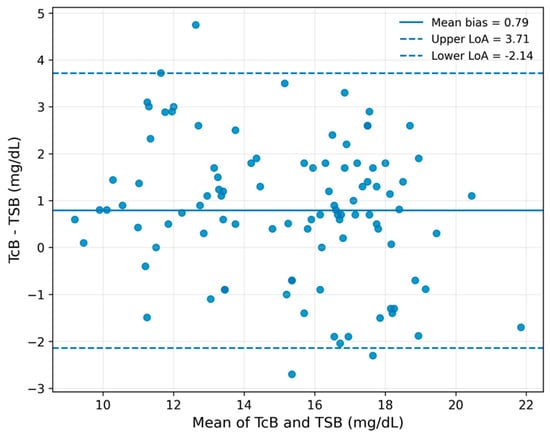
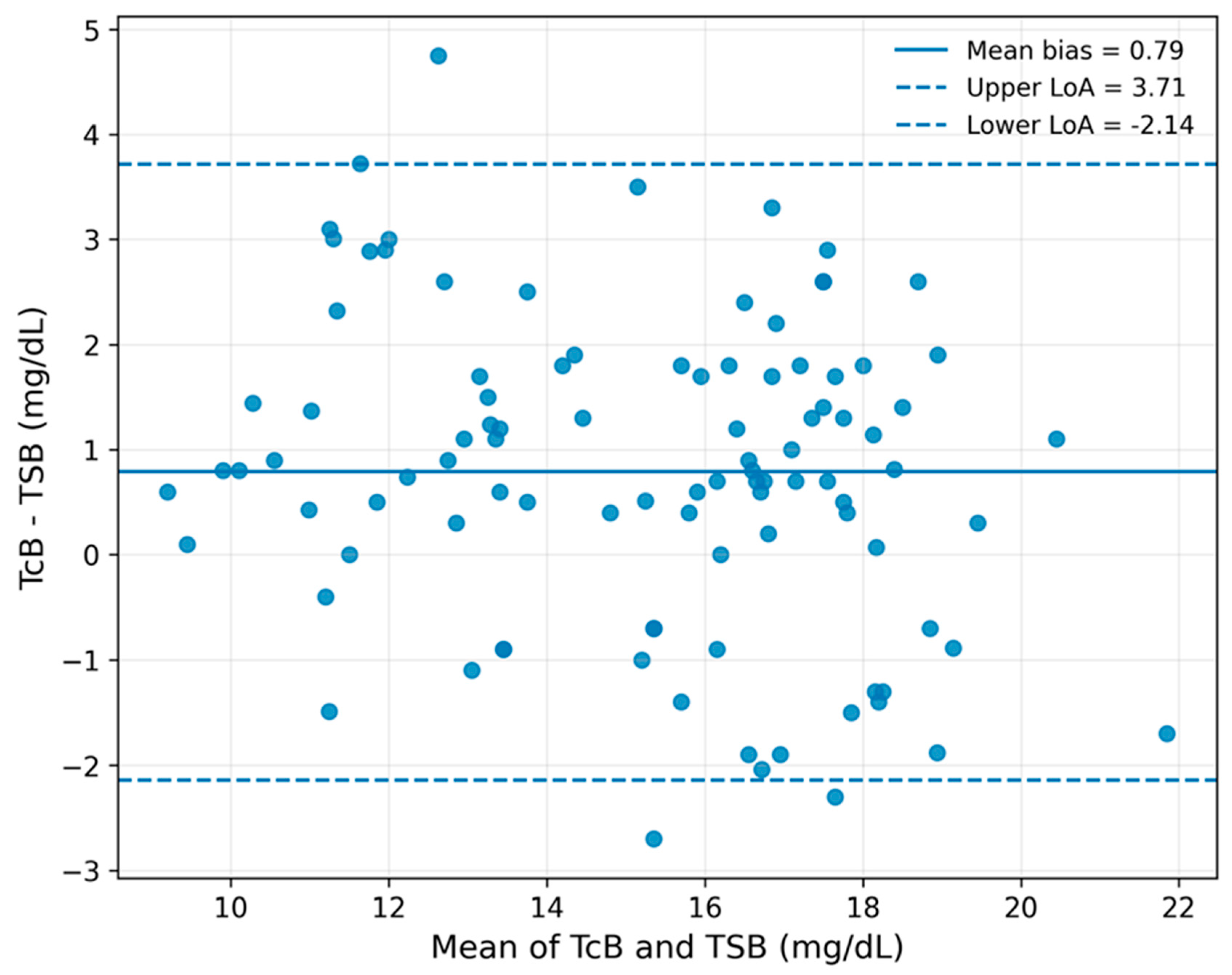
TcB showed a strong linear correlation with TSB (Pearson r = 0.874). The mean bias, calculated as TcB minus TSB, was 0.79 mg/dL (95% CI, 0.49–1.08 mg/dL), with an SD of the differences of 1.49 mg/dL. The 95% limits of agreement ranged from −2.14 to 3.71 mg/dL. The MAE was 1.41 mg/dL, and Lin’s CCC was 0.84 (95% CI, 0.781–0.880). TcB underestimated TSB by ≥2 mg/dL in 3 infants (3.0%), with no cases of underestimation by ≥3 mg/dL. In contrast, TcB overestimated TSB by ≥2 mg/dL in 18 infants (18.0%) and by ≥3 mg/dL in 7 infants (7.0%). Overall, absolute differences of ≥2 and ≥3 mg/dL were observed in 21% and 7% of infants, respectively. The overall agreement metrics are summarized in Table 2A, and the Bland–Altman plot is shown in Figure 1.
Table 2.
Agreement between TcB and TSB measurements.
Figure 1.
Bland–Altman plot of TcB and TSB. Bland–Altman plot showing the overall agreement between transcutaneous bilirubin (TcB) and total serum bilirubin (TSB). The solid line represents the mean bias, and the dashed lines indicate the 95% limits of agreement.
3.3. Subgroup Analysis
Agreement between TcB and TSB according to bilirubin level and BMI is summarized in Table 2B. Across TSB categories, the mean bias decreased from 1.47 mg/dL in the ≤13 mg/dL group to 0.92 mg/dL in the >13 to ≤16 mg/dL group and 0.23 mg/dL in the >16 mg/dL group. The MAE also decreased across increasing TSB categories, from 1.59 to 1.34 and 1.31 mg/dL, respectively. CCC values ranged from 0.35 to 0.43 across TSB subgroups.
Agreement also varied according to BMI group. The BMI < 13.2 kg/m2 group showed a higher mean bias than the BMI ≥ 13.2 kg/m2 group (1.03 vs. 0.40 mg/dL), and the MAE was also higher in the lower BMI group (1.55 vs. 1.19 mg/dL). CCC was lower in the BMI < 13.2 kg/m2 group than in the BMI ≥ 13.2 kg/m2 group (0.81 vs. 0.88).
3.4. Categorical Agreement and Discordance
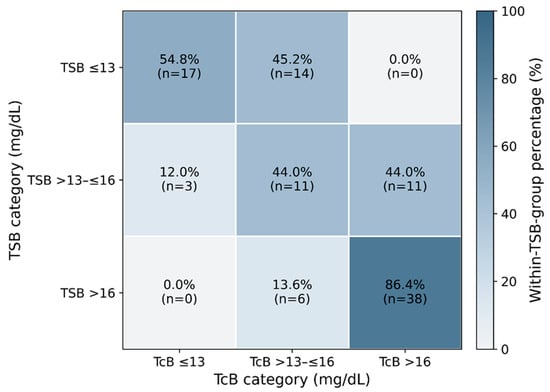
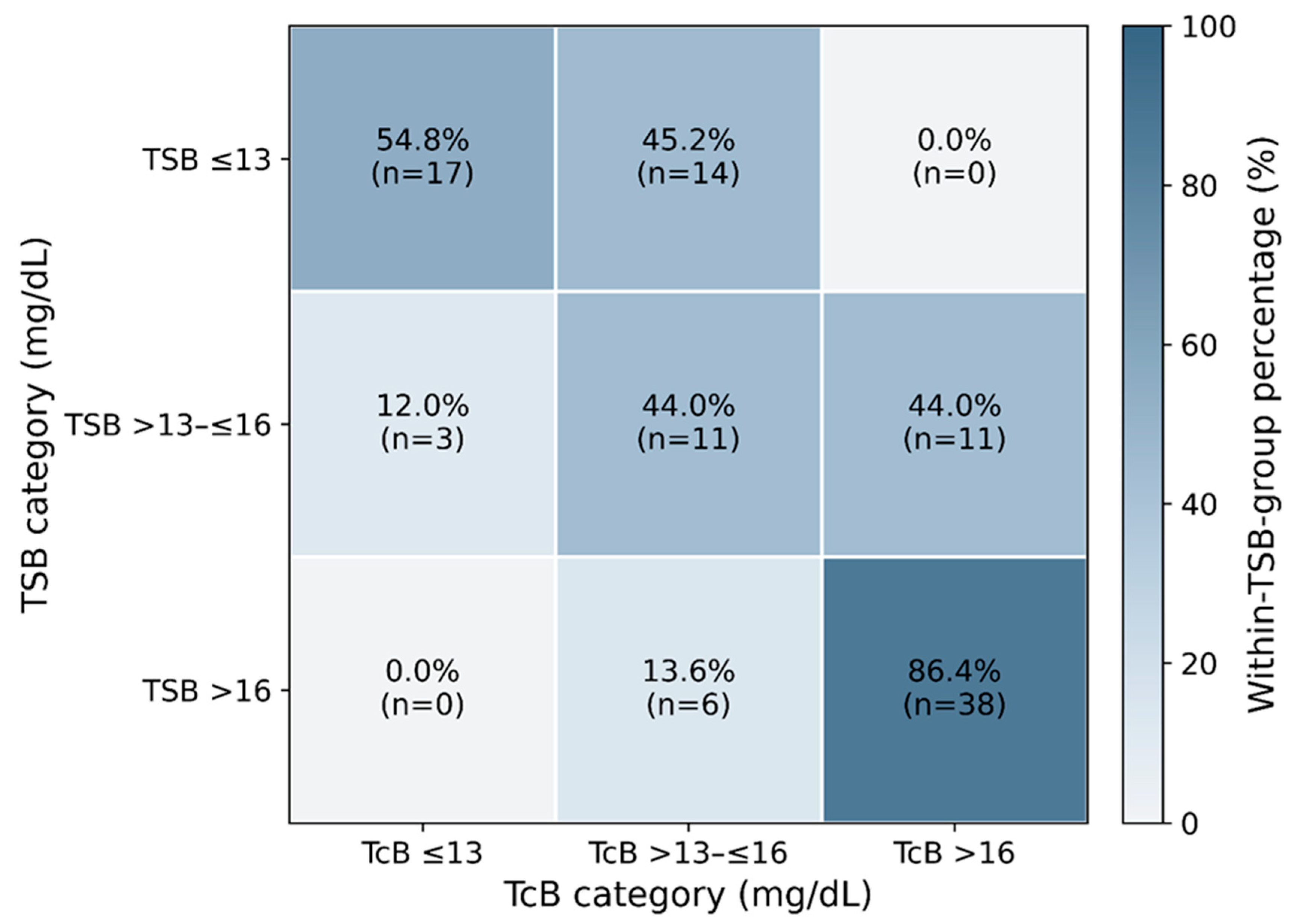
Categorical agreement between TcB and TSB measurements is summarized in Table 3. Concordance rates were 54.8% (17/31), 44.0% (11/25), and 86.4% (38/44) in the low (≤13 mg/dL), intermediate (>13 to ≤16 mg/dL), and high (>16 mg/dL) TSB groups, respectively.
Table 3.
Categorical Agreement Between TcB and TSB.
Overall, category discordance occurred in 34 infants (34.0%; 95% CI, 25.5–43.7%), with upward discordance more frequent than downward discordance (25.0% vs. 9.0%). The linear weighted kappa was 0.616 (95% CI, 0.50–0.72). The distribution of categorical agreement is illustrated in Figure 2.
Figure 2.
Categorical agreement between transcutaneous bilirubin (TcB) and total serum bilirubin (TSB) measurements. The heatmap displays the percentage of neonates assigned to each TcB concentration category within the corresponding TSB category. Each cell presents the row percentage and the number of infants. Diagonal cells indicate category concordance, whereas off-diagonal cells indicate upward or downward category discordance. Categories were defined as ≤13, >13 to ≤16, and >16 mg/dL.
In a post hoc sensitivity analysis, discordance rates were 22.0% and 26.0% using alternative cutoffs of 12/15 and 14/17 mg/dL, respectively, compared with 34.0% using the original 13/16 mg/dL cutoffs.
4. Discussion
Accurate bilirubin assessment is essential for managing neonatal jaundice. Although TSB remains the reference standard, TcB provides a rapid, noninvasive alternative, making measurement agreement particularly important near clinical decision thresholds [1,12,13,14]. This study evaluated both continuous TcB–TSB agreement and discordance across predefined bilirubin concentration categories. Despite a strong correlation, 34% of paired measurements were assigned to different categories, providing a complementary perspective on measurement agreement.
Our findings were consistent with those of Taylor et al., who reported a mean TcB–TSB difference of 0.84 mg/dL, compared with 0.79 mg/dL in our study. TcB underestimation of ≥3 mg/dL occurred in 2.2% of their measurements but was not observed in our cohort. In our study, underestimation of ≥2 mg/dL occurred in 3.0%, whereas overestimation of ≥2 and ≥3 mg/dL occurred in 18.0% and 7.0%, respectively. Differences in patient populations, measurement devices, and clinical settings should be considered when interpreting these findings [10]. Although no TcB underestimation of ≥3 mg/dL was observed in our cohort, this finding should be interpreted cautiously given the relatively small sample size and does not exclude the possibility of such discrepancies in clinical practice. Furthermore, the relatively wide 95% limits of agreement (−2.14 to 3.71 mg/dL) indicate that substantial measurement differences may occur in individual infants, particularly when bilirubin levels are near clinical decision thresholds.
4.1. Influence of Bilirubin Level on TcB-TSB Agreement
Mean positive TcB–TSB bias was larger in the lowest TSB stratum (1.47 mg/dL) than in the highest stratum (0.23 mg/dL). However, these descriptive findings do not establish greater clinical reliability at higher bilirubin concentrations, as six infants in the highest TSB stratum were assigned to a lower category by TcB. All measurements were obtained using the same JM-105 device at the forehead before treatment, limiting variability related to device type, measurement site, and prior phototherapy [10,15]. The relatively low CCC values within TSB subgroups should also be interpreted cautiously, as restriction of the measurement range may affect CCC independently of measurement accuracy.
4.2. Influence of BMI on TcB-TSB Agreement
In an exploratory analysis, mean bias and MAE were numerically greater in the BMI < 13.2 kg/m2 group than in the higher-BMI group. BMI in early life is not a validated surrogate for the optical characteristics of forehead skin, and the 13.2 kg/m2 threshold was not developed to predict TcB accuracy. Unmeasured factors, including skin pigmentation and tissue characteristics, may contribute to the observed differences. These descriptive findings require independent confirmation and do not support BMI-based TcB correction or changes to management [16,17]. More broadly, the observed differences across BMI groups and bilirubin concentration categories were exploratory and descriptive. These findings do not establish that BMI or concentration-based categorization independently predicts TcB–TSB discordance or provides additional clinical benefit.
4.3. Clinical Implications of Categorical Discordance
TcB and TSB placed 34% of paired measurements into different study-defined bilirubin concentration categories. The post hoc exploratory sensitivity analysis demonstrated that discordance varied with the selected cutoffs (22–34%), highlighting the cutoff-dependent nature of this finding. Importantly, these categories did not represent individualized phototherapy thresholds, and categorical discordance should not be interpreted as disagreement in clinical treatment decisions. According to the 2022 AAP guideline, confirmatory TSB measurement is recommended when TcB is ≥15 mg/dL or within 3 mg/dL of the phototherapy threshold [1].
4.4. Strengths and Limitations
This study has several strengths, including paired TcB and TSB measurements obtained before treatment, the use of a single TcB device and measurement site, and a short interval between measurements. Multiple complementary statistical methods were also used to assess measurement agreement.
However, several limitations should be acknowledged. The single-center retrospective design and relatively small sample size limit the generalizability of the findings. The inclusion of only neonates admitted primarily for jaundice with paired TcB and TSB measurements may have introduced selection bias and further limited generalizability to routine newborn screening populations. The total number of neonates screened and excluded during the study period could not be reliably determined from the available retrospective records, preventing a complete assessment of the patient selection process.
More than 70% of infants were born at outside hospitals, and exact birth times and comprehensive neurotoxicity risk-factor data were not consistently available, preventing analysis based on individualized, hour-specific AAP phototherapy thresholds. Although all paired measurements were obtained within 1 h, changes in bilirubin levels during the measurement interval may have contributed to measurement differences.
Furthermore, the cutoffs were selected based on clinical experience rather than validated treatment thresholds, and the resulting categorical discordance was cutoff-dependent and did not reflect actual treatment-decision disagreement.
5. Conclusions
In this retrospective cohort of neonates admitted primarily for jaundice, TcB was strongly correlated with TSB, but 34% of paired measurements were assigned to different study-defined bilirubin concentration categories. This cutoff-dependent discordance represents a descriptive finding in a selected patient population and should not be interpreted as evidence of differences in clinical treatment decisions. Further studies using individualized phototherapy thresholds are needed to evaluate the clinical relevance of these measurement differences.
Author Contributions
Conceptualization, E.-K.L.; methodology, E.-K.L. and S.-G.K.; software, E.-K.L.; validation, E.-K.L. and S.-G.K.; formal analysis, E.-K.L. and S.-G.K.; investigation, E.-K.L., J.K. and M.K.; resources, J.K. and M.K.; data curation, J.K. and M.K.; writing—original draft preparation, E.-K.L.; writing—review and editing, J.K., M.K., S.-G.K. and J.-H.L.; visualization, E.-K.L.; supervision, E.-K.L.; project administration, E.-K.L. All authors have read and agreed to the published version of the manuscript.
Funding
This research was supported by the following grants from the Republic of Korea: (1) the Korea Health Technology R&D Project through the Korea Health Industry Development Institute (KHIDI), funded by the Ministry of Health and Welfare (Grant No. RS-2023-KH136789); (2) the Collabo R&D Program between Industry, University, and Research Institute, funded by the Ministry of SMEs and Startups (MSS) (Grant No. RS-2026-25533076); (3) the Regional Innovation System & Education (RISE) Program through the Daegu RISE Center, funded by the Ministry of Education (MOE) and Daegu Metropolitan City (Grant No. 2025-RISE-03-002); (4) a grant administered by the Commercialization Promotion Agency for R&D Outcomes (COMPA) and funded by the Ministry of Science and ICT (MSIT) (Grant No. RS-2025-02413013, “IP Enhancement and Commercialization to Promote the Market Adoption of Vision Intelligence-Based Multi-Biosignal Measurement Technology”); and (5) a grant administered by the Korea Innovation Foundation and funded by the Ministry of Science and ICT (MSIT) (Grant No. 2710093950).
Institutional Review Board Statement
The study was conducted in accordance with the Declaration of Helsinki and approved by the Institutional Review Board of Daegu Fatima Hospital, Daegu, Republic of Korea (approval No. 2026-04-004; approval date: 29 May 2026).
Informed Consent Statement
The requirement for informed consent, including parental or legal guardian consent, was waived by the Institutional Review Board of Daegu Fatima Hospital because of the retrospective study design and use of de-identified data.
Data Availability Statement
The data presented in this study are not publicly available due to patient privacy and ethical restrictions. De-identified data may be made available from the corresponding author upon reasonable request and subject to institutional approval.
Acknowledgments
During the preparation of this manuscript, the authors used ChatGPT (OpenAI) for language editing, manuscript organization, and refinement of scientific wording. The authors reviewed and edited the generated content and take full responsibility for the final manuscript.
Conflicts of Interest
The authors declare no conflicts of interest.
Abbreviations
BMI, body mass index; CCC, concordance correlation coefficient; CI, confidence interval; LoA, limit of agreement; MAE, mean absolute error; TcB, transcutaneous bilirubin; TSB, total serum bilirubin.
References
- Kemper, A.R.; Newman, T.B.; Slaughter, J.L.; Maisels, M.J.; Watchko, J.F.; Downs, S.M.; Grout, R.W.; Bundy, D.G.; Stark, A.R.; Bogen, D.L.; et al. Clinical Practice Guideline Revision: Management of Hyperbilirubinemia in the Newborn Infant 35 or More Weeks of Gestation. Pediatrics 2022, 150, e2022058859. [Google Scholar] [CrossRef] [Scilit]
- Mitra, S.; Rennie, J. Neonatal jaundice: Aetiology, diagnosis and treatment. Br. J. Hosp. Med. 2017, 78, 699–704. [Google Scholar] [CrossRef] [Scilit]
- Anderson, N.B.; Calkins, K.L. Neonatal Indirect Hyperbilirubinemia. NeoReviews 2020, 21, e749–e760. [Google Scholar] [CrossRef] [Scilit]
- Ansong-Assoku, B.; Adnan, M.; Daley, S.F.; Ankola, P.A. Neonatal Jaundice. In StatPearls; StatPearls Publishing: Treasure Island, FL, USA, 2026. [Google Scholar]
- Qian, S.; Kumar, P.; Testai, F.D. Bilirubin Encephalopathy. Curr. Neurol. Neurosci. Rep. 2022, 22, 343–353. [Google Scholar] [CrossRef] [Scilit]
- National Institute for Health and Care Excellence (NICE). Jaundice in Newborn Babies Under 28 Days; NICE Guideline CG98; NICE: London, UK, 2023. [Google Scholar]
- Muniz, G.B.; Saliga, R.; Liu, H.; Watchko, J.F.; Azzuqa, A. Utility of Jaundice Surveillance and Bilirubin Screening in Identifying Neonates Who Qualify for Phototherapy ≤24 Hours after Birth. J. Pediatr. 2025, 276, 114362. [Google Scholar] [CrossRef] [Scilit]
- Okwundu, C.I.; Bhutani, V.K.; Uthman, O.A.; Smith, J.; Olowoyeye, A.; Fiander, M.; Wiysonge, C.S. Transcutaneous bilirubinometry for detecting jaundice in term or late preterm neonates. Cochrane Database Syst. Rev. 2024, 5, Cd011060. [Google Scholar] [CrossRef] [Scilit]
- Westenberg, L.E.H.; Been, J.V.; Willemsen, S.P.; Vis, J.Y.; Tintu, A.N.; Bramer, W.M.; Dijk, P.H.; Steegers, E.A.P.; Reiss, I.K.M.; Hulzebos, C.V. Diagnostic Accuracy of Portable, Handheld Point-of-Care Tests vs Laboratory-Based Bilirubin Quantification in Neonates: A Systematic Review and Meta-analysis. JAMA Pediatr. 2023, 177, 479–488. [Google Scholar] [CrossRef] [Scilit]
- Taylor, J.A.; Burgos, A.E.; Flaherman, V.; Chung, E.K.; Simpson, E.A.; Goyal, N.K.; Von Kohorn, I.; Dhepyasuwan, N.; Better Outcomes through Research for Newborns Network. Discrepancies between transcutaneous and serum bilirubin measurements. Pediatrics 2015, 135, 224–231. [Google Scholar]
- Brock, R.S.; Falcão, M.C.; Leone, C. Body mass index values for newborns according to gestational age. Nutr. Hosp. 2008, 23, 487–492. [Google Scholar]
- Okwundu, C.I.; Olowoyeye, A.; Uthman, O.A.; Smith, J.; Wiysonge, C.S.; Bhutani, V.K.; Fiander, M.; Gautham, K.S. Transcutaneous bilirubinometry versus total serum bilirubin measurement for newborns. Cochrane Database Syst. Rev. 2023, 5, Cd012660. [Google Scholar] [CrossRef] [Scilit]
- Rohsiswatmo, R.; Oswari, H.; Amandito, R.; Sjakti, H.A.; Windiastuti, E.; Roeslani, R.D.; Barchia, I. Agreement test of transcutaneous bilirubin and bilistick with serum bilirubin in preterm infants receiving phototherapy. BMC Pediatr. 2018, 18, 315. [Google Scholar] [CrossRef] [Scilit]
- Par, E.J.; Hughes, C.A.; DeRico, P. Neonatal Hyperbilirubinemia: Evaluation and Treatment. Am. Fam. Physician 2023, 107, 525–534. [Google Scholar]
- Maisels, M.J.; Ostrea, E.M., Jr.; Touch, S.; Clune, S.E.; Cepeda, E.; Kring, E.; Gracey, K.; Jackson, C.; Talbot, D.; Huang, R. Evaluation of a new transcutaneous bilirubinometer. Pediatrics 2004, 113, 1628–1635. [Google Scholar] [CrossRef] [Scilit]
- van Erk, M.D.; Dam-Vervloet, A.J.; de Boer, F.A.; Boomsma, M.F.; van Straaten, H.; Bosschaart, N. How skin anatomy influences transcutaneous bilirubin determinations: An in vitro evaluation. Pediatr. Res. 2019, 86, 471–477. [Google Scholar] [CrossRef] [Scilit]
- Maya-Enero, S.; Candel-Pau, J.; Garcia-Garcia, J.; Duran-Jordà, X.; López-Vílchez, M.Á. Reliability of transcutaneous bilirubin determination based on skin color determined by a neonatal skin color scale of our own. Eur. J. Pediatr. 2021, 180, 607–616. [Google Scholar] [CrossRef] [Scilit]

Disclaimer/Publisher’s Note: The statements, opinions and data contained in all publications are solely those of the individual author(s) and contributor(s) and not of MDPI and/or the editor(s). MDPI and/or the editor(s) disclaim responsibility for any injury to people or property resulting from any ideas, methods, instructions or products referred to in the content. |
© 2026 by the authors. Licensee MDPI, Basel, Switzerland. This article is an open access article distributed under the terms and conditions of the Creative Commons Attribution (CC BY) license.