


Highlights
What are the main findings?
- The ERC Guidelines 2025 Paediatric Life Support prefer ideal body weight for hydrophilic drugs in an unreferenced explanatory paragraph, while the weight-estimation methods they recommend return total body weight; for children with obesity aged 2–10 years, the two weights differ by about 20–70%.
- The explicit 2021 advice on pre-calculated dose aids no longer appears and the change is not listed; our non-systematic searches identified no pharmacokinetic study of adrenaline in children with obesity.
What is the implication of the main finding?
- Guideline groups may wish to reference or withdraw the statement, or define an operational ideal-body-weight method.
- Services can decide locally which weight is used for which drug and build that rule into pre-calculated, volume-based dosing tools.
Abstract
Introduction: The European Resuscitation Council (ERC) Guidelines 2025 Paediatric Life Support prefer ideal body weight (IBW) for hydrophilic drugs and no longer explicitly recommend pre-calculated dose aids. Objective: To examine what the guidelines state and cite, the evidence, and resulting dose differences. Methods: An exploratory study combining a document analysis of the ERC paediatric guidelines 2015–2025 and 20 comparator documents; a structured, non-systematic evidence review; and a deterministic calculation, from World Health Organization growth references (2–15 years), of total body weight (TBW) at −2 to +3 standard deviations (SD) of body mass index-for-age relative to IBW. Results: The IBW statement (explanatory text only) has no reference, method or threshold; recommended estimation methods return TBW. At 2–10 years, TBW-based doses exceeded IBW-based doses by 18–36% at +2 SD and 28–71% at +3 SD (up to 40% and 78% at 11–15 years); at −2 SD they were 14–22% lower. These are differences between intended doses, not administration errors. Our searches identified no pharmacokinetic study of adrenaline in children with obesity, no comparison of dosing scalars and no study showing harm from such differences. Explicit pre-calculated dose advice (2021) gave way, unlisted among the changes, to a system-level recommendation of standardised drug calculations and cognitive aids, which the guideline retains. In two before–after evaluations of one dosing ruler, threefold deviations fell from 22.0% to 2.2% and 9.9%; deviations above 20% did not. Conclusions: For children with obesity aged 2–10 years, the guideline points to two dosing weights differing by about 20–70%; within the limits of a non-systematic search, we found no pharmacokinetic or outcome data favouring either. Guideline groups may wish to consider referencing or withdrawing the statement, defining any retained IBW method and naming pre-calculated, volume-based dose aids.
1. Introduction
Most emergency drugs for children are dosed per kilogram, often before the weight is known, and dosing errors are frequent: in a real-patient prehospital series from Michigan, USA, 125 of 360 drug administrations (34.7%) deviated by at least 20% from the weight-appropriate dose [1], and in a German prehospital series, 13 of 59 (22.0%) deviated more than threefold from the recommended dose [2]. Clinicians meet these decisions rarely: paramedics in Victoria, Australia, attended a paediatric cardiac arrest on average once in up to 12.5 years [3].
Childhood obesity adds a second difficulty. In the World Health Organization (WHO) European Childhood Obesity Surveillance Initiative (2022–2024; 37 countries), 11% of 7–9-year-olds had obesity (body mass index [BMI]-for-age above +2 standard deviations [SD]), in Poland 14.6% at 8 years and 16.0% at 9 years [4]. In 2007–2013, 1.0–5.5% of 6–9-year-olds in 21 European countries exceeded +3 SD [5], and in a US registry of in-hospital paediatric resuscitation (2000–2004), 17% of 1268 children had obesity (95th percentile or above) [6]. In such children, total body weight (TBW) and the weight expected for length diverge, so the choice of dosing weight changes the dose.
The concise recommendation of the European Resuscitation Council (ERC) Guidelines 2025 Paediatric Life Support (PLS) [7] advises asking caregivers for the child’s weight or using “length-based methods, which should ideally be corrected for body-habitus”, methods built to predict TBW [8,9]. The guideline’s explanatory text states that “A hydrophilic drug should be dosed according to ideal (not actual) body weight”. The 2021 recommendation to use decision aids giving pre-calculated doses [10] no longer appears in those words, and weighing is mentioned only as something that “can be problematic in an emergency”.
Guidelines can themselves contribute to medication errors: in national incident reports from England and Wales (2016–2021), discrepancies from expected practice in finding guidelines, finding information within them or using that information were described in 642 of 5708 coded reports, four of them linked to a death [11]. A guideline whose explanatory text and recommendation point to different dosing weights, and which no longer explicitly recommends pre-calculated dose aids, may open a comparable pathway to paediatric dosing error.
We asked (1) what the ERC PLS guidelines of 2015, 2021 and 2025 and comparable documents state and cite about the dosing weight, how it is obtained and whether doses should be pre-calculated; (2) what evidence exists on the dosing scalar in children with obesity, the weight each estimation method returns, pre-calculated dose systems and weighing; and (3) how much doses based on TBW and on ideal body weight (IBW) differ at the WHO thresholds for overweight and obesity.
2. Methods
2.1. Design
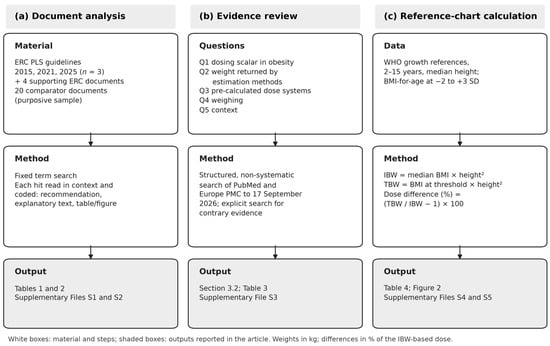
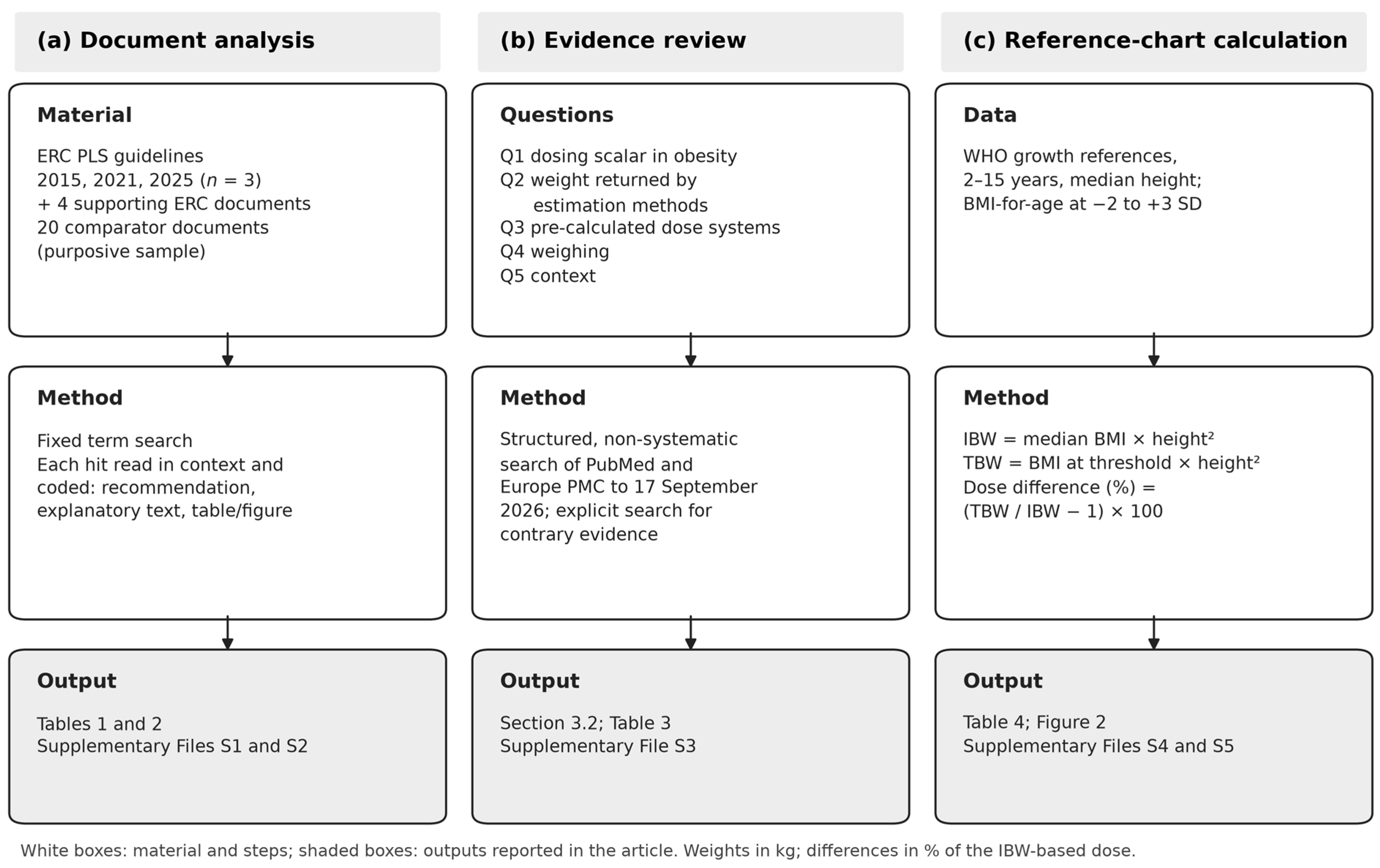
This study combines a document analysis, a structured (non-systematic) evidence review and a deterministic calculation; no protocol was registered. The study is exploratory: it maps what the guidelines say, what evidence our searches identified and how large the resulting dose differences are, and its conclusions about the literature are limited to the searches conducted. Analyses of the wording and evidence base of resuscitation guidelines have precedents [12,13], and quantitative analysis of clinical practice guidelines against predefined coding frameworks has been used to examine whether regulatory risk-minimisation measures for medicines reach clinical guidance [14]. Figure 1 shows the documents, searches and reference data used in each of the three components.
Figure 1.
Study design. The three components of the study, each from material to method to output; full details of documents, search records and sensitivity analyses are given in Section 2 and Supplementary File S1. (a) The three ERC editions were searched with the fixed term list and the four supporting ERC documents with condensed term patterns (Supplementary File S1). The 20 comparator documents were a purposive, not exhaustive, sample; the 10 “other guideline, formulary and policy documents” are the German guideline, the WHO Model Formulary for Children, UK medicines-information guidance, UK anaesthetic guidance, two paediatric pharmacy position statements and four US policy or position statements (Section 2.2). (b) Searching was iterative and purposive; the four confirmatory PubMed searches were not formally screened and serve only as a recall check, assessed for questions 1–3 (Supplementary File S1). Sources cited are the distinct reference keys cited under each sub-heading of Section 3.2 (none is cited under more than one) and, for question 5, the six context sources cited in the Introduction. (c) The calculation is deterministic; adjusted body weight = IBW + c × (TBW − IBW). Solid boxes: material analysed and steps taken; shaded boxes: outputs reported in the article; dashed boxes: documents not searched or without a relevant statement, and records not screened. AHA: American Heart Association; ANZCOR: Australian and New Zealand Committee on Resuscitation; BMI: body mass index; c: weighting factor of adjusted body weight; CDC: US Centers for Disease Control and Prevention; ERC: European Resuscitation Council; IBW: ideal body weight; ILCOR: International Liaison Committee on Resuscitation; n: number of documents; PK: pharmacokinetic; Q: review question; RCUK: Resuscitation Council UK; SD: standard deviation; TBW: total body weight; UK: United Kingdom; US: United States; WHO: World Health Organization.
2.2. Document Analysis
The document analysis follows the READ approach (ready materials, extract, analyse, distil) [15]. The full texts of the ERC PLS guidelines of 2015 [16], 2021 [10] and 2025 [7] were searched with a fixed list of terms on weight, weighing, habitus, obesity, tapes, formulas, dose aids, errors, labelling and maximum doses, and the pharmacological terms of the ideal-body-weight paragraph (hydrophilic, lipophilic, volume of distribution); the 2021 guideline’s online appendix of rapid reviews (672 pages, of which rapid review 3 on calculation tools and rules was read in full) and the ERC Guidelines 2025 Executive Summary [17], System Saving Lives [18] and Education for Resuscitation [19] chapters were searched with condensed term patterns (Supplementary File S1). Every hit was read in context and assigned to the concise recommendations, the explanatory text (the section on the evidence informing the guidelines) or a table or figure, and cited references identified (Table 1). Each hit was coded by location (concise recommendation, explanatory text, table or figure) and by topic (weight estimation, dosing weight, dose aids, weighing). A.J. coded all hits; A.J. and D.S. then independently verified each coded hit against the source text, and any discrepancy was resolved by discussion. We extracted all weight-based doses and maxima from the 2025 guideline (Supplementary File S2) and checked each change against the guideline’s table of changes. The 2021 guideline was analysed in its corrected-proof version and its quotations checked against the published version. The companion chapters were read as the journal’s full-text web pages and the appendix as the publisher’s Supplementary File (locators in Supplementary File S1); the ERC 2010 paediatric section [20] could not be obtained in an open-access version and was not searched. On 18 September 2026 we asked the corresponding author of the 2025 guideline for the review underlying the statement on ideal body weight; we had received no reply by the date of submission.
Table 1.
Weight estimation, dosing weight and dose aids in three ERC paediatric guideline editions.
Comparator documents (n = 20) were a purposive, not exhaustive, sample (Table 2): the consensus statements of the International Liaison Committee on Resuscitation (ILCOR) [21,22,23]; the paediatric guidelines of the American Heart Association (AHA) [24,25,26], the Resuscitation Council UK (RCUK) [27,28] and the Australian and New Zealand and Korean councils [29,30]; the German guideline on medication safety in paediatric emergencies [31]; the WHO Model Formulary for Children [32]; and statements from pharmacy, anaesthesia, nursing, emergency-medicine and patient-safety bodies. The ILCOR documents of 2005 and 2015 and the ILCOR summaries of 2021 and 2023 contained no relevant statement. Some documents were read as archived web versions (Supplementary File S1).
Table 2.
Dosing weight in obesity, weight estimation, pre-calculated doses and weighing in international documents.
2.3. Evidence Review
We searched PubMed and Europe PMC up to 17 September 2026 for five questions: (1) pharmacokinetics and dosing scalars in children with obesity; (2) the weight returned by each estimation method; (3) the effect of pre-calculated dose systems on dosing accuracy; (4) the feasibility and safety of weighing critically ill children; and (5) context (error frequency, clinicians’ exposure, obesity prevalence, resuscitation outcome). Searches were iterative and purposive (keyword, related-article and reference-list searching) rather than protocol-driven; search concepts, recorded strings and one confirmatory PubMed search for each of questions 1–4 (444, 82, 93 and 216 records; not formally screened; recall of the cited studies checked for questions 1–3) are in Supplementary File S1. Because the search was not systematic, statements that no study was found refer to the searches conducted, not to the literature as a whole.
Other documents were identified on organisations’ websites or in the Internet Archive; the 12 cited sources that are not peer-reviewed publications (guidance documents and web pages, a surveillance report and reference data files) are marked as such in the reference list. For each question we sought the most recent systematic review and any later randomised or real-patient study, and searched explicitly for evidence against our working hypothesis. No risk-of-bias tool was applied; limitations of key studies are given in Table 3. Every number and quotation was checked against the full text or, where inaccessible, the abstract of its source (level of verification in Supplementary File S1).
Table 3.
Key studies of dosing accuracy and of pre-calculated dose systems in paediatric emergencies.
2.4. Reference-Chart Calculation
The calculation is deterministic (no confidence intervals); uncertainty is explored by sensitivity analyses. We considered a boy and a girl of median height at each year from 2 to 15, using the WHO Child Growth Standards (2–5 years) [51] and the WHO Reference 2007 (5–15 years) [52,53]. IBW was defined by the BMI method, median BMI-for-age × height2 [54]. This is an operational, reference-based definition, not an established paediatric standard: we chose it because it is reproducible from public WHO tables and is consistent with ILCOR’s IBW “estimated from length” [21]; IBW formulas differ from one another by a median of up to 16.6% of TBW [55], and the modelled differences would shift accordingly (sensitivity analyses below). TBW was the BMI in the published −2 to +3 SD columns × height2. Throughout, TBW denotes the actual (measured or estimated) weight, IBW the weight expected for length, adjusted body weight (ABW) a weight between the two, and an estimated weight an estimate of either. The ratio R = TBW/IBW then equals the ratio of the two BMI values and is independent of height. We report the relative difference between the TBW-based and the IBW-based dose, (R − 1) × 100%. The 10% [47] and 20% [1] deviations that define an error of delivery in dosing studies are shown for scale only: two dosing weights give two intended doses, not an error of delivery.
We assumed that an uncorrected length-based tape returns approximately IBW and a habitus-corrected method or a caregiver’s estimate approximately TBW [8,9,56,57]. These are assumptions taken from validation studies, not findings of this study; individual estimates scatter widely around both targets (Section 3.2), so the model describes the distance between two reference targets, not the error of any estimate in an individual child. Because the most widely used tape covers 46–144 cm and does not fit most children older than 10 years [58], results are reported separately for 2–10 and 11–15 years.
Three sensitivity analyses were performed: first, a tape-type IBW (median weight for height) for children 0.6 SD taller than the median, as children with obesity were in one study [59], and at ±2 SD of height; second, the US Centers for Disease Control and Prevention (CDC) 2000 growth charts at the 95th percentile and at 120% and 140% of it [60,61,62]; third, the scalar expressed as an adjusted body weight, ABW = IBW + c × (TBW − IBW), where c = 0 makes IBW and c = 1 TBW the correct scalar. For the distribution volume of aminoglycosides, c was 0.4, found empirically in 13 obese adults [63] and assumed in a physiological model fitting five children with obesity [64], and is 0.35 in UK guidance [33]; it has not been measured for a resuscitation drug.
From the published LMS parameters (Box–Cox power, median and coefficient of variation) we derived the BMI z-score at which the difference reaches 20% and the share of the reference population beyond it; for children under 5 years, the calculation was repeated with WHO weight-for-height as a further sensitivity analysis. The ERC 2025 adrenaline dose (10 micrograms/kg, maximum 1 mg) was applied on a monthly grid to 18 years. Calculations were scripted in Python (version 3.9.6), re-run on 18 September 2026 with identical outputs, and recomputed with a separate script.
2.5. Use of a Large Language Model
A large language model (Claude Fable 5.1 and Claude Opus 5, Anthropic, 17–19 September 2026; Claude Opus 5.5, Anthropic, 12–17 November 2026, for the revision after peer review and the proof corrections) was used under the direction of A.J. for literature searches, extraction of candidate quotations and numbers, the Python code, cross-checking of citations and calculations and drafts of the manuscript, which were revised under the authors’ direction. Reference details of the PubMed-indexed sources were checked automatically against PubMed records. A.J. and D.S. each checked all 93 cited sources against every sentence and table cell that cites them (18–19 September 2026); Supplementary File S1 lists, for each source, the level of verification, the checkers and the date. No discrepancy was recorded. Citing sentences changed during the revision were re-checked against the same sources on 17 November 2026. The cited sources were obtained by the authors from PubMed or through the library of the Medical University of Bialystok, independently of the language model (where the full text was inaccessible, the abstract was used; Supplementary File S1); the search did not include Embase. The authors take full responsibility for the content.
3. Results
3.1. Document Analysis
ERC guidelines, 2015 to 2025. The 2015 guideline gave no advice on obtaining a child’s weight [16]; guidance first appears in 2021 (Table 1): a caregiver’s estimate or a length-based method, ideally corrected for habitus, and, whenever possible, “decision aids providing pre-calculated dose advice”, said to have “been shown to reduce administration errors” [10]. On obesity, the 2021 text noted differing pharmacokinetics for some drugs (its examples: fentanyl, propofol and midazolam) but found “too much variation between medications and individuals to advocate any specific strategy”. The 2021 online appendix shows the basis of that sentence: its rapid review on calculation tools cites “ILCOR 2010 … (PLS 420 EvUp)”, reproduces the ILCOR recommendation of ideal body weight “that can be estimated from length” in obese patients with “a body length tape with pre-calculated doses”, quotes the ILCOR task force’s 2019 evidence-update worksheet, stating that lipophilic drugs “may best be dosed on actual body weight while hydrophilic medications on ideal body weight, but there is significant individual variation”, and records the writing group’s decision to advocate no strategy [10,22].
The 2025 recommendation on weight estimation is similar [7]; new is a six-sentence paragraph in the explanatory text stating that “In most resuscitation situations, ideal body weight is the preferred weight utilised”. Children with a high BMI are said to have “a similar volume of distribution for hydrophilic medications”, the excess tissue being “usually extra fat tissue”. With doses calculated on TBW, for example, by a length-based method corrected for habitus, “there is a chance the dose will be too high”. Unlike its neighbours the paragraph carries no reference; it reaches no recommendation, algorithm or figure, gives no IBW method or threshold, and its categorical sentence is not restricted to children with obesity.
Possible antecedents. ERC 2025 declares itself based on the ILCOR consensus and the writing group’s rapid reviews, whose methodology “is available from the authors on request” [7]. The paragraph’s conclusion matches a 2010 ILCOR treatment recommendation, supported only by level-of-evidence 5 studies: “In obese patients the initial doses of resuscitation drugs should be based on ideal body weight that can be estimated from length” [21]. A 2020 evidence update left it in effect and added, for a child of unknown weight, “a body length tape with precalculated doses” [22]; the 2025 consensus lists “methods of calculating pediatric drug doses for cardiac arrest” among topics not reviewed since 2020 by systematic or scoping review, and its 2025 evidence-update appendix contains none [23]; on 18 September 2026 neither the ILCOR consensus website nor PubMed showed a 2026 review of the topic. ERC 2025 cites none of these documents.
The published ILCOR consensus gives no volume-of-distribution argument, but the task force’s 2019 worksheet (Appendix C-28 of the 2020 consensus) does: hydrophilic drugs “may best be dosed” on IBW, lipophilic drugs on actual weight, “but there is significant individual variation and very limited data”, and its annotated bibliography lists adrenaline among drugs to be dosed on IBW [22]. The reasoning is a conventional heuristic [65,66]; a 2015 systematic review stated that hydrophilic compounds should be dosed on IBW and named adrenaline dosed on TBW during cardiac arrest as a possible overdose [67]. The 2025 paragraph therefore restates, without citation, reasoning that the ERC’s own 2021 review had considered and set aside. One of the guideline’s references attributes a hydrophilic–lipophilic rule to the WHO Model Formulary for Children [68], which says only that the ideal weight for height and age should be used for oedematous or obese children [32]. Relative to ILCOR the paragraph keeps the principle but not the method (IBW estimated from length), the titration of later doses or the general adult-dose ceiling.
Positions of other bodies. IBW in obesity is advised (Table 2) by ILCOR, RCUK (whose 2025 text is based on the ERC guideline) [27,28], the Australian and New Zealand council [29], UK anaesthetic guidance for adrenaline [34] and the narrative of a US prehospital position statement [37]. In 2010 the AHA advised TBW (actual weight) regardless of habitus, or a tape with precalculated doses [24]; since 2020 it has recommended the child’s body weight up to the adult dose and warned that adjustments for obesity “could result in inaccurate dosing of medications”, citing pharmacokinetic studies of midazolam and fentanyl [25,26].
UK medicines-information guidance allows actual or estimated weight in an emergency [33], and the pharmacy position statement cited by ERC 2021 holds that the distribution volume of hydrophilic drugs in obesity “may be increased or decreased”; its narrative nevertheless repeats the loading-dose heuristic (IBW for hydrophilic, TBW for lipophilic drugs) from secondary sources, its formal recommendations being weight-based dosing up to the adult dose [35,36]. No position rests on pharmacokinetic or outcome data for a resuscitation drug.
From “pre-calculated dose advice” to “cognitive aids”. The terms “pre-calculated”, “dose advice” and “decision aid” occur neither in the 2025 text nor in the Executive Summary, System Saving Lives or Education chapters; the Executive Summary reproduces the PLS wording verbatim, and the Education chapter recommends cognitive aids only for protocol adherence, citing the same simulation review [17,18,19,69]. In their place stand a bedside recommendation on cognitive aids (displayed algorithms, checklists) and a system-level recommendation that all systems “adopt standardised drug calculations and provide cognitive aids (algorithms, tapes, posters, applications)” [7]. The guideline thus continues to support standardised drug calculations and cognitive aids, and tapes and applications, the usual carriers of pre-calculated doses, are still named; gone are the explicit wording, its qualifier “whenever possible”, its place among the bedside recommendations and its supporting sentence.
The explanatory text says nothing about drug calculation (unchanged topics, the guideline states, receive no commentary); its one sentence supporting cognitive aids cites an ILCOR summary and a systematic review of 29 simulation studies that synthesised no dosing outcome [69]. None of the 16 references cited for the weight topic concerns dosing errors or dose aids. The eight-row table of changes records that system-level recommendations are new and that the intravenous glucose bolus for hypoglycaemia changed from 0.3 to 0.2 g/kg (2 ml/kg of 10% glucose; the oral dose remains 0.3 g/kg), but nothing on weight estimation, dosing weight or dose aids.
Pre-calculated doses or dose charts are still named by ILCOR, RCUK, the Korean council, the 2026 US joint policy statement and the German guideline [22,28,30,31,38].
Weighing. None of the three ERC editions recommends weighing; the 2025 text mentions it once, as potentially problematic. ILCOR and the AHA advise using the weight if known; patient-safety, nursing and emergency-department readiness statements and the German guideline ask for a measured weight unless urgency prevents it [31,38,39,40], so life-threatening situations, the core scope of a life-support guideline, are exempt. None cites patient-outcome evidence for weighing itself.
3.2. Evidence Review
Dosing scalar in children with obesity. For the drugs the guideline names, we found no pharmacokinetic data in children with obesity. A 2026 systematic review of 100 high-alert medications identified no study of adenosine, amiodarone or lidocaine and, for adrenaline, only two reports on intramuscular auto-injectors (needle length; dose, depth and device) [70]; an earlier review of 25 acute-care drugs from US emergency-preparedness lists found sufficient data for none [67]; our searches found no later study.
The one systematic review that examined the lipophilicity rule did not confirm it: across 21 drugs (median 10 children with obesity per drug), lipophilicity was not associated with obesity-related changes in distribution volume or clearance [71]. The same review supports the direction of the guideline’s concern: TBW-based dosing gave inappropriate exposure for 4 of 10 drugs, adjusted-weight dosing for none of eight; no drug had been dosed on IBW.
The excess tissue is not only fat: in a body-composition study of 38 children with obesity, fat accounted for 73% of the excess weight and lean tissue for about a quarter [59,65], or as much as 40% in some studies [72]. The distribution volume of a hydrophilic drug loaded to a steady-state target is therefore likely to rise with obesity, but less than proportionally to TBW. For aminoglycosides it was matched when 40% of the adipose or excess mass was counted [63,64], and gentamicin concentrations were higher in children with obesity despite lower doses per kilogram [73]; yet the distribution volume of cefazolin, also hydrophilic, scaled with TBW [64].
Adrenaline in cardiac arrest differs: its effect follows a bolus within minutes, the relevant volume is the central mixing volume under low flow, and repeated doses are governed by clearance. The only paediatric population model of adrenaline (infusions in 39 children after cardiac surgery) assumed a distribution volume equal to the circulating blood volume and examined no covariate for obesity [74]. Because blood volume per kilogram falls as weight rises in adults [75], a higher early concentration after a TBW-based bolus in a child with obesity is plausible.
Bolus data for two lipophilic drugs point the same way: the induction dose of propofol was 2.0 vs. 3.2 mg/kg of TBW in children with and without obesity [76], and 5 min after a TBW-based fentanyl bolus, the concentration was 0.88 vs. 0.53 ng/mL [77]. Conversely, the potency of succinylcholine, a hydrophilic drug, per kilogram of TBW in adolescents with obesity was comparable with historical values [78]. These data do not support the hydrophilic–lipophilic dichotomy but do not refute the concern behind it (Supplementary File S3).
IBW has no agreed definition in children [54]: among English children with obesity, five formulas differed by a median of up to 16.6% of TBW [55]. In 30 children with obesity, it exceeded measured lean body weight by 18–30% [79], as a weight approximating the TBW of children of normal habitus should.
Clinical significance. We found no study showing harm from adrenaline doses 20–80% above the nominal dose. A signal of harm exists for tenfold doses: with rescue adrenaline at 0.1 mg/kg, 1 of 34 children survived 24 h, against 7 of 34 with the standard dose [80]. Nor is IBW known to be the safe choice: in a French registry, 400 of 755 children received a median of 0.04 mg/kg per bolus, four times the recommended dose, without a detectable difference in survival [81]. This observational comparison is open to residual confounding, has few events and wide confidence intervals, and cannot show that higher doses are safe.
Obesity is associated with worse outcome after paediatric in-hospital resuscitation (adjusted odds ratio for survival to discharge 0.62, 95% confidence interval [CI] 0.38–0.93) [6], but an ILCOR scoping review found no study of any adjustment to resuscitation technique in children [82], and the only comparison of dosing scalars we identified analysed four children, none with obesity [83]. Practice was divided: in a 2020 survey, 29 of 68 responding US paediatric intensive care units (43%) reported using IBW for adrenaline in obesity [84].
Which weight each estimation method returns. Caregivers’ estimates, the Mercy method and habitus-adjusted tapes target TBW [8,56], whereas age-based formulas and length-based methods without habitus adjustment probably predict IBW [8]. In the 69 children with obesity who fitted the tape (of 74 with obesity in a pooled sample of 1085), the Broselow tape placed 3.9% of estimates within 10% of TBW but 90.6% within 10% of IBW [9]. In a body-composition study of 332 children (reference 46 of ERC 2025), the tape was within 10% of TBW in 6.9% and of IBW in 72.4% of the 58 children weighing more than 120% of IBW, and the habitus-adjusted PAWPER XL estimate within 10% of TBW in 63.8% and of IBW in 3.4% [57]. Reference 43 of the guideline reports that the tape’s mid-habitus reading, its length-based weight without habitus correction, lay within 10% of IBW in all 58 children with obesity of a pooled sample [68]. Neither paper is cited in the IBW paragraph.
A habitus-corrected tape thus returns TBW when used as designed and approximates IBW only if its mid-habitus value is read, which the guideline does not say. This evidence comes from the PAWPER tapes’ developers and rests on small, partly overlapping subgroups and a reference IBW itself derived from length. In underweight children a length-only estimate exceeded TBW by about 15% [57]; habitus correction protects them.
Pre-calculated dose systems. Weight is one link in the error chain. In a 2026 simulation study, a wrong weight was the immediate cause of 4 of 19 dosing errors, air in the syringe and incorrect dilution of six each [85]. In simulated resuscitations of infants of stated weight, 40 of 52 errors concerned preparation or administration [86].
With a length-based ruler displaying weight-adjusted doses, volumes and preparation information (Table 3), deviations beyond threefold fell from 13 of 59 administrations (22.0%) in a historical control to 2 of 91 (2.2%; relative risk reduction 90%, 95% CI 57–98%). Deviations above 20%, the outcome on which the sample size was planned, were similar (71% vs. 63%) [2]. A separate evaluation 10 years on, against the same control and within a bundle, found severe deviations in 44 of 443 administrations (9.9%; relative risk reduction 55%, 95% CI 21–74%) and deviations above 20% again unchanged [41].
After one US service introduced a field guide listing doses in millilitres by age, 89.4% of 483 administrations were within 80–120% of the reference dose, against 51.1% of 274 before, although the reference doses differed [42]. All real-patient studies are before–after designs (Table 3); we found no randomised trial in patients, though one, of age-based versus weight-based midazolam dosing for seizures, is underway [87]. In randomised simulation trials, error rates were 0–7% with a dosing application or colour-coded prefilled syringes and 17–75% without [46,47,48,49], with training just before use (in the app trial, a standardised 5-min session after allocation) and investigators with an interest in the tools (the app’s owners declared a direct financial interest) [88].
Counter-evidence exists: Michigan introduced a state-wide reference that lists doses in millilitres but requires doses to be drawn from a preloaded syringe into a smaller one through a stopcock, and some drugs to be diluted [45]. The real-patient error rate afterwards was 35.2%, against 34.7% before, an uncontrolled comparison [44], and a subsequent safety bundle did not raise the proportion of correct doses in simulation [50]. A systematic review found no high-quality evidence that tapes with pre-calculated doses, used alone, led to accurate dosing; comprehensive dosing guides and colour-coded systems performed better [89]. These before–after studies used historical, partly shared controls and bundled interventions, and several were conducted by the tools’ developers; they show what particular tools achieved, not that a change in guideline wording will change error rates.
Weighing. The only study we identified of weighing during paediatric resuscitation obtained a weight with a stretcher-integrated scale in 145 of 231 children (63%) in one US trauma centre. Weighing took 8.5 s in a pilot outside resuscitation; unweighed children had lower Glasgow Coma Scale scores, and the documented reasons (20 of 86) were technical, a long board or death on arrival [90]. We found no paediatric study of whether weighing delays treatment; in adults given thrombolysis for stroke, a bed with an inbuilt scale did not prolong door-to-needle time [91]. Wrong-weight entries were detected in 0.63% of 79,000 emergency-department encounters of children under 5 years, and about a third led to a dosing error [92]. We found no study of weighing before hospital arrival; UK ambulances have no facilities for it [93]. A measured weight is a TBW: it settles accuracy, not the choice of dosing weight.
3.3. Reference-Chart Calculation
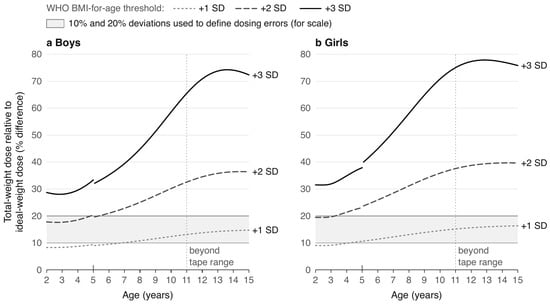
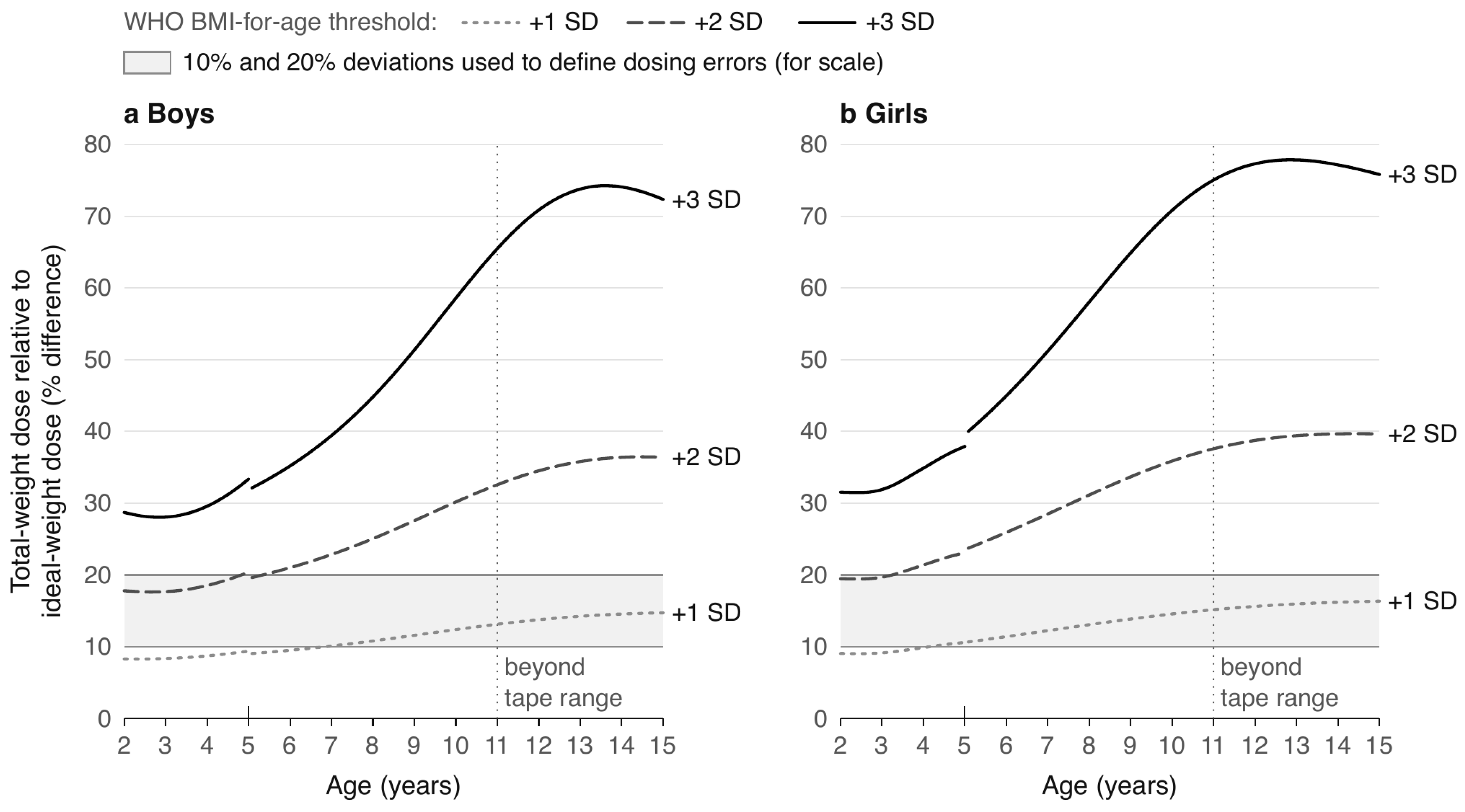
Main result. At +2 SD of BMI-for-age, the WHO threshold for obesity from 5 years and for overweight below that age, the TBW-based dose was 17.7–35.9% higher than the IBW-based dose at 2–10 years and 32.5–39.6% higher at 11–15 years. At +3 SD the differences were 28.0–70.8% and 65.5–77.9% (Table 4, Figure 2; the curves are interrupted at 5 years, where the WHO Child Growth Standards give way to the WHO Reference 2007). These are differences between two intended doses, not errors of administration or demonstrated harm. Equivalently, the IBW-based dose was 15–28% and 22–44% lower. The difference increased with age until early adolescence and was larger in girls at every age. At −2 SD the TBW-based dose was 14–22% lower, so an IBW rule applied to thin children would raise their dose by 16–27%.
Table 4.
Ideal and total body weight, relative dose difference and adrenaline dose by age and sex.
Figure 2.
Relative difference between doses calculated on total and on ideal body weight. Child of median height, by age, sex ((a), boys; (b), girls) and WHO BMI-for-age threshold (+1, +2 and +3 SD). Difference = (BMI at threshold/median BMI − 1) × 100, that is, the dose based on total body weight relative to the dose based on ideal body weight. Total body weight is assumed to correspond to a habitus-corrected or caregiver-reported estimate, and ideal body weight to an uncorrected length-based estimate. WHO Child Growth Standards (2–5 years) and WHO Reference 2007 (5–15 years); curves are interrupted at 5 years, where the two references meet. Grey band: 10% to 20%, the deviations used in dosing studies to define an error of delivery, shown for scale. Dotted vertical line at 11 years: length-based tapes of the Broselow type end at about 144 cm, the median height at about 11 years; beyond that age the curves describe the distance between the two target weights, not the output of a tape. WHO labels at 5–19 years: above +1 SD overweight, above +2 SD obesity (above +3 SD commonly reported as severe obesity); under 5 years: above +2 SD overweight, above +3 SD obesity (defined by WHO on weight-for-height; using it changed the difference by at most 3.1 percentage points). BMI: body mass index; SD: standard deviation; WHO: World Health Organization.
For scale, the difference passed 20% from 5 years in boys and 4 years in girls at +2 SD, and at all ages at +3 SD. It reached 20% at a BMI z-score of +2.2 in 2–3-year-old boys but +1.2 to +1.3 in 13–15-year-olds; 1.3–11.8% of the WHO reference population lies beyond that point.
Maximum doses. With TBW-based dosing, the 1 mg adrenaline maximum (100 kg) was reached only by boys at +3 SD, from 15.4 years. Adolescent values should be read against the adult algorithm, which the guideline permits when the rescuer considers the patient an adult [7]. A flat 1 mg is twice the IBW-based dose of a 14-year-old girl of median height (0.50 mg) and exceeds her TBW-based dose at +2 SD (0.70 mg).
Sensitivity analyses. With a tape-type IBW, the difference for a child 0.6 SD taller than the median changed by +0.7 to −4.1 percentage points at +2 SD and by +0.8 to −5.3 points at +3 SD. At ±2 SD of height and +3 SD of BMI, it changed by −18 to +23 points. With the CDC charts the difference was 14–41% at the 95th percentile, 37–69% at 120% and 60–98% at 140% of it (Supplementary File S4). In every sensitivity analysis the TBW-based dose remained higher than the IBW-based dose at +2 and +3 SD; the assumptions changed the size of the difference, not its direction.
If c were 0.4, TBW-based dosing would exceed the ABW-based dose by 10–21% at +2 SD and 15–36% at +3 SD, and IBW-based dosing would fall short of it by 7–14% and 10–24%. Measurements are of the same order: in the 58 children weighing more than 120% of IBW, the tape underestimated TBW by a mean of 26.0% and the habitus-corrected estimate exceeded IBW by a mean of 21.9% [57].
4. Discussion
4.1. Principal Findings
ERC 2025 states in its explanatory text, without reference, method or threshold, that hydrophilic resuscitation drugs should be dosed on IBW, while its recommendation describes only how to estimate TBW. Its antecedents, ILCOR 2010 and a conventional pharmacological heuristic, rest on no pharmacokinetic data for a resuscitation drug, and neither two systematic reviews nor our searches identified such a study of adrenaline in children with obesity. Three gaps should be kept apart: no obesity-specific pharmacokinetic comparison, no comparison of dosing scalars and no clinical outcome study.
Within the age range of length-based tapes (2–10 years; child of median height, WHO references), the two weights differ by 18–36% at +2 SD and 28–71% at +3 SD of BMI-for-age: as much as the 20% deviation that defines an error of delivery in dosing studies, but far less than the several-fold errors those studies record [1]. The model compares reference targets; it does not validate dosing in an individual child or for every resuscitation drug. The explicit 2021 recommendation for pre-calculated dose advice gave way, unlisted among the changes, to a broader system-level recommendation. To our knowledge these observations have not been described; a 2024 ILCOR-approved comparison of council guidelines did not mention dosing weight [13].
In medication-safety terms, the inconsistency is a guideline-level source of dose discrepancy: two parts of one guideline lead to two intended doses for the same child, and which one applies depends on the part of the text that a clinician, a developer of dose aids or a service follows. Difficulties in finding and using information within guidelines are a recognised contributor to prescribing and administration incidents [11].
4.2. Interpretation
We do not argue that one weight is correct. For a bolus of adrenaline during resuscitation, neither the relevant volume nor clearance has been measured in children with obesity, so the direction of the guideline’s concern is plausible, its size unknown. The registry linking obesity with lower survival after in-hospital paediatric resuscitation named actual-weight dosing as a possible contributor but did not record the dosing weight [6]. Against a fourfold spread of delivered adrenaline doses [81], a 20–40% difference in dosing weight is a second-order source of variation—a reason to prioritise tools that deliver the intended dose rather than settle the choice of weight by an unreferenced statement. The practical risk of two candidate weights may lie less in the toxicity of a larger adrenaline volume than in the cognitive friction they create at the bedside, hesitation, recalculation or delay, which pre-calculated tools remove; this, too, is untested.
Our reading of an inconsistency is the authors’ assessment; the writing group’s intent is not stated. The paragraph may instead have been meant as general explanatory guidance, or read as a caveat to the estimation recommendation, with habitus correction retained to protect underweight children; the caveat is then neither operational nor in the concise guidance.
Two benign explanations for the changed wording on dose aids are possible: the 2025 edition separates bedside from system-level recommendations, and the writing group may regard standardised drug calculations plus cognitive aids as a broader successor; or the 2024 systematic review that found no high-quality evidence for tapes with pre-calculated doses used alone [89] may have made the 2021 claim of reduced administration errors hard to repeat. If either motivated the change, the text does not say so. Either way, the recommendation lost its specificity, whereas the supported systems give the volume to administer and remove or guide preparation steps.
4.3. Implications for Guideline Groups and Services
Table 5 sets out options for consideration by guideline development groups. They are the authors’ opinion, rest on no comparative evidence, and the present analysis cannot determine which should be adopted or recommend any dosing weight in place of current guidance. Option A would withdraw the IBW statement and return to the 2021 position until ILCOR has completed the systematic review whose need it flagged in 2020.
Table 5.
Authors’ proposal: two coherent options for guideline groups and an interim pathway for services.
Option B would keep IBW and make it operational: IBW defined, following ILCOR’s “estimated from length”, as the reading of an uncorrected length-based tape or, beyond its range, a tabulated median BMI-for-age × height2, and the threshold tied to the definition of obesity, because a fixed 120% of IBW [33] corresponds to a BMI z-score of +2.0 to +2.2 at 2–3 years but +1.2 to +1.3 at 15 years. Such a rule is workable only inside pre-calculated tools that carry both estimates. Under either option the statement could be referenced, the change listed, and pre-calculated, volume-based dose aids that remove or guide preparation steps named explicitly.
Until then, services can meet the guideline’s call to “adopt standardised drug calculations” by deciding locally, once, which weight is used for which drugs, as patient-safety guidance asks [39], and building that decision into pre-calculated, volume-based tools (Table 5).
4.4. Research Agenda
The central gap is pharmacokinetic. Adrenaline infusion models exist in critically ill children [74], so sampling during infusions in children with obesity, with body composition as covariate, is feasible. Registries recording length and weight could relate dose per kilogram of IBW to outcome. That an uncorrected tape approximates IBW needs replication in European children against a reference not derived from length.
4.5. Strengths and Limitations
Strengths are the full-text analysis of three guideline editions, the 2021 appendix and three companion chapters, a recorded level of verification for each claim and a calculation reproducible from public reference tables. The analysis was prompted by our reading of the 2025 guideline, not by a protocol; we tried to limit confirmation bias by searching for contrary evidence, reporting the guideline’s hedged wording and benign explanations, and asking the guideline’s corresponding author for the underlying review; selection and interpretation remain ours. The search was not systematic and risk of bias not formally assessed, so negative findings mean that we found no study, not that none exists, and the conclusions are restricted accordingly. A large language model assisted with searching, extraction, coding and drafting; errors of omission cannot be excluded.
The companion chapters were examined by term search only; editions before 2015, including the 2010 paediatric section [20], the public-comment draft of May 2025 and national translations were not examined. The calculation assumes median height and the BMI-method IBW and compares two targets, not two estimates. Because the habitus-corrected tape underestimated TBW in heavy children by a mean of 6% [57], the realised difference between the two estimates is smaller than the modelled one (about 11–31% rather than 18–40% at +2 SD; our calculation). Values at a threshold are lower bounds for children above it.
5. Conclusions
The ERC Guidelines 2025 Paediatric Life Support prefer IBW for hydrophilic drugs in their explanatory text but tell clinicians only how to obtain TBW. In a child with obesity, the two weights differ by about 20–70% within the age range of length-based tapes. The statement is unreferenced and lacks a method and threshold; in our non-systematic searches we found no pharmacokinetic or comparative clinical evidence for either weight, and whether such differences matter clinically is unknown. The explicit recommendation for pre-calculated dose advice no longer appears, unlisted among the changes, although standardised drug calculations and cognitive aids are still recommended. Referencing or withdrawing the statement, making any retained rule operational and naming pre-calculated, volume-based dose aids are options for guideline groups to consider.
Supplementary Materials
The following supporting information can be downloaded at: https://www.mdpi.com/article/10.3390/children13111605/s1, File S1: Methods supplement: term list with hit counts by edition and section and line locators; documents read, with version, locator, archived copy and access date; search concepts, recorded search strings and search log; level of verification for each cited source, with checkers and dates; mapping of the ERC 2025 reference numbers used in the text; versions and dates of use of the large language model (PDF); File S2: All weight-based doses in the ERC Guidelines 2025 Paediatric Life Support (49 items), with the stated maximum dose, the weight at which the maximum becomes active, the location in the guideline and the internal text-versus-figure inconsistencies (XLSX); File S3: Drug-by-drug table of pharmacokinetic evidence in children with obesity for 24 resuscitation and emergency drugs (including fosphenytoin), with the dosing scalar named by each guidance document (PDF); File S4: Figure S1: sensitivity analysis with the CDC 2000 growth charts (85th and 95th percentiles; 120% and 140% of the 95th percentile) (PDF); File S5: Source code of the calculation (model.py, v02_lower_tail.py, audit_independent_check.py, audit_height_sensitivity.py), the CDC input tables, all output tables and instructions for reproducing the analysis; the WHO input tables are re-created by the script (ZIP).
Author Contributions
A.J.: conceptualisation, methodology, investigation, formal analysis, writing—original draft. D.S.: investigation, validation, writing—review and editing. J.R.Ł.: supervision, writing—review and editing. M.W.-Ż.: supervision, writing—review and editing. All authors have read and agreed to the published version of the manuscript.
Funding
This research received no external funding. The APC was funded by the Medical University of Bialystok.
Institutional Review Board Statement
Not applicable. The study did not involve human participants, human data, human tissue or animals. It consisted of a document analysis of the European Resuscitation Council Guidelines 2025 Paediatric Life Support and related guidance documents, a review of the published literature, and a modelling study based on publicly available, aggregated growth-reference data (WHO growth standards and reference; CDC 2000 growth charts). No patients or volunteers were recruited, and no individual-level or identifiable data were collected or analysed. Under Polish law, review by a bioethics committee is required only for a medical experiment involving human participants (Act of 5 December 1996 on the Professions of Physician and Dentist, consolidated text: Journal of Laws 2026, item 37, Articles 21–29); this study was not a medical experiment within the meaning of that Act, and ethics committee review was therefore not required.
Informed Consent Statement
Not applicable. No human participants were involved in this study: it did not recruit patients or volunteers and did not use individual-level patient data. The only materials analysed were published documents and publicly available, aggregated growth-reference tables, so there were no individuals from whom informed consent could be sought.
Data Availability Statement
All documents analysed are published or publicly available; sources, versions and access dates are listed in the references and in Supplementary File S1. The full source code (Python 3.9.6), the CDC input tables, all output tables and instructions for reproducing the analysis are provided in Supplementary File S5. The WHO growth reference tables are not redistributed and are downloaded by the script from the WHO website (addresses in Supplementary File S5).
Conflicts of Interest
The authors declare that they have no conflicts of interest.
References
- Hoyle, J.D.; Davis, A.T.; Putman, K.K.; Trytko, J.A.; Fales, W.D. Medication dosing errors in pediatric patients treated by emergency medical services. Prehospital Emerg. Care 2012, 16, 59–66. [Google Scholar] [CrossRef] [Scilit] [PubMed]
- Kaufmann, J.; Roth, B.; Engelhardt, T.; Lechleuthner, A.; Laschat, M.; Hadamitzky, C.; Wappler, F.; Hellmich, M. Development and prospective federal state-wide evaluation of a device for height-based dose recommendations in prehospital pediatric emergencies: A simple tool to prevent most severe drug errors. Prehospital Emerg. Care 2018, 22, 252–259. [Google Scholar] [CrossRef] [Scilit] [PubMed]
- Dyson, K.; Bray, J.; Smith, K.; Bernard, S.; Straney, L.; Finn, J. Paramedic exposure to out-of-hospital cardiac arrest is rare and declining in Victoria, Australia. Resuscitation 2015, 89, 93–98. [Google Scholar] [CrossRef] [Scilit] [PubMed]
- WHO Regional Office for Europe. WHO European Childhood Obesity Surveillance Initiative (COSI): Report on the Sixth Round of Data Collection, 2022–2024; Document WHO/EURO:2025-11788-51560-78769; WHO Regional Office for Europe: Copenhagen, Denmark, 2025; Available online: https://www.who.int/europe/publications/i/item/WHO-EURO-2025-11788-51560-78769 (accessed on 17 September 2026).
- Spinelli, A.; Buoncristiano, M.; Kovacs, V.A.; Yngve, A.; Spiroski, I.; Obreja, G.; Starc, G.; Pérez, N.; Rito, A.I.; Kunešová, M.; et al. Prevalence of severe obesity among primary school children in 21 European countries. Obes. Facts 2019, 12, 244–258. [Google Scholar] [CrossRef] [Scilit] [PubMed]
- Srinivasan, V.; Nadkarni, V.M.; Helfaer, M.A.; Carey, S.M.; Berg, R.A. American Heart Association National Registry of Cardiopulmonary Resuscitation Investigators. Childhood obesity and survival after in-hospital pediatric cardiopulmonary resuscitation. Pediatrics 2010, 125, e481–e488. [Google Scholar] [CrossRef] [Scilit] [PubMed]
- Djakow, J.; Turner, N.M.; Skellett, S.; Buysse, C.M.P.; Cardona, F.; de Lucas, N.; del Castillo, J.; Kiviranta, P.; Lauridsen, K.G.; Markel, F.; et al. European Resuscitation Council Guidelines 2025 Paediatric Life Support. Resuscitation 2025, 215, 110767. [Google Scholar] [CrossRef] [Scilit] [PubMed]
- Young, K.D.; Korotzer, N.C. Weight estimation methods in children: A systematic review. Ann. Emerg. Med. 2016, 68, 441–451.e10. [Google Scholar] [CrossRef] [Scilit] [PubMed]
- Wells, M.; Goldstein, L.N. Optimising emergency weight estimation in underweight and obese children: The accuracy of estimations of total body weight and ideal body weight. Eur. J. Emerg. Med. 2019, 26, 301–307. [Google Scholar] [CrossRef] [Scilit] [PubMed]
- Van de Voorde, P.; Turner, N.M.; Djakow, J.; de Lucas, N.; Martinez-Mejias, A.; Biarent, D.; Bingham, R.; Brissaud, O.; Hoffmann, F.; Johannesdottir, G.B.; et al. European Resuscitation Council Guidelines 2021: Paediatric Life Support. Resuscitation 2021, 161, 327–387. [Google Scholar] [CrossRef] [Scilit] [PubMed]
- Jones, M.D.; Liu, S.; Powell, F.; Samsor, A.; Ting, F.C.R.; Veliotis, N.; Wong, Y.M.; Franklin, B.D.; Garfield, S. Exploring the role of guidelines in contributing to medication errors: A descriptive analysis of national patient safety incident data. Drug Saf. 2024, 47, 389–400. [Google Scholar] [CrossRef] [Scilit] [PubMed]
- Orkin, A.M. Push hard, push fast, if you’re downtown: A citation review of urban-centrism in American and European basic life support guidelines. Scand. J. Trauma Resusc. Emerg. Med. 2013, 21, 32. [Google Scholar] [CrossRef] [Scilit] [PubMed]
- Shepard, L.N.; Nadkarni, V.M.; Ng, K.C.; Scholefield, B.R.; Ong, G.Y.; ILCOR Pediatric Life Support Task Force. ILCOR pediatric life support recommendations translation to constituent council guidelines: An emphasis on similarities and differences. Resuscitation 2024, 201, 110247. [Google Scholar] [CrossRef] [Scilit] [PubMed]
- Møllebæk, M.; Gardarsdottir, H.; Bikou, A.G.; Kodrič, A.; Silva, A.M.; Andersen, A.; Kontogiorgis, C.; Poplavska, E.; Ahmadizar, F.; Dermiki-Gkana, F.; et al. Challenges in the implementation of EU risk minimisation measures for medicinal products in clinical practice guidelines: Mixed methods multi-case study. Drug Saf. 2025, 48, 161–177. [Google Scholar] [CrossRef] [Scilit] [PubMed]
- Dalglish, S.L.; Khalid, H.; McMahon, S.A. Document analysis in health policy research: The READ approach. Health Policy Plan. 2020, 35, 1424–1431. [Google Scholar] [CrossRef] [Scilit] [PubMed]
- Maconochie, I.K.; Bingham, R.; Eich, C.; López-Herce, J.; Rodríguez-Núñez, A.; Rajka, T.; Van de Voorde, P.; Zideman, D.A.; Biarent, D.; Monsieurs, K.G.; et al. European Resuscitation Council Guidelines for Resuscitation 2015: Section 6. Paediatric life support. Resuscitation 2015, 95, 223–248. [Google Scholar] [CrossRef] [Scilit] [PubMed]
- Greif, R.; Lauridsen, K.G.; Djärv, T.; Ek, J.E.; Monnelly, V.; Monsieurs, K.G.; Nikolaou, N.; Olasveengen, T.M.; Semeraro, F.; Spartinou, A.; et al. European Resuscitation Council Guidelines 2025 Executive Summary. Resuscitation 2025, 215, 110770. [Google Scholar] [CrossRef] [Scilit] [PubMed]
- Semeraro, F.; Schnaubelt, S.; Olasveengen, T.M.; Bignami, E.G.; Böttiger, B.W.; Fijačko, N.; Gamberini, L.; Hansen, C.M.; Lockey, A.; Metelmann, B.; et al. European Resuscitation Council Guidelines 2025 System Saving Lives. Resuscitation 2025, 215, 110821. [Google Scholar] [CrossRef] [Scilit] [PubMed]
- Nabecker, S.; de Raad, T.; Abelairas-Gomez, C.; Breckwoldt, J.; Chakroun-Walha, O.; Farquharson, B.; Hunyadi-Antičević, S.; Lott, C.; Schnaubelt, S.; Yeung, J.; et al. European Resuscitation Council Guidelines 2025 Education for Resuscitation. Resuscitation 2025, 215, 110739. [Google Scholar] [CrossRef] [Scilit] [PubMed]
- Biarent, D.; Bingham, R.; Eich, C.; López-Herce, J.; Maconochie, I.; Rodríguez-Núñez, A.; Rajka, T.; Zideman, D. European Resuscitation Council Guidelines for Resuscitation 2010 Section 6. Paediatric life support. Resuscitation 2010, 81, 1364–1388. [Google Scholar] [CrossRef] [Scilit] [PubMed]
- Kleinman, M.E.; de Caen, A.R.; Chameides, L.; Atkins, D.L.; Berg, R.A.; Berg, M.D.; Bhanji, F.; Biarent, D.; Bingham, R.; Coovadia, A.H.; et al. Part 10: Pediatric basic and advanced life support: 2010 International Consensus on Cardiopulmonary Resuscitation and Emergency Cardiovascular Care Science with Treatment Recommendations. Circulation 2010, 122, S466–S515. [Google Scholar] [CrossRef] [Scilit] [PubMed]
- Maconochie, I.K.; Aickin, R.; Hazinski, M.F.; Atkins, D.L.; Bingham, R.; Couto, T.B.; Guerguerian, A.-M.; Nadkarni, V.M.; Ng, K.-C.; Nuthall, G.A.; et al. Pediatric Life Support: 2020 International Consensus on Cardiopulmonary Resuscitation and Emergency Cardiovascular Care Science with Treatment Recommendations. Resuscitation 2020, 156, A120–A155. [Google Scholar] [CrossRef] [Scilit] [PubMed]
- Scholefield, B.R.; Acworth, J.; Ng, K.C.; Tiwari, L.K.; Raymond, T.T.; Christoff, A.; Katzenschlager, S.; Escalante-Kanashiro, R.; Bansal, A.; Topjian, A.; et al. Pediatric Life Support: 2025 International Liaison Committee on Resuscitation Consensus on Science With Treatment Recommendations. Resuscitation 2025, 215, 110813. [Google Scholar] [CrossRef] [Scilit] [PubMed]
- Kleinman, M.E.; Chameides, L.; Schexnayder, S.M.; Samson, R.A.; Hazinski, M.F.; Atkins, D.L.; Berg, M.D.; de Caen, A.R.; Fink, E.L.; Freid, E.B.; et al. Part 14: Pediatric advanced life support: 2010 American Heart Association Guidelines for Cardiopulmonary Resuscitation and Emergency Cardiovascular Care. Circulation 2010, 122, S876–S908. [Google Scholar] [CrossRef] [Scilit] [PubMed]
- Topjian, A.A.; Raymond, T.T.; Atkins, D.; Chan, M.; Duff, J.P.; Joyner, B.L.; Lasa, J.J.; Lavonas, E.J.; Levy, A.; Mahgoub, M.; et al. Part 4: Pediatric Basic and Advanced Life Support: 2020 American Heart Association Guidelines for Cardiopulmonary Resuscitation and Emergency Cardiovascular Care. Circulation 2020, 142, S469–S523. [Google Scholar] [CrossRef] [Scilit] [PubMed]
- Lasa, J.J.; Dhillon, G.S.; Duff, J.P.; Hayes, J.; Kamath-Rayne, B.D.; Levy, A.; Mahgoub, M.; Morgan, R.W.; McCormick, T.; Roberts, J.S.; et al. Part 8: Pediatric Advanced Life Support: 2025 American Heart Association and American Academy of Pediatrics Guidelines for Cardiopulmonary Resuscitation and Emergency Cardiovascular Care. Circulation 2025, 152, S479–S537. [Google Scholar] [CrossRef] [Scilit] [PubMed]
- Skellett, S.; Maconochie, I.; Bingham, B.; Worrall, M.; Scholefield, B.R.; Johnson, M.; Page, M.; Andre, L.; Wyllie, J.; Lockey, A.; et al. Paediatric Advanced Life Support Guidelines; Resuscitation Council: London, UK, 2021; Available online: https://web.archive.org/web/20250804231248/https://www.resus.org.uk/library/2021-resuscitation-guidelines/paediatric-advanced-life-support-guidelines (accessed on 15 November 2026).
- Skellett, S.; Worrall, M.; Bradfield, M.; Johnson, M.; Mellett-Smith, A.; Stretch, B.; Welsby, D.; Reeves, N.; Benson Clarke, A. Paediatric Life Support (basic and advanced). In Resuscitation Council UK Guidelines 2025; Resuscitation Council: London, UK, 2025; Available online: https://www.resus.org.uk/professional-library/2025-resuscitation-guidelines/paediatric-basic-life-support-guidelines (accessed on 17 September 2026).
- Australian and New Zealand Committee on Resuscitation. Guideline 12.2—Paediatric Advanced Life Support (PALS). Approved April 2026. Available online: https://www.anzcor.org/home/paediatric-advanced-life-support/guideline-12-2-paediatric-advanced-life-support-pals (accessed on 17 September 2026).
- Kim, D.K.; Kim, J.T.; Na, J.Y.; Park, B.; Lee, J.; Jeong, S.I.; Park, J.D.; Chung, S.P.; Kim, T.-Y.; Sohn, Y.; et al. 2025 Korean Guidelines for Cardiopulmonary Resuscitation: Part 8. Pediatric advanced life support. Clin. Exp. Emerg. Med. 2026, 13, S115–S141. [Google Scholar] [CrossRef] [Scilit] [PubMed]
- Deutsche Gesellschaft für Kinder- und Jugendmedizin (coordinator: Kaufmann J). S2k-Leitlinie Medikamentensicherheit bei Kindernotfällen. AWMF-Register Nr. 027/071, version 1.0, 23 March 2021 (valid until 22 March 2026; under revision). Available online: https://register.awmf.org/de/leitlinien/detail/027-071 (accessed on 17 September 2026).
- World Health Organization. WHO Model Formulary for Children 2010: Based on the Second Model List of Essential Medicines for Children 2009; WHO: Geneva, Switzerland, 2010; ISBN 978-92-4-159932-0. Available online: https://iris.who.int/handle/10665/44309 (accessed on 17 September 2026).
- UK Medicines Information (UKMi) Pharmacists, Neonatal and Paediatric Pharmacists Group (NPPG). Medicines Q&As: How Should Medicines Be Dosed in Children Who Are Obese? Date updated 7 May 2021. Original NHS Specialist Pharmacy Service Page Withdrawn. Available online: https://swpaediatricanaesthesia.org/wp-content/uploads/2025/09/ukmiqa-drug-dosing-in-childhood-obesity-1.pdf (accessed on 17 September 2026).
- Russell, K.; Saddington, F.; AbouDaya, M.; Burton, Z.; Society for Obesity and Bariatric Anaesthesia. Anaesthesia for Children Living with Obesity (Single-Sheet Guideline). 14 June 2024. Available online: https://www.sobauk.co.uk/_files/ugd/373d41_2314d5da0f2a40bcb6fec9899f1c544a.pdf (accessed on 17 September 2026).
- Matson, K.L.; Horton, E.R.; Capino, A.C.; Advocacy Committee for the Pediatric Pharmacy Advocacy Group. Medication dosage in overweight and obese children. J. Pediatr. Pharmacol. Ther. 2017, 22, 81–83. [Google Scholar] [CrossRef] [Scilit] [PubMed]
- Matson, K.L.; Horton, E.R.; Capino, A.C. Medication dosing for children with overweight and obesity. J. Pediatr. Pharmacol. Ther. 2024, 29, 550–553. [Google Scholar] [CrossRef] [Scilit] [PubMed]
- Cicero, M.X.; Adelgais, K.; Hoyle, J.D., Jr.; Lyng, J.W.; Harris, M.; Moore, B.; Gausche-Hill, M. Medication dosing safety for pediatric patients: Recognizing gaps, safety threats, and best practices in the emergency medical services setting. A position statement and resource document from NAEMSP. Prehospital Emerg. Care 2021, 25, 294–306. [Google Scholar] [CrossRef] [Scilit] [PubMed]
- Remick, K.E.; Foster, A.A.; Jensen, A.R.; Williams, R.F.; Stone, E.; Joseph, M.; Conners, G.P.; Brown, K.; Gausche-Hill, M. Pediatric readiness in the emergency department: Policy statement. Ann. Emerg. Med. 2026, 87, e11–e24. [Google Scholar] [CrossRef] [Scilit] [PubMed]
- Institute for Safe Medication Practices. 2026–2027 ISMP Targeted Medication Safety Best Practices for Hospitals; Best Practice 3; ISMP: Plymouth Meeting, PA, USA, 2026; Available online: https://online.ecri.org/hubfs/ISMP/Resources/ISMP_TargetedMedicationSafetyBestPractices_Hospitals.pdf (accessed on 17 September 2026).
- Stone, E.L.; Emergency Nurses Association. Weighing All Patients in Kilograms [Position Statement]; Emergency Nurses Association: Schaumburg, IL, USA, 2026; Available online: https://www.ena.org/sites/default/files/2026-01/WeighingAllPatientsinKilograms.pdf (accessed on 17 September 2026).
- Kaufmann, J.; Uhl, S.; Singer, E.; Eifinger, F.; Klein, T.; Lechleuthner, A.; Engelhardt, T.; Wappler, F.; Böhmer, A. Improving pediatric drug safety in prehospital emergency care—10 years on. J. Patient Saf. 2021, 17, e1241–e1246. [Google Scholar] [CrossRef] [Scilit] [PubMed]
- Rappaport, L.D.; Markowitz, G.; Hulac, S.; Roosevelt, G. Medication errors in pediatric patients after implementation of a field guide with volume-based dosing. Prehospital Emerg. Care 2023, 27, 213–220. [Google Scholar] [CrossRef] [Scilit] [PubMed]
- Kaji, A.H.; Gausche-Hill, M.; Conrad, H.; Young, K.D.; Koenig, W.J.; Dorsey, E.; Lewis, R.J. Emergency medical services system changes reduce pediatric epinephrine dosing errors in the prehospital setting. Pediatrics 2006, 118, 1493–1500. [Google Scholar] [CrossRef] [Scilit] [PubMed]
- Kazi, R.; Hoyle, J.D., Jr.; Huffman, C.; Ekblad, G.; Ruffing, R.; Dunwoody, S.; Hover, T.; Cody, S.; Fales, W. An analysis of prehospital pediatric medication dosing errors after implementation of a state-wide EMS pediatric drug dosing reference. Prehospital Emerg. Care 2024, 28, 43–49. [Google Scholar] [CrossRef] [Scilit] [PubMed]
- Hoyle, J.D., Jr.; Ekblad, G.; Hover, T.; Woodwyk, A.; Brandt, R.; Fales, B.; Lammers, R.L. Dosing errors made by paramedics during pediatric patient simulations after implementation of a state-wide pediatric drug dosing reference. Prehospital Emerg. Care 2020, 24, 204–213. [Google Scholar] [CrossRef] [Scilit] [PubMed]
- Siebert, J.N.; Ehrler, F.; Combescure, C.; Lovis, C.; Haddad, K.; Hugon, F.; Luterbacher, F.; Lacroix, L.; Gervaix, A.; Manzano, S.; et al. A mobile device application to reduce medication errors and time to drug delivery during simulated paediatric cardiopulmonary resuscitation: A multicentre, randomised, controlled, crossover trial. Lancet Child. Adolesc. Health 2019, 3, 303–311. [Google Scholar] [CrossRef] [Scilit] [PubMed]
- Siebert, J.N.; Bloudeau, L.; Combescure, C.; Haddad, K.; Hugon, F.; Suppan, L.; Rodieux, F.; Lovis, C.; Gervaix, A.; Ehrler, F.; et al. Effect of a mobile app on prehospital medication errors during simulated pediatric resuscitation: A randomized clinical trial. JAMA Netw. Open 2021, 4, e2123007. [Google Scholar] [CrossRef] [Scilit] [PubMed]
- Moreira, M.E.; Hernandez, C.; Stevens, A.D.; Jones, S.; Sande, M.; Blumen, J.R.; Hopkins, E.; Bakes, K.; Haukoos, J.S. Color-coded prefilled medication syringes decrease time to delivery and dosing error in simulated emergency department pediatric resuscitations. Ann. Emerg. Med. 2015, 66, 97–106.e3. [Google Scholar] [CrossRef] [Scilit] [PubMed]
- Stevens, A.D.; Hernandez, C.; Jones, S.; Moreira, M.E.; Blumen, J.R.; Hopkins, E.; Sande, M.; Bakes, K.; Haukoos, J.S. Color-coded prefilled medication syringes decrease time to delivery and dosing errors in simulated prehospital pediatric resuscitations: A randomized crossover trial. Resuscitation 2015, 96, 85–91. [Google Scholar] [CrossRef] [Scilit] [PubMed]
- Hoyle, J.D., Jr.; Ekblad, G.; Dunwoody, S.; Hickok, K.; McGoff, T.; Hoban, A.; Otieno, S.; Fales, W.; Lammers, R.L. Effect of a drug dosing safety bundle initiative to improve pediatric drug dosing by paramedics. Results of the Michigan Pediatric EMS Error Reduction Study (MI-PEERS). Prehospital Emerg. Care 2026, 30, 865–874. [Google Scholar] [CrossRef] [Scilit] [PubMed]
- WHO Multicentre Growth Reference Study Group. WHO Child Growth Standards based on length/height, weight and age. Acta Paediatr. Suppl. 2006, 450, 76–85. [Google Scholar] [CrossRef] [Scilit] [PubMed]
- de Onis, M.; Onyango, A.W.; Borghi, E.; Siyam, A.; Nishida, C.; Siekmann, J. Development of a WHO growth reference for school-aged children and adolescents. Bull. World Health Organ. 2007, 85, 660–667. [Google Scholar] [CrossRef] [Scilit] [PubMed]
- World Health Organization. Child Growth Standards, and Growth Reference Data for 5–19 years: Expanded z-Score Tables; WHO: Geneva, Switzerland, 2007; Available online: https://www.who.int/tools/child-growth-standards (accessed on 17 September 2026).
- Phillips, S.; Edlbeck, A.; Kirby, M.; Goday, P. Ideal body weight in children. Nutr. Clin. Pract. 2007, 22, 240–245. [Google Scholar] [CrossRef] [Scilit] [PubMed]
- Moylan, A.; Appelbaum, N.; Clarke, J.; Feather, C.; Tairraz, A.F.; Maconochie, I.; Darzi, A. Assessing the agreement of 5 ideal body weight calculations for selecting medication dosages for children with obesity. JAMA Pediatr. 2019, 173, 597–598, Correction in JAMA Pediatr. 2021, 175, 871. [Google Scholar] [CrossRef] [Scilit] [PubMed]
- Wells, M.; Goldstein, L.N.; Bentley, A. The accuracy of emergency weight estimation systems in children—A systematic review and meta-analysis. Int. J. Emerg. Med. 2017, 10, 29. [Google Scholar] [CrossRef] [Scilit] [PubMed]
- Wells, M.; Goldstein, L.N. How and why paediatric weight estimation systems fail—A body composition study. Cureus 2020, 12, e7198. [Google Scholar] [CrossRef] [Scilit] [PubMed]
- Cattermole, G.N.; Leung, P.Y.M.; Graham, C.A.; Rainer, T.H. Too tall for the tape: The weight of schoolchildren who do not fit the Broselow tape. Emerg. Med. J. 2014, 31, 541–544. [Google Scholar] [CrossRef] [Scilit] [PubMed]
- Wells, J.C.K.; Fewtrell, M.S.; Williams, J.E.; Haroun, D.; Lawson, M.S.; Cole, T.J. Body composition in normal weight, overweight and obese children: Matched case-control analyses of total and regional tissue masses, and body composition trends in relation to relative weight. Int. J. Obes. 2006, 30, 1506–1513. [Google Scholar] [CrossRef] [Scilit] [PubMed]
- Kuczmarski, R.J.; Ogden, C.L.; Guo, S.S.; Grummer-Strawn, L.M.; Flegal, K.M.; Mei, Z.; Wei, R.; Curtin, L.R.; Roche, A.F.; Johnson, C.L. 2000 CDC Growth Charts for the United States: Methods and Development; Vital Health Stat 11; National Center for Health Statistics: Hyattsville, MD, USA, 2002; pp. 1–190. [Google Scholar] [PubMed]
- Centers for Disease Control and Prevention, National Center for Health Statistics. Growth Charts: Percentile Data Files with LMS Values; Data File for the CDC Extended BMI-for-Age Growth Charts. Available online: https://www.cdc.gov/growthcharts/cdc-data-files.htm (accessed on 15 November 2026).
- Skinner, A.C.; Skelton, J.A. Prevalence and trends in obesity and severe obesity among children in the United States, 1999-2012. JAMA Pediatr. 2014, 168, 561–566. [Google Scholar] [CrossRef] [Scilit] [PubMed]
- Schwartz, S.N.; Pazin, G.J.; Lyon, J.A.; Ho, M.; Pasculle, A.W. A controlled investigation of the pharmacokinetics of gentamicin and tobramycin in obese subjects. J. Infect. Dis. 1978, 138, 499–505. [Google Scholar] [CrossRef] [Scilit] [PubMed]
- Koshida, R.; Nakashima, E.; Taniguchi, N.; Tsuji, A.; Benet, L.Z.; Ichimura, F. Prediction of the distribution volumes of cefazolin and tobramycin in obese children based on physiological pharmacokinetic concepts. Pharm. Res. 1989, 6, 486–491. [Google Scholar] [CrossRef] [Scilit] [PubMed]
- Kendrick, J.G.; Carr, R.R.; Ensom, M.H.H. Pharmacokinetics and drug dosing in obese children. J. Pediatr. Pharmacol. Ther. 2010, 15, 94–109. [Google Scholar] [CrossRef] [Scilit]
- Carasco, C.F.; Fletcher, P.; Maconochie, I. Review of commonly used age-based weight estimates for paediatric drug dosing in relation to the pharmacokinetic properties of resuscitation drugs. Br. J. Clin. Pharmacol. 2016, 81, 849–856. [Google Scholar] [CrossRef] [Scilit] [PubMed]
- Rowe, S.; Siegel, D.; Benjamin, D.K., Jr. Best Pharmaceuticals for Children Act—Pediatric Trials Network Administrative Core Committee. Gaps in drug dosing for obese children: A systematic review of commonly prescribed emergency care medications. Clin. Ther. 2015, 37, 1924–1932. [Google Scholar] [CrossRef] [Scilit] [PubMed]
- Wells, M.; Goldstein, L. The utility of pediatric age-based weight estimation formulas for emergency drug dose calculations in obese children. J. Am. Coll. Emerg. Physicians Open 2020, 1, 947–954. [Google Scholar] [CrossRef] [Scilit] [PubMed]
- Nabecker, S.; Nation, K.; Gilfoyle, E.; Abelairas-Gomez, C.; Koota, E.; Lin, Y.; Greif, R.; Anderson, N.; Bhanji, F.; Breckwoldt, J.; et al. Cognitive aids used in simulated resuscitation: A systematic review. Resusc. Plus 2024, 19, 100675. [Google Scholar] [CrossRef] [Scilit] [PubMed]
- Hernández-Gago, Y.; Minagorre, P.J.A.; Sánchez-Hernández, J.G.; Marrodán, B.R.; Hernández Sabater, L.; Negrín, A.C.R.; Rodríguez-Suárez, C.-A. Dosing strategies for high-alert medications in obese pediatric patients: A systematic review. Pharmaceuticals 2026, 19, 766. [Google Scholar] [CrossRef] [Scilit] [PubMed]
- Harskamp-van Ginkel, M.W.; Hill, K.D.; Becker, K.C.; Testoni, D.; Cohen-Wolkowiez, M.; Gonzalez, D.; Barrett, J.S.; Benjamin, D.K.; Siegel, D.A.; Banks, P.; et al. Drug dosing and pharmacokinetics in children with obesity: A systematic review. JAMA Pediatr. 2015, 169, 678–685, Correction in JAMA Pediatr. 2015, 169, 1179. [Google Scholar] [CrossRef] [Scilit] [PubMed]
- Forbes, G.B.; Welle, S.L. Lean body mass in obesity. Int. J. Obes. 1983, 7, 99–107. [Google Scholar] [PubMed]
- Choi, J.J.; Moffett, B.S.; McDade, E.J.; Palazzi, D.L. Altered gentamicin serum concentrations in obese pediatric patients. Pediatr. Infect. Dis. J. 2011, 30, 347–349. [Google Scholar] [CrossRef] [Scilit] [PubMed]
- Oualha, M.; Urien, S.; Spreux-Varoquaux, O.; Bordessoule, A.; D’Agostino, I.; Pouard, P.; Tréluyer, J.-M. Pharmacokinetics, hemodynamic and metabolic effects of epinephrine to prevent post-operative low cardiac output syndrome in children. Crit. Care 2014, 18, R23. [Google Scholar] [CrossRef] [Scilit] [PubMed]
- Lemmens, H.J.; Bernstein, D.P.; Brodsky, J.B. Estimating blood volume in obese and morbidly obese patients. Obes. Surg. 2006, 16, 773–776. [Google Scholar] [CrossRef] [Scilit] [PubMed]
- Olutoye, O.A.; Yu, X.; Govindan, K.; Tjia, I.M.; East, D.L.; Spearman, R.; Garcia, P.J.; Coulter-Nava, C.; Needham, J.; Abrams, S.; et al. The effect of obesity on the ED95 of propofol for loss of consciousness in children and adolescents. Anesth. Analg. 2012, 115, 147–153. [Google Scholar] [CrossRef] [Scilit] [PubMed]
- Okada, C.R.; Henthorn, T.K.; Zuk, J.; Sempio, C.; Roosevelt, G.; Ruiz, A.G.; Cohen, M.N.; Chatterjee, D.; Galinkin, J.L. Population pharmacokinetics of single bolus dose fentanyl in obese children. Anesth. Analg. 2024, 138, 99–107. [Google Scholar] [CrossRef] [Scilit] [PubMed]
- Rose, J.B.; Theroux, M.C.; Katz, M.S. The potency of succinylcholine in obese adolescents. Anesth. Analg. 2000, 90, 576–578. [Google Scholar] [CrossRef] [Scilit] [PubMed]
- Wells, M.; Goldstein, L.N. When formulas fail: A secondary analysis of dual-energy X-ray absorptiometry (DXA) body composition data comparing ideal and lean body weight equations against measured lean body weight in obese children. Cureus 2025, 17, e96759. [Google Scholar] [CrossRef] [Scilit] [PubMed]
- Perondi, M.B.; Reis, A.G.; Paiva, E.F.; Nadkarni, V.M.; Berg, R.A. A comparison of high-dose and standard-dose epinephrine in children with cardiac arrest. N. Engl. J. Med. 2004, 350, 1722–1730. [Google Scholar] [CrossRef] [Scilit] [PubMed]
- Recher, M.; Canon, V.; Lockhart, M.; Lafrance, M.; Hubert, H.; Leteurtre, S. High dose of epinephrine does not improve survival of children with out-of-hospital cardiac arrest: Results from the French National Cardiac Arrest Registry. Front. Pediatr. 2022, 10, 978742. [Google Scholar] [CrossRef] [Scilit] [PubMed]
- Considine, J.; Couper, K.; Greif, R.; Ong, G.Y.; Smyth, M.A.; Ng, K.C.; Kidd, T.; Olasveengen, T.M.; Bray, J. Cardiopulmonary resuscitation in obese patients: A scoping review. Resusc. Plus 2024, 20, 100820. [Google Scholar] [CrossRef] [Scilit] [PubMed]
- Pinchevsky, L.E.; Pesaturo, K.A.; Smith, B.S.; Hartman, C.A. Pilot comparison of three cardiopulmonary resuscitation medication dosing strategies in overweight children. J. Pediatr. Pharmacol. Ther. 2010, 15, 282–289. [Google Scholar] [CrossRef] [Scilit]
- Kienzle, M.F.; Morgan, R.W.; Dewan, M.; Hebbar, K.B.; Nadkarni, V.M.; Srinivasan, V.; Tegtmeyer, K.; Sutton, R.M.M.; Wolfe, H.A.M. Weight-based versus flat dosing of epinephrine during cardiac arrest in the PICU: A multicenter survey. Pediatr. Crit. Care Med. 2022, 23, e451–e455. [Google Scholar] [CrossRef] [Scilit] [PubMed]
- Harmer, B.M.; Hoyle, J.D., Jr.; Edwards, A.; Fredericks, T.; Wells, L.; Lecznar, A.; Christopher, K.; Dunwoody, S.; Hong, G.; Rantz, W.; et al. Assessing the influence of a statewide dosing reference aid on prehospital pediatric medication dosing errors: A mixed-methods simulation-based investigation. Prehospital Emerg. Care 2026, 30, 848–855. [Google Scholar] [CrossRef] [Scilit] [PubMed]
- Appelbaum, N.; Clarke, J.; Feather, C.; Franklin, B.; Sinha, R.; Pratt, P.; Maconochie, I.; Darzi, A. Medication errors during simulated paediatric resuscitations: A prospective, observational human reliability analysis. BMJ Open 2019, 9, e032686. [Google Scholar] [CrossRef] [Scilit] [PubMed]
- Shah, M.I.; Adelgais, K.M.; Chamberlain, J.M.; Wang, H.E.; Morgan, L.A.; Riviello, J.J.; Said, R.R.; Sullivan, J.E.; Ghaffari, K.F.; Kothari, K.M.; et al. Methodology for the Pediatric Dose Optimization for Seizures in Emergency Medical Services (PediDOSE) study. Trials 2026, 27, 53. [Google Scholar] [CrossRef] [Scilit] [PubMed]
- Siebert, J.N.; Ehrler, F.; Lovis, C.; Combescure, C.; Haddad, K.; Gervaix, A.; Manzano, S. A mobile device app to reduce medication errors and time to drug delivery during pediatric cardiopulmonary resuscitation: Study protocol of a multicenter randomized controlled crossover trial. JMIR Res. Protoc. 2017, 6, e167. [Google Scholar] [CrossRef] [Scilit] [PubMed]
- Wells, M.; Yende, P. Is there evidence that length-based tapes with precalculated drug doses increase the accuracy of drug dose calculations in children? A systematic review. Clin. Exp. Emerg. Med. 2024, 11, 145–160. [Google Scholar] [CrossRef] [Scilit] [PubMed]
- Sinha, M.; Lezine, M.W.; Frechette, A.; Foster, K.N. Weighing the pediatric patient during trauma resuscitation and its concordance with estimated weight using Broselow Luten Emergency Tape. Pediatr. Emerg. Care 2012, 28, 544–547. [Google Scholar] [CrossRef] [Scilit] [PubMed]
- Truc My Nguyen, T.; van de Stadt, S.I.; Groot, A.E.; Wermer, M.J.; den Hertog, H.M.; Droste, H.M.; van Zwet, E.W.; van Schaik, S.M.; Coutinho, J.M.; Kruyt, N.D. Thrombolysis related symptomatic intracranial hemorrhage in estimated versus measured body weight. Int. J. Stroke 2020, 15, 159–166. [Google Scholar] [CrossRef] [Scilit] [PubMed]
- Hirata, K.M.; Kang, A.H.; Ramirez, G.V.; Kimata, C.; Yamamoto, L.G. Pediatric weight errors and resultant medication dosing errors in the emergency department. Pediatr. Emerg. Care 2019, 35, 637–642. [Google Scholar] [CrossRef] [Scilit] [PubMed]
- Charlton, K.; Capsey, M.; Moat, C. Is weight just a number? The accuracy of UK ambulance paediatric weight guidance—Findings from a cross-sectional study. Br. Paramed. J. 2020, 5, 1–7. [Google Scholar] [CrossRef] [Scilit] [PubMed]

Disclaimer/Publisher’s Note: The statements, opinions and data contained in all publications are solely those of the individual author(s) and contributor(s) and not of MDPI and/or the editor(s). MDPI and/or the editor(s) disclaim responsibility for any injury to people or property resulting from any ideas, methods, instructions or products referred to in the content. |
© 2026 by the authors. Licensee MDPI, Basel, Switzerland. This article is an open access article distributed under the terms and conditions of the Creative Commons Attribution (CC BY) license.