


Highlights
What are the main findings?
- Transcatheter ASD closure had 98.2% procedural success and 4.0% overall complications, with similar outcomes in children weighing ≤20 kg and >20 kg.
- Device embolization occurred in five patients, all presenting unfavorable septal rim characteristics, although their association with procedural risk could not be formally established.
What are the implications of the main findings?
- Rim adequacy, septal morphology, and diameter-to-weight ratio should complement body weight when selecting patients and planning transcatheter ASD closure.
- In appropriately selected children weighing ≤20 kg, transcatheter closure may be performed safely; high relative defect size or deficient rims may warrant greater procedural caution.
Abstract
Background/Objectives: Transcatheter closure is the treatment of choice for hemodynamically significant secundum atrial septal defects in anatomically suitable children. However, procedural risk assessment remains challenging in smaller patients. We assessed safety and effectiveness across weight groups and explored the contribution of defect size and diameter-to-weight ratio (DWR) to procedural complexity. Methods: We retrospectively analyzed 275 children who underwent transcatheter closure of isolated secundum atrial septal defect between 2014 and 2024 at a tertiary pediatric cardiac center. Patients were stratified according to body weight: ≤20 kg and >20 kg. Clinical, procedural, and echocardiographic data were reviewed, including defect size, device type, rim adequacy, and diameter-to-weight ratio. Septal rim characteristics were descriptively assessed in patients experiencing device embolization. Results: Procedural success was achieved in 270/275 patients (98.2%). Eleven adverse events occurred (4.0%), with no significant difference between weight groups (2.9% vs. 5.0%; p = 0.54). Body weight did not differ significantly between patients with and without intraprocedural (p = 0.18) or postprocedural (p = 0.71) complications. DWR was higher in patients weighing ≤20 kg. Five patients experienced device embolization (1.8%); all had unfavorable septal rim characteristics on retrospective review. No device erosion, cardiac tamponade, major vascular complications, pacemaker implantation, or long-term sequelae occurred. Conclusions: Transcatheter atrial septal defect closure can be performed safely and effectively in appropriately selected children, including those weighing ≤20 kg. No significant association between body weight and complications was demonstrated, although few events limit inference. The predictive value of DWR and rim adequacy requires further study.
1. Introduction
Secundum atrial septal defect is one of the most common congenital heart defects, and transcatheter closure has become the preferred treatment in anatomically suitable patients [1,2,3,4]. Although the procedure is routinely performed in children, closure in smaller patients may be technically challenging because of reduced atrial dimensions, relatively large defects, and deficient septal rims [5,6].
Body weight has traditionally been used as a practical marker of procedural risk, and many centers remain cautious when considering transcatheter closure in children weighing less than 15–20 kg. However, weight alone may not adequately capture the complexity of atrial septal anatomy. A small child with a favorable centrally located defect may be an excellent candidate for device closure, whereas a heavier child with a large defect, deficient rims, or unfavorable septal morphology may carry a higher procedural risk.
Diameter-to-weight ratio has been proposed as a simple marker integrating defect size and patient body mass [7,8]. Together with rim adequacy and defect morphology, it may provide a more clinically meaningful assessment of procedural feasibility than body weight alone.
Despite growing evidence supporting the feasibility and safety of transcatheter atrial septal defect closure in pediatric patients, several aspects remain unclear. In particular, the optimal criteria for patient selection, especially in younger and lower-weight children, are still a matter of debate. Although previous studies have reported generally favorable procedural outcomes, differences in patient characteristics, weight thresholds, and anatomical complexity make direct comparisons between cohorts challenging. Furthermore, the relative contribution of body weight, defect size, and atrial septal morphology to procedural risk has not yet been fully elucidated. Additional evidence is therefore needed to better characterize procedural outcomes across different pediatric weight groups and to support more individualized patient selection.
The aim of this study was to evaluate the safety and effectiveness of transcatheter closure of isolated secundum atrial septal defects in children, comparing procedural outcomes between patients weighing ≤20 kg and those weighing >20 kg, while also exploring the role of anatomical characteristics, particularly defect size and diameter-to-weight ratio, in procedural complexity.
2. Materials and Methods
2.1. Study Design and Setting
This was a retrospective study conducted at our tertiary center, the Regina Margherita Children’s Hospital in Turin, Italy.
The study included pediatric patients who underwent transcatheter closure of isolated secundum atrial septal defect between January 2014 and December 2024. The manuscript was prepared in accordance with the STROBE recommendations for observational studies.
At hospital admission, written informed consent for the use of anonymized clinical data for research purposes was obtained from the patients’ parents or legal guardians. Because of its retrospective design, the requirement for additional informed consent was waived.
2.2. Study Population
Patients were eligible for inclusion if they met all the following criteria:
- Diagnosis of isolated secundum atrial septal defect considered technically suitable for transcatheter closure;
- Confirmation of defect anatomy by transthoracic echocardiography and intraprocedural transesophageal echocardiography;
- Clinical indication for closure based on a hemodynamically significant left-to-right shunt, assessed through clinical and echocardiographic evaluation, including evidence of right-sided volume overload (right atrial and/or right ventricular enlargement);
- Age ≤ 18 years at the time of the procedure;
- Availability of complete clinical, echocardiographic, procedural, and follow-up data.
Patients were excluded in the presence of multiple atrial septal defects, complex congenital heart disease, concomitant interventional procedures during the same catheterization, incomplete medical records, missing follow-up data, clinical or echocardiographic suspicion of significant pulmonary hypertension, or anatomy unsuitable for device closure.
The indication for transcatheter ASD closure was based on clinical and echocardiographic assessment of a hemodynamically significant left-to-right shunt associated with right-sided volume overload, including right atrial and/or right ventricular enlargement. This approach is consistent with the principles outlined in the recently published ACC pediatric clinical guidance [9], which recognizes right ventricular dilation as an important indication for ASD closure. However, standardized quantitative measurements of right atrial and right ventricular dimensions, including z-scores, were not systematically collected in the original study database. Therefore, numerical thresholds for right-sided chamber enlargement could not be retrospectively applied. No suspicion of significant pulmonary hypertension was recorded during the preprocedural clinical and echocardiographic evaluations. Therefore, routine invasive hemodynamic assessment, including measurement of pulmonary artery pressure and pulmonary vascular resistance (PVR/PVRi), was not performed. Patients with suspected significant pulmonary hypertension would require further hemodynamic evaluation before being considered for ASD closure [9].
2.3. Procedural Protocol
All procedures were performed under general anesthesia by experienced pediatric interventional cardiologists, using fluoroscopic and echocardiographic guidance. Intraprocedural echocardiographic assessment was performed using two-dimensional transesophageal echocardiography (2D TEE) with a Philips EPIQ ultrasound system (Philips Healthcare, Amsterdam, The Netherlands) equipped with dedicated pediatric transesophageal probes. ASD dimensions, septal morphology, and rim adequacy were assessed using 2D TEE imaging. Balloon sizing was routinely performed using the stop-flow technique to guide device selection.
Device selection was based on defect size, septal morphology, rim adequacy, and operator assessment of device stability. In accordance with our institutional approach, the selected device was generally matched approximately 1:1 to the stretched defect diameter, avoiding intentional oversizing.
The devices used during the study period included the Amplatzer Septal Occluder (Abbott Medical, St. Paul, MN, USA), the Gore Cardioform ASD Occluder (W. L. Gore & Associates, Inc., Flagstaff, AZ, USA), and the Cardia device (Cardia, Inc., Eagan, MN, USA). Device choice followed an anatomy-driven strategy: Amplatzer was preferred for centrally located defects with adequate rims and robust septal support, whereas Gore Cardioform was considered in selected anatomies requiring a softer profile, including smaller atria, floppy septal tissue, mildly deficient non-aortic rims, or elliptical/asymmetric defects. An adequate aortic rim was considered important for Gore implantation in our institutional practice.
In low-weight children, transcatheter closure was avoided or considered at higher risk when marked rim deficiency, high relative defect size, or unfavorable asymmetric morphology raised concerns regarding device stability.
2.4. Anatomical Assessment and Diameter-to-Weight Ratio
Preprocedural and intraprocedural echocardiographic data were reviewed to assess defect size, septal morphology, and rim adequacy. Diameter-to-weight ratio was used as a marker of anatomical complexity and was calculated as atrial septal defect diameter in millimeters divided by body weight in kilograms.
The diameter-to-weight ratio (DWR) was calculated using the non-stretched ASD diameter measured by preprocedural transthoracic echocardiography, whereas the stretched diameter-to-weight ratio (SDWR) was derived from measurements obtained during intraprocedural balloon sizing using the stop-flow technique. These measurements were obtained using different techniques and reflect distinct aspects of ASD dimensions. Consequently, some discrepancies between DWR and SDWR may occur due to differences in imaging planes, defect morphology, septal compliance, and measurement conditions.
Because stretched balloon diameter was not consistently available for the entire cohort, diameter-to-weight ratio was calculated using both stretched diameter, when available, and baseline non-stretched echocardiographic diameter, which was available for all patients. A sub-analysis was performed to compare stretched and non-stretched diameter-to-weight ratio values.
Routine Qp/Qs measurement was not performed in all young children and was reserved for selected patients, particularly in cases of delayed closure or suspected increased pulmonary pressures.
A secondary retrospective review of echocardiographic images was performed exclusively in the five patients who experienced device embolization, with the aim of exploring potential anatomical factors contributing to device instability and procedural failure. This post hoc assessment was purely descriptive and qualitative. Septal rims were classified as adequate or deficient according to their morphological characteristics and anatomical location, without performing quantitative rim measurements or applying a standardized severity grading system. Since this additional anatomical review was restricted to patients with device embolization, no comparative or multivariable analysis of rim characteristics was performed.
2.5. Data Collection and Outcomes
Clinical, echocardiographic, and procedural data were retrospectively collected from institutional medical records. Procedural variables included defect diameter, sizing balloon diameter, fluoroscopy time, procedural duration, device type and size, procedural success, and periprocedural complications.
Procedural success was defined as correct device deployment in the intended position without major periprocedural complications, including device embolization or need for emergent surgical conversion.
Follow-up data were obtained from clinical and transthoracic echocardiographic evaluations performed before discharge and at scheduled intervals of 1, 6, and 12 months. Follow-up assessment included device position, residual shunt, arrhythmias, pericardial effusion, embolization, vascular complications, and need for reintervention. For the purpose of residual shunt analysis, only periprosthetic shunts were considered.
Complications were classified as intraprocedural or post-procedural. Intraprocedural complications included acute device embolization and arrhythmias occurring during catheterization. Post-procedural complications included late device embolization, arrhythmias, residual shunting requiring further intervention, pericardial effusion, and other clinically relevant adverse events.
2.6. Statistical Analysis
Continuous variables were assessed for normality using the Shapiro–Wilk test and are reported as appropriate according to their distribution. Comparisons between children weighing ≤20 kg and those weighing >20 kg were performed using the Wilcoxon rank-sum test for quantitative variables and Fisher’s exact test for categorical variables, including residual shunt, overall complications, intraprocedural complications, and post-procedural complications.
To further investigate the association between body weight and procedural complications, body weight was also analyzed as a continuous variable using the Wilcoxon rank-sum test, comparing weight distributions between patients with and without intraprocedural and postprocedural complications, separately.
Effect sizes for categorical outcomes were expressed as relative risks (RRs) with corresponding 95% confidence intervals (CIs). Given the low number of adverse events, these estimates were interpreted cautiously.
A two-sided p-value < 0.05 was considered statistically significant. Statistical analyses were performed using R software (version 4.4.2; R Foundation for Statistical Computing, Vienna, Austria).
3. Results
3.1. Study Population and Procedural Outcomes
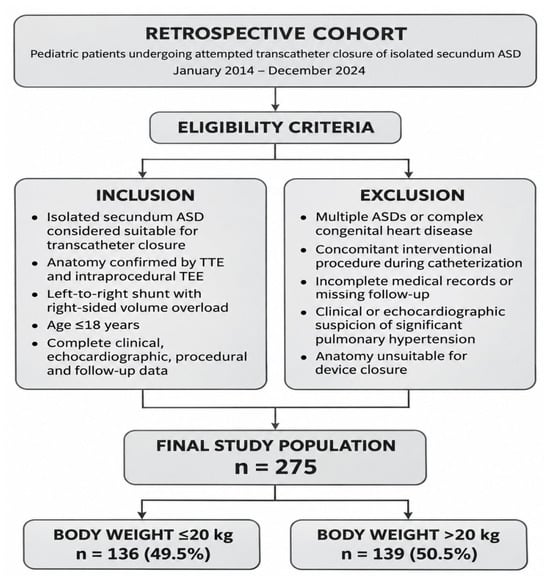
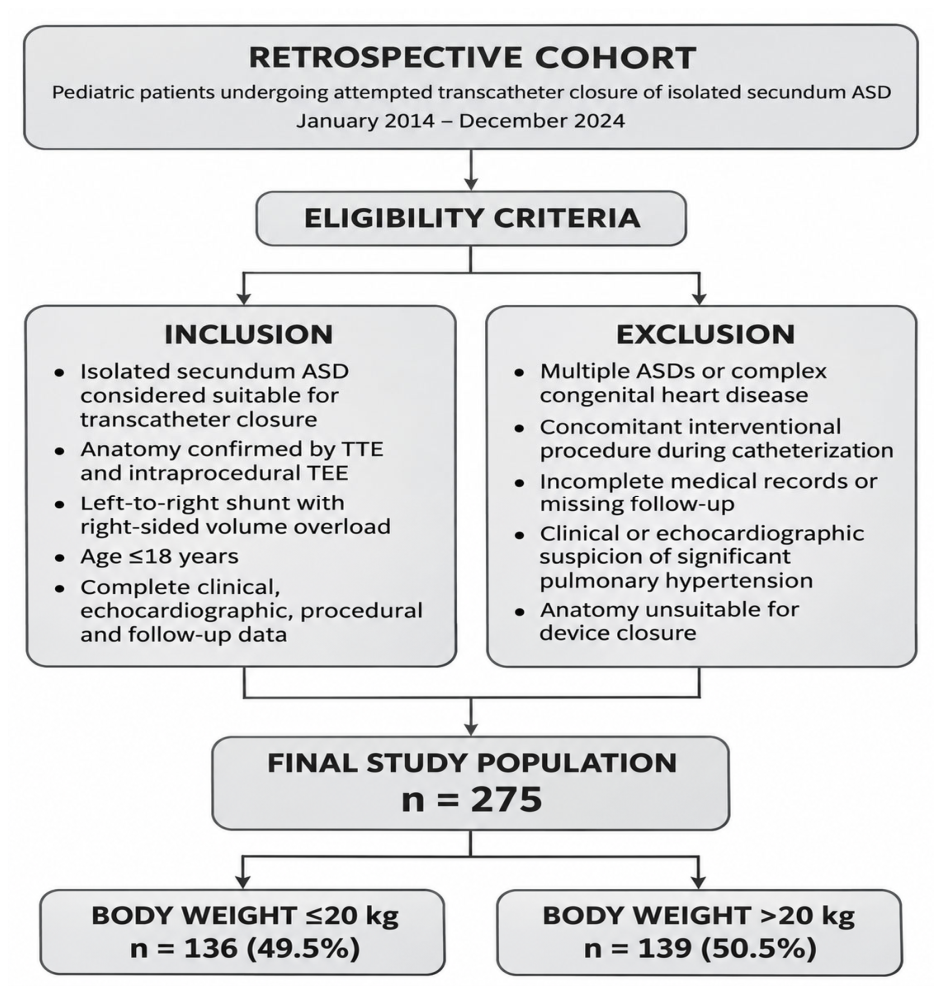
A total of 275 patients met the inclusion criteria and underwent attempted transcatheter closure of isolated secundum atrial septal defect during the study period. Patients were stratified according to body weight into two groups: 136 children weighing ≤20 kg and 139 children weighing >20 kg (Figure 1).
Figure 1.
Study population diagram summarizing the eligibility criteria, exclusion criteria, final study population, and stratification according to body weight.
Devices implanted included Amplatzer Septal Occluder in 245 cases, Gore Cardioform ASD Occluder in 24 cases, and Cardia device in 6 cases. The main demographic, anatomical, and procedural characteristics are summarized in Table 1.
Table 1.
Baseline demographic, anatomical, and procedural characteristics of the study population stratified by body weight.
Procedural success was achieved in 270 of 275 procedures, corresponding to an overall success rate of 98.2% (95% CI, 0.95–0.99). Success rates were comparable between weight groups, with no significant difference between children weighing ≤20 kg and those weighing >20 kg.
3.2. Intraprocedural and Post-Procedural Complications
No major vascular complications, device erosion, cardiac tamponade, or long-term sequelae were observed during the study period. Overall, 11 complications occurred, corresponding to a complication rate of 4.0%, with no significant difference between the two weight groups. Clinical, anatomical, and procedural features of patients with complications are reported in Table 2, and the distribution of complications according to body weight is summarized in Table 3.
Table 2.
Complications and patients’ characteristics. ASD: atrial septal defect; AVB: atrioventricular block.
Table 3.
Summary of complications by group.
Five intraprocedural complications were observed, accounting for 1.8% of the cohort. One event occurred in the ≤20 kg group and four events occurred in the >20 kg group. The mean defect diameter among patients with intraprocedural complications was 22.6 mm, and the mean diameter-to-weight ratio was 0.76.
Six post-procedural complications were documented, accounting for 2.2% of the cohort. Three occurred in children weighing ≤20 kg and three in children weighing >20 kg. Among patients with post-procedural complications, the mean defect diameter was 17 mm and the mean diameter-to-weight ratio was 0.68.
Arrhythmic complications were uncommon and transient. Atrioventricular block of various degrees occurred in four patients. None required device explantation or pacemaker implantation. One patient developed third-degree atrioventricular block, which resolved completely after corticosteroid therapy. Other conduction disturbances were transient and resolved spontaneously or with medical treatment. No recurrence of conduction abnormalities was observed during follow-up.
One patient experienced syncope and junctional tachycardia, successfully treated with amiodarone for two months, with no recurrence at one-year follow-up. One patient developed pericardial effusion, which resolved spontaneously without intervention.
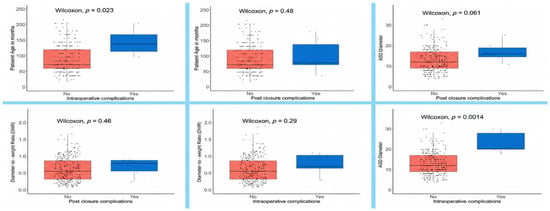
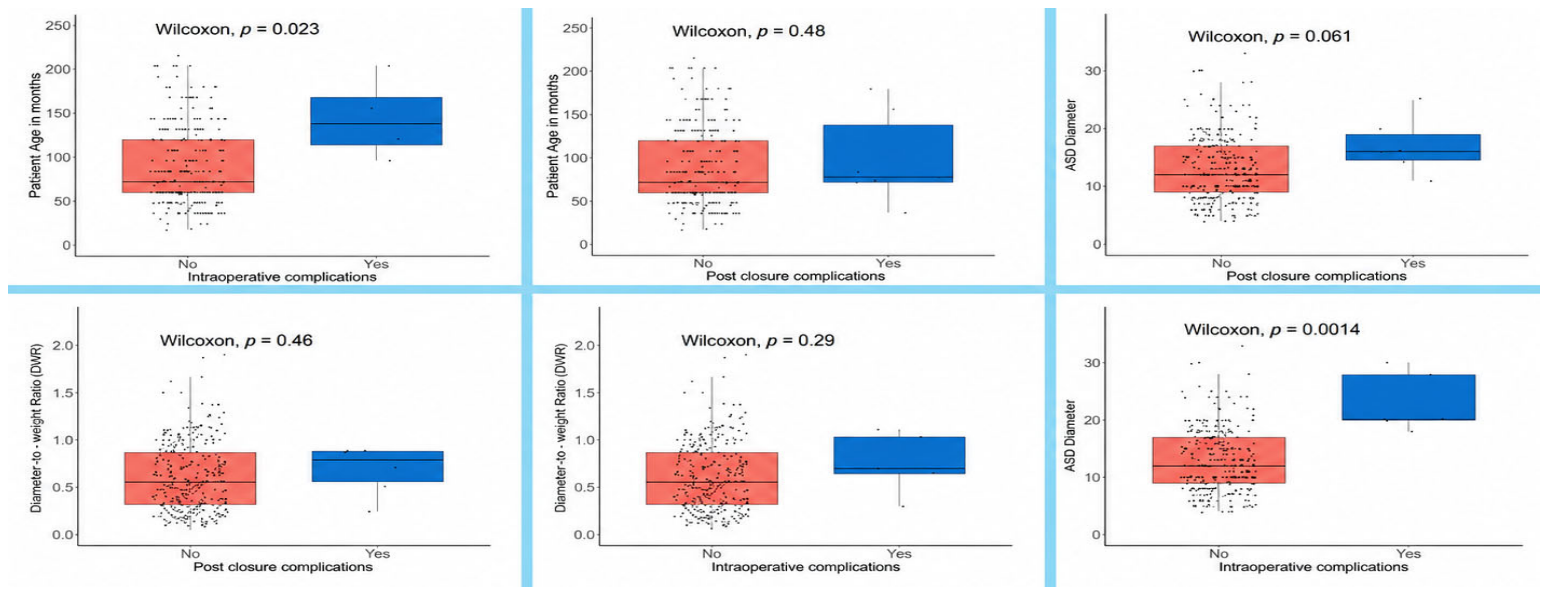
In exploratory analyses, patients experiencing intraprocedural complications had significantly larger ASD diameters than those without complications (p = 0.0014; Figure 2).
Figure 2.
Statistical analysis of complications.
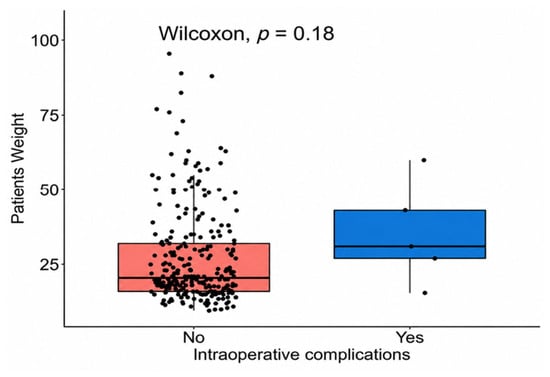
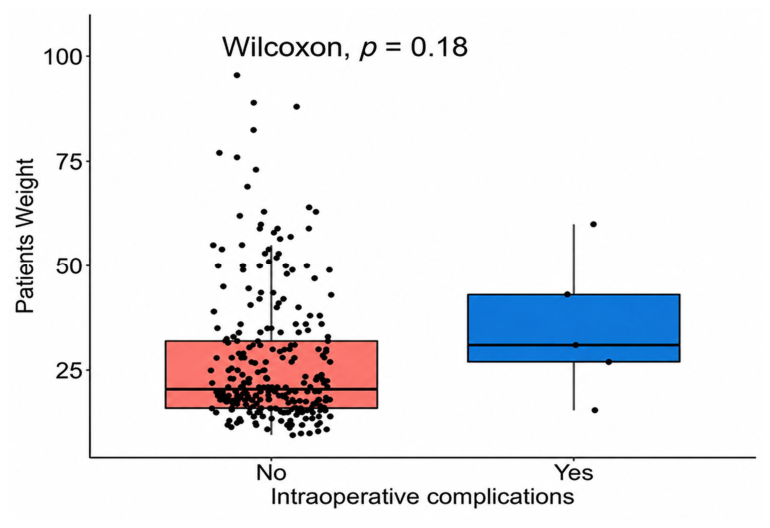
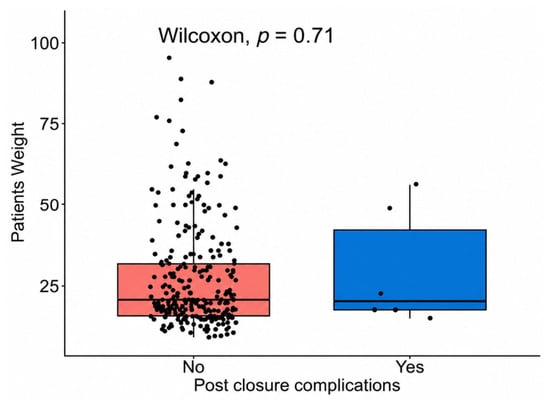
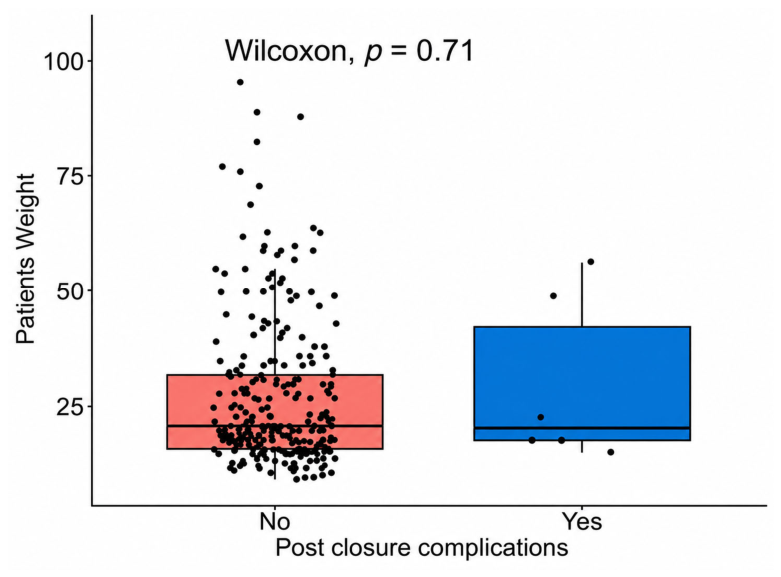
When body weight was analyzed as a continuous variable, no statistically significant differences were observed between patients with and without intraprocedural complications (Wilcoxon rank-sum test, p = 0.18; Figure 3) or between patients with and without postprocedural complications (Wilcoxon rank-sum test, p = 0.71; Figure 4). These findings were consistent with the absence of statistically significant differences in complication rates between the two predefined weight groups (≤20 kg and >20 kg).
Figure 3.
Body weight distribution according to the occurrence of intraprocedural complications. Boxplots with individual data points compare body weight between patients with and without intraprocedural complications (Wilcoxon rank-sum test, p = 0.18). Black dots represent individual patient observations.
Figure 4.
Body weight distribution according to the occurrence of postprocedural complications. Boxplots with individual data points compare body weight between patients with and without postprocedural complications (Wilcoxon rank-sum test, p = 0.71). Black dots represent individual patient observations.
Effect sizes expressed as relative risks (RRs), together with their corresponding 95% confidence intervals, are presented in Table 4. No statistically significant differences were observed between weight groups. However, the wide confidence intervals reflect the limited number of adverse events and indicate uncertainty in the estimated effects.
Table 4.
Effect sizes and 95% confidence intervals for clinical and procedural outcomes according to body weight.
3.3. Device Embolization and Anatomical Findings
Device embolization occurred in five patients (1.8% of the overall cohort), including one patient weighing ≤20 kg and four patients weighing >20 kg. Three embolizations (60%) occurred intraprocedurally, whereas two (40%) were documented after the procedure.
Four patients (80%) required surgical device retrieval, including one emergency surgical intervention, while one device (20%) was successfully retrieved percutaneously during the index catheterization.
One postprocedural embolization involved delayed device migration into the abdominal aorta, requiring surgical retrieval. In another patient, intraprocedural embolization initially occurred in the left atrium, followed by displacement into the inferior vena cava near the common iliac venous confluence, requiring surgical removal.
Four embolized devices were Amplatzer Septal Occluders, whereas one was a Gore device. All embolization events were detected and managed before hospital discharge. Retrospective qualitative assessment of the available echocardiographic data identified deficient, absent, or floppy septal rims in all five patients experiencing device embolization, frequently involving multiple rim abnormalities (Table 5). Although these anatomical features may have contributed to device instability, their potential role remains speculative, as no systematic comparison with patients without embolization was performed. Therefore, these observations are purely descriptive and do not establish a statistical association between rim abnormalities and device embolization.
Table 5.
Clinical, anatomical, and procedural characteristics of patients experiencing device embolization.
3.4. Diameter-to-Weight Ratio and Follow-Up
In the subgroup with available stretched measurements, stretched diameter-to-weight ratio was higher than baseline non-stretched diameter-to-weight ratio, with an average increase of 12% in children weighing ≤20 kg and 10% in those weighing >20 kg. This difference was expected and reflects the effect of balloon sizing on the estimation of relative defect size.
In the ≤20 kg group, median age at closure was 60 months (IQR, 23–83 months), indicating that a relevant subset of patients underwent transcatheter closure earlier than traditional timing. The smallest patient successfully treated weighed 9.6 kg.
Residual shunting was observed during follow-up in six patients, four in the ≤20 kg group and two in the >20 kg group. All residual shunts were small and hemodynamically insignificant. Median follow-up duration was 49 months (IQR, 36–56 months).
Fluoroscopy time did not differ significantly between the two groups. A non-significant trend toward longer fluoroscopy time was observed in children weighing ≤20 kg, probably reflecting greater anatomical complexity and more demanding procedural planning in this subgroup.
4. Discussion
4.1. Principal Findings
In this single-center pediatric cohort spanning 2014–2024, transcatheter closure of isolated secundum atrial septal defects was associated with a high procedural success rate and a low incidence of complications. Importantly, outcomes were comparable between children weighing ≤20 kg and those weighing >20 kg, despite the fact that lower-weight patients showed higher diameter-to-weight ratio values, reflecting greater relative anatomical complexity.
The main finding of this study is that body weight alone did not appear to be the principal determinant of procedural outcome. In patients experiencing device embolization, retrospective qualitative assessment identified unfavorable septal rim characteristics. However, these observations remain descriptive, as no systematic comparison with patients without embolization was performed. Device embolization, which represented the most relevant procedural complication in our cohort, occurred in patients with inadequate rim support or unfavorable septal morphology.
These findings support an anatomy-driven approach to patient selection for transcatheter atrial septal defect closure in children. Rather than using body weight as an isolated threshold, procedural risk assessment should integrate defect size, rim adequacy, septal morphology, and diameter-to-weight ratio.
4.2. Comparison with Previous Studies
Several previous studies have reported the feasibility and safety of transcatheter closure of secundum atrial septal defect in infants and small children, including patients weighing less than 10, 15, or 20 kg, depending on the study [10,11,12,13].
Reported procedural success rates are generally high, although complication rates vary according to patient selection, defect size, device type, and anatomical complexity.
Bartakian et al. reported successful closure in children weighing <15 kg, with a relatively higher incidence of major and minor complications [11]. Joseph et al. described favorable outcomes in symptomatic children weighing <15 kg [12], while Naseem et al. reported high procedural success in children weighing <20 kg with large defects [10]. More recently, Puthiyedath et al. further supported the feasibility of transcatheter closure even in infants weighing <10 kg [13]. A comparison with selected previous pediatric series is summarized in Table 6.
Table 6.
Literature comparison.
Our findings are consistent with this literature but add a clinically relevant perspective. The present study suggests that the risk traditionally attributed to low body weight may, at least in part, reflect underlying anatomical complexity. In other words, smaller children are not necessarily at higher procedural risk because of their weight alone; rather, they may be more likely to present an unfavorable relationship between defect size, septal support, and available atrial dimensions.
4.3. Role of Diameter-to-Weight Ratio and Septal Anatomy
Diameter-to-weight ratio provides a simple quantitative estimate of the relationship between defect size and patient body mass [7,8]. In clinical practice, it may help identify children in whom the atrial septal defect is relatively large for body size and in whom procedural margins are narrower.
In our cohort, children weighing ≤20 kg had significantly higher diameter-to-weight ratio values than heavier children. Exploratory analyses showed that patients experiencing intraprocedural complications had significantly larger ASD diameters than those without complications (p = 0.0014; Figure 2). However, the limited number of events precludes the identification of reliable predictors of procedural complications. For this reason, diameter-to-weight ratio should not be interpreted as an absolute contraindication to transcatheter closure, but rather as a marker of procedural complexity.
The combination of increased diameter-to-weight ratio and rim deficiency appears particularly relevant. A large defect in a small child may still be suitable for device closure if septal rims are adequate and device stability is satisfactory. Conversely, a patient with higher body weight may remain at increased risk if the defect is large, eccentric, or associated with deficient posterior, inferior, superior caval, or multiple rims.
From a practical standpoint, patients with relatively large defects in relation to body weight, particularly in the presence of deficient septal rims, require meticulous device sizing, careful assessment of device stability, and avoidance of oversizing. Surgical closure should be considered when adequate device anchoring cannot be assured. This approach emphasizes that anatomical suitability, rather than body weight alone, should guide the choice between transcatheter and surgical closure.
Although unfavorable septal rim characteristics were observed in patients experiencing device embolization, these findings should be interpreted with caution. Since detailed anatomical assessment was performed retrospectively only in patients who experienced device embolization, the present study cannot establish whether rim deficiency is associated with an increased risk of adverse events. Furthermore, DWR did not differ significantly between patients with and without complications. Therefore, the potential contribution of these anatomical features to procedural risk remains hypothesis-generating and requires further investigation.
4.4. Complication Profile
The overall complication rate in our cohort was low, and no major vascular complications, device erosion, cardiac tamponade, pacemaker implantation, or long-term sequelae were observed. Arrhythmic complications were uncommon and transient, resolving spontaneously or after short-term medical therapy [14]. No patient required device explantation because of rhythm disturbances.
Device embolization was observed in five patients (1.8%), with a numerically higher occurrence in the >20 kg group. Notably, all five patients presented at least one abnormal septal rim, including deficient, absent, or floppy rims, suggesting that unfavorable septal anatomy may have contributed to device instability.
However, these observations should be interpreted cautiously, as rim characteristics were assessed retrospectively in patients who experienced device embolization and were not systematically available for the entire cohort.
Although most embolizations involved Amplatzer devices, the small number of events, the heterogeneous distribution of device types, and the anatomy-driven device selection strategy preclude meaningful conclusions regarding device-specific embolization risk.
Overall, these findings reinforce the importance of careful anatomical assessment and appropriate device selection, while highlighting the limitations of identifying independent predictors of embolization from a small number of events.
Residual shunts were uncommon, small, and hemodynamically insignificant during follow-up. No patient required reintervention or device removal for residual shunting. These findings support the durability of transcatheter closure when appropriate anatomical selection is applied.
4.5. Device Selection
Device selection in our center followed an anatomy-driven strategy. The Amplatzer Septal Occluder remained the preferred device in most patients because of operator experience, predictable deployment, and favorable stability in centrally located defects with adequate septal support. The Gore Cardioform ASD Occluder was used in selected cases requiring a softer profile, including smaller atria, floppy septal tissue, mildly deficient non-aortic rims, or more complex defect morphology.
Because of the relatively small number of complications and the unequal distribution of device types, our data do not allow meaningful comparisons between different occluders. Therefore, no conclusion can be drawn regarding superiority of one device over another. Rather, our findings emphasize that device choice should be individualized according to defect anatomy, rim adequacy, atrial dimensions, and operator assessment of stability [15].
4.6. Clinical Implications
The results of this study have practical implications for pediatric interventional cardiology. First, body weight should not be used as the only determinant of eligibility for transcatheter atrial septal defect closure. Second, lower-weight children may undergo successful and safe device closure when anatomical conditions are favorable. Third, diameter-to-weight ratio may be useful as an additional tool for identifying children with greater anatomical complexity and narrower procedural margins.
This approach may support timely closure in selected symptomatic or anatomically suitable children, avoiding unnecessary delay based only on body weight [16,17,18]. At the same time, it may help identify patients in whom surgical closure remains the safer option because of unfavorable septal anatomy or inadequate device stability.
In our cohort, children weighing ≤20 kg exhibited significantly higher DWR values than heavier patients, despite having comparable absolute ASD diameters. In particular, the mean and median DWR values in the lower-weight group were 0.84 and 0.82, respectively.
These findings reflect the relatively larger defect size in relation to body weight observed in smaller children. However, our study does not establish a validated DWR threshold for predicting procedural complications [19].
4.7. Strengths and Limitations
The strengths of this study include the large pediatric cohort, the long study period, the single-center procedural consistency, and the focus on anatomical characteristics rather than body weight alone. The study also provides practical data on procedural outcomes, complications, and follow-up in a real-world pediatric interventional setting [20,21].
The main limitations of this study include its retrospective design, single-center setting, limited statistical power for rare adverse events, heterogeneous follow-up duration, and non-randomized device selection. Detailed assessment of septal rim characteristics was performed retrospectively only in patients who experienced device embolization. This secondary analysis was qualitative and descriptive, without quantitative rim measurements or standardized severity grading. Consequently, the absence of comparable anatomical data for patients without embolization precluded a formal assessment of the association between rim abnormalities and procedural complications. Furthermore, the limited number of embolization events prevented reliable multivariable analysis and meaningful comparisons between device types. The retrospective nature of the study also limited the availability of detailed clinical information regarding the presentation and detection of individual embolization events. Furthermore, standardized quantitative measurements of right-sided chamber enlargement were not available in the original database, limiting the retrospective assessment of numerical echocardiographic criteria for patient selection. Finally, stretched diameter measurements were not available for all patients; therefore, non-stretched echocardiographic diameter was used to calculate DWR in the full cohort, with a subgroup analysis performed when stretched measurements were available.
Larger multicenter prospective studies with standardized anatomical assessment are needed to validate the role of diameter-to-weight ratio, define clinically useful cut-off values, and improve risk stratification in children undergoing transcatheter atrial septal defect closure.
5. Conclusions
In this single-center pediatric cohort spanning 2014–2024, transcatheter closure of isolated secundum atrial septal defects was associated with a high procedural success rate and a low incidence of complications. Lower body weight alone was not associated with worse procedural outcomes. In patients experiencing device embolization, retrospective qualitative assessment identified unfavorable septal rim characteristics; however, their association with procedural risk could not be formally established. These findings support an anatomy-driven approach to patient selection and procedural planning, in which body weight should be interpreted together with defect size, rim adequacy, septal morphology, and diameter-to-weight ratio.
Author Contributions
Conceptualization, A.B.; methodology, M.S., G.F.P., G.F., G.A.M., R.B., S.B., E.G., S.G., F.F., K.L. and G.A. (Giuseppe Annoni); formal analysis, G.F.P. and G.A. (Giuseppe Annoni); investigation, M.S.; writing—original draft preparation, M.S. and A.B.; writing—review and editing, M.S., A.B. and G.A. (Giuseppe Annoni); supervision, M.R., G.A. (Gabriella Agnoletti), C.R. and G.A. (Giuseppe Annoni); project administration, M.S. and G.A. (Giuseppe Annoni). All authors have read and agreed to the published version of the manuscript.
Funding
This research received no external funding.
Institutional Review Board Statement
This retrospective, non-interventional study involved exclusively the analysis of anonymized clinical data collected during routine clinical care and did not involve any additional diagnostic or therapeutic procedures for research purposes. The study was conducted in accordance with the institutional procedures of Regina Margherita Children’s Hospital for retrospective observational studies based on routinely collected clinical data.
Informed Consent Statement
Written informed consent for the use of anonymized clinical data for research purposes was obtained from the patients’ parents or legal guardians at hospital admission. No additional consent was required for the present retrospective analysis.
Data Availability Statement
The datasets generated and analyzed during the current study are available from the corresponding author on reasonable request.
Acknowledgments
The authors thank the medical, nursing, and technical staff involved in the care of the patients included in this study. The authors also thank the Biostatistics Unit for its support in statistical analysis and data interpretation.
Conflicts of Interest
The authors declare no conflicts of interest.
Abbreviations
| ASD | atrial septal defect |
| ASD II | ostium secundum atrial septal defect |
| TTE | transthoracic echocardiography |
| AVB | atrioventricular block |
| DWR | diameter-to-weight ratio |
| SDWR | stretched diameter-to-weight ratio |
| ASO | Amplatzer septal occluder |
References
- Pilard, C.M.; Villemain, O.; Laforest, G.; Roubertie, F.; Thambo, J.B.; Jalal, Z. Outcomes following closure of secundum Atrial Septal Defect in children ≤15 kg in a French tertiary centre. J. Clin. Med. 2024, 13, 198. [Google Scholar] [CrossRef] [Scilit] [PubMed]
- Sharma, B.; Pinto, R.; Dalvi, B. Transcatheter closure of Atrial Septal Defect in symptomatic children weighing ≤10 kg: Addressing unanswered issues from a decade of experience. Ann. Pediatr. Cardiol. 2020, 13, 4–10. [Google Scholar] [CrossRef] [Scilit] [PubMed]
- Butera, G.; De Rosa, G.; Chessa, M.; Rosti, L.; Negura, D.G.; Luciane, P.; Giamberti, A.; Bossone, E.; Carminati, M. Transcatheter closure of Atrial Septal Defect in young children: Results and follow-up. J. Am. Coll. Cardiol. 2003, 42, 241–245. [Google Scholar] [CrossRef] [Scilit] [PubMed]
- Wyss, Y.; Quandt, D.; Weber, R.; Stiasny, B.; Weber, B.; Knirsch, W.; Kretschmar, O. Interventional closure of secundum type Atrial Septal Defects in infants less than 10 kg: Indications and procedural outcome. J. Interv. Cardiol. 2016, 29, 646–653. [Google Scholar] [CrossRef] [Scilit] [PubMed]
- Dalvi, B.; Pinto, R.; Gupta, A. Device closure of large atrial septal defects requiring devices ≥ 20 mm in small children weighing <20 kg. Catheter. Cardiovasc. Interv. 2008, 71, 679–686. [Google Scholar] [CrossRef] [Scilit] [PubMed]
- Jalal, Z.; Hascoët, S.; Gronier, C.; Godart, F.; Mauri, L.; Dauphin, C.; Lefort, B.; Lachaud, M.; Piot, D.; Dinet, M.-L.; et al. Long-term outcomes after percutaneous closure of ostium secundum Atrial Septal Defect in the young: A nationwide cohort study. JACC Cardiovasc. Interv. 2018, 11, 795–804. [Google Scholar] [CrossRef] [Scilit] [PubMed]
- Houeijeh, A.; Hascoët, S.; Bouvaist, H.; Hadeed, K.; Petit, J.; Godart, F.; Fraisse, A. Transcatheter closure of large atrial septal defects (ASDs) in symptomatic children with device/weight ratio ≥ 1.5. Int. J. Cardiol. 2018, 267, 84–87. [Google Scholar] [CrossRef] [Scilit] [PubMed]
- Tanghöj, G.; Odermarsky, M.; Naumburg, E.; Liuba, P. Early complications after percutaneous closure of atrial septal defect in infants with procedural weight less than 15 kg. Pediatr. Cardiol. 2017, 38, 255–263. [Google Scholar] [CrossRef] [Scilit] [PubMed]
- Sachdeva, R.; Parthiban, A.; Birnbaum, B.; Hancock, H.S.; Jayaram, N.M.; Plummer, S.T.; Statile, C. Outpatient management of isolated left-to-right shunt lesions in pediatric patients: 2026 ACC concise clinical guidance. J. Am. Coll. Cardiol. 2026, 87, 3185–3206. [Google Scholar] [CrossRef] [Scilit] [PubMed]
- Naseem, J.A.; Riyaz, M.S.U.; Joseph, S.P.; Krupa, J.; Agarwal, M.; Mathen, P.G.; George, O.K.; George, P.V.; Jose, J.; Thomson, V.S. Transcatheter closure of large ostium secundum Atrial Septal Defects in symptomatic small children: A single-center retrospective study. Ann. Pediatr. Cardiol. 2023, 16, 393–398. [Google Scholar] [CrossRef] [Scilit] [PubMed]
- Bartakian, S.; Fagan, T.E.; Schaffer, M.S.; Darst, J.R. Device closure of secundum atrial septal defects in children < 15 kg: Complication rates and indications for referral. JACC Cardiovasc. Interv. 2012, 5, 1178–1184. [Google Scholar] [CrossRef] [Scilit] [PubMed]
- Joseph, S.P.; Mirza, S.U.R.; Krupa, J.; Varghese, S.I.; Kartha, G.B.; George, O.K.; George, P.V.; Jose, J.; Thomson, V.S. Clinical and procedural characteristics of successful transcatheter device closure of ostium secundum atrial septal defect in symptomatic children weighing <15 kg: A retrospective study spanning one decade from South India. J. Saudi Heart Assoc. 2024, 36, 14–22. [Google Scholar] [CrossRef] [Scilit] [PubMed]
- Puthiyedath, T.; Sagar, P.; Sivakumar, K. Safety and feasibility of transcatheter closure of atrial septal defects in small children weighing less than 10 kg. Cardiol. Young 2024, 34, 2449–2456. [Google Scholar] [CrossRef] [Scilit] [PubMed]
- Suda, K.; Raboisson, M.J.; Piette, E.; Dahdah, N.S.; Miró, J. Reversible atrioventricular block associated with closure of Atrial Septal Defects using the Amplatzer device. J. Am. Coll. Cardiol. 2004, 43, 1677–1682. [Google Scholar] [CrossRef] [Scilit] [PubMed]
- Castaldi, B.; Santoro, G.; Di Candia, A.; Marchese, P.; Cantinotti, M.; Pizzuto, A.; Scalera, S.; Garibaldi, S.; Fumanelli, J.; Sirico, D.; et al. Impact of Gore Cardioform Atrial Septal Defect Occluder on atrial and ventricular electromechanics in a pediatric population. Am. J. Cardiol. 2024, 211, 259–267. [Google Scholar] [CrossRef] [Scilit] [PubMed]
- Fraisse, A.; Losay, J.; Bourlon, F.; Agnoletti, G.; Lusson, J.-R.; Godart, F.; De Geeter, B.; Petit, J.; Piechaud, J.F. Efficiency of transcatheter closure of Atrial Septal Defects in small and symptomatic children. Cardiol. Young 2008, 18, 343–347. [Google Scholar] [CrossRef] [Scilit] [PubMed]
- Knop, M.; Szkutnik, M.; Fiszer, R.; Białkowska, B.; Głowacki, J.; Białkowski, J. Transcatheter closure of Atrial Septal Defect in children up to 10 kg of body weight with Amplatzer device. Cardiol. J. 2014, 21, 279–283. [Google Scholar] [CrossRef] [Scilit] [PubMed]
- McMahon, C.J.; Feltes, T.F.; Fraley, J.K.; Bricker, J.T.; Grifka, R.G.; Tortoriello, T.A.; Blake, R.; Bezold, L.I. Natural history of growth of secundum Atrial Septal Defects and implication for transcatheter closure. Heart 2002, 87, 256–259. [Google Scholar] [CrossRef] [Scilit] [PubMed]
- Petit, C.J.; Justino, H.; Pignatelli, R.H.; Crystal, M.A.; Payne, W.A.; Ing, F.F. Percutaneous atrial septal defect closure in infants and toddlers: Predictors of success. Pediatr. Cardiol. 2013, 34, 220–225. [Google Scholar] [CrossRef] [Scilit] [PubMed]
- El-Said, H.; Hegde, S.; Foerster, S.; Hellenbrand, W.; Kreutzer, J.; Trucco, S.M.; Holzer, R.; Burch, G.; Mirani, A.; Nicolas, R.; et al. Device therapy for Atrial Septal Defects in a multicenter cohort: Acute outcomes and adverse events. Catheter. Cardiovasc. Interv. 2015, 85, 227–233. [Google Scholar] [CrossRef] [Scilit] [PubMed]
- Kashyap, T.; Sanusi, M.; Momin, E.S.; Khan, A.A.; Mannan, V.; Pervaiz, M.A.; Akram, A.; Elshaikh, A.O.; Pervaiz, M.A., Sr. Transcatheter occluder devices for the closure of Atrial Septal Defect in children: How safe and effective are they? A systematic review. Cureus 2022, 14, e25402. [Google Scholar] [CrossRef] [Scilit] [PubMed]

Disclaimer/Publisher’s Note: The statements, opinions and data contained in all publications are solely those of the individual author(s) and contributor(s) and not of MDPI and/or the editor(s). MDPI and/or the editor(s) disclaim responsibility for any injury to people or property resulting from any ideas, methods, instructions or products referred to in the content. |
© 2026 by the authors. Licensee MDPI, Basel, Switzerland. This article is an open access article distributed under the terms and conditions of the Creative Commons Attribution (CC BY) license.