


Highlights
What are the main findings?
- One-year linear growth showed no significant difference between once-weekly somatrogon and once-daily somatropin.
- Somatrogon was associated with greater increases in IGF-1 concentrations, body weight, and body mass index (BMI), and with more frequent IGF-1 SDS values >+2.
What are the implications of the main findings?
- IGF-1, body weight, and BMI may warrant close monitoring in children receiving somatrogon.
- IGF-1 values during somatrogon treatment should be interpreted in relation to the time since the last injection; these non-randomized findings require confirmation in prospective studies.
Abstract
Objectives: To compare one-year growth, insulin-like growth factor 1 (IGF-1), anthropometric, and safety outcomes of once-weekly somatrogon and once-daily somatropin in children with isolated growth hormone deficiency (GHD). Methods: This single-center retrospective cohort included 150 treatment-naïve children (75 per group); treatment was selected by parental preference. Outcomes were analyzed using repeated-measures general linear models and multivariable regression adjusted for baseline age, sex, Tanner stage, peak stimulated GH, and the corresponding baseline value. Results: Mean height gain was 9.41 ± 1.48 cm with somatrogon and 9.04 ± 1.42 cm with somatropin (p = 0.126). Adjusted differences were not significant for height gain (0.35 cm; 95% CI, −0.12 to 0.82) or height standard deviation score (SDS) change (0.04; 95% CI, −0.06 to 0.15). Weight, weight SDS, body mass index (BMI), and BMI SDS increased more with somatrogon after adjustment (all p ≤ 0.001). Adjusted one-year increases were also greater with somatrogon for IGF-1 (29.3 ng/mL; 95% CI, 8.2–50.4) and IGF-1 SDS (0.34; 95% CI, 0.11–0.58). IGF-1 SDS >+2 occurred in 16.0% versus 4.0% of patients (difference, 12.0 percentage points; 95% CI, 2.3–22.3; p = 0.027); in 9 of the 12 somatrogon-treated patients, samples were obtained <96 h after injection. Adverse events were recorded in 24.0% and 28.0% of patients, respectively, most commonly injection-site pain; no serious adverse events occurred. Conclusions: One-year linear growth did not differ significantly between treatments, whereas somatrogon was associated with greater increases in IGF-1, weight, and BMI. Non-randomized treatment selection, residual confounding, and variable IGF-1 sampling times limit causal interpretation.
1. Introduction
In children and adolescents, growth hormone (GH) deficiency (GHD) restricts linear growth and may also influence body composition and metabolism [1]. Recombinant human GH (rhGH) substantially improves growth outcomes and can enable attainment of adult height within the familial target range [1], and long-term observational studies have characterized the effectiveness and safety of daily rhGH therapy in children [2,3,4].
Daily subcutaneous injections, however, impose a considerable burden on children and their families. Injection discomfort, medication storage and preparation, and the need to integrate treatment into daily routines may adversely affect adherence [5,6]. Missed injections are common and are associated with a reduced growth response [7], and early discontinuation and inadequate response further limit treatment success [8], underscoring the importance of treatment persistence [9,10]. Long-acting GH preparations have therefore been developed to reduce injection frequency while maintaining growth efficacy and an acceptable safety profile [11,12,13].
Somatrogon is a once-weekly long-acting GH analog in which GH is fused to C-terminal peptide sequences of the β-subunit of human chorionic gonadotropin, prolonging its half-life [14]. In randomized phase 3 trials, somatrogon demonstrated non-inferior height velocity compared with daily somatropin, with a similar safety profile [14,15], and extension studies have reported sustained growth responses during longer-term treatment [16,17]. Weekly administration has also been associated with a lower reported treatment burden [18]. Because of its pharmacokinetic profile, however, insulin-like growth factor 1 (IGF-1) concentrations fluctuate across the weekly dosing interval, and higher mean IGF-1 SDS values have been reported with somatrogon than with daily somatropin [15,19,20]. Several real-world reports have also described increases in body weight or body mass index (BMI) during somatrogon treatment [21,22,23].
Clinical trials may not fully reflect routine practice, in which age, pubertal stage, dosing, adherence, and clinical characteristics are more heterogeneous. Although real-world evidence is increasing [21,22,23,24,25,26,27,28], many studies have been single-arm or have included patients switched from daily therapy, and few have directly compared treatment-naïve children receiving somatrogon or daily somatropin during the same period [25,28].
We therefore compared one-year growth responses, IGF-1 concentrations, anthropometric changes, and recorded adverse events in treatment-naïve children with isolated GHD receiving once-weekly somatrogon or once-daily somatropin at a single pediatric endocrinology center, using analyses adjusted for clinically relevant baseline characteristics.
2. Materials and Methods
2.1. Study Design and Participants
This retrospective cohort study was conducted at Diyarbakır Children’s Hospital, a tertiary pediatric endocrinology center in Diyarbakır, Türkiye. All consecutive eligible, treatment-naïve children with isolated GHD who initiated GH therapy between May 2024 and February 2025 were included. Data collection extended from May 2024 through February 2026, including the final 12-month follow-up visits.
Inclusion criteria were age 3–18 years; height SDS ≤−2; pretreatment annual height velocity SDS <−0.7 (approximately below the 25th percentile) [29]; peak GH <10 ng/mL in each of two separate stimulation tests (clonidine and levodopa); and a normal karyotype in girls. Bone age was assessed in all patients before treatment initiation.
Exclusion criteria were systemic diseases affecting growth, including chronic kidney disease, primary hypothyroidism, and celiac disease; chromosomal or syndromic causes of short stature (including Turner, Prader–Willi, Noonan, and Silver–Russell syndromes); SHOX variants or deletions; skeletal dysplasia; birth small for gestational age; a history of malignancy, radiotherapy, or chemotherapy; and any additional pituitary hormone deficiency, including multiple pituitary hormone deficiency or panhypopituitarism. Children with additional pituitary hormone deficiencies were excluded to reduce clinical heterogeneity, because the type and severity of these deficiencies and the timing and adequacy of their replacement therapies may independently influence growth and biochemical responses to GH treatment.
Treatment allocation was non-randomized and reflected parental preference in routine clinical practice. Before treatment initiation, parents or legal guardians were counseled about both preparations, including their administration schedules and injection frequencies, and then selected the treatment. The investigators did not influence treatment selection for research purposes. Of the 150 eligible patients, 75 received once-weekly somatrogon and 75 received once-daily somatropin; the equal group sizes reflected the observed distribution of eligible patients and were not the result of randomization, matching, or predefined quotas. Patients were classified retrospectively according to the preparation received.
Data were retrieved retrospectively from electronic hospital records and patient charts. Brain and pituitary MRI was performed in all patients to assess structural abnormalities. Molecular genetic testing was not performed, as it was not part of our routine diagnostic protocol for isolated GHD. Pubertal development was assessed at baseline and during follow-up using Tanner staging [30,31].
2.2. GH Stimulation Tests and Assay Methodology
GHD was diagnosed using two pharmacological stimulation tests performed on separate occasions after overnight fasting, using oral clonidine (5 µg/kg; maximum 250 µg) and levodopa (125 mg for children weighing <15 kg, 250 mg for 15–30 kg, and 500 mg for >30 kg). Serum GH was measured at 0, 30, 60, and 90 min during the clonidine test and at 0, 60, 90, and 120 min during the levodopa test, and the highest concentration in each test was recorded as the peak GH response. GH was measured by electrochemiluminescence immunoassay (ECLIA) on a Roche cobas e 601 analyzer (Roche Diagnostics, Mannheim, Germany); the Elecsys hGH assay is standardized against the International Reference Preparation NIBSC 98/574. Sex-steroid priming was not performed before stimulation testing.
A peak GH cutoff of <10 ng/mL in both tests was applied, in line with our institutional diagnostic approach and its established use in pediatric endocrinology practice in Türkiye [32]; a similar threshold was used in the somatrogon phase 3 trial [14]. Because lower, assay-dependent cutoffs of approximately 7 ng/mL have been proposed and no universal threshold applies across analytical platforms [33,34], stimulation test results were interpreted together with clinical and auxological findings, baseline IGF-1, bone age, pubertal stage, and pituitary MRI findings. Peak GH values of 7 to <10 ng/mL in both tests were defined as borderline responses for descriptive purposes.
2.3. National Eligibility and Reimbursement Criteria
Eligibility for GH treatment was assessed in accordance with Section 4.2.6.A-1 of the Health Implementation Communiqué (Sağlık Uygulama Tebliği; SUT) of the Turkish Social Security Institution (SGK), which governs national eligibility and reimbursement criteria for pediatric GH therapy [35]. For GHD, these criteria require clinical and auxological evaluation by a pediatric endocrinologist, documentation of pretreatment growth velocity, a peak GH concentration <10 ng/mL on two separate stimulation tests, and a medical board report. Somatrogon was first included in the reimbursement scope by an amendment to the SUT published on 9 May 2024, which entered into force on 17 May 2024; under this amendment, no national bone-age criterion applies to somatrogon [36]. Both preparations were reimbursed under the same criteria without additional cost to families. The national requirements applicable during the study period and the institutional diagnostic, treatment, and monitoring protocol are summarized in Supplementary Table S1 [35,36]. All patients fulfilled both the national eligibility requirements and the study-specific inclusion and exclusion criteria described above.
2.4. Treatment and Follow-Up
Somatrogon was administered subcutaneously at 0.66 mg/kg once weekly and somatropin at 0.035 mg/kg once daily (0.245 mg/kg/week), with initial doses calculated from body weight at treatment initiation. Both treatments were delivered using single-use 31-gauge, 5-mm pen needles, and families were instructed to rotate injection sites routinely.
Somatrogon and somatropin doses were reassessed every 6 months together with IGF-1 results and, provided that IGF-1 SDS did not exceed +2, were readjusted to current body weight. The target IGF-1 SDS range was −2 to +2. When IGF-1 SDS exceeded +2, the dose was not increased and measurement was repeated approximately 6 weeks later; if IGF-1 SDS remained >+2, the dose was reduced by 15% and IGF-1 was reassessed after 6–8 weeks.
Children underwent clinical and auxological assessment at baseline and every 3 months thereafter, including vital signs, height, weight, BMI, height velocity (cm/year), and adverse events. Standing height was recorded with a Harpenden stadiometer (Holtain Ltd., Crymych, UK), and body weight with a calibrated electronic scale; BMI was calculated as weight (kg) divided by height squared (m2).
Age- and sex-specific SDS values for height, height velocity, weight, BMI, and IGF-1 were calculated using the Child Metrics (ÇEDD Çözüm/TPEDS Metrics) online application [29], which uses Turkish national reference data for anthropometric measurements [37] and the Roche Elecsys IGF-1 reference data for IGF-1 [38].
Bone age was assessed using the Greulich–Pyle method [39] at baseline and at 12 months. All radiographs were evaluated by the same pediatric endocrinologist. Skeletal maturation was evaluated using the change in bone age (ΔBA) and the bone-age-to-chronological-age ratio (BA/CA) at both time points. Changes in these parameters were compared between treatment groups and descriptively evaluated according to baseline Tanner stage.
2.5. Laboratory Measurements and Outcomes
At baseline, 6 months, and 12 months, routine laboratory monitoring comprised a complete blood count, hepatic and renal function, serum electrolytes, fasting glucose and insulin, glycated hemoglobin, thyroid function (thyroid-stimulating hormone and free thyroxine), calcium, phosphate, alkaline phosphatase, and IGF-1. Serum IGF-1 concentrations were measured using an electrochemiluminescence immunoassay (ECLIA; Roche Diagnostics, Mannheim, Germany). In the somatrogon group, sampling was scheduled approximately 96 h (4 days) after the most recent injection to approximate mean weekly IGF-1 exposure [13]; in the somatropin group, samples were collected within the day following the most recent injection. Because of the retrospective, real-world design, deviations from the planned sampling intervals occurred, and the actual interval between injection and sampling was not systematically documented for all measurements. IGF-1 was expressed as serum concentration and as age- and sex-specific SDS at baseline, 6 months, and 12 months.
The primary outcomes were one-year height gain and change in height SDS. Secondary outcomes were changes in IGF-1, IGF-1 SDS, weight, weight SDS, BMI, and BMI SDS; bone-age progression; pubertal progression; and safety outcomes.
Safety outcomes were assessed retrospectively from adverse events and laboratory abnormalities documented in clinical records during the 12-month follow-up, including injection-site reactions, lipoatrophy, headache, serious adverse events, clinically significant laboratory abnormalities, disturbances of glucose metabolism or thyroid function, and IGF-1 SDS >+2. Adverse-event ascertainment depended on the completeness of routine clinical documentation, and no standardized severity grading system was applied.
2.6. Statistical Analysis
Analyses were performed using IBM SPSS Statistics 25.0 (IBM Corp., Armonk, NY, USA) and Python 3.14 (statsmodels 0.15.0). Normality was assessed using the Shapiro–Wilk test and graphical methods. Continuous variables are presented as mean ± SD or median (Q1–Q3), and categorical variables as n (%). Groups were compared using Student’s or Welch’s t-test (according to Levene’s test), the Mann–Whitney U test, Pearson’s chi-square test, or Fisher’s exact test, as appropriate.
Changes in height, weight, BMI, their SDS values, IGF-1, and IGF-1 SDS were analyzed using repeated-measures general linear models (RM-GLM) for time, group, and time × group effects, with the Greenhouse–Geisser correction when Mauchly’s test indicated violation of sphericity and Bonferroni-adjusted between-group comparisons at each time point. Weight and BMI indicators were also analyzed jointly in a multivariate model (Pillai’s trace). Data were complete for all 150 patients at all analyzed time points; therefore, no imputation was required.
To address confounding, one-year changes in each outcome were analyzed using separate multivariable linear regression models including treatment group, age at initiation, sex, baseline Tanner stage (categorical), the higher stimulated peak GH concentration, and the corresponding baseline value (height, weight, or BMI SDS, or baseline IGF-1 or IGF-1 SDS). Adjusted differences (somatrogon minus somatropin) are reported with 95% confidence intervals (CIs) and p-values based on heteroskedasticity-consistent (HC3) standard errors. Sensitivity analyses of growth and anthropometric outcomes were restricted to prepubertal children (Tanner stage 1). No adjustment was made for multiple outcomes.
ΔBA and Δ(BA/CA) were compared using Welch’s t-test, and Δ(BA/CA) was described by baseline Tanner stage. The difference in the frequency of IGF-1 SDS >+2 was tested using Fisher’s exact test and reported as an absolute risk difference with a Newcombe 95% CI. Pituitary MRI findings were compared using the Fisher–Freeman–Halton exact test. Pubertal progression was assessed using the marginal homogeneity test within groups and Pearson’s chi-square or Fisher’s exact test between groups. All tests were two-sided, with p < 0.05 considered statistically significant.
3. Results
3.1. Baseline Characteristics
A total of 150 consecutive eligible patients with isolated GHD were included (somatrogon, n = 75; somatropin, n = 75). Baseline demographic, auxological, biochemical, skeletal, and imaging characteristics were similar between groups (Table 1). Borderline peak GH responses (7 to <10 ng/mL in both stimulation tests) were observed in 7 patients (9.3%) receiving somatrogon and 6 (8.0%) receiving somatropin.
Table 1.
Baseline demographic and clinical characteristics of the somatrogon and somatropin groups.
3.2. Growth Response
Height and height SDS increased in both groups (p < 0.001 for both time effects). Mean one-year height gain was 9.41 ± 1.48 cm with somatrogon and 9.04 ± 1.42 cm with somatropin, and height SDS increased by 0.61 ± 0.33 and 0.58 ± 0.32, respectively. Time × group interactions were not significant for height (F = 2.37; p = 0.126) or height SDS (F = 0.32; p = 0.576; Table 2).
Table 2.
One-year changes in height and height SDS in the somatrogon and somatropin groups.
3.3. Adjusted Analyses
After adjustment for baseline covariates, one-year height gain (adjusted difference, 0.35 cm; 95% CI, −0.12 to 0.82; p = 0.144) and height SDS change (0.04; 95% CI, −0.06 to 0.15; p = 0.402) did not differ significantly between groups. In contrast, increases in weight, weight SDS, BMI, and BMI SDS were greater in the somatrogon group (all p ≤ 0.001), as were increases in IGF-1 (29.3 ng/mL; 95% CI, 8.2 to 50.4; p = 0.006) and IGF-1 SDS (0.34; 95% CI, 0.11 to 0.58; p = 0.004). In the sensitivity analysis restricted to prepubertal children (n = 73), differences in height outcomes remained nonsignificant, whereas weight, weight SDS, BMI, and BMI SDS increased more with somatrogon (all p ≤ 0.002; Table 3).
Table 3.
Adjusted between-group differences in one-year growth, anthropometric, and IGF-1 outcomes.
3.4. IGF-1 Response
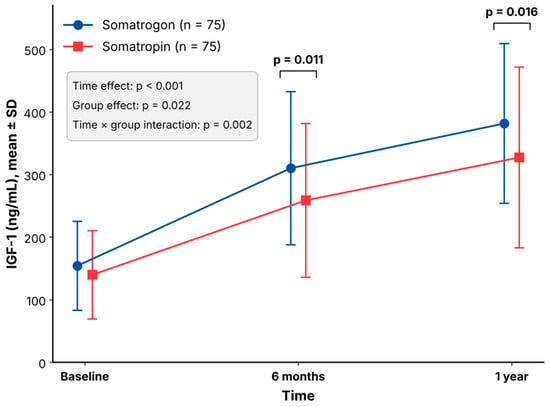
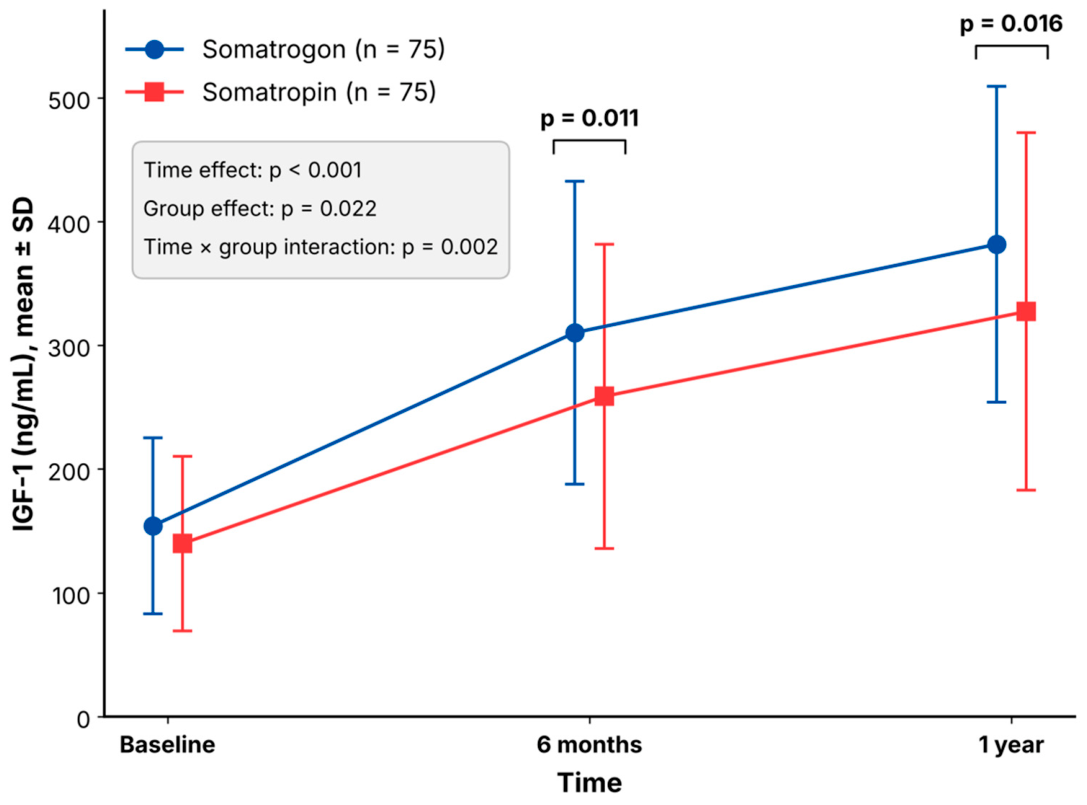
IGF-1 and IGF-1 SDS increased during follow-up in both groups. In the somatrogon group, mean IGF-1 increased from 154.22 ± 70.96 ng/mL at baseline to 310.20 ± 122.47 ng/mL at 6 months and 381.61 ± 127.48 ng/mL at 12 months; corresponding values in the somatropin group were 139.76 ± 70.36, 258.76 ± 122.81, and 327.27 ± 144.47 ng/mL. The Greenhouse–Geisser-corrected time × group interaction was significant (p = 0.002; Figure 1).
Figure 1.
Changes in IGF-1 concentrations in the somatrogon and somatropin groups at baseline, 6 months, and 1 year. Data are presented as mean ± standard deviation. The main effect of time was significant (Greenhouse–Geisser-corrected F = 667.19, p < 0.001, partial η2 = 0.818), as was the time × group interaction (F = 7.40, p = 0.002, partial η2 = 0.048). No significant between-group difference was observed at baseline (p = 0.212); IGF-1 concentrations were higher in the somatrogon group at 6 months (p = 0.011) and 1 year (p = 0.016).
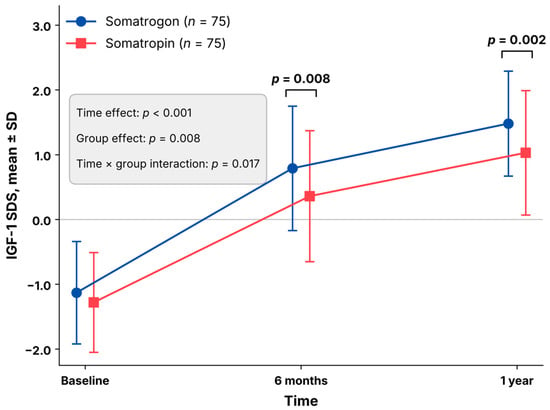
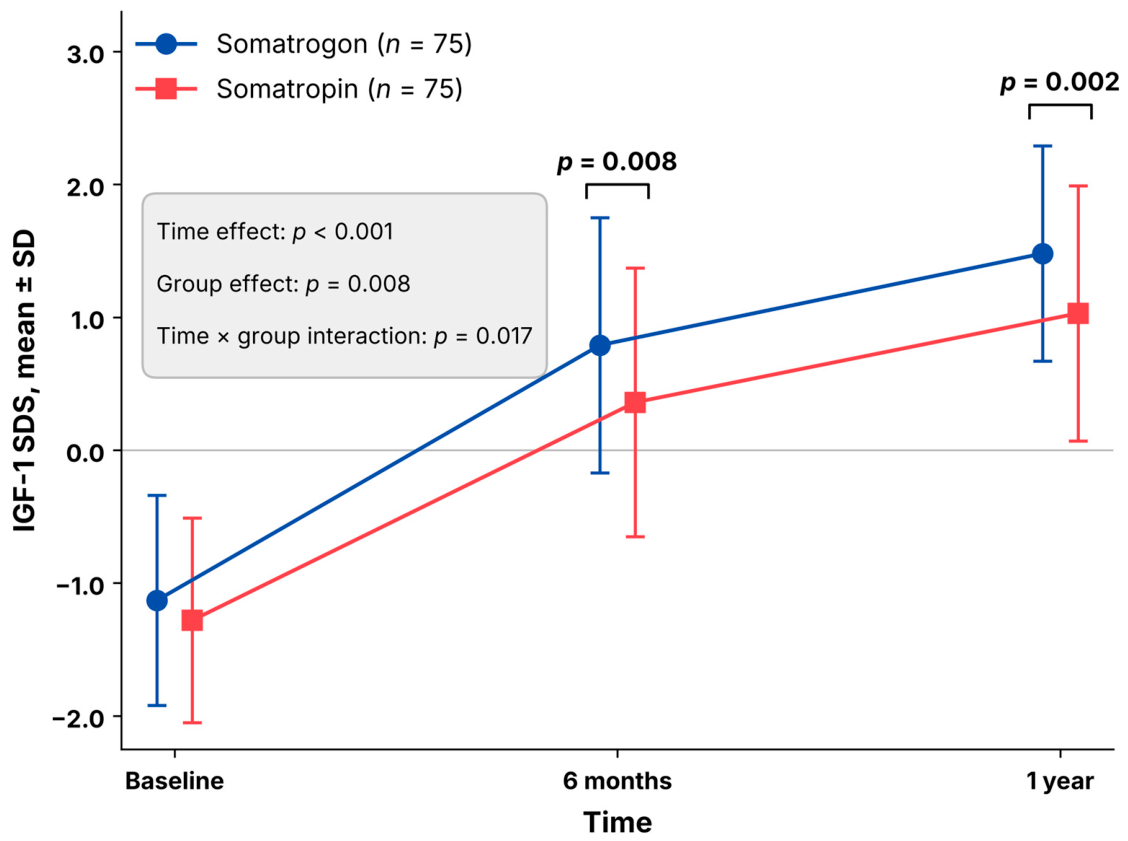
Mean IGF-1 SDS increased from −1.13 ± 0.79 at baseline to 0.79 ± 0.96 at 6 months and 1.48 ± 0.81 at 12 months in the somatrogon group, and from −1.28 ± 0.77 to 0.36 ± 1.01 and 1.03 ± 0.96, respectively, in the somatropin group. The Greenhouse–Geisser-corrected time × group interaction was significant (p = 0.017; Figure 2). The baseline-adjusted differences are shown in Table 3.
Figure 2.
Changes in IGF-1 SDS in the somatrogon and somatropin groups at baseline, 6 months, and 1 year. Data are presented as mean ± standard deviation. The main effect of time was significant (Greenhouse–Geisser-corrected F = 939.11, p < 0.001, partial η2 = 0.864), as was the time × group interaction (F = 4.28, p = 0.017, partial η2 = 0.028). No significant between-group difference was observed at baseline (p = 0.253); IGF-1 SDS was higher in the somatrogon group at 6 months (p = 0.008) and 1 year (p = 0.002).
3.5. Body Weight and BMI
Body weight, weight SDS, BMI, and BMI SDS increased over time (all p < 0.001), and time × group interactions were significant for weight (p < 0.001), weight SDS (p = 0.018), BMI (p = 0.001), and BMI SDS (p < 0.001; Table 4). Mean weight gain was 7.03 ± 2.66 kg with somatrogon and 5.34 ± 2.41 kg with somatropin, and mean BMI increased by 1.32 ± 1.17 and 0.69 ± 1.02 kg/m2, respectively. In the multivariate analysis, both the time effect (Pillai’s trace = 0.895; F = 308.25; p < 0.001) and the time × group interaction (Pillai’s trace = 0.126; F = 5.22; p = 0.001) were significant. No child developed obesity during follow-up; one somatropin-treated child with obesity at baseline had a BMI SDS of 2.30 at baseline and 2.19 at 12 months.
Table 4.
One-year changes in body weight and BMI indicators in the somatrogon and somatropin groups.
3.6. Safety Outcomes
IGF-1 SDS values >+2 were observed in 12 of 75 patients (16.0%) receiving somatrogon and 3 of 75 (4.0%) receiving somatropin (absolute difference, 12.0 percentage points; 95% CI, 2.3 to 22.3, Newcombe method; Fisher’s exact test, p = 0.027). In 9 of the 12 somatrogon-treated patients, blood samples were collected less than 96 h after the most recent injection. On repeat assessment approximately 6 weeks later, IGF-1 SDS was ≤+2 in 7 patients, whereas 5 (6.7%) had persistently elevated values and underwent a 15% dose reduction. All 3 somatropin-treated patients (4.0%) with elevated IGF-1 SDS also had persistently elevated values on repeat testing and underwent a 15% dose reduction. After dose adjustment, IGF-1 SDS decreased to <+2 in all affected patients. Apart from these reductions, doses were readjusted to current body weight at the 6-monthly assessments in accordance with the protocol. Because injection-to-sampling intervals were not available for all measurements, a sensitivity analysis restricted to samples obtained within the recommended window could not be performed.
Adverse events were recorded in 18 of 75 children (24.0%) receiving somatrogon and 21 of 75 (28.0%) receiving somatropin (Fisher’s exact test, p = 0.710). The most frequent event was injection-site pain (17 [22.7%] and 20 [26.7%], respectively), and transient headache was recorded in one child in each group. Available records predominantly described mild events, although no standardized severity grading was applied. No serious adverse events, lipoatrophy, abnormalities of glucose metabolism, or thyroid dysfunction were recorded.
3.7. Pituitary MRI and Aetiological Evaluation
Brain and pituitary magnetic resonance imaging (MRI) was performed in all 150 patients. MRI findings were normal in 59 of 75 patients (78.7%) in the somatrogon group and 60 of 75 patients (80.0%) in the somatropin group. Abnormal findings in the somatrogon group included pituitary microadenomas (n = 11, 14.7%), pituitary hypoplasia (n = 3, 4.0%), and arachnoid cysts (n = 2, 2.7%). The corresponding findings in the somatropin group were pituitary microadenomas (n = 8, 10.7%), arachnoid cysts (n = 5, 6.7%), and pituitary hypoplasia (n = 2, 2.7%). The distribution of MRI findings was similar in the two groups (two-sided Fisher–Freeman–Halton exact test, p = 0.615; Table 1). As molecular genetic testing was not performed in any patient, no genetically confirmed cases of GHD could be identified in this cohort.
3.8. Pubertal Progression
Pubertal stage progressed during follow-up in both groups (marginal homogeneity test, exact p < 0.001 for each group). Progression occurred in 55 of 75 children (73.3%) receiving somatrogon and 46 of 75 (61.3%) receiving somatropin (Pearson χ2 = 2.46; p = 0.117). All children at Tanner stage 2 or 3 at baseline progressed. Among children at Tanner stage 1 at baseline, progression occurred in 14 of 34 (41.2%) in the somatrogon group and 10 of 39 (25.6%) in the somatropin group (Fisher’s exact test, p = 0.213).
3.9. Bone-Age Progression and Skeletal Maturation
Baseline and 12-month bone-age measurements were available for all 150 patients. Mean bone age increased from 8.62 ± 3.24 to 9.76 ± 3.29 years with somatrogon and from 8.14 ± 3.37 to 9.26 ± 3.42 years with somatropin. Mean bone-age advancement (ΔBA) was 1.14 ± 0.13 and 1.12 ± 0.09 years, respectively (mean difference, 0.02 years; 95% CI, −0.02 to 0.06; p = 0.265). The BA/CA ratio increased from 0.760 ± 0.125 to 0.797 ± 0.101 with somatrogon and from 0.753 ± 0.120 to 0.792 ± 0.093 with somatropin; the change in BA/CA did not differ between groups (0.037 ± 0.028 vs. 0.039 ± 0.029; mean difference, −0.002; 95% CI, −0.012 to 0.007; p = 0.644). By baseline Tanner stage (1, 2, and 3), mean Δ(BA/CA) was 0.051, 0.026, and 0.026 with somatrogon and 0.054, 0.023, and 0.024 with somatropin, respectively.
4. Discussion
In this single-center retrospective cohort of 150 treatment-naïve children with isolated GHD, one-year height gain and change in height SDS did not differ significantly between once-weekly somatrogon and once-daily somatropin, either in unadjusted analyses or after adjustment for age, sex, baseline Tanner stage, peak stimulated GH, and baseline height SDS. In contrast, somatrogon was associated with greater one-year increases in IGF-1, IGF-1 SDS, body weight, and BMI; these differences persisted after adjustment and, for anthropometric outcomes, in the prepubertal sensitivity analysis. Because the study was not designed to test equivalence or non-inferiority, the absence of a statistically significant difference in linear growth does not demonstrate that the two treatments are equally effective.
Mean first-year height gain was 9.41 cm with somatrogon and 9.04 cm with somatropin, broadly consistent with first-year height velocities reported in the pivotal phase 3 trial (10.10 and 9.78 cm/year, respectively) [14] and in real-world cohorts [23,25,28]. The slightly lower values in our cohort may reflect its older age and the inclusion of pubertal children, whereas the pivotal trials enrolled prepubertal children [14,15]. The prepubertal sensitivity analysis likewise showed no significant between-group difference in height outcomes.
IGF-1 and IGF-1 SDS increased more with somatrogon, with adjusted one-year differences of 29.3 ng/mL and 0.34 SDS, respectively. Similar findings have been reported previously. In a Turkish real-world cohort, the 12-month increase in IGF-1 SDS was greater with somatrogon than with somatropin (2.2 ± 1.2 vs. 1.3 ± 1.0; p = 0.025) [25], and Stawerska et al. reported higher mean IGF-1 SDS with somatrogon at the end of the 12-month randomized treatment period of the global phase 3 trial (0.64 ± 1.34 vs. −0.70 ± 1.07; p < 0.0001) [19]. IGF-1 SDS elevations occasionally exceeding +2 were described in the Japanese phase 3 trial [15], and a meta-analysis also found greater IGF-1 SDS increases with somatrogon [20]. Interpretation of these differences requires attention to pharmacokinetics: after weekly somatrogon administration, IGF-1 rises during the first days after injection and declines before the next dose, and sampling approximately 4 days after injection is recommended to approximate mean weekly exposure [13,14]. Samples obtained earlier may therefore overestimate average IGF-1 exposure.
This consideration is directly relevant to our safety findings. IGF-1 SDS >+2 occurred in 16.0% of somatrogon-treated and 4.0% of somatropin-treated children, but 9 of the 12 elevated values in the somatrogon group were obtained less than 96 h after injection, and values remained elevated on repeat testing in only 5 children (6.7%), compared with 3 (4.0%) in the somatropin group. Early sampling may therefore have contributed to both the higher frequency of elevated values and, to some extent, the higher mean IGF-1 concentrations in the somatrogon group. Because injection-to-sampling intervals were not documented for all measurements, this contribution could not be quantified. A similar pattern was observed in the pivotal phase 3 trial, in which 23 of 26 initially elevated IGF-1 values in somatrogon-treated children were obtained 2–3 days after injection and 14 normalized on mandatory retesting [14]. Elevated values may also become more frequent with longer treatment: in the open-label extension of the phase 2 study, IGF-1 SDS >+2 was observed in 40.0% (14/35) of participants during year 6, and 34.3% (12/35) required dose reductions after confirmation of elevated values; the authors suggested that pubertal increases in lean body mass and the resulting rise in absolute weight-based doses might have contributed [26]. Differences in sampling protocols, treatment duration, and dosing practices should therefore be considered when comparing biochemical findings across studies. The long-term clinical significance of intermittent IGF-1 elevations during long-acting GH therapy remains uncertain, underscoring the need for standardized sampling and monitoring.
Body weight and BMI increased more with somatrogon (mean weight gain, 7.03 vs. 5.34 kg; BMI increase, 1.32 vs. 0.69 kg/m2), and the adjusted differences in weight, weight SDS, BMI, and BMI SDS remained significant in the overall cohort and among prepubertal children. Previous reports are inconsistent: Flechtner et al. described an increase in BMI SDS during somatrogon treatment followed by stabilization [21], Tamaro et al. and Moutafi et al. reported increases in BMI SDS during follow-up [22,23], whereas other studies found no significant differences in weight or BMI [25,28]. Differences in study populations, prior treatment exposure, pubertal development, and dosing practices may contribute to this variability.
Several factors may have contributed to the anthropometric differences in our cohort. Among children who were prepubertal at baseline, pubertal onset during follow-up was numerically more frequent with somatrogon (41.2% vs. 25.6%), although the difference was not statistically significant; because pubertal progression occurred after treatment initiation, it was not accounted for by baseline adjustment. In addition, somatrogon has been associated with increased lean body mass in adults with GHD [40]. However, BMI does not distinguish fat from lean mass, and body composition was not measured in our cohort. The greater increases in weight and BMI therefore cannot be attributed to adiposity, lean-mass accretion, or a specific metabolic mechanism. No child developed obesity during follow-up, but prospective studies incorporating direct body-composition and metabolic assessments are needed to clarify the clinical significance of these findings.
Bone-age advancement and changes in the BA/CA ratio did not differ significantly between groups, consistent with previous reports of similar skeletal maturation with somatrogon and daily somatropin [14,25], and descriptive analyses by baseline Tanner stage showed similar patterns. Because the BA/CA ratio depends on chronological age, its change should not be interpreted as equivalent to annualized bone-age advancement. Moreover, a 12-month follow-up does not permit conclusions about long-term skeletal maturation or adult height.
Recorded adverse events were mostly mild injection-site symptoms, consistent with clinical and observational studies [14,15,25,27]. Although lipoatrophy has been reported with somatrogon [21,25,41,42], none was documented in our cohort; injection-site rotation was routinely recommended, but its contribution cannot be determined. Because adverse events were ascertained retrospectively from clinical records without standardized severity grading, mild or inconsistently documented events may have been missed, and the absence of a significant difference in recorded adverse-event frequency does not establish equivalent safety.
Pituitary MRI findings were similarly distributed between groups, with normal scans in approximately 80% of children, consistent with previous real-world observations [25]. Most abnormalities were small microadenomas or arachnoid cysts, which may be incidental; imaging findings alone cannot establish the cause of GHD in individual patients, and no molecular genetic investigations were performed.
This study has several limitations. First, treatment was selected according to parental preference rather than random allocation. Preferences related to injection burden may also be associated with adherence, which was not systematically recorded. Although the regression models adjusted for measured baseline characteristics, selection bias and residual confounding cannot be excluded, and the observed associations should not be interpreted as causal effects.
Second, diagnostic heterogeneity is possible. The peak GH cutoff of <10 ng/mL is higher than some assay-specific thresholds proposed for modern immunoassays, and sex-steroid priming was not performed, which may have affected test interpretation in peripubertal children. Borderline peak GH responses (7 to <10 ng/mL) were similarly distributed between groups but were too few for a reliable subgroup analysis. Inclusion was also restricted to isolated GHD, which reduced clinical heterogeneity but limits generalizability to children with more severe organic GHD or additional pituitary hormone deficiencies.
Third, IGF-1 sampling times were not fully documented, and a sensitivity analysis restricted to the recommended sampling window was not feasible; together with the differing pharmacokinetic profiles of the two preparations, this limits attribution of the biochemical differences solely to treatment formulation. Fourth, although doses were readjusted to current body weight every 6 months when IGF-1 SDS was ≤+2, the number of adjustments and individual cumulative GH exposure were not quantified. Because weight gain was greater with somatrogon, weight-based readjustment may have resulted in larger absolute dose increases in this group, which could have contributed to the higher IGF-1 concentrations observed at 12 months. Finally, the single-center retrospective design, 12-month follow-up, absence of adjustment for multiple outcomes, and retrospective adverse-event ascertainment further constrain interpretation.
Strengths of this study include the concurrent comparison of treatment-naïve children receiving weekly or daily GH in routine practice, complete anthropometric, IGF-1, and bone-age data for all participants over 12 months, and complementary unadjusted, baseline-adjusted, and prepubertal sensitivity analyses. The clinical relevance of these findings should be clarified in larger prospective cohorts with standardized IGF-1 sampling, detailed records of dosing and adherence, systematic assessment of safety and body composition, and extended follow-up.
5. Conclusions
In children with isolated GHD, one-year linear growth did not differ significantly between once-weekly somatrogon and once-daily somatropin, including after adjustment for baseline characteristics and in prepubertal children. Somatrogon was associated with greater increases in IGF-1, IGF-1 SDS, body weight, and BMI, and with more frequent IGF-1 SDS values >+2, partly in samples obtained earlier than recommended. These observations should be interpreted cautiously because of non-randomized treatment allocation, potential residual confounding, and variability in IGF-1 sampling times. In clinical practice, IGF-1 sampled at a standardized time after injection, together with body weight and BMI, should be monitored closely in children receiving somatrogon, and larger prospective studies with longer follow-up are needed to clarify the clinical significance of these findings.
Supplementary Materials
The following supporting information can be downloaded at: https://www.mdpi.com/article/10.3390/children13111557/s1, Table S1. National eligibility, reimbursement criteria, and institutional growth hormone treatment protocol. References [35,36] are cited in the Supplementary Materials.
Author Contributions
Conceptualization, Ş.Ö.; methodology, Ş.Ö. and A.A.K.; software, Ş.Ö.; validation, Ş.Ö. and A.A.K.; formal analysis, Ş.Ö.; investigation, Ş.Ö. and A.A.K.; resources, Ş.Ö. and A.A.K.; data curation, Ş.Ö. and A.A.K.; writing—original draft preparation, Ş.Ö.; writing—review and editing, Ş.Ö. and A.A.K.; visualization, Ş.Ö.; supervision, Ş.Ö. and A.A.K.; project administration, Ş.Ö. All authors have read and agreed to the published version of the manuscript.
Funding
This research received no external funding.
Institutional Review Board Statement
The study was approved by the Institutional Ethics Committee of Diyarbakır Gazi Yaşargil Training and Research Hospital (approval no. 2026/309; date: 24 June 2026) and was conducted in accordance with the Declaration of Helsinki.
Informed Consent Statement
Written informed consent for the use of clinical data for research purposes was obtained from the parents or legal guardians of all participants.
Data Availability Statement
Because the dataset contains potentially identifiable clinical information, it is not publicly available; a de-identified version can be obtained from the corresponding author on reasonable request, subject to ethical and institutional approval.
Acknowledgments
We thank all participating children and their families. During the preparation of this manuscript, the authors used Claude Opus 5.5 (model identifier: claude-opus-5-5; Anthropic, San Francisco, CA, USA), accessed via the Claude web interface (claude.ai) between October 2026 and November 2026, for language editing, checking the formatting and consistency of references, verification of statistical analyses and data consistency, and preparation of tables and figures. All analyses were performed on the authors’ original dataset, and the authors reviewed and verified all output and take full responsibility for the content of this publication.
Conflicts of Interest
The authors declare no conflicts of interest.
References
- Ranke, M.B.; Wit, J.M. Growth Hormone—Past, Present and Future. Nat. Rev. Endocrinol. 2018, 14, 285–300. [Google Scholar] [CrossRef] [Scilit] [PubMed]
- Sävendahl, L.; Polak, M.; Backeljauw, P.; Blair, J.C.; Miller, B.S.; Rohrer, T.R.; Hokken-Koelega, A.; Pietropoli, A.; Kelepouris, N.; Ross, J. Long-Term Safety of Growth Hormone Treatment in Childhood: Two Large Observational Studies: NordiNet IOS and ANSWER. J. Clin. Endocrinol. Metab. 2021, 106, 1728–1741. [Google Scholar] [CrossRef] [Scilit] [PubMed]
- Swerdlow, A.J.; Cooke, R.; Albertsson-Wikland, K.; Borgström, B.; Butler, G.; Cianfarani, S.; Clayton, P.; Coste, J.; Deodati, A.; Ecosse, E.; et al. Description of the SAGhE Cohort: A Large European Study of Mortality and Cancer Incidence Risks after Childhood Treatment with Recombinant Growth Hormone. Horm. Res. Paediatr. 2015, 84, 172–183. [Google Scholar] [CrossRef] [Scilit] [PubMed]
- Sävendahl, L.; Polak, M.; Backeljauw, P.; Blair, J.; Miller, B.S.; Rohrer, T.R.; Pietropoli, A.; Ostrow, V.; Ross, J. Treatment of Children with GH in the United States and Europe: Long-Term Follow-Up from NordiNet IOS and ANSWER Program. J. Clin. Endocrinol. Metab. 2019, 104, 4730–4742. [Google Scholar] [CrossRef] [Scilit] [PubMed]
- Brod, M.; Alolga, S.L.; Beck, J.F.; Wilkinson, L.; Højbjerre, L.; Rasmussen, M.H. Understanding Burden of Illness for Child Growth Hormone Deficiency. Qual. Life Res. 2017, 26, 1673–1686. [Google Scholar] [CrossRef] [Scilit] [PubMed]
- Graham, S.; Auyeung, V.; Weinman, J. Exploring Potentially Modifiable Factors That Influence Treatment Non-Adherence amongst Pediatric Growth Hormone Deficiency: A Qualitative Study. Patient Prefer. Adherence 2020, 14, 1889–1899. [Google Scholar] [CrossRef] [Scilit] [PubMed]
- Cutfield, W.S.; Derraik, J.G.; Gunn, A.J.; Reid, K.; Delany, T.; Robinson, E.; Hofman, P.L. Non-Compliance with Growth Hormone Treatment in Children Is Common and Impairs Linear Growth. PLoS ONE 2011, 6, e16223. [Google Scholar] [CrossRef] [Scilit] [PubMed]
- Hughes, I.P.; Choong, C.; Rath, S.; Atkinson, H.; Cotterill, A.; Cutfield, W.; Hofman, P.; Harris, M. Early Cessation and Non-Response Are Important and Possibly Related Problems in Growth Hormone Therapy: An OZGROW Analysis. Growth Horm. IGF Res. 2016, 29, 63–70. [Google Scholar] [CrossRef] [Scilit] [PubMed]
- Mohseni, S.; Heydari, Z.; Qorbani, M.; Radfar, M. Adherence to Growth Hormone Therapy in Children and Its Potential Barriers. J. Pediatr. Endocrinol. Metab. 2018, 31, 13–20. [Google Scholar] [CrossRef] [Scilit] [PubMed]
- Fisher, B.G.; Acerini, C.L. Understanding the Growth Hormone Therapy Adherence Paradigm: A Systematic Review. Horm. Res. Paediatr. 2013, 79, 189–196. [Google Scholar] [CrossRef] [Scilit] [PubMed]
- Christiansen, J.S.; Backeljauw, P.F.; Bidlingmaier, M.; Biller, B.M.; Boguszewski, M.C.; Casanueva, F.F.; Chanson, P.; Chatelain, P.; Choong, C.S.; Clemmons, D.R.; et al. Growth Hormone Research Society Perspective on the Development of Long-Acting Growth Hormone Preparations. Eur. J. Endocrinol. 2016, 174, C1–C8. [Google Scholar] [CrossRef] [Scilit] [PubMed]
- Rodaro, C.; Tamaro, G.; Faleschini, E.; Tornese, G. Long-Acting Growth Hormones: Innovations in Treatment and Guidance on Patient Selection in Pediatric Growth Hormone Deficiency. Ann. Pediatr. Endocrinol. Metab. 2025, 30, 106–110. [Google Scholar] [CrossRef] [Scilit] [PubMed]
- Maniatis, A.; Cutfield, W.; Dattani, M.; Deal, C.; Collett-Solberg, P.F.; Horikawa, R.; Maghnie, M.; Miller, B.S.; Polak, M.; Sävendahl, L.; et al. Long-Acting Growth Hormone Therapy in Pediatric Growth Hormone Deficiency: A Consensus Statement. J. Clin. Endocrinol. Metab. 2025, 110, e1232–e1240. [Google Scholar] [CrossRef] [Scilit]
- Deal, C.L.; Steelman, J.; Vlachopapadopoulou, E.; Stawerska, R.; Silverman, L.A.; Phillip, M.; Kim, H.-S.; Ko, C.; Malievskiy, O.; Cara, J.F.; et al. Efficacy and Safety of Weekly Somatrogon vs. Daily Somatropin in Children with Growth Hormone Deficiency: A Phase 3 Study. J. Clin. Endocrinol. Metab. 2022, 107, e2717–e2728. [Google Scholar] [CrossRef] [Scilit] [PubMed]
- Horikawa, R.; Tanaka, T.; Hasegawa, Y.; Yorifuji, T.; Ng, D.; Rosenfeld, R.G.; Hoshino, Y.; Okayama, A.; Shima, D.; Gomez, R.; et al. Efficacy and Safety of Once-Weekly Somatrogon Compared with Once-Daily Somatropin (Genotropin®) in Japanese Children with Pediatric Growth Hormone Deficiency: Results from a Randomized Phase 3 Study. Horm. Res. Paediatr. 2022, 95, 275–285. [Google Scholar] [CrossRef] [Scilit]
- Horikawa, R.; Tanaka, T.; Hasegawa, Y.; Yorifuji, T.; Ng, D.; Rosenfeld, R.G.; Hoshino, Y.; Okayama, A.; Ebata, N.; Hosoi, M.; et al. Efficacy and Safety of Once-Weekly Somatrogon Following up to 4 Years of Treatment in Japanese Children with Growth Hormone Deficiency: Results from an Open-Label Extension of a Phase 3 Study. Endocr. J. 2026, 73, 21–32. [Google Scholar] [CrossRef] [Scilit] [PubMed]
- Zadik, Z.; Zelinska, N.; Iotova, V.; Skorodok, Y.; Malievsky, O.; Mauras, N.; Valluri, S.R.; Pastrak, A.; Rosenfeld, R. An Open-Label Extension of a Phase 2 Dose-Finding Study of Once-Weekly Somatrogon vs. Once-Daily Genotropin in Children with Short Stature Due to Growth Hormone Deficiency: Results Following 5 Years of Treatment. J. Pediatr. Endocrinol. Metab. 2023, 36, 261–269. [Google Scholar] [CrossRef] [Scilit] [PubMed]
- Maniatis, A.K.; Carakushansky, M.; Galcheva, S.; Prakasam, G.; Fox, L.A.; Dankovcikova, A.; Loftus, J.; A Palladino, A.; Resa, M.d.L.A.; Taylor, C.T.; et al. Treatment Burden of Weekly Somatrogon vs. Daily Somatropin in Children with Growth Hormone Deficiency: A Randomized Study. J. Endocr. Soc. 2022, 6, bvac117. [Google Scholar] [CrossRef] [Scilit] [PubMed]
- Stawerska, R.; Choe, J.; Wang, R.; Wajnrajch, M.P.; Cara, J.F.; Thomas, M.; La Torre, D.; Taylor, C.T.; Phillip, M.; Steelman, J.; et al. Extension of the Phase 3 Trial of Somatrogon in Children with Growth Hormone Deficiency: 3 Years of Safety and Efficacy. Horm. Res. Paediatr. 2026. Epub ahead of print. [Google Scholar] [CrossRef] [Scilit]
- Albers, N.; Cadarette, S.; Feakins, B.; Arregui, M.; Ebohon, S.; Lai, P.; Raveendran, S.; Kjelgaard-Hansen, M.; Andersen, C.; Zhao, C.; et al. Long-Acting Growth Hormone for Pediatric Growth Hormone Deficiency. J. Endocr. Soc. 2025, 9, bvaf040. [Google Scholar] [CrossRef] [Scilit] [PubMed]
- Flechtner, I.; Brue, C.; Gastaud, F.; Benoit, M.L.; Cuny, A.; Gérard, M.; Bouillo, M.; Auger, J.; Chatelais, L.; Castaings-Carlioz, C.; et al. Real-World Clinical Experience with Weekly Somatrogon in Pediatric Growth Hormone Deficiency: A French Longitudinal Study with Some Unexpected Clinical Observations. Ann. Endocrinol. 2026, 87, 102590. [Google Scholar] [CrossRef] [Scilit] [PubMed]
- Tamaro, G.; Rodaro, C.; Fachin, A.; Fabretto, A.; Tornese, G. Two-Year Real-World Experience with Somatrogon in Children and Adolescents with Growth Hormone Deficiency. Front. Endocrinol. 2026, 17, 1685851. [Google Scholar] [CrossRef] [Scilit]
- Moutafi, M.; Sotiriou, G.; Triantafyllou, P.; Papagianni, M.; Christoforidis, A. Real World Performance of Once Weekly Somatrogon on Naive Patients with Isolated Growth Hormone Deficiency: Mind the Weight Gain. Growth Horm. IGF Res. 2026, 85, 101714. [Google Scholar] [CrossRef] [Scilit] [PubMed]
- Giusto, C.; Passeri, M.; Nardone, I.; Wolde Sellasie, S.; Zaccaria, S.; Giurato, L.; Uccioli, L. Efficacy of Once-Weekly Somatrogon in Children with Growth Hormone Deficiency after Switching from Daily Therapy. Endocr. Metab. Immune Disord. Drug Targets 2026, 26, e18715303452569. [Google Scholar] [CrossRef] [Scilit] [PubMed]
- Şen Küçük, K.; Güneş, S.; Dinçer, M.; Öztürk, S.; Ünüvar, T.; Anık, A. Once-Weekly Somatrogon in Pediatric Growth Hormone Deficiency: Real-World Efficacy, Safety, and Quality-of-Life Findings. J. Clin. Res. Pediatr. Endocrinol. 2026, 18, 323–332. [Google Scholar] [CrossRef] [Scilit] [PubMed]
- Mauras, N.; Skorodok, Y.; Iotova, V.; Rosenfeld, R.; Wajnrajch, M.P.; Malievskiy, O.; Zelinska, N.; Valluri, S.R.; Zadik, Z. Open-Label 9-Year Follow-Up Extension Phase 2 Study of Once-Weekly Somatrogon in Children with Growth Hormone Deficiency. J. Clin. Endocrinol. Metab. 2026, dgag260, online ahead of print. [Google Scholar] [CrossRef] [Scilit] [PubMed]
- Atas, N.; Kılçık, R.D.; Melik, F.Ç.; Karaoğlan, M.; Keskin, M.; Albayrak, S. Is Somatrogon Different? 6-Month Clinical Outcomes and Follow-Up Data in Turkish Children Transitioned from Somatropin to Somatrogon. Growth Horm. IGF Res. 2026, 84, 101705. [Google Scholar] [CrossRef] [Scilit] [PubMed]
- Katsoudas, S.; Tsitsekli, E.; Pichlinski, I.; Techlemetzi, N.; Galanopoulou, E.; Polychroni, I.; Zosi, P. Comparative Efficacy of Once-Weekly Somatrogon versus Daily Growth Hormone Therapy in Children with Idiopathic Growth Hormone Deficiency: A Real-World Retrospective Study from Greece. Cureus 2025, 17, e82998. [Google Scholar] [CrossRef] [Scilit]
- Demir, K.; Özen, S.; Konakçı, E.; Aydın, M.; Darendeliler, F. A Comprehensive Online Calculator for Pediatric Endocrinologists: ÇEDD Çözüm/TPEDS Metrics. J. Clin. Res. Pediatr. Endocrinol. 2017, 9, 182–184. [Google Scholar] [CrossRef] [Scilit] [PubMed]
- Marshall, W.A.; Tanner, J.M. Variations in Pattern of Pubertal Changes in Girls. Arch. Dis. Child. 1969, 44, 291–303. [Google Scholar] [CrossRef] [Scilit]
- Marshall, W.A.; Tanner, J.M. Variations in the Pattern of Pubertal Changes in Boys. Arch. Dis. Child. 1970, 45, 13–23. [Google Scholar] [CrossRef] [Scilit] [PubMed]
- Poyrazoğlu, Ş.; Akçay, T.; Arslanoğlu, İ.; Atabek, M.E.; Atay, Z.; Berberoğlu, M.; Bereket, A.; Bideci, A.; Bircan, I.; Böber, E.; et al. Current Practice in Diagnosis and Treatment of Growth Hormone Deficiency in Childhood: A Survey from Turkey. J. Clin. Res. Pediatr. Endocrinol. 2015, 7, 37–44. [Google Scholar] [CrossRef] [Scilit]
- Wagner, I.V.; Paetzold, C.; Gausche, R.; Vogel, M.; Koerner, A.; Thiery, J.; Arsene, C.G.; Henrion, A.; Guettler, B.; Keller, E.; et al. Clinical Evidence-Based Cutoff Limits for GH Stimulation Tests in Children with a Backup of Results with Reference to Mass Spectrometry. Eur. J. Endocrinol. 2014, 171, 389–397. [Google Scholar] [CrossRef] [Scilit]
- Collett-Solberg, P.F.; Ambler, G.; Backeljauw, P.F.; Bidlingmaier, M.; Biller, B.M.K.; Boguszewski, M.C.S.; Cheung, P.T.; Choong, C.S.Y.; Cohen, L.E.; Cohen, P.; et al. Diagnosis, Genetics, and Therapy of Short Stature in Children: A Growth Hormone Research Society International Perspective. Horm. Res. Paediatr. 2019, 92, 1–14. [Google Scholar] [CrossRef] [Scilit] [PubMed]
- Social Security Institution (SGK). Health Implementation Communiqué (Sağlık Uygulama Tebliği); No. 28597; Official Gazette of the Republic of Türkiye: Ankara, Turkey, 2013. [Google Scholar]
- Social Security Institution (SGK). Communiqué Amending the Health Implementation Communiqué; No. 32541 (Repeated Issue); Official Gazette of the Republic of Türkiye: Ankara, Turkey, 2024. [Google Scholar]
- Neyzi, O.; Bundak, R.; Gökçay, G.; Günöz, H.; Furman, A.; Darendeliler, F.; Baş, F. Reference Values for Weight, Height, Head Circumference, and Body Mass Index in Turkish Children. J. Clin. Res. Pediatr. Endocrinol. 2015, 7, 280–293. [Google Scholar] [CrossRef] [Scilit] [PubMed]
- Roche Diagnostics. Elecsys IGF-1: Method Sheet, Version 3.0; 07475918501V3.0; Roche Diagnostics GmbH: Mannheim, Germany, 2025; Available online: https://elabdoc-prod.roche.com/eLD/api/downloads/92703e65-f4f8-ef11-2d91-005056a71a5d?countryIsoCode=us (accessed on 2 November 2026).
- Greulich, W.W.; Pyle, S.I. Radiographic Atlas of Skeletal Development of the Hand and Wrist, 2nd ed.; Stanford University Press: Stanford, CA, USA, 1959. [Google Scholar]
- Fleseriu, M.; Biller, B.M.K.; Webb, S.M.; Strasburger, C.J.; Georgescu, C.E.; Bidlingmaier, M.; Wang, C.; Baciu, I.; Casanueva, F.F.; Gilis-Januszewska, A.; et al. Efficacy and Safety of Once-Weekly Somatrogon in Adults with Growth Hormone Deficiency: A Randomized Phase 3 Study. Pituitary 2026, 29, 59. [Google Scholar] [CrossRef] [Scilit]
- Şen Küçük, K.; Tuzcu, G.; Anık, A. Reversible Injection-Site Lipoatrophy Induced by Long-Acting Growth Hormone (Somatrogon) in Pediatric Growth Hormone Deficiency: A Case Series. J. Clin. Res. Pediatr. Endocrinol. 2025. Epub ahead of print. [Google Scholar] [CrossRef] [Scilit]
- Hazer, I.; Bas, V.N. Lipoatrophy Following Weekly Growth Hormone Therapy: A Case Report. J. Pediatr. Endocrinol. Metab. 2025, 38, 1098–1102. [Google Scholar] [CrossRef] [Scilit] [PubMed]

Disclaimer/Publisher’s Note: The statements, opinions and data contained in all publications are solely those of the individual author(s) and contributor(s) and not of MDPI and/or the editor(s). MDPI and/or the editor(s) disclaim responsibility for any injury to people or property resulting from any ideas, methods, instructions or products referred to in the content. |
© 2026 by the authors. Licensee MDPI, Basel, Switzerland. This article is an open access article distributed under the terms and conditions of the Creative Commons Attribution (CC BY) license.