You are currently viewing a new version of our website. To view the old version click .

Biomedicines, Volume 9, Issue 11

November 2021 - 246 articles

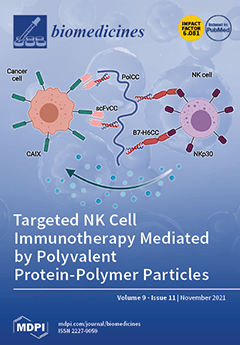
Cover Story: Natural killer (NK) cells are essential effector cells in cancer immunotherapy. One possible strategy to trigger their cytotoxicity toward malignant cells is by using bi- or better poly-valent molecules mediating NK cell recognition. To activate NK cells, we prepared a pHPMA-based copolymer decorated via a complementary coiled coil interaction with NK cell-activating ligand B7-H6 and anti-CAIX tumor-targeting scFv. This chimeric biopolymer is a promising precursor for targeted cancer immunotherapy.View this paper
  • Issues are regarded as officially published after their release is announced to the table of contents alert mailing list .
  • You may sign up for email alerts to receive table of contents of newly released issues.
  • PDF is the official format for papers published in both, html and pdf forms. To view the papers in pdf format, click on the "PDF Full-text" link, and use the free Adobe Reader to open them.

Articles (246)

  • Article
  • Open Access
2 Citations
3,115 Views
10 Pages

Clinical Effects of Oral Bacteriotherapy on Anal HPV Infection and Related Dysplasia in HIV-Positive MSM: Results from the “HPVinHIV” Trial

  • Eugenio Nelson Cavallari,
  • Giancarlo Ceccarelli,
  • Letizia Santinelli,
  • Giuseppe Pietro Innocenti,
  • Gabriella De Girolamo,
  • Cristian Borrazzo,
  • Ornella Spagnolello,
  • Carolina Scagnolari,
  • Stefano Arcieri and
  • Antonio Ciardi
  • + 3 authors

22 November 2021

Background. Anal HPV infection, anal dysplasia and, ultimately, anal cancer are particularly common in HIV-infected men who have sex with men. Treatment of anal dysplasia, aiming to prevent evolution to squamous cell carcinoma of the anus, is current...

  • Article
  • Open Access
10 Citations
3,346 Views
12 Pages

22 November 2021

Obesity is associated with an increased risk of non-alcoholic fatty liver disease (NAFLD), which is initiated by adipocyte-macrophage crosstalk. Among the possible molecules regulating this crosstalk, we focused on neuropeptide Y (NPY), which is know...

  • Review
  • Open Access
22 Citations
8,947 Views
48 Pages

Counting on COVID-19 Vaccine: Insights into the Current Strategies, Progress and Future Challenges

  • Ramesh Kandimalla,
  • Pratik Chakraborty,
  • Jayalakshmi Vallamkondu,
  • Anupama Chaudhary,
  • Sonalinandini Samanta,
  • P. Hemachandra Reddy,
  • Vincenzo De Feo and
  • Saikat Dewanjee

22 November 2021

The emergence of a novel coronavirus viz., severe acute respiratory syndrome coronavirus 2 (SARS-CoV-2) in late 2019 and its subsequent substantial spread produced the coronavirus disease 2019 (COVID-19) pandemic worldwide. Given its unprecedented in...

  • Article
  • Open Access
4 Citations
2,284 Views
12 Pages

22 November 2021

Long non-coding RNAs (lncRNAs) have emerged during the post-genomic era as significant epigenetic regulators. Viral-like 30 elements (VL30s) are a family of mouse retrotransposons that are transcribed into functional lncRNAs. Recent data suggest that...

  • Article
  • Open Access
6 Citations
3,992 Views
20 Pages

Energy Metabolism and Intracellular pH Alteration in Neural Spheroids Carrying Down Syndrome

  • Alena Kashirina,
  • Alena Gavrina,
  • Emil Kryukov,
  • Vadim Elagin,
  • Yuliya Kolesova,
  • Alexander Artyuhov,
  • Ekaterina Momotyuk,
  • Vepa Abdyyev,
  • Natalia Meshcheryakova and
  • Elena Zagaynova
  • + 2 authors

22 November 2021

Brain diseases including Down syndrome (DS/TS21) are known to be characterized by changes in cellular metabolism. To adequately assess such metabolic changes during pathological processes and to test drugs, methods are needed that allow monitoring of...

  • Review
  • Open Access
14 Citations
4,701 Views
35 Pages

22 November 2021

Somatostatin (SST)/somatotropin release-inhibiting factor (SRIF) is a well-known neuropeptide, widely distributed in the central and peripheral nervous systems, that regulates the endocrine system and affects neurotransmission via interaction with fi...

  • Review
  • Open Access
52 Citations
7,447 Views
27 Pages

Bisphenol A and Its Analogues Deteriorate the Hormones Physiological Function of the Male Reproductive System: A Mini-Review

  • Asma’ ‘Afifah Shamhari,
  • Zariyantey Abd Hamid,
  • Siti Balkis Budin,
  • Nurul Jehan Shamsudin and
  • Izatus Shima Taib

22 November 2021

BPA is identified as an endocrine-disrupting chemical that deteriorates the physiological function of the hormones of the male reproductive system. Bisphenol F (BPF), bisphenol S (BPS), and bisphenol AF (BPAF) are actively explored as substitutes for...

  • Review
  • Open Access
8 Citations
8,471 Views
19 Pages

Acne Syndromes and Mosaicism

  • Sumer Baroud,
  • Jim Wu and
  • Christos C. Zouboulis

21 November 2021

Abnormal mosaicism is the coexistence of cells with at least two genotypes, by the time of birth, in an individual derived from a single zygote, which leads to a disease phenotype. Somatic mosaicism can be further categorized into segmental mosaicism...

  • Article
  • Open Access
6 Citations
3,261 Views
21 Pages

Design of α/β-Hybrid Peptide Ligands of α4β1 Integrin Equipped with a Linkable Side Chain for Chemoselective Biofunctionalization of Microstructured Materials

  • Michele Anselmi,
  • Monica Baiula,
  • Federica Santino,
  • Junwei Zhao,
  • Santi Spampinato,
  • Natalia Calonghi and
  • Luca Gentilucci

21 November 2021

Arg-Gly-Asp (RGD)-binding integrins, e.g., αvβ3, αvβ1, αvβ5 integrins, are currently regarded as privileged targets for the delivery of diagnostic and theranostic agents, especially in cancer treatment. In contrast, s...

  • Article
  • Open Access
4 Citations
3,364 Views
21 Pages

21 November 2021

Repetitive elements (REs) occupy a significant part of eukaryotic genomes and are shown to play diverse roles in genome regulation. During embryogenesis of the sea urchin, a large number of REs are expressed, but the role of these elements in the reg...

of 25

Get Alerted

Add your email address to receive forthcoming issues of this journal.

XFacebookLinkedIn
Biomedicines - ISSN 2227-9059