In Silico and In Vitro Evaluation of Calm Supplement Constituents on Antidepressant-Related Molecular Targets and Neuroplasticity-Associated Gene Expression

 , , , , and
Abstract
1. Introduction
2. Materials and Methods
2.1. Preparation and Composition of the Dietary Supplement Calm
2.2. Cell Culture
2.3. Molecular Docking Analysis
2.4. Total RNA Extraction and cDNA Library
2.5. Gene Expression
2.6. Statistical Analysis
3. Results
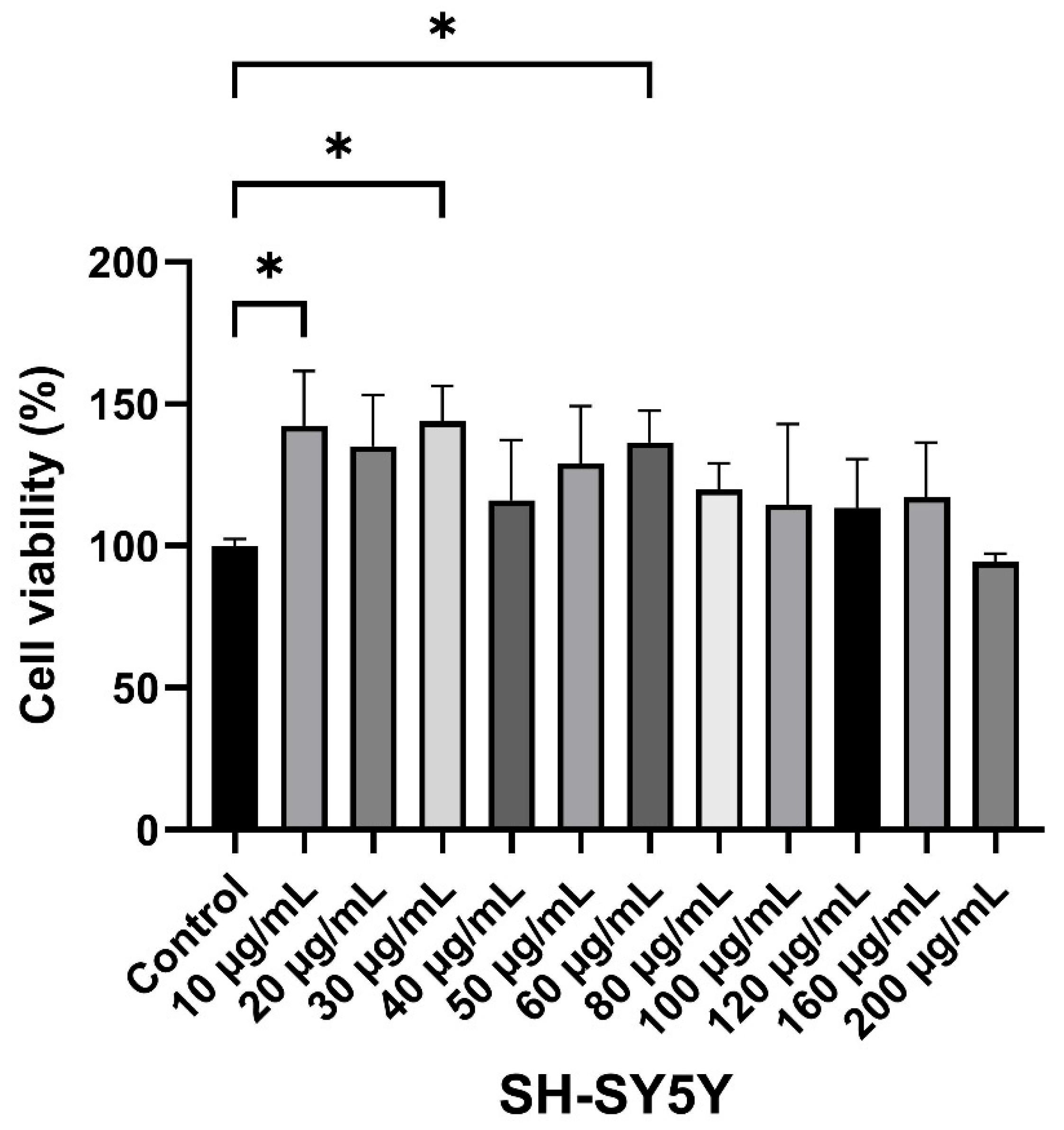
3.1. MTT Assay
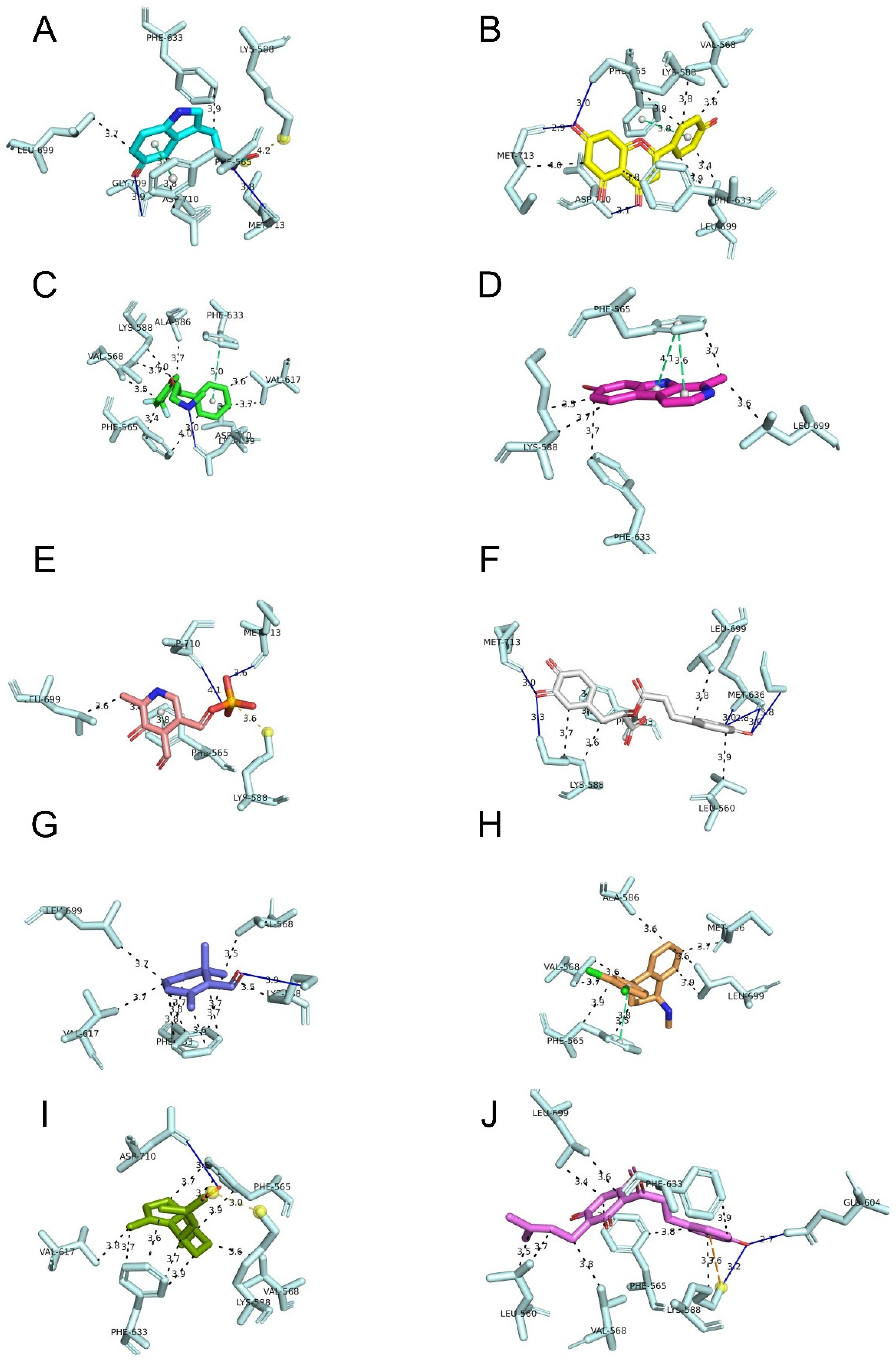
3.2. Molecular Docking
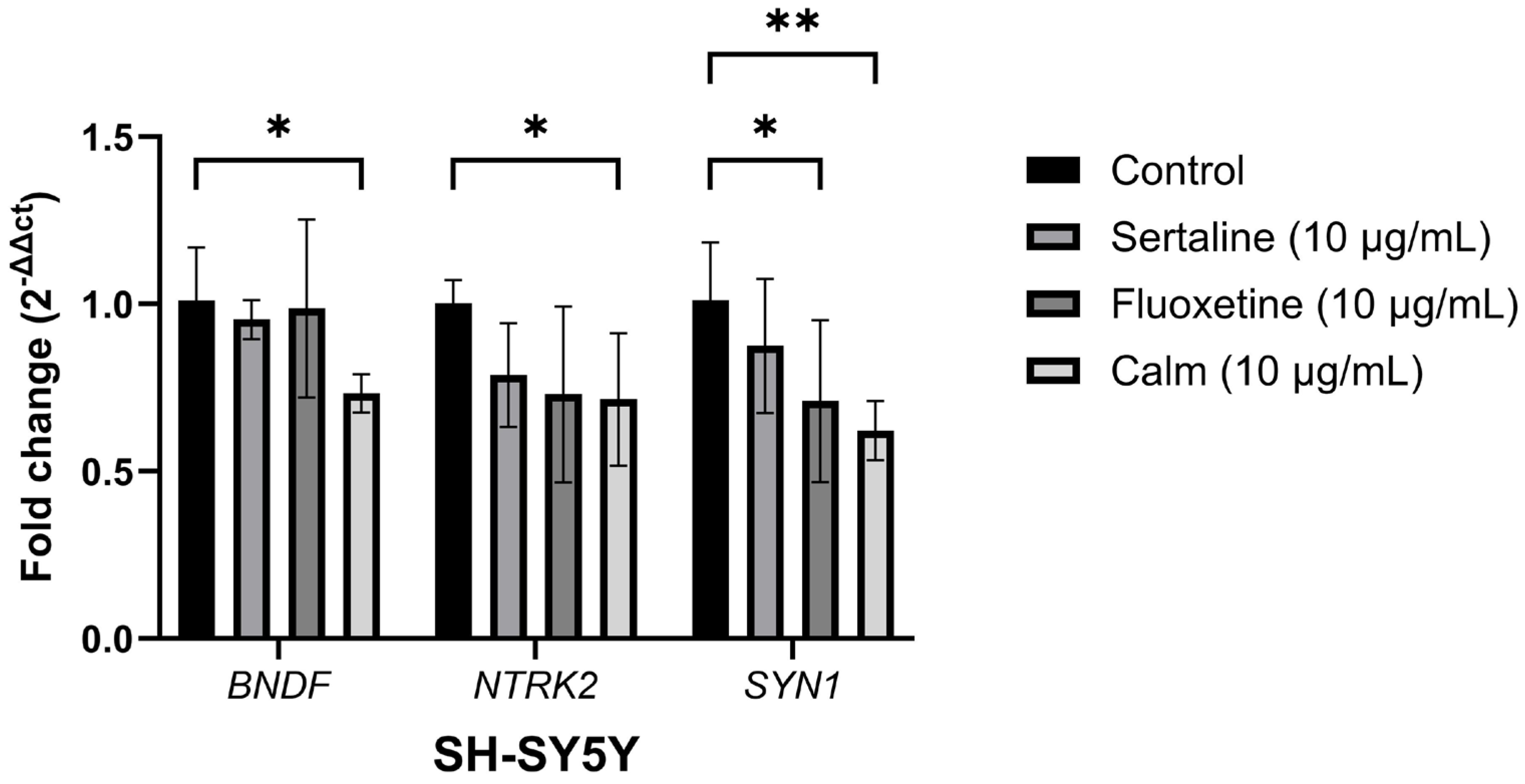
3.3. Relative Expressions of BDNF, NTRK2 and SYN1 Genes
4. Discussion
5. Conclusions
Author Contributions
Funding
Institutional Review Board Statement
Informed Consent Statement
Data Availability Statement
Conflicts of Interest
References
- Jiang, Y.; Zou, D.; Li, Y.; Gu, S.; Dong, J.; Ma, X.; Xu, S.; Wang, F.; Huang, J.H. Monoamine neurotransmitters control basic emotions and affect major depressive disorders. Pharmaceuticals 2022, 15, 1203. [Google Scholar] [CrossRef] [Scilit] [PubMed]
- Liu, Y.; Zhao, J.; Guo, W. Emotional roles of mono-aminergic neurotransmitters in major depressive disorder and anxiety disorders. Front. Psychol. 2018, 9, 2201. [Google Scholar] [CrossRef] [Scilit] [PubMed]
- Massart, R.; Mongeau, R.; Lanfumey, L. Beyond the monoaminergic hypothesis: Neuroplasticity and epigenetic changes in a transgenic mouse model of depression. Philos. Trans. R. Soc. B Biol. Sci. 2012, 367, 2485–2494. [Google Scholar] [CrossRef] [Scilit] [PubMed]
- Ren, F.; Guo, R. Synaptic microenvironment in depressive disorder: Insights from synaptic plasticity. Neuropsychiatr. Dis. Treat. 2021, 17, 157–165. [Google Scholar] [CrossRef] [Scilit] [PubMed]
- Saggu, S.; Pless, A.; Dew, E.; Ware, D.; Jiao, K.; Wang, Q. Monoamine signaling and neuroinflammation: Mechanistic connections and implications for neuropsychiatric disorders. Front. Immunol. 2025, 16, 1543730. [Google Scholar] [CrossRef] [Scilit] [PubMed]
- Ho, P.-S.; Ho, K.K.-J.; Huang, W.-S.; Yen, C.-H.; Shih, M.-C.; Shen, L.-H.; Ma, K.-H.; Huang, S.-Y. Association study of serotonin transporter availability and SLC6A4 gene polymorphisms in patients with major depression. Psychiatry Res. 2013, 212, 216–222. [Google Scholar] [CrossRef] [Scilit] [PubMed]
- Huang, C.; van Wijnen, A.J.; Sampen, H.-J.I. Serotonin transporter (5-HTT, SERT, SLC6A4) and sodium-dependent reuptake inhibitors (SRIs) as modulators of pain behaviors and analgesic responses. J. Pain 2024, 25, 618–631. [Google Scholar] [CrossRef] [Scilit] [PubMed]
- Oz, M.D.; Baskak, B.; Uckun, Z.; Artun, N.Y.; Ozdemir, H.; Ozel, T.K.; Ozguven, H.D.; Suzen, H.S. Association between serotonin 2A receptor (HTR2A), serotonin transporter (SLC6A4) and brain-derived neurotrophic factor (BDNF) gene polymorphisms and citalopram/sertraline induced sexual dysfunction in MDD patients. Pharmacogenomics J. 2020, 20, 443–450. [Google Scholar] [CrossRef] [Scilit] [PubMed]
- Xue, W.; Wang, P.; Li, B.; Li, Y.; Xu, X.; Yang, F.; Yao, X.; Chen, Y.Z.; Xu, F.; Zhu, F. Identification of the inhibitory mechanism of FDA approved selective serotonin reuptake inhibitors: An insight from molecular dynamics simulation study. Phys. Chem. Chem. Phys. 2016, 18, 3260–3271. [Google Scholar] [CrossRef] [Scilit] [PubMed]
- Björkholm, C.; Monteggia, L.M. BDNF—A key transducer of antidepressant effects. Neuropharmacology 2016, 102, 72–79. [Google Scholar] [CrossRef] [Scilit] [PubMed]
- Casarotto, P.C.; Girych, M.; Fred, S.M.; Kovaleva, V.; Moliner, R.; Enkavi, G.; Biojone, C.; Cannarozzo, C.; Sahu, M.P.; Kaurinkoski, K.; et al. Antidepressant drugs act by directly binding to TRKB neurotrophin receptors. Cell 2021, 184, 1299–1313.e19. [Google Scholar] [CrossRef] [Scilit] [PubMed]
- Cubillos, S.; Engmann, O.; Brancato, A. BDNF as a mediator of antidepressant response: Recent advances and lifestyle interactions. Int. J. Mol. Sci. 2022, 23, 14445. [Google Scholar] [CrossRef] [Scilit] [PubMed]
- Guo, N.; Wang, X.; Xu, M.; Bai, J.; Yu, H.; Zhang, L. PI3K/AKT signaling pathway: Molecular mechanisms and therapeutic potential in depression. Pharmacol. Res. 2024, 206, 107300. [Google Scholar] [CrossRef] [Scilit] [PubMed]
- Duman, R.S.; Aghajanian, G.K.; Sanacora, G.; Krystal, J.H. Synaptic plasticity and depression: New insights from stress and rapid-acting antidepressants. Nat. Med. 2016, 22, 238–249. [Google Scholar] [CrossRef] [Scilit] [PubMed]
- Dhiman, A.; Mehan, S.; Khan, Z.; Tiwari, A.; Gupta, G.D.; Narula, A.S. Hereditary patterns and genetic associations in obsessive-compulsive disorder (OCD): Neuropsychiatric insights, genetic influences, and treatment perspectives. Curr. Gene Ther. 2025, 25, 257–316. [Google Scholar] [CrossRef] [Scilit] [PubMed]
- Sulić, P.; Ražić Pavičić, A.; Đapić Ivančić, B.; Božina, T.; Božina, N.; Živković, M. Role of genetic and epigenetic biomarkers in treatment-resistant depression: A literature review. Genes 2025, 16, 1443. [Google Scholar] [CrossRef] [Scilit] [PubMed]
- Casarotto, P.; Umemori, J.; Castrén, E. BDNF receptor TrkB as the mediator of the antidepressant drug action. Front. Mol. Neurosci. 2022, 15, 1032224. [Google Scholar] [CrossRef] [Scilit] [PubMed]
- Patel, M.; Singh, S. Apigenin attenuates functional and structural alterations via targeting NF-kB/Nrf2 signaling pathway in LPS-induced Parkinsonism in experimental rats. Neurotox. Res. 2022, 40, 941–960. [Google Scholar] [CrossRef] [Scilit] [PubMed]
- Priya, V.; Srinivasan, D.; Priyadarsini, S.; Dabaghzadeh, F.; Rana, S.S.; Chengaiyan, J.G.; Sudesh, R.; Ahmad, F. Anxiolytic, antidepressant and healthy sleep-promoting potential of rosmarinic acid: Mechanisms and molecular targets. Neuropsychiatr. Dis. Treat. 2025, 21, 641–661. [Google Scholar] [CrossRef] [Scilit] [PubMed]
- Senn, R.; Schertler, L.; Bussmann, H.; Drewe, J.; Boonen, G.; Butterweck, V. Valerenic acid and pinoresinol as positive allosteric modulators: Unlocking the sleep-promoting potential of valerian extract Ze 911. Molecules 2025, 30, 2344. [Google Scholar] [CrossRef] [Scilit] [PubMed]
- Xie, Z.; Cao, N.; Li, M.; Wang, H.; Guan, H.; Cheng, X.; Wang, C. Exploration of the potential neurotransmitter or neuromodulator-like properties of harmine: Evidence from synthesis to synaptic modulation. Front. Pharmacol. 2025, 16, 1588105. [Google Scholar] [CrossRef] [Scilit] [PubMed]
- Zamoscik, V.; Schmidt, S.N.L.; Bravo, R.; Ugartemendia, L.; Plieger, T.; Rodríguez, A.B.; Reuter, M.; Kirsch, P. Tryptophan-enriched diet or 5-hydroxytryptophan supplementation given in a randomized controlled trial impacts social cognition on a neural and behavioral level. Sci. Rep. 2021, 11, 21637. [Google Scholar] [CrossRef] [Scilit] [PubMed]
- Adomako-Bonsu, A.G.; Chan, S.L.; Pratten, M.; Fry, J.R. Antioxidant activity of rosmarinic acid and its principal metabolites in chemical and cellular systems: Importance of physico-chemical characteristics. Toxicol. Vitr. 2017, 40, 248–255. [Google Scholar] [CrossRef] [Scilit] [PubMed]
- Jugran, A.K.; Bahukhandi, A.; Dhyani, P.; Bhatt, I.D.; Rawal, R.S.; Nandi, S.K. Impact of altitudes and habitats on valerenic acid, total phenolics, flavonoids, tannins, and antioxidant activity of Valeriana jatamansi. Appl. Biochem. Biotechnol. 2016, 179, 911–926. [Google Scholar] [CrossRef] [Scilit] [PubMed]
- Kashyap, P.; Shikha, D.; Thakur, M.; Aneja, A. Functionality of apigenin as a potent antioxidant with emphasis on bioavailability, metabolism, action mechanism and in vitro and in vivo studies: A review. J. Food Biochem. 2022, 46, e13950. [Google Scholar] [CrossRef] [Scilit] [PubMed]
- Nayak, B.N.; Buttar, H.S. Evaluation of the antioxidant properties of tryptophan and its metabolites in in vitro assay. J. Complement. Integr. Med. 2016, 13, 129–136. [Google Scholar] [CrossRef] [Scilit] [PubMed]
- Senhaji, S.; Lamchouri, F.; Akabli, T.; Toufik, H. In vitro antioxidant activities of five β-carboline alkaloids, molecular docking, and dynamic simulations. Struct. Chem. 2022, 33, 883–895. [Google Scholar] [CrossRef] [Scilit]
- Allen, G.F.G.; Neergheen, V.; Oppenheim, M.; Fitzgerald, J.C.; Footitt, E.; Hyland, K.; Clayton, P.T.; Land, J.M.; Heales, S.J.R. Pyridoxal 5′-phosphate deficiency causes a loss of aromatic l-amino acid decarboxylase in patients and human neuroblastoma cells, implications for aromatic l-amino acid decarboxylase and vitamin B6 deficiency states. J. Neurochem. 2010, 114, 87–96. [Google Scholar] [CrossRef] [Scilit] [PubMed]
- Iurlo, M.; Leone, M.; Schilström, B.; Linnér, L.; Nomikos, G.; Hertel, P.; Silvestrini, B.; Svensson, T. Effects of harmine on dopamine output and metabolism in rat striatum: Role of monoamine oxidase-A inhibition. Psychopharmacology 2001, 159, 98–104. [Google Scholar] [CrossRef] [Scilit] [PubMed]
- Maffei, M.E. 5-Hydroxytryptophan (5-HTP): Natural occurrence, analysis, biosynthesis, biotechnology, physiology and toxicology. Int. J. Mol. Sci. 2020, 22, 181. [Google Scholar] [CrossRef] [Scilit] [PubMed]
- Monchaux De Oliveira, C.; Pourtau, L.; Vancassel, S.; Pouchieu, C.; Capuron, L.; Gaudout, D.; Castanon, N. Saffron extract-induced improvement of depressive-like behavior in mice is associated with modulation of monoaminergic neurotransmission. Nutrients 2021, 13, 904. [Google Scholar] [CrossRef] [Scilit] [PubMed]
- Zhao, G.; Qin, G.-W.; Wang, J.; Chu, W.-J.; Guo, L.-H. Functional activation of monoamine transporters by luteolin and apigenin isolated from the fruit of Perilla frutescens (L.) Britt. Neurochem. Int. 2010, 56, 168–176. [Google Scholar] [CrossRef] [Scilit] [PubMed]
- Długosz, A.; Błaszak, B.; Czarnecki, D.; Szulc, J. Mechanism of action and therapeutic potential of xanthohumol in prevention of selected neurodegenerative diseases. Molecules 2025, 30, 694. [Google Scholar] [CrossRef] [Scilit] [PubMed]
- Ghasemzadeh Rahbardar, M.; Hosseinzadeh, H. Effects of rosmarinic acid on nervous system disorders: An updated review. Naunyn Schmiedebergs Arch. Pharmacol. 2020, 393, 1779–1795. [Google Scholar] [CrossRef] [Scilit] [PubMed]
- Monchaux de Oliveira, C.; Vignault, A.; Guille, A.; Vancassel, S.; Capuron, L.; Pourtau, L.; Castanon, N. Exploring the neurofunctional potential of saffron bioactives: From mood-related behavioral modulation to brain access of safranal. Food Funct. 2026, 17, 2800–2818. [Google Scholar] [CrossRef] [Scilit] [PubMed]
- Nabavi, S.F.; Khan, H.; D’onofrio, G.; Šamec, D.; Shirooie, S.; Dehpour, A.R.; Argüelles, S.; Habtemariam, S.; Sobarzo-Sanchez, E. Apigenin as neuroprotective agent: Of mice and men. Pharmacol. Res. 2018, 128, 359–365. [Google Scholar] [CrossRef] [Scilit] [PubMed]
- Xie, Z.; Liu, W.; Dang, R.; Hu, X.; Cai, F.; Xiang, Z.; Zhao, X.; Cheng, X.; Wang, C. Effects and mechanisms of harmine on ameliorating ethanol-induced memory impairment. J. Ethnopharmacol. 2025, 337, 118789. [Google Scholar] [CrossRef] [Scilit] [PubMed]
- Yuan, C.-S.; Mehendale, S.; Xiao, Y.; Aung, H.H.; Xie, J.-T.; Ang-Lee, M.K. The gamma-aminobutyric acidergic effects of valerian and valerenic acid on rat brainstem neuronal activity. Anesth. Analg. 2004, 98, 353–358. [Google Scholar] [CrossRef] [Scilit] [PubMed]
- Karcioglu Batur, L.; Yavas, C.; Kilic, A.; Dogan, T.; Yilmaz, M.; Pektas, A.; Demirci, H.; Ustunova, S. Kiperin Mind Focus supplement mitigates chronic stress–induced neuroinflammation and molecular dysregulation and improves stress-related affective and exploratory behaviors in rats. Front. Integr. Neurosci. 2025, 19, 1745274. [Google Scholar] [CrossRef] [Scilit] [PubMed]
- Jakubowska, K.; Hogendorf, A.S.; Gołda, S.; Jantas, D. Neuroprotective and neurite outgrowth stimulating effects of new low-basicity 5-HT7 receptor agonists: In vitro study in human neuroblastoma SH-SY5Y cells. Neurochem. Res. 2024, 49, 2179–2196. [Google Scholar] [CrossRef] [Scilit] [PubMed]
- Lee, K.; Lee, D.; Jeong, H.; Kim, J.Y.; Shim, J.J.; Lee, J.H. Lactiplantibacillus plantarum HY7715 alleviates restraint stress-induced anxiety-like behaviors by modulating oxidative stress, apoptosis, and mitochondrial function. Int. J. Mol. Sci. 2025, 26, 9251. [Google Scholar] [CrossRef] [Scilit] [PubMed]
- Eberhardt, J.; Santos-Martins, D.; Tillack, A.F.; Forli, S. AutoDock Vina 1.2.0: New Docking Methods, Expanded Force Field, and Python Bindings. J. Chem. Inf. Model. 2021, 61, 3891–3898. [Google Scholar] [CrossRef] [Scilit] [PubMed]
- Trott, O.; Olson, A.J. AutoDock Vina: Improving the speed and accuracy of docking with a new scoring function, efficient op-timization and multithreading. J. Comput. Chem. 2010, 31, 455–461. [Google Scholar] [CrossRef] [Scilit] [PubMed]
- O’Boyle, N.M.; Banck, M.; James, C.A.; Morley, C.; Vandermeersch, T.; Hutchison, G.R. Open Babel: An open chemical toolbox. J. Cheminform 2011, 3, 33. [Google Scholar] [CrossRef] [Scilit] [PubMed]
- Lucke-Wold, B.; Karamian, A. Effect of esketamine on reducing postpartum pain and depression. World J. Clin. Cases 2025, 13, 100422. [Google Scholar] [CrossRef] [Scilit] [PubMed] [PubMed Central]
- Ghasemi, M.; Turnbull, T.; Sebastian, S.; Kempson, I. The MTT assay: Utility, limitations, pitfalls, and interpretation in bulk and single-cell analysis. Int. J. Mol. Sci. 2021, 22, 12827. [Google Scholar] [CrossRef] [Scilit] [PubMed]
- Diniz, C.R.A.F.; Biojone, C.; Joca, S.R.L.; Rantamäki, T.; Castrén, E.; Guimarães, F.S.; Casarotto, P.C. Dual mechanism of TRKB activation by anandamide through CB1 and TRPV1 receptors. PeerJ 2019, 7, e6493. [Google Scholar] [CrossRef] [Scilit] [PubMed]
- Cesca, F.; Baldelli, P.; Valtorta, F.; Benfenati, F. The synapsins: Key actors of synapse function and plasticity. Prog. Neurobiol. 2010, 91, 313–348, Erratum in Prog. Neurobiol. 2010, 93, 549. [Google Scholar] [CrossRef] [Scilit] [PubMed]



| Gene | Primer Pairs |
|---|---|
| BDNF | F: 5′-TGGTTGCATGAAGGCTGCCC-3′ R: 5′-CATTCACGCTCTCCAGAGTCCC-3′ |
| NTRK2 | F: 5′-GAGCCTAACAGTGTAGATCC-3′ R: 5′-TTCTCAGTCCCACATAAGC-3′ |
| SYN1 | F: 5′-GAACAGGCCGAATTCTCTGA-3′ R: 5′-AACTGCGGTAGTCTCCGTTG-3′ |
| GAPDH | F: 5′-CCACCCATGGCAAATTCC-3′ R: 5′-TGGGATTTCCATTGATGACAAG-3′ |
| Ligand | Binding Energy (kcal/mol) | H-Bond | Hydrophobic Interactions | Salt Bridges | π-Cation Interactions | |
|---|---|---|---|---|---|---|
| NTRK2 (4AT3) | Sertralin | −10.2 | No | PHE565(2), VAL568(2), ALA586, MET636, LEU699(2) | No | PHE565 |
| Fluoxetine | −8.7 | ASP710(2) | PHE565(2), VAL568(2), ALA586, LYS588, VAL617(2), LEU699 | No | PHE633 | |
| Valerenic Acid | −9.3 | ASP710 | PHE565(3), VAL568, VAL617, PHE633(4) | LYS588 | No | |
| Harmine | −8.2 | No | PHE565, LYS588(2), PHE633, LEU699 | No | PHE565(2) | |
| Apigenin | −9.6 | LYS588, ASP710, MET713 | PHE565, VAL568(2), PHE633, LEU699(2), MET713 | No | PHE565 | |
| 5-Hidroksitriptofan | −7.4 | GLY709, MET713 | PHE633, LEU699, ASP710 | LYS588 | PHE565 | |
| Rosmarinic Acid | −9.4 | LYS588, MET636(3), GLY639, MET713 | LEU560, LYS588(2), PHE633(2), LEU699 | No | No | |
| Xanthohumol | −8.7 | LYS588, GLU604 | LEU560, PHE565(2), VAL568, LYS588, PHE633, LEU699 | No | LYS588 | |
| Safranal | −6.4 | LYS588 | VAL568, LYS588, VAL617, PHE633(6), LEU699 | No | No | |
| Piridoksal5-fosfat | −6.6 | ASP710, MET713 | PHE565, LEU699 | LYS588 | PHE565 | |
| AKT1 (1H10) | Sertralin | −5.3 | GLU17 | GLU85 | No | LYS20 |
| Fluoxetine | −5.4 | ALA50 | TYR38, 39LYS(2), GLN47(2), LEU52 | No | No | |
| Valerenic acid | −5.4 | ASN53 | GLU17, TYR18(2) | LYS14, ARG23, ARG25 | No | |
| Harmine | −4.9 | LYS14, ARG86 | GLU17(2), TYR18 | No | No | |
| Apigenin | −5.7 | LYS20, THR65, GLU85 | ARG15, ILE74, GLU85, THR87 | No | No | |
| 5-Hidroksitriptofan | −5.5 | GLU17, THR65(2), THR87 | ARG15, THR87 | No | ARG15 | |
| Rosmarinic Acid | −5.6 | GLU17, TYR18, ILE19, ARG86 | GLU17(2), TYR18 | LYS14, ARG23(2) | No | |
| Xanthohumol | −5.8 | LYS14, ARG23(2), ASN53, ARG86 | GLU17, TYR18 | No | No | |
| Safranal | −4.2 | THR87 | ARG15(2), LYS20 | No | No | |
| Piridoksal5-fosfat | −5.5 | GLU17, TYR18, ASN53,ARG86 | GLU17(2) | LYS14, ARG23, ARG25 | No | |
| MAOA (2Z5Y) | Sertralin | −5.4 | GLN215 | TYR69(2), ILE180, PHE208, VAL210, GLN215(2), ILE335, LEU337(2), PHE352 | No | PHE208 |
| Fluoxetine | −6.7 | No | VAL210, GLN215, ILE335(2), PHE352, TYR407 | No | No | |
| Valerenic Acid | −4.3 | TYR407 | PHE208, VAL210, GLN215, ILE335(2), LEU337(2), PHE352 | No | No | |
| Harmine | −8.6 | No | ILE180, PHE208, GLN215, ILE335, LEU337, PHE352, TYR407(2) | No | No | |
| Apigenin | −8.3 | ASN181, TYR407 | ILE180, GLN215, ILE335, LEU337(2), TYR407 | No | PHE208 | |
| 5-Hidroksittriptofan | −7.8 | ASN181, 208PHE | GLN215, ILE335, TYR407 | No | No | |
| Rosmarinic Acid | −7.5 | ALA111, ASN181, VAL210 | PHE208, VAL210, ILE325, ILE335, LEU337, PHE352 | No | TYR407 | |
| Xanthohumol | −6.9 | PHE208, GLY443 | LEU97, ILE180, PHE208, VAL210, ILE325, ILE335, LEU337, TYR407, TYR444(2) | No | No | |
| Safranal | −5.6 | GLN215 | TYR69, ILE180, GLN215, ILE335, PHE352, TYR407, TYR444 | No | No | |
| Piridoksal5-fosfat | −6.9 | PHE208, GLN215 | ILE180, GLN215, ILE335 | No | No | |
| SLC6A4 (5I6X) | Sertralin | −9.7 | TYR95 | TYR95, ILE172, TYR176, PHE341 | No | TYR176 |
| Fluoxetine | −9.2 | ASP98 | ILE172(2), TYR176, PHE341, VAL501 | No | No | |
| Valerenic Acid | −8.2 | NO | ILE172(2), TYR176, PHE341(3) | No | No | |
| Harmine | −8.3 | NO | TYR95, ILE172, TYR176(2) | No | TYR176 | |
| Apigenin | −10.0 | TYR95, ALA96, ASN177, SER438 | ILE172(2), TYR176, PHE341 | No | TYR176 | |
| 5-Hidroksitriptofan | −7.7 | TYR95 | TYR95, ILE172, ALA173, TYR176, PHE341 | No | No | |
| Rosmarinic Acid | −9.0 | ASP98, ASN177, SER439, THR497 | TYR95, ILE172(2), TYR176, PHE335, PHE341 | No | No | |
| Xanthohumol | −9.2 | THR497(2) | ALA169, ILE172, PHE335(2), PHE341, VAL501 | No | No | |
| Safranal | −5.7 | NO | ILE172, TYR176, PHE341(2) | No | No | |
| Piridoksal5-fosfat | −6.7 | SER(2) | TYR95 | No | No |
Disclaimer/Publisher’s Note: The statements, opinions and data contained in all publications are solely those of the individual author(s) and contributor(s) and not of MDPI and/or the editor(s). MDPI and/or the editor(s) disclaim responsibility for any injury to people or property resulting from any ideas, methods, instructions or products referred to in the content. |
© 2026 by the authors. Licensee MDPI, Basel, Switzerland. This article is an open access article distributed under the terms and conditions of the Creative Commons Attribution (CC BY) license.
Share and Cite
Batur, L.K.; Pektas, A.; Aslan, B.; Akcali, N.; Mustafa, Z.; Bayarslan, A.U.; Aldogan, E.H.; Ustunova, S. In Silico and In Vitro Evaluation of Calm Supplement Constituents on Antidepressant-Related Molecular Targets and Neuroplasticity-Associated Gene Expression. Biomedicines 2026, 14, 1749. https://doi.org/10.3390/biomedicines14081749
Batur LK, Pektas A, Aslan B, Akcali N, Mustafa Z, Bayarslan AU, Aldogan EH, Ustunova S. In Silico and In Vitro Evaluation of Calm Supplement Constituents on Antidepressant-Related Molecular Targets and Neuroplasticity-Associated Gene Expression. Biomedicines. 2026; 14(8):1749. https://doi.org/10.3390/biomedicines14081749
Chicago/Turabian StyleBatur, Lutfiye Karcioglu, Ahsen Pektas, Buse Aslan, Nermin Akcali, Zeyneb Mustafa, Asli Ugurlu Bayarslan, Ebru Haciosmanoglu Aldogan, and Savas Ustunova. 2026. "In Silico and In Vitro Evaluation of Calm Supplement Constituents on Antidepressant-Related Molecular Targets and Neuroplasticity-Associated Gene Expression" Biomedicines 14, no. 8: 1749. https://doi.org/10.3390/biomedicines14081749
APA StyleBatur, L. K., Pektas, A., Aslan, B., Akcali, N., Mustafa, Z., Bayarslan, A. U., Aldogan, E. H., & Ustunova, S. (2026). In Silico and In Vitro Evaluation of Calm Supplement Constituents on Antidepressant-Related Molecular Targets and Neuroplasticity-Associated Gene Expression. Biomedicines, 14(8), 1749. https://doi.org/10.3390/biomedicines14081749