


Abstract
Background: The aim of this study was to evaluate the efficacy of mepolizumab as add-on therapy to intranasal corticosteroids (INCSs) for the treatment of severe, uncontrolled chronic rhinosinusitis with nasal polyps (CRSwNPs) in a real-life setting. Methods: This prospective observational study included 60 patients with severe uncontrolled CRSwNP who received mepolizumab. Follow-up assessments were performed at baseline (T0), 3 months (T1), and 6 months (T2). At each time point, patients underwent nasal endoscopy, completed the sinonasal outcome test-22 (SNOT-22), visual analogue scales (VAS) for smell, nasal obstruction and rhinorrhoea and facial pain. Nasal secretion and blood eosinophil counts (BECs) were also evaluated. The levels of eosinophil cationic protein (ECP) in nasal secretions were measured using an enzyme-linked immunosorbent assay (ELISA). Results: Both patient- and physician-derived outcome measures showed significant improvements from baseline to 3 months, and the benefits were maintained at 6 months. No major adverse events were reported. Conclusions: Mepolizumab was associated with improvements in nasal obstruction and sense of smell, based on both patient- and physician-derived outcome measures. However, due to the single-arm design and modest sample size, these findings should be considered hypothesis-generating rather than confirmatory.
1. Introduction
Chronic rhinosinusitis with nasal polyps (CRSwNPs) is a debilitating inflammatory disease of the paranasal sinuses characterized by a type 2 inflammatory endotype, often associated with elevated levels of interleukin-5 (IL-5) and peripheral and tissue eosinophilia [1]. A significant subset of patients remains severely symptomatic and uncontrolled despite maximal standard therapy, including systemic corticosteroids and endoscopic sinus surgery (ESS) [2]. This population experiences a severely impaired quality of life due to persistent nasal obstruction, anosmia, rhinorrhoea, and facial pain. The recognition of IL-5 as a pivotal cytokine in the differentiation, survival, and activation of eosinophils has established it as a key therapeutic target in type 2 inflammatory diseases [3,4].
Mepolizumab, a humanized monoclonal antibody targeting IL-5, has emerged as a promising therapeutic option by inhibiting eosinophilic inflammation [5]. While randomized controlled trials (RCTs) have established its efficacy in reducing nasal polyp size and improving symptoms [6,7], data from real-world settings are still evolving. Real-life studies are crucial to confirm RCT findings in heterogeneous patient populations encountering everyday clinical practice variations.
The primary objective of this real-life study was to evaluate the effectiveness of mepolizumab as an add-on therapy to intranasal corticosteroids (INCSs) in patients with severe, uncontrolled CRSwNPs, using a comprehensive set of both objective and patient-reported outcome measures over a 6-month period.
2. Materials and Methods
2.1. Patient Population
A prospective, single-centre, observational study was conducted from January 2025 to March 2026. All patients were consecutively enrolled into this cohort study. No selection was made based on disease severity, surgical history, disease duration, or asthma status. We collected data at baseline (before starting the biological treatment) (T0) and at subsequent follow-up visits [3 months (T1) and 6 months (T2)]. Before treatment initiation, baseline demographic and clinical data were obtained from electronic medical records and independently verified by two investigators: anthropometric and demographic information, surgical history, respiratory allergen sensitivity, active smoking status, and the number of oral corticosteroids (OCSs) short courses in the 12 months prior to enrollment. Definitions and classifications for key variables (e.g., allergen sensitivity, smoking habit, OCS courses) followed the EPOS 2020 guideline [1]. At each time point, patients were assessed by means of the sinonasal outcome test-22 (SNOT-22) (20), and by means of a nasal endoscopy.
Study participants were recruited and followed in the rhinological units of Guanghua Hospital Affiliated to Shanghai University of Traditional Chinese in Shanghai during the first 6 months after approval of mepolizumab. Inclusion criteria were defined according to the Guideline for diagnosis and treatment of chronic rhinosinusitis (2024) [8]:
- (1)
- Age ≥ 18 years;
- (2)
- diagnosis of severe CRSwNP, defined by a nasal polyp score (NPS) ≥ 5 and/or a SNOT-22 ≥ 50, with inadequate symptom control despite INCS use, receiving at least 2 cycles of systemic corticosteroid in the last year and/or having undergone one or more sinonasal surgeries [ESS];
- (3)
- no planned sinonasal surgery during the study period;
- (4)
- prior ESS was allowed (or not), but no surgery had been performed within at least 3 months before enrollment;
- (5)
- administration of mepolizumab 100 mg, one sub-cutaneous injection every four weeks, indicated specifically for severe CRSwNP treatment as an add-on therapy to INCS as conventional treatment [9]. Patients were excluded if they received another biological treatment for CRSwNP within the 3 months before the start of the study.
Bilateral diffuse CRS with predominance of type 2 inflammation was evident in each patient. Criteria considered for type 2 endotyping were: history of elevated blood eosinophil counts (BEC) and/or high levels of eosinophil infiltrate in previous surgical biopsies [1,10].
Anthropometric and demographic data, surgical history, and respiratory allergens sensitivity in the previous 12 months [1] were collected before starting the treatment. At each timepoint, patients were assessed by means of SNOT-22 [11], and by means of a nasal endoscopy (using 0° rigid endoscope) to assess both NPS [12,13]. The sino-nasal symptoms were also collected using the visual analogue scale (VAS) scores for nasal obstruction (VAS-NO), smell (VAS-smell), rhinorrhoea (VAS-rhinorrhoea) and facial pain (VAS-facial pain) [14], and whenever comorbid asthma was present.
All patients continued their pre-existing background therapy with INCS and nasal irrigation throughout the study period. Patients had been using these treatments regularly for at least 3 months prior to enrollment. No additional standardization or protocol-mandated adjustments were applied to concomitant treatments, reflecting real-world clinical practice.
2.2. Sample Collection
Cytological smears and blood were collected from all patients 3 times at the beginning and after 3 and 6 months of treatment. Nasal tissue biopsy was not performed due to ethical and practical considerations. Instead, nasal secretions and blood samples were collected as surrogate markers, as previous studies have demonstrated that inflammatory mediators in these samples correlate with histopathological changes in sinonasal mucosa [15]. Furthermore, nasal cytology represents a simpler, non-invasive, and reproducible method for assessing local eosinophilia, and is particularly valuable for monitoring therapeutic response to biologics over time [16]. Nasal cytology smears were collected from the middle portion of the bilateral inferior turbinates and stained with eosin. Eosinophil counts were evaluated under light microscopy at 400× magnification and expressed as the mean number of cells per 50 high-power fields. Peripheral BECs were also measured at each visit. ECP concentrations in nasal secretions and supernatants were detected by ELISA, according to ELISA Kits (Wuhan Zhongminteck Biotechnology Co., Ltd., Wuhan, China), and the results were expressed as μg/mL.
2.3. Monitoring of Adverse Events and Treatment Adherence
During each follow-up visit, patients were interviewed regarding any adverse events (AEs), prescriptions for antibiotics or OCSs, and whether they had undergone revision ESS. Adherence to the biologic treatment regimen was reviewed, along with compliance to concomitant standard care involving INCS and nasal irrigation.
2.4. Ethics and Consent
This study complied with all applicable laws regarding patient privacy. Where data had already been collected in registries, no direct subject contact or primary collection of individual human subject data occurred. Where additional patient data were required, individual consent was obtained prior to the use of preexisting patient data. Informed consent was confirmed from all data cohorts. The consent form was approved by the Ethics Committee of Guanghua Hospital affiliated to Shanghai University of Traditional Chinese Medicine (approval number: 2025-K-76), which was compliant with the General Data Protection Regulation and any local requirements. Patients who did not provide informed consent were excluded from this analysis. Informed consent on personal data collection and use for research purposes was obtained from each subject before starting mepolizumab treatment.
2.5. Statistical Analyses
Statistical analyses were performed with GraphPad Prism VI for Macintosh Version 8.4.3 (GraphPad Software Inc., San Diego, CA, USA).
Measurement data are expressed as mean ± standard deviation (Mean ± SD). If it conforms to the normal distribution, the t-test is used for comparison between two groups, and one-way analysis of variance (ANOVA) is used for comparison among three groups. Tukey’s correction is used for multiple comparisons. Pairwise comparisons of differences between groups are performed by the LSD-t test. For measurement data that do not meet the normal distribution, the Kruskal–Wallis non-parametric test is used. Enumeration data are expressed as cases (%) and the χ2 test is used. Values will be considered statistically significant if p-values < 0.05.
3. Results
Based on the effect size of the pre-experiment, we planned to recruit 80 cases. However, due to some patients interrupting the treatment, there were ultimately 60 eligible cases for follow-up. A total of 60 patients with CRSwNP were treated with mepolizumab (mean age 40.5 ± 11, 100 mg every 28 days). There were almost 3% more males than females in our cohort, an average disease duration of more than 10 years, and the majority of patients had undergone one or two ESS in the past. All patients had a significantly higher BECs. Baseline characteristics are listed in Table 1.
Table 1.
Baseline characteristics.
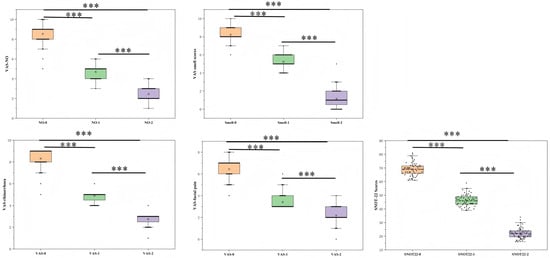
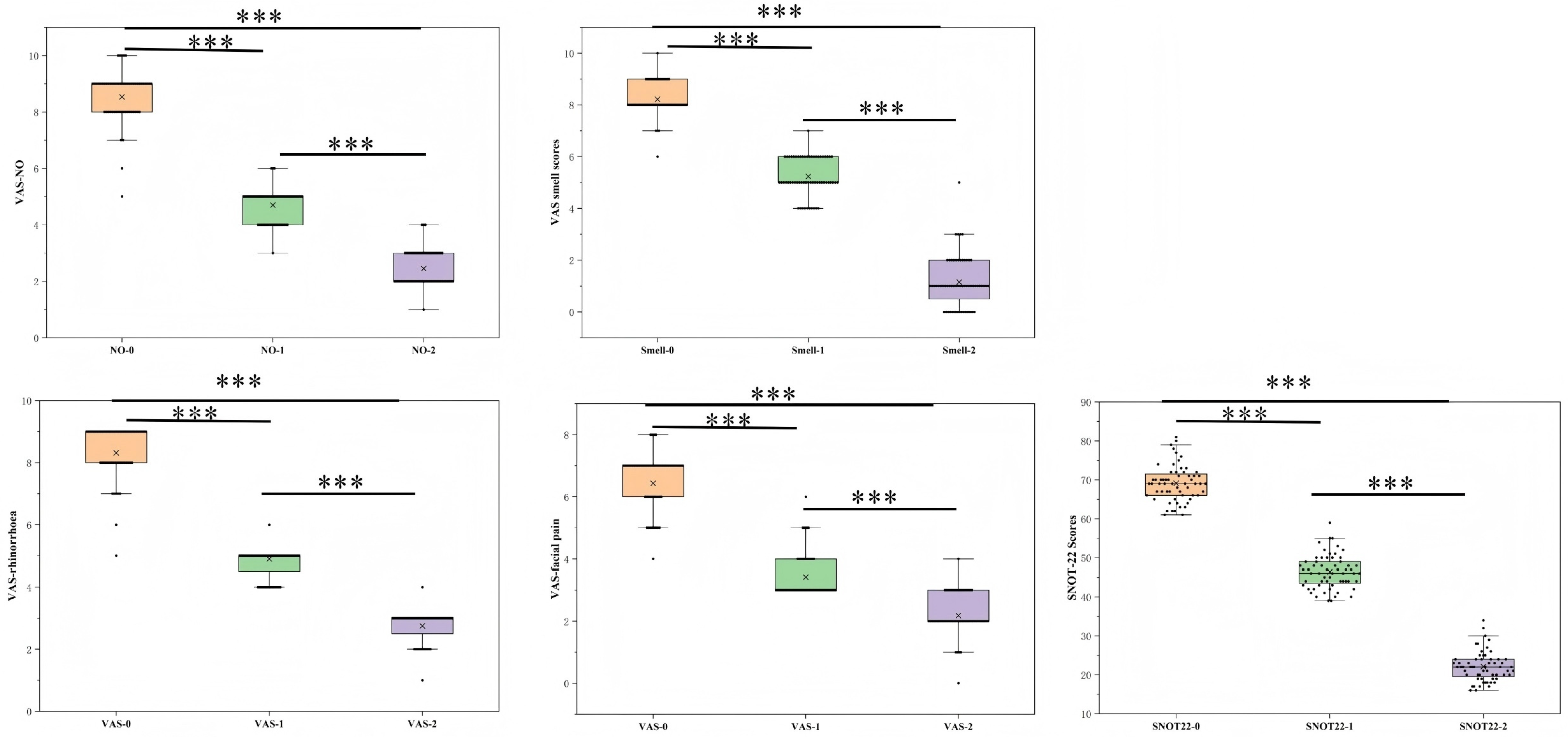
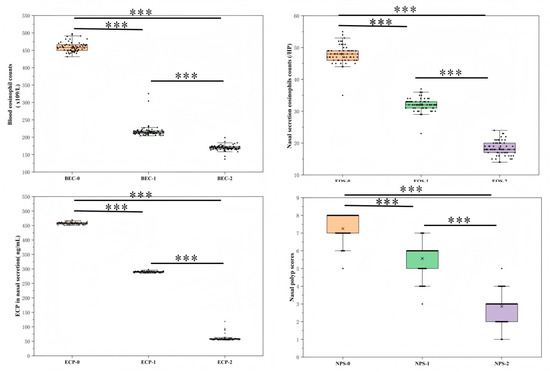
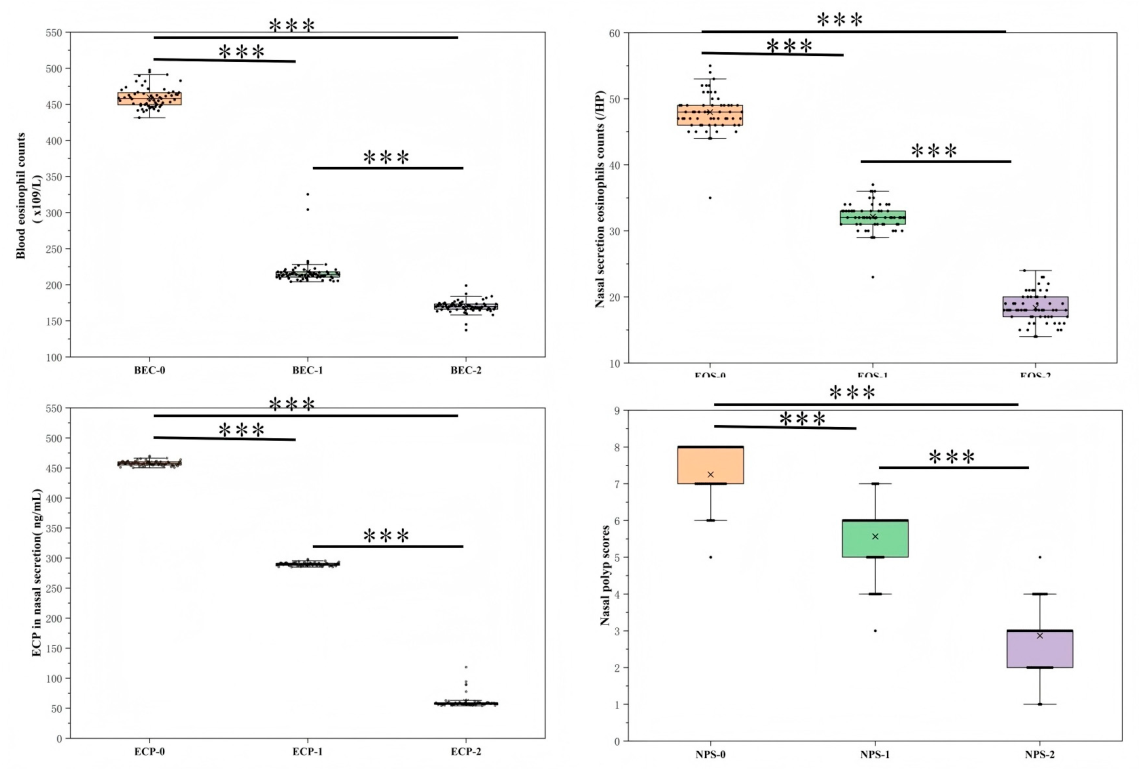
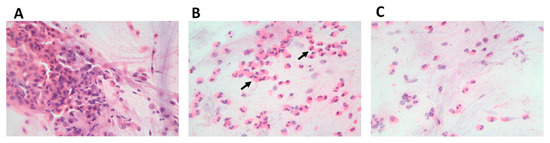
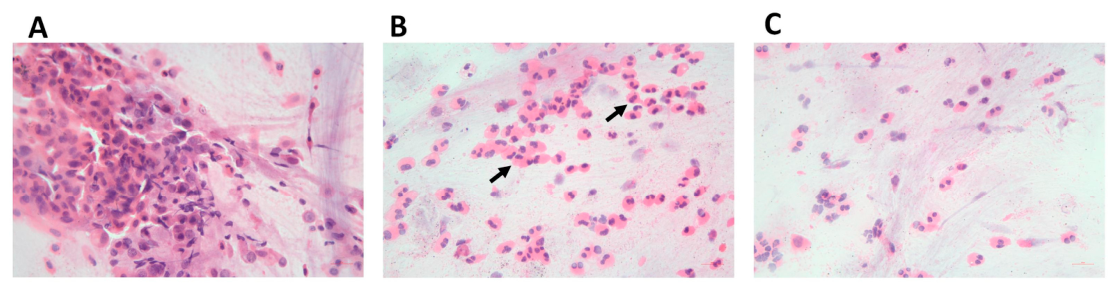
Mepolizumab significantly reduced SNOT-22 after 3 months of treatment and between T0 and T1 and T2. Also, VAS-NO, and VAS-rhinorrhoea showed a similar trend within the first 3 months of treatment. At 3 months of treatment, VAS-smell showed significant improvement. By 6 months, it had basically returned to normal or had mild symptoms (less than one point). VAS-facial pain showed a significant improvement only within the first 3 months (Figure 1). Furthermore, NPS significantly improved between T0 and T1, as well as eosinophils cells in nasal secretion sample (Figure 2). In the same study period, BECs showed a significant reduction between T0 and T1 and between T1 and T2 (Figure 2). A significant decrease in eosinophils was found in all the patients during 6 months of treatment (p < 0.001) (Figure 2). Eosinophils in nasal secretions changed during the study period (Figure 3). Refer to Table 2 for specific data.
Figure 1.
Patient-derived outcome measure changes during the study period. The sino-nasal symptoms were collected using the VAS scores for nasal obstruction (VAS-NO), smell (VAS-smell), rhinorrhoea, (VAS-rhinorrhoea) and facial pain (VAS-facial pain). Data are presented as the means ± standard deviation (SD), significance calculated using mixed effect analysis with Tukey’s multiple comparisons test, ***: p < 0.001. SNOT-22: Sinonasal Outcome Test-22; NO: Nasal Obstruction; VAS: Visual Analogue Scale; 0—before treatment, 1—after 3 months of treatment, 2—after 6 months of treatment. Orange, green, and purple boxes represent baseline (T0), 3 months (T1), and 6 months (T2).
Figure 2.
Physician-derived outcome measure changes during the study period. Data are presented as the means ± standard deviation (SD), significance is calculated using mixed effect analysis with Tukey’s multiple comparisons test, ***: p < 0.001. Eos: Eosinophils cells in nasal secretion sample; Bec: Blood eosinophil counts (cells × 109/L); NPS: Bilateral Nasal Polyp Scores; 0—before treatment, 1—after 3 months of treatment, 2—after 6 months of treatment. Orange, green, and purple boxes represent baseline (T0), 3 months (T1), and 6 months (T2).
Figure 3.
Eosinophils in nasal secretion smear changes during the study period. Representative photomicrographs of nasal mucosa with eosinophilic infiltration (black arrows). (Scale bar: 50 μm, original magnification, ×400). (A) Before treatment, (B) after 3 months of treatment, (C) after 6 months of treatment.
Table 2.
Analysis of VAS score and other data.
Throughout the study period, all patients maintained their ongoing nasal treatment regimen, which included INCS and saline nasal irrigation. Mepolizumab was generally well tolerated throughout the 6-month study period. No serious adverse events were reported, and no patients required OCS or sinonasal surgery due to adverse events. All adverse events were mild and self-limited, and none led to treatment discontinuation. A summary of adverse events is presented in Table 3. The most frequently reported adverse event was injection site dermatitis (11/60 patients, 18.33%), followed by transient musculoskeletal pain (10/60, 16.67%) and fatigue (7/60, 11.67%).
Table 3.
Summary of adverse events during the 6-Month follow-up.
4. Discussion
The real-life experience over 6 months confirms the efficacy of mepolizumab in patients with severe, uncontrolled CRSwNPs. Significant benefits were demonstrated as early as 3 months of treatment, with improvements across core efficacy measures including NPS, SNOT-22 score, and VAS scores for rhinorrhea and facial pain. By 6 months, further statistically significant improvements (p < 0.001) were observed in NPS, olfactory function, and eosinophil counts in nasal secretions. These findings suggest that mepolizumab may provide both early symptomatic benefit and progressive control of local type 2 inflammation, although longer follow-up is required to determine whether these improvements can translate into sustained disease remission.
Our findings are highly consistent with existing real-world evidence demonstrating that mepolizumab induces significant improvements in both patient-reported symptoms and objective inflammatory markers in the early phase of treatment [17], with sustained efficacy observed over time [6,17] and associated histological improvements in nasal polyp tissue, including reduction in eosinophilic inflammation and restoration of epithelial integrity [18]. The early onset of action coupled with durable clinical benefit holds substantial clinical relevance by enhancing patient confidence and promoting long-term treatment adherence. Notably, patients with higher baseline SNOT-22 score and those with comorbid asthma exhibit more pronounced biological responses to mepolizumab. This observation is further supported by a large real-world pooled analysis conducted by Schleich et al. [19], which included 1037 patients with severe eosinophilic asthma (with or without comorbid CRSwNPs). That study demonstrated that mepolizumab treatment was associated with a 30% incremental relative benefit in reducing clinically significant asthma exacerbations among patients with comorbid CRSwNPs compared to those without CRSwNPs. This finding underscores the importance of a holistic approach to managing type 2 inflammatory diseases, as treating one manifestation may yield synergistic benefits across comorbid conditions.
Recent evidence from real-world studies has provided insights into the comparative effectiveness of different biologics in CRSwNP [17,20,21,22]. A direct real-world comparison by De Santis et al. evaluated dupilumab, omalizumab, and mepolizumab in patients with severe uncontrolled CRSwNP, demonstrating that while all three biologics significantly improved quality of life SNOT-22 by 9 months, dupilumab exhibited the fastest onset of action in reducing NPS, with significant improvement observed as early as 4 weeks, whereas mepolizumab and omalizumab achieved significant NPS reduction only at 6 months [20]. Similarly, Ottaviano et al. noted that meta-analyses have indicated the superiority of dupilumab in symptom control and nasal polyp size reduction [17]. Additionally, Viskens et al. found that treatment with either mepolizumab or omalizumab demonstrated significant efficacy as early as 12 weeks, with the mepolizumab group showing a further reduction in NPS between weeks 12 and 24 [21]. These observations are consistent with a large US real-world study by Peters et al., which reported that dupilumab was the most frequently used biologic (89.8%) for CRSwNP, compared to mepolizumab (5.3%), omalizumab (4.8%), reflecting clinical preference [22]. However, these comparisons are primarily based on observational data, and ongoing head-to-head trials are expected to provide more definitive evidence [17,20,21,22]. In the present study, mepolizumab demonstrated consistent clinical improvement in the majority of patients, supporting its efficacy in this Asian population, although direct comparisons with dupilumab were not within the scope of this real-world exploration.
A distinctive contribution of our study is the direct documentation of significantly reduced local eosinophilic infiltration and ECP concentrations, assessed via cytology of nasal secretions, an observation less commonly captured in prior real-world cohorts. It has been established that mepolizumab is effective in type II driven CRSwNP regardless of BEC [19]. Inflammatory eosinophils preferentially accumulate in nasal polyp tissue rather than merely reflecting blood levels, and their local concentration correlates strongly with improvements in the sinonasal microenvironment [18]. These findings suggest that local eosinophils may serve as a more biologically relevant and clinically predictive biomarker than peripheral BEC.Rapid recovery of olfactory function represents another pivotal finding. VAS-smell scores improved significantly by month 3, with most patients approaching normal olfaction by month 6. This benefit likely stems not only from polyp shrinkage and consequent improvement in nasal airflow but also from structural restoration of the olfactory epithelium following inflammation resolution. Reduced local eosinophilia was accompanied by diminished mucosal edema, decreased goblet cell hyperplasia, and increased ciliated epithelial cell density [18,23]. Regarding safety, no serious adverse events were observed. Only mild, transient reactions, including fatigue, injection-site dermatitis, and musculoskeletal pain, were reported, consistent with safety profiles from other real-world studies. Notably, in patients with elevated baseline BEC, mepolizumab was associated with a lower incidence of adverse events compared with dupilumab [24]. None of the patients required OCS or repeat sinus surgery during the 6-month follow-up period, underscoring mepolizumab’s potential to reduce disease recurrence and alleviate the overall healthcare burden.
Several limitations should be considered. First, the modest sample size (n = 60), single-centre design, and six-month follow-up limit generalizability and preclude assessment of long-term outcomes (durability, relapse, safety). The limited enrollment was due to the recent approval of biologics in China, high out-of-pocket costs, and single-centre constraints. Second, the pre-post self-controlled design without a control group cannot exclude natural disease fluctuation or placebo effects; however, the consistent improvement in the majority of patients achieved a clinically meaningful response and large effect sizes suggest a genuine treatment effect. Third, the absence of sinonasal tissue biopsy limits mechanistic insights to surrogate markers (nasal secretions and blood). Fourth, concomitant treatments (INCS, nasal irrigation) were not standardized, and their individual contributions could not be analyzed. This was a single-arm observational study, so causal inference should be made with caution, and the findings should be considered hypothesis-generating rather than confirmatory. Despite these limitations, the study employed rigorous prospective methodology, standardized protocols, and objective outcomes, providing valuable preliminary real-world data in an Asian population after mepolizumab approval in China.
Future studies should build on these findings by enrolling larger, multi-centre cohorts with extended follow-up (beyond 12 months) to better evaluate long-term efficacy, recurrence risk, and cost-effectiveness. Incorporation of sinonasal mucosal biopsy is warranted to provide direct pathological evidence and enable a more comprehensive assessment of local tissue changes. In parallel, there is an urgent need to develop robust biomarker-based predictive models to accurately identify patient subgroups most likely to benefit, thereby facilitating truly personalized therapy. Furthermore, head-to-head comparative trials of different biologics in CRSwNPs are needed to clarify their relative efficacy and optimize treatment algorithms.
5. Conclusions
In summary, this real-world study offers initial evidence that mepolizumab may improve symptoms, polyp size, and olfactory function in severe uncontrolled CRSwNPs, possibly through suppression of type 2 inflammation. Due to the uncontrolled, single-arm design and modest sample size, these findings are hypothesis-generating and require confirmation in larger controlled trials.
Author Contributions
Z.H. and Y.Z.: Writing—data generation, analysis and interpretation, original draft; N.S.: Funding acquisition, Writing—review and editing. All authors participated in data collection. All authors gave final approval for submission. All authors have read and agreed to the published version of the manuscript.
Funding
The authors declare that financial support was received for the publication of this article. Project of the Science and Technology Committee of Changning District (NO: CNKW2024Y21).
Institutional Review Board Statement
The study was approved by the Ethics Committee of Guanghua Hospital affiliated to Shanghai University of Traditional Chinese Medicine (approval number: 2025-K-76, 8 January 2025) and conducted in accordance with the Declaration of Helsinki.
Informed Consent Statement
Informed consent was obtained from all subjects involved in the study.
Data Availability Statement
The original contributions presented in this study are included in the article. Further inquiries can be directed to the corresponding authors.
Conflicts of Interest
The authors declare no conflicts of interest.
Abbreviations
| BEC | Blood eosinophil counts |
| CRSwNP | Chronic rhinosinusitis with nasal polyps |
| ECP | Eosinophil cationic protein |
| ELISA | Enzyme-linked immunosorbent assay |
| ESS | Endoscopic sinus surgery |
| IL-5 | Interleukin-5 |
| INCS | Intranasal corticosteroids |
| NPS | Nasal polyp score |
| OCS | Oral corticosteroids |
| RCTs | Randomized controlled trials |
| SNOT-22 | Sinonasal outcome test-22 |
| VAS | Visual analogue scale |
| VAS-NO | Visual analogue scale score for nasal obstruction |
| VAS-facial pain | Visual analogue scale score for facial pain |
| VAS-rhinorrhoea | Visual analogue scale score for rhinorrhoea |
| VAS-smell | Visual analogue scale score for smell |
References
- Fokkens, W.J.; Lund, V.J.; Hopkins, C.; Hellings, P.W.; Kern, R.; Reitsma, S.; Toppila-Salmi, S.; Bernal-Sprekelsen, M.; Mullol, J.; Alobid, I.; et al. European Position Paper on Rhinosinusitis and Nasal Polyps 2020. Rhinology 2020, 58, 1–464. [Google Scholar] [CrossRef] [Scilit]
- Zhang, L.; Zhang, Y.; Gao, Y.; Wang, K.; Lou, H.; Meng, Y.; Wang, C. Long-term outcomes of different endoscopic sinus surgery in recurrent chronic rhinosinusitis with nasal polyps and asthma. Rhinology 2020, 58, 126–135. [Google Scholar] [CrossRef] [Scilit]
- Solomon, Y.; Malkamu, B.; Berhan, A.; Eyayu, T.; Almaw, A.; Legese, B.; Woldu, B. Peripheral blood eosinophilia in adult asthmatic patients and its association with the severity of asthma. BMC Pulm. Med. 2023, 23, 96. [Google Scholar] [CrossRef] [Scilit] [PubMed]
- Hou, R.; Ye, G.; Cheng, X.; Shaw, D.E.; Bakke, P.S.; Caruso, M.; Dahlen, B.; Dahlen, S.-E.; Fowler, S.J.; Horváth, I.; et al. The role of inflammation in anxiety and depression in the European U-BIOPRED asthma cohorts. Brain Behav. Immun. 2023, 111, 249–258. [Google Scholar] [CrossRef] [Scilit]
- Ortega, H.G.; Liu, M.C.; Pavord, I.D.; Brusselle, G.G.; Fitzgerald, J.M.; Chetta, A.; Humbert, M.; Katz, L.E.; Keene, O.N.; Yancey, S.W.; et al. Mepolizumab treatment in patients with severe eosinophilic asthma. N. Engl. J. Med. 2014, 371, 1198–1207. [Google Scholar] [CrossRef] [Scilit] [PubMed]
- Han, J.K.; Bachert, C.; Fokkens, W.; Desrosiers, M.; Wagenmann, M.; ELee, S.; Smith, S.G.; Martin, N.; Mayer, B.; Yancey, S.W.; et al. Mepolizumab for chronic rhinosinusitis with nasal polyps (SYNAPSE): A randomised, double-blind, placebo-controlled, phase 3 trial. Lancet Respir. Med. 2021, 9, 1141–1153. [Google Scholar] [CrossRef] [Scilit] [PubMed]
- Fujieda, F.; Wang, C.; Yoshikawa, M.; Asako, M.; Suzaki, I.; Bachert, C.; Han, J.K.; Fuller, A.; Baylis, L.; Su, L.; et al. Mepolizumab in CRSwNP/ECRS and NP: The phase III randomised MERIT trial in Japan, China, and Russia. Rhinology 2024, 62, 576–589. [Google Scholar] [CrossRef] [Scilit]
- Chinese Otolaryngology Head and Neck Surgery Journal Editorial Board Nasology Group; Chinese Medical Association Otolaryngology Head and Neck Surgery Branch Nasology Group. Chronic rhinosinusitis diagnosis and treatment guideline (2024). Chin. J. Otorhinolaryngol. Head Neck Surg. 2025, 60, 221–249. [CrossRef]
- De Corso, E.; Pipolo, C.; Caminati, M.; Cantone, E.; Seccia, V.; Cecchi, L.; Nettis, E.; Garzaro, M.; Ottaviano, G.; Gelardi, M.; et al. Multidisciplinary decision-making-ITAlian consensus after two years of real practice on the management of severe uncontrolled CRSwNP by biologics (ITACA study). Curr. Allergy Asthma Rep. 2024, 24, 143–154. [Google Scholar] [CrossRef] [Scilit]
- Toro, M.D.C.; Antonio, M.A.; Alves Dos Reis, M.G.; de Assumpcao, M.S.; Sakano, E. Achieving the best method to classify Eosinophilic Chronic Rhinosinusitis: A systematic review. Rhinology 2021, 59, 330–339. [Google Scholar] [CrossRef] [Scilit]
- Mozzanica, F.; Preti, A.; Gera, R.; Gallo, S.; Bulgheroni, C.; Bandi, F.; Ottaviani, F.; Castelnuovo, P. Cross-cultural adaptation and validation of the SNOT-22 into Italian. Eur. Arch. Otorhinolaryngol. 2017, 274, 887–895. [Google Scholar] [CrossRef] [Scilit] [PubMed]
- Gevaert, P.; Gevaert, P.; De Craemer, J.; De Craemer, J.; Bachert, C.; Bachert, C.; Blauwblomme, M.; Blauwblomme, M.; Chaker, A.; Chaker, A.; et al. European Academy of Allergy and Clinical Immunology position paper on endo scopic scoring of nasal polyposis. Allergy 2023, 78, 912–922. [Google Scholar] [CrossRef] [Scilit]
- Psaltis, A.J.; Li, G.; Vaezeafshar, R.; Cho, K.S.; Hwang, P.H. Modification of the Lund Kennedy endoscopic scoring system improves its reliability and correlation with patient-reported outcome measures. Laryngoscope 2014, 124, 2216–2223. [Google Scholar] [CrossRef] [Scilit]
- Rimmer, J.; Hellings, P.; Lund, V.; Alobid, I.; Beale, T.; Dassi, C.; Douglas, R.; Hopkins, C.; Klimek, L.; Landis, B.; et al. European position paper on diagnostic tools in rhinology. Rhinology 2019, 57, 1–41. [Google Scholar] [CrossRef] [Scilit] [PubMed]
- Paoletti, G.; Malvezzi, L.; Riccio, A.M.; Descalzi, D.; Pirola, F.; Russo, E.; De Ferrari, L.; Racca, F.; Ferri, S.; Messina, M.R.; et al. Nasal cytology as a reliable non-invasive procedure to phenotype patients with type 2 chronic rhinosinusitis with nasal polyps. World Allergy Organ. J. 2022, 15, 100700. [Google Scholar] [CrossRef] [Scilit]
- Piatti, G.; Battilocchi, L.; Cozzi, A.; Gaini, L.M.; Aldè, M.; Pignataro, L.; Torretta, S. Nasal Cytology Is Useful for Evaluating and Monitoring the Therapeutic Response to Biologics in Chronic Rhinosinusitis with Nasal Polyposis. Biomedicines 2025, 14, 77. [Google Scholar] [CrossRef] [Scilit]
- Ottaviano, G.; Roccuzzo, G.; Saccardo, T.; Locatello, L.G.; De Rossi, S.; De Massimi, A.; Rigoni, E.; Marangoni, R.; Lora, L.; Calvanese, L.; et al. Mepolizumab in severe uncontrolled CRSwNP: A real-life multicentre study in Northeast Italy. Rhinology 2025, 63, 343–352. [Google Scholar] [CrossRef] [Scilit]
- Matucci, A.; Accinno, M.; Maggiore, G.; Brugnoli, B.; Vivarelli, E.; Cosmi, L.; Parronchi, P.; Perlato, M.; Milanese, M.; Licci, G.; et al. Mepolizumab Reduces Inflammatory Eosinophils in Nasal Polyp Tissue and Restores Histological Alterations. J. Investig. Allergol. Clin. Immunol. 2025, 36. [Google Scholar] [CrossRef] [Scilit]
- Schleich, F.; Loukides, S.; Chaudhuri, R.; Leuppi, J.D.; Heffler, E.; Domingo, C.; Micheletto, C.; Paulsson, T.; Gaw, N.; Kallinikou, K.; et al. Mepolizumab Effectiveness in Severe Asthma with/Without Chronic Rhinosinusitis with Nasal Polyps: Real-World Pooled Analysis. Allergy 2025, 80, 2557–2571. [Google Scholar] [CrossRef] [Scilit]
- De Santis, S.; Galassi, S.; Cambi, J. Clinical Effects and Response Time of Biological Drugs in Chronic Rhinosinusitis with Nasal Polyps Patients: Real-life Experience. Laryngoscope 2025, 135, 1628–1635. [Google Scholar] [CrossRef] [Scilit] [PubMed]
- Viskens, A.-S.; Bollens, L.; Borgers, E.; Halewyck, S.; Hox, V.; Jorissen, M.; Lemmens, W.; Rogister, F.; Speleman, K.; Van Gerven, L.; et al. Effect of biological treatment in uncontrolled severe chronic rhinosinusitis with nasal polyps in Belgium: A multicentre real-world data study. Rhinology 2025, 63, 316–324. [Google Scholar] [CrossRef] [Scilit]
- Peters, A.; Zhao, X.; Near, A.M.; Han, J.; Spahn, J.D.; Wu, S.-J.S.; Lindsley, A.W.; Le, T.T.; Wang, E.J.; Tuly, R.; et al. Real-world Outcomes Following Biologic Initiation in US Patients with Chronic Rhinosinusitis with Nasal Polyps. Adv. Ther. 2025, 42, 1783–1799. [Google Scholar] [CrossRef] [Scilit] [PubMed]
- Stryjewska-Makuch, G.; Humeniuk-Arasiewicz, M.; Onyszczuk, M.; Kokoszka, M.; Niemiec-Urbańczyk, M.; Michalak-Kolarz, M.; Ścierski, W.; Gawlik, R.; Gluck, J. Biological Treatment of Chronic Rhinosinusitis With Polyps Increases Number of Nasal Ciliated Cells-Real-Life Experience. Allergy 2025, 80, 3434–3437. [Google Scholar] [CrossRef] [Scilit] [PubMed]
- Bärhold, F.; Hagemann, J.; Klimek, L.; Huber, P.; Gröger, M.; Loth, A.G.; Ernst, B.P.; Beutner, C.; Dombrowski, T.; Förster-Ruhrmann, U.; et al. Multi-centric real-world effectiveness of mepolizumab in severe chronic rhinosinusitis with nasal polyps in Germany. Rhinology 2025, 63, 591–599. [Google Scholar] [CrossRef] [Scilit] [PubMed]

Disclaimer/Publisher’s Note: The statements, opinions and data contained in all publications are solely those of the individual author(s) and contributor(s) and not of MDPI and/or the editor(s). MDPI and/or the editor(s) disclaim responsibility for any injury to people or property resulting from any ideas, methods, instructions or products referred to in the content. |
© 2026 by the authors. Licensee MDPI, Basel, Switzerland. This article is an open access article distributed under the terms and conditions of the Creative Commons Attribution (CC BY) license.