


Abstract
Sarcopenia is an age-related skeletal muscle disorder characterized by reduced muscle mass, strength, and physical performance, as well as increased risk of disability, hospitalization, and mortality. Emerging evidence suggests that gut microbiota alterations may contribute to muscle decline via a microbiota–gut–muscle axis, acting as a context-dependent modulator rather than a primary causal driver. This narrative review synthesizes mechanistic, clinical, and translational evidence linking gut dysbiosis to sarcopenia. Preclinical studies show that microbiota modulation (e.g., antibiotics, probiotics, prebiotics, postbiotics, fecal microbiota transplantation) affects muscle mass, strength, and metabolism through pathways including inflammation, mitochondrial dysfunction, altered short-chain fatty acid production, and impaired anabolic signaling. In humans, observational studies associate lower microbial diversity and reduced short-chain fatty acid-producing taxa with poorer muscle outcomes, but findings are heterogeneous and non-causal. Interventional trials remain limited and characterized by small sample sizes, with effects more consistent for functional outcomes than muscle mass. Overall, the gut microbiota represents a modifiable contributor within the complex biology of sarcopenia. Future studies should integrate microbiome profiling and multi-omics approaches within well-designed clinical trials to identify responder phenotypes and define the role of microbiota-targeted strategies within multimodal interventions.
1. Introduction
Sarcopenia represents the pathological manifestation of the progressive decline in skeletal muscle mass and strength occurring with aging, and is associated with adverse clinical outcomes, including falls, disability, hospitalization, and mortality [1,2,3]. Although its pathophysiology is multifactorial, involving anabolic resistance, chronic low-grade inflammation, and metabolic dysfunction, the mechanisms underlying age-related muscle loss remain only partially understood [4].
In parallel with musculoskeletal aging, the gut microbiota undergoes significant compositional and functional changes across the lifespan [5]. Age-related alterations in gut microbiota, often referred to as dysbiosis, are characterized by reduced microbial diversity, increased inter-individual variability, and expansion of potentially pro-inflammatory taxa [6]. These changes have been identified in several age-associated conditions, including metabolic disorders, immune dysfunction, and chronic inflammation [7].
Growing evidence suggests that the gut microbiota may also influence skeletal muscle health, leading to the emergence of the gut–muscle axis as a novel and rapidly evolving area of research [8,9]. Experimental and observational studies indicate that alterations in microbial composition and function, as well as in microbial-derived metabolites, particularly short-chain fatty acids (SCFAs), may affect muscle metabolism, inflammatory pathways, and anabolic signaling [10,11]. However, whether gut dysbiosis directly contributes to sarcopenia or instead acts as an intermediary between environmental factors, such as diet, physical activity, and medication use, and muscle decline remains a matter of debate [8].
Despite increasing interest in this field, current evidence is largely derived from animal models and observational studies in humans, while interventional data in older adults remain limited. Existing literature has primarily focused on mechanistic pathways or descriptive associations, while the integration of experimental and clinical evidence from a translational perspective remains relatively underexplored [12,13,14,15,16,17,18]. Therefore, this narrative review aims to critically synthesize current mechanistic, clinical, and translational evidence linking the gut microbiota to skeletal muscle health in aging, with particular emphasis on its potential role in the pathophysiology of sarcopenia and on emerging microbiota-targeted interventions.
2. Methods
This narrative review is based on a non-systematic literature search conducted in the PubMed database. The search included articles published from database inception through January 2025. The search strategy combined Boolean operators and predefined keywords, including terms related to sarcopenia, gut microbiota, and relevant biological mechanisms (e.g., microbial metabolites and intestinal permeability). The search terms were used in an iterative and flexible manner to capture a broad range of potentially relevant studies. Key references were screened by the authors (S.A.M. and S.C.) to identify studies reporting objective muscle-related outcomes (e.g., muscle strength, muscle mass, or gait speed) and clearly defined sarcopenia phenotypes. Both preclinical (animal and in vitro models) and clinical (human observational and interventional) studies were considered. Preclinical models were prioritized for their capacity to identify molecular and mechanistic pathways linking microbiota alterations to muscle metabolism and anabolic signaling, whereas human studies were evaluated for clinical relevance and epidemiological associations. Articles were excluded if they lacked a clear focus on the gut–muscle axis or addressed secondary muscle wasting not primarily related to aging. Study selection was guided by conceptual relevance to the biological framework of the microbiota–gut–muscle axis rather than by formal quality scoring or statistical pooling, consistent with the integrative nature of a narrative review.
3. Sarcopenia: Pathophysiology and Current Therapeutic Strategies
Sarcopenia is an age-related skeletal muscle disorder characterized by progressive declines in muscle strength, mass, and physical performance and is associated with an increased risk of frailty, disability, and adverse clinical outcomes in older adults [1]. International consensus definitions have been developed to standardize its identification across clinical and research settings, generally integrating measures of muscle strength, muscle quantity, and physical performance [19]. Sarcopenia remains an evolving field, with ongoing refinements in its conceptual and operational definitions [20,21].
3.1. Molecular and Intrinsic Mechanisms
The pathophysiology of sarcopenia is complex and multifactorial, resulting from the interplay between intrinsic biological processes (e.g., cellular and molecular alterations within skeletal muscle) and extrinsic environmental and clinical factors (e.g., physical inactivity, nutrition, and comorbidities). A central molecular mechanism is anabolic resistance, defined as a reduced sensitivity of skeletal muscle to anabolic stimuli such as dietary amino acids and mechanical loading. This leads to impaired activation of key signaling pathways involved in muscle protein synthesis, most notably the IGF-1–Akt–mTORC1. This defect is further compounded by a reduction in satellite cell number and function, thereby limiting muscle regeneration and repair [4,22]. Additionally, mitochondrial dysfunction contributes to muscle degeneration by reducing oxidative capacity, increasing reactive oxygen species production, and impairing energy metabolism, ultimately favoring myofiber atrophy and apoptosis [23].
3.2. Systemic, Endocrine, and Neuromuscular Factors
Beyond intrinsic muscle defects, chronic low-grade systemic inflammation (inflammaging) represents a hallmark of the disorder. Persistently elevated circulating levels of pro-inflammatory cytokines, such as tumor necrosis factor alpha, interleukin 6, and C-reactive protein, promote proteolysis through activation of the ubiquitin–proteasome and autophagy–lysosome systems [22,24]. In parallel, age-related alterations in neuromuscular junction integrity, including motor neuron loss and impaired reinnervation, lead to motor unit remodeling and preferential denervation of fast-twitch fibers, exacerbating strength decline [25]. Furthermore, endocrine changes, characterized by reduced levels of testosterone, estrogen, growth hormone, and vitamin D, negatively affect muscle mass maintenance and neuromuscular function [26].
3.3. Therapeutic Landscape
Current therapeutic strategies primarily focus on resistance exercise training and optimization of protein and energy intake, which remain the cornerstone interventions. Resistance exercise counteracts anabolic resistance by stimulating muscle protein synthesis and improving neuromuscular function, while adequate protein intake, particularly from leucine-rich sources, supports anabolic signaling [1,4,27]. However, responses to these interventions are heterogeneous and influenced by age, comorbidities, physical inactivity, and potentially by individual biological and environmental factors, including gut microbiota composition. Importantly, no pharmacologic therapies are currently approved for the treatment of sarcopenia [28].
4. Gut–Muscle Axis: Biological and Translational Insights
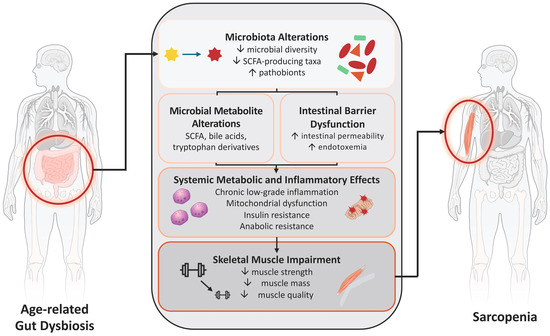
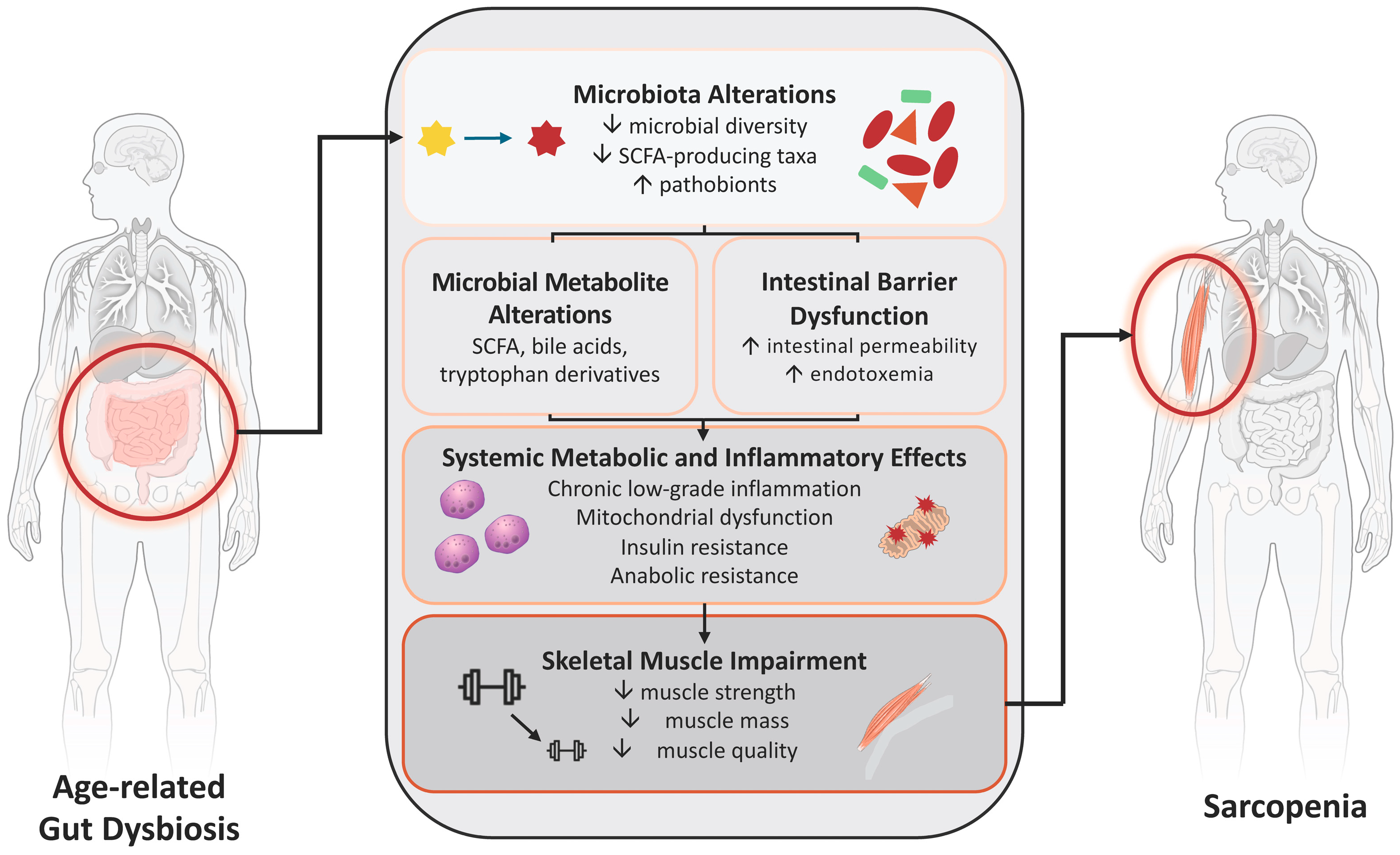
Both preclinical and human studies support a role for the gut microbiota in the regulation of skeletal muscle mass, strength, and function, although the underlying mechanisms remain incompletely understood. The proposed mechanisms linking age-related gut dysbiosis to impaired skeletal muscle health are summarized in Figure 1.
Figure 1.
Conceptual framework of the gut–muscle axis in aging. The figure illustrates the interconnected pathways linking age-related gut dysbiosis to skeletal muscle impairment, including microbiota alterations, microbial metabolite changes, intestinal barrier dysfunction, and downstream systemic metabolic and inflammatory effects. Connections represent biologically plausible interactions, including reciprocal relationships between microbiota composition, metabolite production, and intestinal barrier integrity. Abbreviation: SCFA, short-chain fatty acid.
In animal models, across a wide range of experimental settings, including physiological aging, frailty, glucocorticoid-induced muscle atrophy, antibiotic-induced dysbiosis, and fecal microbiota transplantation, converging evidence indicates that alterations in gut microbial composition or microbial-derived metabolites can influence skeletal muscle phenotype. This has been consistently demonstrated through probiotic and postbiotic supplementation studies [29,30,31,32,33,34,35,36,37,38,39,40,41,42,43,44,45], germ-free and colonization experiments [46,47], as well as fecal microbiota transplantation from donors with divergent physical function [48,49,50], collectively showing effects on muscle mass, strength, endurance, and exercise adaptation (Table 1). These effects are mediated through interconnected pathways involving systemic and local inflammation, mitochondrial function, anabolic signaling, and proteostasis, thereby suggesting a potential causal contribution of the gut microbiota to the regulation of muscle mass, strength, and functional performance.
Table 1.
Evidence from animal models supporting a causal role of the gut–muscle axis.
Collectively, preclinical findings support the concept of a gut–muscle axis, whereby gut dysbiosis may contribute to sarcopenia through interconnected pathways, including altered protein metabolism, chronic low-grade inflammation, metabolic resistance, and mitochondrial dysfunction. The following sections summarize the key pathophysiological mechanisms linking gut microbiota alterations to skeletal muscle decline with aging. Notably, the strength of evidence appears to vary across the translational continuum, with robust mechanistic support from preclinical models and consistent observational associations in humans but limited causal inference.
4.1. Gut Microbiota Ecosystem Shifts and Skeletal Muscle Homeostasis
Age-related gut dysbiosis is characterized by a significant reduction in microbial diversity and a profound shift in the gut ecosystem [51,52]. This transition involves the depletion of beneficial commensal taxa, such as Faecalibacterium prausnitzii, Roseburia spp., Eubacterium rectale, and Bifidobacterium spp., alongside the enrichment of pro-inflammatory pathobionts, including Enterobacteriaceae (e.g., Escherichia coli), Desulfovibrio spp., and Bilophila wadsworthia [51,52].
Crucially, sarcopenia is not merely associated with the loss of individual taxa but with broader alterations in relative abundance and microbial ratios that may compromise the stability of the intestinal environment [9,10,16]. In addition to shifts in individual taxa, aging-related dysbiosis has also been described in terms of broader ecological changes at higher taxonomic levels. In particular, an increased relative abundance of Proteobacteria, often expressed as the Proteobacteria-to-total bacteria ratio, has been proposed as a marker of microbiome instability and inflammatory dysbiosis [52,53]. Conversely, commonly reported indices such as the Firmicutes-to-Bacteroidetes ratio show inconsistent associations with aging and age-related conditions and are increasingly considered insufficient as standalone indicators of microbiome aging [54,55]. These alterations likely reflect complex host–microbiome interactions rather than simple taxonomic imbalances, and their functional implications may vary depending on microbial gene expression and metabolic activity. Moreover, the directionality of these associations remains difficult to disentangle, as lifestyle, metabolic, and clinical factors accompanying aging may simultaneously influence both gut microbiota composition and skeletal muscle health.
Experimental models further demonstrate that global microbiota disruption through antibiotic-induced depletion impairs muscle adaptation and promotes systemic inflammatory signaling [46,47]. This altered ecosystem contributes to increased intestinal permeability, or “leaky gut”, which facilitates the translocation of microbial components such as lipopolysaccharides into the systemic circulation. This process activates innate immune pathways, particularly toll-like receptor 4, contributing to chronic low-grade inflammation (inflammaging). This persistent inflammatory milieu promotes muscle proteolysis and functional decline, as supported by animal studies showing that restoration of microbial balance and ecological diversity attenuates inflammation and preserves the muscle phenotype [37,38,50].
4.2. Microbiota-Derived Metabolites and Skeletal Muscle Homeostasis
Microbiota-derived metabolites constitute a central functional link between gut microbial activity and skeletal muscle physiology. Among these, SCFAs, particularly acetate, propionate, and butyrate, are primarily produced by taxa such as Faecalibacterium prausnitzii, Roseburia spp., and members of Clostridium cluster XIVa. Experimental studies demonstrate that probiotic and postbiotic supplementation increases SCFAs availability, leading to improvements in muscle mass, strength, and endurance in aging and atrophy models [29,31,40,41].
Fecal microbiota transplantation from physically robust or young donors restores microbial metabolite profiles and improves muscle metabolic efficiency and endurance capacity in recipient animals [48,49,50].
Beyond SCFAs, altered microbial metabolism of bile acids and tryptophan-derived metabolites has been implicated in modulating muscle inflammation and energy homeostasis, further supporting a metabolite-mediated gut–muscle communication network [56,57,58].
4.3. Gut Microbiota and Mitochondrial Function in Aging Muscle
Mitochondrial dysfunction is a hallmark of skeletal muscle aging and plays a central role in the development of sarcopenia [59]. Emerging experimental evidence indicates that gut dysbiosis may exacerbate age-related mitochondrial impairments through both inflammatory and metabolic pathways. Antibiotic-induced microbiota depletion results in reduced mitochondrial biogenesis, impaired oxidative phosphorylation, and decreased adenosine triphosphate production in skeletal muscle [46,47]. Conversely, supplementation with probiotics such as Lactobacillus plantarum, Lacticaseibacillus rhamnosus, and Bifidobacterium spp., as well as microbial-derived metabolites, improves mitochondrial content, oxidative capacity, and endurance performance in aging and muscle atrophy models [32,36,42].
Fecal microbiota transplantation studies further demonstrate that donor-dependent microbial profiles influence mitochondrial efficiency and exercise tolerance in recipient animals [48,50]. These findings suggest that gut microbiota composition and metabolic output may represent important modulators of mitochondrial health in skeletal muscle.
4.4. Protein Anabolism, Amino Acid Metabolism, and Anabolic Resistance
Anabolic resistance, defined as a reduced muscle protein synthetic response to anabolic stimuli [60], is a defining feature of sarcopenia and may be partially mediated by gut microbiota-dependent regulation of amino acid metabolism.
Experimental studies indicate that probiotic supplementation enhances anabolic signaling pathways, including activation of Akt/mTORC1 signaling and increased expression of muscle protein synthesis markers [30,33,43]. Gut microorganisms influence the bioavailability and metabolism of essential amino acids, particularly branched-chain amino acids, which are critical activators of muscle protein synthesis [61,62].
Dysbiosis-induced alterations in microbial composition may impair amino acid absorption and signaling, thereby contributing to anabolic resistance. Consistent with this concept, microbiota depletion models demonstrate impaired anabolic responses and reduced exercise-induced muscle adaptation [46].
Fecal microbiota transplantation and colonization experiments further support a role for microbial composition in shaping host nutrient utilization and muscle anabolic capacity [49,50].
4.5. Insulin Resistance and Endocrine Alterations
Insulin resistance frequently accompanies aging and represents an additional pathway linking gut dysbiosis to skeletal muscle decline [63]. Insulin and insulin-like growth factor 1 (IGF-1) signaling are critical for muscle glucose uptake, protein synthesis, and maintenance of muscle mass [63].
Alterations in gut microbiota composition and microbial metabolite production may influence systemic insulin sensitivity through inflammatory signaling, bile acid metabolism, and modulation of incretin pathways. Experimental studies suggest that microbiota-targeted interventions may improve metabolic regulation and physical performance in preclinical models [31,42].
In humans, observational studies associate specific microbial signatures with metabolic profiles relevant to sarcopenia and insulin resistance [64,65]. Reduced SCFAs production and increased endotoxemia may impair insulin and IGF-1 signaling in skeletal muscle, thereby exacerbating anabolic resistance and muscle wasting. Restoration of microbial balance may therefore represent a strategy to support endocrine and metabolic regulation of skeletal muscle during aging.
Importantly, these mechanisms do not operate in isolation. Increased intestinal permeability, altered metabolite production, mitochondrial dysfunction, anabolic resistance, and insulin resistance likely reinforce each other, forming a self-perpetuating network that lowers the threshold for muscle decline in aging.
4.6. Evidence from Human Observational Studies
In humans (Table 2), observational studies consistently support an association between gut microbiota alterations and sarcopenia-related traits, although the specific patterns identified vary across populations and clinical settings. In older adults with sarcopenia or pre-sarcopenia, reduced alpha diversity and clear differences in community structure have been reported compared with controls, together with a lower relative abundance of Firmicutes and depletion of SCFA-producing genera such as Roseburia, Eubacterium, and Lachnospira, which were positively correlated with appendicular skeletal muscle index and grip strength [64]. By contrast, other studies did not detect major differences in overall alpha or beta diversity, but still identified taxon-specific shifts associated with sarcopenia, including lower abundance of beneficial taxa such as Prevotella and Prevotella copri (primarily associated with propionate production), Agathobacter (a butyrate producer), and Dorea (with less well-characterized metabolic profiles) [65,66,67,68,69]. These findings suggest that sarcopenia may be linked either to broad ecological disruption or to more selective compositional changes, depending on the underlying population and phenotype studied.
Table 2.
Observational studies on gut–muscle axis in humans.
Additional evidence comes from community-dwelling older women, in whom sarcopenia was associated not only with lower muscle mass, weaker grip strength, and slower gait speed, but also with lower fecal concentrations of total SCFAs and butyrate, reduced microbial richness, and enrichment of potentially unfavorable taxa such as Bacteroides and Shigella, alongside lower abundance of Agathobacter and Dorea [70]. In the same study, lower protein and fiber intake was also independently associated with sarcopenia, reinforcing the concept that diet, microbiota-derived metabolites, and muscle health are tightly interconnected [70].
In patients with hematological diseases undergoing hematopoietic stem-cell transplantation, microbiota restructuring over time was accompanied by worsening anthropometric and functional parameters, including reductions in body mass index, calf circumference, and gait speed, while pre-transplant sarcopenia was associated with lower Dorea and higher Phascolarctobacterium abundance [71]. These observations extend the gut–muscle axis concept beyond community settings to highly vulnerable clinical populations.
Observational data also suggest that microbiota–muscle associations may differ by sex. In a large population-based study, higher skeletal muscle mass index in males, but not females, was associated with greater alpha diversity and higher abundance of taxa including Haemophilus parainfluenzae, Roseburia faecis, and Lachnospiraceae-related species after adjustment for age, body mass index, and physical activity [72]. Beyond these observational findings, sex hormones may contribute to shaping the gut–muscle axis through effects on microbiota composition, inflammatory pathways, and muscle metabolism [73]. Estrogen has been associated with preservation of microbial diversity and anti-inflammatory signaling [74,75,76], whereas age-related declines in testosterone may influence muscle protein metabolism and metabolic regulation [77].
Taken together, these studies indicate that microbiota alterations may accompany poorer muscle health, although the specific microbial signature appears to be context-dependent. Importantly, these findings remain observational and do not establish causality. Overall, the available evidence supports a biologically plausible and potentially bidirectional relationship within the gut–muscle axis, whereby gut microbiota may influence muscle metabolism and function, while muscle activity and exercise can, in turn, modulate microbiota composition and metabolic output, underscoring the need for longitudinal studies with deeper phenotyping and functional microbiome characterization.
5. Interventional Evidence and Multimodal Strategies Targeting the Gut–Muscle Axis
In contrast to observational findings, interventional studies in humans (Table 3) provide emerging but still limited evidence on the effects of microbiota-targeted strategies on muscle health. Randomized and non-randomized interventions using prebiotics, probiotics, synbiotics, or fecal microbiota transplantation have reported modest and domain-specific improvements, particularly in muscle strength, lower-limb function, and patient-reported outcomes, rather than consistent changes in muscle mass. However, these studies are characterized by heterogeneous designs, small sample sizes, variable endpoints, and limited mechanistic characterization, which currently preclude firm conclusions regarding efficacy. In particular, prebiotic and probiotic interventions have shown improvements in handgrip strength, gait speed, chair stand performance, and quality of life, often in the absence of significant changes in muscle mass or global frailty indices [78,79,80]. In contrast, microbiota-targeted approaches combined with exercise, such as fecal microbiota transplantation plus resistance training, have demonstrated more consistent effects on both muscle mass and functional outcomes, alongside restoration of beneficial microbial taxa and reduction in inflammatory markers [81]. In the study by Yang et al. [81], resistance training consisted of a structured program performed 2–3 times per week, with sessions lasting at least 30 min over a minimum duration of 8 weeks.
Table 3.
Interventional studies targeting the gut–muscle axis in humans.
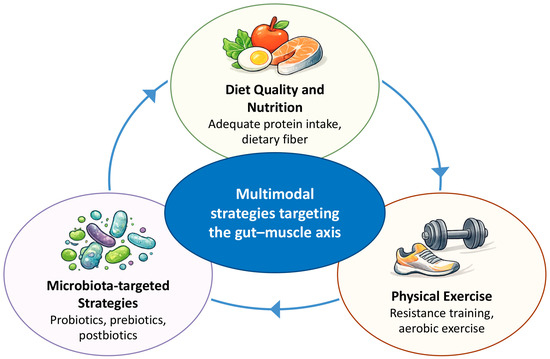
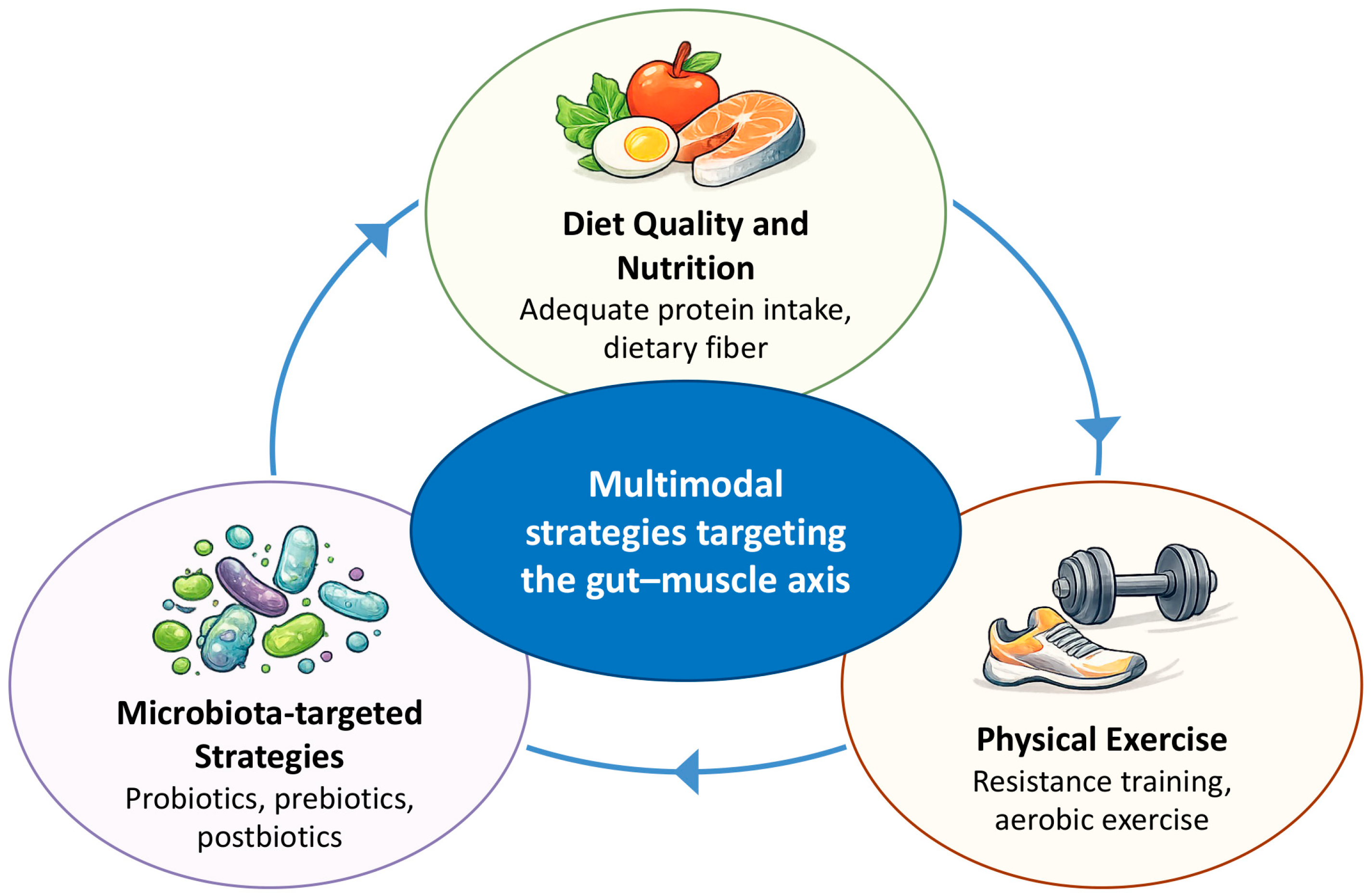
These limitations, including modest and inconsistent effects of microbiota-targeted interventions, small sample sizes, and heterogeneous study designs, have led to increasing interest in integrative and multimodal therapeutic strategies that combine dietary optimization, physical activity, and targeted modulation of the gut microbiota to counteract sarcopenia (Figure 2). Nutritional adequacy, particularly sufficient and sustained protein intake, alongside fiber-rich and high-quality dietary patterns, may support muscle anabolism both directly and indirectly through favorable modulation of gut microbiota composition and metabolic activity [84,85,86]. Dietary fiber promotes the growth of beneficial microbial taxa and enhances SCFAs production, thereby exerting anti-inflammatory effects and supporting anabolic signaling and muscle metabolism [84,85].
Figure 2.
Multimodal interventions targeting the gut–muscle axis. The figure represents a simplified conceptual framework; arrows indicate potential interactions between domains and do not imply fixed or unidirectional causal relationships.
Physical exercise, especially resistance training, represents the cornerstone of sarcopenia management and a critical component of multimodal approaches. Resistance training directly stimulates muscle hypertrophy and strength through mechanical loading, activation of anabolic signaling pathways, and myokine secretion [87]. In parallel, regular physical activity influences gut microbiota diversity, composition, and metabolic output, potentially amplifying exercise-induced muscle adaptations through the gut–muscle axis [88]. Exercise-associated increases in microbial diversity and short-chain fatty acid production may further support mitochondrial function, insulin sensitivity, and muscle performance [14].
In addition to protein and fiber intake, other dietary components such as polyphenols and omega-3 fatty acids may contribute to muscle health through antioxidant, anti-inflammatory, and membrane-stabilizing effects, which may synergize with microbiota-mediated mechanisms [17,89]. These nutritional factors are increasingly recognized as modulators of systemic inflammation and microbial metabolic activity, aligning with mechanistic frameworks proposed in integrative reviews [90,91].
Targeted modulation of the gut microbiota represents a promising adjunctive strategy to support musculoskeletal health in aging. This can be achieved through prebiotics, probiotics, and postbiotics, which aim to selectively enhance beneficial microbial populations, increase microbial-derived metabolites, and improve intestinal barrier integrity [86,92]. Prebiotics, such as inulin and fructooligosaccharides, selectively stimulate the growth of taxa including Bifidobacterium and Lactobacillus, while probiotics consist of live microorganisms that confer health benefits when administered in adequate amounts. Postbiotics, including short-chain fatty acids and other bioactive microbial metabolites, may exert direct biological effects independently of live bacteria. Collectively, these approaches may reduce systemic low-grade inflammation, enhance branched-chain amino acid bioavailability, and support anabolic signaling in skeletal muscle [84,86,93], as highlighted in recent mechanistic and translational syntheses [17].
Importantly, microbiota modulation should be viewed as an amplifier of established interventions such as exercise and adequate protein intake, rather than a replacement.
6. Limitations of Current Microbiota-Targeted Strategies and Future Research Directions
Despite growing interest in microbiota-targeted interventions for sarcopenia, several limitations currently hinder their clinical translation. Most available evidence derives from preclinical models, while human interventional studies remain scarce, characterized by small sample sizes, and highly heterogeneous in terms of study design, participant characteristics, intervention duration, and outcome measures [92]. Probiotic and prebiotic trials differ substantially in strains, dosages, formulations, and co-interventions, limiting comparability and precluding firm conclusions regarding efficacy. Notably, available human trials more consistently report improvements in functional outcomes than in muscle mass, suggesting a potential dissociation between functional and structural endpoints, which may partly reflect methodological limitations in muscle mass assessment. Commonly used techniques such as dual-energy X-ray absorptiometry and bioelectrical impedance analysis may lack sensitivity to detect small or short-term changes [94].
Moreover, many studies assess clinical endpoints without adequately characterizing microbiota changes or downstream mechanisms, thereby limiting causal inference. Several trials report clinical improvements without parallel microbiome assessment, while others show microbiota modulation without functional benefits. The lack of standardized analytical methods, limited integration of multi-omics approaches, and insufficient consideration of host factors further complicate interpretation [95]. Most studies rely on taxonomic profiling, which may not fully capture microbial functional capacity; complementary approaches such as metagenomics and metabolomics are needed [96]. Emerging strategies such as fecal microbiota transplantation, although mechanistically informative, raise ethical and feasibility concerns and are supported by limited clinical evidence [97].
Future research should prioritize well-designed, mechanistically informed clinical trials with standardized muscle outcomes and integrated microbiome analyses. Increasing evidence also points to substantial inter-individual heterogeneity in microbiome aging trajectories [98,99], highlighting the need to identify responder subgroups and develop personalized approaches. Integrating microbiome science within multimodal sarcopenia interventions will help clarify the role of microbiota-targeted strategies in prevention and management.
7. Conclusions
The emerging concept of a microbiota–gut–muscle axis provides a biologically plausible framework linking gut microbial ecology with skeletal muscle health in aging. However, current evidence remains largely associative, and microbiota modulation should be considered an adjunct to established strategies such as exercise and nutritional optimization rather than a standalone therapeutic approach. Available interventional evidence suggests modest and context-dependent benefits, primarily on functional outcomes, with limited and inconsistent effects on muscle mass. Future research should focus on mechanistically informed clinical studies integrating microbiome profiling with standardized muscle outcomes to clarify causality and identify individuals most likely to benefit from microbiota-targeted interventions.
Author Contributions
Conceptualization, S.A.M., G.A., R.S.Z., L.M., R.C., A.P., M.S., M.T., C.L., S.D.A., F.L., E.M. and S.C.; methodology, S.A.M., G.A., R.S.Z., L.M., R.C., A.P., M.S., M.T., C.L., S.D.A., F.L., E.M. and S.C.; validation, S.A.M., G.A., R.S.Z., L.M., R.C., A.P., M.S., M.T., C.L., S.D.A., F.L., E.M. and S.C.; writing—original draft preparation, S.A.M., G.A. and S.C.; writing—review and editing, R.S.Z., L.M., R.C., A.P., M.S., M.T., C.L., S.D.A., F.L. and E.M.; visualization, S.A.M., L.M. and S.C.; supervision, S.C.; funding acquisition, S.D.A., C.L. and E.M. All authors have read and agreed to the published version of the manuscript.
Funding
This work was partly supported by the Università Cattolica del Sacro Cuore (D1.2024 and D1.2025), the Italian Ministry of Health (Ricerca Corrente 2025), the nonprofit research foundation “Centro Studi Achille e Linda Lorenzon”, and the University of Florida Claude D. Pepper Older Americans Independence Center (P30 AG028740). E.M. received support from the Next Generation EU PRIN project (2022YNENP3). The authors also acknowledge co-funding from Next Generation EU within the National Recovery and Resilience Plan, Investment PE8—Project Age-It: “Ageing Well in an Ageing Society”. This resource was co-financed by Next Generation EU (DM 1557 11.10.2022). The views and opinions expressed are those of the authors and do not necessarily reflect those of the European Union or the European Commission. Stefano Cacciatore acknowledges the support of the Ermenegildo Zegna Founder’s Scholarship (N/A).
Institutional Review Board Statement
Not applicable.
Informed Consent Statement
Not applicable.
Data Availability Statement
No new data were created or analyzed in this study. Data sharing is not applicable to this article.
Acknowledgments
During the preparation of this manuscript, the authors used ChatGPT-5.2 to assist with language refinement only. The authors reviewed and edited all content and take full responsibility for the accuracy, integrity, and originality of the work.
Conflicts of Interest
The authors declare no conflicts of interest.
References
- Cruz-Jentoft, A.J.; Sayer, A.A. Sarcopenia. Lancet 2019, 393, 2636–2646. [Google Scholar] [CrossRef] [Scilit]
- Yuan, S.; Larsson, S.C. Epidemiology of sarcopenia: Prevalence, risk factors, and consequences. Metabolism 2023, 144, 155533. [Google Scholar] [CrossRef] [Scilit]
- Cacciatore, S.; Marzetti, E. Sarcopenia and physical function: Proxies of overall health and predictors of mortality in older adults. Arch. Gerontol. Geriatr. 2023, 112, 105037. [Google Scholar] [CrossRef] [Scilit] [PubMed]
- Cacciatore, S.; Calvani, R.; Esposito, I.; Massaro, C.; Gava, G.; Picca, A.; Tosato, M.; Marzetti, E.; Landi, F. Emerging Targets and Treatments for Sarcopenia: A Narrative Review. Nutrients 2024, 16, 3271. [Google Scholar] [CrossRef] [Scilit] [PubMed]
- Claesson, M.J.; Jeffery, I.B.; Conde, S.; Power, S.E.; O’Connor, E.M.; Cusack, S.; Harris, H.M.; Coakley, M.; Lakshminarayanan, B.; O’Sullivan, O.; et al. Gut microbiota composition correlates with diet and health in the elderly. Nature 2012, 488, 178–184. [Google Scholar] [CrossRef] [Scilit] [PubMed]
- O’Toole, P.W.; Jeffery, I.B. Gut microbiota and aging. Science 2015, 350, 1214–1215. [Google Scholar] [CrossRef] [Scilit]
- Qin, J.; Li, Y.; Cai, Z.; Li, S.; Zhu, J.; Zhang, F.; Liang, S.; Zhang, W.; Guan, Y.; Shen, D.; et al. A metagenome-wide association study of gut microbiota in type 2 diabetes. Nature 2012, 490, 55–60. [Google Scholar] [CrossRef] [Scilit]
- Ticinesi, A.; Lauretani, F.; Milani, C.; Nouvenne, A.; Tana, C.; Del Rio, D.; Maggio, M.; Ventura, M.; Meschi, T. Aging Gut Microbiota at the Cross-Road between Nutrition, Physical Frailty, and Sarcopenia: Is There a Gut-Muscle Axis? Nutrients 2017, 9, 1303. [Google Scholar] [CrossRef] [Scilit]
- Grosicki, G.J.; Fielding, R.A.; Lustgarten, M.S. Gut Microbiota Contribute to Age-Related Changes in Skeletal Muscle Size, Composition, and Function: Biological Basis for a Gut-Muscle Axis. Calcif. Tissue Int. 2018, 102, 433–442. [Google Scholar] [CrossRef] [Scilit]
- Ticinesi, A.; Nouvenne, A.; Cerundolo, N.; Catania, P.; Prati, B.; Tana, C.; Meschi, T. Gut Microbiota, Muscle Mass and Function in Aging: A Focus on Physical Frailty and Sarcopenia. Nutrients 2019, 11, 1633. [Google Scholar] [CrossRef] [Scilit]
- Wu, C.S.; Wei, Q.; Wang, H.; Kim, D.M.; Balderas, M.; Wu, G.; Lawler, J.; Safe, S.; Guo, S.; Devaraj, S.; et al. Protective Effects of Ghrelin on Fasting-Induced Muscle Atrophy in Aging Mice. J. Gerontol. A Biol. Sci. Med. Sci. 2020, 75, 621–630. [Google Scholar] [CrossRef] [Scilit] [PubMed]
- Allen, S.L.; Breen, L.; Lord, J.M.; Duggal, N.A. Age-related sarcopenia and the gut microbiome: Mechanistic insights into the gut-muscle axis and potential microbiome based therapeutic interventions. Ageing Res. Rev. 2026, 118, 103065. [Google Scholar] [CrossRef] [Scilit] [PubMed]
- Fang, J.; Yan, W.; Sun, X.; Chen, J. The role of exercise-induced short-chain fatty acids in the gut-muscle axis: Implications for sarcopenia prevention and therapy. Front. Microbiol. 2025, 16, 1665551. [Google Scholar] [CrossRef] [Scilit] [PubMed]
- Gao, L.L.; Chen, Y.; Dai, T.; Zheng, J.; Su, S.S.; Chen, Y.X.; Chen, L.D.; Gao, J.; Feng, X.D. Gut-muscle axis crosstalk in age-related sarcopenia: Mechanisms and therapeutic targets. Front. Microbiol. 2025, 16, 1638880. [Google Scholar] [CrossRef] [Scilit]
- Li, W.; Sheng, R.W.; Cao, M.M.; Rui, Y.F. Exploring the Relationship Between Gut Microbiota and Sarcopenia Based on Gut-Muscle Axis. Food Sci. Nutr. 2024, 12, 8779–8792. [Google Scholar] [CrossRef] [Scilit]
- Liu, C.; Cheung, W.H.; Li, J.; Chow, S.K.; Yu, J.; Wong, S.H.; Ip, M.; Sung, J.J.Y.; Wong, R.M.Y. Understanding the gut microbiota and sarcopenia: A systematic review. J. Cachexia Sarcopenia Muscle 2021, 12, 1393–1407. [Google Scholar] [CrossRef] [Scilit]
- Prokopidis, K.; Chambers, E.; Ni Lochlainn, M.; Witard, O.C. Mechanisms Linking the Gut-Muscle Axis With Muscle Protein Metabolism and Anabolic Resistance: Implications for Older Adults at Risk of Sarcopenia. Front. Physiol. 2021, 12, 770455. [Google Scholar] [CrossRef] [Scilit]
- Wang, M.; Ren, F.; Zhou, Y.; He, Y.; Du, T.; Tan, Y. Age-related sarcopenia and altered gut microbiota: A systematic review. Microb. Pathog. 2024, 195, 106850. [Google Scholar] [CrossRef] [Scilit]
- Coletta, G.; Phillips, S.M. An elusive consensus definition of sarcopenia impedes research and clinical treatment: A narrative review. Ageing Res. Rev. 2023, 86, 101883. [Google Scholar] [CrossRef] [Scilit]
- Smith, C.; Woessner, M.N.; Sim, M.; Levinger, I. Sarcopenia definition: Does it really matter? Implications for resistance training. Ageing Res. Rev. 2022, 78, 101617. [Google Scholar] [CrossRef] [Scilit]
- Coelho-Junior, H.J.; Marzetti, E. Capturing what counts in muscle failure: A critical appraisal of the current operational models of sarcopenia. Lancet Healthy Longev. 2025, 6, 100756. [Google Scholar] [CrossRef] [Scilit]
- Wang, T.; Zhou, D.; Hong, Z. Sarcopenia and cachexia: Molecular mechanisms and therapeutic interventions. MedComm 2025, 6, e70030. [Google Scholar] [CrossRef] [Scilit] [PubMed]
- Marzetti, E.; Calvani, R.; Coelho-Junior, H.J.; Landi, F.; Picca, A. Mitochondrial Quantity and Quality in Age-Related Sarcopenia. Int. J. Mol. Sci. 2024, 25, 2052. [Google Scholar] [CrossRef] [Scilit] [PubMed]
- Bano, G.; Trevisan, C.; Carraro, S.; Solmi, M.; Luchini, C.; Stubbs, B.; Manzato, E.; Sergi, G.; Veronese, N. Inflammation and sarcopenia: A systematic review and meta-analysis. Maturitas 2017, 96, 10–15. [Google Scholar] [CrossRef] [Scilit] [PubMed]
- Sarto, F.; Franchi, M.V.; McPhee, J.S.; Stashuk, D.W.; Paganini, M.; Monti, E.; Rossi, M.; Sirago, G.; Zampieri, S.; Motanova, E.S.; et al. Neuromuscular impairment at different stages of human sarcopenia. J. Cachexia Sarcopenia Muscle 2024, 15, 1797–1810. [Google Scholar] [CrossRef] [Scilit]
- Morley, J.E. Hormones and Sarcopenia. Curr. Pharm. Des. 2017, 23, 4484–4492. [Google Scholar] [CrossRef] [Scilit]
- Yan, R.; Jia, S.; Lu, D.; Song, W.; Zhang, W.; Sun, J.; Li, D. Comparative Effectiveness of Exercise and Protein-Based Interventions on Muscle Strength, Mass, and Function in Sarcopenia: A Systematic Review and Network Meta-Analysis. J. Nutr. Health Aging 2025, 29, 100718. [Google Scholar] [CrossRef] [Scilit]
- Liu, X.; Chen, X.; Cui, J. Therapeutic advances in sarcopenia management: From traditional interventions to personalized medicine. Clin. Nutr. 2025, 51, 187–197. [Google Scholar] [CrossRef] [Scilit]
- Chen, Y.M.; Wei, L.; Chiu, Y.S.; Hsu, Y.J.; Tsai, T.Y.; Wang, M.F.; Huang, C.C. Lactobacillus plantarum TWK10 Supplementation Improves Exercise Performance and Increases Muscle Mass in Mice. Nutrients 2016, 8, 205. [Google Scholar] [CrossRef] [Scilit]
- Chen, L.H.; Huang, S.Y.; Huang, K.C.; Hsu, C.C.; Yang, K.C.; Li, L.A.; Chan, C.H.; Huang, H.Y. Lactobacillus paracasei PS23 decelerated age-related muscle loss by ensuring mitochondrial function in SAMP8 mice. Aging 2019, 11, 756–770. [Google Scholar] [CrossRef] [Scilit]
- Lee, M.C.; Hsu, Y.J.; Chuang, H.L.; Hsieh, P.S.; Ho, H.H.; Chen, W.L.; Chiu, Y.S.; Huang, C.C. In Vivo Ergogenic Properties of the Bifidobacterium longum OLP-01 Isolated from a Weightlifting Gold Medalist. Nutrients 2019, 11, 2003. [Google Scholar] [CrossRef] [Scilit]
- Lee, M.C.; Hsu, Y.J.; Ho, H.H.; Hsieh, S.H.; Kuo, Y.W.; Sung, H.C.; Huang, C.C. Lactobacillus salivarius Subspecies salicinius SA-03 is a New Probiotic Capable of Enhancing Exercise Performance and Decreasing Fatigue. Microorganisms 2020, 8, 545. [Google Scholar] [CrossRef] [Scilit]
- Lee, C.C.; Liao, Y.C.; Lee, M.C.; Lin, K.J.; Hsu, H.Y.; Chiou, S.Y.; Young, S.L.; Lin, J.S.; Huang, C.C.; Watanabe, K. Lactobacillus plantarum TWK10 Attenuates Aging-Associated Muscle Weakness, Bone Loss, and Cognitive Impairment by Modulating the Gut Microbiome in Mice. Front. Nutr. 2021, 8, 708096. [Google Scholar] [CrossRef] [Scilit] [PubMed]
- Lee, K.; Kim, J.; Park, S.D.; Shim, J.J.; Lee, J.L. Lactobacillus plantarum HY7715 Ameliorates Sarcopenia by Improving Skeletal Muscle Mass and Function in Aged Balb/c Mice. Int. J. Mol. Sci. 2021, 22, 10023. [Google Scholar] [CrossRef] [Scilit] [PubMed]
- Munukka, E.; Rintala, A.; Toivonen, R.; Nylund, M.; Yang, B.; Takanen, A.; Hanninen, A.; Vuopio, J.; Huovinen, P.; Jalkanen, S.; et al. Faecalibacterium prausnitzii treatment improves hepatic health and reduces adipose tissue inflammation in high-fat fed mice. ISME J. 2017, 11, 1667–1679. [Google Scholar] [CrossRef] [Scilit] [PubMed]
- Kim, K.H.; Chung, Y.; Huh, J.W.; Park, D.J.; Cho, Y.; Oh, Y.; Jeong, H.; Yoon, J.; Kang, J.H.; Shin, H.S.; et al. Gut microbiota of the young ameliorates physical fitness of the aged in mice. Microbiome 2022, 10, 238. [Google Scholar] [CrossRef] [Scilit]
- Giron, M.; Thomas, M.; Jarzaguet, M.; Mayeur, C.; Ferrere, G.; Noordine, M.L.; Bornes, S.; Dardevet, D.; Chassard, C.; Savary-Auzeloux, I. Lacticaseibacillus casei CNCM I-5663 supplementation maintained muscle mass in a model of frail rodents. Front. Nutr. 2022, 9, 928798, Correction in Front. Nutr. 2022, 9, 1109835. https://doi.org/10.3389/fnut.2022.1109835. [Google Scholar] [CrossRef] [Scilit]
- Chen, L.H.; Chang, S.S.; Chang, H.Y.; Wu, C.H.; Pan, C.H.; Chang, C.C.; Chan, C.H.; Huang, H.Y. Probiotic supplementation attenuates age-related sarcopenia via the gut-muscle axis in SAMP8 mice. J. Cachexia Sarcopenia Muscle 2022, 13, 515–531. [Google Scholar] [CrossRef] [Scilit]
- Baek, J.S.; Shin, Y.J.; Ma, X.; Park, H.S.; Hwang, Y.H.; Kim, D.H. Bifidobacterium bifidum and Lactobacillus paracasei alleviate sarcopenia and cognitive impairment in aged mice by regulating gut microbiota-mediated AKT, NF-kappaB, and FOXO3a signaling pathways. Immun. Ageing 2023, 20, 56. [Google Scholar] [CrossRef] [Scilit]
- Lee, J.; Kang, M.; Yoo, J.; Lee, S.; Kang, M.; Yun, B.; Kim, J.N.; Moon, H.; Chung, Y.; Oh, S. Lactobacillus rhamnosus JY02 Ameliorates Sarcopenia by Anti-Atrophic Effects in a Dexamethasone-Induced Cellular and Murine Model. J. Microbiol. Biotechnol. 2023, 33, 915–925. [Google Scholar] [CrossRef] [Scilit]
- Jeong, Y.J.; Kim, J.H.; Jung, Y.J.; Kwak, M.S.; Sung, M.H.; Imm, J.Y. KL-Biome (Postbiotic Formulation of Lactiplantibacillus plantarum KM2) Improves Dexamethasone-Induced Muscle Atrophy in Mice. Int. J. Mol. Sci. 2024, 25, 7499. [Google Scholar] [CrossRef] [Scilit]
- Kim, D.; Xu, H.; Li, O.; Xue, M.; Bao, Z.; Yang, F. Phenyllactic acid modulates the gut microbiota, enhances intestinal health, and alleviates physical frailty in aging mice. Eur. J. Pharmacol. 2024, 985, 177105. [Google Scholar] [CrossRef] [Scilit]
- Kang, M.; Kang, M.; Yoo, J.; Lee, J.; Lee, S.; Yun, B.; Song, M.; Kim, J.M.; Kim, H.W.; Yang, J.; et al. Dietary supplementation with Lacticaseibacillus rhamnosus IDCC3201 alleviates sarcopenia by modulating the gut microbiota and metabolites in dexamethasone-induced models. Food Funct. 2024, 15, 4936–4953. [Google Scholar] [CrossRef] [Scilit]
- Yang, S.H.; Yang, H.; Ahn, B.M.; Lee, S.Y.; Lee, S.J.; Kim, J.S.; Koo, Y.T.; Lee, C.H.; Kim, J.H.; Yoon Park, J.H.; et al. Fermented Yak-Kong using Bifidobacterium animalis derived from Korean infant intestine effectively relieves muscle atrophy in an aging mouse model. Food Funct. 2024, 15, 7224–7237. [Google Scholar] [CrossRef] [Scilit]
- Liu, C.; Wong, P.Y.; Barua, N.; Li, B.; Wong, H.Y.; Zhang, N.; Chow, S.K.H.; Wong, S.H.; Yu, J.; Ip, M.; et al. From Clinical to Benchside: Lacticaseibacillus and Faecalibacterium Are Positively Associated With Muscle Health and Alleviate Age-Related Muscle Disorder. Aging Cell 2025, 24, e14485. [Google Scholar] [CrossRef] [Scilit] [PubMed]
- Valentino, T.R.; Vechetti, I.J., Jr.; Mobley, C.B.; Dungan, C.M.; Golden, L.; Goh, J.; McCarthy, J.J. Dysbiosis of the gut microbiome impairs mouse skeletal muscle adaptation to exercise. J. Physiol. 2021, 599, 4845–4863. [Google Scholar] [CrossRef] [Scilit] [PubMed]
- Mo, X.; Shen, L.; Cheng, R.; Wang, P.; Wen, L.; Sun, Y.; Wang, Q.; Chen, J.; Lin, S.; Liao, Y.; et al. Faecal microbiota transplantation from young rats attenuates age-related sarcopenia revealed by multiomics analysis. J. Cachexia Sarcopenia Muscle 2023, 14, 2168–2183. [Google Scholar] [CrossRef] [Scilit] [PubMed]
- Fielding, R.A.; Reeves, A.R.; Jasuja, R.; Liu, C.; Barrett, B.B.; Lustgarten, M.S. Muscle strength is increased in mice that are colonized with microbiota from high-functioning older adults. Exp. Gerontol. 2019, 127, 110722. [Google Scholar] [CrossRef] [Scilit]
- Lahiri, S.; Kim, H.; Garcia-Perez, I.; Reza, M.M.; Martin, K.A.; Kundu, P.; Cox, L.M.; Selkrig, J.; Posma, J.M.; Zhang, H.; et al. The gut microbiota influences skeletal muscle mass and function in mice. Sci. Transl. Med. 2019, 11, eaan5662. [Google Scholar] [CrossRef] [Scilit]
- Zhu, M.; Huang, Y.; Wang, Z.; Jin, Z.; Cao, J.; Zhong, Q.; Xiong, Z. Fecal Microbiota Transplantation Attenuates Frailty via Gut-Muscle Axis in Old Mice. Aging Dis. 2024, 16, 1180–1198. [Google Scholar] [CrossRef] [Scilit]
- Biagi, E.; Nylund, L.; Candela, M.; Ostan, R.; Bucci, L.; Pini, E.; Nikkila, J.; Monti, D.; Satokari, R.; Franceschi, C.; et al. Through ageing, and beyond: Gut microbiota and inflammatory status in seniors and centenarians. PLoS ONE 2010, 5, e10667, Correction in PLoS ONE 2010, 5, 10-1371. https://doi.org/10.1371/annotation/df45912f-d15c-44ab-8312-e7ec0607604d. [Google Scholar] [CrossRef] [Scilit]
- Leite, G.; Pimentel, M.; Barlow, G.M.; Chang, C.; Hosseini, A.; Wang, J.; Parodi, G.; Sedighi, R.; Rezaie, A.; Mathur, R. Age and the aging process significantly alter the small bowel microbiome. Cell Rep. 2021, 36, 109765. [Google Scholar] [CrossRef] [Scilit] [PubMed]
- Bradley, P.H.; Pollard, K.S. Proteobacteria explain significant functional variability in the human gut microbiome. Microbiome 2017, 5, 36. [Google Scholar] [CrossRef] [Scilit] [PubMed]
- Vaiserman, A.; Romanenko, M.; Piven, L.; Moseiko, V.; Lushchak, O.; Kryzhanovska, N.; Guryanov, V.; Koliada, A. Differences in the gut Firmicutes to Bacteroidetes ratio across age groups in healthy Ukrainian population. BMC Microbiol. 2020, 20, 221. [Google Scholar] [CrossRef] [Scilit]
- Saraswati, S.; Sitaraman, R. Aging and the human gut microbiota-from correlation to causality. Front. Microbiol. 2014, 5, 764. [Google Scholar] [CrossRef] [Scilit]
- Agus, A.; Planchais, J.; Sokol, H. Gut Microbiota Regulation of Tryptophan Metabolism in Health and Disease. Cell Host Microbe 2018, 23, 716–724. [Google Scholar] [CrossRef] [Scilit]
- Roager, H.M.; Licht, T.R. Microbial tryptophan catabolites in health and disease. Nat. Commun. 2018, 9, 3294. [Google Scholar] [CrossRef] [Scilit]
- Tyagi, A.; Kumar, V. The gut microbiota-bile acid axis: A crucial regulator of immune function and metabolic health. World J. Microbiol. Biotechnol. 2025, 41, 215. [Google Scholar] [CrossRef] [Scilit]
- Marzetti, E.; Calvani, R.; Coelho-Junior, H.J.; Landi, F.; Picca, A. Defective mitochondrial quality control in the aging of skeletal muscle. Mech. Ageing Dev. 2025, 228, 112112. [Google Scholar] [CrossRef] [Scilit]
- Haran, P.H.; Rivas, D.A.; Fielding, R.A. Role and potential mechanisms of anabolic resistance in sarcopenia. J. Cachexia Sarcopenia Muscle 2012, 3, 157–162. [Google Scholar] [CrossRef] [Scilit]
- Li, T.T.; Chen, X.; Huo, D.; Arifuzzaman, M.; Qiao, S.; Jin, W.B.; Shi, H.; Li, X.V.; JRI Live Cell Bank Consortium; Iliev, I.D.; et al. Microbiota metabolism of intestinal amino acids impacts host nutrient homeostasis and physiology. Cell Host Microbe 2024, 32, 661–675.e10. [Google Scholar] [CrossRef] [Scilit] [PubMed]
- Mann, G.; Mora, S.; Madu, G.; Adegoke, O.A.J. Branched-chain Amino Acids: Catabolism in Skeletal Muscle and Implications for Muscle and Whole-body Metabolism. Front. Physiol. 2021, 12, 702826. [Google Scholar] [CrossRef] [Scilit] [PubMed]
- Cleasby, M.E.; Jamieson, P.M.; Atherton, P.J. Insulin resistance and sarcopenia: Mechanistic links between common co-morbidities. J. Endocrinol. 2016, 229, R67–R81. [Google Scholar] [CrossRef] [Scilit] [PubMed]
- Kang, L.; Li, P.; Wang, D.; Wang, T.; Hao, D.; Qu, X. Alterations in intestinal microbiota diversity, composition, and function in patients with sarcopenia. Sci. Rep. 2021, 11, 4628. [Google Scholar] [CrossRef] [Scilit]
- Lee, Y.A.; Song, S.W.; Jung, S.Y.; Bae, J.; Hwang, N.; Kim, H.N. Sarcopenia in community-dwelling older adults is associated with the diversity and composition of the gut microbiota. Exp. Gerontol. 2022, 167, 111927. [Google Scholar] [CrossRef] [Scilit]
- Chen, T.; Long, W.; Zhang, C.; Liu, S.; Zhao, L.; Hamaker, B.R. Fiber-utilizing capacity varies in Prevotella- versus Bacteroides-dominated gut microbiota. Sci. Rep. 2017, 7, 2594. [Google Scholar] [CrossRef] [Scilit]
- Franke, T.; Deppenmeier, U. Physiology and central carbon metabolism of the gut bacterium Prevotella copri. Mol. Microbiol. 2018, 109, 528–540. [Google Scholar] [CrossRef] [Scilit]
- Ahn, S.; Jin, T.E.; Chang, D.H.; Rhee, M.S.; Kim, H.J.; Lee, S.J.; Park, D.S.; Kim, B.C. Agathobaculum butyriciproducens gen. nov. sp. nov., a strict anaerobic, butyrate-producing gut bacterium isolated from human faeces and reclassification of Eubacterium desmolans as Agathobaculum desmolans comb. nov. Int. J. Syst. Evol. Microbiol. 2016, 66, 3656–3661. [Google Scholar] [CrossRef] [Scilit]
- Reichardt, N.; Duncan, S.H.; Young, P.; Belenguer, A.; McWilliam Leitch, C.; Scott, K.P.; Flint, H.J.; Louis, P. Phylogenetic distribution of three pathways for propionate production within the human gut microbiota. ISME J. 2014, 8, 1323–1335. [Google Scholar] [CrossRef] [Scilit]
- Yan, X.; Li, H.; Xie, R.; Lin, L.; Ding, L.; Cheng, X.; Xu, J.; Bai, L.; Qiao, Y. Relationships between sarcopenia, nutrient intake, and gut microbiota in Chinese community-dwelling older women. Arch. Gerontol. Geriatr. 2023, 113, 105063. [Google Scholar] [CrossRef] [Scilit]
- Wang, B.; Hu, W.; Zhang, X.; Cao, Y.; Shao, L.; Xu, X.; Liu, P. Sarcopenia and gut microbiota alterations in patients with hematological diseases before and after hematopoietic stem cell transplantation. Chin. J. Cancer Res. 2023, 35, 386–398. [Google Scholar] [CrossRef] [Scilit] [PubMed]
- Park, C.H.; Lee, E.J.; Kim, H.L.; Lee, Y.T.; Yoon, K.J.; Kim, H.N. Sex-specific associations between gut microbiota and skeletal muscle mass in a population-based study. J. Cachexia Sarcopenia Muscle 2022, 13, 2908–2919. [Google Scholar] [CrossRef] [Scilit] [PubMed]
- Duan, X.; Nie, Y.; Xie, X.; Zhang, Q.; Zhu, C.; Zhu, H.; Chen, R.; Xu, J.; Zhang, J.; Yang, C.; et al. Sex differences and testosterone interfere with the structure of the gut microbiota through the bile acid signaling pathway. Front. Microbiol. 2024, 15, 1421608. [Google Scholar] [CrossRef] [Scilit] [PubMed]
- Chaudhary, R.; Bansal, N.; Sharma, S.; Rohilla, M.; Chauhan, S.; Gupta, S.; Bansal, S. Mechanistic pathways of estrogen mitigating postmenopausal gut dysbiosis. Mol. Biol. Rep. 2025, 53, 45. [Google Scholar] [CrossRef] [Scilit]
- d’Afflitto, M.; Upadhyaya, A.; Green, A.; Peiris, M. Association Between Sex Hormone Levels and Gut Microbiota Composition and Diversity-A Systematic Review. J. Clin. Gastroenterol. 2022, 56, 384–392. [Google Scholar] [CrossRef] [Scilit]
- Goodman, W.A.; Bedoyan, S.M.; Havran, H.L.; Richardson, B.; Cameron, M.J.; Pizarro, T.T. Impaired estrogen signaling underlies regulatory T cell loss-of-function in the chronically inflamed intestine. Proc. Natl. Acad. Sci. USA 2020, 117, 17166–17176. [Google Scholar] [CrossRef] [Scilit]
- Shin, M.J.; Jeon, Y.K.; Kim, I.J. Testosterone and Sarcopenia. World J. Mens. Health 2018, 36, 192–198. [Google Scholar] [CrossRef] [Scilit]
- Buigues, C.; Fernandez-Garrido, J.; Pruimboom, L.; Hoogland, A.J.; Navarro-Martinez, R.; Martinez-Martinez, M.; Verdejo, Y.; Mascaros, M.C.; Peris, C.; Cauli, O. Effect of a Prebiotic Formulation on Frailty Syndrome: A Randomized, Double-Blind Clinical Trial. Int. J. Mol. Sci. 2016, 17, 932. [Google Scholar] [CrossRef] [Scilit]
- Qaisar, R.; Burki, A.; Karim, A.; Iqbal, M.S.; Ahmad, F. Probiotics Supplements Improve the Sarcopenia-Related Quality of Life in Older Adults with Age-Related Muscle Decline. Calcif. Tissue Int. 2024, 114, 583–591. [Google Scholar] [CrossRef] [Scilit]
- Lee, M.C.; Hsu, Y.J.; Yang, H.J.; Huang, C.C. Enhancement of Lower Limb Muscle Strength and Reduction of Inflammation in the Elderly: A Randomized, Double-Blind Clinical Trial Comparing Lacticaseibacillus paracasei PS23 Probiotic with Heat-Treated Supplementation. Nutrients 2025, 17, 463. [Google Scholar] [CrossRef] [Scilit]
- Yang, B.; Li, X.; Wang, J.; Xu, Y.; Wang, L.; Wu, Z.; Zhao, D.; Huang, L.; Li, N.; Chen, Q.; et al. The efficacy and safety of fecal microbiota transplantation in the treatment of sarcopenia: A retrospective study. J. Transl. Med. 2025, 23, 645. [Google Scholar] [CrossRef] [Scilit]
- Kang, C.H.; Jung, E.S.; Jung, S.J.; Han, Y.H.; Chae, S.W.; Jeong, D.Y.; Kim, B.C.; Lee, S.O.; Yoon, S.J. Pasteurized Akkermansia muciniphila HB05 (HB05P) Improves Muscle Strength and Function: A 12-Week, Randomized, Double-Blind, Placebo-Controlled Clinical Trial. Nutrients 2024, 16, 4037. [Google Scholar] [CrossRef] [Scilit] [PubMed]
- Ni Lochlainn, M.; Bowyer, R.C.E.; Moll, J.M.; Garcia, M.P.; Wadge, S.; Baleanu, A.F.; Nessa, A.; Sheedy, A.; Akdag, G.; Hart, D.; et al. Effect of gut microbiome modulation on muscle function and cognition: The PROMOTe randomised controlled trial. Nat. Commun. 2024, 15, 1859. [Google Scholar] [CrossRef] [Scilit] [PubMed]
- Lapauw, L.; Amini, N.; Switsers, E.; Dupont, J.; Vercauteren, L.; Derrien, M.; Raes, J.; Gielen, E. Effect of host and gut microbiota-altering interventions on sarcopenia or its defining parameters: A systematic review and meta-analysis of nutrition-based intervention studies. Aging Clin. Exp. Res. 2025, 38, 17. [Google Scholar] [CrossRef] [Scilit] [PubMed]
- Kwon, R.J.; Mijan, M.A.; Son, S.M.; Yoo, W.; Kim, T. Combined Protein, Probiotics, and Exercise Therapy for Sarcopenia: A Comprehensive Review. Cells 2025, 14, 1375. [Google Scholar] [CrossRef] [Scilit]
- Das, S.; Preethi, B.; Kushwaha, S.; Shrivastava, R. Therapeutic strategies to modulate gut microbial health: Approaches for sarcopenia management. Histol. Histopathol. 2024, 39, 1395–1425. [Google Scholar] [CrossRef] [Scilit]
- Izquierdo, M.; de Souto Barreto, P.; Arai, H.; Bischoff-Ferrari, H.A.; Cadore, E.L.; Cesari, M.; Chen, L.K.; Coen, P.M.; Courneya, K.S.; Duque, G.; et al. Global consensus on optimal exercise recommendations for enhancing healthy longevity in older adults (ICFSR). J. Nutr. Health Aging 2025, 29, 100401. [Google Scholar] [CrossRef] [Scilit]
- Monda, V.; Villano, I.; Messina, A.; Valenzano, A.; Esposito, T.; Moscatelli, F.; Viggiano, A.; Cibelli, G.; Chieffi, S.; Monda, M.; et al. Exercise Modifies the Gut Microbiota with Positive Health Effects. Oxid. Med. Cell Longev. 2017, 2017, 3831972. [Google Scholar] [CrossRef] [Scilit]
- Frampton, J.; Murphy, K.G.; Frost, G.; Chambers, E.S. Short-chain fatty acids as potential regulators of skeletal muscle metabolism and function. Nat. Metab. 2020, 2, 840–848. [Google Scholar] [CrossRef] [Scilit]
- Zhao, J.; Huang, Y.; Yu, X. A Narrative Review of Gut-Muscle Axis and Sarcopenia: The Potential Role of Gut Microbiota. Int. J. Gen. Med. 2021, 14, 1263–1273. [Google Scholar] [CrossRef] [Scilit]
- Li, T.; Yin, D.; Shi, R. Gut-muscle axis mechanism of exercise prevention of sarcopenia. Front. Nutr. 2024, 11, 1418778. [Google Scholar] [CrossRef] [Scilit] [PubMed]
- Prokopidis, K. Probiotics, prebiotics, and synbiotics to counteract sarcopenia: Where are we now and what challenges need to be faced? Proc. Nutr. Soc. 2025, 1–6. [Google Scholar] [CrossRef] [Scilit] [PubMed]
- Besora-Moreno, M.; Llaurado, E.; Valls, R.M.; Pedret, A.; Sola, R. Effects of Probiotics, Prebiotics, and Synbiotics on Sarcopenia Parameters in Older Adults: A Systematic Review and Meta-Analysis of Randomized Controlled Trials. Nutr. Rev. 2025, 83, e1693–e1708. [Google Scholar] [CrossRef] [Scilit] [PubMed]
- Buckinx, F.; Landi, F.; Cesari, M.; Fielding, R.A.; Visser, M.; Engelke, K.; Maggi, S.; Dennison, E.; Al-Daghri, N.M.; Allepaerts, S.; et al. Pitfalls in the measurement of muscle mass: A need for a reference standard. J. Cachexia Sarcopenia Muscle 2018, 9, 269–278. [Google Scholar] [CrossRef] [Scilit]
- McGuinness, A.J.; Stinson, L.F.; Snelson, M.; Loughman, A.; Stringer, A.; Hannan, A.J.; Cowan, C.S.M.; Jama, H.A.; Caparros-Martin, J.A.; West, M.L.; et al. From hype to hope: Considerations in conducting robust microbiome science. Brain Behav. Immun. 2024, 115, 120–130. [Google Scholar] [CrossRef] [Scilit]
- Muller, E.; Shiryan, I.; Borenstein, E. Multi-omic integration of microbiome data for identifying disease-associated modules. Nat. Commun. 2024, 15, 2621. [Google Scholar] [CrossRef] [Scilit]
- Grigoryan, Z.; Shen, M.J.; Twardus, S.W.; Beuttler, M.M.; Chen, L.A.; Bateman-House, A. Fecal microbiota transplantation: Uses, questions, and ethics. Med. Microecol. 2020, 6, 100027. [Google Scholar] [CrossRef] [Scilit]
- Ticinesi, A.; Maggi, S.; Nouvenne, A.; Zuliani, G.; Franceschi, C. The gut microbiome and ageing trajectories: Mechanisms and clinical implications. Nat. Rev. Endocrinol. 2026. [Google Scholar] [CrossRef] [Scilit]
- Martino, C.; Dilmore, A.H.; Burcham, Z.M.; Metcalf, J.L.; Jeste, D.; Knight, R. Microbiota succession throughout life from the cradle to the grave. Nat. Rev. Microbiol. 2022, 20, 707–720. [Google Scholar] [CrossRef] [Scilit]

Disclaimer/Publisher’s Note: The statements, opinions and data contained in all publications are solely those of the individual author(s) and contributor(s) and not of MDPI and/or the editor(s). MDPI and/or the editor(s) disclaim responsibility for any injury to people or property resulting from any ideas, methods, instructions or products referred to in the content. |
© 2026 by the authors. Licensee MDPI, Basel, Switzerland. This article is an open access article distributed under the terms and conditions of the Creative Commons Attribution (CC BY) license.