


Abstract
During the year 2025, the FDA approved 46 “novel” drugs for some diseases where patients show little or no response to the few previously available treatments and which cause various comorbidities. Of the 12 novel biological therapeutics approved, 11 were antibody-based products, including two antibody–drug conjugates (ADCs) and one bispecific. In addition, there is one fusion protein. This paper analyzes all biologics that received FDA approval in 2025, discussing their mechanisms, clinical trials, and expedited review pathways. The number of monoclonal antibodies (mAbs) was lower than in 2024 (11 mAbs, only four indicated for oncology; however, it is still the main focus disease), while two antibody–drug conjugates were now authorized for oncological treatment. In addition, one of the antibodies approved is bispecific and another one is recombinant. What stood out regarding the biologics approved in 2025 was the potential for treating a range of conditions beyond cancer—such as asthma, respiratory syncytial virus (RSV) respiratory syndrome, and myasthenia gravis, among others. A key feature of this work is that, in addition to listing and detailing biological products, it highlights two drugs that are bringing about changes in the landscape of pediatric prevention and treatment. Despite the pharmaceutical industry’s annual technological advances, introducing these biologicals to the market is one of the greatest challenges, particularly in underdeveloped countries—since the proposed technologies entail high costs and limited access for the population.
1. Introduction
In 2025, the Center for Drug Evaluation and Research (CDER) from the US Food and Drug Administration (FDA) approved 46 “novel” drugs, never before approved or marketed in the U.S., including 12 biological therapeutics. Approval was also granted for previously approved drugs for new uses and broader patient populations. According to study, although the number of New Chemical Entities (NCEs) has surpassed that of biological products in the last 10 years, biological products still accounted for approximately one-third of all approved medicines. In this regard, in 2025, biological products represented 26% of drug approvals (12 out of 46), following the pattern of recent years. Importantly, 70% (32) of the total number of drugs (46) to receive authorization in 2025 were approved first in the United States of America (USA) [1,2]. This trend is illustrated in Table 1.
Table 1.
Correlation of total drug approvals vs. biologics approvals by the FDA.
Monoclonal antibodies (mAbs) are proteins derived from a single B-cell clone, designed to bind with high specificity to a single target. This high precision allows mAbs to block disease-related pathways, mark cells for immune destruction or even delivering a cytotoxic payload. Since the first mAb approval they have become the dominant class of biopharmaceuticals, with applications mainly in oncology and autoimmune diseases, but not limited to those.
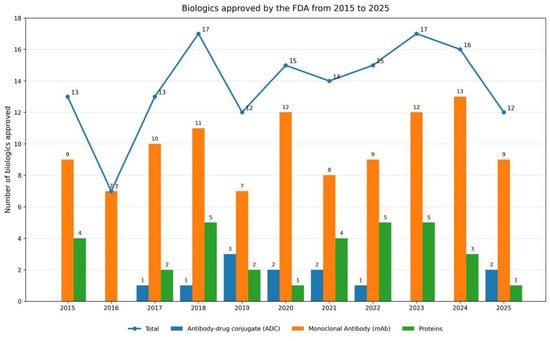
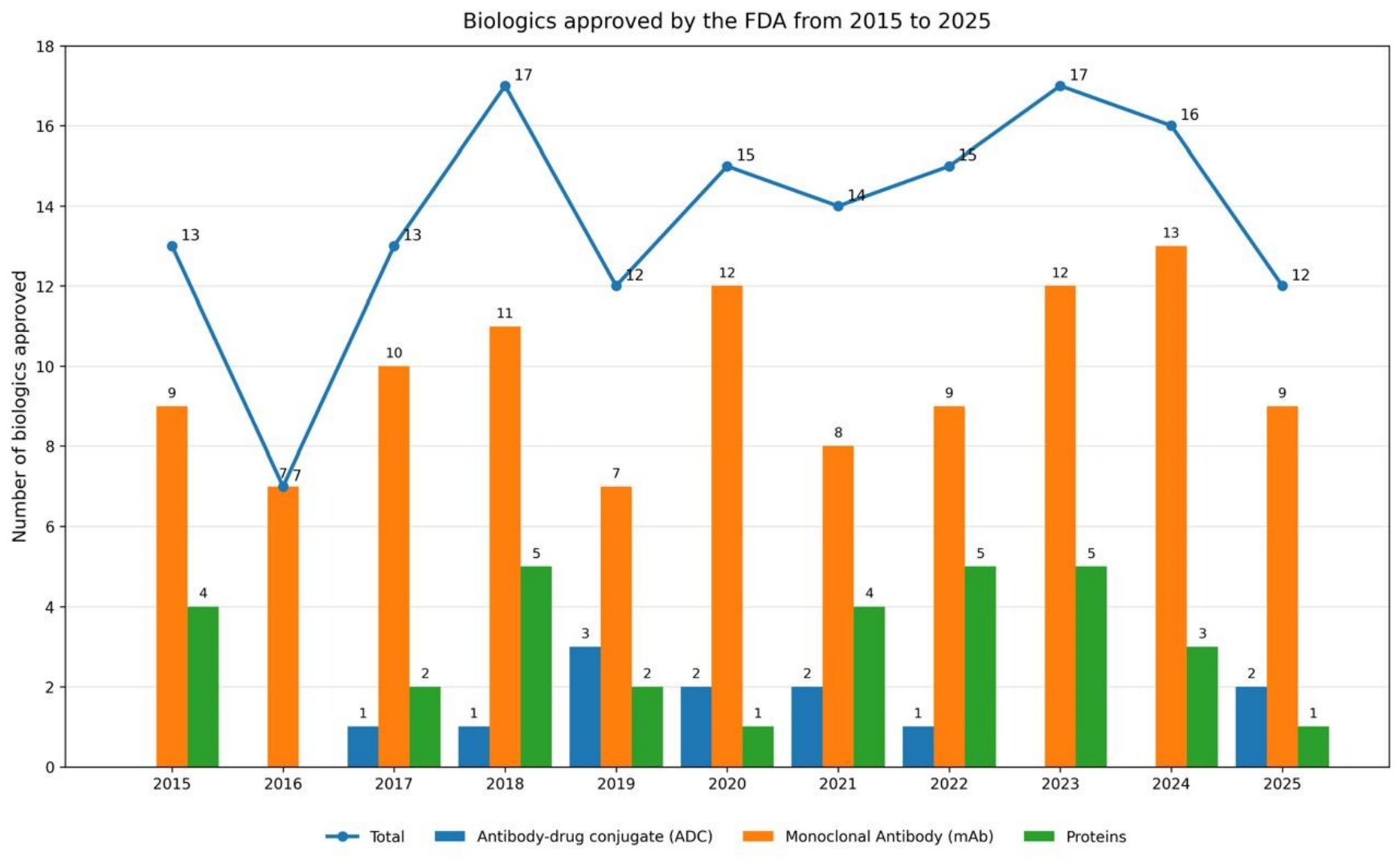
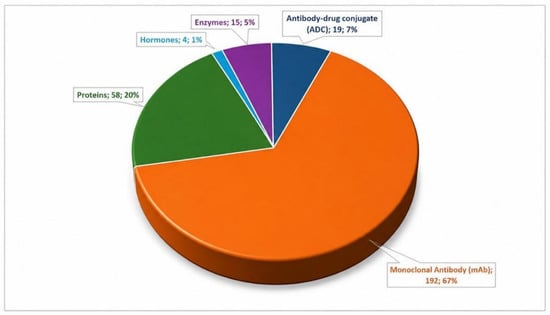
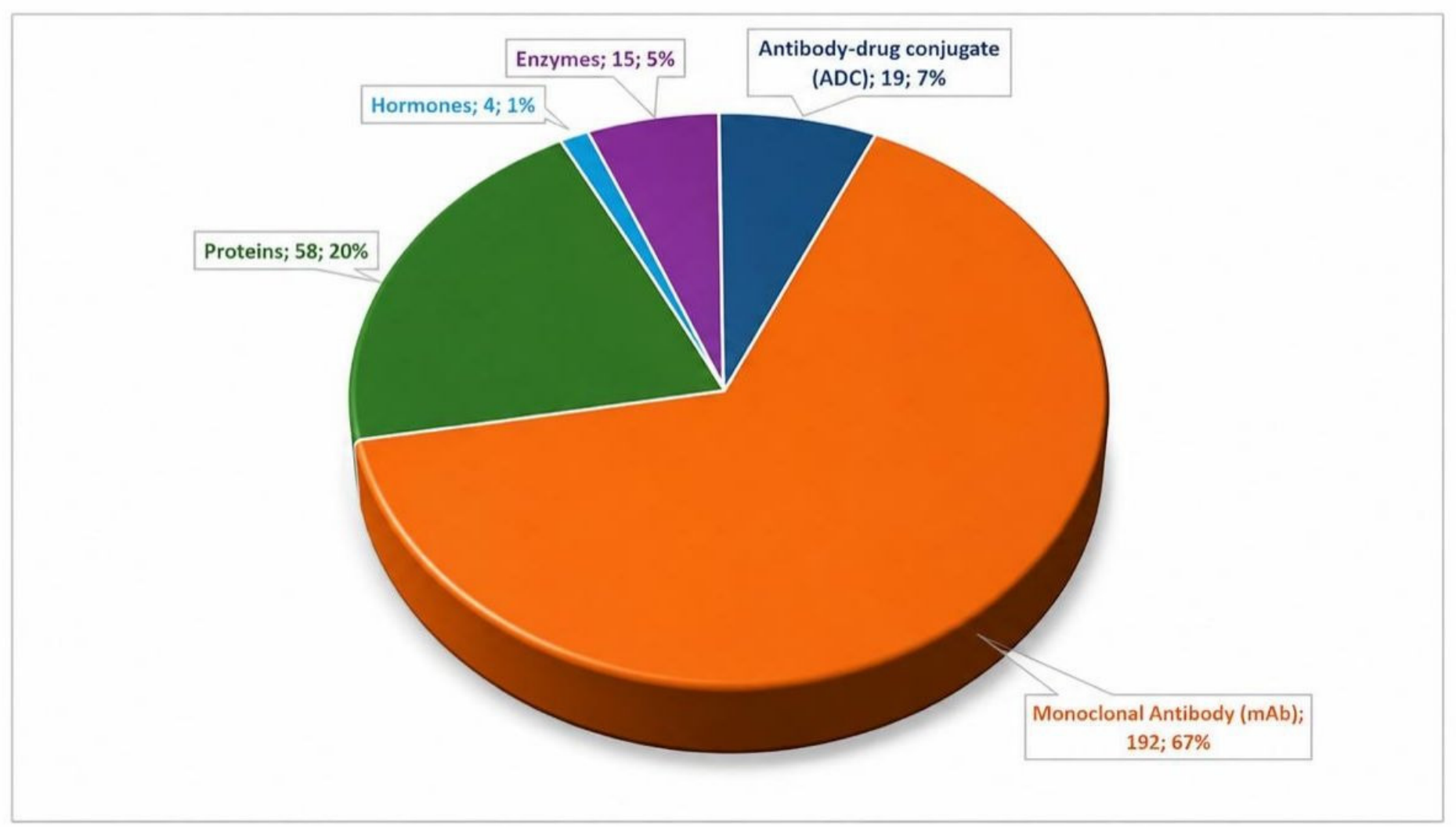
Of these, 12 biological therapeutics were approved. Eleven were antibody-based products, including two antibody–drug conjugates (ADCs), and one was a fusion protein. Unlike the year 2024, as of now one bispecific antibody was approved in 2025; no chimeric monoclonal antibody was identified among the new biologics [1]. Figure 1 and Figure 2 illustrate, respectively, biologics and the percentage of new biopharmaceuticals approved by FDA in the last 10 years keeping the main trend of innovation technology and main therapeutic focus.
Figure 1.
Biologics approved by the FDA from 2015 to 2025. This figure includes publicly available data from FDA databases.
Figure 2.
Percentage of new biopharmaceuticals approved by the FDA from 2015 to 2025. This figure includes publicly available data from FDA databases.
2. Analysis
Changing the pattern of previous years, in the 2025 approvals it was possible to note treatment possibilities for different categories of disease listed below in Table 2 with a little less emphasis on cancer than the year before, although it remains the disease receiving the greatest pharmaceutical focus. Table 2 also shows the biologics approved by the FDA at the same year.
Table 2.
Biologics approved by the FDA in 2025.
As with the previous study published by the same group [2], this article also explores in detail key aspects of the biological drugs approved in 2025, including those that received Orphan Drug Designation (ODD) and those that utilized FDA expedited programs. It also addresses first-in-class biological therapeutics—as defined by the FDA/CDER—their mechanisms of action, and the results of key clinical trials supporting the most significant approvals. This study continues the analysis of year-by-year drug approvals, examining the correlation with ODD approvals and highlighting the main conclusions drawn from the 2025 findings.
Over the past decade, the development and approval of biological therapeutics have expanded significantly, the FDA’s Center for Drug Evaluation and Research (CDER) granted Orphan Drug Designation to and approved various therapies for rare diseases affecting fewer than 200,000 people in the U.S. Among the 46 novel drugs approved by the U.S. Food and Drug Administration (FDA) in 2025, 23 (50%) received Orphan Drug Designation; however, only 11 are characterized as mAbs and one protein fusion (26%) evaluated in this study. Within this group, five biologic therapies based on monoclonal or bispecific antibodies were identified: garadacimab-gxii, nipocalimab-aahu, linvoseltamab-gcpt, penpulimab-kcqx, and narsoplimab-wuug, targeting hereditary angioedema, generalized myasthenia gravis, multiple myeloma, nasopharyngeal carcinoma, and hematopoietic stem cell transplant-associated thrombotic microangiopathy, respectively [1]. Table 3 provides a quantitative analysis of FDA-granted Orphan Drug Designations (ODD) and Table 4 highlights the 5 Orphan Drug Designations of mAbs approved.
Table 3.
Orphan Drug Designations granted by the FDA from 2015 to 2025.
Table 4.
Orphan-designated biologics among novel FDA drug approvals in 2025.
Scientific evidence supporting the clinical development of these agents includes the pivotal VANGUARD phase 3 trial of garadacimab [13], the phase 3 Vivacity-MG3 trial of nipocalimab [14], the pivotal clinical study of narsoplimab in hematopoietic stem cell transplantation-associated thrombotic microangiopathy [15], and phase I/II and phase II clinical studies evaluating linvoseltamab and penpulimab, respectively [16,17].
What stood out compared to the previous year was that, in 2025, two mAbs were approved for pediatric use—one for treatment and the other for prevention. They cover widely differing age groups, as well as highly specific therapeutic approaches. Enflonsia™ is a human monoclonal antibody responsible for prevention of respiratory syncytial virus (RSV) in lower respiratory tract disease in neonates and infants entering their first RSV season, which differs from the other biologics, whose function is treatment rather than prevention, representing a significant innovation for the medical field, once it acts as a vaccine, which has an extended half-life and high levels in the nasal epithelial lining and high safety and efficacy profiles, according to Kelleher et al., 2025 [18].
The drug Keytruda (pembrolizumab) is also indicated for pediatric patients with several malignancies. In 2017, the FDA approved pembrolizumab for pediatric patients aged ≥2 years with relapsed or refractory classical Hodgkin lymphoma. In the same year, pembrolizumab received a tumor-agnostic indication for pediatric and adult patients with unresectable or metastatic microsatellite instability-high (MSI-H) or mismatch repair-deficient (dMMR) solid tumors [19]. Subsequent pediatric indications have expanded its use across multiple solid tumors. Pediatric clinical evidence for MSI-H solid tumors has also been reported from the KEYNOTE-051 study [20]. In 2025, Keytruda Qlex, a subcutaneous formulation combining pembrolizumab with berahyaluronidase alfa-pmph, was approved for adults and pediatric patients aged ≥12 years with solid tumor indications already approved for intravenous pembrolizumab [21].
The drugs approved in 2025 are presented in detail below.
3. Biologics in 2025
3.1. Biologics for Cancer
3.1.1. Datroway—HER2-Negative Breast Cancer
Breast cancer is the most commonly diagnosed cancer worldwide, with an estimated 2.3 million new cases (11.7% of all cancers) and nearly 685,000 deaths (6.9%) in 2020. HR-positive/HER2-negative breast cancer, defined by the presence of estrogen and/or progesterone receptors and absence of HER2 amplification, accounts for approximately 65–70% of all breast cancers and is the most prevalent subtype. Incidence increases with age, and the median age at diagnosis is about 61 years. Rates are highest in White women (138 per 100,000), followed by Black women (112 per 100,000) and Hispanic and Asian/Pacific Islander women (94–97 per 100,000). Most patients present with localized disease, but 3–6% have de novo metastatic disease, and 10–30% of those with early-stage disease later develop systemic recurrence. For unresectable or metastatic HR-positive/HER2-negative breast cancer, endocrine therapy remains the cornerstone of treatment, often combined with CDK4/6 inhibitors, which have significantly improved overall survival. Chemotherapy is generally reserved for cases with endocrine resistance, while novel endocrine agents and antibody–drug conjugates are reshaping the treatment landscape. As new options emerge, optimizing treatment sequencing is critical to maximize clinical benefit and minimize toxicity in this challenging setting [22,23].
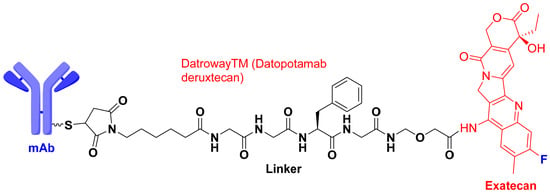
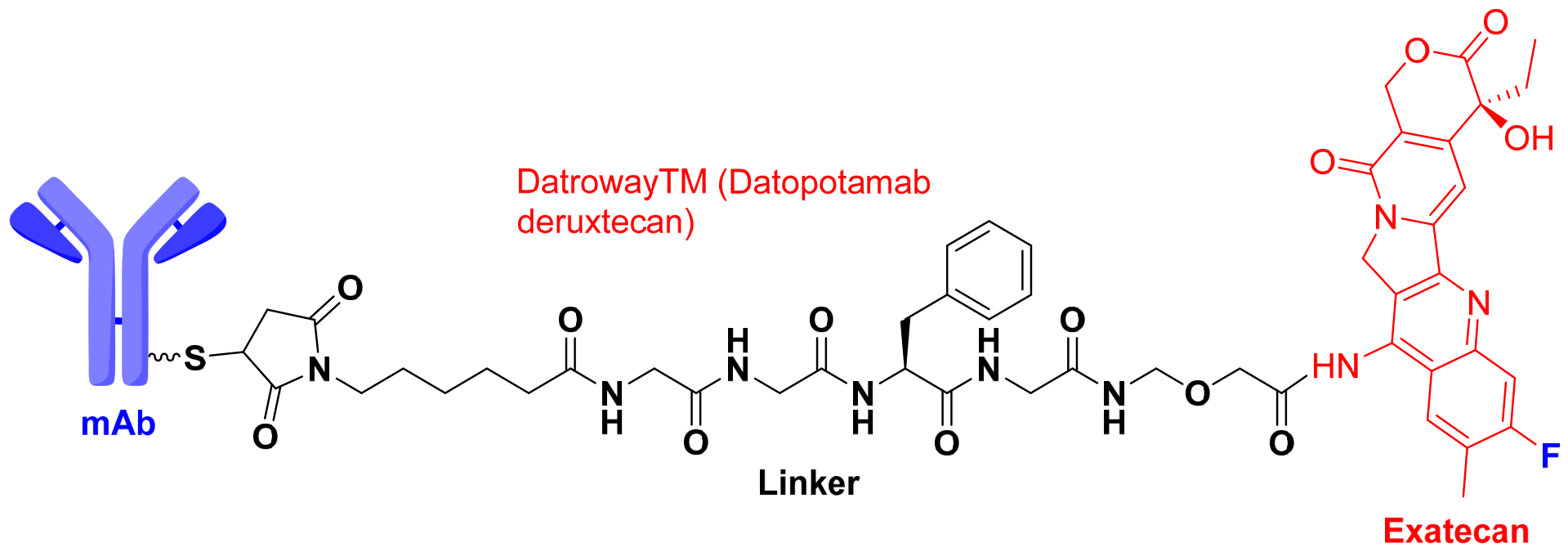
The most recent approval by the FDA DATROWAY® (datopotamab deruxtecan-dlnk) (Figure 3) is a Trop-2-directed antibody–drug conjugate that delivers a topoisomerase inhibitor to cancer cells. It is indicated for adults with hormone receptor (HR)-positive, HER2-negative breast cancer that is unresectable or metastatic and who have previously received endocrine-based therapy and chemotherapy for advanced disease. The drug is administered as an intravenous infusion once every three weeks [1,24,25].
Figure 3.
Structure of DatrowayTM [26].
Datopotamab deruxtecan (Dato-DXd) is a TROP2-directed antibody–drug conjugate (ADC) designed to selectively target tumor cells. It consists of a humanized anti-TROP2 IgG1 monoclonal antibody conjugated to a potent topoisomerase I inhibitor payload (DXd) via a plasma-stable, protease-cleavable maleimidocaproyl-GGFG tetrapeptide linker. Upon binding to TROP2, which is highly expressed in various epithelial cancers and associated with poor prognosis, the ADC is internalized into the tumor cell, and DXd is released, inhibiting DNA unwinding and replication, leading to cell death. The DXd-ADC technology platform provides desirable characteristics for ADCs, including a highly potent payload with a short systemic half-life, a cleavable linker designed to be tumor selective and stable in circulation, and an optimized drug-to-antibody ratio (DAR) of 4 for Dato-DXd, compared with approximately 8 for trastuzumab deruxtecan, maximizing the therapeutic window [24].
In the phase 3 TROPION-Breast01 trial, 732 patients with unresectable or metastatic HR-positive, HER2-negative breast cancer who had received prior endocrine therapy and chemotherapy were randomized to datopotamab deruxtecan (Dato-DXd) or investigator’s choice of chemotherapy (eribulin, capecitabine, vinorelbine, or gemcitabine). Dato-DXd significantly improved progression-free survival compared with chemotherapy (median 6.9 months vs. 4.9 months; HR 0.63; 95% CI: 0.52–0.76; p < 0.0001) and achieved a higher objective response rate (36% vs. 23%). Median overall survival was similar between arms (18.6 vs. 18.3 months; HR 1.01; 95% CI: 0.83–1.22; p = NS). The safety profile showed lower rates of grade ≥3 treatment-related adverse events with Dato-DXd compared to chemotherapy (20.8% vs. 44.7%) (Journal of Clinical Oncology). Common adverse events included stomatitis, nausea, fatigue, alopecia, and ocular surface disorders, while interstitial lung disease (ILD) occurred at low rates, with no new grade ≥3 ILD events reported [25,26].
3.1.2. Penpulimab-kcqx—Recurrent or Metastatic Non-Keratinizing Nasopharyngeal Carcinoma (NPC)
Nasopharyngeal carcinoma (NPC) is an epithelial malignancy of the nasopharynx that frequently demonstrates squamous differentiation. Its anatomical origin is classically traced to the lateral nasopharyngeal wall, particularly the Fossa of Rosenmüller, with the superior posterior wall representing the second most common site. In the most recent World Health Organization classification, NPC is delineated into three major histological subtypes: non-keratinizing squamous cell carcinoma (NK-NPC), keratinizing squamous cell carcinoma (K-NPC), and basaloid squamous cell carcinoma. Among these, NK-NPC predominates worldwide and shows a strong and well-established association with Epstein–Barr virus (EBV) infection. This histopathologic framework remains fundamental in contemporary epidemiologic, diagnostic, and therapeutic research on NPC [27].
Globally, nasopharyngeal carcinoma remains relatively rare, with approximately 120,434 new cases and 73,482 deaths reported in 2022. The disease shows a pronounced regional concentration, occurring most frequently in Southeast Asia—especially Southern China—as well as in parts of East Asia and North Africa [28].
The most recent approval of the FDA, Penpulimab-kcqx is an anti-PD-1 monoclonal antibody approved for the treatment of non-keratinizing nasopharyngeal carcinoma (NPC). In the first-line setting, it is administered in combination with either cisplatin or carboplatin plus gemcitabine for adults with recurrent or metastatic disease. Penpulimab-kcqx is also indicated as monotherapy for patients with metastatic non-keratinizing NPC whose disease has progressed following platinum-based chemotherapy and at least one additional prior systemic regimen. When used in combination therapy, it is administered intravenously every three weeks until disease progression or for a maximum duration of 24 months. As a single agent, penpulimab-kcqx is given at the same dose every two weeks, following the same duration limits [29,30].
PENPULIMAB-KCQX received FDA approval based on two key trials: the phase III AK105-304 study, and the phase II AK105-202 trial. In the randomized AK105-304 trial, PENPULIMAB-KCQX combined with platinum-based chemotherapy and gemcitabine produced a statistically significant improvement in progression-free survival as assessed by blinded independent central review, compared with the corresponding placebo-based regimen. No meaningful difference in overall survival was observed between treatment arms. In the single-arm AK105-202 study, PENPULIMAB-KCQX monotherapy demonstrated measurable antitumor activity, with responses that were durable across the treated population [30].
3.1.3. EMRELIS—Telisotuzumab Vedotin-tllv
Lung cancer is the leading cause of cancer-related mortality in men and women around the world. There are two major groups of lung cancer named small-cell lung cancer (SCLC) and non-small-cell lung cancer (NSCLC). The groups of NSCLC comprise about 85% of all lung cancer cases. Of its variants, non-squamous NSCLC also encompasses adenocarcinoma, large cell carcinoma, and other non-squamous histology. Research in molecular oncology has led to the discovery of the C-MET protein (also known as MET or mesenchymal–epithelial transition factor) used as a diagnostic and therapeutic biomarker. Because it is a tyrosine kinase receptor, c-Met protein deals with cell growth, cell survival, cell motility, and cell angiogenesis. When it is overexpressed or modified, it may cause uncontrolled tumor growth and metastasis in advanced cases. c-Met overexpressing NSCLC is associated with poor prognosis and limited treatment approaches as well as resistance to conventional therapy [31].
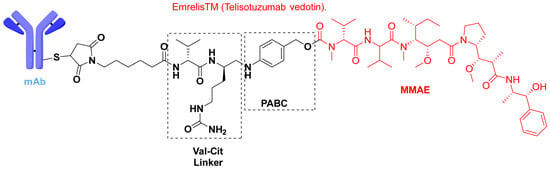
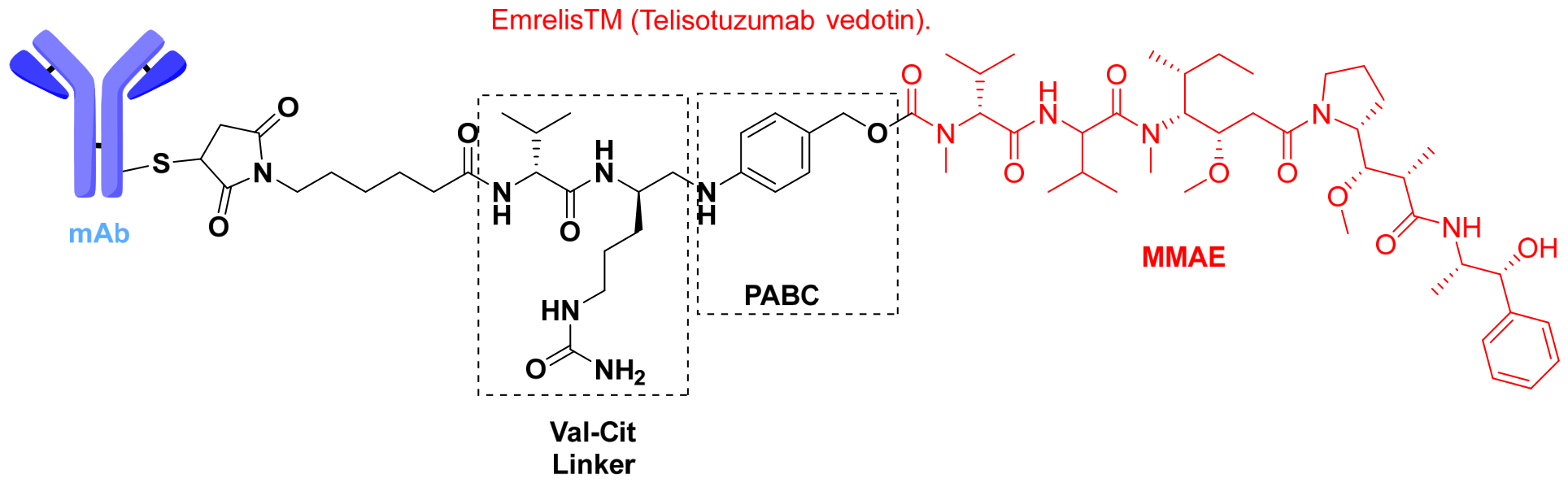
Due to poor prognosis of these types of cancer, new treatment has been developed. EMRELISTM (telisotuzumab vedotin-tllv), an intravenous infusion administered over 30 min every 2 weeks, is a c-Met-directed antibody and microtubule inhibitor conjugate indicated for the treatment of adult patients with locally advanced or metastatic non-squamous non-small-cell lung cancer (NSCLC) showing high c-Met protein overexpression by immunohistochemistry [≥50% of tumor cells with strong (3+) staining in label]. On 14 May 2025, telisotuzumab vedotin (Figure 4), developed by AbbVie, received accelerated approval in the USA for the treatment of this type of cancer—from one clinical trial (LUMINOSITY/NCT03539536)’s evidence, as determined by an FDA-approved test—for those who have received a prior systemic therapy. Still there are few studies related to this antibody in Pubmed. Further research is necessary to establish the prognosis of this disease with this treatment [32,33].
Figure 4.
Structure of Telisotuzumab vedotin-tllv.
3.1.4. KEYTRUDA QLEX™—Pembrolizumab and Berahyaluronidase Alfa-pmph
KEYTRUDA QLEX is approved for use in a broad range of oncologic indications, mainly involving solid tumors such as melanoma, lung cancer, head and neck cancer, urothelial carcinoma, gastrointestinal malignancies, gynecologic cancers, hepatobiliary tumors, renal cell carcinoma, cutaneous malignancies, and breast cancer, as well as tumors defined by specific molecular characteristics including microsatellite instability-high (MSI-H), mismatch repair deficiency (dMMR), and high tumor mutational burden (TMB-H). The therapy is primarily indicated for adult patients, with selected indications also including pediatric patients aged 12 years and older, particularly in melanoma, Merkel cell carcinoma, MSI-H or dMMR solid tumors, and TMB-H solid tumors [34].
KEYTRUDA QLEX is a subcutaneous co-formulation of pembrolizumab, a monoclonal antibody that targets the PD-1 receptor, preventing its interaction with the ligands PD-L1 and PD-L2. This mechanism promotes activation of T-cell-mediated immune responses directed against tumor cells [35,36]. The formulation enables pembrolizumab administration through a rapid subcutaneous injection, typically completed within approximately 1–2 min, offering an alternative to conventional intravenous administration, which generally requires approximately 30 min of infusion time.
Berahyaluronidase alfa, a human hyaluronidase variant developed by Alteogen Inc., enhances tissue permeability by temporarily degrading the extracellular matrix at the site of injection, which promotes drug dispersion [37].
Keytruda (pembrolizumab) represents a significant innovation in oncology, introducing immune checkpoint inhibition as a new therapeutic approach. Initially approved by the U.S. Food and Drug Administration in September 2014 for unresectable or metastatic melanoma, it shifted cancer treatment from cytotoxic chemotherapy to immune-mediated tumor control by targeting the PD-1 receptor on T lymphocytes. Its clinical expansion progressed rapidly, including approval for non-small-cell lung cancer in 2015 and subsequent indications across multiple tumor types. A major milestone occurred in 2016–2017 with the first tumor-agnostic approval based on microsatellite instability-high (MSI-H) or mismatch repair deficiency (dMMR), establishing a framework centered on molecular characteristics rather than tissue origin. Continued expansion throughout the 2020s reinforced its role as a key therapy in modern oncology [34].
Clinical safety data for KEYTRUDA QLEX were derived from multiple randomized and single-arm clinical trials evaluating pembrolizumab as monotherapy or in combination regimens across different tumor types. These analyses included patients treated with intravenous pembrolizumab in controlled studies such as KEYNOTE-002, KEYNOTE-006, and KEYNOTE-010, as well as a single-arm study (KEYNOTE-001), involving patients primarily with melanoma and non-small-cell lung cancer. Across these trials, treatment exposure varied, with a substantial proportion of patients receiving therapy for six months or longer. The most frequently reported adverse reactions in combination regimens included nausea, fatigue, and musculoskeletal pain, while immune-mediated and hypersensitivity-related reactions were identified as clinically significant safety concerns [21,36].
3.2. Biologics for Other Diseases
3.2.1. Nipocalimab-aahu (IMAAVY®)
Myasthenia gravis (MG) is a rare illness. This disease has an annual incidence of approximately 4.1 to 30 cases per million individuals, while its prevalence is estimated to be between 150 and 200 cases per million. It is an autoimmune disorder characterized by variable, fatigable muscle weakness that can affect the eye, bulbar, respiratory, axial, and limb musculature. This condition is caused by antibodies that interfere with acetylcholine receptors (AChRs) and it represents the most common pathology involving the neuromuscular junction. In addition, factors such as infections, stress, surgical procedures, thymic disorders, and drug-related adverse effects may contribute to its onset or progression [37,38].
On 29 April 2025, Nipocalimab was approved by the FDA for the treatment of generalized myasthenia gravis in adult and pediatric patients ≥ 12 years of age who are anti-acetylcholine receptor or anti-muscle-specific tyrosine kinase antibody positive. Nipocalimab is a human IgG1 monoclonal antibody that binds the neonatal Fc receptor (FcRn) with high affinity across neutral and acidic pH, leading to reduced circulating IgG, including pathogenic antibodies. Structural and preclinical studies demonstrate pH-independent FcRn binding and dose-dependent IgG reduction, without measurable effects on other immune functions, supporting its potential use in IgG-mediated diseases [39].
The FDA approval is supported by positive findings from multiple clinical trials. In the phase 3 VIVACITY-MG3 randomized, double-blind, placebo-controlled study, patients demonstrated rapid and clinically meaningful improvements in MG-ADL (Myasthenia Gravis Activities of Daily Living) scores within the first week of treatment, with sustained efficacy throughout the study period. Concurrently, the phase 2/3 VIBRANCE-MG trial in pediatric patients showed a significant reduction in immunoglobulin G (IgG) levels over 24 weeks, with several participants achieving minimal disease activity [14,40].
There are other biologics that have previously been approved by the FDA, such as efgartigimod and rozanolixizumab, which are personalized therapies providing effective treatment for myasthenia gravis. Future research should further evaluate and compare the long-term outcomes of these treatments. However, nipocalimab is distinguished by its approval for use in pediatric patients aged 12 years and older. In study 1, the most frequently reported adverse reactions in patients treated with IMAAVY (occurring in at least 10% of cases) were respiratory tract infections, peripheral edema, and muscle spasms [39,41,42].
3.2.2. Enflonsia—Clesrovimab-cfor
Respiratory syncytial virus (RSV) is the most frequent cause of severe respiratory tract infections (RTIs) affecting around 75,000 to 125,000 infants and children annually only in the USA. From 1995 to 2016, there were approximately 27,000 hospital deaths related to acute respiratory infections. RSV-associated acute lower RTIs, with 45% of admissions and deaths occurring in infants less than 6 months of age, constitute a global public health problem [43].
ENFLONSIA™ (clesrovimab-cfor) injection, for intramuscular use developed by Merck Sharp Dohme, is a fusion inhibitor targeting the F protein of respiratory syncytial virus (RSV). It binds a highly conserved epitope at antigenic site IV of the RSV fusion protein, blocking viral entry into host cells and conferring passive immunity. Clesrovimab received its first US approval on 9 June 2025 for preventing RSV of lower respiratory tract diseases in neonates and infants born during RSV season or experiencing this period for the first time [44,45].
There are two previously developed antibodies for RSV, Palivizumab and Nirsevimab. Clesrovimab offers simplified dosing, favorable safety, and potential cost savings compared with palivizumab and nirsevimab. While nirsevimab has a longer half-life, clesrovimab’s unique binding site and room-temperature stability offer practical advantages. Clesrovimab is a promising treatment to RSV as a prevention strategy, offering effective, safe, and accessible immunization for infants. Current research that is being carried out will establish its role in high-risk populations and broader clinical use [43,45].
3.2.3. Lynozyfic—Linvoseltamab-gcpt
Multiple myeloma (MM) is a condition characterized by the accumulation of clonal, malignant plasma cells in the bone marrow. The cause of myeloma is still unknown. Radiation may be a factor in some cases (although there is no association with therapeutic radiation). Exposure to industrial/agricultural toxins or viruses have all been considered, but not proofed yet. Despite significant advancements, MM remains incurable, and there is still a pressing need for new therapeutic strategies with highly selective mechanisms of action and balanced off-target toxicity [46].
LYNOZYFIC™ (linvoseltamab-gcpt) injection, for intravenous use, is an orphan drug and a bispecific B-cell maturation antigen (BCMA)-directed CD3 T-cell engager indicated for the treatment of adult patients with relapsed or refractory multiple myeloma who have received at least four prior lines of therapy, including a proteasome inhibitor, an immunomodulatory agent, and an anti-CD38 monoclonal antibody. This indication was approved under accelerated approval based on response rate and durability of response. Linvoseltamab was developed by Regeneron Pharmaceuticals, Inc. for multiple indications including multiple myeloma and received its first approval on 28 Apr 2025 in the EU [47,48].
3.2.4. Andembry—Garadacimab
Hereditary angioedema (HAE) is a rare genetic condition with potentially life-threatening consequences, characterized by recurrent swelling episodes. These manifestations are driven by excessive bradykinin production resulting from dysregulation of the activated factor XII (FXIIa)–mediated kallikrein–kinin pathway, which promotes local vasodilation and increased vascular permeability [49,50].
There are three types of HAE: types 1 and 2 hereditary angioedema arise from mutations in the SERPING1 gene, which encodes the C1 inhibitor. This serine protease inhibitor is essential for controlling multiple biological pathways, including the coagulation cascade, the contact activation system responsible for bradykinin generation, the fibrinolytic pathway, and the complement system. Type 3 hereditary angioedema is strongly influenced by estrogen and is commonly described as estrogen-dependent HAE. It occurs primarily in women, with symptom onset or exacerbation frequently observed during pregnancy or following exposure to estrogen-containing contraceptives. Elevated estrogen concentrations are associated with increased activation of factor XII, which amplifies bradykinin generation through a positive feedback process [50].
Garadacimab-gxii is a monoclonal antibody, first-in-class, that targets activated factor XII by binding to its catalytic site, thereby inhibiting the activity of FXIIa and βFXIIa. Factor XII plays a key role as the initiating component of the contact activation pathway, leading to activation of the kallikrein–kinin system and increased bradykinin production. By blocking FXIIa, garadacimab prevents the conversion of prekallikrein to kallikrein and reduces bradykinin generation. This mechanism limits the inflammatory and edema-forming processes responsible for hereditary angioedema attacks. It was approved by FDA in June 2025 [51,52].
In clinical trials, garadacimab significantly reduced mean HAE attack rates from the first administration in the pivotal phase III VANGUARD (NCT04656418) study and open-label extension (OLE) (NCT04739059), demonstrating sustained efficacy over time. Long-term administration of Garadacimab resulted in persistent improvements in quality of life, functional capacity, and overall treatment experience in patients with HAE, supporting durable disease control and a meaningful return to normal daily activities [53,54].
3.2.5. Voyxact—Sibeprenlimab-szsi
IgA nephropathy (IgAN) is a chronic immune-mediated kidney disease characterized by deposition of IgA-containing immune complexes in the glomerulus, leading to inflammation, scarring, and progressive renal damage. It is the most common immune-mediated glomerular disease worldwide, affecting an estimated 198,887 to 208,184 individuals in the United States, with up to 50% of patients progressing to kidney failure within 10 years of diagnosis. The disease typically occurs in younger adults, with a mean age at diagnosis between 34 and 45 years, and commonly presents with hematuria or proteinuria, with approximately 60% of cases identified incidentally during urinalysis. Proteinuria is a key feature in suspected cases, and patients with levels ≥0.5 g/day are recommended to undergo kidney biopsy to confirm the diagnosis through identification of IgA-dominant immune deposits after exclusion of secondary causes [55].
Current treatments for IgA nephropathy mainly address general mechanisms such as blood pressure and proteinuria control but do not directly target underlying immune drivers, leaving patients at risk for progressive kidney damage. The disease develops through a four-hit autoimmune process involving increased Gd-IgA1, autoantibody production, immune complex formation, and mesangial deposition, which triggers inflammation and renal injury. APRIL plays a central role in this pathway by promoting production and persistence of pathogenic plasma cells, and the TNFSF13 gene encoding APRIL has been identified as a susceptibility factor. These findings support targeted inhibition of APRIL, and VOYXACT—sibeprenlimab is a humanized IgG2 monoclonal antibody against APRIL [56].
VOYXACT is an APRIL (A Proliferation-Inducing Ligand) blocker indicated to reduce proteinuria in adults with primary IgA nephropathy (IgAN) who are at risk of disease progression. This indication was granted under accelerated approval based on reduction in proteinuria, although its long-term effect on kidney function decline has not yet been established and remains subject to confirmation in further clinical trials. Safety was evaluated in the randomized, double-blind, placebo-controlled VISIONARY study, in which median treatment duration was 44 weeks for VOYXACT and 48 weeks for placebo. The most commonly reported adverse reactions occurring in at least 10% of patients and at higher frequency than placebo were infections and injection-site reactions, particularly upper respiratory infections and injection-site erythema, with most events described as mild to moderate and resolving without treatment interruption [57,58].
3.2.6. Exdensur—Depemokimab-ulaa
Exdensur, also known as depemokimab-ulaa, is an interleukin-5 (IL-5) antagonist, an ultra-long-acting monoclonal antibody (humanized immunoglobulin G [IgG]1 kappa) indicated for adjunctive maintenance treatment of severe asthma characterized by an eosinophilic phenotype in adult and pediatric patients 12 years of age and older. This medication was approved by the U.S. FDA on December 16th 2025 based on evidence from two clinical trials of 762 adult and pediatric patients with asthma conducted in 23 countries around the world [59,60].
The SWIFT-1 (NCT04719832) and SWIFT-2 (NCT04718103) clinical trials were multicenter, randomized, double-blind, placebo-controlled studies lasting 52 weeks. Patients had to have a documented medical diagnosis of asthma for at least two years, with persistent symptoms despite treatment with a medium-to-high-dose inhaled corticosteroid, in addition to at least one other asthma control medication, with or without maintenance of oral corticosteroids. According to both studies, all patients maintained their baseline asthma therapy during the trials. Furthermore, this monoclonal antibody is also suitable to treat chronic rhinosinusitis with nasal polyps (CRSwNP), chronic obstructive pulmonary disease, eosinophilic granulomatosis with polyangiitis and hypereosinophilic syndrome only using twice a year. Still on asthma, patients treated with depemokimab showed a 54% lower rate of exacerbations, indicating an estimated 1.66 years of treatment needed to prevent an exacerbation [59,61].
3.2.7. Lerochol—Lerodalcibep
Familial hypercholesterolemia (FH) is a genetic metabolic disorder inherited in an autosomal dominant pattern, characterized by elevated levels of low-density lipoprotein (LDL) cholesterol in the blood. It is most commonly caused by mutations in the LDL receptor (LDLR) gene on chromosome 19, which impairs the body’s ability to remove LDL from circulation. The accumulation of LDL leads to early development of atherosclerosis, increasing the risk of premature cardiovascular disease. FH can occur in two forms: heterozygous (HeFH), when one gene is affected and the condition is less severe, and homozygous (HoFH), when both genes are mutated, resulting in a rarer but more aggressive form with earlier complications. In addition to LDLR mutations, other genes such as apolipoprotein B (apoB), PCSK9, and LDLRAP1 may also be involved [62].
Lerodalcibep (lerodalcibep-liga; LEROCHOL®) was first approved in the United States on 12 December 2025. It is indicated as an add-on to lifestyle measures such as diet and physical activity to lower LDL cholesterol levels in adults with hypercholesterolemia, including those with heterozygous familial hypercholesterolemia [63].
This drug is a recombinant fusion protein engineered to bind PCSK9 with very high affinity. Physiologically, PCSK9 interacts with LDL receptors (LDLRs) on hepatocytes and directs them toward lysosomal degradation, thereby reducing receptor recycling and LDL clearance. By inhibiting this interaction, lerodalcibep-liga prevents LDLR degradation, increases receptor density on the hepatocyte surface, and enhances the hepatic uptake of circulating LDL cholesterol, resulting in lower plasma LDL-C levels [63].
The FDA approval of Lerodalcibep was supported by data from three clinical trials. Two studies (NCT04797247; NCT04806893) included 1,844 adults with established or high-risk atherosclerotic cardiovascular disease (ASCVD), while a third trial (NCT04797104) involved 478 patients with heterozygous familial hypercholesterolemia (HeFH). Clinical trials showed that LEROCHOL significantly lowered LDL-C levels, achieving reductions of 60% or more in patients with cardiovascular disease or elevated cardiovascular risk, and around 59% in those with heterozygous familial hypercholesterolemia (HeFH), a group characterized by particularly high LDL-C levels [64].
Evolocumab (Repatha) is a drug approved by the FDA on 27August 2015. The LIBerate-HoFH phase 3 randomized, open-label crossover trial (NCT04034485) evaluated lerodalcibep versus evolocumab in patients aged ≥10 years with homozygous familial hypercholesterolemia on background lipid-lowering therapy, using two 24-week treatment periods separated by a washout; both drugs led to modest and variable LDL cholesterol reductions, with evolocumab achieving slightly greater lowering, meaning non-inferiority of lerodalcibep was not demonstrated, although individual responses were generally consistent across treatments, no clear predictors of response were identified, and both therapies were well tolerated with few adverse events [65,66].
4. Conclusions
The FDA approval of 12 novel biologics in 2025 reinforces the sustained importance of biological therapeutics in modern drug development. Although biologics represented 26% of the 46 novel drugs approved during the year, a slightly lower proportion than observed in several previous years, they continue to account for approximately one-third of all FDA novel drug approvals over the last decade. This sustained contribution demonstrates that, despite fluctuations in the total number of approvals each year, biologics continue to occupy a central position in drug development, largely due to advances in antibody engineering, protein design, molecular biology, and translational medicine.
One of the most remarkable characteristics of the 2025 approvals was the broad diversification of therapeutic areas. While oncology continued to represent the largest area of biologic development, accounting for approvals targeting breast cancer, nasopharyngeal carcinoma, non-small-cell lung cancer, and multiple myeloma, nearly half of the newly approved biologics addressed non-oncological diseases. These included generalized myasthenia gravis, hereditary angioedema, respiratory syncytial virus infection, IgA nephropathy, eosinophilic asthma, hypercholesterolemia, and hematopoietic stem cell transplant-associated thrombotic microangiopathy. This diversification reflects an expanding application of biologics beyond cancer treatment and demonstrates how advances in molecular immunology have accelerated the development of targeted therapies for chronic, rare, and immune-mediated disorders.
Monoclonal antibodies remained the dominant class of biologics approved in 2025, accounting for eleven of the twelve new products. However, these approvals also demonstrate the growing diversity of antibody-based technologies, including antibody–drug conjugates (ADCs), bispecific antibodies, and engineered formulations. Beyond identifying novel therapeutic targets, recent innovations have focused on improving pharmacokinetic properties, reducing immunogenicity, and enhancing treatment convenience. For example, KEYTRUDA QLEX® (pembrolizumab and berahyaluronidase alfa) introduces a subcutaneous formulation that may improve patient comfort and reduce healthcare resource utilization.
The approval of datopotamab deruxtecan and telisotuzumab vedotin further highlights the growing importance of ADCs in oncology. These next-generation conjugates combine highly selective antibodies with potent cytotoxic agents, providing greater tumor specificity while reducing systemic toxicity. Their approval reflects continued advances in ADC technology and reinforces the growing role of this therapeutic platform in precision cancer treatment.
A key feature of this work is that, in addition to listing and detailing biological products, it highlights two drugs that are bringing about changes in the landscape of pediatric prevention and treatment.
Note that a comparison with other agencies is possible but not strictly equivalent. In 2025, the EMA recommended 104 medicines, 38 out of them with new active substances vs. 46 novel FDA approvals. The FDA figure covers only CDER products, excluding vaccines and gene therapies, while the EMA’s includes all product types. The EMA also issues only a recommendation, with final authorization granted by the European commission.
In the end, despite the pharmaceutical industry’s annual technological advances, the introduction of these biologicals into the market remains a major challenge for the pharmaceutical industry to overcome, particularly in underdeveloped countries, given that the proposed technologies entail high costs and restricted access for low-income populations.
The future advancements in biological therapeutics would be shaped by innovations in antibody engineering, next ADCs generations, targeted proteins, multispecific antibodies and more accessible manufacturing technologies. Eventually translating these medical interventions into more beneficial clinical use depends on the therapeutic efficacy, safety, accessibility, affordability and sustainable global distribution.
Author Contributions
Conceptualization, A.C.M., B.d.l.T. and F.A.; formal analysis, A.C.M.; investigation, A.C.M., B.N.S., M.Y.O., M.S.d.S. and R.S.; writing—original draft preparation, A.C.M., B.N.S., M.Y.O., M.S.d.S. and R.S.; writing—review and editing, all authors. All authors have read and agreed to the published version of the manuscript.
Funding
The work carried out at UKZN is partially sponsored by the University of KwaZulu-Natal.
Institutional Review Board Statement
Not applicable.
Informed Consent Statement
Not applicable.
Data Availability Statement
No new data were created or analyzed in this study.
Conflicts of Interest
The authors declare no conflicts of interest.
References
- US Food and Drug Administration. Advancing Health Through Innovation: New Drug Therapy Approvals 2025; US Food and Drug Administration: Silver Spring, MD, USA, 2026. Available online: https://www.fda.gov/media/190705/download (accessed on 13 July 2026).
- Martins, A.C.; Oshiro, M.Y.; Schiavon, B.N.; de Jesus, G.A.; de la Torre, B.G.; Albericio, F. Monoclonal antibodies (mAbs) and proteins: The biologic drugs approved by the Food and Drug Administration (FDA) in 2024. Biomedicines 2025, 13, 1962. [Google Scholar] [CrossRef] [Scilit] [PubMed]
- US Food and Drug Administration. Novel Drug Approvals for 2024; US Food and Drug Administration: Silver Spring, MD, USA, 2025. Available online: https://www.fda.gov/drugs/novel-drug-approvals-fda/novel-drug-approvals-2024 (accessed on 13 July 2026).
- US Food and Drug Administration. Novel Drug Approvals for 2023; US Food and Drug Administration: Silver Spring, MD, USA, 2024. Available online: https://www.fda.gov/drugs/novel-drug-approvals-fda/novel-drug-approvals-2023 (accessed on 13 July 2026).
- US Food and Drug Administration. Novel Drug Approvals for 2022; US Food and Drug Administration: Silver Spring, MD, USA, 2023. Available online: https://www.fda.gov/drugs/novel-drug-approvals-fda/novel-drug-approvals-2022 (accessed on 13 July 2026).
- US Food and Drug Administration. Novel Drug Approvals for 2021; US Food and Drug Administration: Silver Spring, MD, USA, 2022. Available online: https://www.fda.gov/drugs/novel-drug-approvals-fda/novel-drug-approvals-2021 (accessed on 13 July 2026).
- US Food and Drug Administration. Novel Drug Approvals for 2020; US Food and Drug Administration: Silver Spring, MD, USA, 2021. Available online: https://web.archive.org/web/20240430031332/https://www.fda.gov/drugs/novel-drug-approvals-fda/novel-drug-approvals-2020 (accessed on 13 July 2026).
- US Food and Drug Administration. Novel Drug Approvals for 2019; US Food and Drug Administration: Silver Spring, MD, USA, 2020. Available online: https://web.archive.org/web/20240430031236/https://www.fda.gov/drugs/novel-drug-approvals-fda/novel-drug-approvals-2019 (accessed on 13 July 2026).
- US Food and Drug Administration. Novel Drug Approvals for 2018; US Food and Drug Administration: Silver Spring, MD, USA, 2019. Available online: https://web.archive.org/web/20240430031254/https://www.fda.gov/drugs/novel-drug-approvals-fda/novel-drug-approvals-2018 (accessed on 13 July 2026).
- US Food and Drug Administration. Novel Drug Approvals for 2017; US Food and Drug Administration: Silver Spring, MD, USA, 2018. Available online: https://web.archive.org/web/20240430031316/https://www.fda.gov/drugs/novel-drug-approvals-fda/novel-drug-approvals-2017 (accessed on 13 July 2026).
- US Food and Drug Administration. Novel Drug Approvals for 2016; US Food and Drug Administration: Silver Spring, MD, USA, 2017. Available online: https://web.archive.org/web/20240430031449/https://www.fda.gov/drugs/novel-drug-approvals-fda/novel-drug-approvals-2016 (accessed on 13 July 2026).
- US Food and Drug Administration. Novel Drug Approvals for 2015; US Food and Drug Administration: Silver Spring, MD, USA, 2016. Available online: https://web.archive.org/web/20240428045412/https://www.fda.gov/drugs/novel-drug-approvals-fda/novel-drug-approvals-2015 (accessed on 13 July 2026).
- Craig, T.J.; Reshef, A.; Li, H.H.; Jacobs, J.S.; Bernstein, J.A.; Farkas, H.; Yang, W.H.; Stroes, E.S.; Ohsawa, I.; Tachdjian, R.; et al. Efficacy and safety of garadacimab, a factor XIIa inhibitor for hereditary angioedema prevention (VANGUARD): A global, multicentre, randomised, double-blind, placebo-controlled, phase 3 trial. Lancet 2023, 401, 1079–1090. [Google Scholar] [CrossRef] [Scilit] [PubMed]
- Antozzi, C.; Vu, T.; Ramchandren, S.; Nowak, R.J.; Farmakidis, C.; Bril, V.; De Bleecker, J.; Yang, H.; Minks, E.; Park, J.S.; et al. Safety and efficacy of nipocalimab in adults with generalised myasthenia gravis (Vivacity-MG3): A phase 3, random-ised, double-blind, placebo-controlled study. Lancet Neurol. 2025, 24, 105–116. [Google Scholar] [CrossRef] [Scilit] [PubMed]
- Khaled, S.K.; Claes, K.; Goh, Y.T.; Kwong, Y.L.; Leung, N.; Mendrek, W.; Nakamura, R.; Sathar, J.; Ng, E.; Nangia, N.; et al. Narsoplimab, a mannan-binding lectin-associated serine protease-2 inhibitor, for the treatment of adult hematopoietic stem-cell transplantation-associated thrombotic microangiopathy. J. Clin. Oncol. 2022, 40, 2447–2457. [Google Scholar] [CrossRef] [Scilit] [PubMed]
- Bumma, N.; Richter, J.; Jagannath, S.; Lee, H.C.; Hoffman, J.E.; Suvannasankha, A.; Zonder, J.A.; Shah, M.R.; Lentzsch, S.; Baz, R.; et al. Linvoseltamab for treatment of relapsed/refractory multiple myeloma. J. Clin. Oncol. 2024, 42, 2702–2712. [Google Scholar] [CrossRef] [Scilit] [PubMed]
- Chen, X.; Wang, W.; Zou, Q.; Zhu, X.; Lin, Q.; Jiang, Y.; Sun, Y.; Shen, L.; Wang, L.; Zou, G.; et al. Penpulimab, an anti-PD-1 antibody, for heavily pretreated metastatic nasopharyngeal carcinoma: A single-arm phase II study. Signal Trans.-Duct Target Ther. 2024, 9, 148. [Google Scholar] [CrossRef] [Scilit] [PubMed]
- Kelleher, K.; Subramaniam, N.; Drysdale, S.B. The recent landscape of RSV vaccine research. Ther. Adv. Vaccines Immunother. 2025, 13, 25151355241310601. [Google Scholar] [CrossRef] [Scilit] [PubMed]
- Marcus, L.; Lemery, S.J.; Keegan, P.; Pazdur, R. FDA approval summary: Pembrolizumab for the treatment of microsatellite instability-high solid tumors. Clin. Cancer Res. 2019, 25, 3753–3758. [Google Scholar] [CrossRef] [Scilit] [PubMed]
- Pappo, A.S.; Kang, H.J.; Macy, M.E.; DuBois, S.G.; Watt, T.C.; Rossig, C.; Vinti, L.; Hayashi, R.J.; Pathiraja, K.; Singh, R.; et al. Pembrolizumab in pediatric participants with relapsed or refractory microsatellite instability-high solid tumors: Results from the phase 1/2 KEYNOTE-051 trial. J. Clin. Oncol. 2025, 43, 10040. [Google Scholar] [CrossRef] [Scilit]
- US Food and Drug Administration. Keytruda Qlex (Pembrolizumab and Berahyaluronidase Alfa-pmph) Prescribing Information; US Food and Drug Administration: Silver Spring, MD, USA, 2025. Available online: https://www.accessdata.fda.gov/drugsatfda_docs/label/2025/761467s000lblOrig2.pdf (accessed on 13 July 2026).
- Huppert, L.A.; Gumusay, O.; Idossa, D.; Rugo, H.S. Systemic therapy for hormone receptor-positive/human epidermal growth factor receptor 2-negative early stage and metastatic breast cancer. CA Cancer J. Clin. 2023, 73, 480–515. [Google Scholar] [CrossRef] [Scilit] [PubMed]
- Sung, H.; Ferlay, J.; Siegel, R.L.; Laversanne, M.; Soerjomataram, I.; Jemal, A.; Bray, F. Global cancer statistics 2020: GLOBOCAN estimates of incidence and mortality worldwide for 36 cancers in 185 countries. CA Cancer J. Clin. 2021, 71, 209–249. [Google Scholar] [CrossRef] [Scilit] [PubMed]
- Hong, Y.; Peigné, S.; Pan, Υ.; Friberg Hietala, S.; McLaughlin, A.; Tajima, N.; Uema, D.; Zebger-Gong, H.; Tang, Z.; Zhou, D.; et al. Population pharmacokinetic analysis of datopotamab deruxtecan (Dato-DXd), a TROP2-directed antibody-drug conjugate, in patients with advanced solid tumors. CPT Pharmacomet. Syst. Pharmacol. 2025, 14, 2149–2160. [Google Scholar] [CrossRef] [Scilit] [PubMed]
- Bardia, A.; Jhaveri, K.; Im, S.A.; Pernas, S.; De Laurentiis, M.; Wang, S.; Martínez Jañez, N.; Borges, G.; Cescon, D.W.; Hattori, M.; et al. Datopotamab deruxtecan versus chemotherapy in previously treated inoperable/metastatic hormone receptor-positive human epidermal growth factor receptor 2-negative breast cancer: Primary results from TROPION-Breast01. J. Clin. Oncol. 2025, 43, 285–296. [Google Scholar] [CrossRef] [Scilit] [PubMed]
- US Food and Drug Administration. Drug Trials Snapshots: Datroway (Datopotamab Deruxtecan-dlnk); US Food and Drug Administration: Silver Spring, MD, USA, 2025. Available online: https://www.fda.gov/drugs/drug-approvals-and-databases/drug-trials-snapshots-datroway (accessed on 13 July 2026).
- Omar, U.A.; Md Pauzi, S.H.; Mohamad Yunus, M.R.; Sutan, R.; Tizen Laim, N.M.; Mustangin, M.B.; Md Zin, R.R. Evaluation of CK8/18 and CK19 expression as adjunct immunohistochemical markers in non-keratinizing nasopharyngeal carcinoma. Diagnostics 2025, 15, 2292. [Google Scholar] [CrossRef] [Scilit] [PubMed]
- Sali, S.; Abakay, C.D.; Sali, M.; Güdücü, H.; Çakır, F.G.; Ocak, B.; Şahin, A.B.; Coşkun, A.; Orhan, S.O.; Ulaş, A.; et al. Prognostic value of histological subtypes and clinical factors in non-endemic nasopharyngeal carcinoma: A retrospective cohort study. Medicina 2025, 61, 2207. [Google Scholar] [CrossRef] [Scilit] [PubMed]
- US Food and Drug Administration. Penpulimab-kcqx Prescribing Information; US Food and Drug Administration: Silver Spring, MD, USA, 2025. Available online: https://www.accessdata.fda.gov/drugsatfda_docs/label/2025/761258Orig1s000correctedlbl.pdf (accessed on 13 July 2026).
- US Food and Drug Administration. Drug Trials Snapshots: Penpulimab-kcqx; US Food and Drug Administration: Silver Spring, MD, USA, 2025. Available online: https://www.fda.gov/drugs/drug-approvals-and-databases/drug-trials-snapshots-penpulimab-kcqx (accessed on 13 July 2026).
- Khan, M.A.H.; Ahmad, W.; Ehsan, H.; Iqbal, M. Emrelis (telisotuzumab vedotin-tllv): Targeting C-MET in non-small cell lung cancer. Clin. Case Rep. 2025, 87, 7870–7871. [Google Scholar] [CrossRef] [Scilit] [PubMed]
- Blair, H.A. Telisotuzumab vedotin: First approval. Drugs 2025, 85, 1171–1176. [Google Scholar] [CrossRef] [Scilit] [PubMed]
- US Food and Drug Administration. Telisotuzumab Vedotin-tllv Prescribing Information; US Food and Drug Administration: Silver Spring, MD, USA, 2025. Available online: https://www.accessdata.fda.gov/drugsatfda_docs/label/2025/761384s000lbl.pdf (accessed on 13 July 2026).
- Raedler, L.A. Keytruda (pembrolizumab): First PD-1 inhibitor approved for previously treated unresectable or metastatic melanoma. Am. Health Drug Benefits 2015, 8, 96–100. [Google Scholar] [PubMed]
- Cohen, G.L.; Coetzee, C.; Walton, C.A.; Torras, Ò.R.; Cho, B.C.; McAdam, G.; Rojas, C.I.; Rodríguez, L.M.; Papai, Z.; Chan, S.W.; et al. Pharmacokinetics and bioavailability of pembrolizumab with berahyaluronidase alfa for subcutaneous administration in participants with advanced or metastatic solid tumors: The phase 1 study 3475A-C18. Eur. J. Cancer 2025, 230, 115709. [Google Scholar] [CrossRef] [Scilit] [PubMed]
- Song, G.; Erman, M.; Martinengo, G.L.; Kocsis, J.; Kunta, G.; Wang, M.; Yoshioka, H.; de Miranda Silva, C.; Lala, M. Model-based dose selection and pharmacokinetic bridging of subcutaneous from intravenous pembrolizumab across indications. Eur. J. Cancer 2025, 230, 115711. [Google Scholar] [CrossRef] [Scilit] [PubMed]
- Dresser, L.; Wlodarski, R.; Rezania, K.; Soliven, B. Myasthenia gravis: Epidemiology, pathophysiology and clinical manifestations. J. Clin. Med. 2021, 10, 2235. [Google Scholar] [CrossRef] [Scilit] [PubMed]
- Mishra, A.K.; Varma, A. Myasthenia gravis: A systematic review. Cureus 2023, 15, e50017. [Google Scholar] [CrossRef] [Scilit] [PubMed]
- Fung, S. Nipocalimab: First approval. Drugs 2025, 85, 1185–1192. [Google Scholar] [CrossRef] [Scilit] [PubMed]
- Seth, N.P.; Xu, R.; DuPrie, M.; Choudhury, A.; Sihapong, S.; Tyler, S.; Meador, J.; Avery, W.; Cochran, E.; Daly, T.; et al. Nipocalimab, an immunoselective FcRn blocker that lowers IgG and has unique molecular properties. MAbs 2025, 17, 2461191. [Google Scholar] [CrossRef] [Scilit] [PubMed]
- Vissing, J.; Pease, S.; Scippa, K.; Gandhi, K.; Ramchandren, S.; Grover, K.; Huang, D.; Watanabe, G. Health-related quality of life outcomes with nipocalimab versus placebo in generalized myasthenia gravis: An analysis of the Vivacity-MG3 study. J. Neurol. 2026, 273, 423. [Google Scholar] [CrossRef] [Scilit] [PubMed]
- US Food and Drug Administration. IMAAVY (Nipocalimab-aahu) Prescribing Information; US Food and Drug Administration: Silver Spring, MD, USA, 2025. Available online: https://www.accessdata.fda.gov/drugsatfda_docs/label/2025/761430s000lbl.pdf (accessed on 13 July 2026).
- Phillips, B.; Jackson, C.; Phillips, J. Clesrovimab for the prevention of respiratory syncytial virus lower respiratory tract disease in infants. J. Pharm. Technol. 2026, 42, 98–104. [Google Scholar] [CrossRef] [Scilit] [PubMed]
- Syed, Y.Y. Clesrovimab: First approval. Drugs 2025, 85, 1487–1492. [Google Scholar] [CrossRef] [Scilit] [PubMed]
- US Food and Drug Administration. ENFLONSIA (Clesrovimab-cfor) Prescribing Information; US Food and Drug Administration: Silver Spring, MD, USA, 2025. Available online: https://www.accessdata.fda.gov/drugsatfda_docs/label/2025/761432s000lbledt.pdf (accessed on 13 July 2026).
- Firth, J. Haematology: Multiple myeloma. Clin. Med. 2019, 19, 58–60. [Google Scholar] [CrossRef] [Scilit] [PubMed]
- Waldschmidt, J.M.; Rasche, L.; Kortüm, K.M.; Einsele, H. Comprehensive review of bispecific antibody constructs in multiple myeloma: Affinities, dosing strategies and future perspectives. Clin. Lymphoma Myeloma Leuk. 2025, 25, 309–315. [Google Scholar] [CrossRef] [Scilit] [PubMed]
- Lee, A. Linvoseltamab: First approval. Drugs 2025, 85, 1329–1333. [Google Scholar] [CrossRef] [Scilit] [PubMed]
- Cohn, D.M.; Reshef, A.; Staubach, P.; Lumry, W.R.; Feuersenger, H.; Jacobs, I.; Pragst, I.; Zuraw, B.; Bork, K. Garadacimab in hereditary angioedema due to normal C1INH with F12/PLG mutations. J. Allergy Clin. Immunol. 2025, 156, 1756–1760.e4. [Google Scholar] [CrossRef] [Scilit] [PubMed]
- Sinnathamby, E.S.; Issa, P.P.; Roberts, L.; Norwood, H.; Malone, K.; Vemulapalli, H.; Ahmadzadeh, S.; Cornett, E.M.; Shekoohi, S.; Kaye, A.D. Hereditary angioedema: Diagnosis, clinical implications, and pathophysiology. Adv. Ther. 2023, 40, 814–827. [Google Scholar] [CrossRef] [Scilit] [PubMed]
- Cohn, D.M.; Renné, T. Targeting factor XIIa for therapeutic interference with hereditary angioedema. J. Intern. Med. 2024, 296, 311–326. [Google Scholar] [CrossRef] [Scilit] [PubMed]
- Beninger, P. ANDEMBRY (Garadacimab-gxii). Clin. Ther. 2025, 47, 823–824. [Google Scholar] [CrossRef] [Scilit] [PubMed]
- Guilarte, M.; Lumry, W.R.; Magerl, M.; Martinez Saguer, I.; Reshef, A.; Sobotkova, M.; Braverman, J.; Lawo, J.P.; Wieman, L.; Nenci, C.; et al. Garadacimab improves long-term health-related quality of life in patients with hereditary angioedema. Allergy Asthma Proc. 2025, 46, 192–199. [Google Scholar] [CrossRef] [Scilit] [PubMed]
- US Food and Drug Administration. ANDEMBRY (Garadacimab-gxii) Prescribing Information; US Food and Drug Administration: Silver Spring, MD, USA, 2025. Available online: https://www.accessdata.fda.gov/drugsatfda_docs/label/2025/761433s000lbl.pdf.
- Stoneman, S.; Teh, J.W.; O’Shaughnessy, M.M. IgA nephropathy in adults: A review. JAMA 2026, 335, 799–813. [Google Scholar] [CrossRef] [Scilit] [PubMed]
- Perkovic, V.; Barratt, J.; Lafayette, R.; Liew, A.; Suzuki, Y.; Carroll, K.; Cheung, C.K.; Tesař, V.; Trimarchi, H.; Wong, M.G.; et al. Evaluating sibeprenlimab in IgA nephropathy: Rationale and baseline data from the VISIONARY trial. Kidney Int. Rep. 2025, 10, 4207–4218. [Google Scholar] [CrossRef] [Scilit] [PubMed]
- US Food and Drug Administration. VOYXACT (sibeprenlimab-szsi) Prescribing Information; US Food and Drug Administration: Silver Spring, MD, USA, 2025. Available online: https://www.accessdata.fda.gov/drugsatfda_docs/label/2025/761434s000lbl.pdf (accessed on 13 July 2026).
- US Food and Drug Administration. Drug Trials Snapshots: Voyxact (Sibeprenlimab-szsi); US Food and Drug Administration: Silver Spring, MD, USA, 2025. Available online: https://www.fda.gov/drugs/drug-trials-snapshots/drug-trials-snapshots-voyxact (accessed on 13 July 2026).
- Lee, A. Depemokimab: First approval. Drugs 2026, 86, 943–948. [Google Scholar] [CrossRef] [Scilit] [PubMed]
- Nolasco, S.; Crimi, C. Depemokimab, the first ultra-long-acting anti-IL-5 monoclonal antibody for severe eosinophilic asthma. Med 2024, 5, 1452–1455. [Google Scholar] [CrossRef] [Scilit] [PubMed]
- US Food and Drug Administration. EXDENSUR (Depemokimab-ulaa) Prescribing Information; US Food and Drug Administration: Silver Spring, MD, USA, 2026. Available online: https://www.accessdata.fda.gov/drugsatfda_docs/label/2026/761458Orig1s000lbl.pdf (accessed on 13 July 2026).
- Suryawanshi, Y.N.; Warbhe, R.A. Familial hypercholesterolemia: A literature review of the pathophysiology and current and novel treatments. Cureus 2023, 15, e49121. [Google Scholar] [CrossRef] [Scilit] [PubMed]
- Zhuang-Yan, A.; Blair, H.A. Lerodalcibep: First approval. Drugs 2026, 86, 1133–1139. [Google Scholar] [CrossRef] [Scilit] [PubMed]
- US Food and Drug Administration. Drug Trials Snapshots: Lerochol (Lerodalcibep-liga); US Food and Drug Administration: Silver Spring, MD, USA, 2025. Available online: https://www.fda.gov/drugs/drug-trials-snapshots/drug-trials-snapshots-lerochol (accessed on 13 July 2026).
- Raal, F.J.; Mehta, V.; Kayikcioglu, M.; Blom, D.; Gupta, P.; Elis, A.; Turner, T.; Daniels, C.; Vest, J.; Mitchell, T.; et al. Lerodalcibep and evolocumab for the treatment of homozygous familial hypercholesterolaemia with PCSK9 inhibition (LIBerate-HoFH): A phase 3, randomised, open-label, crossover, non-inferiority trial. Lancet Diabetes Endocrinol. 2025, 13, 178–187. [Google Scholar] [CrossRef] [Scilit] [PubMed]
- LIB Therapeutics. US Food and Drug Administration Approves LIB Therapeutics’ LEROCHOL for Adults with Elevated LDL Cholesterol; LIB Therapeutics: New York, NY, USA, 2025; Available online: https://libtherapeutics.com/news-and-events/us-food-and-drug-administration-approves-lib-therapeutics-lerochol-for-adults-with-elevated-ldl-cholesterol.html (accessed on 13 July 2026).

Disclaimer/Publisher’s Note: The statements, opinions and data contained in all publications are solely those of the individual author(s) and contributor(s) and not of MDPI and/or the editor(s). MDPI and/or the editor(s) disclaim responsibility for any injury to people or property resulting from any ideas, methods, instructions or products referred to in the content. |
© 2026 by the authors. Licensee MDPI, Basel, Switzerland. This article is an open access article distributed under the terms and conditions of the Creative Commons Attribution (CC BY) license.