


Abstract
Introduction: The combination of enfortumab vedotin and pembrolizumab (EVP) has become standard first-line therapy in metastatic urothelial carcinoma (mUC). Yet little is known regarding the impact of prior exposure to checkpoint inhibition (CPI) in the perioperative setting on efficacy of EVP. Methods: We evaluated a real-world cohort of patients with mUC treated with first-line EVP. Patients were categorized into three groups based on prior systemic therapy received before first-line EVP for metastatic disease: prior CPI, prior chemotherapy, or no prior therapy. Demographic characteristics, rwPFS, and OS were assessed. Kaplan–Meier methods and multivariable Cox regression were used to compare outcomes across groups. Results: Among 923 patients, 654 had no prior therapy, 148 had prior CPI exposure, and 121 had prior chemotherapy. Prior CPI exposure was independently associated with worse rwPFS on multivariable analysis (HR 1.43, 95% CI 1.10–1.86; p = 0.007), with significant differences across groups on Kaplan–Meier analysis (p = 0.017). OS from EVP initiation was similar across groups on univariable analysis (p > 0.05), although prior CPI exposure was associated with worse OS after multivariable adjustment (HR 1.42, 95% CI 1.07–1.89; p = 0.015). Limitations include the retrospective design and residual confounding. Conclusions: We find that among patients who progressed to metastatic disease, prior CPI exposure was associated with inferior outcomes following first-line EVP in a real-world experience. Further investigation is needed to determine whether prior CPI exposure directly compromises EVP efficacy, and if it warrants altering treatment strategies.
1. Introduction
Metastatic urothelial carcinoma (mUC) is a lethal disease with a poor prognosis [1]. For many decades, platinum-based combination chemotherapy was the mainstay of systemic-therapy treatment, but responses were short-lived. Current treatment spans local and systemic modalities: radical cystectomy with perioperative platinum-based chemotherapy or PD-1/PD-L1 checkpoint inhibitor (CPI) therapy in muscle invasive disease, and radiation for bladder preservation or palliation. In metastatic disease, various systemic therapy regimens are used, but recent advances in systemic therapy have significantly improved outcomes for patients with enfortumab vedotin and pembrolizumab (EVP), which has become the standard-of-care first-line therapy in mUC [2,3,4]. However, the proper sequencing of CPI in urothelial carcinoma remains unclear as this class of agents is increasingly being used in earlier phases of urothelial carcinoma care, including the perioperative period. Clinical trials have demonstrated improvement in disease-free survival (DFS) and overall survival (OS) for patients receiving CPI in the adjuvant setting following radical surgery for muscle invasive UC [5,6,7], as well as a modest OS benefit for perioperative CPI added to neoadjuvant gemcitabine and cisplatin [8]. However, 50 to 60% of patients will ultimately experience a disease recurrence in 3 years requiring first-line therapies for recurrent, metastatic UC. The EV-302 trial that led to the approval of EVP in the front-line metastatic setting excluded those with prior treatment with PD-1 or PD-L1 for any malignancy including earlier stage UC [2]. The study only allowed receipt of prior perioperative chemotherapy granted the recurrence >12 months from the completion of the therapy.
Given the tremendous therapeutic change seen across the natural history of urothelial care, providers are increasingly faced with patients who have already received different systemic regimens, including CPI, before first-line metastatic treatment. Whether early CPI exposure alters the efficacy of later CPI-based therapy is unknown, and it is not addressed by the pivotal EV-302 data. To address this knowledge gap, we used a large real-world oncology database to compare outcomes with first-line EVP across patients with prior CPI exposure, prior chemotherapy, or no prior therapy. We hypothesized that rwPFS with EVP would be shorter in patients with prior CPI exposure compared with patients who received no prior therapy or prior chemotherapy.
2. Methods
This cohort study was approved by the Institutional Review Board at the Yale School of Medicine, which did not require informed consent due to the usage of deidentified data.
2.1. Data Source and Study Design
We conducted a retrospective cohort analysis utilizing patient-level data from the US-based deidentified electronic health record-derived database, Flatiron Health Research Database, incorporating data from more than 220 oncology clinics across the United States from 1 January 2011 to 31 May 2025 [9]. Patients still alive and/or progression-free beyond 18 months were censored at that cutoff as the limited number of patients followed past this point would have made survival estimates unreliable. Patients receiving treatment for two or more different types of cancer were excluded from the analysis. Patients represented in the database originate primarily from community oncology settings, though some variation exists within the relative proportions of community to academic treatment settings). Patient data are subjected to systematic deidentification and anonymization methods. Analyzed data include structured variables like cancer and related-medical diagnoses, tumor staging, medication records, and other abstracted information extracted from unstructured sources such as physicians’ clinical notes [10,11,12,13,14].
2.2. Exposure Definitions
Patients were classified into three groups based on systemic therapy received prior to first-line EVP for metastatic disease. The prior CPI group received at least one dose of a PD-1 or PD-L1 inhibitor in the perioperative setting, defined using Flatiron Health line-of-therapy and treatment setting data. The prior chemotherapy group received platinum-based chemotherapy without CPI, and the no prior therapy group received no systemic therapy before EVP. Patients who received prior CPI for other malignancies were not included.
2.3. Study Outcomes
The primary endpoint of the study was rwPFS across prior therapies before EVP (prior-CPI, prior-chemotherapy, and no prior therapy). rwPFS was defined as the interval of time between the start of EVP therapy and a recorded progression event or death, whichever occurred first. Secondary endpoint was rwOS. This was defined as the time from start of EVP to death.
2.4. Statistical Analysis
Treatments in each cohort of prior therapy before EVP were summarized using frequency and percentages. Descriptive statistics were used to summarize the study population. Continuous variables were reported as median values with interquartile ranges (IQR), while categorical variables were summarized using counts and percentages. Categorical variables were compared using the Pearson’s chi-squared test or Fisher’s exact test, and continuous variables were compared using the Kruskal–Wallis rank sum test. Overall survival and progression-free survival were calculated using the Kaplan–Meier analysis and Multivariable cox proportional hazards analysis, adjusting for patient-level characteristics and disease characteristics. Median follow-up time was estimated using the reverse Kaplan–Meier method. Statistical significance was assessed at a two-sided alpha level of 0.05. All analyses were performed using R, version 4.4.2 (R Project for Statistical Computing).
3. Results
A total of 923 patients received EVP in the first-line metastatic setting. Of these patients, 654 (70.9%) received no prior therapy, 148 received prior CPI (16.0%), and 121 (13.1%) received prior chemotherapy. Baseline characteristics are shown in Table 1. The median age of the cohort was 72 years (IQR 65–78), and 25% were female. Patients with no prior therapy were older (median 74 years, IQR 66–79) than those with prior CPI (71 years, IQR 65–77) or prior chemotherapy (70 years, IQR 63–75; p < 0.001). Sex and race were balanced across groups (p > 0.9 and p = 0.3, respectively), as was social index (p = 0.3). Baseline ECOG performance status differed across groups (p < 0.001): ECOG 0-1 was recorded in 81% of the prior CPI group and 85% of the prior chemotherapy group, compared with 65% of the no prior therapy group, although ECOG was missing far more often in the no prior therapy group (22%) than in the prior CPI (5.4%) or prior chemotherapy (5.8%) groups. Patients with prior CPI exposure were more likely to have undergone surgery (61%) than those with no prior therapy (30%) or prior chemotherapy (39%; p < 0.001), and had a higher comorbidity burden (median Elixhauser Comorbidity Index 4 [IQR 3–5] vs. 3 [IQR 2–5] in the no prior therapy group; p < 0.001). Both the prior CPI and prior chemotherapy groups had higher rates of public insurance (21% each) than the no prior therapy group (14%; p = 0.023). Biomarker testing also differed (FGFR p < 0.001; PD-L1 p = 0.003): FGFR alterations were identified in 17% of the prior CPI group, 15% of the prior chemotherapy group, and 10% of the no prior therapy group, and PD-L1 testing was more often documented in the prior-treatment groups. However, FGFR status was missing in 46% and PD-L1 status in 78% of the overall cohort, which limited their use as adjustment variables.
Table 1.
Descriptive statistics for cohort. CPI, checkpoint inhibitor; ECOG, eastern cooperative oncology group; ECI (Elixhauser Comorbidity Index).
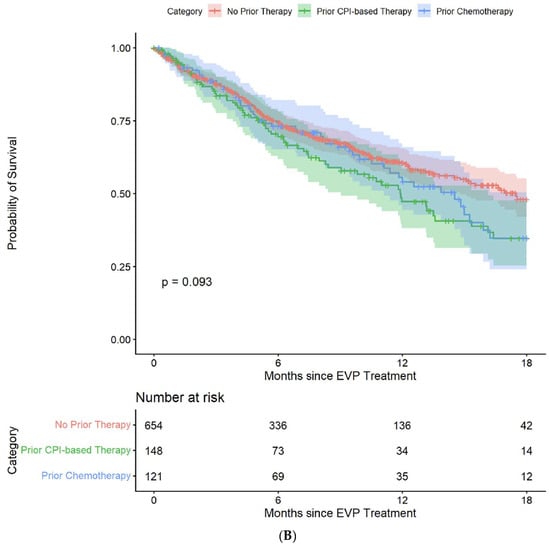
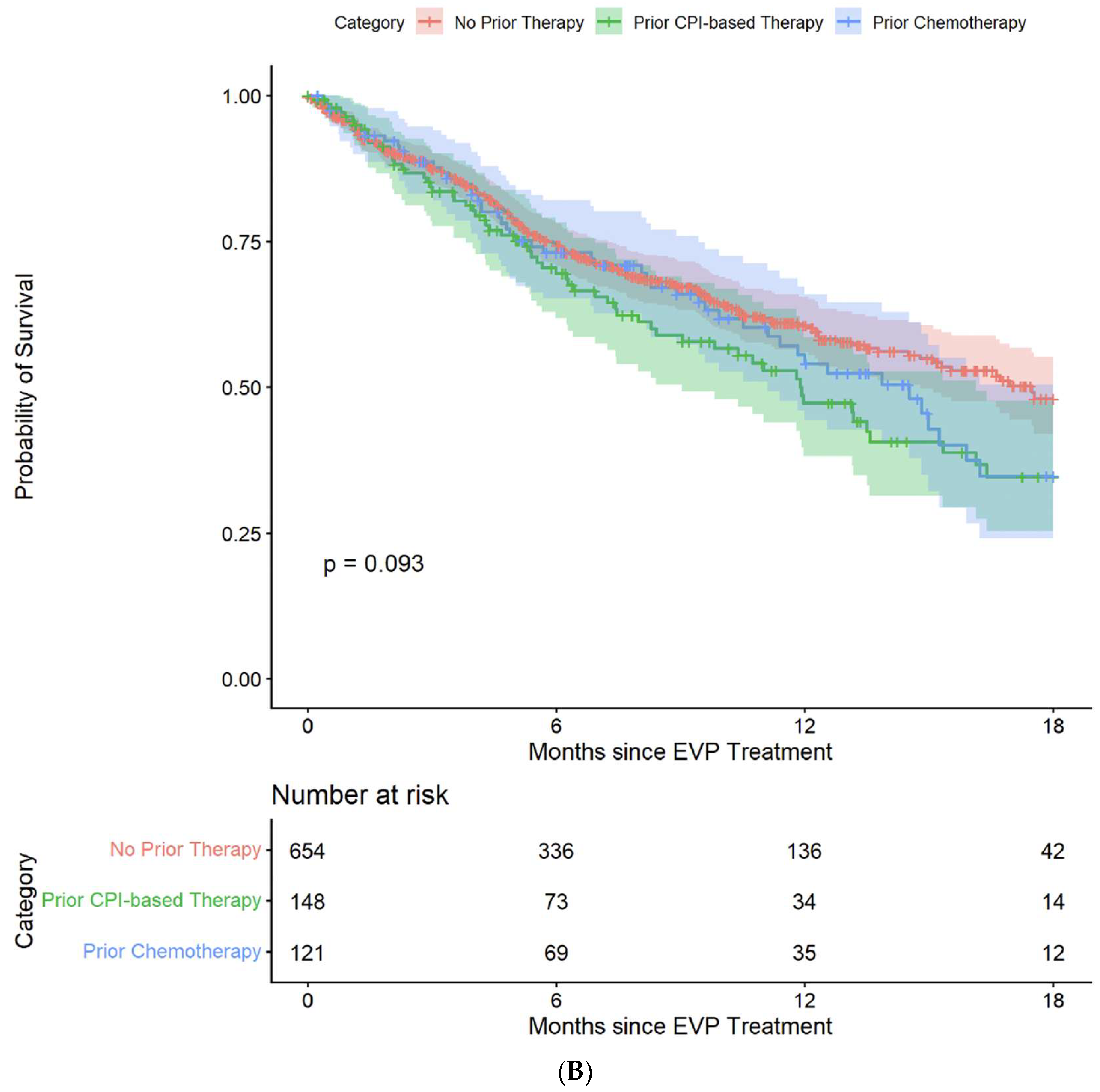
A median follow-up was 9.5 (95% CI: 8.9–10.4) months in the entire cohort. Survival analysis (Figure 1), after censoring events past 18 months, demonstrated that the prior CPI cohort had a KM OS probability of 0.695 (0.618–0.782) compared to 0.743 (0.707–0.782) in the no prior systemic therapy cohort at 6 months. At 12 months, KM OS probability was similarly 0.473 (0.382–0.585) in the prior CPI cohort compared to 0.605 (0.560–0.655) in the no prior systemic therapy cohort.
Figure 1.
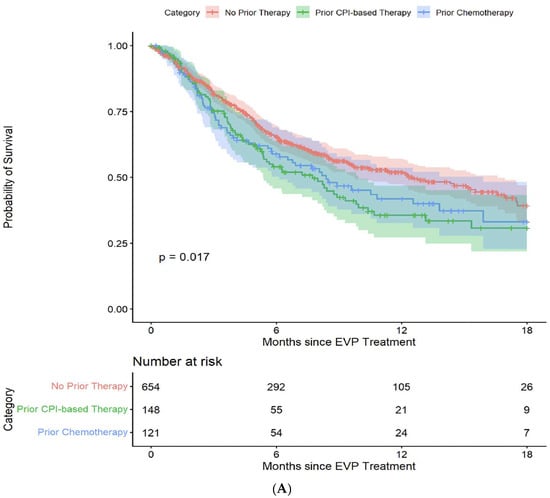
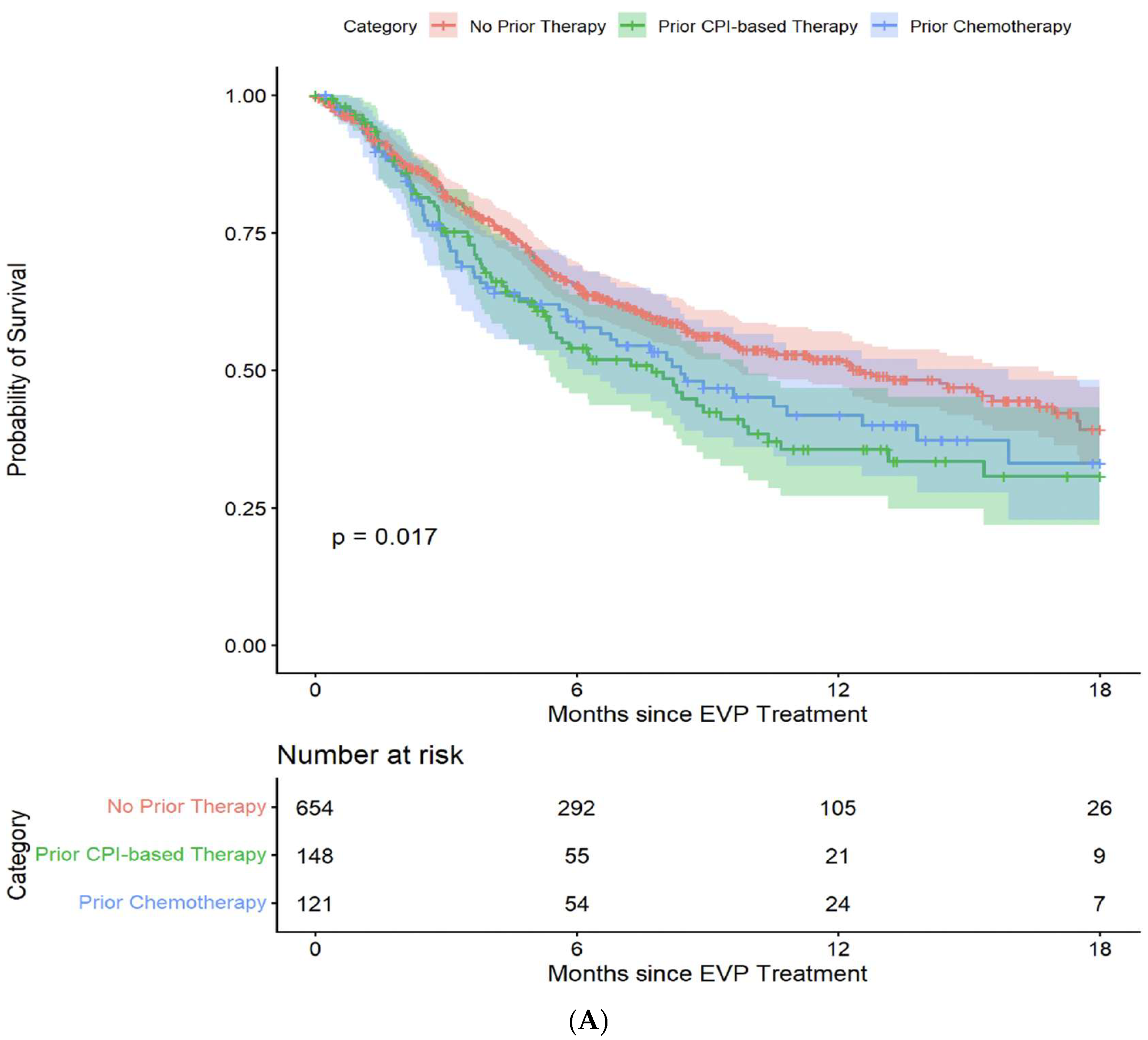
(A) Kaplan–Meier analysis for PFS, stratified by therapy. PFS, progression-free survival. (B) Kaplan–Meier analysis for OS, stratified by therapy.
Additionally, the prior CPI cohort had a KM rwPFS probability of 0.540 (0.458–0.638) compared to 0.654 (0.615–0.697) in the cohort without prior systemic therapy at 6 months. At 12 months KM rwPFS probability was similarly 0.356 (0.271–0.467) in the prior CPI cohort compared to 0.520 (0.474–0.571) in the cohort without prior systemic therapy.
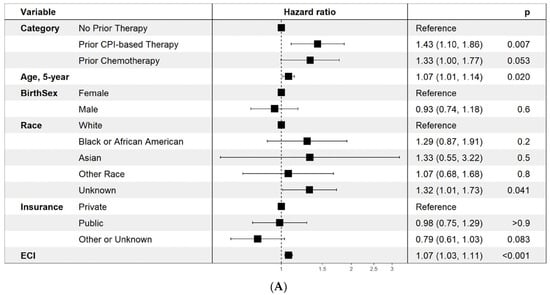
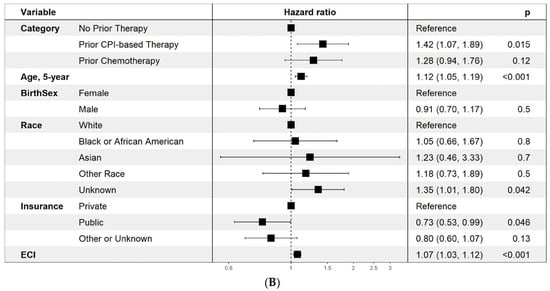
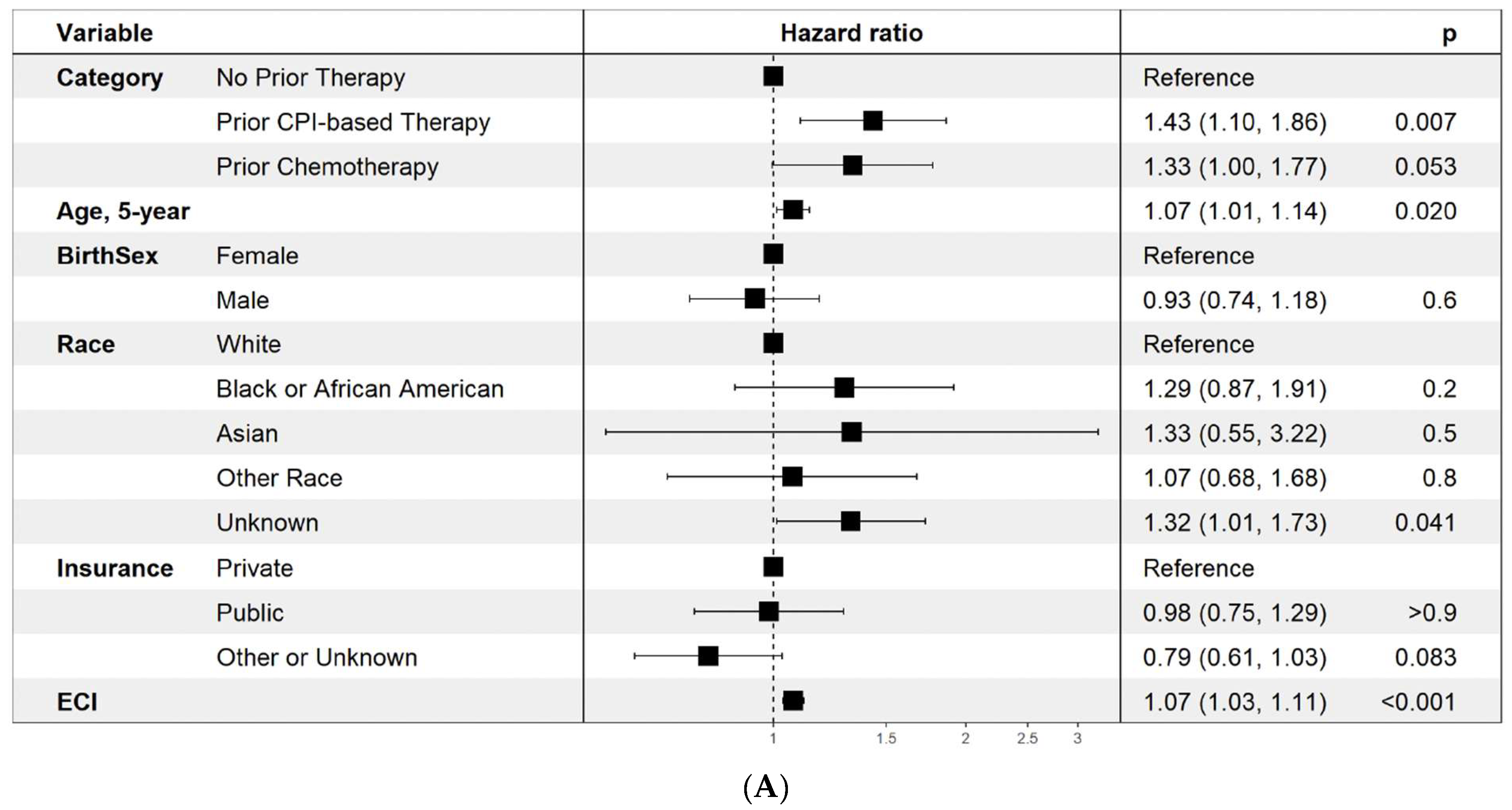
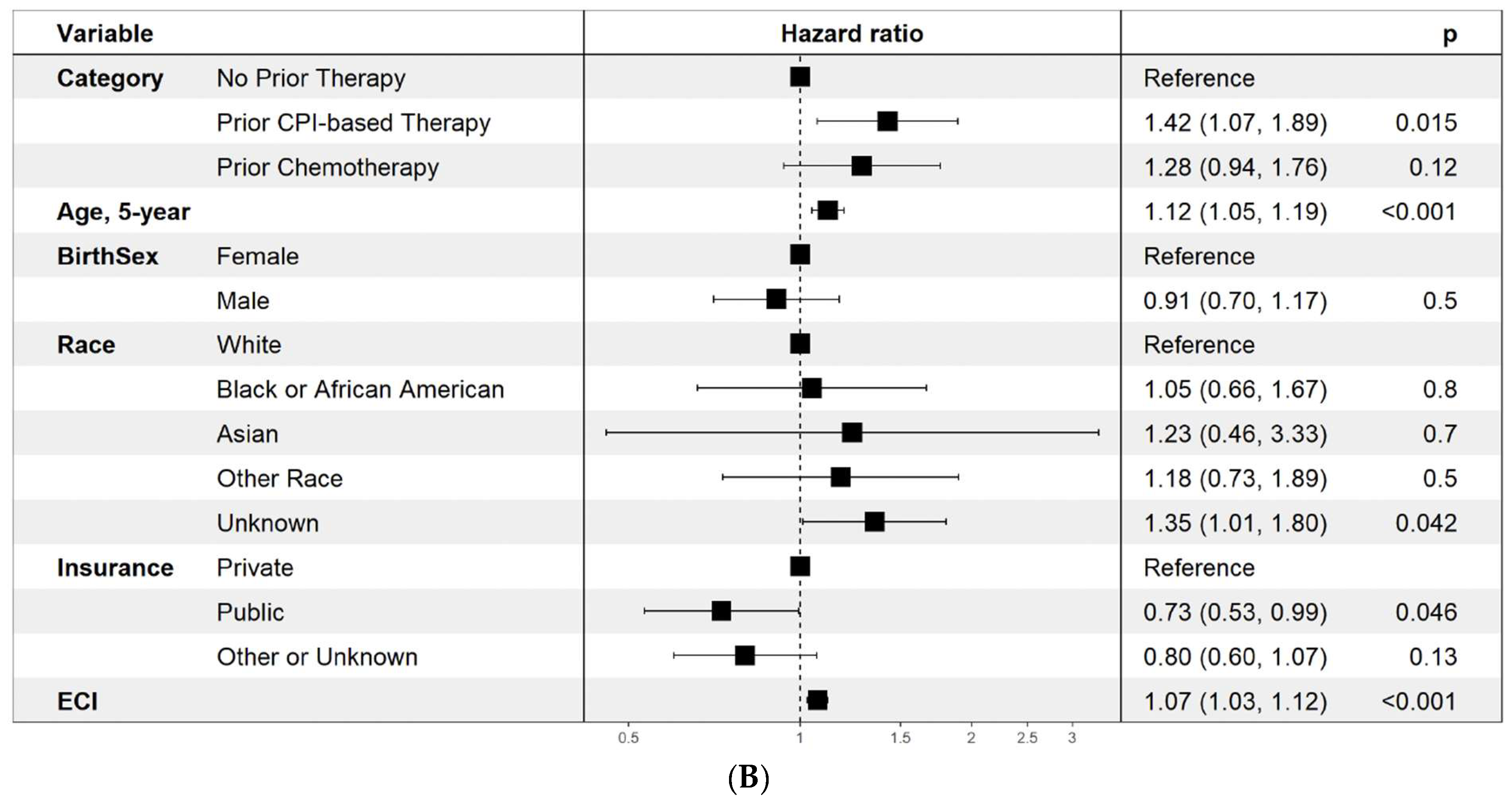
The Kaplan–Meier analysis demonstrated worsened rwPFS for patients that received prior CPI compared with those that received prior chemotherapy or those without prior systemic therapy (Figure 1A, p = 0.017). OS was not statistically different among the three groups by Kaplan–Meier analysis (Figure 1B, p > 0.05), although prior CPI exposure was associated with worse OS in multivariable Cox analysis. Multivariable analysis for rwPFS finds prior CPI exposure associated with a statistically significant increased risk of progression or death (HR 1.43 [1.10–1.86], p = 0.007) as demonstrated in Figure 2. Multivariable analysis for OS similarly found that prior CPI exposure was associated with a statistically significant decreased survival (1.42 [1.07–1.89]) p = 0.015).
Figure 2.
Forest plot for (A) PFS and (B) OS.
4. Discussion
The efficacy of CPI use in the first-line metastatic setting following previous CPI exposure is an area of active investigation. We evaluated a large real-world clinical data set and found patients with prior CPI exposure have shorter rwPFS with EVP and similar rwOS from time of EVP start compared with CPI-naive patients.
Re-challenge with CPI following progression on prior therapy is a question of high clinical significance, given the rapidly advancing inclusion of these agents earlier in the urothelial carcinoma treatment paradigm, resulting in more patients progressing to advanced disease with previous CPI exposure [2,3,4,5,6,7,8]. Other malignancies share this issue and have demonstrated mixed data. In renal cell carcinoma (RCC), increasing clinical evidence argues against the use of CPI-rechallenge as a treatment approach for most patients [15]. One trial which explored re-challenge with dual agent CPI (ipilimumab and nivolumab) in patients that had progressed on adjuvant single-agent nivolumab noted a response rate of only 4% [16]. CPI-rechallenge in advanced UC has similarly demonstrated limited response, although it has not been fully investigated [16,17].
Adjuvant CPI studies in urothelial carcinoma have demonstrated prolonged disease-free survival compared with placebo and follow-up outcomes have found survival benefit [7]. Still, the rate of CPI treatment among progressors in the control arms across trials is low or unreported, which can bias the comparative survival assessment towards the intervention arm and result in difficulty interpreting the perceived benefit of early CPI. Fitting such data into the context of a patient’s whole treatment paradigm is an urgent challenge in cancer care. Here, we find that while DFS may be prolonged with the use of CPI early in the disease, prior CPI exposure was associated with shorter rwPFS on subsequent EVP. Because EV-302 excluded patients with prior CPI exposure, these data suggest that EVP may have poorer real-world efficacy in this population but cannot establish that perioperative CPI itself causes reduced EVP effectiveness.
Our study only evaluates patients who develop the advanced or metastatic form of disease, thus the subset that is cured with early CPI treatment is not evaluated here. For those who develop disease progression, we found that no significant OS differences are detectable on univariable assessment between the groups defined by prior therapy exposure, though an association is seen on multivariable Cox analysis. This is interesting to note, considering the observation reported in CHECKMATE-274 updated results by Galsky and colleagues, which noted improved progression-free survival, a measure of PFS following initial adjuvant nivolumab treatment, progression, and subsequent treatment [7]. Our real-world data suggest instead that when the subsequent therapy is EVP, there is reduced PFS, and no related survival advantage from the time of metastatic diagnosis.
These findings warrant further investigation but are currently insufficient to change clinical practice. Randomized trials have demonstrated the disease-free survival benefit associated with perioperative CPI [5,6,7,8], and this study only includes patients who develop the metastatic form of disease, so cannot assess the benefit among patients cured by early CPI. Our results therefore should not be interpreted as evidence against perioperative CPI. Rather, they serve to highlight the need to understand how prior CPI exposure influences later therapy and may inform future studies of treatment sequencing in very high-risk subsets [18,19].
This study has several important limitations. First, it is retrospective and observational in nature, permitting only associations and not causal inference. Second, the groups had differences in baseline characteristics like age, ECOG performance status, and other features. Although we adjusted for available covariates, residual confounding by indication is possible. Third, both data recording and documentation of rwPFS are dependent on data abstraction and clinician documentation, which may introduce misclassification. Fourth, adverse event data are not systematically captured in the Flatiron Health database, so we could not evaluate the toxicity of EVP in this cohort or compare tolerability between groups. Prior CPI exposure could plausibly influence immune-related toxicity or treatment discontinuation, and such differences may contribute to the outcomes observed. Taken together, our findings are hypothesis-generating. These results should be validated in larger series with a longer follow-up period and ideally prospective trials mandating appropriate post-progression standard-of-care treatment access.
In this real-world experience of mUC, prior CPI exposure was associated with significantly shorter rwPFS among patients treated with first-line EVP, compared with CPI-naïve patients. Future studies into the impact of prior CPI exposure on efficacy of key first line metastatic regimens, and studies of ideal treatment sequencing of systemic agents in metastatic urothelial carcinoma warrant investigation.
Author Contributions
Conceptualization, S.R., A.P.-L., W.S.T., J.W., D.K., W.K., P.M., C.J.P., J.W.K., D.P. and F.G.; formal analysis, S.R., X.X. and F.G.; writing—original draft preparation, S.R., A.P.-L., X.X., W.S.T., J.W., D.K., W.K., P.M., C.J.P., J.W.K., D.P. and F.G.; writing—review and editing, S.R., A.P.-L., X.X., W.S.T., J.W., D.K., W.K., P.M., C.J.P., J.W.K., D.P. and F.G.; supervision, F.G. All authors have read and agreed to the published version of the manuscript.
Funding
This research received no external funding.
Institutional Review Board Statement
The study was conducted in accordance with the Declaration of Helsinki, and was approved by the Ethics Committee of the Yale School of Medicine (Date: 14 May 2025; Approval No. FWA00002571).
Informed Consent Statement
This study does not require informed consent due to the usage of deidentified data.
Data Availability Statement
The data that support the findings of this study were originated by and are the property of Flatiron Health, Inc. Requests for data sharing by license or by permission for the specific purpose of replicating results in this manuscript can be submitted to https://PublicationsDataAccess@flatiron.com (accessed on 26 May 2026).
Conflicts of Interest
P.M. served as a scientific consultant at Accutar Biotechnology, Inc.
References
- Niegisch, G.; Grimm, M.O.; Hardtstock, F.; Krieger, J.; Starry, A.; Osowski, U.; Guenther, S.; Deiters, B.; Maywald, U.; Wilke, T.; et al. Treatment patterns and clinical outcomes in metastatic urothelial carcinoma: A German retrospective real-world analysis. Future Oncol. 2024, 20, 1351–1366. [Google Scholar] [CrossRef] [Scilit]
- Powles, T.; Valderrama, B.P.; Gupta, S.; Bedke, J.; Kikuchi, E.; Hoffman-Censits, J.; Iyer, G.; Vulsteke, C.; Park, S.H.; Shin, S.J.; et al. EV-302 Trial Investigators. Enfortumab vedotin and pembrolizumab in untreated advanced urothelial cancer. N. Engl. J. Med. 2024, 390, 875–888. [Google Scholar] [CrossRef] [Scilit]
- Wang, Y.; Guo, S.; Zeng, J.; Feng, W.; Li, H.; Qing, X.; Yu, Y.; Zhao, P.; Yao, K.; Li, W.; et al. Prognostic Significance of Lymph Node Ratio for Overall Survival in Patients with Lymph Node-Positive Bladder Cancer Post-Radical Cystectomy and Chemotherapy: A Multicenter Cohort Analysis. Ann. Surg. Oncol. 2026, 33, 4823–4833. [Google Scholar] [CrossRef] [Scilit] [PubMed]
- Guo, S.B.; Hu, L.S.; Huang, W.J.; Zhou, Z.Z.; Luo, H.Y.; Tian, X.P. Comparative investigation of neoadjuvant immunotherapy versus adjuvant immunotherapy in perioperative patients with cancer: A global-scale, cross-sectional, and large-sample informatics study. Int. J. Surg. 2024, 110, 4660–4671. [Google Scholar] [CrossRef] [Scilit] [PubMed] [PubMed Central]
- Bajorin, D.F.; Witjes, J.A.; Gschwend, J.E.; Schenker, M.; Valderrama, B.P.; Tomita, Y.; Bamias, A.; Lebret, T.; Shariat, S.F.; Park, S.H.; et al. Adjuvant nivolumab versus placebo in muscle-invasive urothelial carcinoma. N. Engl. J. Med. 2021, 384, 2102–2114, Correction in N. Engl. J. Med. 2021, 385, 864. [Google Scholar] [CrossRef] [Scilit]
- Apolo, A.B.; Ballman, K.V.; Sonpavde, G.; Berg, S.; Kim, W.Y.; Parikh, R.; Teo, M.Y.; Sweis, R.F.; Geynisman, D.M.; Grivas, P.; et al. Adjuvant pembrolizumab versus observation in muscle-invasive urothelial carcinoma. N. Engl. J. Med. 2025, 392, 45–55. [Google Scholar] [CrossRef] [Scilit]
- Galsky, M.D.; Witjes, J.A.; Gschwend, J.E.; Milowsky, M.I.; Schenker, M.; Valderrama, B.P.; Tomita, Y.; Bamias, A.; Lebret, T.; Shariat, S.F.; et al. Adjuvant nivolumab in high-risk muscle-invasive urothelial carcinoma: Expanded efficacy from CheckMate 274. J. Clin. Oncol. 2025, 43, 15–21. [Google Scholar] [CrossRef] [Scilit]
- Powles, T.; Catto, J.W.F.; Galsky, M.D.; Al-Ahmadie, H.; Meeks, J.J.; Nishiyama, H.; Vu, T.Q.; Antonuzzo, L.; Wiechno, P.; Atduev, V.; et al. NIAGARA Investigators. Perioperative durvalumab with neoadjuvant chemotherapy in operable bladder cancer. N. Engl. J. Med. 2024, 391, 1773–1786. [Google Scholar] [CrossRef] [Scilit]
- Flatiron Health. Database Characterization Guide. 18 March 2025. Available online: https://flatiron.com/database-characterization (accessed on 26 May 2026).
- Sherman, R.E.; Anderson, S.A.; Dal Pan, G.J.; Gray, G.W.; Gross, T.; Hunter, N.L.; LaVange, L.; Marinac-Dabic, D.; Marks, P.W.; Robb, M.A.; et al. Real-world evidence—What is it and what can it tell us? N. Engl. J. Med. 2016, 375, 2293–2297. [Google Scholar] [CrossRef] [Scilit]
- Flatiron Health. Available online: https://flatiron.com/ (accessed on 18 October 2023).
- Ma, X.; Long, L.; Moon, S.; Adamson, B.J.S.; Baxi, S.S. Comparison of population characteristics in real-world clinical oncology databases in the US: Flatiron Health, SEER, and NPCR. medRxiv 2023, preprint. [Google Scholar] [CrossRef] [Scilit]
- Birnbaum, B.; Nussbaum, N.; Seidl-Rathkopf, K.; Agrawal, M.; Estevez, M.; Estola, E.; Haimson, J.; He, L.; Larson, P.; Richardson, P. Model-assisted cohort selection with bias analysis for generating large-scale cohorts from the EHR for oncology research. arXiv 2020, arXiv:2001.09765. [Google Scholar] [CrossRef] [Scilit]
- Graf, R.P.; Fisher, V.; Mateo, J.; Gjoerup, O.V.; Madison, R.W.; Raskina, K.; Tukachinsky, H.; Creeden, J.; Cunningham, R.; Huang, R.S.; et al. Predictive genomic biomarkers of hormonal therapy versus chemotherapy benefit in metastatic castration-resistant prostate cancer. Eur. Urol. 2022, 81, 37–47. [Google Scholar] [CrossRef] [Scilit]
- Sammarco, E.; Manfredi, F.; Nuzzo, A.; Ferrari, M.; Bonato, A.; Salfi, A.; Serafin, D.; Zatteri, L.; Antonuzzo, A.; Galli, L. Immune checkpoint inhibitor rechallenge in renal cell carcinoma: Current evidence and future directions. Cancers 2023, 15, 3172. [Google Scholar] [CrossRef] [Scilit]
- McKay, R.R.; McGregor, B.A.; Xie, W.; Braun, D.A.; Wei, X.; Kyriakopoulos, C.E.; Zakharia, Y.; Maughan, B.L.; Rose, T.L.; Stadler, W.M.; et al. Optimized management of nivolumab and ipilimumab in advanced renal cell carcinoma: A response-based phase II study (OMNIVORE). J. Clin. Oncol. 2020, 38, 4240–4248. [Google Scholar] [CrossRef] [Scilit]
- Jindal, T.; Chou, J.; Friedlander, T.; Barata, P.C.; Koshkin, V.S. Repeat treatment of patients with advanced urothelial carcinoma with immune checkpoint inhibitors following prior progression on a checkpoint inhibitor regimen: A case series. Clin. Genitourin. Cancer 2022, 20, 189–194. [Google Scholar] [CrossRef] [Scilit]
- Makrakis, D.; Bakaloudi, D.R.; Talukder, R.; Lin, G.I.; Diamantopoulos, L.N.; Jindal, T.; Vather-Wu, N.; Zakharia, Y.; Tripathi, N.; Agarwal, N.; et al. Treatment rechallenge with immune checkpoint inhibitors in advanced urothelial carcinoma. Clin. Genitourin. Cancer 2023, 21, 286–294. [Google Scholar] [CrossRef] [Scilit]
- Powles, T.; Assaf, Z.J.; Degaonkar, V.; Grivas, P.; Hussain, M.; Oudard, S.; Gschwend, J.E.; Albers, P.; Castellano, D.; Nishiyama, H.; et al. Updated overall survival by circulating tumor DNA status from the phase 3 IMvigor010 trial: Adjuvant atezolizumab versus observation in muscle-invasive urothelial carcinoma. Eur. Urol. 2024, 85, 114–122. [Google Scholar] [CrossRef] [Scilit]

Disclaimer/Publisher’s Note: The statements, opinions and data contained in all publications are solely those of the individual author(s) and contributor(s) and not of MDPI and/or the editor(s). MDPI and/or the editor(s) disclaim responsibility for any injury to people or property resulting from any ideas, methods, instructions or products referred to in the content. |
© 2026 by the authors. Licensee MDPI, Basel, Switzerland. This article is an open access article distributed under the terms and conditions of the Creative Commons Attribution (CC BY) license.