About Face: Is Virtual Group Delivery of Clinical Emotional Freedom Techniques (EFT) as Effective as Face-to-Face Group Delivery in Improving Psychological and Physiological Markers of Health?


Abstract
1. Background
2. Methodology
3. Clinical EFT Intervention
4. Results
5. Discussion
6. Conclusions
Author Contributions
Funding
Institutional Review Board Statement
Informed Consent Statement
Data Availability Statement
Conflicts of Interest
References
- Church, D.; Stapleton, P.; Vasudevan, A.; O’Keefe, T. Clinical EFT as an evidence-based practice for the treatment of psychological and physiological conditions: A systematic review. Front. Psychol. 2022, 13, 951451. [Google Scholar] [CrossRef] [PubMed]
- Church, D.; Stapleton, P.; Yang, A.; Gallo, F. Is tapping on acupuncture points an active ingredient in Emotional Freedom Techniques (EFT)? A systematic review and meta-analysis of comparative studies. J. Nerv. Ment. Dis. 2018, 206, 783–793. [Google Scholar] [CrossRef]
- Clond, M. Emotional freedom techniques for anxiety a systematic review with meta-analysis. J. Nerv. Ment. Dis. 2016, 204, 388–395. [Google Scholar] [CrossRef]
- Gilomen, S.A.; Lee, C.W. The efficacy of acupoint stimulation in the treatment of psychological distress: A meta-analysis. J. Behav. Ther. Exp. Psychiatry 2015, 48, 140–148. [Google Scholar] [CrossRef] [PubMed]
- Nelms, J.A.; Castel, L. A Systematic Review and Meta-Analysis of Randomized and Nonrandomized Trials of Clinical Emotional Freedom Techniques (EFT) for the Treatment of Depression. Explor. J. Sci. Heal. 2016, 12, 416–426. [Google Scholar] [CrossRef]
- Sebastian, B.; Nelms, J. The Effectiveness of Emotional Freedom Techniques in the Treatment of Posttraumatic Stress Disorder: A Meta-Analysis. Explor. J. Sci. Heal. 2017, 13, 16–25. [Google Scholar] [CrossRef]
- Stapleton, P.; Kip, K.; Church, D.; Toussaint, L.; Footman, J.; Ballantyne, P.; O’Keefe, T. Emotional freedom techniques for treating post traumatic stress disorder: An updated systematic review and meta-analysis. Front. Psychol. 2023, 14, 1195286. [Google Scholar] [CrossRef]
- Church, D.; Stapleton, P.; Mollon, P.; Feinstein, D.; Boath, E.; Mackay, D.; Sims, R. Guidelines for the treatment of PTSD using Clinical EFT (Emotional Freedom Techniques). Healthcare 2018, 6, 146. [Google Scholar] [CrossRef]
- Church, D.; House, D. Borrowing Benefits: Group Treatment with Clinical Emotional Freedom Techniques Is Associated with Simultaneous Reductions in Posttraumatic Stress Disorder, Anxiety, and Depression Symptoms. J. Evid. Based Integr. Med. 2018, 23, 2156587218756510. [Google Scholar] [CrossRef]
- Church, D.; Stern, S.; Boath, E.; Stewart, A.; Feinstein, D.; Clond, M. Emotional Freedom Techniques to Treat Posttraumatic Stress Disorder in Veterans: Review of the Evidence, Survey of Practitioners, and Proposed Clinical Guidelines. Perm. J. 2017, 21, 16–100. [Google Scholar] [CrossRef] [PubMed]
- Stapleton, P. The Science Behind Tapping: A Proven Stress Management Technique for the Mind and Body; Hay House Publishing: Carlsbad, CA, USA, 2019. [Google Scholar]
- Bustamante-Paster, A. The efficacy of EFT on the symptoms of depression, anxiety and stress among college students’ during the covid-19 pandemic: Basis for the development of psychological acupuncture intervention. Int. J. Multidiscip. Res. Anal. 2022, 5, 2643–9875. [Google Scholar] [CrossRef]
- Stapleton, P.; Stewart, M. Comparison of the Effectiveness of Two Modalities of Group Delivery of Emotional Freedom Technique (EFT) Intervention for Food Cravings: Online versus In-Person. Open J. Soc. Sci. 2020, 8, 158–181. [Google Scholar] [CrossRef][Green Version]
- Zandieh, S.; Abdollahzadeh, S.M.; Sadeghirad, B.; Wang, L.; McCabe, R.E.; Yao, L.; Inness, B.E.; Pathak, A.; Couban, R.J.; Crandon, H.; et al. Therapist-guided remote versus in-person cognitive behavioural therapy: A systematic review and meta-analysis of randomized controlled trials. CMAJ Can. Med. Assoc. J. 2024, 196, E327–E340. [Google Scholar] [CrossRef]
- World Health Organization (WHO). Rolling Updates on Corona Virus Disease (COVID-19). 2020. Available online: https://www.who.int/emergencies/diseases/novel-coronavirus-2019/events-as-they-happen (accessed on 31 July 2020).
- Sampaio, M.; Navarro Haro, M.V.; De Sousa, B.; Vieira Melo, W.; Hoffman, H.G. Therapists Make the Switch to Telepsychology to Safely Continue Treating Their Patients During the COVID-19 Pandemic. Virtual Reality Telepsychology may be Next. Front. Virtual Real. 2021, 1, 576421. [Google Scholar] [CrossRef] [PubMed]
- Bach, D.; Groesbeck, G.; Stapleton, P.; Sims, R.; Blickheuser, K.; Church, D. Clinical EFT (Emotional Freedom Techniques) Improves Multiple Physiological Markers of Health. J. Evid. Based Integr. Med. 2019, 24, 2515690X18823691. [Google Scholar] [CrossRef] [PubMed]
- Coyne, J.C.; van Sonderen, E. No further research needed: Abandoning the Hospital and Anxiety Depression Scale (HADS). J. Psychosom. Res. 2012, 72, 173–174. [Google Scholar] [CrossRef]
- Zigmond, A.S.; Snaith, R.P. The Hospital Anxiety and Depression Scale. Acta Psychiatr. Scand. 1983, 67, 361–370. [Google Scholar] [CrossRef]
- Kroenke, K.; Spitzer, R.L.; Williams, J.B.W.; Löwe, B. An ultra-brief screening scale for anxiety and depression: The PHQ-4. Psychosomatics 2009, 50, 613–621. [Google Scholar] [CrossRef]
- National Institute for Integrative Healthcare (NIIH). Leading the Way in Integrative Psychology and Medicine; National Institute for Integrative Healthcare (NIIH): Fulton, CA, USA, 2025. [Google Scholar]
- Lang, A.J.; Wilkins, K.; Roy-Byrne, P.P.; Golinelli, D.; Chavira, D.; Sherbourne, C.; Rose, R.D.; Bystritsky, A.; Sullivan, G.; Craske, M.G.; et al. Abbreviated PTSD Checklist (PCL) as a guide to clinical response. Gen. Hosp. Psychiatry 2012, 34, 332–338. [Google Scholar] [CrossRef] [PubMed]
- Abdel-Khalek, A. Measuring happiness with a single-item scale. Soc. Behav. Personal. Int. J. 2006, 34, 139–150. [Google Scholar] [CrossRef]
- Matheson, L.N.; Mark Melhorn, J.; Mayer, T.G.; Theodore, B.R.; Gatchel, R.J. Reliability of a Visual Analog Version of the QuickDASH. J. Bone Jt. Surg. 2006, 88, 1782–1787. [Google Scholar] [CrossRef]
- EFT Universe. Available online: https://eftuniverse.com/ (accessed on 31 July 2020).
- Church, D. The EFT Manual, 3rd ed.; Energy Psychology Press: Petaluma, CA, USA, 2013; Volume 3, 280p. [Google Scholar]
- Backhaus, A.; Agha, Z.; Maglione, M.L.; Repp, A.; Ross, B.; Zuest, D.; Rice-Thorp, N.M.; Lohr, J.; Thorp, S.R. Videoconferencing psychotherapy: A systematic review. Psychol. Serv. 2012, 9, 111–131. [Google Scholar] [CrossRef] [PubMed]
- Simpson, S. Psychotherapy via videoconferencing: A review. Br. J. Guid. Couns. 2009, 37, 271–286. [Google Scholar] [CrossRef]
- Connolly, S.L.; Miller, C.J.; Lindsay, J.A.; Bauer, M.S. A systematic review of providers’ attitudes toward telemental health via videoconferencing. Clin. Psychol. Sci. Pract. 2020, 27, e12311. [Google Scholar] [CrossRef]
- Roesler, C. Tele-analysis: The use of media technology in psychotherapy and its impact on the therapeutic relationship. J. Anal. Psychol. 2017, 62, 372–394. [Google Scholar] [CrossRef]
- Simpson, S.G.; Reid, C.L. Therapeutic alliance in videoconferencing psychotherapy: A review. Aust. J. Rural. Health 2014, 22, 280–299. [Google Scholar] [CrossRef]
- Scholl, J.; Kohls, E.; Görges, F.; Steinbrecher, M.; Baldofski, S.; Moessner, M.; Rummel-Kluge, C. Acceptability and feasibility of the transfer of face-to-face group therapy to online group chats in a psychiatric outpatient setting during the COVID-19 pandemic: Longitudinal observational study. JMIR Form. Res. 2021, 5, e27865. [Google Scholar] [CrossRef]
- Marmarosh, C.L.; Sandage, S.; Wade, N.; Captari, L.E.; Crabtree, S. New horizons in group psychotherapy research and practice from third wave positive psychology: A practice-friendly review. Res. Psychother. Psychopathol. Process Outcome 2022, 25, 258–270. [Google Scholar] [CrossRef] [PubMed]
- Li, S.; Hong, Y.C.; Craig, S.D. A systematic literature review of Social Learning Theory in Online Learning environments. Educ. Psychol. Rev. 2023, 35, 108. [Google Scholar] [CrossRef]
- Greyling, T.; Rossouw, S.; Adhikari, T.; Greyling, T.; Rossouw, S. Standard-Nutzungsbedingungen: Happiness-Lost: Did Governments Make the Right Decisions to Combat Covid-19? Available online: https://hdl.handle.net/10419/217494 (accessed on 31 July 2020).
- Sibley, C.G.; Greaves, L.M.; Satherley, N.; Wilson, M.S.; Overall, N.C.; Lee, C.H.J.; Milojev, P.; Bulbulia, J.; Osborne, D.; Milfont, T.L.; et al. Short-term effects of the COVID-19 pandemic and a nationwide lockdown on institutional trust, attitudes to government, health and wellbeing. Am. Psychol. Assoc. 2020, 75, 618–663. [Google Scholar] [CrossRef]
- Santabárbara, J.; Lasheras, I.; Lipnicki, D.M.; Bueno-Notivol, J.; Pérez-Moreno, M.; López-Antón, R.; De la Cámara, C.; Lobo, A.; Gracia-García, P. Prevalence of anxiety in the COVID-19 pandemic: An updated meta-analysis of community-based studies. Prog. Neuropsychopharmacol. Biol. Psychiatry 2021, 109, 110207. [Google Scholar] [CrossRef] [PubMed]
- Lin, T.; Heckman, T.G.; Anderson, T. The efficacy of synchronous teletherapy versus in-person therapy: A meta-analysis of randomized clinical trials. Clin. Psychol. Sci. Pract. 2022, 29, 167. [Google Scholar] [CrossRef]
- Havlik, S.; Malott, K.M.; Gamerman, T.; Okonya, P. Working Across Differences While Online: Examining the Experience of Facilitating a Virtual Group. Int. J. Adv. Couns. 2023, 45, 291–309. [Google Scholar] [CrossRef]
- Nieborowska, V.; Gorenko, J.; Shumlich, E.; Enman, M. Mindfulness-based Cognitive Group Therapy: Adaptation and Practical Recommendations for Virtual Delivery. Int. J. Group Psychother. 2022, 72, 173–186. [Google Scholar] [CrossRef]
- Blumenberg, C.; Barros, A.J.D. Response rate differences between web and alternative data collection methods for public health research: A systematic review of the literature. Int. J. Public Health 2018, 63, 765–773. [Google Scholar] [CrossRef]
- Dillman, D.A.; Phelps, G.; Tortora, R.; Swift, K.; Kohrell, J.; Berck, J.; Messer, B.L. Response rate and measurement differences in mixed-mode surveys using mail, telephone, interactive voice response (IVR) and the Internet. Soc. Sci. Res. 2009, 38, 1–18. [Google Scholar] [CrossRef]
- Wu, M.J.; Zhao, K.; Fils-Aime, F. Response rates of online surveys in published research: A meta-analysis. Comput. Hum. Behav. Rep. 2022, 7, 100206. [Google Scholar] [CrossRef]
- Kristman, V.; Manno, M.; Côté, P. Loss to follow-up in cohort studies: How much is too much? Eur. J. Epidemiol. 2004, 19, 751–760. [Google Scholar] [CrossRef]
- Venkatesh, V.; Brown, S.A.; Bala, H. Bridging the qualitative-quantitative divide: Guidelines for conducting mixed methods research in information systems. MIS Q. 2013, 37, 21–54. [Google Scholar] [CrossRef]
- Gambin, M.; Sękowski, M.; Woźniak-Prus, M.; Wnuk, A.; Oleksy, T.; Cudo, A.; Hansen, K.; Huflejt-Łukasik, M.; Kubicka, K.; Łyś, A.E.; et al. Generalized anxiety and depressive symptoms in various age groups during the COVID-19 lockdown in Poland. Specific predictors and differences in symptoms severity. Compr. Psychiatry 2021, 105, 152222. [Google Scholar] [CrossRef] [PubMed]
- Pashazadeh Kan, F.; Raoofi, S.; Rafiei, S.; Khani, S.; Hosseinifard, H.; Tajik, F.; Raoofi, N.; Ahmadi, S.; Aghalou, S.; Torabi, F.; et al. A systematic review of the prevalence of anxiety among the general population during the COVID-19 pandemic. J. Affect. Disord. 2021, 293, 391–398. [Google Scholar] [CrossRef]
- Bueno-Notivol, J.; Gracia-García, P.; Olaya, B.; Lasheras, I.; López-Antón, R.; Santabárbara, J. Prevalence of depression during the COVID-19 outbreak: A meta-analysis of community-based studies. Int. J. Clin. Health Psychol. 2021, 21, 100196. [Google Scholar] [CrossRef]
- Békés, V.; Avan, D.K. Psychotherapists’ attitudes toward online therapy during the COVID-19 pandemic. J. Psychother. Integr. 2020, 30, 238–247. [Google Scholar] [CrossRef]
- Messina, I.; Löffler-Stastka, H. Psychotherapists’ perception of their clinical skills and in-session feelings in live therapy versus online therapy during the COVID-19 pandemic: A pilot study. Res. Psychother. Psychopathol. Process Outcome 2021, 24, 53–59. [Google Scholar] [CrossRef] [PubMed]
- Brodeur, A.; Clark, A.E.; Fleche, S.; Powdthavee, N. Assessing the impact of the coronavirus lockdown on unhappiness, loneliness, and boredom using Google Trends. arXiv 2020, arXiv:2004.12129. [Google Scholar] [CrossRef]
- Palmer-Hoffman, J.; Brooks, A.J. Psychological symptoms change after group application of Emotional Freedom Techniques (EFT). Energy Psychol. Theory Res. Treat. 2011, 3, 33–38. [Google Scholar] [CrossRef]
- Maharaj, M.E. Differential gene expression after Emotional Freedom Techniques (EFT) treatment: A novel pilot protocol for salivary mRNA assessment. Energy Psychol. Theory Res. Treat. 2016, 8, 17–32. [Google Scholar] [CrossRef]
- Brainard, R.; Watson, L. Zoom in the classroom: Transforming traditional teaching to incorporate real-time distance learning in a face-to-face graduate physiology course. FASEB J. 2020, 34, 1. [Google Scholar] [CrossRef]
- Stapleton, P.; Wilson, C.; Uechtritz, N.; Stewart, M.; McCosker, M.; O’Keefe, T.; Blanchard, M. A randomized clinical trial of emotional freedom techniques for chronic pain: Live versus self-paced delivery with 6-month follow-up. Eur. J. Pain 2025, 29, e4740. [Google Scholar] [CrossRef]
- Lin, A.; Liu, Z.; Zhang, T.; Zhao, Y.; Yang, C.; Wan, H. Effect of emotional freedom techniques in mitigating pain catastrophizing following total knee arthroplasty. Complement. Ther. Med. 2025, 93, 103213. [Google Scholar] [CrossRef]



| Face-to-Face | Virtual | p | |||||
|---|---|---|---|---|---|---|---|
| Demographic and Baseline Characteristics | Subjects | Male | Female | Subjects | Male | Female | |
| Gender (%) | 203 | 33 (16.3) | 170 (83.7) | 172 | 19 (11.1) | 153 (88.9) | 0.435 |
| Age, years | 0.004 * | ||||||
| Mean | 50.45 | 48.13 | 50.80 | 46.97 | 49.63 | 46.64 | |
| Standard deviation | 12.35 | 14.76 | 11.96 | 10.02 | 11.84 | 9.76 | |
| Min–Max | 19–81 | 22–75 | 19–81 | 23–79 | 30–73 | 23–79 | |
| Education, n (%) | |||||||
| High school/College | 14 (6.9) | 3 (9.09) | 11 (6.47) | 26 (15.02) | 0 (0) | 26 (17.0) | |
| University | 55 (27.1) | 9 (27.27) | 46 (27.06) | 111 (64.16) | 11 (57.90) | 100 (65.40) | |
| Postgraduate | 86 (42.4) | 15 (45.45) | 71 (41.46) | 35 (20.23) | 8 (42.10) | 27 (17.6) | |
| Unknown | 48 (23.6) | 6 (18.18) | 42 (24.71) | 0 | 0 (0) | 0 (0) | |
| Post-traumatic stress symptoms | 0.012 * | ||||||
| Mean | 2.54 | 2.57 | 2.51 | 2.05 | 2.00 | 2.06 | |
| Standard deviation | 1.24 | 1.50 | 1.17 | 0.82 | 0.75 | 0.83 | |
| Min–Max | 1–5 | 1–5 | 1–5 | 1–5 | 1–3 | 1–5 | |
| Pain | <0.001 * | ||||||
| Mean | 4.09 | 3.54 | 4.16 | 3.04 | 2.84 | 3.06 | |
| Standard deviation | 2.49 | 2.40 | 2.49 | 2.38 | 2.24 | 2.40 | |
| Min–Max | 0–10 | 0–8 | 0–10 | 0–8 | 0–7 | 0–8 | |
| Happiness | 0.001 * | ||||||
| Mean | 7.28 | 7.39 | 7.30 | 6.73 | 6.42 | 6.77 | |
| Standard deviation | 2.10 | 2.41 | 2.03 | 1.88 | 2.06 | 1.86 | |
| Min–Max | 0–10 | 0–10 | 1–10 | 2–10 | 2–10 | 2–10 | |
| Anxiety | HADS | PHQ | --- ** | ||||
| Mean | 8.35 | 7.31 | 8.54 | 1.64 | 1.53 | 1.65 | |
| Standard deviation | 3.85 | 3.95 | 3.82 | 1.32 | 1.12 | 1.34 | |
| Min–Max | 0–20 | 1–18 | 0–20 | 0–6 | 0–4 | 0–6 | |
| Depression | HADS | PHQ | --- ** | ||||
| Mean | 4.04 | 4.14 | 3.96 | 0.90 | 0.79 | 0.91 | |
| Standard deviation | 3.18 | 3.29 | 3.07 | 1.07 | 0.98 | 1.08 | |
| Min–Max | 0–14 | 0–13 | 0–13 | 0–6 | 0–3 | 0–6 | |
| Scale | Pretest, Mean ± SD | Post-Test, Mean ± SD | Change in Mean | Z Statistic | p | Percent Change |
|---|---|---|---|---|---|---|
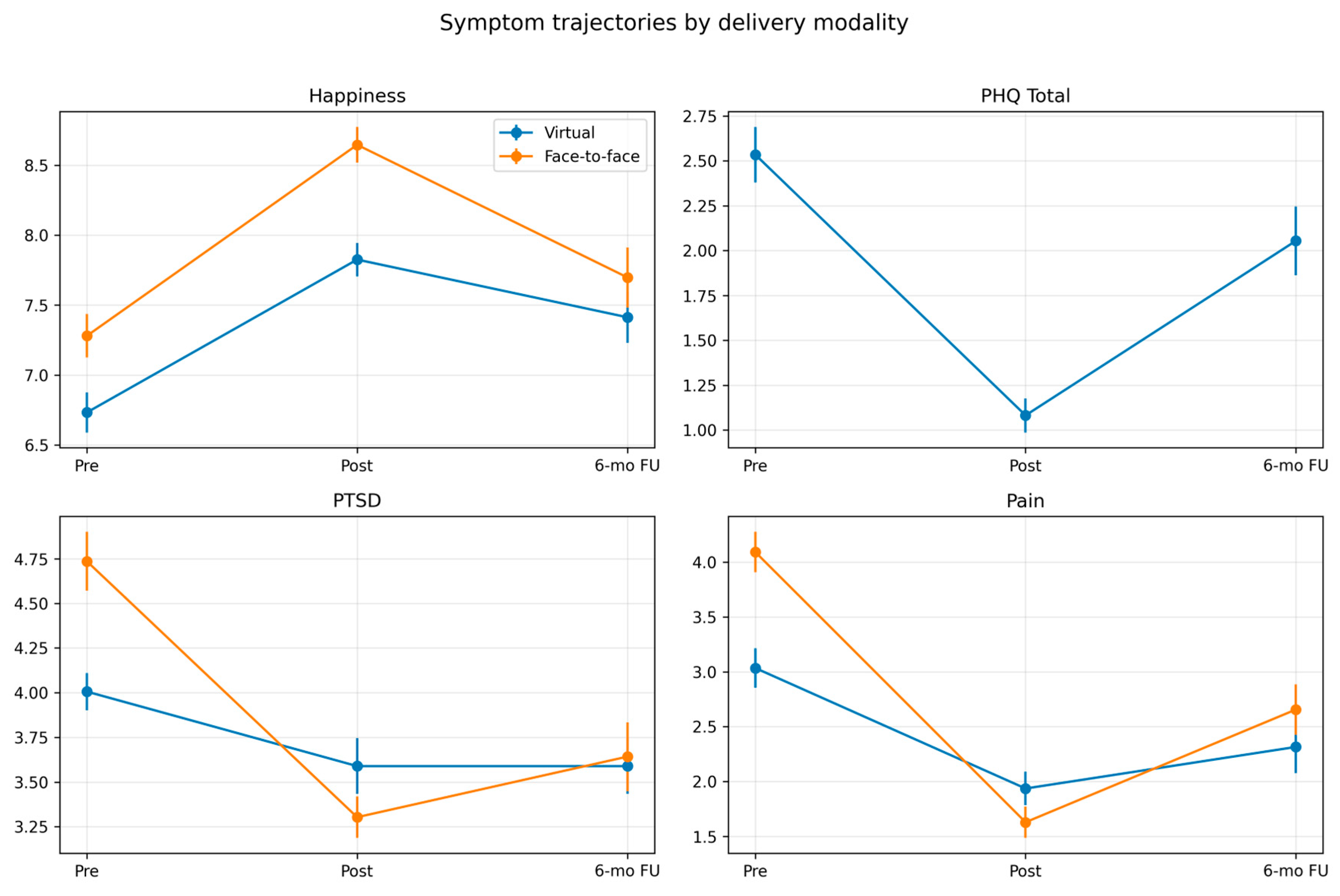
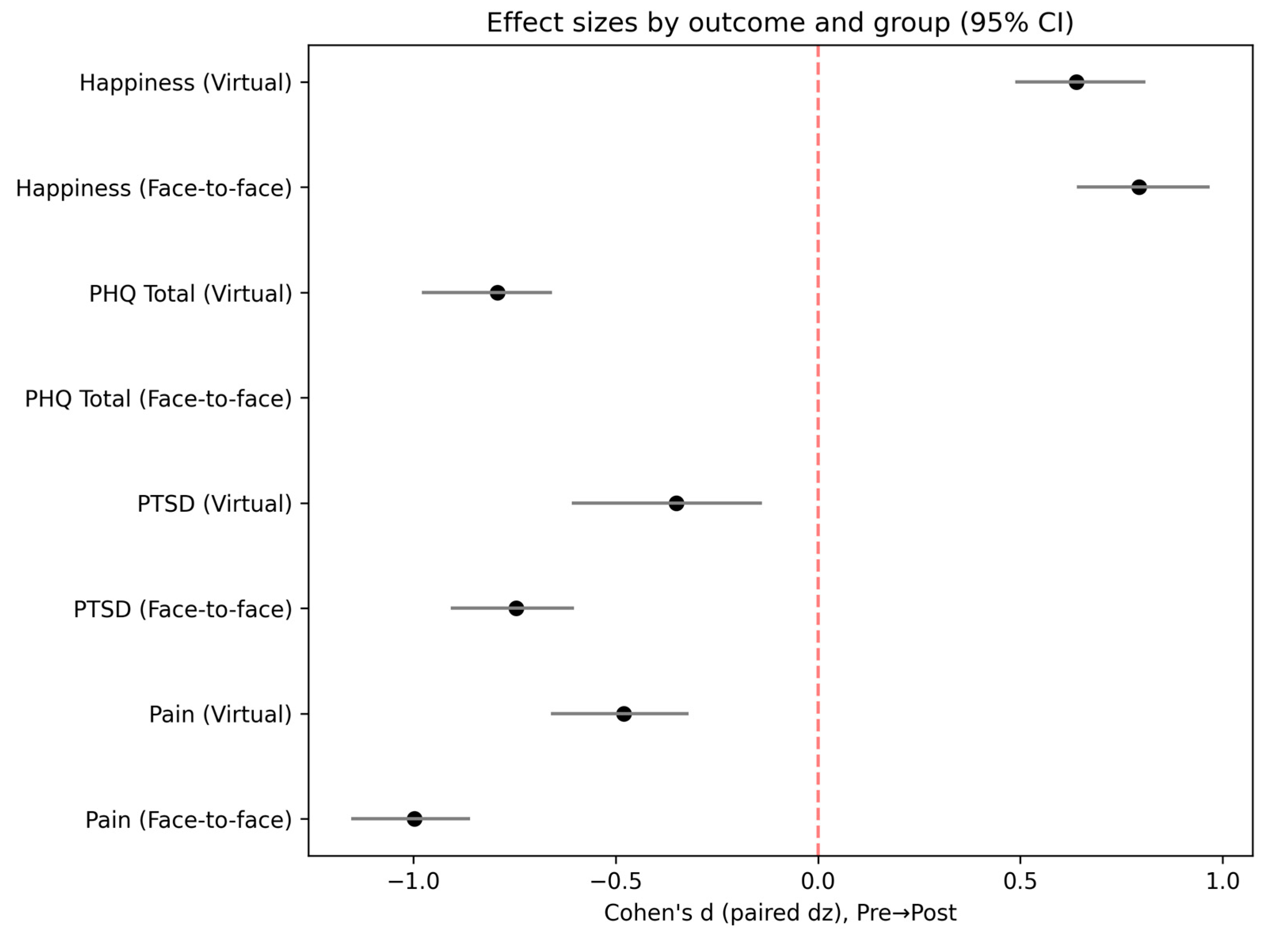
| Happiness (n = 172) | 6.733 ± 1.876 | 7.826 ± 1.561 | 1.093 | −7.092 | <0.001 | 16.23 |
| Anxiety (n = 172) | 1.640 ± 1.315 | 1.256 ± 1.221 | −0.384 | 3.987 | <0.001 | −23.41 |
| Depression (n = 172) | 0.895 ± 1.065 | 0.610 ± 0.861 | −0.285 | 3.505 | <0.001 | −31.84 |
| PTSD (n = 172) | 4.006 ± 1.362 | 3.529 ± 1.550 | −0.477 | 4.071 | <0.001 | −11.91 |
| Pain (n = 172) | 3.035 ± 2.377 | 1.936 ± 2.000 | 1.099 | 5.918 | <0.001 | −36.21 |
| Scale | Pretest, Mean ± SD (n = 172) | Follow-Up Mean ± SD (n = 92) | Change in Mean | Z Statistic | p | Percentage Change |
|---|---|---|---|---|---|---|
| Happiness (n = 92) | 6.733 ± 1.876 | 7.413 ± 1.749 | 0.68 | −3.491 | <0.001 | 8.61 |
| PHQ Anxiety (n = 92) | 1.640 ± 1.315 | 1.446 ± 1.252 | −0.194 | 1.588 | 0.102 | −11.83 |
| PHQ Depression (n = 92) | 0.895 ± 1.065 | 0.674 ± 0.962 | −0.221 | 1.875 | 0.048 | −24.69 |
| PSTD (n = 92) | 4.006 ± 1.362 | 3.598 ± 1.490 | −0.408 | 3.483 | <0.001 | −10.18 |
| Pain (n = 92) | 3.035 ± 2.377 | 2.315 ± 2.301 | −0.72 | 3.038 | 0.002 | −23.72 |
| Face-to-Face (n = 170) | Virtual (n = 172) | |||||
|---|---|---|---|---|---|---|
| Scale | Change in Mean | p | Percent Change | Change in Mean | p | Percent Change |
| Happiness | 1.37 | <0.000 | 18.82 | 1.09 | <0.001 | 16.23 |
| Anxiety | −3.37 | <0.000 | −40.36 | −0.384 | <0.001 | −23.41 |
| Depression | −1.74 | <0.000 | −43.07 | −0.29 | <0.001 | −31.84 |
| PTSD | −1.44 | <0.000 | −30.38 | −0.48 | <0.001 | −11.91 |
| Pain | −2.46 | <0.000 | −60.15 | 1.10 | <0.001 | −36.21 |
| Face-to-Face (n = 85) | Virtual (n = 92) | |||||
|---|---|---|---|---|---|---|
| Scale | Change in Mean | p | Percent Change | Change in Mean | p | Percent Change |
| Happiness | 0.42 | 0.114 | 5.77 | 0.68 | <0.001 | 8.61 |
| Anxiety | −2.73 | <0.001 | −32.69 | −0.194 | 0.102 | −11.83 |
| Depression | −1.26 | 0.002 | −31.18 | −0.221 | 0.048 | −24.69 |
| PTSD | −1.10 | <0.001 | −23.21 | −0.408 | <0.001 | −10.18 |
| Pain | −1.43 | <0.001 | −34.96 | −0.72 | 0.002 | −23.72 |
| Face-to-Face Mean (SD) | Virtual Mean (SD) | Mann-Whitney U p-Value | |
|---|---|---|---|
| PTSD Symptoms | |||
| PCL Pre EFT | 4.735 (2.155) | 4.006 (1.362) | 0.012 * |
| PCL Post EFT | 3.303 (1.487) | 4.855 (1.375) | <0.001 * |
| PCL Follow-up | 3.642 (1.734) | 3.589 (1.476) | 0.826 |
| Happiness | |||
| Happiness pre-EFT | 7.280 (2.098) | 6.733 (1.876) | 0.001 * |
| Happiness post | 8.846 (1.715) | 7.826 (1.561) | <0.001 * |
| Happiness Follow-up | 7.698 (2.098) | 7.413 (1.749) | 0.069 |
| Pain | |||
| Pain Pre-EFT | 4.093 (2.489) | 3.035 (2.377) | <0.001 * |
| Pain Post-EFT | 1.629 (1.889) | 1.936 (2.000) | 0.096 |
| Pain follow-up | 2.656 (2.261) | 2.315 (2.301) | 0.185 |
Disclaimer/Publisher’s Note: The statements, opinions and data contained in all publications are solely those of the individual author(s) and contributor(s) and not of MDPI and/or the editor(s). MDPI and/or the editor(s) disclaim responsibility for any injury to people or property resulting from any ideas, methods, instructions or products referred to in the content. |
© 2026 by the authors. Licensee MDPI, Basel, Switzerland. This article is an open access article distributed under the terms and conditions of the Creative Commons Attribution (CC BY) license.
Share and Cite
Boath, E.; Church, D.; Stapleton, P. About Face: Is Virtual Group Delivery of Clinical Emotional Freedom Techniques (EFT) as Effective as Face-to-Face Group Delivery in Improving Psychological and Physiological Markers of Health? Healthcare 2026, 14, 784. https://doi.org/10.3390/healthcare14060784
Boath E, Church D, Stapleton P. About Face: Is Virtual Group Delivery of Clinical Emotional Freedom Techniques (EFT) as Effective as Face-to-Face Group Delivery in Improving Psychological and Physiological Markers of Health? Healthcare. 2026; 14(6):784. https://doi.org/10.3390/healthcare14060784
Chicago/Turabian StyleBoath, Elizabeth, Dawson Church, and Peta Stapleton. 2026. "About Face: Is Virtual Group Delivery of Clinical Emotional Freedom Techniques (EFT) as Effective as Face-to-Face Group Delivery in Improving Psychological and Physiological Markers of Health?" Healthcare 14, no. 6: 784. https://doi.org/10.3390/healthcare14060784
APA StyleBoath, E., Church, D., & Stapleton, P. (2026). About Face: Is Virtual Group Delivery of Clinical Emotional Freedom Techniques (EFT) as Effective as Face-to-Face Group Delivery in Improving Psychological and Physiological Markers of Health? Healthcare, 14(6), 784. https://doi.org/10.3390/healthcare14060784