


Abstract
Background/Objectives: Ultra-processed foods are thought to affect sleep and mental health. The aim of this study was to examine the relationships between ultra-processed food consumption and mental health (mental well-being, depression, anxiety, and stress) and sleep quality in Turkish adults. Methods: In this cross-sectional study (n = 2935), the status of adult individuals was determined via the Short Screening Questionnaire of Highly Processed Food Consumption (sQ-HPF), the Warwick-Edinburgh Mental Well-being Scale (WEMWBS), the Depression-Anxiety-Stress Scale 21 (DASS-21), the Beck Depression Inventory (BDI), and the Pittsburgh Sleep Quality Index (PSQI). Pearson correlation and multivariate path analysis were used to examine the relationships between the scales. Results: Forty-six percent of the participants had a minimal level of depression, and the vast majority of participants had poor sleep quality (84%). According to the sQ-HPF classification, individuals exhibiting high consumption had higher DASS-21, BDI, and PSQI scores but lower WEMWBS scores than individuals exhibiting low consumption (p < 0.001). The sQ-HPF was found to have independent and significant associations with mental well-being, depression, mood symptoms, and sleep quality. A 1-unit increase in the total sQ-HPF score led to a 0.26-unit decrease in the WEMWBS score (β = −0.05; p = 0.004). In the model established for depression (BDI), a 1-unit increase in sQ-HPF corresponded to a 0.32-unit increase in the BDI score (β = 0.09; p < 0.001). Similarly, sQ-HPF was found to be a positive and significant predictor of the total DASS-21 score (β = 0.11; p < 0.001). The sQ-HPF total score showed the strongest positive correlation with impaired sleep quality, with a 1-unit increase in sQ-HPF leading to a 0.13-unit increase in the PSQI score (β = 0.15; p < 0.001). Conclusions: The consumption of ultra-processed foods is associated with poorer mental health and sleep quality, regardless of age, sex, and socioeconomic factors.
1. Introduction
Mental disorders, which are increasingly prevalent worldwide, cause significant financial and social burdens on health systems and affect the well-being of individuals [1,2]. Depression and anxiety are the most frequently diagnosed mental health disorders, affecting one in ten people [3]. Furthermore, mental disorders are associated with an increased risk of chronic diseases, decreased quality of life, and worsening sleep problems, whereas sleep disorders can also lead to a further increase in psychological symptoms and deterioration in overall health [4,5]. Dietary habits, particularly the consumption of ultra-processed foods (UPFs), have emerged as modifiable risk factors [6]. Ultra-processed foods are industrially formulated products and typically contain additives such as colorants, flavor enhancers, added sugars, fats, salt, and preservatives [7]. Characterized by low nutritional value and high caloric density, UPFs are widely accessible, convenient (ready-to-eat or ready-to-heat), affordable, and palatable [8]. Several factors, including income growth, urbanization, changing workforce structures, demographic shifts in developed and developing countries, and increasing global time constraints, are leading to an increase in UPFs consumption [9]. An analysis of national food intake surveys from 36 countries indicated that ultra-processed foods contribute between 9% and 60% of total dietary energy intake [10]. Furthermore, evaluations of global UPF sales data and consumption patterns over the past decade reveal a growing trend toward an ultra-processed global diet, particularly in low- and middle-income countries, despite significant variation across countries and regions [10,11,12]. High consumption of UPFs has also raised public health concerns [13]. Cohort studies and meta-analyses have examined the health effects of UPFs; UPFs have been reported to be associated with obesity [14], type 2 diabetes [15], cardiovascular diseases [16,17], cancer [18,19], survival [20,21,22], mental health [12,23,24] and sleep [6,25,26].
UPFs have been shown to be associated with negative mental health outcomes such as sleep problems, anxiety, and depression [12]. Data suggest that individuals with high UPF consumption have a greater risk of depression, anxiety, and sleep problems [27]. Furthermore, one study indicated that higher UPF intake increased the likelihood of recurrent depressive symptoms [28].
There are numerous biological mechanisms that explain the link between UPFs and mental health. Possible harmful mechanisms include nutritional imbalances; overeating; decreased consumption of health-protective phytochemicals; and the consumption of toxic contaminants from processing or packaging, harmful additives and additive mixtures, resulting in inflammation, dysglycemia, dyslipidemia, microbiome dysbiosis, and renal or hepatic dysfunction [6,10,12].
Although studies have examined UPFs separately in relation to depression, anxiety, and sleep quality [27,28], there is no research that holistically evaluates UPFs in relation to mental well-being, depression, anxiety, and sleep quality. Owing to the lack of data in the literature and the inability to reach a clear conclusion, this issue needs to be investigated in depth. Accordingly, this study aims to evaluate the possible effects of UPFs on individuals’ mental health outcomes and sleep quality, taking into account sociodemographic characteristics, potential modifiers, and confounders.
2. Materials and Methods
2.1. Study Design and Sample Selection
Post hoc power analysis for sample size was performed using the G*Power 3.1.9.4 software package. In this study, a multiple regression analysis was planned to examine the effect of ultra processed food consumption on mental health and sleep quality in adults, and the statistical power of the sample size was evaluated based on this analysis. In power calculations based on regression analysis, the effect size must first be defined to ensure the study has sufficient statistical power. Accordingly, the reference effect size classifications proposed by Cohen (1988) were used in the calculations [29]. According to Cohen, the effect size (f2) value represents a small effect size of 0.02, a medium effect size of 0.15, and a large effect size of 0.35. For the analyses planned within the scope of this study, a small effect size (f2 = 0.02), a significance level of α = 0.05, and a sample size of n = 2935 were accepted. Based on these parameters, the calculation performed with the G*Power program determined that the statistical power of the study was 99.99%. This cross-sectional study was conducted between June and December 2025, with 2935 individuals identified through voluntary sampling. This study utilized a voluntary convenience sampling method, a type of non-probability sampling. Participants were reached through open calls made via online platforms and telephone. To increase sample diversity, participation of individuals from different socioeconomic backgrounds was encouraged; however, no random or probability-based method was used in sample selection. Individuals who agreed to participate were informed in writing about the purpose of the research and the implementation process, and their written informed consent was obtained. All data were collected face-to-face with the volunteer participants by the research team. The exclusion criteria included individuals under 18 and over 65 years of age, those diagnosed with depression or insomnia, those with psychological disorders, those taking medication for sleep problems, those following a special diet program, and pregnant or breastfeeding individuals.
A questionnaire was administered to participants who agreed to participate in the study. Data were collected on the basis of participant self-reports. The questionnaire consisted of a demographic information form (age, sex, marital and educational status, profession, and anthropometric measurements such as height and weight, etc.) and five scales [Short Screening Questionnaire of Highly Processed Food Consumption (sQ-HPF), Warwick-Edinburgh Mental Well-being Scale (WEMWBS), Depression-Anxiety-Stress Scale 21 (DASS-21), Beck Depression Inventory (BDI), and Pittsburgh Sleep Quality Index (PSQI)]. The Beck Depression Inventory (BDI) was used to assess the severity of depressive symptoms and to allow categorization according to established clinical severity thresholds. In addition, the Depression Anxiety Stress Scales-21 (DASS-21) was included to capture broader dimensions of emotional distress, encompassing depression, anxiety, and stress symptoms. The concurrent use of these instruments was intended to provide a more comprehensive assessment of affective symptomatology, with the BDI focusing on depressive severity and the DASS-21 assessing multidimensional emotional symptoms.
2.1.1. Short Screening Questionnaire of Highly Processed Food Consumption (sQ-HPF)
In this study, ultra-processed foods are operationalized using the Short Screening Questionnaire of Highly Processed Food Consumption (sQ-HPF). The sQ-HPF, developed by Martinez-Perez et al. [30] and Erdoğan Gövez et al. conducted a study in Turkish to determine its validity and reliability in 2024 [31]. It was determined that the Cronbach’s alpha value was 0.65. The total score ranges from 0 to 11, with scores of 6 or above indicating a high level of ultra-processed food consumption [31].
2.1.2. Warwick-Edinburgh Mental Well-Being Scale (WEMWBS)
To determine the mental well-being levels of individuals, the Warwick-Edinburgh Mental Well-being Scale, developed by Tennant et al. [32] and validated and proven reliable in Turkish by Keldal (Cronbach’s alpha coefficient 0.89), was used. The scale consists of 14 items and is scored on a 5-point Likert scale (1 = never to 5 = always). The lowest possible score is 14, whereas the highest is 70. A higher total score indicates a positive trend in an individual’s mental well-being [33].
2.1.3. Depression Anxiety Stress Scale-21 (DASS-21)
The Turkish version of the Depression-Anxiety-Stress Scale Short Form (DASS-21), consisting of 21 items, was used to assess individuals’ levels of depression, anxiety, and stress. The validity and reliability of the Turkish version of the DASS-21 were established by Yılmaz et al. (2017) [34]. Cronbach’s alpha coefficient was determined to be 0.87 in the internal consistency calculations of the scale [34]. The DASS-21 is a 4-point Likert scale and includes 3 subdimensions (depression, anxiety, and stress). It is suitable for measuring depression, anxiety, and stress in both normal and clinical samples. Each factor consists of 7 items. There are no reverse items in the scale [34].
2.1.4. Beck Depression Inventory (BDI)
The Beck Depression Inventory, which is used to determine the symptoms and severity of depression in individuals, has had its Turkish validity and reliability established by Hisli [35]. The scale measures the emotional, cognitive, and motivational symptoms of depression. A total score between 0 and 9 points is interpreted as “minimal depression,” a score between 10 and 16 points is interpreted as “mild depression,” a score between 17 and 29 points is interpreted as “moderate depression,” and a score between 30 and 63 points is interpreted as “severe depression.” [35,36].
2.1.5. Pittsburgh Sleep Quality Index (PSQI)
The PSQI, developed by Buysse et al. [37] and validated and made reliable in Turkish by Ağargün et al., was used to evaluate the sleep quality of individuals. Seven components, each scored between 0 and 3, are summed to obtain a total PSQI score ranging from 0 to 21; higher scores indicate worse sleep quality. A total PSQI score between 0 and 4 is considered “good sleep quality,” whereas a score between 5 and 21 is considered “poor sleep quality” [38].
2.2. Statistical Analysis of Data
The data obtained from the research were analyzed via the IBM SPSS Statistics 31.0 and AMOS 31.0 software packages. The distribution characteristics of continuous variables are presented as the means ± standard deviations, whereas categorical variables are presented as numbers and percentages. The normality of the distribution of continuous variables was evaluated via skewness and kurtosis values. For the management of missing data, participants with a large amount of missing information were excluded from the analyses, while a partial imputation approach was applied for variables with only minimal missing data. Categorical variables were compared across groups using the chi-square (χ2) test. In cases involving more than two groups, Bonferroni correction was applied following a significant overall effect to account for the increased risk of Type I error due to multiple comparisons. Independent samples t tests and one-way ANOVA were applied for continuous variables. For cases where the overall test was significant, differences between groups were examined using post hoc tests. Specifically, for groups defined by BDI classification (minimal, mild, moderate, severe), multiple comparisons were conducted using the Tukey HSD post hoc test. In the tables, differences between groups indicated by different superscript letters (a, b, c, d) within the same row are considered statistically significant (p < 0.05). Pearson correlation analysis was used to evaluate the relationships between scales. The correlation coefficients were interpreted as low correlations between 0.00 and 0.30, moderate correlations between 0.30 and 0.70, and high correlations between 0.70 and 1.00. In the interpretation of the findings, emphasis was placed not solely on individual p-values but also on effect sizes and the overall patterns of the results. The predictive associations of ultra-processed food consumption (sQ-HPF) with mental well-being (WEMWBS), depression (BDI), mental symptoms (DASS-21), and sleep quality (PSQI) were examined using multivariable path analysis. Age, sex, marital status, education level, and socioeconomic status were included in the model as potential confounding variables. Results are reported using unstandardized path coefficients (B), standardized coefficients (β), p-values, and the proportion of variance explained (R2). In all analyses, the statistical significance level was accepted as p < 0.05.
3. Results
The general characteristics of the participants and their sociodemographic characteristics according to ultra-processed food consumption categories are given in Table 1. A total of 59.5% of the participants were female (n = 1745), 69.9% were married (n = 2051), and 54.2% were high school graduates. The average age of the participants was 28.4 ± 10.94 years, and the average body mass index was 24.5 ± 4.66 kg/m2. While no difference was found in gender distribution between ultra-processed food consumption categories (low or high), statistically significant differences were found in terms of marital status, education level, occupation, alcohol consumption, age, and body mass index (p < 0.001).
Table 1.
General characteristics of the participants.
Table 2 compares participants’ ultra-processed food consumption, sleep quality, mental well-being and psychological symptoms. The mean total PSQI score of the participants was 8.3 ± 2.84, the mean sQ-HPF score was 5.4 ± 3.13, the mean WEMWBS score was 44.9 ± 15.59, and the mean BDI score was 13.5 ± 11.64. The mean scores for the DASS-21 subdimensions (depression, anxiety, and stress) were 6.1 ± 4.19, 6.4 ± 4.18, and 5.7 ± 4.23, respectively. A total of 46.1% of the participants had minimal depression, and the vast majority of participants had poor sleep quality (84%). Furthermore, individuals exhibiting high consumption according to the sQ-HPF classification had higher DASS-21, BDI, and PSQI scores but lower WEMWBS scores than individuals exhibiting low consumption (p < 0.001).
Table 2.
Participants’ ultra-processed food consumption, sleep quality, mental well-being and psychological symptoms.
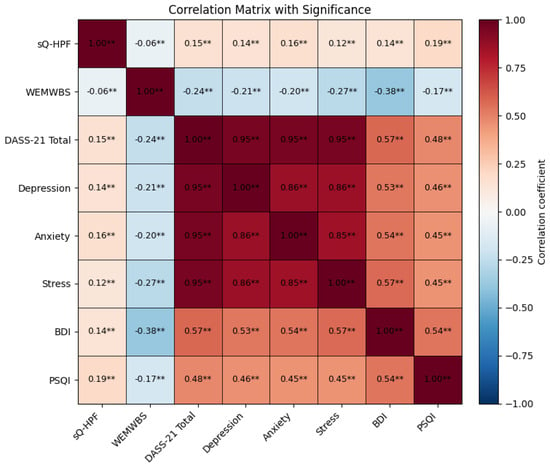
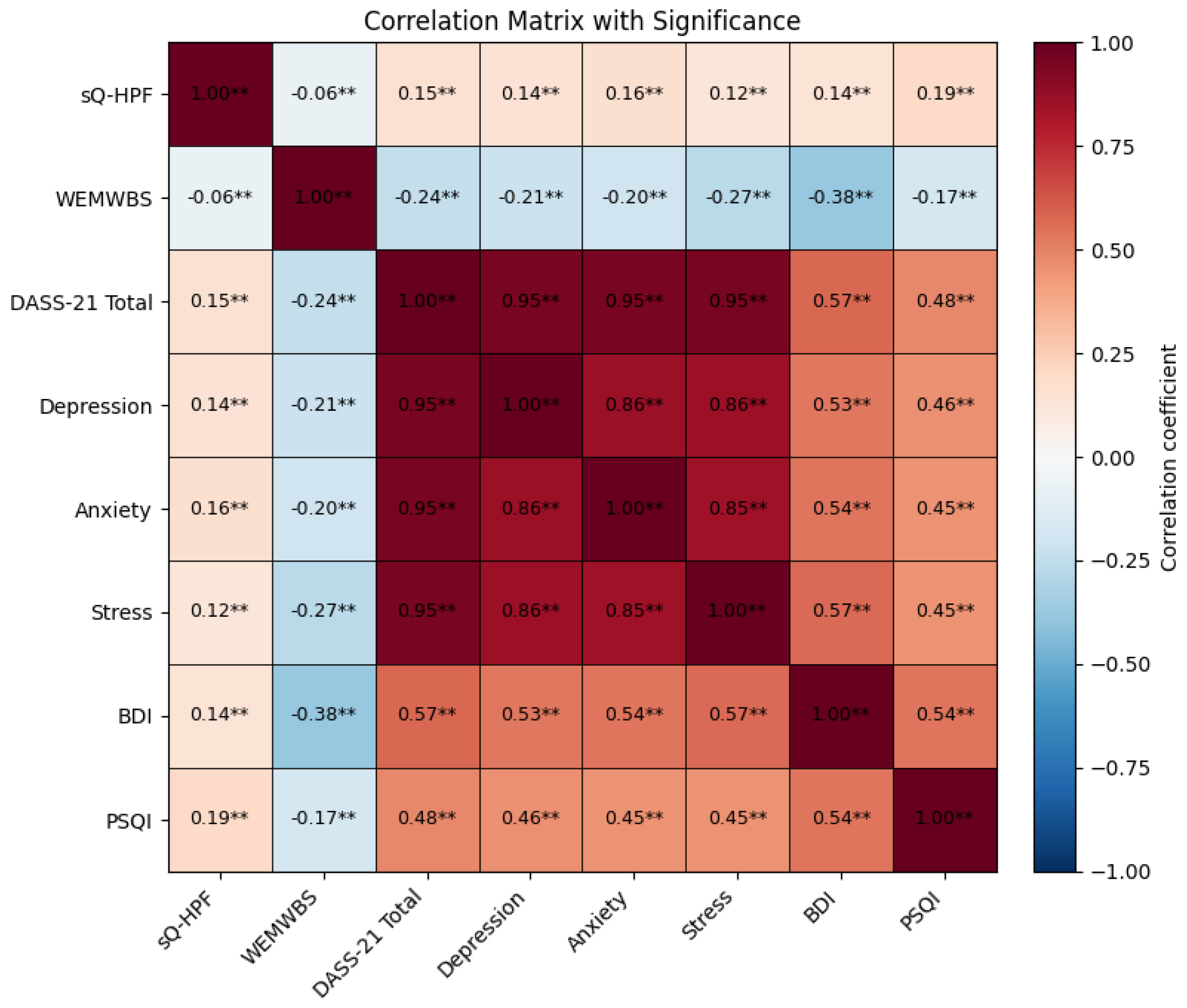
The results of the correlation analysis between ultra-processed food consumption (sQ-HPF) and mental symptoms, psychological well-being, and sleep quality are shown in Table 3 and Figure 1. Accordingly, the total sQ-HPF score was found to be positively and weakly correlated with the total DASS-21 score (r = 0.15; p < 0.001). Similarly, significant positive correlations were found between the sQ-HPF score and the BDI score (r = 0.13; p < 0.001) and the PSQI score (r = 0.19; p < 0.001). In contrast, a negative and weak correlation was found between sQ-HPF and the WEMWBS score, which indicates psychological well-being (r = −0.06; p < 0.001).
Table 3.
Correlation analysis between ultra-processed food consumption, psychological symptoms, mental well-being, and sleep quality.
Figure 1.
Pearson correlation matrix showing the relationships between ultra-processed food consumption, mental well-being indicators, and sleep quality. Positive correlations are shown in red, and negative correlations are shown in blue. The cell values represent Pearson’s r coefficients. BDI: Beck Depression Inventory; DASS-21: Depression, Anxiety and Stress Scale-21 Items; PSQI: Pittsburgh Sleep Quality Index; sQ-HPF: Screening Questionnaire of Highly Processed Food Consumption; WEMWBS: Warwick-Edinburgh Mental Wellbeing Scale. ** p < 0.01.
Comparisons based on depression and sleep quality classifications are shown in Table 4. As the severity of depression increased, the total PSQI, sQ-HPF, and DASS-21 scores increased significantly, whereas the WEMWBS score decreased significantly (p < 0.001). In the evaluation based on the PSQI classification, individuals with poor sleep quality had significantly higher total and subdimensional DASS-21 scores and BDI and sQ-HPF scores and lower WEMWBS scores than individuals with good sleep quality (p < 0.001).
Table 4.
Comparison of psychological symptoms, ultra-processed food consumption and mental well-being scores by depression level and sleep quality categories.
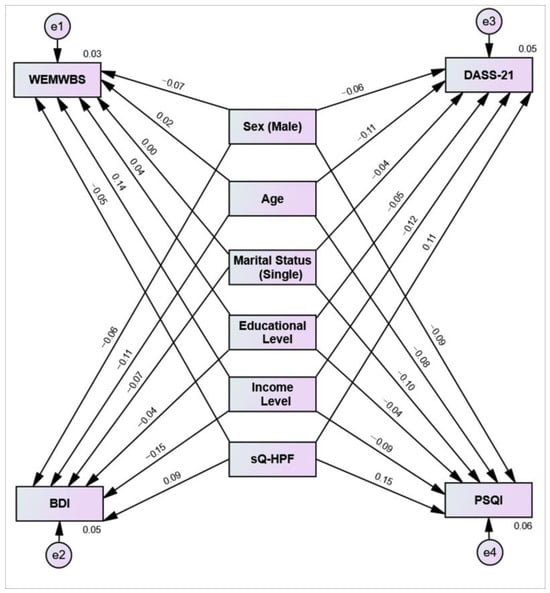
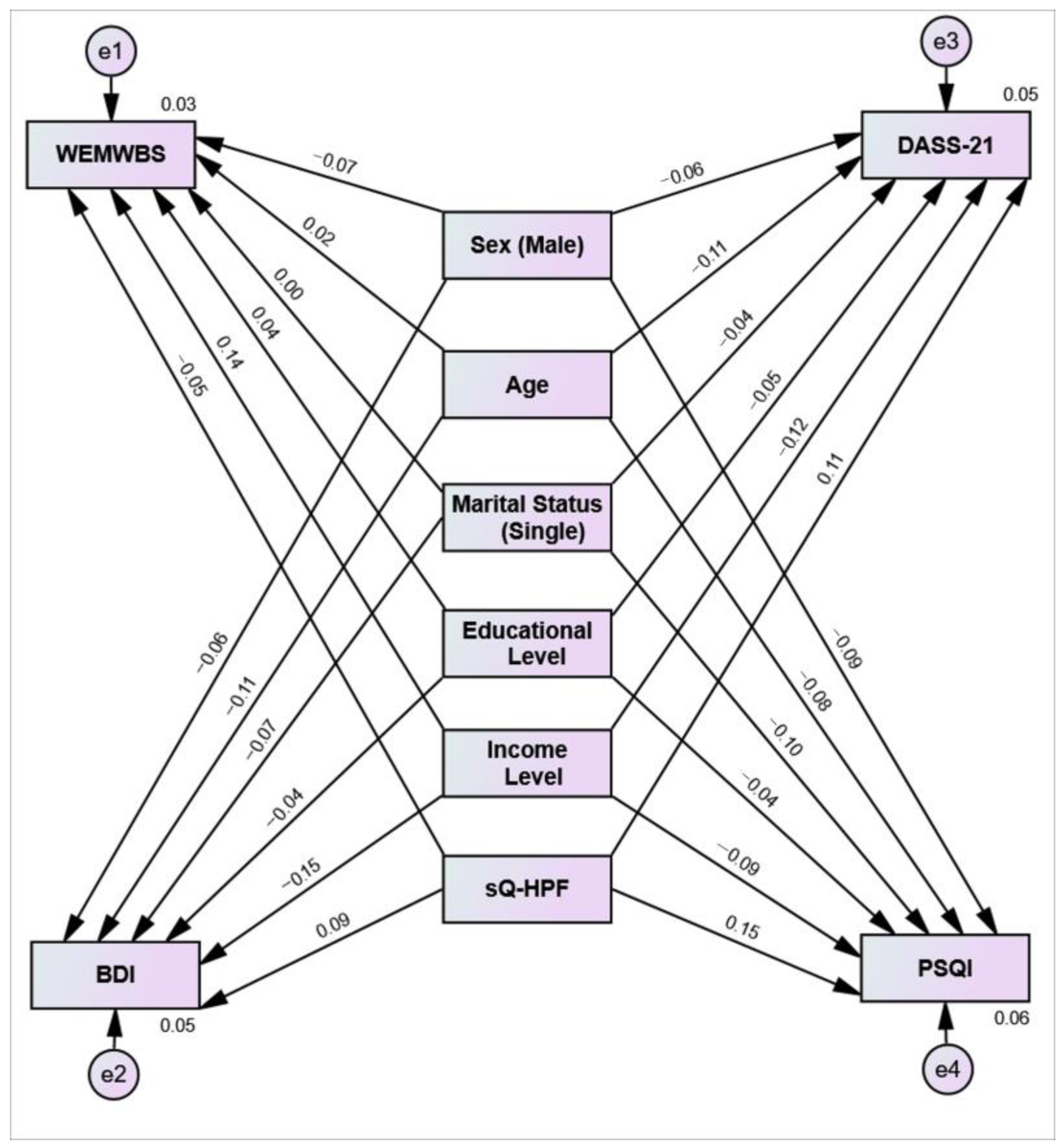
In this study, age, sex, marital status, education level, and income level, which have been shown in the literature to be associated with both nutritional behaviors and mental health and sleep, were included in the multivariate path analysis model as potential confounding variables. The conceptual model of the established path analysis is presented in Figure 2, and the results of the multivariate analysis are shown in detail in Table 5. The consumption of ultra-processed foods was found to have independent and significant effects on psychological well-being, depression, mental symptoms, and sleep quality. In the model created for the WEMWBS, the total sQ-HPF score was found to be negatively correlated with psychological well-being, whereas a 1-unit increase in the total sQ-HPF score led to a 0.26-unit decrease in the WEMWBS score (β = −0.05; p = 0.004). In the model established for depression (BDI), a 1-unit increase in sQ-HPF corresponded to a 0.32-unit increase in the BDI score (β = 0.09; p < 0.001). Similarly, sQ-HPF was found to be a positive and significant predictor of the total DASS-21 score (β = 0.11; p < 0.001). In the sleep quality (PSQI) model, the total sQ-HPF score showed the strongest positive correlation with impaired sleep quality, with a 1-unit increase in the sQ-HPF leading to a 0.13-unit increase in the PSQI score (β = 0.15; p < 0.001).
Figure 2.
Multivariate path analysis model of the effects of ultra-processed food consumption on mental well-being, depression, psychological symptoms, and sleep quality.
Table 5.
Multivariate path analysis results of the effects of ultra-processed food consumption on mental well-being, depression, psychological symptoms, and sleep quality.
Multivariate path analysis examining the effects of sQ-HPF, income, education, marital status, age and sex on BDI, PSQI, DASS-21 and WEMWBS scores. The model tested whether four dependent variables were significantly predictive of sQ-HPF. The dependent variables were the BDI, PSQI, DASS-21 and WEMWBS scores, while the independent variables were the total scores of the sQ-HPF, income, education, marital status, age and sex. Two-way arrows represent the correlation (r) between the scales, and the one-way arrows represent the standardized beta coefficients (β). The term “e” represents the margin of error, whereas the number in the dependent variable represents the explanatory variance of the independent variables in the dependent variable. Although these constructs are conceptually related, they were modeled as parallel outcome variables rather than as predictors of one another. This approach was adopted to avoid conceptual overlap within the model and to minimize potential concerns regarding multicollinearity.
4. Discussion
This study evaluated the effects of ultra-processed food consumption on mental health, psychological state, and sleep quality. Ultra-processed food consumption was found to be associated with decreased psychological well-being; increased symptoms such as depression, anxiety, and stress; and impaired sleep quality. These relationships persisted independently of age, sex, and socioeconomic factors. Our study did not find a statistically significant difference in UPF consumption based on sex. Although studies in the literature have shown that men consume more UPFs than women do [39,40], other studies have shown that women consume more UPFs [40,41]. Differences between genders are likely due to factors such as the level of development of the country, differences in the nutritional behavior of men and women, differing perceptions of healthy food among men compared with women, and the increasing attractiveness of ready-made meals due to the increasing number of working women [9,42]. The results of studies vary due to methodological, national, regional, and cultural differences. It is important to conduct longitudinal studies with large sample sizes, which are based on gender, at the national and international levels.
Factors such as age, gender, marital status, and employment status have also been found to be associated with UPF consumption [9]. Ge et al. [43] reported that married individuals consumed more UPFs, similar to our study. Furthermore, the study argues that married individuals have higher UPF consumption because they are among the vulnerable demographic groups [43]. Married individuals, owing to their busy work schedules and family responsibilities, tend to prefer quick and easy-to-prepare foods, which can increase their consumption of UPFs. Factors such as changing workforce structures, demographic shifts in developed and developing countries, and increasing global time constraints can also contribute to increased UPF consumption [9]. This issue can be clarified through studies examining various sociodemographic characteristics.
Our study revealed that the average age of individuals with low UPF consumption was greater than the average age of individuals with high UPF consumption. Similar results have been reported in studies in the literature, and UPF consumption decreases with age [44,45]. The consumption of these foods, characterized by high energy density and low nutritional quality, generally increases during late adolescence and young adulthood [46]. Consumption of ultra-processed foods generally declines with age, which may be explained by age-related changes in dietary preferences. Individual and environmental factors such as young individuals’ sensitivity to advertising, curiosity in trying new products, socialization needs, and insufficient knowledge and time to buy and cook healthy foods can influence these preferences [9,43,46]. Our study data revealed that UPF consumption is significantly associated with psychological symptoms, mental well-being, and sleep quality. A comprehensive review of UPFs and adverse health outcomes revealed that UPFs are associated with negative mental health outcomes such as sleep-related problems, anxiety, and newly emerged depression [12]. In our study, a 1-unit increase in the total sQ-HPF score corresponded to a 0.26-unit decrease in the WEMWBS score (β = −0.05; p = 0.004) and a 0.32-unit increase in the BDI score (β = 0.09; p < 0.001). Similarly, sQ-HPF was found to be a positive and significant predictor of the total DASS-21 score (β = 0.11; p < 0.001). In a cohort study (n = 4554) by Arshad et al. (2023), higher UPF intake was found to increase the likelihood of recurrent depressive symptoms by 34% [28]. A systematic review and meta-analysis revealed that higher UPF consumption was associated with an increased likelihood of common mental disorders (depressive and anxiety symptoms) [27]. Adjibade et al. reported that a 10% increase in the intake of ultra-processed foods was associated with a 21% increased risk of developing symptoms of depression over a 5-year follow-up period [47]. The relationship between UPF consumption and depression is thought to be linked to inflammatory processes and metabolic disorders. Ultra-processed foods are associated with chronic nutrition-related conditions, including obesity and metabolic syndrome, both of which exhibit bidirectional relationships with depression [48]. It is thought that such an outcome may occur due to the overactivity of the HPA axis, elevated cortisol secretion, immune-inflammatory signaling, leptin and insulin resistance, as well as potential alterations in the gut–brain [6,49]. Increased consumption of UPFs can lead to insufficient intake of healthy options containing important nutrients such as vitamins, minerals, and dietary fiber. Nutrient deficiencies can increase the risk of depression [6]. However, contaminants in food processing and phthalates found in packaging are reported to be linked to symptoms of depression [50]. Diets high in refined grains, simple sugars, and saturated or trans fats are associated with mental disorders, likely through pathways involving systemic inflammation, oxidative stress, and mitochondrial dysfunction [6,51]. Reduced dietary fiber intake can disrupt the balance of the gut microbiome via the gut–brain microbiome. It is also known that gut microbiome imbalances can further increase the risk of depression [6,52]. In conclusion, UPF consumption has the potential to negatively affect mental health through possible mechanisms of action; however, longitudinal and intervention-based studies are needed to reach a definitive conclusion. Since there is no research specifically examining this relationship in our country, it is important that future research examine this issue holistically with larger sample sizes and long-term follow-up.
Our study revealed that the total sQ-HPF score exhibited the strongest positive correlation with impaired sleep quality. A 1-unit increase in sQ-HPF was found to lead to a 0.13-unit increase in the PSQI score. There are also studies reporting a positive correlation between high UPF consumption and an increased risk of insomnia [27,53]. Pourmotabbed et al. (2024) reported a significant positive association between higher UPF intake and an increased risk of insomnia (OR = 1.53; 95% CI: 1.20, 1.95; I2 = 62.3%; p = 0.014; n = 7) [54]. Research using data from the NutriNet-Sante study reported that UPF consumption is associated with an increased likelihood of chronic insomnia [53]. It can disrupt sleep quality through multiple physiological pathways. These include increased levels of ghrelin and cortisol, which promote hunger and disrupt melatonin secretion; decreased leptin concentrations; disruption of the microbiota; and changes in serotonin and melatonin synthesis [26]. Furthermore, higher intake of added sugars and refined grains has been recognized as an independent risk factor for insomnia, leading to increases in the dietary glycemic index and glycemic load [55]. This is a very current topic, and more studies are needed to clarify it.
Limitations
This study has several limitations. The fact that the sample consisted predominantly of young people and students (mean age: 28.4 ± 10.94; 46.1% students) limits the generalizability of the findings. Furthermore, because a non-probability convenience sampling method was used in the study, the results obtained do not statistically represent the entire adult population in Türkiye. Nevertheless, the findings contribute to understanding trends and patterns within the relevant sample group. Another limitation is that the data regarding the relationship between the severity of depression and sleep quality experienced by participants and UPFs are based on self-reports; this may lead to potential recall bias and misreporting. In this study, it is not possible to draw definitive conclusions because sleep quality, mental states, and nutritional characteristics are based on individuals’ self-assessments, perceptions, and memories. Data from individual reports may not reflect normal conditions or may lead to misinformation. Last limitation is that only sociodemographic covariates were included in the multivariate models, and that residual confounding from health behaviors and clinical variables is likely.
5. Conclusions
The study showed that consumption of ultra-processed foods is associated with poorer mental health and sleep quality, regardless of age, sex, and socioeconomic factors. Sleep quality was assessed solely via the PSQI, and more detailed clinical studies evaluating sleep quality could strengthen the research. To our knowledge, this topic has never been studied in a Turkish population before, and the uniqueness of this study is a strong point. This study is the first to holistically analyze the effects of UPFs on mental state, mental health, and sleep quality in a Turkish population, incorporating current nutritional concepts, which is another strong point of our study.
Author Contributions
Conceptualization, S.İ.I. and H.B.; methodology, S.İ.I. and H.B.; software, S.İ.I. and H.B.; validation, S.İ.I. and H.B.; formal analysis, S.İ.I. and H.B.; investigation, S.İ.I. and H.B.; resources, S.İ.I. and H.B.; data curation, S.İ.I. and H.B.; writing—original draft preparation, S.İ.I. and H.B.; writing—review and editing, S.İ.I. and H.B.; visualization, S.İ.I.; supervision, S.İ.I. and H.B. All authors have read and agreed to the published version of the manuscript.
Funding
This research received no external funding.
Institutional Review Board Statement
The study was conducted in accordance with the Declaration of Helsinki, Karamanoğlu Mehmetbey University Health Sciences Scientific Research and Publication Ethics Committee (decision number 07-2025/104 and 17 June 2025).
Informed Consent Statement
Informed consent was obtained from all subjects involved in the study.
Data Availability Statement
The datasets generated and/or analyzed during the current study are not publicly available due to restrictions (e.g., they contain information that could compromise the privacy of research participants) but are available from the corresponding author (Serap Incedal Irgat, email: serapincedal@kmu.edu.tr) upon reasonable request.
Conflicts of Interest
The authors declare no conflicts of interest.
Abbreviations
The following abbreviations are used in this manuscript:
| sQ-HPF | Short Screening Questionnaire of Highly Processed Food Consumption |
| WEMWBS | Warwick-Edinburgh Mental Well-being Scale |
| DASS-21 | Depression-Anxiety-Stress Scale 21 |
| BDI | Beck Depression Inventory |
| PSQI | Pittsburgh Sleep Quality Index |
| UPFs | Ultra-processed foods |
References
- Cebrino, J.; Portero de la Cruz, S. Diet quality according to mental status and associated factors during adulthood in Spain. Nutrients 2021, 13, 1727. [Google Scholar] [CrossRef] [Scilit]
- Santomauro, D.F.; Herrera, A.M.M.; Shadid, J.; Zheng, P.; Ashbaugh, C.; Pigott, D.M.; Abbafati, C.; Adolph, C.; Amlag, J.O.; Aravkin, A.Y.; et al. Global prevalence and burden of depressive and anxiety disorders in 204 countries and territories in 2020 due to the COVID-19 pandemic. Lancet 2021, 398, 1700–1712. [Google Scholar] [CrossRef] [Scilit]
- World Health Organization. Depression and Other Common Mental Disorders: Global Health Estimates. Available online: https://www.afro.who.int/publications/depression-and-other-common-mental-disorders-global-health-estimates-2017 (accessed on 14 October 2025).
- Swathi, M.; Manjusha, S.; Vadakkiniath, I.J.; Gururaj, A. Prevalence and correlates of stress, anxiety, and depression in patients with chronic diseases: A cross-sectional study. Middle East Curr. Psychiatry 2023, 30, 66. [Google Scholar] [CrossRef] [Scilit]
- Vestergaard, C.L.; Skogen, J.C.; Hysing, M.; Harvey, A.G.; Vedaa, Ø.; Sivertsen, B. Sleep duration and mental health in young adults. Sleep Med. 2024, 115, 30–38. [Google Scholar] [CrossRef] [Scilit] [PubMed]
- Abdollahpour, N.; Fard, S.A.M.; Salahmanesh, A.; Hatamzadeh, H.; Moeini, R.; Soflaei, S.S.; Seifi, N.; Ghayour-Mobarhan, M. The Association between Ultra-Processed Foods and Depression, Anxiety and Sleep in Adults: A Cross-Sectional Study in Iran. Food Sci. Nutr. 2025, 13, e70316. [Google Scholar] [CrossRef] [Scilit] [PubMed]
- Monteiro, C.A.; Cannon, G.; Levy, R.B.; Moubarac, J.C.; Louzada, M.L.; Rauber, F.; Khandpur, N.; Cediel, G.; Neri, D.; Martinez-Steele, E.; et al. Ultra-processed foods: What they are and how to identify them. Public Health Nutr. 2019, 22, 936–941. [Google Scholar] [CrossRef] [Scilit]
- Martini, D.; Godos, J.; Bonaccio, M.; Vitaglione, P.; Grosso, G. Ultra-Processed Foods and Nutritional Dietary Profile: A Meta-Analysis of Nationally Representative Samples. Nutrients 2021, 13, 3390. [Google Scholar] [CrossRef] [Scilit]
- Mengi Çelik, Ö.; Güler, Ü.; Ekici, E.M. Factors Affecting Ultra-Processed Food Consumption: Hedonic Hunger, Food Addiction, and Mood. Food Sci. Nutr. 2025, 13, e70248. [Google Scholar] [CrossRef] [Scilit]
- Monteiro, C.A.; Louzada, M.L.; Steele-Martinez, E.; Cannon, G.; Andrade, G.C.; Baker, P.; Bes-Rastrollo, M.; Bonaccio, M.; Gearhardt, A.N.; Khandpur, N.; et al. Ultra-processed foods and human health: The main thesis and the evidence. Lancet 2025, 406, 2667–2684. [Google Scholar] [CrossRef] [Scilit] [PubMed]
- Baker, P.; Machado, P.; Santos, T.; Sievert, K.; Backholer, K.; Hadjikakou, M.; Russell, C.; Huse, O.; Bell, C.; Scrinis, G.; et al. Ultra-processed foods and the nutrition transition: Global, regional and national trends, food systems transformations and political economy drivers. Obes. Rev. 2020, 21, e13126. [Google Scholar] [CrossRef] [Scilit]
- Lane, M.M.; Gamage, E.; Du, S.; Ashtree, D.N.; McGuinness, A.J.; Gauci, S.; Baker, P.; Lawrence, M.; Rebholz, C.M.; Srour, B.; et al. Ultra-processed food exposure and adverse health outcomes: Umbrella review of epidemiological meta-analyses. BMJ 2024, 384, e077310. [Google Scholar] [CrossRef] [Scilit]
- Touvier, M.; da Costa Louzada, M.L.; Mozaffarian, D.; Baker, P.; Juul, F.; Srour, B. Ultra-processed foods and cardiometabolic health: Public health policies to reduce consumption cannot wait. BMJ 2023, 383, e075294. [Google Scholar] [CrossRef] [Scilit] [PubMed]
- Cordova, R.; Kliemann, N.; Huybrechts, I.; Rauber, F.; Vamos, E.P.; Levy, R.B.; Wagner, K.-H.; Viallon, V.; Casagrande, C.; Nicolas, G.; et al. Consumption of ultra-processed foods associated with weight gain and obesity in adults: A multi-national cohort study. Clin. Nutr. 2021, 40, 5079–5088. [Google Scholar] [CrossRef] [Scilit]
- Chen, Z.; Khandpur, N.; Desjardins, C.; Wang, L.; Monteiro, C.A.; Rossato, S.L.; Fung, T.T.; Manson, J.E.; Willett, W.C.; Rimm, E.B.; et al. Ultra-processed food consumption and risk of type 2 diabetes: Three large prospective US cohort studies. Diabetes Care 2023, 46, 1335–1344. [Google Scholar] [CrossRef] [Scilit] [PubMed]
- Juul, F.; Vaidean, G.; Lin, Y.; Deierlein, A.L.; Parekh, N. Ultra-Processed Foods and Incident Cardiovascular Disease in the Framingham Offspring Study. J. Am. Coll. Cardiol. 2021, 77, 1520–1531. [Google Scholar] [CrossRef] [Scilit]
- Rezende-Alves, K.; Hermsdorff, H.H.M.; da Silva Miranda, A.E.; Lopes, A.C.S.; Bressan, J.; Pimenta, A.M. Food processing and risk of hypertension: Cohort of Universities of Minas Gerais, Brazil (CUME Project). Public Health Nutr. 2021, 24, 4071–4079. [Google Scholar] [CrossRef] [Scilit] [PubMed]
- Lian, Y.; Wang, G.P.; Chen, G.Q.; Chen, H.N.; Zhang, G.Y. Association between ultra-processed foods and risk of cancer: A systematic review and meta-analysis. Front. Nutr. 2023, 10, 1175994. [Google Scholar] [CrossRef] [Scilit]
- Isaksen, I.M.; Dankel, S.N. Ultra-processed food consumption and cancer risk: A systematic review and meta-analysis. Clin. Nutr. 2023, 42, 919–928. [Google Scholar] [CrossRef] [Scilit]
- Wang, L.; Pan, X.F.; Munro, H.M.; Shrubsole, M.J.; Yu, D. Consumption of ultra-processed foods and all-cause and cause-specific mortality in the Southern Community Cohort Study. Clin. Nutr. 2023, 42, 1866–1874. [Google Scholar] [CrossRef] [Scilit]
- Vellinga, R.E.; van den Boomgaard, I.; Boer, J.M.; van der Schouw, Y.T.; Harbers, M.C.; Verschuren, W.M.; van’t Veer, P.; Temme, E.H.M.; Biesbroek, S. Different levels of ultraprocessed food and beverage consumption and associations with environmental sustainability and all-cause mortality in EPIC-NL. Am. J. Clin. Nutr. 2023, 118, 103–113. [Google Scholar] [CrossRef] [Scilit]
- Liang, S.; Zhou, Y.; Zhang, Q.; Yu, S.; Wu, S. Ultra-processed foods and risk of all-cause mortality: An updated systematic review and dose-response meta-analysis of prospective cohort studies. Syst. Rev. 2025, 14, 53. [Google Scholar] [CrossRef] [Scilit]
- Delpino, F.M.; Figueiredo, L.M.; Flores, T.R.; Silveira, E.A.; Dos Santos, F.S.; Werneck, A.O.; da Costa Louzada, M.L.; Arcêncio, R.A.; Nunes, B.P. Intake of ultra-processed foods and sleep-related outcomes: A systematic review and meta-analysis. Nutrition 2023, 106, 111908. [Google Scholar] [CrossRef] [Scilit] [PubMed]
- Gómez-Donoso, C.; Sánchez-Villegas, A.; Martínez-González, M.A.; Gea, A.; de Deus Mendonça, R.; Lahortiga-Ramos, F.; Bes-Rastrollo, M. Ultra-processed food consumption and the incidence of depression in a Mediterranean cohort: The SUN Project. Eur. J. Nutr. 2020, 59, 1093–1103. [Google Scholar] [CrossRef] [Scilit] [PubMed]
- Sousa Gomes, M.; Martins, J.; Duarte, A.; Augusto, C.; Silva, M.J.; Padrão, P.; Moreira, P.; Rosário, R. Processed Food Consumption and Sleep Quality in School-Aged Children: Insights from a Cross-Sectional Study. Nutrients 2025, 17, 233. [Google Scholar] [CrossRef] [Scilit]
- Ekici, E.M.; Çelik, Ö.M.; Göbel, P.; Güzelalp, A.H. Association between ultra-processed food intake, night eating behavior, and sleep quality: A cross-sectional study from Türkiye. Health Qual. Life Outcomes 2025, 23, 103. [Google Scholar] [CrossRef] [Scilit]
- Lane, M.M.; Gamage, E.; Travica, N.; Dissanayaka, T.; Ashtree, D.N.; Gauci, S.; Lotfaliany, M.; O’Neil, A.; Jacka, F.N.; Marx, W. Ultra-Processed Food Consumption and Mental Health: A Systematic Review and Meta-Analysis of Observational Studies. Nutrients 2022, 14, 2568. [Google Scholar] [CrossRef] [Scilit]
- Arshad, H.; Head, J.; Jacka, F.N.; Lane, M.M.; Kivimaki, M.; Akbaraly, T. Association between ultra-processed foods and recurrence of depressive symptoms: The Whitehall II cohort study. Nutr. Neurosci. 2024, 27, 42–54. [Google Scholar] [CrossRef] [Scilit]
- Cohen, J. Statistical Power Analysis for the Behavioral Sciences; Lawrence Erlbaum Associates: Hillsdale, NJ, USA, 1988. [Google Scholar]
- Martinez-Perez, C.; Daimiel, L.; Climent-Mainar, C.; Martínez-González, M.Á.; Salas-Salvadó, J.; Corella, D.; Schröder, H.; Martinez, J.A.; Alonso-Gómez, Á.M.; Wärnberg, J.; et al. Integrative development of a short screening questionnaire of highly processed food consumption (sQ-HPF). Int. J. Behav. Nutr. Phys. Act. 2022, 19, 6. [Google Scholar] [CrossRef] [Scilit]
- Erdoğan Gövez, N.; Köksal, E.; Martinez-Perez, C.; Daimiel, L. Validity and Reliability of the Turkish Version of the Screening Questionnaire of Highly Processed Food Consumption (sQ-HPF). Nutrients 2024, 16, 2552. [Google Scholar] [CrossRef] [Scilit]
- Tennant, R.; Hiller, L.; Fishwick, R.; Platt, S.; Joseph, S.; Weich, S.; Parkinson, J.; Secker, J.; Stewart-Brown, S. The Warwick-Edinburgh Mental Well-being Scale (WEMWBS): Development and UK validation. Health Qual. Life Outcomes 2007, 5, 63. [Google Scholar] [CrossRef] [Scilit] [PubMed]
- Keldal, G. Warwick-Edinburgh mental iyi oluş ölçeği’nin Türkçe formu: Geçerlik ve güvenirlik çalışması. J. Happiness Well-Being 2015, 3, 103–115. [Google Scholar]
- Yılmaz, Ö.; Boz, H.; Arslan, A. Depresyon Anksiyete Stres Ölçeğinin (DASS 21) Türkçe kisa formunun geçerlilik-güvenilirlik çalişmasi. Finans Ekon. Sos. Araştır. Derg. 2017, 2, 78–91. [Google Scholar]
- Hisli, N. Beck Depresyon Envanteri’nin geçerliği üzerine bir çalışma. Psikoloji Derg. 1988, 6, 118–126. [Google Scholar]
- Kılınç, S.; Torun, F. Türkiye’de Klinikte Kullanılan Depresyon Değerlendirme Ölçekleri. Dirim Tıp Gaz. 2011, 86, 39–47. [Google Scholar]
- Buysse, D.J.; Reynolds, C.F., III; Monk, T.H.; Berman, S.R.; Kupfer, D.J. The Pittsburgh Sleep Quality Index: A new instrument for psychiatric practice and research. Psychiatry Res. 1989, 28, 193–213. [Google Scholar] [CrossRef] [Scilit]
- Ağargün, M.Y.; Kara, H.; Anlar, O. Pittsburgh Uyku Kalitesi İndeksi’nin geçerliği ve güvenirliği. Turk Psikiyatri. Derg. 1996, 7, 107–115. [Google Scholar]
- Nardocci, M.; Leclerc, B.S.; Louzada, M.L.; Monteiro, C.A.; Batal, M.; Moubarac, J.-C. Consumption of ultra-processed foods and obesity in Canada. Can. J. Public Health 2019, 110, 4–14. [Google Scholar] [CrossRef] [Scilit]
- Hosseinpour-Niazi, S.; Niknam, M.; Amiri, P.; Mirmiran, P.; Ainy, E.; Izadi, N.; Gaeini, Z.; Azizi, F. The association between ultra-processed food consumption and health-related quality of life differs across lifestyle and socioeconomic strata. BMC Public Health 2024, 24, 1955. [Google Scholar]
- Khandpur, N.; Neri, D.A.; Monteiro, C.; Mazur, A.; Frelut, M.L.; Boyland, E.; Weghuber, D.; Thivel, D. Ultra-processed food consumption among the paediatric population: An overview and call to action from the European Childhood Obesity Group. Ann. Nutr. Metab. 2020, 76, 109–113. [Google Scholar] [CrossRef] [Scilit]
- Shim, J.-S.; Shim, S.-Y.; Cha, H.-J.; Kim, J.; Kim, H.C. Socioeconomic Characteristics and Trends in the Consumption of Ultra-Processed Foods in Korea from 2010 to 2018. Nutrients 2021, 13, 1120. [Google Scholar] [CrossRef] [Scilit]
- Ge, M.W.; Shi, H.Y.; Chen, X.L.; Shen, L.T.; Hu, F.H.; Jia, Y.J.; Li, W.; Lan, J.-Z.; Xu, H.; Cai, B.; et al. Higher socioeconomic status is associated with higher ultra-processed food intake: A cross-sectional analysis. Int. J. Food Sci. Nutr. 2024, 75, 898–910. [Google Scholar] [CrossRef] [Scilit] [PubMed]
- Magalhães, V.; Severo, M.; Correia, D.; Torres, D.; Costa de Miranda, R.; Rauber, F.; Levy, R.; Rodrigues, S.; Lopes, C. Associated factors to the consumption of ultra-processed foods and its relation with dietary sources in Portugal. J. Nutr. Sci. 2021, 10, e89. [Google Scholar] [CrossRef] [Scilit] [PubMed]
- Marino, M.; Puppo, F.; Del Bo’, C.; Vinelli, V.; Riso, P.; Porrini, M.; Martini, D. A Systematic Review of Worldwide Consumption of Ultra-Processed Foods: Findings and Criticisms. Nutrients 2021, 13, 2778. [Google Scholar] [CrossRef] [Scilit] [PubMed]
- Gonçalves, H.V.B.; Batista, L.S.; de Amorim, A.L.B.; Bandoni, D.H. Association between Consumption of Ultra-Processed Foods and Sociodemographic Characteristics in Brazilian Adolescents. Nutrients 2023, 15, 2027. [Google Scholar] [CrossRef] [Scilit]
- Adjibade, M.; Julia, C.; Allès, B.; Touvier, M.; Lemogne, C.; Srour, B.; Hercberg, S.; Galan, P.; Assmann, K.E.; Kesse-Guyot, E. Prospective association between ultra-processed food consumption and incident depressive symptoms in the French NutriNet-Santé cohort. BMC Med. 2019, 17, 78. [Google Scholar] [CrossRef] [Scilit]
- Milaneschi, Y.; Simmons, W.K.; van Rossum, E.F.C.; Penninx, B.W. Depression and obesity: Evidence of shared biological mechanisms. Mol. Psychiatry 2019, 24, 18–33. [Google Scholar] [CrossRef] [Scilit]
- Sanchez-Villegas, A.; Zazpe, I.; Santiago, S.; Perez-Cornago, A.; Martinez-Gonzalez, M.A.; Lahortiga-Ramos, F. Added sugars and sugar-sweetened beverage consumption, dietary carbohydrate index and depression risk in the Seguimiento Universidad de Navarra (SUN) Project. Br. J. Nutr. 2018, 119, 211–221. [Google Scholar] [CrossRef] [Scilit]
- Canella, D.S.; Louzada, M.L.D.C.; Claro, R.M.; Costa, J.C.; Bandoni, D.H.; Levy, R.B.; Martins, A.P.B. Consumption of vegetables and their relation with ultra-processed foods in Brazil. Rev. Saude Publica 2018, 52, 50. [Google Scholar] [CrossRef] [Scilit]
- DiNicolantonio, J.J.; Mehta, V.; Onkaramurthy, N.; O’Keefe, J.H. Fructose-Induced Inflammation and Increased Cortisol: A New Mechanism for How Sugar Induces Visceral Adiposity. Prog. Cardiovasc. Dis. 2018, 61, 3–9. [Google Scholar] [CrossRef] [Scilit]
- Koopman, M.; El Aidy, S. Depressed Gut? The Microbiota-Diet-Inflammation Trialogue in Depression. Curr. Opin. Psychiatry 2017, 30, 369–377. [Google Scholar] [CrossRef] [Scilit]
- Duquenne, P.; Capperella, J.; Fezeu, L.K.; Srour, B.; Benasi, G.; Hercberg, S.; Touvier, M.; Andreeva, V.A.; St-Onge, M.P. The association between ultra-processed food consumption and chronic insomnia in the NutriNet-Santé Study. J. Acad. Nutr. Diet. 2024, 124, 1109–1117. [Google Scholar] [CrossRef] [Scilit] [PubMed]
- Pourmotabbed, A.; Awlqadr, F.H.; Mehrabani, S.; Babaei, A.; Wong, A.; Ghoreishy, S.M.; Talebi, S.; Kermani, M.A.H.; Jalili, F.; Moradi, S.; et al. Ultra-Processed Food Intake and Risk of Insomnia: A Systematic Review and Meta-Analysis. Nutrients 2024, 16, 3767. [Google Scholar] [CrossRef] [Scilit] [PubMed]
- Gangwisch, J.E.; Hale, L.; St-Onge, M.P.; Choi, L.; LeBlanc, E.S.; Malaspina, D.; Opler, M.G.; Shadyab, A.H.; Shikany, J.M.; Snetselaar, L.; et al. High glycemic index and glycemic load diets as risk factors for insomnia: Analyses from the Women’s Health Initiative. Am. J. Clin. Nutr. 2020, 111, 429–439. [Google Scholar] [CrossRef] [Scilit] [PubMed]

Disclaimer/Publisher’s Note: The statements, opinions and data contained in all publications are solely those of the individual author(s) and contributor(s) and not of MDPI and/or the editor(s). MDPI and/or the editor(s) disclaim responsibility for any injury to people or property resulting from any ideas, methods, instructions or products referred to in the content. |
© 2026 by the authors. Licensee MDPI, Basel, Switzerland. This article is an open access article distributed under the terms and conditions of the Creative Commons Attribution (CC BY) license.