The Impact of Social Media Engagement on Adult Self-Esteem: Implications for Managing Digital Well-Being



Abstract
1. Introduction
1.1. Background and Purpose of the Research
1.2. Literature Review
1.3. Empirical Evidence
1.4. Critical Evaluation of the Literature and Research Gap
2. Materials and Methods
2.1. Research Design
2.2. Sample and Data Collection
2.3. Instruments
2.3.1. Social Media Use Questionnaire
2.3.2. Rosenberg Self Esteem Scale (RSES)
2.4. Statistical Analyses
2.5. Ethical Issues
3. Results
3.1. Descriptive Characteristics of Social Media Use
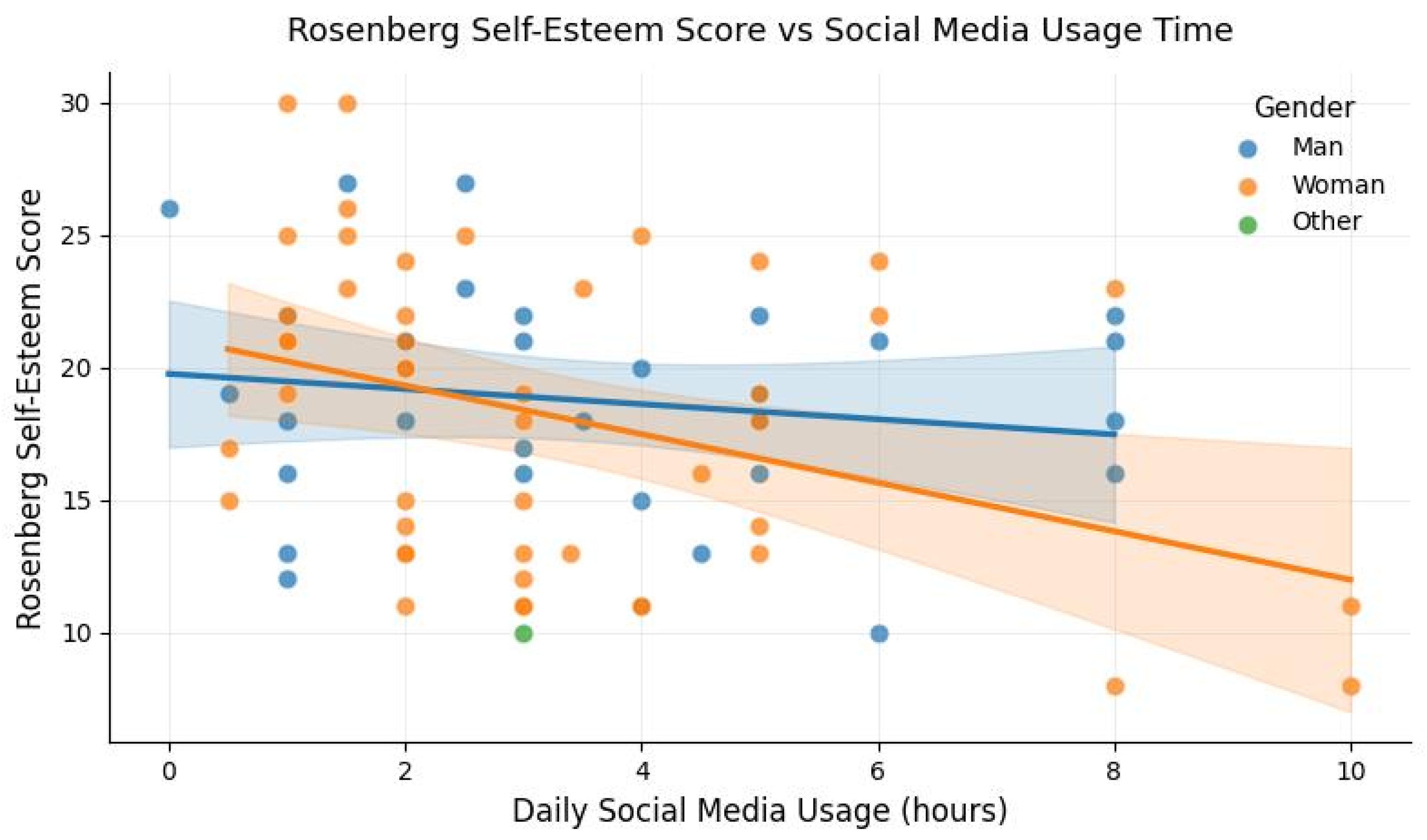
3.2. Association Between Social Media Use and Self-Esteem
3.3. Multiple Regression and Group Comparisons
3.4. Additional Behavioral Observations
4. Discussion
4.1. Interpretation of Findings
4.2. Behavioral Patterns and Mechanisms
4.3. Subgroup Differences
4.4. Limitations
4.5. Broader Context and Implications
5. Conclusions
Supplementary Materials
Author Contributions
Funding
Institutional Review Board Statement
Informed Consent Statement
Data Availability Statement
Conflicts of Interest
References
- Kaplan, A.M.; Haenlein, M. Users of the world, unite! The challenges and opportunities of social media. Bus. Horiz. 2010, 53, 59–68. [Google Scholar] [CrossRef] [Scilit]
- Kietzmann, J.H.; Hermkens, K.; McCarthy, I.P.; Silvestre, B.S. Social media? Get serious! Understanding the functional building blocks of social media. Bus. Horiz. 2011, 54, 241–251. [Google Scholar] [CrossRef] [Scilit]
- O’Reilly, T. What is Web 2.0: Design patterns and business models for the next generation of software. Commun. Strateg. 2007, 1, 17. [Google Scholar]
- Papacharissi, Z. A Networked Self: Identity, Community, and Culture on Social Network Sites; Routledge: New York, NY, USA, 2010. [Google Scholar]
- Boyd, D.M.; Ellison, N.B. Social network sites: Definition, history, and scholarship. J. Comput. Mediat. Commun. 2007, 13, 210–230. [Google Scholar] [CrossRef] [Scilit]
- Diener, E. Subjective well-being. Psychol. Bull. 1984, 95, 542–575. [Google Scholar] [CrossRef]
- Ryff, C.D. Happiness is everything, or is it? Explorations on the meaning of psychological well-being. J. Pers. Soc. Psychol. 1989, 57, 1069–1081. [Google Scholar] [CrossRef]
- Orth, U.; Robins, R.W.; Widaman, K.F. Life-span development of self-esteem and its effects on important life outcomes. J. Pers. Soc. Psychol. 2012, 102, 1271–1288. [Google Scholar]
- Lund, C.; Brooke-Sumner, C.; Baingana, F.; Baron, E.C.; Breuer, E.; Chandra, P.S.; Haushofer, J.; Herrman, H.; Jordans, M.J.; Kieling, C.; et al. Social determinants of mental disorders and the Sustainable Development Goals: A systematic review of reviews. Lancet Psychiatry 2018, 5, 357–369. [Google Scholar] [CrossRef] [Scilit]
- Karava, E.; Barbouni, A.; Niforou, K.; Marinos, G.; Riza, E.; Lagiou, A.; Lagiou, P.; Naska, A.; Orfanos, P. Subjective well-being and its determinants in a sample of adolescents in Greece. Health Res. J. 2025, 11, 142–153. [Google Scholar] [CrossRef] [Scilit]
- Ulvi, O.; Karamehic-Muratovic, A.; Baghbanzadeh, M.; Bashir, A.; Smith, J.; Haque, U. Social media use and mental health: A global analysis. Epidemiologia 2022, 3, 11–25. [Google Scholar] [CrossRef] [Scilit]
- Bhatiasevi, V. The uses and gratifications of social media and their impact on social relationships and psychological well-being. Front. Psychiatry 2024, 15, 1260565. [Google Scholar] [CrossRef] [Scilit] [PubMed]
- Ostic, D.; Qalati, S.A.; Barbosa, B.; Shah, S.M.M.; Galvan Vela, E.; Herzallah, A.M.; Liu, F. Effects of social media use on psychological well-being: A mediated model. Front. Psychol. 2021, 12, 678766. [Google Scholar] [CrossRef] [Scilit] [PubMed]
- Koh, G.K.; Ow Yong, J.Q.Y.; Lee, A.R.Y.B.; Yau, C.E.; Ho, C.S.H.; Goh, Y.S. Social media use and its impact on adults’ mental health and well-being: A scoping review. Worldviews Evid. Based Nurs. 2024, 21, 345–394. [Google Scholar] [CrossRef] [Scilit] [PubMed]
- Şentürk, E.; Geniş, B.; Coşar, B. Social media addiction in young adult patients with anxiety disorders and depression. Alpha Psychiatry 2021, 22, 257–262. [Google Scholar] [CrossRef] [Scilit]
- Shensa, A.; Escobar-Viera, C.G.; Sidani, J.E.; Bowman, N.D.; Marshal, M.P.; Primack, B.A. Problematic social media use and depressive symptoms among U.S. young adults: A nationally-representative study. Soc. Sci. Med. 2017, 182, 150–157. [Google Scholar] [CrossRef] [Scilit]
- Wong, J.; Yi, P.X.; Quek, F.Y.X.; Lua, V.Y.Q.; Majeed, N.M.; Hartanto, A. A four-level meta-analytic review of the relationship between social media and well-being: A fresh perspective in the context of COVID-19. Curr. Psychol. 2022, 43, 14972–14986. [Google Scholar] [CrossRef] [Scilit]
- Lin, L.Y.; Sidani, J.E.; Shensa, A.; Radovic, A.; Miller, E.; Colditz, J.B.; Hoffman, B.L.; Giles, L.M.; Primack, B.A. Association between social media use and depression among US young adults. Depress. Anxiety 2016, 33, 323–331. [Google Scholar] [CrossRef] [Scilit]
- Ellison, N.B.; Steinfield, C.; Lampe, C. The benefits of Facebook “friends”: Social capital and college students’ use of online social network sites. J. Comput. Mediat. Commun. 2007, 12, 1143–1168. [Google Scholar] [CrossRef] [Scilit]
- Stangl, F.J.; Riedl, R.; Kiemeswenger, R.; Montag, C. Negative psychological and physiological effects of social networking site use: The example of Facebook. Front. Psychol. 2023, 14, 1141663. [Google Scholar] [CrossRef] [Scilit]
- Ahmed, O.; Walsh, E.I.; Dawel, A.; Alateeq, K.; Espinoza Oyarce, D.A.; Cherbuin, N. Social media use, mental health and sleep: A systematic review with meta-analyses. J. Affect. Disord. 2024, 367, 701–712. [Google Scholar] [CrossRef] [Scilit]
- Handerer, F.; Kinderman, P.; Shafti, M.; Tai, S. A scoping review and narrative synthesis comparing the constructs of social determinants of health and social determinants of mental health: Matryoshka or two independent constructs? Front. Psychiatry 2022, 13, 848556. [Google Scholar] [CrossRef] [Scilit]
- Godard, R.; Holtzman, S. Are active and passive social media use related to mental health, wellbeing, and social support outcomes? A meta-analysis of 141 studies. J. Comput.-Mediat. Commun. 2024, 29, zmad055. [Google Scholar] [CrossRef] [Scilit]
- Jahagirdar, V.; Sequeira, L.A.; Kinattingal, N.; Roohi, T.F.; Alshehri, S.; Shakeel, F.; Mehdi, S. Assessment of the impact of social media addiction on psychosocial behaviour like depression, stress, and anxiety in working professionals. BMC Psychol. 2024, 12, 352. [Google Scholar] [CrossRef] [Scilit] [PubMed]
- Kuss, D.J.; Griffiths, M.D. Online social networking and addiction: A review of the psychological literature. Int. J. Environ. Res. Public Health 2011, 8, 3528–3557. [Google Scholar] [CrossRef] [Scilit] [PubMed]
- Andreassen, C.S.; Torsheim, T.; Brunborg, G.S.; Pallesen, S. Development of a Facebook Addiction Scale. Psychol. Rep. 2012, 110, 501–517. [Google Scholar] [CrossRef] [Scilit]
- Montag, C.; Yang, H.; Elhai, J.D. On the psychology of TikTok use: A first glimpse from empirical findings. Front. Public Health 2021, 9, 641673. [Google Scholar] [CrossRef] [Scilit]
- Crolic, C.; Zubcsek, P.P.; Stephen, A.T.; Brooks, G. Social platform use and psychological well-being. J. Consum. Psychol. 2024, 35, 463–474. [Google Scholar] [CrossRef] [Scilit]
- Barragan, N.; Batista, A.; Hall, D.L.; Silva, Y.N. Social identity, social media use, and mental health in adults: Investigating the mediating role of cyberbullying experiences and the moderating effects of gender and age. Psychol. Res. Behav. Manag. 2024, 17, 4009–4020. [Google Scholar] [CrossRef] [Scilit]
- Yu, Y.; Dykxhoorn, J.; Plackett, R. The impact of different types of social media use on the mental health of UK adults: Longitudinal observational study. J. Med. Internet Res. 2024, 26, e56950. [Google Scholar]
- Lin, X.Y.; Lachman, M.E. Social media use and daily well-being: The role of quantity and quality of social support. Res. Aging 2024, 46, 287–301. [Google Scholar] [CrossRef] [Scilit]
- Vogel, E.A.; Rose, J.P.; Roberts, L.R.; Eckles, K. Social comparison, social media, and self-esteem. Psychol. Pop. Media Cult. 2014, 3, 206–222. [Google Scholar] [CrossRef] [Scilit]
- Rosenberg, M. Society and the Adolescent Self-Image; Princeton University Press: Princeton, NJ, USA, 1965; 326p. [Google Scholar]
- Gray-Little, B.; Williams, V.S.; Hancock, T.D. An item response theory analysis of the Rosenberg Self-Esteem Scale. Pers. Soc. Psychol. Bull. 1997, 23, 443–451. [Google Scholar] [CrossRef] [Scilit]
- Burgess, J.; Green, J. YouTube: Online Video and Participatory Culture, 2nd ed.; Polity Press: Cambridge, UK, 2018. [Google Scholar]
- Allcott, H.; Gentzkow, H. Social media and fake news in the 2016 election. J. Econ. Perspect. 2017, 31, 211–236. [Google Scholar] [CrossRef] [Scilit]
- Crandal, R. The measurement of self-esteem and related constructs. In Measures of Social Psychological Attitudes, Revised ed.; Robinson, J.P., Shaver, P.R., Eds.; ISR: Ann Arbor, MI, USA, 1973; pp. 80–82. [Google Scholar]
- Wylie, R.C. The Self-Concept, Revised ed.; University of Nebraska Press: Lincoln, NE, USA, 1974. [Google Scholar]


| Coef. | Std. Err. | t | p > |t| | [0.025 | 0.975] | |
|---|---|---|---|---|---|---|
| const | 20.4531 | 1.001 | 20.431 | 0.000 | 18.460 | 22.446 |
| Time_Usage | −0.6388 | 0.247 | −2.587 | 0.012 | −1.130 | −0.147 |
| Variables | Linear Regression | Quadratic Regression |
|---|---|---|
| Constant | 20.45 | 20.92 |
| x | −0.64 * (0.247) | −0.94 (0.85) |
| X2 | - | 0.035 (0.09) |
| R2 | 0.078 | 0.080 |
| Item | Response Category | n (%) |
|---|---|---|
| Intensive use at specific times/conditions | Yes | 68 (84.0) |
| No | 13 (16.0) | |
| Sleep impact attributed to social media use | Never | 17 (21.0) |
| A little | 17 (21.0) | |
| Moderately | 17 (21.0) | |
| A lot | 21 (25.9) | |
| Very much | 9 (11.1) | |
| Considered limiting/stopping social media for mental health reasons | No | 36 (44.4) |
| Yes, considered | 36 (44.4) | |
| Yes, already did so | 9 (11.1) | |
| Cognitive preoccupation with social media | Never | 18 (22.2) |
| Rarely | 38 (46.9) | |
| Sometimes | 16 (19.8) | |
| Often | 9 (11.1) |
Disclaimer/Publisher’s Note: The statements, opinions and data contained in all publications are solely those of the individual author(s) and contributor(s) and not of MDPI and/or the editor(s). MDPI and/or the editor(s) disclaim responsibility for any injury to people or property resulting from any ideas, methods, instructions or products referred to in the content. |
© 2026 by the authors. Licensee MDPI, Basel, Switzerland. This article is an open access article distributed under the terms and conditions of the Creative Commons Attribution (CC BY) license.
Share and Cite
Latsi, I.C.; Gasparinatou, A.A.; Kontodimopoulos, N. The Impact of Social Media Engagement on Adult Self-Esteem: Implications for Managing Digital Well-Being. Healthcare 2026, 14, 326. https://doi.org/10.3390/healthcare14030326
Latsi IC, Gasparinatou AA, Kontodimopoulos N. The Impact of Social Media Engagement on Adult Self-Esteem: Implications for Managing Digital Well-Being. Healthcare. 2026; 14(3):326. https://doi.org/10.3390/healthcare14030326
Chicago/Turabian StyleLatsi, Ismini Chrysoula, Alexandra Anna Gasparinatou, and Nikolaos Kontodimopoulos. 2026. "The Impact of Social Media Engagement on Adult Self-Esteem: Implications for Managing Digital Well-Being" Healthcare 14, no. 3: 326. https://doi.org/10.3390/healthcare14030326
APA StyleLatsi, I. C., Gasparinatou, A. A., & Kontodimopoulos, N. (2026). The Impact of Social Media Engagement on Adult Self-Esteem: Implications for Managing Digital Well-Being. Healthcare, 14(3), 326. https://doi.org/10.3390/healthcare14030326