


Abstract
Background/Objectives: Last-minute cancellations and avoidable preoperative inpatient days reduce surgical efficiency and burden children and families. In December 2022, a tertiary pediatric hospital in Naples, Italy, centralized pre-hospitalization (preoperative assessment) in a dedicated unit, with fixed weekly sessions per surgical unit, three calendar days before admission. We compared surgical pathway indicators before and after this change. Methods: This was a retrospective, uncontrolled before–after study of aggregated data on elective inpatient procedures in six surgical units, comparing 2017–2019 with 2023–2025. Outcomes were scheduled and performed procedures, cancellations from the final daily operating list, same-day admissions, and mean preoperative length of stay (LOS). Proportions were compared using 95% confidence intervals (CIs) and the chi-square test. Results: Scheduled procedures increased from 7735 to 8354 and performed procedures from 7159 to 8122, with the largest volume increase in urology. Cancellations from the final daily operating list decreased from 576 (7.4%) to 232 (2.8%) (difference −4.7 percentage points; 95% CI −5.4 to −4.0; p < 0.001), and same-day admissions increased from 29.4% to 62.2% (p < 0.001). The mean preoperative LOS was 1.07 days in 2017–2019 and 0.60 days in 2023–2025. Changes were heterogeneous: otolaryngology accounted for most of the reduction in cancellations and increase in same-day admissions, whereas cancellations did not change in orthopedics. Conclusions: Following the centralization of pre-hospitalization, the six surgical units experienced fewer cancellations from the final daily operating list, higher same-day admission rates, and a shorter preoperative LOS compared with the pre-pandemic period. Given the uncontrolled study design, aggregated data, and concurrent institutional changes, these improvements cannot be attributed to centralization alone, though they are compatible with a positive contribution from the reorganized pathway.
1. Introduction
The scheduled surgical pathway requires the coordination of waiting-list management, preoperative assessment, operating room (OR) scheduling, and bed management. Since the COVID-19 pandemic, which led to the cancellation or postponement of a large proportion of elective procedures worldwide and generated backlogs that have lengthened waiting times [1,2], the efficient use of OR and bed capacity has become even more important. Last-minute cancellations and avoidable preoperative inpatient days waste this capacity and cause distress and impose costs on children and their families [3,4,5].
In children, acute intercurrent conditions, particularly upper respiratory tract infections, are among the most frequent causes of cancellation on the day of surgery [4,5,6,7,8]. Preoperative assessment before admission aims to identify such problems and to complete the work-up in advance, and preoperative assessment clinics and structured elective pathways have been associated with fewer cancellations and shorter preoperative length of stay [9,10,11,12]. However, the certainty of this evidence is low, and most studies involved adults [13]. In a recent UK multicenter cohort of children undergoing elective general anesthesia, preassessment was not associated with a statistically significant difference in overall cancellation rates, and the authors suggested that screening calls in the days before surgery might prevent cancellations due to intercurrent illness [14]. How preoperative assessment should be organized in pediatric hospitals, and, in particular, how it should be timed and coordinated with OR scheduling, therefore remains uncertain.
In Italy, where preoperative assessment before admission is known as pre-hospitalization, national guidelines for the governance of the scheduled surgical pathway were issued in 2020 (State–Regions Agreement, Rep. Atti n. 100/CSR of 9 July 2020) [15] and adopted by the Campania Region in 2024 (Regional Government Resolution n. 254 of 30 May 2024) [16]. The guidelines structure the pathway into five phases: the preoperative phase, from enrollment on the waiting list to pre-hospitalization; OR scheduling; bed management; the intraoperative phase; and the postoperative phase.
Following the national guidelines, AORN Santobono Pausilipon IRCCS, the only hospital in Southern Italy entirely dedicated to pediatric care, centralized pre-hospitalization in a dedicated unit in December 2022, with fixed weekly assessment sessions planned together with the allocation of OR sessions (Section 2.4). The aim of this study was to compare scheduled surgical pathway indicators (surgical volumes, cancellations from the final daily operating list, same-day admissions, and preoperative length of stay) in six surgical units between the three years before the COVID-19 pandemic (2017–2019) and the first three years after full implementation of the centralized model (2023–2025). Because the two periods are separated by the pandemic, they may differ in several respects other than the organization of pre-hospitalization; the implications of this comparison are discussed in Section 4.4.
2. Materials and Methods
2.1. Study Design and Reporting
We conducted a retrospective, observational, uncontrolled before–after study using aggregated administrative data from a single center. The study is reported according to the revised Standards for Quality Improvement Reporting Excellence (SQUIRE 2.0) [17]; the completed checklist is provided in Table S1.
2.2. Setting
AORN Santobono Pausilipon IRCCS (Naples, Italy) is a Hospital of National Relevance (AORN) recently recognized as a Scientific Institute for Research, Hospitalization and Healthcare (IRCCS). It has a Level II Emergency Department, a 14-bed Pediatric Intensive Care Unit (PICU), and a 14-bed Neonatal Intensive Care Unit (NICU), and it provides elective surgery through 11 surgical units: Neonatal and Emergency Pediatric Surgery; Urology; Pediatric Surgery and Day Surgery; Orthopedics and Traumatology; Neurosurgery; Ophthalmology (Regional Reference Center for Retinopathy of Prematurity); Otolaryngology (ENT; Regional Reference Center for Cochlear Implants); Plastic Surgery (Regional Pediatric Burn Center); Oncology Surgery; Dentistry; and Functional Orthopedics.
2.3. Pre-Hospitalization Before Centralization (2017–2019)
Before centralization, pre-hospitalization was carried out in the individual surgical wards by the surgeons, anesthesiologists, and nurses of each unit, with unit-specific protocols for preoperative tests and consultations. Pre-hospitalization sessions were not coordinated with OR scheduling, and the interval between the preoperative work-up and surgery was variable and often long, so that test results could expire before surgery and allocated OR sessions could be lost because of last-minute postponements. Table 1 summarizes the main features of the pathway before and after centralization.
Table 1.
Main features of the pre-hospitalization pathway before and after centralization.
2.4. Intervention: Centralized Pre-Hospitalization
Development and timeline. After the publication of the national guidelines [15], in 2021 the hospital set up a multidisciplinary working group including the directors of the surgical units; the anesthesiology, radiology, and laboratory medicine services; the Medical Directorate; strategic management; OR managers; and the head of the Pediatric Day Hospital-Day Service and Pre-Hospitalization Unit. The national guidelines found their first operational application in October 2021, when the need to organize dedicated modular units for pre-admission SARS-CoV-2 swabs in pediatric surgical patients prompted the design of a centralized pre-hospitalization model. The group identified critical issues, designed a pilot pathway, revised it with the directors of the involved units, disseminated it to staff, and defined process and outcome indicators; the institutional pathway was then formally adopted by a General Manager resolution. In December 2022, the Pediatric Day Hospital-Day Service and Pre-Hospitalization Unit was activated to centralize pre-hospitalization, and all six units joined at the same time. The 2024 regional resolution [16] formally adopted the national guidelines; as the institutional pathway was already in place, it was not modified after 2024.
Operational definition. Pre-hospitalization is a scheduled, single-day outpatient attendance at the centralized unit, during which all preoperative assessments are completed. It is not an inpatient admission: the child returns home on the same day and is admitted on the scheduled date. Attendance is therefore not included in the preoperative length of stay, which starts from the inpatient admission date (Section 2.6). Since activation, all children scheduled for elective surgery by the six included units have attended centralized pre-hospitalization sessions; children already hospitalized for other reasons follow a different pathway, without pre-hospitalization, and were not included in the analysis (Section 2.6). In ENT, admission rules introduced together with centralization provide for children cleared at pre-hospitalization to be admitted on the morning of surgery (Section 4.3).
Assessments. Each child undergoes a pediatric clinical evaluation, an anesthesiological evaluation with assignment of the American Society of Anesthesiologists (ASA) physical status class [18], a surgical evaluation by a surgeon of the referring unit, and a nursing assessment; the child and family receive information on surgery and anesthesia, and informed consent is obtained. The institutional protocol, defined by the working group as part of the pathway, prescribes a standard set of laboratory investigations for all children: complete blood count, coagulation tests, blood urea nitrogen, glucose, creatinine, transaminases, electrolytes, and creatine kinase, with pretransfusion testing when indicated. Cardiac assessment depends on age: children younger than 2 years undergo a cardiology evaluation, and older children an electrocardiogram only. A chest radiograph is obtained for children with bronchopulmonary dysplasia, severe asthma, or neuromuscular disease. The clinical yield of individual investigations was not assessed in this study. When additional tests or consultations are needed, the unit schedules them, whenever possible, on the same day. If the child is not fit for surgery (e.g., because of acute illness or an incomplete work-up), surgery is deferred before the daily operating list is finalized; the surgical unit is informed so that the slot can be reassigned, and the child is recalled according to the priority class of the procedure and his or her clinical condition.
Team and responsibilities. The team comprises the staff of the centralized unit (one pediatrician, 18 nurses, and administrative staff, who also run the unit’s day-hospital and day-service activity) and the anesthesiologists and surgeons of each specialty. Pre-hospitalization takes place on the premises of the unit, which are shared with its day-hospital and day-service activity. The head of the unit coordinates the pathway and the calendar of sessions; administrative staff book attendances and tests; the pediatrician performs the clinical evaluation and coordinates additional investigations; anesthesiologists assess anesthetic risk and give anesthetic clearance; and surgeons confirm the indication and obtain surgical consent. Before surgery, the anesthesiologist re-evaluates the child in the surgical unit and gives final clearance.
Dedicated weekly slots and scheduling. Pre-hospitalization sessions are held twice a week, with fixed slots for each surgical unit. The calendar of sessions is drawn up monthly, in line with the monthly allocation of OR sessions to each unit. Each unit then drafts its weekly OR schedule from the waiting list, according to priority class and available OR time and beds, and books each child for pre-hospitalization three calendar days before the planned admission date; no exceptions are foreseen, as urgent procedures are not elective and do not follow this pathway. The daily operating list is finalized at least 24 h before the surgical session, after pre-hospitalization. The target interval therefore refers to admission, not to surgery; for children admitted on the day of surgery, the two coincide. Adherence to the target and the actual interval between pre-hospitalization and surgery were not recorded during the study period.
2.5. Units, Periods, and Population
The study included children aged 0–14 years scheduled for elective surgery with ordinary (inpatient) admission by the following six surgical units:
- •
- Neonatal and Emergency Pediatric Surgery Unit;
- •
- Urology Unit;
- •
- Otolaryngology Unit (Regional Reference Center for Cochlear Implants);
- •
- Ophthalmology Unit (Regional Reference Center for Retinopathy of Prematurity);
- •
- Neurosurgery Unit;
- •
- Orthopedics and Traumatology Unit.
The following units were excluded:
- •
- The Plastic Surgery Unit and Regional Pediatric Burn Center, as they were not yet activeinThe Plastic Surgery Unit (Regional Pediatric Burn Center), as it was not yet active.
- •
- The Pediatric Surgery and Day Surgery Unit, Dentistry Unit, and Functional Orthopedics Unit, because their activities are predominantly performed in a day-surgery setting and are not structurally influenced by emergency care or inpatient bed availability.
- •
- The Oncology Surgery Unit, due to a limited sample size.
The share of the hospital’s elective activity represented by the six included units could not be calculated from the available data. Throughout the manuscript, aggregate results therefore refer to the six included units combined (six-unit total), not to the whole hospital.
We compared two three-year periods: 2017–2019, before centralization and before the COVID-19 pandemic (baseline), and 2023–2025, when the centralized model was fully operational (post-implementation period). The years 2020–2022 were excluded because elective activity was disrupted by the pandemic [1] and because the centralized unit was activated only in December 2022. The same periods were used for the six-unit total and for each unit.
2.6. Outcome Measures and Definitions
The unit of analysis was the scheduled procedure, i.e., each entry of a child in a final daily operating list; a child whose procedure was canceled and later rescheduled therefore contributed one cancellation and one further scheduled procedure. The following indicators were calculated for each year and period, for each unit and for the six-unit total:
- •
- Scheduled procedures: Procedures entered in the final daily operating list (in the centralized pathway, finalized at least 24 h before the surgical session).
- •
- Performed procedures: Scheduled procedures performed on the planned day.
- •
- Cancellations from the final daily operating list: Scheduled procedures not performed on the planned day, for any reason (scheduled minus performed procedures); the cancellation rate was calculated as cancellations divided by scheduled procedures × 100. Deferrals decided before the list was finalized, including those decided at pre-hospitalization, are not included in this indicator.
- •
- Same-day admissions: Performed procedures in which the child was admitted on the day of surgery, expressed as a percentage of performed procedures. This indicator refers to the day of admission and does not imply discharge on the same day.
- •
- Preoperative length of stay (LOS): Days between the inpatient admission date and the date of surgery (0 for children admitted on the day of surgery). Annual and period means were calculated as the total number of preoperative days divided by the number of performed procedures; the period mean is therefore the mean of the annual values weighted by the annual number of procedures.
The rules for drawing up and finalizing the daily operating list were not identical in the two periods: in 2023–2025, as part of the new institutional pathway, they were more structured than in 2017–2019, which may affect the comparability of the cancellation indicator (Section 4.6). In 2017–2019, there was no institutional deadline for finalizing the list; the timing varied between wards, and cancellations were recorded in paper-based OR registers on the day of surgery. Only elective procedures with ordinary (inpatient) admission were included; day-surgery cases, outpatient procedures, and children already hospitalized (including transfers from other wards), who follow a different pathway without pre-hospitalization, were not included. The completeness of admission and surgery dates was not formally assessed before aggregation; one annual value (mean preoperative LOS in Urology in 2017) is inconsistent with the corresponding count of same-day admissions and is reported as recorded, with an explanatory note (Table A1).
2.7. Data Sources and Handling
Scheduled, performed, and canceled procedures were obtained from the OR registers (surgical logs). Admission and surgery dates, from which same-day admissions and preoperative LOS were derived, were extracted from the Hospital Discharge Records (Schede di Dimissione Ospedaliera, SDO) of the Ministry of Health information flow using the QuaniSDO software (BIM Italia, Trento, Italy). Each entry in the OR register reports the number of the corresponding SDO, through which the two sources were linked at the record level. The linkage was performed within the hospital information systems by Medical Directorate staff as part of the routine monitoring of surgical activity; the linked records were then aggregated by unit and year, and only the aggregated dataset, without patient-level or identifying information, was used for this study and managed in Microsoft Excel 365 (Microsoft Corp., Redmond, WA, USA). Annual counts and denominators are reported in Appendix A (Table A1).
2.8. Statistical Analysis
Changes between periods are expressed as absolute differences in counts, relative changes (%), and absolute differences between proportions in percentage points (p.p.), i.e., the arithmetic difference between two percentages; all changes were calculated from the original counts before rounding. Ninety-five percent confidence intervals (CIs) were calculated with the Wilson score method for proportions [19] and with the Newcombe hybrid score method for differences between proportions [20]. Proportions were compared between periods with Pearson’s chi-square test without continuity correction; a two-sided p < 0.05 was considered statistically significant. Unit-level comparisons were exploratory and not adjusted for multiplicity. Because only aggregated annual means were available, preoperative LOS is reported descriptively, without measures of dispersion or statistical tests. Analyses were performed in Python 3.13 (Python Software Foundation, Wilmington, DE, USA) with SciPy 1.18.
3. Results
3.1. Six Included Units Combined
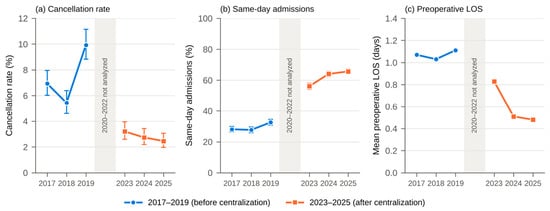
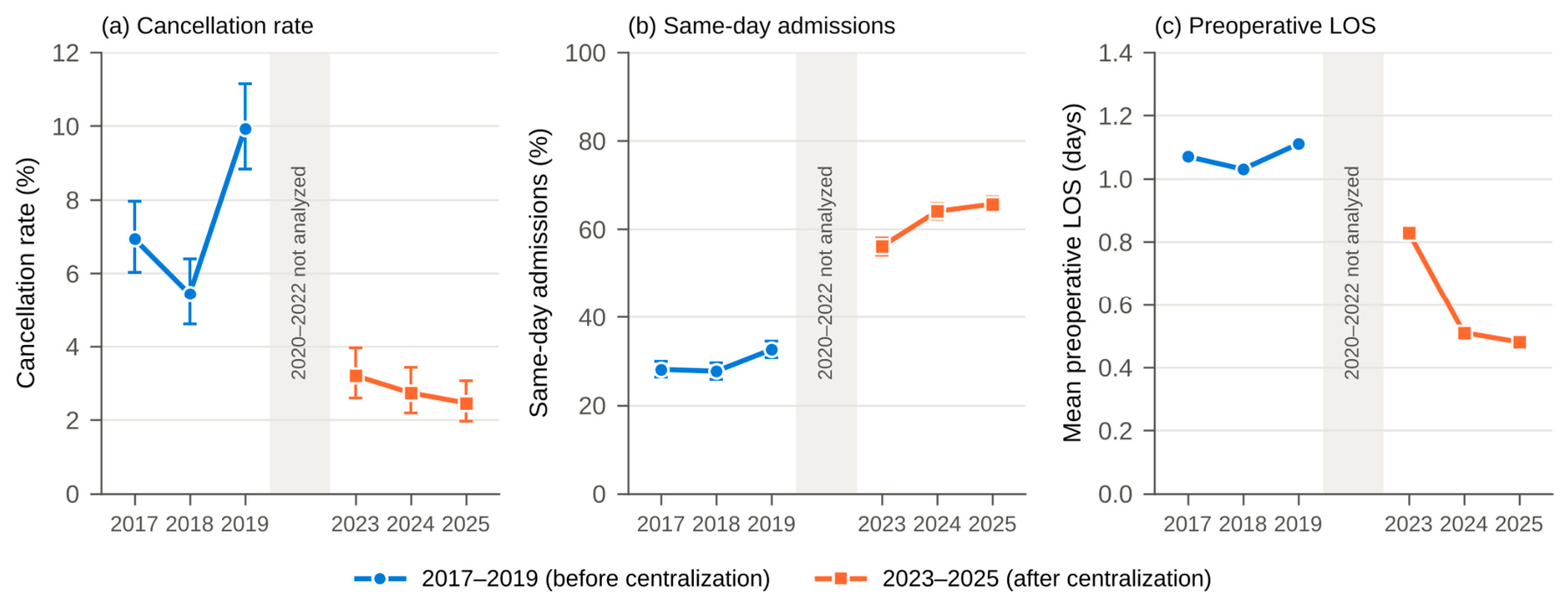
Table 2 summarizes the indicators for the six-unit total; Figure 1 shows their annual values; and Table A1 reports the annual counts and denominators. Between 2017–2019 and 2023–2025, scheduled procedures increased from 7735 to 8354 (+619; +8.0%), and performed procedures from 7159 to 8122 (+963; +13.5%). The increase in performed procedures therefore resulted from 619 additional scheduled procedures and 344 fewer cancellations.
Table 2.
Indicators for the six included units combined, 2017–2019 vs. 2023–2025.
Figure 1.
Annual indicators for the six included units combined: (a) cancellation rate from the final daily operating list (% of scheduled procedures); (b) same-day admissions (% of performed procedures); (c) mean preoperative length of stay (LOS, days). Error bars: 95% confidence intervals. The years 2020–2022 were not analyzed.
Cancellations from the final daily operating list decreased from 576 to 232 (−344; −59.7%), and the cancellation rate from 7.4% (95% CI 6.9–8.1) to 2.8% (95% CI 2.4–3.2), a difference of −4.7 p.p. (95% CI −5.4 to −4.0; p < 0.001). The annual cancellation rate ranged from 5.4% to 9.9% in 2017–2019 and from 2.5% to 3.2% in 2023–2025 (Figure 1a).
In 2017–2019, 70.6% of procedures were performed on children admitted before the day of surgery. Same-day admissions increased from 2105 (29.4%; 95% CI 28.4–30.5) to 5055 (62.2%; 95% CI 61.2–63.3) of performed procedures (+2950; +32.8 p.p.; 95% CI 31.3 to 34.3; p < 0.001); annual values ranged from 27.7% to 32.6% in 2017–2019 and from 56.1% to 65.7% in 2023–2025 (Figure 1b). The mean preoperative LOS was 1.07 days in 2017–2019 and 0.60 days in 2023–2025; annual means ranged from 1.03 to 1.11 days in the first period and decreased from 0.83 days in 2023 to 0.48 days in 2025 (Figure 1c).
3.2. Individual Surgical Units
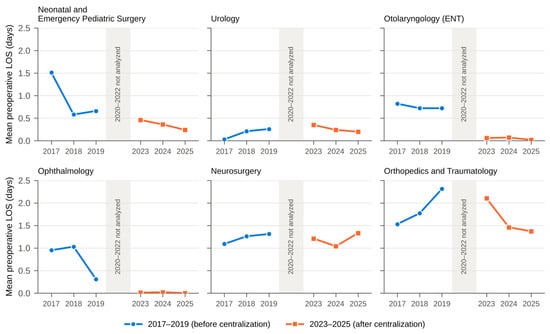
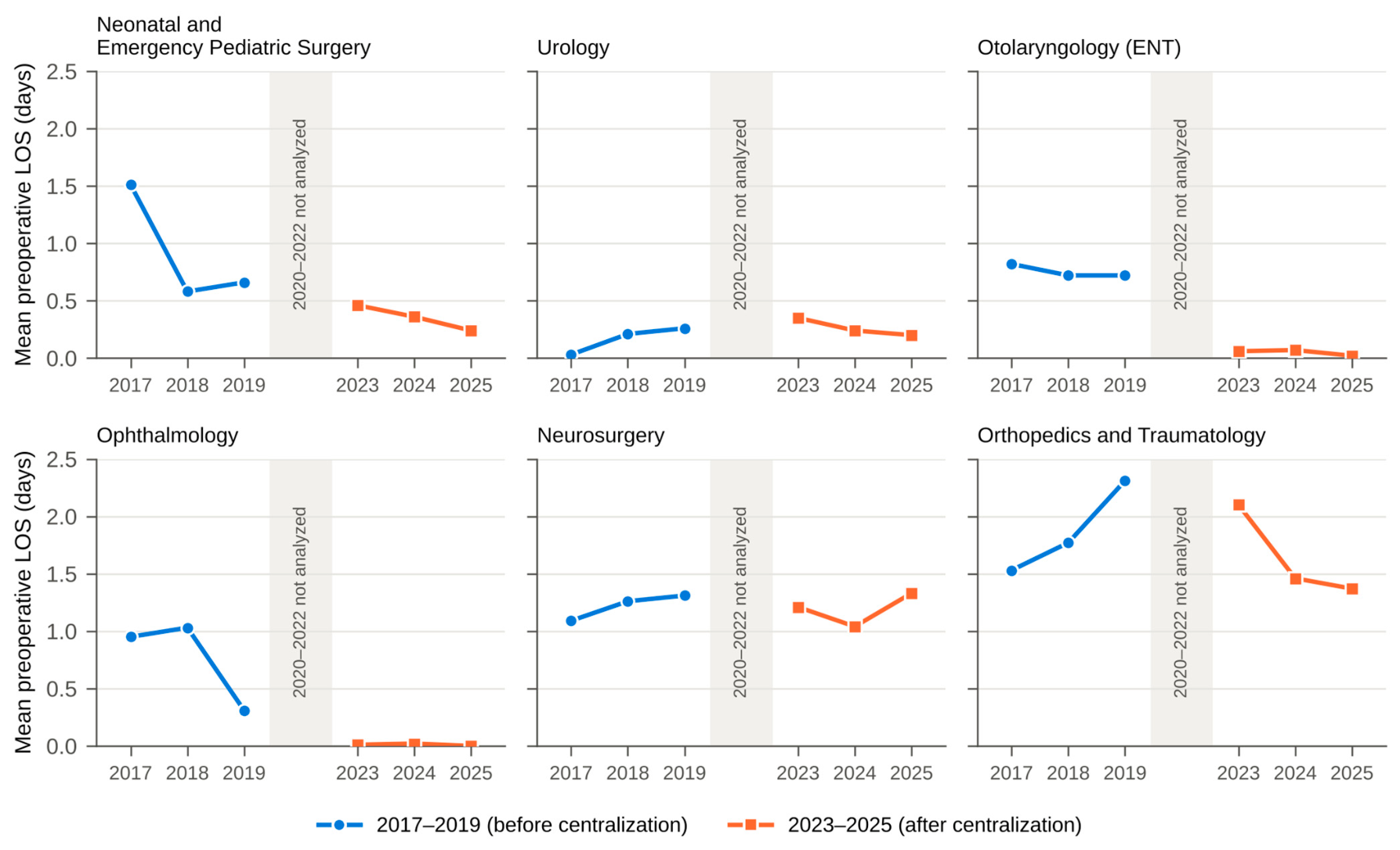
Table 3 reports the indicators for each unit, and Figure 2 shows the annual mean preoperative LOS by unit; annual data are reported in Table A1.
Table 3.
Indicators by surgical unit, 2017–2019 vs. 2023–2025.
Figure 2.
Annual mean preoperative length of stay (LOS, days) by surgical unit. The years 2020–2022 were not analyzed. The 2017 value for Urology is inconsistent with the corresponding admission counts (see note to Table A1). ENT, otolaryngology.
Surgical volume. Changes in volume differed widely between units. Urology performed 1082 more procedures in 2023–2025 than in 2017–2019 (506 vs. 1588; +213.8%), i.e., more than the increase in the six-unit total (+963), whereas the other five units together performed 119 fewer procedures (6653 vs. 6534). Performed procedures also increased in Neurosurgery (331 vs. 627; +89.4%) and Ophthalmology (364 vs. 480; +31.9%). They decreased in ENT (3196 vs. 2786; −12.8%), where scheduled procedures fell from 3476 to 2803 (−19.4%); in Neonatal and Emergency Pediatric Surgery (678 vs. 646; −4.7%); and in Orthopedics and Traumatology (2084 vs. 1995; −4.3%).
Cancellations. The cancellation rate decreased in five of the six units, most markedly in Urology (10.3% to 2.2%; −8.1 p.p.); ENT (8.1% to 0.6%; −7.4 p.p.); Neurosurgery (14.0% to 8.2%; −5.8 p.p.); and Neonatal and Emergency Pediatric Surgery (7.6% to 1.8%; −5.8 p.p.). In Neurosurgery, the number of cancellations was similar (54 vs. 56) while scheduled procedures increased. The rate did not change in Orthopedics and Traumatology (5.2% vs. 5.1%; p = 0.94). ENT accounted for 263 of the 344 fewer cancellations; in the other five units combined, the cancellation rate decreased from 6.9% (296/4259) to 3.9% (215/5551) (−3.1 p.p.; 95% CI −4.0 to −2.2; p < 0.001).
Same-day admissions and preoperative LOS. Same-day admissions increased markedly in ENT (29.4% to 97.0%) and Ophthalmology (26.9% to 99.0%), were stable in Neonatal and Emergency Pediatric Surgery (70.6% vs. 72.0%) and Neurosurgery (12.4% vs. 14.2%), and decreased in Urology (87.7% to 81.2%) and Orthopedics and Traumatology (5.0% to 1.7%). ENT accounted for 1763 of the 2950 additional same-day admissions. The period mean preoperative LOS decreased in ENT (0.76 to 0.05 days), Ophthalmology (0.77 to 0.01 days), and Neonatal and Emergency Pediatric Surgery (0.94 to 0.34 days), changed little in Neurosurgery (1.23 vs. 1.20 days) and Orthopedics and Traumatology (1.85 vs. 1.66 days), and increased slightly in Urology (0.18 vs. 0.25 days).
Annual trends. Some changes began before centralization (Figure 2 and Table A1). In Neonatal and Emergency Pediatric Surgery, the mean preoperative LOS fell from 1.51 days in 2017 to 0.58 days in 2018; in Ophthalmology, it fell from 1.03 days in 2018 to 0.31 days in 2019, when same-day admissions in this unit rose from 5.9% to 69.2%. In Orthopedics and Traumatology, the mean preoperative LOS peaked at 2.31 days in 2019 and was 2.10, 1.46, and 1.37 days in 2023, 2024, and 2025, respectively.
4. Discussion
4.1. Principal Findings
In the six surgical units studied, the period following the centralization of pre-hospitalization (2023–2025) showed improvements in all three indicators compared with the pre-pandemic period (2017–2019). Specifically, we observed a marked reduction in cancellation rates from the final daily operating list (2.8% vs. 7.4%), an increase in same-day admissions (62.2% vs. 29.4%), a shortened mean preoperative LOS (0.60 vs. 1.07 days), and an overall expansion in the volume of performed procedures. However, these positive shifts were heterogeneous across specialties: the improvements were concentrated in Otolaryngology (ENT) and Ophthalmology, the increase in surgical volume was driven by Urology, and Orthopedics and Traumatology exhibited no reduction in cancellations. Given the uncontrolled before–after design utilizing aggregated data, these findings describe observed differences between the two periods rather than demonstrated causal effects. Nonetheless, the reduction in cancellations in five of six units and its stability over the three post-implementation years are compatible with a positive contribution from the reorganized pathway, although the more structured rules for finalizing the daily operating list may have contributed.
4.2. Possible Mechanisms
Our findings align with the existing literature reporting fewer cancellations and shorter preoperative LOS after the introduction of preoperative assessment clinics or structured elective pathways [9,10,11,12], despite the low certainty of evidence regarding pre-anesthetic clinics specifically [13]. Several plausible mechanisms may underlie these improvements, although our aggregate dataset precludes direct hypothesis testing. First, a short, fixed interval between pre-hospitalization and admission may reduce the time window during which intercurrent illnesses can develop and may prevent the expiration of preoperative tests. In pediatric cohorts, acute conditions—predominantly upper respiratory tract infections—are among the most frequent causes of last-minute cancellation [4,5,6,7,8]. Since specific reasons for cancellation were not recorded in our database, a definitive reduction in illness-related cancellations cannot be verified. Second, the co-location of pediatricians, anesthesiologists, and surgeons during a single outpatient attendance may have streamlined the clearance process, though individual times to clearance were not monitored. Third, the centralized model may allow earlier identification of children unfit for surgery, so that surgery can be deferred before the daily operating list is finalized and the slot reassigned; whether this reduced unused OR capacity could not be assessed, because OR utilization was not measured. Consequently, fewer cancellations on the final list do not automatically equate to a net reduction in postponements across the entire system; rather, some postponements may simply have been identified earlier in the pathway. Furthermore, because the administrative framework for compiling and finalizing operating lists was more structured during the 2023–2025 period, a portion of the recorded reduction may stem from these more structured rules. In the UK multicenter PINEAPPLE cohort, preassessment was not associated with a statistically significant difference in overall cancellation rates; intercurrent illness and anxiety were the most common reasons for cancellation, and the authors suggested that screening calls in the days before surgery could prevent on-the-day cancellations due to intercurrent illness [14]. These findings indicate that preassessment alone does not guarantee fewer cancellations, but they do not identify an optimal interval between assessment and surgery. Because our study did not directly compare different preassessment-to-admission intervals, further research is required to determine whether our target of three calendar days represents the ideal operational window.
4.3. Differences Between Units and Concurrent Changes
The aggregated outcomes were profoundly influenced by individual unit performance. The increase in performed procedures in Urology (+1082) exceeded the increase in the six-unit total (+963); Urology tripled its procedural volume following an institutional expansion of its dedicated OR sessions and a comprehensive scheduling overhaul. Conversely, the remaining five units combined experienced a minor decline in procedural volumes between the two periods. This suggests that the changes in volume mainly reflect changes in OR capacity rather than the centralization of pre-hospitalization itself. Similarly, according to the directors of the units concerned, the increase in Neurosurgery activity and the decrease in ENT bookings reflected internal reorganizations with more explicit scheduling criteria, rather than staff transfers between units or changes in the workforce; these reorganizations are not documented in the data available for this study. ENT alone accounted for most of the aggregated reduction in cancellations (263 out of 344) and most of the increase in same-day admissions (1763 out of 2950), achieving a near-universal same-day admission rate (97.0%). This reflects the structured admission rules adopted by the ENT unit together with the centralization of pre-hospitalization in December 2022, under which children cleared at pre-hospitalization are admitted on the morning of surgery; these rules are therefore part of the intervention. Nevertheless, the cancellation rate in the other five units combined also decreased (from 6.9% to 3.9%), so the reduction was not limited to a single specialty. The annual data show that the reduction in preoperative LOS in Ophthalmology and Neonatal and Emergency Pediatric Surgery, and the rise in same-day admissions in Ophthalmology, had already begun before 2020. These pre-existing trends suggest that a progressive reorganization of scheduling and admission had already begun in some units before centralization. In contrast, Neurosurgery and Orthopedics maintained persistently higher cancellation rates and longer preoperative stays, with same-day admissions actually declining in Orthopedics and Urology. Possible explanations include higher case complexity, the need for specific preoperative imaging (e.g., MRI), competition between elective and emergency activity, and the availability of postoperative intensive care and ward beds, all of which have been associated with cancellations and delays in other settings [3,21,22]. In the absence of local data on emergency workload or bed occupancy, these explanations remain hypotheses.
4.4. Implications of Comparing Pre- and Post-Pandemic Periods
To circumvent the profound disruptions in elective surgery caused by the COVID-19 pandemic and the immediate post-activation transition phase, we purposely compared a pre-pandemic baseline with a fully operational post-implementation period [1,2]. This methodological approach carries distinct implications. First, the observed differences reflect any contribution of centralization together with multi-year secular changes. These may include programmes to recover the pandemic backlog [2], changes in staffing and OR capacity, and changes in admission practices, such as a wider use of same-day admission, that may have persisted after the emergency. Second, the post-pandemic landscape witnessed altered epidemiological patterns for pediatric respiratory infections, characterized by severe, off-season outbreaks of respiratory syncytial virus (RSV) and other pathogens following the cessation of public health containment measures [23]. This is relevant background for the interpretation of the cancellation indicator in 2023–2025; however, as no local data on infection-related cancellations are available, it provides no evidence for or against an effect of the intervention. Lastly, omitting the 2020–2022 data prevents us from establishing when these changes began, and the annual data show that some of them preceded centralization. Future studies utilizing interrupted time-series analyses on granular monthly data would be highly valuable to statistically isolate the specific impact of the centralization from broader secular trends.
4.5. Implications for Practice
For tertiary institutions seeking to replicate this operational model, our experience highlights several components: a physically dedicated unit staffed by a core team; fixed weekly pre-hospitalization sessions synchronized with monthly OR allocations; a pre-hospitalization protocol shared by all specialties; integrated multidisciplinary evaluations (pediatric, anesthetic, and surgical) completed in a single visit; and a short, fixed interval between assessment and admission. The content of preoperative testing, however, should follow current recommendations, which advise against routine testing and favour tests selected according to the medical history, physical examination, and the type and invasiveness of the planned procedure [18]; as this study did not assess the clinical yield of individual investigations, the fixed laboratory panel and age-based cardiac assessment used in our hospital should not be taken as a recommendation. Crucially, institutional quality-improvement frameworks must look beyond mere final operating list cancellations. Comprehensive tracking must encompass upstream deferrals occurring during pre-hospitalization, granular reasons for clinical delays, actual compliance with scheduling windows, time to resolution after deferral, and hard safety outcomes such as postoperative complications and readmission rates. Continuous monitoring is ongoing at our facility to integrate patient-level clinical variables (such as age, sex, and ASA status) to adjust for longitudinal shifts in case-mix complexity.
4.6. Strengths and Limitations
This study possesses notable strengths, including a six-year evaluation period across six distinct surgical specialties with varying case-mix profiles, the use of the same indicator formulas in both periods (although the rules for finalizing the daily operating list and recording cancellations differed, as discussed below), the transparent reporting of raw annual denominators, and unit-stratified analyses that show where the change occurred. Conversely, several limitations must be acknowledged. First, the uncontrolled before–after design, combined with the lack of a parallel control group or transition-period data, precludes definitive causal inference. Secular trends in institutional staffing, baseline OR allocations, shifting referral patterns, and clinical case-mix may explain part or all of the observed differences. Second, the use of aggregated data restricted our ability to perform patient-level risk adjustments (e.g., for age or ASA class). Because statistical testing was conducted on aggregated counts to which individual children could theoretically contribute multiple procedures, the resulting p-values must be interpreted with caution, and unit-level comparisons should be viewed as exploratory. Third, the absence of codified reasons for cancellation limits our understanding of whether the intervention specifically mitigated clinical issues (e.g., acute infections) versus administrative bottlenecks. Fourth, deferrals decided before the finalization of the daily operating list, including those at pre-hospitalization, were not captured, so the outcome is limited to cancellations from the final list; moreover, the rules for drawing up and finalizing the list and for recording cancellations differed between the two periods, which limits the comparability of this indicator. Fifth, operational adherence to the target three-day preassessment window and individual times to clearance were not actively audited, preventing a formal fidelity assessment of the protocol. Sixth, we did not capture clinical safety outcomes, time to surgery after deferral, financial cost–benefit metrics, or patient-reported experience measures (PREMs). Finally, preoperative LOS data were restricted to annual averages, which masked the distribution of hospital stays and prevented the verification of missing dates (one annual value is inconsistent with the admission counts; Table A1), and the generalizability of the aggregate findings is limited because the six included units do not represent the whole surgical activity of the hospital and their share of it could not be quantified.
5. Conclusions
In six surgical units of a tertiary pediatric hospital, the period following the centralization of pre-hospitalization (2023–2025) was associated with fewer cancellations from the final daily operating list (2.8% vs. 7.4%), a higher rate of same-day admissions (62.2% vs. 29.4%), and a shorter mean preoperative length of stay (0.60 vs. 1.07 days) compared with the pre-pandemic baseline (2017–2019). These changes varied across specialties: most of the reduction in cancellations occurred in otolaryngology, the reduction in preoperative stay was concentrated in otolaryngology, ophthalmology, and neonatal and emergency pediatric surgery, and the overall increase in surgical volume was driven by urology. Neurosurgery and orthopedics and traumatology showed smaller changes, possibly reflecting higher clinical complexity and competing emergency workloads. Because this study relies on an uncontrolled before–after comparison of aggregated administrative data across periods separated by the COVID-19 pandemic, the observed differences cannot be attributed solely to the centralization of pre-hospitalization. Nevertheless, the reduction in cancellations from the final daily operating list in five of the six units, sustained over three consecutive years, is consistent with the value of a dedicated multidisciplinary pre-hospitalization unit integrated with structured operating room scheduling, although the more structured rules for finalizing the daily operating list introduced in the same period may also have contributed. Future evaluations should adopt quasi-experimental designs, such as interrupted time-series analyses, and track patient-level variables alongside upstream pre-hospitalization deferrals, specific cancellation reasons, adherence to the three-day assessment window, and postoperative safety outcomes. Continuous institutional monitoring of this centralized pathway remains ongoing to refine unit-specific workflows and enhance overall surgical governance.
Supplementary Materials
The following supporting information can be downloaded at: https://www.mdpi.com/article/10.3390/healthcare14234129/s1. Table S1: SQUIRE 2.0 checklist.
Author Contributions
Conceptualization, E.P., A.B., and G.M.; methodology, A.B., G.M., E.P., and F.S.; software, A.B. and F.S.; validation, E.P. and A.B.; formal analysis, E.P., G.M., A.C., and A.B.; investigation, E.P., G.M., A.B., E.D.C., R.S., S.F., and F.S.; resources, E.P., A.B., and F.S.; data curation, G.M., A.B., and F.S.; writing—original draft preparation, E.P., G.M., E.D.C., R.S., S.F., A.C., F.S., and A.B.; writing—review and editing, E.P. and F.S.; supervision, A.B., E.P., and F.S. All authors have read and agreed to the published version of the manuscript.
Funding
This research did not receive external funding.
Institutional Review Board Statement
This study was a retrospective evaluation based exclusively on aggregated, anonymized administrative data routinely collected for service monitoring: record-level linkage of the data sources was performed within the hospital by authorized Medical Directorate staff as part of this routine monitoring, and no patient-level or identifying information was used for the study (Section 2.7). The study documentation was submitted to the Territorial Ethics Committee Campania 1 (Comitato Etico Territoriale Campania 1), which issued an acknowledgment (“presa d’atto”; Register Project No. 38/26 OSS SP).
Informed Consent Statement
Not applicable. Individual consent was not sought because the study used exclusively aggregated, anonymized administrative data routinely collected for service monitoring (Section 2.7).
Data Availability Statement
The aggregated annual data supporting the findings of this study are reported in Appendix A (Table A1). Further data are available from the corresponding author upon reasonable request; they are not publicly available for confidentiality reasons.
Acknowledgments
During the preparation of this manuscript, the authors used Claude (Anthropic) for the purposes of language editing and translation.The authors have reviewed and edited the output and take full responsibility for the content of this publication.
Conflicts of Interest
The authors declare no conflicts of interest.
Abbreviations
The following abbreviations are used in this manuscript:
| AORN | Azienda Ospedaliera di Rilievo Nazionale (Hospital of National Relevance) |
| ASA | American Society of Anesthesiologists |
| CI | Confidence interval |
| ENT | Otolaryngology (ear, nose, and throat) |
| IRCCS | Istituto di Ricovero e Cura a Carattere Scientifico (Scientific Institute for Research, Hospitalization and Healthcare) |
| LOS | Length of stay |
| MRI | Magnetic resonance imaging |
| NICU | Neonatal Intensive Care Unit |
| OR | Operating room |
| PICU | Pediatric Intensive Care Unit |
| p.p. | Percentage points |
| PREMs | Patient-reported experience measures |
| RSV | Respiratory syncytial virus |
| SDO | Scheda di Dimissione Ospedaliera (Hospital Discharge Record) |
| SQUIRE | Standards for QUality Improvement Reporting Excellence |
Appendix A
Table A1.
Annual indicators by surgical unit and for the six-unit total.
References
- COVIDSurg Collaborative. Elective surgery cancellations due to the COVID-19 pandemic: Global predictive modelling to inform surgical recovery plans. Br. J. Surg. 2020, 107, 1440–1449. [Google Scholar] [CrossRef] [Scilit] [PubMed] [PubMed Central]
- COVIDSurg Collaborative. Projecting COVID-19 disruption to elective surgery. Lancet 2022, 399, 233–234. [Google Scholar] [CrossRef] [Scilit] [PubMed] [PubMed Central]
- Koushan, M.; Wood, L.C.; Greatbanks, R. Evaluating factors associated with the cancellation and delay of elective surgical procedures: A systematic review. Int. J. Qual. Health Care 2021, 33, mzab092. [Google Scholar] [CrossRef] [Scilit] [PubMed]
- Ben Mansour, M.; Lassioued, O.; Chakroun, S.; Slimene, A.; Ben Youssef, S.; Ksiaa, A.; Gahbiche, M. Elective surgery cancellations in pediatric surgery: Rate and reasons. BMC Pediatr. 2023, 23, 383. [Google Scholar] [CrossRef] [Scilit] [PubMed] [PubMed Central]
- Boudreau, S.A.; Gibson, M.J. Surgical cancellations: A review of elective surgery cancellations in a tertiary care pediatric institution. J. Perianesth. Nurs. 2011, 26, 315–322. [Google Scholar] [CrossRef] [Scilit] [PubMed]
- Macarthur, A.J.; Macarthur, C.; Bevan, J.C. Determinants of pediatric day surgery cancellation. J. Clin. Epidemiol. 1995, 48, 485–489. [Google Scholar] [CrossRef] [Scilit] [PubMed]
- Vittori, A.; Iyer, R.S.; Cascella, M.; Tarquini, R.; Francia, E.; Mascilini, I.; Pizzo, C.M.; Marinangeli, F.; Pedone, R.; Marchetti, G.; et al. Last-Minute Cancellations in Pediatric Ambulatory and Day Surgeries in Italy: Prevalence and Risk Factors. Paediatr. Anaesth. 2025, 35, 439–445. [Google Scholar] [CrossRef] [Scilit] [PubMed] [PubMed Central]
- Shemesh, S.; Tamir, S.; Goldfarb, A.; Ezri, T.; Roth, Y. To proceed or not to proceed: ENT surgery in paediatric patients with acute upper respiratory tract infection. J. Laryngol. Otol. 2016, 130, 800–804. [Google Scholar] [CrossRef] [Scilit] [PubMed]
- Ferschl, M.B.; Tung, A.; Sweitzer, B.; Huo, D.; Glick, D.B. Preoperative clinic visits reduce operating room cancellations and delays. Anesthesiology 2005, 103, 855–859. [Google Scholar] [CrossRef] [Scilit] [PubMed]
- van Klei, W.A.; Moons, K.G.; Rutten, C.L.; Schuurhuis, A.; Knape, J.T.; Kalkman, C.J.; Grobbee, D.E. The effect of outpatient preoperative evaluation of hospital inpatients on cancellation of surgery and length of hospital stay. Anesth. Analg. 2002, 94, 644–649. [Google Scholar] [CrossRef] [Scilit] [PubMed]
- Fischer, S.P. Development and effectiveness of an anesthesia preoperative evaluation clinic in a teaching hospital. Anesthesiology 1996, 85, 196–206. [Google Scholar] [CrossRef] [Scilit] [PubMed]
- Hovlid, E.; Bukve, O.; Haug, K.; Aslaksen, A.B.; von Plessen, C. A new pathway for elective surgery to reduce cancellation rates. BMC Health Serv. Res. 2012, 12, 154. [Google Scholar] [CrossRef] [Scilit] [PubMed] [PubMed Central]
- Kristoffersen, E.W.; Opsal, A.; Tveit, T.O.; Berg, R.C.; Fossum, M. Effectiveness of pre-anaesthetic assessment clinic: A systematic review of randomised and non-randomised prospective controlled studies. BMJ Open 2022, 12, e054206. [Google Scholar] [CrossRef] [Scilit] [PubMed] [PubMed Central]
- Bennett, T.; Lewis, H.; Riley, C.; Lee, A.J.; Raja, E.A.; Arnold, P.; Paediatric Anaesthetic Trainee Research Network (PATRN); Brooks, P. PaedIatric caNcelation ratEs And PerioPerative clinicaL Evaluation (PINEAPPLE): A UK Prospective Multi-Center Observational Cohort Study. Paediatr. Anaesth. 2026, 36, 388–395. [Google Scholar] [CrossRef] [Scilit] [PubMed]
- Conferenza permanente per i rapporti tra lo Stato, le Regioni e le Province autonome di Trento e Bolzano. Accordo 9 luglio 2020, Rep. atti n. 100/CSR. Linee di indirizzo per il governo del percorso del paziente chirurgico programmato. Available online: https://www.statoregioni.it (accessed on 25 November 2026).
- Regione Campania. Deliberazione della Giunta regionale n. 254 del 30 maggio 2024. Recepimento dell’Accordo Stato-Regioni sul documento “Linee di indirizzo per il governo del percorso del paziente chirurgico programmato”, Rep. atti n. 100/CSR del 9 luglio 2020. Bollettino Ufficiale della Regione Campania n. 42 del 3 giugno 2024. Available online: https://regione.campania.it (accessed on 25 November 2026).
- Ogrinc, G.; Davies, L.; Goodman, D.; Batalden, P.; Davidoff, F.; Stevens, D. SQUIRE 2.0 (Standards for QUality Improvement Reporting Excellence): Revised publication guidelines from a detailed consensus process. BMJ Qual. Saf. 2016, 25, 986–992. [Google Scholar] [CrossRef] [Scilit] [PubMed] [PubMed Central]
- Committee on Standards and Practice Parameters; Apfelbaum, J.L.; Connis, R.T.; Nickinovich, D.G.; American Society of Anesthesiologists Task Force on Preanesthesia Evaluation; Pasternak, L.R.; Arens, J.F.; Caplan, R.A.; Connis, R.T.; Fleisher, L.A.; et al. Practice advisory for preanesthesia evaluation: An updated report by the American Society of Anesthesiologists Task Force on Preanesthesia Evaluation. Anesthesiology 2012, 116, 522–538. [Google Scholar] [CrossRef] [Scilit] [PubMed]
- Wilson, E.B. Probable inference, the law of succession, and statistical inference. J. Am. Stat. Assoc. 1927, 22, 209–212. [Google Scholar] [CrossRef]
- Newcombe, R.G. Interval estimation for the difference between independent proportions: Comparison of eleven methods. Stat. Med. 1998, 17, 873–890. [Google Scholar] [CrossRef] [Scilit] [PubMed]
- Naderi-Boldaji, V.; Banifatemi, M.; Zandi, R.; Eghbal, M.H.; Nematollahi, M.; Sahmeddini, M.A. Incidence and root causes of surgery cancellations at an academic medical center in Iran: A retrospective cohort study on 29,978 elective surgical cases. Patient Saf. Surg. 2023, 17, 24. [Google Scholar] [CrossRef] [Scilit] [PubMed] [PubMed Central]
- Schuster, M.; Neumann, C.; Neumann, K.; Braun, J.; Geldner, G.; Martin, J.; Spies, C.; Bauer, M. CASCAES Study Group. The effect of hospital size and surgical service on case cancellation in elective surgery: Results from a prospective multicenter study. Anesth. Analg. 2011, 113, 578–585. [Google Scholar] [CrossRef] [Scilit] [PubMed]
- Bardsley, M.; Morbey, R.A.; Hughes, H.E.; Beck, C.R.; Watson, C.H.; Zhao, H.; Ellis, J.; Smith, G.E.; Elliot, A.J. Epidemiology of respiratory syncytial virus in children younger than 5 years in England during the COVID-19 pandemic, measured by laboratory, clinical, and syndromic surveillance: A retrospective observational study. Lancet Infect. Dis. 2023, 23, 56–66. [Google Scholar] [CrossRef] [Scilit] [PubMed]

Disclaimer/Publisher’s Note: The statements, opinions and data contained in all publications are solely those of the individual author(s) and contributor(s) and not of MDPI and/or the editor(s). MDPI and/or the editor(s) disclaim responsibility for any injury to people or property resulting from any ideas, methods, instructions or products referred to in the content. |
© 2026 by the authors. Licensee MDPI, Basel, Switzerland. This article is an open access article distributed under the terms and conditions of the Creative Commons Attribution (CC BY) license.