


Abstract
Background: Healthcare systems face increasing challenges related to population ageing, chronic diseases, multimorbidity, and healthcare workforce needs. Advanced practice nursing (APN) offers opportunities to strengthen healthcare delivery through expanded nursing roles. Although specialist nursing is legally recognized in Türkiye, an integrated national APN framework encompassing education, professional authorization, employment, and clinical practice has not yet been established. This study aims to examine international APN experiences and identify considerations for future APN development in Türkiye. Methods: A literature review incorporating international comparison and conceptual analysis was conducted. International APN frameworks, the scientific literature, selected postgraduate education programmes, and Turkish healthcare and regulatory documents were examined across four interrelated dimensions: education, professional authorization, employment, and clinical practice. Results: The review identified interdependencies among advanced educational preparation, clinical competencies, professional authorization, employment arrangements, and clinical responsibilities. These findings informed a preliminary conceptual proposal for Türkiye rather than a developed or validated national model. Chronic disease management was considered as one potential area for future needs assessment, while educational and implementation arrangements were presented as illustrative considerations. Conclusions: Future APN development in Türkiye requires national and regional needs assessment, participatory co-design, stakeholder consultation, and regulatory and organizational evaluation. The proposed conceptual framework provides a basis for further policy discussion and context-specific model development, with subsequent feasibility assessment and pilot evaluation needed before wider implementation.
1. Introduction
Changes in healthcare are reshaping service delivery and professional roles. Population ageing, increasing chronic disease burden and multimorbidity, and growing demands for accessible and continuous care require more effective use of the healthcare workforce [1,2,3]. In this context, nurses are assuming broader responsibilities in advanced clinical assessment, decision-making, consultation, care coordination, chronic disease management, and clinical leadership [2,3,4].
Advanced Practice Nursing (APN) represents an important development in the nursing workforce. The International Council of Nurses (ICN) recognizes that APN roles vary across healthcare systems and regulatory contexts, while sharing characteristics such as advanced educational preparation, clinical competence, complex decision-making, and expanded scope of practice [4]. International evidence also identifies considerable variation in APN education, regulation, and professional responsibilities across countries [3,5].
The World Health Organization (WHO), in the State of the World’s Nursing 2025 report, addresses advanced practice within global nursing workforce development [1]. Evidence suggests that APN roles can contribute to healthcare access, continuity of care, patient outcomes, and service utilization, although their effects depend on the healthcare context and implementation conditions [6,7]. Experiences from developing APN systems further highlight the importance of local healthcare needs, professional acceptance, and regulatory and organizational readiness [5,8].
APN development involves more than assigning additional clinical tasks to nurses. International frameworks emphasize alignment among educational preparation, competencies, scope of practice, professional regulation, organizational integration, and evaluation [5,9,10]. Regulatory clarity, organizational support, and interprofessional collaboration are particularly important for translating advanced nursing competencies into clinical practice [8,10]. APN should therefore be considered within an integrated workforce and service-delivery approach rather than as an isolated educational initiative.
In Türkiye, specialist nursing is legally recognized; however, an integrated national framework connecting advanced nursing education, professional authorization, employment, and clinical scope of practice has not yet been established. This situation warrants further examination in light of chronic disease burden, complex care needs, and continuity-of-care requirements. Differences between Türkiye and countries with established APN systems also underscore the need for context-specific consideration rather than direct model transfer.
This article aims to examine international APN frameworks, evidence, and selected postgraduate education programmes to identify and critically discuss educational, regulatory, employment, and clinical practice considerations relevant to future APN development in Türkiye. Drawing on this literature-based comparison and conceptual analysis, the study presents a preliminary conceptual proposal to inform subsequent national needs assessment, stakeholder engagement, and context-specific model development. Chronic disease management is discussed as one potential area for future exploration rather than a predetermined implementation priority.
2. Methodological Approach
This study is based on a literature review incorporating international comparison and conceptual analysis of advanced practice nursing (APN), with a focus on future policy considerations for Türkiye. International professional frameworks, scientific publications, postgraduate education programmes, and Turkish healthcare and regulatory documents were examined across four interrelated dimensions: education, professional authorization, employment, and clinical practice. These dimensions provide an analytical structure for a preliminary conceptual proposal rather than an empirically developed or validated national APN model.
2.1. Review Design and Literature Identification
The literature search was conducted between June and August 2026. Sources were prioritized based on their relevance to the four established APN dimensions, the authority of professional and regulatory frameworks, their applicability to the Turkish healthcare context, and their contribution to understanding international educational and clinical practice arrangements.
A targeted literature search was conducted using PubMed/MEDLINE, Scopus, Web of Science Core Collection, CINAHL, and Google Scholar, supplemented by publications from the World Health Organization (WHO), International Council of Nurses (ICN), OECD, and relevant Turkish governmental and regulatory institutions. Search terms included “advanced practice nursing,” “nurse practitioner,” “specialist nursing,” “nursing education,” “scope of practice,” “professional regulation,” “clinical competencies,” and “healthcare workforce.”
Sources were purposively selected for their relevance to the four analytical dimensions and the Turkish healthcare context. These included peer-reviewed publications, international professional frameworks, regulatory documents, postgraduate education programmes, and healthcare workforce and policy reports. Turkish legislation and healthcare data were examined to contextualize international evidence. The review did not involve systematic screening, formal quality appraisal, or meta-analysis.
2.2. International Comparison and Conceptual Analysis
The United States, Australia, and the United Kingdom were purposively selected to illustrate different APN approaches: established Nurse Practitioner roles and postgraduate specialization in the United States, regulated professional authorization in Australia, and a multidimensional advanced clinical practice framework in the United Kingdom. Programmes at the University of Pennsylvania, Duke University, Monash University, and King’s College London were examined for their educational structures, clinical competencies, and supervised practice requirements.
International evidence was compared across education, professional authorization, employment, and clinical practice, and interpreted in relation to Türkiye’s nursing education, legislation, healthcare workforce, and potential service needs. This analysis was used to identify interdependencies, contextual considerations, and areas requiring further investigation rather than to establish a directly transferable APN model. Chronic disease management was considered an illustrative area for future needs assessment, not a predetermined implementation priority.
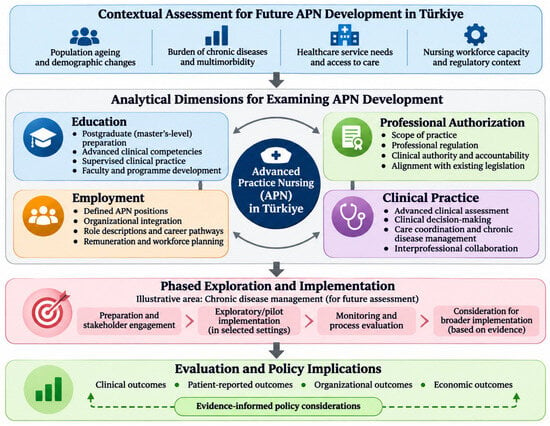
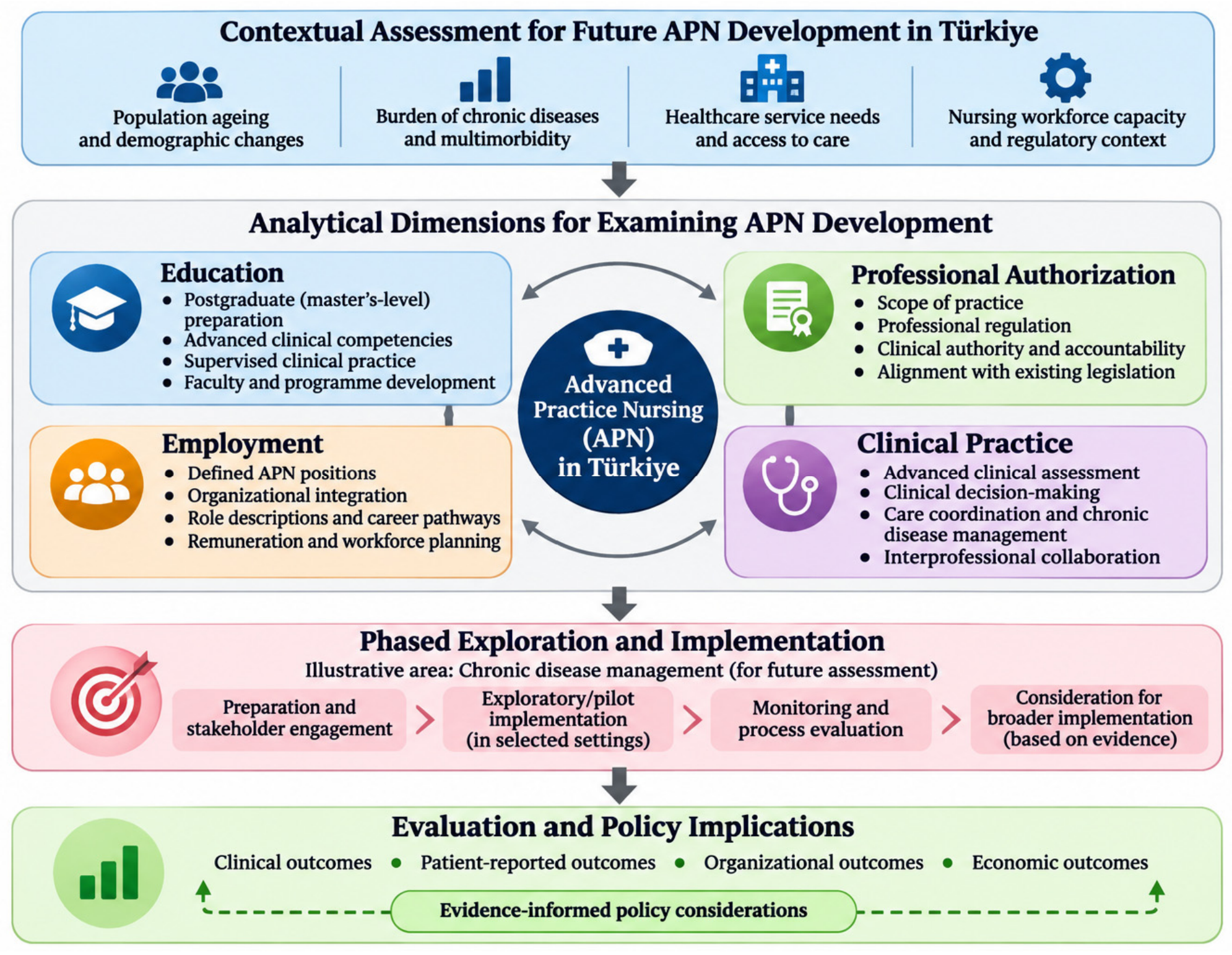
The relationships among the four dimensions are illustrated in Figure 1, which provides a preliminary analytical framework for future APN policy discussion in Türkiye.
Figure 1.
Conceptual Framework for Future APN Policy Considerations in Türkiye.
The four dimensions in Figure 1 are established in international APN frameworks rather than newly developed theoretical constructs. Their integration highlights the interdependencies between educational preparation, legal authority, organizational recognition, and clinical responsibilities. Advanced education does not automatically confer professional authorization, and authorization alone does not ensure appropriate employment or clinical integration. The framework therefore offers a context-sensitive interpretation of established APN principles rather than a developed or validated national model.
3. Advanced Practice Nursing: Concept and Scope
3.1. Terminology and the Concept of Advanced Practice Nursing
In this article, APN refers to advanced practice nursing and, where appropriate, to the advanced practice nurse as an individual practitioner, consistent with terminology used in the international literature [4]. APN represents a level of nursing practice characterized by advanced educational preparation, clinical competence, complex decision-making, and an expanded scope of practice [3,4]. Although master’s-level education is recommended as the educational foundation, postgraduate qualifications or clinical experience alone do not establish APN status. Advanced competencies must be linked to clearly defined professional responsibilities and an authorized scope of practice [4,5]. The two widely recognized APN roles are the Clinical Nurse Specialist (CNS) and Nurse Practitioner (NP) [4]. CNSs typically focus on advanced specialty practice, consultation, education, and evidence-based improvement, whereas NPs emphasize direct patient assessment and clinical management. Depending on national regulations, NP responsibilities may include diagnostic assessment, ordering tests, treatment management, and prescribing medications [3,4]. However, role definitions, educational requirements, and authorized clinical activities vary across healthcare systems [3,5]. A fundamental distinction therefore exists between clinical competence and professional authorization: education develops advanced competencies, while regulatory frameworks determine which activities practitioners may legally undertake [3,4]. This distinction informs the educational and authorization considerations discussed in subsequent sections.
3.2. Specialist Nursing and Advanced Practice Nursing
Distinguishing specialist nursing from APN is particularly important in Türkiye. Turkish nursing legislation recognizes specialist nursing based on postgraduate education and defines responsibilities within areas of specialization, including assessment, care, education, and consultation [11,12]. Although this provides an existing professional and regulatory foundation, specialist nursing and APN should not be regarded as equivalent. International frameworks distinguish APN through advanced clinical preparation, complex clinical reasoning, broader decision-making responsibilities, and a defined scope of practice [3,4,13,14]. Depending on the role, educational preparation may include advanced health assessment, pathophysiology, pharmacology, diagnostic reasoning, and clinical management [4,14,15]. Nevertheless, these competencies do not independently confer authority to perform expanded clinical activities; such authority depends on national regulation [3,9,10]. For Türkiye, existing specialist nursing education, professional experience, and regulatory arrangements may provide a foundation for exploring future APN development. However, specialist nursing qualifications should not automatically confer APN status, nor should APN be considered a mandatory progression for specialist nurses. The potential relationship between these roles, including educational requirements, competencies, professional authorization, and clinical responsibilities, would need to be determined through national needs assessment, stakeholder engagement, context-specific model development, and regulatory evaluation [3,4,5,9,16].
4. Contribution of Advanced Practice Nursing to Healthcare Systems
Advanced practice nursing (APN) offers opportunities to address evolving healthcare needs through advanced clinical care, care coordination, management of complex conditions, and interprofessional collaboration [4,9]. Its potential contribution extends beyond professional role development to improving the organization, accessibility, and continuity of healthcare services. Evidence from primary care suggests that APN-led care can achieve outcomes comparable to physician-led care in appropriately selected patient populations. A systematic review of randomized controlled trials by Swan et al. reported comparable outcomes across several measures, with some findings favoring APN care [7]. Similarly, a Cochrane review found that appropriately trained nurses probably provide care of equal or better quality for several patient outcomes, although the certainty of evidence varied across outcomes and settings [17]. These findings support the potential effectiveness of advanced nursing roles within appropriately defined clinical responsibilities.
Evidence also suggests potential benefits for healthcare utilization and costs. In a scoping review of 18 studies, Horton et al. reported that most studies examining emergency department visits and hospital admissions or readmissions identified lower utilization associated with APN care. Seven of the eight studies assessing costs reported lower healthcare costs [6]. However, the predominance of US-based evidence limits the direct generalizability of these findings to healthcare systems with different financing, workforce, and regulatory arrangements. The contribution of APN depends on appropriate educational preparation, professional authorization, role clarity, organizational support, and interprofessional collaboration [2,5,9,10]. APN should therefore not be conceptualized simply as physician substitution, but as an approach to organizing advanced nursing responsibilities according to patient needs and healthcare system characteristics [2,3,4]. For Türkiye, international evidence provides a rationale for further investigation rather than proof of equivalent outcomes or cost-effectiveness. The potential contribution of APN would need to be examined through context-specific needs assessment, stakeholder engagement, and subsequent empirical evaluation.
5. A Proposed Advanced Practice Nursing Model for Türkiye
5.1. Core Principles of the Proposed Model
Future APN development in Türkiye should be informed by identified healthcare needs rather than the direct adoption of international models. International frameworks emphasize the interdependence of advanced education, clinical competencies, professional authorization, employment, scope of practice, and outcome evaluation [3,9,10,18]. These dimensions provide the conceptual foundation for the proposal presented in this article, rather than constituting an established or validated national APN model.
A potential APN pathway could connect relevant nursing education and clinical experience with APN-specific postgraduate preparation, competency assessment, formally defined professional authorization, and designated clinical roles [3,4,15,16]. However, the specific requirements and relationships among these components would need to be determined through a context-specific development process.
Such a process should begin with national and regional needs assessment, followed by participatory co-design involving nurses, physicians, educators, healthcare administrators, professional organizations, regulators, and patient representatives. Interviews, focus groups, stakeholder workshops, and consensus-building activities could inform the development of locally relevant roles, competencies, and organizational arrangements. Any resulting model would require regulatory and feasibility assessment, pilot evaluation, and refinement before wider implementation.
5.2. Needs-Based Development of the APN Model in Türkiye
A national and regional needs assessment would be necessary to determine whether, where, and for which populations APN roles could address identified gaps in healthcare delivery [9,18]. Relevant considerations include disease burden, population ageing, access to care, workforce distribution, continuity of care, and existing nursing responsibilities. These indicators should inform the assessment of potential APN roles rather than be interpreted as evidence that new roles are automatically required. National indicators provide context for this assessment. In 2023, Türkiye had 361 nurses and midwives per 100,000 population, with regional figures ranging from 312 to 445 [19]. OECD data also indicate a lower practising-nurse density in Türkiye than the OECD average [20]. Noncommunicable diseases accounted for an estimated 69% of deaths in 2021 [21], while the population aged 65 years and over reached approximately 9.58 million (11.1%) in 2025 [22]. These indicators suggest areas warranting investigation but do not independently establish the need for APN or determine priority specialties. Following needs assessment, existing nursing roles and service arrangements should be examined to identify potential gaps and opportunities for advanced practice. Findings from this analysis and stakeholder engagement would inform subsequent decisions concerning APN competencies, education, authorization, employment, and clinical responsibilities [3,4,9,18,23].
5.3. Priority Areas for Initial APN Implementation in Türkiye
Priority clinical areas for APN development should be identified through national and regional assessment rather than selected solely on the basis of international experience [9,18]. Potential areas include chronic disease management, older adult care, oncology, mental health, primary care, and acute or critical care, depending on identified service needs and organizational readiness [3,5,13]. Chronic disease management is one possible area for further investigation because conditions such as diabetes, hypertension, heart failure, and chronic obstructive pulmonary disease require sustained monitoring, patient education, self-management support, and coordinated care [24,25,26]. These activities overlap with internationally recognized APN functions, although their relevance to Türkiye requires further assessment [4,7,17]. If needs assessment and stakeholder engagement identify an appropriate clinical area, subsequent feasibility studies and carefully designed pilot evaluations could examine patient outcomes, service utilization, professional roles, organizational integration, and costs [9,18,23,27]. Decisions regarding wider implementation or expansion into other specialties should depend on the findings of these evaluations and the relevant regulatory arrangements.
6. Proposed APN Education Model for Türkiye
6.1. Curriculum Structure and Content
APN education requires more than adding advanced clinical courses to existing nursing master’s programmes. International frameworks emphasize graduate-level preparation integrating advanced clinical sciences, complex clinical reasoning, role-specific competencies, and supervised clinical practice [4,11,14,28,29].
As an illustrative educational option, a two-year, 120-ECTS master’s programme focusing on chronic disease management is presented in Table 1. The four-semester structure progresses from advanced clinical sciences and chronic disease management to complex patient care and consolidated supervised practice [28,30]. This structure is not a developed or validated APN curriculum for Türkiye, and chronic disease management has not been established as a national priority.
Table 1.
Illustrative Educational Structure for Potential APN Development in Türkiye.
The proposed sequence illustrates the integration of theoretical preparation, progressive clinical responsibility, leadership, and competency assessment rather than prescribing specific educational requirements [4,14,15,31,32]. Admission criteria, competency standards, clinical supervision, ECTS distribution, and quality assurance arrangements would require national needs assessment, stakeholder co-design, and regulatory and educational evaluation.
Clinical preparation should be competency-based rather than defined solely by clinical hours [30,32,33]. No minimum clinical hours are prescribed in this proposal; appropriate requirements would need to be determined through future curriculum development, considering intended competencies, scope of practice, patient safety, and national regulatory arrangements [4,31,33].
6.2. International Foundations of the Proposed Curriculum
International APN frameworks provide principles for advanced education without establishing a universally transferable curriculum. These include advanced assessment, pathophysiology, pharmacology, clinical reasoning, supervised practice, and competencies in leadership, education, research, and quality improvement [4,11,14,15,29,31,34]. Educational preparation must also align with professional competencies, clinical responsibilities, and regulatory authorization [3,9,15]. Accordingly, these international principles inform the illustrative educational structure, while their relevance and adaptation to Türkiye remain subject to future assessment.
6.3. Selected International APN Postgraduate Programs
Four postgraduate programmes from the United States, Australia, and the United Kingdom were selected to illustrate different approaches to advanced clinical education, supervised practice, competency assessment, and professional regulation. Their characteristics are summarized in Table 2 [35,36,37,38].
Table 2.
Comparison of Selected International APN Postgraduate Programs and Their Contributions to the Proposed Education Model for Türkiye.
The programmes demonstrate different educational arrangements, including progressive supervised clinical learning, integration with professional authorization, and assessment of advanced clinical competencies. These examples inform the comparative analysis but do not constitute directly transferable educational or regulatory requirements for Türkiye.
6.4. Interprofessional Approach to APN Education
APN education could incorporate interprofessional contributions while maintaining nursing leadership and professional identity. Relevant medical specialties, clinical pharmacy, nutrition, rehabilitation, psychology, public health, and health law may contribute to advanced clinical and collaborative competencies [4,14,39,40,41]. Universities, healthcare institutions, professional nursing associations, and regulatory authorities could participate in future curriculum development, competency definition, and educational evaluation. Such collaboration would support context-specific educational planning rather than establish predetermined institutional responsibilities.
6.5. Assessment of Clinical Competence
Postgraduate qualifications alone should not establish readiness for advanced clinical practice. Competency assessment may combine clinical portfolios, case-based evaluations, Objective Structured Clinical Examinations (OSCEs), and supervised practice-based assessment [4,29,33,42,43]. Assessment should address advanced clinical reasoning, decision-making, patient management, and recognition of professional boundaries, including appropriate consultation, referral, and escalation [4,14,31]. Specific assessment standards would require development and validation within any future nationally defined APN educational and regulatory framework.
7. Regulation, Authorization, and Employment
7.1. A Progressive Authorization Model for Türkiye
Future APN authorization in Türkiye would require clearly defined competencies, professional responsibilities, and legal boundaries [3,4,10]. Rather than representing successive levels of professional advancement, the following four categories illustrate potential conditions of clinical practice and decision-making:
Category 1—Independently authorized APN activities. Potential activities could include advanced assessment, monitoring of stable chronic conditions, patient education, self-management support, and care coordination, provided they fall within a legally authorized scope of practice.
Category 2—Protocol-based expanded practice. Activities such as ordering specified diagnostic tests, applying clinical algorithms, or adjusting treatment within defined protocols could be considered only where appropriate education, competency assessment, and explicit legal authorization exist.
Category 3—Collaborative APN–physician management. Complex symptoms, suspected new diagnoses, significant treatment changes, or multimorbidity may require collaborative decision-making according to clinical circumstances and regulatory requirements.
Category 4—Activities outside the authorized APN scope. Unstable clinical conditions, advanced interventions, or activities beyond established competencies and authorization would require consultation, escalation, or referral.
These categories are illustrative and do not represent clinical authorities currently granted to APNs under Turkish legislation. Their applicability would require national needs assessment, stakeholder co-design, legal review, and development of appropriate regulatory and accountability arrangements [3,4,9,10].
7.2. Distinguishing Academic Qualification from Professional Authorization
Advanced academic qualifications do not independently confer legal authority to undertake expanded clinical activities [3,4,15]. In Türkiye, Nursing Law No. 6283, as amended in 2007, and the Nursing Regulation of 2010, as amended in 2011, provide the principal legal framework for nursing and specialist nursing practice.
Existing legislation recognizes nursing responsibilities in patient assessment, care planning, education, and coordination. However, specialist nursing qualifications should not be equated with independent APN authorization. Independent medical diagnosis, prescribing, and autonomous treatment modification are not generally established as nursing authorities under the current framework. Any future expansion would require explicit legal and regulatory consideration. Table 3 summarizes existing nursing responsibilities under the current regulatory framework and key considerations for future APN development in Türkiye.
Table 3.
Existing Nursing Responsibilities and Regulatory Considerations for Future APN Development in Türkiye.
The distinction between existing responsibilities and potential future APN activities highlights the need to examine professional authorization, competency verification, institutional recognition, and accountability through relevant regulatory and stakeholder processes [3,9,10].
7.3. Employment and Clinical Integration of APNs
Advanced education and authorization would need to be accompanied by appropriate employment arrangements, including defined APN positions, responsibilities, scope of practice, and organizational support [2,9,10,44]. Without such arrangements, advanced competencies may not be effectively integrated into healthcare delivery. Potential settings could include primary care, chronic disease clinics, hospital services, home healthcare, and transitional care, depending on identified needs and regulatory arrangements [6,24,26]. Employment structures, remuneration, and interprofessional collaboration would require further assessment [16,44,45].
7.4. Feasibility and Potential Barriers to Implementation
Potential barriers to future APN development include regulatory uncertainty, professional boundary concerns, limited institutional readiness, and educational or financial constraints. Early stakeholder engagement, interprofessional collaboration, and organizational support could inform strategies to address these challenges. As no nationally developed APN model has been implemented or evaluated through this study, feasibility and acceptability remain undetermined. These would require context-specific assessment before implementation.
7.5. Financial Considerations and Economic Sustainability
Future APN development may require investment in postgraduate education, supervised clinical preparation, competency assessment, regulatory arrangements, and designated employment positions. Financial feasibility should therefore be considered alongside educational and organizational readiness.
Economic evaluation in any future pilot could examine implementation costs, healthcare utilization, service efficiency, and patient outcomes. Cost-effectiveness in Türkiye cannot be assumed from international evidence and would require empirical evaluation.
7.6. Phased Organizational Implementation Framework
A phased approach could inform future APN development in Türkiye, beginning with national needs assessment and participatory co-design, followed by regulatory and educational development, institutional preparation, pilot evaluation, and refinement. These phases are illustrative planning considerations, not an approved or validated national implementation pathway. Table 4 summarizes the proposed phases, relevant stakeholders, required resources, and potential milestones for future APN development in Türkiye.
Table 4.
Illustrative Phases for Future APN Development and Evaluation in Türkiye.
Progression between phases would depend on stakeholder agreement, regulatory authorization, organizational readiness, patient safety requirements, and feasibility findings. Broader implementation should be considered only after appropriate evaluation and refinement. The authorization categories outlined in Section 7.1 describe potential conditions and boundaries of clinical practice, whereas the implementation phases presented in Table 4 refer to the broader process of policy development, regulatory preparation, organizational integration, and evaluation. These represent distinct but complementary elements of future APN development in Türkiye.
8. Considerations for Future Pilot Evaluation in Türkiye
This section presents illustrative considerations for future APN pilot evaluation rather than a developed research protocol. Any pilot study would need to follow national and regional needs assessment, participatory co-design, context-specific model development, and regulatory and organizational evaluation. Only after APN roles, competencies, professional authorization, and implementation requirements have been defined could an appropriate pilot study protocol be developed.
Depending on the resulting APN model and clinical setting, future evaluation could employ a controlled mixed-methods design, with appropriate comparison groups and follow-up periods. Study populations, eligibility criteria, sample sizes, and evaluation methods would need to be determined according to the identified healthcare needs, intended APN responsibilities, and institutional readiness.
Potential outcomes could include clinical indicators, healthcare utilization, patient-reported outcomes, continuity and coordination of care, and professional and organizational outcomes. For example, if chronic disease management were selected, relevant measures might include HbA1c, blood pressure control, emergency department visits, hospital admissions, patient satisfaction, and self-management capacity. Economic evaluation could examine implementation costs, personnel requirements, and healthcare resource utilization.
Future protocols should specify primary and secondary outcomes, validated measurement instruments, appropriate comparison methods, and relevant confounding factors. Feasibility and safety criteria could include recruitment and retention, intervention fidelity, clinical supervision, stakeholder acceptability, and patient safety. Qualitative research involving patients, nurses, physicians, and healthcare administrators could further examine implementation experiences and organizational barriers.
Pilot findings would inform further refinement and evaluation of the context-specific APN model rather than establish national effectiveness or justify immediate expansion. Any subsequent implementation decisions would require consideration of clinical, organizational, regulatory, patient safety, and economic findings [9,23].
9. Discussion
The development of APN in Türkiye should not be approached merely as the introduction of a new professional title within nursing. Rather, its primary rationale should be the development of a healthcare workforce model capable of responding to changing health-system needs through more effective, accessible, continuous, and safe care [1,2,6]. International experience indicates that the development and implementation of APN roles are closely related to healthcare needs, workforce structures, regulatory arrangements, and organizational contexts [2,3,5,10]. These findings reinforce the importance of context-sensitive role development rather than implementing APN according to a single predetermined model [5,9].
Accordingly, direct transfer of any single model from the United States, United Kingdom, or Australia would not be appropriate for Türkiye. International evidence demonstrates substantial variation in APN education, regulation, professional titles, and scope of practice across healthcare systems [3,5]. At the same time, the international frameworks and postgraduate programs considered in this review demonstrate a common educational core that includes advanced health assessment, advanced pathophysiology, pharmacology and pharmacotherapeutics, clinical reasoning, and supervised clinical practice [4,14,15,35,36,37,38]. The duration and structure of education, organization of clinical practice, regulatory arrangements, and scope of practice nevertheless vary across healthcare systems [3,4]. Türkiye therefore needs to critically examine these common principles within its own healthcare and nursing context. The present review provides a preliminary conceptual basis for such consideration rather than an already completed adaptation of international APN models. Context-specific development would require national needs assessment, participatory co-design, stakeholder consultation, and regulatory evaluation before a Türkiye-specific APN framework could be established [5,9].
A further consideration is the risk of conceptualizing the APN simply as a nurse who performs selected tasks traditionally undertaken by physicians. Evidence concerning substitution in primary care demonstrates that appropriately trained nurses can assume substantial responsibility for selected aspects of patient management [7,17]. However, APN extends beyond the transfer or substitution of tasks between professional groups [4,14]. Its distinctive contribution lies in integrating nursing’s holistic and person-centred orientation with advanced clinical assessment, clinical reasoning, evidence-based decision-making, care coordination, and advanced clinical competence [4,14,29]. This distinction is important for ensuring that the development of APN roles expands nursing practice while preserving the professional identity and disciplinary foundations of nursing.
International experience also provides evidence relevant to the implementation and evaluation of advanced nursing roles. The PEPPA framework emphasizes healthcare needs assessment, stakeholder engagement, implementation planning, and evaluation as essential components of APN role development [9]. Evidence from nurse-led primary care indicates that appropriately trained nurses can achieve comparable or improved patient outcomes and patient satisfaction, although the effects on healthcare costs remain uncertain [17]. However, these findings do not establish the effectiveness, feasibility, or cost-effectiveness of potential APN arrangements in Türkiye. Differences in healthcare financing, professional regulation, workforce organization, and institutional readiness further limit direct transferability. Following context-specific model development and regulatory assessment, future pilot studies could examine professional acceptance, clinical outcomes, resource utilization, patient safety, and economic sustainability.
Another major challenge is potential misalignment between education, authorization, and employment. Establishing APN master’s programs without simultaneously defining graduates’ roles, scope of practice, responsibilities, authorization mechanisms, and employment positions would limit the translation of advanced education into clinical practice [3,9,10]. The international APN implementation literature highlights regulatory clarity, organizational readiness, role definition, and organizational support as important conditions for successful role implementation [8,9,10]. More recent evidence specifically identifies structured APN positions, job descriptions, funding and salary structures, administrative support, role clarity, and professional autonomy as relevant to integration of APNs into healthcare systems [44]. Role ambiguity, organizational recognition, and the dynamics of integration within interprofessional teams may further influence whether APNs are able to enact their intended roles in practice [41].
APN development in Türkiye should therefore be approached not as a series of independent educational or regulatory reforms, but as an integrated system connecting education, competence, authorization, employment, advanced clinical practice, accountability, and outcome evaluation [5,9,23]. International APN implementation frameworks emphasize the importance of aligning role development, education, organizational structures, implementation, and evaluation [9,23]. In the present review, these interrelated dimensions provide an analytical basis for identifying considerations relevant to future APN development in Türkiye, rather than constituting a fully developed or validated national model. Their translation into an operational framework would require further empirical research, stakeholder consensus, and assessment of the Turkish healthcare and regulatory context [19,27]. As this review relied on purposively selected literature and did not include empirical needs assessment or stakeholder-based model development, its findings should be interpreted as preliminary conceptual considerations.
10. Conclusions
APN is an increasingly important healthcare workforce model developed in response to the changing needs of healthcare systems worldwide. In the WHO State of the World’s Nursing 2025 report, advanced practice nursing is included as a distinct indicator in monitoring the global nursing workforce.
Although Türkiye’s existing specialist nursing and postgraduate education infrastructure provides an important foundation for future APN development, further work is needed to establish a context-specific framework integrating education, clinical competence, professional authorization, scope of practice, and employment. Based on the international literature examined, potential areas for consideration include master’s-level educational preparation, advanced clinical assessment and reasoning, supervised clinical practice, competency assessment, clearly defined professional responsibilities, appropriate authorization mechanisms, dedicated employment arrangements, and continuing professional development. These elements represent preliminary considerations rather than established components of a validated national APN model. Chronic disease management may represent a potential area for future APN development in Türkiye; however, its prioritization should be informed by national and regional needs assessments, healthcare access, workforce capacity, and patient safety considerations. The selection of clinical areas and the design of subsequent pilot evaluations would require further stakeholder consultation, context-specific model development, and regulatory assessment.
In conclusion, future APN development in Türkiye should be approached as a coordinated, system-level process involving nursing education, professional authorization, employment structures, clinical practice, and healthcare workforce planning. This literature review provides a preliminary conceptual basis for examining these interrelated dimensions rather than a fully developed, adapted, or empirically validated national APN model. Immediate research priorities should include national and regional needs assessments, stakeholder-based qualitative inquiry, participatory co-design, and consensus-building activities to identify context-specific healthcare needs, potential APN roles, and the requirements for developing a national framework. Subsequent research and evaluation should address regulatory and organizational feasibility and, following context-specific model development and the necessary regulatory preparations, proceed to appropriately designed pilot studies examining clinical, patient-reported, organizational, and economic outcomes.
Author Contributions
Conceptualization, A.Y.; Methodology, A.Y.; Investigation, A.Y. and G.A.; Resources, A.Y. and G.A.; Writing—Original Draft Preparation, A.Y.; Writing—Review and Editing, A.Y. and G.A.; Visualization, G.A.; Supervision, A.Y.; Project Administration, A.Y. and G.A. All authors have read and agreed to the published version of the manuscript.
Funding
This research received no external funding.
Institutional Review Board Statement
Not applicable.
Informed Consent Statement
Not applicable.
Data Availability Statement
No new data were created or analyzed in this study. Data sharing is not applicable to this article.
Acknowledgments
Generative AI tools, including ChatGPT (GPT-6.2; OpenAI), Microsoft Copilot (Microsoft), and Claude (Claude Sonnet 5.5; Anthropic), were used to support English language editing, academic writing refinement, manuscript organization, and preparation of responses to reviewers. These tools were used to improve clarity, coherence, and presentation. The authors critically reviewed and revised the AI-assisted content and take full responsibility for the accuracy, scientific integrity, references, and final manuscript.
Conflicts of Interest
The authors declare no conflicts of interest.
References
- World Health Organization. State of the World’s Nursing Report 2025: Investing in Education, Jobs, Leadership and Service Delivery; World Health Organization: Geneva, Switzerland, 2025.
- Maier, C.B.; Aiken, L.H.; Busse, R. Nurses in Advanced Roles in Primary Care: Policy Levers for Implementation; OECD Publishing: Paris, France, 2017. [Google Scholar]
- Wheeler, K.J.; Miller, M.; Pulcini, J.; Gray, D.; Ladd, E.; Rayens, M.K. Advanced practice nursing roles, regulation, education, and practice: A global study. Ann. Glob. Health 2022, 88, 42. [Google Scholar] [CrossRef] [Scilit] [PubMed]
- International Council of Nurses. Guidelines on Advanced Practice Nursing 2020; International Council of Nurses: Geneva, Switzerland, 2020. [Google Scholar]
- Han, S.; Duan, X.; Dong, W.; Lv, J.; Cao, G.; Zhu, R.; Zhang, Q. State of the art on advanced practice nursing role management international theories, models and frameworks: A scoping review. Int. J. Nurs. Stud. Adv. 2026, 11, 100620. [Google Scholar] [CrossRef] [Scilit] [PubMed]
- Horton, M.; Dixon, J.; Turi, E.; Balusu, C.; Paikoff, R.; Maier, C.B.; Poghosyan, L. Advanced practice nurses in primary care and their impact on health service utilisation, costs and access globally: A scoping review. J. Clin. Nurs. 2025, 34, 1592–1601. [Google Scholar] [CrossRef] [Scilit] [PubMed]
- Swan, M.; Ferguson, S.; Chang, A.; Larson, E.; Smaldone, A. Quality of primary care by advanced practice nurses: A systematic review. Int. J. Qual. Health Care 2015, 27, 396–404. [Google Scholar] [CrossRef] [Scilit] [PubMed]
- Hanoun, J.; Beloni, P.; Toniolo, J. Feasibility and acceptability of advanced practice nursing in Lebanon: A convergent parallel mixed-methods study. Int. J. Nurs. Stud. Adv. 2026, 11, 100570. [Google Scholar] [CrossRef] [Scilit] [PubMed]
- Bryant-Lukosius, D.; DiCenso, A. A framework for the introduction and evaluation of advanced practice nursing roles. J. Adv. Nurs. 2004, 48, 530–540. [Google Scholar] [CrossRef] [Scilit] [PubMed]
- Schober, M.M.; Gerrish, K.; McDonnell, A. Development of a conceptual policy framework for advanced practice nursing: An ethnographic study. J. Adv. Nurs. 2016, 72, 1313–1324. [Google Scholar] [CrossRef] [Scilit] [PubMed]
- Ministry of Health, Republic of Türkiye. Nursing Regulation; Official Gazette of the Republic of Türkiye, No. 27515; Ministry of Health, Republic of Türkiye: Çankaya, Türkiye, 2010.
- Ministry of Health, Republic of Türkiye. Regulation Amending the Nursing Regulation; Official Gazette of the Republic of Türkiye, No. 27910; Ministry of Health, Republic of Türkiye: Çankaya, Türkiye, 2011.
- Lehwaldt, D.; Bryant-Lukosius, D.; Jokiniemi, K.; Tracy, M.F.; Schober, M. Models and frameworks for advanced practice nursing (APN). In Advanced Practice Nurse Networking to Enhance Global Health; Rogers, M., Lehwaldt, D., Roussel, J., Acorn, M., Eds.; Springer: Cham, Switzerland, 2024; pp. 43–57. [Google Scholar]
- Tracy, M.F.; O’Grady, E.T.; Phillips, S.J. Hamric & Hanson’s Advanced Practice Nursing: An Integrative Approach, 7th ed.; Elsevier: Amsterdam, The Netherlands, 2023. [Google Scholar]
- APRN Consensus Work Group & National Council of State Boards of Nursing APRN Advisory Committee. Consensus Model for APRN Regulation: Licensure, Accreditation, Certification & Education; APRN Consensus Work Group & National Council of State Boards of Nursing APRN Advisory Committee: Chicago, IL, USA, 2008. [Google Scholar]
- Ackerman, M.H.; Mick, D.; Witzel, P. Creating an organizational model to support advanced practice. J. Nurs. Adm. 2010, 40, 63–68. [Google Scholar] [CrossRef] [Scilit] [PubMed]
- Laurant, M.; van der Biezen, M.; Wijers, N.; Watananirun, K.; Kontopantelis, E.; van Vught, A.J.A.H. Nurses as substitutes for doctors in primary care. Cochrane Database Syst. Rev. 2018, 2018, CD001271. [Google Scholar] [CrossRef] [Scilit] [PubMed]
- Oldenburger, D.; De Bortoli Cassiani, S.H.; Bryant-Lukosius, D.; Valaitis, R.K.; Baumann, A.; Pulcini, J.; Martin-Misener, R. Implementation strategy for advanced practice nursing in primary health care in Latin America and the Caribbean. Rev. Panam. Salud Pública 2017, 41, e40. [Google Scholar] [CrossRef] [Scilit] [PubMed]
- Republic of Türkiye Ministry of Health. Health Statistics Yearbook 2023; General Directorate of Health Information Systems: Çankaya, Türkiye, 2024.
- Organisation for Economic Co-operation and Development (OECD). Health at a Glance 2025: OECD Indicators; OECD Publishing: Paris, France, 2025. [Google Scholar] [CrossRef] [Scilit]
- World Health Organization. Noncommunicable Diseases Progress Monitor 2025; World Health Organization: Geneva, Switzerland, 2025. Available online: https://www.who.int/publications/i/item/9789240105775 (accessed on 27 September 2026).
- Turkish Statistical Institute. Elderly Statistics, 2025 (Bulletin No. 58231). 2026. Available online: https://veriportali.tuik.gov.tr/Bulten/Index?dil=2&p=Elderly-Statistics-2025-58231 (accessed on 27 September 2026).
- Bryant-Lukosius, D.; Spichiger, E.; Martin, J.; Stoll, H.; Kellerhals, S.D.; Fliedner, M.; Grossmann, F.; Henry, M.; Herrmann, L.; Koller, A.; et al. Framework for evaluating the impact of advanced practice nursing roles. J. Nurs. Scholarsh. 2016, 48, 201–209. [Google Scholar] [CrossRef] [Scilit] [PubMed]
- Michalski-Monnerat, C.; Wibin, A.; Geese, F.; Jaques, C.; Mabire, C.; Bryant-Lukosius, D. Advanced practice nursing interventions promoting capacity-workload balance in adults with multiple chronic conditions: A scoping review. Int. J. Nurs. Stud. 2026, 179, 105515. [Google Scholar] [CrossRef] [Scilit] [PubMed]
- Rees, S.; Williams, A. Promoting and supporting self-management for adults living in the community with physical chronic illness: A systematic review of the effectiveness and meaningfulness of the patient-practitioner encounter. JBI Libr. Syst. Rev. 2009, 7, 492–582. [Google Scholar] [CrossRef] [Scilit] [PubMed]
- Bales, G.; Hasemann, W.; Kressig, R.W.; Mayer, H. Scope of practice, competencies and impact of advanced practice nurses within APN-led models of care for young and middle-aged adult patients with multimorbidity and/or complex chronic conditions in hospital settings: A scoping review. BMJ Open 2025, 15, e091170. [Google Scholar] [CrossRef] [Scilit] [PubMed]
- Sidani, S.; Irvine, D. A conceptual framework for evaluating the nurse practitioner role in acute care settings. J. Adv. Nurs. 1999, 30, 58–66. [Google Scholar] [CrossRef] [Scilit] [PubMed]
- Schumacher, G.; Risco, K. Nurse practitioner program curriculum development: A competency-based approach. J. Nurse Pract. 2017, 13, e75–e81. [Google Scholar] [CrossRef] [Scilit]
- Van Hecke, A.; Decoene, E.; Embo, M.; Beeckman, D.; Bergs, J.; Courtens, A.; Dancot, J.; Dobbels, F.; Goossens, G.A.; Jacobs, N.; et al. Development of a competency framework for advanced practice nurses: A co-design process. J. Adv. Nurs. 2025, 81, 353–365. [Google Scholar] [CrossRef] [Scilit] [PubMed]
- Johnson, H.L.; Owen, R.P.; Romito, K.; Jennings, S.; Hall, A.; Patton, A.L.; Braybrook, C.; Beatty, J.R.; Tetteyfio, G.; Casper, B.A.; et al. Measuring competency progression across the advanced practice nursing curriculum: A framework for continuous improvement. J. Prof. Nurs. 2025, 61, 69–76. [Google Scholar] [CrossRef] [Scilit] [PubMed]
- National Organization of Nurse Practitioner Faculties. 2022 Nurse Practitioner Role Core Competencies; National Organization of Nurse Practitioner Faculties: Washington, DC, USA, 2022. [Google Scholar]
- Hodges, A.L.; Konicki, A.J.; Talley, M.H.; Bordelon, C.J.; Holland, A.C.; Galin, F.S. Competency-based education in transitioning nurse practitioner students from education into practice. J. Am. Assoc. Nurse Pract. 2019, 31, 675–682. [Google Scholar] [CrossRef] [Scilit] [PubMed]
- National Task Force on Quality Nurse Practitioner Education. Standards for Quality Nurse Practitioner Education, 6th ed.; National Task Force on Quality Nurse Practitioner Education: Washington, DC, USA, 2022. [Google Scholar]
- Health Education England. Multi-Professional Framework for Advanced Clinical Practice in England; Health Education England: London, UK, 2017. [Google Scholar]
- University of Pennsylvania School of Nursing. Adult Gerontology Primary Care Nurse Practitioner; University of Pennsylvania School of Nursing: Philadelphia, PA, USA, 2026. [Google Scholar]
- Duke University School of Nursing. Adult-Gerontology Nurse Practitioner-Primary Care Curricula; Duke University School of Nursing: Durham, NC, USA, 2026. [Google Scholar]
- Monash University. Master of Nurse Practitioner; Faculty of Medicine, Nursing and Health Sciences: Melbourne, Australia, 2026. [Google Scholar]
- King’s College London. Advanced Clinical Practice MSc/PG Dip; Florence Nightingale Faculty of Nursing, Midwifery & Palliative Care: London, UK, 2026. [Google Scholar]
- World Health Organization. Framework for Action on Interprofessional Education & Collaborative Practice; World Health Organization: Geneva, Switzerland, 2010.
- Kaas-Mason, S.; Langlois, S.; Bartlett, S.; Friesen, F.; Ng, S.; Bellicoso, D.; Rowland, P. A critical interpretive synthesis of interprofessional education interventions. J. Interprof. Care 2024, 38, 729–738. [Google Scholar] [CrossRef] [Scilit] [PubMed]
- Kaas-Mason, S.; Rowland, P. Seeing health and social care work through the lens of ‘connective professionalism’: Implications for interprofessional education. Med. Educ. 2026; early view. [CrossRef] [Scilit] [PubMed]
- Miller, G.E. The assessment of clinical skills/competence/performance. Acad. Med. 1990, 65, S63–S67. [Google Scholar] [CrossRef] [Scilit] [PubMed]
- Jenkins-Weintaub, E.; Goodwin, M.; Fingerhood, M. Competency-based evaluation: Collaboration and consistency from academia to practice. J. Am. Assoc. Nurse Pract. 2023, 35, 142–149. [Google Scholar] [CrossRef] [Scilit] [PubMed]
- Qamar, I.; Šteinmiller, J.; Istomina, N. Integrating advanced practice nurses into the health system: Views from nurses and healthcare managers—A qualitative study. BMC Nurs. 2026, 25, 283. [Google Scholar] [CrossRef] [Scilit] [PubMed]
- Van Hecke, A.; Vlerick, I.; Akhayad, S.; Daem, M.; Decoene, E.; Kinnaer, L.M. Dynamics and processes influencing role integration of advanced practice nurses and nurse navigators in oncology teams. Eur. J. Oncol. Nurs. 2023, 62, 102257. [Google Scholar] [CrossRef] [Scilit] [PubMed]

Disclaimer/Publisher’s Note: The statements, opinions and data contained in all publications are solely those of the individual author(s) and contributor(s) and not of MDPI and/or the editor(s). MDPI and/or the editor(s) disclaim responsibility for any injury to people or property resulting from any ideas, methods, instructions or products referred to in the content. |
© 2026 by the authors. Licensee MDPI, Basel, Switzerland. This article is an open access article distributed under the terms and conditions of the Creative Commons Attribution (CC BY) license.