


Abstract
Background: Cardiometabolic diseases (CMDs) are highly prevalent and contribute to functional decline. Intrinsic capacity (IC) is central to healthy ageing, yet evidence on IC impairment among older adults with CMDs in under-resourced regions remains limited. This study aimed to identify distinct IC impairment profiles and associated factors among community-dwelling older adults with CMDs in the Xinjiang Production and Construction Corps (XPCC), China. Methods: This cross-sectional study included 813 older adults (≥60 years) with CMDs from three urban and two rural communities within the XPCC. IC was assessed across six domains: cognition, locomotion, vitality, psychology, vision, and hearing. Latent class analysis (LCA) identified distinct IC impairment profiles, and multinomial logistic regression examined factors associated with class membership. Results: Mean age was 79.11 years (SD = 6.2), and 66.5% were female. IC impairment was nearly universal (99.2%). Psychological impairment was more prevalent among those with cardiometabolic multimorbidity (40.94% vs. 28.09%, p = 0.002). LCA identified three subgroups: “Cognition impairment” (25.34%), “Vitality–Cognition–Locomotion” (24.97%), and “Multidomain IC impairment” (49.69%). Older age, single marital status, lower education, poor self-rated health, insufficient physical activity, and poor sleep quality were significantly associated with more severe IC impairment. Conclusions: IC impairment is highly prevalent and heterogeneous among community-dwelling older adults with CMDs. These findings support a shift from disease-centred to function-centred care, with risk-stratified, personalised interventions to promote healthy ageing.
1. Introduction
Population ageing worldwide poses an escalating public health challenge. China is home to the world’s largest older adult population. According to the China Ageing Development Report (2025), by year-end 2024, adults aged 60 years and older numbered 310 million, comprising 22.0% of the total population [1]. Moreover, as the cohort born during the second baby boom (1962–1975) progressively enters retirement, China’s ageing burden will intensify. Among age-related health conditions, cardiometabolic diseases (CMDs) are particularly prevalent. This category comprises chronic conditions spanning cardiovascular and metabolic disorders [2], including ischaemic heart disease, stroke, hypertension, and diabetes. These conditions frequently co-occur and interact through complex pathophysiological pathways and shared risk factors [3]. Worldwide, cardiovascular and metabolic diseases pose substantial threats to health, representing leading causes of mortality and disability. They markedly compromise functional capacity and quality of life in older adults, placing considerable strain on family caregivers and healthcare systems [4].
To advance healthy ageing, the World Health Organization (WHO) has developed the Integrated Care for Older People (ICOPE) framework, which prioritises preserving and enhancing intrinsic capacity (IC) to optimise functional well-being. This paradigm shifts focus from disease-centric models to functional capacity as the cornerstone of healthy ageing assessment [5]. Intrinsic capacity denotes the composite of all physical and mental capacities available to an individual at any point in time, spanning five domains: locomotion, cognition, vitality, sensory (vision and hearing), and psychological function. It thus serves as a holistic indicator of individual health status [6]. Assessing IC enables early detection of decline, facilitating timely interventions to postpone disability onset [7].
Current evidence demonstrates that IC impairment is highly prevalent among older adults across community and clinical settings. Community-dwelling older adults exhibit a 77.4% prevalence of functional impairment [8], which increases to 87.6% among those with chronic conditions [9]. Among hospitalised older adults, prevalence escalates to 93.4%, attributable to acute medical conditions [10]. These findings underscore a robust association between chronic disease burden and IC decline, with disease activity potentially accelerating physiological deterioration. Older adults with CMDs, which are characterised by metabolic dysregulation, atherosclerosis, and chronic inflammation, commonly exhibit multidimensional functional decline, encompassing diminished cardiopulmonary endurance, reduced gait speed, cognitive impairment, sensory deficits, and emotional dysregulation. This compromise in functional capacity substantially impairs sensory processing and decision-making [11,12]. Conventional unidimensional health assessments fail to capture the complexity of health status in this population. The multidimensional IC framework offers a systematic approach to evaluating health status, identifying risk profiles, and tailoring interventions for older adults with CMDs.
Currently, no standardized criteria exist for assessing IC. Most studies derive composite scores by summing domain-specific ratings, ignoring potential inter-domain weightings and thereby overlooking associations between domains. Moreover, comprehensive indicators remain scarce, and whether all domains equally contribute to overall IC is uncertain [13]. Latent class analysis (LCA), a person-centred approach rooted in latent variable theory, characterises associations among observed indicators via discrete latent classes. This approach identifies population subgroups sharing similar profiles, thereby circumventing the limitations of conventional variable-centred methods.
Furthermore, research on IC has predominantly focused on economically developed regions in eastern and central China, where healthcare resources are relatively abundant. This geographic concentration has compromised national representativeness, particularly for northwestern regions with limited healthcare resources, where IC research remains scarce. The Xinjiang Production and Construction Corps (XPCC), a special provincial-level administrative division in northwestern China, transitioned to an aged society in 2003. Its population has aged rapidly, posing mounting challenges for healthcare and social services. Concurrently, cardiometabolic diseases constitute the leading chronic disease burden in the XPCC, presenting substantial challenges for prevention and management [14]. Therefore, this study examines IC status among community-dwelling older adults with CMDs in the XPCC. Using latent class analysis, we identified distinct IC impairment profiles and examined determinants of class membership. These findings aim to inform personalised, risk-stratified interventions in primary care settings to delay functional decline, reduce adverse health outcomes, and improve quality of life in this population.
2. Methods
2.1. Participants
This cross-sectional study enrolled 813 community-dwelling older adults with CMD in three urban and two rural communities of a Xinjiang Production and Construction Corps division between July and December 2024. We calculated the sample size using the formula:
We set the significance level at α = 0.05 (two-tailed), corresponding to Z = 1.96. Based on a systematic review reporting a 67.8% prevalence of IC impairment among community-dwelling older adults [15], we estimated the required sample size at 190 participants. Assuming a 20% attrition rate, we set the minimum sample size at 228. The following inclusion and exclusion criteria were established. Inclusion criteria were: (1) aged ≥60 years; (2) living in the surveyed community for a minimum of one year; (3) having at least one CMD, including ischaemic heart disease, stroke, hypertension, and diabetes; (4) capable of communicating to complete the survey. Exclusion criteria were: (1) unstable medical or psychiatric conditions; (2) severe osteoarthritis, neuromuscular disorders, cancer cachexia, or conditions substantially compromising intrinsic capacity (e.g., vascular or traumatic brain injury-related dementia). A total of 826 individuals were initially recruited. After excluding 13 participants with missing data on key variables, 813 participants were included in the final analysis. Among the 813 participants, the prevalence of individual CMDs was as follows: hypertension, 90.90%; diabetes, 50.43%; ischaemic heart disease, 54.35%; and stroke, 32.15%. A total of 635 participants (78.11%) were classified as having cardiometabolic multimorbidity (CMM; ≥2 CMDs), while the remaining 178 participants (21.89%) had a single CMD.
The study protocol was approved by the Medical Ethics Committee of the First Affiliated Hospital of Shihezi University (approval number: KJ2024-210-01). All participants provided written informed consent prior to enrolment.
2.2. Characteristics and Measurement
2.2.1. Intrinsic Capacity
Currently, no standardized criteria exist for assessing IC. We based the assessment of IC on the six-domain structure proposed by the WHO [5], and in conjunction with the relevant guidelines and literature from both domestic and international sources, assessment criteria for impaired domains of IC in older individuals are established.
Cognition: We used the Mini Mental State Examination (MMSE) [16], with a total score of 30 points. According to the education level of the research object, whether there is cognitive dysfunction is defined as follows: illiteracy ≤ 17 points, primary school level ≤ 20 points, secondary school level (including technical secondary school) ≤ 22 points, university level (including junior college) ≤ 23 points.
Locomotion: We used the Short Physical Performance Battery (SPPB) [17], scored 0–12. Scores ≤ 9 indicated locomotor impairment.
Vitality: Grip strength was used as a proxy for vitality as it is a well-validated, objective measure of overall muscle strength and a strong predictor of adverse health outcomes in older populations. We measured dominant hand grip strength (kg) using a dynamometer, averaging two trials [18]. Values < 28 kg for men or <18 kg for women indicated vitality impairment.
Psychology: We administered the Patient Health Questionnaire-9 (PHQ-9) [19], scored 0–27. Scores > 4 indicated psychological impairment.
Vision and hearing: Given the high operational demands and procedural complexity of the WHO-recommended sensory assessment methods in community settings, self-reported measures were employed as a more practical alternative [20]. Participants rated their vision and hearing on a 5-point scale (excellent, very good, good, fair, poor), with ratings of fair or poor indicating impairment in the respective domain.
We dichotomised each domain (1 = impaired, 0 = normal), yielding a composite IC score ranging 0–6, with higher scores indicating poorer capacity. Given the absence of established thresholds for IC levels, we defined IC impairment as impairment in ≥1 domain, consistent with previous research [21].
2.2.2. Socio-Demographic and Health-Related Characteristics
Socio-demographic characteristics encompass age (<80 years, ≥80 years), gender (male, female), community type (urban, suburban, rural), educational attainment (illiterate, primary, junior high school and above), marital status (single, spouse), medical insurance (no or yes), and household size. Health-related characteristics include cardiometabolic disease status, body mass index, polypharmacy, self-rated health status, physical activity, and sleep quality.
Cardiometabolic disease status was self-reported by respondents indicating whether diagnosed by a physician with hypertension, diabetes, stroke, or ischaemic heart disease. Participants reporting ≥2 CMDs were classified as having cardiometabolic multimorbidity (CMM). Body Mass Index (BMI) was calculated from measured height and weight (kg/m2). Polypharmacy was defined as regular use of ≥5 medications [22]. Self-rated health status was assessed by respondents evaluating their health over the past year using five response options: very good, good, fair, poor, or very poor.
We assessed physical activity via questionnaire, capturing regular exercise participation, activity types (≥10 min per bout), weekly frequency, and duration per session. To standardise physical activity levels, we quantified intensity using metabolic equivalents (METs) [23]. The total MET value represents the sum of MET values for all exercise modes undertaken by the respondent, calculated as MET = mean metabolic equivalent of physical activity × number of exercises per week × number of minutes of per exercise per week. Average MET values for each activity level were assigned as 3.3, 4.0, and 8.0 respectively [24]. Insufficient physical activity was defined as failing to meet any of the following criteria within a week: (a) At least 20 min of vigorous activity on 3 or more days per week; (b) at least 30 min of moderate-intensity activity and/or walking on 5 or more days per week; or (c) any combination of walking, moderate-intensity, or vigorous-intensity activity on 5 or more days per week, achieving a minimum total physical activity of at least 600 MET minutes per week.
We assessed sleep quality using the Pittsburgh Sleep Quality Index (PSQI), which evaluates sleep over the preceding month. The PSQI comprises seven components: subjective sleep quality, sleep latency, sleep duration, habitual sleep efficiency, sleep disturbances, use of sleeping medication, and daytime dysfunction. Each component is scored 0–3, with higher scores indicating worse sleep quality. Total scores range 0–21; scores > 7 indicate poor sleep quality [25].
2.3. Statistical Analysis
Statistical data processing was conducted using Mplus 8.0 and Stata 17.0. Mplus 8.0 software analysed the categories of IC impairment among study subjects, starting from an initial model with one category and progressively increasing the number of categories until optimal model fit was achieved. Model evaluation metrics included: Akaike Information Criterion (AIC), Bayesian Information Criterion (BIC), and sample-corrected Bayesian Information Criterion (aBIC), where lower values indicated better model fit; Entropy assessed classification precision, with higher values denoting greater accuracy; the Vuong–Lo–Mendell–Rubin Test (VLMR) and Bootstrap Likelihood Ratio Test (BLRT) metrics compare the fitting differences between latent category models. When both values reach statistical significance (p < 0.05), it indicates that the K-category model (where K is the number of freely estimated parameters) significantly outperforms the K-1 category model. Participants were assigned to their most likely latent class based on the maximum posterior probability.
Statistical description and further analysis were conducted using Stata 17.0 software. Normally distributed continuous variables are presented as mean ± standard deviation; non-normally distributed continuous variables are represented by median and interquartile range. Categorical variables were presented as frequencies and percentages. After defining potential categories for study subjects, univariate analysis of variance, non-parametric tests, or chi-square tests were employed to compare characteristics across different groups. A multinomial logistic regression model was employed to identify factors associated with latent class membership of IC impairment among older adults with CMDs. p < 0.05 was considered statistically significant.
3. Results
3.1. Basic Demographic Characteristics
Supplementary Materials Table S1 presents the baseline characteristics of the 813 participants, stratified by the number of cardiometabolic diseases: single cardiometabolic diseases (CMD group, n = 178) and cardiometabolic multimorbidity (CMM group, n = 635). The mean age was 79.11 years (SD = 6.18), with 541 (66.54%) females. Significant differences between the CMD and CMM groups were observed in several health-related variables (all p < 0.05), except for age, gender, community type, marital status, education, medical insurance, and household size. Compared to the CMD group, participants in the CMM group had a higher proportion of polypharmacy (49.45% vs. 21.91%, p < 0.001), poorer self-rated health status (fair/poor/very poor: 60.15% vs. 48.88%, p = 0.020), and a higher prevalence of insufficient physical activity (28.82% vs. 22.47%, p = 0.095, though not statistically significant). Regarding sleep quality, the CMM group demonstrated significantly poorer overall sleep health. The mean total PSQI score was higher than that of the CMD group (8.20 ± 4.76 vs. 6.78 ± 4.58, p < 0.001). Specifically, the CMM group had a higher proportion of participants with habitual sleep efficiency < 65% (28.19% vs. 23.03%, p = 0.024), more frequent sleep disturbances (once or more per week: 29.61% vs. 15.73%, p = 0.001), and greater daytime dysfunction (once or more per week: 38.42% vs. 23.60%, p < 0.001) compared to the CMD group.
3.2. IC Impairment Among Community-Dwelling Older Adults with CMDs
Table 1 illustrates the prevalence of intrinsic capacity (IC) impairment among community-dwelling older adults with CMDs, stratified by CMD subtype (CMD vs. CMM). In the total population, cognitive impairment was the most prevalent domain (90.77%), followed by vitality impairment (88.07%) and locomotion impairment (80.20%). When comparing the two groups, the CMM group consistently showed higher impairment rates across most individual domains than the CMD group. Notably, a statistically significant difference was found in the psychological domain, where the impairment rate was considerably higher in the CMM group (40.94%) than in the CMD group (28.09%) (p = 0.002).
Table 1.
Percentage distribution of IC impairment among community-dwelling older adults with CMDs.
Regarding the number of impaired IC domains, the majority of participants in both groups experienced impairments in three to five domains. Significant between-group differences were observed at the extremes of multimorbidity burden: the proportion of individuals with three impaired domains was significantly higher in the CMD group (29.78%) than in the CMM group (20.94%) (p = 0.013). Conversely, the CMM group had a significantly higher proportion of individuals with impairments in all six domains (14.17%) compared to the CMD group (6.74%) (p = 0.008).
3.3. Latent Class Analysis of Intrinsic Capacity
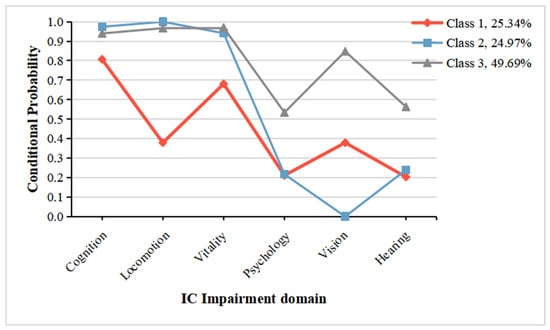
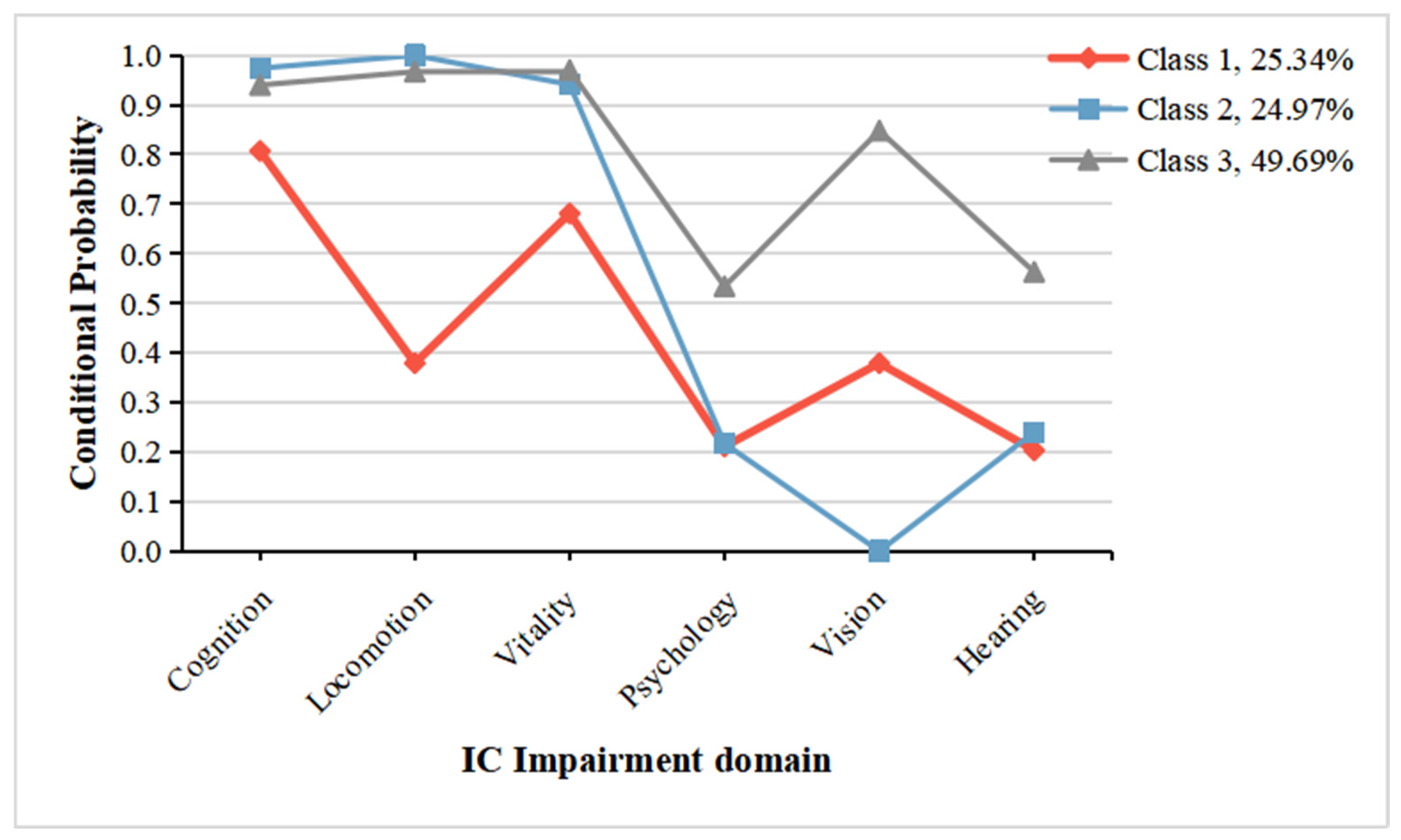
Using participants’ scores across six domains of intrinsic ability as manifest variables, an LCA model was constructed. Starting with a baseline model containing one category, the number of categories was incrementally increased, resulting in five fitted models. Results showed that as the number of categories increased, the values of the AIC, BIC, and aBIC metrics initially decreased before increasing, while the entropy value also fluctuated accordingly (Table 2). For comparison, the two-class model yielded Class 1 (58.9%) and Class 2 (41.1%); the two-class solution merely distinguished between “lower impairment” and “higher impairment” without capturing the differential patterns across specific domains. We selected the three-class solution based on a combination of factors. Firstly, the AIC, aBIC, and entropy values were better. Secondly, the significant BLRT value theoretically indicates the three-class model outperforms the two-class model. Most importantly, the three-class model yielded clinically distinct and interpretable subgroups that align with the conceptual framework of IC, whereas the two-class model was deemed overly simplistic and less informative for guiding differentiated interventions. The average latent class posterior probabilities for correct classification of IC impairment in CMD patients for the three classes were 0.858, 0.941, and 0.909, demonstrating the high reliability of the classification. The posterior probabilities matrix for the three latent classes is presented in Table 3. The definition of locomotor impairment as an SPPB score ≤ 8 was applied in the sensitivity analysis. Based on clinical interpretability and the comprehensive evaluation of the models, we still consider the three-class solution to be the most appropriate (Supplementary Table S3).The conditional probabilities of IC impairment across the three latent classes are visualized in Figure 1.
Table 2.
LCA indicators of impaired intrinsic capabilities among community-dwelling older adults with CMDs.
Table 3.
The posterior probabilities of the three classes (n = 813).
Figure 1.
Conditional probabilities of 3 classes of IC impairments by latent class. Note: Class 1: Cognition impairment; Class 2: Vitality–Cognition–Locomotion; Class 3: Multidomain IC impairment. Abbreviation: IC, intrinsic capacity.
Additionally, Table 4 detailed presents the three categories, their respective sample sizes, and the conditional probability of impairment within each IC domain when assigned to a category. Each category’s designation was defined by comparing its conditional probability with the actual impairment rate in each intrinsic capability domain: when the conditional probability exceeded the respondent’s impairment rate in the corresponding domain, that domain appeared in the category name [26]. Class 1 “Cognition impairment” (n = 206, 25.34%): Compared with the other two classes, individuals in class 1 have a low probability of impairment in all IC domains, but they still faced a substantially high probability of cognitive impairment; class 2 “Vitality–Cognition–Locomotion” (n = 203, 24.97%): Individuals in class 2 have a high probability of impairment in the three domains of vitality, cognition, and locomotion; class 3 “Multidomain IC impairment” (n = 404, 49.69%): Individuals in class 3 have a high probability of impairment in all six IC domains.
Table 4.
LCA clusters and conditional probabilities of impairment for each IC domains *.
3.4. Factors Associated with Categories of Impaired Intrinsic Functioning
The characteristics of the three categories of IC impairment, as shown in Table 5, exhibited statistically significant differences (p < 0.05) in terms of age, marital status, educational attainment, polypharmacy, self-rated health status, physical activity, and sleep quality (subjective sleep quality, sleep latency, sleep duration, habitual sleep efficiency, sleep disturbances, daytime dysfunction).
Table 5.
Participant characteristics of IC impairment across three classes.
Using the three categories derived from latent class analysis as the dependent variable, multiple logit regression analysis was conducted. Table 6 presents the results of the multiple logit regression analysis. Compared with class 1, being aged ≥80 years (OR = 3.313, 95% CI = 2.128–5.158) and insufficient physical activity (OR = 2.782, 95% CI = 1.549–4.995) were more likely to be assigned to class 2. Conversely, factors associated with a lower likelihood of being in Class 2 were having a spouse (OR = 0.596, 95% CI = 0.376–0.945) and having a junior high school education or above (OR = 0.405, 95% CI = 0.232–0.706). Compared to class 1, those aged ≥80 years (OR = 3.385, 95% CI = 2.238–5.119), self-rated health status as “fair” (OR = 3.623, 95% CI = 1.334–9.844) or “poor/very poor” (OR = 3.617, 95% CI = 1.255–10.420), insufficient physical activity (OR = 4.201, 95% CI = 2.442–7.225), subjective sleep quality as “very bad” (OR = 4.163, 95% CI = 1.249–13.876), experiencing severe difficulty with sleep latency (OR = 2.267, 95% CI = 1.131–4.541), sleep efficiency of 75–84% (OR = 1.841, 95% CI = 1.049–3.228), experiencing sleep disturbances once or twice weekly (OR = 1.866, 95% CI = 1.111–3.136), and experiencing daytime dysfunction three or more times weekly (OR = 2.112, 95% CI = 1.036–4.310) were more likely to be classified into class 3. However, having junior high school education and above (OR = 0.314, 95% CI = 0.188–0.527) and sleeping for 6–7 h (OR = 0.601, 95% CI = 0.371–0.973) were associated with a lower likelihood of being classified into Class 3. Furthermore, compared with class 2, those reporting self-rated health status as “fair” (OR = 3.578, 95% CI = 1.299–9.955), moderate difficulty with sleep latency (OR = 2.152, 95% CI = 1.116–4.149), and experiencing daytime dysfunction three or more times per week (OR = 3.112, 95% CI = 1.659–5.838) were more likely to be assigned to class 3.
Table 6.
Multinomial logistic regression analysis for IC impairment among three classes.
4. Discussion
In this study, 99.2% of older adults with CMDs exhibited IC impairment, exceeding findings from prior research on older chronic disease populations [27,28,29]. The cumulative burden of prolonged disease and advancing age predisposes this population to cognitive decline, sarcopenia, locomotion limitations, and psychological distress. Moreover, the interplay across these domains may create a cascade of functional decline, wherein impairment in one domain can compound deficits in others, ultimately accelerating overall IC impairment. Consistent with our team’s earlier findings [30], psychological impairment was significantly more prevalent among participants in the CMM group than among those with a single CMD. This disparity likely arises from the compounded burden of managing multiple chronic conditions, which not only intensifies physiological strain but also exacts considerable psychological and financial tolls. Patients must adhere to complex, long-term regimens involving polypharmacy, regular monitoring of blood pressure and glucose, and sustained lifestyle modifications (e.g., dietary changes, increased physical activity, smoking cessation, and alcohol restriction). The complexity of these self-management tasks can readily precipitate psychological distress, manifesting as fatigue and self-doubt. Difficulty adhering to such demanding interventions is often associated with suboptimal disease control and a higher risk of complications, which in turn can diminish physical function and quality of life while amplifying feelings of anxiety and depression [31]. These findings highlight the importance of integrating psychological assessment and support into community-based chronic disease management for older adults. In addition to routine monitoring of blood pressure and glucose, follow-up care should prioritize the mental health of individuals with multiple coexisting conditions.
LCA identified three distinct subgroups among older adults with CMDs. The “Cognition impairment” group was characterized by younger age, fewer comorbidities, and healthier behaviors. Nevertheless, vigilance is warranted regarding potential early signs of functional decline with advancing age, particularly cognitive decline. Longer duration of cardiometabolic disease has been associated with an elevated risk of mild cognitive impairment in older populations [32]. Promoting sustained healthy lifestyles remains fundamental to delaying future functional deterioration in this subgroup. The “Vitality–Cognition–Locomotion” group exhibited an intermediate risk profile. The concurrent impairment in these domains likely reflects shared underlying mechanisms, which compromise both energy metabolism and neuromuscular function. This clustering underscores the need for early, multidimensional interventions aimed at preserving functional capacity, rather than managing individual diseases in isolation. The “Multidomain IC impairment” group, comprising the oldest and most clinically complex individuals, faces the highest risk of adverse outcomes. Cumulative physiological insults likely accelerate accelerated aging across multiple systems, perpetuating a cycle of disability and dependence. For this vulnerable population, integrated, multidisciplinary care prioritizing functional maintenance and quality of life over single-disease metrics is essential.
The present study findings indicate that age, marital status, educational attainment, physical activity, sleep quality, and self-rated health status were associated with the latent classes of IC impairment among community-dwelling older adults with CMDs (all p < 0.05), consistent with previous research [33,34].
Compared to class 1, older adults with CMDs aged 80 years and above were more likely to be classified into class 2 and class 3. This indicates that across all domains of IC, impairment is prevalent among older adults with CMDs in the advanced age cohort, potentially reflecting the age-related decline in IC [29]. Therefore, older adults with CMDs should actively monitor their health status, undergo regular comprehensive geriatric health examinations, and prioritise assessments of cognitive function, nutritional status, mobility, sensory function, and mental health to achieve early detection, diagnosis, and timely intervention for chronic diseases and their complications.
Analysis indicates that being married and having an educational level of junior secondary school or above were more likely to be assigned to class 1. Following retirement and separation from children, spouses not only fulfil most social needs but also share financial burdens. Furthermore, spouses of older individuals with chronic diseases can provide partial daily care. Older adults with higher educational attainment are more likely to monitor their health status, including medical conditions and emotional well-being, and adjust accordingly. They are also more inclined to maintain higher IC through lifestyle choices such as healthy diets and physical activity. While educational levels may be difficult to alter significantly in the short term, proactive interventions can compensate for this limitation. Specifically, we can encourage and guide older adults to read more books and newspapers, cultivate personal hobbies, participate in social activities, and engage in cognitive training. These approaches help maintain or even enhance their IC and performance, thereby effectively strengthening their physiological reserves.
Self-rated health status exhibits a significant association with the latent capability category of older adults with CMDs. This study found that patients self-rating their health as “fair” or “poor/very poor” were more likely to be classified into class 3 compared to class 1; similarly, those self-rating “fair” were more likely to be categorised into class 3 than class 2. This indicates consistency between patients’ subjective health perceptions and their objective functional capacity levels. Given that self-rated health is a known risk indicator for adverse outcomes such as disability, hospitalisation, and mortality [35], it may serve as a convenient preliminary screening tool for identifying high-risk populations with IC impairment in primary healthcare settings. Healthcare professionals can thus maintain vigilance regarding older adults with poor self-rated health status, providing early, comprehensive health interventions to delay functional decline.
Using class 1 as a reference, older adults with CMDs with insufficient physical activity are more likely to be classified into class 2 and class 3. A previous study reported that reduced exercise volume (weekly exercise duration < 3 h) correlates with diminished IC [36]. For older adults with CMDs, regular physical activity not only improves cardiorespiratory endurance, muscle strength, and metabolic indicators but also positively impacts cognitive function, emotional regulation, and overall functional status [37,38]. In line with physical activity guidelines for chronic disease populations [39], older adults with CMDs should develop personalised, sustainable activity plans under professional assessment and guidance. Where contraindications are absent, the following principles may be followed: accumulate at least 150 min of moderate-intensity aerobic activity weekly, or at least 75 min of vigorous-intensity aerobic activity, alongside two or more sessions of muscle-strengthening activities (e.g., seated leg raises, chair squats, resistance band training). Should functional limitations prevent meeting these recommendations, individuals should nevertheless minimise sedentary time and engage in low-intensity daily activities suited to their condition, such as slow walking or stretching exercises. It is crucial to emphasise that physical activity for older adults with CMDs must prioritise safety and gradual progression. Such activities should ideally be undertaken under the guidance of community healthcare professionals or rehabilitation specialists. Where necessary, exercise monitoring and regular assessments may be incorporated to ensure the activity plan both promotes functional maintenance and avoids exercise-related risks.
Sleep disturbances exhibit multidimensional characteristics among older adults with CMDs, and are associated with IC impairment. In this study, 47.72% of older adults with CMDs exhibited poor sleep quality, a proportion exceeding previous research [40], highlighting heightened sleep health risks within this cohort. Furthermore, this study found that all six dimensions of the PSQI were significantly correlated with categories of IC impairment, consistent with findings from other studies [41,42]. Potential explanations include: firstly, sleep disturbances may disrupt growth hormone secretion rhythms, reduce insulin-like growth factor-1 levels, and promote the release of inflammatory mediators such as interleukin-6 and C-reactive protein, thereby exacerbating the pre-existing chronic low-grade inflammatory state in older adults with CMDs [43]; on the other hand, evidence indicates that sleep problems are closely associated with impairments across multiple domains of IC, such as exacerbated depressive symptoms [44], cognitive dysfunction [45], deteriorating nutritional status [46], and diminished auditory performance [47]. Notably, only 27.32% of those with poor sleep quality in this study used hypnotic medications. This may reflect that most older individuals have limited knowledge of hypnotics and harbour concerns and apprehensions regarding their potential side effects and dependency risks, thereby avoiding their use.
The innovation of this study manifests in three principal aspects. Firstly, this study enriches the domestic evidence base on IC studies by investigating its current status among community-dwelling older adults with CMDs in the XPCC, a region facing rapid ageing and relatively limited medical resources. It provides a foundational basis for future research on healthy ageing and the implementation of ICOPE. Secondly, by employing latent class analysis to categorise IC impairments of older adults with CMDs, it reveals more detailed patterns of combination across different functional domains and population heterogeneity. This provides a new analytical perspective and classification basis for implementing stratified, precision health interventions. Thirdly, this study not only described the current state of IC impairment but also examined factors associated with these latent classes of IC impairment in older adults with CMDs, providing evidence to support the transition from “disease control” to “functional maintenance” in community chronic disease management.
However, this study also has certain limitations. Firstly, the cross-sectional survey design, while revealing associations between variables, cannot establish causal relationships. Moreover, although participants were assigned to latent classes using maximum posterior probability assignment, they may still have non-zero probabilities of belonging to other classes. Furthermore, as intrinsic capabilities are dynamic constructs, future studies could employ longitudinal tracking of participants to explore the trajectory of capability changes and patterns in health outcomes among older adults with CMDs. Finally, the research was confined to urban and farm communities within a specific division of the XPCC. Consequently, conclusions may be more applicable to regions with comparable economic and healthcare conditions. Future studies should consider multi-centre investigations with larger sample sizes.
5. Conclusions
This study represents an investigation of IC among older individuals with cardiovascular and metabolic diseases within XPCC communities, employing latent class analysis to identify three categories with distinct risk profiles: “Cognition impairment” (25.34%), “Vitality–Cognition–Locomotion” (24.97%), and “Multidomain IC impairment” (49.69%). Age, marital status, educational attainment, self-rated health status, physical activity, and sleep quality were identified as factors associated with the latent classes of IC impairment among community-dwelling older adults with CMDs. These findings carry distinct implications for stratified intervention. The “Cognition impairment” group, characterized by relatively preserved function, represents a target for primary prevention through lifestyle modification, cognitive training, and social engagement to delay age-related decline. The “Vitality–Cognition–Locomotion” group requires early, multi-domain interventions that integrate nutritional optimization, personalized exercise, cognitive stimulation, and psychosocial support to arrest synergistic functional deterioration across interconnected domains. The “Multidomain IC impairment” group requires implementation of patient-centered, multidisciplinary integrated care focused on maintaining basic activities of daily living through coordinated medical management, rehabilitation, nutritional support, assistive devices, and caregiver assistance. In summary, risk stratification based on IC facilitates a shift from disease-centred to function-centred care models among older adults with CMDs. This approach enables personalized, tiered interventions in clinical and public health settings, advancing the goal of healthy aging.
Supplementary Materials
The following supporting information can be downloaded at: https://www.mdpi.com/article/10.3390/healthcare14224001/s1, Table S1. Characteristics of all participants in the study. Figure S1. Conditional probabilities of 2-classes IC impairments by latent class. Abbreviation: IC, intrinsic capacity. Table S2. LCA clusters and conditional probabilities of impairment for each IC domains (2-classes). Table S3. LCA indicators of impaired intrinsic capabilities among community-dwelling older adults with CMDs. Supplementary Mplus syntax.
Author Contributions
Conceptualization, M.J. and F.D.; methodology, F.D.; software, F.D.; validation, F.D., J.L. and J.W.; formal analysis, F.D.; investigation, F.D., J.L., J.W. and Z.W.; resources, M.J.; data curation, J.L., Z.W. and J.W.; writing—original draft preparation, F.D.; writing—review and editing, F.D., M.J. and Y.M.; visualization, F.D.; supervision, M.J.; project administration, M.J. and Y.M.; funding acquisition, M.J. All authors have read and agreed to the published version of the manuscript.
Funding
Funding for the study was provided by Key Scientific & Technological Project of Xinjiang Production and Construction Corps (2025AB090).
Institutional Review Board Statement
This study was carried out in compliance with the guidelines of the Helsinki Declaration. The studies involving human participants were reviewed and approved by the Ethics Review Board of The First Affiliated Hospital of Shihezi University (Approval No.: KJ2024-210-01, approved on 28 June 2024).
Informed Consent Statement
This study obtained the written informed consent of participants. Before completing the questionnaire, participants were asked to answer the question “Do you agree to participate in this survey?”. If participants choose “Yes,” the survey is considered voluntary. If the participants select “No,” then they exit the survey.
Data Availability Statement
The data presented in this study are available from the corresponding author upon reasonable request. The data are not publicly available because the dataset contains individual-level health information, and the informed consent obtained from participants did not include permission for public sharing of participant-level data. Any access to de-identified data will be considered in accordance with applicable ethical and privacy requirements to protect participant confidentiality.
Acknowledgments
We extend our sincere gratitude to the community health service station and the staff of the Xinjiang Production and Construction Corps for their invaluable support in participant recruitment and data collection. Additionally, we would like to express our heartfelt appreciation to the study participants for their time and willingness to contribute to this research.
Conflicts of Interest
The authors declare no conflicts of interest.
Abbreviations
The following abbreviations are used in this manuscript:
| CMDs | Cardiometabolic diseases |
| IC | Intrinsic capacity |
| WHO | World Health Organization |
| ICOPE | Integrated care for older people |
| LCA | Latent Class Analysis |
| XPCC | The Xinjiang Production and Construction Corps |
| CMM | Cardiometabolic multimorbidity |
| BMI | Body Mass Index |
| MET | Metabolic Equivalent |
| PSQI | Pittsburgh Sleep Quality Index |
| AIC | Akaike Information Criterion |
| BIC | Bayesian Information Criterion |
| VLMR | The Vuong–Lo–Mendell–Rubin Test |
| BLRT | Bootstrap Likelihood Ratio Test |
References
- Gao, C.; Luo, X.; Li, J. China Aging Development Report (2025): The Demand Status of Older Adults in China; Social Sciences Academic Press: Beijing, China, 2025. [Google Scholar]
- Zhang, Y. Predictive Value of Biochemical Markers on Incident Cardiometabolic Disease in a Population of Older Community-Dwelling Chinese Adults; Griffith University: Brisbane, QLD, Australia, 2023. [Google Scholar]
- Mustafa, R.; Ghanbari, M.; Evangelou, M.; Dehghan, A. An Enrichment Analysis for Cardiometabolic Traits Suggests Non-Random Assignment of Genes to microRNAs. Int. J. Mol. Sci. 2018, 19, 3666. [Google Scholar] [CrossRef] [Scilit]
- GBD 2019 Risk Factors Collaborators. Global burden of 87 risk factors in 204 countries and territories, 1990–2019: A systematic analysis for the Global Burden of Disease Study 2019. Lancet 2020, 396, 1223–1249. [Google Scholar] [CrossRef] [Scilit]
- World Health Organization. Integrated Care for Older People (ICOPE): Guidance for Person-Centred Assessment and Pathways in Primary Care; World Health Organization: Geneva, Switzerland, 2019. [Google Scholar]
- Beard, J.R.; Jotheeswaran, A.T.; Cesari, M.; Araujo de Carvalho, I. The structure and predictive value of intrinsic capacity in a longitudinal study of ageing. BMJ Open 2019, 9, e026119. [Google Scholar] [CrossRef] [Scilit]
- Sánchez-Sánchez, J.L.; Lu, W.H.; Gallardo-Gómez, D.; Del Pozo Cruz, B.; de Souto Barreto, P.; Lucia, A.; Valenzuela, P.L. Association of intrinsic capacity with functional decline and mortality in older adults: A systematic review and meta-analysis of longitudinal studies. Lancet Health Longev. 2024, 5, e480–e492. [Google Scholar] [CrossRef] [Scilit]
- Yu, W.; Zhou, Y.; Gao, X.; Han, J.; Zhang, L.; Ma, L. Social isolation and intrinsic capacity decline in older adults: Mediating roles of sleep duration and pain. Exp. Gerontol. 2025, 213, 112991. [Google Scholar] [CrossRef] [Scilit]
- Zhang, Y.; Jiang, Z.; Hu, R.; Liang, H.; Yang, S.; Mao, Q.; Liu, S.; Yuan, X. Patterns and Factors of Intrinsic Capacity Impairment in Older Adults with Chronic Diseases: A Latent Class Analysis. Clin. Interv. Aging 2025, 20, 2317–2336. [Google Scholar] [CrossRef] [Scilit]
- Zhang, J.; Li, J.; Wu, J.; Li, C.; Shen, J.; Wu, W.; Shi, H.; Yuan, Y.; Liu, Y.; Li, H. Correlation between intrinsic capacity and nutrition, glucose and lipid metabolism indexes in elderly in patients. Chin. J. Front. Med. Sci. (Electron Version) 2023, 15, 40–46. [Google Scholar]
- Onor, I.O.; Hill, L.M.; Famodimu, M.M.; Coleman, M.R.; Huynh, C.H.; Beyl, R.A.; Payne, C.J.; Johnston, E.K.; Okogbaa, J.I.; Gillard, C.J.; et al. Association of Serum Magnesium with Blood Pressure in Patients with Hypertensive Crises: A Retrospective Cross-Sectional Study. Nutrients 2021, 13, 4213. [Google Scholar] [CrossRef] [Scilit]
- Mikkelsen, M.B.; Neumann, H.; Buskbjerg, C.R.; Johannsen, M.; O’Toole, M.S.; Arendt-Nielsen, L.; Zachariae, R. The effect of experimental emotion induction on experimental pain: A systematic review and meta-analysis. Pain 2024, 165, e17–e38. [Google Scholar] [CrossRef] [Scilit]
- Liang, Y.; An, L.; Gao, Y.; Li, H.; Wu, J.; Zhang, R. Research progress on intrinsic capacity of the elderly. Chin. Nurs. Res. 2022, 36, 3481–3484. [Google Scholar]
- Liu, C.; Deng, C.; Song, Y.; Yang, F.; Shi, Q.; Li, Y.; Zhang, X. Comparison of Prevalence and Comorbidity of Hypertension, Diabetes and Dyslipidemia in Xinjiang Residents. Chin. Gen. Pract. 2025, 28, 4031–4037. [Google Scholar]
- Cao, X.; Yi, X.; Chen, H.; Tian, Y.; Li, S.; Zhou, J. Prevalence of intrinsic capacity decline among community-dwelling older adults: A systematic review and meta-analysis. Aging Clin. Exp. Res. 2024, 36, 157. [Google Scholar] [CrossRef] [Scilit]
- Folstein, M.F.; Folstein, S.E.; McHugh, P.R. “Mini-mental state”. A practical method for grading the cognitive state of patients for the clinician. J. Psychiatr. Res. 1975, 12, 189–198. [Google Scholar] [CrossRef] [Scilit]
- Guralnik, J.M.; Winograd, C.H. Physical performance measures in the assessment of older persons. Aging 1994, 6, 303–305. [Google Scholar] [CrossRef] [Scilit]
- Beard, J.R.; Si, Y.; Liu, Z.; Chenoweth, L.; Hanewald, K. Intrinsic Capacity: Validation of a New WHO Concept for Healthy Aging in a Longitudinal Chinese Study. J. Gerontol. A-Biol. 2022, 77, 94–100. [Google Scholar] [CrossRef] [Scilit]
- Kroenke, K.; Spitzer, R.L.; Williams, J.B. The PHQ-9: Validity of a brief depression severity measure. J. Gen. Intern. Med. 2001, 16, 606–613. [Google Scholar] [CrossRef] [Scilit]
- Lu, F.; Liu, X. Research progress on intrinsic capacity in the elderly. Chin. J. Clin. Healthc. 2023, 26, 278–283. [Google Scholar]
- Liu, S.; Kang, L.; Liu, X.; Zhao, S.; Wang, X.; Li, J.; Jiang, S. Trajectory and Correlation of Intrinsic Capacity and Frailty in a Beijing Elderly Community. Front. Med. 2021, 8, 751586. [Google Scholar] [CrossRef] [Scilit]
- Jang, I.Y.; Lee, E.; Lee, H.; Park, H.; Kim, S.; Kim, K.I.; Jung, H.W.; Kim, D.H. Characteristics of sarcopenia by European consensuses and a phenotype score. J. Cachexia Sarcopenia Muscle 2020, 11, 497–504. [Google Scholar] [CrossRef] [Scilit]
- Ainsworth, B.E.; Haskell, W.L.; Herrmann, S.D.; Meckes, N.; Bassett, D.R., Jr.; Tudor-Locke, C.; Greer, J.L.; Vezina, J.; Whitt-Glover, M.C.; Leon, A.S. 2011 Compendium of Physical Activities: A second update of codes and MET values. Med. Sci. Sports Exerc. 2011, 43, 1575–1581. [Google Scholar] [CrossRef] [Scilit]
- Li, X.; Zhang, W.; Zhang, W.; Tao, K.; Ni, W.; Wang, K.; Li, Z.; Liu, Q.; Lin, J. Level of physical activity among middle-aged and older Chinese people: Evidence from the China health and retirement longitudinal study. BMC Public Health 2020, 20, 1682. [Google Scholar] [CrossRef] [Scilit]
- Buysse, D.J.; Reynolds, C.F., 3rd; Monk, T.H.; Berman, S.R.; Kupfer, D.J. The Pittsburgh Sleep Quality Index: A new instrument for psychiatric practice and research. Psychiatry Res. 1989, 28, 193–213. [Google Scholar] [CrossRef] [Scilit]
- de Souto Barreto, P.; Gonzalez-Bautista, E.; Bischoff-Ferrari, H.A.; Pelegrim de Oliveira, V.; Gorga Bandeira de Mello, R.; Andrieu, S.; Berbon, C.; Tavassoli, N.; Beard, J.R.; Rolland, Y.; et al. Real-life intrinsic capacity screening data from the ICOPE-Care program. Nat. Aging 2024, 4, 1279–1289. [Google Scholar] [CrossRef] [Scilit]
- Huang, B.; Luo, T.; Jiang, X. Correlation between decline in intrinsic capacity and blood pressure variability in elderly patients with hypertension. Chin. J. Geriatr. Heart Brain Vessel Dis. 2022, 24, 709–712. [Google Scholar]
- Ji, S. Study on Intrinsic Capacity Status and Its Influencing Factors in Elderly Patients with Coronary Heart Disease. Master’s Thesis, Yangzhou University, Yangzhou, China, 2024. [Google Scholar]
- Zhou, B.; Ma, R.; Lu, M.; Wang, Y. Latent class analysis of intrinsic capacity among community-dwelling elderly diabetes mellitus patients with multimorbidity. J. Nurs. Sci. 2025, 40, 6–11. [Google Scholar]
- Wang, Z.; Fan, J.; Fan, J.; Jing, M. Risk prediction of cardiometabolic diseases with depression in the community of Xinjiang production and construction corps. BMC Public Health 2025, 25, 3722. [Google Scholar] [CrossRef] [Scilit]
- Huang, Z.; Luo, Y.; Su, H.; Wang, K.; Chen, Z.; Xu, H.; Hu, Y.; Xu, B. Relationship between cardiovascular metabolic multimorbidity and depressive symptoms in Chinese older adults. Chin. J. Prev. Control Chronic Dis. 2021, 29, 644–648. [Google Scholar] [CrossRef]
- Vázquez-de Sebastián, J.; Ortiz-Zuñiga, A.M.; Ciudin, A.; Ars, J.; Inzitari, M.; Simó, R.; Hernández, C.; Ariño-Blasco, S.; Barahona, M.J.; Franco, M.; et al. Cognitive Profile and Cardiovascular Risk Factors in Older Adults with Mild Cognitive Impairment. Int. J. Environ. Res. Public Health 2024, 21, 500. [Google Scholar] [CrossRef] [Scilit]
- Ntsama Essomba, M.J.; Andela Ebidiye, J.K.; Noubiap, J.J.; Motto Ndoumbe, J.; Djuikwo Teukeng, F.; Tabue Teguo, M. Prevalence of intrinsic capacity impairment and associated factors among retired older people in Cameroon. BMC Geriatr. 2025, 25, 760. [Google Scholar] [CrossRef] [Scilit]
- Xu, W.; Tian, L.; Dai, H. An interactive dynamic online nomogram for predicting the heterogeneous trajectories of intrinsic capacity among older adults. Arch. Gerontol. Geriatr. 2025, 139, 105993. [Google Scholar] [CrossRef] [Scilit]
- Enroth, L.; Fors, S. Trends in the Social Class Inequalities in Disability and Self-Rated Health: Repeated Cross-Sectional Surveys from Finland and Sweden 2001–2018. Int. J. Public Health 2021, 66, 645513. [Google Scholar] [CrossRef] [Scilit]
- Ma, L.; Chhetri, J.K.; Zhang, L.; Sun, F.; Li, Y.; Tang, Z. Cross-sectional study examining the status of intrinsic capacity decline in community-dwelling older adults in China: Prevalence, associated factors and implications for clinical care. BMJ Open 2021, 11, e043062. [Google Scholar] [CrossRef] [Scilit]
- Muneera, K.; Muhammad, T.; Althaf, S. Socio-demographic and lifestyle factors associated with intrinsic capacity among older adults: Evidence from India. BMC Geriatr. 2022, 22, 851. [Google Scholar] [CrossRef] [Scilit]
- Singh, B.; Olds, T.; Curtis, R.; Dumuid, D.; Virgara, R.; Watson, A.; Szeto, K.; O’Connor, E.; Ferguson, T.; Eglitis, E.; et al. Effectiveness of physical activity interventions for improving depression, anxiety and distress: An overview of systematic reviews. Br. J. Sports Med. 2023, 57, 1203–1209. [Google Scholar] [CrossRef] [Scilit]
- Bull, F.C.; Al-Ansari, S.S.; Biddle, S.; Borodulin, K.; Buman, M.P.; Cardon, G.; Carty, C.; Chaput, J.P.; Chastin, S.; Chou, R.; et al. World Health Organization 2020 guidelines on physical activity and sedentary behaviour. Br. J. Sport Med. 2020, 54, 1451–1462. [Google Scholar] [CrossRef] [Scilit]
- Kyprianidou, M.; Panagiotakos, D.; Makris, K.C.; Kambanaros, M.; Christophi, C.A.; Giannakou, K. The Lifestyle Profile of Individuals with Cardiovascular and Endocrine Diseases in Cyprus: A Hierarchical, Classification Analysis. Nutrients 2022, 14, 1559. [Google Scholar] [CrossRef] [Scilit]
- de Souza, Â.M.N.; Fernandes, D.P.S.; Castro, I.S.; Gróla, F.G.; Ribeiro, A.Q. Sleep quality and duration and frailty in older adults: A systematic review. Front. Public Health 2025, 13, 1539849. [Google Scholar] [CrossRef] [Scilit]
- Yu, X.; Wang, D.; Yao, L.; Shi, Z.; Liu, X.; Wu, H.; Jiang, J.; Zhang, Y.; He, Q. Sleep disorders and the association with frailty among community-dwelling older adults in Northwest China: A cross-sectional study. BMJ Open 2025, 15, e088030. [Google Scholar] [CrossRef] [Scilit]
- Cohen, C.I.; Benyaminov, R.; Rahman, M.; Ngu, D.; Reinhardt, M. Frailty: A Multidimensional Biopsychosocial Syndrome. Med. Clin. N. Am. 2023, 107, 183–197. [Google Scholar] [CrossRef] [Scilit]
- Jackowska, M.; Poole, L. Sleep problems, short sleep and a combination of both increase the risk of depressive symptoms in older people: A 6-year follow-up investigation from the English Longitudinal Study of Ageing. Sleep Med. 2017, 37, 60–65. [Google Scholar] [CrossRef] [Scilit]
- Futenma, K.; Takaesu, Y.; Komada, Y.; Shimura, A.; Okajima, I.; Matsui, K.; Tanioka, K.; Inoue, Y. Delayed sleep-wake phase disorder and its related sleep behaviors in the young generation. Front. Psychiatry 2023, 14, 1174719. [Google Scholar] [CrossRef] [Scilit]
- Hao, C.; Li, Z.; Wng, L.; Zhang, J.; Chen, J. Expert consensus on nutritional intervention for elderly patients with sleep disorders. Chin. J. Mult. Organ Dis. Elder. 2023, 22, 721–728. [Google Scholar]
- Zhang, P.; An, X.; Yang, R.; Qi, M.; Gao, Z.; Zhang, X.; Wu, Z.; Zheng, Z.; Dong, X.; Wang, W.; et al. Echoes in the night: How sleep quality influences auditory health. Neuroscience 2025, 577, 200–216. [Google Scholar] [CrossRef] [Scilit]

Disclaimer/Publisher’s Note: The statements, opinions and data contained in all publications are solely those of the individual author(s) and contributor(s) and not of MDPI and/or the editor(s). MDPI and/or the editor(s) disclaim responsibility for any injury to people or property resulting from any ideas, methods, instructions or products referred to in the content. |
© 2026 by the authors. Licensee MDPI, Basel, Switzerland. This article is an open access article distributed under the terms and conditions of the Creative Commons Attribution (CC BY) license.