


Highlights
What are the main findings?
- •
- Compared with routine lecture-based training, a multicomponent flipped learning program, which also involved more training time, was associated with higher baseline-adjusted posttest scores for cognitive performance and self-rated tube-care skill mastery among newly hired nurses.
- •
- Exploratory step-level analyses suggested the largest differences in self-rated mastery for tasks involving assessment, clinical decision-making, corrective action, and physician communication using the Identify, Situation, Background, Assessment, Recommendation, and Read-back (ISBARR) framework.
What are the implications of the main findings?
- •
- For onboarding in high-risk procedural tasks, pre-class preparation may be most useful when face-to-face time is used for peer clarification and repeated simulation-based practice.
- •
- The observed differences should be interpreted as associations with the multicomponent program as a whole rather than with any single component, given the substantial differences in learning strategies and training time between the study groups.
Abstract
Background/Objectives: Invasive tube care requires procedural knowledge, clinical judgment, and communication. We evaluated a multicomponent flipped learning program for newly hired nurses. Methods: In this 2015 quasi-experimental study, 66 nurses from five branches of a Taiwanese hospital system were allocated nonrandomly by branch to an intervention (three branches, n = 33) or routine lecture-based training (two branches, n = 33). The intervention combined online preparation, peer teaching, and simulation and involved more instructional time than the 50-min control lecture. Cognitive performance and self-rated tube-care skill mastery were measured before and shortly after training. Mixed-effects ANCOVA adjusted for baseline scores and accounted for branch clustering. Results: The intervention group started with lower scores. Unadjusted posttest cognitive scores were higher in the intervention group (233.45 ± 30.42 vs. 208.97 ± 14.10; p < 0.001), whereas self-rated mastery did not differ significantly (64.39 ± 9.36 vs. 60.67 ± 7.18; p = 0.074). Adjusted posttest differences favored the intervention for cognitive performance (29.84 points; 95% CI, 11.65–48.03; p = 0.014) and self-rated mastery (6.41 points; 95% CI, 0.58–12.23; p = 0.039). For self-rated mastery, the estimated between-group difference varied according to baseline scores. Statistical significance was not consistent across sensitivity analyses. Conclusions: The program was associated with higher short-term learning scores, but nonrandom allocation, unequal instructional time, and only five branches limit causal interpretation. Objective clinical competence and patient outcomes were not assessed.
1. Introduction
Invasive tubes, including artificial airways, nasogastric tubes, urinary catheters, central venous catheters, and surgical drains, are commonly used in acute medical and surgical care [1,2]. Their placement and maintenance are closely linked to patient safety [3,4,5]. Tube displacement, obstruction, disconnection, or mismanagement may lead to infection, treatment interruption, clinical deterioration, or other preventable harm [3,4,5]. In Taiwan, tube-related incidents accounted for 15.4% of all events reported to the Taiwan Patient-safety Reporting System in 2015, ranking third among event categories. Tube-related incidents remained the third most frequently reported category in the fourth quarter of 2024, accounting for 11.5% of all reports [6,7]. An integrative review also documented serious adverse events associated with nasogastric and nasoenteric tubes [5]. A Taiwanese retrospective case–control study reported that unplanned self-extubation occurred more frequently during shifts staffed by nurses with less clinical experience and lower educational attainment [8]. For newly hired nurses, safe tube care therefore requires more than familiarity with routine procedures; it also involves recognizing potential complications and communicating concerns promptly [9,10,11,12].
During their transition into practice, newly hired nurses entering acute clinical settings must adapt to unfamiliar workflows, high patient acuity, and the use of multiple invasive devices while developing the clinical judgment and communication skills required to identify and report patient safety concerns [9,10,11,12]. When a patient has several tubes in place, novice nurses may struggle to recognize early signs of tube-related problems, decide whether a tube’s position or function is abnormal, and communicate using structured tools such as the “Identify, Situation, Background, Assessment, Recommendation, and Read-back” (ISBARR) framework [10,11,12]. These challenges suggest a need for onboarding education that provides opportunities to apply knowledge in clinically relevant situations.
Traditional onboarding education for newly hired nurses often relies on lectures, which can efficiently deliver foundational knowledge but provide limited opportunities for procedural rehearsal, clinical decision-making, and individualized feedback [13]. Invasive tube care, however, requires the integration of procedural knowledge, psychomotor skills, clinical judgment, and situational awareness [11,12,14]. Training should therefore provide opportunities to apply knowledge and practice clinical skills. Simulation-based education may help address these needs by allowing learners to rehearse clinical scenarios and receive feedback in a controlled environment. A systematic review and meta-analysis found that technology-enhanced simulation improved knowledge, skills, and behaviors compared with no intervention [15], while a comparative meta-analysis reported better skill acquisition with simulation-based deliberate practice than with traditional clinical education [16]. Nevertheless, simulation requires additional instructional time and resources, and performance in simulated settings does not necessarily translate into competence in routine clinical practice. Unlike lecture-based approaches that primarily emphasize knowledge delivery, competency-based education places greater emphasis on assessing observable performance against defined standards [17].
Flipped learning offers one approach to this challenge by shifting foundational learning before class and reserving face-to-face time for application and practice [18,19,20]. Pre-class materials allow learners to review basic concepts and procedures at their own pace and identify areas requiring clarification, supporting self-directed and self-regulated learning [20]. During class, peer teaching encourages learners to explain concepts, discuss clinical problems, and refine their reasoning through interaction and feedback, consistent with constructivist learning principles [20,21]. Simulation-based practice provides opportunities to apply knowledge to clinical scenarios, rehearse decisions and procedures, and receive feedback, reflecting experiential learning and deliberate practice [16,20].
Although flipped learning has been widely studied in nursing education, most evidence concerns students rather than newly hired nurses [18,19,22]. Evidence involving newly hired nurses is also emerging. For example, Liu et al. studied 92 newly recruited nurses and found that a flipped classroom combined with mind mapping improved autonomous learning ability compared with conventional pre-job training [23]. However, that study did not specifically assess invasive tube-care knowledge or self-rated mastery of procedural steps. Evidence on multicomponent flipped learning for high-risk procedural training during hospital onboarding therefore remains limited.
This study developed and evaluated a multicomponent flipped learning program for newly hired nurses, combining online preparation, reciprocal peer teaching, and simulation-based practice around a standardized 19-step tube-care process. The two main outcomes were total cognitive performance and total self-rated tube-care skill mastery. Additional outcomes included scores in the three cognitive domains and self-ratings of the 19 individual care steps. We hypothesized that the intervention group would show greater improvements in cognitive performance and self-rated tube-care skill mastery than the lecture-based control group. Secondary outcomes and analyses of learner characteristics were treated as exploratory. Because the groups differed in hospital-branch allocation, instructional strategies, and learning time, the study evaluated the multicomponent program as a whole rather than the independent effect of flipped learning.
2. Materials and Methods
2.1. Study Design and Setting
This study was conducted in two stages. In the first stage, we focused on program development and assessment design through a literature review and a focus group discussion with clinical nursing experts. In the second stage, we adopted a two-group pretest–posttest quasi-experimental design to evaluate learning outcomes.
The study was conducted across five branches of a public hospital in Taipei, Taiwan. The target population comprised newly hired nurses working in acute medical, surgical, or mixed medical and surgical wards. All five branches were included, and branch assignment was determined before participant recruitment and baseline assessment. Based on historical numbers of newly hired nurses at each branch, three branches were assigned nonrandomly to the intervention group and two to the control group to achieve approximately balanced recruitment while reducing contamination between training conditions. Individual nurses were not randomized. Because branch characteristics, staffing patterns, and local educational practices may have differed, branch-level differences could have influenced the observed outcomes.
The study was conducted in December 2015 as part of the first author’s master’s research, and the thesis was completed in 2016. The present manuscript was prepared subsequently for journal publication using the original study data. Preliminary results from this cohort were previously published in Chinese [24]. That report presented unadjusted pretest–posttest comparisons using paired- and independent-samples t tests. The present manuscript is based on a re-analysis of the original individual-level data and extends the earlier report by describing the program development, recruitment, and participant flow in detail; using baseline-adjusted and mixed-effects models that account for branch-level allocation, with cluster-sensitive sensitivity analyses; reporting effect sizes and confidence intervals; comparing step-level gains between groups with correction for multiple comparisons; and examining learner characteristics associated with learning gains. Several values reported in the earlier publication were corrected after verification against the original dataset. The earlier report described the design as a randomized controlled trial; however, branch assignment was not made by a formal random procedure, and individual nurses were not randomized. We therefore describe the study here as a nonrandomized quasi-experimental design.
2.2. Participants and Group Allocation
Eligible participants were newly hired nurses with less than three months of employment who were receiving the hospital’s onboarding training in invasive tube care. The sample size was determined by the anticipated availability of newly hired nurses. During the corresponding recruitment periods in 2013 and 2014, the hospital had hired 79 and 88 nurses, respectively. Based on these historical numbers, the recruitment target was initially set at 30 participants per group and subsequently increased to 33 per group to allow for potential attrition. Participation was voluntary, and eligible nurses were enrolled on a first-come, first-served basis until the target number was reached in each group.
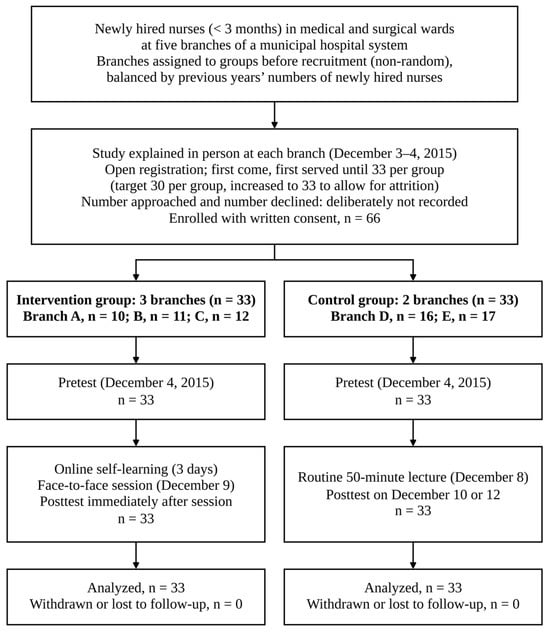
Because the first author held a nursing supervisory position at the time, measures were taken to protect the voluntary nature of participation. Nurses were informed that participation was voluntary and would not affect their training or performance evaluation, and individual performance appraisals were conducted by unit managers without involvement of the investigators. As a further safeguard, the research team deliberately did not record the identities or number of nurses who declined participation. Consequently, the total number of eligible nurses approached and the participation rate could not be determined. All 66 enrolled nurses (33 per group) completed both the pretest and posttest assessments, with no loss to follow-up or missing outcome data. Participant enrollment and completion are summarized in Figure 1.
Figure 1.
Participant flow diagram. Branches were assigned to groups nonrandomly before recruitment, and enrollment proceeded on a first-come, first-served basis until each group reached 33 participants. The number of eligible nurses approached and the number who declined were deliberately not recorded to protect voluntary participation (see Section 2.2).
2.3. Development of the Multicomponent Flipped Learning Program
The program was developed through a literature review, consultation with clinical nursing experts, and discussions within the research working group. It followed a flipped learning approach, with foundational content provided through online materials before class and face-to-face sessions devoted to peer teaching and simulation-based practice. The online materials covered patient safety, tube-care procedures, and clinical scenarios. Peer teaching was designed to address questions arising from self-study, while simulation provided opportunities to practice tube-care procedures and clinical decision-making.
A focus group meeting was held on 24 August 2015 to review and confirm the tube-care process and the program’s learning objectives and assessment criteria. The meeting involved seven nursing experts experienced in invasive tube care and clinical teaching: two head nurses responsible for patient safety (one from a medical ward and one from a surgical ward), three nurse practitioners with more than five years of clinical experience, and two clinical nurse educators.
The tube-care process was adapted from a previously developed 12-step framework [25]. The research working group reviewed its application to four tube types—nasogastric tubes, central venous catheters, pigtail drainage catheters, and endotracheal tubes—and expanded it to 19 steps. The revised process was then reviewed and confirmed by the focus group, which also examined the assessment indicators, scoring rubrics, and passing standards. No predefined numerical consensus threshold was documented. Separate clinical validation of the 19-step process for each tube type was not conducted.
The 19 steps were hand hygiene before care; patient identification; assessment of tube condition; determination of correct tube position; repositioning to the correct position; testing tube function; judgment of tube function; physician communication using ISBARR; decision regarding tube replacement; direct removal when indicated; explanation to the patient or family; preparation of materials; assistance with tube replacement; dressing change and fixation; functional positioning; organization of the patient unit; sorting, cleaning, or disposal of materials; hand hygiene after care; and documentation.
2.4. Intervention and Control Conditions
Participants in the intervention group received a two-phase flipped learning program. During the pre-class phase, they accessed the hospital’s digital learning platform over three days. The materials comprised approximately 82 min of recorded lectures on patient safety and tube-care procedures and clinical scenario videos covering the four target tube types. The platform recorded participant logins and required completion of all assigned videos before issuing learning completion certification. All 33 participants in the intervention group obtained certification, corresponding to a 100% online learning completion rate. The face-to-face phase took place on a single day and included approximately 3.3 h of structured activities: 20 min of orientation and briefing, 60 min of peer teaching, and 120 min of simulation-based practice. The remaining session time was allocated to breaks, transitions, and assessments. Participants attended a 60-min reciprocal peer-teaching session in groups of five to six, using structured question and clarification sheets to discuss difficulties encountered during self-study, with guidance from instructors. This was followed by 120 min of simulation-based practice in four simulated ward rooms. Working in groups of three, participants rotated through the roles of nurse, patient, and observer. Each participant practiced four times, once for each tube type, and observed eight peer simulations. Each room was facilitated by an instructor with at least five years of tube-care and teaching experience. All instructors had participated in program development and received standardization training before delivery. The online materials, peer-teaching procedures, simulation activities, and instructor preparation were designed to promote consistent delivery across the three intervention branches. However, no formal assessment of implementation fidelity was conducted to verify adherence to these procedures across branches.
The control group received the hospital’s routine 50-min lecture on tube care, delivered by clinical instructors, without online materials, structured peer teaching, or simulation practice. This usual-training comparator was retained to reflect the hospital’s existing onboarding practice rather than to evaluate flipped learning under equivalent instructional duration. Both groups completed the pretest on the same day before training. The intervention group completed the posttest immediately after the face-to-face session, whereas the control group completed it two or four days after training (on 10 or 12 December 2015).
2.5. Measures
The assessment instruments underwent expert content validity review involving four clinical experts: a nursing expert with more than 10 years of patient safety experience at a medical center, two senior physicians specializing in internal medicine and surgery with patient safety responsibilities, and a nursing unit manager responsible for patient safety. An additional expert with a master’s degree or higher in a relevant field reviewed the assessment item design. The four clinical experts evaluated item appropriateness using a four-point scale, ranging from 1 (highly inappropriate) to 4 (highly appropriate without revision). A content validity index threshold of 0.80 was used to guide the review, and revisions were made based on expert feedback. Several cognitive assessment items were revised, including changes from matching or short-answer questions to multiple-choice formats.
Cognitive performance was measured using a tube-care cognitive test covering three domains: patient safety problems, tube-care process, and situational awareness and decision-making. Each domain was scored from 0 to 100, with a total possible score of 300. The expert content validity indices ranged from 0.88 to 0.93. In our pilot study involving 26 nurses, the Kuder–Richardson Formula 21 coefficient was 0.67, indicating modest internal consistency.
Self-rated skill mastery was assessed using a 19-item tube-care task checklist. Each participant rated their perceived mastery of the 19 items on a four-point scale (1–4), yielding a total score of 19–76, with higher scores indicating greater perceived mastery. Peer assessment was incorporated into the simulation activities, but the study outcome scores were calculated solely from the 19 self-rated items. The checklist had an expert content validity index of 1.00. Its Cronbach’s alpha was 0.93 in our pilot study involving 26 nurses.
Prerequisite knowledge was assessed using a 25-item multiple-choice test covering 15 core prerequisite competencies. The content validity index was 0.95, and the split-half reliability coefficients were 0.88, 0.72, and 0.88 for factual, conceptual, and procedural domains, respectively.
The demographic and clinical background variables considered were sex, age, education level, marital status, prior work experience in other hospitals, prior tube-care experience, and previous tube-care training hours.
No formal inter-rater reliability assessment was conducted because skill mastery outcomes were based on participants’ self-ratings rather than independent assessor ratings. Measurement consistency across hospital branches was not separately evaluated.
2.6. Statistical Analysis
Descriptive statistics are presented as means and standard deviations or frequencies and percentages. Baseline characteristics were compared using independent-samples t tests, chi-square tests, or Fisher’s exact tests, as appropriate. Paired-samples t tests assessed within-group changes, while independent-samples and Welch’s t tests were used for between-group comparisons. Normality was assessed using Shapiro–Wilk tests, and variance homogeneity was examined using the median-centered Brown–Forsythe test. Nonparametric tests were used as sensitivity analyses where appropriate. Gain scores were calculated as posttest minus pretest scores. Cohen’s d was calculated by dividing the between-group mean difference by the pooled standard deviation and was reported with 95% confidence intervals (CIs).
Between-group differences in total cognitive performance and self-rated skill mastery were assessed using baseline-adjusted analysis of covariance (ANCOVA). The main model adjusted for the corresponding pretest score, while an additional model included prior work experience in other hospitals and previous tube-care training hours. To account for branch-level allocation, linear mixed-effects models with a random intercept for branch were fitted using restricted maximum likelihood. Group effects were evaluated using conservative degrees of freedom (df = 3). Homogeneity of regression slopes was examined using group-by-pretest interactions. Given the small number of branches, sensitivity analyses included HC3 and cluster-robust standard errors, wild cluster bootstrap, branch-level comparisons, leave-one-branch-out analyses, rank-based ANCOVA, and exclusion of one participant with an extreme pretest score. Gain-score comparisons were retained as supportive analyses.
For the three secondary cognitive-domain comparisons, p-values were adjusted using the Holm method. Comparisons across the 19 individual skill steps were exploratory, with a Bonferroni-adjusted significance threshold of 0.0026 (0.05/19). Analyses of learner characteristics were also exploratory and were not adjusted for multiplicity. The two main outcomes were reported without multiplicity adjustment. All tests were two-sided, with a nominal significance level of 0.05. The original analyses were conducted using IBM SPSS Statistics, version 22.0 (IBM Corp., Armonk, NY, USA), while additional analyses were performed using SAS, version 9.4 (SAS Institute Inc., Cary, NC, USA). Baseline- and cluster-adjusted models, sensitivity analyses, multiplicity corrections, and the classification of main and secondary outcomes were introduced retrospectively during manuscript revision.
2.7. Ethical Considerations
This study was approved by the Institutional Review Board of Taipei City Hospital (approval number: TCHIRB-10403104-E; approval date: 9 June 2015). All participants provided informed consent before their enrollment. Participation was voluntary, and all data were analyzed in a de-identified format.
3. Results
3.1. Participant Characteristics and Baseline Comparability
The final study sample comprised 66 newly hired nurses (33 in each group). As shown in Table 1, the groups had similar distributions of sex, age, education level, marital status, and prior tube-care experience. Most participants were women and unmarried, and all held either a college diploma or a bachelor’s degree. The control group had more prior work experience in other hospitals (2.02 ± 0.70 vs. 1.07 ± 2.62 years; p = 0.05) and more previous tube-care training (0.70 ± 1.29 vs. 0.09 ± 0.38 h; p = 0.01) than the intervention group. These baseline differences were considered in the adjusted outcome analyses.
Table 1.
Participant characteristics at baseline.
3.2. Baseline Cognitive Performance and Skill Mastery Scores
Baseline outcome comparisons are presented in Table 2. Before training, the control group had higher total cognitive performance scores and higher scores in two domains, namely, patient safety problems and tube-care process. These differences were statistically significant, whereas the difference in situational awareness and decision-making was not. The control group also had significantly higher baseline self-rated skill mastery scores. These baseline differences were taken into account in the adjusted between-group analyses presented in Section 3.5.
Table 2.
Pretest, posttest, and gain scores of cognitive performance and tube-care skill mastery.
3.3. Within-Group Changes After the Intervention
Within-group changes in the intervention group are summarized in Table 2. After training, the total cognitive performance score increased significantly from 187.39 ± 45.06 to 233.45 ± 30.42 (t = 5.772, p < 0.001). Significant improvements were observed in all three cognitive performance domains: patient safety problems, tube-care process, and situational awareness and decision-making. The total self-rated tube-care skill mastery score also increased significantly from 55.58 ± 9.21 to 64.39 ± 9.36 (t = 4.474, p < 0.001).
3.4. Between-Group Posttest and Gain-Score Comparisons
Shapiro–Wilk tests indicated departures from normality in several score distributions, while Brown–Forsythe tests identified unequal between-group variances, particularly for cognitive performance and self-rated skill mastery gains. Accordingly, Welch’s t tests were used for unadjusted between-group comparisons, with nonparametric analyses conducted as sensitivity checks. Between-group posttest and gain-score comparisons are presented in Table 2. The intervention group had a significantly higher posttest cognitive performance score than the control group (233.45 ± 30.42 vs. 208.97 ± 14.10, t = 4.195, p < 0.001). At the domain level, posttest scores were significantly higher in the intervention group for tube-care process (Holm-adjusted p < 0.001) and situational awareness and decision-making (Holm-adjusted p = 0.023), but not for patient safety problems. The posttest self-rated tube-care skill mastery score was also higher in the intervention group, although the difference was not statistically significant (64.39 ± 9.36 vs. 60.67 ± 7.18; t = 1.815, p = 0.074).
The intervention group showed significantly greater gains in both total outcomes. The mean cognitive performance gain was 46.06 ± 45.84 in the intervention group versus 1.00 ± 11.86 in the control group (t = 5.466, p < 0.001). The corresponding gain in self-rated skill mastery was 8.82 ± 11.32 versus 0.09 ± 0.98 (t = 4.411, p < 0.001). All three cognitive-domain gain comparisons remained significant after Holm adjustment. Effect sizes for the total gain scores were large (Cohen’s d = 1.35, 95% CI: 0.81–1.88, for cognitive performance; d = 1.09, 95% CI: 0.57–1.60, for self-rated skill mastery). For posttest scores, the corresponding effect sizes were d = 1.03 (95% CI: 0.52–1.55) and d = 0.45 (95% CI: −0.04 to 0.94), respectively.
3.5. Baseline- and Cluster-Adjusted Analyses
Table 3 presents the baseline- and cluster-adjusted between-group comparisons. In the mixed-effects ANCOVA models adjusting for pretest scores and hospital branch, the intervention group had higher posttest cognitive performance scores (adjusted difference, 29.84 points; 95% CI, 11.65–48.03; p = 0.014) and self-rated tube-care skill mastery scores (6.41 points; 95% CI, 0.58–12.23; p = 0.039) than the control group. Additional adjustment for prior work experience in other hospitals and previous tube-care training hours yielded similar estimates (31.90 points, p = 0.013, and 6.19 points, p = 0.050, respectively).
Table 3.
Unadjusted, Baseline-Adjusted, and Branch-Sensitive Between-Group Differences in Posttest Scores.
The estimated branch-level variance was zero or close to zero in all mixed-effects models (intraclass correlation < 0.001). For self-rated skill mastery, the group-by-pretest interaction was significant (p < 0.001), indicating that the adjusted between-group difference varied according to baseline scores. Therefore, the common-slope estimate of 6.41 points should not be interpreted as a uniform difference across baseline performance levels. In the interaction model, the estimated difference at the control group’s mean baseline score (60.58) was 5.03 points (95% CI, 1.58–8.48; p = 0.005). The estimated difference was larger at lower baseline scores but was smaller and no longer statistically significant at a baseline score of 65 (1.86 points; 95% CI, −2.37 to 6.09; p = 0.382) (Supplementary Table S1, Panel C).
Sensitivity analyses generally favored the intervention group, although statistical significance varied across methods. The wild cluster bootstrap did not reach statistical significance for cognitive performance (p = 0.068), and the analysis excluding branch E did not reach significance for self-rated skill mastery (p = 0.054; Supplementary Table S1). These results highlight the uncertainty associated with the small number of hospital branches.
3.6. Step-Level Tube-Care Skill Mastery Gains
Exploratory step-level gain-score comparisons are presented in Table 4. After Bonferroni correction for 19 comparisons (α = 0.0026), the intervention group showed significantly greater gains than the control group in 10 steps (steps 4–8, 10, 12–14, and 17). These included determining and correcting tube position, assessing tube function, communicating with physicians using ISBARR, removing a tube when indicated, preparing materials, assisting with tube replacement, dressing change and fixation, and handling used materials. In contrast, differences were not statistically significant for basic steps such as hand hygiene before care, patient identification, hand hygiene after care, and documentation. For 10 of the 19 steps, all control participants reported unchanged self-rated mastery scores between pretest and posttest (mean gain = 0, SD = 0). These unchanged ratings may reflect ceiling effects in some items or limited sensitivity of the self-assessment measure and should be interpreted cautiously.
Table 4.
Step-level gain scores for self-rated tube-care skill mastery.
3.7. Factors Associated with Learning Outcomes
Exploratory associations between learner characteristics and learning gains in the intervention group (n = 33) are presented in Table 5. Education level was not significantly associated with cognitive performance or self-rated tube-care skill mastery gains. Prior tube-care experience was associated with greater self-rated skill mastery gains (p = 0.025), but not with cognitive performance gains. Previous tube-care training hours were negatively correlated with self-rated skill mastery gains (r = −0.413, p = 0.017).
Table 5.
Learner characteristics associated with learning outcomes in the intervention group.
These analyses were exploratory and unadjusted for multiple comparisons. Given the small sample size and limited variation in previous training exposure, the findings should be interpreted cautiously.
4. Discussion
This study found that a multicomponent flipped learning program was associated with higher short-term cognitive performance and self-rated tube-care skill mastery scores among newly hired nurses compared with routine lecture-based training. After adjustment for baseline scores and accounting for branch-level clustering, the between-group differences favored the intervention group for both cognitive performance (29.84 points; 95% CI, 11.65–48.03) and self-rated skill mastery (6.41 points; 95% CI, 0.58–12.23). However, the estimated difference in self-rated mastery varied according to baseline scores, with larger differences at lower baseline scores (Section 3.5 and Supplementary Table S1, Panel C).
The intervention combined pre-class online learning, peer teaching, and simulation-based practice. Pre-class materials introduced essential tube-care concepts, while face-to-face activities provided opportunities to clarify uncertainties, practice procedures, and receive feedback. Previous studies have reported favorable learning outcomes with flipped classroom approaches in nursing education [18,19]. Wang et al. [22] reported better training assessment scores when flipped classroom teaching was combined with workshops on tube fixation, while Liu et al. [23] found improved autonomous learning among newly recruited nurses following flipped classroom and mind-mapping training. These studies support the potential value of active learning, although their educational approaches and outcome measures differed from ours. Importantly, our intervention also involved substantially more instructional time than the 50-min lecture received by the control group. The additional practice opportunities may have contributed to the observed differences, making it difficult to separate the effects of instructional approach from those of greater learning exposure.
The step-level analyses provide a more detailed picture of changes in self-rated tube-care skill mastery. Of the 19 steps assessed, 10 showed greater gains in the intervention group after correction for multiple comparisons. These steps covered several aspects of tube assessment, procedural care, and communication. Differences across individual steps may reflect variation in baseline familiarity and opportunities for improvement, although the study was not designed to identify which teaching components contributed to these patterns. More importantly, these findings reflect perceived mastery rather than demonstrated clinical competence. Previous research has shown that healthcare professionals’ self-assessments do not always correspond closely with externally assessed performance [26]. Although participants used the 19-step checklist to observe peers and provide feedback during simulation, these observations were not formally scored or included in the study outcomes. Thus, improvements in self-rated mastery cannot establish whether participants performed procedures more accurately or safely.
Baseline differences between groups also complicate the interpretation of these findings. The control group had higher pretest scores and more previous tube-care training, leaving greater scope for improvement in the intervention group. Although baseline-adjusted analyses generally favored the intervention, some sensitivity analyses did not reach statistical significance. With only five hospital branches, the precision of cluster-adjusted estimates was limited, and differences between branches could not be fully separated from the intervention. The significant group-by-pretest interaction for self-rated skill mastery further indicated that the adjusted group difference varied according to baseline scores. Exploratory analyses suggested associations between previous training exposure and self-rated mastery gains, but these findings should be interpreted cautiously given the small sample and limited variation in training experience.
From a practical perspective, the program illustrates how structured learning activities can be incorporated into hospital-based orientation for newly hired nurses. The standardized 19-step checklist provided a common framework for procedural practice and peer feedback, while online preparation and simulation allowed face-to-face sessions to focus on applying knowledge to clinical scenarios. This task-based approach may be useful when designing training for other safety-sensitive nursing procedures. Although these educational components may remain applicable to contemporary hospital onboarding, the original clinical content, simulation scenarios, and digital learning materials would require updating and reassessment to reflect current clinical standards and educational technologies. However, implementation requires instructor time, simulation facilities, and preparation of learning materials beyond those needed for conventional lectures. Hospitals considering a similar approach would need to weigh these requirements against their training capacity and educational priorities. Formal implementation costs and instructor workload were not systematically measured, limiting our ability to assess the additional resources required for wider implementation.
Several limitations should be acknowledged. The study involved 66 nurses from five branches of a single hospital system, with nonrandom allocation and a limited number of clusters. The modest sample size and lack of a prespecified minimum educationally important difference limit our ability to determine whether smaller but meaningful differences could have been detected. Residual confounding remains possible despite adjustment for baseline differences and branch-level clustering. The groups also differed in instructional time and posttest timing, which may have influenced the observed outcomes. The cognitive assessment had modest internal consistency (KR-21 = 0.67), which reduces the precision of individual and domain-level scores. Furthermore, skill mastery was measured through self-ratings rather than independent performance assessments. Self-ratings may have been influenced by response bias, social desirability, and increasing familiarity with the checklist. Repeated use of the same instruments may also have introduced testing effects. In addition, because the number of eligible nurses approached and the number who declined were deliberately not recorded to protect voluntary participation, the participation rate could not be calculated, and selection bias cannot be excluded. The study assessed only short-term learning outcomes, without examining knowledge retention, clinical performance, tube-related adverse events, or patient outcomes. Finally, because the data were collected in 2015, the original training materials have not been reassessed against current clinical guidelines, and the program has not been evaluated in a contemporary nursing cohort.
Despite these limitations, this study provides a practical example of task-based training for newly hired nurses. By organizing online preparation, peer teaching, and simulation around a standardized tube-care process, the program offers an educational approach that can be adapted and evaluated in other clinical settings. Its contribution lies in the structured design and preliminary evaluation of training for a safety-sensitive nursing task.
5. Conclusions
This study found that a multicomponent flipped learning program combining online preparation, peer teaching, and simulation-based practice was associated with higher short-term cognitive performance and self-rated tube-care skill mastery scores among newly hired nurses compared with routine lecture-based training. However, the nonrandomized design and differences in instructional time limit conclusions about the independent effects of flipped learning. Further studies using more rigorous designs are needed to determine whether this structured approach improves objectively assessed clinical competence, whether learning gains are sustained over time, and whether they translate into better patient safety outcomes.
Supplementary Materials
The following supporting information can be downloaded at https://www.mdpi.com/article/10.3390/healthcare14223976/s1: Table S1: Additional Model Estimates and Sensitivity Analyses for Cognitive Performance and Self-Rated Tube-Care Skill Mastery.
Author Contributions
Conceptualization, W.-C.L. and M.-Y.F.H.; methodology, W.-C.L. and J.J.L.; validation, M.-Y.F.H. and J.J.L.; investigation, W.-C.L.; formal analysis, W.-C.L., S.-Y.H. and J.J.L.; resources, W.-C.L.; data curation, W.-C.L., S.-Y.H., M.-Y.F.H. and J.J.L.; writing—original draft preparation, W.-C.L., S.-Y.H., M.-Y.F.H. and J.J.L.; writing—review and editing, W.-C.L., S.-Y.H., M.-Y.F.H. and J.J.L.; supervision, M.-Y.F.H. and J.J.L. All authors have read and agreed to the published version of the manuscript.
Funding
This research received no external funding.
Institutional Review Board Statement
This study was conducted in accordance with the Declaration of Helsinki. The study protocol was approved by the Institutional Review Board of Taipei City Hospital (approval number: TCHIRB-10403104-E; approval date: 9 June 2015).
Informed Consent Statement
Informed consent was obtained from all participants.
Data Availability Statement
Individual-level data are not publicly available because they contain institutional educational records of newly hired nurses and are subject to privacy and institutional restrictions. Additional information on the assessment tools and educational program is available from the corresponding author upon reasonable request, subject to institutional approval.
Acknowledgments
During the preparation of this manuscript, the authors used Claude version Opus 5.5. (Anthropic, November 2026) for language editing and for checking the consistency of the text, tables, and reported numerical results against the statistical output. All statistical analyses were conducted and verified by the authors using SPSS version 22.0 and SAS version 9.4. The authors reviewed and edited all AI-assisted output and take full responsibility for the content of this publication.
Conflicts of Interest
The authors have no conflicts of interest to declare.
References
- Blot, S.; Ruppe, E.; Harbarth, S.; Asehnoune, K.; Poulakou, G.; Luyt, C.E. Healthcare-associated infections in adult intensive care unit patients: Changes in epidemiology, diagnosis, prevention and contributions of new technologies. Intensive Crit. Care Nurs. 2022, 70, 103227. [Google Scholar] [CrossRef] [Scilit] [PubMed]
- Durai, R.; Mownah, A.; Ng, P.C. Use of drains in surgery: A review. J. Perioper. Pract. 2009, 19, 180–186. [Google Scholar] [CrossRef] [Scilit] [PubMed]
- Buetti, N.; Marschall, J.; Drees, M.; Fakih, M.G.; Hadaway, L.; Maragakis, L.L.; Monsees, E.; Novosad, S.; O’Grady, N.P.; Rupp, M.E. Strategies to prevent central line-associated bloodstream infections in acute-care hospitals: 2022 Update. Infect. Control Hosp. Epidemiol. 2022, 43, 553–569. [Google Scholar] [CrossRef] [Scilit] [PubMed]
- Lo, E.; Nicolle, L.E.; Coffin, S.E.; Gould, C.; Maragakis, L.L.; Meddings, J.; Pegues, D.A.; Pettis, A.M.; Saint, S.; Yokoe, D.S. Strategies to prevent catheter-associated urinary tract infections in acute care hospitals: 2014 update. Infect. Control Hosp. Epidemiol. 2014, 35, 464–479. [Google Scholar] [CrossRef] [PubMed]
- Motta, A.P.G.; Rigobello, M.C.G.; Silveira, R.C.C.P.; Gimenes, F.R.E. Nasogastric/nasoenteric tube-related adverse events: An integrative review. Rev. Lat.-Am. Enferm. 2021, 29, e3400. [Google Scholar] [CrossRef] [Scilit] [PubMed]
- Joint Commission of Taiwan. Taiwan Patient-Safety Reporting System Annual Report 2015; Ministry of Health and Welfare: Taipei, Taiwan, 2016.
- Joint Commission of Taiwan. Taiwan Patient-Safety Reporting System (TPR): Fourth Quarter 2024 Report; Ministry of Health and Welfare: Taipei, Taiwan, 2025.
- Chang, L.C.; Liu, P.F.; Huang, Y.L.; Yang, S.S.; Chang, W.Y. Risk factors associated with unplanned endotracheal self-extubation of hospitalized intubated patients: A 3-year retrospective case-control study. Appl. Nurs. Res. ANR 2011, 24, 188–192. [Google Scholar] [CrossRef] [Scilit] [PubMed]
- Duchscher, J.E.B. Transition shock: The initial stage of role adaptation for newly graduated Registered Nurses. J. Adv. Nurs. 2009, 65, 1103–1113. [Google Scholar] [CrossRef] [Scilit] [PubMed]
- Muller, M.; Jurgens, J.; Redaelli, M.; Klingberg, K.; Hautz, W.E.; Stock, S. Impact of the communication and patient hand-off tool SBAR on patient safety: A systematic review. BMJ Open 2018, 8, e022202. [Google Scholar] [CrossRef] [Scilit] [PubMed]
- Saintsing, D.; Gibson, L.M.; Pennington, A.W. The novice nurse and clinical decision-making: How to avoid errors. J. Nurs. Manag. 2011, 19, 354–359. [Google Scholar] [CrossRef] [Scilit] [PubMed]
- Walshe, N.; Ryng, S.; Drennan, J.; O’Connor, P.; O’Brien, S.; Crowley, C.; Hegarty, J. Situation awareness and the mitigation of risk associated with patient deterioration: A meta-narrative review of theories and models and their relevance to nursing practice. Int. J. Nurs. Stud. 2021, 124, 104086. [Google Scholar] [CrossRef] [Scilit] [PubMed]
- Forsetlund, L.; Bjorndal, A.; Rashidian, A.; Jamtvedt, G.; O’Brien, M.A.; Wolf, F.; Davis, D.; Odgaard-Jensen, J.; Oxman, A.D. Continuing education meetings and workshops: Effects on professional practice and health care outcomes. Cochrane Database Syst. Rev. 2009, 2009, CD003030. [Google Scholar] [CrossRef] [Scilit] [PubMed]
- Tanner, C.A. Thinking like a nurse: A research-based model of clinical judgment in nursing. J. Nurs. Educ. 2006, 45, 204–211. [Google Scholar] [CrossRef] [Scilit] [PubMed]
- Cook, D.A.; Hatala, R.; Brydges, R.; Zendejas, B.; Szostek, J.H.; Wang, A.T.; Erwin, P.J.; Hamstra, S.J. Technology-enhanced simulation for health professions education: A systematic review and meta-analysis. JAMA 2011, 306, 978–988. [Google Scholar] [CrossRef] [Scilit] [PubMed]
- McGaghie, W.C.; Issenberg, S.B.; Cohen, E.R.; Barsuk, J.H.; Wayne, D.B. Does simulation-based medical education with deliberate practice yield better results than traditional clinical education? A meta-analytic comparative review of the evidence. Acad. Med. 2011, 86, 706–711. [Google Scholar] [CrossRef] [Scilit] [PubMed]
- Ten Cate, O.; Billett, S. Competency-based medical education: Origins, perspectives and potentialities. Med. Educ. 2014, 48, 325–332. [Google Scholar] [CrossRef] [Scilit] [PubMed]
- Betihavas, V.; Bridgman, H.; Kornhaber, R.; Cross, M. The evidence for ‘flipping out’: A systematic review of the flipped classroom in nursing education. Nurse Educ. Today 2016, 38, 15–21. [Google Scholar] [CrossRef] [Scilit] [PubMed]
- Hew, K.F.; Lo, C.K. Flipped classroom improves student learning in health professions education: A meta-analysis. BMC Med. Educ. 2018, 18, 38. [Google Scholar] [CrossRef] [Scilit] [PubMed]
- Persky, A.M.; McLaughlin, J.E. The Flipped Classroom—From Theory to Practice in Health Professional Education. Am. J. Pharm. Educ. 2017, 81, 118. [Google Scholar] [CrossRef] [Scilit] [PubMed]
- Zhang, H.; Liao, A.W.X.; Goh, S.H.; Wu, X.V.; Yoong, S.Q. Effectiveness of peer teaching in health professions education: A systematic review and meta-analysis. Nurse Educ. Today 2022, 118, 105499. [Google Scholar] [CrossRef] [Scilit] [PubMed]
- Wang, Y.C.; Cheng, H.L.; Deng, Y.M.; Li, B.Q.; Zhou, X.Z. Effectiveness of the combination of workshops and flipped classroom model to improve tube fixation training for nursing students. World J. Clin. Cases 2022, 10, 2447–2456. [Google Scholar] [CrossRef] [Scilit] [PubMed]
- Liu, Y.; Li, Y.; Cui, X.; Zhou, H.; Wang, J.; Zhang, Y. Clinical study on flipped classroom and mind map in newly recruited nurses’ pre-job training. BMC Nurs. 2022, 21, 72. [Google Scholar] [CrossRef] [Scilit] [PubMed]
- Lu, W.-C.; Hsu, M.-Y.; Tsai, Y.-F.; Yang, W.; Kao, M.-J.; Lee, J.J.-S. The effectiveness of blended learning on tube care among new nurses. Taipei City Med. J. 2017, 14, 315–323. (In Chinese) [Google Scholar] [CrossRef]
- Liao, H.Y. Development of a Competency-Based Modular Curriculum and Instructional Design for Tube Care. Master’s Thesis, National Taipei University of Nursing and Health Sciences, Taipei, Taiwan, 2013. [Google Scholar]
- Davis, D.A.; Mazmanian, P.E.; Fordis, M.; Van Harrison, R.; Thorpe, K.E.; Perrier, L. Accuracy of physician self-assessment compared with observed measures of competence: A systematic review. JAMA 2006, 296, 1094–1102. [Google Scholar] [CrossRef] [Scilit] [PubMed]

Disclaimer/Publisher’s Note: The statements, opinions and data contained in all publications are solely those of the individual author(s) and contributor(s) and not of MDPI and/or the editor(s). MDPI and/or the editor(s) disclaim responsibility for any injury to people or property resulting from any ideas, methods, instructions or products referred to in the content. |
© 2026 by the authors. Licensee MDPI, Basel, Switzerland. This article is an open access article distributed under the terms and conditions of the Creative Commons Attribution (CC BY) license.