


Abstract
Concomitant pulmonary and hepatic cystic echinococcosis is an uncommon and clinically challenging form of hydatid disease. This systematic review and meta-analysis evaluated the safety and effectiveness of one-stage surgical management, focusing on postoperative complications, mortality, and recurrence. PubMed, Scopus, and Google Scholar were systematically searched for studies reporting outcomes of one-stage surgery. Twelve studies were included. Six studies comprising 173 patients contributed to the meta-analysis of postoperative complications, yielding a pooled rate of 18.3% (95% CI: 8.7–34.4%; I2 = 56.3%). Eight studies comprising 237 patients reported mortality, with no postoperative deaths observed (0/237). Eight studies comprising 230 patients reported eight recurrences, with a pooled recurrence rate of 7.2% (95% CI: 3.5–14.2%; I2 = 9.9%). One-stage surgical management appears to be a feasible option for carefully selected patients, with an acceptable postoperative complication rate, no observed postoperative mortality, and a relatively low recurrence rate. However, given the very low certainty of the underlying evidence and the exclusively retrospective, observational design of the included studies, these findings should not be interpreted as demonstrating that one-stage surgery is superior to, or should be universally preferred over, staged surgical treatment; higher-quality comparative studies are required before definitive treatment recommendations can be made.
1. Introduction
Human cystic echinococcosis (hydatid disease) is a chronic zoonotic parasitic infection caused by the larval stage of Echinococcus granulosus [1]. It remains a significant public health problem in many endemic regions, including the Mediterranean basin, the Middle East, Central Asia, South America, Eastern Europe, North Africa, and western China. The disease is particularly prevalent in areas where livestock breeding is closely associated with domestic dogs, facilitating transmission of the parasite between definitive and intermediate hosts [2]. Despite advances in prevention and control programs, cystic echinococcosis continues to impose a substantial clinical and economic burden in endemic countries due to its chronic course, need for surgical intervention, and potential for serious complications [3].
The liver and lungs are the two most commonly affected organs, accounting for approximately 90% of all hydatid cysts. Hepatic involvement occurs in approximately 60–70% of patients, whereas pulmonary cysts account for 20–30% of cases [1]. Simultaneous involvement of both organs is considerably less common, representing approximately 4–25% of all patients with hydatid disease depending on the endemic population and referral patterns [4]. Concomitant pulmonary and hepatic cystic echinococcosis presents unique diagnostic and therapeutic challenges because lesions involve two anatomical compartments requiring coordinated surgical management. If left untreated, these cysts may enlarge progressively and lead to rupture, secondary infection, biliary communication, bronchial fistula formation, anaphylaxis, or dissemination of the parasite [5].
Surgery remains the cornerstone of treatment for patients with symptomatic or complicated pulmonary and hepatic hydatid cysts [5].
Traditionally, patients with concomitant disease have been treated using staged operations performed during separate hospital admissions. In endemic countries, including Kazakhstan, delayed diagnosis and unequal access to specialized surgical services remain important challenges, contributing to regional disparities in surgical treatment and emergency hospital admissions [6]. Although staged treatment allows independent management of thoracic and abdominal lesions, it is associated with repeated anesthesia, prolonged hospitalization, delayed recovery, increased healthcare costs, and the potential risk of interval cyst rupture or other disease-related complications before completion of treatment. Consequently, one-stage surgical management, particularly through a transthoracic transdiaphragmatic approach, has been increasingly adopted as an alternative strategy for appropriately selected patients. This technique enables simultaneous treatment of pulmonary and hepatic cysts through a single incision, potentially reducing operative burden while maintaining favorable clinical outcomes.
Over the past three decades, numerous retrospective case series have reported encouraging results following one-stage surgical management, including low postoperative mortality, acceptable complication rates, and low recurrence rates. Nevertheless, most published studies originate from single institutions, involve relatively small patient populations, and differ considerably in surgical techniques, patient selection, perioperative management, and duration of follow-up. Consequently, the overall safety and effectiveness of one-stage surgery remain uncertain, and robust quantitative evidence to guide surgical decision-making has been lacking.
To our knowledge, no previous systematic review and meta-analysis has comprehensively synthesized the available evidence regarding one-stage surgical management for concomitant pulmonary and hepatic cystic echinococcosis. Therefore, the present study aimed to systematically review the published literature and quantitatively evaluate the safety and effectiveness of one-stage surgical treatment by pooling data on postoperative complications, postoperative mortality, and disease recurrence.
2. Materials and Methods
2.1. Study Design and Reporting Guideline
This systematic review and meta-analysis was conducted to evaluate the clinical outcomes of one-stage surgical management for patients with concomitant pulmonary and hepatic cystic echinococcosis. The review was designed and reported in accordance with the Preferred Reporting Items for Systematic Reviews and Meta-Analyses (PRISMA 2020) [7] statement. The review protocol was prospectively registered in the International Prospective Register of Systematic Reviews (PROSPERO; CRD420261442521) before study selection. The methods, eligibility criteria, predefined outcomes, and planned statistical analyses followed the registered protocol. Any methodological decisions made during the review process were based on the prespecified protocol.
2.2. Eligibility Criteria
Eligibility criteria were established before the literature search using the Population, Intervention, Comparator, Outcomes, and Study design (PICOS) framework.
Studies were eligible if they included patients of any age or sex with concomitant pulmonary and hepatic cystic echinococcosis who underwent one-stage surgical treatment during a single operative session. Any one-stage surgical technique was considered eligible, including transthoracic, transdiaphragmatic, thoracophrenotomy, and combined thoracic–abdominal approaches.
The primary outcome was the overall postoperative complication rate. Secondary outcomes included postoperative mortality and recurrence during follow-up. Additional outcomes, including operative time, length of hospital stay, postoperative chest drainage, reoperation, and duration of follow-up, were extracted whenever these data were available.
Prospective and retrospective cohort studies, comparative observational studies, and case series reporting postoperative outcomes after one-stage surgery were considered for inclusion. Case reports, narrative reviews, systematic reviews, meta-analyses, editorials, letters, conference abstracts without sufficient data, animal studies, laboratory investigations, and studies evaluating only two-stage surgical treatment or non-surgical management were excluded. Small case series involving fewer than 10 patients were retained for qualitative synthesis to provide a comprehensive overview of the available evidence but were excluded from all quantitative meta-analyses. When multiple publications reported overlapping patient populations, the study providing the most complete dataset or the longest follow-up was retained for quantitative synthesis. Studies that met the eligibility criteria but did not report sufficient data for a specific outcome were included in the qualitative review but excluded from the corresponding meta-analysis.
2.3. Literature Search
A systematic search of the literature was performed in PubMed, Scopus, and Google Scholar from database inception to 22 June 2026. Only articles published in English were considered. The search strategy combined controlled vocabulary and free-text terms related to cystic echinococcosis, pulmonary involvement, hepatic involvement, and one-stage surgical treatment.
The PubMed search included the following terms:
((“hydatid cyst”[Title/Abstract] OR “cystic echinococcosis”[Title/Abstract]) AND (“pulmonary”[Title/Abstract] OR “lung”[Title/Abstract]) AND (“hepatic”[Title/Abstract] OR “liver”[Title/Abstract])) AND (“one-stage”[Title/Abstract] OR “single-stage”[Title/Abstract] OR simultaneous[Title/Abstract] OR thoracophrenotomy[Title/Abstract] OR transdiaphragmatic[Title/Abstract])
The Scopus search strategy was as follows:
TITLE-ABS-KEY((“hydatid cyst” OR “cystic echinococcosis” OR “hydatid disease”) AND (pulmonary OR lung) AND (hepatic OR liver) AND (“one-stage” OR “single-stage” OR simultaneous OR thoracophrenotomy OR transdiaphragmatic))
The Google Scholar search was performed using the keywords “pulmonary and hepatic hydatid cysts” AND “one-stage”.
2.4. Study Selection Process
After removal of duplicate records, titles and abstracts were screened independently by two reviewers. Full-text articles considered potentially eligible were assessed against the predefined inclusion and exclusion criteria. Disagreements at any stage of the review were resolved through discussion until consensus was reached. The study selection process was documented using the PRISMA 2020 flow diagram (PRISMA checklist see File S1).
2.5. Data Extraction
Data extraction was performed independently by two reviewers using a standardized extraction form. The following information was collected from each study: first author, year of publication, country, study design, study period, sample size, patient characteristics, surgical technique, duration of follow-up, postoperative complications, mortality, recurrence, and other relevant perioperative outcomes. Where outcome data were available only for patients with concomitant pulmonary and hepatic disease, only those data were extracted. Any discrepancies in the extracted information were resolved by consensus.
2.6. Outcomes
The primary outcome of interest was the pooled postoperative complication rate following one-stage surgical management. Secondary outcomes included postoperative mortality and disease recurrence during follow-up. Additional perioperative outcomes were summarized descriptively whenever sufficient information was reported by the included studies. Separate meta-analyses were conducted for each outcome because outcome reporting varied across studies.
2.7. Quality Assessment
The methodological quality of the included studies was assessed independently by two reviewers. Case series were evaluated using the Joanna Briggs Institute (JBI) Critical Appraisal Checklist for Case Series, whereas comparative observational studies were assessed using the Newcastle–Ottawa Scale (NOS). Any disagreements were resolved through discussion. The certainty of evidence for postoperative complications, postoperative mortality, and disease recurrence was evaluated using the GRADE approach, considering risk of bias, inconsistency, indirectness, imprecision, and publication bias.
2.8. Statistical Analysis
Statistical analyses were performed using R version 4.5.1 (R Foundation for Statistical Computing, Vienna, Austria). Meta-analyses of proportions were conducted using the meta package. Random-effects models were applied for all pooled analyses because clinical and methodological heterogeneity among the included studies was anticipated.
Pooled estimates for postoperative complications and recurrence were calculated using random-effects models with inverse-variance weighting after logit transformation of proportions (PLOGIT). Between-study variance was estimated using the restricted maximum likelihood (REML) method, and confidence intervals were calculated using the Hartung–Knapp adjustment. Because no postoperative deaths occurred in any of the studies reporting mortality, postoperative mortality was summarized descriptively as the total number of observed deaths among the total number of patients at risk.
Publication bias was planned to be assessed only when at least 10 studies were available for a meta-analysis, because funnel plot asymmetry tests have limited power when fewer studies are included. As fewer than 10 studies contributed to each meta-analysis, publication bias was not formally assessed. A two-sided p value < 0.05 was considered statistically significant.
3. Results
3.1. Study Selection
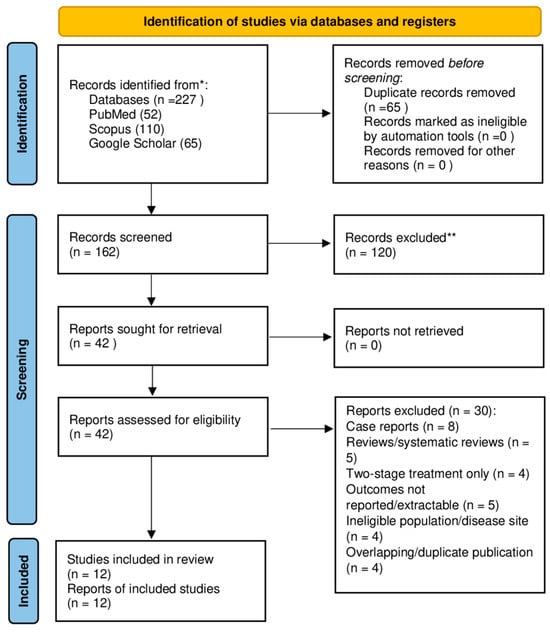
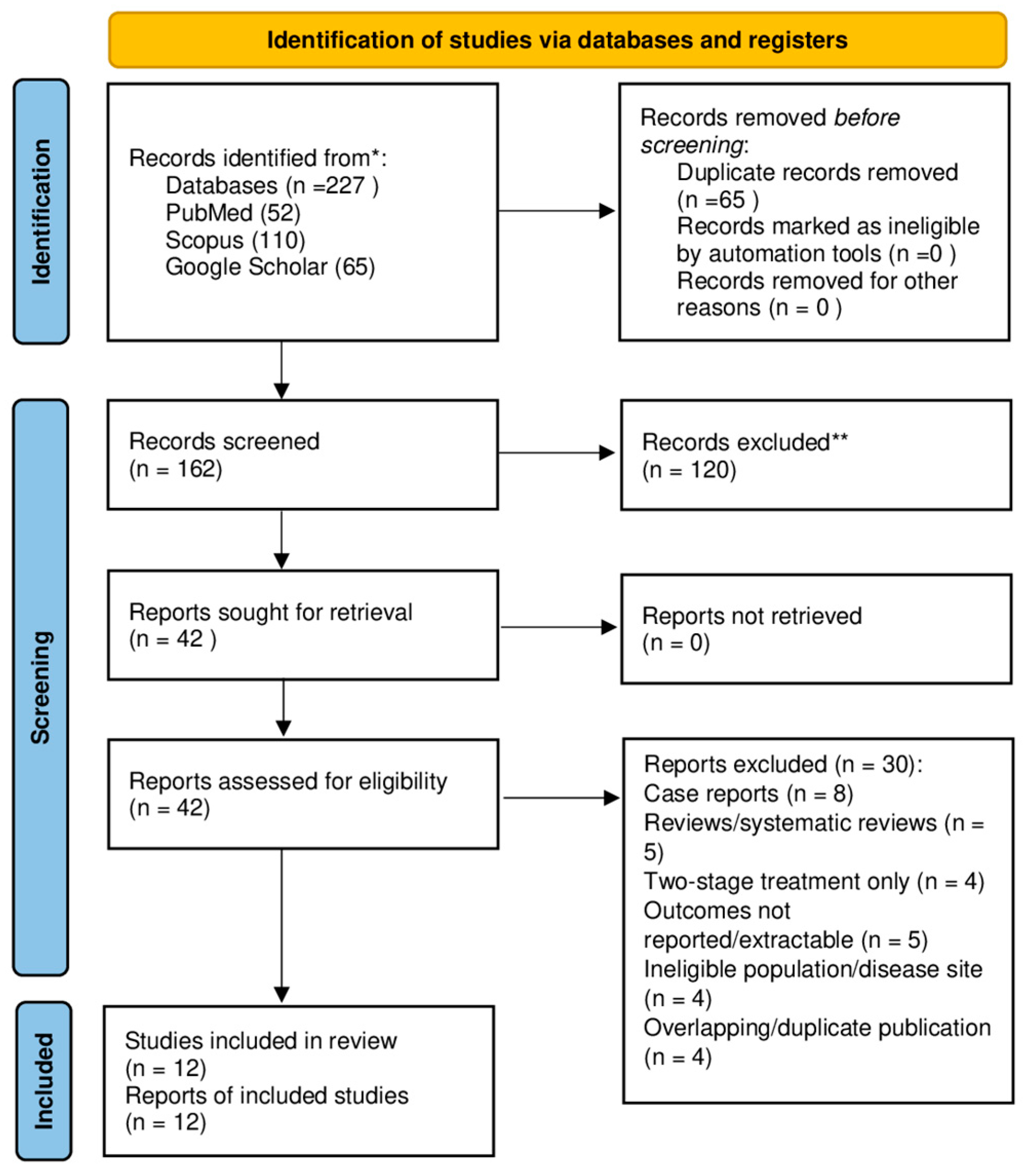
A total of 227 records were identified through database searching, including 52 records from PubMed, 110 from Scopus, and 65 from Google Scholar. After removal of 65 duplicate records, 162 unique records remained and were screened based on titles and abstracts. Following title and abstract screening, 120 records were excluded because they did not meet the predefined eligibility criteria. The remaining 42 full-text articles were retrieved and assessed for eligibility. After full-text assessment, 30 articles were excluded for the following reasons: case reports (n = 8), reviews or systematic reviews/meta-analyses (n = 5), studies evaluating only two-stage surgical treatment (n = 4), outcomes of interest not reported or not separately extractable (n = 5), ineligible population or disease site (n = 4), and overlapping patient populations or duplicate publications (n = 4).
Twelve studies met the eligibility criteria and were included in the qualitative synthesis. Small case series involving fewer than 10 patients that otherwise met the eligibility criteria were retained in the qualitative synthesis but were excluded from quantitative pooling. Depending on outcome availability and the predefined criteria for quantitative analysis, six to eight studies contributed to the individual meta-analyses (Figure 1).
Figure 1.
PRISMA 2020 flow diagram of the study selection process. * Records identified from PubMed, Scopus, and Google Scholar. ** Records excluded after title and abstract screening because they did not meet the predefined eligibility criteria.
3.2. Characteristics of Included Studies
A total of 12 studies met the eligibility criteria and were included in the qualitative synthesis (Table 1). Not all studies reported all predefined outcomes; therefore, the number of studies differed between the individual meta-analyses. These studies were published between 1994 and 2025 and originated from four countries: Turkey, India, Iran, and Morocco, with half of them conducted in Turkey.
Table 1.
Characteristics of the studies included in the systematic review.
All included studies were observational in design, comprising retrospective case series, retrospective observational studies, retrospective comparative studies, and prospective observational or case series. No randomized controlled trials were identified.
The number of eligible patients per study ranged from 5 to 48, with a total of 293 patients undergoing one-stage surgical treatment for concomitant pulmonary and hepatic cystic echinococcosis. Most studies included adult patients, although one study exclusively evaluated a pediatric population, and two others (Aghajanzadeh et al. [8] and Gandhi et al. [9]) included both adult and pediatric patients. The duration of postoperative follow-up ranged from 0.5 months to 15 years, although several studies did not report follow-up duration.
All studies evaluated one-stage surgical management for concomitant pulmonary and hepatic hydatid cysts. The most frequently performed procedures were right posterolateral thoracotomy combined with phrenotomy or transdiaphragmatic access, allowing simultaneous treatment of pulmonary and hepatic cysts through a single incision. Alternative surgical approaches included thoracophrenotomy, transthoracic transdiaphragmatic surgery, combined thoracotomy and laparotomy performed during the same operation, and midsternotomy with transdiaphragmatic or transabdominal hepatic cyst removal.
The primary outcome, postoperative complications, was available for eight studies. However, two studies were excluded from the quantitative synthesis because they enrolled fewer than 10 patients, in accordance with the predefined eligibility criteria. Consequently, six studies were included in the meta-analysis of postoperative complications. The methodological characteristics of the included studies are summarized in Table 1.
3.3. Quality Assessment of Included Studies
The methodological quality of the included studies was assessed according to study design. Non-comparative case series were evaluated using the Joanna Briggs Institute (JBI) Critical Appraisal Checklist for Case Series, whereas the comparative observational studies by Kabiri et al. [10] and Dubus et al. [11] were assessed using the Newcastle–Ottawa Scale (NOS). Overall, the case series generally provided clear descriptions of patient characteristics, diagnostic methods, surgical procedures, and postoperative outcomes. The most frequent methodological limitations were the predominantly retrospective designs, small sample sizes, unclear reporting of consecutive recruitment in several studies, and variable completeness and duration of follow-up. Aydin et al. [12] explicitly reported consecutive patient inclusion, whereas this was unclear in several other case series. In the study by Biswas et al. [13], follow-up was available for 35 of 42 patients.
The two comparative studies received NOS scores of 7/9 for Kabiri et al. [10] and 6/9 for Dubus et al. [11]. The principal limitation of both comparative studies was the absence of adequate adjustment for potential confounding. Detailed study-level assessments are presented in Supplementary Tables S1 and S2.
3.4. Certainty of the Evidence
The certainty of the evidence was assessed using the GRADE approach for the three assessed outcomes: postoperative complications, postoperative mortality, and disease recurrence. Overall, the certainty of the evidence was rated as very low for all outcomes. This rating primarily reflected the predominance of retrospective case series, methodological limitations including unclear consecutive recruitment or incomplete follow-up in several studies, inadequate adjustment for potential confounding in the comparative studies, limited sample sizes, and imprecision of the pooled estimates. Publication bias was not formally assessed because fewer than 10 studies were included in each meta-analysis, as funnel plot asymmetry tests have limited power with small numbers of studies.
3.5. Surgical Characteristics and Postoperative Outcomes
The surgical techniques and postoperative outcomes of the included studies are summarized in Table 2. All studies evaluated one-stage surgical management for concomitant pulmonary and hepatic cystic echinococcosis, although the operative approaches varied according to cyst location, disease extent, and institutional practice.
Table 2.
Surgical approaches and postoperative outcomes of the included studies.
The most frequently employed technique was right posterolateral thoracotomy combined with phrenotomy or a transthoracic transdiaphragmatic approach, which enabled simultaneous treatment of pulmonary and hepatic cysts through a single incision. Alternative procedures included thoracophrenotomy, transdiaphragmatic surgery, combined thoracotomy and laparotomy performed during the same operation, and midsternotomy with transdiaphragmatic or transabdominal liver cyst removal. The duration of postoperative follow-up ranged from 0.5 months to 15 years, although follow-up data were not reported in all studies. Postoperative complications were reported in eight studies; however, only six met the predefined criteria for quantitative synthesis. Recurrence was uncommon and was documented in only three studies. Owing to incomplete subgroup-specific outcome reporting, some studies were excluded from individual quantitative analyses despite meeting the inclusion criteria for the qualitative synthesis.
3.6. Meta-Analysis of Postoperative Complications
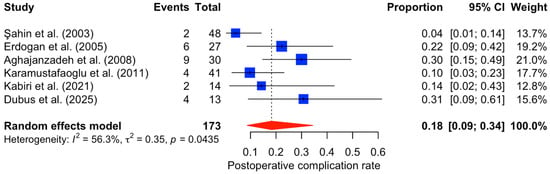
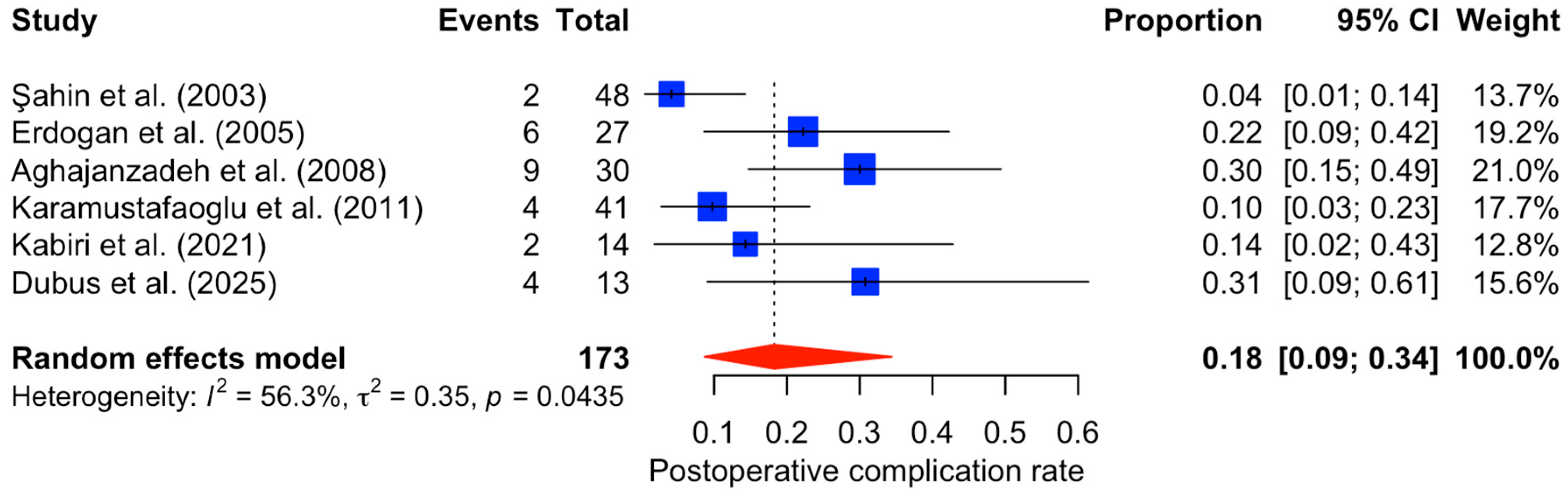
Six studies comprising 173 patients were included in the primary meta-analysis of postoperative complications following one-stage surgical management for concomitant pulmonary and hepatic cystic echinococcosis (Figure 2). The pooled postoperative complication rate was 18.3% (95% CI: 8.7–34.4%). Moderate heterogeneity was observed across the included studies (I2 = 56.3%, τ2 = 0.35, p = 0.0435).
Figure 2.
Forest plot of postoperative complications following one-stage surgical treatment for concomitant pulmonary and hepatic cystic echinococcosis. The pooled postoperative complication rate across six studies comprising 173 patients was 18.3% (95% CI: 8.7–34.4%; I2 = 56.3%). Included studies: Aghajanzadeh et al., 2008 [8]; Şahin et al., 2003 [10]; Erdogan et al., 2005 [11]; Kabiri et al., 2021 [12]; Karamustafaoglu et al., 2011 [13]; Dubus et al., 2025 [17].
3.7. Postoperative Mortality
Eight studies involving 237 patients reported postoperative mortality following one-stage surgical treatment for concomitant pulmonary and hepatic cystic echinococcosis. No postoperative deaths were observed in any of the included cohorts (0/237 patients). Because no mortality events occurred across the included studies, postoperative mortality was summarized descriptively rather than pooled using a random-effects meta-analysis.
3.8. Meta-Analysis of Postoperative Recurrence
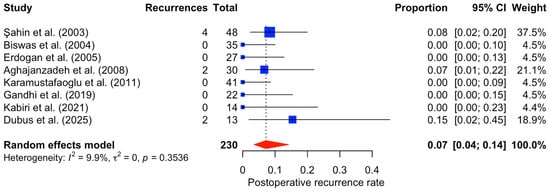
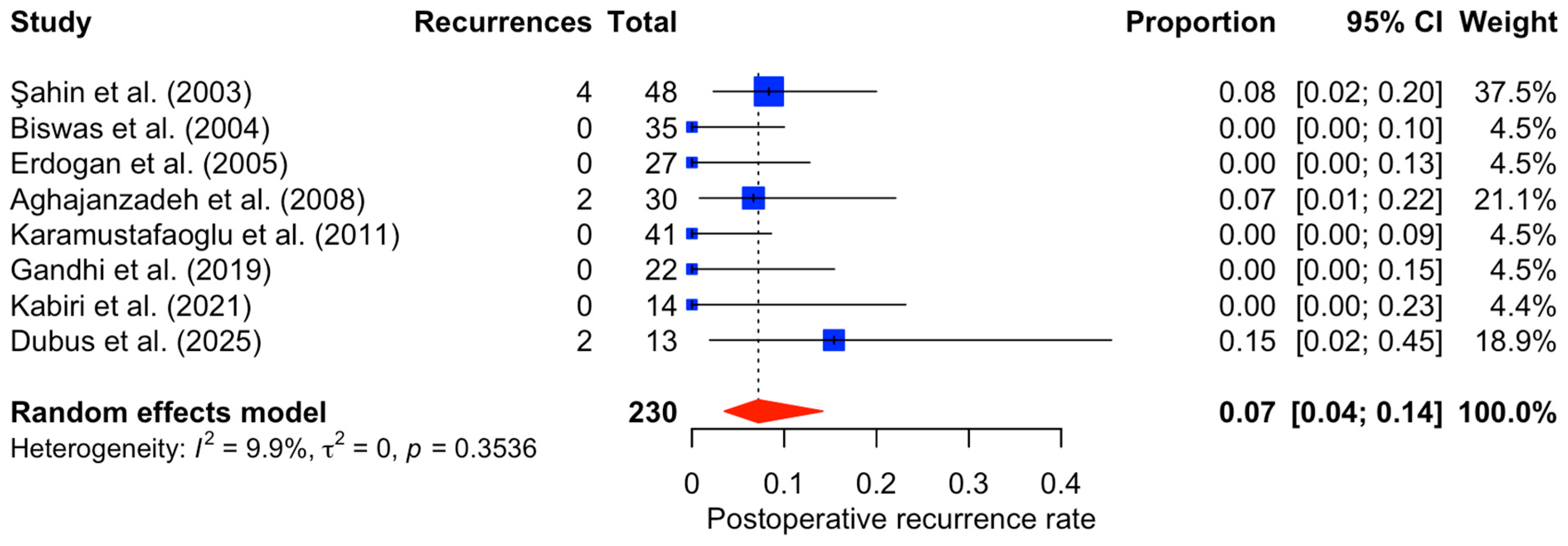
Eight studies involving 230 patients contributed to the meta-analysis of postoperative recurrence after one-stage surgical management for concomitant pulmonary and hepatic cystic echinococcosis (Figure 3). Eight recurrences were reported across the included studies. The pooled recurrence rate was 7.2% (95% CI: 3.5–14.2%). Between-study heterogeneity was low (I2 = 9.9%, τ2 = 0, p = 0.3536).
Figure 3.
Forest plot of postoperative recurrence following one-stage surgical treatment for concomitant pulmonary and hepatic cystic echinococcosis. The pooled recurrence rate across eight studies comprising 230 patients was 7.2% (95% CI: 3.5–14.2%; I2 = 9.9%). Included studies: Aghajanzadeh et al., 2008 [8]; Şahin et al., 2003 [10]; Erdogan et al., 2005 [11]; Kabiri et al., 2021 [12]; Karamustafaoglu et al., 2011 [13]; Gandhi et al., 2019 [15]; Dubus et al., 2025 [17]; Biswas et al., 2004 [18].
4. Discussion
This systematic review and meta-analysis provides, to our knowledge, the first quantitative synthesis of clinical outcomes following one-stage surgical management for concomitant pulmonary and hepatic cystic echinococcosis. Across 12 observational studies comprising 293 eligible patients, one-stage surgery was associated with a pooled postoperative complication rate of 18.3%, no observed postoperative mortality among the 237 patients contributing to the mortality analysis, and a pooled recurrence rate of 7.2%. These findings support the feasibility and potential effectiveness of one-stage surgical treatment in carefully selected patients, while the very low certainty of the available evidence warrants cautious interpretation and highlights the need for higher-quality comparative studies. The pooled postoperative complication rate of 18.3% indicates that morbidity remains clinically relevant following simultaneous pulmonary and hepatic surgery. Previous transthoracic surgical experience has similarly documented postoperative morbidity related particularly to pleural complications and fistula formation, supporting the clinical plausibility of the complications identified across the studies included in our review [20]. It should be noted that this comparative reference is more than two decades old, and advances in perioperative and anesthetic management since that time may limit the direct comparability of historical complication rates with those observed in the more recent studies included in our review.
The moderate between-study heterogeneity (I2 = 56.3%) may reflect differences in patient characteristics, cyst size and anatomical distribution, operative techniques, definitions of postoperative complications, and perioperative management across institutions and study periods. Importantly, most complications reported in the included studies were manageable and did not translate into postoperative mortality.
The absence of observed postoperative deaths among 237 patients represents an important finding. This result is consistent with previous experience with simultaneous surgical treatment of coexisting pulmonary and hepatic hydatid cysts, where favorable perioperative survival has been reported following thoracotomy with transdiaphragmatic treatment of hepatic lesions [4]. Overall, the available evidence suggests that one-stage surgery can be performed with very low perioperative mortality in appropriately selected patients treated in experienced surgical centers.
The pooled recurrence rate of 7.2%, with low between-study heterogeneity (I2 = 9.9%), suggests relatively consistent long-term disease control across the available studies. For comparison, a large single-center series of 405 patients undergoing one-stage removal of coexisting pulmonary and hepatic hydatid cysts reported a considerably lower recurrence rate of 1.5% [4], while a systematic review and meta-analysis comparing laparoscopic and open surgical techniques for isolated hepatic hydatid cyst found no significant difference in recurrence between approaches, with substantial variability across the underlying primary studies [21]. The comparatively higher pooled recurrence rate observed in the present meta-analysis may reflect differences in patient selection and institutional experience, although direct comparison is limited by differences in patient populations, follow-up duration, and recurrence definitions across studies. Whether recurrence after one-stage surgery is more common at the thoracic or abdominal site, and whether this relates to perioperative albendazole use, remains an open question, as neither the location of recurrence nor the consistency of albendazole administration was adequately reported across the included studies (see Section 4.2).
Adjunct medical therapy may represent another determinant of long-term outcomes. Current guidance recommends perioperative benzimidazole therapy as adjuvant treatment for cystic echinococcosis, and evidence from a systematic review and meta-analysis suggests that benzimidazole therapy may improve outcomes when incorporated into multimodal treatment [22]. However, perioperative albendazole use, dosing, and duration were inconsistently and often incompletely reported across the studies included in our review, and this variable could not be systematically extracted for inclusion in Table 1 and Table 2. Consequently, its independent contribution to the pooled recurrence rate observed in this meta-analysis cannot be determined, and the favorable recurrence outcomes reported here should not be attributed to albendazole use without further study specifically designed to evaluate this association.
4.1. Comparison with Previous Literature
Previous surgical experience has demonstrated the feasibility and practical advantages of simultaneous treatment of pulmonary and hepatic hydatid disease, particularly the possibility of treating both anatomical sites during a single operation and avoiding a second surgical procedure [4].
More recent comparative evidence has further examined the relative outcomes of simultaneous and staged treatment. Studies comparing one-stage and two-stage strategies suggest that simultaneous surgery can achieve postoperative outcomes comparable to staged treatment while potentially reducing hospitalization and accelerating recovery [17]. These observations are consistent with the favorable pooled complication and mortality outcomes observed in the present meta-analysis.
The predominance of transthoracic transdiaphragmatic approaches and right thoracotomy with phrenotomy in our included studies reflects the anatomical feasibility of treating right-sided pulmonary cysts and hepatic dome lesions through a single operative field. Previous clinical experience has demonstrated that a single-stage transthoracic approach can provide simultaneous access to right pulmonary and upper hepatic hydatid cysts with favorable postoperative outcomes [10]. The transthoracic strategy therefore remains particularly relevant when hepatic lesions are located in anatomically accessible superior liver segments.
Alternative simultaneous approaches were also represented in the studies included in our review, including combined thoracotomy–laparotomy, thoracophrenotomy, and midsternotomy with transdiaphragmatic or transabdominal hepatic cyst treatment. This variation suggests that the operative approach should be adapted to cyst distribution and anatomical accessibility rather than applying a uniform surgical technique to all patients.
Evidence from hepatic cystic echinococcosis also suggests a growing role for minimally invasive surgery. Systematic reviews comparing laparoscopic and open treatment indicate that minimally invasive approaches may offer perioperative advantages in appropriately selected patients [21]. However, these findings relate predominantly to isolated hepatic disease and cannot be directly extrapolated to concomitant pulmonary and hepatic echinococcosis. Evidence specifically evaluating minimally invasive one-stage treatment of combined pulmonary–hepatic disease remains limited, representing an important area for future investigation.
4.2. Strengths and Limitations
The present study has several strengths. To our knowledge, it is the first systematic review and meta-analysis specifically designed to quantitatively evaluate clinical outcomes following one-stage surgical management of concomitant pulmonary and hepatic cystic echinococcosis. The review was prospectively registered in PROSPERO and conducted according to PRISMA 2020 guidance. Eligibility criteria and outcomes were predefined, and random-effects models with logit transformation, REML estimation of between-study variance, and Hartung–Knapp adjustment were used for quantitative synthesis. The certainty of evidence was additionally evaluated using the GRADE framework.
Several limitations should also be acknowledged. First, all included studies were observational, and most were retrospective case series. No randomized controlled trials were identified, limiting causal inference and preventing robust direct comparison between one-stage and staged strategies. Second, the rarity of concomitant pulmonary and hepatic echinococcosis resulted in relatively small individual study populations. Third, differences in patient selection, cyst characteristics, operative techniques, definitions of complications, postoperative management, use of albendazole, and follow-up duration introduced clinical and methodological heterogeneity.
Fourth, studies involving fewer than 10 patients were retained for qualitative synthesis but excluded from the quantitative analyses according to the predefined eligibility criteria. Although this decision reduced the influence of very small and potentially unstable estimates, it may also have introduced selection effects. In particular, this exclusion may have masked outcomes from lower-volume centers, which could differ systematically from those of the larger case series retained for quantitative synthesis. Fifth, publication bias could not be formally evaluated because fewer than 10 studies contributed to each meta-analysis. Favorable outcomes from experienced specialist centers may therefore be disproportionately represented in the available literature. This concern is particularly relevant to the finding of 0% postoperative mortality across all included studies, which may in part reflect selective reporting or publication of favorable surgical series rather than the true population-level mortality risk. Furthermore, most included studies did not consistently categorize postoperative complications by type (e.g., surgical, infective, or other) or by anatomical site (intrathoracic versus abdominal), which precluded a more detailed stratified analysis that would be of interest to readers and clinicians. Similarly, the anatomical location of disease recurrence (intrathoracic, intra-abdominal, or other) was not consistently reported, limiting our ability to determine whether recurrence occurred preferentially at either surgical site.
Additionally, in two studies (Gandhi et al., 2019; Aydin et al., 2012) [15,16], outcomes were reported for the overall surgical cohort without separating patients with isolated single-organ involvement from those with true concomitant pulmonary–hepatic disease. Consequently, complication data could not be extracted for the concomitant subgroup in either study, and both were excluded from the complication meta-analysis. This lack of subgroup-specific reporting reduced the number of studies and patients contributing to the pooled complication rate and may limit its precision and generalizability specifically to patients with combined pulmonary–hepatic disease.
Finally, the GRADE certainty of evidence was very low for all three assessed outcomes. Consequently, the favorable pooled estimates should not be interpreted as definitive evidence that one-stage surgery is superior to staged treatment.
4.3. Clinical Implications
The present findings suggest that one-stage surgical treatment may represent an appropriate option for carefully selected patients with concomitant pulmonary and hepatic cystic echinococcosis, particularly when right-sided pulmonary cysts coexist with anatomically accessible hepatic dome lesions. Comparative surgical experience with thoracophrenotomy supports simultaneous management as a feasible alternative to staged surgery in appropriately selected patients [12].
Importantly, this approach is anatomically constrained: it is best suited to unilateral, typically right-sided, pulmonary cysts combined with hepatic cysts located in the hepatic dome that are accessible through a single transthoracic–transdiaphragmatic operative field. It is not indicated for bilateral pulmonary involvement or for hepatic cysts located in inferior or posterior liver segments requiring a formal laparotomy for safe and complete resection; such presentations should continue to be managed with staged or organ-specific surgical strategies.
The absence of observed postoperative mortality, together with an acceptable pooled complication rate and relatively low recurrence rate, supports consideration of one-stage surgery when pulmonary and hepatic lesions can be safely managed during the same operative session. However, these findings should not be interpreted as supporting one-stage surgery for all patients with concomitant disease.
Patient selection remains critical. The choice between simultaneous and staged treatment should be individualized according to pulmonary and hepatic cyst distribution, anatomical accessibility, disease complexity, the need for additional abdominal exposure, the patient’s general condition and operative risk, and the expertise of the treating center. A multidisciplinary approach involving thoracic, hepatobiliary, anesthesia, infectious disease, and radiological expertise may be particularly valuable in complex cases.
4.4. Directions for Future Research
The limited availability of high-quality comparative evidence has long been recognized as a major challenge in the management of complicated cystic echinococcosis.
Future studies with a larger cumulative number of cases may also allow stratified analysis of outcomes by publication era, given the potential impact of evolving surgical and perioperative practices over time. Future research should therefore prioritize prospective multicenter cohort studies and, where feasible, comparative trials evaluating one-stage versus staged surgical management. Standardized definitions of postoperative complications, mortality, recurrence, and reintervention should be adopted to improve comparability across studies. Long-term follow-up is particularly important because recurrence may occur years after initial treatment.
Future studies should also systematically document cyst characteristics, surgical radicality, operative access, perioperative albendazole use, duration of hospitalization, return to normal activity, healthcare costs, and patient-reported quality-of-life outcomes. Stratification according to pulmonary laterality, hepatic cyst location, and open versus minimally invasive approaches may help identify the patients most likely to benefit from simultaneous treatment. Individual-patient-data meta-analysis may ultimately allow development of more precise risk-stratification models for surgical decision-making.
5. Conclusions
One-stage surgical management of concomitant pulmonary and hepatic cystic echinococcosis was associated with an acceptable postoperative complication rate, no observed postoperative mortality, and a relatively low recurrence rate in the available observational literature. Although these findings support consideration of one-stage surgery in appropriately selected patients treated at experienced centers, they should not be interpreted as establishing the superiority of one-stage surgery over staged treatment, given the very low certainty of the currently available evidence.
Higher-quality prospective comparative studies are required to determine whether one-stage surgery provides clinically meaningful advantages over staged treatment and to define optimal patient selection, operative approach, and adjunct medical therapy.
Supplementary Materials
The following supporting information can be downloaded at: https://www.mdpi.com/article/10.3390/healthcare14223943/s1, Table S1: JBI Critical Appraisal Checklist for Case Series; Table S2: Newcastle–Ottawa Scale Assessment of Comparative Studies; File S1: PRISMA 2020 Checklist.
Author Contributions
Conceptualization, T.Y., B.A. and I.K.T.; methodology, T.Y., B.A., L.N. and N.A.; software, L.N.; validation, T.Y., B.A., M.S. and L.N.; formal analysis, L.N. and B.A.; investigation, T.Y., B.A., M.S., T.B. and N.N.; data curation, B.A., L.N. and N.N.; writing—original draft preparation, T.Y., B.A. and M.S.; writing—review and editing, T.B., I.K.T., L.N., N.N. and N.A.; visualization, B.A. and L.N.; supervision, I.K.T. and N.A.; project administration, T.Y. and I.K.T. All authors have read and agreed to the published version of the manuscript.
Funding
This research received no external funding.
Institutional Review Board Statement
Not applicable.
Informed Consent Statement
Not applicable.
Data Availability Statement
All data analyzed in this study are available in the included published studies and the Supplementary Materials.
Conflicts of Interest
The authors declare no conflicts of interest.
References
- Brunetti, E.; Kern, P.; Vuitton, D.A. Expert Consensus for the Diagnosis and Treatment of Cystic and Alveolar Echinococcosis in Humans. Acta Trop. 2010, 114, 1–16. [Google Scholar] [CrossRef] [Scilit] [PubMed]
- Craig, P.S.; McManus, D.P.; Lightowlers, M.W.; Chabalgoity, J.A. Prevention and Control of Cystic Echinococcosis. Lancet Infect. Dis. 2007, 7, 385–394. [Google Scholar] [CrossRef] [Scilit] [PubMed]
- Echinococcosis. Available online: https://www.who.int/news-room/fact-sheets/detail/echinococcosis (accessed on 18 August 2026).
- Kurul, İ.C.; Topcu, S.; Altinok, T.; Yazici, U.; Tastepe, I.; Kaya, S.; Cetin, G. One-Stage Operation for Hydatid Disease of Lung and Liver: Principles of Treatment. J. Thorac. Cardiovasc. Surg. 2002, 124, 1212–1215. [Google Scholar] [CrossRef] [Scilit] [PubMed]
- Taş, O.; Eryazğan, M.A. Predictors of Concomitant Pulmonary Involvement in Hepatic Cystic Echinococcosis: A Clinical Risk Stratification Model. Acta Parasitol. 2026, 71, 98. [Google Scholar] [CrossRef] [Scilit] [PubMed]
- Akimniyazova, B.; Yeshmuratov, T.; Medetbekov, T.; Serikbayeva, A.; Akhmad, N.; Dyussembayeva, A.; Kenbayeva, S.; Aitambayeva, N.; Nurakysh, S.; Tazhiyeva, A. Trends and Regional Disparities in the Treatment of Echinococcosis in Kazakhstan: A Nationwide Retrospective Study (2017–2024). Healthcare 2026, 14, 1304. [Google Scholar] [CrossRef] [Scilit] [PubMed]
- Page, M.J.; McKenzie, J.E.; Bossuyt, P.M.; Boutron, I.; Hoffmann, T.C.; Mulrow, C.D.; Shamseer, L.; Tetzlaff, J.M.; Akl, E.A.; Brennan, S.E.; et al. The PRISMA 2020 statement: An updated guideline for reporting systematic reviews. BMJ 2021, 372, n71. [Google Scholar] [CrossRef] [Scilit] [PubMed]
- Aghajanzadeh, M.; Safarpoor, F.; Amani, H.; Alavi, A. One-Stage Procedure for Lung and Liver Hydatid Cysts. Asian Cardiovasc. Thorac. Ann. 2008, 16, 392–395. [Google Scholar] [CrossRef] [Scilit] [PubMed]
- Gandhi, S.; Das, B.; Basu, R.; Dey, S. Single-Centre Experience in Treatment of Multiple-Site Hydatid Disease in a Tertiary Care Centre of Eastern India. Indian J. Thorac. Cardiovasc. Surg. 2019, 35, 461–467. [Google Scholar] [CrossRef] [Scilit] [PubMed]
- Kabiri, E.H.; El Hammoumi, M.; Bhairis, M. Single-Stage versus Two-Stage Surgery of Pulmonary and Hepatic Hydatid Cysts. Kardiochirurgia Torakochirurgia Pol. (Pol. J. Thorac. Cardiovasc. Surg.) 2021, 18, 139–144. [Google Scholar] [CrossRef] [Scilit] [PubMed]
- Dubus, T.; Cangel, G.; Büyükasik, K.; Rakici, I.; Ari, A. A Surgical Priority for Echinococcal Cysts in the Lung and Liver: One or Two-Stage? Ann. Ital. Chir. 2025, 96, 168–178. [Google Scholar] [CrossRef] [Scilit] [PubMed]
- Aydin, Y.; Çelik, M.; Ulaş, A.; Eroğlu, A. Transdiaphragmatic Approach to Liver and Lung Hydatid Cysts. Turk. J. Med. Sci. 2012, 42, 1388–1393. [Google Scholar] [CrossRef] [Scilit]
- Biswas, B.; Ghosh, D.; Bhattacharjee, R.; Patra, A.; Basuthakur, S.; Basu, R. One Stage Surgical Management of Hydatid Cyst of Lung & Liver—By Right Thoracotomy & Phrenotomy. Indian J. Thorac. Cardiovasc. Surg. 2004, 20, 88–90. [Google Scholar] [CrossRef] [Scilit]
- Dhaliwal, R.S.; Kalkat, M.S. One-Stage Surgical Procedure for Bilateral Lung and Liver Hydatid Cysts. Ann. Thorac. Surg. 1997, 64, 338–341. [Google Scholar] [CrossRef] [Scilit] [PubMed]
- Şahin, E.; Enön, S.; Cangır, A.K.; Kutlay, H.; Kavukçu, Ş.; Akay, H.; Ökten, İ.; Yavuzer, Ş. Single-Stage Transthoracic Approach for Right Lung and Liver Hydatid Disease. J. Thorac. Cardiovasc. Surg. 2003, 126, 769–773. [Google Scholar] [CrossRef] [Scilit] [PubMed]
- Erdogan, A.; Ayten, A.; Kabukcu, H.; Demircan, A. One-Stage Transthoracic Operation for the Treatment of Right Lung and Liver Hydatid Cysts. World J. Surg. 2005, 29, 1680–1686. [Google Scholar] [CrossRef] [Scilit] [PubMed]
- Karamustafaoglu, Y.A.; Reyhan, G.; Kuzucuoglu, M.; Yoruk, Y. One-Stage Surgical Management for Lung and Liver Hydatid Diseases. Eur. Surg. 2011, 43, 233–235. [Google Scholar] [CrossRef] [Scilit]
- Dalal, U.; Dalal, A.K.; Singal, R. Concomitant Lung and Liver Hydatid Cyst Managed as One-Stage Surgery. Maedica (Bucur) 2017, 12, 19–22. [Google Scholar] [PubMed]
- Özçelik, C.; İnci, İ.; Toprak, M.; Eren, N.; Özgen, G.; Yaşar, T. Surgical Treatment of Pulmonary Hydatidosis in Children: Experience in 92 Patients. J. Pediatr. Surg. 1994, 29, 392–395. [Google Scholar] [CrossRef] [Scilit] [PubMed]
- Athanassiadi, K.; Kalavrouziotis, G.; Loutsidis, A.; Bellenis, I.; Exarchos, N. Surgical Treatment of Echinococcosis by a Transthoracic Approach: A Review of 85 Cases. Eur. J. Cardio-Thorac. Surg. 1998, 14, 134–140. [Google Scholar] [CrossRef] [Scilit] [PubMed]
- Sokouti, M.; Sadeghi, R.; Pashazadeh, S.; Abadi, S.E.H.; Sokouti, M.; Rezaei-hachesu, P.; Ghojazadeh, M.; Sokouti, B. A Systematic Review and Meta-Analysis on the Treatment of Liver Hydatid Cyst: Comparing Laparoscopic and Open Surgeries. Arab J. Gastroenterol. 2017, 18, 127–135. [Google Scholar] [CrossRef] [Scilit] [PubMed]
- Velasco-Tirado, V.; Alonso-Sardón, M.; Lopez-Bernus, A.; Romero-Alegría, Á.; Burguillo, F.J.; Muro, A.; Carpio-Pérez, A.; Muñoz Bellido, J.L.; Pardo-Lledias, J.; Cordero, M.; et al. Medical Treatment of Cystic Echinococcosis: Systematic Review and Meta-Analysis. BMC Infect. Dis. 2018, 18, 306. [Google Scholar] [CrossRef] [Scilit] [PubMed]

Disclaimer/Publisher’s Note: The statements, opinions and data contained in all publications are solely those of the individual author(s) and contributor(s) and not of MDPI and/or the editor(s). MDPI and/or the editor(s) disclaim responsibility for any injury to people or property resulting from any ideas, methods, instructions or products referred to in the content. |
© 2026 by the authors. Licensee MDPI, Basel, Switzerland. This article is an open access article distributed under the terms and conditions of the Creative Commons Attribution (CC BY) license.