


Abstract
Background/Objectives: Routine episiotomy is no longer supported by evidence, yet episiotomy rates vary widely between maternity settings. This study aimed to determine the incidence of episiotomy and spontaneous perineal tears following vaginal birth in a tertiary maternity hospital in the Azores, Portugal, and to identify factors associated with episiotomy. Methods: This retrospective cohort study included 277 records of women aged 18 years or over with a term, singleton, cephalic vaginal birth between November 2023 and April 2024. The primary outcome was episiotomy; spontaneous tears were described but not modelled, because their degree was not documented. Associated factors were examined using multivariable logistic regression, with a sensitivity analysis restricted to spontaneous births. Results: Episiotomy was performed in 129 women (46.6%): 34.8% of spontaneous and 75.9% of instrumental births, and 68.7% of primiparous and 26.7% of multiparous women. A spontaneous tear occurred in 79 women (28.5%), and 80 (28.9%) had an intact perineum. Primiparity (aOR 4.634, 95% CI 2.665–8.056) and instrumental birth (aOR 4.418, 95% CI 1.941–10.053) were independently associated with episiotomy, whereas maternal age >35 years (aOR 0.824, 95% CI 0.396–1.715) and obstetrician-attended birth (aOR 0.984, 95% CI 0.482–2.007) were not. Results were consistent in the 198 spontaneous births (primiparity aOR 5.228, 95% CI 2.738–9.981). Conclusions: Episiotomy was performed in almost half of vaginal births and was concentrated in primiparous women and instrumental births, independently of the birth attendant. These single-centre findings support audit of episiotomy practice and standardised documentation of perineal outcomes and require confirmation in prospective multicentre studies.
1. Introduction
Perineal trauma is one of the most common maternal complications associated with vaginal birth and remains a significant public health concern because of its potential impact on women’s short- and long-term health [1].
Perineal injury encompasses a spectrum of conditions ranging from minor spontaneous tears to obstetric anal sphincter injuries (OASIS), as well as episiotomy, a surgical incision of the perineum performed by the birth attendant. Although most women experience minor perineal trauma with favourable healing, more severe injuries, particularly third- and fourth-degree tears involving the anal sphincter complex, are associated with substantial maternal morbidity, including chronic perineal pain, anal incontinence, dyspareunia, pelvic floor dysfunction and impaired quality of life. Consequently, preserving perineal integrity has become a major objective of contemporary intrapartum care [2,3].
Unlike spontaneous tears, which are physiological events that are often unavoidable, episiotomy results from a clinical decision, and its use has changed substantially over recent decades [4]. Current evidence demonstrates that routine episiotomy does not improve maternal or neonatal outcomes and may increase postpartum pain, delayed wound healing and other complications. Accordingly, the World Health Organization (WHO) and other international professional bodies recommend a restrictive approach, reserving episiotomy for clearly defined clinical indications rather than routine practice [5]. The WHO recommendation against routine or liberal use of episiotomy in spontaneous vaginal birth (p. 150) was revalidated in 2025 in the consolidated guidelines on postpartum haemorrhage, co-published with the International Federation of Gynecology and Obstetrics and the International Confederation of Midwives (p. 19) [6]. Nevertheless, episiotomy rates vary considerably across countries and maternity settings, reflecting differences in models of care, professional training and intrapartum practices [7,8]. Portugal has historically reported high episiotomy rates compared with other European countries, although recent evidence suggests a gradual decline following national recommendations promoting restrictive use [9,10].
The decision to perform an episiotomy is influenced by maternal, foetal and intrapartum characteristics. Primiparity, operative vaginal birth, suspected foetal compromise, foetal macrosomia and a prolonged second stage of labour are among the factors most consistently associated with its use, and several of these are also risk factors for spontaneous perineal injury [11,12]. The relative contribution of these factors may differ according to local models of maternity care, clinical protocols and the professional group attending the birth. Understanding these associations within specific healthcare settings is essential to inform preventive strategies, support evidence-based clinical decision-making and improve the quality of maternity care [13]. Strategies such as promotion of physiological birth, maternal mobility, upright birth positions, warm compresses, hands-on perineal support and restrictive episiotomy use may contribute to improved perineal outcomes and reduction in unnecessary intervention during labour and birth [14].
Despite the clinical importance of episiotomy and perineal trauma, evidence from Portugal remains limited, particularly within the Autonomous Region of the Azores. Regional epidemiological data are needed to evaluate current obstetric practice, describe the distribution of perineal outcomes and support quality improvement initiatives aimed at promoting safe, evidence-based and woman-centred intrapartum care. Documenting local patterns of episiotomy use may help maternity services evaluate adherence to contemporary international recommendations advocating restrictive use of this intervention.
The present study therefore aimed to determine the incidence of episiotomy and of spontaneous perineal tears following vaginal birth in a tertiary maternity hospital in the Autonomous Region of the Azores, Portugal, to describe the characteristics of episiotomy use according to mode of birth, parity and birth attendant, and to identify maternal, foetal and obstetric factors independently associated with episiotomy. The findings are intended to contribute to the understanding of perineal outcomes in Portuguese maternity care and to support the development of strategies aimed at preserving perineal integrity and reducing avoidable intervention.
2. Methods
2.1. Study Design and Setting
A retrospective cohort study was conducted at the maternity unit of the Hospital do Divino Espírito Santo (HDES), a tertiary referral hospital located in the Autonomous Region of the Azores, Portugal. The study included the records of all eligible women who underwent vaginal birth between 1 November 2023 and 30 April 2024. The study was designed and reported in accordance with the Strengthening the Reporting of Observational Studies in Epidemiology (STROBE) guidelines [15]. This study was authorised by the Ethics Committee of the Hospital do Divino Espírito Santo of Ponta Delgada under protocol no. S-HDES/2024/719, approved on 21 November 2024and by the University of the Azores Ethics Committee under protocol no. UAC/2024/26690, approved on 18 December 2024.
2.2. Study Sample
The study included records of women aged 18 years and over who experienced a vaginal birth of a live, singleton foetus at term (37 to 41 completed weeks of gestation) in cephalic presentation. Foetal presentation was not available as a separate variable in our dataset, so we cannot report a number for this criterion. At our hospital, however, pregnancies with a non-cephalic presentation are referred for elective caesarean birth and are therefore included among the caesarean births. Records relating to caesarean births, women aged under 18 years, stillbirths, preterm births, multiple pregnancies, or non-cephalic presentations and records with incomplete data for the study variables were excluded.
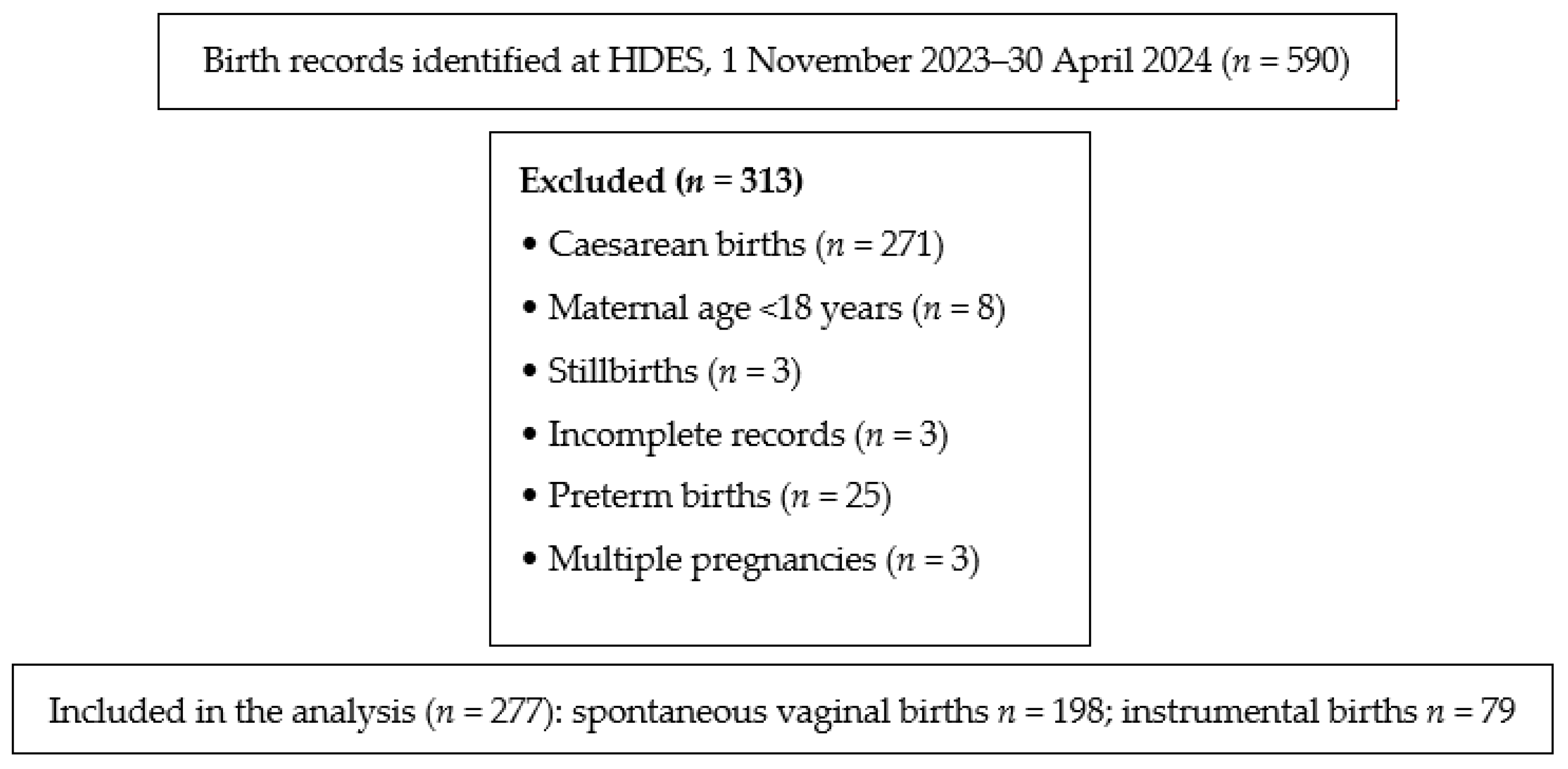
During the study period, 590 birth records were identified. The following were excluded: 271 caesarean births, 8 births to women aged under 18 years, 3 stillbirths, 25 preterm births, 3 multiple pregnancies and 3 records with incomplete data. The 25 preterm births and 3 multiple pregnancies did not meet the stated eligibility criteria but had been retained in the dataset analysed in the original version of this manuscript (n = 305); they were identified and removed on re-examination of the dataset during peer review, and all analyses reported here refer to the resulting cohort of 277 births. The final analysis included 277 term singleton vaginal births, comprising 198 spontaneous vaginal births and 79 instrumental births.
The flowchart of the study sample selection process is presented in Figure 1.
Figure 1.
Flowchart of the study sample selection process, prepared in accordance with STROBE recommendations [15].
2.3. Data Collection and Variable Definitions
Data were retrospectively extracted from the hospital’s electronic medical records using a structured data collection form. The variables collected comprised maternal age, parity, antenatal care, presence of a birth plan, induction of labour, epidural analgesia, gestational age, foetal birthweight, mode of vaginal birth, healthcare professional attending the birth, episiotomy and spontaneous perineal tear.
Maternal age was recorded in completed years and analysed both as a continuous variable and as a dichotomous variable (18–35 years versus >35 years). The 35-year threshold was prespecified because it corresponds to the conventional definition of advanced maternal age used in obstetric practice and in previous studies of perineal trauma [16]; women aged 18–35 years formed the reference category. For descriptive purposes, age was also grouped into four categories (<20, 20–29, 30–39 and ≥40 years).
Parity was classified as primiparous (women giving birth for the first time) or multiparous (one or more previous births), according to the obstetric index recorded in the clinical record.
Gestational age was recorded in completed weeks. Foetal birthweight was recorded in grams, and foetal macrosomia was defined as a birthweight of 4000 g or more.
Induction of labour was defined as admission for induction, as opposed to spontaneous onset of labour. Mode of vaginal birth was classified as spontaneous or instrumental. Instrumental birth included vacuum extraction, forceps and the sequential use of both instruments.
The birth attendant was classified as a midwife or obstetrician according to the professional who conducted the birth. In the study unit, all instrumental births are performed by obstetricians, who also attend spontaneous births when clinical circumstances require medical involvement; consequently, all 79 instrumental births in the cohort were obstetrician-attended, whereas obstetricians attended 51 of the 198 spontaneous births (25.8%). Birth attendant was therefore interpreted as a marker of case complexity rather than as a characteristic of professional practice.
Episiotomy was recorded as performed or not performed. Two main types of episiotomy are described in the literature: the midline incision, which runs vertically from the posterior fourchette towards the anus, and the mediolateral incision, which extends laterally from the fourchette at an angle of 60° from the midline at crowning. The Royal College of Obstetricians and Gynaecologists (RCOG) recommends the mediolateral technique, as midline incisions are associated with a higher risk of OASIS [17]. Neither the type and angle of the incision nor the clinical indication for episiotomy is recorded in a structured field of the electronic record, and these characteristics could therefore not be analysed.
Spontaneous perineal tear was recorded as present or absent. The electronic medical records did not routinely document the degree of spontaneous perineal tears (first, second, third or fourth degree) or the occurrence of OASIS. The duration of the second stage of labour, maternal position during the expulsive period, foetal head circumference and perineal protection techniques were also prespecified variables; however, these data were not available in the medical records.
2.4. Outcome Definitions
The study was originally designed around a composite primary outcome of perineal trauma, defined as episiotomy, spontaneous perineal tear or both, and this composite outcome was analysed in the manuscript as first submitted. During peer review, the primary outcome was redefined as episiotomy, because the degree of spontaneous tears was not documented in the clinical records and because episiotomy and spontaneous tears are distinct clinical events with different determinants. The primary outcome reported here is therefore episiotomy, defined as the performance of a surgical incision of the perineum during vaginal birth, irrespective of whether a spontaneous tear also occurred. Episiotomy is a clinician-performed intervention with a recognised evidence base for restrictive use, so that its frequency and determinants are directly relevant to clinical practice and quality improvement. This change in the analytical approach was made after data collection and should be taken into account when interpreting the findings.
Spontaneous perineal tear (present or absent) was a secondary, descriptive outcome. Because the degree of spontaneous tears was not documented, the clinical significance of a recorded tear ranges from minor first-degree lacerations to OASIS; spontaneous tears were therefore described but not subjected to multivariable analysis. For descriptive purposes, perineal outcomes were also classified into four mutually exclusive categories: intact perineum; episiotomy only; spontaneous tear only; and combined episiotomy and spontaneous tear.
2.5. Statistical Analysis
Statistical analyses were performed using JASP software (version 0.18.3). Continuous variables were assessed for normality using the Shapiro–Wilk test and are presented as mean ± standard deviation and median with interquartile range (IQR). Categorical variables are presented as frequencies and percentages.
Associations between maternal, foetal and obstetric characteristics and episiotomy were explored using bivariate analyses. Student’s t-test or the Mann–Whitney U test was applied for continuous variables, and Pearson’s chi-square test or Fisher’s exact test (when any expected cell count was below five) for categorical variables. Unadjusted odds ratios (ORs) with 95% confidence intervals (CIs) were calculated for dichotomous exposures; percentages in the bivariate table are the proportion of women with episiotomy within each exposure category. The same bivariate comparisons were performed for spontaneous perineal tear and are reported descriptively in Supplementary Table S6; no multivariable model was fitted for this outcome.
A multivariable binary logistic regression model was fitted to identify factors independently associated with episiotomy. Candidate variables, identified a priori from the literature, were maternal age, parity, induction of labour, epidural analgesia, instrumental birth, birth attendant and foetal macrosomia. Foetal macrosomia (n = 6) was not included because the small number of events precluded stable estimation. Induction of labour and epidural analgesia were not associated with episiotomy in bivariate analyses (p = 0.166 and p = 0.384, respectively) and, when forced into the model, yielded adjusted odds ratios close to unity and changed the estimates of the remaining covariates by less than 5%; they were therefore not retained in the final model, which is reported with these two variables included in Supplementary Table S3. The final model included maternal age (>35 versus 18–35 years), parity (primiparous versus multiparous), instrumental birth (yes versus no) and birth attendant (obstetrician versus midwife). The number of candidate variables was considered in relation to the number of outcome events: with four covariates and 129 episiotomies (the smaller outcome group), the final model had 32 events per variable, above the conventional minimum of 10 [18].
Because all instrumental births were attended by obstetricians, the adjusted estimate for birth attendant in the full cohort is informed only by spontaneous births. A sensitivity analysis therefore repeated the model in the subgroup of spontaneous vaginal births (n = 198), with maternal age, parity and birth attendant as covariates (23 events per variable). Additional sensitivity analyses replaced the dichotomised maternal age with age as a continuous variable and added birthweight as a continuous variable (Supplementary Table S4).
The model was specified as an explanatory model to estimate adjusted associations, not as a prediction tool. Model fit was summarised by the likelihood ratio chi-square test and Nagelkerke R2, and discrimination by the area under the receiver operating characteristic curve (AUC), reported only to characterise the model. Multicollinearity was assessed using tolerance values and variance inflation factors (VIFs). Adjusted odds ratios (aORs) with 95% CIs are reported to three decimal places. A two-sided p-value < 0.05 was considered statistically significant.
3. Results
3.1. Demographic, Obstetric and Intrapartum Characteristics
A total of 277 women who experienced vaginal birth were included in the analysis. Maternal age ranged from 18 to 45 years, with a mean of 29.64 ± 6.00 years and a median of 30 years (IQR 25–34); 51 women (18.4%) were older than 35 years. The largest age groups were 30–39 years (46.6%) and 20–29 years (44.4%), while 4.7% of women were younger than 20 years and 4.3% were aged 40 years or older. Of the 277 women, 131 (47.3%) were primiparous and 146 (52.7%) were multiparous. Almost all women had received antenatal care (99.6%) and a birth plan was documented in 12 cases (4.3%). Labour was induced in 123 women (44.4%) and epidural analgesia was used in 251 (90.6%).
Mean gestational age at birth was 39.13 ± 1.06 weeks (median 39 weeks, IQR 39–40; range 37–41). Mean birthweight was 3250.96 ± 403.01 g (median 3275 g, IQR 2980–3535; range 2160–4200 g); 6 infants (2.2%) weighed 4000 g or more and 13 (4.7%) weighed less than 2500 g. Regarding mode of vaginal birth, 198 women (71.5%) had a spontaneous vaginal birth and 79 (28.5%) an instrumental birth (vacuum extraction n = 74, forceps n = 1, sequential vacuum and forceps n = 4). The birth attendant was a midwife in 147 cases (53.1%) and an obstetrician in 130 cases (46.9%). All 79 instrumental births were attended by an obstetrician; among the 198 spontaneous births, 147 (74.2%) were attended by a midwife and 51 (25.8%) by an obstetrician. The characteristics of the study population are summarised in Table 1.
Table 1.
Demographic, obstetric and intrapartum characteristics of the study sample (n = 277).
3.2. Perineal Outcomes and Characteristics of Episiotomy Use
Of the 277 women, 80 (28.9%) maintained an intact perineum, 118 (42.6%) underwent episiotomy only, 68 (24.5%) sustained a spontaneous perineal tear only and 11 (4.0%) experienced both episiotomy and a spontaneous tear (Table 2). The overall episiotomy rate was therefore 46.6% (129/277) and the overall rate of spontaneous perineal tear was 28.5% (79/277). Among the 129 women who underwent episiotomy, 11 (8.5%) also sustained a spontaneous tear. Among the 148 women without episiotomy, 80 (54.1%) had an intact perineum and 68 (45.9%) sustained a spontaneous tear.
Table 2.
Distribution of perineal outcomes following vaginal birth, overall and by mode of birth and parity (n = 277).
Episiotomy use differed markedly according to mode of birth, parity and birth attendant. Episiotomy was performed in 34.8% (69/198) of spontaneous vaginal births and in 75.9% (60/79) of instrumental births, including 74.3% (55/74) of vacuum extractions and all five births involving forceps. Episiotomy was performed in 68.7% (90/131) of primiparous and 26.7% (39/146) of multiparous women; this difference was present in both spontaneous births (58.7% [44/75] vs. 20.3% [25/123]) and instrumental births (82.1% [46/56] vs. 60.9% [14/23]). Episiotomy was performed in 34.0% (50/147) of midwife-attended and 60.8% (79/130) of obstetrician-attended births; however, when the comparison was restricted to spontaneous births, the rates were similar (34.0% [50/147] vs. 37.3% [19/51]), indicating that the difference between professional groups was accounted for by instrumental births.
Spontaneous perineal tears, described without reference to their degree, occurred in 29.3% (58/198) of spontaneous and 26.6% (21/79) of instrumental births, in 22.9% (30/131) of primiparous and 33.6% (49/146) of multiparous women, and in 25.2% (37/147) of midwife-attended and 32.3% (42/130) of obstetrician-attended births. An intact perineum was recorded in 15.3% (20/131) of primiparous and 41.1% (60/146) of multiparous women, and in 38.4% (76/198) of spontaneous compared with 5.1% (4/79) of instrumental births. The unadjusted associations between maternal, foetal and obstetric characteristics and spontaneous perineal tear are presented in Supplementary Table S6. Spontaneous tears were not associated with mode of birth, birth attendant, induction of labour, epidural analgesia or maternal age >35 years. They tended to be more frequent among multiparous than primiparous women (33.6% vs. 22.9%; OR = 0.588 for primiparity, 95% CI 0.345–1.002; p = 0.050) and occurred in four of the six macrosomic infants (Fisher’s exact test, p = 0.057), and mean birthweight was higher among women who sustained a spontaneous tear than among those who did not (3341.8 ± 379.4 g vs. 3214.7 ± 407.3 g; p = 0.018).
3.3. Factors Associated with Episiotomy: Bivariate Analyses
The bivariate analyses are presented in Table 3; percentages denote the proportion of women who underwent episiotomy within each exposure category. Episiotomy was strongly associated with primiparity (68.7% vs. 26.7% in multiparous women; χ2 = 48.926, p < 0.001; OR = 6.023, 95% CI 3.579–10.134), instrumental birth (75.9% vs. 34.8% in spontaneous births; χ2 = 38.337, p < 0.001; OR = 5.904, 95% CI 3.263–10.683) and obstetrician-attended birth (60.8% vs. 34.0% in midwife-attended births; χ2 = 19.848, p < 0.001; OR = 3.005, 95% CI 1.840–4.907). Episiotomy was less frequent among women aged >35 years than among those aged 18–35 years (39.2% vs. 48.2%), but the difference was not statistically significant (χ2 = 1.359, p = 0.244; OR = 0.693, 95% CI 0.373–1.287). No statistically significant associations were observed with the presence of a birth plan, induction of labour, epidural analgesia or foetal macrosomia (2 of 6 macrosomic infants; Fisher’s exact test, p = 0.689).
Table 3.
Bivariate associations between maternal, foetal and obstetric characteristics and episiotomy (n = 277).
When maternal age was analysed as a continuous variable, mean age did not differ between women with and without episiotomy (29.1 ± 6.0 vs. 30.1 ± 6.0 years; p = 0.166). Across the four age groups, episiotomy was performed in 53.8% (7/13) of women aged <20 years, 48.8% (60/123) of those aged 20–29 years, 45.0% (58/129) of those aged 30–39 years and 33.3% (4/12) of those aged ≥40 years (χ2 = 1.497, df = 3, p = 0.683; Supplementary Table S5). Neither gestational age (39.1 ± 1.0 vs. 39.1 ± 1.1 weeks; p = 0.889) nor birthweight (3233 ± 377 vs. 3266 ± 425 g; p = 0.497) differed between women with and without episiotomy.
3.4. Factors Independently Associated with Episiotomy
Table 4 presents the multivariable logistic regression model for episiotomy in the full cohort and the sensitivity analysis restricted to spontaneous vaginal births. The full statistical output of both models is provided in Supplementary Table S1.
Table 4.
Multivariable logistic regression models of factors associated with episiotomy in the full cohort (n = 277) and in the sensitivity analysis restricted to spontaneous vaginal births (n = 198).
In the full cohort, primiparity (aOR = 4.634, 95% CI 2.665–8.056, p < 0.001) and instrumental birth (aOR = 4.418, 95% CI 1.941–10.053, p < 0.001) were independently associated with episiotomy. Maternal age > 35 years (aOR = 0.824, 95% CI 0.396–1.715, p = 0.605) was not associated with episiotomy, and the unadjusted association with obstetrician-attended birth disappeared entirely after adjustment for mode of birth and parity (aOR = 0.984, 95% CI 0.482–2.007, p = 0.964). The model was statistically significant (χ2(4) = 72.748, p < 0.001), with a Nagelkerke R2 of 0.308 and an AUC of 0.778 (Supplementary Figure S1). Tolerance values ranged from 0.586 to 0.967 and VIFs from 1.034 to 1.708, the highest values corresponding to birth attendant and instrumental birth and reflecting the nesting of instrumental births within obstetrician-attended births; no problematic collinearity was identified. Because the model was specified as explanatory rather than predictive, classification statistics are not emphasised; they are provided for completeness in Supplementary Table S2.
In the 198 spontaneous vaginal births, primiparity remained strongly associated with episiotomy (aOR = 5.228, 95% CI 2.738–9.981, p < 0.001), whereas neither maternal age > 35 years (aOR = 0.592, 95% CI 0.230–1.526, p = 0.278) nor obstetrician-attended birth (aOR = 0.955, 95% CI 0.462–1.974, p = 0.900) was associated with the outcome (χ2(3) = 31.352, p < 0.001; Nagelkerke R2 = 0.202; AUC = 0.725).
The results were unchanged in the additional sensitivity analyses. When induction of labour and epidural analgesia were added to the model, neither was associated with episiotomy (aOR = 1.129, 95% CI 0.647–1.969, p = 0.669 and aOR = 0.740, 95% CI 0.282–1.944, p = 0.541, respectively), and the estimates for primiparity (aOR = 4.773) and instrumental birth (aOR = 4.382) were essentially unchanged (Supplementary Table S3). Modelling maternal age as a continuous variable (aOR per year = 0.999, 95% CI 0.952–1.047, p = 0.952) or adding birthweight (aOR per 100 g = 1.021, 95% CI 0.951–1.097, p = 0.570) did not alter the associations with primiparity or instrumental birth (Supplementary Table S4).
4. Discussion
This study investigated the incidence of episiotomy and its associated factors among women undergoing vaginal birth in a tertiary maternity hospital in the Autonomous Region of the Azores, Portugal. Episiotomy was performed in 46.6% of vaginal births, in 34.8% of spontaneous and 75.9% of instrumental births, and in more than two-thirds of primiparous women. A spontaneous perineal tear was recorded in 28.5% of women and 28.9% had an intact perineum. In the adjusted analysis, primiparity and instrumental birth were the only factors independently associated with episiotomy; maternal age over 35 years was not associated with the outcome, and the higher episiotomy rate observed in obstetrician-attended births was entirely explained by the fact that all instrumental births were performed by obstetricians. The findings were consistent when the analysis was restricted to spontaneous births and were robust to alternative model specifications.
The episiotomy rate of 46.6% deserves particular attention, as does the rate of 34.8% observed among spontaneous vaginal births. Although episiotomy may reduce the risk of uncontrolled perineal extension in selected clinical circumstances, contemporary international guidelines advocate a restrictive rather than routine approach to its use. The WHO and other professional organisations [5,6] recommend that episiotomy should be performed only when clinically indicated, as routine use has not been shown to improve maternal or neonatal outcomes and may increase postpartum pain, delay recovery and contribute to pelvic floor dysfunction. The rates observed in this cohort should also be interpreted against the gradual decline in episiotomy described nationally in Portugal over the past decade [9,10]. They suggest that further evaluation of local clinical practice is warranted, particularly regarding adherence to evidence-based recommendations and opportunities to reduce unnecessary intervention through regular audit, continuing professional education and implementation of restrictive episiotomy policies.
Primiparity emerged as the strongest factor associated with episiotomy: primiparous women had more than four times the adjusted odds of episiotomy of multiparous women in the full cohort and more than five times in spontaneous births, where the episiotomy rate was 58.7% among primiparous and 20.3% among multiparous women. These findings are consistent with previous observational studies and systematic reviews identifying first vaginal birth as a major determinant of perineal injury and intervention [16,19,20]. Reduced perineal distensibility, increased soft tissue resistance and a longer second stage of labour among nulliparous women have been proposed as mechanisms that increase the perceived need for episiotomy. Because the indication for episiotomy was not recorded, it is not possible to determine how often the procedure was performed for a specific clinical reason, such as suspected foetal compromise, and how often it reflected an anticipatory practice in first births. The magnitude of the difference between primiparous and multiparous women nevertheless indicates that first vaginal births are where the greatest scope for reducing episiotomy lies, and that preventive strategies specifically targeted at this group, including continuous labour support, optimisation of maternal positioning, promotion of spontaneous physiological birth where appropriate and evidence-based perineal protection techniques during the expulsive phase, should be prioritised alongside a critical review of the threshold for performing episiotomy.
Instrumental birth was the second factor independently associated with episiotomy, with approximately four times higher adjusted odds compared with spontaneous vaginal birth; episiotomy accompanied three-quarters of vacuum extractions and all births involving forceps. This is consistent with the existing literature identifying operative vaginal birth as a major risk factor for perineal injury and intervention [11,21]. Operative vaginal birth is frequently associated with increased perineal distension and more complex intrapartum management, and episiotomy is often performed routinely, or at a low threshold, to facilitate the application of the instrument. Randomised evidence on the value of routine episiotomy in instrumental births remains limited and inconclusive, in contrast with the clear evidence favouring selective use in births where instrumental delivery is not anticipated [22]. The wide confidence interval around the adjusted estimate for instrumental birth reflects the comparatively small number of instrumental births without episiotomy (n = 19) and should temper the interpretation of its magnitude.
Maternal age over 35 years was not associated with episiotomy in either the unadjusted or the adjusted analyses, in the full cohort or in spontaneous births, and no association was observed when age was modelled as a continuous variable or across four age groups. Although advanced maternal age is traditionally associated with an increased risk of obstetric complications, its relationship with perineal trauma remains unclear, and previous studies have reported inconsistent findings, with some suggesting that older maternal age may not be associated with an increased risk of perineal injury and may even be protective in certain populations [16]. In the present cohort, the lower episiotomy rate observed among older women was modest and statistically compatible with chance, and maternal age should not be regarded as a factor associated with episiotomy in this setting; any residual association warrants evaluation in larger prospective studies designed specifically to examine the influence of maternal age on perineal outcomes [16,19].
Induction of labour and epidural analgesia were not associated with episiotomy in bivariate analyses, and their inclusion in the multivariable model did not alter the estimates for the other covariates; they were therefore not retained in the final model. Previous evidence suggests that induction may contribute to increased intervention during labour, including higher rates of instrumental birth [23,24], and that any association between epidural analgesia and perineal injury is likely to be indirect, mediated through prolonged labour or an increased likelihood of operative birth [25,26]. In the present cohort, any such influence would be captured by the instrumental birth variable, and neither exposure appears to act as an independent determinant of episiotomy.
Foetal macrosomia could not be examined in the multivariable model because only six infants weighed 4000 g or more, and birthweight analysed as a continuous variable was not associated with episiotomy. High birthweight is a recognised risk factor for spontaneous perineal injury [21,27], and four of the six macrosomic infants in this cohort were born to women who sustained a spontaneous tear; however, given the small number of macrosomic infants, the absence of a statistically significant association should not be interpreted as evidence of the absence of an association, and larger studies with sufficient representation of macrosomic births are required to determine whether foetal macrosomia influences the decision to perform episiotomy in this population.
The finding regarding the birth attendant merits careful interpretation. Obstetrician-attended births had almost twice the episiotomy rate of midwife-attended births in the unadjusted analysis, but this difference disappeared completely after adjustment for mode of birth and parity, and the episiotomy rate in spontaneous births attended by obstetricians (37.3%) was similar to that in births attended by midwives (34.0%). In the study setting, obstetricians perform all instrumental births and attend spontaneous births in which clinical circumstances require medical involvement; birth attendant therefore functions as a marker of case complexity rather than as a characteristic of professional practice, and the unadjusted association is explained by confounding by indication. The present data do not suggest that the professional group attending a spontaneous birth influences the likelihood of episiotomy. Similar considerations regarding confounding by indication have been raised in studies comparing perineal outcomes according to models of maternity care [13,28]. Residual confounding by variables that were not available, including the duration of the second stage of labour, foetal head circumference, maternal birth position and perineal protection practices, nevertheless cannot be excluded.
Spontaneous perineal tears were recorded in 28.5% of women and were described but not modelled, because the degree of tear was not documented and a recorded tear may therefore represent anything from a minor first-degree laceration to OASIS. Descriptively, spontaneous tears were more frequent among multiparous than primiparous women and among women without episiotomy (45.9%) than among those with episiotomy (8.5%), a pattern consistent with episiotomy pre-empting spontaneous tearing in primiparous women, so that one form of perineal trauma is substituted for another. In unadjusted comparisons (Supplementary Table S6), spontaneous tears were not associated with mode of birth, birth attendant, induction of labour or epidural analgesia, but were associated with higher birthweight, consistent with the recognised contribution of birthweight to spontaneous perineal injury [21,27]; these descriptive findings were not adjusted for confounding and should be interpreted with caution. Whether this substitution is clinically favourable cannot be determined from these data, since randomised evidence indicates that a restrictive episiotomy policy reduces severe perineal and vaginal trauma compared with routine use [22], and the balance between episiotomy and spontaneous tears can only be evaluated meaningfully when the severity of tears is known. The absence of tear severity and OASIS data is therefore the principal limitation on the clinical reach of this study, and the findings on perineal integrity should be read as describing the occurrence, not the severity, of perineal trauma.
These findings have implications for midwives and multidisciplinary maternity teams. The model presented here is explanatory and is not intended to identify individual women at risk; rather, it describes where episiotomy is concentrated in this setting. Preventive efforts should prioritise the physiological birth of primiparous women, through continuous labour support, maternal mobility and appropriate upright birth positions, the use of warm perineal compresses and manual perineal protection when indicated, and the restriction of episiotomy to clear clinical indications. Standardised documentation of the indication for episiotomy, of the episiotomy technique and of the degree of spontaneous tears, including OASIS, is a prerequisite for meaningful audit. Regular audit of episiotomy practice, standardised monitoring of perineal outcomes and feedback to healthcare professionals, supported by continuing education, reflective practice and local protocols aligned with international guidance, may reduce unnecessary intervention and strengthen adherence to evidence-based recommendations.
This study provides the first region-specific evidence on episiotomy and perineal outcomes following vaginal birth in the Autonomous Region of the Azores, where published data remain limited. It shows that episiotomy is the dominant form of perineal trauma in this setting and that its use is concentrated in first vaginal births and instrumental births, independently of the professional attending the birth. Episiotomy practice reflects maternal and foetal characteristics, labour dynamics and clinical decision-making, and efforts to reduce avoidable perineal trauma should combine evidence-based intrapartum care that supports physiological birth with timely, clearly indicated intervention.
5. Limitations
Several limitations should be acknowledged when interpreting these findings. First, the retrospective design relied on routinely collected clinical records and was therefore subject to the limitations inherent in secondary data analysis, including the possibility of incomplete or inconsistent documentation. Second, the study was conducted in a single tertiary maternity hospital over a six-month period, which may limit the generalisability of the findings to other maternity settings with different models of care or case-mix; the associations reported here require confirmation in larger prospective or multicentre studies before broader clinical recommendations can be made.
Third, the severity of spontaneous perineal tears, including OASIS, was not routinely recorded in the electronic medical records and therefore could not be evaluated. For this reason, spontaneous tears were described but not analysed as an outcome, and the study cannot address severe perineal trauma, which is the outcome of greatest clinical importance following vaginal birth, nor the balance between episiotomy and tear severity.
Fourth, the indication for episiotomy was not recorded in a structured field, so that the appropriateness of individual episiotomies could not be assessed, and several intrapartum variables that influence the decision to perform episiotomy, including the duration of the second stage of labour, foetal head circumference, maternal birth position, suspected foetal compromise and perineal protection practices, were not available, leaving potential for residual confounding.
Fifth, although the number of events per variable was adequate, the number of instrumental births without episiotomy and the number of macrosomic infants were small, resulting in an imprecise estimate for instrumental birth and precluding the analysis of macrosomia. Finally, the model was developed to estimate adjusted associations and not to predict individual risk, and its discrimination statistics should not be interpreted as evidence of clinical utility. In addition, as described in Section 2.4, the primary outcome was redefined from a composite measure of perineal trauma to episiotomy during peer review; although this decision was made on clinical and methodological grounds, it was taken after data collection and should be borne in mind when interpreting the findings.
6. Conclusions
Episiotomy was performed in 46.6% of vaginal births in this tertiary maternity setting, in approximately one-third of spontaneous births and in three-quarters of instrumental births and was the most frequent form of perineal trauma; a spontaneous perineal tear was recorded in 28.5% of women and 28.9% had an intact perineum. These figures highlight the importance of continued monitoring and audit of episiotomy practice in accordance with contemporary evidence-based recommendations.
In this single-centre retrospective study, primiparity and instrumental birth were the only factors independently associated with episiotomy. Maternal age over 35 years was not associated with episiotomy, and the higher rate observed in obstetrician-attended births was explained by the performance of all instrumental births by obstetricians, with birth attendant acting as a marker of case complexity rather than as an independent factor. None of these associations should be interpreted as evidence of causality.
Because the degree of spontaneous tears and the indication for episiotomy were not documented, the findings describe the occurrence but not the severity or appropriateness of perineal trauma, and standardised documentation of these elements should be incorporated into routine clinical practice. The results require confirmation in larger prospective multicentre studies before broader clinical recommendations can be made. Within these limits, they support the implementation of evidence-based intrapartum practices aimed at preserving perineal integrity and restricting episiotomy to clear clinical indications, particularly among primiparous women, while supporting safe, physiological and woman-centred vaginal birth.
Supplementary Materials
The following supporting information can be downloaded at: https://www.mdpi.com/article/10.3390/healthcare14223913/s1, Table S1: Full output of the multivariable logistic regression models for episiotomy in the full cohort and in spontaneous vaginal births; Table S2: Classification statistics of the multivariable models for episiotomy; Table S3: Multivariable logistic regression models for episiotomy with induction of labour and epidural analgesia forced into the model; Table S4: Sensitivity analyses: multivariable models for episiotomy with maternal age as a continuous variable (per year) and with birthweight (per 100 g) added to the final model; Table S5: Perineal outcomes by maternal age group; Table S6: Bivariate associations between maternal, foetal and obstetric characteristics and spontaneous perineal tear; Figure S1: Receiver operating characteristic curve of the multivariable model for episiotomy in the full cohort.
Author Contributions
Conceptualization, M.C. and M.T.; methodology, M.C.; software, M.C.; validation, M.C. and M.T.; formal analysis, M.C. and M.T.; investigation, M.C.; resources, M.C.; data curation, M.C.; writing—original draft preparation, M.C.; writing—review and editing, M.T. and M.C.; visualization, M.C.; supervision, M.T.; project administration, M.C. All authors have read and agreed to the published version of the manuscript.
Funding
This research received no external funding.
Institutional Review Board Statement
The study was conducted in accordance with the Declaration of Helsinki and approved by the Ethics Committee of the Hospital do Divino Espirito Santo of Ponta Delgada after a favourable report by the Health Ethics Committee (Ref. S-HDES/2024/719), approved on 21 November 2024 and by the University of the Azores Ethics Committee (Ref. UAC/2024/26690), approved on 18 December 2024.
Informed Consent Statement
The data were fully de-identified prior to analysis and examined in aggregate form. They were provided in an anonymised format by the HDES. The requirement for informed consent was waived, as the study comprised a documentary analysis of clinical records, with data collected exclusively through retrospective record review, without any direct contact or interaction with the women and without access to any identifying data.
Data Availability Statement
The data presented in this study are available on request from the corresponding author due to privacy and ethical restrictions: they derive from individual clinical records of the Hospital do Divino Espírito Santo and contain sensitive health information. De-identified data may be requested by email and will be shared subject to authorisation by the hospital.
Conflicts of Interest
The authors declare no conflicts of interest.
Abbreviations
The following abbreviations are used in this manuscript:
| aOR | Adjusted odds ratio |
| AUC | Area under the receiver operating characteristic curve |
| CI | Confidence interval |
| EPV | Events per variable |
| HDES | Hospital do Divino Espírito Santo |
| IQR | Interquartile range |
| OASIS | Obstetric Anal Sphincter Injuries |
| OR | Odds ratio |
| RCOG | Royal College of Obstetricians and Gynaecologists |
| SD | Standard deviation |
| STROBE | Strengthening the Reporting of Observational Studies in Epidemiology |
| VIF | Variance inflation factor |
| WHO | World Health Organization |
References
- Ramar, C.N.; Vadakekut, E.S.; Grimes, W.R. Perineal Lacerations. In StatPearls; StatPearls Publishing: Treasure Island, FL, USA, 2025. Available online: https://www.ncbi.nlm.nih.gov/books/NBK559068/ (accessed on 13 January 2026).
- Opondo, C.; Harrison, S.; Sanders, J.; Quigley, M.A.; Alderdice, F. The relationship between perineal trauma and postpartum psychological outcomes: A secondary analysis of a population-based survey. BMC Pregnancy Childbirth 2023, 23, 639. [Google Scholar] [CrossRef] [Scilit] [PubMed]
- Schmidt, P.C.; Fenner, D.E. Repair of episiotomy and obstetrical perineal lacerations (first–fourth degree). Am. J. Obstet. Gynecol. 2024, 230, S1005–S1013. [Google Scholar] [CrossRef] [Scilit] [PubMed]
- Djusad, S.; Permatasari, I.I.; Futihandayani, A.; Shahnaz, P.; Hadiwinata, D.; Herianti, H.F. Analysis of Episiotomy Incidence and Risk Factors in Vaginal Deliveries: A Single-Center Study. AJOG Glob. Rep. 2024, 4, 100371, Correction in AJOG Glob. Rep. 2024, 4, 100401. [Google Scholar] [CrossRef] [Scilit] [PubMed]
- World Health Organization (WHO). WHO Recommendations: Intrapartum Care for a Positive Childbirth Experience; WHO: Geneva, Switzerland, 2018; Available online: https://iris.who.int/handle/10665/260178 (accessed on 24 September 2025).
- World Health Organization (WHO). Consolidated Guidelines for the Prevention, Diagnosis and Treatment of Postpartum Haemorrhage; WHO: Geneva, Switzerland, 2025; Available online: https://www.who.int/publications/i/item/9789240115637 (accessed on 13 October 2025).
- OECD. Health at a Glance 2021: OECD Indicators; OECD Publishing: Paris, France, 2021. [Google Scholar] [CrossRef] [Scilit]
- Rodrigues, S.; Silva, P.; Vieira, R.; Duarte, A.; Escuriet, R. Midwives’ Practices on Perineal Protection and Episiotomy Decision-Making: A Qualitative and Descriptive Study. Eur. J. Midwifery 2024, 8, 19. [Google Scholar] [CrossRef] [Scilit] [PubMed]
- Teixeira, C.; Lorthe, E.; Barros, H. Time Trends in Episiotomy and Severe Perineal Tears in Portugal: A Nationwide Register-Based Study. BMC Pregnancy Childbirth 2022, 22, 976. [Google Scholar] [CrossRef] [Scilit] [PubMed]
- Bandeira, M.; Costa-Santos, C.; Lopes, F.; Bernardes, J.; Reynolds, A. National Trends of Episiotomy in Non-Instrumental Vaginal Deliveries (2013–2022): A Multi-Data Source Approach. Int. J. Gynecol. Obstet. 2025, 172, 1684–1690. [Google Scholar] [CrossRef] [Scilit] [PubMed]
- Dendini, M.; Aldossari, S.K.; AlQassab, H.A.; Aldraihem, O.O.; Almalki, A. Retrospective Case-Control Study of Extended Birth Perineal Tears and Risk Factors. Cureus 2024, 16, e57132. [Google Scholar] [CrossRef] [Scilit] [PubMed]
- Okeahialam, N.A.; Sultan, A.H.; Thakar, R. The Prevention of Perineal Trauma during Vaginal Birth. Am. J. Obstet. Gynecol. 2024, 230, S991–S1004. [Google Scholar] [CrossRef] [Scilit] [PubMed]
- Sriram, S.; Almutairi, F.M.; Albadrani, M. Midwife-Led Versus Obstetrician-Led Perinatal Care for Low-Risk Pregnancy: A Systematic Review and Meta-Analysis of 1.4 Million Pregnancies. J. Clin. Med. 2024, 13, 6629. [Google Scholar] [CrossRef] [Scilit] [PubMed]
- Tannous, A.M.; Warffuel, J.; Van Backle, A.S.; Burgard, I.; Israel, M.R.; Hartley, S.; Ramos, J.A.; Stickrath, E.; Metz, T.; Alston, M.J. An Evidence-Based Approach to Vaginal Birth. O&G Open 2024, 1, e024. [Google Scholar] [CrossRef] [Scilit] [PubMed]
- Von Elm, E.; Altman, D.G.; Egger, M.; Pocock, S.J.; Gøtzsche, P.C.; Vandenbroucke, J.P.; STROBE Initiative. The Strengthening the Reporting of Observational Studies in Epidemiology (STROBE) Statement: Guidelines for Reporting Observational Studies. Ann. Intern. Med. 2007, 147, 573–577. [Google Scholar] [CrossRef] [Scilit] [PubMed]
- Nolan, C.E.; O’Leary, B.D.; Ciprike, V. Is the Older Perineum a Safer Perineum? Risk Factors for Obstetric Anal Sphincter Injury. Ir. J. Med. Sci. 2021, 190, 693–699. [Google Scholar] [CrossRef] [Scilit] [PubMed]
- Royal College of Obstetricians and Gynaecologists (RCOG). The Management of Third- and Fourth-Degree Perineal Tears; Green-Top Guideline No. 29; RCOG: London, UK, 2015; Available online: https://www.rcog.org.uk/media/5jeb5hzu/gtg-29.pdf (accessed on 29 October 2025).
- Peduzzi, P.; Concato, J.; Kemper, E.; Holford, T.R.; Feinstein, A.R. A Simulation Study of the Number of Events per Variable in Logistic Regression Analysis. J. Clin. Epidemiol. 1996, 49, 1373–1379. [Google Scholar] [CrossRef] [Scilit] [PubMed]
- Rodrigues, S.; Silva, P.; Agius, A.; Rocha, F.; Castanheira, R.; Gross, M.; Agius, J. Intact Perineum: What Are the Predictive Factors in Spontaneous Vaginal Birth? Mater. Sociomed. 2019, 31, 25–30. [Google Scholar] [CrossRef] [Scilit] [PubMed]
- Hu, Y.; Lu, H.; Huang, Q.; Ren, L.; Wang, N.; Huang, J.; Yang, M.; Cao, L. Risk Factors for Severe Perineal Lacerations during Childbirth: A Systematic Review and Meta-Analysis of Cohort Studies. J. Clin. Nurs. 2023, 32, 3248–3265. [Google Scholar] [CrossRef] [Scilit] [PubMed]
- Macedo, M.D.; Risløkken, J.; Halle, T.; Ellström Engh, M.; Siafarikas, F. Occurrence and Risk Factors for Second-Degree Perineal Tears: A Prospective Cohort Study Using a Detailed Classification System. Birth 2024, 51, 602–611. [Google Scholar] [CrossRef] [Scilit] [PubMed]
- Jiang, H.; Qian, X.; Carroli, G.; Garner, P. Selective versus Routine Use of Episiotomy for Vaginal Birth. Cochrane Database Syst. Rev. 2017, 2, CD000081. [Google Scholar] [CrossRef] [Scilit] [PubMed]
- Jansson, M.H.; Franzén, K.; Hiyoshi, A.; Tegerstedt, G.; Dahlgren, H.; Nilsson, K. Risk Factors for Perineal and Vaginal Tears in Primiparous Women: The Prospective POPRACT Cohort Study. BMC Pregnancy Childbirth 2020, 20, 749. [Google Scholar] [CrossRef] [Scilit] [PubMed]
- Saucedo, A.M.; Tuuli, M.G.; Gregory, W.T.; Richter, H.E.; Lowder, J.L.; Woolfolk, C.; Caughey, A.B.; Srinivas, S.K.; Tita, A.T.N.; Macones, G.A.; et al. First and Second Stage Risk Factors Associated with Perineal Lacerations. Matern. Child Health J. 2024, 28, 1228–1233. [Google Scholar] [CrossRef] [Scilit] [PubMed]
- Eshkoli, T.; Baumfeld, Y.; Yohay, Z.; Binyamin, Y.; Speigel, E.; Dym, L.; Weintraub, A.Y. Is Epidural Analgesia an Independent Risk Factor for OASIS? A Population-Based Cohort Study. Arch. Gynecol. Obstet. 2024, 309, 2499–2504. [Google Scholar] [CrossRef] [Scilit] [PubMed]
- Aquino, C.I.; Tivano, A.; Sala, F.D.; Colagiorgio, S.; Scalisi, L.; Alemu, T.E.; Scotti, L.; Tarrano, E.; Remorgida, V.; Surico, D. The “Ideal Birth”: The Occurrence of Severe Perineal Lacerations, Related Factors and the Possibility of Identifying Patients at Higher Risk. Healthcare 2024, 12, 2584. [Google Scholar] [CrossRef] [Scilit] [PubMed]
- Nóbrega, M.A.; Pereira, G.M.V.; Brito, L.G.O.; Luz, A.G.; Lajos, G.J. Severe Perineal Trauma in a Brazilian Southeastern Tertiary Hospital: A Retrospective Cohort Study. Female Pelvic Med. Reconstr. Surg. 2021, 27, e301–e305. [Google Scholar] [CrossRef] [Scilit] [PubMed]
- Bodner-Adler, B.; Kimberger, O.; Griebaum, J.; Husslein, P.; Bodner, K. A Ten-Year Study of Midwife-Led Care at an Austrian Tertiary Care Center: A Retrospective Analysis with Special Consideration of Perineal Trauma. BMC Pregnancy Childbirth 2017, 17, 357. [Google Scholar] [CrossRef] [Scilit] [PubMed]

Disclaimer/Publisher’s Note: The statements, opinions and data contained in all publications are solely those of the individual author(s) and contributor(s) and not of MDPI and/or the editor(s). MDPI and/or the editor(s) disclaim responsibility for any injury to people or property resulting from any ideas, methods, instructions or products referred to in the content. |
© 2026 by the authors. Licensee MDPI, Basel, Switzerland. This article is an open access article distributed under the terms and conditions of the Creative Commons Attribution (CC BY) license.