


Abstract
Background/Objectives: Early-career nurses in 24-h hospital services face sustained demands that may contribute to fatigue and intentions to leave. Micro-breaks may offer within-shift recovery when formal breaks are delayed or missed, but little is known about how nurses negotiate them within organizational and cultural contexts. This study explored how early-career nurses experienced and negotiated brief recovery during long shifts. Methods: A narrative inquiry with an interpretive orientation was conducted in two tertiary teaching hospitals in Riyadh, Saudi Arabia. Twenty-two registered nurses with less than five years of clinical experience, recruited by purposive maximum-variation sampling, completed semi-structured narrative interviews between August and November 2025. Data were analyzed using reflexive thematic analysis attentive to narrative structure. Reporting followed COREQ. Results: Four interrelated themes were developed: the long shift embodied; micro-breaks as acts of quiet recovery; cultural scripts and the politics of rest; and micro-breaks, meaning, and intention to remain. Participants described fatigue as normalized, brief pauses as restorative, and access to rest as shaped by workload, hierarchy, gender, and leadership. Conclusions: Access to micro-breaks appeared to depend not only on workload but on whether unit culture and leadership treated brief recovery as legitimate. The study examined intention to remain, not actual retention.
1. Introduction
The early years of practice are a demanding period in which nurses take on new clinical responsibilities within hospital settings [1]. Work in 24-h hospital services may intensify these demands through long shifts, rotating schedules, high patient acuity, and limited opportunities for recovery during working hours.
Fatigue in this context extends beyond ordinary tiredness. Shift characteristics, including shift length and the availability of rest breaks, have been associated with burnout and exhaustion among hospital nurses [2]. Longer shifts have also been associated with deficits in care delivery, including delayed or missed vital-sign observations [3], and nurse fatigue has itself been associated with higher levels of missed nursing care [4]. Early-career nurses may be particularly vulnerable because they are simultaneously developing clinical judgment, adapting to organizational hierarchies, and adjusting to shift-based work. Transition shock among newly graduated nurses has been associated with lower intention to remain [5], while successful adaptation is influenced by the support and resources available within the clinical environment [6,7].
Twelve-hour shifts, now common in hospital nursing, have been associated with burnout, job dissatisfaction, and intention to leave [8,9]. Although formal rest breaks are mandated in many health systems, they may be delayed, shortened, or missed because of workload, staffing constraints, and workplace norms [10,11]. Nurses may consequently improvise brief pauses to hydrate, stretch, use the restroom, regulate emotions, or briefly restore attention. These short periods of recovery, commonly described as micro-breaks, have been associated with short-term improvements in energy, attention, and well-being in occupational settings, including in meta-analytic evidence [12,13,14,15]. Much of this literature has examined micro-breaks as individual recovery behaviors and has paid less attention to the organizational and relational conditions that determine whether workers feel able to take them. Recent qualitative work with clinical nurses in China has begun to address this, describing micro-breaks as a self-regulation practice whose feasibility depended on department characteristics, organizational culture, and leadership style, and identifying potential social and psychological costs of being seen to pause [16]. From this perspective, taking a brief pause is not simply an individual behavior; it may also involve questions of hierarchy, visibility, workload distribution, and workplace culture. Research on organizational silence in nursing further suggests that perceived power differences and limited psychological safety may encourage nurses to conceal strain rather than openly seek support [17].
Two gaps are particularly relevant. First, within-shift recovery has received less attention than recovery outside working hours. Second, qualitative research on early-career nurses has focused predominantly on transition, competence development, professional identity, and intention to leave, with less attention to the everyday processes through which nurses negotiate opportunities to pause during demanding shifts. Whether the dynamics reported for clinical nurses generally [16] also operate for nurses in the earliest years of practice, and how nurses connect them with judgements about staying in the profession, remains unexamined.
Saudi Arabia offers a distinctive setting for examining these processes. Although the number of Saudi nurses has grown steadily, Saudi nationals made up 44.2% of the national nursing workforce in 2023, so expatriate nurses remain the majority [18]. Expatriate staff are recruited predominantly from South and Southeast Asia, and hospital nursing teams therefore routinely combine staff of differing national, linguistic, and professional backgrounds within hierarchical clinical structures [19]. National assessments of the profession have identified this reliance on expatriate staff, alongside labor-market fragmentation and uneven working conditions, as continuing challenges within the health-sector reform agenda [20]. Nursing practice in this environment therefore involves multidisciplinary teams, rotating shift systems, and expectations concerning professional responsibility and availability that are shaped by both organizational hierarchy and prevailing social norms. Understanding how early-career nurses experience and negotiate brief periods of recovery may therefore provide insight that measures of workload or fatigue alone do not capture.
Accordingly, this study explored early-career nurses’ narratives of micro-breaks during long shifts in acute care settings in Riyadh, Saudi Arabia. The study aimed to understand how nurses experienced and negotiated brief periods of recovery within demanding 24-h hospital services and how these experiences related to perceptions of fatigue, workplace culture, and intention to remain in nursing.
2. Materials and Methods
2.1. Study Design and Reporting
This qualitative study used a narrative inquiry approach with an interpretive orientation. Narrative inquiry was selected to enable participants to reconstruct experiences across the temporal sequence of a work shift and to describe how particular moments of fatigue, pausing, negotiation, and recovery acquired meaning within the broader story of their working lives [21]. The interpretive orientation supported examination of these narratives in relation to embodiment, professional identity, culture, and the meanings participants attributed to rest and recovery.
Narrative inquiry and reflexive thematic analysis were combined deliberately: narrative inquiry shaped how accounts were elicited and read, preserving the temporal arc of a shift, while reflexive thematic analysis provided the procedure for developing patterns of meaning across the 22 accounts. This pairing reflected the study’s focus on both experience as narrated and meaning as interpreted. Participant accounts were therefore treated not simply as descriptions of events but as situated narratives through which nurses constructed and communicated their experiences of working, resting, and sustaining a career in nursing. How the two approaches were combined in practice is described in Section 2.5.
The study was reported in accordance with the Consolidated Criteria for Reporting Qualitative Research (COREQ) [22]. The completed 32-item COREQ checklist is provided in Supplementary File S2.
2.2. Setting and Study Context
The study was conducted in two tertiary teaching hospitals affiliated with King Saud University in Riyadh, Saudi Arabia. The participating hospitals provide continuous acute and high-acuity care across medical, surgical, and critical care services. Nursing services operate across rotating day and night shifts, with shift lengths ranging from 8 to 12 h according to unit and institutional scheduling arrangements. These two hospitals were selected because they are the university’s tertiary teaching hospitals, they apply the same break entitlements (described below), and the research team could recruit within them without holding line-management relationships with potential participants. Holding the formal break policy constant across both sites meant that differences in participants’ access to rest were more likely to reflect informal unit practice than differences in written policy. The same choice brings institutional characteristics that may shape the findings; these are considered in Section 4.6 and Section 4.7.
As in the wider Saudi hospital sector, nursing teams in these facilities comprise both Saudi and expatriate staff and work within hierarchical, multidisciplinary structures. Because the study concerns pauses that arise when formal breaks are delayed or missed, the formal entitlement provides the relevant baseline. Nursing staff in the participating units are entitled to one 30-min meal break and two 15-min rest breaks during a 12-h shift, and to one 30-min break during an 8-h shift. Breaks are scheduled by the charge nurse and taken according to unit activity, and no dedicated relief staffing is allocated to cover them. These characteristics provided a relevant setting for examining how early-career nurses experience fatigue and negotiate opportunities for brief recovery during continuous hospital operations. Data collection was conducted between 10 August and 15 November 2025.
2.3. Participants and Sampling
Participants were eligible if they were registered nurses with less than five years of total clinical experience; were employed in one of the participating hospitals; provided direct patient care within services operating 24 h, whether on fixed-day, fixed-night, or rotating schedules; had completed at least six months of continuous service in their current clinical unit; and were willing to discuss experiences of rest, fatigue, and intentions concerning continued nursing practice.
Nurses working exclusively in administrative, educational, or supervisory positions were excluded. Nurses who were in a direct line-management relationship with a member of the research team were also excluded to minimize potential power imbalances during recruitment and data collection.
Purposive maximum-variation sampling was used to obtain variation in clinical unit, gender, and shift pattern. Recruitment was facilitated through nurse educators who did not have supervisory responsibility for potential participants. Of the 27 nurses approached, 22 consented and participated; five declined. Reasons for declining were not systematically recorded. No participant withdrew after providing consent.
Sample adequacy was considered using the concept of information power rather than a predetermined numerical target or a claim of statistical representativeness [23]. Information power considers the extent to which the characteristics of the sample and study design provide sufficient information relevant to the study aim. In the present study, information power was supported by the narrow research question, the specificity of the participant group, and the cross-case interpretive strategy applied to the dataset. Recruitment was concluded when the dataset provided sufficient depth and variation to address the study aim, and further recruitment was not judged likely to make a substantive contribution to the developing interpretation. Data saturation was not used as the stopping criterion. In reflexive thematic analysis, themes are constructed through the researchers’ interpretation rather than found once no new codes appear, so a saturation threshold does not fit the analytic approach; information power was therefore used instead [24].
All 22 participants completed a brief demographic questionnaire recording age group, gender, clinical unit, years of professional experience, shift pattern, and recent exposure to fatigue-management or safety-culture training.
2.4. Data Collection
Individual semi-structured narrative interviews were conducted with all 22 participants. The interview guide is provided in Supplementary File S1. Participants were invited to recall and narrate a specific long shift, reconstructing the experience chronologically from the beginning of the shift through periods of fatigue, opportunities or difficulties in taking brief pauses, and the end of the shift. Prompts explored physical and emotional fatigue, opportunities to pause, unsuccessful attempts to pause, informal recovery practices, perceptions of fairness in access to rest, responses from colleagues and supervisors, and perceived relationships between these experiences and their intention to remain in nursing.
Two pilot interviews were conducted to assess the clarity, sequencing, and feasibility of the interview guide. The pilot interviews were not included in the final analytic dataset, and the two pilot participants were additional to the 27 nurses approached for the main study. The interview guide was refined following the pilot interviews before formal data collection commenced.
Interviews were conducted in private hospital rooms away from clinical areas or through a secure online platform, according to participant preference. Each interview lasted 60–90 min. Only the participant and interviewer were present. One interview was conducted per participant, and no repeat interviews were undertaken.
Participants selected either Arabic or English for the interview. Twelve interviews were conducted in Arabic and ten in English. With participants’ consent, interviews were audio-recorded and transcribed verbatim. Field notes were prepared following each interview to document contextual observations and initial reflexive impressions. Arabic interviews were professionally forward-translated into English and independently back-translated into Arabic by a second bilingual translator. Back-translation was applied to the extracts selected for analysis and reporting rather than to the complete transcripts. Discrepancies were reviewed and reconciled, with the original Arabic transcripts retained alongside the English versions to support interpretation and verification of quotations.
2.5. Data Analysis
Data were analyzed using reflexive thematic analysis, informed by Braun and Clarke’s reflexive approach [25] and applied qualitative health-research guidance [26], while retaining attention to the temporal and meaning-making features of participants’ narratives. Analysis proceeded through repeated reading of each transcript as a whole account, generation of initial codes across the dataset, collation of codes into candidate themes, review of candidate themes against coded extracts and complete transcripts, and definition and naming of the final themes. Coding was primarily inductive and data-driven; no fixed a priori coding framework was imposed. A working code list was iteratively developed and revised as analysis progressed, and related codes were organized into candidate themes.
Coding was conducted on the English transcripts, with the original Arabic consulted where the meaning of a phrase was uncertain. Codes were applied to segments of meaning rather than to fixed units of text and stayed close to participants’ own language. For example, RN01’s account of lingering at the handwash sink with eyes closed was first coded as “staying longer at the handwash”; this code was grouped with others describing pauses hidden inside routine tasks into the candidate theme “hidden pauses”, which was later refined into subtheme 2a, “Stolen seconds between alarms”.
Narrative inquiry and thematic analysis were brought together at three points. First, because the interview asked participants to reconstruct one shift chronologically, each transcript was read as a complete account before coding, and the point in the shift at which each coded segment occurred was retained so that codes were not detached from the moment in which they arose. Second, codes recorded both what participants did and how they positioned themselves within their story, for example as someone who endured, someone who was watched, or someone who was given permission; this distinction informed the later separation of practices (Theme 2), the conditions governing them (Theme 3), and the meanings attached to them (Theme 4). Third, candidate themes were reviewed against complete accounts as well as against collated extracts, and a candidate theme was revised when it held across extracts but did not fit the course of the shifts from which those extracts came. The ordering of the final themes, from embodied fatigue through improvised pausing to its legitimacy and meaning, follows this narrative reading.
Consistent with the narrative-inquiry design, accounts were interpreted as situated stories of working, pausing, fatigue, and career sustainability rather than reduced to decontextualized statements. The developing interpretation incorporated cross-case comparison, including attention to contradictory and minority accounts. Consistent with a reflexive approach, coding was treated as an interpretive act rather than a measurement procedure; inter-coder agreement was therefore not calculated, and divergent readings were examined in team discussion and used to refine the developing interpretation. Initial coding was undertaken by W.M.A. and M.A.; F.F.A. and T.E. contributed to theme review and interpretive refinement. The interviewers, B.M.A. and A.M.A., contributed field notes and reflexive journal material to team discussion of the developing themes. NVivo version 14 (Lumivero, Denver, CO, USA) was used to organize transcripts, codes, and analytic memos; the software served as an organizational aid and did not perform the interpretation.
2.6. Researcher Characteristics and Reflexivity
The interviews were conducted by B.M.A. and A.M.A., both PhD-prepared faculty members in the College of Nursing, King Saud University. Both are registered nurses with prior clinical hospital experience and with formal training and prior experience in qualitative interviewing and analysis. Neither interviewer was employed by the participating hospitals, and neither had a clinical, supervisory, or personal relationship with the participants.
Before each interview, participants were informed that the researchers were university-based investigators and had no role in their clinical management, performance appraisal, professional licensing, employment contracts, or contract renewal. This clarification was intended to reduce perceived power differentials and support open discussion of workplace experiences.
The interviewers maintained reflexive journals throughout data collection and analysis, documenting their assumptions, emotional responses, interpretations of professional responsibility and rest, and reflections on interactions with participants. Team debriefings were used to examine how the researchers’ professional backgrounds, seniority, gender, and familiarity with the Saudi healthcare context could shape questioning and interpretation. Both interviewers were men, and most participants were women, and the team considered throughout how this configuration might affect what participants chose to disclose, particularly in relation to gendered expectations of endurance. Interviewer explanations or impressions recorded in field notes were treated as reflexive material rather than automatically considered participant data.
Reflexivity was approached as an ongoing process of identifying and critically examining researchers’ assumptions rather than attempting to achieve complete detachment from the research process.
2.7. Trustworthiness
Trustworthiness was supported through several procedures documented in the study record. Field notes were prepared after interviews, original Arabic transcripts were retained alongside English translations, translation discrepancies were reconciled, reflexive journals were maintained by the interviewers, and team debriefings were used to examine alternative interpretations and the influence of researcher positioning. An audit trail documented analytic decisions, including theme development and refinement, contradictory accounts, and minority perspectives. Transcripts were not returned to participants for comment or correction, and formal member checking was not undertaken; interpretive credibility was supported instead through team debriefing, retention of the original Arabic transcripts alongside the English versions, and audit-trail documentation. These procedures follow established criteria for trustworthiness in qualitative research [27] and were used to enhance transparency and interpretive credibility rather than to imply researcher neutrality, consistent with a reflexive analytic stance [25].
2.8. Ethical Considerations
Ethical approval was granted by the Institutional Review Board of King Saud University, Riyadh, Saudi Arabia (reference KSU-HE-25-905; approved 5 August 2025). Participation was voluntary. All participants received an information sheet describing the study aims, confidentiality arrangements, and their right to withdraw without consequence. Written informed consent was obtained before data collection, including consent to audio recording and the publication of anonymized verbatim quotations. Participants interviewed remotely returned a signed consent form electronically before the interview.
Recruitment through nurse educators with no supervisory relationship to participants was used to minimize perceived pressure to participate. Participants were reminded that they could decline to answer any question or withdraw from the study without consequence. Identifiers such as unit names, colleagues’ names, and specific patient events were removed or generalized during transcription and reporting to reduce the risk of identification. Data were stored on encrypted, password-protected institutional servers accessible only to members of the research team. The study was conducted in accordance with the Declaration of Helsinki and institutional regulations governing research involving human participants.
3. Results
3.1. Participant Characteristics
Table 1 presents the demographic and professional characteristics of the 22 participants, who are identified throughout by the codes RN01–RN22. Participants ranged in age from 23 to 33 years and represented a range of clinical settings, including medical-surgical, emergency, critical care, obstetric, and pediatric units. Most participants worked rotating day and night shifts. Ten participants (45.5%) reported receiving fatigue-management or safety-culture training within the preceding 12 months, whereas 12 (54.5%) reported no such training.
Table 1.
Demographic and professional characteristics of participants (n = 22).
The variation in clinical unit and shift pattern provided a range of accounts of fatigue, opportunities for brief recovery, and the organizational conditions surrounding micro-breaks.
3.2. Overview of Themes
Four interrelated themes, each comprising three subthemes, were developed through reflexive thematic analysis (Table 2). Together, the themes trace a temporal and interpretive progression from the embodied experience of fatigue during long shifts, through the informal and often improvised ways nurses created brief opportunities for recovery, to the organizational and relational conditions that shaped whether such pauses were considered legitimate. The final theme addresses how participants interpreted these experiences in relation to their capacity to sustain their work and their intention to remain in nursing. Because the same practice recurs across themes, the distinction between them is analytic rather than behavioral: Theme 2 concerns what nurses did, Theme 3 the conditions under which doing it was permitted, and Theme 4 the meaning participants attached to that permission. Several accounts therefore appear under more than one theme, read for a different aspect on each occasion.
Table 2.
Themes, subthemes, and descriptions.
Accounts varied across clinical contexts. Participants working in critical care more often described brief collective pauses following periods of intense clinical activity, whereas participants in ward-based settings more frequently described solitary or discreet moments of rest. Accounts from night and rotating shifts placed the most acute fatigue in the late hours of the night (for example, RN01 and RN16). Men’s and women’s accounts differed in the scrutiny they reported, as described under subtheme 3c. These differences are presented as variations in participants’ accounts rather than as fixed characteristics of particular clinical units. Maximum-variation sampling was used to establish whether the central patterns held across different units and shift patterns, not to compare subgroups, which a sample of 22 spread across six unit types could not support. The four themes were developed from accounts spanning the unit types and shift patterns in the sample; the variations described here concern how those patterns were expressed.
3.3. Theme 1: The Long Shift Embodied
Participants portrayed fatigue as a continuous and embodied experience that became intertwined with professional responsibility and perceptions of competence. Rather than being viewed simply as an adverse consequence of long shifts, fatigue was sometimes normalized as part of becoming and being a nurse.
Fatigue as part of professional identity. Fatigue was presented as an expected feature of nursing, particularly during long shifts. For some, the ability to continue working despite exhaustion was framed as evidence of commitment and of being a capable nurse.
“If you can finish a 12-h night shift and you’re still okay with your patients, still smiling and talking to them, then yeah, I think you can handle nursing”.(RN07)
“We don’t really complain because everyone is tired. If you say, ‘I’m exhausted,’ they’ll just say, ‘Yeah, welcome to nursing’. So after a while you just get used to it”.(RN03)
At the same time, some participants described this normalization as masking distress. One participant explained:
“Sometimes you tell yourself, okay, I’m tired because I’m working hard and doing my job. But really, inside you just feel… very tired, like you have nothing left”.(RN02)
Endurance, on these accounts, could provide a sense of professional belonging while also making it difficult to acknowledge the need for rest.
Cognitive fog and emotional drain. As shifts progressed, participants reported declining concentration and increasing effort required for routine clinical tasks. One participant repeatedly checked their work because of concerns about fatigue-related lapses:
“Sometimes I do the charting and then I think, wait, did I give the medication already or not? So I keep checking again because when I’m really tired, honestly, I can’t think properly”.(RN01)
Cognitive difficulty was accompanied by emotional depletion. RN16 became less communicative as the shift progressed:
“By around three in the morning, I don’t really talk much unless I have to. It’s not because I don’t care. I’m just tired and I don’t have the energy anymore”.(RN16)
Participants described a pattern in which they were able to maintain a high level of effort earlier in the shift but experienced greater cognitive and emotional depletion later. Some also indicated that fatigue-related difficulties were not openly discussed because they feared appearing careless or unable to cope. In this way, fatigue was managed informally among colleagues while remaining relatively invisible at the individual level.
Body as alarm system. Physical sensations were reported as signals that their bodies needed to stop or slow down. Head pressure, trembling, back pain, blurred vision, and weakness were among the experiences described. However, these signals were often overridden by perceived clinical responsibilities.
“After standing for so many hours, sometimes my legs are actually shaking. But you look around and patients are waiting, so you feel bad if you sit down”.(RN22)
One participant recounted a momentary blackout while carrying an infusion pump and afterwards treated the incident lightly rather than stopping work (RN10). Others described using caffeine, stretching, breathing, or brief pauses between tasks to manage physical discomfort (for example, RN13).
RN18 treated stretching as a brief way of acknowledging physical fatigue:
“Sometimes I just stretch my shoulders for a few seconds. It helps a little, you know, and then I just go back and continue working”.(RN18)
Across these accounts, the body gave increasingly clear signals of fatigue, while workplace demands and professional expectations often made it difficult to respond to them.
3.4. Theme 2: Micro-Breaks as Acts of Quiet Recovery
Micro-breaks were characterized as brief opportunities to regulate fatigue, regain focus, and restore composure during demanding shifts. Unlike formal breaks, these pauses were often spontaneous, self-negotiated, and incorporated into routine clinical activity. They were generally framed as practical ways of getting through the shift rather than as an entitlement to rest.
Stolen seconds between alarms. Micro-breaks were often created within small gaps in clinical activity. Participants made use of moments that might otherwise have been overlooked, including time spent washing their hands, checking documentation, moving between rooms, or waiting for a task to begin.
“On night shift, honestly, you don’t always get a proper break. Sometimes when I’m washing my hands, I just stay there a little longer, close my eyes for a few seconds and breathe. Then I go back”.(RN01)
For another participant, even sitting briefly could attract attention:
“Even if I sit for like two minutes, something will beep or somebody will need something. So sometimes you’re kind of resting while standing, like you’re looking at the chart”.(RN04)
Recovery could therefore become embedded within clinical routines rather than occurring through a clearly defined break. Such pauses were sometimes concealed, because openly stopping was perceived as difficult to justify.
Shared pauses as solidarity. Brief moments of collective recovery also featured in the accounts. These included drinking water together, exchanging humor, sharing a look after a difficult event, or briefly checking on one another, and they provided emotional relief as well as reinforcing collegial relationships.
RN08 recalled the brief interaction that followed an emergency:
“After a code, sometimes we just look at each other and smile or laugh a little. Nobody really says anything. It’s just like, okay, we’re fine, let’s keep going”.(RN08)
Another recalled a charge nurse actively encouraging staff to take a brief pause:
“Sometimes the charge nurse says, ‘Go drink some water before you fall down’. It sounds funny, but actually it helps. You feel like someone is looking out for you”.(RN05)
Participants’ accounts suggested that a workplace culture of checking in could make brief recovery more socially acceptable. In contrast, participants who described more punitive or competitive environments reported fewer opportunities to pause openly.
Mindfulness in motion. For some participants, micro-breaks were primarily internal rather than involving physical withdrawal from the clinical environment. Participants spoke of deliberate breathing, briefly redirecting attention, or using small personal cues to regain composure while continuing to work.
One participant explained:
“I can’t really leave the ward, so sometimes I just focus on my breathing while I’m doing something. Like breathe in, breathe out. Just a few seconds, but it helps me calm down”.(RN07)
Others counted several breaths or used a small physical cue, such as touching their identification badge, to interrupt escalating tension. These practices appeared to be self-developed or informally shared rather than systematically taught through formal fatigue-management programs.
3.5. Theme 3: Cultural Scripts and the Politics of Rest
Rest emerged in these accounts as socially negotiated rather than determined simply by physiological need. Participants’ accounts reflected tensions between patient responsibility, professional identity, workplace hierarchy, and expectations surrounding appropriate behavior during a shift. In this theme, “cultural” refers to the unit and professional cultures participants described in these two hospitals, not to Saudi national culture or to nursing culture in general.
Duty versus self-care. Participants felt responsible for remaining available to patients even when they were physically or emotionally depleted. For some, taking a break created a sense of guilt because patient needs were perceived as more legitimate than their own need for recovery.
“If I close my eyes even for two minutes, I start thinking, what if one of my patients needs me? Then I feel guilty, like I shouldn’t be resting”.(RN06)
Another voiced an internalized message that patient needs should take priority over personal recovery:
“They always say, ‘Patients don’t stop needing you’. So even when I’m really tired or my back is hurting, I still think, okay, I have to keep going”.(RN09)
Some participants nevertheless reframed brief pauses as part of responsible clinical practice, treating recovery not as self-indulgence but as necessary for maintaining concentration, emotional control, and safe patient care.
Hierarchy, surveillance, and permission. Opportunities to pause were shaped by informal expectations about who could rest, when rest was acceptable, and whether a nurse appeared sufficiently busy. Early-career nurses in particular were conscious of how their behavior might be interpreted by colleagues or senior staff.
RN06 felt continually observed:
“You feel like people are watching you. If you sit down, even for a minute, someone might say, ‘Oh, are you free?’ So you feel like you always have to look busy”.(RN06)
RN12 noted the difference that explicit permission from a senior nurse could make:
“If the charge nurse says, ‘Go drink some water, I’ll cover for you,’ then you feel okay to go. But if nobody says anything, sometimes you don’t know if you’re allowed to take even a small break”.(RN12)
The meaning of a micro-break was shaped not only by its duration but by whether the surrounding team regarded it as legitimate. Peer observation could reinforce these expectations, with participants voicing admiration for nurses who appeared able to continue without stopping and concern that visible rest might be interpreted negatively.
Within this subtheme, some participants also raised the position of colleagues perceived as internationally educated, suggesting that such nurses might experience these pressures differently because of cultural expectations, deference to senior staff, or concerns about employment security. Given that expatriate nurses form the majority of hospital nursing staff in Saudi Arabia [18], these distinctions were salient to participants. Because nationality and country of nursing education were not recorded as demographic sampling variables, these accounts are reported only as participants’ perceptions and are not interpreted as evidence of systematic differences between groups.
Gendered expectations of endurance. Participants also discussed expectations concerning gender and appropriate behavior at work. Women in the sample described expectations to remain emotionally composed, approachable, and continuously available to others.
“I think for women there is this expectation that you should be nice and smiling all the time, even when you’re really tired. If you say you need a break, sometimes people think you’re complaining”.(RN13)
Some women also carried additional emotional work, including supporting junior colleagues and reassuring patients’ families. These responsibilities were experienced as adding to physical and cognitive fatigue.
One participant contrasted the perceived scrutiny of women with the greater freedom sometimes experienced by male colleagues:
“For me, if I sit down, usually nobody says anything. But sometimes when the female nurses sit, people ask them, ‘Why are you sitting?’ I’ve noticed that”.(RN15)
Because these accounts were based on participants’ individual experiences, gender-related expectations are interpreted as perceived workplace norms rather than as evidence of a uniform gender difference across the participating hospitals.
3.6. Theme 4: Micro-Breaks, Meaning, and Intention to Remain
Micro-breaks carried meaning beyond their immediate duration. Participants sometimes connected brief opportunities to pause with perceptions of coping, professional sustainability, and whether they could imagine continuing to work in 24-h hospital services. These accounts concern intention to remain, rather than observed retention or turnover.
Tiny breaks, big difference. Participants often judged the effects of very brief pauses to be disproportionate to their duration. Even a minute or two could provide an opportunity to regain composure or refocus before returning to clinical work.
“Sometimes I just stop for maybe one minute and look away from the monitor. Just stand there and do nothing for a bit. It’s very short, but I feel better after”.(RN14)
For another, a short pause was tied to maintaining safe and respectful care:
“If I don’t stop for a couple of minutes when I’m really tired, I know I might make a mistake or get annoyed with someone. So I just need that little break to get myself together”.(RN17)
Unlike formal breaks, which were vulnerable to interruption or cancellation, micro-breaks could be taken flexibly within the flow of work. Over time, some participants came to view the ability to recognize and use these moments as a practical skill for managing demanding shifts.
From surviving to sustaining. For some, the meaning of resilience shifted. Rather than equating strength with continuous endurance, they came to regard recognizing the need to pause as part of sustaining their ability to work.
“When I first started, I thought a strong nurse should just keep going and not stop. But now I think, no, you need to know when you’re tired and take a minute”.(RN19)
Another described feeling less guilt about resting, which in turn made a longer-term future in nursing easier to imagine.
In contrast, participants who consistently had little opportunity or permission to pause sometimes expressed growing frustration, cynicism, or thoughts about leaving.
“You can’t keep working like that every shift. If every day you come to work and you feel completely exhausted, of course you start thinking, maybe I can’t do this anymore”.(RN21)
Micro-breaks were not, then, only momentary strategies for reducing fatigue. For some, the ability to recover during a shift formed part of a broader perception of whether working in the setting was sustainable.
Recognition and intention to remain. The response of colleagues and leaders gave micro-breaks a broader organizational meaning. When a senior nurse explicitly encouraged a brief pause or offered to provide coverage, participants interpreted the action as recognition that their well-being mattered.
RN03 put it this way:
“When the head nurse says, ‘Go have some water, I’ll cover you,’ honestly, it means a lot. It’s a small thing, but you feel like they actually care about you”.(RN03)
Another participant questioned their sense of belonging when even a brief pause was challenged:
“If you sit for one minute and immediately someone is asking, ‘Why are you sitting?’ after some time you think, okay, maybe this is not the place for me”.(RN20)
Informal check-ins also featured, with colleagues reminding one another to stretch, drink water, or take a moment to breathe. These interactions were small but meaningful forms of support.
One participant summarized this connection between collegial support and intention to remain:
“Sometimes you just need someone to say, ‘Go take a minute, I’ll cover you’. It’s something small, but it really makes a difference. You feel like you can keep going”.(RN11)
Taken together, these accounts suggest that the meaning of micro-breaks extended beyond individual coping. Participants sometimes interpreted being permitted to pause, being covered by a colleague, or being encouraged to attend to basic needs as signals that their well-being was recognized within the workplace. Conversely, some participants linked repeated pressure to continue without pausing with thoughts of leaving.
4. Discussion
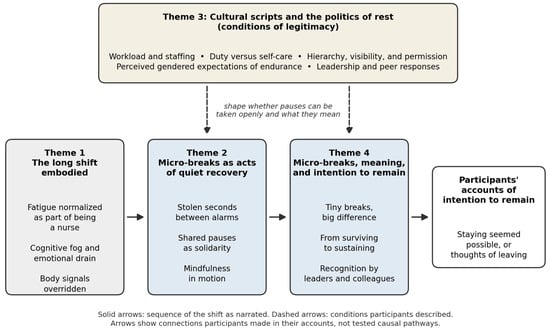
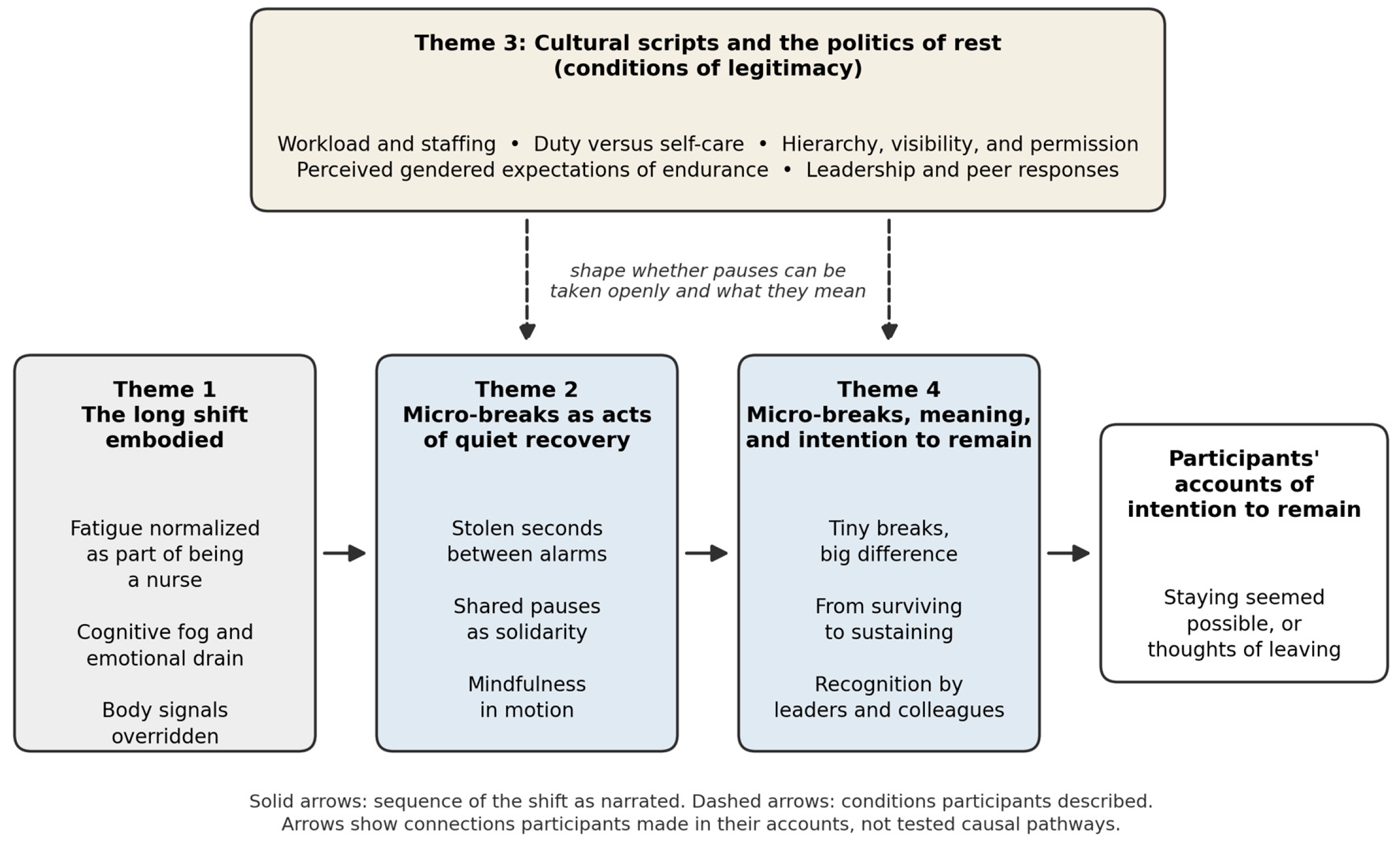
Early-career nurses in this study characterized micro-breaks as brief and often unobtrusive recovery practices that helped restore focus and composure during long shifts. Participants connected the availability and legitimacy of brief recovery opportunities with their perceptions of whether working in 24-h hospital services was sustainable and whether they could envisage remaining in nursing. The central contribution is conceptual. In these accounts, a micro-break was a socially negotiated practice whose legitimacy depended on workload, leadership, unit norms, and, in some accounts, gendered expectations, rather than an individual recovery behavior that nurses simply chose to take or skip. Figure 1 summarizes the connections participants drew between the four themes.
Figure 1.
Connections between the four themes as drawn by participants. Solid arrows follow the sequence of a shift as participants narrated it; dashed arrows show the conditions that, in participants’ accounts, shaped whether micro-breaks could be taken openly and what they came to mean. The figure summarizes interpretations developed from the data; it does not represent tested causal pathways.
4.1. Fatigue, Endurance, and Professional Identity
Participants presented fatigue not only as a physical or cognitive state but as an experience bound up with duty, professional identity, and expectations of endurance. Exhaustion was sometimes normalized as evidence of dedication, particularly during the early stages of participants’ careers. This interpretation is consistent with research indicating that professional identity can shape how nurses experience work-related strain [28,29].
Participants also described resilience, particularly early in their careers, as the ability to continue working despite fatigue. Some accounts subsequently positioned this understanding of endurance as unsustainable and reframed rest as compatible with, rather than contrary to, safe and responsible nursing practice. This finding suggests a tension between the endurance valued in these units and within nursing, and recognition of the need for recovery.
4.2. Micro-Breaks as Adaptive Recovery Practices
Micro-breaks functioned, in these accounts, as forms of embodied self-regulation within work environments in which formal opportunities for rest were sometimes limited or difficult to access. Nursing research has commonly examined rest breaks as organizational and structural practices, including whether breaks occur and the consequences of missed or inadequate breaks [2,10,11]. Occupational research on micro-breaks, in contrast, has examined short within-shift pauses as potential strategies for managing energy and reducing work-related strain [12,13,14,15].
The present findings add a relational and symbolic dimension to this literature. Participants did not describe micro-breaks solely in terms of physical recovery. Brief pauses could also represent temporary control over one’s attention, emotions, and bodily state within highly regulated clinical environments. For nurses adapting to shift work and the demands of clinical practice [30], these moments may therefore function simultaneously as coping practices and as experiences through which professional expectations concerning endurance and self-care are negotiated.
A recent qualitative study of 12 clinical nurses in a Chinese teaching hospital, analyzed through directed content analysis within a conservation-of-resources framework, reported comparable patterns, describing micro-breaks as varied forms of physical disengagement, cognitive detachment, and minimal replenishment whose feasibility depended on department characteristics, work pace, organizational culture, and leadership style, and noting potential social and psychological costs of pausing [16]. The convergence of these accounts across two markedly different health systems suggests that the social regulation of brief rest is not confined to one national context. The present study extends that work by focusing on nurses in their first five years of practice and by linking the perceived legitimacy of pausing to participants’ accounts of intention to remain.
4.3. Organizational Culture and the Politics of Rest
Participants’ accounts of competing obligations, perceived observation, and unequal access to opportunities for rest indicate that fatigue management may be influenced by organizational culture as well as workload and staffing conditions. Participants who perceived limited permission to pause reported strategies for concealing fatigue or taking brief rest discreetly. This finding is consistent with research showing that organizational silence, hierarchy, and limited psychological safety can affect whether nurses feel able to raise concerns or express vulnerability in clinical environments [17].
Across the interviews, the idea that a good nurse should continue working despite fatigue appeared to influence how participants evaluated their own need for rest. In this context, the availability of a break was not necessarily sufficient. What also mattered, in participants’ accounts, was whether a pause was perceived as legitimate and whether colleagues or leaders signaled that taking a brief moment to recover was acceptable. Diary research in other occupations points the same way: supervisor support for recovery strengthened the benefit employees gained from micro-break activities [14].
How far these patterns are specific to the Saudi setting cannot be settled by the present data. The dynamics participants described, including hierarchy, visibility, and the need to appear occupied, are reported in hospital nursing elsewhere [11,16]. What may be more particular to this setting is the composition of the workforce. Because expatriate nurses form the majority of hospital nursing staff in Saudi Arabia and are typically employed on fixed-term contracts [18,19,20], the perceived cost of appearing to rest may fall unevenly across a unit, as several participants suggested. The present study was not designed to test that possibility, and these findings should be read as identifying it rather than demonstrating it.
The accounts concerning gender should be interpreted cautiously. Some women described greater scrutiny of rest and additional expectations concerning emotional presentation and relational responsibilities. Given the predominantly female sample, the limited number of accounts addressing this issue directly, and the fact that both interviewers were men, these findings should be regarded as an exploratory pattern requiring further investigation rather than evidence of an established gender difference. Future studies with more diverse samples should examine whether and how gender influences access to recovery opportunities and perceptions of legitimacy around rest.
4.4. Implications for Intention to Remain
Participants connected recognition of micro-breaks by charge nurses and unit leaders with feelings of support, belonging, and the expectation that they could continue working in nursing. A recent scoping review of nurse retention identified safe staffing, the quality of the work environment, leadership, and support for psychological well-being as factors relevant to whether nurses remain in their roles [31].
What a brief pause meant, in these accounts, could extend well beyond its duration. A brief, visibly supported opportunity to pause could be interpreted as a signal that nurses’ well-being was recognized within the organization. Conversely, participants linked experiences in which rest was questioned or implicitly discouraged with doubts about whether they could continue working in the setting.
The connections described in this section were drawn by participants; they are not demonstrated effects. A qualitative, single-interview design can show how nurses reason about staying, but it cannot show that access to micro-breaks changes intention to remain, and intention is itself an imperfect guide to later employment decisions. Other influences on staying, such as pay, contract terms, family circumstances, and career opportunities, were not the focus of the interviews and may outweigh the experiences described here.
4.5. Implications for Practice
The implications below follow from participants’ accounts, and they have a clear limit: none of them can compensate for structural understaffing. In the participating units, breaks were scheduled by the charge nurse and no relief staff were allocated to cover them (Section 2.2), so the first implication is structural.
First, cover for breaks should be counted when staffing levels are set. Where no staff are allocated to cover breaks, every pause depends on a colleague absorbing additional work, which is the condition under which participants felt that rest had to be justified. Staffing models that include relief cover for formal breaks address this at its source, and studies of hospital nurses’ break practices in other countries point to the same gap between entitlement and practice [10,11].
Second, nurse managers and unit leaders can make the legitimacy of brief recovery opportunities explicit by framing appropriate short pauses as part of safe and sustainable clinical practice. Leadership modeling may be particularly important because participants described rest as more acceptable when it was visibly supported by those responsible for coordinating care.
Third, units may consider simple coverage arrangements, such as buddy coverage or brief task redistribution during periods of lower immediate clinical demand, to facilitate short recovery opportunities without unnecessarily disrupting workflow. Participants’ accounts suggested that even limited organizational support could reduce the perception that taking a brief pause required individual justification. Such arrangements work only where baseline staffing leaves some capacity to redistribute; on a unit that is already short-staffed, buddy coverage moves the deficit from one nurse to another rather than removing it.
Fourth, orientation and preceptorship programs may provide an appropriate setting for discussing expectations concerning fatigue, recovery, and help-seeking. This may be particularly relevant for nurses who are still adapting to shift work and hierarchical clinical environments. Participants described their recovery practices as self-developed or informally shared rather than taught, which suggests scope for addressing them explicitly within structured programs. Such discussions should position appropriate recovery as compatible with professional responsibility rather than as evidence of inadequate commitment.
These implications concern unit and institutional practice; whether any of them improves well-being or retention would need to be tested.
4.6. Transferability
In qualitative research, transferability is judged by readers who compare the setting described with their own, which depends on the contextual detail a study provides [27]. Two features of these findings seem most likely to hold in comparable settings. The first is the gap between formal break entitlement and practice: participants described entitlements that existed on paper but depended on unit activity and on a colleague’s willingness to cover, a pattern also reported among hospital nurses in the United States [10,11]. The second is the social regulation of pausing, in which a brief rest could be read by others as spare capacity or lack of commitment, and in which explicit permission from a charge nurse changed whether nurses felt able to stop, which parallels the social and psychological costs of pausing reported among clinical nurses in China [16]. Hospitals with hierarchical nursing structures, long or rotating shifts, and break cover that is not built into staffing are the settings to which these findings are most plausibly transferable.
Other features are closely tied to this setting. Expatriate nurses form the majority of the workforce and are typically employed on fixed-term contracts [18,19,20], which may change the perceived cost of being seen to rest in ways that would not apply where most nurses are locally trained and permanently employed. The accounts concerning gender arose in a predominantly female sample interviewed by men, within particular social norms concerning gender at work. Both hospitals are university-affiliated teaching hospitals, and early-career nurses in non-teaching, private, or regional hospitals may have different access to the informal support participants described. Section 2.2 and Table 1 provide the contextual detail readers need to judge the fit with their own settings.
4.7. Strengths and Limitations
A key strength of this study was the use of narrative inquiry with an interpretive orientation to examine how early-career nurses constructed meaning around fatigue, pausing, endurance, and sustainability during long shifts. The approach enabled attention to temporal experience, embodiment, professional identity, interpersonal relationships, and the meanings participants attributed to brief recovery practices. Variation in clinical unit, shift pattern, and interview language, together with retention of the original Arabic transcripts alongside the English versions, supported interpretation across a range of working contexts.
Several limitations should be considered. First, recruitment was confined to two tertiary teaching hospitals affiliated with King Saud University in Riyadh. The findings may therefore not reflect experiences in other regions, healthcare systems, or private-sector hospitals. Teaching hospitals may also differ from other hospitals in the educational support available to new nurses and in leadership norms, and because both sites applied the same break policy, the influence of differing formal policies could not be examined. Second, participants were recruited through nurse educators within the institutional network with which the research team was affiliated. Although the educators had no supervisory relationship with participants, the institutional affiliation may nevertheless have influenced perceptions of participation or disclosure.
Third, the interviews relied on retrospective accounts of remembered clinical experiences and were therefore susceptible to recall and social-desirability effects. This may be particularly relevant because participants described rest as an activity that could carry social or professional costs. Fourth, interviews conducted in Arabic were analyzed using English translations. Although professional forward translation, independent back-translation, and reconciliation procedures were used, some linguistic or culturally embedded meanings may not have been fully retained in translation.
Fifth, purposive sampling and the predominantly female composition of the sample limit transferability, particularly for conclusions concerning gender; both interviewers were men, which may also have shaped what women participants chose to disclose about gendered expectations. Sixth, nationality and country of nursing education were not recorded, although participants themselves raised these distinctions; in a workforce in which most nurses are expatriate, this omission constrains what can be said about differential access to recovery. Seventh, 13 of the 22 participants had three to fewer than five years of experience, the upper end of the eligibility range, so accounts of a shift from endurance toward sustainable practice may reflect the composition of the sample rather than a general trajectory; because each participant was interviewed once and accounts were retrospective, the study cannot show that this shift develops with experience. Finally, the study examined participants’ perceptions and intentions rather than objectively measured fatigue, physiological recovery, clinical performance, or subsequent retention behavior. Accordingly, the findings should not be interpreted as demonstrating that micro-breaks cause improved performance, well-being, or retention.
Future research should use multi-site designs that include non-teaching, private, and regional hospitals, and longitudinal designs that follow early-career nurses through their first years of practice. Combining qualitative accounts with objective measures, such as validated fatigue instruments administered during shifts, actigraphy, and structured observation of break-taking, would allow the experiences reported here to be examined against measured fatigue and recovery. Linking such data to subsequent employment records would show whether perceived access to recovery is associated with actual retention.
5. Conclusions
Early-career nurses in this study described micro-breaks as brief, improvised, and socially regulated practices that helped them restore focus and composure during long shifts. Their accounts suggested that access to these moments depended not only on workload but also on whether unit culture and leadership treated brief recovery as legitimate. Participants connected this legitimacy with their perceptions of whether a career in 24-h hospital nursing was sustainable and whether they intended to remain in nursing.
Brief recovery opportunities appeared to matter beyond physical rest, because participants sometimes read them as signs of organizational recognition and support. Creating conditions in which appropriate short pauses are accepted and supported, alongside staffing that includes cover for breaks, may therefore be considered as one component of unit-level approaches to nurse well-being and sustainable work. Whether micro-break practices influence measured well-being, clinical outcomes, intention to remain, or actual retention should be evaluated in longitudinal, multi-site research that combines self-report with observational or physiological measures.
Supplementary Materials
The following supporting information can be downloaded at: https://www.mdpi.com/article/10.3390/healthcare14223852/s1, Supplementary File S1: Semi-structured narrative interview guide; Supplementary File S2: COREQ 32-Item Checklist.
Author Contributions
Conceptualization, B.M.A., W.M.A. and A.M.A.; methodology, W.M.A., M.A. and A.M.A.; formal analysis, W.M.A., M.A., F.F.A. and T.E.; investigation, W.M.A., M.A., T.E., B.M.A. and A.M.A.; data curation, F.F.A. and B.M.A.; writing—original draft preparation, W.M.A. and M.A.; writing—review and editing, F.F.A., T.E., B.M.A. and A.M.A.; supervision, A.M.A.; project administration, A.M.A.; funding acquisition, A.M.A. All authors have read and agreed to the published version of the manuscript.
Funding
This research was supported by the Ongoing Research Funding Program (ORF-2026-1544), King Saud University, Riyadh, Saudi Arabia. The funder had no role in the study design; in the collection, analysis, or interpretation of data; in the writing of the manuscript; or in the decision to publish the results.
Institutional Review Board Statement
The study was conducted in accordance with the Declaration of Helsinki and approved by the Institutional Review Board of King Saud University, Riyadh, Saudi Arabia (protocol code KSU-HE-25-905; approved 5 August 2025).
Informed Consent Statement
Written informed consent was obtained from all participants before data collection, including consent to audio recording and to the publication of anonymized verbatim quotations.
Data Availability Statement
The full transcripts analyzed in this study are not publicly available because participants did not consent to the public release of complete interview accounts and because the small, single-network sample makes reliable de-identification of full transcripts difficult. Anonymized extracts are available from the corresponding author upon reasonable request, subject to applicable ethical and confidentiality requirements.
Acknowledgments
The authors thank the participating nurses from King Saud University-affiliated hospitals for their openness in sharing their experiences and the nursing leadership teams for facilitating data collection. The authors also thank the Ongoing Research Funding Program (ORF-2026-1544), King Saud University, Riyadh, Saudi Arabia.
Conflicts of Interest
The authors declare no conflicts of interest.
References
- Ting, J.J.; Babenko-Mould, Y.; Garnett, A. Early career nurses’ experiences of engaging in a leadership role in hospital settings. Can. J. Nurs. Res. 2024, 56, 257–268. [Google Scholar] [CrossRef] [Scilit] [PubMed]
- Dall’Ora, C.; Ejebu, O.-Z.; Ball, J.; Griffiths, P. Shift work characteristics and burnout among nurses: Cross-sectional survey. Occup. Med. 2023, 73, 199–204. [Google Scholar] [CrossRef] [Scilit] [PubMed]
- Dall’Ora, C.; Griffiths, P.; Redfern, O.; Recio-Saucedo, A.; Meredith, P.; Ball, J.; Böhning, D. Nurses’ 12-hour shifts and missed or delayed vital signs observations on hospital wards: Retrospective observational study. BMJ Open 2019, 9, e024778. [Google Scholar] [CrossRef] [Scilit] [PubMed]
- Alshammari, B.; Alsaleh, G.S.; Alrasheeday, A.; Baghdadi, N.; Almalki, N.; Alshammari, F.; Assiry, A.; Almalki, M. Association between missed nursing care and nurse fatigue: A cross-sectional correlational study. Nurs. Rep. 2025, 15, 298. [Google Scholar] [CrossRef] [Scilit] [PubMed]
- Xin, D.; Li, W.; Zhu, W.; Li, M.; Xu, N.; Yue, L.; Cui, L.; Wang, Y. Relationship between transition shock, resilience, career calling, and retention intention among new nurses: A moderated mediation model. BMC Nurs. 2024, 23, 873. [Google Scholar] [CrossRef] [Scilit] [PubMed]
- Baharum, H.; Ismail, A.; McKenna, L.; Mohamed, Z.; Ibrahim, R.; Hassan, N.H. Success factors in adaptation of newly graduated nurses: A scoping review. BMC Nurs. 2023, 22, 125. [Google Scholar] [CrossRef] [Scilit] [PubMed]
- Kaldal, M.H.; Voldbjerg, S.L.; Grønkjær, M.; Conroy, T.; Feo, R. Newly graduated nurses’ commitment to the nursing profession and their workplace during their first year of employment: A focused ethnography. J. Adv. Nurs. 2024, 80, 1058–1071. [Google Scholar] [CrossRef] [Scilit] [PubMed]
- Dall’Ora, C.; Ejebu, O.-Z.; Griffiths, P. Because they’re worth it? A discussion paper on the value of 12-h shifts for hospital nursing. Hum. Resour. Health 2022, 20, 36. [Google Scholar] [CrossRef] [Scilit] [PubMed]
- Dall’Ora, C.; Griffiths, P.; Ball, J.; Simon, M.; Aiken, L.H. Association of 12 h shifts and nurses’ job satisfaction, burnout and intention to leave: Findings from a cross-sectional study of 12 European countries. BMJ Open 2015, 5, e008331. [Google Scholar] [CrossRef] [Scilit] [PubMed]
- Sagherian, K.; Cho, H.; Steege, L.M. The state of rest break practices among 12-hour shift hospital nurses in the United States. J. Nurs. Adm. 2023, 53, 277–283. [Google Scholar] [CrossRef] [Scilit] [PubMed]
- Landis, T.T.; Wilson, M.; Bigand, T.; Cason, M. Registered nurses’ experiences taking breaks on night shift: A qualitative analysis. Workplace Health Saf. 2021, 69, 252–256. [Google Scholar] [CrossRef] [Scilit] [PubMed]
- Zacher, H.; Brailsford, H.A.; Parker, S.L. Micro-breaks matter: A diary study on the effects of energy management strategies on occupational well-being. J. Vocat. Behav. 2014, 85, 287–297. [Google Scholar] [CrossRef] [Scilit]
- Kim, S.; Park, Y.; Niu, Q. Micro-break activities at work to recover from daily work demands. J. Organ. Behav. 2017, 38, 28–44. [Google Scholar] [CrossRef] [Scilit]
- Nie, Q.; Zhang, J.; Peng, J.; Chen, X. Daily micro-break activities and workplace well-being: A recovery perspective. Curr. Psychol. 2023, 42, 9972–9985. [Google Scholar] [CrossRef] [Scilit]
- Albulescu, P.; Macsinga, I.; Rusu, A.; Sulea, C.; Bodnaru, A.; Tulbure, B.T. “Give me a break!” A systematic review and meta-analysis on the efficacy of micro-breaks for increasing well-being and performance. PLoS ONE 2022, 17, e0272460. [Google Scholar] [CrossRef] [Scilit] [PubMed]
- Pan, L.; Wu, J.; Jiang, Q.; Wang, L.; Li, Y. “It’s not just a pause”: A qualitative exploration of micro-breaks among clinical nurses. J. Nurs. Scholarsh. 2026, 58, e70126. [Google Scholar] [CrossRef] [Scilit] [PubMed]
- Zou, J.; Zhu, X.; Fu, X.; Zong, X.; Tang, J.; Chi, C.; Jiang, J. The experiences of organizational silence among nurses: A qualitative meta-synthesis. BMC Nurs. 2025, 24, 31. [Google Scholar] [CrossRef] [Scilit] [PubMed]
- Kattan, W.; Al-Hanawi, M.K. Inequalities in the distribution of the nursing workforce in the Kingdom of Saudi Arabia: A regional analysis. Hum. Resour. Health 2025, 23, 34. [Google Scholar] [CrossRef] [Scilit] [PubMed]
- Alsadaan, N.; Jones, L.K.; Kimpton, A.; DaCosta, C. Challenges facing the nursing profession in Saudi Arabia: An integrative review. Nurs. Rep. 2021, 11, 395–403. [Google Scholar] [CrossRef] [Scilit] [PubMed]
- Alluhidan, M.; Tashkandi, N.; Albowi, F.; Omer, T.; Alghaith, T.; Alghodaier, H.; Alazemi, N.; Tulenko, K.; Herbst, C.H.; Hamza, M.M.; et al. Challenges and policy opportunities in nursing in Saudi Arabia. Hum. Resour. Health 2020, 18, 98. [Google Scholar] [CrossRef] [Scilit] [PubMed]
- Clandinin, D.J.; Huber, J. Narrative inquiry. In International Encyclopedia of Education, 3rd ed.; Peterson, P., Baker, E., McGaw, B., Eds.; Elsevier: Amsterdam, The Netherlands, 2010; pp. 436–441. [Google Scholar] [CrossRef] [Scilit]
- Tong, A.; Sainsbury, P.; Craig, J. Consolidated criteria for reporting qualitative research (COREQ): A 32-item checklist for interviews and focus groups. Int. J. Qual. Health Care 2007, 19, 349–357. [Google Scholar] [CrossRef] [Scilit] [PubMed]
- Malterud, K.; Siersma, V.D.; Guassora, A.D. Sample size in qualitative interview studies: Guided by information power. Qual. Health Res. 2016, 26, 1753–1760. [Google Scholar] [CrossRef] [Scilit] [PubMed]
- Braun, V.; Clarke, V. To saturate or not to saturate? Questioning data saturation as a useful concept for thematic analysis and sample-size rationales. Qual. Res. Sport Exerc. Health 2021, 13, 201–216. [Google Scholar] [CrossRef] [Scilit]
- Braun, V.; Clarke, V. Reflecting on reflexive thematic analysis. Qual. Res. Sport Exerc. Health 2019, 11, 589–597. [Google Scholar] [CrossRef] [Scilit]
- Campbell, K.; Orr, E.; Durepos, P.; Nguyen, L.; Li, L.; Whitmore, C. Reflexive thematic analysis for applied qualitative health research. Qual. Rep. 2021, 26, 2011–2028. [Google Scholar] [CrossRef] [Scilit]
- Lincoln, Y.S.; Guba, E.G. Naturalistic Inquiry; Sage: Newbury Park, CA, USA, 1985. [Google Scholar]
- Shuai, T.; Xuan, Y.; Jiménez-Herrera, M.F.; Yi, L.; Tian, X. Moral distress and compassion fatigue among nursing interns: A cross-sectional study on the mediating roles of moral resilience and professional identity. BMC Nurs. 2024, 23, 638. [Google Scholar] [CrossRef] [Scilit] [PubMed]
- Howle, A.; Carter, G.; Reising, D. Contemporary factors influencing professional identity in acute care nurses: An integrative review. J. Adv. Nurs. 2025, 81, 6134–6154. [Google Scholar] [CrossRef] [Scilit] [PubMed]
- Ejebu, O.-Z.; Dall’Ora, C.; Griffiths, P. Nurses’ experiences and preferences around shift patterns: A scoping review. PLoS ONE 2021, 16, e0256300. [Google Scholar] [CrossRef] [Scilit] [PubMed]
- Buckley, L.; McGillis Hall, L.; Price, S.; Visekruna, S.; McTavish, C. Nurse retention in peri- and post-COVID-19 work environments: A scoping review of factors, strategies and interventions. BMJ Open 2025, 15, e096333. [Google Scholar] [CrossRef] [Scilit] [PubMed]

Disclaimer/Publisher’s Note: The statements, opinions and data contained in all publications are solely those of the individual author(s) and contributor(s) and not of MDPI and/or the editor(s). MDPI and/or the editor(s) disclaim responsibility for any injury to people or property resulting from any ideas, methods, instructions or products referred to in the content. |
© 2026 by the authors. Licensee MDPI, Basel, Switzerland. This article is an open access article distributed under the terms and conditions of the Creative Commons Attribution (CC BY) license.