


Highlights
What are the main findings?
- This systematic review identified only five eligible studies from four Asian countries/regions, highlighting the limited availability of economic evidence on Hospital-at-Home (HaH) programs in Asia;
- Four of five studies reported cost savings alongside favorable findings for selected clinical outcomes, although the outcomes assessed and magnitude of effects varied across studies.
What are the implications of the main findings?
- Available evidence suggests that Hospital-at-Home programs may reduce healthcare costs in some Asian healthcare settings while maintaining comparable or improved outcomes; however, the evidence remains limited and heterogeneous;
- More rigorous economic evaluations incorporating quality-of-life outcomes and formal cost-effectiveness modeling are needed to support policy implementation and scaling decisions.
Abstract
Background/Objectives: Hospital-at-home (HaH) programs are increasingly adopted as an alternative to inpatient care and have demonstrated cost savings and comparable clinical outcomes in Western healthcare systems. In Asia, where healthcare systems face growing hospital-bed capacity constraints, evidence on the economic impact of HaH remains limited. This systematic review aimed to appraise and synthesize evidence on costs, resource utilization, and formal cost-effectiveness evaluation, where available, of HaH programs for patients eligible for general hospital admission within Asian healthcare systems. Methods: This systematic review was conducted according to PRISMA guidelines and registered in PROSPERO (CRD420251117897). Literature searches were performed in PubMed/MEDLINE, EMBASE, and the Cochrane Library from 2000 to June 2026. Studies evaluating HaH or similar home-based hospitalization models in Asian settings and reporting cost-related outcomes were included. Methodological quality was assessed using the Joanna Briggs Institute checklist for economic evaluations, and findings were synthesized using a dominance ranking matrix. Results: Of 2243 records identified, five studies from four Asian countries/regions involving 10,152 patients met the inclusion criteria. Four studies reported cost savings alongside favorable findings for selected clinical outcomes, including shorter hospital stays, although findings varied across outcomes and settings. No study reported a formal cost-effectiveness analysis. Overall, the dominance ranking matrix favored HaH in most scenarios, although one study reported less favorable outcomes. Conclusions: The limited available evidence suggested that HaH programs may reduce healthcare costs alongside favorable findings for selected clinical outcomes in some Asian healthcare settings. However, substantial heterogeneity and the absence of formal cost-effectiveness evaluations limit definitive conclusions regarding their cost-effectiveness.
1. Introduction
Hospital-at-home (HaH) has evolved over the past three decades as a viable alternative to traditional inpatient hospitalization, offering acute care services in the patient’s home through coordinated, multidisciplinary teams. This model addresses growing healthcare demands on healthcare systems by reducing reliance on hospital beds while maintaining clinical standards. Evidence from North America, Europe and Australia have shown that HaH reduces costs by 19% to 30% per episode while achieving comparable clinical outcomes and high levels of patient satisfaction [1,2,3]. These findings have established HaH as a cornerstone of value-based care in many advanced health systems.
In Asia, health systems face significant capacity issues due to high population density, limited hospital infrastructure, and increasing demand for chronic and acute care services. These pressures have accelerated interest in HaH programs across countries such as Malaysia [4], Singapore [5], China [6], and Japan [7] to address these challenges. It is important to establish not only clinical equivalence but also cost savings, particularly given the diverse healthcare financing models in Asia. Although numerous systematic reviews have examined the cost-effectiveness of HaH in Western settings, evidence from Asian contexts remains scarce and fragmented.
Understanding the economic implications of HaH in Asia is critical for policymakers and healthcare providers seeking sustainable solutions to hospital overcrowding and rising costs. This systematic review aims to critically appraise and summarize current evidence on costs, resource utilization, and formal cost-effectiveness evaluation, where applicable, of HaH programs for patients eligible for general hospital admission within Asian healthcare systems. By consolidating the available data, this review seeks to inform future research and guide policy decisions on scaling HaH models in the region.
2. Materials and Methods
This systematic review has been registered in the international prospective register of systematic reviews (PROSPERO) under the registration number: CRD420251117897. The Preferred Reporting Items for Systematic Reviews and Meta-Analyses (PRISMA) guidelines were adopted to identify eligible studies.
2.1. PICO Elements
- Population: Patients who require hospital admission in an emergency department or general ward in a general hospital;
- Intervention: Hospital-at-Home (HaH), or “medical at home” program;
- Control: Traditional ward-based care;
- Outcome: Formal economic evaluation, including cost-effectiveness analysis (CEA) in terms of incremental cost-effectiveness ratio (ICER), cost–utility analysis (CUA), cost–benefit analysis (CBA), and cost-minimization analysis (CMA) where applicable. In the absence of formal economic evaluation, studies reporting both relevant clinical outcomes (e.g., length of stay, readmission, or mortality) and cost outcomes were considered.
2.2. Search Strategy and Eligibility Criteria
A literature search was performed in PubMed/MEDLINE, EMBASE, and the Cochrane library, from 2000 to Jun 2026 with language restriction of English only. Search terms included were “hospital at home”, “HaH”, “medical home”, “home care service”, “cost analysis”, “cost effectiveness”, “economic evaluation”, “length of stay”, “readmission”, and related synonyms. The search included both MeSH terms and free text. In addition, all reference lists in the included articles and relevant review articles were manually checked. The search strategy for the 3 databases available is attached in the Appendix A.
Studies were included if they matched our predefined PICOs and provided cost analysis data. We included primary research studies of any study design that evaluated the costs and/or economic outcomes of HaH interventions and provided relevant cost data. Studies were excluded if “home care” were delivered in settings such as nursing homes, home births, palliative services, hemodialysis, rehabilitation, chronic disease management, primary care, health education, or nutrition/exercise interventions, as there were outside the scope of this review. Study protocols, other systematic reviews, and meta-analysis were also excluded.
All records identified from the literature searches across the three databases were imported into Covidence for citation management and study selection. Two reviewers (GL, JH) independently screened the titles and abstracts for the first most relevant 100 records, according to Covidence most relevant rating, as a calibration exercise to ensure consistent interpretation and application of the predefined eligibility criteria. Discrepancies were discussed and resolved by consensus before one reviewer completed the remaining title and abstract screening. Full-text eligibility assessment was subsequently conducted independently by two reviewers (GL, JH). Any disagreements at this stage were resolved through discussion and consensus. Where consensus could not be reached, a third reviewer (LM) was consulted to make the final decision.
2.3. Data Extraction
A predefined data extraction template was set up before the literature screening started. Baseline characteristics consisted of the first author, year of publication, study design, total number of participants enrolled, gender and age, and study setting. All relevant data for comparative economic evaluations were extracted including effectiveness and cost analysis related information consisting of economic perspective, time horizon, main effectiveness outcomes, cost estimates, data source, cost type, currency, sensitivity analysis, and any co-variate considered for adjusted model. Data extraction was performed independently by two reviewers, with results cross-checked upon completion. Any discrepancies were resolved by a third reviewer.
2.4. Assessment of Quality and Risk of Bias
The methodological quality of included economic evaluations was assessed using the Joanna Briggs Institute (JBI) Critical Appraisal Checklist for Economic Evaluations [8]. Each item on the checklist was evaluated and recorded as “Yes”, “No”, “Unclear”, or “Not applicable”. Consistent with JBI guidance, the appraisal focused on the methodological rigor and transparency of each study. For descriptive purposes, the proportion of applicable JBI criteria rated “Yes” was calculated for each study, with items rated “Not applicable” excluded from the denominator. These percentages were used to facilitate comparison across studies rather than as validated JBI quality scores. Methodological quality was primarily interpreted based on the item-level judgments. The assessment was independently conducted by two reviewers, and any disagreement resolved by a third reviewer.
2.5. Analysis
Clinical outcomes and cost data were synthesized separately before an integrated assessment of the direction of clinical and economic findings. A meta-analysis was considered where sufficiently comparable data were available; however, owing to heterogeneity in the included studies and outcome measures, quantitative pooling was not considered appropriate. Clinical outcomes and cost data were, therefore, synthesized narratively and reported separately where comparative analyses were unavailable. As none of the included studies conducted a formal cost-effectiveness analysis, ICERs or other summary measures of cost-effectiveness were unavailable for quantitative synthesis.
To synthesize the direction of cost and health outcomes across the included studies, the dominance ranking matrix (DRM) [8], developed by the Joanna Briggs Institute (JBI), was utilized. The DRM is a classification tool that interprets economic evaluation results in systematic reviews, presenting the analysis as a permutation matrix with nine possible cost-effectiveness outcomes. In this review, a study was categorized as “health benefit+” if improvement was observed in any of the main clinical outcomes, such as length of stay, readmission, or mortality; “health benefit−” indicated poorer clinical outcomes, while “health benefit 0” indicated no meaningful difference among groups. Similarly, “cost−” indicated lower costs or cost savings associated with the intervention, “cost+” indicated higher costs, and “cost 0” indicated no meaningful difference in costs. These classifications were based on the direction of the reported comparative findings rather than on results of a formal economic evaluation. The corresponding combination of cost and health outcomes was then mapped to the nine cells of the DRM and classified as favor intervention, rejection, or unclear. The overall distribution of studies across these classifications was then used to provide an integrated, directional interpretation of the reported clinical and cost outcomes.
3. Results
3.1. Characteristics of the Studies
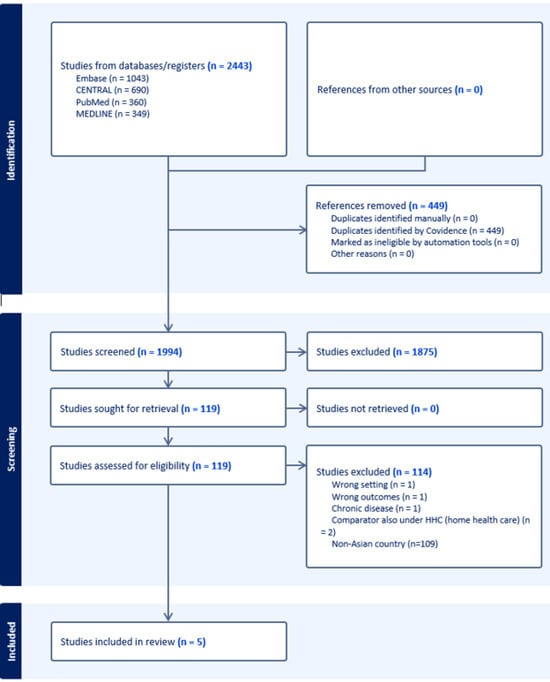
A total of 2443 articles were identified in our literature search among PubMed/MEDLINE, EMBASE, and the Cochrane library, based on the specified search criteria. One hundred and nineteen eligible full-text articles and abstracts were assessed after removal of duplications and initial screening. According to the inclusion criteria, five studies [9,10,11,12,13] were ultimately selected for the systematic review (Figure 1).
Figure 1.
PRISMA flow diagram.
Table 1 summarized the main characteristics of the included studies. The studies originated from four different countries or regions, of which three were retrospective or cross-sectional observational studies and two were quasi-experimental studies. Three of the papers are published recently in 2025 and 2026, while one in 2019 and another in 2007. In total, 10,152 eligible patients were included in the analysis, with average ages ranged from 51.4 to 81.9 years. Most studies focused on elderly population. The home healthcare models reported in the five studies varied to some extent, though all fell within the categories of home hospitalization (HH), transitional care (TC) model, hospital-at-home (HaH), or home healthcare services (HHS). While the main functions of these care models differ slightly, all involve multidisciplinary teams with wide range of specialists caring for patients. Additionally, the inclusion criteria varied across studies. The Isreal study was a government-led approach in which elderly were widely included in HaH based on the medical condition. The Turky study focused on patients from the emergency department, while the other studies recruited patients from general inpatient settings.
Table 1.
Characteristics of included studies.
Quality assessment of all the included studies was conducted using JBI Critical Appraisal Checklist for Economic Evaluations. Item 7, “Are costs and outcomes adjusted for differential timing?” was not applicable to any of the studies, as none had performed formal economic evaluations requiring such adjustment. Consequently, this item was excluded from the denominator when calculating the descriptive proportion of applicable criteria rated “Yes”. For the same reason, all the studies were marked as “No” for the criterion “Has clinical effectiveness been established?”. Studies were also penalized if there was no incremental analysis or sensitivity analysis conducted.
The proportion of applicable criteria rated “Yes” ranged from 40% to 90% across the included studies. Ang and Ko met 80% and 90% of applicable criteria, respectively, while Jacobs met 70% and Tan and Ayyildiz each met 40%. Item-level judgments are presented in Table 2 to facilitate interpretation of specific methodological strengths and limitations.
Table 2.
Quality assessment of included studies.
3.2. Key Findings
Table 3 presents results of all the studies. None of the included studies conducted formal cost-effectiveness analysis or reported an ICER. The 2 Singapore studies performed comparative analysis for adjusted differences among groups, controlling for relevant covariates. These studies adopted different perspectives: Ang considered both patient and government viewpoints, while Ko at focused on healthcare system perspective, collecting costs across all related activities. Both studies reported significantly shorter lengths of hospital stay (by 3 or 4.2 days) and lower healthcare costs compared with their respective comparator groups. Ang observed fewer hospital readmissions, emergency facility visits, and higher mortality rates, though these findings were not statistically significant. Ko noted a higher readmission at 30 days in HaH group, but this was also not statistically significant due to a wide confidence interval. Ko additionally reported quality-of-life data, with no observed difference among groups. Ko’s study also conducted sensitivity analysis that confirmed the robustness of their base-case results.
Table 3.
Clinical and Cost analysis of included studies.
Studies from Taiwan and Turkey reported clinical outcomes and cost data across different patient groups, enabling meaningful comparisons. Tan observed a positive impact of the HaH model, with a significant shorter length of stay (LoS) and reduced costs; however, other clinical parameters did not demonstrate significant advantages. Patient satisfaction was also assessed, and all respondents described the program as “satisfied”. In contrast, Ayyildiz reached an entirely different conclusion, reporting longer LoS in both ward and ICU, lower survival rates, and higher cost for the intervention group, all statistical significance.
Jacobs’s study in Isreal offered a unique perspective by evaluating changes after the HaH program was phased out. Following the government’s discontinuation of the program, there was a marked increase in hospital visits and healthcare expenditures among previously enrolled patients. Although patient-level data were not available, the overall increase trend showed significant rises in hospitalization, recurrent admissions, and costs. The ratio of increased costs to prior savings was 5:1, supporting the hypothesis that discontinuing HaH would lead to higher hospital utilization rates among the local elderly population.
3.3. Synthesis of the Studies
Table 4 presented the dominance ranking matrix for the reviewed studies. It indicates that four out of five studies were classified within the “favor intervention” domain of DRM, reflecting concurrent improvement in selected clinical outcomes and cost savings. However, one study (Ayyildiz) with higher cost and lower health benefit led to “reject intervention” domain. Taken together, while most of the evidence favors HaH, variability across context should be noted and the potential for adverse outcomes in certain settings. Overall, these findings should be interpreted as a directional synthesis of clinical and cost outcomes rather than evidence from formal cost-effectiveness evaluations.
Table 4.
Dominance ranking matrix.
4. Discussion
With the current policy emphasis on “care closer to home” [14] (WHO 2021 to 2030), and growing concern about the rising demand for hospital-bed-based care, research on economic impact of the home-based care has become increasingly important. Over the past two decades, numerous systematic reviews have examined this topic [15,16,17], most notably the Cochrane Review initiated by Shepperd and colleagues on early discharge Hospital-at-Home (HaH), which has been updated multiple times and provides broad coverage of the available evidence [18]. However, these reviews predominantly include studies from Western countries with more developed healthcare systems, leaving a significant gap in evidence in Asia. This gap likely reflects the scarcity of comprehensive and rigorous economic evaluations conducted in Asian contexts, a finding consistent with the observations of this review. During the literature screening process, 109 potentially relevant studies reporting economic evidence were excluded because they were conducted outside Asia. This underscores an urgent need for high-quality research focused on the economic impact of HaH programs within Asian healthcare systems.
This review identified five studies analyzing costs associated with HaH and similar programs across four Asian countries and regions. None of the included studies reported formal cost-effectiveness evaluations. Nevertheless, comparative analyses of clinical and cost outcomes provided preliminary evidence that HaH may be associated with cost savings alongside comparable or favorable findings for selected clinical outcomes in some settings. Findings varied across individual outcomes, particularly for readmission and mortality, and should, therefore, not be interpreted as demonstrating an overall improvement in clinical outcomes. Considerable variation was also observed in program design, patient populations, cost perspectives, time horizons, and healthcare system contexts.
Since none of the included studies reported formal cost-effectiveness evaluations, items requiring detailed economic methods (e.g., disaggregated direct and indirect costs, modeling approaches, discounting procedures, or cost-effectiveness acceptability curves) were not applicable for data extraction. Furthermore, the studies varied in healthcare system settings, patients’ inclusion criteria, and HaH program designs, as well as in analytical perspectives. These variations rendered quantitative pooling of effectiveness data unfeasible. In this context, a three-by-three dominance ranking matrix (DRM) was utilized to classify each study’s overall economic finding (favored/unclear/rejected). The DRM—recommended in the JBI guidance and other methodological papers—provides a pragmatic, visual approach to summarizing heterogeneous or partial economic evidence when quantitative pooling synthesis is not feasible and has increasingly been used in recent systematic reviews of economic studies [19,20,21]. The matrix provided a structured approach of synthesizing the direction of cost and clinical outcomes and indicated that four of the five included studies fell within the “favor intervention” category. However, the DRM should, therefore, be interpreted as a directional synthesis of the reported cost and clinical outcomes rather than as evidence of formal cost-effectiveness. In addition, the classification does not fully account for differences in study design, methodological quality, population, magnitude or precision of effect estimates, or healthcare context across studies.
Regarding the populations studied, the five included studies focused on the elderly, which may limit the generalizability of HaH program effectiveness to the broader population. Furthermore, Ayyildiz was the only study reporting adverse findings, with both clinical outcomes and cost data suggesting rejection of the intervention. This may be attributable to the characteristics of the intervention group, which was significantly older and included more females compared with the control group. Older age is typically associated with higher healthcare expenditures, while female sex may also be linked to elevated costs [22], although evidence on gender differences remains inconsistent. The baseline differences between the intervention and comparator groups, particularly in age, may, therefore, have contributed to residual confounding and influenced the observed cost differences. Additionally, several methodological limitations identified through the item-level JBI appraisal may further reduce confidence in these findings.
HaH programs are also associated with increased patient satisfaction and potential economic benefits, supporting continued evaluation of these models as alternatives to conventional inpatient care [23,24]. However, QoL data were reported in only one included study (Ko et al.). In contemporary health economic evaluations, QoL outcomes have become increasingly important alongside traditional clinical and cost measures [25], particularly in home-care services, where the primary objective is to enhance patient comfort, satisfaction, and overall quality of life [26]. Incorporating QoL allows for a more comprehensive assessment of healthcare interventions, especially in chronic or non-fatal conditions where survival alone may not capture patient-relevant benefits [27]. Measures such as quality-adjusted life years (QALYs) and patient-reported outcome instruments enable the integration of both length and quality of life into economic models, facilitating comparisons across interventions and informing resource allocation decisions. Consequently, consideration of QoL outcomes enhances the relevance and patient-centeredness of economic evaluations, supporting policymakers in prioritizing interventions that improve both longevity and well-being.
Regarding quality assessment, this review utilized the JBI Critical Appraisal Checklist for Economic Evaluations, a widely recognized tool for assessing the methodological quality of health economic evaluation studies. However, the checklist does not contain a specific item evaluating the appropriateness or justification of the chosen evaluation perspective, with this aspect only indirectly addressed under the criterion of whether a well-defined review question is stated. This has been highlighted as a limitation when compared with other economic evaluation appraisal tools [28], such as the Drummond checklist and the Consensus on Health Economic Criteria (CHEC) checklist. Although the original protocol proposed the use of the CHEC checklist, no included studies reported a full cost-effectiveness analysis, rendering several CHEC items inapplicable. The JBI checklist was, therefore, selected as a more applicable alternative for the available evidence, while its limitations for assessing some aspects of economic evaluation, including analytical perspective, are acknowledged [29,30].
A formal assessment of reporting bias was not conducted due to the limited number of included studies and the absence of quantitative meta-analysis. Similarly, a formal certainty-of-evidence assessment following the GRADE approach was not undertaken, this should be considered when interpreting the strength of the overall evidence.
This review has several limitations. First, this review excluded research focused exclusively on end-of-life care, dialysis, rehabilitation, or tele-care model. While this approach ensured relevance to the scope of HaH programs examined in this review, it may have excluded studies reporting comprehensive cost-effectiveness data for specific populations or settings. Economic evaluations may also vary across countries because of differences in healthcare systems and reimbursement structures, and these variations are amplified for patients with diverse diagnosis and comorbidities. Importantly, none of the included studies conducted a formal cost-effectiveness analysis; therefore, the observed combination of cost savings and favorable clinical outcomes should not be interpreted as establishing the cost-effectiveness of HaH. Furthermore, the included interventions represented heterogeneous models of home-based care that differed in their organization, intensity, target populations, and healthcare settings. The findings should, therefore, not be interpreted as reflecting the effectiveness or economic impact of a single standardized HaH model, and their applicability to other HaH programs may be limited. Future research or systematic reviews may benefit from focusing on specific disease groups or clinical populations to improve the precision and applicability of the findings.
5. Conclusions
Despite methodological limitations and the absence of formal economic evaluations, synthesis of the available clinical and cost outcomes provides preliminary evidence regarding the potential economic implications of HaH programs in Asian healthcare settings. The limited available evidence suggests that these models may be associated with favorable findings for selected clinical outcomes alongside cost savings in some settings. However, these findings should not be interpreted as establishing the cost-effectiveness of HaH, given the small and heterogeneous evidence base and absence of formal cost-effectiveness analyses. Future studies should adopt rigorous economic evaluation frameworks, incorporate patient-centered outcomes, and investigate clearly defined populations and HaH models within specific healthcare contexts to better inform policy and implementation decisions.
Author Contributions
Conceptualization, L.S. and L.G.; methodology, L.G.; validation, L.G. and J.H.C.; investigation, L.G. and J.H.C.; data curation, L.G. and J.H.C.; formal analysis, L.G.; writing—original draft preparation, L.G.; writing—review and editing, L.G., J.H.C. and L.S.; visualization, L.G.; supervision, L.S. All authors have read and agreed to the published version of the manuscript.
Funding
This research received no external funding.
Institutional Review Board Statement
Not applicable. This study is a systematic review of published literature and did not involve the collection of primary data from human participants or animals.
Informed Consent Statement
Not applicable. This study is a systematic review based on previously published studies and did not involve the recruitment of human participants or the collection of identifiable personal data.
Data Availability Statement
No new data were created or analyzed in this study. Data sharing is not applicable to this article, as all data was obtained from published studies included in the systematic review.
Acknowledgments
This work was initiated as part of the Master’s Degree in Health Economics and Pharmacoeconomics at UPF Barcelona School of Management. During the preparation of this manuscript, the authors used Microsoft 365 Copilot (Microsoft Corporation, Redmond, WA, USA; accessed July 2026) for language editing and proofreading purposes. The authors reviewed and edited all outputs and take full responsibility for the content of this publication.
Conflicts of Interest
The authors declare no conflicts of interest.
Abbreviations
The following abbreviations are used in this manuscript:
| CKD | Chronic Kidney Disease |
| CHF | Congestive Heart Failure |
| COPD | Chronic Obstructive Pulmonary Disease |
| ED | Emergency Department |
| EQ-5D-5L | EuroQol 5-Dimension 5-Level Questionnaire |
| EQ-VAS | EuroQol Visual Analogue Scale |
| HaH | Hospital at Home |
| HMO | Jerusalem Clalit Health Fund |
| ICU | Intensive Care Unit |
| IUT | Intrauterine Transfusion |
| LoS | Length of Stay |
| MOH | Ministry of Health |
| NTD | New Taiwan Dollar |
| QoL | Quality of Life |
| SGD | Singapore Dollar |
| TRY | Turkish Lira |
| USD | United States Dollar |
| UTI | Urinary Tract Infection |
Appendix A
Appendix A.1. Search Strategy in PubMed
| 18 | #17 AND home [Title/Abstract] |
| 17 | #6 AND #12 AND #16, filter: English, Humans, from 2000–2026 |
| 16 | #13 OR #14 OR #15 |
| 15 | “mortality”[MeSH Terms] OR mortalit* |
| 14 | readmission OR “Patient Readmission”[Mesh] |
| 13 | “length of stay”[MeSH Terms] OR (length* AND stay) OR “length* of stay” |
| 12 | #7 OR #8 OR #9 OR #10 OR #11 |
| 11 | (“economic*” AND “evaluation”) OR (“economic* evaluation”) |
| 10 | (incremental cost effectiveness ratio) OR (cost effectiveness ratio) OR ICER |
| 9 | cost effectiveness analysis |
| 8 | (cost* AND analysis) OR “cost* analysis” |
| 7 | “costs and cost analysis”[MeSH Terms] OR “Economics, Medical”[Mesh] OR “Economics, Nursing”[Mesh] |
| 6 | #1 OR #2 OR #3 OR #4 OR #5 |
| 5 | medic* AND home |
| 4 | home AND (health service) |
| 3 | (hospital* OR “hospitalization”[MeSH Terms] OR “hospitals”[MeSH Terms] ) AND home |
| 2 | hospital-at-home[Title/Abstract] |
| 1 | “Home Care Services”[Mesh] |
Appendix A.2. Search Strategy in EMBASE
| #23 | #22 NOT ‘systematic review’/de NOT ‘meta analysis’/de NOT ‘practice guideline’/de NOT ‘questionnaire’/de NOT ‘editorial’/de NOT ‘letter’/de |
| #22 | #21 AND [embase]/lim AND [2000–2026]/py AND [english]/lim AND [humans]/lim NOT [conference abstract]/lim |
| #21 | #19 AND #20 |
| #20 | home:ti |
| #19 | #7 AND #14 AND #18 |
| #18 | #15 OR #16 OR #17 |
| #17 | ‘mortality’/exp OR mortalit*:ti,ab |
| #16 | readmission*:ti,ab OR ‘patient readmission’/exp |
| #15 | ‘length of stay’/exp OR (length*:ti,ab AND stay:ti,ab) OR ‘length of stay’:ti,ab |
| #14 | #8 OR #9 OR #10 OR #11 OR #12 OR #13 |
| #13 | economic*:ti,ab AND evaluation:ti,ab OR ‘economic evaluation’:ti,ab |
| #12 | ‘cost effectiveness ratio’:ti,ab OR icer:ti,ab |
| #11 | cost:ti,ab AND effectiveness:ti,ab AND analysis:ti,ab |
| #10 | ‘cost effectiveness analysis’/exp OR ‘cost effectiveness analysis’:ti,ab |
| #9 | cost*:ti,ab AND analysis:ti,ab |
| #8 | ‘costs and cost analysis’/exp OR ‘medical economics’/exp OR ‘nursing economics’/exp |
| #7 | #1 OR #2 OR #5 OR #6 |
| #6 | medic*:ti,ab AND #4 |
| #5 | #3 AND #4 |
| #4 | ‘home’/exp OR home:ti,ab |
| #3 | ‘health service’/exp OR (health:ti,ab AND service*:ti,ab) OR ‘health service’:ti,ab |
| #2 | hospital*:ti,ab OR ‘hospitalization’/exp OR ‘hospitals’/exp |
| #1 | ‘home care’/exp OR ‘hospital at home’:ti,ab |
Appendix A.3. Search Strategy in Cochrane Library
| #1 | MeSH descriptor: [Home Care Services] explode all trees | 3164 |
| #2 | hospital at home | 20,012 |
| #3 | medic* OR (health service) OR hospital* | 1,019,198 |
| #4 | MeSH descriptor: [Hospitalization] explode all trees | 20,807 |
| #5 | (#3 OR #4) AND home | 40,416 |
| #6 | (#1 OR #2 OR #3 OR #4 OR #5) | 1,021,138 |
| #7 | MeSH descriptor: [Costs and Cost Analysis] explode all trees | 16,690 |
| #8 | MeSH descriptor: [Economics, Medical] explode all trees | 77 |
| #9 | MeSH descriptor: [Economics, Nursing] explode all trees | 14 |
| #10 | cost* analysis | 58,932 |
| #11 | cost effectiveness analysis | 29,905 |
| #12 | #10 OR #11 | 58,932 |
| #13 | (incremental cost effectiveness ratio) OR (cost effectiveness ratio) OR ICER | 11,036 |
| #14 | economic* evaluation | 14,172 |
| #15 | (#7 OR #8 OR #9 OR #10 OR #11 OR #12 OR #13 OR #14 OR #15) | 66,930 |
| #16 | MeSH descriptor: [Length of Stay] explode all trees | 9669 |
| #17 | length* of stay | 40,598 |
| #18 | MeSH descriptor: [Patient Readmission] explode all trees | 1673 |
| #19 | readmission | 10,294 |
| #20 | MeSH descriptor: [Mortality] explode all trees | 18,583 |
| #21 | mortalit* | 133,176 |
| #22 | (#16 OR #17 OR #18 OR #19 OR #20 OR #21) | 168,754 |
| #23 | #6 AND #15 AND #22 with Cochrane Library publication date Between Jan 2000 and Jun 2026, in Cochrane Reviews, Trials | 12,437 |
| #24 | “home”:ti | 15,155 |
| #25 | #23 AND #24 with Cochrane Library publication date to Jun 2026, in Cochrane Reviews, Trials | 277 |
References
- Noto, S. Perspectives on Aging and Quality of Life. Healthcare 2023, 11, 2131. [Google Scholar] [CrossRef] [Scilit] [PubMed]
- Collaborators GBoDS. Global, regional, and national burden of diseases and injuries for adults 70 years and older: Systematic analysis for the Global Burden of Disease 2019 Study. BMJ 2022, 376, e068208. [Google Scholar] [CrossRef] [Scilit]
- Leff, B.; Burton, L.; Bynum, J.W.; Harper, M.; Greenough, W.B.; Steinwachs, D.; Burton, J.R. Prospective Evaluation of Clinical Criteria to Select Older Persons with Acute Medical Illness for Care in a Hypothetical Home Hospital. J. Am. Geriatr. Soc. 1997, 45, 1066–1073. [Google Scholar] [CrossRef] [Scilit]
- Hospital Management Asia. The Growing Value of Home-Based Care in Asia’s Healthcare Landscape; Hospital Management Asia, 2023. Available online: https://www.hospitalmanagementasia.com/hospital-at-home/the-growing-value-of-home-based-care-in-asias-healthcare-landscape/ (accessed on 30 June 2026).
- Ko, S.Q.; Goh, J.; Tay, Y.K.; Nashi, N.; Hooi, B.M.; Luo, N.; Kuan, W.S.; Soong, J.T.; Chan, D.; Lai, Y.F.; et al. Treating acutely ill patients at home: Data from Singapore. Ann. Acad. Med. Singap. 2022, 51, 392–399. [Google Scholar] [CrossRef] [Scilit]
- Cheng, W.; Cao, X.; Lian, W.; Tian, J. An Introduction to Smart Home Ward–Based Hospital-at-Home Care in China. JMIR mHealth uHealth 2024, 12, e44422. [Google Scholar] [CrossRef] [Scilit]
- Naomi, A.; Shiroiwa, T.; Fukuda, T.; Murashima, S. Institutional care versus home care for the elderly in a rural area: Cost comparison in rural Japan. Rural Remote Health 2012, 12, 1817. [Google Scholar] [CrossRef] [Scilit]
- Gomersall, J.S.; Jadotte, Y.T.; Xue, Y.; Lockwood, S.; Riddle, D.; Preda, A. Conducting systematic reviews of economic evaluations. Int. J. Evid.-Based Healthc. 2015, 13, 170–178. [Google Scholar] [CrossRef] [Scilit] [PubMed]
- Ang, Y.H.; Ginting, M.L.; Wong, C.H.; Tew, C.W.; Liu, C.; Sivapragasam, N.R.; Matchar, D.B. From Hospital to Home: Impact of Transitional Care on Cost, Hospitalisation and Mortality. Ann. Acad. Med. Singap. 2019, 48, 333–337. [Google Scholar] [CrossRef] [Scilit] [PubMed]
- Ayyildiz, F.A.; Yildiz, G.; Ayyildiz, A. Assessment of the effect of home health care services on emergency department admissions in geriatric patients: A cross-sectional observational study. Medicine 2025, 104, e43729. [Google Scholar] [CrossRef] [Scilit] [PubMed]
- Jacobs, J.M.; Cohen, A.; Rozengarten, O.; Meiller, L.; Azoulay, D.; Hammerman-Rozenberg, R.; Stessman, J. Closure of a home hospital program: Impact on hospitalization rates. Arch. Gerontol. Geriatr. 2007, 45, 179–189. [Google Scholar] [CrossRef] [Scilit] [PubMed]
- Tan, T.H.; Ho, Y.C.; Hsu, H.L.; Chang, T.-C.; Tsai, K.-T.; Tang, H.-J.; Hsu, C.-C.; Lin, H.-J.; Chen, H.-C.; Huang, C.-C. Hospital-at-Home in Taiwan: Reducing Hospital Stay and Medical Expenditures. J. Multidiscip. Healthc. 2025, 18, 5893–5903. [Google Scholar] [CrossRef] [Scilit] [PubMed]
- Ko, S.Q.; Rahman, N.; Chai, J.H.; Goh, J.; Luo, N.; Shi, L.; Lai, Y.F.; Soong, J.T.Y.; Chan, D.K.W.; Peh, A.L.T.; et al. Hospital-at-home versus hospital admission for acute care in Singapore: A prospective quasi-experimental study on cost, utilisation and clinical outcomes. BMC Health Serv. Res. 2026, 26, 242. [Google Scholar] [CrossRef] [Scilit] [PubMed]
- Organization WHO. WHO’s Work on the UN Decade of Healthy Ageing (2021–2030). Available online: https://www.who.int/initiatives/decade-of-healthy-ageing (accessed on 30 June 2026).
- Shi, C.; Dumville, J.; Rubinstein, F.; Norman, G.; Ullah, A.; Bashir, S.; Bower, P.; Vardy, E.R.L.C. Inpatient-level care at home delivered by virtual wards and hospital at home: A systematic review and meta-analysis of complex interventions and their components. BMC Med. 2024, 22, 145. [Google Scholar] [CrossRef] [Scilit]
- Leong, M.Q.; Lim, C.W.; Lai, Y.F. Comparison of Hospital-at-Home models: A systematic review of reviews. BMJ Open 2021, 11, e043285. [Google Scholar] [CrossRef] [Scilit]
- Qaddoura, A.; Yazdan-Ashoori, P.; Kabali, C.; Thabane, L.; Haynes, R.B.; Connolly, S.J.; Van Spall, H.G.C. Efficacy of Hospital at Home in Patients with Heart Failure: A Systematic Review and Meta-Analysis. PLoS ONE 2015, 10, e0129282. [Google Scholar] [CrossRef] [Scilit] [PubMed]
- Gonçalves-Bradley, D.C.; Iliffe, S.; Doll, H.A.; Broad, J.; Gladman, J.; Langhorne, P.; Richards, S.H.; Shepperd, S. Early discharge hospital at home. Cochrane Database Syst. Rev. 2017, 6, CD000356. [Google Scholar] [CrossRef] [Scilit] [PubMed]
- Ncube, J.; Adom, T.; Nkonki, L. Protocol for a systematic review of economic evaluations conducted on gender-transformative interventions aimed at preventing unintended pregnancy and promoting sexual health in adolescents. BMJ Open 2022, 12, e056553. [Google Scholar] [CrossRef] [Scilit] [PubMed]
- De la Perrelle, L.; Radisic, G.; Cations, M.; Kaambwa, B.; Barbery, G.; Laver, K. Costs and economic evaluations of Quality Improvement Collaboratives in healthcare: A systematic review. BMC Health Serv. Res. 2020, 20, 155. [Google Scholar] [CrossRef] [Scilit] [PubMed]
- Tchouaket, E.N.; El-Mousawi, F.; Robins, S.; Kruglova, K.; Séguin, C.; Kilpatrick, K.; Jubinville, M.; Leroux, S.; Beogo, I.; Sia, D. A systematic review of economic evaluation of healthcare associated infection prevention and control interventions in long term care facilities. Health Econ. Rev. 2024, 14, 101. [Google Scholar] [CrossRef] [Scilit] [PubMed]
- Adjei, N.N.; Haas, A.; Sun, C.C.; Zhao, H.; Yeh, P.G.; Giordano, S.H.; Toumazis, I.; Meyer, L.A. Healthcare Costs in the United States by Demographic Characteristics and Comorbidity Status. Value Health 2025, 28, 206–214. [Google Scholar] [CrossRef] [Scilit]
- Kanagala, S.G.; Gupta, V.; Kumawat, S.; Anamika, F.; McGillen, B.; Jain, R. Hospital at home: Emergence of a high-value model of care delivery. Egypt. J. Intern. Med. 2023, 35, 21. [Google Scholar] [CrossRef] [Scilit] [PubMed]
- Patel, H.Y.; West, D.J. Hospital at home: An evolving model for comprehensive healthcare. Glob. J. Qual. Saf. Healthc. 2021, 4, 141–146. [Google Scholar] [CrossRef] [Scilit]
- Luo, N.; Wang, Y.; How, C.H.; Wong, K.Y.; Shen, L.; Tay, E.G.; Thumboo, J.; Herdman, M. Cross-cultural measurement equivalence of the EQ-5D-5L items for English-speaking Asians in Singapore. Qual. Life Res. 2015, 24, 1565–1574. [Google Scholar] [CrossRef] [Scilit] [PubMed]
- Khadka, J.; Milte, R.; Hutchinson, C.; Cleland, J.; Ratcliffe, J. Reliability of the quality of life-aged care consumers (QOL-ACC) and EQ-5D-5L among older people using aged care services at home. Health Qual. Life Outcomes 2024, 22, 40. [Google Scholar] [CrossRef] [Scilit]
- Riecke, F.; Bauer, L.; Polzer, H.; Baumbach, S.F.; Neuerburg, C.; Böcker, W.; Grill, E.; Saller, M.M. Effects of medical interventions on health-related quality of life in chronic disease—Systematic review and meta-analysis of the 19 most common diagnoses. Front. Public Health 2024, 12, 1313685. [Google Scholar] [CrossRef] [Scilit] [PubMed]
- Walker, D.G.; Wilson, R.F.; Sharma, R.; Bridges, J.; Niessen, L.; Bass, E.B.; Frick, K. Best Practices for Conducting Economic Evaluations in Health Care: A Systematic Review of Quality Assessment Tools; Agency for Healthcare Research and Quality (US): Rockville, MD, USA, 2012.
- Drummond, M.F.; Jefferson, T.O. Guidelines for authors and peer reviewers of economic submissions to the BMJ. BMJ 1996, 313, 275–283. [Google Scholar] [CrossRef] [Scilit] [PubMed]
- Evers, S.; Goossens, M.; de Vet, H.; van Tulder, M.; Ament, A. Criteria list for assessment of methodological quality of economic evaluations: Consensus on Health Economic Criteria. Int. J. Technol. Assess. Health Care 2005, 21, 240–245. [Google Scholar] [CrossRef] [Scilit]

Disclaimer/Publisher’s Note: The statements, opinions and data contained in all publications are solely those of the individual author(s) and contributor(s) and not of MDPI and/or the editor(s). MDPI and/or the editor(s) disclaim responsibility for any injury to people or property resulting from any ideas, methods, instructions or products referred to in the content. |
© 2026 by the authors. Licensee MDPI, Basel, Switzerland. This article is an open access article distributed under the terms and conditions of the Creative Commons Attribution (CC BY) license.