


Abstract
Background/Objectives: Healthcare organizations are increasingly challenged by workforce shortages, occupational stress, burnout, moral distress, and staff turnover. Workplace spirituality has been associated with positive outcomes among healthcare professionals, including well-being, engagement, job satisfaction, and organizational commitment. However, existing research has largely focused on these associations, with less attention to the organizational and interpersonal mechanisms through which workplace spirituality may influence healthcare professionals’ experiences and workforce sustainability. This conceptual paper aims to develop an integrative framework explaining how workplace spirituality may contribute to healthcare professionals’ well-being through interconnected organizational and interpersonal processes. Methods: The paper synthesizes theoretical perspectives and empirical literature from workplace spirituality, spiritual leadership, psychosocial safety climate, psychological safety, meaningful work, Self-Determination Theory, and the Job Demands–Resources model. These perspectives are conceptually integrated to develop a multilevel framework linking workplace spirituality and spiritual leadership with psychosocial safety climate, psychological safety, and healthcare workforce outcomes. Results: The proposed framework conceptualizes workplace spirituality as a multidimensional, value-based psychosocial condition encompassing meaningful work, sense of community, and alignment between individual and organizational values. Spiritual leadership is positioned as an enabling mechanism through which these value-based principles may be translated into organizational priorities and practices. These processes are proposed to contribute to a positive psychosocial safety climate, reflecting organizational commitment to protecting employees’ psychological health. In turn, psychosocial safety climate may provide an organizational foundation for psychological safety within healthcare teams, facilitating open communication, speaking up, error reporting, help-seeking, learning, and adaptive coping. Psychological safety may subsequently contribute to improved well-being, resilience, engagement, and workforce retention, while reducing emotional exhaustion and burnout and potentially supporting patient safety. The strength of these proposed relationships may depend on contextual conditions such as professional hierarchy, workload, emotional demands, and organizational resources. Conclusions: The proposed framework offers a novel conceptual integration of workplace spirituality, spiritual leadership, psychosocial safety climate, and psychological safety into a multilevel explanatory pathway. Rather than treating workplace spirituality as a conventional organizational asset, the framework conceptualizes it as a value-based psychosocial condition that may enable the development and translation of relational and organizational resources. The framework provides a basis for future empirical research examining the proposed pathways, their directionality and boundary conditions, and their potential relevance to healthcare workforce well-being and sustainability.
1. Introduction
Healthcare professionals constitute the foundation of healthcare systems, playing a critical role in ensuring the accessibility, quality, and sustainability of healthcare services worldwide [1,2,3]. However, healthcare systems across the globe continue to experience persistent workforce shortages, defined as an insufficient supply of appropriately qualified professionals to meet the growing demand for healthcare services [1,2]. Population ageing, increasing prevalence of chronic disease, rising service complexity, and expanding healthcare needs have intensified demands on an already overstretched workforce, creating substantial challenges for healthcare organizations [1,3]. The COVID-19 pandemic further exposed longstanding vulnerabilities in workforce planning and human resource management, highlighting the indispensable role of healthcare professionals while simultaneously amplifying existing workforce pressures [4,5]. Consequently, ensuring a sustainable healthcare workforce has become a global priority for healthcare organizations, policymakers, and researchers alike.
The consequences of these workforce challenges extend well beyond staffing shortages. Healthcare professionals routinely work in highly demanding environments characterized by heavy workloads, time pressures, increasing administrative responsibilities, emotional labor, exposure to suffering and death, workplace violence, and growing expectations for high-quality, patient-centered care [6,7,8]. These cumulative occupational demands have been consistently associated with elevated levels of burnout, emotional exhaustion, compassion fatigue, moral distress, psychological distress, and turnover intentions across healthcare professions [9,10]. Burnout, in particular, has emerged as one of the most significant occupational challenges facing healthcare systems, compromising clinicians’ well-being while simultaneously affecting patient safety, quality of care, organizational performance, and workforce retention [11,12,13]. Although strategies such as improving staffing levels, redesigning work processes, expanding professional roles, resilience training, and leadership development remain essential, there is increasing recognition that structural solutions alone are unlikely to fully address the complex psychological and relational challenges experienced by healthcare professionals [14,15,16].
Against this backdrop, growing attention has been directed towards workplace conditions that foster meaning, connectedness, value congruence, and supportive relationships. One construct that has attracted increasing scholarly interest is workplace spirituality. Broadly conceptualized as employees’ experience of meaningful work, connectedness with others, alignment between personal and organizational values, and a sense of purpose within the workplace, workplace spirituality has been associated with numerous positive organizational and individual outcomes [17,18]. Within healthcare settings, studies suggest that workplace spirituality is associated with greater job satisfaction, organizational commitment, work engagement, resilience, psychological well-being, and lower levels of burnout and turnover intentions [19,20,21]. Given the inherently value-driven and relational nature of healthcare work, workplace spirituality has been increasingly proposed as a potentially important value-based psychosocial condition for supporting healthcare professionals in demanding clinical environments [19,20,21].
However, the term “organizational resource” requires conceptual clarification in the context of workplace spirituality. In this paper, workplace spirituality is not conceptualized as a tangible or intangible organizational asset possessed by the organization. Rather, it is conceptualized as an upstream, value-based psychosocial condition through which employees may experience meaning, belonging, value congruence, and relational connection. Its potential resource value lies in the psychological and relational resources it may generate, reinforce, or make accessible to employees, rather than in workplace spirituality being a discrete organizational asset in itself.
Despite this growing body of evidence, the literature remains dominated by studies demonstrating direct associations between workplace spirituality and desirable employee outcomes. Although these findings consistently suggest beneficial relationships, they provide limited insight into the underlying organizational and psychological processes through which workplace spirituality influences healthcare professionals’ experiences and well-being. Consequently, current evidence explains whether workplace spirituality is beneficial far more effectively than how or why these benefits emerge. Moreover, existing conceptualizations have largely focused on workplace spirituality as an individual-level experience, giving comparatively less attention to how organizational conditions and interpersonal workplace climates translate value-based experiences into sustainable improvements in employee well-being. Addressing these explanatory gaps is essential for advancing theory and informing interventions that move beyond promoting workplace spirituality as an abstract organizational ideal.
Workplace spirituality also requires conceptual differentiation from adjacent constructs. Although it overlaps with meaningful work, organizational identification, organizational culture, and work engagement, these constructs are not interchangeable. Workplace spirituality integrates experiences of meaningful work, sense of community, and alignment between individual and organizational values [17,18], whereas related constructs typically capture more specific psychological states, organizational processes, or workplace conditions. For example, work engagement concerns vigor, dedication, and absorption [22], while meaningful work focuses primarily on the perceived significance and purpose of one’s work [23]. These distinctions are important for positioning workplace spirituality within the proposed multilevel framework and are examined in greater detail in Section 2.
One promising mechanism through which workplace spirituality may influence healthcare professionals’ well-being is psychological safety. Originally introduced by Edmondson [24], psychological safety refers to employees’ shared belief that they can express ideas, ask questions, admit mistakes, raise concerns, and seek assistance without fear of embarrassment, punishment, or negative interpersonal consequences. Although previous research has identified leadership, social support, and organizational culture as important antecedents of psychological safety [25,26,27], less attention has been given to the broader value-based and organizational conditions through which psychologically safe environments emerge. Workplace spirituality may represent one such upstream condition because meaningful work, sense of community, and alignment between individual and organizational values may support relational qualities such as trust, mutual respect, openness, and connection. These qualities may, in turn, facilitate employees’ willingness to engage in interpersonal risk-taking. Integrating workplace spirituality with psychological safety therefore provides an opportunity to move beyond examining whether spirituality is beneficial and towards understanding how value-based workplace conditions may influence healthcare professionals’ capacity to communicate, learn, seek support, and cope with challenging experiences.
Furthermore, although psychological safety has received increasing attention within healthcare research, it primarily captures interpersonal experiences occurring within teams. Less consideration has been given to the broader organizational conditions that shape psychologically safe environments. In this respect, psychosocial safety climate (PSC) [28] provides an important complementary perspective by reflecting employees’ shared perceptions that organizational policies, leadership practices, and management priorities actively protect psychological health and minimize psychosocial risks. PSC therefore occupies a different conceptual level from workplace spirituality and psychological safety: whereas workplace spirituality concerns employees’ experiences of meaning, community, and values alignment, PSC concerns shared perceptions of organizational priorities and practices relating to psychological health, and psychological safety concerns the interpersonal experience of whether it is safe to take interpersonal risks within a team. Integrating PSC with workplace spirituality and psychological safety therefore enables a multilevel understanding of how value-based workplace conditions may be translated into organizational priorities and, ultimately, psychologically safe workplace experiences.
This multilevel perspective is particularly relevant to healthcare, where professional hierarchies, multidisciplinary interdependence, clinical uncertainty, moral distress, and high emotional demands can make open communication and help-seeking both essential and difficult [29,30]. Psychological safety enables healthcare professionals to speak up, question decisions, acknowledge uncertainty, report concerns, and learn from complex clinical situations, with implications for teamwork, learning, and the quality and safety of healthcare delivery [31,32]. In healthcare settings, these processes are embedded within broader ethical and psychosocial conditions [33]. Research among healthcare professionals has highlighted the importance of ethical values and moral responsibility within healthcare organizations [32], while empirical evidence has linked adverse workplace experiences with burnout, negative affect, poorer general health, and lower perceived group cohesion among nurses [34,35,36]. Such findings underscore the importance of organizational and interpersonal conditions that shape how healthcare professionals experience their work and interact with colleagues.
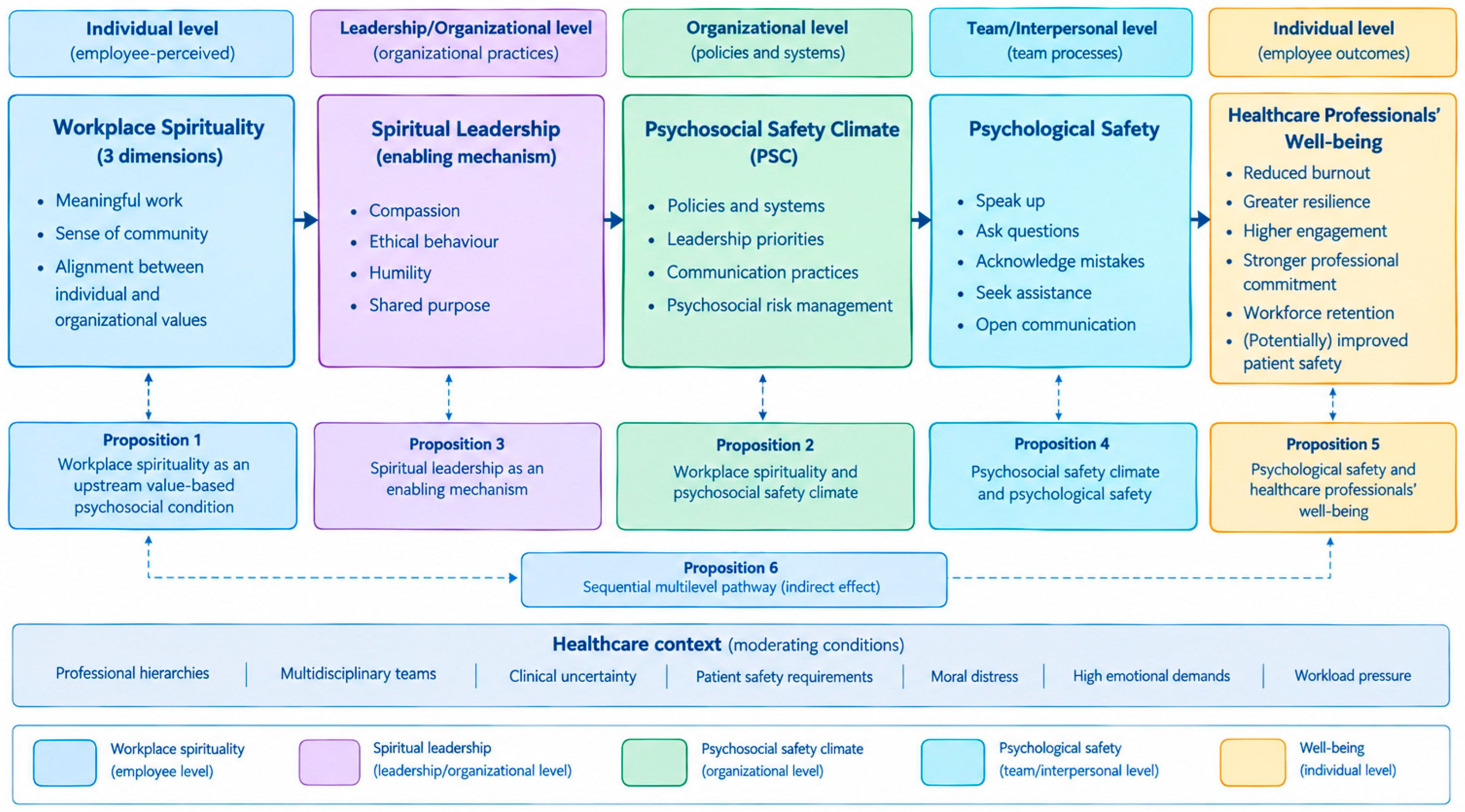
Accordingly, this conceptual paper develops an integrative multilevel framework explaining how workplace spirituality may contribute to healthcare professionals’ well-being through interconnected leadership, organizational, and interpersonal processes. Drawing upon workplace spirituality theory, psychosocial safety climate, psychological safety, spiritual leadership, Self-Determination Theory, and the Job Demands–Resources model, we propose that workplace spirituality functions as an upstream value-based psychosocial condition that may be translated through spiritual leadership into organizational priorities and practices supporting psychosocial safety climate. A positive psychosocial safety climate may subsequently provide an organizational foundation for psychological safety within healthcare teams, enabling healthcare professionals to engage in open communication, learning, adaptive coping, and help-seeking behaviors that may strengthen well-being while reducing burnout and emotional exhaustion.
By bringing together theoretical perspectives that have often been examined separately, this paper makes three related contributions. First, it shifts attention from documenting associations between workplace spirituality and employee outcomes towards explaining the organizational and interpersonal processes through which these associations may emerge. Second, it positions psychosocial safety climate as an organizational bridge between value-based workplace conditions and interpersonal psychological safety. Third, it conceptualizes spiritual leadership as an enabling mechanism through which value-based principles may be translated into leadership behaviors and organizational practices, while recognizing that workplace spirituality and spiritual leadership may also be mutually reinforcing in practice. The proposed framework therefore offers a theoretically grounded basis for future empirical research examining the directionality, mechanisms, and boundary conditions of these relationships and may inform healthcare organizations seeking to create psychologically healthy and sustainable workplaces.
The theoretical contribution of this paper does not rest on introducing a new construct or claiming that the individual relationships among workplace spirituality, spiritual leadership, psychosocial safety climate, psychological safety, and well-being have not previously been examined. Rather, the contribution lies in their theoretically specified integration across organizational and interpersonal levels. Existing workplace spirituality research has frequently examined direct associations with outcomes such as well-being, job satisfaction, engagement, commitment, and burnout, while mediation studies have commonly focused on individual-level psychological or attitudinal mechanisms. The present framework extends this literature by proposing that workplace spirituality may function as an upstream value-based psychosocial condition whose effects may be translated through leadership and organizational psychosocial conditions before becoming reflected in proximal interpersonal experiences of psychological safety and, ultimately, employee well-being.
A particularly important distinction concerns the role of PSC. PSC is not treated as another form of supportive leadership or as an alternative indicator of psychological safety. Rather, PSC captures shared perceptions of organizational management priorities, policies, and practices concerning the protection of employees’ psychological health. Its inclusion therefore provides an organizational-level mechanism through which value-based leadership and workplace conditions may become reflected in the broader psychosocial environment. Psychological safety operates at a more proximal interpersonal or team level, concerning employees’ perceptions of whether they can speak up, seek help, acknowledge uncertainty or mistakes, and express concerns without fear of interpersonal consequences. By connecting these levels, the framework seeks to explain how value-based workplace experiences may be translated into organizational and interpersonal conditions relevant to healthcare professionals’ well-being.
Accordingly, the proposed framework should be understood as a conceptual integration of established constructs rather than as a claim of an entirely new theory. Its added value lies in specifying a multilevel explanatory pathway and identifying theoretically meaningful points at which translation, reinforcement, or disruption may occur. This formulation also creates empirically testable questions concerning cross-level relationships, temporal ordering, reciprocal processes, and contextual boundary conditions. The framework is intended as a conceptual model that organizes theoretically plausible relationships rather than as an established causal model. Its principal theoretical contribution lies in addressing a gap between two bodies of literature that have often been considered separately: workplace spirituality research, which has frequently emphasized direct or individual-level associations with employee outcomes, and organizational psychosocial research, which has examined leadership, psychosocial safety climate, and psychological safety without explicitly incorporating workplace spirituality as a value-based upstream condition. The present framework connects these perspectives by specifying how value-based workplace experiences may be translated through leadership and organizational psychosocial conditions into proximal interpersonal processes relevant to employee well-being.
This distinction is important because the framework is not simply a rearrangement of existing constructs. Each component addresses a different explanatory level and mechanism: workplace spirituality represents the value-based psychosocial condition; spiritual leadership represents a leadership-level translation mechanism; PSC represents the organizational-level prioritization of psychological health; psychological safety represents the proximal interpersonal condition governing voice and interpersonal risk; and well-being represents the individual-level outcome. The proposed contribution is therefore the specification of a multilevel translation pathway that can be empirically distinguished from direct workplace spirituality effects, predominantly individual-level mediation models, and alternative leadership-centred pathways.
Conceptual Framework Development Approach
This article uses a conceptual theory-building approach rather than a systematic or scoping review methodology. Accordingly, the objective was not to provide an exhaustive synthesis of all literature concerning workplace spirituality, leadership, psychosocial safety, or healthcare well-being. Instead, the framework was developed through an iterative conceptual synthesis of established theoretical and empirical literature selected for its relevance to the proposed explanatory problem: how value-based workplace experiences may become connected to healthcare professionals’ well-being through organizational and interpersonal mechanisms.
The selection of constructs was guided by two principles: conceptual relevance and non-redundant explanatory function. Five linked domains were therefore incorporated: workplace spirituality, spiritual leadership, psychosocial safety climate, psychological safety, and healthcare professionals’ well-being and workforce-related outcomes. These constructs were selected because they address different but potentially connected levels of the proposed process.
The theoretical perspectives used in the framework were selected according to their explanatory contribution rather than to maximize the number of theories included. Workplace spirituality provides the conceptual basis for understanding meaning, community, and alignment between individual and organizational values. Spiritual leadership provides a leadership perspective on how values may be enacted and translated into organizational practices. Psychosocial safety climate provides an organizational-level perspective on management priorities and practices concerning psychological health. Psychological safety provides an interpersonal perspective on voice, help-seeking, error disclosure, and interpersonal risk. Self-determination theory provides a complementary explanation for the motivational relevance of meaning, relatedness, and value congruence, whereas the Job Demands–Resources perspective situates these processes within broader workplace demands and resources.
The proposed relationships were established through integration of established construct definitions, prior theoretical arguments, empirical findings, and conceptual compatibility across levels of analysis. Importantly, the framework distinguishes between relationships supported by previous literature and relationships that constitute the authors’ proposed conceptual synthesis. The directional sequence presented in the framework therefore represents a theoretically specified pathway for future empirical testing rather than an established causal model. Alternative and reciprocal relationships were also considered and are discussed as important directions for future research.
In the following sections, the theoretical foundations and conceptual relationships underlying the proposed framework are examined in greater detail.
3. Psychological Safety as a Mechanism Linking Workplace Spirituality and Healthcare Professionals’ Well-Being
Psychological safety has become one of the most influential concepts for understanding employee behavior, learning, and well-being within complex organizational environments. Rather than reflecting individual confidence alone, psychological safety represents an important characteristic of workplace relationships and organizational culture that enables constructive interpersonal risk-taking [24]. While psychological safety is classically conceptualized as a shared team-level belief, it is also frequently assessed through individual employees’ perceptions of interpersonal risk within their teams. In contrast, psychosocial safety climate reflects broader organizational priorities and systems related to protecting psychological health [18,51]. Distinguishing these concepts is essential because organizational commitment to psychological health does not automatically guarantee that employees experience their immediate team environment as safe.
Unlike traditional notions of workplace safety, which primarily concern physical hazards and accident prevention, psychological safety focuses on the social and interpersonal conditions that enable employees to participate fully within organizations [52]. It reflects whether employees perceive that their workplace supports openness, respect, inclusion, and honest communication. This distinction is particularly important within healthcare, where safe patient care depends not only on technical competence but also on effective teamwork, continuous learning, and willingness to speak up when concerns arise [29,30].
Healthcare professionals operate within complex systems characterized by heavy workloads, emotional labor, uncertainty, frequent exposure to adverse events, and hierarchical professional structures [53]. Within these environments, psychological safety becomes particularly important because high-quality care depends upon employees’ willingness to communicate concerns, question decisions, report mistakes, seek assistance, and share knowledge. When psychological safety is lacking, professionals may remain silent because of fear of blame, reputational damage, or negative career consequences. Such silence limits learning, weakens teamwork, and may compromise both patient safety and employee well-being [24,54].
Consistent evidence demonstrates that psychologically safe workplaces are associated with healthier organizational outcomes. Employees who perceive higher psychological safety report stronger trust, greater work engagement, better collaboration, and lower burnout and turnover intentions [55,56]. Within healthcare, psychological safety has increasingly been recognized as an important protective psychosocial condition that may reduce exposure to occupational stress and emotional exhaustion. For example, Wang et al. [57] demonstrated that psychological safety mediated the relationship between servant leadership and burnout, suggesting that supportive leadership reduces psychological strain by creating environments where employees feel respected and protected.
More recent evidence further reinforces this protective role. A scoping review by Sato et al. [58] identified a consistent inverse relationship between psychological safety and burnout among nurses, concluding that psychologically safe work environments may have a protective role, particularly within high-intensity clinical settings. Similarly, Cogan et al. [59] demonstrated that both individual and team psychological safety were associated with lower burnout and acute stress among health and social care workers, with team-level psychological safety showing particularly strong associations with workforce well-being. Collectively, these findings suggest that psychological safety is not simply beneficial for communication and learning but also represents an important determinant of healthcare workforce sustainability.
Existing literature has primarily conceptualized psychological safety as a consequence of leadership, communication practices, and team dynamics. Inclusive leadership, supportive interpersonal relationships, trust, employee voice, and non-punitive responses to mistakes have consistently been identified as important antecedents of psychological safety [40,54]. Importantly, psychological safety should not be interpreted as the absence of disagreement or conflict. Rather, psychologically safe environments encourage constructive challenge, questioning, and learning because employees believe that differing opinions and honest discussion will be treated respectfully.
While these antecedents are well established, comparatively less attention has been devoted to the broader organizational values that make psychologically safe environments possible. This represents an important theoretical gap because leadership behaviors and communication practices rarely develop independently of the organizational values that shape them. Workplace spirituality may therefore provide an important upstream value-based psychosocial context within which psychological safety develops.
Conceptually, workplace spirituality and psychological safety share several underlying relational principles. Meaningful work reinforces employees’ perceptions that their contributions are valued [59]; sense of community strengthens interpersonal trust and belonging [60]; and values alignment promotes authenticity, integrity, and mutual respect [61]. Together, these characteristics may create organizational environments in which employees feel accepted, supported, and psychologically secure. In this way, workplace spirituality may not influence employee well-being directly alone, but indirectly by strengthening the interpersonal conditions necessary for psychological safety to emerge.
Emerging empirical evidence provides preliminary support for this proposition. Pahuja et al. [18] found that dimensions of workplace spirituality significantly predicted psychosocial safety climate, providing preliminary empirical evidence consistent with the proposed association between workplace spirituality and PSC. However, this finding does not establish that workplace spirituality necessarily produces positive PSC, nor does it by itself establish the sequential pathway proposed in this paper. Similarly, workplace spirituality may strengthen positive emotional experiences such as gratitude, hope, and compassion, which according to broaden-and-build theory [61,62] expand individuals’ psychological resources and strengthen interpersonal relationships during periods of stress. Within healthcare, where professionals frequently encounter emotionally demanding situations and moral challenges, these positive relational resources may provide an important foundation for psychological safety.
Taken together, the existing literature suggests that workplace spirituality, psychosocial safety climate, and psychological safety should not be viewed as independent organizational constructs but as conceptually distinct and potentially interconnected processes operating at different levels of organizational functioning. Workplace spirituality provides a value-based context characterized by meaningful work, sense of community, and alignment between individual and organizational values; spiritual leadership may translate these values into leadership behaviors and organizational practices; psychosocial safety climate reflects shared perceptions that organizational systems and leadership prioritize psychological health; and psychological safety reflects the proximal interpersonal experience that employees can take interpersonal risks without fear of negative consequences (Table 1). Building on this integration, the following sections propose a multilevel conceptual framework explaining how workplace spirituality may contribute to healthcare professionals’ well-being through the proposed sequential development of supportive organizational and interpersonal conditions.
Table 1.
Conceptual Definitions and Levels of Analysis of Key Constructs.
These relationships may be particularly consequential in healthcare because clinical work combines high emotional demands with professional hierarchies, multidisciplinary interdependence, clinical uncertainty, and substantial responsibility for patient safety [29,30]. Hierarchical structures may make it difficult for junior or less powerful professionals to question decisions or disclose concerns, while multidisciplinary care requires frequent communication across professional boundaries [31]. Similarly, exposure to suffering, ethical conflict, adverse events, and situations in which available resources do not align with professional values may challenge healthcare professionals’ sense of meaning and contribute to moral distress. Within this context, value-based organizational conditions may be particularly relevant when they are translated into leadership practices and psychosocial climates that legitimize speaking up, seeking assistance, acknowledging uncertainty, and learning from adverse events. Thus, the healthcare context is not merely the empirical setting for the proposed framework but provides a theoretically important context in which the proposed mechanisms may become especially salient.
5. Practical Implications
The proposed framework has important implications for healthcare leaders, managers, and organizational policymakers seeking to promote sustainable workforce well-being. While workplace spirituality has traditionally been discussed primarily as an individual experience of meaning, connection, and personal fulfilment [37,38,39], the present framework suggests that its organizational relevance lies in the extent to which these experiences are supported and translated into everyday leadership practices, workplace systems, and relational processes. Accordingly, workplace spirituality should not be treated as a discrete organizational asset or as a substitute for adequate staffing, fair working conditions, or other structural resources. Rather, it may function as a value-based psychosocial condition that helps shape the relational and organizational environments in which healthcare professionals work.
Importantly, healthcare organizations should not attempt to promote spirituality through symbolic statements, isolated initiatives, or abstract organizational values. Instead, the framework suggests that the potential benefits of workplace spirituality depend on the consistency between organizational values and employees’ everyday experiences. Meaning, belonging, and value alignment are more likely to contribute to positive outcomes when they are reflected in leadership behavior, organizational policies, and practices that demonstrate respect, compassion, fairness, inclusion, and genuine concern for psychological health [74]. Conversely, symbolic or imposed forms of spirituality may have limited value, particularly when they coexist with punitive management, excessive workload, or inadequate organizational support.
A first implication concerns leadership development. Because spiritual leadership represents a key mechanism through which value-based principles may be translated into organizational practices [63], healthcare organizations should support leadership approaches characterized by compassion, ethical integrity, humility, and shared purpose. Leaders who actively listen, acknowledge employee contributions, respond constructively to concerns, and demonstrate genuine concern for staff well-being may help translate workplace spirituality into a psychosocial safety climate by signaling that psychological health is an organizational priority. These leadership behaviors may also strengthen trust and psychological safety by making it more acceptable for employees to express concerns, ask for assistance, and acknowledge uncertainty.
Second, healthcare organizations should develop structured opportunities that enable reflection, meaning reconstruction, and emotional processing. Healthcare professionals frequently encounter suffering, ethical challenges, adverse events, and emotionally demanding situations that may threaten their sense of purpose and professional identity [32,68]. Reflective practice groups, facilitated team discussions, clinical debriefings, and opportunities to discuss ethical concerns may help sustain experiences of meaningful work and professional connection, while also providing psychologically safer spaces in which difficult experiences can be discussed. Such initiatives should be integrated into routine organizational processes rather than implemented as isolated wellness activities.
Third, organizations should strengthen peer-support mechanisms and relational resources. Because workplace spirituality emphasizes community and belonging [17,18,19,20], supportive relationships among colleagues represent an important pathway through which healthcare professionals experience connection and protection during periods of stress. Peer-support programs may reduce isolation, facilitate adaptive coping, and provide opportunities for shared emotional processing following difficult clinical experiences. Their effectiveness is likely to depend on whether participation is voluntary, trusted, adequately supported, and embedded within a broader organizational culture that values openness and psychological health.
Fourth, healthcare organizations should promote cultures of learning rather than blame. Psychological safety requires that employees feel able to report concerns, discuss mistakes, and seek assistance without fear of punishment or humiliation [24]. Therefore, responses to errors and challenging situations should prioritize improvement, reflection, and collective learning rather than individual blame. Organizational responses to adverse events should distinguish learning-oriented accountability from punitive responses to human error. Such approaches may strengthen psychological safety and encourage speaking up, help-seeking, error reporting, and knowledge sharing, thereby supporting both workforce well-being and patient safety.
Finally, psychological safety should be incorporated into broader workforce sustainability strategies. Creating environments where healthcare professionals feel confident speaking up, questioning decisions, and acknowledging uncertainty is not only relevant for employee well-being but also essential for improving teamwork, learning, and the quality and safety of healthcare delivery in different cultural contexts [31]. From the perspective of the proposed framework, psychological safety represents a proximal mechanism through which broader organizational conditions may influence everyday employee behaviors and, ultimately, workforce outcomes. Consequently, interventions aimed at workforce sustainability should consider not only workload and staffing pressures but also whether organizational systems and leadership practices enable employees to use relational and psychological resources effectively.
6. Limitations and Future Research Directions
6.1. Limitations
Several limitations should be acknowledged. First, the proposed framework is conceptual and does not provide empirical evidence for the direction, magnitude, or causal nature of the relationships proposed. The sequential pathway from workplace spirituality through spiritual leadership, psychosocial safety climate, and psychological safety should therefore be interpreted as a theoretically informed proposition rather than an established causal process. In particular, workplace spirituality and spiritual leadership may be reciprocally related in practice, and future longitudinal research is required to determine temporal ordering.
Second, conceptual and measurement boundaries between the constructs require careful consideration. Workplace spirituality overlaps to some extent with related concepts such as meaningful work, organizational identification, organizational culture, belonging, ethical leadership, compassion, and work engagement. The present framework addresses this issue by retaining the established three-dimensional formulation of workplace spirituality and explicitly distinguishing it from these related constructs; however, empirical research will still need to establish discriminant validity using theoretically distinct and validated measures.
Third, the proposed multilevel relationships present methodological challenges. Workplace spirituality is primarily conceptualized as an employee-perceived experience, PSC as an organizational-level climate, psychological safety as a team-level or interpersonal perception, and well-being and burnout as individual-level outcomes. Cross-level relationships should therefore not be assumed without appropriate evidence of within-group agreement, aggregation, and temporal ordering. In particular, the proposed organizational-to-team translation from PSC to psychological safety requires empirical examination rather than being treated as automatic.
Finally, the framework may not operate uniformly across healthcare settings, professional groups, or cultural contexts. Organizational hierarchy, workload, leadership structures, professional norms, multidisciplinary interdependence, and cultural understandings of spirituality and communication may influence the strength and direction of the proposed relationships. The framework should therefore be regarded as a theoretically transferable model whose assumptions require empirical examination across diverse healthcare contexts rather than as a universal explanatory model.
6.2. Future Research Directions
Although research on workplace spirituality, psychological safety, psychosocial safety climate, and healthcare workforce well-being continues to expand, several important questions remain unresolved. Future research should therefore move beyond demonstrating associations between individual constructs and empirically examine the multilevel, temporal, and contextual processes proposed by the present framework. In particular, future studies should determine whether the proposed sequence from workplace spirituality to spiritual leadership and organizational practices, psychosocial safety climate, psychological safety, and workforce outcomes is supported by longitudinal and multilevel evidence, while also examining alternative and reciprocal explanations.
First, longitudinal research is needed to examine the temporal ordering of the proposed relationships. Existing research provides evidence of associations between workplace spirituality, leadership, psychosocial safety climate, psychological safety, and employee outcomes; however, cross-sectional designs cannot establish whether changes in one construct precede changes in another. Longitudinal studies should therefore examine whether changes in workplace spirituality and leadership practices are followed by changes in psychosocial safety climate and psychological safety and whether these changes are subsequently associated with changes in well-being, burnout, and other workforce outcomes. Such designs should also test competing temporal orderings, including whether spiritual leadership precedes changes in workplace spirituality, whether psychological safety subsequently influences perceptions of organizational climate, and whether employee well-being influences later perceptions of workplace spirituality, leadership, or psychological safety. This approach would allow researchers to distinguish the focal conceptual ordering from reciprocal or alternative temporal relationships.
Second, future research should employ multilevel designs that correspond to the conceptual levels of the framework. Because workplace spirituality, spiritual leadership, psychosocial safety climate, and psychological safety represent conceptually distinct phenomena that may operate at different levels, studies should avoid treating all variables as if they were individual-level constructs. Future research could examine workplace spirituality primarily as an employee-perceived experience, spiritual leadership at the leadership or organizational level, psychosocial safety climate at the organizational level, psychological safety at the team or interpersonal level, and well-being and burnout at the individual level. Multilevel structural equation modelling, cross-level modelling, and longitudinal multilevel approaches may provide appropriate methods for examining whether organizational-level conditions are associated with team-level psychological processes and, subsequently, individual-level outcomes. Where employee perceptions are aggregated to team or organizational levels, researchers should also establish appropriate within-group agreement and aggregation statistics.
Third, mixed-methods research is needed to examine how the proposed constructs are experienced and enacted in everyday healthcare practice. Quantitative research can test associations, temporal relationships, and multilevel pathways, whereas qualitative research can examine how healthcare professionals interpret concepts such as meaning, belonging, value alignment, compassion, trust, leadership, and psychological safety within specific clinical contexts. This is particularly important because workplace spirituality may not be experienced uniformly across professional groups or organizational settings. Qualitative and mixed-methods studies could therefore examine whether the three dimensions of workplace spirituality—meaningful work, sense of community, and alignment between individual and organizational values—are interpreted similarly across professions, clinical environments, and organizational contexts, and how these experiences interact with leadership and organizational practices.
Fourth, future research should examine contextual and cross-cultural boundary conditions. Experiences of spirituality, leadership, communication, psychological safety, and organizational values may vary across healthcare systems, professional groups, cultures, and organizational structures. Rather than assuming that the proposed relationships are universal, researchers should examine whether cultural values, professional norms, organizational hierarchy, workload, staffing conditions, and available organizational resources alter the strength or direction of specific relationships within the framework. Such research may clarify the circumstances under which value-based workplace experiences are successfully translated into organizational and interpersonal conditions and the circumstances in which these processes are disrupted.
Fifth, intervention and implementation research should examine whether the mechanisms identified in the framework can be influenced in practice. Future studies could evaluate leadership development programs, reflective practices, peer-support initiatives, team-based psychological safety interventions, and organizational strategies designed to strengthen meaningful work, belonging, value alignment, and psychologically healthy working conditions. Intervention studies should distinguish between interventions directed at individual experiences and those directed at leadership, organizational policies, or team processes, because improvements at one level may not necessarily produce corresponding changes at another level. Longitudinal follow-up would also be important for determining whether changes in psychological safety, psychosocial safety climate, and workforce well-being are sustained and whether intervention effects vary according to baseline working conditions and organizational context.
Finally, future empirical studies should directly compare the proposed framework with alternative theoretical models rather than testing the focal pathway in isolation. In particular, researchers could compare the proposed WPS → spiritual leadership → PSC → psychological safety → well-being sequence with models in which spiritual leadership precedes workplace spirituality, workplace spirituality and spiritual leadership have parallel relationships with PSC, or psychological safety contributes independently to well-being without requiring the full upstream sequence. Studies could also examine whether PSC and psychological safety operate as sequential, partially independent, or reciprocal processes and whether employee well-being subsequently influences perceptions of workplace spirituality, leadership, and organizational climate. Comparing these alternative specifications would help determine whether the proposed multilevel pathway provides explanatory value beyond direct, parallel, reverse-direction, or reciprocal models.
The framework therefore provides a set of empirically testable questions rather than an established causal or mediation model. Future studies should assess whether the proposed relationships represent direct associations, sequential indirect pathways, reciprocal processes, or context-dependent relationships. Longitudinal multilevel modelling and multilevel structural equation modelling may be particularly useful for examining these possibilities, provided that the temporal ordering, level of analysis, aggregation assumptions, and relevant contextual moderators are appropriately specified. Such research would provide a stronger basis for determining how value-based workplace experiences, leadership practices, organizational psychosocial conditions, and interpersonal psychological processes interact to influence healthcare professionals’ well-being and workforce sustainability.
7. Conclusions
Workplace spirituality may provide an important value-based foundation for understanding healthcare professionals’ well-being, particularly in work environments characterized by high emotional demands, professional hierarchy, clinical uncertainty, and workforce pressures. This conceptual paper proposes that the relationship between workplace spirituality and well-being is not necessarily direct, but may operate through organizational and interpersonal processes. Specifically, the framework positions spiritual leadership as an enabling mechanism through which value-based principles may be translated into organizational practices and psychosocial safety climate, which may in turn support psychological safety within healthcare teams.
By integrating workplace spirituality, spiritual leadership, psychosocial safety climate, and psychological safety, the framework provides a multilevel perspective on how meaning, community, and alignment between individual and organizational values may become connected to healthier workplace experiences. The contribution of the present paper should be understood as a conceptual integration rather than the development of a new standalone theory. The proposed relationships remain conceptual and require empirical testing, particularly through longitudinal and multilevel research that can examine directionality, reciprocal relationships, and contextual conditions. Nevertheless, the framework offers a basis for future research and for healthcare organizations seeking to foster workplaces characterized by meaning, trust, openness, psychological safety, and sustainable workforce well-being.
Author Contributions
Conceptualization, P.T. and V.G.; investigation, P.T.; writing—original draft preparation, P.T. and V.G.; writing—review and editing, P.T. and V.G. All authors have read and agreed to the published version of the manuscript.
Funding
This research received no external funding.
Institutional Review Board Statement
Not applicable.
Informed Consent Statement
Not applicable.
Data Availability Statement
No new data were created or analyzed in this study. Data sharing is not applicable to this article.
Acknowledgments
During the preparation of this manuscript, the authors used ChatGPT (OpenAI, version GPT-4) for the purpose of presenting the framework in Figure 1. The authors have reviewed and edited the output and take full responsibility for the content of this publication.
Conflicts of Interest
The authors declare no conflicts of interest.
References
- World Health Organization. Everybody’s Business: Strengthening Health Systems to Improve Health Outcomes: WHO’s Framework for Action; World Health Organization: Geneva, Switzerland, 2007; pp. 1–56. [Google Scholar]
- Kok, M.C.; Dieleman, M.; Taegtmeyer, M.; Broerse, J.E.; Kane, S.S.; Ormel, H.; Tijm, M.M.; de Koning, K.A.M. Which intervention design factors influence performance of community health workers in low- and middle-income countries? A systematic review. Health Policy Plan. 2015, 30, 1207–1227. [Google Scholar] [CrossRef] [Scilit] [PubMed]
- Franco, C.M.; Lima, J.G.; Giovanella, L. Primary healthcare in rural areas: Access, organization, and health workforce in an integrative literature review. Cad. Saúde Pública 2021, 37, e00310520. [Google Scholar] [CrossRef] [Scilit] [PubMed]
- Desborough, J.; Dykgraaf, S.H.; Phillips, C.; Wright, M.; Maddox, R.; Davis, S.; Kidd, M. Lessons for the global primary care response to COVID-19: A rapid review of evidence from past epidemics. Fam. Pract. 2021, 38, 811–825. [Google Scholar] [CrossRef] [Scilit] [PubMed]
- Buchan, J.; Williams, G.A.; Zapata, T. Governing health workforce responses during COVID-19. Eurohealth 2021, 27, 41–48. Available online: https://iris.who.int/server/api/core/bitstreams/1c4abdba-6bb3-4e0d-8676-53c5221a3aa2/content (accessed on 20 August 2026). [CrossRef] [Scilit] [PubMed]
- Lombardi, B.; Jensen, T.; Galloway, E.; Fraher, E. Trends in workplace violence for health care occupations and facilities over the last 10 years. Health Aff. Sch. 2024, 2, qxae134. [Google Scholar] [CrossRef] [Scilit] [PubMed]
- Ullah, H.; Arbab, S.; Khan, S.A.; Liu, C.Q.; Fayaz, M.; Tian, Y.; Li, K. Work-related stress, professional respect, and psychological counseling among nurses: A cross-sectional study. J. Nurs. Manag. 2025, 2025, 2413658. [Google Scholar] [CrossRef] [Scilit] [PubMed]
- Izdebski, Z.; Kozakiewicz, A.; Białorudzki, M.; Dec-Pietrowska, J.; Mazur, J. Occupational burnout in healthcare workers, stress and other symptoms of work overload during the COVID-19 pandemic in Poland. Int. J. Environ. Res. Public Health 2023, 20, 2428. [Google Scholar] [CrossRef] [Scilit] [PubMed]
- Fronteira, I.; Mathews, V.; dos Santos, R.L.B.; Matsumoto, K.; Amde, W.; Pereira, A.; de Oliveira, A.P.C.; Craveiro, I.; Chança, R.; Boniol, M.; et al. Impacts for health and care workers of Covid-19 and other public health emergencies of international concern: Living systematic review, meta-analysis and policy recommendations. Hum. Resour. Health 2024, 22, 10. [Google Scholar] [CrossRef] [Scilit] [PubMed]
- Chireh, B.; Essien, S.K.; Swerhun, K.; D’Arcy, C.; Acharibasam, J.W. Workplace stressors and mental health outcomes among personal support workers: A systematic review. Int. J. Nurs. Stud. 2025, 168, 105093. [Google Scholar] [CrossRef] [Scilit] [PubMed]
- Garcia, C.L.; Abreu, L.C.; Ramos, J.L.S.; Castro, C.F.D.; Smiderle, F.R.N.; Santos, J.A.D.; Bezerra, I.M.P. Influence of burnout on patient safety: Systematic review and meta-analysis. Medicina 2019, 55, 553. [Google Scholar] [CrossRef] [Scilit] [PubMed]
- Donisa, E.; Roșu, T.S.; Roșu, V.E.; Cărăușu, E.M. Systemic burnout in healthcare: A conceptual multilevel framework of workforce erosion and institutional fragility. Healthcare 2026, 14, 1812. [Google Scholar] [CrossRef] [Scilit] [PubMed]
- Yang, L.; Lei, Y.; Zhang, R.; Mukhtar, F.; Lim, P.Y.; Jiang, J.; Li, Z.; Zhang, Y.; Anita, A.R. Common antecedents and outcomes of burnout among healthcare workers in the emergency department: A scoping review. Am. J. Emerg. Med. 2025, 96, 140–150. [Google Scholar] [CrossRef] [Scilit] [PubMed]
- de Vries, N.; de Winter, P.; Drost-Goossens, S.; Vermeulen, H.; van Oostveen, C. Key factors associated with nurse retention and how they work: A mixed-methods study. Int. J. Nurs. Stud. Adv. 2026, 10, 100480. [Google Scholar] [CrossRef] [Scilit] [PubMed]
- Staniškienė, E.; Stankevičiūtė, Ž.; Daunorienė, A.; Ramanauskaitė, J. Fostering resilience among nurses: The impact of organisational resources on work satisfaction. Sustainability 2026, 18, 4855. [Google Scholar] [CrossRef] [Scilit]
- Ramalisa, R.J.; du Plessis, E.; Koen, M.P. Increasing coping and strengthening resilience in nurses providing mental health care: Empirical qualitative research. Health SA Gesondheid 2018, 23, 1094. [Google Scholar] [CrossRef] [Scilit] [PubMed]
- Ahmed, R.R.; Soomro, F.A.; Channar, Z.A.; Hashem, E.A.R.; Soomro, H.A.; Pahi, M.H.; Md Salleh, N.Z. Relationship between different dimensions of workplace spirituality and psychological well-being: Measuring mediation analysis through conditional process modeling. Int. J. Environ. Res. Public Health 2022, 19, 11244. [Google Scholar] [CrossRef] [Scilit] [PubMed]
- Pahuja, S.; Garg, P.; Punia, B.K. Workplace spirituality and psychosocial safety climate: Moderating role of gratitude. J. Hum. Values 2025, 31, 223–240. [Google Scholar] [CrossRef] [Scilit]
- Lee, E.H.; Yu, H.J. Effects of perceived spiritual management, work engagement, and organizational commitment on job satisfaction among clinical nurses: The mediating role of perceived spiritual management. BMC Nurs. 2023, 22, 462. [Google Scholar] [CrossRef] [Scilit] [PubMed]
- Syahir, A.N.A.; Abidin, M.S.Z.; Sa’ari, C.Z.; Rahman, M.Z.A. Workplace spirituality and its impact on employee well-being: A systematic literature review of global evidence. J. Relig. Health 2025, 64, 3313–3345. [Google Scholar] [CrossRef] [Scilit] [PubMed]
- Ahmed, M.F.; AbdElhay, E.S.; Abd-ElGhani, A.M. Workplace spirituality as a predictor of nursing self-efficacy and job embeddedness. BMC Nurs. 2026, 25, 300. [Google Scholar] [CrossRef] [Scilit] [PubMed]
- Zammitti, A.; Russo, A.; Magnano, P.; Guarnera, M. Work Engagement as a Moderating Factor between Positive Attitude toward Smart Working and Job and Life Satisfaction. Eur. J. Investig. Health Psychol. Educ. 2022, 12, 781–791. [Google Scholar] [CrossRef] [Scilit] [PubMed]
- Lysova, E.I.; Fletcher, L. Meaningful Work: An Organizational Psychology and Organizational Behavior Perspective. In Work Meaning and Motivation; Nikolova, M., Ed.; Springer: Cham, Switzerland, 2026. [Google Scholar] [CrossRef] [Scilit]
- Edmondson, A. Psychological safety and learning behavior in work teams. Adm. Sci. Q. 1999, 44, 350–383. [Google Scholar] [CrossRef] [Scilit]
- Konečná, L.; Lisá, E.; Čiriková, V. The role of leadership in shaping psychological safety: A qualitative study from Slovakia. Sci. Rep. 2026, 16, 7249. [Google Scholar] [CrossRef] [Scilit] [PubMed]
- Hirvikallio, J.; Haaranen, A.; Hult, M. Psychological safety, social support, and commitment among nurse managers: A cross-sectional study. Nord. J. Nurs. Res. 2024, 44, 20571585241238844. [Google Scholar] [CrossRef] [Scilit]
- Dheer, R.; Terpstra-Tong, J.; Treviño, L.; Ralston, D.A.; Tjemkes, B.; Sigala Paparella, L.; Crowley-Henry, M.; Burns, C.; Froese, F.; Poeschl, G.; et al. Impact of organizational culture on employee psychological safety perception: The pivotal role of trust in top management across 18 societies. Int. Bus. Rev. 2026, 35, 102523. [Google Scholar] [CrossRef] [Scilit]
- Loh, M.Y.; Lee, M.C.C.; Dollard, M.; Gardner, D.; Kikunaga, K.; Tondokoro, T.; Nakata, A.; Idris, M.A.; Bentley, T.; Afsharian, A.; et al. The Generality of Psychosocial Safety Climate Theory—A Fundamental Element for Global Worker Well-Being: Evidence From Four Nations. Stress Health 2025, 41, e70070. [Google Scholar] [CrossRef] [Scilit] [PubMed]
- Pradelli, L.; Risoli, C.; Summer, E.; Bellini, G.; Mozzarelli, F.; Anderson, G.; Guasconi, M.; Artioli, G.; Bonacaro, A.; Sarli, L. Healthcare professional perspective on barriers and facilitators of multidisciplinary team working in acute care setting: A systematic review and meta-synthesis. BMJ Open 2025, 15, e087268. [Google Scholar] [CrossRef] [Scilit] [PubMed]
- Meneses-La-Riva, M.E.; Fernández-Bedoya, V.H.; Suyo-Vega, J.A.; Ocupa-Cabrera, H.G.; Grijalva-Salazar, R.V.; Ocupa-Meneses, G.D.D. Enhancing healthcare efficiency: The relationship between effective communication and teamwork among nurses in Peru. Nurs. Rep. 2025, 15, 59. [Google Scholar] [CrossRef] [Scilit] [PubMed]
- Weller, J.M.; Mahajan, R.; Fahey-Williams, K.; Webster, C.S. Teamwork matters: Team situation awareness to build high-performing healthcare teams, a narrative review. Br. J. Anaesth. 2024, 132, 771–778. [Google Scholar] [CrossRef] [Scilit] [PubMed]
- Giannouli, V. Business ethics in healthcare: The case of Greece. In Research Anthology on Business Law, Policy, and Social Responsibility; IGI Global Scientific Publishing: Hershey, PA, USA, 2024; pp. 115–137. [Google Scholar] [CrossRef] [Scilit]
- Evans, A.; Bor, R. Working in a healthcare setting: Professional and ethical challenges. In Handbook of Professional and Ethical Practice for Psychologists, Counsellors and Psychotherapists; Routledge/Taylor & Francis Group: New York, NY, USA, 2015; pp. 147–157. [Google Scholar]
- Tsukamoto, S.A.S.; Galdino, M.J.Q.; Barreto, M.F.C.; Martins, J.T. Burnout syndrome and workplace violence among nursing staff: A cross-sectional study. Sao Paulo Med. J. Rev. Paul. Med. 2022, 140, 101–107. [Google Scholar] [CrossRef] [Scilit] [PubMed]
- Varytis, A.; Giannouli, V. Workplace mobbing, group cohesion and intraindividual variables in nurses from a rural hospital in Northern Greece: A correlation study. Work. 2023, 76, 1255–1261. [Google Scholar] [CrossRef] [Scilit] [PubMed]
- Liang, Y.; Peng, H.; Luo, X.; Wang, M.; Zhang, Y.; Huang, H.; Zhu, J.; Chen, M.; Tian, W.; Mo, J.; et al. The impact of health emergencies on nurses’ burnout: A systematic review and meta-analysis. BMC Public Health 2025, 25, 2847. [Google Scholar] [CrossRef] [Scilit] [PubMed]
- Ashmos, D.P.; Duchon, D. Spirituality at work: A conceptualization and measure. J. Manag. Inq. 2000, 9, 134–145. [Google Scholar] [CrossRef] [Scilit]
- Milliman, J.; Czaplewski, A.J.; Ferguson, J. Workplace spirituality and employee work attitudes: An exploratory empirical assessment. J. Organ. Change Manag. 2003, 16, 426–447. [Google Scholar] [CrossRef] [Scilit]
- Pawar, B.S. Workplace spirituality and employee well-being: An empirical examination. Empl. Relat. 2016, 38, 975–994. [Google Scholar] [CrossRef] [Scilit]
- Nöhammer, E. Meaning, needs, and workplace spirituality. Merits 2023, 3, 1–20. [Google Scholar] [CrossRef] [Scilit]
- Galanakis, M.D. Positive Psychology in the Workplace: Psychological Capital, Flourishing, Leadership, and Employee Well-Being in Contemporary Organizations. Adm. Sci. 2026, 16, 325. [Google Scholar] [CrossRef] [Scilit]
- Orgambídez, A.; Borrego, Y.; Alcalde, F.J.; Durán, A. Moral Distress and Emotional Exhaustion in Healthcare Professionals: A Systematic Review and Meta-Analysis. Healthcare 2025, 13, 393. [Google Scholar] [CrossRef] [Scilit] [PubMed]
- Case, P.; Gosling, J. The spiritual organization: Critical reflections on the instrumentality of workplace spirituality. J. Manag. Spiritual. Relig. 2010, 7, 257–282. [Google Scholar] [CrossRef] [Scilit]
- Garg, N. Workplace spirituality and employee well-being: An empirical exploration. J. Hum. Values 2017, 23, 129–147. [Google Scholar] [CrossRef] [Scilit]
- Hunsaker, W.D.; Jeong, W.S. Spiritual leadership and work-life balance. J. Manag. Spiritual. Relig. 2023, 20, 27–52. [Google Scholar] [CrossRef] [Scilit]
- Yıldız, M.S.; Börklü Doğan, Ö.; Dayan, A. The Relationship between Spiritual Leadership and Burnout Syndrome in Medical Residency Students. Turk. J. Fam. Pract. 2022, 26, 29–36. [Google Scholar] [CrossRef] [Scilit]
- Sun, Y.; Chen, S.; Li, Z.; Peng, Q.; Li, X.; Zhao, Y.; Zhou, T.; Zou, W.; Hong, X. The Impact of Spiritual Leadership on Nurses’ Spiritual Care Behavior: A Cross-Sectional Study of Chinese Nurses. Healthcare 2026, 14, 1634. [Google Scholar] [CrossRef] [Scilit] [PubMed]
- Boateng, E.A.; Ahomka Yeboah, M.; Ansong, A.; Kwao, I.T. Spiritual leadership and adaptive performance among health workers: The roles of optimism and trust. Int. J. Health Care Qual. Assur. 2026, 39, 219–235. [Google Scholar] [CrossRef] [Scilit] [PubMed]
- Dubey, S.; Bedi, S.S. Workplace spirituality: A systematic review and future research agenda. J. Manag. Spiritual. Relig. 2024, 21, 83–128. [Google Scholar] [CrossRef] [Scilit]
- Nishanthi, B.; Hariharan, C. Workplace spirituality as a psychological pathway between sustainable practices and job satisfaction: A structural equation model-based analysis in the cement sector. Acta Psychol. 2026, 265, 106667. [Google Scholar] [CrossRef] [Scilit] [PubMed]
- Idris, M.A.; Dollard, M.F.; Coward, J.; Dormann, C. Psychosocial safety climate: Conceptual distinctiveness and effect on job demands and worker psychological health. Saf. Sci. 2012, 50, 19–28. [Google Scholar] [CrossRef] [Scilit]
- Ip, E.; Srivastava, R.; Lentz, L.; Jasinoski, S.; Anderson, G.S. Antecedents of workplace psychological safety in public safety and frontline healthcare: A scoping review. Int. J. Environ. Res. Public Health 2025, 22, 820. [Google Scholar] [CrossRef] [Scilit] [PubMed]
- Edgelow, M.; Legassick, K.; Novecosky, J.; Fecica, A. Return to work experiences of Ontario public safety personnel with work-related psychological injuries. J. Occup. Rehabil. 2023, 33, 796–807. [Google Scholar] [CrossRef] [Scilit] [PubMed]
- O’Donovan, R.; Ward, M.; De Brún, A.; McAuliffe, E. Safety culture in health care teams: A narrative review of the literature. J. Nurs. Manag. 2019, 27, 871–883. [Google Scholar] [CrossRef] [Scilit] [PubMed]
- Asfour, L.; Saleh, A.M.; Abu-Wardeh, Y. The Role of Servant Leadership in Fostering Psychological Safety Among Nurses in Jordanian Hospitals. J. Nurs. Manag. 2025, 2025, 1028249. [Google Scholar] [CrossRef] [Scilit] [PubMed]
- Ma, Y.; Faraz, N.A.; Ahmed, F.; Iqbal, M.K.; Saeed, U.; Mughal, M.F.; Raza, A. Curbing nurses’ burnout during COVID-19: The roles of servant leadership and psychological safety. J. Nurs. Manag. 2021, 29, 2383–2391. [Google Scholar] [CrossRef] [Scilit] [PubMed]
- Wang, R.; Ahmad, N.; Ryu, H.B.; Comite, U.; Ariza-Montes, A.; Han, H. Healing leaders: Altruism and psychological safety as antidotes to burnout in health care settings. Soc. Behav. Personal. Int. J. 2024, 52, e13540. [Google Scholar] [CrossRef] [Scilit]
- Sato, T.; Kakuda, K.; Sekiguchi, E.; Ishiseki, M.; Iwanami, M.; Akamatsu, Y.; Taito, S. Psychological safety and burnout in nurses: A scoping review. Cureus 2025, 17, e92411. [Google Scholar] [CrossRef] [Scilit] [PubMed]
- Cogan, N.; Smith, M.; Deakin, K. Psychological safety as a predictor of acute stress, well-being and burnout in health and social care workers: A predictive correlational study. Behav. Sci. 2026, 16, 418. [Google Scholar] [CrossRef] [Scilit] [PubMed]
- Kaur, P.; Mittal, A. Meaningfulness of work and employee engagement: The role of affective commitment. Open Psychol. J. 2020, 13, 115–122. [Google Scholar] [CrossRef] [Scilit]
- Boland, E.M.; Martin, I.; Jordan, B.; Decker-Tonnesen, P.; Bhagra, A. Enhancing belonging in healthcare: A commentary on strategies for organizational leadership. J. Healthc. Leadersh. 2025, 17, 117–121. [Google Scholar] [CrossRef] [Scilit] [PubMed]
- Tian, Z.; Wen, Q.; Ding, H.; Zhu, Y. How culture values shape leadership and employee well-being: Insights from altruistic and egoistic perspectives. Front. Psychol. 2026, 16, 1637594. [Google Scholar] [CrossRef] [Scilit] [PubMed]
- Fry, L.W.; Wei, B.X.; Phelps, F.; Siegrist, R.B.; Bean, W.; Witherell, T.J.; Koh, H.K. The relevance of spiritual leadership to public health: Values, meaning and purpose. Front. Public Health 2026, 13, 1632959. [Google Scholar] [CrossRef] [Scilit] [PubMed]
- Dollard, M.F.; Bakker, A.B. Psychosocial safety climate as a precursor to conducive work environments, psychological health problems, and employee engagement. J. Occup. Organ. Psychol. 2010, 83, 579–599. [Google Scholar] [CrossRef] [Scilit]
- Ryan, R.M.; Deci, E.L. Self-determination theory and the facilitation of intrinsic motivation, social development, and well-being. Am. Psychol. 2000, 55, 68–78. [Google Scholar] [CrossRef] [Scilit] [PubMed]
- Bakker, A.B.; Demerouti, E. The Job Demands-Resources model: State of the art. J. Manag. Psychol. 2007, 22, 309–328. [Google Scholar] [CrossRef] [Scilit]
- Vander Elst, T.; Cavents, C.; Daneels, K.; Johannik, K.; Baillien, E.; Van den Broeck, A.; Godderis, L. Job demands-resources predicting burnout and work engagement among Belgian home health care nurses: A cross-sectional study. Nurs. Outlook 2016, 64, 542–556. [Google Scholar] [CrossRef] [Scilit] [PubMed]
- Habibpour, Z.; Sodeify, R.; Mokhtari, L. Nurses’ lived experiences of spirituality in the workplace: A qualitative descriptive study. BMC Nurs. 2026, 25, 298. [Google Scholar] [CrossRef] [Scilit] [PubMed]
- Deci, E.L.; Ryan, R.M. Self-Determination Theory. In Handbook of Theories of Social Psychology; Van Lange, P.A.M., Kruglanski, A.W., Higgins, E.T., Eds.; Sage: Thousand Oaks, CA, USA, 2012; pp. 416–437. [Google Scholar] [CrossRef] [Scilit]
- Ryan, R.M.; Deci, E.L. Self-determination theory and the role of basic psychological needs in personality and the organization of behavior. In Handbook of Personality: Theory and Research, 3rd ed.; John, O.P., Robins, R.W., Pervin, L.A., Eds.; The Guilford Press: New York, NY, USA, 2008; pp. 654–678. [Google Scholar]
- Søvold, L.E.; Naslund, J.A.; Kousoulis, A.A.; Saxena, S.; Qoronfleh, M.W.; Grobler, C.; Münter, L. Prioritizing the mental health and well-being of healthcare workers: An urgent global public health priority. Front. Public Health 2021, 9, 679397. [Google Scholar] [CrossRef] [Scilit] [PubMed]
- Sanseverino, D.; Sacchi, A.; Molino, M.; Ghislieri, C. Be engaged at work in a digital scenario: A multigroup study using self-determination theory. Curr. Psychol. 2026, 45, 832. [Google Scholar] [CrossRef] [Scilit]
- Saleem, A.; Bhutta, M.K.S.; Abrar, M.; Bari, M.W.; Bashir, M. Leader’s ethical behavior: A precursor to employees’ well-being through emotions management. Acta Psychol. 2024, 249, 104453. [Google Scholar] [CrossRef] [Scilit] [PubMed]
- Qasim, M.; Laghari, A.A. Belonging through Values: Ethical Leadership, Creativity, and Psychological Safety with Ethical Climate as a Moderator. Front. Psychol. 2025, 16, 1559427. [Google Scholar] [CrossRef] [Scilit] [PubMed]

Disclaimer/Publisher’s Note: The statements, opinions and data contained in all publications are solely those of the individual author(s) and contributor(s) and not of MDPI and/or the editor(s). MDPI and/or the editor(s) disclaim responsibility for any injury to people or property resulting from any ideas, methods, instructions or products referred to in the content. |
© 2026 by the authors. Licensee MDPI, Basel, Switzerland. This article is an open access article distributed under the terms and conditions of the Creative Commons Attribution (CC BY) license.