


Highlights
What are the main findings?
- Community surveys reported prevalence estimates of 2.5–23.5 per 1000, but methods and case definitions differed; no resident-population study identified in this review reported all four review-defined features used here to assess claims about chronic altitude exposure.
- Regional evidence documents selected potentially preventable causes, gaps in treatment quality and continuity, and uneven diagnostic and workforce capacity. In one assessed subgroup, 35.4% screened positive for depressive symptoms and 52.0% for anxiety symptoms.
What are the implications of the main findings?
- Healthcare priorities can be evaluated prospectively even while the role of chronic altitude exposure remains uncertain.
- The four review-defined appraisal features provide a transparent framework for examining claims about altitude-related health risks in remote settings.
Abstract
Background/Objectives: In Tibetan-inhabited plateau regions of western China, remoteness, uneven access to care, and preventable causes complicate epilepsy care. We assessed whether regional evidence supports an independent effect of chronic altitude exposure on epilepsy risk and identified healthcare priorities. Methods: We conducted a targeted narrative review of English-language journal articles published through 12 June 2026 (PubMed/MEDLINE, Web of Science Core Collection, citation tracking). Altitude-related evidence was evaluated against four prespecified, review-defined features; core sources underwent structured qualitative appraisal. Results: Three community surveys with differing case definitions and ascertainment reported prevalence estimates of 2.5–23.5 per 1000; the most recent (Daofu County, 2025) reported 4.4 per 1000 (95% confidence interval 3.7–5.1). No population-based incidence study of long-term residents was identified among the retrieved publications, and no identified resident-population study reported all four features. Regional studies documented parasitic, traumatic, and vascular etiologies, historical treatment gaps of 97–100%, and uneven diagnostic and workforce capacity. Among 127 Daofu participants assessed in detail, 33.1% were classified as receiving nonstandard treatment and 14.2% as untreated; 35.4% and 52.0% screened positive for depressive and anxiety symptoms. Conclusions: Current evidence neither establishes nor excludes an independent effect of chronic altitude exposure. It supports prospective evaluation of prevention, treatment continuity, diagnostic and referral services, workforce development, integrated mental health care, and surveillance.
1. Introduction
Epilepsy imposes substantial health and societal burdens, particularly where acquired causes and gaps in treatment persist [1,2,3]. China has expanded community-based epilepsy management and specialized services over the past two decades [4]. However, access to diagnosis, treatment, and continuing care may remain uneven in remote areas, where workforce distribution and retention can constrain service delivery [5]. In Tibetan-inhabited plateau regions of western China, altitude exposure, remoteness, and healthcare access vary together. These overlapping conditions make it difficult to separate biological effects of altitude from social, diagnostic, and health service influences.
Published surveys and modeled analyses have reported substantially different estimates of epilepsy prevalence in these regions [6,7,8,9]. Geographic and environmental explanations have been proposed for regional variation [6]. However, residence in a plateau region does not establish an individual’s chronic altitude exposure. For descriptive consistency, this review uses high altitude to denote elevations of at least 2500 m when source data permit; this threshold is descriptive and does not imply a biological cutoff for epilepsy risk [10]. Epilepsy is distinguished from an isolated seizure and from an acute symptomatic seizure occurring in close temporal association with an acute insult [11,12].
Healthcare access and effective coverage are also distinct. Access reflects whether people can obtain and use services when needed. Effective coverage reflects receipt of care that is adequate to improve health outcomes, not simply contact with services [13,14,15]. These distinctions are important when interpreting regional variation in recorded prevalence, treatment, and outcomes.
This review addresses three questions: (1) what available studies show about epilepsy prevalence, etiologies, treatment, and outcomes in these regions; (2) whether available evidence supports an independent effect of chronic altitude exposure on epilepsy among long-term residents; and (3) which healthcare and public health priorities warrant evaluation despite this uncertainty. By separating unresolved altitude attribution from more directly supported healthcare needs, the review identifies priorities that can be evaluated without assuming a causal effect of altitude. Four explicitly defined features guide our assessment of evidence for a chronic-altitude effect.
2. Methods
We conducted a narrative review of peer-reviewed evidence relevant to epilepsy in Tibetan-inhabited plateau regions of western China. A narrative approach was appropriate because the evidence spans population surveys, clinical cohorts, modeled estimates, biological studies, and health service research, with substantial differences in populations, exposures, outcomes, and study purposes. Throughout this review, “Tibetan-inhabited plateau regions” is used as a sociogeographic descriptor. We classified studies as directly relevant when participants were sampled from the Tibet Autonomous Region or from Tibetan autonomous prefectures or counties in western China. Studies from neighboring areas or mixed populations were classified as indirect evidence unless results for the target region were reported separately; examples include a physician survey combining Lhasa and Xichang, a rural management cohort from counties outside the target plateau setting, and a military cohort outside the target region. We treated administrative location, ethnicity, place of residence, and individual altitude exposure as distinct concepts.
Targeted searches of PubMed/MEDLINE and Web of Science Core Collection were conducted on 12 June 2026. The searches combined epilepsy- and seizure-related terms with terms describing the Tibetan-inhabited plateau regions or altitude exposure; the database-specific strategies and record flow are reported in Supplementary Table S1. Backward and forward citation tracking supplemented the database searches. Eligible sources were peer-reviewed journal articles published in English through 12 June 2026. Chinese-language publications and non-journal reports were outside the scope of this review. Statements that no study of a particular design was identified are limited to the literature retrieved for this review.
We selected sources that informed epilepsy prevalence or distribution; potentially preventable or modifiable etiologies; status epilepticus; treatment continuity or effective coverage; mortality; diagnostic or workforce capacity; mental health comorbidity; biological plausibility; or seizures after recent or subacute altitude exposure. When sources addressed similar questions, we emphasized those with explicit case definitions, defined denominators, and measures of uncertainty. For core sources, we documented the setting and study period, population and residency criteria, outcome definitions and ascertainment, sample size, major estimates, relevance to chronic altitude exposure, and principal limitations.
We assessed evidence for an effect of chronic altitude exposure using four review-defined features (Table 1): temporally appropriate measurement of chronic altitude exposure; comparable epilepsy ascertainment across populations; an informative contrast in altitude exposure; and appropriate handling of major social, etiologic, diagnostic, and health system factors. The four domains were specified before appraisal, drawing on epidemiologic principles of exposure measurement, outcome ascertainment, exposure contrast, and confounding, as well as established standards for epilepsy epidemiology [16]. Their wording was refined during manuscript preparation, but the domains remained unchanged throughout the appraisal. We synthesized the findings narratively because populations, outcomes, exposure measures, and study objectives differed across sources. We did not pool community prevalence estimates because differences in case definitions, sampling, study periods, and diagnostic ascertainment made it implausible that the surveys estimated a common underlying prevalence. We report confidence or uncertainty intervals when available in the original publications and did not calculate additional intervals.
Table 1.
Review-Defined Features Used to Appraise Evidence Bearing on Chronic Altitude Exposure.
We conducted a structured qualitative appraisal of the ten sources in Table 2 and the two regional studies of parasitic disease described in Section 3.2 (Supplementary Table S2). For each source, we evaluated sampling and selection, outcome ascertainment, exposure or setting characterization, analysis and contextual factors, precision, and applicability. We also assessed sources relevant to altitude exposure against the four features in Table 1. We assigned no summary scores. The appraisal domains are not a validated risk-of-bias instrument. Yulong Li and Yixiu Lin conducted the appraisal jointly through discussion; they did not perform independent duplicate appraisals.
3. Results
Table 2 summarizes the main evidence and its limitations. Supplementary Table S2 presents the structured appraisal.
3.1. Population Epidemiology and Limits of Inference About Chronic Altitude
Three community surveys reported substantially different prevalence estimates among residents. A 2006 household survey of 14,822 rural residents reported a lifetime prevalence of convulsive epilepsy of 2.5 per 1000 (95% CI 1.8–3.4) and an active prevalence of 2.4 per 1000 (95% CI 1.7–3.3) [7]. A 2008 household survey of 7669 residents across 45 villages in two Zayul County towns reported a lifetime prevalence of convulsive epilepsy of 23.5 per 1000 (95% CI 20.1–26.9) and an active prevalence of 22.8 per 1000 (95% CI 19.5–26.1) [8]. In Daofu County, a 2025 survey of 37,390 permanent residents identified 164 cases using the 2014 International League Against Epilepsy definition. The crude prevalence was 4.4 per 1000 (95% CI 3.7–5.1) [9].
The two earlier surveys assessed convulsive epilepsy without routinely using electroencephalography (EEG) or neuroimaging to ascertain cases. In the Zayul survey, 25 of 180 cases (13.9%) were classified as alcohol-related [8]. Some alcohol-related events may have been acute symptomatic seizures, which alone do not establish a diagnosis of epilepsy [11,12]. This distinction adds uncertainty to comparisons across surveys. Among cases identified in Daofu, 82.9% reported prior computed tomography (CT) or magnetic resonance imaging (MRI), and 78.0% reported prior EEG [9]. The surveys differed in location, study period, sampling, case definition, and ascertainment. Their prevalence estimates are therefore not directly comparable. No population-based incidence study of long-term residents was identified through this review.
Participant-level residential altitude was not reported in any of the three community surveys [7,8,9]. These data cannot support an individual-level altitude–response analysis. Residence in a plateau administrative region is not a direct measure of lifetime altitude exposure.
A national synthesis reported Tibet-specific estimates ranging from 2.42 to 23.47 per 1000. The largest contributing survey reported the lowest estimate, whereas the smallest reported the highest. The high-prevalence corridor described in that synthesis was not defined by measured altitude and lay well below plateau elevations [6]. This synthesis included the two earlier surveys discussed above [7,8] and does not provide independent replication of their findings. International evidence also shows substantial heterogeneity in prevalence estimates according to rurality, study size, case definition, and ascertainment [16,17,18]. GBD 2019 modeled an age-standardized epilepsy prevalence for Tibet of 438.85 per 100,000 (95% uncertainty interval 115.95–740.52), compared with 219.69 per 100,000 nationally [19]. These GBD estimates refer to the modeled idiopathic epilepsy cause category rather than to epilepsy of all etiologies [1,19]. This modeled, province-level age-standardized estimate measures a different quantity from the crude community survey estimates; direct numerical comparison is inappropriate. The wide uncertainty interval indicates substantial imprecision.
Evidence from recent or subacute ascent concerns a different exposure and outcome. A prospective military cohort outside the target region followed 39,213 healthy adult men who had ascended from low altitude and stayed at elevations of at least 2500 m for more than 30 days. During 39,848.6 person-years, 41 new-onset seizures occurred, corresponding to 102.9 per 100,000 person-years (95% CI 75.8–139.7); 12 were associated with cerebral venous thrombosis [20]. Exposure was recorded in broad altitude categories. There was no concurrent low-altitude comparison group, and only two events occurred above 5800 m. The outcome was new-onset seizure, not incident epilepsy. The study therefore does not estimate epilepsy incidence among acclimatized long-term residents.
Hypobaric hypoxia has been proposed to modify seizure susceptibility through oxidative, inflammatory, vascular, and neuronal pathways [21,22]. However, this evidence is experimental or indirect and cannot establish whether chronic altitude exposure changes epilepsy risk among long-term residents. Physiologic and genetic adaptation among Tibetan highlanders further limits extrapolation from recent ascent to lifelong residence [23]. No study of long-term residents identified in this review reported all four review-defined features used here to evaluate causal claims about chronic altitude exposure (Table 1; Supplementary Table S2).
3.2. Potentially Preventable or Modifiable Etiologies
In the Daofu community survey, investigators attributed epilepsy to intracranial parasitic infection in 16.5% of identified cases, traumatic brain injury in 11.0%, and stroke in 7.3%; the cause was classified as unknown in 32.3% [9]. A retrospective comparison included 165 inpatients with epilepsy in Ganzi and 165 age- and sex-matched inpatients in Chengdu. Among patients in Ganzi, reported etiologies included head trauma in 20.6%, stroke in 10.9%, neurocysticercosis in 7.9%, cerebral echinococcosis in 6.7%, and tuberculous infection in 5.5%. Infectious etiologies were more frequent in Ganzi than in Chengdu (24.8% vs. 7.3%; unadjusted odds ratio 4.22, 95% CI 2.12–8.37) [24]. The inpatient groups were matched on age and sex, but the reported odds ratio was not adjusted using a multivariable model. The cohorts differed substantially in residence, education, occupation, ethnic composition, and diagnostic practice. The difference in infectious etiologies cannot be attributed to altitude, and the inpatient proportions should not be interpreted as population estimates.
Two regional studies provide further context on parasitic exposures and associated neurologic disease. In a survey of 661 Tibetan volunteers in one township of Yajiang County, Ganzi, 56 participants (8.5%) were identified as having symptoms suggestive of late-onset epilepsy. Among tested participants classified as having epilepsy, 9 of 55 (16.4%) were seropositive for Taenia solium cysticercosis antibodies, compared with 11 of 445 (2.5%) participants without epilepsy [25]. The site was selected after hospital reports of cysticercosis, and epilepsy was assessed by questionnaire and clinical examination without neuroimaging. Seropositivity alone cannot establish neurocysticercosis as the cause of epilepsy. No T. solium carriers were identified among 21 confirmed tapeworm carriers. These data indicate local exposure to cysticercosis but cannot establish a representative epilepsy prevalence or an etiologic fraction. In a Ganzi hospital cohort of 97 patients with intracranial alveolar echinococcosis, 20 (20.6%) had epilepsy. The investigators reported an association between cortical involvement and epilepsy in multivariable logistic regression, with a wide confidence interval; 13 of the 16 patients receiving antiseizure medication had unsatisfactory seizure control [26].
Evidence of parasitic, traumatic, and vascular etiologies in community and clinical studies suggests potential prevention priorities. Neurocysticercosis is a preventable cause of acquired epilepsy in endemic settings [27]. Clinical and imaging findings are central to diagnostic criteria; serology alone is insufficient [28,29]. Studies in endemic settings also document neurocysticercosis among people with epilepsy [30]. Control of Taenia solium transmission depends on the local enabling environment as well as on the technical intervention itself [31]. Echinococcosis has imposed a substantial burden in parts of the Tibetan Plateau [32] and requires species- and setting-specific control [33]. Central nervous system infection can produce acute symptomatic seizures and, after a latent interval, acquired epilepsy through inflammatory and structural injury [34]. These findings support evaluating prevention strategies but do not establish the population-attributable burden of any specific cause.
3.3. Treatment Continuity, Effective Coverage, and Severe Outcomes
The two historical surveys reported large treatment gaps. Both defined the treatment gap by the absence of optimal, regular antiseizure medication during the week before the survey among people with active convulsive epilepsy. By this definition, the gap was 97% (34 of 35) in the 2006 survey [7]. This does not mean that 97% received no treatment of any kind. In the Zayul survey, the gap was 100%, and none of the 175 people with active epilepsy reported taking either antiseizure medication or traditional Tibetan medicine during that week [8]. In Zayul, the surveyed health facilities, including the county hospital, did not provide conventional antiseizure medication, and no local health worker had received formal training in epilepsy care [8]. Both estimates reflect historical definitions and local service conditions, not current treatment coverage. The International League Against Epilepsy (ILAE) Epidemiology Commission has highlighted variation in treatment-gap definitions and proposed separate diagnostic and therapeutic components [35]. By contrast, the Daofu study reported treatment-status categories rather than a comparable treatment-gap estimate [9].
The more recent Daofu study documents medication use and contact with specialist care, but these measures do not establish effective coverage. In Daofu, 83.5% of all 164 identified cases were using at least one antiseizure medication, and 87.8% had sought tertiary care. Among 127 participants assessed in detail, investigators classified 33.1% as receiving nonstandard treatment and 14.2% as untreated [9]. Medication receipt alone does not establish appropriate, continuous, or effective care. Measures of effective coverage should include treatment appropriateness, retention, seizure control, adverse effects, and quality of life [14,15].
In a two-center study of status epilepticus, 223 of 318 patients admitted in Tibet (70.1%) had previously diagnosed epilepsy with inadequate seizure control. Of these, 111 had never received an antiseizure medication, and 52 (23.3%) had received treatment that the investigators judged inappropriate; 40 had used traditional Tibetan medicine alone [36]. These categories reflect the investigators’ definitions and do not establish patient nonadherence or treatment preferences. No nonconvulsive status epilepticus was recorded in Tibet, and EEG and lumbar puncture were used less often [36]. Unadjusted outcome comparisons cannot establish differences in hospital performance. These findings motivate evaluation of whether continuity of epilepsy care, rescue planning, and timely referral can prevent some episodes of status epilepticus. Historical treatment-gap estimates should not be compared directly with contemporary medication use because definitions of active, untreated, and traditionally treated epilepsy differ across studies [37,38,39].
Evidence on mortality in the target population remains indirect. GBD 2019 modeled an age-standardized mortality rate for idiopathic epilepsy in Tibet of 4.26 per 100,000 (95% uncertainty interval 1.43–5.66) [19]. This model-based population mortality rate is distinct from the mortality rate among people with epilepsy. A management cohort in 10 rural counties of Sichuan recorded 44 probable cases of sudden unexpected death in epilepsy (SUDEP) during 31,347 person-years among 10,128 people with convulsive epilepsy. The reported SUDEP incidence was lower during follow-up years 6–8 than during years 1–5 (incidence rate ratio 0.4, 95% CI 0.2–0.8) [40]. The cohort was uncontrolled and not plateau-specific, so it cannot estimate plateau SUDEP. The study nevertheless demonstrates that follow-up, medication supply, and death ascertainment can be organized in a rural management program [40]. Future regional mortality surveillance could include structured ascertainment of SUDEP [41]. More generally, effective coverage should be assessed by outcomes such as seizure control rather than medication receipt alone [14,15].
3.4. Diagnostic and Referral Capacity, Workforce, and Mental Health
Available studies suggest variation in diagnostic and workforce capacity but are not representative of the entire region. In the Ganzi inpatient comparison, EEG had been used in 30.9% of patients, compared with 91.5% in Chengdu [24]. A 2026 convenience survey of 325 physicians attending epilepsy training found that 73.97% of the Chengdu participants were neurologists, compared with 12.85% of the investigators’ combined plateau group [42]. The investigators reported no statistically significant differences in neurologist knowledge scores between groups. However, the plateau subgroup included only 23 neurologists, and the convenience sample cannot estimate workforce density or clinical competence. The plateau group combined Lhasa and Xichang. Because Xichang lies outside this review’s target region, the combined results provide only indirect evidence for the plateau population.
China has developed a tiered network of epilepsy centers [43]. This network could support referrals and specialist consultation, but its reach, quality, and equity in plateau counties have not been evaluated. Remote review of EEG, imaging, and clinical information and locally adapted community health worker or mobile health models are potential service approaches [44,45]. Their effectiveness in the target region remains untested.
Mental health care is an important consideration in designing epilepsy services. Among the 127 participants assessed in Daofu, 45 (35.4%; 95% CI 27.1–43.8) screened positive for depressive symptoms and 66 (52.0%; 95% CI 43.3–60.7) screened positive for anxiety symptoms [9]. These symptoms were assessed using Tibetan-language translations of the Chinese Neurological Disorders Depression Inventory for Epilepsy and the Generalized Anxiety Disorder-7 scale, respectively. Psychiatric comorbidity is more common in people with epilepsy than in the general population and can add substantially to disability and impaired quality of life [46,47]. These proportions come from one subgroup and should not be generalized to the entire regional epilepsy population. They support evaluating mental health screening and referral as part of epilepsy care.
Table 2.
Selected Evidence Informing the Review.
4. Discussion
Regional studies provide stronger evidence of unmet healthcare needs and potentially modifiable causes than of an independent effect of chronic altitude exposure. Community estimates of epilepsy frequency are highly heterogeneous. Available population studies identified in this review do not combine direct, temporally appropriate exposure measurement with comparable epilepsy ascertainment, an informative altitude contrast, and adequate handling of major contextual factors. Whether chronic altitude exposure independently affects epilepsy risk remains unresolved. The evidence neither establishes nor excludes such an effect. This uncertainty does not preclude identification of healthcare priorities supported by more direct regional evidence.
Altitude, remoteness, and access to care may influence observed epilepsy patterns through distinct mechanisms. Experimental and indirect evidence suggests that chronic hypobaric hypoxia could affect seizure susceptibility [21,22]. Whether this alters epilepsy risk among long-term residents remains unknown. Terrain, travel time, clinician availability, household resources, and diagnostic capacity may also affect case detection, treatment continuity, and survival. Differences in measurement further complicate interpretation. Incomplete case finding may reduce recorded prevalence without changing disease incidence. Differences in access to EEG and imaging can affect diagnostic confirmation and etiologic classification, and therefore the comparability of recorded prevalence. Prevalence also depends on incidence, remission, and mortality [16,17,18]. Regional differences therefore cannot be attributed to altitude without an explicit causal framework and comparable measurement across populations. The same distinction matters for healthcare planning because service access, diagnostic intensity, and treatment continuity are measurable domains that can be evaluated without assuming an altitude effect. Recent-ascent cohorts, experimental studies, non-plateau cohorts, and convenience samples can inform biological hypotheses or service planning. They cannot directly estimate population-level effects among long-term residents of the target region.
The causal role of a contextual factor depends on the question being asked and when that factor occurs. Remoteness, socioeconomic conditions, and occupational or household exposure to parasites may confound an altitude–epilepsy association if they are associated with both residential altitude and epilepsy risk and are not themselves consequences of altitude. If residence at higher altitude increases travel barriers and limits access to care, healthcare access may mediate effects on subsequent epilepsy outcomes. Hypoxia-related vascular or neuronal changes are other possible mediating pathways [21,22], but their contribution to epilepsy risk among long-term residents has not been established. Genetic or physiologic adaptation, duration of residence, and age at exposure may modify any effect of hypobaric hypoxia [23]. Diagnostic capacity chiefly affects measurement: EEG and imaging availability can influence case ascertainment, etiologic classification, and recorded prevalence without necessarily changing underlying epilepsy risk [16,17,18]. Lower case detection in remote settings could reduce recorded prevalence, whereas differences in etiologic exposures could produce apparent altitude-related associations; the net direction of bias cannot be determined from the available data. Future studies should specify the hypothesized causal relationships in advance rather than adjust indiscriminately for all contextual variables.
These findings illustrate a broader challenge in remote settings: environmental exposure, remoteness, diagnostic intensity, and access to continuing care may vary together. Without separate measurement of these factors, geographic differences may be incorrectly attributed to altitude alone. The four review-defined features in Table 1 make explicit the limitations of causal claims based on geographic exposure proxies.
The available evidence provides a clearer basis for setting healthcare and public health research priorities. Prevention research can prioritize locally documented acquired causes [9,24]. Evaluation of setting-specific measures to control Taenia solium and Echinococcus transmission is warranted by locally documented parasitic etiologies [9,24,25,26], the echinococcosis burden reported for parts of the Tibetan Plateau [32], and established prevention frameworks [31,33]. Injury prevention, vascular risk reduction, and stroke care are additional priorities suggested by the traumatic and vascular etiologies reported in the local community and inpatient studies [9,24]. Epilepsy care should be assessed by effective coverage, not medication receipt alone: appropriate treatment, continuity, retention, seizure control, adverse effects, and quality of life [14,15]. Diagnostic and referral services can be evaluated using interpretable EEG availability, reporting times, completion of indicated CT or MRI, access to neuroradiology review, referral completion, and the time and cost required to reach care. Remote specialist support could expand access to expertise but should complement local services and be evaluated for accountability, data governance, and equitable access [44].
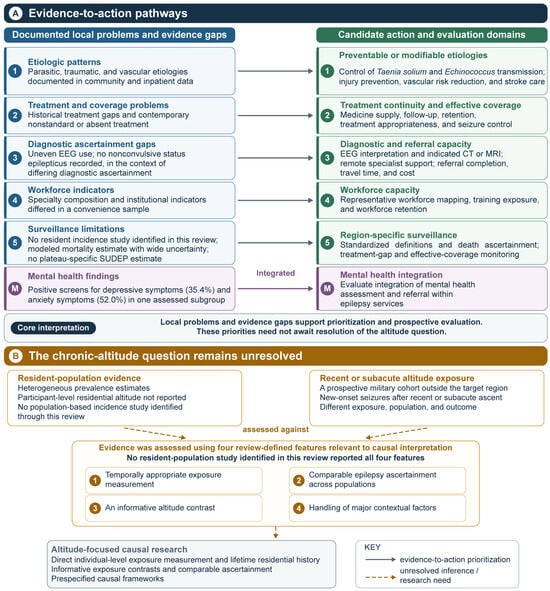
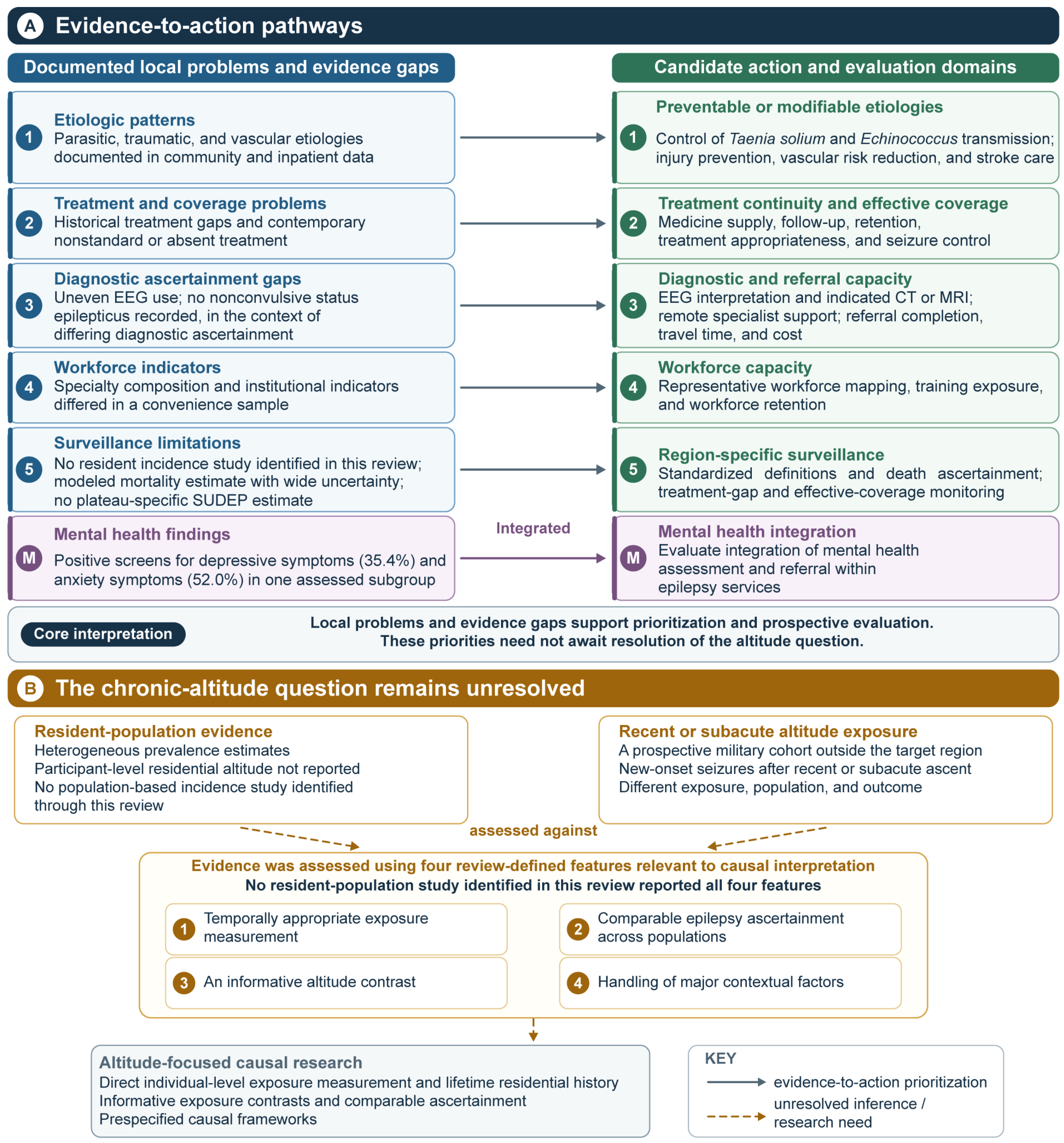
Workforce planning requires representative data on clinician distribution, training, and retention; convenience samples cannot provide these estimates [5,42]. Regional surveillance should use standardized case definitions, structured death ascertainment, and repeated measurement of prevalence, incidence when feasible, treatment gaps, and effective coverage [16,41]. Mental health assessment should be evaluated as an integral part of epilepsy services [46,47]. Figure 1 summarizes the distinction between evidence-supported healthcare priorities and the unresolved chronic-altitude question. Table 3 presents measurable domains for prospective evaluation. These domains warrant prospective evaluation; the effectiveness of specific interventions in this setting has not been established.
Figure 1.
Evidence, uncertainty, and evidence-informed priorities for epilepsy care and public health in Tibetan-inhabited plateau regions of western China. (A) Documented local problems and evidence gaps (left) are linked to candidate action and evaluation domains (right); rows 1–5 correspond to the first five domains in Table 3, and row M addresses mental health integration. Solid arrows indicate proposed priorities for evaluation; they do not imply that an intervention is effective. (B) Resident-population evidence and evidence from recent or subacute ascent were appraised against four review-defined features (Table 1); these are appraisal dimensions, not a validated instrument. No resident-population study identified in this review reported all four. The bottom box identifies design elements for future studies of altitude exposure. Dashed arrows denote unresolved inference and research needs. Table 2 summarizes source studies, and Table 3 summarizes evaluation priorities. Source citations appear in the Results. CT, computed tomography; EEG, electroencephalography; MRI, magnetic resonance imaging; SUDEP, sudden unexpected death in epilepsy.
Table 3.
Evidence-Informed Healthcare and Public Health Priorities for Prospective Evaluation.
Evaluating healthcare interventions and testing the chronic-altitude hypothesis require different study designs. Service interventions should be evaluated using designs capable of estimating their effects. For phased implementation, stepped-wedge trials or difference-in-differences designs may be appropriate when their assumptions are satisfied. More informative evidence on chronic altitude exposure would come from multisite incidence cohorts or repeated surveys with harmonized International League Against Epilepsy case definitions and epidemiologic methods [11,12,16,48]. Such studies should measure altitude directly, record lifetime residential history and migration, and prespecify potential confounders, mediators, and effect modifiers. Informative altitude contrasts would also require comparable case ascertainment and measurement of diagnostic intensity and relevant social and health system factors.
Several limitations should be considered. The searches were targeted rather than exhaustive and were restricted to PubMed/MEDLINE, Web of Science, and English-language peer-reviewed literature; relevant studies indexed elsewhere or published in other languages may therefore have been missed. Restriction to published English-language articles introduces potential publication and language bias, particularly because some regional surveys and service reports are published only in Chinese. Statements that no qualifying study was identified should be interpreted as the yield of this review rather than proof of absence. Evidence available only in reports, policy documents, theses, websites, or conference proceedings was excluded. The included community studies used different epilepsy and treatment definitions. Clinical cohorts were subject to referral and admission selection; workforce data came from a convenience sample; and modeled estimates relied on limited regional inputs. Some studies shared investigators or institutions, and patient populations may overlap across hospital-based reports. We did not access unpublished or participant-level data. The heterogeneity of the available studies precluded a meaningful pooled prevalence estimate, and the evidence did not permit estimation of population-attributable fractions. Affordability, travel burden, stigma, language access, and cultural acceptability were not directly assessed in the included studies and warrant evaluation in the target population.
5. Conclusions
The studies identified in this review cannot establish whether chronic altitude exposure independently affects epilepsy incidence or prevalence among long-term residents of Tibetan-inhabited plateau regions of western China. Lack of sufficient evidence should not be interpreted as evidence of no effect. Regional studies more directly document selected infectious, traumatic, and vascular etiologies, historical treatment gaps, challenges in treatment continuity, and uneven diagnostic capacity. In one assessed community subgroup, 35.4% screened positive for depressive symptoms and 52.0% for anxiety symptoms.
Priorities for prospective evaluation include prevention of locally relevant acquired causes, treatment continuity and effective coverage, diagnostic and referral services, workforce development, mental health integration, and region-specific surveillance. These priorities can be studied without first resolving the chronic-altitude question. Studies addressing the altitude hypothesis should measure exposure directly, compare informative altitude ranges, harmonize epilepsy ascertainment, and prespecify causal models that account for remoteness, social conditions, diagnostic practices, and healthcare access. The review-defined features may also guide appraisal of future studies using geographic proxies for environmental exposure.
Supplementary Materials
The following supporting information can be downloaded at: https://www.mdpi.com/article/10.3390/healthcare14203511/s1, Table S1: Database search strategies and record-selection summary; Table S2: Structured appraisal of core sources.
Author Contributions
Conceptualization, Y.L. (Yulong Li), Y.L. (Yixiu Lin) and L.C.; methodology, Y.L. (Yulong Li) and Y.L. (Yixiu Lin); investigation, Y.L. (Yulong Li) and Y.L. (Yixiu Lin); data curation, Y.L. (Yixiu Lin); writing—original draft preparation, Y.L. (Yulong Li) and Y.L. (Yixiu Lin); writing—review and editing, L.C.; visualization, Y.L. (Yulong Li); supervision, L.C.; project administration, L.C.; funding acquisition, L.C. All authors have read and agreed to the published version of the manuscript.
Funding
This research was funded by the Science and Technology Projects of Xizang Autonomous Region, China (grant number XZ202501ZY0120) and the Sichuan Science and Technology Program (grant number 2025NSFTD0027).
Institutional Review Board Statement
Not applicable.
Informed Consent Statement
Not applicable.
Data Availability Statement
No new participant-level data were collected. The search strategies and structured appraisal supporting this review are provided in Supplementary Tables S1 and S2. Study-level findings are available in the cited publications.
Conflicts of Interest
The authors declare no conflicts of interest. The funders had no role in the design of the review; in the collection, analysis, or interpretation of the evidence; in the writing of the manuscript; or in the decision to publish the results.
References
- GBD 2021 Epilepsy Collaborators. Global, regional, and national burden of epilepsy, 1990–2021: A systematic analysis for the Global Burden of Disease Study 2021. Lancet Public Health 2025, 10, e203–e227. [Google Scholar] [CrossRef] [Scilit] [PubMed]
- Meyer, A.C.; Dua, T.; Ma, J.; Saxena, S.; Birbeck, G. Global disparities in the epilepsy treatment gap: A systematic review. Bull. World Health Organ. 2010, 88, 260–266. [Google Scholar] [CrossRef] [Scilit] [PubMed]
- Newton, C.R.; Garcia, H.H. Epilepsy in poor regions of the world. Lancet 2012, 380, 1193–1201. [Google Scholar] [CrossRef] [Scilit] [PubMed]
- Ding, D.; Zhou, D.; Sander, J.W.; Wang, W.; Li, S.; Hong, Z. Epilepsy in China: Major progress in the past two decades. Lancet Neurol. 2021, 20, 316–326. [Google Scholar] [CrossRef] [Scilit] [PubMed]
- Dolea, C.; Stormont, L.; Braichet, J.M. Evaluated strategies to increase attraction and retention of health workers in remote and rural areas. Bull. World Health Organ. 2010, 88, 379–385. [Google Scholar] [CrossRef] [Scilit] [PubMed]
- Wu, L.; Ye, Z.; Li, Y.; Luo, M.; Li, S.; Mi, H.; Qiu, Z.; Jiang, Y. Is there an epilepsy belt of high prevalence rate in China? Front. Neurol. 2022, 13, 994305. [Google Scholar] [CrossRef] [Scilit] [PubMed]
- Zhao, Y.; Zhang, Q.; Tsering, T.; Sangwan; Hu, X.; Liu, L.; Shang, H.; Chen, Q.; Liu, Y.; Yang, X.; et al. Prevalence of convulsive epilepsy and health-related quality of life of the population with convulsive epilepsy in rural areas of Tibet Autonomous Region in China: An initial survey. Epilepsy Behav. 2008, 12, 373–381. [Google Scholar] [CrossRef] [Scilit] [PubMed]
- Zhao, Y.H.; Zhang, Q.; Long, N.; Yang, C.; Hong, J.; Mu, L.; Zhou, D. Prevalence of epilepsy and alcohol-related risk in Zayul County, Tibet Autonomous Region in China: An initial survey. Epilepsy Behav. 2010, 19, 635–638. [Google Scholar] [CrossRef] [Scilit] [PubMed]
- Wang, C.; Chen, D.; Zhao, L.; Liu, F.; Zhang, L.; Liu, X.; Liu, L. Clinical characteristics and factors associated with psychiatric comorbidity among people with epilepsy in Ganzi Tibetan autonomous prefecture of China: A cross-sectional study. Acta Epileptol. 2026, 8, 16. [Google Scholar] [CrossRef] [Scilit] [PubMed]
- Bärtsch, P.; Swenson, E.R. Acute high-altitude illnesses. N. Engl. J. Med. 2013, 368, 2294–2302. [Google Scholar] [CrossRef] [Scilit] [PubMed]
- Fisher, R.S.; Acevedo, C.; Arzimanoglou, A.; Bogacz, A.; Cross, J.H.; Elger, C.E.; Engel, J., Jr.; Forsgren, L.; French, J.A.; Glynn, M.; et al. ILAE official report: A practical clinical definition of epilepsy. Epilepsia 2014, 55, 475–482. [Google Scholar] [CrossRef] [Scilit] [PubMed]
- Beghi, E.; Carpio, A.; Forsgren, L.; Hesdorffer, D.C.; Malmgren, K.; Sander, J.W.; Tomson, T. Recommendation for a definition of acute symptomatic seizure. Epilepsia 2010, 51, 671–675. [Google Scholar] [CrossRef] [Scilit] [PubMed]
- Levesque, J.F.; Harris, M.F.; Russell, G. Patient-centred access to health care: Conceptualising access at the interface of health systems and populations. Int. J. Equity Health 2013, 12, 18. [Google Scholar] [CrossRef] [Scilit] [PubMed]
- Kruk, M.E.; Gage, A.D.; Arsenault, C.; Jordan, K.; Leslie, H.H.; Roder-DeWan, S.; Adeyi, O.; Barker, P.; Daelmans, B.; Doubova, S.V.; et al. High-quality health systems in the Sustainable Development Goals era: Time for a revolution. Lancet Glob. Health 2018, 6, e1196–e1252. [Google Scholar] [CrossRef] [Scilit] [PubMed]
- Ng, M.; Fullman, N.; Dieleman, J.L.; Flaxman, A.D.; Murray, C.J.; Lim, S.S. Effective coverage: A metric for monitoring Universal Health Coverage. PLoS Med. 2014, 11, e1001730. [Google Scholar] [CrossRef] [Scilit] [PubMed]
- Thurman, D.J.; Beghi, E.; Begley, C.E.; Berg, A.T.; Buchhalter, J.R.; Ding, D.; Hesdorffer, D.C.; Hauser, W.A.; Kazis, L.; Kobau, R.; et al. Standards for epidemiologic studies and surveillance of epilepsy. Epilepsia 2011, 52, 2–26. [Google Scholar] [CrossRef] [Scilit] [PubMed]
- Ngugi, A.K.; Bottomley, C.; Kleinschmidt, I.; Sander, J.W.; Newton, C.R. Estimation of the burden of active and life-time epilepsy: A meta-analytic approach. Epilepsia 2010, 51, 883–890. [Google Scholar] [CrossRef] [Scilit] [PubMed]
- Fiest, K.M.; Sauro, K.M.; Wiebe, S.; Patten, S.B.; Kwon, C.S.; Dykeman, J.; Pringsheim, T.; Lorenzetti, D.L.; Jetté, N. Prevalence and incidence of epilepsy: A systematic review and meta-analysis of international studies. Neurology 2017, 88, 296–303. [Google Scholar] [PubMed]
- Liu, W.; Xu, Y.; Lin, Y.; Wang, L.; Zhou, M.; Yin, P.; Zhao, G. Burden of epilepsy in China and its provinces, 1990 to 2019: Findings from the Global Burden of Disease Study 2019. Chin. Med. J. 2023, 136, 305–312. [Google Scholar] [CrossRef] [Scilit] [PubMed]
- Srinath, R.; Ahmad, F.; Asturkar, V.; Mathur, A.; Sondhi, V.; Nanda, S.K. New-onset seizure at high altitude among healthy males. Seizure 2022, 97, 82–87. [Google Scholar] [CrossRef] [Scilit] [PubMed]
- Wilson, M.H.; Newman, S.; Imray, C.H. The cerebral effects of ascent to high altitudes. Lancet Neurol. 2009, 8, 175–191. [Google Scholar] [CrossRef] [Scilit] [PubMed]
- Xu, Y.; Fan, Q. Relationship between chronic hypoxia and seizure susceptibility. CNS Neurosci. Ther. 2022, 28, 1689–1705. [Google Scholar] [CrossRef] [Scilit] [PubMed]
- Petousi, N.; Robbins, P.A. Human adaptation to the hypoxia of high altitude: The Tibetan paradigm from the pregenomic to the postgenomic era. J. Appl. Physiol. 2014, 116, 875–884. [Google Scholar] [CrossRef] [Scilit] [PubMed]
- Chen, J.; Wu, X.; He, Y.; Li, S.; Deng, Y.; Chen, J.; Fang, W.; Zeren, Z.; Peng, J.; Li, Y.; et al. A retrospective analysis of the clinical features of inpatients with epilepsy in the Ganzi Tibetan Autonomous Prefecture. Front. Neurol. 2018, 9, 891. [Google Scholar] [CrossRef] [Scilit] [PubMed]
- Li, T.; Craig, P.S.; Ito, A.; Chen, X.; Qiu, D.; Qiu, J.; Sato, M.O.; Wandra, T.; Bradshaw, H.; Li, L.; et al. Taeniasis/cysticercosis in a Tibetan population in Sichuan Province, China. Acta Trop. 2006, 100, 223–231. [Google Scholar] [CrossRef] [Scilit] [PubMed]
- Li, S.; Chen, J.; He, Y.; Chen, J.; Liao, S.; Deng, Y.; Fang, W.; Zeren, Z.; Lin, M.; Yan, B.; et al. Incidence and risk factors associated with the development of epilepsy in patients with intracranial alveolar echinococcosis. Epilepsy Res. 2021, 174, 106643. [Google Scholar] [CrossRef] [Scilit] [PubMed]
- Ndimubanzi, P.C.; Carabin, H.; Budke, C.M.; Nguyen, H.; Qian, Y.J.; Rainwater, E.; Dickey, M.; Reynolds, S.; Stoner, J.A. A systematic review of the frequency of neurocyticercosis with a focus on people with epilepsy. PLoS Negl. Trop. Dis. 2010, 4, e870. [Google Scholar] [CrossRef] [Scilit] [PubMed]
- White, A.C., Jr.; Coyle, C.M.; Rajshekhar, V.; Singh, G.; Hauser, W.A.; Mohanty, A.; Garcia, H.H.; Nash, T.E. Diagnosis and treatment of neurocysticercosis: 2017 clinical practice guidelines by the Infectious Diseases Society of America (IDSA) and the American Society of Tropical Medicine and Hygiene (ASTMH). Clin. Infect. Dis. 2018, 66, 1159–1163. [Google Scholar] [CrossRef] [Scilit] [PubMed]
- Del Brutto, O.H.; Nash, T.E.; White, A.C., Jr.; Rajshekhar, V.; Wilkins, P.P.; Singh, G.; Vasquez, C.M.; Salgado, P.; Gilman, R.H.; Garcia, H.H. Revised diagnostic criteria for neurocysticercosis. J. Neurol. Sci. 2017, 372, 202–210. [Google Scholar] [CrossRef] [Scilit] [PubMed]
- Stelzle, D.; Schmidt, V.; Keller, L.; Ngowi, B.J.; Matuja, W.; Escheu, G.; Hauke, P.; Richter, V.; Ovuga, E.; Pfausler, B.; et al. Characteristics of people with epilepsy and neurocysticercosis in three eastern African countries—A pooled analysis. PLoS Negl. Trop. Dis. 2022, 16, e0010870. [Google Scholar] [CrossRef] [Scilit] [PubMed]
- Ngwili, N.; Johnson, N.; Wahome, R.; Githigia, S.; Roesel, K.; Thomas, L. A qualitative assessment of the context and enabling environment for the control of Taenia solium infections in endemic settings. PLoS Negl. Trop. Dis. 2021, 15, e0009470. [Google Scholar] [CrossRef] [Scilit] [PubMed]
- Budke, C.M.; Qiu, J.; Zinsstag, J.; Wang, Q.; Torgerson, P.R. Use of disability adjusted life years in the estimation of the disease burden of echinococcosis for a high endemic region of the Tibetan plateau. Am. J. Trop. Med. Hyg. 2004, 71, 56–64. [Google Scholar] [CrossRef] [Scilit]
- Craig, P.S.; McManus, D.P.; Lightowlers, M.W.; Chabalgoity, J.A.; Garcia, H.H.; Gavidia, C.M.; Gilman, R.H.; Gonzalez, A.E.; Lorca, M.; Naquira, C.; et al. Prevention and control of cystic echinococcosis. Lancet Infect. Dis. 2007, 7, 385–394. [Google Scholar] [CrossRef] [Scilit] [PubMed]
- Vezzani, A.; Fujinami, R.S.; White, H.S.; Preux, P.M.; Blümcke, I.; Sander, J.W.; Löscher, W. Infections, inflammation and epilepsy. Acta Neuropathol. 2016, 131, 211–234. [Google Scholar] [CrossRef] [Scilit] [PubMed]
- Kwon, C.S.; Wagner, R.G.; Carpio, A.; Jetté, N.; Newton, C.R.; Thurman, D.J. The worldwide epilepsy treatment gap: A systematic review and recommendations for revised definitions—A report from the ILAE Epidemiology Commission. Epilepsia 2022, 63, 551–564. [Google Scholar] [CrossRef] [Scilit] [PubMed]
- Peng, W.; Lu, L.; Hao, Y.; Xiong, W.; Abdulaziz, A.T.; Lian, Y.; Chen, L.; Wu, X.; Zhao, Y.; Zhou, D. Etiological features of status epilepticus of the in-patient cohort in Tibet: A retrospective comparative study. Seizure 2025, 125, 179–185. [Google Scholar] [CrossRef] [Scilit] [PubMed]
- Singh, B.; Mahajan, N.; Singh, G.; Sander, J.W. Temporal trends in the epilepsy treatment gap in low- and low-middle-income countries: A meta-analysis. J. Neurol. Sci. 2022, 434, 120174. [Google Scholar] [CrossRef] [Scilit] [PubMed]
- Mbuba, C.K.; Ngugi, A.K.; Newton, C.R.; Carter, J.A. The epilepsy treatment gap in developing countries: A systematic review of the magnitude, causes, and intervention strategies. Epilepsia 2008, 49, 1491–1503. [Google Scholar] [CrossRef] [Scilit] [PubMed]
- Meyer, A.C.; Dua, T.; Boscardin, W.J.; Escarce, J.J.; Saxena, S.; Birbeck, G.L. Critical determinants of the epilepsy treatment gap: A cross-national analysis in resource-limited settings. Epilepsia 2012, 53, 2178–2185. [Google Scholar] [CrossRef] [Scilit] [PubMed]
- Wang, H.; Chen, D.; He, J.; He, Y.; Liu, L.; Zhou, D. Trend of sudden unexpected death in epilepsy incidence rate in rural West China. Front. Neurol. 2021, 12, 735201. [Google Scholar] [CrossRef] [Scilit] [PubMed]
- Harden, C.; Tomson, T.; Gloss, D.; Buchhalter, J.; Cross, J.H.; Donner, E.; French, J.A.; Gil-Nagel, A.; Hesdorffer, D.C.; Smithson, W.H.; et al. Practice guideline summary: Sudden unexpected death in epilepsy incidence rates and risk factors: Report of the Guideline Development, Dissemination, and Implementation Subcommittee of the American Academy of Neurology and the American Epilepsy Society. Neurology 2017, 88, 1674–1680. [Google Scholar] [PubMed]
- Xiao, X.; Xiao, J.; Zhou, C.; Pan, C.; Hao, Y.; Jin, M.; Han, M.; Jiang, S.; Liu, J.; Tang, Y.; et al. Epilepsy awareness among physicians in plains and plateau regions of western China: A cross-sectional study. Acta Epileptol. 2026, 8, 11. [Google Scholar] [CrossRef] [Scilit] [PubMed]
- Lin, Y.; Hu, S.; Hao, X.; Duan, L.; Wang, W.; Zhou, D.; Wang, X.; Xiao, B.; Liu, X.; Wang, Y.; et al. Epilepsy centers in China: Current status and ways forward. Epilepsia 2021, 62, 2640–2650. [Google Scholar] [CrossRef] [Scilit] [PubMed]
- Dorsey, E.R.; Glidden, A.M.; Holloway, M.R.; Birbeck, G.L.; Schwamm, L.H. Teleneurology and mobile technologies: The future of neurological care. Nat. Rev. Neurol. 2018, 14, 285–297. [Google Scholar] [CrossRef] [Scilit] [PubMed]
- Dolo, H.; Kamaforo, M.; Konipo, F.D.N.; Sangho, O.; Daou, M.; Camara, B.; Konate, A.; Sininta, M.; Sangare, M.; Toure, D.M.; et al. Utilizing an mHealth platform and community health workers to enhance epilepsy screening and treatment in a rural setting in Mali: A closed cohort study. J. Epidemiol. Glob. Health 2025, 15, 109. [Google Scholar] [CrossRef] [Scilit] [PubMed]
- Fiest, K.M.; Dykeman, J.; Patten, S.B.; Wiebe, S.; Kaplan, G.G.; Maxwell, C.J.; Bulloch, A.G.M.; Jetté, N. Depression in epilepsy: A systematic review and meta-analysis. Neurology 2013, 80, 590–599. [Google Scholar] [PubMed]
- Keezer, M.R.; Sisodiya, S.M.; Sander, J.W. Comorbidities of epilepsy: Current concepts and future perspectives. Lancet Neurol. 2016, 15, 106–115. [Google Scholar] [CrossRef] [Scilit] [PubMed]
- Scheffer, I.E.; Berkovic, S.; Capovilla, G.; Connolly, M.B.; French, J.; Guilhoto, L.; Hirsch, E.; Jain, S.; Mathern, G.W.; Moshé, S.L.; et al. ILAE classification of the epilepsies: Position paper of the ILAE Commission for Classification and Terminology. Epilepsia 2017, 58, 512–521. [Google Scholar] [CrossRef] [Scilit] [PubMed]

Disclaimer/Publisher’s Note: The statements, opinions and data contained in all publications are solely those of the individual author(s) and contributor(s) and not of MDPI and/or the editor(s). MDPI and/or the editor(s) disclaim responsibility for any injury to people or property resulting from any ideas, methods, instructions or products referred to in the content. |
© 2026 by the authors. Licensee MDPI, Basel, Switzerland. This article is an open access article distributed under the terms and conditions of the Creative Commons Attribution (CC BY) license.