


Highlights
What are the main findings?
- Environmental Financial Literacy strengthens environmental and social sustainability primarily through Governance/ESG Reporting.
- Governance/ESG Reporting serves as a key mediating mechanism linking Environmental Financial Literacy to organizational sustainability.
What are the implications of the main findings?
- Healthcare organizations should integrate Environmental Financial Literacy development with governance practices and ESG reporting systems.
- Governance should be recognized as an enabling mechanism for environmental and social sustainability rather than merely a separate ESG pillar.
Abstract
Background/Objectives: Healthcare organizations face challenges in integrating environmental sustainability with financial constraints, digitalization, governance, and social responsibilities. Although financial and digital financial literacy have been associated with environmental, social, and governance (ESG) performance, the organizational mechanisms underlying these relationships remain insufficiently understood. This study examines Environmental Financial Literacy (EFL) as a sustainability-relevant decision-making capability and Governance/ESG Reporting as a potential mediator linking EFL with environmental and social sustainability. Methods: A quantitative, cross-sectional survey included 1415 healthcare employees in Serbia. Exploratory factor analysis assessed the measurement structure, followed by reliability and validity testing. Covariance-based structural equation modeling (CB-SEM) examined the hypothesized relationships, while bias-corrected bootstrapping assessed indirect effects. Results: Four distinct constructs were identified. EFL was positively associated with Governance/ESG Reporting (β = 0.658, p < 0.001), which was positively associated with Environmental Sustainability (β = 0.561, p < 0.001) and Social Sustainability (β = 0.469, p < 0.001). Governance/ESG Reporting partially mediated both relationships, with significant indirect effects on Environmental Sustainability (β = 0.369, 95% CI [0.330, 0.415]) and Social Sustainability (β = 0.369, 95% confidence interval (CI) [0.330, 0.415]). Both indirect effects exceeded the corresponding direct effects. Conclusions: Governance/ESG Reporting represents a significant statistical intermediary between EFL and organizational sustainability. The findings highlight the potential importance of integrating sustainability-relevant financial competence with governance and reporting practices in healthcare organizations, while offering a framework for further investigation across different healthcare systems.
1. Introduction
Healthcare systems face a distinctive sustainability challenge: their mission to protect human health coexists with resource-intensive, technologically complex, financially constrained, and environmentally consequential operations [1,2,3]. Healthcare organizations consume substantial energy and materials, generate waste, and make capital-intensive decisions concerning procurement, infrastructure, medical technologies, and resource allocation [4,5,6,7]. Accounting for approximately 5% of global greenhouse-gas emissions, the health sector faces growing pressure to improve its environmental performance [8,9]. However, healthcare sustainability extends beyond environmental concerns [10,11] to encompass patient safety, employee welfare, accessibility, equality, financial viability, accountability, and stakeholder interests [12,13].
Sustainability-related decisions require healthcare organizations to evaluate environmental consequences alongside financial costs, risks, regulatory requirements, and long-term organizational implications [14,15]. Increasing digitalization further requires the effective interpretation of financial and management information [16,17,18]. Sustainable decision-making therefore depends on integrating financial reasoning, digital information, and environmental understanding [19,20]. This study conceptualizes this capability as Environmental Financial Literacy (EFL), defined as the ability to understand, evaluate, and use financial information, including digitally generated data, in decisions involving environmental costs, resource efficiency, green investments, compliance, and sustainability implications. Research increasingly connects financial and digital financial literacy with sustainability-related behavior and organizational outcomes [21,22]. Fan et al. [23] identified a positive association between digital financial literacy and corporate ESG performance among Chinese listed firms, particularly for the social dimension. International evidence similarly links financial literacy with ESG disclosure and performance [24], while individual-level studies associate digital financial literacy with sustainable investment behavior [25,26,27].
Despite these advances, existing studies primarily examine whether financial or digital financial literacy is associated with sustainability behavior, ESG disclosure, or performance [26,28,29], providing limited insight into how these capabilities translate into organizational sustainability outcomes. Financial competence alone may be insufficient without organizational structures that integrate such knowledge into strategic decisions, internal controls, risk management, reporting, and accountability [30,31]. Healthcare research identifies governance as critical to sustainability implementation [32,33], with evidence from European hospitals highlighting knowledge, management involvement, professional commitment, and technology as relevant factors [34,35]. However, this literature remains largely disconnected from research on financial and digital financial literacy [36,37]. Consequently, limited attention has been devoted to whether governance provides the organizational structures through which sustainability-relevant financial capabilities become institutionalized and associated with sustainability outcomes [38,39].
The present study examines Governance/ESG Reporting as a potential mediator linking EFL with environmental and social sustainability. Integrating financial literacy, digital financial literacy, and sustainability-oriented decision-making [25,40], EFL extends conventional financial competence by incorporating environmental costs, green investments, resource efficiency, compliance, and sustainability-related financial information into healthcare decision-making [41,42]. The framework emphasizes governance functions—including transparency, strategic decision-making, risk management, internal controls, ethical accountability, and information quality—as organizational processes through which sustainability-relevant financial competence may become associated with environmental and social outcomes.
Conventional ESG frameworks conceptualize environmental, social, and governance dimensions as parallel sustainability pillars [43,44,45], potentially obscuring their distinct organizational functions [46,47]. This study proposes that the governance dimension also performs a process-enabling role, embedding sustainability-relevant financial competence into organizational reporting, controls, accountability, risk management, and strategic decisions. Resource-based reasoning [48] and dynamic capabilities theory [49] explain how organizational capabilities become consequential through their deployment, while stakeholder theory [50] extends this reasoning to social outcomes affecting employees, patients, communities, and other stakeholders. Using data from 1415 employees across primary, secondary, and tertiary healthcare organizations in Serbia, where healthcare financing challenges, ongoing digital transformation, and the development of digital health literacy remain relevant organizational concerns [51,52,53], this study conceptualizes EFL as a sustainability-relevant decision-making capability and examines whether Governance/ESG Reporting mediates its relationships with Environmental Sustainability and Social Sustainability.
2. Literature Review and Hypothesis Development
2.1. Literature Review
Sustainability-oriented decision-making extends financial competence beyond conventional budgeting, investment, and risk assessment [54] to include environmental costs, resource efficiency, regulatory requirements, sustainability risks, and long-term investment implications [55,56]. Digital technologies increasingly support these decisions through monitoring, analysis, and reporting [57], integrating financial, digital, and sustainability-related knowledge [25,28]. Empirical evidence links financial and digital financial literacy with sustainable investment behavior and corporate ESG performance [27,58], while international studies identify positive associations with ESG disclosure and performance [36,40]. Within healthcare organizations, EFL informs decisions concerning energy consumption, medical waste, procurement, infrastructure, and environmental compliance by integrating financial, digital, and environmental considerations [41,59,60]. Although sustainability is increasingly integrated into healthcare management and control systems [61,62], the organizational mechanisms connecting EFL with sustainability outcomes remain insufficiently understood.
The resource-based view suggests that organizational capabilities contribute to outcomes when deployed through value-creating strategies [48], while dynamic capabilities theory emphasizes their integration, coordination, and adaptation [49]. Accordingly, EFL represents a sustainability-relevant decision-making capability integrating financial, environmental, and digital information [63], whose organizational relevance depends on its incorporation into governance systems. Governance provides structures for oversight, responsibility allocation, risk management, internal controls, strategic decisions, transparency, and accountability [64,65], consistent with contemporary governance research emphasizing administration, disclosure, control, and organizational decision-making [66,67]. EFL may strengthen governance by integrating environmental costs, investments, sustainability risks, and digitally generated financial information into strategic decisions, monitoring, controls, and ESG reporting [68]. Empirical evidence linking digital financial literacy with ESG performance and governance outcomes [69], and financial literacy with ESG disclosure [70], supports this proposed relationship.
Governance institutionalizes sustainability priorities through recurring organizational decisions [39], including those concerning energy consumption, resource efficiency, waste management, procurement, environmental risks, and investments [71,72]. These activities require accountability, internal controls, reliable information, and the integration of environmental considerations into decision-making [73]. Existing research associates sustainability governance with ESG performance [74], corporate governance with sustainability outcomes [75], and governance configurations with environmental performance through strategic and organizational processes [76]. In healthcare, Governance/ESG Reporting may support environmental sustainability through transparency, accountability, risk management, and monitoring, particularly when environmental initiatives involve substantial resources and operational consequences [77,78].
Stakeholder theory emphasizes incorporating diverse stakeholder interests into organizational decision-making [50], a particularly important responsibility in healthcare, where patients, employees, communities, regulators, suppliers, and funding bodies have differing expectations [79,80]. Social sustainability encompasses employee welfare, professional development, equality, patient safety, rights, accessibility, and stakeholder relationships [73], requiring organizational mechanisms that systematically integrate these responsibilities into decisions [73,81]. Governance supports stakeholder integration through transparency, accountability, reliable information, risk management, and strategic oversight [82]. Evidence associates these mechanisms with social and environmental performance [83], suggesting that Governance/ESG Reporting may help healthcare organizations monitor stakeholder responsibilities and incorporate social considerations into decision-making [84,85]. Together, these arguments suggest that EFL may support environmental and social sustainability through Governance/ESG Reporting, which enables organizational capabilities to be deployed and embedded in recurring practices [48,49].
EFL may remain confined to individual decision-making unless integrated into organizational systems [86]. Governance/ESG Reporting provides a potential mechanism through which this capability becomes embedded in strategic decisions, reporting, controls, risk management, and accountability [87], thereby connecting EFL with organizational sustainability outcomes. For environmental sustainability, this mechanism may institutionalize financial evaluations of environmental costs, investments, risks, and resource implications [88,89,90]. For social sustainability, governance may link financially informed decisions with accountability toward employees, patients, and other stakeholders [91,92].
2.2. Hypothesis Development
Based on the preceding theoretical arguments, five hypotheses are proposed:
H1.
Environmental Financial Literacy is positively associated with Governance/ESG Reporting.
H2.
Governance/ESG Reporting is positively associated with Environmental Sustainability.
H3.
Governance/ESG Reporting is positively associated with Social Sustainability.
H4.
Governance/ESG Reporting mediates the relationship between Environmental Financial Literacy and Environmental Sustainability.
H5.
Governance/ESG Reporting mediates the relationship between Environmental Financial Literacy and Social Sustainability.
2.3. Conceptual Model
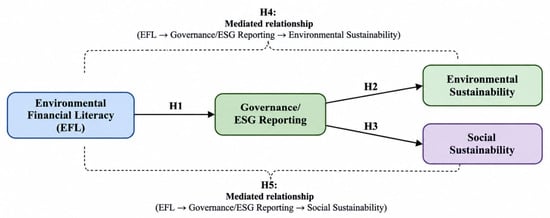
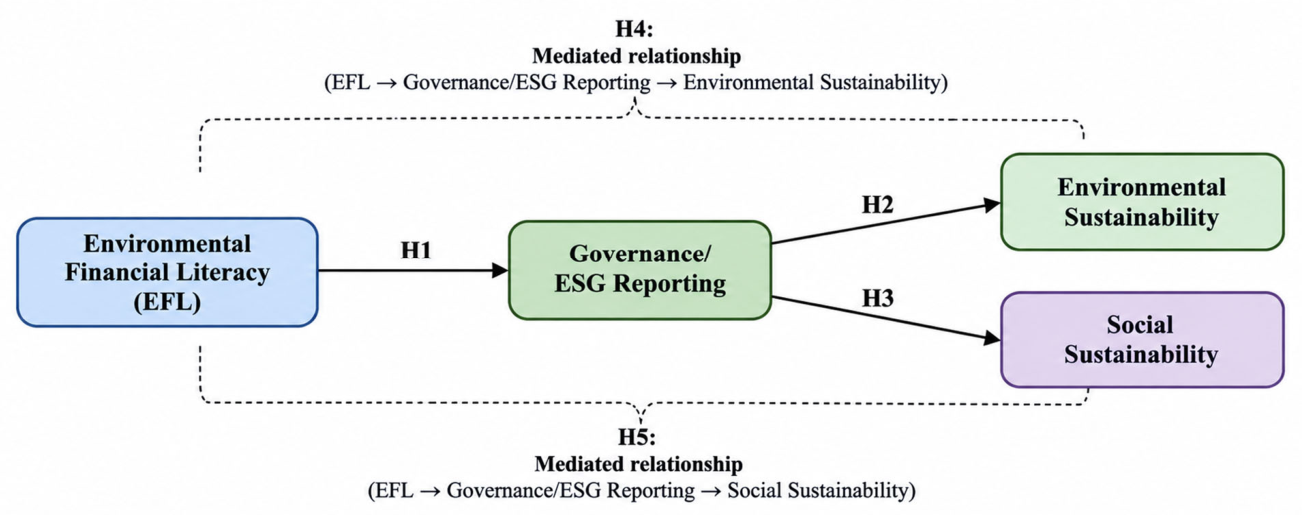
The conceptual model, presented in Figure 1, positions Governance/ESG Reporting as a mediator between EFL and Environmental and Social Sustainability, while retaining direct relationships between EFL and both outcomes. It integrates resource-based reasoning, which conceptualizes EFL as a valuable organizational capability [48]; dynamic capabilities theory, which explains its organizational deployment [49]; and stakeholder theory, which extends its potential implications to employees, patients, communities, and other stakeholders [50].
Figure 1.
Conceptual model and hypothesized relationships.
3. Materials and Methods
3.1. Data Collection and Sample
The study employed a quantitative, observational, cross-sectional survey design with an explanatory-correlational approach to examine the relationships among Environmental Financial Literacy, Governance/ESG Reporting, Environmental Sustainability, and Social Sustainability in healthcare organizations. The design also enabled the assessment of the proposed statistical mediating role of Governance/ESG Reporting without implying temporal or causal relationships. Following ethical approval by the Ethics Committee of the Faculty of Medical Sciences, University of Kragujevac (Approval No. 09-9518/6, 31 August 2026), data were collected from 1 to 10 September 2026 using a structured questionnaire administered to employees of healthcare organizations.
A non-probability, institutionally facilitated sampling strategy was employed to obtain respondents from different healthcare professions, organizational levels, and healthcare settings. Participating healthcare organizations served as access points to eligible employees but were not involved in completing or evaluating individual responses. To enhance institutional and geographical coverage, recruitment was conducted concurrently across multiple healthcare organizations located in different parts of Serbia. Institutional diversity was addressed by including employees from primary, secondary, and tertiary healthcare organizations, while geographical coverage was pursued through recruitment across different locations rather than concentrating data collection within a single healthcare institution or locality. Access to eligible participants was coordinated through designated institutional representatives, and a mixed-mode approach combining on-site recruitment and electronic questionnaire distribution was employed to facilitate participation across healthcare settings. Given the non-probability sampling strategy, this approach was intended to increase sample heterogeneity rather than establish geographical representativeness.
During institutional visits, eligible healthcare employees were approached directly and invited to participate. In parallel, designated institutional representatives facilitated electronic distribution of the same questionnaire by forwarding a survey link to eligible employees within their organizations. A total of 1438 questionnaires were collected between 1 and 10 September 2026. Following data screening, 23 questionnaires were excluded because they were incomplete or improperly completed, resulting in a final analytical sample of 1415 valid responses (98.4% of all collected questionnaires).
3.2. Questionnaire Development and Content Validation
The study employed a structured questionnaire developed specifically for the healthcare organizational context. The initial measurement instrument comprised 51 items addressing financial and digital financial literacy, sustainability-oriented financial and organizational decision-making, environmental and social organizational practices, governance and ESG reporting, and the use of digital technologies in healthcare organizations. All measurement items were assessed using a five-point Likert-type scale ranging from 1 (“strongly disagree”) to 5 (“strongly agree”). The complete initial item pool is presented in Appendix A.
The four constructs were operationally defined according to their respective measurement domains. Environmental Financial Literacy (EFL) refers to respondents’ reported capability to evaluate environmental costs, green and sustainable investments, resource efficiency, environmental reporting, and regulatory compliance using sustainability-relevant financial information [19,23,24,54,59]. Environmental Sustainability captures reported organizational practices concerning energy efficiency, resource monitoring and reduction, environmental impact, waste management, green procurement, and environmental training [1,6,7,60,61,71]. Social Sustainability reflects reported organizational practices related to employee welfare, professional development, equality, patient safety, patient rights, and stakeholder responsibilities [50,73,78,81]. Governance/ESG Reporting captures reported organizational arrangements involving financial transparency, strategic decision-making, risk management, internal controls, ethical accountability, and information quality [15,64,65,66,67,68,78]. The operational meaning of each questionnaire item, together with its supporting conceptual references, is provided in Appendix A. These references informed the conceptual development of the instrument and do not indicate that the items were adopted verbatim from previously validated scales.
The questionnaire was literature-informed and contextually developed rather than derived from the direct adoption of a single pre-existing measurement scale. Item formulation was guided by several interconnected streams of literature. First, research on financial and digital financial literacy provided the conceptual basis for items capturing the ability to interpret financial information, evaluate financial consequences, use digitally supported financial information, and incorporate financial considerations into organizational decision-making. Recent studies have linked financial and digital financial literacy with financial decision-making, sustainable financial capability, sustainable investment choices, and ESG-related outcomes [19,23,25,54]. In particular, evidence that digital financial literacy can contribute to corporate ESG performance and that financial literacy can enhance ESG disclosure provided a basis for extending conventional financial-literacy concepts toward sustainability-related organizational decision-making [23,24].
Second, the development of items addressing governance, ESG reporting, accountability, and sustainability-oriented organizational practices was informed by research positioning governance as an organizational mechanism through which financial, digital, and managerial capabilities can be translated into sustainable organizational outcomes [37,40,68,76]. This literature emphasizes the connections among financial literacy, governance mechanisms, ESG disclosure, accountability, and environmental performance, providing the conceptual basis for treating governance and reporting as organizational processes rather than merely formal compliance activities.
Third, the healthcare-specific formulation of the items was informed by research addressing environmental sustainability, governance, accountability, resource management, and sustainability reporting in healthcare organizations [1,15,32,61]. This literature highlights the importance of organizational governance, environmental management, management controls, and reporting mechanisms for embedding sustainability into healthcare operations and decision-making. This literature was used to contextualize broader financial-literacy and ESG concepts within the operational realities of healthcare organizations rather than to reproduce existing healthcare scales verbatim.
Prior to data collection, the initial 51-item questionnaire underwent expert content validation. Three independent experts, all holding doctoral degrees and possessing academic and research expertise relevant to healthcare management, sustainability/ESG, financial literacy, and quantitative research, independently assessed the instrument. Each item was evaluated in terms of relevance, clarity, comprehensibility, conceptual consistency, and appropriateness for the healthcare organizational context. The experts additionally considered whether the overall item pool provided adequate coverage of the conceptual domains addressed by the study. Based on their assessment, item wording and contextual applicability were reviewed and refined before administration. This procedure was undertaken to establish the content and face validity of the initial instrument.
Importantly, no empirical factor structure was imposed a priori. All 51 measurement items were administered in the main survey, and their latent dimensional structure was subsequently investigated using exploratory factor analysis (EFA). The final composition of the measurement instrument was therefore empirically derived. Following examination of factor loadings, cross-loadings, and the theoretical interpretability of the emerging factor solution, 41 of the original 51 items were retained and 10 were removed. Items were excluded when they exhibited insufficient factor loadings, problematic cross-loadings, or did not contribute adequately to a theoretically coherent and interpretable factor. Item retention was consequently based on the combined consideration of statistical evidence and conceptual interpretability, rather than on the mechanical application of a single loading threshold. The complete original item pool, together with the retention status and final factor allocation of each item, is reported in Appendix A.
3.3. Statistical Analysis
The dimensional structure of the initial item pool was examined using exploratory factor analysis (EFA) with maximum likelihood extraction. Sampling adequacy and factorability were evaluated using the Kaiser–Meyer–Olkin (KMO) measure and Bartlett’s test of sphericity. Because the underlying dimensions were theoretically expected to be correlated, Promax oblique rotation with Kaiser normalization was applied. Factor retention was informed by eigenvalues, factor-loading patterns, conceptual interpretability, and the stability of the resulting structure. Items were evaluated based on their primary loadings, cross-loadings, and theoretical coherence. Statistical analyses were conducted using IBM SPSS Statistics and IBM SPSS AMOS (version 28.00).
Following EFA, questionnaire reliability was evaluated at the construct level using Cronbach’s alpha (α), corrected item–total correlations, and composite reliability (CR). Cronbach’s alpha was used to assess the internal consistency of the items within each identified construct, while corrected item–total correlations were examined to evaluate the contribution of individual items to their respective scales. Composite reliability was additionally calculated to assess the internal consistency of the latent constructs while accounting for their standardized factor loadings. Cronbach’s alpha and CR values of 0.70 or higher were considered indicative of acceptable internal consistency. Construct validity was assessed separately through average variance extracted (AVE) for convergent validity and the Fornell–Larcker criterion and heterotrait–monotrait ratio (HTMT) for discriminant validity. Potential common method variance arising from the use of a single self-report questionnaire was assessed using Harman’s single-factor test.
The hypothesized relationships among the latent constructs were subsequently tested using covariance-based structural equation modeling (CB-SEM) with maximum likelihood estimation. Model fit was evaluated using multiple absolute, incremental, and parsimony-adjusted fit indices, including χ2/df, RMR, GFI, AGFI, NFI, IFI, TLI, CFI, RMSEA, PNFI, and PCFI. Direct effects were evaluated using standardized path coefficients (β), standard errors, critical ratios, and associated p-values. The mediating role of Governance/ESG Reporting was examined using bias-corrected bootstrapping with 5000 bootstrap resamples. The statistical significance of indirect effects was determined using 95% bias-corrected bootstrap confidence intervals. An indirect effect was considered statistically significant when its confidence interval did not include zero. Mediation was classified as partial when both the indirect effect and the corresponding direct effect remained statistically significant, and as full when the indirect effect was significant while the corresponding direct effect was no longer statistically significant. Finally, R2 values were examined to assess the proportion of variance explained in each endogenous construct.
4. Results
4.1. Sample Characteristics
The sociodemographic and professional characteristics of the respondents are presented in Table 1. The sample (N = 1415) was predominantly male (62.4%) and consisted largely of experienced healthcare employees, with 70.4% aged over 40 years and 72.3% reporting more than ten years of professional experience. Participants represented all three levels of healthcare delivery, with the largest proportion working in secondary healthcare (43.4%). Public healthcare organizations predominated (77.7%), while both managerial (22.3%) and non-managerial (77.7%) employees were represented. The sample also exhibited variation in professional roles, educational attainment, and ESG implementation status, with 72.9% reporting that ESG principles were fully or partially implemented or that implementation was underway. Overall, these characteristics provide a heterogeneous professional and organizational context for examining the proposed relationships, although the predominance of public-sector respondents limits the generalizability of the findings to privately owned healthcare organizations.
Table 1.
Sample Characteristics of Respondents (N = 1415).
4.2. Measurement Model
The Kaiser–Meyer–Olkin (KMO) measure of sampling adequacy was 0.977, indicating excellent sampling adequacy for factor analysis. Bartlett’s test of sphericity was statistically significant, χ2(1275) = 29,913.641, p < 0.001, confirming the suitability of the correlation matrix for factor extraction. Four factors had initial eigenvalues greater than 1 and jointly accounted for 46.75% of the total variance prior to rotation. The first four factors accounted for 27.57%, 11.17%, 5.14%, and 2.86% of the variance, respectively. Items with factor loadings below 0.40, problematic cross-loadings, or inadequate conceptual contribution to a clearly interpretable factor were removed from the measurement structure. Following this procedure, 41 of the original 51 items were retained. Maximum likelihood extraction yielded an interpretable four-factor solution comprising Environmental Sustainability, Social Sustainability, Environmental Financial Literacy, and Governance/ESG Reporting. As shown in Table 2, the retained items loaded substantially on their respective factors, supporting the identified four-factor structure.
Table 2.
Pattern Matrix of the Four-Factor Measurement Structure.
Reliability analysis indicated good to high internal consistency across all four factors. Cronbach’s α was 0.919 for Environmental Sustainability, 0.923 for Social Sustainability, 0.836 for Environmental Financial Literacy, and 0.830 for Governance/ESG Reporting. Corrected item–total correlations ranged from 0.546 to 0.733, 0.544 to 0.740, 0.550 to 0.661, and 0.516 to 0.674, respectively, supporting the reliability of all four measurement scales (Table 2).
Harman’s single-factor test was conducted to assess potential common method variance. The first unrotated component accounted for 27.57% of the total variance, below the conventional 50% threshold. This result suggests that no single factor dominated the variance and provides no indication of substantial common method variance based on this diagnostic.
Construct reliability and convergent validity were assessed using Cronbach’s alpha (α), Dijkstra–Henseler’s rho_A (ρA), composite reliability (ρC), and average variance extracted (AVE). As presented in Table 3, Cronbach’s alpha values ranged from 0.830 to 0.923, rho_A values from 0.839 to 0.926, and composite reliability values from 0.832 to 0.923, indicating satisfactory reliability across all four constructs. However, AVE values ranged from 0.447 to 0.461 and remained below the conventional 0.50 threshold, suggesting that convergent validity was not fully established according to this criterion. The rho_A estimates were obtained as a supplementary PLS Mode A reliability analysis, while the primary structural model was estimated using CB-SEM.
Table 3.
Construct Reliability and Convergent Validity of the Measurement Model.
Discriminant validity was assessed using the Fornell–Larcker criterion and the heterotrait–monotrait ratio (HTMT). As presented in Table 4, the square roots of AVE ranged from 0.669 to 0.679 and exceeded the corresponding inter-construct correlations, which ranged from 0.340 to 0.660. The HTMT values ranged from 0.339 to 0.659, remaining below the conservative threshold of 0.85. Accordingly, both criteria indicated adequate discriminant validity among the four latent constructs.
Table 4.
Discriminant Validity: Fornell–Larcker Criterion and HTMT Ratios.
The structural model demonstrated a good fit to the data. The chi-square statistic was non-significant, χ2(774) = 827.924, p = 0.087, with χ2/df = 1.070. The absolute fit indices were RMR = 0.029, GFI = 0.973, and AGFI = 0.970, while the incremental fit indices were NFI = 0.967, IFI = 0.998, TLI = 0.998, and CFI = 0.998. RMSEA was 0.007 (90% CI [0.000, 0.011], PCLOSE = 1.000), and the parsimony-adjusted indices were PNFI = 0.913 and PCFI = 0.942. Taken together, these indices indicated an adequate fit of the structural model to the observed data.
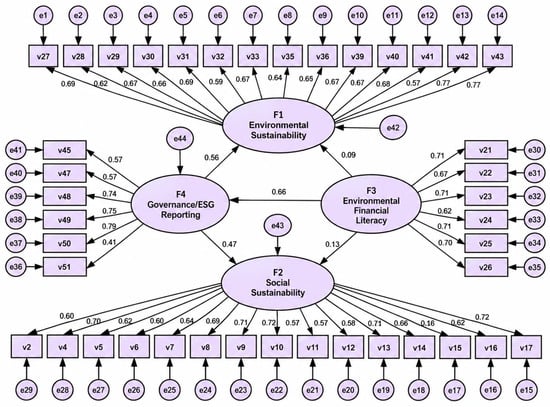
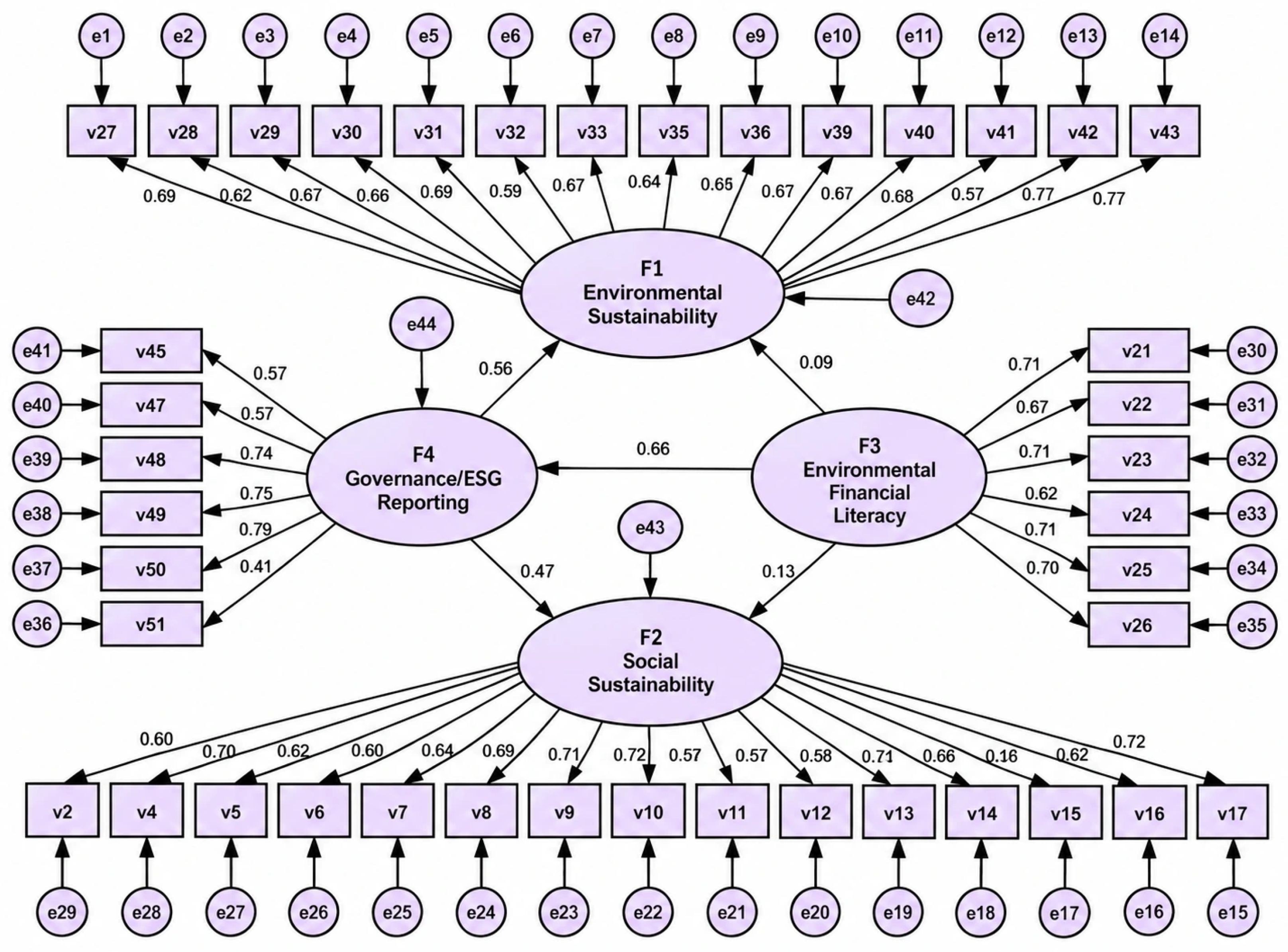
Figure 2 presents the estimated structural model linking Environmental Financial Literacy, Governance/ESG Reporting, Environmental Sustainability, and Social Sustainability. The structural model results, including standardized path coefficients, standard errors, critical ratios, statistical significance, and explained variance, are presented in Table 5. All three hypothesized direct relationships were statistically significant and positive. Environmental Financial Literacy was positively associated with Governance/ESG Reporting (β = 0.658, p < 0.001), supporting H1. Governance/ESG Reporting was positively associated with Environmental Sustainability (β = 0.561, p < 0.001) and Social Sustainability (β = 0.469, p < 0.001), supporting H2 and H3, respectively. The model explained 43.3% of the variance in Governance/ESG Reporting, 39.1% in Environmental Sustainability, and 31.5% in Social Sustainability, indicating meaningful explanatory capacity across the three endogenous constructs.
Figure 2.
Structural Model of the Relationships among Environmental Financial Literacy, Governance/ESG Reporting, and Sustainability Outcomes.
Table 5.
Structural Model Results and Explained Variance.
The mediation analysis provided support for both mediation hypotheses. As shown in Table 6, Governance/ESG Reporting significantly mediated the relationship between Environmental Financial Literacy (EFL) and Environmental Sustainability. The standardized indirect effect was β = 0.369, with a 95% bias-corrected bootstrap confidence interval of [0.330, 0.415]. Because the confidence interval did not include zero, the indirect effect was statistically significant. The direct effect of EFL on Environmental Sustainability also remained statistically significant (β = 0.092, p = 0.014), indicating partial mediation and supporting H4. Similarly, Governance/ESG Reporting significantly mediated the relationship between EFL and Social Sustainability. The standardized indirect effect was β = 0.309, with a 95% bias-corrected bootstrap confidence interval of [0.266, 0.353], which also excluded zero. The corresponding direct effect remained statistically significant (β = 0.127, p = 0.001), indicating partial mediation and supporting H5. In both relationships, the standardized indirect effects were substantially larger than the corresponding direct effects.
Table 6.
Mediation Effects (Standardized).
Overall, the structural model provided consistent support for the proposed relationships. The findings indicate that Environmental Financial Literacy is associated with sustainability outcomes primarily through Governance/ESG Reporting, highlighting governance as the central mechanism linking financial capability with broader organizational sustainability.
5. Discussion
5.1. From Environmental Financial Literacy to Sustainability: Governance as the Missing Link
The findings reveal a strong positive relationship between Environmental Financial Literacy (EFL) and Governance/ESG Reporting (β = 0.658, p < 0.001), supporting H1 and aligning with previous evidence linking financial and digital financial literacy to ESG-related organizational outcomes [23,24,69,70]. By integrating financial reasoning, digital information use, and environmental considerations, EFL extends this relationship to sustainability-oriented decision-making in healthcare. Consistent with the resource-based view [48] and dynamic capabilities perspective [49], the findings suggest that sustainability-relevant financial competence is associated with governance arrangements supporting transparency, accountability, internal controls, and ESG reporting, without implying that such competence automatically generates sustainable organizational outcomes. The observed relationship further distinguishes decision-making competence from its organizational application, suggesting that governance and reporting arrangements may facilitate the integration of sustainability-related financial knowledge into organizational practices.
5.2. Governance/ESG Reporting as a Transmission Mechanism
Governance/ESG Reporting significantly mediated the relationships between EFL and Environmental Sustainability (β = 0.369, 95% BC CI [0.330, 0.415]; H4) and Social Sustainability (β = 0.309, 95% BC CI [0.266, 0.353]; H5). Both indirect effects exceeded the corresponding statistically significant direct effects, indicating partial mediation. Extending research linking financial literacy with ESG disclosure and performance [23,24,69,70], these findings identify governance and reporting as a potential organizational intermediary, consistent with dynamic capabilities theory [49]. However, the cross-sectional design does not establish causal or temporal mediation. The partial mediation findings indicate that EFL remains associated with both sustainability dimensions beyond the relationships statistically accounted for by Governance/ESG Reporting. These remaining direct associations may reflect the relevance of financial competence to resource allocation, investment evaluation, environmental costs, and organizational responsibilities. Governance and reporting arrangements may additionally facilitate the integration of these considerations into recurring decisions through transparency, risk management, internal controls, and accountability, representing an important but non-exclusive intermediary.
5.3. Why Governance Matters for Both Environmental and Social Sustainability
Governance/ESG Reporting was positively associated with Environmental Sustainability (β = 0.561, p < 0.001; H2) and Social Sustainability (β = 0.469, p < 0.001; H3). The environmental relationship aligns with previous governance research [74,75,76], while the social relationship is consistent with stakeholder theory [50] and evidence linking governance to stakeholder-oriented outcomes [83]. In healthcare, these associations highlight the relevance of governance to both environmental management and responsibilities toward patients, employees, and communities. Although the environmental coefficient was numerically larger, the statistical significance of this difference was not established. For environmental sustainability, EFL may support the evaluation of environmental costs, green investments, and resource efficiency, while governance and reporting arrangements may facilitate the integration of such considerations into procurement, resource allocation, risk management, and monitoring. The relationship observed for H2 is therefore consistent with the importance of both sustainability-relevant competence and organizational processes supporting its application.
For Social Sustainability, governance may facilitate the consideration of employee welfare, patient safety, equality, accessibility, and community responsibilities within organizational decisions. Consistent with stakeholder theory [50], financially informed decisions concerning investments, procurement, technologies, and resource allocation can be evaluated alongside stakeholder interests. The relationship observed for H3 therefore suggests that Governance/ESG Reporting is relevant to socially responsible organizational practices alongside environmental management.
5.4. From Decision-Making Competence to Organizational Capability
The findings distinguish individual decision-making competence from the organizational capacity to apply sustainability-relevant knowledge. EFL reflects the ability to evaluate environmental and financial information, whereas Governance/ESG Reporting represents arrangements supporting its organizational application. The strong EFL–Governance/ESG Reporting association (β = 0.658) and significant indirect relationships with both sustainability dimensions are consistent with dynamic capabilities theory [49], which emphasizes the coordination and deployment of organizational competences. Although the cross-sectional design cannot establish capability development over time, the findings highlight the potential importance of governance arrangements in connecting individual competence with organizational sustainability.
5.5. Repositioning the “G” in ESG
The findings suggest that governance may perform a process-enabling function alongside its conventional role as an ESG dimension. Its positive relationships with Environmental Sustainability (β = 0.561) and Social Sustainability (β = 0.469), together with the significant indirect relationships involving EFL, support examining Governance/ESG Reporting as an organizational intermediary. Consistent with resource-based reasoning [48] and dynamic capabilities theory [49], governance may facilitate the integration of sustainability-relevant competence into strategic decisions, accountability, reporting, and operational practices. These findings do not establish a universal causal hierarchy among ESG dimensions, but indicate that the intermediary role of Governance/ESG Reporting is consistent with the relationships examined in this cross-sectional model. Integrating dynamic capabilities theory and stakeholder theory [50], the results suggest that governance may connect sustainability-relevant competences with environmental priorities and stakeholder responsibilities. Its theoretical significance therefore lies in its potential dual role as both an ESG dimension and an organizational process associated with environmental and social sustainability.
5.6. Environmental Financial Literacy as a Boundary-Spanning Strategic Capability
The findings support conceptualizing EFL as a boundary-spanning capability integrating financial reasoning, digital information, and environmental considerations. Its positive association with Governance/ESG Reporting (β = 0.658, p < 0.001), alongside significant direct and indirect associations with both sustainability dimensions, suggests organizational relevance beyond conventional financial literacy. Consistent with dynamic capabilities theory [49], EFL may facilitate the integration of environmental costs, sustainable investments, resource efficiency, and digitally supported financial information across organizational decisions. The capability-based framework may also inform research on other specialized competences, including digital, data, artificial intelligence, climate, and sustainability literacy. Governance and reporting arrangements may represent organizational conditions associated with their application [48,49]. Although these domains were not examined directly, future research could investigate whether similar relationships emerge across different organizational and sectoral contexts.
5.7. Why the Healthcare Context Matters
The healthcare context is particularly relevant because financial constraints, technological transformation, environmental responsibilities, and stakeholder expectations frequently intersect [93,94]. Among Serbian healthcare employees, EFL was strongly associated with Governance/ESG Reporting (β = 0.658), which was positively associated with Environmental Sustainability (β = 0.561) and Social Sustainability (β = 0.469). These relationships suggest that governance and reporting arrangements may help healthcare organizations integrate financial, environmental, and social considerations into decisions concerning energy efficiency, technologies, waste management, procurement, and infrastructure. The significant indirect relationships suggest potential complementarity between EFL and Governance/ESG Reporting in healthcare sustainability management. EFL may support the evaluation of environmental costs, investments, and resource trade-offs, while governance arrangements may facilitate the integration of these considerations into monitoring, accountability, and strategic decisions. Although causal benefits cannot be established, the findings support considering financial competence and governance arrangements together when designing sustainability-oriented management practices.
5.8. Theoretical Contributions
The study makes three theoretical contributions. First, it conceptualizes EFL as an integrative capability combining financial reasoning, digital information, and environmental considerations. Its positive association with Governance/ESG Reporting (β = 0.658) supports the organizational relevance of this conceptualization, although its broader applicability requires further investigation. Second, the findings extend resource-based and dynamic capabilities reasoning [48,49] by identifying Governance/ESG Reporting as a significant statistical mediator between EFL and both sustainability dimensions. The partial mediation effects are consistent with a conceptual distinction between capability possession and its potential organizational application, without establishing a causal sequence. Third, the findings suggest that Governance/ESG Reporting may perform a process-enabling function beyond its conventional role as an ESG dimension. Its positive associations with environmental and social sustainability, together with stakeholder theory [50], highlight the relevance of governance to responsibilities toward employees, patients, communities, and other stakeholders. Together, these contributions advance a capability-based interpretation of healthcare sustainability.
5.9. Practical and International Implications
The findings suggest that healthcare administrators and policymakers should consider developing sustainability-related financial competence alongside governance arrangements supporting transparency, accountability, and reporting. Professional development programs could integrate environmental cost assessment, digital financial information management, sustainable investment evaluation, and ESG-related decision-making, particularly for employees involved in procurement, resource allocation, infrastructure planning, and environmental management. The positive relationships between Governance/ESG Reporting and both sustainability dimensions suggest that healthcare sustainability initiatives should integrate environmental and stakeholder considerations into planning, monitoring, and accountability. Accordingly, competence development and governance improvement may be approached as complementary organizational priorities.
The findings may also be relevant beyond Serbia, as healthcare systems internationally face financial constraints, digital transformation, environmental responsibilities, and increasing accountability expectations. In settings with developing ESG frameworks, integrating EFL with governance and reporting practices may offer a direction for organizational development. Healthcare systems with established sustainability frameworks may instead evaluate how effectively existing governance arrangements integrate financial and environmental knowledge into decisions. The international applicability of these findings remains dependent on institutional conditions, including healthcare financing, regulation, organizational autonomy, digital infrastructure, and ESG reporting requirements. The proposed framework should therefore not be interpreted as universally applicable, and future cross-national research is needed to assess its consistency across healthcare systems.
6. Limitations and Future Research
The primary limitation of this study concerns its national context. The data were collected from healthcare organizations in Serbia; consequently, the findings should be validated across different national healthcare systems, which may differ in regulatory arrangements, financing structures, digital maturity, and ESG practices. Future studies could employ longitudinal designs and incorporate objective sustainability indicators. Further research should also examine whether Governance/ESG Reporting operates similarly in other organizational and sectoral contexts and explore additional mechanisms through which Environmental Financial Literacy may influence sustainability. Finally, organizational position represents a particularly relevant extension: comparing managers and non-managers could reveal whether the translation of Environmental Financial Literacy into governance practices depends on decision-making authority and organizational responsibility.
7. Conclusions
This study provides evidence that the sustainability implications of Environmental Financial Literacy in healthcare extend beyond the possession of financial and digital knowledge. By examining environmental and social sustainability within a single structural framework, the study shows that the organizational conditions through which such knowledge is mobilized are central to understanding its broader consequences. The findings have a clear implication for healthcare management. Strengthening Environmental Financial Literacy should not be approached as an isolated training objective. Healthcare organizations seeking to improve sustainability should simultaneously develop the organizational conditions that allow financially informed environmental decisions to be incorporated into formal management processes. This requires closer integration between capability development, ESG information systems, strategic planning, risk management, internal controls, and sustainability-related decision-making. Such integration is particularly relevant in healthcare, where environmental objectives must be pursued alongside financial constraints and responsibilities toward patients, employees, and other stakeholders.
For healthcare decision-makers, the results also caution against relying on either competence-building or formal ESG systems in isolation. Training can increase the capacity to recognize environmental costs, risks, and investment opportunities, but organizations must also ensure that this capacity can influence actual decisions. Similarly, expanding ESG reporting requirements without strengthening the ability of decision-makers to interpret and use sustainability-related financial information may increase formal compliance without necessarily producing corresponding organizational change. Sustainability strategies should therefore align human capabilities with the systems through which decisions are made, evaluated, and monitored. The Serbian healthcare setting provides an important empirical basis for these conclusions while also defining their immediate scope. For policymakers and healthcare administrators, this points to the value of treating sustainability competence, digitalization, and governance development as interconnected elements of institutional modernization rather than as separate policy agendas.
Ultimately, the study redirects attention from a relatively simple question—whether greater financial literacy is associated with sustainability—to a more consequential organizational question: what must healthcare organizations put in place for sustainability-relevant financial knowledge to make a difference in practice? Developing knowledgeable decision-makers is only part of that challenge; equally important is creating governance conditions through which sustainability-relevant knowledge can be translated into consistent and responsible organizational action.
Author Contributions
Conceptualization, A.V. and S.K.; methodology, S.M. and S.K.; software, A.V.; validation, A.V. and S.M.; formal analysis, A.V.; investigation, S.K.; resources, A.V.; data curation, S.M.; writing—original draft preparation, A.V.; writing—review and editing, A.V.; visualization, S.M. and S.K.; supervision, A.V.; project administration, S.M.; funding acquisition, S.K. and S.M. All authors have read and agreed to the published version of the manuscript.
Funding
This research received no external funding.
Institutional Review Board Statement
The study was conducted in accordance with the Declaration of Helsinki and approved by the Ethics Committee of the Faculty of Medical Sciences, University of Kragujevac (protocol code 09-9475; approval No. 09-9518/6; approval date: 31 August 2026).
Informed Consent Statement
Informed consent was obtained from all subjects involved in the study.
Data Availability Statement
The original contributions presented in this study are included in the article. Further inquiries can be directed to the corresponding author(s).
Conflicts of Interest
The authors declare no conflicts of interest.
Appendix A
Table A1.
Measurement Items, Operational Definitions, Supporting References, and Item Retention Following Exploratory Factor Analysis.
References
- Montes-Piña, L.; Badanta, B.; de Diego-Cordero, R. Decarbonizing the Spanish health system: A qualitative study on the implementation of environmental regulations and management strategies in health institutions. Healthcare 2026, 14, 753. [Google Scholar] [CrossRef] [Scilit]
- Martín-Plaza, P.; Abad-Valle, J.; Rodríguez-Gómez, P.; Arroyo-Bello, E.; Álvarez-Gómez, E.; González-Toledo, B.; González-Tejerina, B. From sustainability to regeneration: A scoping review of nursing practices in the construction of green and healthy hospitals. Healthcare 2026, 14, 2701. [Google Scholar] [CrossRef] [Scilit]
- Pisters, P.; Bien, B.; Dankner, S.; Rubinstein, E.; Sheriff, F. Supporting hospital renewal through strategic environmental sustainability programs. Healthc. Manag. Forum 2017, 30, 79–83. [Google Scholar] [CrossRef] [Scilit]
- Ritchie, N.H. Leadership for a climate resilient, net-zero health system: Transforming supply chains to the circular economy. Healthc. Manag. Forum 2021, 34, 216–220. [Google Scholar] [CrossRef] [Scilit]
- Thomson, D.; Varangu, L.; Webster, R.J. A climate resilience maturity matrix for Canadian health systems. Healthc. Manag. Forum 2023, 36, 217–223. [Google Scholar] [CrossRef] [Scilit]
- Langstaff, K.; Brzozowski, V. Managing environmental sustainability in a healthcare setting. Healthc. Manag. Forum 2017, 30, 84–88. [Google Scholar] [CrossRef] [Scilit]
- Butler, K. How energy benchmarking in healthcare facilities supports greenhouse gas emission reduction. Healthc. Manag. Forum 2023, 36, 199–206. [Google Scholar] [CrossRef] [Scilit]
- Hancock, T. Beyond net-zero: Toward a “One Planet” health system. Healthc. Manag. Forum 2023, 36, 184–189. [Google Scholar] [CrossRef] [Scilit]
- Or, Z.; Seppänen, A.-V. The role of the health sector in tackling climate change: A narrative review. Health Policy 2024, 143, 105053. [Google Scholar] [CrossRef] [Scilit]
- Milicevic, N.; Djokic, N.; Djokic, I.; Radic, J.; Berber, N.; Kalas, B. The impact of environmental quality dimensions and green practices on patient satisfaction from students’ perspective—Managerial and financial implications. Healthcare 2025, 13, 1673. [Google Scholar] [CrossRef] [Scilit]
- Berniak-Woźny, J.; Rataj, M. Towards green and sustainable healthcare: A literature review and research agenda for green leadership in the healthcare sector. Int. J. Environ. Res. Public Health 2023, 20, 908. [Google Scholar] [CrossRef] [Scilit]
- Hernández Aguado, S.; Quidiello Vázquez, L.; Toro-Gallego, C.; Lertxundi, U.; Domingo-Echaburu, S. Assessing sustainability in the pharmaceutical supply chain: A participatory multi-criteria approach in the Basque Country (Spain). Sustain. Chem. Pharm. 2026, 52, 102468. [Google Scholar] [CrossRef] [Scilit]
- Eugster, R.; Luciani, P. Advancing sustainability through digitalization: From drug development to patient care. RSC Pharm. 2026, 3, 361–373. [Google Scholar] [CrossRef] [Scilit]
- Bhopal, A.; Hensher, M.; MacNeill, A.J.; Norheim, O.F.; Sherman, J.D.; Mitton, C. Priority setting for environmentally sustainable health care: Emerging approaches to fair resource allocation. Lancet Planet. Health 2025, 9, 101391. [Google Scholar] [CrossRef] [Scilit]
- Pisarra, M.; Marsilio, M. Non-financial reporting for accountability in the public healthcare sector: A structured literature review. J. Public Budg. Account. Financ. Manag. 2025, 37, 220–243. [Google Scholar] [CrossRef] [Scilit]
- Xi, D.; Zhang, M.; Veronesi, G. The digital-environmental tension: Managerial attention to digital transformation and energy consumption in healthcare organizations. Technol. Forecast. Soc. Chang. 2026, 225, 124519. [Google Scholar] [CrossRef] [Scilit]
- Tenggono, E.; Soetjipto, B.W.; Sudhartio, L. Dynamic managerial capabilities in action: Advancing strategic agility and digital readiness in healthcare organizations. J. Organ. Chang. Manag. 2025, 38, 548–568. [Google Scholar] [CrossRef] [Scilit]
- Cimino, A.; Longo, F.; Manfredi, K.A.; Mirabelli, G.; Mortara, L.; Solina, V. Human-centric interfaces for Digital Twin as a Service: A framework for managerial decision support. Procedia Comput. Sci. 2026, 277, 3868–3878. [Google Scholar] [CrossRef] [Scilit]
- Tran, M.; Paseková, M. Financial behaviour translates digital literacy financial knowledge and financial attitude into sustainable financial capability in Vietnam. Discov. Sustain. 2026, 7. advance online publication. [Google Scholar] [CrossRef] [Scilit]
- Raji, I.A.; Naqshbandi, M.M.; Islam, M.Z. Green entrepreneurial orientation and sustainable performance of MSMEs: The role of circular economy and digital capability. Bus. Process Manag. J. 2026, 1–28. [Google Scholar] [CrossRef] [Scilit]
- Merter, A.K.; Balcıoğlu, Y.S. Financial literacy and decision-making: The impact of knowledge gaps on financial outcomes. Borsa Istanb. Rev. 2025, 25, 101–108. [Google Scholar] [CrossRef] [Scilit]
- Vrdoljak, A.T.; Aljinović, Z.; Škrabić Perić, B.; Arnerić, J. The role of financial literacy in shaping cryptocurrency investment decisions. Soc. Sci. Humanit. Open 2026, 14, 103160. [Google Scholar] [CrossRef] [Scilit]
- Fan, S.; Deng, W.; Zhou, Y.; Su, X. Impact of digital financial literacy on corporate ESG performance. Financ. Res. Lett. 2025, 85, 108010. [Google Scholar] [CrossRef] [Scilit]
- Jia, X.; Kanagaretnam, K.; Lee, J.; Lim, C.Y. Can financial literacy enhance ESG disclosures? Account. Financ. 2026, 66, 2208–2244. [Google Scholar] [CrossRef] [Scilit]
- Kakinuma, Y. Crypto-asset ownership and sustainable investment: The mediating roles of financial and digital financial literacy in shaping ESG preferences. Soc. Sci. Humanit. Open 2026, 13, 102776. [Google Scholar] [CrossRef] [Scilit]
- Yadav, M.; Sharma, V.P.; Kathuria, A. Towards sustainable retirement: The impact of digital financial literacy and behavioural mediators. Dev. Sustain. Econ. Financ. 2025, 8, 100100. [Google Scholar] [CrossRef] [Scilit]
- Mazzoli, C.; Baiocco, S. Unlocking sustainable investing through digital financial literacy: The impact of advanced digital skills. Int. J. Bank Mark. 2025, 43, 1863–1883. [Google Scholar] [CrossRef] [Scilit]
- Hasan, K.K.; Hasnat, M.A.; Khandakar, H. Knowledge management as a catalyst for digital financial literacy in Bangladesh: Integrating AI and metaverse technologies for sustainable development. J. Strategy Innov. 2026, 37, 200577. [Google Scholar] [CrossRef] [Scilit]
- Guo, L.; Wang, L.; Zhao, W. Investigating the impact of corporate digital transformation on ESG performance: Empirical evidence derived from large language models. J. Innov. Knowl. 2026, 17, 101065. [Google Scholar] [CrossRef] [Scilit]
- Mac Cord, D.; Ramos, C.; Monteiro, G.F.A. Hybrid decision architectures: Exploring how facilitated AI access reconfigures startups’ organizational structures and decision-making. Int. J. Entrep. Behav. Res. 2026, 1–33. [Google Scholar] [CrossRef] [Scilit]
- Luong, A.; Kumar, N.; Lang, K.R. Human–machine collaboration and algorithmic decision-making: The role of organizational incentives and AI capabilities. Inf. Manag. 2026, 63, 104384. [Google Scholar] [CrossRef] [Scilit]
- van Schie, V. Governance related factors influencing the implementation of sustainability in hospitals: A systematic literature review. Health Policy 2024, 146, 105115. [Google Scholar] [CrossRef] [Scilit]
- Tian, J.; Zhao, Z.; Tang, L.; Song, Y.; Li, Y.; Jiang, N. From pilot trap to institutional capacity: A governance framework for sustainable clinical AI implementation in health systems. J. Med. Internet Res. 2026, 28, e92680. [Google Scholar] [CrossRef] [Scilit]
- Mathenge, W.; Uwizeye, O.; Whitestone, N.; Cherwek, D.H. Using the Normalization Process Theory to study facilitators and barriers to sustainable implementation of artificial intelligence-based diabetic retinopathy screening in Rwanda. Dialogues Health 2026, 9, 100332. [Google Scholar] [CrossRef] [Scilit]
- Murtaza, M.R.; Qin, Q.; Ullah, A.; Zaman, M. A sustainable societal transformation in Central and Southern Asia: Examining the synergy of digital inclusive finance and e-governance. Technol. Soc. 2026, 87, 103380. [Google Scholar] [CrossRef] [Scilit]
- Raina, K.; Dayal, S.; Singhal, E. ‘Profit with purpose’: Shaping young investors’ socially responsible investment behavior through financial literacy and subjective norms. Acta Psychol. 2026, 264, 106599. [Google Scholar] [CrossRef] [Scilit]
- Jitanugoon, S.; Puntha, P. From technology to transformation: How AI governance initiatives drives sustainability through managerial and organizational mediation. J. Eng. Technol. Manag. 2026, 81, 101996. [Google Scholar] [CrossRef] [Scilit]
- Chen-Florea, A.L.Q.; Granberg, M.; Hofstad, H.; Vedeld, T. Network organizational capabilities for scaling co-created sustainability solutions: The Nordic countries as a testbed. Environ. Innov. Soc. Transit. 2026, 61, 101167. [Google Scholar] [CrossRef] [Scilit]
- Liu, D.Y.; Kamal, M.M.; Dou, J.; Zhang, J.Z. Generative AI, digital dexterity, and organizational future performance: The roles of decision-making and institutional governance for sustainable supply chains. Technol. Forecast. Soc. Chang. 2026, 227, 124656. [Google Scholar] [CrossRef] [Scilit]
- Hossain, M.N.; Hidayat-ur-Rehman, I.; Bhuiyan, A.B.; Salleh, H.M. Evaluating the influence of IT governance, Fintech adoption, and financial literacy on sustainable performance. Stud. Econ. Financ. 2026, 43, 811–835. [Google Scholar] [CrossRef] [Scilit]
- Nuzula, N.F.; Worokinasih, S.; Damayanti, C.R. Redefining governance mechanism through examining green financial behaviors on youth entrepreneurs. Sustain. Futur. 2026, 11, 101924. [Google Scholar] [CrossRef] [Scilit]
- Merli, M.; Roger, T. Environmental values, climate awareness and willingness to pay for green savings: The direct and moderating effect of perceived greenwashing. Ecol. Econ. 2027, 251, 109195. [Google Scholar] [CrossRef] [Scilit]
- Sajid, A.; Taghavi, S.M.; Oliveros-Sepúlveda, D.; Hamedi, M.; Anticoi, H.; Bascompta, M. A systematic review of Environmental, Social, and Governance (ESG) integration across the mining life cycle. Resour. Environ. Sustain. 2026, 27, 100372. [Google Scholar] [CrossRef] [Scilit]
- Adardour, Z.; Ed-Dafali, S.; Derj, A.; Sbai, H.; Bami, A. Environmental, social and governance (ESG) performance and firm risk: A systematic literature review, practical insights and future directions. J. Financ. Report. Account. 2026, 1–27. [Google Scholar] [CrossRef] [Scilit]
- Maiti, M.; Kayal, P.; Vujko, A. A study on ethical implications of artificial intelligence adoption in business: Challenges and best practices. Future Bus. J. 2025, 11, 34. [Google Scholar] [CrossRef] [Scilit]
- Shin, J.; Kim, Y.U.; Jo, G.Y.; Oh, C.H. How do different types of institutions shape corporate environmental, social and governance performance? Multinatl. Bus. Rev. 2026, 34, 401–426. [Google Scholar] [CrossRef] [Scilit]
- Amitrano, C.C.; Gheith, M.H.; Troise, C.; Cappa, F. Individual and organizational intellectual capital, ESG dimensions and competitive advantage: A focus on Italian SMEs. J. Intellect. Cap. 2025, 27, 89–109. [Google Scholar] [CrossRef] [Scilit]
- Barney, J.B. Firm resources and sustained competitive advantage. J. Manag. 1991, 17, 99–120. [Google Scholar] [CrossRef] [Scilit]
- Teece, D.J.; Pisano, G.; Shuen, A. Dynamic capabilities and strategic management. Strateg. Manag. J. 1997, 18, 509–533. [Google Scholar] [CrossRef] [Scilit]
- Freeman, R.E. Strategic Management: A Stakeholder Approach; Pitman: Boston, MA, USA, 1984. [Google Scholar]
- Vujkovic, B.; Brkovic, V.; Pajičić, A.; Pavlovic, V.; Stanisavljevic, D.; Krajnović, D.; Jovic Vranes, A. Serbian version of the eHealth Literacy Questionnaire (eHLQ): Translation, cultural adaptation, and validation study among primary health care users. J. Med. Internet Res. 2024, 26, e57963. [Google Scholar] [CrossRef] [Scilit]
- Bošković, N. Digital transformation of the healthcare system in Serbia: Attitudes of eZdravlje and HIS users. BizInfo Blace 2025, 16, 105–113. [Google Scholar] [CrossRef] [Scilit]
- Krstic, K.; Janicijevic, K.; Timofeyev, Y.; Arsentyev, E.V.; Rosic, G.; Bolevich, S.; Reshetnikov, V.; Jakovljevic, M.B. Dynamics of health care financing and spending in Serbia in the XXI century. Front. Public Health 2019, 7, 381. [Google Scholar] [CrossRef] [Scilit]
- Filippini, M.; Leippold, M.; Wekhof, T. The impact of sustainable finance literacy on investment decisions. J. Bank. Financ. 2026, 187, 107687. [Google Scholar] [CrossRef] [Scilit]
- Wang, Y.; Han, C.; Asif, M. Environmental and financial sustainability in low-cost carriers: A bibliometric analysis. Res. Transp. Bus. Manag. 2026, 67, 101669. [Google Scholar] [CrossRef] [Scilit]
- Abdel-Halim, A.M.S. Contingencies influencing the adoption of product life cycle cost analysis and its direct impact on the financial performance: An empirical investigation. Account. Res. J. 2026, 1–27. [Google Scholar] [CrossRef] [Scilit]
- Lu, C.; Jin, H.; Wang, Y.; Xiahou, X. Automating infrastructure sustainability assessment: A conceptual framework integrating quantifiable credits, data needs and digital technologies. Resour. Environ. Sustain. 2026, 27, 100370. [Google Scholar] [CrossRef] [Scilit]
- Lanciano, E.; Previati, D.; Ricci, O.; Santilli, G. Financial literacy and sustainable finance decisions among Italian households. J. Econ. Bus. 2025, 134–135, 106220. [Google Scholar] [CrossRef] [Scilit]
- Yao, X.; Wang, W.; Fu, C. Financing the Transition: Green Financial Literacy and Low-Carbon Consumption Interaction in the Digital-Intelligence Era. Emerg. Mark. Financ. Trade 2026, 1–20. [Google Scholar] [CrossRef] [Scilit]
- Doğan Kaya, A.; Çelik Bekleviç, A. Green Hospital Awareness: Evidence from Healthcare Technician Students. Healthcare 2026, 14, 723. [Google Scholar] [CrossRef] [Scilit]
- Bauer, P.; Greiling, D.; Kienast, L. Management Controls for Promoting Sustainable Development in Austrian State-Owned Hospitals. Eur. Manag. J. 2026, in press. [Google Scholar] [CrossRef] [Scilit]
- Nwosu, L.; Yesilada, F. Transforming Public Healthcare in Nigeria: The Impact of Green Human Resource Management in Promoting Environmental Sustainability. J. Health Organ. Manag. 2026, 40, 1959–1980. [Google Scholar] [CrossRef] [Scilit]
- Soydaş, Ş.S.; Özbek, A.; Çam, A.V.; Radulescu, M.; Alofaysan, H. Toward Sustainable Financial Behavior: The Role of Financial Socialization and FinTech in Enhancing Green Financial Literacy. Sustainability 2026, 18, 4621. [Google Scholar] [CrossRef] [Scilit]
- Azenzoul, A.; Mahouat, N.; Mokhlis, K. Artificial Intelligence and Corporate Governance: Strengthening Oversight Mechanisms to Mitigate Tax Avoidance. Corp. Gov. 2026, 1–27. [Google Scholar] [CrossRef] [Scilit]
- Lal, S.; Arora, M. Socio-Economic Effect of Corporate Social Responsibility in Uttarakhand, India: Mediating Role of Corporate Accountability. S. Asian J. Bus. Stud. 2026, 1–19. [Google Scholar] [CrossRef] [Scilit]
- Otoo, F.N.K.; Adjei, G.N.; Eduah, G.A.; Otoo, E.A. Measuring the Impact of Internal Control Systems on Performance of Ghanaian Banks: The Mediating Role of Good Corporate Governance. Afr. J. Econ. Manag. Stud. 2026, 1–54. [Google Scholar] [CrossRef] [Scilit]
- Seow, R.Y.C.; Ellili, N.O.D. Bibliometric Insights into Corporate Governance and ESG Controversies: Trends, Theories and Future Directions. Corp. Gov. 2026, 1–34. [Google Scholar] [CrossRef] [Scilit]
- Tóth, R.; Zéman, Z.; Túróczi, I.; Kása, R.; Popp, J.; Oláh, J. The System of Relationships between Sustainable Corporate Governance and Corporate Financial Literacy. Pol. J. Manag. Stud. 2021, 23, 418–435. [Google Scholar] [CrossRef] [Scilit]
- Aliakhbar, I.H.; Anshari, M.; Masri, M. Digital Wallets as Enablers of Sustainable Digital Finance for ESG Integration and Global Sustainability Goals. S. Asian J. Bus. Stud. 2026, 15, 409–430. [Google Scholar] [CrossRef] [Scilit]
- Chung, R.; Bayne, L.; Birt, J. The Impact of Environmental, Social and Governance (ESG) Disclosure on Firm Financial Performance: Evidence from Hong Kong. Asian Rev. Account. 2023, 32, 136–165. [Google Scholar] [CrossRef] [Scilit]
- Sferrazzo, F.; Marchi, B.; Savio, A.; Roletto, A.; Zanoni, S. Integrating Energy Efficiency into Healthcare Operations: A Discrete-Event Simulation Approach for Surgical Pathways. Healthcare 2026, 14, 1134. [Google Scholar] [CrossRef] [Scilit]
- Faizan, M.; Han, C.; Lee, S.W. Policy-Driven Digital Health Interventions for Health Promotion and Disease Prevention: A Systematic Review of Clinical and Environmental Outcomes. Healthcare 2025, 13, 2319. [Google Scholar] [CrossRef] [Scilit]
- Landi, D.; Cernic, A.; Cantalupi, T.; Savoldelli, A. Telemedicine for Innovation and Sustainability: Social Life Cycle Assessment (S-LCA) from the Healthcare System Perspective. Sustain. Prod. Consum. 2026, 68, 82–92. [Google Scholar] [CrossRef] [Scilit]
- Salama, A.A.; Bilal, A.O.A.; Gamer, S.D.; Alzahrani, A.S.; Jawadi, R.H.; Alamri, S.M. How ESG Performance and Sustainability Governance Shape SDGs Disclosure and Firm Value: Evidence from OECD Firms. Sustainability 2026, 18, 2474. [Google Scholar] [CrossRef] [Scilit]
- Zapata-Soto, T.; Guiñez-Cabrera, N. Greenwashing in the Digital Age: Transparency and Sustainable Corporate Governance Mechanisms. Corp. Gov. 2026, 1–16. [Google Scholar] [CrossRef] [Scilit]
- Agnese, P.; Arduino, F.R.; Bruno, E.; Ferri, G. The Role of Corporate Governance in Shaping Environmental Performance: Exploring Industry Differences. Socio-Econ. Plan. Sci. 2026, 105, 102435. [Google Scholar] [CrossRef] [Scilit]
- Vijaya, A.; Qadri, F.D.; Angreani, L.S.; Wicaksono, H. From Fragmentation to Interoperability: How Semantic Models Transform Environmental, Social, Governance (ESG) Reporting, Knowledge, and Sustainability Governance. J. Innov. Knowl. 2026, 13, 100924. [Google Scholar] [CrossRef] [Scilit]
- Pratici, L.; Salvatore, F.P.; Fanelli, S.; Zangrandi, A.; Milone, M. Using ESG Paradigm as a Basis for Social Reporting in Nonprofit Organizations: Evidence from Cases in Healthcare. Manag. Decis. 2024, 63, 586–609. [Google Scholar] [CrossRef] [Scilit]
- Motsieloa, L.; Phalane, E.; Phaswana-Mafuya, R.N. Stakeholder Roles and Views in the Implementation of the Differentiated HIV Treatment Service Delivery Model among Female Sex Workers in Gauteng Province, South Africa. Healthcare 2025, 13, 2329. [Google Scholar] [CrossRef] [Scilit]
- Brandsma, T.; van de Wetering, R.; Stoffers, J. Digital Innovation Readiness of Dutch Healthcare Organizations: An Interview Study with Multiple Stakeholders. Health Policy Technol. 2025, 14, 101105. [Google Scholar] [CrossRef] [Scilit]
- Kearney, S.M.; Williams, K.; Nikolajski, C.; Park, M.J.; Kraemer, K.L.; Landsittel, D.; Kang, C.; Malito, A.; Schuster, J. Stakeholder Impact on the Implementation of Integrated Care: Opportunities to Consider for Patient-Centered Outcomes Research. Contemp. Clin. Trials 2021, 101, 106256. [Google Scholar] [CrossRef] [Scilit]
- Rozenblit, L.; Price, A.; Solomonides, A.; Joseph, A.L.; Koski, E.; Srivastava, G.; Labkoff, S.; Bray, D.; Lopez-Gonzalez, M.; Singh, R.; et al. Toward Responsible AI Governance: Balancing Multi-Stakeholder Perspectives on AI in Healthcare. Int. J. Med. Inform. 2025, 203, 106015. [Google Scholar] [CrossRef] [Scilit]
- Sule, U.; Busse, R.; Heidecke, C.-D.; Prinz, R.; Quentin, W. Germany’s 2024 Hospital Transparency Act: A Step towards Enhanced Accountability and Quality in Healthcare? Health Policy 2026, 168, 105611. [Google Scholar] [CrossRef] [Scilit]
- Souissi, Y.; Jarboui, A. Substitution or Complementarity: Influence of Blockchain Adoption and Corporate Governance on Corporate Social Responsibility Performance. Corp. Gov. 2026, 1–25. [Google Scholar] [CrossRef] [Scilit]
- Singh, G.; Kumar, A. Driving ESG Excellence in the Pharmaceutical Sector through an Analytical Approach: A Roadmap for Score Improvement. Environ. Sci. Adv. 2025, 5, 221–238. [Google Scholar] [CrossRef] [Scilit]
- Vegro, V.; Perrone, P.M.; Scirocco, T.; Ferrari, S.L.; Baratelli, A.; Gargioni, G.; Raviglione, M.; Tediosi, F. Synergising One Health and Environmental, Social, and Governance (ESG) Standards: A Scoping Review. One Health 2025, 21, 101180. [Google Scholar] [CrossRef] [Scilit]
- Sposato, M.; Nizamidou, C. From Technical Skills to Dynamic Capabilities: A Hierarchical Taxonomy for Developing Organizational AI Prompting Competencies. Eur. J. Train. Dev. 2026, 50, 663–681. [Google Scholar] [CrossRef] [Scilit]
- Dong, H.; Wang, L.; Wu, X.; Hou, K. The Impact of Green Innovation Network Embeddedness on ESG Performance in Energy Enterprises: The Mediating Role of Green Dynamic Capabilities and the Moderating Role of Organizational Agility. J. Clean. Prod. 2025, 526, 146632. [Google Scholar] [CrossRef] [Scilit]
- Ozdemir, A. Green Transformational Leadership and Organizational Sustainability: The Role of Green Organizational Learning Capability (Green Absorptive Capability and Green Transformative Capability). Soc. Responsib. J. 2026, 22, 1294–1313. [Google Scholar] [CrossRef] [Scilit]
- Naveedi, R.T.; Bhatti, S.M.; Adnan, M.; Hamid, T.A.; Muneer, S. From Digital Adoption to SDG Alignment: Examining the Dual Pathways of Transformational Sustainability Governance through Stakeholder Engagement and Innovation Commitment under Environmental Dynamism. Telemat. Inform. Rep. 2026, 23, 100357. [Google Scholar] [CrossRef] [Scilit]
- Kyambade, M.; Alinda, K.; Mwesigwa, R.; Tumwine, S.; Lwanga, F. Understanding Stakeholder Engagement for Improved Sustainability Performance of Health and Sanitation Projects in Uganda: A Qualitative Inquiry. Int. J. Health Care Qual. Assur. 2026, 1–21. [Google Scholar] [CrossRef] [Scilit]
- Kodua, L.T.; Zhao, S.; Sampene, A.K.; Kodua, G.T.; Xinyi, Y.; Jie, Z. Digital Pathways to Sustainability: Examining the Role of E-Governance in Advancing Environmental, Economic, and Social Development in Africa. Telecommun. Policy 2026, 50, 103291. [Google Scholar] [CrossRef] [Scilit]
- Jakovljevic, M.; Matejic, B.; Santric-Milicevic, M.; Stamenkovic, Z.; Sotirovic, I.; Milenovic, M.; Todorov-Sakic, V.; Cirkovic, A. Factors Associated with Unmet Healthcare Needs in Serbia Before and During the COVID-19 Pandemic: Analysis Based on EU-SILC Data. Healthcare 2026, 14, 599. [Google Scholar] [CrossRef] [Scilit]
- Savić, N.; Bogdanović Vasić, S.; Aranđelović, B.; Pavić, K.; Sava Kocić, S.; Arnaut, A.; Zlatanović, M.; Stojčević-Maletić, J.; Ristić, S. Healthcare Accessibility and Financial Risks for Unmet Health Needs of the Older Adult Population in the Republic of Serbia. Front. Public Health 2026, 14, 1912324. [Google Scholar] [CrossRef] [Scilit]

Disclaimer/Publisher’s Note: The statements, opinions and data contained in all publications are solely those of the individual author(s) and contributor(s) and not of MDPI and/or the editor(s). MDPI and/or the editor(s) disclaim responsibility for any injury to people or property resulting from any ideas, methods, instructions or products referred to in the content. |
© 2026 by the authors. Licensee MDPI, Basel, Switzerland. This article is an open access article distributed under the terms and conditions of the Creative Commons Attribution (CC BY) license.