


Abstract
Introduction: Population ageing and increasing recognition of sexual and gender diversity have highlighted health inequalities affecting older LGBTIQA+ people. Ageism and LGBTIQA+ phobia intersect, creating specific barriers to healthcare. Objective: To map and synthesize evidence on healthcare barriers affecting older LGBTIQA+ people and their consequences from a nursing perspective. Methods: A scoping review was conducted following PRISMA-ScR and Joanna Briggs Institute guidance. The review question was developed using the PCC framework. Searches were performed in PubMed, CINAHL, Scopus, and the Cochrane Library. Nineteen sources were included. Results: Structural barriers included inadequate professional training, cisheteronormativity, and limited inclusive policies. Interpersonal barriers comprised discriminatory attitudes, identity invisibility, misgendering, and fear of disclosure. Social barriers included stigma, isolation, and socioeconomic disadvantages. These barriers were associated with delayed care-seeking, reduced service utilization, and poorer physical, mental, and social health outcomes. Discussion: The findings indicate that inequalities cannot be explained by age or LGBTIQA+ identity alone, but by their interaction with socioeconomic and psychosocial vulnerabilities across the life course. Community networks may provide protection, although their availability is unequal. Nursing education, identity-affirming protocols, inclusive organizational policies, and accountability mechanisms are therefore required. Conclusions: Older LGBTIQA+ people experience cumulative barriers within healthcare and long-term care. Longitudinal and intervention research is needed to evaluate effective strategies for culturally safe and equitable care. The protocol was registered in the Open Science Framework on 8 July 2026.
1. Introduction
Population ageing is one of the major demographic and societal challenges facing contemporary societies, with a direct impact on healthcare systems and the organization of care [1,2].
The increase in life expectancy has led to a growing demand for healthcare services and has highlighted the need to develop policies and models of care that adequately address the needs of older adults [1,2,3]. In this context, systematic discrimination against individuals based on age—analogous to racism and sexism—known as ageism, a term coined by Robert Butler in 1968 [4], has gained increasing attention. Ageism is understood as the set of stereotypes, prejudices, and discriminatory practices directed at individuals because of their age, which may adversely affect their well-being, autonomy, and access to social and healthcare resources [5].
Ageism is not confined to the social sphere but also manifests within healthcare services, influencing how older adults are perceived and cared for by healthcare professionals. Recognizing the presence of ageism in healthcare settings is essential to promoting more equitable, person-centered care, particularly within disciplines such as nursing, which plays a pivotal role in the direct and continuous care of older adults [2,5,6].
In recent years, there has been growing academic interest in the living conditions and ageing experiences of older LGBTIQA+ people (Lesbian, Gay, Transgender, Bisexual, Intersex, Queer, Asexual, and other gender- and sexually diverse identities), bringing greater visibility to realities that remained overlooked for many years [7,8]. Nevertheless, studies focusing on the healthcare of older LGBTIQA+ people have documented experiences of discriminatory treatment, the invisibility of sexual orientation and gender identity, and care that is insufficiently responsive to diversity. These experiences contribute to mistrust of healthcare services and may result in reduced utilization of healthcare [7,8,9].
From the perspective of active ageing, as proposed by the World Health Organization (WHO), factors such as social participation, security, and equitable access to healthcare are fundamental to healthy ageing [1,3,9,10]. However, older LGBTIQA+ people continue to encounter barriers arising from the persistence of cisheteronormativity, discrimination based on sexual orientation and gender identity, and the lack of recognition of their specific needs. Phenomena such as returning to the closet in later life, fear of rejection, and the absence of adequate support networks have been identified as barriers that limit their equitable access to social and healthcare resources [7,11].
Within healthcare settings, these inequalities give rise to both structural and interpersonal barriers. Furthermore, fear of prejudicial attitudes among healthcare professionals has been shown to lead some older LGBTIQA+ people to conceal important aspects of their identity, thereby hindering the delivery of comprehensive, high-quality care [6,7,8,11].
In this context, the Minority Stress Model proposed by Meyer for sexual minorities, together with the extension developed by Testa et al. specifically for transgender and gender-diverse people, provides a relevant theoretical framework for understanding health inequalities among the LGBTIQA+ population [12,13]. These models propose that individuals belonging to sexual and gender minorities are exposed to specific stressors arising from their social position, in addition to the general stressors of everyday life. These stressors may be distal, such as experiences of discrimination or rejection, or proximal, such as fear of stigma or the internalization of negative attitudes towards one’s own identity. Together, these stressors may adversely affect both physical and mental health, as well as individuals’ relationships with healthcare services, influencing how they access and utilize healthcare [12,13,14,15].
From a nursing perspective, the literature highlights the importance of providing competent, inclusive, and non-discriminatory care, recognizing sexual and gender diversity as a social determinant of health. The lack of specific education and training on sexual diversity and ageing within nursing curricula and clinical practice contributes to the persistence of barriers in the therapeutic relationship between older LGBTIQA+ people and nursing professionals [6,11,16].
Evidence suggests that health inequalities among the LGBTIQA+ population are not attributable solely to age but also to structural disparities within the healthcare system compared with heterosexual and cisgender older adults [7,8,9,17]. In this regard, nursing plays a pivotal role in reducing health inequities and improving the quality of comprehensive care [11,16,17].
In the Spanish context, Law 4/2023 of 28 February, on the Real and Effective Equality of transgender People and the Protection of the Rights of LGBTI+ People, establishes an advanced legal framework that includes specific measures for older LGBTI+ people within the health and social care sectors, with the aim of ensuring safe, discrimination-free environments that are responsive to their needs [18]. Furthermore, Spain ranked first in ILGA-Europe’s Rainbow Map 2026 for the first time, achieving one of the highest scores in Europe for the strength of its legislation and public policies protecting the rights of LGBTI+ people [19].
Against this background, a comprehensive and systematic overview of the available evidence on the barriers affecting older LGBTIQA+ people within healthcare systems is needed. Accordingly, the aim of this scoping review was to map and synthesize the available scientific evidence on the barriers to healthcare access and healthcare provision affecting older LGBTIQA+ people, describing how ageism and LGBTIQA+ phobia have been conceptualized and examining their consequences for healthcare utilization and health outcomes from a nursing perspective.
In doing so, the review brings together both studies that explicitly address age-related discrimination in healthcare and sources that, while not labelling ageism as such, report barriers and inequalities affecting older LGBTIQA+ people that are consistent with ageist and cisheteronormative dynamics.
While recent reviews have examined discrimination in healthcare among older transgender individuals and the healthcare experiences of LGBTIQA+ older adults more broadly [20,21], the present scoping review extends this work by explicitly focusing on the intersection between ageism and LGBTIQA+ phobia, organizing barriers into structural, relational and social domains, and examining their implications for nursing practice and education.
2. Materials and Methods
Given the exploratory nature of the topic and the heterogeneity of the available evidence, a scoping review was considered the most appropriate approach for mapping the existing body of knowledge, identifying the types of available evidence, key concepts, and research gaps relating to ageism and LGBTIQA+ phobia among older adults.
This scoping review was conducted in accordance with the methodological framework developed by the Joanna Briggs Institute (JBI) and is reported following the Preferred Reporting Items for Systematic Reviews and Meta-Analyses Extension for Scoping Reviews (PRISMA-ScR) guidelines [22,23].
The study protocol was prospectively registered with the Open Science Framework (OSF) (Registration DOI: 10.17605/OSF.IO/52YJM). The completed PRISMA-ScR checklist [23] is provided as Supplementary File S1.
2.1. Study Design and Development of the Research Question
To guide the literature search and define the scope of the review, the Population–Concept–Context (PCC) framework recommended by the Joanna Briggs Institute (JBI) for scoping reviews was employed [24]. In this review, the Population (P) comprised LGBTIQA+ people aged 65 years and over; the Concept (C) encompassed ageism and LGBTIQA+ phobia, understood as barriers, forms of discrimination, and inequalities affecting access to and the provision of healthcare; and the Context (C) included a range of healthcare and social care settings, such as primary care, hospital care, mental health services, long-term care, and community-based services.
Based on this framework, the review question was formulated as follows: What is known from the scientific literature about the barriers to healthcare experienced by older LGBTIQA+ people, including ageism and LGBTIQA+ phobia, and what are the consequences of these barriers for access to healthcare services and health outcomes?
2.2. Search Strategy
A literature search was conducted between January and July 2026 in specialist health science databases to identify relevant sources of evidence on ageism and LGBTIQA+ phobia among older LGBTIQA+ people. The databases searched were PubMed, the Cumulative Index to Nursing and Allied Health Literature Complete (CINAHL), Scopus, and the Cochrane Library.
Search strategies were developed using controlled vocabulary from both DeCS (Health Sciences Descriptors) and MeSH (Medical Subject Headings), combined with the Boolean operators AND-OR to refine the search results. The search terms were organized according to the PCC framework. Population: older adults/ageism, elderly; sexual and gender minorities. Concept: ageism; barriers to healthcare access. Context: healthcare disparities; nursing care; health services.
Specific filters were applied according to the characteristics of each database, as detailed in the search strategy table (Table 1).
Table 1.
Search strategy and sources of evidence identified.
2.3. Selection of Sources of Evidence, Data Extraction, and Data Synthesis
Inclusion criteria were established to refine the search and select the most relevant sources of evidence:
- Studies primarily focused on older adults (≥65 years old) belonging to sexual and gender minorities.
- Publications addressing aspects related to nursing care or healthcare services.
- Studies addressing health inequalities, ageism, and/or LGBTIQA+ phobia affecting older LGBTIQA+ people.
- Quantitative, qualitative, and mixed-methods studies, previous reviews, and policy documents reporting empirical data on barriers to healthcare.
- Published in English or Spanish.
- Studies published in the last 5 years.
Although the PCC framework defined the Population as LGBTIQA+ people aged 65 years and over, we adopted a pragmatic life-course approach during screening. For the PubMed search, an adults ≥ 65 years filter was applied to identify studies explicitly focused on older adults, whereas no age filters were used in CINAHL, Scopus, or the Cochrane Library. We therefore included studies that either reported age-disaggregated findings for older participants or focused on adults in mid- to later life (typically ≥50 years), when barriers and health outcomes are directly relevant to the accumulation of disadvantage into older age. This heterogeneity in age ranges is acknowledged in the Limitations as a source of variability in how “older adult” is operationalized in the existing LGBTIQA+ health literature.
The following were excluded:
- Publications whose content was clearly irrelevant to the review question (e.g., those focusing on the general population without a specific analysis of older LGBTIQA+ people).
- Documents for which the full text could not be accessed despite reasonable attempts to obtain it.
- Commentaries and editorials that do not draw empirical evidence or clinical recommendations relevant to older LGBTIQA+ people.
- Studies related to dementia, ethics, and religion.
In line with the JBI recommendations for scoping reviews, methodological quality appraisal was not used as an exclusion criterion but rather as complementary information to describe the overall robustness of the body of evidence [24].
The selection process was conducted in two stages. In the first stage, an initial screening of the retrieved records was carried out by reviewing titles and abstracts to identify potentially relevant sources of evidence. In the second stage, the full-text articles selected were assessed in detail to determine whether they met the inclusion and exclusion criteria.
Two reviewers independently conducted the study selection and data extraction processes, recording information on the year of publication, country, methodological design, population characteristics, concepts related to ageism and LGBTIQA+ phobia, healthcare setting, and the main findings. No discrepancies requiring arbitration were identified.
Duplicate identification and removal were performed using Microsoft Excel® (Version 2402; Microsoft Corp., Redmond, WA, USA). Records retrieved from the different databases were exported and merged into a single spreadsheet, where they were arranged alphabetically by title. Subsequently, the Remove Duplicates function was used to ensure accuracy and prevent the inclusion of duplicate studies.
Data were synthesized using a narrative and thematic approach, with the sources of evidence grouped according to predefined analytical categories. To facilitate understanding of the body of evidence and ensure alignment with the objectives of the scoping review, the extracted data were organized, classified, and summarized in a data extraction table. The information was synthesized into analytical categories consistent with the PCC framework and the JBI methodological recommendations for scoping reviews [22,24].
Table 2 presents this synthesis by organizing the sources of evidence according to the older LGBTIQA+ population studied, the conceptualization of ageism and LGBTIQA+ phobia, healthcare settings, study design, the different barriers identified (structural, interpersonal, and social), the consequences for access to and utilization of healthcare services and health outcomes, and the level and methodological quality of the available evidence.
Table 2.
Identified included studies by chart review.
2.4. Quality Assessment
In line with the primary objective of this scoping review, a formal critical appraisal of the methodological quality of the included studies was undertaken to describe the overall robustness of the identified literature.
In line with the primary objective of this scoping review, a formal critical appraisal of the methodological quality of the included studies was undertaken to describe the overall robustness of the identified literature. We followed the Joanna Briggs Institute (JBI) guidance for scoping reviews [24], which advises against excluding studies based on quality appraisal, and therefore used the appraisal results solely to contextualize the interpretation of the evidence.
For this purpose, we employed the Scottish Intercollegiate Guidelines Network (SIGN) [42] levels of evidence (Levels 1++ to 4 and Grades A to D), selecting this framework because it offers a concise, cross-design hierarchy that can be applied across analytical observational studies, qualitative research, mixed-methods designs, and reviews, rather than relying on multiple design-specific JBI checklists. Analytical observational studies (e.g., cross-sectional or cohort designs) were classified as level 2+ or 2− depending on risk of bias and analytical rigor; qualitative and other non-analytical designs (e.g., grounded theory, phenomenological studies, historical case studies) were assigned level 3; opinion papers were classified as level 4; and integrative or scoping reviews synthesizing observational and qualitative evidence were generally mapped to level 2−.
Table 3 presents the resulting level of evidence (LE) and grade of recommendation (GR) assigned to each study, which were used to describe the strength and consistency of the evidence rather than to determine eligibility.
Table 3.
Level of evidence and grade of recommendation of the retrieved scientific literature.
2.5. Study Selection
The initial literature search identified a large number of records across the databases consulted (PubMed, CINAHL, Scopus, and the Cochrane Library), as detailed in Table 1, which presents the search strategies and applied limits. Following the removal of duplicate records and the screening of titles and abstracts, potentially relevant studies were selected for full-text assessment according to the predefined inclusion and exclusion criteria.
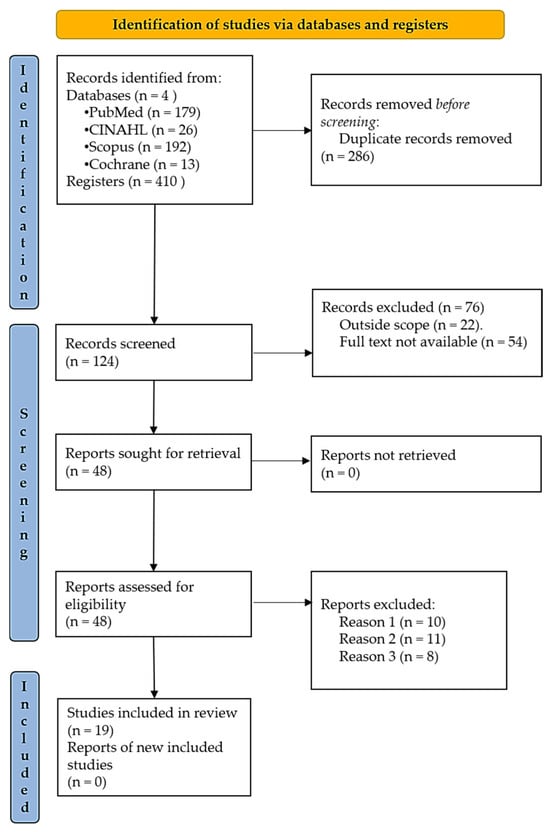
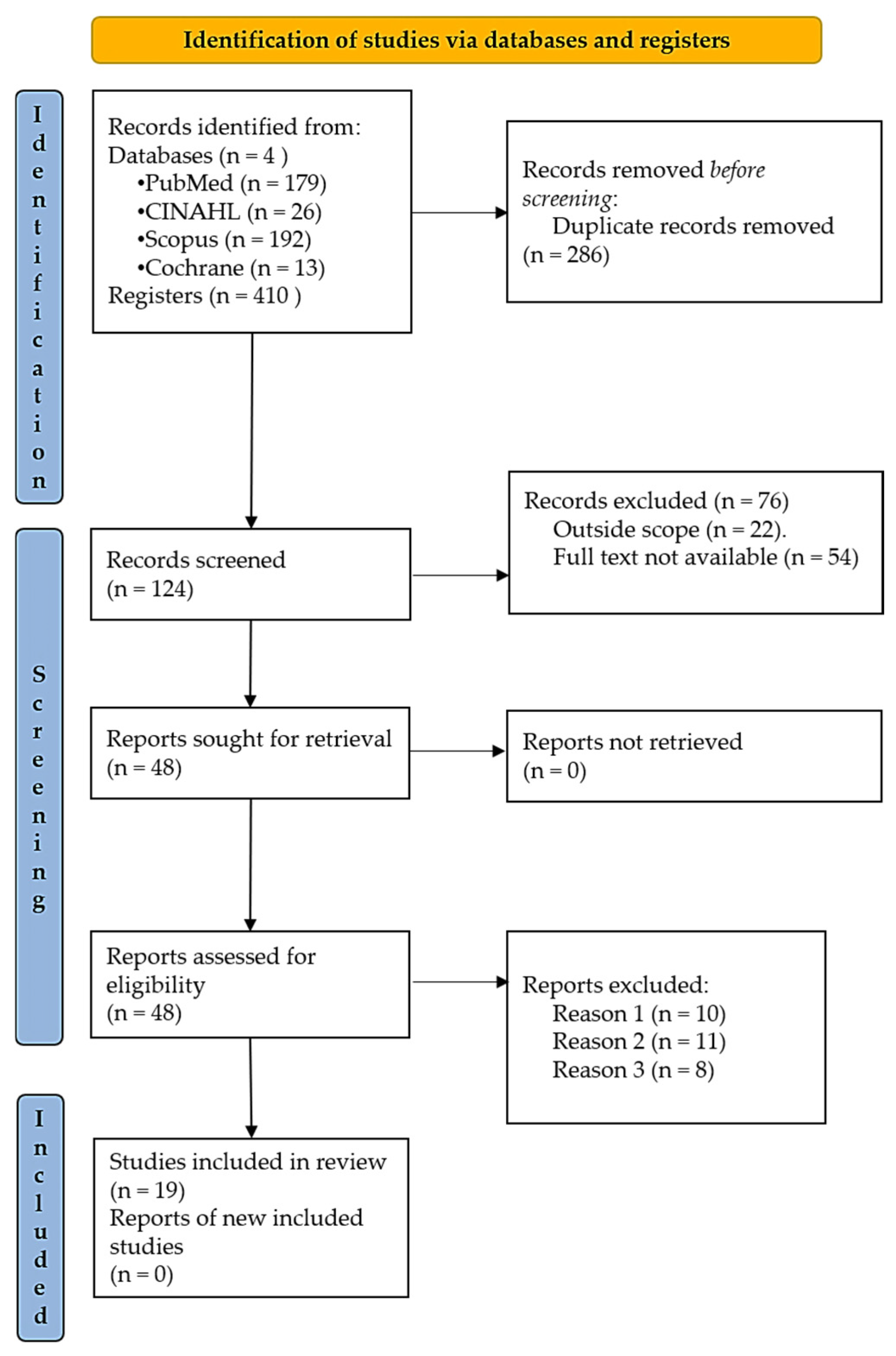
After the removal of 286 duplicate records, a total of 124 articles were screened based on their titles and abstracts. After title and abstract screening, the remaining full-text articles were assessed for eligibility. At this stage, 76 full-text articles were excluded: 22 because they were outside the scope of the review and 54 because the full text could not be obtained despite reasonable efforts. Forty-eight reports were retrieved and assessed for eligibility, of which 29 were excluded for the following reasons: population not aligned with the review question (Reason 1), lack of relevant data on the variables of interest (Reason 2), and ineligible publication type or study design (Reason 3). Ultimately, 19 sources of evidence were included, comprising quantitative, qualitative, and mixed-methods studies, as well as previous scoping reviews focusing on LGBTQIA+ older adults or on issues affecting their access to and experiences of healthcare. The processes of identification, screening, eligibility assessment, and inclusion are summarized in the PRISMA-ScR flow diagram (Figure 1).
Figure 1.
Adapted PRISMA 2020 Flow Diagram for Systematic Reviews which included Searches of Databases, Registers and Other Sources [43].
3. Results
3.1. Characteristics of the Sources of Evidence
The included sources of evidence were conducted predominantly in high-income countries, including the United States [21,26,29,30,31,32,35,36,40], Taiwan [28], Brazil [25], Germany [34], the Netherlands [38], the United Kingdom [27], Australia [39,41], Israel [33], and New Zealand [37]. Together, they represent a wide range of healthcare and social care contexts, including primary care, hospital care, long-term care, community-based services, and population health surveys.
With regard to study design, the review included qualitative studies exploring the experiences of LGBTQIA+ older adults in residential aged care settings and healthcare professionals’ perspectives on culturally competent care [28,33,40,41], as well as a scoping review examining care for LGBTQIA+ older adults in residential aged care facilities [25]. Quantitative studies investigated health insurance coverage, access to healthcare, hospitalizations, and health behaviors [26,29,30,34,35,37,38]. Mixed-methods research examined psychosocial health among sexual and gender minority individuals with cancer [31], while comparative studies explored mental health and loneliness among older transgender adults receiving gender-affirming care [38]. The review also included scoping and integrative reviews addressing discrimination in healthcare experienced by older transgender individuals and the healthcare experiences of older adults with LGBTIQA+ identities [20,21,25].
The populations studied included LGBTQIA+ older adults living in long-term care facilities, older adults from sexual and gender minority groups receiving care across a range of healthcare settings, older transgender individuals attending gender identity clinics, and broader samples of sexual minority adults that provide valuable insights into life-course experiences and their implications for health and ageing in later life [26,27,32,35,36,38,40].
3.2. Narrative and Thematic Synthesis of the Identified Barriers
The narrative and thematic synthesis, organized according to the analytical categories presented in the synthesis table (Table 2), identified three main types of barriers: structural, relational, and social. It also highlighted their consequences for healthcare access and utilization, as well as their impact on health outcomes.
3.2.1. Structural Barriers
Structural barriers were primarily related to the organization and design of healthcare and social care systems, professional training, and institutional policies. Several studies highlighted the limited provision of education on LGBTQIA+ health and ageing among nursing staff and other healthcare professionals, particularly in residential and long-term care settings [21,39]. They also identified the pervasive influence of cisheteronormativity within many healthcare services, where the specific needs of LGBTQIA+ older adults are not explicitly considered in the planning of resources and care protocols [25,28,41].
Furthermore, studies examining health insurance coverage and access to healthcare according to sexual orientation revealed persistent structural inequalities. Women from sexual minority groups were more likely to be uninsured, whereas insured men from sexual minority groups reported greater difficulty affording the healthcare they required. Other studies demonstrated the influence of socioeconomic disadvantage on patterns of hospital utilization and the demographic composition of LGBTQIA+ older adults accessing hospital services, highlighting the importance of economic and geographical factors [21,29,30,35].
3.2.2. Relational Barriers
Relational barriers were associated with interactions between LGBTQIA+ older adults and healthcare professionals. Qualitative studies conducted in residential aged care facilities and other healthcare settings describe ambivalent or openly discriminatory attitudes, the invisibility of identities and relationships, misgendering, and fear of disclosing one’s identity because of anticipated rejection or mistreatment. Studies focusing on older transgender individuals reported discrimination in healthcare, including disrespectful treatment, the persistent use of non-affirmed names and gender markers, communication barriers, and breaches of confidentiality. These experiences frequently led individuals to avoid or delay seeking healthcare [20,21,25,28,39,41].
Other qualitative studies suggest that experiences within healthcare systems may be perceived as processes that fragment an individual’s sense of self. Achieving wholeness therefore requires intra-community support, self-determined care, and healthcare that affirms identity while addressing structural sources of harm [33,40]. These relational barriers have a direct impact on trust in healthcare services and on individuals’ willingness to seek care over time [28,33,40].
3.2.3. Social Barriers
Social barriers refer to broader contextual factors, including stigma, social isolation, and socioeconomic disadvantages. Studies examining psychosocial health and real-world social networks indicate that LGBTIQA+ older adults experience a substantial burden of chronic stress resulting from social prejudice, family rejection, and limited recognition of their rights, which is associated with poorer emotional well-being and an increased risk of loneliness [26,31,33,34,35,36,38]. The evidence also shows that older transgender individuals report significantly higher levels of depressive symptoms, anxiety, and loneliness than their cisgender counterparts, largely explained by the cumulative effects of financial hardship, somatic problems, and social connectedness across the life course [26,38].
Socioeconomic disadvantages and geographical deprivation also influence patterns of hospital utilization, while distrust of formal services and the legacy of historical trauma undermine engagement with aged care services. As a result, many LGBTQIA+ older adults rely on informal support networks or seek to avoid institutional care whenever possible [32,35,41].
3.3. Consequences for Healthcare Access, Service Utilization, and Health Outcomes
Overall, structural, relational, and social barriers were consistently associated with delayed healthcare seeking, lower utilization of healthcare services, and poorer physical, mental, and social health outcomes among LGBTQIA+ older adults [20,21,28,30,31,35,36,41].
Several studies reported that inadequate professional training and the persistence of cisheteronormativity practices in residential aged care facilities and healthcare services lead LGBTQIA+ residents to conceal their identities, limit the expression of their relationships, and avoid using available services for fear of negative reactions, with detrimental effects on their well-being and mental health [25,31,32,36,38]. Structural inequalities in health insurance coverage and the ability to afford healthcare create practical barriers to accessing preventive services and treatment, particularly among women and men from sexual minority groups. In addition, less favorable health behavior patterns—including higher alcohol consumption, tobacco use, and poorer dietary habits—identified in population-based surveys suggest a greater accumulation of health risks that may manifest in later life [25,26,29,30,37,41].
With respect to mental health, the evidence indicates high levels of chronic stress, depressive symptoms, and loneliness among LGBTIQA+ older adults, particularly among older transgender individuals, whose real-world social networks do not always provide sufficient support. At the same time, several studies highlight the protective role of diverse community networks and collective empowerment processes in fostering resilience in the face of exclusion. These findings provide important insights for the development of interventions aimed at strengthening social support and improving access to culturally competent healthcare services [26,32,36,38,40].
3.4. Summary of the Evidence Map and Identified Gaps
Overall, the evidence map demonstrates a growing body of literature on ageism, LGBTQIA+ phobia, and health inequalities affecting LGBTQIA+ older adults. However, this evidence remains heavily concentrated in high-income countries and is dominated by descriptive and exploratory study designs.
Most studies focus on identifying barriers and associated health outcomes, whereas relatively few evaluate specific interventions aimed at reducing ageism and LGBTQIA+ phobia within healthcare and social care services, particularly in nursing practice and long-term care settings [21,25,28,29,35,37,38,40,41].
The review also revealed a limited number of studies explicitly led from a nursing perspective, together with a lack of evaluated protocols and educational programs that systematically integrate sexual and gender diversity into the care of older adults. Key knowledge gaps include the absence of longitudinal studies examining the cumulative impact of these barriers across the life course, the limited representation of primary care and community-based settings, and the scarcity of evidence on inclusive and culturally competent models of care that have been implemented and evaluated in terms of health outcomes and healthcare utilizations [21,25,28,39,41].
4. Discussion
The findings of this scoping review indicate that LGBTQIA+ older adults face a complex interplay of structural, relational, and social barriers in their interactions with healthcare and long-term care systems. These barriers are associated with delays in seeking healthcare, lower utilization of health services [25,28,29,30], poorer physical and mental health, and higher levels of loneliness, particularly among older transgender individuals and LGBTIQA+ older adults experiencing socioeconomic disadvantage [21,35,36,38].
The evidence map further demonstrates that inequalities in health insurance coverage, economic capacity, residential care organization, and social network composition are closely linked to experiences of discrimination, identity invisibility, and fear of rejection [21,25,26,29,30,31,32,33,34,35,36,37,39,40,41].
Together, these factors configure a pattern of cumulative vulnerability across the LGBTIQA+ life course that shapes healthcare access, service utilization, and health outcomes in later life [21,26,31,32,33,35,36,37,38,40,41].
4.1. Ageism, Active Ageing, and the Social Determinants of Health
The findings are consistent with previous evidence on ageism in healthcare services, which has shown that older adults frequently experience stereotyping, infantilizing attitudes, and exclusion from clinical decision-making. Among LGBTQIA+ older adults, these processes are further intensified by the cisheteronormative nature of many healthcare services and the absence of specific inclusive policies, thereby undermining the right to dignified care in later life as recognized in international human rights frameworks on the rights of older persons [2,6,7,9].
From the perspective of the World Health Organization’s Active Ageing framework, which advocates optimizing opportunities for health, participation, and security throughout the life course, the evidence included in this review suggests that these opportunities are not fully realized for LGBTQIA+ older adults [2,3]. Socioeconomic disadvantages, social isolation, fear of institutionalization in non-inclusive care settings, and the absence of adequate support networks act as key social determinants that limit the ability of LGBTQIA+ older adults to age actively, healthily, and successfully [7,11,21,26,35,38,41].
4.2. Minority Stress, Mental Health, and Intersectionality
The findings on mental health, real-world social networks, and loneliness among LGBTQIA+ older adults are consistent with Meyer’s Minority Stress Model, which links prejudice, expectations of rejection, identity concealment, and internalized stigma to an increased risk of psychological distress and mental health disorders [8,12,14]. Recent studies involving LGBTIQA+ older adults have shown that the cumulative effects of social stressors experienced throughout adulthood are associated with higher levels of depression and anxiety, whereas generativity and social participation function as psychosocial resources that can mitigate these adverse effects. The studies reviewed demonstrate that chronic stress and limited real-world social networks are associated with poorer emotional well-being among LGBTIQA+ older adults, highlighting the importance of perceived social support and diversity in the composition of real-world social networks [26,33,36,44,45].
Similarly, the evidence indicates that older transgender individuals experience significantly higher levels of depressive symptoms, anxiety, and loneliness than their cisgender counterparts, largely explained by the cumulative effects of financial hardship, somatic problems, and reduced social connectedness across the life course [38]. When examining the experiences of older transgender individuals, it is important to consider the role of cisnormativity in healthcare and the need for pluralistic theoretical frameworks capable of capturing the specificity of their lived experiences. This perspective reinforces the view that inequalities cannot be explained solely by older age or transgender identity, but rather by the intersection of these characteristics with other axes of vulnerability [14,38,46].
This perspective is consistent with intersectionality frameworks applied to LGBTQIA+ populations, which argue that systems of oppression intersect to produce distinct forms of inequality affecting women and sexual and gender minority groups that cannot be understood through isolated social categories [13,15]. The findings support an intersectional interpretation of health inequalities in LGBTQIA+ older adults by demonstrating how ageism, LGBTQIA+ phobia, socioeconomic disadvantage, and other forms of discrimination interact to generate barriers to healthcare access and utilization [13,15,21,25,35,41].
4.3. Implications for Nursing and Clinical Practice
The evidence confirms that the lack of specific education and training in sexual and gender diversity among nurses and other healthcare professionals constitutes a major barrier to the provision of culturally competent, inclusive, and non-discriminatory care [11,21,25,28,41]. Studies have shown that the quality of comprehensive care provided to LGBTQIA+ populations depends largely on the cultural competence of nursing teams and the explicit integration of sexual and gender diversity into clinical protocols and models of care. Qualitative research exploring nurses’ knowledge and experiences in caring for transgender individuals has identified substantial gaps in knowledge, attitudes, and perceived confidence, which contribute to experiences of inequity and mistreatment within healthcare services [11,16,20,25,28,41].
In this context, Madeleine Leininger’s Theory of Culture Care Diversity and Universality, together with its applications to sexual and gender diversity, provides a valuable framework for designing culturally competent nursing interventions that emphasize individualized care tailored to the specific needs of LGBTQIA+ people [47]. Accordingly, the findings of this evidence mapping support the systematic integration of sexual and gender diversity into undergraduate and postgraduate nursing curricula, as well as the development of mandatory continuing education programs for professionals working in residential aged care facilities, hospitals, and primary care settings. These programs should include content on ageism, LGBTQIA+ phobia, historical trauma, and strategies for delivering identity-affirming, culturally competent care [11,16,21,25,28,41].
4.4. Limitations of the Evidence Base and the Present Scoping Review
The identified body of evidence presents several limitations that should be considered when interpreting the findings. Most of the included studies were conducted in high-income countries and predominantly urban settings, limiting the generalizability of the findings to rural contexts and to healthcare systems with less developed policies on LGBTQIA+ sexual and gender diversity.
Descriptive and cross-sectional study designs predominated, whereas longitudinal studies examining the cumulative impact of these barriers across the life course were scarce. Likewise, there was a lack of rigorous evaluations of specific interventions aimed at reducing ageism and LGBTQIA+ phobia within healthcare and social care services.
It is important to note that relatively few of the included studies explicitly operationalize ‘ageism’ as a measured construct. Instead, most sources document barriers, discriminatory experiences and health inequalities affecting older LGBTIQA+ people, which we interpret through an ageism and LGBTIQA+ phobia lens when they reflect age-related and cisheteronormative exclusion in healthcare settings.
Regarding the review process, the literature search was limited to selected databases and predefined time periods, which may have resulted in the omission of relevant studies available in other repositories or published in languages other than those included in the search strategy. Consequently, pertinent studies indexed in interdisciplinary databases and published in other languages may have been overlooked. In addition, as no structured search of the grey literature was undertaken, relevant publications may have been missed, potentially introducing publication or reporting bias by limiting the comprehensiveness of the evidence map. Although an exploratory methodological quality appraisal was conducted using tools such as the Scottish Intercollegiate Guidelines Network (SIGN) criteria [42], this assessment was used solely to contextualize the interpretation of the evidence map and did not serve as a basis for excluding studies, in accordance with the recommendations of the Joanna Briggs Institute (JBI) for scoping reviews [22,24]. Finally, there was considerable heterogeneity in both the age ranges and the definitions used for “older adult” across the included sources. Some studies focused explicitly on participants aged 65 years and over, whereas others examined broader age bands (e.g., ≥50 years or general adult samples with age-stratified analyses). Together with variability in the LGBTQIA+ identity categories considered, this heterogeneity limits direct comparisons between findings and should be considered when interpreting the evidence. In addition, explicit operationalization of ageism was limited across the included literature. Our intersectional framing of ageism and LGBTIQA+ phobia therefore relies on conceptual alignment between the reported barriers and age-related and cisheteronormative dynamics, rather than on uniform measurement of ageism in all studies.
4.5. Implications for Research, Clinical Practice, and Health Policy
In light of these findings, several priorities for future research can be identified. Longitudinal studies are needed to examine the cumulative impact of ageism and LGBTQIA+ phobia on health outcomes and healthcare utilization among LGBTQIA+ older adults. In addition, rigorous evaluations of interventions specifically designed to reduce these barriers in residential aged care facilities, hospitals, and primary care settings are required [2,9,12,13].
Particular emphasis should be placed on developing nursing-led research that integrates theoretical frameworks such as Minority Stress Theory, intersectionality, and Madeleine Leininger’s Theory of Culture Care Diversity and Universality in order to generate evidence-based models of care tailored to the specific needs of LGBTQIA+ older adults [6,11,12,13,15,16,47].
From a clinical practice perspective, the findings support the implementation of identity-affirming care protocols, mandatory education and training programs, and robust monitoring and accountability mechanisms to ensure culturally safe care for LGBTQIA+ older adults [1,4,6,7,21,41]. From a health policy perspective, international frameworks on active ageing, the social determinants of health, and the human rights of older adults and LGBTQIA+ people provide a strong foundation for advancing legal and organizational reforms aimed at reducing the inequalities identified in this review. Integrating these perspectives into the planning of services for older adults and broader public health strategies is essential to advancing healthcare systems that recognize diversity and ensure dignified, safe, and equitable ageing for LGBTQIA+ older adults [3,5,11,25,28,35,41].
The landmark achievement of Spain ranking first in the ILGA-Europe Rainbow Map 2026, together with the enactment of Law 4/2023, reflects a favorable political and legal context for the protection of LGBTI+ rights. Nevertheless, the persistence of the barriers identified in this review suggests that the current challenge lies not in the absence of legislation, but in the effective implementation of inclusive policies across healthcare and long-term care services, as well as in the transformation of professional practice [18,19].
5. Conclusions
This scoping review demonstrates that ageism and LGBTQIA+ phobia intersect within healthcare and long-term care systems, giving rise to multiple structural, relational, and social barriers that adversely affect healthcare access, service utilization, and health outcomes among LGBTQIA+ older adults. These barriers are manifested through inadequate professional education and training in sexual and gender diversity, the persistence of cisheteronormativity within the organization of healthcare and long-term care services, socioeconomic inequalities, and insufficient social support networks, together creating a pattern of cumulative vulnerability across the life course.
The findings are consistent with the World Health Organization’s Active Ageing framework and the social determinants of health approach, demonstrating that the conditions required for healthy, participatory, and secure ageing are not fully realized for LGBTQIA+ older adults because of the combined effects of ageism, discrimination based on sexual orientation and gender identity, and structural socioeconomic disadvantage. The findings also reinforce the contributions of Minority Stress Theory and intersectionality by demonstrating that health inequalities affecting LGBTQIA+ older adults cannot be understood solely in terms of age or LGBTQIA+ identity, but rather through the interaction of multiple, intersecting systems of oppression.
From a nursing perspective, the evidence highlights the urgent need to integrate sexual and gender diversity into undergraduate and continuing professional education, to develop culturally competent and identity-affirming care protocols, and to establish robust governance and accountability mechanisms that ensure culturally safe care for LGBTQIA+ older adults.
The existence of a favorable legal and policy framework does not necessarily translate into the absence of barriers in everyday clinical practice. This underscores the need to examine how equality is implemented in practice within healthcare and long-term care services for LGBTQIA+ older adults.
The findings identify several priorities for future research, including the design and evaluation of targeted interventions to reduce ageism and LGBTQIA+ phobia, the development of longitudinal studies examining the cumulative impact of these barriers across the life course, and the expansion of nursing-led research across diverse healthcare and social care settings.
Supplementary Materials
The following supporting information can be downloaded at https://www.mdpi.com/article/10.3390/healthcare14193276/s1, Supplementary File S1. PRISMA-ScR checklist [23].
Author Contributions
Conceptualization, F.J.C.-M., J.M.G.-A. and A.P.-L.; methodology, F.J.C.-M. and A.P.-L.; investigation, F.J.C.-M., J.M.G.-A. and A.P.-L.; writing—original draft preparation, F.J.C.-M., J.M.G.-A. and A.P.-L.; writing—review and editing, F.J.C.-M. and J.M.G.-A.; supervision, A.P.-L. and J.M.G.-A.; project administration, A.P.-L. All authors have read and agreed to the published version of the manuscript.
Funding
This research received no external funding.
Institutional Review Board Statement
This study is a scoping review of publicly available literature and therefore did not require ethical approval.
Informed Consent Statement
Not applicable.
Data Availability Statement
The data presented in this study are openly available in https://doi.org/10.17605/OSF.IO/52YJM (accessed on 8 July 2026).
Conflicts of Interest
The authors declare no conflicts of interest.
References
- Leone, A.; Couselo, D. Population ageing and care policies: Tensions in social policy formulation. Itiner. Trab. Soc. 2022, 7, 79–86. [Google Scholar] [CrossRef] [Scilit]
- Pan American Health Organization. Global Report on Ageism; Organización Panamericana de la Salud: Washington, DC, USA, 2022; 116p, Available online: https://iris.paho.org/items/5ec40a5d-32a9-4dc6-ad45-97661de2bff7 (accessed on 17 May 2026).
- World Health Organization; Pan American Health Organization. Social Determinants of Health. Conceptual Framework. 2023. Available online: https://www.paho.org/es/temas/determinantes-sociales-salud (accessed on 11 May 2026).
- Goudarzian, A.H.; Abdi, K.; Taebi, M.; Sayahi, S.; Wibisono, A.H.; Allen, K.A.; Yaghoobzadeh, A. A concept analysis of ageism from older adults’ perspective: A hybrid model. Ann. Med. Surg. 2024, 86, 4475–4482. [Google Scholar] [CrossRef] [Scilit] [PubMed]
- Barranco Avilés, M.; Vicente Echevarría, I. The human rights of older persons. Tiempo Paz 2022, 145, 10–17. Available online: https://revistatiempodepaz.org/wp-content/uploads/2022/08/R-145.Tiempo-de-Paz_online.pdf (accessed on 11 June 2026).
- Araújo, P.; Soares, I.; Vale, P.; Sousa, A.; Aparicio, E.; Carvalho, E. Ageism against older people in healthcare services: A Scoping Review. Rev. Lat. Am. Enferm. 2023, 31, 16. [Google Scholar] [CrossRef] [Scilit]
- Gramajo Graña, N. Relationships between active ageing and the LGBT+ population. Perspect. Rev. Soc. Sci. 2024, 9. [Google Scholar] [CrossRef] [Scilit]
- Carrascosa Sánchez, C. Social Stressors and Mental Health in LGBT Older Adults: Generativity and Social Participation as Psychosocial Resources; Universitat de València: Valencia, Spain, 2024; Available online: https://producciocientifica.uv.es/documentos/68642443b4207d2935b7330b (accessed on 11 June 2026).
- World Health Organization. Ending Violence and Discrimination Against Lesbian, Gay, Bisexual, Transgender and Intersex People; World Health Organization: Geneva, Switzerland, 2015; p. 2. Available online: https://www.who.int/es/publications/m/item/Joint_LGBTI_Statement (accessed on 5 May 2026).
- Martín Hernández, I. Active, successful, and healthy ageing: A new life for older people. Rev. Int. Trab. Soc. Y Soc. Sci. 2025, 1, 65–90. [Google Scholar] [CrossRef] [Scilit]
- Escobar Escobar, M.; Fernández Rincón, C.; Henao Buriticá, A. Nursing care and quality of comprehensive care for the population LGBTI/OSIGD. Rev. Med. 2024, 32, 33–50. [Google Scholar] [CrossRef] [Scilit]
- Meyer, I. Prejudice, social stress, and mental health in lesbian, gay, and bisexual populations: Conceptual issues and research evidence. Psychol. Bull. 2003, 129, 674–697. [Google Scholar] [CrossRef] [Scilit] [PubMed]
- Testa, R.; Habarth, J.; Peta, J.; Balsam, K.; Bockting, W. Development of the gender minority stress and resilience measure. Psychol. Sex. Orientat. Gend. Divers. 2015, 2, 65–77, Erratum in Psychol. Sex. Orientat. Gend. Divers. 2022, 9, 286. https://doi.org/10.1037/sgd0000584. [Google Scholar] [CrossRef] [Scilit]
- Linander, I.; Lundberg, T.; Alm, E. The gender minority stress model and/or cisnormativity? The need for pluralistic theoretical perspectives in improving trans health and medicine. Soc. Sci. Med. 2024, 351, 116957. [Google Scholar] [CrossRef] [Scilit] [PubMed]
- Crenshaw, K. Mapping the Margins: Intersectionality, Identity Politics, and Violence against Women of Color. Rev. Stanford. Law. Rev. 1991, 43, 1241–1299. [Google Scholar] [CrossRef] [Scilit]
- Forrisi, F. Nursing and sexual diversity: An approach based on Madeleine Leininger’s transcultural theory. Rev. Urug. Nurs. 2022, 17, e507. [Google Scholar] [CrossRef] [Scilit]
- Carabez, R.; Eliason, M.; Martinson, M. Nurses’ knowledge about transgender patient care: A qualitative study. Adv. Nurs. Sci. 2016, 39, 257–271. [Google Scholar] [CrossRef] [Scilit] [PubMed]
- Jefatura del Estado. Ley 4/2023, de 28 de febrero, que promueve la igualdad real y efectiva de las personas trans y garantiza los derechos de las personas LGTBI en España. In Boletín Oficial del Estado (BOE-A-2023-5366), 1st ed.; Jefatura del Estado, Ed.; BOE: Madrid, Spain, 2023; pp. 1–61. Available online: https://www.boe.es/buscar/pdf/2023/BOE-A-2023-5366-consolidado.pdf (accessed on 8 June 2026).
- ILGA-Europe. Spain Breaks Malta’s Decade-Long Hold on the Rainbow Map Top Spot. 2026 Rainbow Map. 2026. p. 3. Available online: https://rainbowmap.ilga-europe.org/ (accessed on 24 June 2026).
- Constantinou, C.; Nikitara, M. Older Transgender People’s Discrimination in Healthcare: A Scoping Review. Geriatrics 2025, 10, 140. [Google Scholar] [CrossRef] [Scilit] [PubMed]
- Johansen, A.; Swane, C.; Evron, L.; Bay, L.; Vasantharajan, S.; Nielsen, D. Healthcare Experiences of Older Adults with an LGBT+ Identity: An Integrative Review. Healthcare 2026, 14, 1110. [Google Scholar] [CrossRef] [Scilit] [PubMed]
- Peters, M.; Godfrey, C.; Khalil, H.; McInerney, P.; Parker, D.; Soares, C. Guidance for conducting systematic scoping reviews. JBI Evid. Implement. 2015, 13, 141–146. [Google Scholar] [CrossRef] [Scilit] [PubMed]
- Tricco, A.C.; Lillie, E.; Zarin, W.; O’Brien, K.K.; Colquhoun, H.; Levac, D.; Moher, D.; Peters, M.D.J.; Horsley, T.; Weeks, L.; et al. PRISMA extension for scoping reviews (PRISMA-SCR): Checklist and explanation. Ann. Intern. Med. 2018, 169, 467–473. [Google Scholar] [CrossRef] [Scilit] [PubMed]
- Peters, M.; Marnie, C.; Tricco, A.; Pollock, D.; Munn, Z.; Alexander, L.; McInerney, P.; Godfrey, C.M.; Khalil, H. Updated methodological guidance for the conduct of scoping reviews. JBI Evid. Implement. 2020, 18, 2119–2126. [Google Scholar] [CrossRef] [Scilit] [PubMed]
- Silva, J.; França, L.; Rosa, A.; Neves, V.; Siqueira, L. Health care for LGBTI+ elders living in Nursing Homes. Rev. Bras. Enferm. 2021, 74, e20200403. [Google Scholar] [CrossRef] [Scilit] [PubMed]
- Kittle, K.; Boerner, K.; Kim, K.; Fredriksen-Goldsen, K. Social Resource Variations Among LGBT Middle-Aged and Older Adults: The Intersections of Sociodemographic Characteristics. Gerontologist 2022, 62, 1324–1335. [Google Scholar] [CrossRef] [Scilit] [PubMed]
- Matthews, A.; Li, C.; Bernhardt, B.; Sohani, S.; Dong, X. Factors influencing the well-being of Asian American LGBT individuals across the lifespan: Perspectives from leaders of community-based organizations. BMC Geriatr. 2022, 22, 909. [Google Scholar] [CrossRef] [Scilit] [PubMed]
- Wang, Y.; Miao, N.; Wang, F.; Chang, S. Factors associated with providers’ culturally competent care for sexual and gender minority older adults in Taiwan: A qualitative study applying the social ecological model. Int. J. Nurs. Stud. 2022, 135, 104331. [Google Scholar] [CrossRef] [Scilit] [PubMed]
- Gavulic, K.; Wallace, J. Medicare eligibility and changes in coverage, access to care, and health by sexual orientation and gender identity. JAMA Health Forum. 2024, 5, 15. [Google Scholar] [CrossRef] [Scilit] [PubMed]
- Nguyen, K.; Levengood, T.; Allen, H.; Gonzales, G. Health insurance coverage and access to care by sexual orientation during the COVID-19 pandemic: United States, January 2021–February 2022. Am. J. Public Health 2024, 114, 118–128. [Google Scholar] [CrossRef] [Scilit] [PubMed]
- Franco-Rocha, O.; Trainum, K.; Wheldon, C. The psychosocial health of sexual and gender minority people with anal and colorectal cancer: A mixed methods study. J. Cancer Surviv. 2025, 19, 2012–2326. [Google Scholar] [CrossRef] [Scilit] [PubMed]
- Perone, A. An historical case study of trans exclusion and empowerment: Implications for transgender older adults and aging. J. Gerontol. Soc. Work 2024, 67, 660–686. [Google Scholar] [CrossRef] [Scilit] [PubMed]
- Sperling, D. Needs, Experiences, and Hopes for Aging Futures among Older Adults in the LGBTQ Communities: A Qualitative Study in Israel. Arch. Sex. Behav. 2024, 53, 3139–3150. [Google Scholar] [CrossRef] [Scilit] [PubMed]
- Buczak-Stec, E.; König, H.; Brettschneider, C.; Hajek, A. Preferred settings of care and preferred type of home care among heterosexual and sexual minority individuals. J. Am. Med. Dir. Assoc. 2025, 26, 105794. [Google Scholar] [CrossRef] [Scilit] [PubMed]
- May, J.; Noonan, D.; Silva, S. Social determinants of health in lesbian, gay, bisexual, transgender, queer, and other sexual and gender minority (LGBTQ+) older adults: Impact of socioeconomic disadvantage on inpatient hospitalizations. PLoS ONE 2025, 20, e0330612. [Google Scholar] [CrossRef] [Scilit] [PubMed]
- Prasad, A.; Burr, J.; Miller, E.; Fredriksen-Goldsen, K. Stress and emotional wellbeing among LGBT older adults: A moderated mediation model for social network size, composition, and perceived social support. Gerontologist 2025, 65, 9. [Google Scholar] [CrossRef] [Scilit] [PubMed]
- Adams, J.; Jankhotkaew, J.; Ellis, S.; Neville, S. Health Promotion Opportunities for Lesbian, Gay and Bisexual People: Using Data From the New Zealand Health Survey. Health Promot. J. Aust. 2025, 36, e70077. [Google Scholar] [CrossRef] [Scilit] [PubMed]
- van Heesewijk, J.O.; de Groot, I.L.; Dreijerink, K.M.A.; Wiepjes, C.M.; Kok, A.A.L.; van Schoor, N.M.; Huisman, M.; den Heijer, M.; Kreukels, B.P.C. Mental health outcomes and loneliness in older transgender individuals receiving long-term gender-affirming hormone therapy compared with older cisgender individuals. Int. Psychogeriatr. 2025, 37, 100049. [Google Scholar] [CrossRef] [Scilit] [PubMed]
- Scott, K.; Brown, D.; Brömdal, A.; Debattista, J.; Matson, A.; Sargent, J.; Howard, C.; Farmer, G.; Wojciechowski, L.; Beccaria, L.; et al. LGBT+ concerns of ageing and accessing aged care services in Australia: A cross-sectional study. Australas. J. Ageing 2025, 44, e70084. [Google Scholar] [CrossRef] [Scilit] [PubMed]
- Gillani, B.; Moxie, J.; Ray-Novak, M.; Diamant-Wilson, R.; Prince, D.M.; Mintz, L.J.; Moore, S.E. Constructing Wholeness in LGBTQ+ Healthcare Access: A Grounded Theory Model. Healthcare 2026, 14, 536. [Google Scholar] [CrossRef] [Scilit] [PubMed]
- Tissot, D.; Karacsony, S.; Andrews, S.; James, R. LGBTIQA+ Inclusion in Aged Care: Perspectives From Providers and Community Stakeholders. Australas. J. Ageing 2026, 46, e70129. [Google Scholar] [CrossRef] [Scilit] [PubMed]
- Scottish Intercollegiate Guidelines Network (SIGN). A Guideline Developer’s Handbook; Healthcare Improvement Scotland: Edinburgh, UK, 2019; 67p, Available online: https://www.sign.ac.uk/media/2038/sign50_2019.pdf (accessed on 17 May 2026).
- Page, M.; McKenzie, J.; Bossuyt, P.; Boutron, I.; Hoffmann, T.; Mulrow, C.D.; Shamseer, L.; Tetzlaff, J.M.; Akl, E.; Brennan, S.E.; et al. The PRISMA 2020 statement: An updated guideline for reporting systematic reviews. BMJ 2021, 134, 178–189. [Google Scholar] [CrossRef] [Scilit] [PubMed]
- Torres Alonso, E. Invisibles. Ageing, old age and the LGBT+ community. Epistem. Rev. Socioterritorial Stud. 2023, 15, 58–69. [Google Scholar] [CrossRef] [Scilit]
- Prasad, A. Real-World Social Networks and Emotional Wellbeing Among LGBT Older Adults. Doctoral Dissertation, UMass Boston, Boston, MA, USA, 2024. Available online: https://scholarworks.umb.edu/doctoral_dissertations/944 (accessed on 17 May 2026).
- Merodio, G.; Martínez Ortiz de Zárate, A.; Zhu, F.; Morentin-Encina, J. The impact of gender ageism and related intersectional inequalities on the health and well-being of older women. Res. Ageing Soc. Policy 2024, 12, 146–165. [Google Scholar] [CrossRef] [Scilit]
- de Carvalho Lira, A.; da Silva, B.; Pinto, E. Analysis of Madeleine Leininger’s theory of cultural care diversity and universality. Cult. Los Cuid. Rev. Nurs. Humanit. 2023, 67, 355–374. [Google Scholar] [CrossRef] [Scilit]

Disclaimer/Publisher’s Note: The statements, opinions and data contained in all publications are solely those of the individual author(s) and contributor(s) and not of MDPI and/or the editor(s). MDPI and/or the editor(s) disclaim responsibility for any injury to people or property resulting from any ideas, methods, instructions or products referred to in the content. |
© 2026 by the authors. Licensee MDPI, Basel, Switzerland. This article is an open access article distributed under the terms and conditions of the Creative Commons Attribution (CC BY) license.