


Highlights
What are the main findings?
- Serum LDL-C was not independently associated with neck disability after adjustment for sex, age group, education level, and job position.
- Ordinal, continuous-outcome, influence, and bootstrap analyses yielded consistent sample-specific estimates.
What are the implications of the main findings?
- The findings do not support using serum LDL-C alone as a marker of neck disability in this occupational population.
- Prospective studies should integrate multidimensional cardiometabolic, inflammatory, ergonomic, behavioral, and psychosocial assessments.
Abstract
Background: Neck pain is a common cause of work-related disability, yet the relationship between serum low-density lipoprotein cholesterol (LDL-C) and neck disability remains uncertain. This study examined whether serum LDL-C was independently associated with neck disability among university employees. Methods: A cross-sectional secondary analysis was conducted using occupational health records from 236 administrative and teaching employees of a private university in Quito, Ecuador. Neck disability was assessed using the Spanish-language Neck Disability Index (NDI). Serum LDL-C was analyzed as a continuous variable (per 10 mg/dL increase). The primary analysis used proportional-odds ordinal logistic regression adjusted for sex, age group, education level, and job position. Model assumptions, multicollinearity, influence, and stability were evaluated. Sensitivity analyses included a three-level ordinal model, multiple linear regression with the continuous NDI score, and nonparametric bootstrap resampling. Results: Mean LDL-C was 112.42 ± 29.09 mg/dL, and 56 participants (23.73%) had LDL-C concentrations ≥ 130 mg/dL. Mild neck disability was the most common category (58.05%), whereas severe disability was uncommon (1.27%). Serum LDL-C was not independently associated with higher neck disability in the adjusted ordinal model (adjusted OR per 10 mg/dL = 0.956; 95% CI, 0.876–1.043; p = 0.309). Sensitivity analyses using alternative-outcome specifications and bootstrap resampling produced consistent findings. Female sex was independently associated with greater disability, whereas no other covariates reached statistical significance. Conclusions: Serum LDL-C was not independently associated with neck disability in this selected occupational population after adjustment for demographic and occupational factors. Prospective multicenter studies incorporating broader cardiometabolic, inflammatory, ergonomic, behavioral, and psychosocial variables are needed to further clarify determinants of neck disability.
1. Introduction
Neck pain is a common musculoskeletal condition that can affect physical function, social participation, and work capacity [1]. It is a leading global cause of years lived with disability (YLDs) [2]. In 2020, an estimated 203 million people were affected worldwide, and projections suggest approximately 269 million cases by 2050 [3]. Neck pain accounted for 20.2 million YLDs worldwide in 2020, with a global age-standardized YLD rate of 244 per 100,000 people [3].
In Ecuador, the Global Burden of Disease analysis identified low-back pain as the leading musculoskeletal condition, followed by osteoarthritis and fragility fractures, with neck pain ranking fourth [4]. The World Health Organization Rehabilitation Need Estimator reported a neck-pain prevalence of 2450 per 100,000 people in Ecuador in 2021 [5].
Neck pain can reduce mobility and dexterity and can contribute to sleep disturbance, fatigue, early retirement, and reduced social participation [6,7]. These consequences impair quality of life [8] and are consistent with a broader understanding of disability as restrictions in daily functioning and participation [9].
The Neck Disability Index (NDI) is a 10-item self-reported instrument that evaluates the effect of neck pain on daily activities [10]. It has been adapted across linguistic and cultural settings and has demonstrated favorable reliability and internal consistency in validation studies [11].
Several biological pathways have been proposed to link metabolic status with musculoskeletal pain, but the available evidence is indirect. Muscle ischemia may contribute to myalgia [12], and native or oxidized LDL participates in systemic inflammatory signaling [13,14]. Pro-inflammatory cytokines have also been associated with nociceptive sensitization and chronic pain [15,16]. However, these observations do not establish that circulating LDL-C causes local cervical ischemia or neck disability. The present study measured neither oxidized LDL nor inflammatory cytokines; therefore, these pathways are considered contextual hypotheses rather than tested mechanisms.
Serum LDL-C is only one component of cardiometabolic risk and may incompletely capture metabolic and inflammatory exposure. Neck disability is also influenced by demographic, biomechanical, occupational, behavioral, and psychosocial factors. This multifactorial context is particularly relevant in working populations, in which prolonged computer use, sustained posture, and sedentary behavior may coexist with metabolic risk [17,18,19].
Against this background, the objective of this study was to examine the cross-sectional association between serum LDL-C and neck pain-related disability among university employees. The analysis was exploratory and was not designed to establish causality or preventive or therapeutic effects.
2. Materials and Methods
An analytical cross-sectional secondary analysis was conducted among administrative and teaching employees of a private university in Quito, Ecuador. The study was approved by the Human Research Ethics Committee of the Pontifical Catholic University of Ecuador (CEISH-PUCE; protocol EO-33-2023, version 1; approval reference CEISH-182-2023; 22 March 2023).
2.1. Data Collection
An electronic survey was distributed through institutional email and configured to allow one response per user. It included the informed-consent form, authorization to access occupational laboratory results, the Spanish-language NDI, and questions on sex, age group, education level, and job position.
Fasting lipid-profile results were retrieved from occupational medical records maintained by the university’s Department of Occupational Health and Safety. The records identified the samples as fasting, although the exact fasting duration was not retained. The dataset contained total cholesterol, triglycerides, high-density lipoprotein cholesterol, and LDL-C, all expressed in mg/dL; LDL-C was available for every participant in the final analytical sample. The analytical file did not retain the assay platform, whether LDL-C was measured directly or calculated, laboratory quality-control records, or the exact interval between blood sampling and NDI completion. These details could not be verified retrospectively and are reported as limitations.
2.2. Study Population
A non-probability convenience sample was drawn from 1773 active employees. Eligible participants were active university workers who had undergone a routine occupational health examination that included a fasting lipid profile and who provided informed consent for use of their clinical data. Employees were excluded if they did not provide consent or were receiving anti-inflammatory, analgesic, or lipid-lowering medication that could affect the study variables. After initial screening, 460 employees were eligible. Reason-specific counts within the 1313 initial exclusions were not preserved in the analytical records and could not be reported separately.
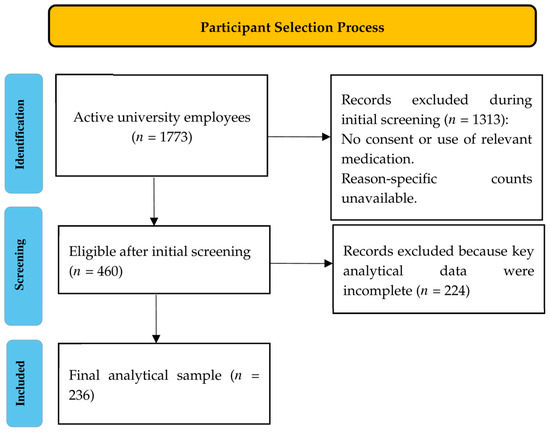
During data preparation, 224 of the 460 eligible records were excluded because key analytical data were incomplete. The available project files did not retain the variables missing in those records or sufficient participant characteristics to compare included and excluded employees; variable-specific missingness and between-group comparisons therefore could not be reconstructed. The final sample comprised 236 participants (13.3% of the source population and 51.3% of those initially eligible). Because this was a secondary analysis of a fixed set of occupational health records, the sample size was determined by data availability and no a priori sample-size calculation was performed. All records meeting the analytical criteria were included. Adequacy was evaluated using confidence-interval precision, model diagnostics, influence analysis, and bootstrap stability rather than an uninformative post hoc power calculation. Model complexity was restricted to seven slope coefficients plus three ordinal thresholds. The model could be estimated with the available sample; however, only three participants had severe disability, limiting precision at the upper threshold and precluding reliable expansion to a larger covariate set. Figure 1 summarizes participant selection.
Figure 1.
Flow of participants from the source population to the final analytical sample.
2.3. Variables
The exposure, outcome, and prespecified adjustment covariates are described below.
2.3.1. Serum Low-Density Lipoprotein Cholesterol
LDL is the main carrier of cholesterol from the liver to peripheral tissues. Cholesterol transported by LDL contributes to cell-membrane integrity, steroid-hormone synthesis, and bile-acid production [20].
Elevated LDL-C is an established cardiovascular risk factor [21] and has also been studied in musculoskeletal conditions, including tendon and rotator-cuff disorders [22,23]. These observations provide background only and do not establish a mechanism for neck disability.
The definition of elevated LDL-C depends on clinical context and cardiovascular-risk stratification, and thresholds vary across professional guidelines, including those of the American Heart Association (AHA), European Society of Cardiology (ESC), and Canadian Cardiovascular Society (CCS) [24,25].
For descriptive presentation, we used the Adult Treatment Panel III (ATP III) classification, which categorizes LDL-C as optimal, near/above optimal, borderline high, high, or very high [25] (Table 1). These categories were not used as predictors.
Table 1.
Descriptive LDL-C classification based on ATP III.
The AHA describes LDL-C ≤ 100 mg/dL as optimal for many adults, while emphasizing that treatment targets depend on overall cardiovascular risk [26].
2.3.2. Neck Disability Index
Neck disability was assessed with the Spanish-language NDI [27,28]. The instrument contains 10 items (pain intensity, personal care, lifting, reading, headache, concentration, work, driving, sleeping, and recreation), each scored from 0 to 5; higher scores indicate greater disability. All 10 items were available for 221 participants, nine items for 14 participants, and eight items for one participant. When one or two items were missing, the sum of answered items was prorated to the 0–50 scale as follows: observed sum/(5 × number of answered items) × 50. Omitted items were therefore not assigned a score of zero. Scores were classified as no disability (<5), mild disability (5 to <15), moderate disability (15 to <25), severe disability (25 to <35), or complete disability (≥35). No participant had complete disability. Internal consistency among the 221 complete questionnaires was good (Cronbach’s alpha = 0.830). The Spanish version has demonstrated acceptable psychometric properties [28], but an Ecuador-specific validation was not identified; this is acknowledged as a limitation.
2.3.3. Covariates
The adjusted analyses included covariates selected on substantive grounds before estimation because of their plausible relationships with both lipid concentrations and neck disability: sex (male or female), age group (14–26, 27–59, or ≥60 years), education level (secondary, undergraduate, or postgraduate), and job position (administrative or teaching). The dataset also contained grouped income, ethnicity, and nationality fields; however, the original income-category labels were unavailable and the ethnicity and nationality variables had been heavily grouped for de-identification, so they could not be interpreted reliably as confounders. Total cholesterol, HDL-C, and triglycerides were not entered simultaneously with LDL-C because they arose from the same lipid profile and could introduce collinearity without addressing the principal unmeasured confounding. Exact age, body mass index, waist circumference, smoking, physical activity, sedentary time, ergonomic exposure, working hours, psychological stress, diabetes, hypertension, and duration of neck symptoms were not available.
2.4. Statistical Analysis
Analyses were independently reproduced in Python version 3.12.13 [29] using pandas 2.2.3 for data management, NumPy 2.3.5 for matrix operations, and SciPy 1.17.0 for estimation and statistical distributions. Categorical variables are reported as frequencies and percentages. Continuous variables are summarized using means and standard deviations or medians and interquartile ranges, as appropriate. Cronbach’s alpha was calculated from complete NDI item responses.
The primary analysis used proportional-odds ordinal logistic regression with the four observed NDI categories as the ordered outcome. LDL-C was entered continuously per 10 mg/dL. An unadjusted model was fitted first, followed by a model adjusted for sex, age group, education level, and job position. Male sex, age 27–59 years, secondary education, and administrative employment were reference categories. Regression coefficients (beta), standard errors (SEs), odds ratios (ORs), 95% confidence intervals (CIs), and two-sided p-values were calculated. The OR represents the multiplicative change in the cumulative odds of belonging to a higher disability category for each 10 mg/dL increase in LDL-C.
The proportional-odds assumption was evaluated using an approximate global Wald-type comparison of slope estimates across cumulative logits. Because the severe-disability category contained only three participants, this diagnostic and estimates involving the highest cut point were interpreted cautiously. Numerical convergence was checked for every model. Overall fit of the adjusted model was evaluated using a likelihood-ratio comparison with the intercept-only model, Akaike’s information criterion (AIC), and McFadden’s pseudo-R-squared. Multicollinearity was assessed using variance inflation factors (VIFs), with values < 5 considered acceptable. Influence on the LDL-C coefficient was assessed by refitting the adjusted model after omitting one participant at a time and calculating an approximate DFBETA; an absolute DFBETA ≥ 1 was prespecified as potentially influential.
Stability of the adjusted LDL-C coefficient was examined using 1000 nonparametric participant-level bootstrap resamples. The same four-level adjusted ordinal model was fitted in each resample. Resamples that did not contain all four observed NDI categories were recorded as non-estimable because the primary outcome structure could not be reproduced. A percentile 95% bootstrap interval was calculated from estimable resamples.
Two sensitivity analyses were performed. First, moderate and severe disability were combined to produce a three-level ordinal outcome, and the adjusted proportional-odds model was repeated. Second, the prorated total NDI score was analyzed as a continuous outcome in multiple linear regression adjusted for the same covariates. Because the residual distribution departed from normality, heteroscedasticity-consistent type 3 (HC3) standard errors were used. Statistical significance was defined as a two-sided p-value < 0.05. Analyses used all 236 participants; LDL-C and the included covariates had no missing values in the final analytical dataset.
3. Results
Results are presented first for the analytical sample and then for the primary, diagnostic, sensitivity, and stability analyses.
3.1. Population Characterization
The analytical sample included 236 employees. Women accounted for 154 participants (65.25%), 214 participants (90.68%) were aged 27–59 years, 130 (55.08%) had undergraduate education, and 153 (64.83%) held administrative positions (Table 2).
Table 2.
Characteristics of the study population.
3.2. Serum LDL Cholesterol
Mean LDL-C was 112.42 mg/dL (standard deviation, 29.09), and the median was 112.14 mg/dL (interquartile range, 92.20–127.76). Applying ATP III thresholds to the recorded continuous values, 180 participants (76.27%) had LDL-C < 130 mg/dL and 56 (23.73%) had LDL-C ≥ 130 mg/dL (Table 3).
Table 3.
Distribution of serum LDL cholesterol concentrations according to the Adult Treatment Panel III classification.
ATP III categories were used for descriptive presentation only; continuous LDL-C was used in all regression models.
3.3. Neck Pain Disability
The prorated total NDI score had a mean of 8.46 (standard deviation, 5.98) and a median of 7.00 (interquartile range, 4.00–11.00). Mild disability was the most frequent category (n = 137, 58.05%), followed by no disability (n = 64, 27.12%), moderate disability (n = 32, 13.56%), and severe disability (n = 3, 1.27%) (Table 4). No participant had complete disability.
Table 4.
Distribution of neck disability categories according to the prorated NDI score.
3.4. Association Between LDL Cholesterol and Neck Disability
In the unadjusted proportional-odds model, there was no evidence that LDL-C was associated with higher neck disability categories (OR per 10 mg/dL = 0.950; 95% CI: 0.872–1.035; p = 0.244). The result remained null after adjustment for sex, age group, education level, and job position (adjusted OR per 10 mg/dL = 0.956; 95% CI: 0.876–1.043; p = 0.309) (Table 5).
Table 5.
Unadjusted and adjusted proportional-odds ordinal logistic regression models for neck disability.
Female sex was associated with higher cumulative odds of belonging to a more severe disability category (adjusted OR = 1.936; 95% CI: 1.108–3.384; p = 0.020). None of the other covariates was statistically significant. The adjusted model converged without numerical errors. Compared with the intercept-only model, the full model yielded a likelihood-ratio chi-square of 12.18 with 7 degrees of freedom (p = 0.095), an AIC of 477.93, and a McFadden pseudo-R-squared of 0.026. The approximate global Wald-type diagnostic did not provide evidence against the proportional-odds assumption (chi-square(14) = 6.36; p = 0.957), although the result must be interpreted cautiously because the highest category contained only three observations. The maximum VIF was 4.19. In the one-participant-deletion analysis, the LDL-C coefficient ranged from −0.055 to −0.035 and the maximum absolute DFBETA was 0.388, indicating that no single observation materially changed the LDL-C conclusion.
3.5. Sensitivity and Stability Analyses
When moderate and severe disability were combined, there remained no evidence of an association between LDL-C and the three-level ordinal outcome (adjusted OR per 10 mg/dL = 0.954; 95% CI: 0.875–1.041; p = 0.292). Female sex remained associated with higher disability in this model (adjusted OR = 1.919; 95% CI: 1.098–3.354; p = 0.022).
In the adjusted linear regression using the prorated total NDI score, LDL-C was not associated with disability (beta per 10 mg/dL = −0.171; 95% CI: −0.433 to 0.091; p = 0.200). The model explained 8.7% of the observed variability in NDI scores (R-squared = 0.087). Residual normality was not supported (Shapiro–Wilk p < 0.001), so HC3 robust standard errors were used. Female participants scored an adjusted mean of 2.67 NDI points higher than male participants (95% CI: 1.17–4.18; p < 0.001).
In the bootstrap stability analysis, 968 of 1000 resamples (96.8%) retained all four NDI categories and yielded finite estimates; 32 resamples did not contain the severe-disability category and were therefore non-estimable, and no additional convergence failures occurred. The percentile 95% bootstrap interval for the adjusted LDL-C OR was 0.879–1.044, which included the null value and was consistent with the model-based interval. The direction of the point estimate was therefore not interpreted as a trend or biological effect (Table 6).
Table 6.
Sensitivity and stability analyses for the association between LDL cholesterol and neck disability.
All models were adjusted for sex, age group, education level, and job position. The linear model used HC3 heteroscedasticity-consistent standard errors. The bootstrap row reports the original adjusted OR with its percentile bootstrap interval; 968 of 1000 resamples were estimable.
3.6. Distribution of LDL Cholesterol Across Neck Disability Categories
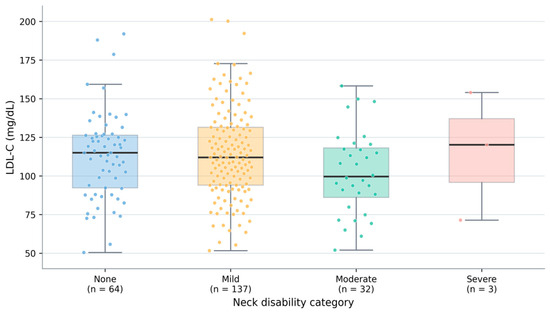
Serum LDL-C concentrations showed substantial overlap across all neck disability categories, with no clear monotonic pattern as disability severity increased (Figure 2). The severe-disability group contained only three observations; its apparent distribution should not be interpreted as a distinct clinical pattern.
Figure 2.
Distribution of serum LDL-C concentrations across neck disability categories. Boxes show medians and interquartile ranges; whiskers extend to 1.5 times the interquartile range, and points represent individual participants.
4. Discussion
The present study found no evidence of an independent association between serum LDL-C and neck disability among administrative and teaching employees. Each 10 mg/dL increase in LDL-C was associated with an adjusted OR of 0.956 (95% CI: 0.876–1.043; p = 0.309) for belonging to a higher NDI category. The model-based confidence interval, bootstrap interval (0.879–1.044), three-level ordinal model, and continuous NDI analysis all crossed the null. Taken together, these estimates do not support either a harmful or protective interpretation of LDL-C, and the negative point estimate should not be characterized as a trend. Because the confidence interval still includes modest associations in either direction, the result is best interpreted as an absence of a detected association in this sample rather than proof of equivalence.
These findings add nuance to a small and methodologically heterogeneous literature. Kumagai et al. reported an inverse association between LDL-C and neck symptoms in a Japanese population-based sample [30], whereas Ahorukomeye et al. reported higher odds of neck pain among adults with hypercholesterolemia after adjustment for confounders [31]. Those studies assessed neck pain or stiffness and used exposure definitions that differ from the continuous LDL-C concentration and NDI-based disability outcome used here. Differences in population characteristics, medication eligibility, occupational context, covariate control, and outcome severity may therefore contribute to the apparently discordant results. More importantly, all three studies are cross-sectional; none can establish whether lipid abnormalities precede, follow, or are unrelated to cervical symptoms.
Recent clinical evidence further illustrates the heterogeneity of neck-disability trajectories. Prall et al. described reductions in pain and disability after a multimodal rehabilitation program that included rib manipulation in a patient recovering from thoracic-spine osteomyelitis [32]. As a single case report involving a specific mechanical and infectious context, it cannot be compared directly with this population analysis or used to infer an effect of LDL-C. Its relevance here is limited to underscoring that NDI scores can reflect clinical and biomechanical processes that were not measured in the present study.
An isolated LDL-C measurement may be too narrow to characterize the cardiometabolic processes potentially relevant to musculoskeletal pain. LDL-C reflects the cholesterol carried by LDL particles but does not capture central adiposity, insulin resistance, glycemic status, triglyceride-rich lipoproteins, particle number, LDL oxidation, or systemic inflammatory activity. Metabolic syndrome has been associated with neck pain [33], and inflammatory cytokines have been linked to discogenic neck pain [34], but these multidimensional exposures are not interchangeable with LDL-C. Evidence from other pain conditions likewise highlights the importance of phenotype and treatment context: Cordero et al. reported relationships among overweight, lipid profile, and selected clinical symptoms in fibromyalgia [35], whereas Liu et al. examined lipid-lowering targets and medication use in relation to intervertebral disc degeneration, sciatica, and low-back pain [36]. These outcomes and populations differ from neck disability and cannot be extrapolated to the present sample. Studies in other clinical settings have also combined anthropometric, biochemical, dietary, and behavioral indicators rather than relying on a single lipid marker [37,38]. Accordingly, the present null result for LDL-C should not be generalized to cardiometabolic health as a whole or interpreted as evidence against inflammatory mechanisms.
The occupational context is also important. Prospective and systematic-review evidence identifies prolonged sitting, job strain, stress, workstation demands, and other ergonomic and psychosocial factors as contributors to neck pain and musculoskeletal disability [7,39,40,41,42,43,44,45]. None of these exposures were available in sufficient detail for adjustment. Job position (administrative versus teaching) is only a coarse proxy and may conceal substantial within-category differences in computer use, posture, workload, work breaks, and physical activity. This incomplete characterization may have limited the explanatory capacity of the fitted model and underscores the need to integrate biochemical measures with direct occupational assessment.
Female sex was associated with higher disability in the adjusted ordinal model and in the sensitivity analyses. This finding is compatible with prior reports of sex-related differences in pain prevalence and experience [46,47,48,49], but it was not the primary hypothesis. The study did not assess hormonal status, caregiving demands, psychosocial exposures, pain coping, or a sex-by-LDL-C interaction, nor was it powered for sex-stratified inference. The association should therefore be regarded as exploratory and potentially affected by residual confounding rather than as evidence of an inherent biological susceptibility.
The sparse severe-disability category was an important analytical challenge. Only three participants were classified as severely disabled, limiting information at the highest ordinal threshold. Nonetheless, the primary model converged, the global proportional-odds diagnostic did not indicate a violation, VIFs were acceptable, and deletion of individual observations did not materially change the LDL-C coefficient. Collapsing moderate and severe categories, treating NDI as continuous, and applying 1000 bootstrap resamples yielded concordant conclusions. This triangulation strengthens the internal consistency of the analysis, although it cannot compensate for selection bias, unmeasured confounding, or limited representation of more severe disability.
4.1. Strengths and Limitations
This study has several strengths. It addresses an understudied question in an Ecuadorian occupational population and uses a validated Spanish-language NDI to quantify functional impact rather than relying solely on the presence or absence of neck pain. LDL-C was modeled continuously in clinically interpretable 10 mg/dL units, preserving information that would be lost through arbitrary dichotomization. The primary ordinal model retained the ordered disability categories and incorporated prespecified demographic and occupational covariates available in the dataset. Transparent handling of one or two missing NDI items, reporting of internal consistency, model-fit and proportional-odds diagnostics, multicollinearity and influence assessments, two alternative outcome specifications, and participant-level bootstrap analysis collectively strengthen analytical transparency. Reporting effect estimates with confidence intervals and avoiding biological interpretation of nonsignificant findings further support a cautious appraisal.
These strengths should be considered alongside important limitations. The cross-sectional design prevents establishing temporality or causality. The convenience sample was drawn from one private university, and only 236 of 1773 source employees entered the analytical sample. Reason-specific counts for the initial exclusions, variable-specific missingness among 224 incomplete eligible records, and characteristics for comparing included and excluded employees were not retained. Selection, nonresponse, and healthy-worker biases are therefore plausible, and generalizability beyond this selected workforce is limited.
Adjustment was restricted to sex, age group, education level, and job position. Exact age, anthropometric indicators, smoking, diet, physical activity and sedentary time, ergonomic exposure, working hours, psychological stress, sleep, diabetes; hypertension, symptom duration, and medication history beyond the exclusion criteria were unavailable. Low-back pain and fibromyalgia outcomes were also unavailable, and participants receiving lipid-lowering, anti-inflammatory, or analgesic medication were excluded. Consequently, medication-related effects, coexisting pain conditions, effect modification, and substantial residual confounding could not be evaluated. The dataset did not include circulating inflammatory or oxidative markers such as interleukin-6 (IL-6), interleukin-1 beta (IL-1β), tumor necrosis factor-alpha (TNF-α), high-sensitivity C-reactive protein, or oxidized LDL (oxLDL).
The analytical dataset also lacked the laboratory platform, the method used to determine LDL-C (direct measurement or calculation), detailed quality-control information, exact fasting duration, and the interval between blood collection and NDI completion. A single LDL-C value may be affected by biological and analytical variability and does not represent long-term lipid exposure. Although the Spanish-language NDI has acceptable psychometric properties, an Ecuador-specific validation was not identified, 15 questionnaires required proration of one or two missing items, and disability was self-reported. Finally, the severe-disability category contained only three participants. Diagnostic, influence, bootstrap, and sensitivity analyses improve transparency but cannot eliminate the imprecision caused by this sparse category.
4.2. Future Perspectives
Future research should use prospective, multicenter designs that recruit employees from public and private institutions and ensure adequate representation across job types and the full spectrum of neck disability. Repeated measurement of LDL-C and NDI would help determine temporal sequence and whether changes in lipid status accompany the onset, persistence, or progression of disability. Laboratory protocols should standardize fasting conditions, assay methods, and quality control, while cardiometabolic characterization should extend beyond LDL-C to include anthropometry, blood pressure, glycemic markers, the complete lipid profile, apolipoprotein B, oxLDL, high-sensitivity C-reactive protein, IL-6, IL-1β, and TNF-α. Local validation or measurement-invariance testing of the NDI in Ecuador would further strengthen outcome assessment.
Future studies should also integrate objective and self-reported occupational exposures, including workstation ergonomics, screen and sitting time, posture, work breaks, workload, job strain, stress, sleep, physical activity, coexisting pain conditions, and medication use. Prespecified causal frameworks could guide confounder selection, while sex-stratified analyses and interaction terms could examine whether associations differ across demographic or occupational groups. Rather than testing LDL-C in isolation, future models should evaluate multidimensional cardiometabolic profiles and their incremental value beyond established ergonomic and psychosocial determinants. Only longitudinal evidence with adequate control of confounding would justify considering targeted preventive or clinical applications.
5. Conclusions
In this selected sample of university employees, serum LDL-C was not independently associated with neck disability after adjustment for sex, age group, education level, and job position. Concordant estimates across the primary ordinal model, alternative outcome specifications, influence analysis, and bootstrap resampling strengthen confidence in this sample-specific null finding, but they neither establish equivalence nor exclude an association in other populations. These data do not support using LDL-C alone as a marker of neck disability. Prospective multicenter research integrating repeated cardiometabolic, inflammatory, ergonomic, behavioral, and psychosocial assessments is needed to clarify whether broader risk profiles are associated with the onset or progression of neck-related disability.
Author Contributions
Conceptualization, N.A.R.-M., S.O.I.-J., I.S.V.-F. and S.M.C.-P.; methodology, N.A.R.-M., S.O.I.-J., I.S.V.-F. and S.M.C.-P.; formal analysis, S.O.I.-J. and S.M.C.-P.; investigation, N.A.R.-M., S.O.I.-J. and I.S.V.-F.; resources, S.O.I.-J. and I.S.V.-F.; data curation, N.A.R.-M. and S.O.I.-J.; writing—original draft preparation, N.A.R.-M. and S.M.C.-P.; writing—review and editing, all authors; visualization, S.M.C.-P.; supervision, I.S.V.-F. and S.M.C.-P.; project administration, S.O.I.-J. All authors have read and agreed to the published version of the manuscript.
Funding
This research received no external funding.
Institutional Review Board Statement
The study was conducted in accordance with the Declaration of Helsinki and approved by the Human Research Ethics Committee of the Pontifical Catholic University of Ecuador (CEISH-PUCE) for the project entitled “Relationship between Dyslipidemia and Non-Specific Neck Pain among Staff of the Pontifical Catholic University of Ecuador, Pichincha, Ecuador” (protocol code EO-33-2023, V1; approval reference CEISH-182-2023; approved on 22 March 2023).
Informed Consent Statement
Informed consent was obtained from all subjects involved in the study.
Data Availability Statement
The data presented in this study are available upon request from the corresponding author due to privacy restrictions.
Acknowledgments
During preparation of this manuscript, the authors used ChatGPT 5.6 Sol (OpenAI, San Francisco, CA, USA) for language editing, organization of the response to reviewers, and assistance with statistical code drafting. The tool was not used autonomously to generate data or make scientific decisions. The authors executed and reviewed the analyses, verified all numerical results and references, edited the final text, and take full responsibility for the publication.
Conflicts of Interest
The authors declare no conflicts of interest.
Abbreviations
The following abbreviations are used in this manuscript:
| AHA | American Heart Association |
| AIC | Akaike’s information criterion |
| ATP III | Adult Treatment Panel III |
| CCS | Canadian Cardiovascular Society |
| ESC | European Society of Cardiology |
| HC3 | Heteroscedasticity-consistent type 3 |
| IL-1β | Interleukin-1 beta |
| IL-6 | Interleukin-6 |
| LDL | Low-density lipoprotein |
| LDL-C | Low-density lipoprotein cholesterol |
| NDI | Neck Disability Index |
| oxLDL | Oxidized low-density lipoprotein |
| TNF-α | Tumor necrosis factor-alpha |
| VIF | Variance inflation factor |
| YLDs | Years lived with disability |
References
- Cholewicki, J.; Popovich, J.M., Jr.; Reeves, N.P.; DeStefano, L.A.; Rowan, J.J.; Francisco, T.J.; Prokop, L.L.; Zatkin, M.A.; Lee, A.S.; Sikorskii, A.; et al. The effects of osteopathic manipulative treatment on pain and disability in patients with chronic neck pain: A single-blinded randomized controlled trial. PM&R 2022, 14, 1417–1429. [Google Scholar] [CrossRef] [Scilit] [PubMed]
- Xu, F.; Zhang, X.; Yang, M.; Zhao, Q.; Wang, Q.; Lian, J.; Zhang, R.; Chu, T.; Kou, Z.; Zhao, M. Magnitude, temporal trend and inequality in burden of neck pain: An analysis of the Global Burden of Disease Study 2019. BMC Musculoskelet. Disord. 2025, 26, 202. [Google Scholar] [CrossRef] [Scilit] [PubMed]
- Wu, A.M.; Cross, M.; Elliott, J.M.; Culbreth, G.T.; Haile, L.M.; Steinmetz, J.D.; Hagins, H.; Kopec, J.A.; Brooks, P.M.; Woolf, A.D.; et al. Global, regional, and national burden of neck pain, 1990–2020, and projections to 2050: A systematic analysis of the Global Burden of Disease Study 2021. Lancet Rheumatol. 2024, 6, e142–e155. [Google Scholar] [CrossRef] [Scilit] [PubMed]
- Abbafati, C.; Lim, S.S.; Abbafati, C.; Abbas, K.M.; Abbasi, M.; Abbasifard, M.; Abbasi-Kangevari, M.; Abbastabar, H.; Abd-Allah, F.; Abdelalim, A.; et al. Global burden of 369 diseases and injuries in 204 countries and territories, 1990–2019: A systematic analysis for the Global Burden of Disease Study 2019. Lancet 2020, 396, 1204–1222. [Google Scholar] [CrossRef] [PubMed]
- Institute for Health Metrics and Evaluation. VizHub—WHO Rehabilitation Need Estimator. 2025. Available online: https://vizhub.healthdata.org/rehabilitation/ (accessed on 13 January 2025).
- Lutke Schipholt, I.J.; Scholten-Peeters, G.G.M.; Koop, M.A.; Bonnet, P.; Bontkes, H.J.; Coppieters, M.W. Systemic neuroimmune responses in people with non-specific neck pain and cervical radiculopathy, and associations with clinical, psychological, and lifestyle factors. Front. Mol. Neurosci. 2022, 15, 1003821. [Google Scholar] [CrossRef] [Scilit] [PubMed]
- Mazaheri-Tehrani, S.; Arefian, M.; Abhari, A.P.; Riahi, R.; Vahdatpour, B.; Mahdavi, S.B.; Kelishadi, R. Sedentary behavior and neck pain in adults: A systematic review and meta-analysis. Prev. Med. 2023, 175, 107711. [Google Scholar] [CrossRef] [Scilit] [PubMed]
- Machino, M.; Ando, K.; Kobayashi, K.; Nakashima, H.; Morozumi, M.; Kanbara, S.; Ito, S.; Inoue, T.; Koshimizu, H.; Seki, T.; et al. Impact of neck and shoulder pain on health-related quality of life in a middle-aged community-living population. BioMed Res. Int. 2021, 2021, 6674264. [Google Scholar] [CrossRef] [Scilit] [PubMed]
- Toboso Martín, M.; Arnau Ripollés, M.S. La discapacidad dentro del enfoque de capacidades y funcionamientos de Amartya Sen. Rev. Iberoam. Filos. Polit. Humanid. 2008, 10, 64–94. Available online: https://www.fuhem.es/wp-content/uploads/2019/08/Discapacidad_enfoque_Amartya_Sen.pdf (accessed on 13 January 2025).
- Jones, L.B.; Jadhakhan, F.; Falla, D. The influence of exercise on pain, disability and quality of life in office workers with chronic neck pain: A systematic review and meta-analysis. Appl. Ergon. 2024, 117, 104216. [Google Scholar] [CrossRef] [Scilit] [PubMed]
- Geete, D.B.; Mhatre, B.S.; Vernon, H. Cross-cultural adaptation and psychometric validation of the Hindi version of the Neck Disability Index in patients with chronic neck pain. Spine 2023, 48, 1663–1669. [Google Scholar] [CrossRef] [Scilit] [PubMed]
- Queme, L.F.; Ross, J.L.; Jankowski, M.P. Peripheral mechanisms of ischemic myalgia. Front. Cell. Neurosci. 2017, 11, 419. [Google Scholar] [CrossRef] [Scilit] [PubMed]
- Carvajal, C. LDL oxidada y la aterosclerosis. Med. Leg. Costa Rica 2015, 32, 161–169. Available online: https://www.scielo.sa.cr/scielo.php?script=sci_arttext&pid=S1409-00152015000100020 (accessed on 13 January 2025).
- Ding, Z.; Pothineni, N.V.K.; Goel, A.; Lüscher, T.F.; Mehta, J.L. PCSK9 and inflammation: Role of shear stress, pro-inflammatory cytokines, and LOX-1. Cardiovasc. Res. 2020, 116, 908–915. [Google Scholar] [CrossRef] [Scilit] [PubMed]
- Crespo-Pardo, L.; Taboada-Iglesias, Y. Mediadores inflamatorios: Su relación con el dolor crónico y problemas asociados. Revisión bibliográfica. Rev. Soc. Esp. Dolor 2021, 28, 37–46. [Google Scholar] [CrossRef] [Scilit] [PubMed]
- Moreno Brea, M.R.; Micó, J.A. TNF y citocinas y dolor: Más allá de la inflamación tisular. Reumatol. Clin. 2009, 5, 1–4. Available online: https://www.reumatologiaclinica.org/es-tnf-citocinas-dolor-mas-alla-articulo-S1699258X0900148X (accessed on 26 February 2025). [CrossRef] [Scilit] [PubMed]
- Carrillo-Larco, R.M.; Benites-Moya, C.J.; Anza-Ramirez, C.; Albitres-Flores, L.; Sánchez-Velazco, D.; Pacheco-Barrios, N.; Bernabe-Ortiz, A. A systematic review of population-based studies on lipid profiles in Latin America and the Caribbean. eLife 2020, 9, e57980. [Google Scholar] [CrossRef] [Scilit] [PubMed]
- Cagnie, B.; Danneels, L.; Van Tiggelen, D.; De Loose, V.; Cambier, D. Individual and work-related risk factors for neck pain among office workers: A cross-sectional study. Eur. Spine J. 2007, 16, 679–686. [Google Scholar] [CrossRef] [Scilit] [PubMed]
- Iqbal, Z.A.; Alghadir, A.H.; Anwer, S. Efficacy of deep cervical flexor muscle training on neck pain, functional disability, and muscle endurance in school teachers: A clinical trial. BioMed Res. Int. 2021, 2021, 7190808. [Google Scholar] [CrossRef] [Scilit] [PubMed]
- Feingold, K.R.; Grunfeld, C. Introduction to Lipids and Lipoproteins. In Endotext; MDText.com, Inc.: South Dartmouth, MA, USA, 2024. Available online: https://www.ncbi.nlm.nih.gov/books/NBK305896/ (accessed on 28 April 2025).
- Guijarro, C.; Cosín-Sales, J. Colesterol LDL y aterosclerosis: Evidencias. Clin. Investig. Arterioscler. 2021, 33, 25–32. [Google Scholar] [CrossRef] [Scilit] [PubMed]
- Fang, W.H.; Bonavida, V.; Agrawal, D.K.; Thankam, F.G. Hyperlipidemia in tendon injury: Chronicles of low-density lipoproteins. Cell Tissue Res. 2023, 392, 431–442. [Google Scholar] [CrossRef] [Scilit] [PubMed]
- Yazdani, A.N.; Rai, V.; Agrawal, D.K. Rotator cuff health, pathology, and repair in the perspective of hyperlipidemia. J. Orthop. Sports Med. 2022, 4, 263–275. [Google Scholar] [CrossRef] [Scilit] [PubMed]
- Aygun, S.; Tokgozoglu, L. Comparison of current international guidelines for the management of dyslipidemia. J. Clin. Med. 2022, 11, 7249. [Google Scholar] [CrossRef] [Scilit] [PubMed]
- Clebak, K.T.; Dambro, A.B. Hyperlipidemia: An evidence-based review of current guidelines. Cureus 2020, 12, e7326. [Google Scholar] [CrossRef] [Scilit] [PubMed]
- American Heart Association. What Your Cholesterol Levels Mean. 2025. Available online: https://www.heart.org/en/health-topics/cholesterol/about-cholesterol/what-your-cholesterol-levels-mean (accessed on 16 April 2025).
- García-Remeseiro, T.; Gutiérrez-Sánchez, Á.; Garganta, R.; Alonso-Fernández, D. Dolor y discapacidad cervical de los trabajadores públicos usuarios de pantallas de visualización de datos. Cien. Saude Colet. 2021, 26, 5215–5222. [Google Scholar] [CrossRef] [Scilit] [PubMed]
- Andrade Ortega, J.A.; Delgado-Martínez, A.D.; Almécija Ruiz, R. Validation of the Spanish version of the Neck Disability Index. Spine 2010, 35, E114–E118. [Google Scholar] [CrossRef] [Scilit] [PubMed]
- Python Software Foundation. Python Language Reference; Version 3.12; Python Software Foundation: Beaverton, OR, USA, 2024; Available online: https://www.python.org/ (accessed on 5 August 2026).
- Kumagai, G.; Wada, K.; Tanaka, T.; Kudo, H.; Asari, T.; Chiba, D.; Ota, S.; Nakaji, S.; Ishibashi, Y. Associations between neck symptoms and LDL cholesterol in a cross-sectional population-based study. J. Orthop. Sci. 2018, 23, 277–281. [Google Scholar] [CrossRef] [Scilit] [PubMed]
- Ahorukomeye, P.; Mahajan, A.; Du, J.Y.; Yu, C.C.; Bhandutia, A.K.; Ahn, N.U. Association between hypercholesterolemia and neck pain in a cross-sectional population-based study. Spine 2023, 48, 137–142. [Google Scholar] [CrossRef] [Scilit] [PubMed]
- Prall, J.; Dunning, J.; Young, I.; Ross, M.; Escaloni, J.; Bliton, P. Pain and disability reduction following rib manipulation in a patient recovering from osteomyelitis of the thoracic spine. Healthcare 2025, 13, 1355. [Google Scholar] [CrossRef] [Scilit] [PubMed]
- Mäntyselkä, P.; Kautiainen, H.; Vanhala, M. Prevalence of neck pain in subjects with metabolic syndrome—A cross-sectional population-based study. BMC Musculoskelet. Disord. 2010, 11, 171. [Google Scholar] [CrossRef] [Scilit] [PubMed]
- Kang, X.; Qian, M.; Qin, T.; Liu, M.; Xu, H.; Xu, B. Increased expression of inflammatory cytokines and discogenic neck pain. Orthop. Surg. 2024, 16, 227–233. [Google Scholar] [CrossRef] [Scilit] [PubMed]
- Cordero, M.D.; Alcocer-Gómez, E.; Cano-García, F.J.; Sánchez-Domínguez, B.; Fernández-Riejo, P.; Moreno Fernández, A.M.; Fernández-Rodríguez, A.; de Miguel, M. Clinical symptoms in fibromyalgia are associated to overweight and lipid profile. Rheumatol. Int. 2014, 34, 419–422. [Google Scholar] [CrossRef] [Scilit] [PubMed]
- Liu, C.; Chu, X.; Biao, Y.; Jin, Q.; Zhang, Y.; Gao, Y.; Feng, S.; Ma, J.; Zhang, Y. Association between lipid-lowering agents with intervertebral disc degeneration, sciatica and low back pain: A drug-targeted Mendelian randomized study and cross-sectional observation. Lipids Health Dis. 2024, 23, 327. [Google Scholar] [CrossRef] [Scilit] [PubMed]
- Arslan, S.; Sahin, K.; Dal, N.; Atan, R.M.; Selcuk, K.T. The relationship between anthropometric indices and cardiovascular risk in patients with type 2 diabetes mellitus. Diabetes Res. Clin. Pract. 2025, 224, 112243. [Google Scholar] [CrossRef] [Scilit] [PubMed]
- Onay, T.; Dal, N.; Selçuk, K.T.; Arslan, S.; Torun, M.T. Are metabolic risk parameters and MEDFICTS Score associated with tinnitus severity in adults? Nutr. Clin. Metab. 2025, 39, 110–117. [Google Scholar] [CrossRef] [Scilit]
- Kazeminasab, S.; Nejadghaderi, S.A.; Amiri, P.; Pourfathi, H.; Araj-Khodaei, M.; Sullman, M.J.M.; Kolahi, A.-A.; Safiri, S. Neck pain: Global epidemiology, trends and risk factors. BMC Musculoskelet. Disord. 2022, 23, 26. [Google Scholar] [CrossRef] [Scilit] [PubMed]
- Bezzina, A.; Austin, E.; Nguyen, H.; James, C. Workplace psychosocial factors and their association with musculoskeletal disorders: A systematic review of longitudinal studies. Workplace Health Saf. 2023, 71, 578–588. [Google Scholar] [CrossRef] [Scilit] [PubMed]
- Greggi, C.; Visconti, V.V.; Albanese, M.; Gasperini, B.; Chiavoghilefu, A.; Prezioso, C.; Persechino, B.; Iavicoli, S.; Gasbarra, E.; Iundusi, R.; et al. Work-related musculoskeletal disorders: A systematic review and meta-analysis. J. Clin. Med. 2024, 13, 3964. [Google Scholar] [CrossRef] [Scilit] [PubMed]
- Jun, D.; Johnston, V.; McPhail, S.M.; O’Leary, S. A longitudinal evaluation of risk factors and interactions for the development of nonspecific neck pain in office workers in two cultures. Hum. Factors 2021, 63, 663–683. [Google Scholar] [CrossRef] [Scilit] [PubMed]
- Jayakumar, P.; Overbeek, C.L.; Lamb, S.; Williams, M.; Funes, C.; Gwilym, S.; Ring, D.; Vranceanu, A.-M. What factors are associated with disability after upper extremity injuries? A systematic review. Clin. Orthop. Relat. Res. 2018, 476, 2190–2215. [Google Scholar] [CrossRef] [Scilit] [PubMed]
- Martinez-Calderon, J.; Meeus, M.; Struyf, F.; Morales-Asencio, J.M.; Gijon-Nogueron, G.; Luque-Suarez, A. The role of psychological factors in the perpetuation of pain intensity and disability in people with chronic shoulder pain: A systematic review. BMJ Open 2018, 8, e020703. [Google Scholar] [CrossRef] [Scilit] [PubMed]
- Mansfield, M.; Thacker, M.; Taylor, J.L.; Bannister, K.; Spahr, N.; Jong, S.T.; Smith, T. The association between psychosocial factors and mental health symptoms in cervical spine pain with or without radiculopathy on health outcomes: A systematic review. BMC Musculoskelet. Disord. 2023, 24, 235. [Google Scholar] [CrossRef] [Scilit] [PubMed]
- Becker, B.; McGregor, A.J. Men, women, and pain. Gend. Genome 2017, 1, 46–50. [Google Scholar] [CrossRef] [Scilit]
- Iacovides, S.; Avidon, I.; Baker, F.C. Does pain vary across the menstrual cycle? A review. Eur. J. Pain 2015, 19, 1389–1405. [Google Scholar] [CrossRef] [Scilit] [PubMed]
- Jiménez-Trujillo, I.; López-De-Andrés, A.; Del Barrio, J.L.; Hernández-Barrera, V.; Valero-De-Bernabé, M.; Jiménez-García, R. Gender differences in the prevalence and characteristics of pain in Spain: Report from a population-based study. Pain Med. 2019, 20, 2349–2359. [Google Scholar] [CrossRef] [Scilit] [PubMed]
- Athnaiel, O.; Cantillo, S.; Paredes, S.; Knezevic, N.N. The role of sex hormones in pain-related conditions. Int. J. Mol. Sci. 2023, 24, 1866. [Google Scholar] [CrossRef] [Scilit] [PubMed]

Disclaimer/Publisher’s Note: The statements, opinions and data contained in all publications are solely those of the individual author(s) and contributor(s) and not of MDPI and/or the editor(s). MDPI and/or the editor(s) disclaim responsibility for any injury to people or property resulting from any ideas, methods, instructions or products referred to in the content. |
© 2026 by the authors. Licensee MDPI, Basel, Switzerland. This article is an open access article distributed under the terms and conditions of the Creative Commons Attribution (CC BY) license.