


Abstract
Background: This study explored the associations between artificial intelligence (AI)-derived competency scores and nurse retention outcomes among newly employed nurses. Evidence regarding the relationship between AI-based competency assessments, nurse performance, and long-term retention remains limited. Methods: Data were collected from 156 newly employed nurses at hospitals in South Korea between March 2021 and August 2023. Retention status (retained vs. resigned) was specified as the dependent variable, while AI-derived competency scores served as independent variables in binary logistic regression analyses. Result: Self-reflection was significantly associated with retention (p = 0.032), whereas honesty (p = 0.051) and values (p = 0.072) did not achieve statistical significance and were therefore not associated with retention. Behavioral response was significantly associated with early turnover (p = 0.035), whereas relationship (p = 0.073) and understanding of others (p = 0.141) were not significantly associated with turnover. Conclusions: These findings provide preliminary evidence that selected AI-derived competency scores are associated with nurse retention outcomes. However, the findings should be interpreted cautiously because this study examined statistical associations rather than predictive performance, and further validation studies are required before AI-assisted competency assessments can be considered standalone decision-support tools for nurse recruitment.
1. Introduction
The recruitment and retention of nursing staff in healthcare institutions are critical for ensuring patient safety and stable operations [1,2]. In South Korea, the demand for nurses is high, as the number of hospital beds is three times the Organization for Economic Co-operation and Development average [3]. However, securing sufficient personnel is increasingly challenging due to structural issues such as high work intensity, difficulties in adapting to clinical environments, and high turnover rates [4,5,6]. These challenges negatively affect both hospital operations and nursing service quality [7].
To address this shortage, the South Korean government and related organizations have increased nursing college enrolments, and approximately 20,000 nurses are produced annually [8]. Despite this increase, clinical nursing shortages persist because many graduates fail to remain in the field long-term [6,9].
In South Korea, a national nursing licensing exam is held annually for graduates. Based on this exam, major hospitals conduct large-scale recruitment [10]. Approximately 20,000 nurses are hired annually, but many struggle to adapt and resign early. In 2022, 57.4% of new nurses resigned, with 34.8% leaving within the first year due to work adaptation issues [9]. High turnover increases workloads, lowers job satisfaction, reduces care quality, and raises recruitment costs [11].
Advancements in technology have introduced artificial intelligence (AI)-based competency assessments in recruitment. Many employers use AI tools to identify top talent and streamline recruitment processes [12,13]. In healthcare, AI has been proposed as a tool that may improve the efficiency of recruitment processes and support hiring decisions in some settings [14]. However, evidence regarding its ability to improve recruitment outcomes in healthcare remains limited. AI is especially advantageous for processing large application volumes [12], and many South Korean hospitals use AI competency assessments for large-scale nurse recruitment [10].
Among the AI-based recruitment systems used in South Korea, the competency assessment developed by MIDAS IN has been adopted by numerous public and private organizations. The system infers applicants’ competency profiles using AI-assisted analysis of game-based assessment data and behavioral responses. The underlying technology is protected by a Korean patent entitled System and Methods for Evaluating and Deducing Interviewer’s Ability to Use Interview Game (Korean Patent No. 10-2205955) [15,16]. Recent evidence also suggests that AI-assisted personnel assessment may provide meaningful information regarding interpersonal competencies in healthcare settings, although independent validation studies remain limited. Accordingly, further empirical evidence is needed to evaluate whether competency scores generated by such systems are associated with actual workforce outcomes, including nurse retention and early turnover.
Although evidence regarding the relationship between AI-based recruitment, nurse performance, and long-term retention remains limited, AI-assisted competency assessments have been increasingly adopted in nurse recruitment [17]. This study examined the associations between AI-derived competency assessment scores and retention duration among newly employed nurses. Specifically, we sought to identify competency domains associated with nurse retention and early turnover. Furthermore, we explored the potential value and limitations of AI-assisted competency assessments in nursing recruitment and identified directions for future validation studies.
A preliminary, short abstract-style report of this pilot dataset was previously presented at a conference and archived as a brief, two-page proceeding [18]. This comprehensive, full-length manuscript substantially expands upon that initial work by presenting a systematic, hierarchical analysis of the competency framework across three distinct levels (upper, middle, and lower), providing a deeply elaborated theoretical discussion on the psychological and organizational mechanisms behind the findings, and introducing concrete operational safeguards and clinical implications for nursing administration.
2. Methods
2.1. Data Collection
This study was based on data collected and archived between 1 March 2021 and 31 August 2023, including AI competency assessment results and retention durations of new nurse recruits.
2.2. Study Population and Data Selection
This secondary data analysis used the full dataset stored at the institution to maximize statistical power, including interview results and employment durations for 156 nurses who joined through open recruitment between 2021 and 2022. Participants were classified into two groups according to their employment duration during the first year after appointment. Early turnover was defined as employment for less than 365 days, whereas retention was defined as employment for 365 days or longer.
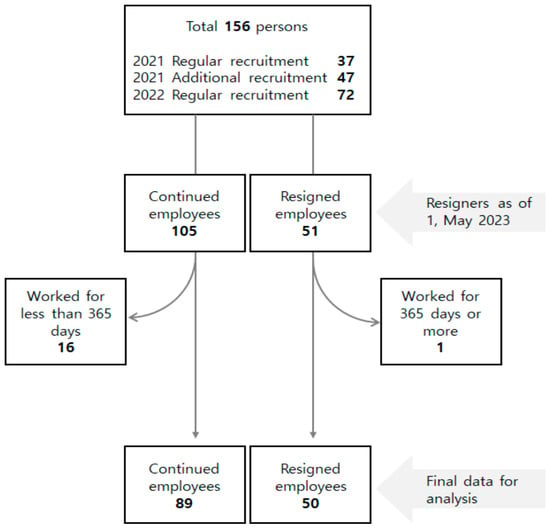
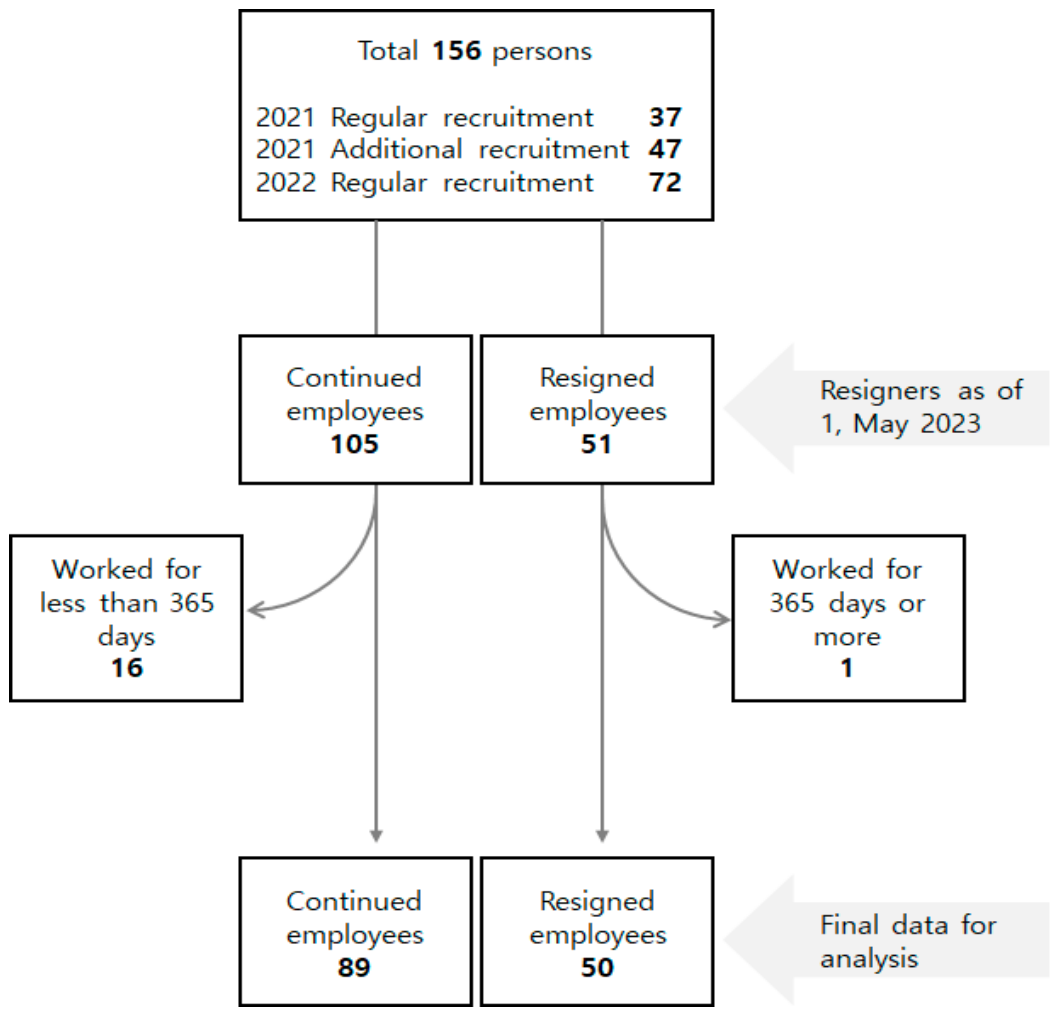
Based on the institutional employment records, 105 participants were initially classified as retained and 51 as resigned. However, these administrative classifications were not fully consistent with the predefined study outcome criteria. Retention was defined as employment for 365 days or longer, whereas early turnover was defined as employment for less than 365 days. Accordingly, 16 participants initially classified as retained had employment durations of less than 365 days, and one participant initially classified as resigned had remained employed for 365 days or longer. These 17 cases were excluded to ensure consistent outcome classification based on the predefined 365-day threshold. The final analytic sample therefore consisted of 89 retained nurses and 50 early leavers, for a total of 139 participants, as illustrated in Figure 1.
Figure 1.
Study participant selection and data collection process.
2.3. Research Design and Analysis
This study employed a secondary analysis of archived administrative data. Descriptive statistics and participant characteristics were analyzed using SPSS version 27.0 (IBM Corp., Armonk, NY, USA). Binary logistic regression analyses were conducted to examine the associations between AI-derived competency scores and retention outcomes.
The AI competency assessment provides competency scores at three hierarchical levels (upper-, middle-, and lower-level competencies). To reflect this hierarchical structure, three separate binary logistic regression models were constructed for the upper-, middle-, and lower-level competencies. Each model examined the associations between competency scores at the corresponding hierarchical level and retention status. Because competency scores across the hierarchical framework are conceptually related, separate regression models were constructed for each level to facilitate interpretation while avoiding the inclusion of conceptually overlapping competency variables within a single model.
Within each model, all competency variables belonging to the corresponding hierarchical level were entered simultaneously using the enter method. No variable selection procedure was performed because previous evidence identifying specific AI-derived competency domains associated with nurse retention remains limited. Therefore, all variables within each competency level were included to explore their potential associations with retention outcomes.
Retention status (retention vs. turnover) was specified as the dependent variable, whereas competency scores at the corresponding hierarchical level were entered as independent variables.
2.4. Data Structure and Characteristics
The AI competency assessment used in this study was developed by MIDAS IN (Seongnam, Republic of Korea) as a commercial recruitment support system. The assessment utilizes AI-assisted analysis of game-based behavioral responses to infer applicants’ competency profiles and is protected by a Korean patent [15]. The assessment results are organized into a hierarchical framework consisting of 59 competency items, including seven upper-level competencies, 15 middle-level competencies, and 37 lower-level competencies. Middle-level competency scores are derived from their corresponding lower-level competencies, while upper-level competencies are generated from the middle-level competency scores. Each competency score was treated as an independent AI-derived variable in the present study, and detailed conceptual definitions are provided in Appendix A.
Because the assessment is a proprietary commercial system, detailed information regarding the underlying AI algorithm, model training procedures, feature weighting, and psychometric validation was not available to the researchers. Therefore, the present study focused on evaluating the associations between the AI-generated competency scores and nurse retention outcomes rather than validating the assessment algorithm itself.
2.5. Ethical Considerations
This study adhered to the latest revision of the Declaration of Helsinki and the International Council for Harmonisation Good Clinical Practice guidelines. Ethical review and approval were waived by the Institutional Review Board of Konkuk University Medical Center (KUMC 2023-11-008) due to the retrospective use of de-identified data. Data collection and analysis complied with these ethical standards, and all study data were securely stored in password-protected files under the responsibility of the principal investigator in a locked research facility.
3. Results
Descriptive statistical analyses comparing the retention and turnover groups are presented in Table 1. The average employment duration for the retention group was 490.11 days (±68.84), significantly longer than the turnover group’s average of 94.38 days (±83.13). The analysis systematically evaluated the structured competency scores across the AI assessment’s hierarchical framework, specifically analyzing the 7 upper-level, 15 middle-level, and 37 lower-level competency variables in separate models.
Table 1.
Descriptive statistics of AI-derived competency scores according to the hierarchical competency structure.
The analysis revealed notable differences between the retention and turnover groups in terms of AI competency assessment variables. In the retention group, the variables with the highest mean scores were emotional perception (59.20 ± 11.84), negativity (56.55 ± 9.94), depression (56.05 ± 9.98), simultaneous processing (57.07 ± 10.43), and communication (56.40 ± 7.87). Conversely, the variables with the lowest mean scores were achievement seeking (43.80 ± 9.15), proactivity (47.15 ± 6.79), growth seeking (47.98 ± 11.76), change management (48.06 ± 9.39), and behavioral response (48.48 ± 9.66).
In the turnover group, the variables with the highest mean scores were emotional perception (61.43 ± 11.19), negativity (58.15 ± 10.03), depression (57.45 ± 10.49), simultaneous processing (56.88 ± 10.74), and hostility (56.16 ± 9.49). The lowest-scoring variables in the turnover group included achievement seeking (44.91 ± 11.18), proactivity (48.62 ± 8.62), honesty (48.70 ± 10.58), change management (49.06 ± 10.40), and self-reflection (49.37 ± 7.48).
Both groups exhibited high scores in emotional perception, simultaneous processing, negativity, and depression, while consistently low scores were observed in achievement seeking, proactivity, and change management.
Because no prior evidence clearly identified which AI-derived competency variables are associated with nurse retention, all variables within each hierarchical competency level were simultaneously entered into their respective logistic regression models using the enter method. Binary logistic regression analysis was conducted at each hierarchical level of the AI competency assessment. Table 2 presents the regression analysis results, highlighting variables with significant influence on nurse retention and early turnover.
Table 2.
Binary logistic regression results between long-tenured nurses and early leavers.
For the middle-level competencies, self-reflection was identified as a statistically significant factor (p = 0.032). Self-reflection refers to the ability to objectively understand oneself with a humble attitude. For every one-unit increase in self-reflection, the likelihood of retention increased by approximately 7.2%.
Among the upper-level competencies, no upper-level competency was significantly associated with retention outcomes.
Among the lower-level competencies, behavioral response emerged as a significant predictor (p = 0.035). Behavioral response refers to the ability to communicate appropriately with others to achieve performance goals. A one-unit increase in behavioral response was associated with an approximately 8.4% lower likelihood of retention. These findings suggest that the role of behavioral response in nurse retention warrants further investigation.
Although honesty did not reach statistical significance (p = 0.051), a one-unit increase in honesty score showed only a marginal, non-significant trend (estimated 4.7% higher likelihood of retention). Because this relationship strictly failed to meet the significance threshold, it cannot be inferred as a reliable factor. Honesty reflects a moral attitude characterized by truthfulness, adherence to principles, and consistency between words and actions.
Relationship (OR = 0.926, 95% CI = 0.852–1.007, p = 0.073) and understanding of others (OR = 0.948, 95% CI = 0.884–1.018, p = 0.141) showed only modest estimated effect sizes and were strictly non-significant, suggesting no statistical association with the outcomes within this sample.
4. Discussion
This study used binary logistic regression analyses to examine the associations between AI-derived competency scores and nurse retention outcomes among newly employed nurses. Self-reflection was positively associated with retention, whereas behavioral response was significantly associated with early turnover. Although these findings provide preliminary evidence of associations between AI-derived competency scores and nurse retention outcomes, they should be interpreted cautiously and require replication in larger independent samples.
4.1. Variables Positively Influencing Retention
Self-reflection emerged as a significant predictor of retention, as it encompasses self-regulation and awareness. Nurses with strong self-reflection can effectively manage their emotions and behaviors, even in challenging situations, fostering positive attitudes and loyalty toward their organizations. Jeon and Lee found that self-efficacy and resilience, key components of self-reflection, positively influence retention intentions by helping nurses adapt to demanding environments [19]. Reflective practices also improve job satisfaction and commitment [20].
Although honesty has been reported to support organizational trust and collaboration in previous studies [21,22], it did not achieve statistical significance in the present study (p = 0.051). To maintain statistical conservatism, we refrain from drawing practical conclusions regarding honesty’s role in nurse retention from our sample, classifying it strictly as non-significant.
Similarly, values were not significantly associated with retention in this study despite previous evidence suggesting their importance in organizational commitment [23,24].
4.2. Variables Positively Influencing Early Turnover
Higher behavioral response scores were associated with an increased likelihood of early turnover in the present study. This finding was unexpected because behavioral response is conceptually defined as the ability to communicate and interact effectively with others to achieve work-related goals. Rather than indicating a direct causal relationship, this unexpected association may reflect specific characteristics of the assessment tool, unmeasured organizational factors, or other confounding variables. Because the underlying algorithm and weighting processes of this proprietary system are not publicly disclosed, it remains unclear which specific behavioral features drove this competency domain. Indeed, this lack of transparency highlights a critical limitation of relying on commercial ‘black-box’ AI competency assessments in clinical settings; because there are no clear mechanistic clues to explain how or why these AI-derived scores relate to actual nursing retention, the tool’s practical utility remains constrained by this explainability gap. Consequently, further replication studies using more transparent, open-access competency metrics are required to clarify these nuances. Future studies should examine whether similar findings can be reproduced using alternative competency assessment instruments or more transparent AI-based evaluation methods.
It is also possible that behavioral response interacts with organizational rather than individual factors. Previous studies have shown that excessive stress among Generation Z novice nurses contributes to turnover intentions, while lower resilience reduces the ability to cope with workplace stress and increases turnover risk [17,25]. Organizational support deficiencies, excessive workload, and stressful early work environments have also been consistently identified as important contributors to early turnover among newly graduated nurses [26,27]. Because these organizational variables were not measured in the present study, this alternative explanation could not be empirically evaluated. It is also plausible that individuals with stronger behavioral response competencies may possess higher interpersonal awareness and greater expectations regarding communication, teamwork, and organizational support. When these expectations are not met in demanding clinical environments, such individuals may be more likely to experience dissatisfaction and voluntarily leave the organization. Although this interpretation is speculative, it provides one possible theoretical explanation for the unexpected association observed in the present study.
Although relationship competency and understanding of others were not significantly associated with turnover in the present study, previous studies have suggested that interpersonal stress, emotional exhaustion, and workplace conflict are important contributors to early turnover among novice nurses [28,29,30,31]. Because these competencies strictly failed to reach statistical significance, any conclusions regarding their independent influence on turnover are avoided to prevent extending beyond what the data support. Nevertheless, these variables remain non-significant trends that may warrant prospective investigation in larger and more diverse samples.
4.3. Clinical and Practical Implications for Nursing Management
The findings of this study offer several actionable insights for nurse managers and healthcare administrators seeking to optimize recruitment and early onboarding processes. First, AI-derived competency scores should be treated strictly as supplementary, decision-support information rather than standalone screening or rejection thresholds. Because these metrics capture broad behavioral tendencies, they are best utilized to complement traditional, face-to-face structured interviews. For example, if a candidate exhibits a high behavioral response score—which was associated with early turnover in our sample—interviewers can use this information as a prompt to ask targeted, behavioral questions during the interview to probe the candidate’s realistic job expectations and coping mechanisms under pressure.
Second, healthcare organizations must implement robust institutional safeguards when adopting proprietary AI assessment tools. Nursing administrations should establish review committees to oversee AI implementation, ensuring that automated algorithms do not introduce systematic bias or replace professional human judgment in hiring.
Lastly, these competency profiles can be used post-hire to design personalized transition-to-practice programs. For instance, newly graduated nurses showing lower self-reflection scores could be assigned to structured reflective practice groups or paired with experienced mentors to foster emotional resilience and clinical adaptation during their critical first year of practice.
4.4. Limitations and Recommendations
Despite its novel insights, this study has several limitations that must be acknowledged. First, the retrospective secondary analysis was conducted using data from a single institution with a final sample of 139 participants. This limited sample size poses a key methodological constraint when evaluated against the relatively large number of independent variables entered into our regression models, particularly in the lower-level competency model, which analyzed 37 variables simultaneously. Such a high variable-to-sample ratio significantly increases the risk of model overfitting and reduces statistical power, which may compromise the stability and reproducibility of the regression estimates. Furthermore, due to the reliance on administrative records, we were unable to control for crucial unmeasured organizational variables known to influence nurse retention, such as leadership style, ward workload, staffing ratios, organizational support, and overall job satisfaction. Consequently, the observed associations between AI scores and turnover should be understood within the context of these unmeasured environmental influences.
Second, the commercial AI assessment system (MIDAS IN) utilized in this study is proprietary. As a result, detailed information regarding its underlying algorithmic architecture, training datasets, feature weights, and psychometric validation was inaccessible to the researchers. Therefore, this study serves strictly to evaluate statistical associations with clinical retention outcomes rather than validating the technical performance of the proprietary AI algorithm itself. Given the single-center design and exploratory nature of our analysis, these findings represent preliminary evidence rather than definitive proof of predictive utility, and they should not be extrapolated as evidence that the AI tool can accurately predict nurse retention in other settings.
To position this exploratory work as a preliminary foundation, future research directions must be significantly expanded. First, prospective studies utilizing multicenter cohorts are required to facilitate rigorous external validation of these findings across diverse clinical settings. Second, future researchers should build and evaluate prospective prediction models, explicitly reporting predictive performance measures such as sensitivity, specificity, and Area Under the Curve (AUC). Third, direct comparisons with traditional structured interview assessments should be conducted to establish the incremental validity of AI tools. Finally, comprehensive psychometric evaluations of the AI-derived competency framework are warranted to ensure its construct validity and reliability within the unique, high-stakes environment of clinical nursing.
5. Conclusions
This study explored the associations between AI-derived competency scores and nurse retention outcomes among newly employed clinical nurses. Our exploratory analysis revealed that self-reflection was positively associated with retention, whereas behavioral response was significantly associated with early turnover. These findings suggest that specific AI-derived competency domains may serve as useful supplementary benchmarks for understanding nurse retention. However, these associations represent preliminary exploratory evidence requiring prospective external validation before they can inform actual recruitment practices.
Furthermore, the integration of AI-assisted competency assessments in healthcare recruitment raises critical ethical and operational considerations. Due to the limited transparency of proprietary algorithms, concerns regarding explainability, fairness, and potential algorithmic bias must be addressed. Therefore, AI-derived competency assessments should be implemented strictly as decision-support tools to complement, rather than replace, human professional judgment and structured face-to-face interviews. Crucially, competency scores generated by proprietary AI systems must not be used as a standalone criterion in recruitment decisions until independent, peer-reviewed evidence supporting their predictive validity becomes available. Ultimately, a balanced approach that combines data-driven insights with robust organizational support and reflective practices holds the greatest promise for improving clinical nurse retention and fostering a sustainable healthcare workforce.
Author Contributions
Conceptualization, H.R. and Y.H.S.; methodology, H.R.; formal analysis, H.R.; investigation, H.R.; data curation, H.R.; writing—original draft preparation, H.R.; writing—review and editing, Y.H.S., H.R.P., M.R.K. and H.R.; supervision, Y.H.S.; project administration, H.R. All authors have read and agreed to the published version of the manuscript.
Funding
This paper was supported by Konkuk University in 2023.
Institutional Review Board Statement
Ethical review and approval were waived by the Institutional Review Board of Konkuk University Medical Center (KUMC 2023-11-008) due to the retrospective nature of the study and the use of de-identified data. The study was conducted in accordance with the Declaration of Helsinki and the International Council for Harmonisation Good Clinical Practice guidelines.
Informed Consent Statement
Informed consent was waived by the Institutional Review Board of Konkuk University Medical Center (KUMC 2023-11-008) due to the retrospective nature of the study and the use of de-identified personnel data.
Data Availability Statement
The data presented in this study are not publicly available due to privacy and ethical restrictions.
Acknowledgments
The authors would like to express their sincere gratitude to the Human Resources Team of Konkuk University Medical Center for their administrative support and cooperation in data collection. The authors also acknowledge MIDAS IN for providing documentation and information regarding the AI competency assessment system used in this study.
Conflicts of Interest
The authors declare no conflicts of interest.
Abbreviations
The following abbreviations are used in this manuscript:
| AI | Artificial Intelligence |
| KUMC | Konkuk University Medical Center |
| SPSS | Statistical Package for the Social Sciences |
Appendix A
Table A1.
AI variable composition concept.
References
- Yoon, H.J. The effect of nurse staffing on patient outcomes in acute care hospitals in Korea. Int. J. Environ. Res. Public Health 2022, 19, 15566. [Google Scholar] [CrossRef] [Scilit] [PubMed]
- NSI Nursing Solutions. 2024 NSI National Health Care Retention Report; NSI Nursing Solutions, Inc.: East Petersburg, PA, USA, 2024; Available online: https://www.nsinursingsolutions.com/documents/library/nsi_national_health_care_retention_report.pdf (accessed on 13 June 2026).
- OECD. Health at a Glance 2021: OECD Indicators; OECD Publishing: Paris, France, 2021; Available online: https://www.oecd.org/en/publications/health-at-a-glance-2021_ae3016b9-en.html (accessed on 13 June 2026).
- Eriksson, A.; Vulkan, P.; Dellve, L. A case study of critical reasons behind hospital nurses turnover due to challenges across system levels. J. Multidiscip. Healthc. 2022, 15, 1213–1224. [Google Scholar] [CrossRef] [Scilit] [PubMed]
- Tamata, A.T.; Mohammadnezhad, M. A systematic review study on the factors affecting shortage of nursing workforce in the hospitals. Nurs. Open 2023, 10, 1247–1257. [Google Scholar] [CrossRef] [Scilit] [PubMed]
- Kim, Y.; Kim, H.Y. Turnover rates and factors associated with turnover: A longitudinal analysis of the retention period of clinical nurses in Korea using national data. Policy Polit. Nurs. Pract. 2024, 25, 83–93. [Google Scholar] [CrossRef] [Scilit] [PubMed]
- Peters, M. Time to solve persistent, pernicious and widespread nursing workforce shortages. Int. Nurs. Rev. 2023, 70, 247–253. [Google Scholar] [CrossRef] [Scilit] [PubMed]
- Ministry of Health and Welfare. OECD Health Statistics 2024. Available online: https://www.mohw.go.kr/board.es?mid=a10411010300&bid=0019&act=view&list_no=1483195&tag=&nPage=1 (accessed on 13 June 2026).
- Korean Hospital Nurses Association. Survey on the Current Status of Hospital Nurse Staffing; Korean Hospital Nurses Association: Seoul, Republic of Korea, 2023. [Google Scholar]
- Lee, W.; Choi, S. Suggestions for managing recruitment of nurses based on domestic and foreign new graduate nurse recruitment processes and characteristics. J. Korean Soc. Nurs. Ethics 2023, 3, 26–34. [Google Scholar] [CrossRef] [Scilit]
- Meler, S.; Toygar, Ş.A. Nurse turnover and its costs. In Perspectives on Modern Economy; IJOPEC Publication: London, UK, 2020; pp. 487–504. [Google Scholar]
- Drage, E.; Mackereth, K. Does AI debias recruitment? Race, gender, and AI’s “eradication of difference”. Philos. Technol. 2022, 35, 89. [Google Scholar] [CrossRef] [Scilit] [PubMed]
- Hunkenschroer, A.L.; Kriebitz, A. Is AI recruiting (un)ethical? A human rights perspective on the use of AI for hiring. AI Ethics 2023, 3, 199–213. [Google Scholar] [CrossRef] [Scilit] [PubMed]
- Li, P.; Bastone, A.; Mohamad, T.A.; Schiavone, F. How does artificial intelligence impact human resources performance. Evidence from a healthcare institution in the United Arab Emirates. J. Innov. Knowl. 2023, 8, 100340. [Google Scholar] [CrossRef] [Scilit]
- MIDAS IN Inc. System and Methods for Evaluating and Deducing Interviewer’s Ability to Use Interview Game. Korean Patent No. 10-2205955, 20 January 2021. [Google Scholar] [CrossRef]
- Cheong, I.; Huh, Y.E.; Puntoni, S. Lay Beliefs about AI Assessment of Interpersonal Skills in Personnel Selection. Sci. Rep. 2025, 15, 25317. [Google Scholar] [CrossRef] [Scilit] [PubMed]
- Lee, H.S.; Lee, H.S.; Jang, H.J.; Choi, D.W.; Keum, J.D.; Park, J.S.; Oh, D.J.; Shin, G.G.; Ha, H.S.; Heo, H.J.; et al. Artificial Intelligence (AI) and Public Value in the Public Sector: An Exploration of Recruitment Processes; National Research Council for Economics, Humanities, and Social Sciences: Sejong, Republic of Korea, 2023; Available online: https://sky.kipa.re.kr/%24/10210/contents/7137811 (accessed on 17 June 2026).
- Park, H.R.; Song, Y.H.; Kim, M.R.; Ryu, H.; An, T.K. Evaluation of AI-Based Competency Assessment as a Predictor of Early Turnover in New Nurses. In Medinfo 2025—Healthcare Smart X Medicine Deep: Proceedings of the 20th World Congress on Medical and Health Informatics; SAGE Publications: London, UK, 2025; pp. 1907–1908. [Google Scholar] [CrossRef] [Scilit] [PubMed]
- Jeon, J.N.; Lee, S.H. Effect of self-efficacy, resilience, and nursing work environment on intent to stay among newly graduated nurses in general hospitals. J. Korean Acad. Nurs. Adm. 2021, 27, 291–300. [Google Scholar] [CrossRef] [Scilit]
- Ji, E.A.; Kim, J.S. Factor influencing new graduate nurses’ turnover intention according to length of service. J. Korean Acad. Nurs. Adm. 2018, 24, 51–60. [Google Scholar] [CrossRef] [Scilit]
- Kim, E.G.; Jung, M.S.; Kim, J.K.; You, S.J. Factors affecting new graduate nurses’ intention on retention in hospitals: Focused on nursing organizational culture, empowering leadership and organizational socialization. J. Korean Acad. Nurs. Adm. 2020, 26, 31–41. [Google Scholar] [CrossRef] [Scilit]
- Park, S.; Lee, T. Factors influencing Korean nurses’ intention to stay: A systematic review and meta-analysis. J. Korean Acad. Nurs. Adm. 2018, 24, 139–148. [Google Scholar] [CrossRef] [Scilit]
- Brook, J.; Aitken, L.; Webb, R.; MacLaren, J.; Salmon, D. Characteristics of successful interventions to reduce turnover and increase retention of early career nurses: A systematic review. Int. J. Nurs. Stud. 2019, 91, 47–59. [Google Scholar] [CrossRef] [Scilit] [PubMed]
- Yu, H.; Huang, C.; Chin, Y.; Shen, Y.; Chiang, Y.; Chang, C.; Lou, J. The mediating effects of nursing professional commitment on the relationship between social support, resilience, and intention to stay among newly graduated male nurses: A cross-sectional questionnaire survey. Int. J. Environ. Res. Public Health 2021, 18, 7546. [Google Scholar] [CrossRef] [Scilit] [PubMed]
- Na, H.J.; Yoo, S.H.; Kweon, Y.R. Resilience mediates the association between job stress and turnover intention of new graduate nurses. J. Korean Data Anal. Soc. 2022, 24, 133–147. [Google Scholar] [CrossRef] [Scilit]
- Han, M.H. Analysis of factors related to resignation within 12 months of the first job of Korean nurses using survival analysis. J. Korea Acad.-Indust Coop. Soc. 2022, 23, 555–564. [Google Scholar] [CrossRef] [Scilit]
- Lee, E. Why newly graduated nurses in South Korea leave their first job in a short time? A survival analysis. Hum. Resour. Health 2019, 17, 61. [Google Scholar] [CrossRef] [Scilit] [PubMed]
- Kim, K.K.; Kim, G.Y.; Kim, B.K. New nurses’ experience of turnover: A qualitative meta-synthesis. J. Korean Acad. Nurs. Adm. 2020, 26, 84–99. [Google Scholar] [CrossRef] [Scilit]
- Li, Z.; Cao, J.; Wu, X.; Li, F.; Zhu, C. Intention to leave among newly graduated nurses: A descriptive, multicenter study. J. Adv. Nurs. 2020, 76, 3429–3439. [Google Scholar] [CrossRef] [Scilit] [PubMed]
- Joseph, B.; Jacob, S.; Lam, L.; Rahman, M.A. Factors influencing the transition and retention of mental health nurses during the initial years of practice: Scoping review. J. Nurs. Manag. 2022, 30, 4274–4284. [Google Scholar] [CrossRef] [Scilit] [PubMed]
- Bae, S.H. Comprehensive assessment of factors contributing to the actual turnover of newly licensed registered nurses working in acute care hospitals: A systematic review. BMC Nurs. 2023, 22, 31. [Google Scholar] [CrossRef] [Scilit] [PubMed]

Disclaimer/Publisher’s Note: The statements, opinions and data contained in all publications are solely those of the individual author(s) and contributor(s) and not of MDPI and/or the editor(s). MDPI and/or the editor(s) disclaim responsibility for any injury to people or property resulting from any ideas, methods, instructions or products referred to in the content. |
© 2026 by the authors. Licensee MDPI, Basel, Switzerland. This article is an open access article distributed under the terms and conditions of the Creative Commons Attribution (CC BY) license.