


Abstract
Background/Objectives: This retrospective study aimed to assess the sociodemographic and temporal factors associated with dental emergency presentations in adults from Arad county, Western Romania. Methods: We collected data on age, sex, origin area, presentation time, and diagnostic (macro)category in 510 adult patients. Diagnoses were grouped into four macrocategories: dental pathology (PD), endodontic and periapical pathology (EPP), odontogenic septic complications (OSC), and other emergencies (OE). Results: EPP was the predominant (macro)category, with most cases involving acute apical periodontitis and pulpitis. Age differed significantly across diagnostic categories (p < 0.001), with PD patients being significantly younger than other groups (p < 0.001). Increasing age was associated with higher odds of EPP (AOR = 1.06, p = 0.004) but lower odds of PD (AOR = 0.93, p < 0.001). Rural origin was associated with increased odds of EPP (AOR = 1.49, p = 0.031) but decreased odds of OE (AOR = 0.39, p = 0.003). No significant associations were identified for sex. Most patients presented in the evening (46.47%) and on weekends, particularly Sundays (21%; n = 107) and Saturdays (16%; n = 82). Patient age differed significantly across time intervals (p = 0.016), with individuals seeking dental emergency care during morning and afternoon hours being significantly older than those presenting in the evening (p = 0.009) or nighttime (p = 0.047). Conclusions: Our findings suggest that observed sociodemographic and temporal differences may be associated with variations in the stage and type of dental pathology at presentation. Understanding these presentation patterns may help inform service organization and resource allocation in emergency dental care.
1. Introduction
Dental emergencies represent a major component within the spectrum of dental conditions—the most widespread non-communicable diseases [1,2]. These presentations exert a substantial financial burden on national budgets and often represent the “tip of the iceberg” in a system where prevention has failed or is unaffordable for economic reasons [3,4,5]. Taken together with an aging population and increasing treatment complexity [6], these circumstances have made emergency dentistry an important indicator of systemic efficiency and social equity in the contemporary public health landscape in Europe, not just a simple technical branch of dentistry [7,8].
Romania exhibits one of the highest levels of unmet dental care needs in the European Union, as well as the greatest socioeconomic disparity on this topic [9]. This negative outcome is likely related to the systemic challenges and transformations encountered over the past quarter of a century by the oral health landscape in Romania, especially the predominance of the private sector, chronic underfunding, limited reimbursed procedures, and the low number of dentists contracting with the public health insurance system [10]. However, existing research is fragmented and regionally concentrated. Most studies are local (single-center), primarily retrospective descriptive and limited to local emergency units [5,7,11,12,13,14,15,16,17,18]. National epidemiological data are also scarce [10], with no studies on nationwide emergency dentistry registry or multicenter analyses [9]. In addition, there is little information about socioeconomic determinants of emergencies (e.g., income, education, geographic location) or predictors of emergency presentation (e.g., age, sex, smoking, comorbidities) [14,16]. Moreover, information on when patients arrive (hours/day) is poorly documented, although it is essential for resource planning [19].
This study aimed to identify the prevalence and distribution of dental emergencies and their relationship to key demographic factors among patients seeking unscheduled urgent dental care at the Arad County Emergency Clinical Hospital (Arad county, Romania). This county may serve as an informative regional model due to its mixed urban–rural population, strategic trans-European geographic position, and reliance on a national dental system dominated by the private sector [10,20,21]. These features make it suitable for examining how emergency dental services function under constrained public-sector availability. The need for the study in this area is accentuated by recent regional data indicating major gaps in prevention: in Western Romania, the prevalence of active caries reaches alarming levels of 71.2% among schoolchildren, potentially reflecting limitations in current preventive oral health strategies and increased pressure on emergency services [10]. In this context, we aimed to address this lack of multicenter, nationwide data in Romania and the scarcity of robust information on the sociodemographic and temporal determinants of dental emergency presentations in the region. To achieve this, we provide a structured analysis of demographic, residence-based, diagnostic, and temporal presentation patterns in a major 24 h emergency dental center from Arad County, thereby offering clinically relevant insights for service organization and future regional comparative research.
2. Materials and Methods
2.1. Study Design
This was a retrospective cross-sectional observational study conducted at the Arad County Emergency Clinical Hospital (Arad county, Romania)—a large hospital in the western part of Romania that covers a population exceeding 400,000 inhabitants. It functions as the only 24 h dental emergency center in the Arad county, backed by a team of five certified dentists [22]. The study received approval from the Institutional Ethics Committee at the aforementioned hospital (approval No. 123/2 March 2026) and was conducted in agreement with the Declaration of Helsinki (2008), including subsequent amendments [23].
2.2. Participants and Eligibility Criteria
We retrieved information on patients presenting for emergency dental and oral care between 17 September and 23 December 2025. Collected medical data included sex, age, origin area, time of presentation at the emergency department (hour and day), and diagnosis. The rationale behind using only sex, age, and area of residence stems from their routine recording in clinical settings and well-established effect on healthcare utilization patterns and access to dental care.
The primary inclusion criteria were aged 18 years or older, availability of clinical and demographic data, and first eligible presentation. The unit of analysis was the emergency dental presentation, not the individual patient. To reduce duplicate counting, when the same patient presented more than once on the same day for the same clinical condition, only the first presentation was retained. Presentations occurring on different days or for different diagnoses were considered separate emergency episodes.
Patients younger than 18 years, with incomplete records, non-dental complaints, or insufficient data for diagnostic classification were excluded. Furthermore, we excluded individuals with diagnoses that did not constitute medical emergencies, including unfinished fillings, dental plaque and calculus, oral thrush, chronic gingivitis, and orthodontic discomfort without complications. Non-emergency uncomplicated eruption complaints were also excluded, while complicated/urgent eruption-related cases were retained.
Individual diagnoses were grouped into four (macro)categories based on etiopathogenic and therapeutic criteria and aligned with ICD-10 codes: (i) dental pathology (PD), including deep caries; (ii) endodontic and periapical pathology (EPP), including all types of pulpitis and apical periodontitis; (iii) odontogenic infections and septic complications (OSC), including all types of abscesses and cellulitis; and (iv) other emergencies (OE), including traumatic dental injuries, temporomandibular disorders, pericoronitis, alveolitis, hemorrhagic complications, and insufficiently specified urgent dental conditions. Trauma-related diagnoses were harmonized under ICD-10 S02.x codes when documentation indicated acute traumatic origin. ICD-10 coding was applied pragmatically to support retrospective epidemiological categorization within emergency clinical documentation, prioritizing consistency and functional grouping over subspecialty-level diagnostic granularity.
2.3. Statistical Analysis
We first used a Kruskal–Wallis test to assess intergroup differences in age. Dunn’s tests with Bonferroni correction were applied for pairwise comparisons in case of significant results. Differences in the distribution of sex (male vs. female) and origin area (urban vs. rural) were determined using Chi-square tests based on 4 × 2 contingency tables [24]. For significant overall Chi-square associations, post hoc pairwise comparisons between diagnostic macrocategories were performed using separate 2 × 2 Chi-square tests. To control for inflated Type I error due to multiple testing, Bonferroni correction was applied by adjusting the statistical significance threshold according to the number of pairwise comparisons performed (0.05/6 comparisons, i.e., p < 0.0083). This conservative correction strategy was selected to ensure methodological transparency, maintain consistency with other post hoc analyses performed in the study, and minimize the likelihood of false-positive findings. Non-significant comparisons were interpreted cautiously, and no borderline or trend-level associations were considered statistically meaningful after correction.
We then conducted separate binary logistic regressions to evaluate the independent associations between age, sex, and area of residence with each dental (macro)category. Age was modeled as a continuous predictor, while the female sex and urban residence served as reference categories. Multicollinearity was assessed using variance inflation factors (VIF), whereas model calibration was evaluated using the Hosmer–Lemeshow goodness-of-fit test. The aforementioned strategy (separate binary logistic regression models for each stratum) was selected to maximize category-specific interpretability, preserve statistical stability across uneven subgroup sizes, and allow clinically meaningful evaluation of independent predictors for each emergency macrocategory. Because the four diagnostic (macro)categories represented distinct clinical entities with differing pathophysiological progression, independent binary models allowed each stratum to be directly compared against all remaining presentations. This facilitated clearer identification of predictors uniquely associated with each form of emergency dental pathology. This approach also enhanced clinical interpretability by providing straightforward adjusted odds ratios for each macrocategory individually, rather than relying on indirect intercategory comparisons inherent to multinomial models. Moreover, given the substantial imbalance in subgroup frequencies, separate binary models improved statistical robustness by reducing potential instability, coefficient distortion, or reduced precision that may arise when applying multinomial logistic regression to unevenly distributed outcomes.
Patients were stratified based on the time interval when they sought emergency dental care into three strata: (i) morning/afternoon (08:00–16:00); (ii) evening (16:00–00:00); and (iii) night (00:00–08:00). Kernel density estimation (KDE) smoothing was applied for descriptive visualization of hourly presentation patterns. Differences in age across time intervals were assessed using the Kruskal–Wallis test, followed by Dunn’s post hoc tests with Bonferroni correction in case of significant differences. A p-value less than 0.05 was considered significant [25], except for post hoc analyses conducted for categorical variables (see above). All statistical analyses were performed using Stata v11 (StataCorp, College Station, TX, USA).
3. Results
The distribution of specific conditions within each (macro)category is presented in Table 1. EPP represented the predominant (macro)category, with most cases involving acute apical periodontitis, followed by pulpitis, and acute exacerbations of established chronic apical periodontitis lesions. In contrast, the non-exacerbated chronic form was rare. We also found a substantial prevalence of OSC, primarily abscesses and cellulitis, but a reduced prevalence of PD.
Table 1.
Classification of dental conditions and corresponding ICD-10 codes.
The distribution of cases across the four dental (macro)categories (types of dental emergency) is shown in Table 2. We observed significant age differences (Kruskal–Wallis test, p < 0.001), with patients with PD being significantly younger than those from the other (macro)categories (Dunn’s test with Bonferroni correction; in all cases p < 0.001). The other paired comparisons yielded no significant differences (Dunn’s test with Bonferroni correction, p ≥ 0.144).
Table 2.
Sociodemographic parameters of dental emergency (macro)category.
Origin area was significantly related to the distribution of cases across the four dental (macro)categories (Chi-square test, p = 0.011), whereas sex did not (Chi-square test, p = 0.568). Post hoc examination of urban–rural differences revealed only one significant comparison; that is, the comparison between PD individuals and OE individuals (Chi-square test with Bonferroni correction, p = 0.003). Comparisons between OE and both EPP (Chi-square test with Bonferroni correction, p = 0.015) and OSC (Chi-square test with Bonferroni correction, p = 0.073) yielded relatively lower corrected p-values, suggesting potentially meaningful distributional differences that did not reach formal statistical significance after adjustment. All remaining pairwise comparisons yielded substantially higher corrected p-values (Chi-square tests with Bonferroni correction, p ≥ 0.274).
Regression model diagnostics supported the adequacy and stability of all analyses. Multicollinearity assessment revealed negligible predictor overlap, with variance inflation factor values close to 1 for all variables (age = 1.002, sex = 1.001, rural residence = 1.002). Event-per-variable ratios exceeded the conventional minimum threshold of 10 events per predictor across all models, confirming sufficient statistical stability despite subgroup size variability: PD, 14.3 (43 cases); EPP, 99.0 (297 cases); OSC, 36.3 (109 cases); and OE, 20.3 (61 cases). Model calibration was acceptable for all logistic regression models, with non-significant results throughout (Hosmer–Lemeshow goodness-of-fit test: PD, p = 0.395; EPP, p = 0.259; OSC, p = 0.427; and OE, p = 0.449). (macro)category are given in Table 3. Age was a significant predictor of EPP, with each one-year increase being linked to a 5% increase in the odds of this outcome. Origin area exerted a similar effect; that is, individuals from rural areas had nearly one and a half times the likelihood of having these pathologies. On the other hand, increasing age was independently associated with significantly lower odds of having PD. Moreover, rural origin was associated with a significantly reduced likelihood of falling into the OE (macro)category. No independent associations were identified for the other variables.
Table 3.
Results of logistic regression for age, sex, and origin area across dental emergency macrocategories.
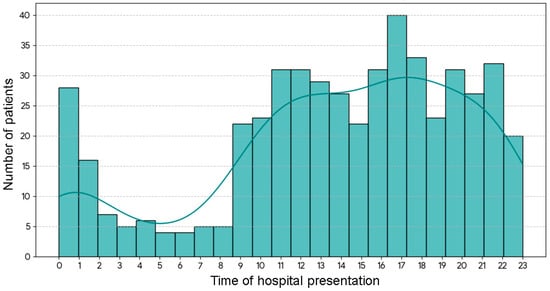
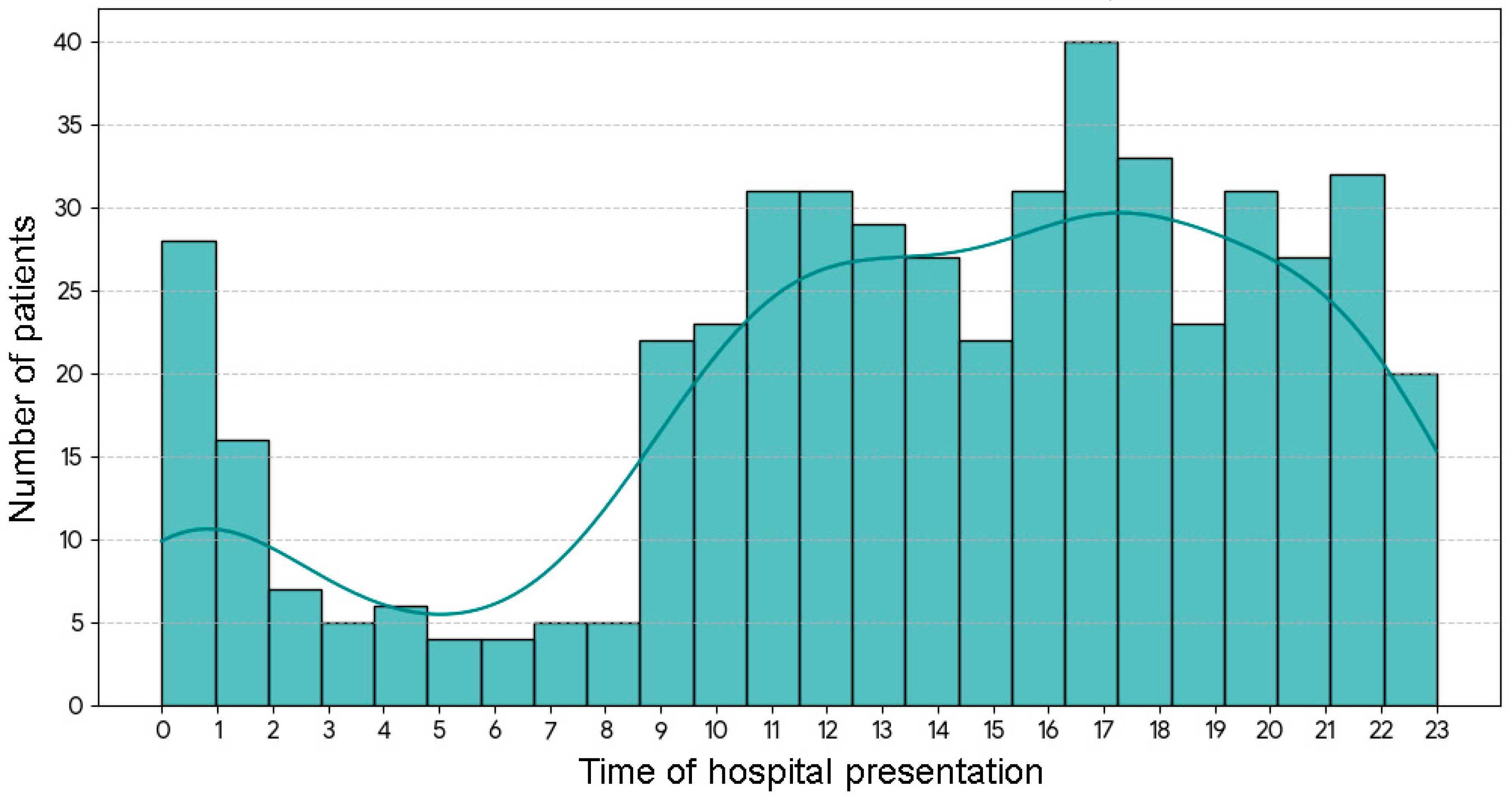
The temporal dynamics of presentations to dental emergency services is illustrated in Figure 1. Most patients sought emergency dental care in the evening (46.47%, n = 237), followed by morning/afternoon (37.25%, n = 190), whereas the smallest proportion of cases was recorded at night (16.27%, n = 83). The analysis of hourly patient arrival patterns demonstrated substantial variation across the full 24 h day, with a peak in the evening (16:00–24:00) when 46.47% of patients presented for dental emergency care.
Figure 1.
Temporal distribution of dental emergency presentations. Bars represent hourly patient frequencies, while the superimposed KDE curve illustrates the smoothed temporal distribution pattern.
Patient age differed significantly across time intervals (Kruskal–Wallis test, p = 0.016). Individuals seeking dental emergency care in the morning/afternoon were significantly older [median age: 33 (22–50)] than those accessing these services in the evening [median age: 27 (18–37)] or at night [median age: 27 (19–41)]. We observed significant differences when comparing the first group with the second group (Dunn’s test with Bonferroni correction, p = 0.009) and the third group (Dunn’s test with Bonferroni correction, p = 0.047). However, no significant differences were observed between the age of patients presenting to dental emergency in the evening and at night (Dunn’s test with Bonferroni correction, p = 0.561). With respect to weekly distribution of dental emergency presentations, the highest number of presentations occurred on Sundays (n = 107, 21.00%), followed by Saturday (n = 82, 16.00%), Monday (n = 77, 15.00%), Thursday (n = 71, 14.00%), Friday (n = 77, 15.00%), with the lowest attendance observed on Wednesdays (n = 56, 11.00%) and Tuesdays (n = 40, 8.00%).
4. Discussion
Derived from an underrepresented region in Romania, this study expands our understanding of emergency dental care in Romania specifically and Eastern Europe broadly. The present findings may be indicative of limited access to preventive care and increasing reliance on emergency services—features typical for post-transition healthcare systems [10,15]. Notably, this investigation is built on a pragmatic classification into macrocategories aligned with ICD-10, reducing diagnostic fragmentation and allowing multivariate (logistic) modeling of predictors (age, sex, residency). In fact, the variability of definitions/codes and reporting methods is considered a major problem that hinders comparisons between centers and over time [26]. Our strategy may therefore be of notable translational and clinical importance since most existing studies in Romania report nominal diagnoses (e.g., pulpitis, apical periodontitis, abscess) without a comparable aggregation scheme between studies [11,12,13,14,15,16,17,18].
Our results reveal that acute inflammatory processes of dental pulp and periapical tissues are the main reasons for presentation to dental emergency services. On the other hand, the relatively high proportion of odontogenic infections indicates that untreated lesions tend to progress to suppurative complications within the analyzed cohort. In contrast, we observed a lower contribution of uncomplicated carious pathology and other dental emergencies. This pattern is broadly consistent with the trends reported in dental literature. For example, a large retrospective study from a public hospital dental emergency service in Târgu Mureș (2012–2017) reported 38,610 presentations, with a distribution of diagnoses dominated by “pulp infections” (30.33%) and “periodontal infections” (23.08%), followed by dental abscesses (12.75%) and root remnants (13.29%) [16]. A post-COVID Romanian study (Bihor/Oradea, 2022–2023) analyzed 4769 patients and showed that the most frequent diagnoses were acute pulpitis (39.2%) and acute apical periodontitis (37.5%); hence, over three-quarters of cases in the endodontic/periapical sphere [14]. Moreover, a population-based study (2010–2022) conducted in the Czech Republic and based on a registry of reimbursed health services reported again the predominance of endodontic and periapical outbreaks [27]. Overall, these data may reflect delayed presentation, with patients postponing care until caries progresses to symptomatic pulpitis or apical periodontitis.
Consistent with literature data [28,29,30,31], patients with dental pathology formed a distinct and significantly younger demographic group than the other conditions. The natural history of dental disease accounts, at least partly, for this disparity in age groups. Thus, dental pathologies (including cavities) are the entry point, while endodontic and septic pathologies are the end-stage complications. The time interval required for bacteria to dissolve enamel and penetrate dentin is typically several years, and as a consequence, the observed age difference aligns with the established clinical timeline of caries progression to pulpal involvement [32]. Existing literature shows that the third decade of life (20–29 years) corresponds to the peak period for primary caries and secondary caries (decay around existing fillings) [33]—a finding in line with our data. If those early lesions are not treated or restorations fail, the infection progresses from a localized process, confined to the hard tissues of the tooth, to dental pulp and periapical structures, triggering pulpitis or apical periodontitis (endodontic pathologies) [34,35]. Because this “penetration” takes time, the average age for these complications naturally pushes towards the fourth decade of life (30–39 years). This decade is also the point when most patients typically receive their first major restorations (fillings). With common fillings lasting between 5 and 15 years, many fillings fail or leak in the fourth decade of life [36]. At this stage, the decay is often deeper, closer to the nerve, and likely to require endodontic intervention or result in a septic (abscessed) state [37]. These differences may also stem from age-related changes in pulp morphology [38,39]; these changes can hide the pain of a slow-growing cavity, allowing chronic infection and sepsis to develop before symptoms appear.
Notably, a minority of patients presented with other emergencies. These conditions, however, may yield a disproportionate burden of long-term disability and medico-legal complexity since this (macro)category includes traumatic dental injuries, temporomandibular disorders, and other potentially disabling conditions. In fact, evidence from an adolescent Portuguese cohort revealed that specific injury types (e.g., tooth and alveolar loss, complicated fractures, temporomandibular injuries) predict the duration of temporary disability and the risk of definitive damage [40]. Moreover, longitudinal studies on temporomandibular trauma indicate that acute injuries initially managed in emergency settings may evolve into chronic dysfunction requiring specialized rehabilitation [41].
Age was associated with increased odds of endodontic and periapical pathology and lower likelihood of having dental pathology. This pattern may reflect the natural history of dental disease progression; that is, early-stage lesions (confined to enamel and dentin) are more common in younger individuals, whereas older patients are more likely to present with the sequelae of long-standing, untreated disease [38,39]. In addition, cumulative exposure to risk factors and potential delays in accessing dental care may contribute to the higher burden of advanced pathology in older populations [42].
We identified clinically meaningful differences along the urban–rural axis, supporting that the distribution of dental cases across geography may reflect a genuine association rather than chance. The only significant difference was observed between dental pathology and other emergencies: urban inhabitants showed a higher prevalence of the latter (macro)category—a heterogeneous category that reflect variations in the perception of urgency, accessibility, and access to primary dental care. This emphasizes the need to better characterize these cases and optimize patient flow, especially for populations from different backgrounds.
Interestingly, rural origin was linked to increased odds of having endodontic and periapical pathology, but reduced likelihood of presenting with conditions classified as other emergencies. It is possible that, depending on the area of origin, the simpler dental issues might be handled differently or reported at different rates [5]. With more dentists per capita, appointments may be more easily accessible in urban centers, whereas travel time is negligible. This may encourage patients to seek help for minor dental complaints (e.g., tooth sensitivity or minor restorative irregularities) rather than more severe emergencies (e.g., spreading odontogenic infections or traumatic dental injuries) [43], increasing their likelihood to be diagnosed with enamel- or dentin-level lesions. These non-pulpal dental lesions typically involve simple restorations—like a filling or a sealant—while preserving tooth vitality [44]. In contrast, rural patients tend to present for dental care with severe tooth pain and endodontic pathology (pulpitis) or, worse, a septic complication (periapical abscess or cellulitis) [45,46]. Taken together with the aforementioned findings, the high burden of advanced odontogenic infections and severe dental pathology within our cohort support the interpretation that the studied emergency dental unit frequently functions as a safety net, particularly for rural communities. However, this interpretation should be considered with nuance, as certain categories of emergencies—most notably maxillofacial trauma and temporomandibular joint injuries—may occur independently of routine dental attendance behaviors.
The peak of emergency presentation was observed in the evening, which aligns with previous findings [16,47,48,49]. This pattern may reflect the influence of socioeconomic factors, service accessibility, and behavioral timing considerations. Thus, engagement in work or school activities during daytime hours may delay care-seeking despite the onset of symptoms [50]. On the other hand, limited access to routine dental services outside standard working hours may contribute to increased reliance on emergency services during the evening period [51].
We also note that patients seeking emergency dental care in the morning/afternoon were significantly older. This may be related to a more rigorous scheduling or the severity of symptoms cumulated overnight [52]. Interestingly, the evening peak included not only the majority of patients but also most young individuals. This pattern may reflect scheduling constraints; more precisely, younger adults postpone dental visits during the day due to educational/professional activities and seek care after finishing their daily schedule. These findings suggest a potential association between younger age and later presentation times. This dynamic supports the need to adapt the medical personnel in this unit to accommodate increased patient flow during the second part of the day.
The temporal clustering of emergency presentations in weekends may stem from the limited availability of routine dental services during this time period. It may also reflect the progression of dental pain and infection over several days, leading to accumulation of untreated cases that subsequently present as emergencies. These findings are largely comparable with trends reported in previous studies [16,47,53]. Overall, our data indicate that emergency dental service utilization may be influenced not only by clinical severity but also by access to care, service availability, and patient behavior.
This study provides several important contributions to the existing literature. Our analysis of temporal dynamics across time intervals addresses a recognized gap in the international literature: information on when patients arrive (hours/day) is relatively underreported and insufficiently statistically validated in dental literature despite being essential for resource planning [19]. Studies that explicitly report time distributions frequently report peaks in the evening/early night—interpreted as an effect of outpatient service closures and schedule constraints of the working population [53]. The fact that our observation (peak in 16:00–24:00) aligns with these results strengthens the organizational interpretation, providing a local basis for staffing and triage recommendations.
In addition, the present results linking rural patients to increased odds for endodontic and periapical pathologies but decreased odds for other emergencies and unspecified causes constitute a differentiating signal compared to most Romanian studies that either do not find significant urban–rural differences in the distribution of diagnosis, or do not independently test this association (controlling for age/sex) [12,14,54]. The novelty is not that rural areas may have more difficult access; our observation suggests a change in composition of cases on the rural–urban axis towards more advanced pulpal and periapical diseases and less towards the heterogeneous non-specific dental emergencies, in an adjusted model. This type of signal is rarely explained in the available East European studies and is worth discussing as a hypothesis of mechanism (delay in presentation, differences in healthcare utilization patterns, distance, provider density).
Moreover, increasing age was associated with a significant decrease in the incidence of dental caries, but a corresponding increase in the incidence of complications. Petersen et al. show in the reports of World Health Organization that the incidence of dental caries remains elevated throughout lifetime, but its presentation form changes [55]. In this context, our data identify a critical window of intervention: at adult age, the simple dental caries become less frequent in emergency service presentations, being completely replaced by dental complications. These findings may indicate that, within this cohort, emergency dental services were more commonly utilized for advanced symptom management than for early-stage intervention.
Notwithstanding its important epidemiological strengths, this study is subject to several limitations that should be carefully considered. First, this was a retrospective, single-center study based on data derived from a single regional emergency dental department, which may limit generalizability to other geographic regions, institutional settings, or healthcare systems with differing demographic structures, referral pathways, and service accessibility. The observed diagnostic distributions and healthcare utilization patterns may therefore partially reflect local organizational or population-specific factors rather than broader national trends. Although this design offers valuable real-world insight into routine emergency dental practice, multicenter studies would be necessary to confirm external validity across diverse Romanian and international settings. Second, the relatively short study period of approximately three months may not fully capture seasonal or temporal fluctuations in emergency dental presentations, including variations associated with holidays, weather conditions, school schedules, occupational patterns, or temporary changes in outpatient service availability. Because this time frame may represent only a limited segment of annual healthcare demand, temporal bias is possible, and the observed attendance patterns may not fully reflect year-round epidemiology. As a result, extrapolation of these findings to broader annual trends should be approached with caution. Longer-term surveillance over multiple seasons or full-year periods would be particularly valuable to determine whether the identified patterns remain stable over time or are partially influenced by the specific study interval. Third, the pragmatic reliance on routinely recorded variables such as age, sex, and residence precluded inclusion of more comprehensive socioeconomic determinants—including education, income, employment, insurance status, prior dental attendance behavior, and systemic comorbidities—which may substantially influence healthcare access and emergency service utilization. Future Romanian studies should incorporate these dimensions to better distinguish structural healthcare barriers from behavioral presentation patterns. Fourth, the unit of analysis was the emergency presentation rather than the individual patient; while same-day duplicate presentations for identical diagnoses were excluded, separate visits on different days or for different conditions were intentionally retained to reflect real-world clinical workload, which may have modestly increased frequencies of certain recurrent diagnostic categories. Fifth, retrospective diagnostic coding based on existing clinical records introduces some potential for minor misclassification, particularly within broader heterogeneous categories such as “other emergencies,” which may combine diverse conditions with differing etiologies, prognoses, and long-term healthcare implications. Finally, exclusion of patients under 18 years of age limits assessment of pediatric and adolescent emergency dental patterns, potentially underrepresenting earlier stages of preventive care failure. Future multicenter, prospective, and longer-term studies incorporating broader socioeconomic, behavioral, and pediatric variables are therefore essential to strengthen generalizability, clarify structural healthcare barriers, and provide a more comprehensive understanding of temporal and population-level determinants of emergency dental healthcare utilization.
5. Conclusions
Our findings suggest that emergency dental services in Arad County serve an important role in managing predominantly advanced-stage dental pathology rather than early preventive presentations. Emergency care utilization was largely characterized by endodontic and periapical conditions, which comprised most cases. Increasing age was significantly associated with higher odds of more advanced pathology. Rural residence was associated with increased odds of endodontic and periapical pathology and decreased odds of other or unspecified conditions, while urban patients more frequently presented with non-specific emergencies. Emergency visits peaked during evening hours and weekends, particularly on Sundays and Saturdays. These results demonstrate substantial temporal and geographic variation in emergency dental presentations and may reflect disparities in disease progression and healthcare access. Improved alignment of staffing with peak demand periods and expanded preventive care accessibility, particularly in underserved rural areas, may help reduce emergency service dependence.
Author Contributions
Conceptualization, M.C.N., M.V., I.-C.T.-N. and I.O.; Methodology, M.C.N., A.M.B., M.V., D.V.N., I.-C.T.-N. and I.O.; Software, M.C.N. and I.-C.T.-N.; Validation, A.M.B. and M.V.; Formal analysis, M.C.N., A.M.B., D.V.N. and I.-C.T.-N.; Investigation, A.M.B., M.V., I.-C.T.-N. and I.O.; Resources, M.C.N. and I.O.; Data curation, A.M.B., M.V. and I.O.; Writing—original draft, M.C.N., D.V.N., I.-C.T.-N. and I.O.; Writing—review & editing, M.C.N., A.M.B., D.V.N. and I.O.; Visualization, A.M.B. and I.O.; Supervision, D.V.N. and I.O.; Project administration, M.C.N., M.V., D.V.N. and I.O.; Funding acquisition, M.C.N., A.M.B., M.V. and I.-C.T.-N. All authors have read and agreed to the published version of the manuscript.
Funding
This research received no external funding.
Institutional Review Board Statement
The study received approval from the Institutional Ethics Committee at the Arad County Emergency Clinical Hospital (approval No. 123/2 March 2026).
Informed Consent Statement
Informed consent form was signed by each participant in the study.
Data Availability Statement
The data presented in this study are available on request from the corresponding author due to privacy and ethical restrictions.
Acknowledgments
We would like to acknowledge Victor Babes University of Medicine and Pharmacy Timisoara for their support in covering the costs of publication for this paper.
Conflicts of Interest
The authors declare no conflicts of interest.
Abbreviations
The following abbreviations are used in this manuscript:
| PD | Dental pathology |
| EPP | Endodontic and periapical pathology |
| OSC | Odontogenic infections and septic complications |
| OE | Other emergencies and unspecified causes |
| AOR | Adjusted odds ratio |
| CI | Confidence interval (95%) |
| ICD-10 | International classification of diseases, 10th revision |
| β | Beta coefficient (used in logistic regression) |
| SE | Standard error |
| Wald (Z) | Wald statistic/Z-test value |
| EU | European Union |
| WHO | World Health Organization |
References
- O’Brien, K.J.; Forde, V.M.; Mulrooney, M.A.; Purcell, E.C.; Flaherty, G.T. Global status of oral health provision: Identifying the root of the problem. Public Health Chall. 2022, 1, e6. [Google Scholar] [CrossRef] [Scilit]
- Peres, M.A.; Macpherson, L.M.D.; Weyant, R.J.; Daly, B.; Venturelli, R.; Mathur, M.R.; Listl, S.; Celeste, R.K.; Guarnizo-Herreño, C.C.; Kearns, C.; et al. Oral diseases: A global public health challenge. Lancet 2019, 394, 249–260. [Google Scholar] [CrossRef] [Scilit] [PubMed]
- Hammel, J.M.; Fischel, J. Dental emergencies. Emerg. Med. Clin. N. Am. 2019, 37, 81–93. [Google Scholar] [CrossRef] [Scilit]
- Tambor, M.; Klich, J.; Domagała, A. Financing healthcare in Central and Eastern European countries: How far are we from universal health coverage? Int. J. Environ. Res. Public Health 2021, 18, 1382. [Google Scholar] [CrossRef] [Scilit] [PubMed]
- Luo, H.; Wu, Q.; Bell, R.A.; Wright, W.; Quandt, S.A.; Basu, R.; Moss, M.E. Rural-urban differences in dental service utilization and dental service procedures received among US adults: Results from the 2016 Medical Expenditure Panel Survey. J. Rural Health 2021, 37, 655–666. [Google Scholar] [CrossRef] [Scilit] [PubMed]
- Petersen, P.E.; Yamamoto, T. Improving the oral health of older people: The approach of the WHO Global Oral Health Programme. Community Dent. Oral Epidemiol. 2005, 33, 81–92. [Google Scholar] [CrossRef] [Scilit]
- Listl, S.; Bärnighausen, T. Oral health as a marker of social progress. J. Dent. Res. 2025, 104, 820–827. [Google Scholar] [CrossRef] [Scilit]
- Watt, R.G.; Daly, B.; Allison, P.; Macpherson, L.M.D.; Venturelli, R.; Listl, S.; Weyant, R.J.; Mathur, M.R.; Guarnizo-Herreño, C.C.; Celeste, R.K.; et al. Ending the neglect of global oral health: Time for radical action. Lancet 2019, 394, 261–272. [Google Scholar] [CrossRef] [Scilit]
- 6% Experience Unmet Dental Care Needs in the EU. Available online: https://ec.europa.eu/eurostat/web/products-eurostat-news/w/ddn-20250829-2 (accessed on 4 April 2026).
- Cernega, A.; Mincă, D.G.; Furtunescu, F.L.; Radu, C.-P.; Pârvu, S.; Pițuru, S.-M. The predictability of the dental practitioner in a volatile healthcare system: A 25-year study of dental care policies in Romania (1999–2023). Healthcare 2025, 13, 249. [Google Scholar] [CrossRef] [Scilit]
- Cosoroabă, R.M.; Talpoş, Ş.; Dinu, Ş.; Liga, S.; Tănase, A.D. Oral health care for institutionalized elderly in Romania: Needs, barriers, and legislative gaps. Dent. J. 2025, 13, 527. [Google Scholar] [CrossRef] [Scilit]
- Iorga, M.; Pop, L.M.; Tudose, M.T.; Iurcov, R. Oral health behaviors identified in patients accessing dental emergency units: A single-center study. Med.-Surg. J. 2025, 129, 18. [Google Scholar] [CrossRef] [Scilit]
- Ciuhodaru, T.; Halitchi, G.L.; Costescu, E.; Sava, D.; Botez, C.; Forna, N.; Ursu, C.; Mihai, C. Transformative innovations in emergency dental care: Navigating the COVID-19 pandemic and beyond. Rom. J. Oral Rehabil. 2024, 16, 388. [Google Scholar] [CrossRef] [Scilit]
- Moca, A.E.; Cherecheș, J.O.; Șipoș, L.R.; Moca, R.T.; Slăvescu, D.; Iurcov, R. Post-COVID-19 trends in dental emergencies: A two-year retrospective study from Romania. Dent. J. 2024, 12, 401. [Google Scholar] [CrossRef] [Scilit] [PubMed]
- Dorner, K.; Kerekes-Mathe, B.; Kis, M.; Bors, A.; Molnar-Varlam, C.; Nimigean, V.R.; Nimigean, V.; Szekely, M. Quality control of emergency dental care in Mureș County. Rev. Chim. 2019, 70, 4443–4446. [Google Scholar]
- Dorner, K.; Kerekes Mathe, B.; Bors, A.; Molnar Varlam, C.; Nimigean, V.R.; Szekely, M. Patients attendance for emergency dental services in Mures county. Rev. Chim. 2018, 69, 2115–2120. [Google Scholar] [CrossRef] [Scilit]
- Dörner, K.; Kis, M.; Markovics, E.; Birta, O.; Koszta, Z.; Boeriu, C.; Vass, H.; Szekely, M. A two-year retrospective study of emergency dental treatments at Mureș County Emergency Hospital. J. Interdiscip. Med. 2017, 2, 25–30. [Google Scholar] [CrossRef] [Scilit]
- Urechescu, H.; Pricop, M.; Costan, V.V.; Oniga, S.; Cuzic, C.; Banu, A. Aerobic pathogens and antimicrobial susceptibility in odontogenic infections: A one-year observational study from southwestern Romania. Medicina 2025, 61, 2008. [Google Scholar] [CrossRef] [Scilit]
- Okunseri, C.; Okunseri, E.; Fischer, M.C.; Sadeghi, S.N.; Xiang, Q.; Szabo, A. Nontraumatic dental condition-related visits to emergency departments on weekdays, weekends and night hours: Findings from the National Hospital Ambulatory Medical Care survey. Clin. Cosmet. Investig. Dent. 2013, 5, 69–76. [Google Scholar] [CrossRef] [Scilit]
- Mocanu, I. Territorial social and economic disparities within the development of Arad County. Hum. Geogr. J. Stud. Res. Hum. Geogr. 2008, 2, 55–67. [Google Scholar]
- Lile, I.E.; Cojocariu, C.; Marian, D.; Hosszu, T.; Stana, A.H.; Stana, O. Oral hygiene and dietary behaviors among Romanian schoolchildren: A cross-sectional study. Children 2025, 12, 1712. [Google Scholar] [CrossRef] [Scilit]
- Unitatea Primire Urgențe. Available online: https://www.scjarad.ro/servicii/upu/ (accessed on 1 April 2026).
- Grelus, A.; Nica, D.V.; Miklos, I.; Belengeanu, V.; Ioiart, I.; Popescu, C. Clinical significance of measuring global hydroxymethylation of white blood cell DNA in prostate cancer: Comparison to PSA in a pilot exploratory study. Int. J. Mol. Sci. 2017, 18, 2465. [Google Scholar] [CrossRef] [Scilit] [PubMed]
- Manea, D.; Ienciu, A.A.; Ștef, R.; Peț, I.; Șmuleac, L.; Grozea, I.; Cărăbeț, A.; Drăghici, G.A.; Nica, D.V. The “sandwich” system: A potential solution for protecting overwintering Cornu aspersum snails reared in semi-intensive heliciculture farms in colder climates. Animals 2021, 11, 1420. [Google Scholar] [CrossRef] [Scilit] [PubMed]
- Azghadi, S.M.R.; Suciu, M.; Gruia, A.T.; Barbu-Tudoran, L.; Cristea, M.I.; Mic, A.A.; Muntean, D.; Nica, D.V.; Mic, F.A. Mesenchymal stromal cells support the viability and differentiation of thymocytes through direct contact in autologous co-cultures. Histochem. Cell Biol. 2016, 146, 153–165. [Google Scholar] [CrossRef] [Scilit]
- Recommended Guidelines for Surveillance of Non-Traumatic Dental Care in Emergency Departments (Updated July 2022). Available online: https://www.astdd.org/docs/recommended-guidelines-for-surveillance-of-ntdc-in-eds.pdf (accessed on 30 March 2026).
- Mihalčin, M.; Chrdle, A.; Fašaneková, L.; Peřina, V.; Májek, T.; Macková, B. The surge in infectious complications of dental and periodontal infections in the Czech Republic between 2010 and 2022. Eur. J. Public Health 2026, 36, 208–213. [Google Scholar] [CrossRef] [Scilit]
- Yang, H.; Feng, Y.; Xiao, L.-Y.; Wang, K.-M.; Feng, H.-C. Global, regional and national burden of deciduous dental caries from 1990 to 2021: Analysis of risk factors and prediction of trends in 2035. Front. Dent. Med. 2025, 6, 1624571. [Google Scholar] [CrossRef] [Scilit]
- Mahmud, A.A.; Shathi, I.J.; Rabby, M.A.I.; Ferdoushi, I.A.; Kulsum, U. Prevalence of caries with its distribution by age and gender in institutional clinical patients. Med. Today 2023, 35, 78–82. [Google Scholar] [CrossRef] [Scilit]
- Sipahi, A.; Efeoglu, C.; Koca, H.; Mert, A. Oral pathological lesions in the Aegean region: A 30-year retrospective study. Meandros Med. Dent. J. 2021, 22, 301–308. [Google Scholar] [CrossRef] [Scilit]
- Petrescu, N.B.; Aghiorghiesei, O.; Mesaros, A.S.; Lucaciu, O.P.; Dinu, C.M.; Campian, R.S.; Negucioiu, M. Impact of COVID-19 on dental emergency services in Cluj-Napoca metropolitan area: A cross-sectional study. Int. J. Environ. Res. Public Health 2020, 17, 7716. [Google Scholar] [CrossRef] [Scilit]
- Giacaman, R.A.; Fernández, C.E.; Muñoz-Sandoval, C.; León, S.; García-Manríquez, N.; Echeverría, C.; Valdés, S.; Castro, R.J.; Gambetta-Tessini, K. Understanding dental caries as a non-communicable and behavioral disease: Management implications. Front. Oral Health 2022, 3, 764479. [Google Scholar] [CrossRef] [Scilit]
- Broadbent, J.M.; Thomson, W.M.; Poulton, R. Progression of dental caries and tooth loss between the third and fourth decades of life: A birth cohort study. Caries Res. 2006, 40, 459–465. [Google Scholar] [CrossRef] [Scilit]
- Walsh, D.; Quigley, R.; Ekperuoh, A.; Duncan, H.F. Objectively diagnosing pulpitis: Opportunities and methodological challenges in the development of point-of-care assays. Int. J. Mol. Sci. 2026, 27, 355. [Google Scholar] [CrossRef] [Scilit]
- Lin, B.; Wang, J.; Zhang, Y. Bacterial dynamics in the progression of caries to apical periodontitis in primary teeth of children with severe early childhood caries. Front. Microbiol. 2024, 15, 1418261. [Google Scholar] [CrossRef] [Scilit]
- Opdam, N.J.M.; van de Sande, F.H.; Bronkhorst, E.; Cenci, M.S.; Bottenberg, P.; Pallesen, U.; Gaengler, P.; Lindberg, A.; Huysmans, M.C.D.N.J.M.; van Dijken, J.W. Longevity of posterior composite restorations: A systematic review and meta-analysis. J. Dent. Res. 2014, 93, 943–949. [Google Scholar] [CrossRef] [Scilit] [PubMed]
- Duncan, H.F.; Galler, K.M.; Tomson, P.L.; Simon, S.; El-Karim, I.; Kundzina, R.; Krastl, G.; Dammaschke, T.; Fransson, H.; Markvart, M.; et al. European Society of Endodontology position statement: Management of deep caries and the exposed pulp. Int. Endod. J. 2019, 52, 923–934. [Google Scholar] [CrossRef] [Scilit] [PubMed]
- Carvalho, T.S.; Lussi, A. Age-related morphological, histological and functional changes in teeth. J. Oral Rehabil. 2017, 44, 291–298. [Google Scholar] [CrossRef] [Scilit]
- Zandoná, A.F.; Santiago, E.; Eckert, G.J.; Katz, B.P.; Pereira de Oliveira, S.; Capin, O.R.; Mau, M.; Zero, D.T. The natural history of dental caries lesions: A 4-year observational study. J. Dent. Res. 2012, 91, 841–846. [Google Scholar] [CrossRef] [Scilit] [PubMed]
- Nunes, T.; Almiro, P.A.; Coelho, J.; Caetano, C.; Figueiredo, J.P.; Corte-Real, A. Orofacial trauma injuries and disability assessment in adolescents: A Portuguese study. Dent. Traumatol. 2022, 38, 41–47. [Google Scholar] [CrossRef] [Scilit]
- Figueiredo, C.; Afonso, A.; Caramelo, F.; Corte-Real, A. Temporomandibular joint trauma and disability assessment—A longitudinal exploratory study. J. Forensic Leg. Med. 2021, 82, 102230. [Google Scholar] [CrossRef] [Scilit]
- World Health Organization. Oral Health Surveys: Basic Methods. 2013. Available online: https://iris.who.int/server/api/core/bitstreams/b00e659f-ab38-4e61-b786-0152d91b5f1b/content (accessed on 28 March 2026).
- Sun, B.C.; Chi, D.L.; Schwarz, E.; Milgrom, P.; Yagapen, A.; Malveau, S.; Chen, Z.; Chan, B.; Danner, S.; Owen, E.; et al. Emergency department visits for nontraumatic dental problems: A mixed-methods study. Am. J. Public Health 2015, 105, 947–955. [Google Scholar] [CrossRef] [Scilit]
- Pitts, N.B.; Zero, D.T.; Marsh, P.D.; Ekstrand, K.; Weintraub, J.A.; Ramos-Gomez, F.; Tagami, J.; Twetman, S.; Tsakos, G.; Ismail, A. Dental caries. Nat. Rev. Dis. Prim. 2017, 3, 17030. [Google Scholar] [CrossRef] [Scilit]
- Piotrowska, D.E.; Pędziński, B.; Jankowska, D.; Huzarska, D.; Charkiewicz, A.E.; Szpak, A.S. Socio-economic inequalities in the use of dental care in urban and rural areas in Poland. Ann. Agric. Environ. Med. 2018, 25, 512–516. [Google Scholar] [CrossRef] [Scilit]
- Robertson, D.; Smith, A.J. The microbiology of the acute dental abscess. J. Med. Microbiol. 2009, 58, 155–162. [Google Scholar] [CrossRef] [Scilit] [PubMed]
- Omokhua, H.; Evbuomwan, R. Factors influencing patients’ time of presentation to a dental clinic and pattern of sociodemographic influence in a tertiary health facility. Ann. Clin. Biomed. Res. 2023, 4, 317. [Google Scholar] [CrossRef] [Scilit]
- Huang, C.-L.; Yeh, I.-J.; Lin, Y.-C.; Chiu, C.-F.; Du, J.-K. Analysis of adult dental emergencies at a medical center in southern Taiwan. J. Dent. Sci. 2022, 17, 1314–1320. [Google Scholar] [CrossRef] [Scilit] [PubMed]
- McCartan, B.; Freeman, L.; Harrison, A.; Daly, P. Patterns of attendance and treatment at an emergency dental clinic: A three year follow-up. J. Ir. Dent. Assoc. 2000, 46, 116–120. [Google Scholar]
- Manski, R.J.; Macek, M.D.; Moeller, J.F. Private dental coverage: Who has it and how does it influence dental visits and expenditures? J. Am. Dent. Assoc. 2002, 133, 1551–1559. [Google Scholar] [CrossRef] [Scilit] [PubMed]
- Anderson, R.; Thomas, D.W. Toothache stories’: A qualitative investigation of why and how people seek emergency dental care. Community Dent. Health 2003, 20, 106–111. [Google Scholar]
- Vujicic, M.; Buchmueller, T.; Klein, R. Dental care presents the highest level of financial barriers compared to other types of health care. Health Aff. 2016, 35, 2176–2182. [Google Scholar] [CrossRef] [Scilit]
- Li, K.; Chen, Z.; Zhang, L.; He, Y.; Du, R.; Tang, Y.; Shi, L. Ten-year trend of dental emergency visits in China: A cross-sectional study. BMC Oral Health 2025, 25, 1828. [Google Scholar] [CrossRef] [Scilit]
- Al Hage, W.E.; Dascălu, C.G.; Balcoș, C.; Agop-Forna, D.; Forna, N.C. Trends in access to oral health care among adults from the N-E region of Romania. Medicina 2022, 59, 74. [Google Scholar] [CrossRef] [Scilit] [PubMed]
- Petersen, P.E.; Bourgeois, D.; Ogawa, H.; Estupinan-Day, S.; Ndiaye, C. The global burden of oral diseases and risks to oral health. Bull. World Health Organ. 2005, 83, 661–669. [Google Scholar] [PubMed]

Disclaimer/Publisher’s Note: The statements, opinions and data contained in all publications are solely those of the individual author(s) and contributor(s) and not of MDPI and/or the editor(s). MDPI and/or the editor(s) disclaim responsibility for any injury to people or property resulting from any ideas, methods, instructions or products referred to in the content. |
© 2026 by the authors. Licensee MDPI, Basel, Switzerland. This article is an open access article distributed under the terms and conditions of the Creative Commons Attribution (CC BY) license.