Impact of COVID-19 on Fracture Incidence in Germany: A Comparative Age and Gender Analysis of Pre- and Post-Outbreak Periods


 ,
,  ,
,  and
and 
Abstract
1. Introduction
2. Materials and Methods
3. Results
4. Discussion
5. Conclusions
Author Contributions
Funding
Institutional Review Board Statement
Informed Consent Statement
Data Availability Statement
Conflicts of Interest
References
- Migliorini, F.; Weber, C.D.; Pappalardo, G.; Schenker, H.; Hofmann, U.K.; Eschweiler, J.; Hildebrand, F. Orthopaedic, trauma surgery, and COVID-2019 pandemic: Clinical panorama and future prospective in Europe. Eur. J. Trauma Emerg. Surg. 2022, 48, 4385–4402. [Google Scholar] [CrossRef] [PubMed]
- Probert, A.C.; Sivakumar, B.S.; An, V.; Nicholls, S.L.; Shatrov, J.G.; Symes, M.J.; Ellis, A.M. Impact of COVID-19-related social restrictions on orthopaedic trauma in a level 1 trauma centre in Sydney: The first wave. ANZ J. Surg. 2021, 91, 68–72. [Google Scholar] [CrossRef] [PubMed]
- Park, C.; Sugand, K.; Nathwani, D.; Bhattacharya, R.; Sarraf, K.M. Impact of the COVID-19 pandemic on orthopedic trauma workload in a London level 1 trauma center: The “golden month”. Acta Orthop. 2020, 91, 556–561. [Google Scholar] [CrossRef] [PubMed]
- Wong, J.S.H.; Cheung, K.M.C. Impact of COVID-19 on Orthopaedic and Trauma Service: An Epidemiological Study. J. Bone Joint Surg. Am. 2020, 102, e80. [Google Scholar] [CrossRef]
- Baron, J.A.; Barrett, J.A.; Karagas, M.R. The epidemiology of peripheral fractures. Bone 1996, 18 (Suppl. 1), S209–S213. [Google Scholar] [CrossRef]
- Greenhalgh, M.; Dupley, L.; Unsworth, R.; Boden, R. Where did all the trauma go? A rapid review of the demands on orthopaedic services at a UK Major Trauma Centre during the COVID-19 pandemic. Int. J. Clin. Pract. 2021, 75, e13690. [Google Scholar] [CrossRef]
- Scheer, R.C.; Newman, J.M.; Zhou, J.J.; Oommen, A.J.; Naziri, Q.; Shah, N.V.; Pascal, S.C.; Penny, G.S.; McKean, J.M.; Tsai, J.; et al. Ankle Fracture Epidemiology in the United States: Patient-Related Trends and Mechanisms of Injury. J. Foot Ankle Surg. 2020, 59, 479–483. [Google Scholar] [CrossRef]
- Schneider, F.; Runer, A.; Burkert, F.; Aspang, J.S.U.; Reider, S.; Schneider, H.; Pocecco, E. Digital Workout Versus Team Training: The Impact of the COVID-19 Pandemic on Athletes. Sports Med. Int. Open 2022, 6, E18–E24. [Google Scholar] [CrossRef]
- Chtourou, H.; Trabelsi, K.; H’mida, C.; Boukhris, O.; Glenn, J.M.; Brach, M.; Bentlage, E.; Bott, N.; Shephard, R.J.; Ammar, A. Staying physically active during the quarantine and self-isolation period for controlling and mitigating the COVID-19 pandemic: A systematic overview of the literature. Front. Psychol. 2020, 11, 1708. [Google Scholar] [CrossRef]
- Meyer, J.; McDowell, C.; Lansing, J.; Brower, C.; Smith, L.; Tully, M.; Herring, M. Changes in physical activity and sedentary behavior in response to COVID-19 and their associations with mental health in 3052 US adults. Int. J. Environ. Res. Public Health 2020, 17, 6469. [Google Scholar] [CrossRef]
- Shen, X.; MacDonald, M.; Logan, S.W.; Parkinson, C.; Gorrell, L.; Hatfield, B.E. Leisure Engagement during COVID-19 and Its Association with Mental Health and Wellbeing in U.S. Adults. Int. J. Environ. Res. Public Health 2022, 19, 1081. [Google Scholar] [CrossRef] [PubMed]
- Rydberg, E.M.; Möller, M.; Ekelund, J.; Wolf, O.; Wennergren, D. Does the COVID-19 pandemic affect ankle fracture incidence? Moderate decrease in Sweden. Acta Orthop. 2021, 92, 381–384. [Google Scholar] [CrossRef]
- Ghosh, S.; Aggarwal, S.; Kumar, V.; Patel, S.; Kumar, P. Epidemiology of pelvic fractures in adults: Our experience at a tertiary hospital. Chin. J. Traumatol. 2019, 22, 138–141. [Google Scholar] [CrossRef] [PubMed]
- Lange, R.H.; Hansen, S.T., Jr. Pelvic ring disruptions with symphysis pubis diastasis. Indications, technique, and limitations of anterior internal fixation. Clin. Orthop. Relat. Res. 1985, 201, 130–137. [Google Scholar] [CrossRef]
- Martinet, O.; Cordey, J.; Harder, Y.; Maier, A.; Bühler, M.; Barraud, G.E. The epidemiology of fractures of the distal femur. Injury 2000, 31, 62–94. [Google Scholar] [CrossRef]
- Valent, F. Road traffic accidents in Italy during COVID-19. Traffic Inj. Prev. 2022, 23, 193–197. [Google Scholar] [CrossRef]
- Kumar Jain, V.; Lal, H.; Kumar Patralekh, M.; Vaishya, R. Fracture management during COVID-19 pandemic: A systematic review. J. Clin. Orthop. Trauma 2020, 11, S431–S441. [Google Scholar] [CrossRef]
- Miranda, I.; Sangüesa-Nebot, M.J.; González, A.; Doménech, J. Impact of strict population confinement on fracture incidence during the COVID-19 pandemic. Experience from a public Health Care Department in Spain. J. Orthop. Sci. 2022, 27, 677–680. [Google Scholar] [CrossRef]
- Ogliari, G.; Lunt, E.; Ong, T.; Marshall, L.; Sahota, O. The impact of lockdown during the COVID-19 pandemic on osteoporotic fragility fractures: An observational study. Arch. Osteoporos. 2020, 15, 156. [Google Scholar] [CrossRef]
- de Souto Barreto, P.; Fabre, D.; Vellas, B.; Blain, H.; Molinier, L.; Rolland, Y. Reduction prevalence of fragility fracture hospitalisation during the COVID-19 lockdown. Arch. Osteoporos. 2022, 17, 68. [Google Scholar] [CrossRef]
- Ojeda-Thies, C.; Cuarental-García, J.; Ramos-Pascua, L.R. Decreased volume of hip fractures observed during COVID-19 lockdown. Eur. Geriatr. Med. 2021, 12, 759–766. [Google Scholar] [CrossRef] [PubMed]
- Oulianski, M.; Rosinsky, P.J.; Fuhrmann, A.; Sokolov, R.; Arriola, R.; Lubovsky, O. Decrease in incidence of proximal femur fractures in the elderly population during the COVID-19 pandemic: A case–control study. BMC Musculoskelet. Disord. 2022, 23, 61. [Google Scholar] [CrossRef] [PubMed]
- Emaus, N.; Olsen, L.R.; Ahmed, L.A.; Balteskard, L.; Jacobsen, B.K.; Magnus, T.; Ytterstad, B. Hip fractures in a city in Northern Norway over 15 years: Time trends, seasonal variation and mortality: The Harstad Injury Prevention Study. Osteoporos. Int. 2011, 22, 2603–2610. [Google Scholar] [CrossRef] [PubMed]
- De Vincentis, S.; Domenici, D.; Ansaloni, A.; Boselli, G.; D’Angelo, G.; Russo, A.; Taliani, E.; Rochira, V.; Simoni, M.; Madeo, B. COVID-19 lockdown negatively impacted on adherence to denosumab therapy: Incidence of non-traumatic fractures and role of telemedicine. J. Endocrinol. Investig. 2022, 45, 1887–1897. [Google Scholar] [CrossRef]
- Tsourdi, E.; Hofbauer, L.C.; Rauner, M. The Impact of COVID-19 in Bone Metabolism: Basic and Clinical Aspects. Horm. Metab. Res. 2022, 54, 540–548. [Google Scholar] [CrossRef]
- Awosanya, O.D.; Dalloul, C.E.; Blosser, R.J. Osteoclast-mediated bone loss observed in a COVID-19 mouse model. Bone 2022, 154, 116227. [Google Scholar] [CrossRef]
- Gawronska, K.; Lorkowski, J. Falls as One of the Atypical Presentations of COVID-19 in Older Population. Geriatr. Orthop. Surg. Rehabil. 2021, 12, 2151459321996619. [Google Scholar] [CrossRef]
- Hoffman, G.J.; Malani, P.N.; Solway, E.; Kirch, M.; Singer, D.C.; Kullgren, J.T. Changes in activity levels, physical functioning, and fall risk during the COVID-19 pandemic. J. Am. Geriatr. Soc. 2021, 70, 49–59. [Google Scholar] [CrossRef]
- Damasceno de Albuquerque Angelo, F.; de Souza Fonseca, F.; Quintella Farah, B.; Cappato de Araújo, R.; Remígio Cavalcante, B.; Barros Beltrão, N.; Pirauá, A.L.T. Changes in Physical Functioning and Fall-Related Factors in Older Adults Due to COVID-19 Social Isolation. Can. Geriatr. J. 2022, 25, 240–247. [Google Scholar] [CrossRef]
- Cunningham, C.; O’Sullivan, R.; Caserotti, P.; Tully, M.A. Consequences of physical inactivity in older adults: A systematic review of reviews and meta-analyses. Scand. J. Med. Sci. Sports 2020, 30, 816–827. [Google Scholar] [CrossRef]
- Araújo, R.S.; Matos, N.M.d.; Mariano, T.; Medved, I.; Santos, S.; Pinheiro, H.A. Functional capacity, risk of falling and chronic pain in older adults during the COVID-19 pandemic: A telemonitoring study. Geriatr. Gerontol. Aging 2021, 15, e0210065. [Google Scholar] [CrossRef]
- Ritter, A.L. The effect of social distancing due to the COVID-19 on adult and elderly exercises. Exerc. Soc. Distancing 2022, 35, 12. [Google Scholar]



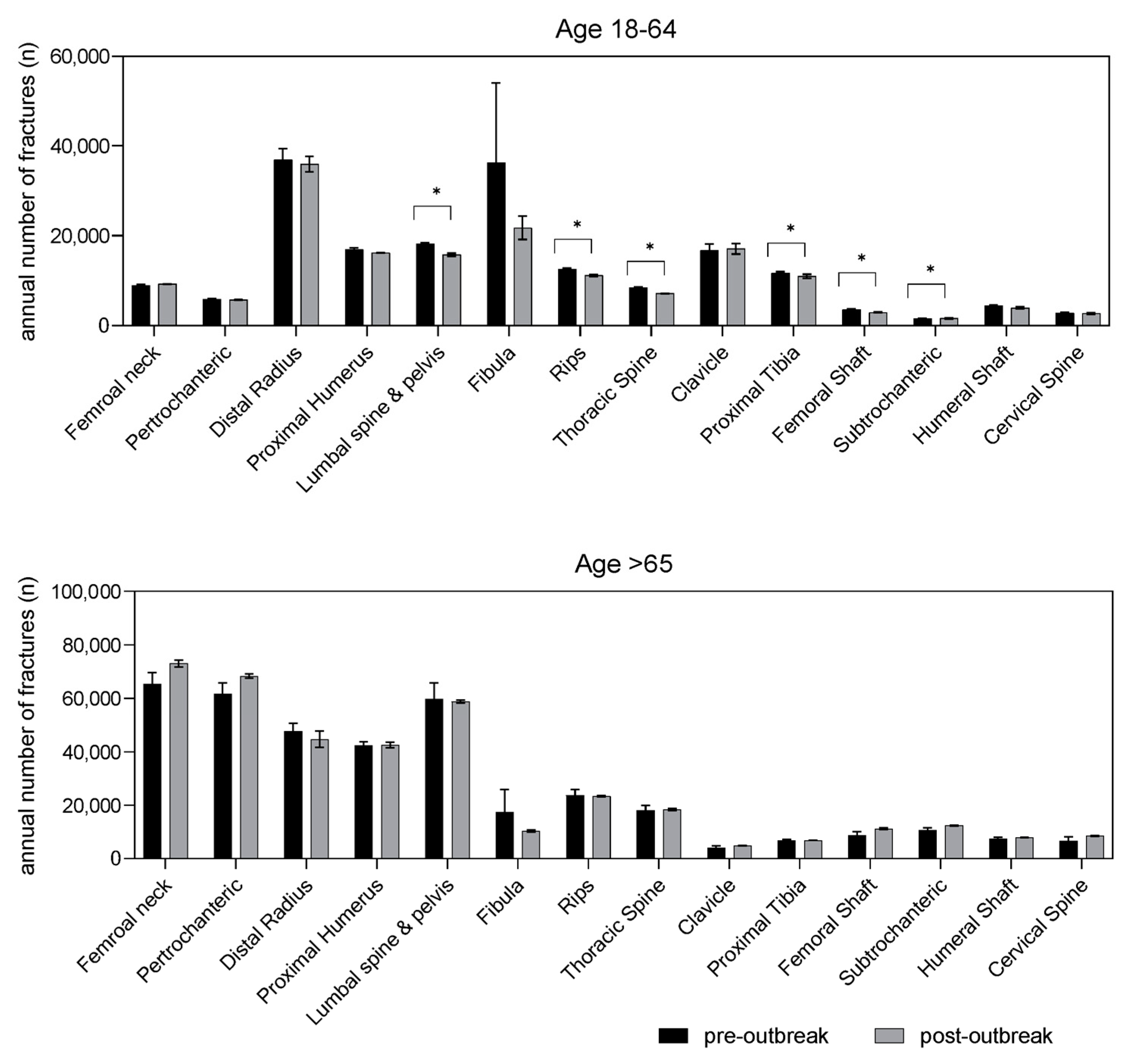
| Fracture Type | Change in the Mean Fracture Number Per Year for the COVID-19 Pre-Outbreak vs. Post-Outbreak Period | p-Value | ||
|---|---|---|---|---|
| Age | 18–64 | >65 | 18–64 | >65 |
| Femoral neck | +4.02% | +10.59% | 0.24 | 0.03 |
| Pertrochanteric | −2.21% | +9.68% | 0.24 | 0.05 |
| Distal radius | −2.65% | −6.61 | 0.62 | 0.24 |
| Proximal humerus | −4.48% | +0.25% | 0.03 | 0.91 |
| Lumbal spine and pelvis | −15.32% * | −1.59% | <0.01 | 0.84 |
| Fibula | −66.68% | −68.61% | 0.29 | 0.28 |
| Cervical spine | −3.29% | +21.91% | 0.43 | 0.12 |
| Humeral shaft | −11.53% * | +4.71% | <0.01 | 0.32 |
| Subtrochanteric | +1.07% | +14.32% | 0.69 | 0.04 |
| Femoral shaft | −19.21% * | +22.13% | <0.01 | 0.04 |
| Clavicle | +2.24% | +16.59% | 0.73 | 0.18 |
| Thoracic spine | −17.78% * | +2.02% | <0.01 | 0.79 |
| Ribs | −12.62% * | −1.00% | <0.01 | 0.89 |
| Proximal tibia | −6.70% * | +0.80% | <0.01 | 0.83 |
| Cases Per Year (×1000) | Female 18–64 yr. | Female > 65 yr. | Male 18–64 yr. | Male > 65 yr. | ||||
|---|---|---|---|---|---|---|---|---|
| Pre-Outbreak | Post-Outbreak | Pre-Outbreak | Post-Outbreak | Pre-Outbreak | Post-Outbreak | Pre-Outbreak | Post-Outbreak | |
| Femoral neck | ||||||||
| mean (med) | 4.49 (4.47) | 4.69 (4.69) | 46.36 (46.39) | 50.00 (50.00) | 4.39 (4.37) | 4.56 (4.56) | 18.95 (19.01) | 23.04 (23.04) |
| [min–max] | [4.26–4.86] | [4.66–4.71] | [43.81–49.81] | [49.67–50.33] | [4.1–4.64] | [4.54–4.59] | [16.2–22.36] | [22.43–23.65] |
| Pertrochanteric | ||||||||
| mean (med) | 2.24 (2.24) | 2.25 (2.25) | 45.77 (46.13) | 49.1 (49.1) | 3.64 (3.63) | 3.5 (3.5) | 15.97 (16.11) | 19.25 (19.25) |
| [min–max] | [2.14–2.33] | [2.22–2.27] | [42.88–49.16] | [48.91–49.29] | [3.47–3.79] | [3.47–3.53] | [13.68–18.69] | [18.9–19.61] |
| Distal radius | ||||||||
| mean (med) | 23.86 (23.77) | 24.03 (24.03) | 42.69 (41.76) | 39.93 (39.93) | 13.06 (12.9) | 11.94 (11.94) | 4.98 (4.9) | 4.79 (4.79) |
| [min–max] | [21.45–29.26] | [22.66–25.4] | [40.26–49.52] | [38.02–41.83] | [12.68–13.88] | [11.78–12.09] | [4.57–5.94] | [4.54–5.04] |
| Proximal humerus | ||||||||
| mean (med) | 10.08 (10.14) | 10.03 (10.03) | 34.67 (34.69) | 34.31 (34.31) | 6.88 (6.85) | 6.2 (6.2) | 7.73 (7.77) | 8.19 (8.19) |
| [min–max] | [9.59–10.45] | [9.89–10.18] | [33.74–36.14] | [33.8–34.83] | [6.61–7.32] | [6.01–6.39] | [7.08–8.49] | [7.94–8.44] |
| Lumbar spine and pelvis | ||||||||
| mean (med) | 8.03 (8.06) | 7.01 (7.01) | 43.39 (44.36) | 41.55 (41.55) | 10.15 (10.18) | 8.76 (8.76) | 16.34 (16.63) | 17.25 (17.25) |
| [min–max] | [7.64–8.28] | [6.93–7.09] | [36.68–47.49] | [41.11–41.99] | [9.75–10.35] | [8.59–8.92] | [13.42–18.73] | [17.21–17.29] |
| Fibula | ||||||||
| mean (med) | 17.91 (12.6) | 11.68 (11.68) | 12.24 (8.34) | 6.96 (6.96) | 18.35 (13.23) | 10.08 (10.08) | 5.16 (4.03) | 3.36 (3.36) |
| [min–max] | [11.9–36.12] | [10.61–12.74] | [7.67–23.47] | [6.75–7.17] | [12.09–34.99] | [9.3–10.85] | [3.54–9.24] | [3.22–3.5] |
| Rib | ||||||||
| mean (med) | 3.01 (3.05) | 2.68 (2.68) | 12.6 (13.01) | 12.11 (12.11) | 9.56 (9.51) | 8.48 (8.48) | 10.98 (11.27) | 11.24 (11.24) |
| [min–max] | [2.76–3.15] | [2.67–2.69] | [10.8–13.73] | [11.97–12.24] | [9.26–9.81] | [8.31–8.65] | [9.06–12.58] | [11.23–11.25] |
| Thoracic spine | ||||||||
| mean (med) | 3.62 (3.64) | 3.01 (3.01) | 13.25 (13.36) | 12.93 (12.93) | 4.81 (4.81) | 4.14 (4.14) | 4.79 (4.80) | 5.48 (5.48) |
| [min–max] | [3.40–3.83] | [3.01–3.02] | [11.59–14.54] | [12.72–13.14] | [4.71–4.89] | [4.10–4.18] | [3.72–5.70] | [5.38–5.59] |
| Clavicula | ||||||||
| mean (med) | 3.45 (3.45) | 3.69 (3.69) | 2.4 (2.35) | 2.78 (2.78) | 13.28 (13.63) | 13.43 (13.43) | 1.67 (1.67) | 2.11 (2.11) |
| [min–max] | [2.77–3.93] | [3.53–3.85] | [1.7–3.08] | [2.76–2.79] | [10.79–14.56] | [12.76–14.09] | [1.18–2.21] | [2.09–2.14] |
| Proximal tibia | ||||||||
| mean (med) | 5.82 (5.77) | 6.10 (6.10) | 5.26 (5.19) | 5.35 (5.35) | 5.89 (5.85) | 4.88 (4.88) | 1.56 (1.53) | 1.52 (1.52) |
| [min–max] | [5.23–6.49] | [5.97–6.23] | [5–5.72] | [5.33–5.38] | [5.66–6.11] | [4.7–5.05] | [1.43–1.75] | [1.5–1.54] |
| Femoral shaft | ||||||||
| mean (med) | 1.15 (1.14) | 1.04 (1.04) | 6.71 (6.42) | 8.40 (8.40) | 2.36 (2.35) | 1.90 (1.90) | 2.00 (1.89) | 2.80 (2.80) |
| [min–max] | [1.08–1.21] | [1.04–1.04] | [5.48–8.21] | [8.21–8.58] | [2.17–2.59] | [1.84–1.97] | [1.52–2.69] | [2.74–2.85] |
| Subtrochanteric | ||||||||
| mean (med) | 0.59 (0.59) | 0.65 (0.65) | 7.89 (7.7) | 8.89 (8.89) | 1.00 (0.98) | 0.95 (0.95) | 2.69 (2.63) | 3.46 (3.46) |
| [min–max] | [0.54–0.65] | [0.62–0.68] | [7.2–8.86] | [8.88–8.9] | [0.95–1.06] | [0.91–1.00] | [2.2–3.34] | [3.4–3.52] |
| Humeral shaft | ||||||||
| mean (med) | 2.09 (2.10) | 1.98 (1.98) | 5.78 (5.8) | 6.04 (6.04) | 2.29 (2.26) | 1.94 (1.94) | 1.67 (1.64) | 1.79 (1.79) |
| [min–max] | [2.01–2.15] | [1.93–2.03] | [5.38–6.39] | [5.96–6.11] | [2.11–2.55] | [1.86–2.03] | [1.46–1.9] | [1.78–1.79] |
| Cervical spine | ||||||||
| mean (med) | 0.78 (0.80) | 0.73 (0.73) | 3.72 (3.85) | 4.50 (4.50) | 2.02 (2.02) | 1.98 (1.98) | 2.92 (2.98) | 4.00 (4.00) |
| [min–max] | [0.69–0.84] | [0.7–0.77] | [2.4–4.73] | [4.4–4.6] | [1.8–2.14] | [1.89–2.07] | [1.86–3.99] | [3.96–4.05] |
| Cases Per Year (×1000) | All Genders >18 | Female 18–64 yr. | Female >65 yr. | Male 18–64 yr. | Male >65 yr. |
|---|---|---|---|---|---|
| Femoral neck | |||||
| 2018 and 2019 | 79.33 and 81.59 | 4.68 and 4.86 | 48.35 and 49.81 | 4.61 and 4.56 | 21.70 and 22.36 |
| 2020 and 2021 | 81.35 and 83.24 | 4.71 and 4.66 | 49.67 and 50.33 | 4.54 and 4.59 | 22.43 and 23.65 |
| Pertrochanteric | |||||
| 2018 and 2019 | 71.89 and 73.8 | 2.32 and 2.33 | 47.88 and 49.16 | 3.62 and 3.62 | 18.06 and 18.69 |
| 2020 and 2021 | 73.51 and 74.69 | 2.22 and 2.27 | 48.91 and 49.29 | 3.47 and 3.53 | 18.90 and 19.61 |
| Distal radius | |||||
| 2018 and 2019 | 84.10 and 82.16 | 23.86 and 23.37 | 41.84 and 41.05 | 13.44 and 12.83 | 4.95 and 4.91 |
| 2020 and 2021 | 77.31 and 84.06 | 22.66 and 25.40 | 38.02 and 41.83 | 12.09 and 11.78 | 4.54 and 5.04 |
| Proximal humerus | |||||
| 2018 and 2019 | 60.28 and 61.67 | 10.22 and 10.24 | 35.33 and 36.14 | 6.61 and 6.80 | 8.11 and 8.49 |
| 2020 and 2021 | 58.01 and 59.45 | 9.89 and 10.18 | 33.80 and 34.83 | 6.39 and 6.01 | 7.94 and 8.44 |
| Lumbar spine and pelvis | |||||
| 2018 and 2019 | 84.61 and 83.71 | 8.24 and 8.22 | 47.49 and 47.09 | 10.15 and 9.75 | 18.73 and 18.64 |
| 2020 and 2021 | 74.41 and 74.73 | 7.09 and 6.93 | 41.11 and 41.99 | 8.92 and 8.59 | 17.29 and 17.21 |
| Fibula | |||||
| 2018 and 2019 | 36.38 and 35.70 | 12.18 and 12.04 | 8.11 and 7.67 | 12.33 and 12.09 | 3.76 and 3.92 |
| 2020 and 2021 | 29.88 and 34.26 | 10.61 and 12.74 | 6.75 and 7.17 | 9.30 and 10.85 | 3.22 and 3.50 |
| Rib | |||||
| 2018 and 2019 | 38.75 and 38.92 | 3.08 and 3.1 | 13.54 and 13.73 | 9.69 and 9.5 | 12.44 and 12.58 |
| 2020 and 2021 | 34.79 and 34.21 | 2.67 and 2.69 | 12.24 and 11.97 | 8.65 and 8.31 | 11.23 and 11.25 |
| Thoracic spine | |||||
| 2018 and 2019 | 28.43 and 28.50 | 3.66 and 3.53 | 14.31 and 14.54 | 4.85 and 4.73 | 5.62 and 5.70 |
| 2020 and 2021 | 25.28 and 25.85 | 3.01 and 3.02 | 12.72 and 13.14 | 4.18 and 4.10 | 5.38 and 5.59 |
| Clavicula | |||||
| 2018 and 2019 | 23.38 and 23.62 | 3.84 and 3.93 | 2.89 and 3.08 | 14.56 and 14.39 | 2.09 and 2.21 |
| 2020 and 2021 | 22.79 and 21.21 | 3.85 and 3.53 | 2.76 and 2.79 | 14.09 and 12.76 | 2.09 and 2.14 |
| Proximal tibia | |||||
| 2018 and 2019 | 19.22 and 19.62 | 6.28 and 6.49 | 5.60 and 5.72 | 5.70 and 5.66 | 1.63 and 1.75 |
| 2020 and 2021 | 18.19 and 17.50 | 6.23 and 5.97 | 5.38 and 5.33 | 5.05 and 4.70 | 1.54 and 1.50 |
| Femoral shaft | |||||
| 2018 and 2019 | 13.91 and 14.15 | 1.13 and 1.08 | 7.94 and 8.21 | 2.29 and 2.17 | 2.55 and 2.69 |
| 2020 and 2021 | 13.96 and 14.31 | 1.04 and 1.04 | 8.21 and 8.58 | 1.97 and 1.84 | 2.74 and 2.85 |
| Subtrochanteric | |||||
| 2018 and 2019 | 13.52 and 13.83 | 0.61 and 0.65 | 8.76 and 8.86 | 0.95 and 0.98 | 3.21 and 3.34 |
| 2020 and 2021 | 13.95 and 13.95 | 0.68 and 0.62 | 8.88 and 8.90 | 1.00 and 0.91 | 3.40 and 3.52 |
| Humeral shaft | |||||
| 2018 and 2019 | 12.35 and 12.50 | 2.12 and 2.10 | 6.19 and 6.39 | 2.24 and 2.11 | 1.80 and 1.90 |
| 2020 and 2021 | 11.67 and 11.81 | 1.93 and 2.03 | 6.11 and 5.96 | 1.86 and 2.03 | 1.78 and 1.79 |
| Cervical spine | |||||
| 2018 and 2019 | 11.35 and 11.56 | 0.84 and 0.80 | 4.55 and 4.73 | 2.14 and 2.04 | 3.82 and 3.99 |
| 2020 and 2021 | 11.19 and 11.24 | 0.77 and 0.70 | 4.40 and 4.60 | 2.07 and 1.89 | 3.96 and 4.05 |
Disclaimer/Publisher’s Note: The statements, opinions and data contained in all publications are solely those of the individual author(s) and contributor(s) and not of MDPI and/or the editor(s). MDPI and/or the editor(s) disclaim responsibility for any injury to people or property resulting from any ideas, methods, instructions or products referred to in the content. |
© 2023 by the authors. Licensee MDPI, Basel, Switzerland. This article is an open access article distributed under the terms and conditions of the Creative Commons Attribution (CC BY) license (https://creativecommons.org/licenses/by/4.0/).
Share and Cite
Heinz, T.; Wild, M.; Eidmann, A.; Weißenberger, M.; Rak, D.; Nedopil, A.J.; Rudert, M.; Stratos, I. Impact of COVID-19 on Fracture Incidence in Germany: A Comparative Age and Gender Analysis of Pre- and Post-Outbreak Periods. Healthcare 2023, 11, 2139. https://doi.org/10.3390/healthcare11152139
Heinz T, Wild M, Eidmann A, Weißenberger M, Rak D, Nedopil AJ, Rudert M, Stratos I. Impact of COVID-19 on Fracture Incidence in Germany: A Comparative Age and Gender Analysis of Pre- and Post-Outbreak Periods. Healthcare. 2023; 11(15):2139. https://doi.org/10.3390/healthcare11152139
Chicago/Turabian StyleHeinz, Tizian, Moritz Wild, Annette Eidmann, Manuel Weißenberger, Dominik Rak, Alexander Johannes Nedopil, Maximilian Rudert, and Ioannis Stratos. 2023. "Impact of COVID-19 on Fracture Incidence in Germany: A Comparative Age and Gender Analysis of Pre- and Post-Outbreak Periods" Healthcare 11, no. 15: 2139. https://doi.org/10.3390/healthcare11152139
APA StyleHeinz, T., Wild, M., Eidmann, A., Weißenberger, M., Rak, D., Nedopil, A. J., Rudert, M., & Stratos, I. (2023). Impact of COVID-19 on Fracture Incidence in Germany: A Comparative Age and Gender Analysis of Pre- and Post-Outbreak Periods. Healthcare, 11(15), 2139. https://doi.org/10.3390/healthcare11152139