


Abstract
Parents with autism spectrum disorder (ASD) children generally suffer from poor coping and an impaired quality of life (QoL). This systematic review investigates parenting stress, positive reappraisal coping, and QoL in parents with ASD children. A literature search was carried out for publications written in English on the selected investigation topics using five databases, namely, Scopus, PubMed, Wiley, ScienceDirect Online, and EBSCO. Only studies investigating or measuring parenting stress, positive reappraisal coping, and QoL in ASD were included. Our results indicate that parents with ASD children have high stress levels. This is associated with the ineffective use of coping strategies and a low QoL. Adaptive coping strategies are related to a higher QoL, whereas maladaptive coping techniques are related to a worse QoL. Positive reappraisal coping is negatively correlated to meaningfulness, and it is used by parents to change their daily routines in order to motivate themselves towards new and evolving goals in life. Finally, we found a significant negative correlation between parenting stress, positive reappraisal coping, and the QoL of parents with ASD children. Positive reappraisal coping as a strategy helps parents adapt to stress and was found to be a potential mediatory function between parental stress and QoL.
1. Introduction
An autism spectrum disorder (ASD) is a developmental condition identified by medical criteria such as deficiencies in social communication and social interaction, and the existence of limited, repeated patterns of behavior, interests, or activities that may continue throughout life [1]. Parents with ASD children are key members of their ASD children’s health teams, and serve as the primary nurses for their ASD children [2]. They may encounter more caregiving issues than parents of typical children, such as higher costs of therapy, childcare difficulties, locating therapeutic facilities that are reasonably priced due to a lack of clinical resources and governmental assistance [3], and preserving their socioeconomic status [4]. These problems can detrimentally impact the care of children with ASD, particularly when these problems are coupled with parental health issues such as stress [5], anxiety disorders [6], and quality of life (QoL) [7]. In addition, their inability to meet parenting responsibilities can affect the parents’ physiological and cognitive function and, in conjunction with changes in their behavior, may prevent them from performing their parental duties appropriately, and, eventually, lead to ASD children feeling more negative emotions [5,7,8].
Many studies demonstrate that parents with ASD children have more stress [9,10,11,12,13], use more emotion-focused coping, which is not actually an ineffective coping strategy, [14], and a worse QoL (19). Understanding how they manage these difficult conditions, cope with the stress, and maintain a good quality of life is an interesting topic. Moreover, the connection between factors affecting the well-being of parents with ASD children is also not completely understood yet [15].
Previous studies partially investigate parenting stress, positive reappraisal coping, and quality of life. For instance, some studies have sought to use various broad understandings of how communities engage with stressful events to discover coping strategies [16,17], whereas others have only investigated how using a particular method can be better when it comes to successful stress management and well-being [16,17,18]. The difficulty in understanding how parenting stress and positive reappraisal coping correlate to the quality of life of parents with ASD children stems from a lack of agreement in the literature on how these are defined and quantified. The research focus of this study is the possible correlation between parenting stress, positive reappraisal coping strategies, and the QoL of parents with ASD children. To the best of our knowledge, there is no previous study investigating all these variables comprehensively, and it is the first thorough investigation evaluating the link between parenting stress, coping strategy, and QoL in parents with ASD children. Secondly, it also aims to investigate whether positive reappraisal coping serves as a mediator between parental stress and QoL.
Examining the correlation between these three variables and the mediator role of the positive reappraisal coping will be beneficial, particularly in terms of the stress management improvement of parents with ASD children. In addition, the effective coping strategies expected to be found by this study could be a worthy recommendation for the better QoL management of parents with ASD children. This study aims to investigate the association between parenting stress, positive reappraisal coping, and QoL in parents with autism spectrum disorder (ASD) children. This is an important topic to explore, because improving the quality of life of parents with ASD children is crucial in maintaining their stress and mental health.
2. Materials and Methods
2.1. Literature Search Strategy
In this study, a literature search was carried out for publications written in English from five databases—Scopus, PubMed, Wiley, ScienceDirect Online (SDOL), and EBSCO—, and the study was then published following the Preferred Reporting Items for Systematic Reviews and Meta-Analyses (PRISMA) checklist. The research was limited to the latest research from 1 November 2010 to 1 November 2020 to ensure that the research was modern and acceptable. The research population was included in the search strategy, which included terms and keywords acquired through scoping searches as well as existing knowledge in the topic area. A thesaurus software was employed to determine the terms for searching articles. Search words were used to find articles that addressed the search strategies’ three primary concerns: (1) autism disorder or autism spectrum disorder, (2) parenting stress or stress of parents with ASD children, (3) coping strategies or positive reappraisal coping, and (4) quality of life or well-being. Appendix A details the search approach utilized in each of the electronic databases. Duplicates were eliminated from the results when they were exported to EndNote. All references were entered into EndNote, which is specialized software for handling bibliographies. This systematic review was not registered in advance.
2.2. Eligibility Criteria
To be included in our inquiry, the article had to have reported on the influence of parenting stress on positive reappraisal coping, and the QoL of parents with ASD children. The studies must also have included a correlational study design, been written in English, and used clinical and/or non-clinical samples. To ensure that all studies included in this review were peer-reviewed for scientific rigor, articles needed to have used a case series or quality design, whereas abstracts, books, proceedings, oral/poster presentations, systematic reviews, meta-analyses, and studies that did not report on parenting stress or positive reappraisal were excluded. This limited our review to studies that included information about ASD children to better understand parenting stress, positive reappraisal coping, and QoL.
2.3. Analytical Process
At each stage of the review process, two reviewers (N.Z. and V.N.) separately searched information sources and assessed the discovered studies’ eligibility for inclusion using preset criteria. A study’s whole text was examined. For abstracts with inadequate information, or in cases of conflict, the full text was requested. When both reviewers independently determined that a study met the inclusion criteria after examining the complete text, it was included. The risk of prejudice in each experiment was separately evaluated by the same examiners. In cases of conflict, both reviewers mediated a decision. Cohen’s criterion was used to arrive at an agreement between reviewers. Before being used, all tools and processes were tested. The Joanna Briggs Institute critical evaluation checklist was used to examine the risk of bias [19]. The data were then presented in tabular form to enable quantitative and qualitative comparisons of parenting stress, the positive reappraisal coping style, and QoL amidst parents with ASD children.
2.4. Study Selection
The relevance of each article was first determined based on the data supplied in the abstract. A reproduction of the complete text was requested after the abstract failed to give sufficient information. The two reviewers independently assessed the abstracts using our search criteria and then chose publications for full-text review. Articles with full text were evaluated for eligibility using preset criteria. Studies had to use an observational study design to explore parenting stress, positive reappraisal coping, and the quality of life related to the well-being of parents with ASD children to be included in the final analysis.
2.5. Quality Assessment
The kappa statistic was used to compare the results of these reviews to determine the amount of agreement between the two reviewers. Studies were considered if the kappa score for the selected study was more than 0.91, as determined by both reviewers. “Fair” agreement was defined as kappa values between 0.40 and 0.59, “good” agreement was defined as kappa values between 0.60 to 0.74, and “excellent” agreement was defined as kappa values of 0.75 or above [20]. When the two reviewers’ scores for an article diverged, a consensus score was assigned following a thorough discussion.
2.6. Data Extraction and Synthesis
Data were extracted using a Microsoft Excel sheet (Microsoft Corporation, Redmond, WA, USA) in accordance with the data extraction template developed by the Cochrane Consumers and Communication Review Group. The Excel sheet was used to examine inclusion criteria and then tested for all the papers that were chosen. The two authors worked independently on this process. Any disagreements about study eligibility were settled during their conversations. The reasons for excluding full-text articles were recorded in the Excel sheet.
The risk of bias was appraised using the ROBINS-E tool (University of Bristol, Bristol, UK). The ROBINS-E technique was developed by an international team of investigators and has several advantages, including offering a formal and transparent method for assessing bias risk in observational research [20]. The ROBINS-E tool can assess risks of bias such as confounding, the selection of participants in the study, the classification of exposures, departures from intended exposures, missing data, the measurement of outcomes, and the selection of the reported result. For each of these items, signaling questions were posed to assist the user in determining decisions. Finally, the judgments within each domain were combined to create an overall risk of bias rating for each study [20]. The risk of bias was assessed independently by the same two authors.
3. Results
3.1. Search and Screening
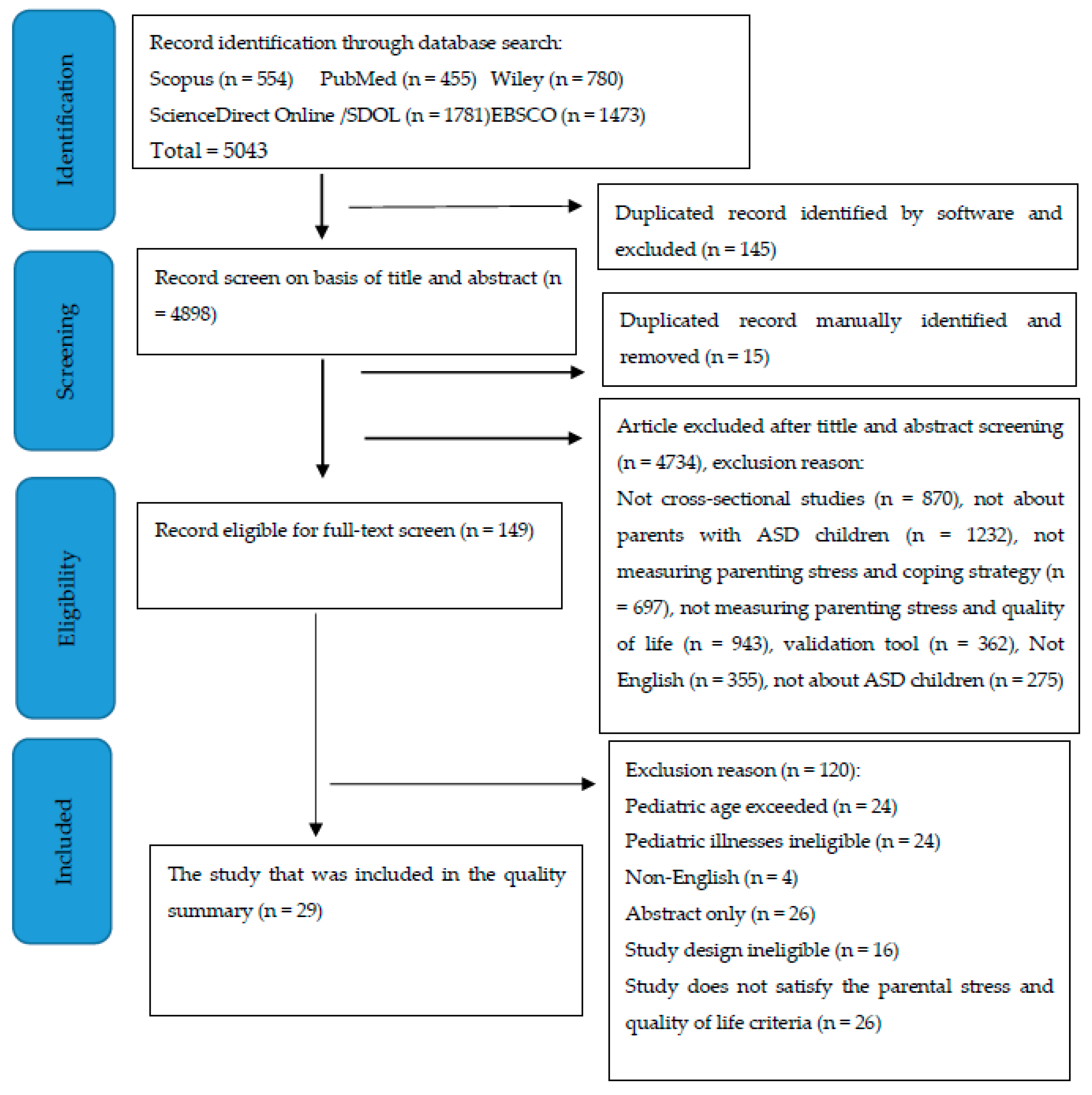
During this literature search, 5043 articles were identified from Scopus (n = 554), PubMed (n = 455), Wiley (n = 780), ScienceDirect Online (SDOL) (n = 1781), and EBSCO (n = 1473). The citations were entered into a review management program, and 15 duplicates were eliminated. A total of 149 quotes was found for the full-text examination after the initial screening phase, 4 of which were duplicates. A total of 120 articles was excluded during the second screening process. Finally, 29 papers were chosen for peer review. Figure 1 depicts the research selection procedures in greater detail.
Figure 1.
PRISMA flow diagram for the systematic review of parental stress, positive reappraisal coping, and quality of life of parents with ASD children.
Most of the eliminated studies met more than one exclusion criterion. A total of 24 articles covered populations over the age of 18; 24 studies on pediatric disorders were deemed ineligible for this investigation; 4 research studies were conducted in a language other than English; 26 were abstracts only; finally, ineligible study designs were used in 16 of the papers (e.g., analysis reviews, meta-analyses, experimental designs, and description analyses that did not address the relationship between coping, parenting, and QoL) and 26 studies did not satisfy the parenting stress and QoL criteria. Therefore, this review included a total of 29 articles for a further analysis (see Table 1).
Table 1.
Socio-demographic characteristics of the parents and children.
3.2. Characteristics of the Research Included
There were 29 studies included, all of which were cross-sectional studies investigating ASD (see Table 1). The number of studies published by different geographical areas was as follows: the United States (12), Australia (1), China (2), India (3), Europe (6), Taiwan (1), Hong Kong (1), Malaysia (1), Pakistan (1), and Jordan (1). The review sample included a total of 8392 parents. In nearly all the included studies, most research respondents were mothers.
3.3. Instruments for Measuring Main Constructs
3.3.1. Parenting Stress Measurement
To measure parenting stress, several instruments were utilized (see Table 2). Eleven research studies employed the Parenting Stress Index-Short Form (PSI-SF) [15,21,22,23,24,25,26,27,28,29,30]. The PSI-SF is a self-report measure to evaluate relationships between the stress of parents and children. There are twenty elements directly related to parents in the self-rating depression scale (SDS) to evaluate a parent’s level of stress. Ashworth et al. [31] used the GSSS (Genetic Syndromes Stressors Scale) to quantify parental stressors in relation to unusual genetic illnesses with 14 items. One study used the 2016 National Survey of Children’s Health (NSCH) to assess family resilience [32], and included three stress-related items to measure parenting stress and four new items to assess family resilience. In addition, Rodriguez et al. [33] used the Burden Interview to assess psychological anguish and difficulty when parenting and caring for children. Two studies [34,35] used the PRSS (Perceived Stress Scale), which was developed to assess perceived stress in mothers.
Table 2.
Self-administered measurement tools used to examine parenting stress, positive reappraisal coping, and QoL status.
Tomeny [36] employed the Questionnaire on Resources and Stress-Short Form (QRS-F) for evaluating parental adaptability and coping with developmental limitations in raising a child with physical disabilities or a chronic illness. Costa et al. [37] used the heart rate variability (HRV) index, since individual differences in cardiac activity (HRV) represent an objective sign of the brain’s ability to organize autonomous emotional responses of the nervous system. Cappe et al. [38] used the ALES (Appraisal of Life Events Scale). The Questionnaire on Resources and Stress-Short Form for families with chronic diseases or disabilities was used by Pisula and Porebowicz-Dorsmann [39], whereas the DASS-21 (Depression, Anxiety, and Stress Scale-21) was used by Seymour et al. [40].
3.3.2. Measurement of Positive Reappraisal Coping
To assess caregiver coping techniques, five self-reported questionnaires were used (Table 2). Begum et al. [41] and Pisula and Kossakowska [42] utilized an updated version of a coping checklist. It was separated into eight subgroups: confrontative, self-control, distancing, searching for support networks, admitting authority, avoiding escape, problem solving planning, and positive reassessment. In addition, four studies used the Brief-COPE (Coping Orientation to Problems Experienced) [15,26,40,43]. Cappe et al. [44] and Cappe, Bolduc, Rougé, Saiag, and Delorme [38] used the French version of the WCC-R (Ways of Coping Checklist) to evaluate parents’ techniques for coping with stress caused by their children. Ishtiaq et al. [45] used the Coping Strategies Inventory Short Form (CSI-SF) to evaluate stress levels and parent coping techniques.
3.3.3. Measurement of Quality of Life (QoL)
To evaluate QoL, Pisula and Porebowicz-Dorsmann [39] employed the WHOQO-BREF (World Health Organization Quality of Life Assessment Questionnaire) (see Table 2). It consists of 26 items and assesses physical and mental health, and social and environmental relationships. Hsiao [46] used a family quality of life scale to measure and evaluate parental satisfaction and QoL. It comprised 25 questions divided into five categories (family, emotional well-being, parenting, physical/material well-being, and support for disability). In addition, Chu et al. [47] measured the overall QoL in terms of happiness using the CarerQol visual analog scale (CarerQol-VAS) and the CarerQol-7D. Bohadana, Morrissey and Paynter [22] assessed the effects and repercussions of ASD on many dimensions of daily life using a quality of life of ASD scale. Furthermore, Nuske et al. [48] used the Pediatric Quality of Life (PedsQL) inventory to measure the occurrence of issues in several domains of functioning over the previous four weeks, such as physical, social, emotional, and cognitive functioning.
3.4. Evaluation of Quality
We evaluated the quality of the selected studies using the Joanna Briggs Institute’s checklist for analytical cross-sectional studies. The checklist was created using information from the study design, study execution, and analysis of the desired outcome. Studies of high quality obtained seven to eight marks, while those of moderate quality received four to six. Studies with a point total of less than four were disqualified. The listed studies were evaluated by two writers (N.Z. and V.N.).
3.5. Parenting Stress and Factors Related to Parenting Stress
Previous research indicated that parents with ASD children experience the highest amount of parenting stress compared to parents of children with mental retardation, cerebral palsy, and typically developed children [23,26,30,34]. Thus, the research demonstrated that parents with ASD children reported more stress and depression (see Table 3). Another study discovered that mothers with ASD children had more stress in parenting than mothers with cerebral palsy children [25,34]. Interestingly, there were gender differences for depression in parents. For example, Gong, Du, Li, Zhang, An, and Wu [23] found that mothers with ASD children were more likely to suffer from depression than fathers, although the stress levels of fathers were found to have increased by Rivard, Terroux, Parent-Boursier, and Mercier [29]. Thus, emotional differences between parents of different genders are a necessary area for further investigation. Among the 22 research articles included in the parenting stress review, 1 study discovered at least some indication that certain factors, such as parents’ negative evaluation of their ASD children’s lability, were significantly predictive of parental stress [37]. One study reported that the behavior problems and emotional impairments of the child are predictors of parenting stress [25]. Other studies found that predictors of parenting stress are age, behavioral problems, and anxiety [23]. Furthermore, parental self-efficacy lowers parental stress substantially [27,32].
Table 3.
Interest variable, analytic technique, and key findings of the studies included.
3.6. Association between Parenting Stress and Positive Reappraisal Coping
As previously discussed, (see Table 3), the data indicated that parents with ASD children reported increased stress and depressive symptoms [26,45]. According to Begum, Islam, and Rahman [41], this disorder requires parents to attempt to handle their situation with various methods based on their abilities. However, Hall and Graff [24] discovered that while parents can manage externalizing behaviors, they often do not have the tools or the awareness necessary to manage internalizing behaviors. Problems with child behavior may lead to parental exhaustion, which may result in the use of inadequate coping strategies and increased stress.
Two studies found parents with ASD children utilize maladaptive coping strategies to shield their children’s stress (i.e., coping for active avoidance and escape avoidance) more than parents with typical children, which is the underlying cause of crisis in the homes of ASD children [24,26]. According to Seymour, Wood, Giallo, and Jellett [40], significant levels of tiredness, which were linked to high maternal stress, were highly linked to maladaptive coping. Cappe, Pedoux, Poirier, Downes, and Nader-Grosbois [44] found that French parents placed more focus on problem coping strategies than emotion-centered methods and sought social assistance. Begum, Islam, and Rahman [41] demonstrated that parents with a higher level of education more frequently accepted responsibility, and Pisula and Kossakowska [42] found that the frequency of stress and greater burdens related to childcare experienced increased with the deterioration of the parents’ sense of coherence.
In several parents with ASD children, meaningfulness was negatively impacted by a positive re-evaluation [42] and the rise in care-related parental stress had a strong correlation with an increase in reported ASD symptoms over all four areas [43].
3.7. The Correlation between Parenting Stress and QoL of Parents with ASD Children
Two studies analyzed the significant negative correlation between parenting stress and QoL in most areas (physical health, psychological well-being, and social relations), and found that a high level of parenting stress was correlated with a lower QoL. Four studies found that parents with ASD children had high levels of parenting stress and lower QoL than parents with typical children.
Furthermore, there are two factors that are known to moderate the correlation between parenting stress and QoL. The first is social support [15] and the second is self-compassion [22]. Another study looked at the factors that influence QoL, including everyday activities, interactions between families and couples, psychological well-being, occupation, social activities and relationships, and activities and relationships with the ASD child [44]. One study discovered that a lower cognitive stigma is linked substantially with a greater quality of life and overall satisfaction [47].
3.8. The Relationship between Parenting Stress, Positive Reappraisal Coping, and QoL
Six studies investigated the association between parenting stress, coping strategies, and QoL [15,21,22,39,47,48]. The results were varied but generally indicated that a high degree of parenting stress could be related to inefficient coping strategies and a low level of QoL (see Table 3). Two studies analyzing the relationship between parents’ stress and QoL showed that, in most areas (physical health, psychological well-being, and social relations), high levels of stress in parents with ASD children were correlated with lower QoL levels than parents with typical children, which was observed by four studies [21,39,46,47].
Five studies reported an overall association between coping strategies and QoL [15,38,48]. Cappe et al. and Pisula et al. [38,48] found that parents used two emotional regulation strategies to face the situation (i.e., self-soothing and deep exhalation), while Cappe, Bolduc, Rougé, Saiag, and Delorme [38] found that parents who leaned on their feelings and had more unwanted contact with their ASD children struggled more to live their everyday lives. On the contrary, parents who commonly used problem-solving mechanisms or sought social help had stronger relationships with their children and were happier. Social support has been known to mitigate the link between stress and QoL, for example, by moderating factors such as receiving social assistance and avoiding stressful circumstances, and it was revealed that taking responsibility mediated the association between stress and QoL [15]. Cappe, Pedoux, Poirier, Downes, and Nader-Grosbois [44] found that problem-focused coping techniques and the search for social support seemed to be the more effective coping strategies for helping parents understand challenges in life and lead to better-adjusted parents who are less disturbed.
3.9. Factors That Influence Relationship between Parenting Stress, Positive Reappraisal Coping, and QoL
This study found the factors that influence QoL, including everyday activities, interactions between families and couples, psychological well-being, occupation, social activities and relationships, and activities and relationships with the ASD child [44]. Whether or not parents are aware of their children’s problems [38] and have compassion for themselves are other indications of parenting stress and QoL [22]. In terms of parent QoL, one study discovered that lower cognitive stigma is linked substantially with a greater QoL and overall satisfaction [47].
4. Discussion
This review sought to further explore the relationship between parenting stress, positive reappraisal coping, and the quality of life in parents with ASD children. Moreover, it also examined the role of coping strategies as mediators for this relationship. Overall, based on the studies in this review, there appeared to be a significant correlation between parenting stress, positive reappraisal coping, and quality of life.
Parenting stress is an outcome of a series of assessments of the parenting role and a psychological reaction that arises due to parental strain. Furthermore, Abidin [49], Craig et al. [50], and Deater-Deckard [51] argued that the tension between parents usually arises from stress related to childcare. Moreover, when stress is a result of parents feeling powerless, they may not be able to cope with stress while taking care of their children and might seek help for their children (i.e., through schools, health provider units, therapy services, learning management and care, and contact with their teachers).
This study revealed the following factors had an important effect on parental stress: behavior problems and emotional impairments of the child, age, lack of respite care, several ASD children in the household, race/ethnicity, family communication, hopeful thinking, social support, life satisfaction, parenting self-efficacy, the children’s lability, negative impressions of parents, and daily positive affect [25,27,32,37].
The present analysis review found that parenting stress has a positive significant correlation with positive reappraisal coping. High levels of parenting stress were correlated with negative reappraisal coping and led to the lack of knowledge of coping strategies [26]. Parenting stress was correlated with different coping mechanisms used by parents to address their issues in meaningful ways [24,26,42]. Nevertheless, variations in how coping mechanisms were assessed rendered categorizing coping strategies difficult in many of the reviewed studies.
Research on coping strategies conducted by Begum, Islam, and Rahman [41], Dardas and Ahmad [15], and Cappe, Pedoux, Poirier, Downes, and Nader-Grosbois [44] all found that active coping, acceptance, positive reappraisal coping and development, elimination of competitive activities, planning, and problem-focused coping strategies were the most frequently reported coping strategies used by parents with ASD children.
Conversely, a high stress level in parents with ASD children was significantly connected to a lack of knowledge of coping strategies (i.e., active avoidance, escape avoidance, maladaptive/emotion-focused coping) [26,40]. The findings of this investigation were supported by the research of Hall and Graff [24], who found that parental weariness is linked to insufficient coping techniques, and research by Pisula and Kossakowska [42], who found that parents prefer to use escape avoidance coping because caring for ASD children raises stress levels and depression and also decreases positive mood levels. This was related to findings from a review by Cappe, Bolduc, Rougé, Saiag, and Delorme [38], in which they found that it was harder for parents of ASD children to live their regular lives, and that parents who relied on their emotions to manage had a more damaged relationship with their ASD children. Similarly, parents using coping skills or seeking social assistance for overcoming problems were better and happier with their children. In one study, Pisula and Kossakowska [42] found that positive reappraisal coping negatively correlated with meaningfulness, whereas Begum, Islam, and Rahman [41] found that positive reappraisal coping was frequently used by parents to change their daily lifestyles in order to motivate themselves towards new and evolving goals in life.
This study found that the education level was a moderator variable in the relationship between parenting stress and coping strategy. education The level affected parents’ tendency towards “accepting responsibilities”. When taking charge of the issues in their lives, parents with a high level of education felt more self-control and could make progress in rehabilitation more easily, rather than focusing on the past and blaming external forces for their problems.
It was observed that there was a significant negative correlation between parenting stress and QoL in parents with ASD children [21,39,46,47]. Social support and self-compassion were moderating factors in the correlation between parenting stress and QoL [15,31]. According to Hosseininejad et al. [52], the availability of social support and the capacity to speak with others are critical for stress prevention and treatment.
The present systematic review found that parenting stress correlated with coping strategies and QoL. High levels of parenting stress led to ineffective coping strategies and low QoL [15,21,22,39,47,48]. The correlation between parenting stress and QoL was mediated by the coping strategies chosen by parents with ASD children (i.e., accepting responsibility coping strategy) [15]. Positive reappraisal coping led to positive feelings in the parent and affected their relationship with their ASD children [46]. Future studies on this group’s coping strategies and quality of life should try to gain a deeper understanding of these issues.
The strengths of this study were that every attempt was undertaken to include all relevant studies, include a comprehensive search strategy, strict inclusion and exclusion criteria, critical appraisal, and analytical strategies that included an in-depth subgroup analysis to identify heterogeneity among the articles. Secondly, all included studies used the same diagnostic guidelines that minimized the confounding effect while pooling the data for the analysis. The limitation of this study was our search criteria to only papers published in English and papers that employed a cross-sectional study design. Therefore, our findings are restricted by the absence of more studies, such as those using an experimental study design, to explain the chronological sequence of identified associations within variables. Future studies should also evaluate the association between parenting stress, coping strategy, and QoL using an experimental design as part of the inclusion criteria.
5. Conclusions
We found a significant negative correlation between parenting stress, positive reappraisal coping, and QoL in parents with ASD children. High levels of parenting stress resulted in low levels of positive reappraisal coping and a lower level of QoL. Positive reappraisal coping played a role as a mediator variable in the correlation between parenting stress and QoL in parents with ASD children.
Author Contributions
Conceptualization, N., M.-W.S., and V.N.; methodology, N. and V.N.; software, V.N.; validation, N., M.-W.S. and V.N.; formal analysis, N., M.S.Y., V.N., N.H.; investigation, N., M.-W.S., W. and V.N.; resources, V.N., N., J.-H.W. and M.-W.S.; data curation, N., V.N., N.H; writing—original draft preparation, N., M.-W.S., M.S.Y., and V.N.; writing—review and editing, N., M.-W.S., M.S.Y. and V.N.; visualization, N. and M.-W.S.; supervision, W., M.-W.S., M.S.Y. and J.-H.W.; project administration, N. and V.N.; funding acquisition, M.-W.S., N., J.-H.W. and N.H. All authors have read and agreed to the published version of the manuscript.
Funding
This research received no external funding.
Institutional Review Board Statement
Not applicable.
Informed Consent Statement
Not applicable.
Data Availability Statement
The data presented in this study are available on request from the corresponding authors.
Conflicts of Interest
The authors declare no conflict of interest. The funders had no role in the design of the study; in the collection, analyses, or interpretation of data; in the writing of the manuscript, or in the decision to publish the results.
Appendix A
Table A1.
Risk of bias (ROBINS-E).
References
- Baio, J.; Wiggins, L.; Christensen, D.L.; Maenner, M.J.; Daniels, J.; Warren, Z.; Kurzius-Spencer, M.; Zahorodny, W.; Robinson, C.R.; Rosenberg, C.R.; et al. Prevalence of Autism Spectrum Disorder among children aged 8 years—Autism and developmental disabilities monitoring network, 11 sites, United States, 2014. MMWR. Surveill. Summ. 2018, 67, 1–23. [Google Scholar] [CrossRef] [Scilit]
- Gupta, V.B.; Mehrotra, P.; Mehrotra, N. Parental stress in raising a child with disabilities in India. Disabil. CBR Incl. Dev. 2012, 23, 41–52. [Google Scholar] [CrossRef] [Scilit]
- Lovell, B.; Wetherell, M.A. Child behaviour problems mediate the association between coping and perceived stress in caregivers of children with autism. Res. Autism Spectr. Disord. 2015, 20, 17–23. [Google Scholar] [CrossRef] [Scilit]
- Pereira, M.; Negrão, M.; Soares, I.; Mesman, J. Predicting harsh discipline in at-risk mothers: The moderating effect of socioeconomic deprivation severity. J. Child Fam. Stud. 2015, 24, 725–733. [Google Scholar] [CrossRef] [Scilit]
- Carpenter, J.K.; Andrews, L.A.; Witcraft, S.M.; Powers, M.B.; Smits, J.A.J.; Hofmann, S.G. Cognitive behavioral therapy for anxiety and related disorders: A meta-analysis of randomized placebo-controlled trials. Depress. Anxiety 2018, 35, 502–514. [Google Scholar] [CrossRef] [Scilit]
- Carpenter, J.K.; Sanford, J.; Hofmann, S.G. The effect of a brief mindfulness training on distress tolerance and stress reactivity. Behav. Ther. 2019, 50, 630–645. [Google Scholar] [CrossRef] [Scilit]
- Bawalsah, J.A. Stress and coping strategies in parents of children with physical, mental, and hearing disabilities in Jordan. Int. J. Educ. 2016, 8, 1–22. [Google Scholar] [CrossRef] [Scilit]
- Hayes, S.A.; Watson, S.L. The impact of parenting stress: A Meta-analysis of studies comparing the experience of parenting stress in parents of children with and without Autism Spectrum Disorder. J. Autism Dev. Disord. 2013, 43, 629–642. [Google Scholar] [CrossRef] [Scilit] [PubMed]
- Falk, N.H.; Norris, K.; Quinn, M.G. The factors predicting stress, anxiety and depression in the parents of children with Autism. J. Autism Dev. Disord. 2014, 44, 3185–3203. [Google Scholar] [CrossRef] [Scilit]
- Dąbrowska-Zimakowska, A.; Pisula, E. Parenting stress and coping styles in mothers and fathers of pre-school children with Autism and Down syndrome. J. Intellect. Disabil. Res. 2010, 54, 266–280. [Google Scholar] [CrossRef] [Scilit]
- Cuzzocrea, F.; Murdaca, A.M.; Costa, S.; Filippello, P.; Larcan, R. Parental stress, coping strategies and social support in families of children with a disability. Child Care Pract. 2016, 22, 3–19. [Google Scholar] [CrossRef] [Scilit]
- Derguy, C.; M’Bailara, K.; Michel, G.; Roux, S.; Bouvard, M. The need for an ecological approach to parental stress in Autism Spectrum Disorders: The combined role of individual and environmental factors. J. Autism Dev. Disord. 2016, 46, 1895–1905. [Google Scholar] [CrossRef] [Scilit] [PubMed]
- Brei, N.G.; Schwarz, G.N.; Klein-Tasman, B. Predictors of parenting stress in children referred for an Autism Spectrum Disorder diagnostic evaluation. J. Dev. Phys. Disabil. 2015, 27, 617–635. [Google Scholar] [CrossRef] [Scilit]
- Vernhet, C.; Dellapiazza, F.; Blanc, N.; Cousson-Gélie, F.; Miot, S.; Roeyers, H.; Baghdadli, A. Coping strategies of parents of children with autism spectrum disorder: A systematic review. Eur. Child Adolesc. Psychiatry 2018, 28, 747–758. [Google Scholar] [CrossRef] [Scilit]
- Dardas, L.A.; Ahmad, M.M. Coping strategies as mediators and moderators between stress and quality of life among parents of children with Autistic Disorder. Stress Health 2015, 31, 5–12. [Google Scholar] [CrossRef] [Scilit] [PubMed]
- Folkman, S.; Lazarus, R.S. The relationship between coping and emotion: Implications for theory and research. Soc. Sci. Med. 1988, 26, 309–317. [Google Scholar] [CrossRef] [Scilit]
- Schulz, U.; Mohamed, E.N. Turning the tide: Benefit finding after cancer surgery. Soc. Sci. Med. 2004, 59, 653–662. [Google Scholar] [CrossRef] [Scilit] [PubMed]
- Zuckerman, M.; Gagné, M. The COPE revised: Proposing a 5-factor model of coping strategies. J. Res. Pers. 2003, 37, 169–204. [Google Scholar] [CrossRef] [Scilit]
- Munn, Z.; Moola, S.; Lisy, K.; Riitano, D.; Tufanaru, C. Methodological guidance for systematic reviews of observational epidemiological studies reporting prevalence and cumulative incidence data. Int. J. Evid. Based Health 2015, 13, 147–153. [Google Scholar] [CrossRef] [Scilit]
- Bero, L.; Chartres, N.; Diong, J.; Fabbri, A.; Ghersi, D.; Lam, J.; Lau, A.; McDonald, S.; Mintzes, B.; Sutton, P.; et al. The risk of bias in observational studies of exposures (ROBINS-E) tool: Concerns arising from application to observational studies of exposures. Syst. Rev. 2018, 7, 242. [Google Scholar] [CrossRef] [Scilit]
- Thullen, M.; Bonsall, A. Co-parenting quality, parenting stress, and feeding challenges in families with a child diagnosed with Autism Spectrum Disorder. J. Autism Dev. Disord. 2017, 47, 878–886. [Google Scholar] [CrossRef] [Scilit]
- Bohadana, G.; Morrissey, S.; Paynter, J. Self-compassion: A novel predictor of stress and quality of life in parents of children with Autism Spectrum Disorder. J. Autism Dev. Disord. 2019, 49, 4039–4052. [Google Scholar] [CrossRef] [Scilit]
- Gong, Y.; Du, Y.; Li, H.; Zhang, X.; An, Y.; Wu, B.-L. Parenting stress and affective symptoms in parents of autistic children. Sci. China Life Sci. 2015, 58, 1036–1043. [Google Scholar] [CrossRef] [Scilit] [PubMed]
- Hall, H.R.; Graff, J.C. Maladaptive behaviors of children with Autism: Parent support, stress, and coping. Issues Compr. Pediatr. Nurs. 2012, 35, 194–214. [Google Scholar] [CrossRef] [Scilit] [PubMed]
- Hou, Y.-M.; Stewart, L.; Iao, L.-S.; Wu, C.-C. Parenting stress and depressive symptoms in Taiwanese mothers of young children with autism spectrum disorder: Association with children’s behavioural problems. J. Appl. Res. Intellect. Disabil. 2018, 31, 1113–1121. [Google Scholar] [CrossRef] [Scilit] [PubMed]
- Lai, W.W.; Goh, T.J.; Oei, T.P.; Sung, M. Coping and well-being in parents of children with Autism Spectrum Disorders (ASD). J. Autism Dev. Disord. 2015, 45, 2582–2593. [Google Scholar] [CrossRef] [Scilit]
- Lu, M.-H.; Wang, G.-H.; Lei, H.; Shi, M.-L.; Zhu, R.; Jiang, F. Social support as mediator and moderator of the relationship between parenting stress and life satisfaction among the Chinese parents of children with ASD. J. Autism Dev. Disord. 2018, 48, 1181–1188. [Google Scholar] [CrossRef] [Scilit]
- Pattini, E.; Carnevali, L.; Troisi, A.; Matrella, G.; Rollo, D.; Fornari, M.; Sgoifo, A. Psychological characteristics and physiological reactivity to acute stress in mothers of children with autism spectrum disorder. Stress Health 2019, 35, 421–431. [Google Scholar] [CrossRef] [Scilit]
- Rivard, M.; Terroux, A.; Parent-Boursier, C.; Mercier, C. Determinants of stress in parents of children with Autism Spectrum Disorders. J. Autism Dev. Disord. 2014, 44, 1609–1620. [Google Scholar] [CrossRef] [Scilit] [PubMed]
- Siu, Q.K.Y.; Yi, H.; Chan, R.C.H.; Chio, F.H.N.; Chan, D.F.Y.; Mak, W. The role of child problem behaviors in Autism Spectrum symptoms and parenting stress: A primary school-based study. J. Autism Dev. Disord. 2019, 49, 857–870. [Google Scholar] [CrossRef] [Scilit]
- Ashworth, M.; Palikara, O.; Van Herwegen, J. Comparing parental stress of children with neurodevelopmental disorders: The case of Williams syndrome, Down syndrome and autism spectrum disorders. J. Appl. Res. Intellect. Disabil. 2019, 32, 1047–1057. [Google Scholar] [CrossRef] [Scilit] [PubMed]
- Kim, I.; Dababnah, S.; Lee, J. The influence of race and ethnicity on the relationship between family resilience and parenting stress in caregivers of children with Autism. J. Autism Dev. Disord. 2020, 50, 650–658. [Google Scholar] [CrossRef] [Scilit] [PubMed]
- Rodriguez, G.; Hartley, S.L.; Bolt, D. Transactional relations between parenting stress and child Autism symptoms and behavior problems. J. Autism Dev. Disord. 2019, 49, 1887–1898. [Google Scholar] [CrossRef] [Scilit] [PubMed]
- Mohakud, K.; Sahu, R.K.; Dash, S.R.; Sahoo, S. Child behavioral problem and its relationship with parenting stress of mothers of Cerebral Palsy children and Autistic children. Indian J. Physiother. Occup. Ther. Int. J. 2019, 13, 78. [Google Scholar] [CrossRef] [Scilit]
- Factor, R.S.; Swain, D.M.; Scarpa, A. Child Autism Spectrum Disorder traits and parenting stress: The utility of using a physiological measure of parental stress. J. Autism Dev. Disord. 2017, 48, 1081–1091. [Google Scholar] [CrossRef] [Scilit]
- Tomeny, T.S. Parenting stress as an indirect pathway to mental health concerns among mothers of children with autism spectrum disorder. Autism 2017, 21, 907–911. [Google Scholar] [CrossRef] [Scilit] [PubMed]
- Costa, A.P.; Steffgen, G.; Ferring, D. Contributors to well-being and stress in parents of children with autism spectrum disorder. Res. Autism Spectr. Disord. 2017, 37, 61–72. [Google Scholar] [CrossRef] [Scilit]
- Cappe, E.; Bolduc, M.; Rougé, M.-C.; Saiag, M.-C.; Delorme, R. Quality of life, psychological characteristics, and adjustment in parents of children with Attention-Deficit/Hyperactivity Disorder. Qual. Life Res. 2016, 26, 1283–1294. [Google Scholar] [CrossRef] [Scilit]
- Pisula, E.; Porębowicz-Dörsmann, A. Family functioning, parenting stress and quality of life in mothers and fathers of Polish children with high functioning autism or Asperger syndrome. PLoS ONE 2017, 12, e0186536. [Google Scholar] [CrossRef] [Scilit]
- Seymour, M.; Wood, C.; Giallo, R.; Jellett, R. Fatigue, stress and coping in mothers of children with an Autism Spectrum Disorder. J. Autism Dev. Disord. 2013, 43, 1547–1554. [Google Scholar] [CrossRef] [Scilit] [PubMed]
- Begum, F.A.; Islam, S.; Rahman, A.S. Coping strategies and education of parents of autistic children in Bangladesh. Bangladesh J. Med. Sci. 2020, 19, 614–619. [Google Scholar] [CrossRef] [Scilit]
- Pisula, E.; Kossakowska, Z. Sense of coherence and coping with stress among mothers and fathers of children with Autism. J. Autism Dev. Disord. 2010, 40, 1485–1494. [Google Scholar] [CrossRef] [Scilit] [PubMed]
- Shepherd, D.; Landon, J.; Taylor, S.; Goedeke, S. Coping and care-related stress in parents of a child with autism spectrum disorder. Anxiety Stress Coping 2018, 31, 277–290. [Google Scholar] [CrossRef] [Scilit]
- Cappe, É.; Pedoux, A.; Poirier, N.; Downes, N.; Nader-Grosbois, N. Adaptation and quality of life of parents with a child with autism spectrum disorder: A comparative exploratory study between France, French-Speaking Belgium and Quebec. Psychol. Française 2019, 65, 141–155. [Google Scholar] [CrossRef] [Scilit]
- Ishtiaq, N.; Mumtaz, N.; Saqulain, G. Stress and coping strategies for parenting children with hearing impairment and Autism. Pak. J. Med. Sci. 2020, 36, 538–543. [Google Scholar] [CrossRef] [Scilit] [PubMed]
- Hsiao, Y.-J. Autism Spectrum Disorders: Family demographics, parental stress, and family quality of life. J. Policy Pract. Intellect. Disabil. 2018, 15, 70–79. [Google Scholar] [CrossRef] [Scilit]
- Chu, S.Y.; Park, H.; Lee, J.; Shaharuddin, K.K.B.; Gan, C.H. Self-stigma and its associations with stress and quality of life among Malaysian parents of children with autism. Child Care Health Dev. 2020, 46, 485–494. [Google Scholar] [CrossRef] [Scilit]
- Nuske, H.J.; Hedley, D.; Tseng, C.H.; Begeer, S.; Dissanayake, C. Emotion regulation strategies in preschoolers with Autism: Associations with parent quality of life and family functioning. J. Autism Dev. Disord. 2018, 48, 1287–1300. [Google Scholar] [CrossRef] [Scilit]
- Abidin, R.R. Introduction to the special issue: The stresses of parenting. J. Clin. Child Psychol. 1990, 19, 298–301. [Google Scholar] [CrossRef] [Scilit]
- Craig, F.; Operto, F.F.; De Giacomo, A.; Margari, L.; Frolli, A.; Conson, M.; Ivagnes, S.; Monaco, M.; Margari, F. Parenting stress among parents of children with Neurodevelopmental Disorders. Psychiatry Res. 2016, 242, 121–129. [Google Scholar] [CrossRef] [Scilit]
- Deater-Deckard, K. Parenting stress and child adjustment: Some old hypotheses and new questions. Clin. Psychol. Sci. Pract. 1998, 5, 314–332. [Google Scholar] [CrossRef] [Scilit]
- Hosseininejad, S.M.; Jahanian, F.; Elyasi, F.; Mokhtari, H.; Koulaei, M.E.; Pashaei, S.M. The prevalence of post-traumatic stress disorder among emergency nurses: A cross sectional study in northern Iran. Biomedicine 2019, 9, 19. [Google Scholar] [CrossRef] [Scilit] [PubMed]

Publisher’s Note: MDPI stays neutral with regard to jurisdictional claims in published maps and institutional affiliations. |
© 2021 by the authors. Licensee MDPI, Basel, Switzerland. This article is an open access article distributed under the terms and conditions of the Creative Commons Attribution (CC BY) license (https://creativecommons.org/licenses/by/4.0/).